Isaiah 29:15

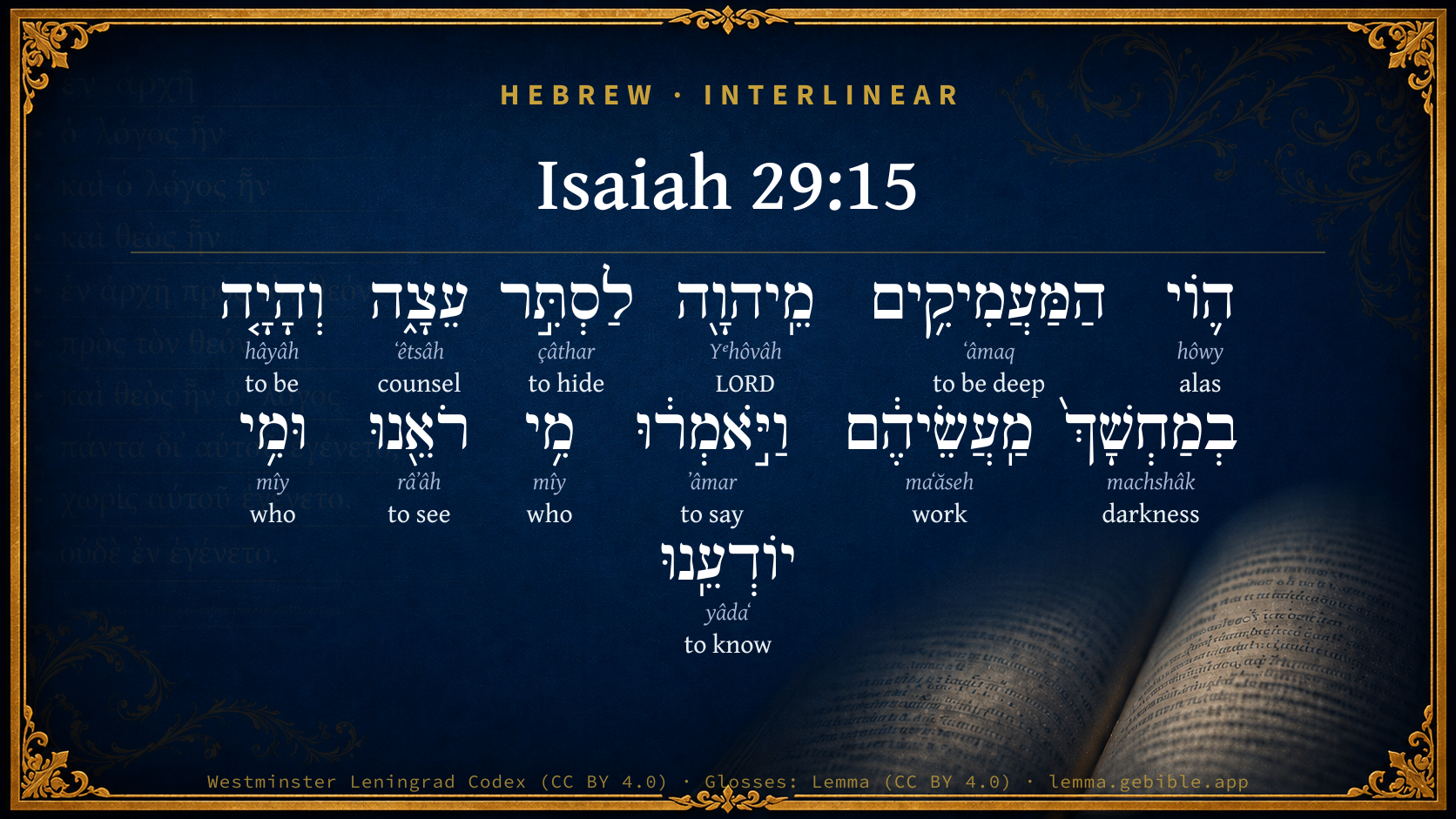
Hebrew (Westminster Leningrad Codex) Isaiah 29:15 appears in the Hebrew Old Testament. The text above is from the Westminster Leningrad Codex. Each word links to its Strong’s number, a concise gloss, and parsing drawn from the Open Scriptures Hebrew Bible morphology. Click any word for its full Brown-Driver-Briggs (BDB) entry.
Download image
Cite this verse

Isaiah 29:15 (World English Bible). Public Domain. Lemma interlinear Bible study tool, https://lemma.gebible.app/v/isaiah/29/15.

Show BibTeX & RIS
BibTeX
RIS
English Translation
Woe to those who hide deep their counsel from Yahweh, and whose works are in the dark, and who say, Who sees us? and who knows us?
World English Bible · Public Domain
Download a study sheet

One document with this verse’s original text, its word-by-word gloss line, the meaning frame, cross-references with their text, attributed commentary, and full source and license credits — printable, and it pastes into notes with its structure intact.

This verse Autodidact and up

Study sheet (.html) Plain text (.txt)

A passage Seminary Student

Up to 50 verses in one chapter. A passage sheet keeps up to 6 commentary sources and 12 cross-references per verse, in the order this page ranks them, and says so on the sheet whenever that leaves anything out. Ask for a single verse and you get the Autodidact verse sheet above.

Everything on this page stays free to read, with no account — the sheet is a download of what is already on screen, not access to it.

Want to remove ads? Support Godless Engineer
Compare translations 3

The same verse in 3 English versions, stacked beneath the original-language interlinear above. Click any original word for its lexicon entry.

Each is an independent rendering of the whole verse — the interlinear is not word-aligned to these translations.

Highlighted words mark where these versions differ — a whole-verse word diff, not a word-by-word alignment.

  • World English Bible Public Domain
    Woe to those who hide deep their counsel from Yahweh, and whose works are in the dark, and who say, Who sees us? and who knows us?
  • King James Version Public Domain
    Woe unto them that seek deep to hide their counsel from the LORD, and their works are in the dark, and they say, Who seeth us? and who knoweth us?
  • unfoldingWord Literal Text CC BY-SA 4.0
    Woe to the ones making deep to hide counsel from Yahweh, and it is in darkness, their deeds, and they say, “Who sees us, and who knows us?”

unfoldingWord Literal Text — © unfoldingWord, licensed CC BY-SA 4.0. Word-aligned USFM3 via Door43 (git.door43.org/unfoldingWord/en_ult).

Versions to compare (up to 4)

3 of 4 selected

Show all 18 translations

Every available English version of this verse, each an independent rendering of the whole verse.

  • World English Bible Public Domain
    Woe to those who hide deep their counsel from Yahweh, and whose works are in the dark, and who say, Who sees us? and who knows us?
  • Berean Standard Bible Public Domain
    Woe to those who dig deep to hide their plans from the LORD. In darkness they do their works and say, “Who sees us, and who will know?”
  • Majority Standard Bible Public Domain
    Woe to those who dig deep to hide their plans from the LORD. In darkness they do their works and say, “Who sees us, and who will know?”
  • King James Version Public Domain
    Woe unto them that seek deep to hide their counsel from the LORD, and their works are in the dark, and they say, Who seeth us? and who knoweth us?
  • American Standard Version (1901) Public Domain
    Woe unto them that hide deep their counsel from Jehovah, and whose works are in the dark, and that say, Who seeth us? and who knoweth us?
  • Revised Version (1885) Public Domain
    Woe unto them that seek deep to hide their counsel from the LORD, and their works are in the dark, and they say, Who seeth us? and who knoweth us?
  • Geneva Bible (1599) Public Domain
    Wo vnto them that seeke deepe to hide their counsell from the Lord: for their workes are in darkenes, and they say, Who seeth vs? and who knoweth vs?
  • Douay-Rheims (1899) Public Domain
    Woe to you that are deep of heart, to hide your counsel from the Lord: and their works are in the dark, and they say: Who seeth us, and who knoweth us?
  • Young's Literal Translation Public Domain
    Wo `to' those going deep from Jehovah to hide counsel, And whose works have been in darkness. And they say, `Who is seeing us? And who is knowing us?'
  • Literal Standard Version CC BY-SA 4.0
    Woe [to] those going deep from YHWH to hide counsel, || And whose works have been in darkness. And they say, “Who is seeing us? And who is knowing us?”
  • Unlocked Literal Bible CC BY-SA 4.0
    Woe to those who deeply hide their plans from Yahweh, and whose deeds are in darkness. They say, “Who sees us, and who knows us?”
  • unfoldingWord Literal Text CC BY-SA 4.0
    Woe to the ones making deep to hide counsel from Yahweh, and it is in darkness, their deeds, and they say, “Who sees us, and who knows us?”
  • Darby Bible Public Domain
    Woe unto them that hide deep, far from Jehovah, their counsel! And their works are in the dark, and they say, Who seeth us? and who knoweth us?
  • World Messianic Bible Public Domain
    Woe to those who deeply hide their counsel from the LORD, and whose deeds are in the dark, and who say, “Who sees us?” and “Who knows us?”
  • Webster's Bible Public Domain
    Woe to them that seek deep to hide their counsel from the LORD, and their works are in the dark, and they say, Who seeth us? and who knoweth us?
  • Free Bible Version CC BY-SA 4.0
    Tragedy is coming to people who take such trouble to hide their plans from the Lord. They work in the dark and say to themselves, “Nobody can see us, can they? Nobody will know, will they?”
  • Bible in Basic English Public Domain
    Cursed are those who go deep to keep their designs secret from the Lord, and whose works are in the dark, and who say, Who sees us? and who has knowledge of our acts?
  • JPS Tanakh (1917) Public Domain
    Woe unto them that seek deep to hide their counsel from the LORD, and their works are in the dark, and they say: 'Who seeth us? and who knoweth us?'

Literal Standard Version (2020), Covenant Press — licensed CC BY-SA 4.0. Text via the HelloAO Bible API (eBible.org). Unlocked Literal Bible (unfoldingWord) — licensed CC BY-SA 4.0. Text via the HelloAO Bible API (eBible.org). unfoldingWord Literal Text — © unfoldingWord, licensed CC BY-SA 4.0. Word-aligned USFM3 via Door43 (git.door43.org/unfoldingWord/en_ult). Free Bible Version, Dr. Jonathan Gallagher — licensed CC BY-SA 4.0. Text via the HelloAO Bible API (eBible.org).

Word by word

More ways to search: Search by grammar → Find every occurrence → Compare this word →

Practice this passage: Drill this verse → Learn its vocabulary →

בְמַחְשָׁךְ֙
machshâk
H4285
“in/at · darkness”
Preposition + Noun, Common, Masculine, Singular, Absolute
Part of Speech
Preposition + Noun
Type
Common
Gender
Masculine
Number
Singular
State
Absolute
Full BDB Definition

Origin: from H2821

TWOT: 769d

dark place, darkness, secrecy - hiding-place - dark region - grave
  1. ה֛וֹי hôwy H1945 “alas” Particle, Interjection
  2. הַמַּעֲמִיקִ֥ים ʻâmaq H6009 “the · being deep” Particle, Definite Article + Verb, Hiphil, Participle Active, Masculine, Plural, Absolute
  3. מֵֽיהוָ֖ה Yᵉhôvâh H3068 “from · LORD” Preposition + Noun, Proper
  4. לַסְתִּ֣ר çâthar H5641 “to hide” Preposition + Verb, Hiphil, Infinitive Construct
  5. עֵצָ֑ה ʻêtsâh H6098 “counsel” Noun, Common, Feminine, Singular, Absolute
  6. וְהָיָ֤ה hâyâh H1961 “and · to be” Conjunction + Verb, Qal, Sequential Perfect, 3rd Person, Masculine, Singular
  7. מַֽעֲשֵׂיהֶ֔ם maʻăseh H4639 “works · their” Noun, Common, Masculine, Plural, Construct + Suffix, Personal, 3rd Person, Masculine, Plural
  8. וַיֹּ֣אמְר֔וּ ʼâmar H559 “and · to say” Conjunction + Verb, Qal, Sequential Imperfect, 3rd Person, Masculine, Plural
  9. מִ֥י mîy H4310 “who” Particle, Interrogative
  10. רֹאֵ֖נוּ râʼâh H7200 “seeing · us” Verb, Qal, Participle Active, Masculine, Singular, Construct + Suffix, Personal, 1st Person, Common, Plural
  11. וּמִ֥י mîy H4310 “and · who” Conjunction + Particle, Interrogative
  12. יוֹדְעֵֽנוּ yâdaʻ H3045 “knowing · us” Verb, Qal, Participle Active, Masculine, Singular, Construct + Suffix, Personal, 1st Person, Common, Plural

About this verse

These counts appear in no published source. They are computed here, from the morphology-tagged text and Lemma’s own curated glosses. What Lemma adds →

13
words
12
distinct lemmas
Prophets
section

Notable vocabulary

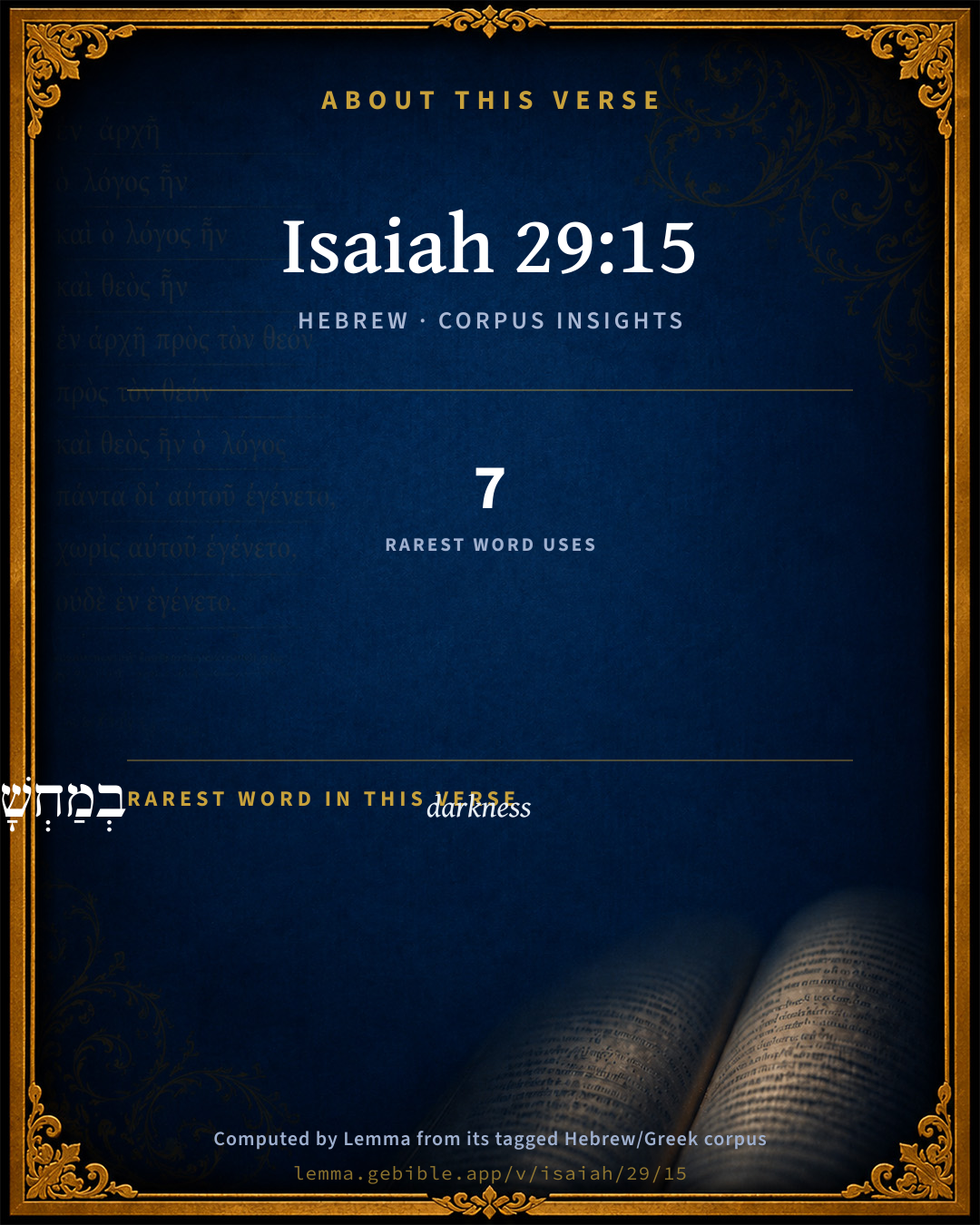
The rarest word here is בְמַחְשָׁךְ֙ darkness H4285 — appearing just 7 times in the whole Hebrew Bible.

Shared distinctive vocabulary

בְמַחְשָׁךְ֙ darkness H4285 occurs in 7 verses of the Hebrew Bible. Also found in:

Grammatical profile

  • 6 verbs
  • 4 nouns
  • 3 particles

Verb forms

  • הַמַּעֲמִיקִ֥ים Hiphil · Participle Active
  • לַסְתִּ֣ר Hiphil · Infinitive Construct
  • וְהָיָ֤ה Qal · Sequential Perfect
  • וַיֹּ֣אמְר֔וּ Qal · Sequential Imperfect
  • רֹאֵ֖נוּ Qal · Participle Active
  • יוֹדְעֵֽנוּ Qal · Participle Active

Repetition

A word recurs within this verse — often emphatic in Hebrew:

Hebrew & Septuagint length

In English translation the verse runs 27 words from the Hebrew and 41 from the Septuagint (LXX English) — the Septuagint runs noticeably longer here. See the side-by-side →

A rough comparison of the two English renderings, which tokenize alike — not a word-level alignment.

Word counts can differ between the Hebrew and the Greek without any difference in meaning — e.g. the Hebrew direct-object marker אֵת has no separate Greek word, and Greek often adds the article ὁ.

Cross-references

25

Topical passages linked to Isaiah 29:15 in the Treasury of Scripture Knowledge — connected by theme and wording, ordered by reader-vote popularity; previews shown in the World English Bible.

  • Ezekiel 8:12 Then said he to me, Son of man, have you seen what the elders of the house of Israel do in the dark, every man in his chambers of imagery? for they say, Yahweh doesn't see us; Yahweh has forsaken the land.
  • Isaiah 47:10 For you have trusted in your wickedness; you have said, None sees me; your wisdom and your knowledge, it has perverted you, and you have said in your heart, I am, and there is none else besides me.
  • Isaiah 30:1 Woe to the rebellious children, says Yahweh, who take counsel, but not of me; and who make a league, but not of my Spirit, that they may add sin to sin,
  • Psalms 94:7–9 They say, "Yah will not see, Neither will Jacob's God consider."
  • Psalms 10:11–13 He says in his heart, "God has forgotten. He hides his face. He will never see it."
  • Psalms 59:7 Behold, they spew with their mouth. Swords are in their lips, "For," they say, "who hears us?"
  • Psalms 139:1–8 Yahweh, you have searched me, And you know me.
  • Isaiah 28:15 Because you have said, We have made a covenant with death, and with Sheol are we at agreement; when the overflowing scourge shall pass through, it shall not come to us; for we have made lies our refuge, and under falsehood have we hid ourselves:
  • Jeremiah 23:24 Can any hide himself in secret places so that I shall not see him? says Yahweh. Don't I fill heaven and earth? says Yahweh.
  • Ezekiel 9:9 Then said he to me, The iniquity of the house of Israel and Judah is exceeding great, and the land is full of blood, and the city full of wrestling [of judgment]: for they say, Yahweh has forsaken the land, and Yahweh doesn't see.
  • Zephaniah 1:12 It will happen at that time, that I will search Jerusalem with lamps, and I will punish the men who are settled on their dregs, who say in their heart, "Yahweh will not do good, neither will he do evil."
  • Malachi 2:17 You have wearied Yahweh with your words. Yet you say, 'How have we wearied him?' In that you say, 'Everyone who does evil is good in the sight of Yahweh, and he delights in them;' or 'Where is the God of justice?'
  • Luke 12:1–3 Meanwhile, when a multitude of many thousands had gathered together, so much so that they trampled on each other, he began to tell his disciples first of all, "Beware of the yeast of the Pharisees, which is hypocrisy.
  • Job 22:13–14 You say, 'What does God know? Can he judge through the thick darkness?
  • Job 24:13–17 "These are of those who rebel against the light; They don't know the ways of it, Nor abide in the paths of it.
  • Job 34:22 There is no darkness, nor thick gloom, Where the workers of iniquity may hide themselves.
  • 1 Corinthians 4:5 Therefore judge nothing before the time, until the Lord comes, who will both bring to light the hidden things of darkness, and reveal the counsels of the hearts. Then each man will get his praise from God.
  • Psalms 64:5–6 They encourage themselves in evil plans. They talk about laying snares secretly. They say, "Who will see them?"
  • Psalms 73:11 They say, "How does God know? Is there knowledge in the Most High?"
  • Isaiah 5:18–19 Woe to those who draw iniquity with cords of falsehood, And wickedness as with cart rope;
  • Isaiah 57:12 I will declare your righteousness; and as for your works, they shall not profit you.
  • 2 Corinthians 4:2 But we have renounced the hidden things of shame, not walking in craftiness, nor handling the word of God deceitfully; but by the manifestation of the truth commending ourselves to every man's conscience in the sight of God.
  • Isaiah 28:17 I will make justice the line, and righteousness the plummet; and the hail shall sweep away the refuge of lies, and the waters shall overflow the hiding-place.
  • John 3:19 This is the judgment, that the light has come into the world, and men loved the darkness rather than the light; for their works were evil.
  • Revelation 2:23 I will kill her children with Death, and all the assemblies will know that I am he who searches the minds and hearts. I will give to each one of you according to your deeds.

Cross-references courtesy of OpenBible.info (CC BY 4.0).

Hebrew and Greek witnesses Masoretic Hebrew ↔ Greek Septuagint

The same verse in the two great witnesses to the Old Testament, shown verse-for-verse.

Here the Septuagint runs noticeably longer than the Hebrew — LXX2012 (modern English Septuagint) 41 words vs World English Bible 27. A rough length comparison of the two English translations, not a word-level alignment — read both below.

These are two independent witnesses, not word-aligned to each other, and the Septuagint is shown in lemma (dictionary) form.

Hebrew Isaiah 29:15 Masoretic · Westminster Leningrad Codex

ה֛וֹי הַמַּעֲמִיקִ֥ים מֵֽיהוָ֖ה לַסְתִּ֣ר עֵצָ֑ה וְהָיָ֤ה בְמַחְשָׁךְ֙ מַֽעֲשֵׂיהֶ֔ם וַיֹּ֣אמְר֔וּ מִ֥י רֹאֵ֖נוּ וּמִ֥י יוֹדְעֵֽנוּ

Woe to those who hide deep their counsel from Yahweh, and whose works are in the dark, and who say, Who sees us? and who knows us?

World English Bible · Public Domain

Greek LXX Isaiah 29:15 Septuagint · lemma form

οὐαί ὁ βαθέως βουλή ποιέω καί οὐ διά κύριος οὐαί ὁ ἐν κρυφῇ βουλή ποιέω καί εἰμί ἐν σκότος ὁ ἔργον αὐτός καί εἶπον τίς ἐγώ ὁράω καί τίς ἐγώ γιγνώσκω ἤ ὅς ἐγώ ποιέω

Woe to them that deepen their counsel, and not by the Lord. Woe to them that take secret counsel, and whose works are in darkness, and they say, Who has seen us? and who shall know us, or what we do?

LXX2012 (modern English Septuagint) · Public Domain

Hebrew: Westminster Leningrad Codex (CC BY 4.0). Greek: Septuagint (public domain); English from LXX2012 (modern English Septuagint) (Public Domain). How the Septuagint differs from the Hebrew →

Targum (Aramaic paraphrase)

1

The Targum is the ancient Jewish Aramaic paraphrase of the Hebrew Scriptures — an interpretive translation, not the Hebrew text itself. Onkelos (literal) and Pseudo-Jonathan (expansive) render the Torah, and Jonathan the Prophets. Coverage is partial: where no permissively-licensed English translation exists for a verse, only the Aramaic is shown. This is verse-level text, not a word-by-word alignment to the Hebrew.

  1. Targum Jonathan Prophets (Joshua–Malachi)
    וַי דִמְדַמָן לְאִטַמָרָא עֵצָא מִן קֳדָם יְיָ וַהֲווֹ כִדְבְקִבְלָא עוֹבָדֵיהוֹן וְאָמְרִין לֵית דְחָזֵי לָנָא וְלֵית דְיָדַע בְּעוֹבָדָנָא:

    Woe unto them that purpose to hide counsel from before the Lord, that their works may be in darkness, and they say, None sees us, and none takes cognizance of our works.

    Targum Jonathan — Aramaic: “Mikraot Gedolot” (public domain). English: “Sefaria Community Translation” (CC0 1.0 (public-domain dedication)); “London "Chaldee Paraphrase," 1871” (public domain). Text via Sefaria.

Commentary

Notes on Isaiah 29:15 from classic Christian and Jewish commentators (each source and its license shown beneath its notes). The classic Christian expositions comment on the surrounding passage and are grouped to its opening verse, so a note may address several verses; the Jewish commentaries on the Tanakh (Rashi and others) are per-verse, so they appear only where the commentator wrote on this verse.

Lemma curates 59 commentaries, every one of them public domain or Creative Commons licensed, each selected and text-cleaned for this edition rather than reprinted as found. About our sources →

The Cambridge Bible for Schools and Colleges

gen. ed. J. J. S. Perowne

15. Cf. Isa_30:1, Isa_31:1. that seek deep to hide their counsel from the Lord] that hide a plan deep from Jehovah. The Egyptian party at court had done their utmost to conceal their project from Isaiah; this attempt to deceive God’s prophet is an act of rebellion, an attempt to steal a march on Jehovah. That they had other reasons for working in the dark is no doubt true; but these were of small moment compared with the sin of refusing to Jehovah a voice in their counsels of state.

Ch. Isa_29:15-24 A Messianic forecast

The third “Woe” (Isa_29:15), directed against the political intrigue with Egypt, merely serves as a point of attachment for a glowing description of the regenerated Israel. The course of thought is as follows:—

The prophet, having unmasked the designs of the conspirators, expostulates with them for pitting their foolish plans against the purpose of the Almighty (Isa_29:15-16).

Ere long, Jehovah will prove His power by a marvellous transformation of nature and society; the word of the Lord will be received by the people, now deaf and dumb to spiritual things; the poor and oppressed shall rejoice in their God (Isa_29:17-19).

In that glorious age there shall be neither tyrant nor scoffer,—neither oppression from without, nor injustice within the state (Isa_29:20-21).

The time of Israel’s humiliation shall soon pass away, never to return; and those who at present are perplexed and discontented shall accept the instruction of true religion (Isa_29:22-24).

The Cambridge Bible for Schools and Colleges (gen. ed. J. J. S. Perowne; Cambridge University Press, 1878–1918) — public domain. Text from a community e-Sword module.

Trapp's Complete Commentary

John Trapp

Isa 29:15 Woe unto them that seek deep to hide their counsel from the LORD, and their works are in the dark, and they say, Who seeth us? and who knoweth us?

Ver. 15. Woe unto them that seek deep to hide.] That carry two faces under a hood, as all formalists and double-minded persons do, desirous to deceive the world, and, if it were possible, God himself also, with their pretences and professions, and to cozen him of heaven.

To hide their counsel.] Their cunning contrivances, ut ita libere in omnes veneres et scelera ruant.

From the Lord.] Which cannot be, because he is all eye, and the searcher of hearts; he is intimo nostro intimior nobis, and will bring to light the hidden things of darkness. {1Co 4:5}

Their works are in the dark.] Out of sight, but not out of the light of his countenance. {Psa 90:8} Deo obscura liquent, muta respondent, silentium confitetur. "All things are naked and open before the eyes of him with whom we have to do." {Heb 4:13} Sin not therefore in hope of secrecy; Si non caste tamen caute, will prove too short a covering.

And say, Who seeth us? and who knoweth us?] God doth, to be sure, whoever doth not; hold this fast against that natural atheism which is in us all. See Eze 9:9 Rom 3:18. {See Trapp on "Rom 3:18"}

John Trapp, A Commentary or Exposition upon All the Books of the Old and New Testament (1647–1656) — public domain. Text from a community e-Sword module.

The Biblical Illustrator

Joseph S. Exell

Isa_29:15-16

Woe unto them that seek deep to hide their counsel from the Lord

The folly of acting separately from God

I.

THEIR POLITICS DESCRIBED (Isa_29:15). The consultations they had about their own safety they kept to themselves, and never asked Gods advice concerning them. See what foolish, fruitless pains sinners take in their sinful ways; they seek deep, they sink deep, to hide their counsel from the Lord, who sits in heaven and laughs at them. A practical disbelief of Gods omniscience is at the bottom both of the carnal worship and carnal confidences of the hypocrites (Psa_94:7; Eze_8:12; Eze_9:9).

II. THE ABSURDITY OF THEIR POLITICS DEMONSTRATED (Isa_29:16). Your inverting the order of things, and thinking to make Gods providence give attendance on your projects, and that God must know no more than you think fit, which is perfectly turning things upside down, and beginning at the wrong end,--it shall be esteemed as the potters clay; i.e., God will turn and manage you, and all your counsels, with as much ease, and as absolute a power, as the potter forms and fashions his clay. They that think to hide their counsels from God--

1. In effect deny Him to be their Creator.

2. Or, which comes to the same thing, deny Him to be a wise

Creator. (M. Henry.)

The Biblical Illustrator, edited by Joseph S. Exell (c. 1880s–1900s) — public domain. Text from a community e-Sword module.

Joseph Benson's Commentary

Isa 29:15-16. Wo unto them that seek deep — Hebrew, המעמיקים, that make, or dig deep; a metaphor from persons digging deep into the earth, that they may hide what they wish to keep safe and unknown. To hide their counsel from the Lord — Who vainly imagine that they can conceal their hypocrisy and secret wickedness from him, and can deceive, not only men, but God, by their external professions and services; or, who think they can carry on their projects without the observation or interposition of Providence. And their works are in the dark — Their wicked counsels are contrived, and their idolatry is practised, in secret and dark places, of which see Eze 8:12. And they say, Who seeth us? — Neither God nor man can discover us. Surely your turning of things upside down — “Your giving things unexpected turns, or false appearances, to hide your true designs, shall signify no more toward producing the intended effect, than the clay does without the artificer.” Dr. Waterland renders the verse, “This perverseness of yours is as if the potter were reputed as clay; that the work should say of its maker. He made me not; or the thing framed, say of him that framed it, He hath no understanding.” Bishop Lowth reads the passage in the interrogative form, and thereby gives it still more force: “Perverse as ye are! shall the potter be esteemed as the clay? Shall the work say of the workman, He hath not made me?” &c. “We, and all our works are in the hands of God, as clay in the hands of the potter, to give what form and fashion to them he pleases; and when the finest schemes are laid, he can work things to a quite contrary end.” — Lowth.

Joseph Benson's Commentary on the Old and New Testaments (1811–1818) — public domain. Text from a community e-Sword module.

Tyndale Open Study Notes

Tyndale Open Resources

29:15-24 This threat of coming judgment is the third of the six woes (see study note on 28:1–33:24). It begins with judgment but moves to a vision of creation being renewed and of the wicked coming to an end.

29:15 Their plans might refer to the advice that royal counselors were giving Hezekiah, who at first attempted to free himself from Assyria by making alliances with Egypt (715 or 701 BC). • The people were conspiring to commit evil deeds in secret, but God saw everything.

Tyndale Open Study Notes — © Tyndale Open Resources, licensed CC BY-SA 4.0. Text via the HelloAO Bible API.

Geneva Bible (1599)

Geneva Bible translators

This is spoken of them which in heart despised God’s word, and mocked at the admonitions, but outwardly bare a good face.

Geneva Bible (1599) marginal notes — public domain. Text via Bolls.life.

Jamieson, Fausset & Brown

Robert Jamieson, A. R. Fausset & David Brown

seek deep to hide--rather, "That seek to hide deeply," &c. (compare Isa 30:1-2). The reference is to the secret plan which many of the Jewish nobles had of seeking Egyptian aid against Assyria, contrary to the advice of Isaiah. At the same time the hypocrite in general is described, who, under a plausible exterior, tries to hide his real character, not only from men, but even from God.

Jamieson, Fausset & Brown — Commentary Critical and Explanatory on the Whole Bible (1871) — public domain (CC PDM 1.0). Text via the HelloAO Bible API.

Ellicott's Commentary for English Readers

(15) Woe unto them . . .—The words sound like an echo of Isa_5:8; Isa_5:11; Isa_5:18, and show that Isaiah had not lost the power of adding to that catalogue of woes. The sins of which he speaks here may have been either the dark sensualities which lay beneath the surface of religion, or, more probably, their clandestine intrigues with this or that foreign power—Egypt, Ethiopia, Babylon—against the Assyrian invader, instead of trusting in the Lord of hosts.

A Bible Commentary for English Readers, edited by Charles John Ellicott (1878–1897) — public domain. Text from a community e-Sword module.

John Gill's Exposition

Woe unto them,.... Or, "O ye",

that seek deep to hide their counsel from the Lord; which they consulted against Christ, to take away his life, to persecute his apostles, and hinder the spread of his Gospel; which though they consulted in private, and formed deep schemes, imagining they were not observed by the Lord, yet he that sits in the heaven saw them, and laughed at their vain imaginations, Psa 2:1,

and their works are in the dark; in the dark night, as if the darkness could conceal them from the all seeing eye of God; such works are truly works of darkness, but cannot be hid, though they flatter themselves they will:

and they say, Who seeth us? and who knoweth us? as no man, they imagined, did, so not God himself; into such atheism do wicked men sink, when desirous of bringing their schemes into execution, they have taken great pains to form; and which they please themselves are so deeply laid, as that they cannot fail of succeeding; but hear what follows Isa 29:16.

John Gill's Exposition of the Whole Bible (1746–1763) — public domain (CC PDM 1.0). Text via the HelloAO Bible API.

Albert Barnes' Notes on the Bible

Woe unto them that seek deep ... - That is, who attempt to conceal their “real” intentions under a plausible exterior, and correct outward deportment. This is most strikingly descriptive of the character of a hypocrite who seeks to conceal his plans and his purposes from the eyes of people and of God. His external conduct is fair; his observance of the duties of religion exemplary; his attendance on the means of grace and the worship of God regular; his professions loud and constant, but the whole design is to “conceal” his real sentiments, and to accomplish some sinister and wicked purpose by it.

From the Lord - This proves that the design of the hypocrite is not always to attempt to deceive his fellowmen, but that he also aims to deceive God.

Albert Barnes' Notes on the Bible (1834–1885) — public domain. Text from a community e-Sword/MySword module.

Matthew Poole's English Annotations

That seek deep, Heb. that make deep. A metaphor from men who use to dig deep into the earth, that they may hide any thing there which they would keep safe and unknown.

To hide their counsel from the Lord; vainly imagining that they can keep all their hypocrisy and secret wickedness out of God’s sight, and that they can deceive, not only man, but God, by their external professions and services. Their works are in the dark; their wicked counsels are contrived, and their idolatry is practised, in secret and dark places, of which see Eze 8:12.

Who seeth us? and who knoweth us? we act so cunningly, that neither God nor man can discover us.

Matthew Poole's English Annotations on the Holy Bible (1683–1685) — public domain. Text from a community e-Sword/MySword module.

Whedon's Commentary on the Bible

Daniel D. Whedon

15. Seek deep to hide — Irony on the conceit of these leaders, in impiously supposing even God did not see their intent as to Egypt, and the motive of their disloyalty to him. Their absurdity is exposed in the next verse.

Daniel D. Whedon (gen. ed.), Commentary on the Old and New Testaments (1874–1909) — public domain. Text from a community e-Sword module.

The Pulpit Commentary

Woe unto them that seek deep to hide their counsel from the Lord. The allusion is to the schemes which were afloat for calling in the aid of Egypt. As Isaiah had long since denounced these schemes as the height of folly, (Isa_19:11-17) and prophesied their failure, (Isa_20:5, Isa_20:6) every effort was made to conceal them from his knowledge end from the knowledge of all who were like-minded. (comp. Isa_30:1, Isa_30:2) Steps were probably even now being taken for the carrying out of the schemes, which were studiously concealed from the prophet. Their works are in the dark. Underhand proceedings ere at all times suspicious. "Men love darkness rather than light, because their deeds are evil." The very fact of concealment was an indication that the works in which the rulers were engaged were evil, and that they knew them to be evil. They say, Who seeth us? (comp. Psa_73:11, "Tush, they say, How should God perceive? Is there knowledge in the Most High? The wicked persuade themselves that God does not see their actions.

God the Mind-Searcher.

Foolish indeed are they who "seek deep to hide their counsel from the Lord." The first reference of this warning may be to the secret schemes of the party in Jerusalem which advocated an offensive and defensive alliance with Egypt in the national emergency. Such a policy was so evidently untheocratic that, in the days of the good Hezekiah, they were obliged to work in the dark. It may be noticed that the Divine omniscience of all events and circumstances is a much more familiar and readily recognized truth than the Divine omniscience of all thoughts of mind and decisions of will. Yet we are to understand that, as the psalmist expresses it, "Thou understandest my thought afar off.... For before a word is yet on my tongue, lo! O Jehovah, thou knowest it altogether." By our "thoughts" is not meant the passing set of mental associations from which we have to select, but the selections we make, the things we cherish. The omniscience of God is most searching to us when we regard it as his "knowledge of the deepest thoughts and most secret workings of the human heart.

I THE DIVINE OMNISCIENCE AS A CHECK. A boy was required to accompany his father when out stealing potatoes from a field. The boy was set to watch while the man dug. Presently he called out, as if there was danger. "Where? where?" said the man, who could see no signs of any one approaching. "Look up!" replied the boy. This should always be taken into consideration in our thinking and our planning God sees; God knows. We all need that check of the Divine eye upon us, reading our very hearts.

II THE DIVINE OMNISCIENCE AS A TERROR. Such it must always be to the evildoer, to the man who wants to do wrong. It checks the good man; it frightens the bad man. A servant-girl was accustomed to pilfer when dusting her master"s room, but there was a portrait on the walls, the eyes of which seemed to be always following and watching her; so, to relieve herself of her terror, the foolish girl cut out the eyes. An oppressive picture of the terror of God"s looking at and into evil-doers is given in the description of the judgment, when men wilt call on the rocks and hills to hide them from the face of God as if they could!

III THE DIVINE OMNISCIENCE AS A CONSOLATION AND STRENGTH. This it is to all who wish to be good. The best source of illustration is Psalm 139. See especially the restfulness and the joy breathed in the prayer of vers. 23, 24. As Calvin says, "That man must have a rare confidence who offers himself so boldly to the scrutiny of God"s righteous judgment. R.T.

The Pulpit Commentary (1880–1919), ed. H.D.M. Spence-Jones & Joseph S. Exell — public domain. Text from a community e-Sword module.

John Wesley's Explanatory Notes

Seek deep - A metaphor from men, who use to dig deep into the earth, that they may hide any thing there. To hide - Vainly imagining, that they can deceive, not only men, but God, by their external professions. Who - Neither God nor man can discover us.

John Wesley, Explanatory Notes Upon the Whole Bible (1754–1765) — public domain. Text via the GEBible commentary corpus.

Keil & Delitzsch

C. F. Keil & F. Delitzsch

Their hypocrisy, which was about to be so wonderfully punished according to the universal law (Psa 18:26-27), manifested itself in their self-willed and secret behaviour, which would not inquire for Jehovah, nor suffer itself to be chastened by His word. "Woe unto them that hide plans deep from Jehovah, and their doing occurs in a dark place, and they say, Who saw us then, and who knew about us? Oh for your perversity! It is to be regarded as potters' clay; that a work could say to its maker, He has not made me; and an image to its sculptor, He does not understand it!" Just as Ahaz had carefully kept his appeal to Asshur for help secret from the prophet; so did they try, as far as possible, to hide from the prophet the plan for an alliance with Egypt. לסתּיר is a syncopated hiphil for להסתּיר, as in Isa 1:12; Isa 3:8; Isa 23:11. העמיק adds the adverbial notion, according to our mode of expression (comp. Joe 2:20, and the opposite thought in Joe 2:26; Ges. 142). To hide from Jehovah is equivalent to hiding from the prophet of Jehovah, that they might not have to listen to reproof from the word of Jehovah. We may see from Isa 8:12 how suspiciously they watched the prophet in such circumstances as these. But Jehovah saw them in their secrecy, and the prophet saw through the whole in the light of Jehovah. הפכּכם is an exclamation, like תּפלצתּך in Jer 49:16. They are perverse, or ('im) "is it not so?" They think they can dispense with Jehovah, and yet they are His creatures; they attribute cleverness to themselves, and practically disown Jehovah, as if the pot should say to the potter who has turned it, He does not understand it.

Keil & Delitzsch — Biblical Commentary on the Old Testament (1861–1891) — public domain (CC PDM 1.0). Text via the HelloAO Bible API. (Old Testament only.)

J. A. Alexander on Isaiah

Joseph Addison Alexander

“Woe unto those (or alas for those) going deep from Jehovah to hide counsel (i.e., laying their plans deep in the hope of hiding them from God), and their works (are) in the dark, and they say, Who sees us and who knows us?”- This is a further description of the people or their leaders, as not only wise in their own conceit, but as impiously hoping to deceive God or elude his notice. The absurdity of such an expectation is exposed in the following verse. In the last clause of this, the interrogative form implies negation.

Joseph Addison Alexander, The Prophecies of Isaiah (1846–1847; New York: Scribner, 1870–1878) — public domain. Text from a community e-Sword module.

unfoldingWord translationNotes

Door43 World Missions Community

General Information:

This may be Isaiah speaking or it may continue Yahweh's speech in Isa 29:13-14.

who deeply hide their plans from Yahweh

People trying to make plans without Yahweh knowing about it is spoken of as if they hide their plans in a deep place where Yahweh cannot see. AT: "who try to hide their plans from Yahweh" or "who try to keep Yahweh from finding out what they are planning to do" (See: Metaphor)

whose deeds are in darkness

It is implied that they are secretly doing evil things. AT: "who do evil things in the dark so no one can see them" (See: Assumed Knowledge and Implicit Information)

Who sees us, and who knows us?

They use a question to emphasize that they believe no one knows what they are doing. AT: "No one, not even Yahweh, sees us or knows what we are doing!" (See: Rhetorical Question)

translationWords

woe

Yahweh

works

darkness

know

unfoldingWord translationNotes — © Distant Shores Media and the Door43 World Missions Community, licensed CC BY-SA 4.0. Source: git.door43.org/Door43/en_tn.

Rashi

Rabbi Shlomo Yitzchaki (Rashi)

to hide counsel (לַסְתִּיר) equivalent to לְהַסְתִּיר.

Rashi on the Tanakh — English translations: “The Judaica Press complete Tanach with Rashi, translated by A. J. Rosenberg” (CC BY 4.0); “Pentateuch with Rashi's commentary by M. Rosenbaum and A.M. Silbermann, 1929-1934” (public domain); “The Metsudah Tanach series, Lakewood, N.J” (CC BY 4.0); and “The Book of Joshua, Metsudah Publications, 1997” (CC BY 4.0). Text via Sefaria.

Ibn Ezra

Rabbi Abraham ibn Ezra

המעמיקים That seek deep in the depth of their hearts.

להסתיר═לסתיר To hide. Comp. להשמיד═לשמיד to destroy (23:11)

Ibn Ezra on the Tanakh — English translations: “Sefaria Community Translation” (CC0 1.0 (public-domain dedication)); “Yalkut, Sifsei Chachomim Chumash, Metsudah Publications, 2009” (CC BY 4.0); and “Commentary of Ibn Ezra on Isaiah - trans. by M. Friedlander, 1873” (public domain). Text via Sefaria.

Lesson kit

Teaching starters — assembled from the data on this page, not authored interpretation. Every prompt links to the verse data it draws on. Edit before teaching.

Isaiah, in the Prophets, opens this verse with 13 words (12 distinct Hebrew lemmas). Its most distinctive word is machshâk (“darkness”). The Greek Septuagint runs longer here. A historical commentator’s framing appears above. Read the whole chapter for the surrounding context.

Discussion questions

  1. The word machshâk carries the sense “darkness.” How does it shape the verse?
  2. Psalms 74:20 shares the word «darkness» with this verse. How do the two illuminate each other?
  3. “who” occurs 2× in this one verse. What is the effect of the repetition?
  4. Compared with the Hebrew, the Septuagint runs longer here. What questions does that raise?
  5. The translations on this page render this verse differently — a whole-verse word diff, not a word-by-word alignment. What might account for the different wordings?
  6. The verb «הַמַּעֲמִיקִ֥ים» is Hiphil Participle Active. How does its form color the action?
  7. Reading how The Cambridge Bible for Schools and Colleges and Trapp's Complete Commentary read this verse, where do the two commentators agree and where do they part?

Things to notice

Reading settings

Reading text

Shown beneath each verse's original-language words.

Old Testament
Old Testament edition

Read the OT as the Masoretic Hebrew (MT) or the Greek Septuagint (LXX).

English shown for the Greek Septuagint (in the Hebrew ↔ Greek comparison).

Comparing translations? Open the Compare panel on any verse page to stack up to four side by side.