
Exodus 26:30

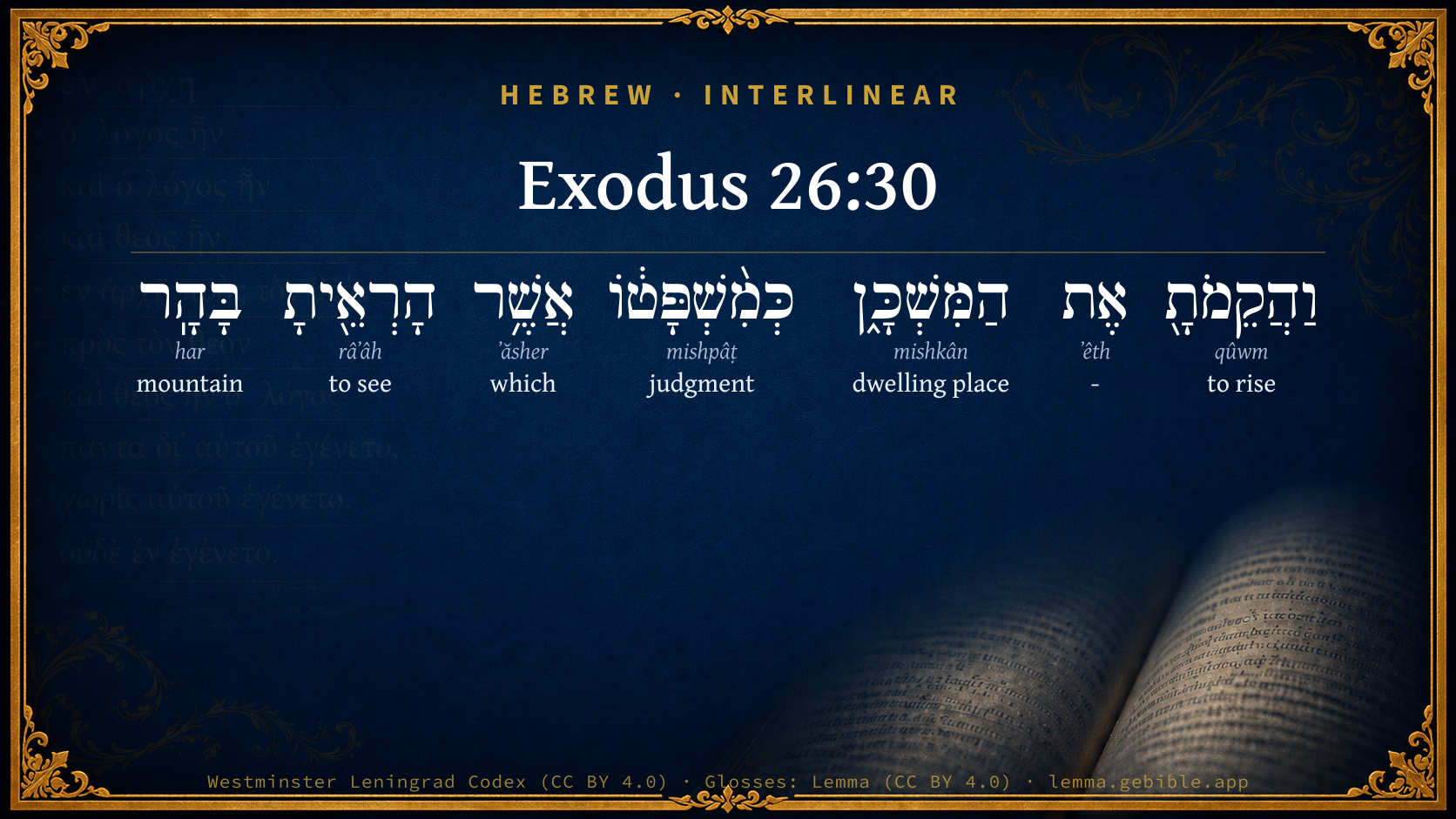
Hebrew (Westminster Leningrad Codex) Exodus 26:30 appears in the Hebrew Old Testament. The text above is from the Westminster Leningrad Codex. Each word links to its Strong’s number, a concise gloss, and parsing drawn from the Open Scriptures Hebrew Bible morphology. Click any word for its full Brown-Driver-Briggs (BDB) entry.
Download image
Cite this verse

Exodus 26:30 (World English Bible). Public Domain. Lemma interlinear Bible study tool, https://lemma.gebible.app/v/exodus/26/30.

Show BibTeX & RIS
BibTeX
RIS
English Translation
You shall set up the tent according to the way that it was shown to you on the mountain.
World English Bible · Public Domain
Download a study sheet

One document with this verse’s original text, its word-by-word gloss line, the meaning frame, cross-references with their text, attributed commentary, and full source and license credits — printable, and it pastes into notes with its structure intact.

This verse Autodidact and up

Study sheet (.html) Plain text (.txt)

A passage Seminary Student

Up to 50 verses in one chapter. A passage sheet keeps up to 6 commentary sources and 12 cross-references per verse, in the order this page ranks them, and says so on the sheet whenever that leaves anything out. Ask for a single verse and you get the Autodidact verse sheet above.

Everything on this page stays free to read, with no account — the sheet is a download of what is already on screen, not access to it.

Want to remove ads? Support Godless Engineer
Compare translations 3

The same verse in 3 English versions, stacked beneath the original-language interlinear above. Click any original word for its lexicon entry.

Each is an independent rendering of the whole verse — the interlinear is not word-aligned to these translations.

Highlighted words mark where these versions differ — a whole-verse word diff, not a word-by-word alignment.

  • World English Bible Public Domain
    You shall set up the tent according to the way that it was shown to you on the mountain.
  • King James Version Public Domain
    And thou shalt rear up the tabernacle according to the fashion thereof which was showed thee in the mount.
  • unfoldingWord Literal Text CC BY-SA 4.0
    And you shall set up the Dwelling according to its plan that you were shown on the mountain.

unfoldingWord Literal Text — © unfoldingWord, licensed CC BY-SA 4.0. Word-aligned USFM3 via Door43 (git.door43.org/unfoldingWord/en_ult).

Versions to compare (up to 4)

3 of 4 selected

Show all 18 translations

Every available English version of this verse, each an independent rendering of the whole verse.

  • World English Bible Public Domain
    You shall set up the tent according to the way that it was shown to you on the mountain.
  • Berean Standard Bible Public Domain
    So you are to set up the tabernacle according to the pattern shown you on the mountain.
  • Majority Standard Bible Public Domain
    So you are to set up the tabernacle according to the pattern shown you on the mountain.
  • King James Version Public Domain
    And thou shalt rear up the tabernacle according to the fashion thereof which was showed thee in the mount.
  • American Standard Version (1901) Public Domain
    And thou shalt rear up the tabernacle according to the fashion thereof which hath been showed thee in the mount.
  • Revised Version (1885) Public Domain
    And thou shalt rear up the tabernacle according to the fashion thereof which hath been shewed thee in the mount.
  • Geneva Bible (1599) Public Domain
    So thou shalt reare vp the Tabernacle, according to the facion thereof, which was shewed thee in the mount.
  • Douay-Rheims (1899) Public Domain
    And thou shalt rear up the tabernacle according to the pattern that was shewn thee in the mount.
  • Young's Literal Translation Public Domain
    and thou hast raised up the tabernacle according to its fashion which thou hast been shewn in the mount.
  • Literal Standard Version CC BY-SA 4.0
    and you have raised up the Dwelling Place according to its fashion which you have been shown on the mountain.
  • Unlocked Literal Bible CC BY-SA 4.0
    You must set up the tabernacle by following the plan you were shown on the mountain.
  • unfoldingWord Literal Text CC BY-SA 4.0
    And you shall set up the Dwelling according to its plan that you were shown on the mountain.
  • Darby Bible Public Domain
    And thou shalt set up the tabernacle according to its fashion, as hath been shewn thee on the mountain.
  • World Messianic Bible Public Domain
    You shall set up the tabernacle according to the way that it was shown to you on the mountain.
  • Webster's Bible Public Domain
    And thou shalt rear up the tabernacle according to the fashion thereof which was shown thee on the mount.
  • Free Bible Version CC BY-SA 4.0
    Assemble the Tabernacle following the design you were shown on the mountain.
  • Bible in Basic English Public Domain
    And you are to make the House from the design which you saw on the mountain.
  • JPS Tanakh (1917) Public Domain
    And thou shalt rear up the tabernacle according to the fashion thereof which hath been shown thee in the mount.

Literal Standard Version (2020), Covenant Press — licensed CC BY-SA 4.0. Text via the HelloAO Bible API (eBible.org). Unlocked Literal Bible (unfoldingWord) — licensed CC BY-SA 4.0. Text via the HelloAO Bible API (eBible.org). unfoldingWord Literal Text — © unfoldingWord, licensed CC BY-SA 4.0. Word-aligned USFM3 via Door43 (git.door43.org/unfoldingWord/en_ult). Free Bible Version, Dr. Jonathan Gallagher — licensed CC BY-SA 4.0. Text via the HelloAO Bible API (eBible.org).

Word by word

More ways to search: Search by grammar → Find every occurrence → Compare this word →

Practice this passage: Drill this verse → Learn its vocabulary →

About this verse

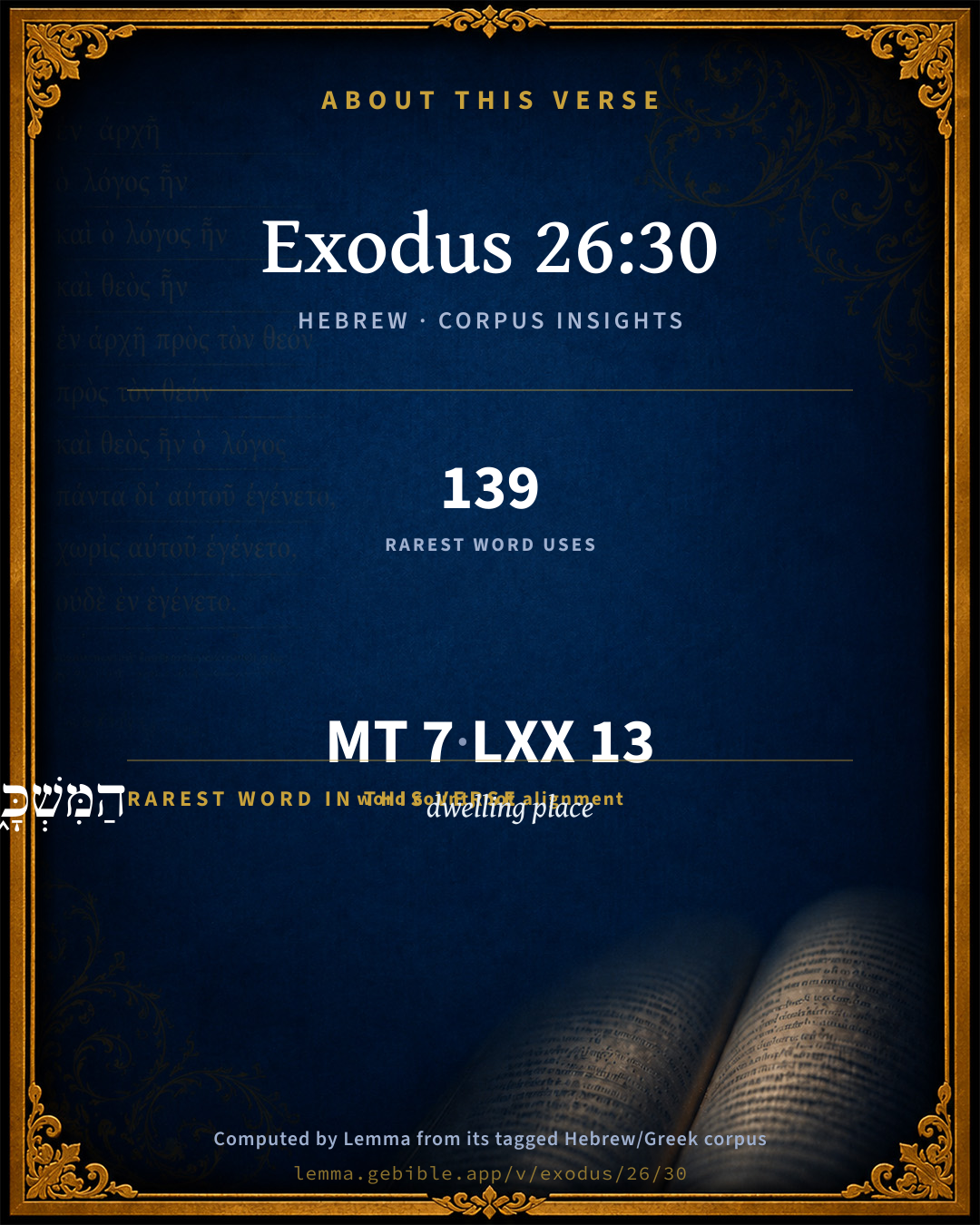
These counts appear in no published source. They are computed here, from the morphology-tagged text and Lemma’s own curated glosses. What Lemma adds →

7
words
7
distinct lemmas
Pentateuch
section

Grammatical profile

  • 2 verbs
  • 3 nouns
  • 2 particles

Verb forms

  • וַהֲקֵמֹתָ֖ Hiphil · Sequential Perfect
  • הָרְאֵ֖יתָ Hophal · Perfect

Hebrew & Septuagint length

In English translation the verse runs 19 words from the Hebrew and 16 from the Septuagint (LXX English) — closely comparable.

A rough comparison of the two English renderings, which tokenize alike — not a word-level alignment.

Word counts can differ between the Hebrew and the Greek without any difference in meaning — e.g. the Hebrew direct-object marker אֵת has no separate Greek word, and Greek often adds the article ὁ.

In the original languages it is 7 Hebrew tokens and 13 Greek tokens — but the two are counted differently (Hebrew bundles its prefixes and suffixes into one token; the Greek is in lemma form), so that isn’t a like-for-like length.

Cross-references

11

Topical passages linked to Exodus 26:30 in the Treasury of Scripture Knowledge — connected by theme and wording, ordered by reader-vote popularity; previews shown in the World English Bible.

  • Exodus 25:40 See that you make them after their pattern, which has been shown to you on the mountain.
  • Hebrews 8:5 who serve a copy and shadow of the heavenly things, even as Moses was warned by God when he was about to make the tabernacle, for he said, "See, you shall make everything according to the pattern that was shown to you on the mountain."
  • Exodus 25:9 According to all that I show you, the pattern of the tent, and the pattern of all of its furniture, even so you shall make it.
  • Acts 7:44 "Our fathers had the tent of the testimony in the wilderness, even as he who spoke to Moses commanded him to make it according to the pattern that he had seen;
  • Exodus 27:8 Hollow with planks shall you make it: as it has been shown you on the mountain, so shall they make it.
  • Exodus 40:2 "On the first day of the first month you shall raise up the tent of the Tent of Meeting.
  • Exodus 40:17–18 It happened in the first month in the second year, on the first day of the month, that the tent was raised up.
  • Numbers 10:21 The Kohathites set forward, bearing the sanctuary: and [the others] did set up the tent against their coming.
  • Joshua 18:1 The whole congregation of the children of Israel assembled themselves together at Shiloh, and set up the tent of meeting there: and the land was subdued before them.
  • Hebrews 8:2 a minister of the sanctuary, and of the true tabernacle, which the Lord pitched, not man.
  • Hebrews 9:23 It was necessary therefore that the copies of the things in the heavens should be cleansed with these; but the heavenly things themselves with better sacrifices than these.

Cross-references courtesy of OpenBible.info (CC BY 4.0).

Hebrew and Greek witnesses Masoretic Hebrew ↔ Greek Septuagint

The same verse in the two great witnesses to the Old Testament, shown verse-for-verse.

These are two independent witnesses, not word-aligned to each other, and the Septuagint is shown in lemma (dictionary) form.

Hebrew Exodus 26:30 Masoretic · Westminster Leningrad Codex

וַהֲקֵמֹתָ֖ אֶת הַמִּשְׁכָּ֑ן כְּמִ֨שְׁפָּט֔וֹ אֲשֶׁ֥ר הָרְאֵ֖יתָ בָּהָֽר

You shall set up the tent according to the way that it was shown to you on the mountain.

World English Bible · Public Domain

Greek LXX Exodus 26:30 Septuagint · lemma form

καί ἀναἵστημι ὁ σκηνή κατά ὁ εἶδος ὁ δεικνύω σύ ἐν ὁ ὄρος

And you shall set up the tabernacle according to the pattern showed you in the mount.

LXX2012 (modern English Septuagint) · Public Domain

Hebrew: Westminster Leningrad Codex (CC BY 4.0). Greek: Septuagint (public domain); English from LXX2012 (modern English Septuagint) (Public Domain). How the Septuagint differs from the Hebrew →

Targum (Aramaic paraphrase)

2

The Targum is the ancient Jewish Aramaic paraphrase of the Hebrew Scriptures — an interpretive translation, not the Hebrew text itself. Onkelos (literal) and Pseudo-Jonathan (expansive) render the Torah, and Jonathan the Prophets. Coverage is partial: where no permissively-licensed English translation exists for a verse, only the Aramaic is shown. This is verse-level text, not a word-by-word alignment to the Hebrew.

  1. Targum Onkelos Torah (Genesis–Deuteronomy)
    וּתְקִים יָת מַשְׁכְּנָא כְּהִלְכְתֵהּ דִי אִתְחֲזֵיתָא בְּטוּרָא:

    (no public-domain English translation for this verse)

    Targum Onkelos — Aramaic: “Onkelos Genesis” (public domain); “Onkelos Exodus” (public domain); “Onkelos Leviticus” (public domain); “Onkelos Numbers” (public domain); “Onkelos Deuteronomy” (public domain). English: “Sefaria Community Translation” (CC0 1.0 (public-domain dedication)); “J.W. Etheridge. The Targums of Onkelos and Jonathan Ben Uzziel on the Pentateuch. London: Longmans, Green, 1862” (public domain). Text via Sefaria.

  2. Targum Pseudo-Jonathan Torah (Genesis–Deuteronomy)
    וְתָקִים יַת מַשְׁכְּנָא כְּהִילְכָתָא דְאִתְחֲמִיתָא בְּטַוְורָא

    And thou shalt rear the tabernacle according to the manner showed thee in the mountain.

    Targum Pseudo-Jonathan — Aramaic: “Targum Jonathan on Genesis” (public domain); “Targum Jonathan on Exodus” (public domain); “Targum Jonathan on Leviticus” (public domain); “Targum Jonathan on Numbers” (public domain); “Targum Jonathan on Deuteronomy” (public domain). English: “The Targum of Jonathan ben Uzziel, trans. J. W. Etheridge, London, 1862” (public domain). Text via Sefaria.

Commentary

Notes on Exodus 26:30 from classic Christian and Jewish commentators (each source and its license shown beneath its notes). The classic Christian expositions comment on the surrounding passage and are grouped to its opening verse, so a note may address several verses; the Jewish commentaries on the Tanakh (Rashi and others) are per-verse, so they appear only where the commentator wrote on this verse.

Lemma curates 59 commentaries, every one of them public domain or Creative Commons licensed, each selected and text-cleaned for this edition rather than reprinted as found. About our sources →

Ellicott's Commentary for English Readers

(30) According to the fashion thereof which was shewed thee.—See Exo_25:9; Exo_25:40. However minute—even tediously minute—the description, there would necessarily have been a multitude of particulars, not to be described in words, where Moses would have to be guided by the pattern that he had seen.

A Bible Commentary for English Readers, edited by Charles John Ellicott (1878–1897) — public domain. Text from a community e-Sword module.

The Cambridge Bible for Schools and Colleges

gen. ed. J. J. S. Perowne

30. Cf. Exo_25:9; Exo_25:40; and see Exo_40:18.

fashion] more exactly, prescribed norm: cf. 1Ki_6:38, Eze_42:11; and see on this sense of mishpâṭ the writer’s Jeremiah, p. 345.

The Cambridge Bible for Schools and Colleges (gen. ed. J. J. S. Perowne; Cambridge University Press, 1878–1918) — public domain. Text from a community e-Sword module.

John Gill's Exposition

And thou shalt hang it upon four pillars of shittim wood, overlaid with gold,.... For it was ten cubits long, and as many broad; and being of such a stiffness and thickness as it was, required so many pillars to support it: these pillars may signify the deity of Christ, which is the support of his human nature, and in which it has its personal subsistence, and gives all its actions and sufferings virtue and efficacy; and being of "shittim wood", which is incorruptible, may denote his eternity, and being covered with gold, his glory:

their hooks shall be of gold; which were upon the tops of the pillars on which the vail was hung: and the pillars were

upon the four sockets of silver; which were properly the pedestals or feet of the pillars; and these sockets, into which the pillars were let and placed, and the hooks the vail hung by, may hint to the union of the two natures in Christ, who is God and man in one person, God manifest in the flesh; see Sol 5:15.

John Gill's Exposition of the Whole Bible (1746–1763) — public domain (CC PDM 1.0). Text via the HelloAO Bible API.

Matthew Poole's English Annotations

Either by visible representation to his eye, or rather by mental vision or impression of it upon his imagination.

Matthew Poole's English Annotations on the Holy Bible (1683–1685) — public domain. Text from a community e-Sword/MySword module.

Whedon's Commentary on the Bible

Daniel D. Whedon

30. Thou shalt rear up the tabernacle — The making and erection of the tabernacle involved a great many details which are not here recorded; but as Moses was shown the fashion thereof, (Hebrews its judgment,) he understood perfectly what was judged, and ordered to be, the appropriate arrangement of each part.

Daniel D. Whedon (gen. ed.), Commentary on the Old and New Testaments (1874–1909) — public domain. Text from a community e-Sword module.

The Pulpit Commentary

According to the fashion. Where the description was incomplete (and it could not but be incomplete in many points), Moses was to follow his recollection of the "pattern," which either in vision, or otherwise he had seen in the mount This would be his best guide, for

Segnius irritant animum demissa per aures, Quam quae sunt oculis subjecta fidelibus.

HOMILIES BY G. A. GOODHART Ver. 30. God dwelleth not in temples made with hands.

An idea, to be realised, must be embodied; e.g. , thoughts must be expressed in words; the vision of the artist must take form on canvas or in marble. So, too, with the Divine ideas; they also must be embodied, and as presented for man"s instruction, they must be so embodied that man may apprehend them. The unseen must be made visible; the pattern on the mount must be modelled and reared up upon the plain. Notice

I THE DIVINE IDEAL. Moses was shown the original Divine embodiment, not a mere toy model which he was to enlarge, but the actual God-fashioned tabernacle, in all the perfection of its related parts. So far as man was concerned, it might be a purely ideal structure; but the ideals of earth are the realities of heaven. The holy of holies, and the holy place, and the outer court all these must exist, or Moses could not have been shown them. May we not also discern dimly that reality which Moses saw? The holy of holies, where God"s throne is set heaven in its innermost recesses, screened off from earth by the blue sky-curtain, which no unaided eye can pierce. The holy place and the outer court, God"s earthly sanctuary, his Church in this world, related on the one side to heaven, and on the other to the world around it; the visible heavens are, in some sort, an expression of this Divine idea, illuminated by the sun, (cf. Ps 19) and with the earth from man"s standpoint forming a kind of outer court. Even this true tabernacle (cf. Heb_8:2) is only an embodiment of the Divine idea; but then it is the Divine embodiment, the expression found for it by God himself.

II THE HUMAN COPY. The divine ideal as divinely embodied is still beyond man"s understanding; it needs to be translated for men into language with which they are familiar. The child must be spoken to as, (Isa_28:11) "with stammering lips and a feigned tongue." The tabernacle of nature expresses God"s idea in polysyllables; the tabernacle which Moses reared translates it into easier language. Notice

1. The holy of holies.

(1) The sanctity of the Divine dwelling-place emphasises the sanctity of its Divine inmate. "Clouds and darkness are round about him." "Holiness becometh his house for ever.

(2) "Righteousness and judgment are the establishment of his throne;" it is founded upon a guarded law.

(3) Mercy rejoiceth over judgment. God is just, or righteous, but also the justifier who makes righteous. "Mercy and truth are met together; righteousness and peace have kissed each other.

2. The holy place. God has made it possible for man to approach him. They who may not bear the presence may yet be admitted to the ante-chamber. The Church is the link between heaven and earth, as the high priest is the link between the Divine and human. Notice

(1) The golden altar. The fumes of the incense may penetrate the veil, which shuts out the priest who offers it. Prayer can go where the worshipper cannot go.

(2) The golden candlestick. No lamp needed in the holiest place. (cf. Rev_21:23) Here, when man meets with God, for man"s sake the lamp is needed. The light derived from God must be guarded by man, so only is the required illumination to be secured.

(3) The golden table. Furnished week by week with food satisfying alike to God and man. Such the Church a heaven on earth. Prayer ascending towards the unseen holy; light from God carefully guarded; offerings wherein God and man both find satisfaction such are the notes of a true Church, one wherein man may have communion with his Maker, holy as preluding to the holy of holies.

(4) The outer court. Here we have the first stage in man"s progress from the world God-wards. The altar and the laver, sacrifice and purification, must come before communion. Consecration and cleansing precede intercourse and fellowship, and these again prepare for the beatific vision.

Conclusion. What is the central thought thus shadowed forth? Is it not this: God"s holiness can only be approached step by step, whilst the road by which we must approach it is that which will ensure for us growth in holiness. "The pure in heart shall see God;" the beatific vision is for those only whose spiritual eyesight has been prepared for its reception. We cannot come up to the throne of God save through the outer court and through the sanctuary; sacrifice and cleansing, illumination and communion; then, for those who can receive it, the open vision and the presence of God. G.

The Pulpit Commentary (1880–1919), ed. H.D.M. Spence-Jones & Joseph S. Exell — public domain. Text from a community e-Sword module.

Keil & Delitzsch

C. F. Keil & F. Delitzsch

"And set up the dwelling according to its right, as was shown thee upon the mountain" (cf. Exo 25:9). Even the setting up and position of the dwelling were not left to human judgment, but were to be carried out כּמשׁפּטו, i.e., according to the direction corresponding to its meaning and purpose. From the description which is given of the separate portions, it is evident that the dwelling was to be set up in the direction of the four quarters of the heavens, the back being towards the west, and the entrance to the east; whilst the whole of the dwelling formed an oblong of thirty cubits long, ten broad, and ten high. The length we obtain from the twenty boards of a cubit and a half in breadth; and the breadth, by adding to the nine cubits covered by the six boards at the back, half a cubit as the inner thickness of each of the corner beams. The thickness of the corner beams is not given, but we may conjecture that on the outside which formed part of the back they were three-quarters of a cubit thick, and that half a cubit is to be taken as the thickness towards the side. In this case, on the supposition that the side beams were a quarter of a cubit thick, the inner space would be exactly ten cubits broad and thirty and a quarter long; but the surplus quarter would be taken up by the thickness of the pillars upon which the inner curtain was hung, so that the room at the back would form a perfect cube, and the one at the front an oblong of exactly twenty cubits in length, ten in breadth, and ten in height.

Keil & Delitzsch — Biblical Commentary on the Old Testament (1861–1891) — public domain (CC PDM 1.0). Text via the HelloAO Bible API. (Old Testament only.)

Rashi

Rabbi Shlomo Yitzchaki (Rashi)

והקמת את המשכן AND THOU SHALT SET UP THE TABERNACLE — after it is completed set it up....

הראית בהר This must be translated: WHICH THOU WILT before then HAVE BEEN SHOWN IN THE MOUTAIN — (The verb is future perfect). For later on I shall instruct thee and show thee the way to erect it.

Rashi on the Tanakh — English translations: “The Judaica Press complete Tanach with Rashi, translated by A. J. Rosenberg” (CC BY 4.0); “Pentateuch with Rashi's commentary by M. Rosenbaum and A.M. Silbermann, 1929-1934” (public domain); “The Metsudah Tanach series, Lakewood, N.J” (CC BY 4.0); and “The Book of Joshua, Metsudah Publications, 1997” (CC BY 4.0). Text via Sefaria.

Lesson kit

Teaching starters — assembled from the data on this page, not authored interpretation. Every prompt links to the verse data it draws on. Edit before teaching.

Exodus, in the Pentateuch, opens this verse with 7 words (7 distinct Hebrew lemmas). Its most distinctive word is mishkân (“dwelling place”). A historical commentator’s framing appears above. Read the whole chapter for the surrounding context.

Discussion questions

  1. What does “dwelling place” (mishkân) contribute to the verse as a whole?
  2. How does Exodus 25:40, which shares this passage’s theme, read alongside this verse?
  3. The translations on this page render this verse differently — a whole-verse word diff, not a word-by-word alignment. What might account for the different wordings?
  4. «וַהֲקֵמֹתָ֖» is a Hiphil Sequential Perfect verb. How does that grammatical form shape the action described?
  5. Compare how Ellicott's Commentary for English Readers and The Cambridge Bible for Schools and Colleges read this verse. Where do they agree or differ?

Things to notice

Reading settings

Reading text

Shown beneath each verse's original-language words.

Old Testament
Old Testament edition

Read the OT as the Masoretic Hebrew (MT) or the Greek Septuagint (LXX).

English shown for the Greek Septuagint (in the Hebrew ↔ Greek comparison).

Comparing translations? Open the Compare panel on any verse page to stack up to four side by side.