
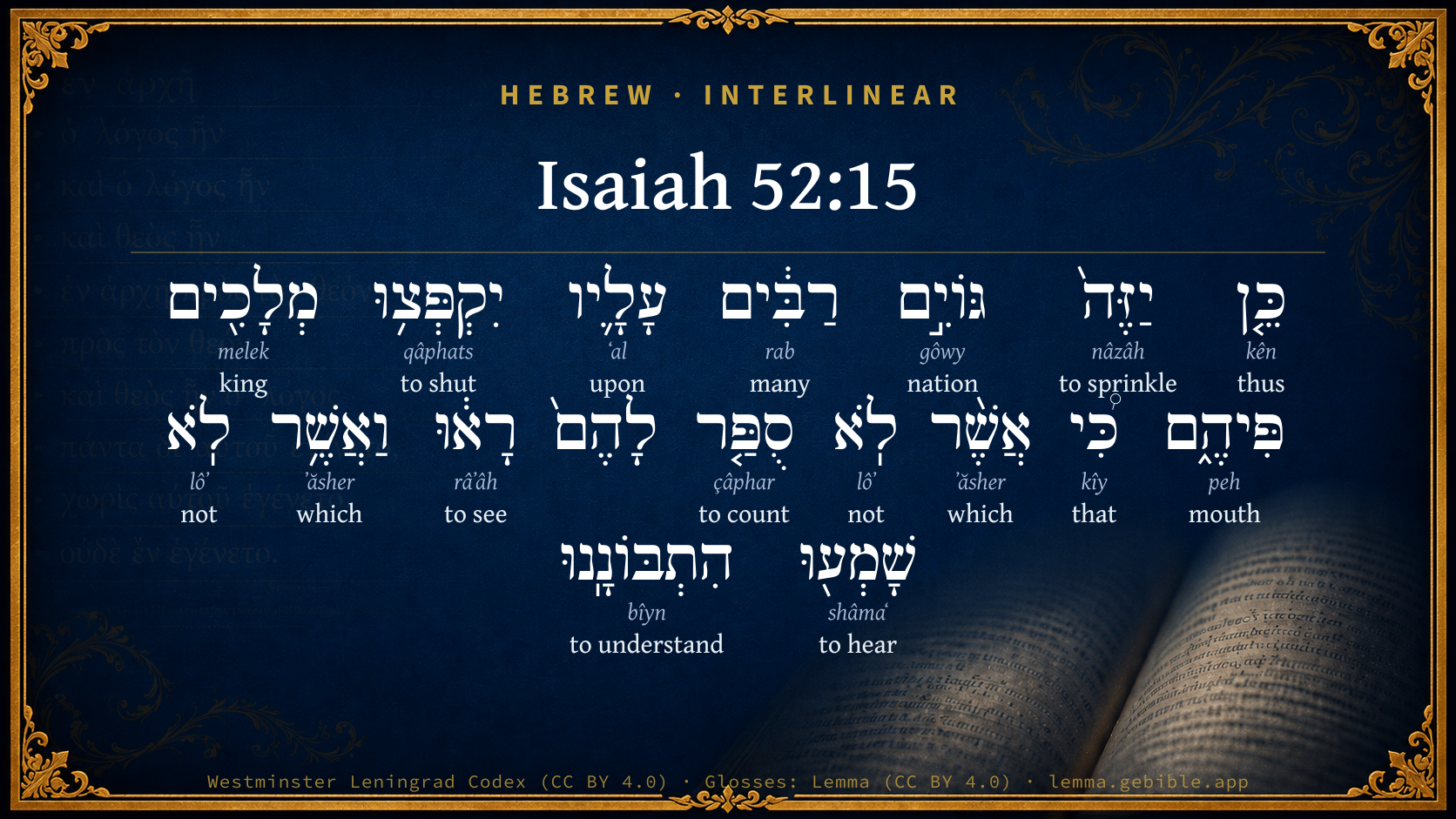
Isaiah 52:15

Hebrew (Westminster Leningrad Codex) Isaiah 52:15 appears in the Hebrew Old Testament. The text above is from the Westminster Leningrad Codex. Each word links to its Strong’s number, a concise gloss, and parsing drawn from the Open Scriptures Hebrew Bible morphology. Click any word for its full Brown-Driver-Briggs (BDB) entry.
Download image
Cite this verse

Isaiah 52:15 (World English Bible). Public Domain. Lemma interlinear Bible study tool, https://lemma.gebible.app/v/isaiah/52/15.

Show BibTeX & RIS
BibTeX
RIS
English Translation
so shall he sprinkle many nations; kings shall shut their mouths at him: for that which had not been told them shall they see; and that which they had not heard shall they understand.
World English Bible · Public Domain
Download a study sheet

One document with this verse’s original text, its word-by-word gloss line, the meaning frame, cross-references with their text, attributed commentary, and full source and license credits — printable, and it pastes into notes with its structure intact.

This verse Autodidact and up

Study sheet (.html) Plain text (.txt)

A passage Seminary Student

Up to 50 verses in one chapter. A passage sheet keeps up to 6 commentary sources and 12 cross-references per verse, in the order this page ranks them, and says so on the sheet whenever that leaves anything out. Ask for a single verse and you get the Autodidact verse sheet above.

Everything on this page stays free to read, with no account — the sheet is a download of what is already on screen, not access to it.

Want to remove ads? Support Godless Engineer
Compare translations 3

The same verse in 3 English versions, stacked beneath the original-language interlinear above. Click any original word for its lexicon entry.

Each is an independent rendering of the whole verse — the interlinear is not word-aligned to these translations.

Highlighted words mark where these versions differ — a whole-verse word diff, not a word-by-word alignment.

  • World English Bible Public Domain
    so shall he sprinkle many nations; kings shall shut their mouths at him: for that which had not been told them shall they see; and that which they had not heard shall they understand.
  • King James Version Public Domain
    So shall he sprinkle many nations; the kings shall shut their mouths at him: for that which had not been told them shall they see; and that which they had not heard shall they consider.
  • unfoldingWord Literal Text CC BY-SA 4.0
    so he will sprinkle many nations. Kings will shut their mouths because of him, for what had not been told to them, they will see, and what they had not heard, they will understand.”

unfoldingWord Literal Text — © unfoldingWord, licensed CC BY-SA 4.0. Word-aligned USFM3 via Door43 (git.door43.org/unfoldingWord/en_ult).

Versions to compare (up to 4)

3 of 4 selected

Show all 17 translations

Every available English version of this verse, each an independent rendering of the whole verse.

  • World English Bible Public Domain
    so shall he sprinkle many nations; kings shall shut their mouths at him: for that which had not been told them shall they see; and that which they had not heard shall they understand.
  • Berean Standard Bible Public Domain
    so He will sprinkle many nations. Kings will shut their mouths because of Him. For they will see what they have not been told, and they will understand what they have not heard.
  • Majority Standard Bible Public Domain
    so He will sprinkle many nations. Kings will shut their mouths because of Him. For they will see what they have not been told, and they will understand what they have not heard.
  • King James Version Public Domain
    So shall he sprinkle many nations; the kings shall shut their mouths at him: for that which had not been told them shall they see; and that which they had not heard shall they consider.
  • American Standard Version (1901) Public Domain
    so shall he sprinkle many nations; kings shall shut their mouths at him: for that which had not been told them shall they see; and that which they had not heard shall they understand.
  • Revised Version (1885) Public Domain
    so shall he sprinkle many nations; kings shall shut their mouths at him: for that which had not been told them shall they see; and that which they had not heard shall they understand.
  • Douay-Rheims (1899) Public Domain
    He shall sprinkle many nations, kings shall shut their mouth at him: for they to whom it was not told of him, have seen: and they that heard not, have beheld.
  • Young's Literal Translation Public Domain
    So doth he sprinkle many nations. Concerning him kings shut their mouth, For that which was not recounted to them they have seen, And that which they had not heard they have understood!
  • Literal Standard Version CC BY-SA 4.0
    So He sprinkles many nations. Kings shut their mouth concerning Him, || For that which was not recounted to them they have seen, || And that which they had not heard they have understood!
  • Unlocked Literal Bible CC BY-SA 4.0
    Even so, my servant will sprinkle many nations and kings will shut their mouths because of him. For that which they had not been told, they will see, and that which they had not heard, they will understand.
  • unfoldingWord Literal Text CC BY-SA 4.0
    so he will sprinkle many nations. Kings will shut their mouths because of him, for what had not been told to them, they will see, and what they had not heard, they will understand.”
  • Darby Bible Public Domain
    -- so shall he astonish many nations; kings shall shut their mouths at him: for what had not been told them shall they see, and what they had not heard shall they consider.
  • World Messianic Bible Public Domain
    so he will cleanse many nations. Kings will shut their mouths at him; for they will see that which had not been told them, and they will understand that which they had not heard.
  • Webster's Bible Public Domain
    So shall he sprinkle many nations; the kings shall shut their mouths at him: for that which had not been told them shall they see; and that which they had not heard shall they consider.
  • Free Bible Version CC BY-SA 4.0
    He will surprise many nations, and kings will keep quiet because of him—for they'll see what they haven't been told, and they'll understand what they hadn't heard.
  • Bible in Basic English Public Domain
    So will nations give him honour; kings will keep quiet because of him: for what had not been made clear to them they will see; and they will give their minds to what had not come to their ears.
  • JPS Tanakh (1917) Public Domain
    So shall he startle many nations, kings shall shut their mouths because of him; for that which had not been told them shall they see, and that which they had not heard shall they perceive.

Literal Standard Version (2020), Covenant Press — licensed CC BY-SA 4.0. Text via the HelloAO Bible API (eBible.org). Unlocked Literal Bible (unfoldingWord) — licensed CC BY-SA 4.0. Text via the HelloAO Bible API (eBible.org). unfoldingWord Literal Text — © unfoldingWord, licensed CC BY-SA 4.0. Word-aligned USFM3 via Door43 (git.door43.org/unfoldingWord/en_ult). Free Bible Version, Dr. Jonathan Gallagher — licensed CC BY-SA 4.0. Text via the HelloAO Bible API (eBible.org).

Word by word

More ways to search: Search by grammar → Find every occurrence → Compare this word →

Practice this passage: Drill this verse → Learn its vocabulary →

יִקְפְּצ֥וּ
qâphats
H7092
“to shut”
Verb, Qal, Imperfect, 3rd Person, Masculine, Plural
Part of Speech
Verb
Stem
Qal
Form
Imperfect
Person
3rd Person
Gender
Masculine
Number
Plural
Full BDB Definition

Origin: a primitive root

TWOT: 2051

to draw together, close, shut, shut up, stop up - (Qal) to shut - (Niphal) - to draw oneself together (of death) - to be shut up to death - (Piel) springing, skipping (participle)
  1. כֵּ֤ן kên H3651 “thus” Particle, Demonstrative
  2. יַזֶּה֙ nâzâh H5137 “to sprinkle” Verb, Hiphil, Imperfect, 3rd Person, Masculine, Singular
  3. גּוֹיִ֣ם gôwy H1471 “nations” Noun, Common, Masculine, Plural, Absolute
  4. רַבִּ֔ים rab H7227 “many” Adjective, Adjective, Masculine, Plural, Absolute
  5. עָלָ֛יו ʻal H5921 “upon · him” Preposition + Suffix, Personal, 3rd Person, Masculine, Singular
  6. מְלָכִ֖ים melek H4428 “kings” Noun, Common, Masculine, Plural, Absolute
  7. פִּיהֶ֑ם peh H6310 “mouth · their” Noun, Common, Masculine, Singular, Construct + Suffix, Personal, 3rd Person, Masculine, Plural
  8. כִּ֠י kîy H3588 “that” Conjunction
  9. אֲשֶׁ֨ר ʼăsher H834 “which” Particle, Relative
  10. לֹֽא lôʼ H3808 “not” Particle, Negative
  11. סֻפַּ֤ר çâphar H5608 “to count” Verb, Pual, Perfect, 3rd Person, Masculine, Singular
  12. רָא֔וּ râʼâh H7200 “to see” Verb, Qal, Perfect, 3rd Person, Common, Plural
  13. וַאֲשֶׁ֥ר ʼăsher H834 “and · which” Conjunction + Particle, Relative
  14. לֹֽא lôʼ H3808 “not” Particle, Negative
  15. שָׁמְע֖וּ shâmaʻ H8085 “to hear” Verb, Qal, Perfect, 3rd Person, Common, Plural
  16. הִתְבּוֹנָֽנוּ bîyn H995 “to understand” Verb, Hithpolel, Perfect, 3rd Person, Common, Plural

About this verse

These counts appear in no published source. They are computed here, from the morphology-tagged text and Lemma’s own curated glosses. What Lemma adds →

18
words
15
distinct lemmas
Prophets
section

Notable vocabulary

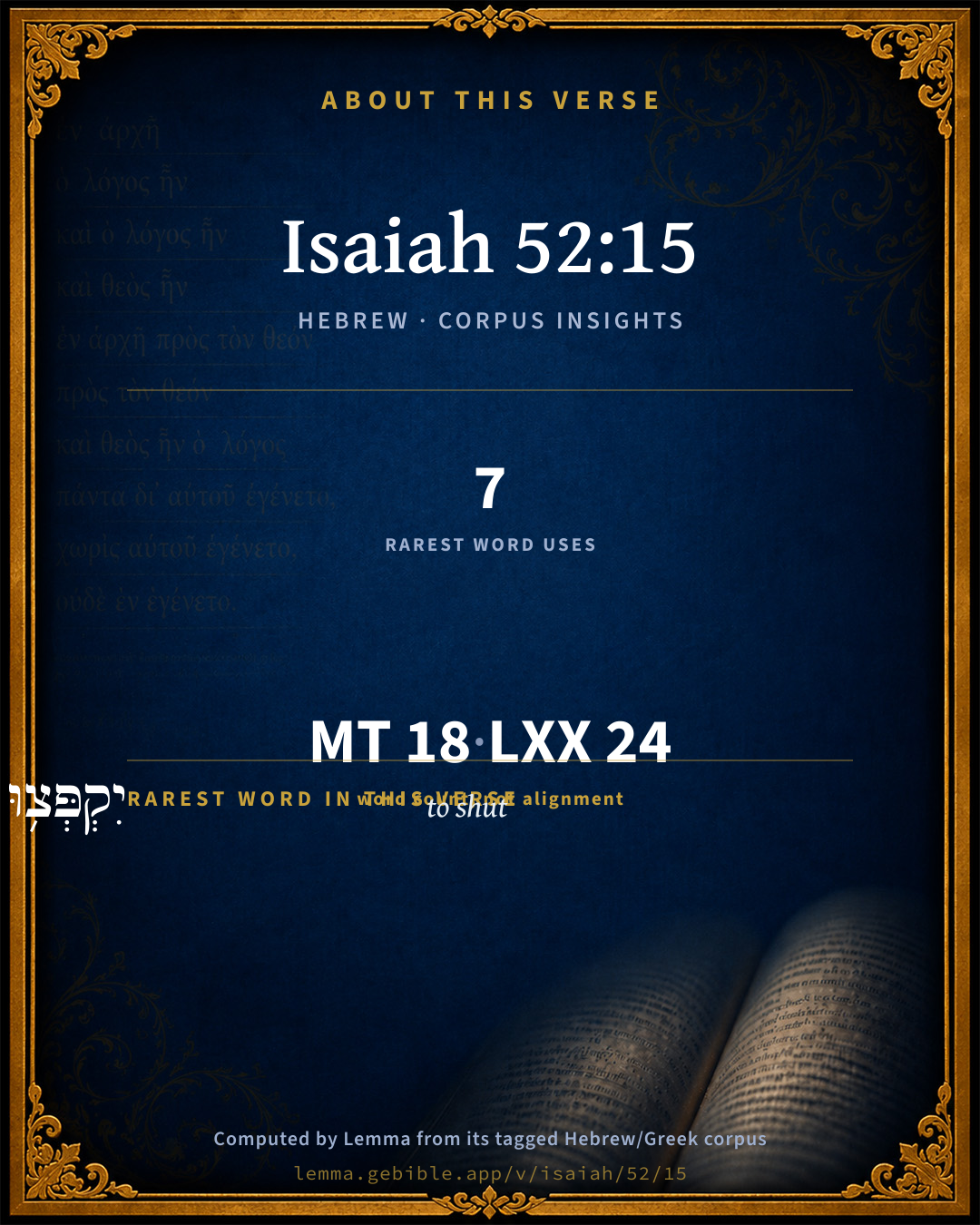
The rarest word here is יִקְפְּצ֥וּ to shut H7092 — appearing just 7 times in the whole Hebrew Bible.

Shared distinctive vocabulary

יִקְפְּצ֥וּ to shut H7092 occurs in 7 verses of the Hebrew Bible. Also found in:

Grammatical profile

  • 6 verbs
  • 3 nouns
  • 1 adjective
  • 2 prepositions
  • 1 conjunction
  • 5 particles

Verb forms

  • יַזֶּה֙ Hiphil · Imperfect
  • יִקְפְּצ֥וּ Qal · Imperfect
  • סֻפַּ֤ר Pual · Perfect
  • רָא֔וּ Qal · Perfect
  • שָׁמְע֖וּ Qal · Perfect
  • הִתְבּוֹנָֽנוּ Hithpolel · Perfect

Repetition

Words recur within this verse — often emphatic in Hebrew:

  • אֲשֶׁ֨ר which H834 ×2
  • לֹֽא not H3808 ×2

Hebrew & Septuagint length

In English translation the verse runs 34 words from the Hebrew and 34 from the Septuagint (LXX English) — the same length.

A rough comparison of the two English renderings, which tokenize alike — not a word-level alignment.

Word counts can differ between the Hebrew and the Greek without any difference in meaning — e.g. the Hebrew direct-object marker אֵת has no separate Greek word, and Greek often adds the article ὁ.

In the original languages it is 18 Hebrew tokens and 24 Greek tokens — but the two are counted differently (Hebrew bundles its prefixes and suffixes into one token; the Greek is in lemma form), so that isn’t a like-for-like length.

Cross-references

22

Topical passages linked to Isaiah 52:15 in the Treasury of Scripture Knowledge — connected by theme and wording, ordered by reader-vote popularity; previews shown in the World English Bible.

  • Romans 15:20–21 yes, making it my aim to preach the Gospel, not where Christ was already named, that I might not build on another's foundation.
  • Isaiah 49:7 Thus says Yahweh, the Redeemer of Israel, [and] his Holy One, to him whom man despises, to him whom the nation abhors, to a servant of rulers: Kings shall see and arise; princes, and they shall worship; because of Yahweh who is faithful, [even] the Holy One of Israel, who has chosen you.
  • Psalms 72:9–11 Those who dwell in the wilderness shall bow before him. His enemies shall lick the dust.
  • Isaiah 55:5 Behold, you shall call a nation that you don't know; and a nation that didn't know you shall run to you, because of Yahweh your God, and for the Holy One of Israel; for he has glorified you.
  • Ezekiel 36:25 I will sprinkle clean water on you, and you shall be clean: from all your filthiness, and from all your idols, will I cleanse you.
  • 1 Peter 1:2 according to the foreknowledge of God the Father, in sanctification of the Spirit, that you may obey Jesus Christ and be sprinkled in his blood: Grace to you and peace be multiplied.
  • Isaiah 49:23 Kings shall be your nursing fathers, and their queens your nursing mothers: they shall bow down to you with their faces to the earth, and lick the dust of your feet; and you shall know that I am Yahweh; and those who wait for me shall not be disappointed.
  • Micah 7:16–17 The nations will see and be ashamed of all their might. They will lay their hand on their mouth. Their ears will be deaf.
  • Zechariah 2:13 Be silent, all flesh, before Yahweh; for he has roused himself from his holy habitation!"
  • Matthew 28:19 Therefore go, and make disciples of all nations, baptizing them in the name of the Father and of the Son and of the Holy Spirit,
  • Acts 2:33 Being therefore exalted by the right hand of God, and having received from the Father the promise of the Holy Spirit, he has poured out this, which you now see and hear.
  • Romans 16:25–26
  • Ephesians 3:5–9 which in other generations was not made known to the children of men, as it has now been revealed to his holy apostles and prophets in the Spirit;
  • Titus 3:5–6 not by works of righteousness, which we did ourselves, but according to his mercy, he saved us, through the washing of regeneration and renewing by the Holy Spirit,
  • Hebrews 9:13–14 For if the blood of goats and bulls, and the ashes of a heifer sprinkling those who have been defiled, sanctify to the cleanness of the flesh:
  • Hebrews 10:22 let's draw near with a true heart in fullness of faith, having our hearts sprinkled from an evil conscience, and having our body washed with pure water,
  • Hebrews 11:28 By faith, he kept the Passover, and the sprinkling of the blood, that the destroyer of the firstborn should not touch them.
  • Hebrews 12:24 to Jesus, the mediator of a new covenant, and to the blood of sprinkling that speaks better than that of Abel.
  • Numbers 8:7 Thus shall you do to them, to cleanse them: sprinkle the water of cleansing on them, let them shave their whole bodies with a razor, and let them wash their clothes, and cleanse themselves.
  • Job 29:9–10 The princes refrained from talking, And laid their hand on their mouth;
  • Job 40:4 "Behold, I am of small account. What shall I answer you? I lay my hand on my mouth.
  • Isaiah 51:5 My righteousness is near, my salvation is gone forth, and my arms shall judge the peoples; the isles shall wait for me, and on my arm shall they trust.

Cross-references courtesy of OpenBible.info (CC BY 4.0).

Hebrew and Greek witnesses Masoretic Hebrew ↔ Greek Septuagint

The same verse in the two great witnesses to the Old Testament, shown verse-for-verse.

These are two independent witnesses, not word-aligned to each other, and the Septuagint is shown in lemma (dictionary) form.

Hebrew Isaiah 52:15 Masoretic · Westminster Leningrad Codex

כֵּ֤ן יַזֶּה֙ גּוֹיִ֣ם רַבִּ֔ים עָלָ֛יו יִקְפְּצ֥וּ מְלָכִ֖ים פִּיהֶ֑ם כִּ֠י אֲשֶׁ֨ר לֹֽא סֻפַּ֤ר לָהֶם֙ רָא֔וּ וַאֲשֶׁ֥ר לֹֽא שָׁמְע֖וּ הִתְבּוֹנָֽנוּ

so shall he sprinkle many nations; kings shall shut their mouths at him: for that which had not been told them shall they see; and that which they had not heard shall they understand.

World English Bible · Public Domain

Greek LXX Isaiah 52:15 Septuagint · lemma form

οὕτως θαυμάζω ἔθνος πολύς ἐπί αὐτός καί συνἔχω βασιλεύς ὁ στόμα αὐτός ὅτι ὅς οὐ ἀναἀγγέλλω περί αὐτός ὁράω καί ὅς οὐ ἀκούω συνἵημι

Thus shall many nations wonder at him; and kings shall keep their mouths shut: for they to whom no report was brought concerning him, shall see; and they who have not heard, shall consider.

LXX2012 (modern English Septuagint) · Public Domain

On this verse, Adam Clarke's Commentary discusses the Septuagint’s reading. Read the note in Commentary ↓

Hebrew: Westminster Leningrad Codex (CC BY 4.0). Greek: Septuagint (public domain); English from LXX2012 (modern English Septuagint) (Public Domain). How the Septuagint differs from the Hebrew →

Targum (Aramaic paraphrase)

1

The Targum is the ancient Jewish Aramaic paraphrase of the Hebrew Scriptures — an interpretive translation, not the Hebrew text itself. Onkelos (literal) and Pseudo-Jonathan (expansive) render the Torah, and Jonathan the Prophets. Coverage is partial: where no permissively-licensed English translation exists for a verse, only the Aramaic is shown. This is verse-level text, not a word-by-word alignment to the Hebrew.

  1. Targum Jonathan Prophets (Joshua–Malachi)
    כֵּן יְבַדַר עַמְמִין סַגִיאִין עֲלוֹהִי יִשְׁתְּקוּן מַלְכִין יְשַׁווּן יְדֵיהוֹן עַל פּוּמְהוֹן אֲרֵי דְלָא אִשְׁתָּעִיאוּ לְהוֹן חֲזוֹ וּדְלָא שְׁמָעוּ אִסְתַּכֵּלוּ:

    Thus shall he scatter many nations; before him kings shall keep silence: they shall put their hands upon their mouths, for that which had not been told them shall they see: and that which they had not heard shall they consider.

    Targum Jonathan — Aramaic: “Mikraot Gedolot” (public domain). English: “Sefaria Community Translation” (CC0 1.0 (public-domain dedication)); “London "Chaldee Paraphrase," 1871” (public domain). Text via Sefaria.

Commentary

Notes on Isaiah 52:15 from classic Christian and Jewish commentators (each source and its license shown beneath its notes). The classic Christian expositions comment on the surrounding passage and are grouped to its opening verse, so a note may address several verses; the Jewish commentaries on the Tanakh (Rashi and others) are per-verse, so they appear only where the commentator wrote on this verse.

Lemma curates 59 commentaries, every one of them public domain or Creative Commons licensed, each selected and text-cleaned for this edition rather than reprinted as found. About our sources →

Trapp's Complete Commentary

John Trapp

Isa 52:15 So shall he sprinkle many nations; the kings shall shut their mouths at him: for [that] which had not been told them shall they see; and [that] which they had not heard shall they consider.

Ver. 15. So shall he sprinkle many nations.] With his doctrine, {Eze 20:46 Amo 7:16} or with his blood, that blood of sprinkling. See Heb 10:22. Or with water in baptism, wherein sprinkling is sufficient.

Kings shall shut their mouths at him.] As being astonished at his prudence and prosperity. {Isa 52:13} They shall also silently and reverently submit to his sceptre, and to the laws of his kingdom, with all humble observance.

For that which had not been told them.] The mystery of the gospel so long time concealed. {Rom 15:21; Rom 16:25}

Shall they see,] viz., With the eyes of their faith, God enlightening both organ and object.

And that which they had not heard.] Gospel truths. See 1Co 2:9. {See Trapp on "1Co 2:9"}

John Trapp, A Commentary or Exposition upon All the Books of the Old and New Testament (1647–1656) — public domain. Text from a community e-Sword module.

The Biblical Illustrator

Joseph S. Exell

Isa_52:15

So shall He sprinkle many nation

Sprinkling the nations

Sprinkle; possibly startle, cause to rise up in wonder and reverence.

The nations were familiar with the afflictions and abjectness of the Servant; suddenly, and without intimation of it, they see His elevation and stand up in reverential silence, before Him. (A.B. Davidson, D.D.)

The peculiar doctrines of Christianity the subject of ancient prophecy

I. THE ACCOMPLISHMENT OF THIS PROPHECY IN GENERAL. This prophecy hath been in part already accomplished, in the diffusive spread of the Gospel throughout the world: many nations whereof have been plentifully sprinkled with its Divine doctrines, and made nominal Christians; and many individuals in those nations been made real converts, by virtue of that blood of sprinkling which speaketh better things than the blood of Abel.

II. SOME OF THOSE PECULIAR DOCTRINES OF CHRISTIANITY WHICH WE MAY SUPPOSE TO BE HERE REFEREED TO, most of which were in a great measure, and some of them altogether, unknown to the world, before the Messiah came.

1. The doctrine of mans apostacy, and the way wherein moral evil made its first entrance into the world.

2. The method of mans recovery from the miseries of his apostate state, by the mediation and redemption of Christ.

3. The renovation of our natures by the gracious operations of the Holy Spirit.

4. The doctrine of the ever-blessed Trinity.

5. The incarnation of the Son of God.

6. The doctrine of grace.

7. The gracious and effectual operations of the Holy Spirit on the heart of man.

8. The resurrection of the body.

9. Several particular circumstances relating to the final judgment are the peculiar discoveries of the Christian revelation, that Christ will be the Judge, etc.

10. The undoubted certainty of a future state of rewards and punishments. (A. Mason, M.A.)

The risen Christ winning the nations

Bishop George Augustus Selwyn was a splendid type of the muscular Christian. As a missionary he was a mighty force, and as a friend he was universally beloved. An incident in his career as Missionary Bishop of New Zealand well shows what manner of man he was. Governor Grey and Bishop Selwyn were out together on a walking expedition, and it was Easter Sunday. Christ has risen! Selwyn reverently welcomed the day, and his companion joined, He has risen indeed! They were communing in that spirit when a bundle of letters was brought into the tent. One to Selwyn the news of the death of Siapo, a Loyalty Islander, who had become a Christian under his teaching, and who was being educated with other natives at his seminary in Auckland. The Bishop, overcome with grief, burst into tears; then he broke some moments of silence with the words, Why, you have not shed a single tear! No, said the Governor, I have been so wrapped in thought that I could not weep. I have been thinking of the prophecy that men of every race were to be assembled in the kingdom of heaven. I have tried to imagine the wonder and joy prevailing there at the coming of Siapo, the first Christian of his race. He would be glad evidence that another people of the world had been added to the teaching of Christ. Yes, yes, said Selwyn, drying his tears, that is the true idea to entertain, and I shall not weep any more. (Christian Age.)

The kings shall shut their mouths at Him

The wondrous monarchy

I. THE UNIQUE SPECTACLE WHICH CHRIST PRESENTS. All that is great in this spectacle gathers round what this Servant is to be and do. We observe five distinguishing features--

1. Wondrous wisdom. My Servant shall deal prudently. Jesus was filled with the spirit of Wisdom and understanding; with a keen and piercing glance He saw men through and through. But it was not only in confounding His enemies that His superhuman wisdom was shown; it was also in the means He used for establishing that kingdom which He came to found. Means on which the world would have relied He forbade and abjured. Means never tried before were the only ones He would use. He would have no sword employed either to defend Himself, or to, extend His sway, but equipped His warriors only with power from on high !

2. Wondrous sorrow (Isa_52:14). He was a man of sorrows

3. Wondrous elevation. He shall arise, and be lifted up, and be glorified exceedingly. These words exactly indicate the resurrection, the ascension and the exaltation to mediatorial glory.

4. Wondrous redeeming efficacy. So shall He sprinkle many nations. As His sorrow was intense, so shall His redeeming power be large, as if the one were a recompense for the other. There were (among others) two kinds of sprinkling enjoined by the Mosaic law, to either or to both of which a reference may be intended here. The sprinkling of blood, being towards and on the mercy-seat, was God-wards; the sprinkling of water, as on the Levite or leper, was on the person, manwards. So the work of Christ has this double aspect. The blood-shedding was Gods own atoning act in Him, for us; the cleansing grace is Gods purifying act, through Him, in us.

5. Wondrous uniting power. So shall He sprinkle many nations. He would absolve and sanctify, not the Jew only, but also the Greek, and thus abolish the wall of partition between Israel and the heathen, and gather into one holy Church with Israel, those who had hitherto been pronounced unclean. How vividly is the fulfilment of this portrayed in Act_10:1-48.

II. WHAT IS THERE HERE THAT SHOULD LEAD KINGS, IN PARTICULAR, TO DO THIS? Is it that though kings and princes know all that earth has to give of luxury and splendour, they see here a pomp that outshines all beside? That may be so, but we think the mason lies deeper still. It is evidently on account of something before unknown that they are to shut their mouths, for the text goes on to say, That which had not been told them shall they see, and that which they had not heard shall they consider. Around what do the thoughts and associations of kings gather? Do they not gather round the sceptre, crown and empire? Do they not naturally weigh in the balance one monarchy against another? Surely. Well, here is such a monarchy as earth had never known before, and one that will ever stand absolutely alone.

1. In this monarchy alone right and might are entirely equal.

2. This monarchy is based on the King s own self-sacrifice.

3. How did He set up this kingdom? A few poor fishermen undertook to instruct and convert the world. The success was prodigious.

4. This monarchy was based on the Kings own priesthood.

5. The power of love is the only power that gathers men round the Cross

6. This monarchy was inaugurated by the issue of a royal pardon offered to the worst of sinners, beginning at Jerusalem.

7. This is a monarchy that, uniting men under its sceptre, creating a new power of love towards itself, creates also a new power of love for man towards man, as well as of man for Jesus; and, strange as it may seem, in gathering men of every tribe and tongue under its sceptre, it makes them forget their diversity, and brings them to feel their oneness in one common God and Father; and by the pulse-beat of a common life in all the nations, solves the long-vexed problem of the unity of the human race! Nor is this all.

8. Everywhere the one force which holds together the subjects of this Monarch is love!--not fear, not constraint, but love. Is there nothing in such a monarchy as this to give a clue to the meaning of the expression, Kings shall shut their mouths at Him? The expression evidently denotes the effect which the report or the sight of such a monarchy should produce upon them. Some take it as meaning that they should shut their mouths in silent fear. Others, that they should withdraw the edicts against Christianity. We rather, with Mr. Urwick, take it as indicating the awe-inspiring power of Christ. There may be yet a deeper meaning in the expression, shall shut their mouths--a meaning which applies only to Christian kings, and not to them simply as kings, but rather as Christians in common with others. The words may indicate the silence induced by deep emotion. (J. Culross, D.D.)

.

The Biblical Illustrator, edited by Joseph S. Exell (c. 1880s–1900s) — public domain. Text from a community e-Sword module.

Tyndale Open Study Notes

Tyndale Open Resources

52:15 startle many nations: They would be amazed that a rescuer would appear so weak and helpless and would stand speechless. • What they will see and what they will understand will be in complete contrast to anything they had previously imagined.

Tyndale Open Study Notes — © Tyndale Open Resources, licensed CC BY-SA 4.0. Text via the HelloAO Bible API.

Jamieson, Fausset & Brown

Robert Jamieson, A. R. Fausset & David Brown

sprinkle many--GESENIUS, for the antithesis to "be astonished," translates, "shall cause . . . to exult." But the word universally in the Old Testament means either to sprinkle with blood, as the high priest makes an expiation (Lev 4:6; Lev 16:18-19); or with water, to purify (Eze 36:25; compare as to the Spirit, Act 2:33), both appropriate to Messiah (Joh 13:8; Heb 9:13-14; Heb 10:22; Heb 12:24; Pe1 1:2). The antithesis is sufficient without any forced rendering. Many were astonished; so many (not merely men, but) nations shall be sprinkled. They were amazed at such an abject person claiming to be Messiah; yet it is He who shall justify and purify. Men were dumb with the amazement of scorn at one marred more than the lowest of men, yet the highest: even kings (Isa 49:7, Isa 49:23) shall be dumb with awe and veneration ("shut . . . mouths"; Job 29:9-10; Mic 7:16).

that . . . not . . . told them--the reason why kings shall so venerate them; the wonders of redemption, which had not been before told them, shall then be announced to them, wonders such as they had never heard or seen parallelled (Isa 55:1; Rom 15:21; Rom 16:25-26).

The speaker, according to HORSLEY, personates the repenting Jews in the latter ages of the world coming over to the faith of the Redeemer; the whole is their penitent confession. This view suits the context (Isa 52:7-9), which is not to be fully realized until Israel is restored. However, primarily, it is the abrupt exclamation of the prophet: "Who hath believed our report," that of Isaiah and the other prophets, as to Messiah? The infidel's objection from the unbelief of the Jews is anticipated and hereby answered: that unbelief and the cause of it (Messiah's humiliation, whereas they looked for One coming to reign) were foreseen and foretold.

Next: Isaiah Chapter 53

Jamieson, Fausset & Brown — Commentary Critical and Explanatory on the Whole Bible (1871) — public domain (CC PDM 1.0). Text via the HelloAO Bible API.

Adam Clarke's Commentary

Verse 15. So shall he sprinkle many nations] I retain the common rendering, though I am by no means satisfied with it. "יזה yazzeh, frequent in the law, means only to sprinkle: but the water sprinkled is the accusative case; the thing on which has על al or אל el. θαυμασονταιο, makes the best apodosis. ינהג yenahag would do. ינהרו yinharu is used Isa 2:2; Jer 31:12; Jer 51:14, but is unlike. 'Kings shall shut,' c., is good, but seems to want a first part." - SECKER. Munster translates it, faciet loqui, (de se) and in his note thus explains it: יזה yazzeh proprie significat spargere et stillas disseminare; hic hero capitur pro loqui, et verbum disseminare. "יזה yazzeh properly signifies to sprinkle, and to scatter about drops; but it here means to speak, and to disseminate the word." This is pretty much as the Rabbins Kimchi and Sal. ben Melec explain it, referring to the expression of "dropping the word." But the same objection lies to this as to the common rendering; it ought to be על גוים(דבר)יזה yazzeh (debar) al goyim. Bishop Chandler, Defence, p. 148, says, "that to sprinkle is used for to surprise and astonish, as people are that have much water thrown upon them. And this sense is followed by the Septuagint." This is ingenious, but rather too refined. Dr. Durell conjectures that the true reading may be יהזו yechezu, they shall regard, which comes near to the θαυμασονται of the Septuagint, who seem to give the best sense of any to this place.

"I find in my papers the same conjecture which Dr. Durell made from θαυμασονται in the Septuagint. And it may be added that חזה chazah is used to express 'looking on any thing with admiration,' Ps 11:7; Ps 17:15; Ps 27:4; Ps 63:2; Son 6:13. It is particularly applied to 'looking on God,' Ex 24:11, and Job 19:26. Gisbert Cuper, in Observ. lib. ii. 1, though treating on another subject, has some observations which show how nearly οραω and θαυμαζω are allied, which, with the peculiar sense of the verb חזה chazah above noted, add to the probability of θαυμασονται being the version of יחזו yechezu in the text: οἱ δε νυ λαοι Παντες ες αυτον ὁρωσι. Hesiod., id est. cum veneratione quadam adminantur. Hinc οραω et θαυμαζω junxit Themistius Or. i. Ειτα παυσονται οἱ ανθρωποι προς σε μονον ὁρωνες, και σε μονον θαυμαζοντες. Theophrastus in Charact. c. 3. Ενθυμη ὡς αποβλεπουσιν εις σε οἱ ανθρωποι. Hence the rendering of this verse seems to be -

"So many nations shall look on him with admiration

Kings shall stop their mouths - " DR. JUBB.

Does not sprinkling the nations refer to the conversion and baptism of the Gentiles? Many nations shall become proselytes to his religion.

Kings shall shut their mouths at him] His Gospel shall so prevail that all opposition shall be finally overcome; and kings and potentates shall be overwhelmed with confusion, and become speechless before the doctrines of his truth. When they hear these declared they shall attentively consider them, and their conviction of their truth shall be the consequence.

For that which had not been told them] The mystery of the Gospel so long concealed. See Ro 15:21; Ro 16:25.

Shall they see] With the eyes of their faith; God enlightening both organ and object.

And that which they had not heard] The redemption of the world by Jesus Christ; the conversion of the Gentiles, and making them one flock with the converted Jews. - TRAPP

Adam Clarke's Commentary on the Bible (1810–1826) — public domain. Text from a community e-Sword/MySword module.

Ellicott's Commentary for English Readers

(15) So shall he sprinkle many nations . . .—The words have been very differently rendered by, He shall cause to spring up, i.e., shall startle, He shall scatter, He shall fling away, or, Many nations shall marvel at him. On the whole, however, admitting the difficulty of the passage, the Authorised version seems preferable. The “sprinkling” is that of the priest who cleanses the leper (Lev_4:6; Lev_4:17), and this was to be done by Him who was Himself counted as a leper “smitten of God” (Isa_53:4). We may probably trace an echo of the words in the “sprinkling clean water” of Eze_36:25, in the “blood of sprinkling,” of Heb_10:22; Heb_12:24. Here it comes as an explanation of the paradox that the Servant of Jehovah was to bring in “many nations” into the holy city, and yet that the “uncircumcised and unclean” were not to enter it (Isa_52:1).

The kings shall shut their mouths . . .—The reverence, as in Isa_49:7, Job_29:9; Job_40:4, is that of silent wonder at the change which has passed over the suffering Servant. Wis_5:1-5 presents an interesting parallel, the reference there being to the person of the ideal righteous sufferer. In that case, as in this, there was, so to speak, a transfiguration “beyond all that men looked for.”

A Bible Commentary for English Readers, edited by Charles John Ellicott (1878–1897) — public domain. Text from a community e-Sword module.

The Cambridge Bible for Schools and Colleges

gen. ed. J. J. S. Perowne

15. so shall he sprinkle many nations] The verb rendered “sprinkle” means elsewhere to “scatter (a liquid) in small drops,” and its usage is confined to the ceremonial act illustrated by Lev_4:6; Num_19:18 f. etc. This is the sense intended by the A.V. and the ancient authorities (Aquila, Theodotion, Vulg.) which it follows; the antithesis suggested being that as the Servant had been shunned by many as unclean, so he shall (metaphorically) “sprinkle” them, i.e. make them clean. But this interpretation imports into the passage ideas which are not expressed, and is besides inadmissible on grammatical grounds; i.e. the verb always means to sprinkle (a liquid), not to besprinkle (a person or thing). The only rendering at all compatible with the ceremonial use of the word would be that of the Targ.: “so shall he scatter many nations,” where the nations are actually, by a most unnatural metaphor, compared to spirting drops of water. To reach a satisfactory sense it is only necessary to assume that the Hebrew verb had a wider range of meaning than is represented in the O.T. It might be causative of a verb (found in Arabic) meaning to “spring” or “leap,” just as the English “sprinkle” is perhaps etymologically the causative of “spring.” We may thus render with R.V. marg. so will he startle many nations, i.e. “cause them to spring” in surprise, or (better) “cause them to rise up suddenly” in reverential admiration. Cf. ch. Isa_49:7 and Job_29:8 (“The aged arose and stood up”). Most modern writers agree in this explanation, although some have recourse to emendation of the text. The LXX. expresses the same general idea (θαυμάσονται ἔθνη πολλά, “many nations shall marvel”).

kings shall shut their mouths because of him (R.V. marg.)] Comp. again Job’s touching description of the respect paid to him in the days of his prosperity: “The princes refrained talking, and laid their hand on their mouth. The nobles held their peace, and their tongue cleaved to the roof of their mouth” (Isa_29:9 f.). The art. before “kings” should be omitted (as in R.V.).

for that which had not been told them &c.] The meaning is either that the exaltation of the Servant is an event of which they had received no announcement beforehand, or that it is one the like of which had never been known. If the reference be to the coming elevation of Israel, either sense would be suitable; if on the other hand the resurrection of an individual be predicted, the second would be more appropriate.

The Cambridge Bible for Schools and Colleges (gen. ed. J. J. S. Perowne; Cambridge University Press, 1878–1918) — public domain. Text from a community e-Sword module.

John Gill's Exposition

So shall he sprinkle many nations,.... This is not to be understood of water baptism, for though this has been administered in many nations, yet not by Christ, nor done by sprinkling; rather of the grace of the Spirit, which is expressed by water, and its application by sprinkling, and is of a cleansing and sanctifying nature, and which Gentiles are made partakers of; but better of the blood of Christ, called the blood of sprinkling, by which the conscience is purged from dead works, and the heart from an evil conscience, and by which multitudes of many nations are justified and sanctified; though it seems best of all to interpret it of the doctrine of Christ, which is compared to rain and dew, and is dropped, distilled, and sprinkled, and falls gently upon the souls of men, and has been published in many nations, with good effect and success. So Kimchi and Ben Melech say the phrase is expressive of speaking. This passage is applied to the Messiah by a Jewish writer (y). The Targum is,

"he will scatter many people;''

and Aben Ezra interprets it of pouring out their blood and taking vengeance on them.

The kings shall shut their mouths at him; astonished at the glories and excellencies of his person and office, as outshining theirs; at his wonderful works of grace and salvation, and as having nothing to object to his doctrines; and if they do not profess them, yet dare not blaspheme them. It seems to denote a reverent attention to them, and a subjection to Christ and his ordinances; and must be understood of their subjects as well as of themselves.

For that which had not been told them shall they see, and that which they had not heard shall they consider; or "understand" (z); this is applied to Christ and his Gospel, in the times of the apostles, Rom 15:20. The Gentiles had not the oracles of God committed to them; could not be told the things of the Gospel, and what relate to Christ, by their oracles, or by their philosophers; nor could they be come at by the light of nature, or by carnal reason; such as the doctrines of a trinity of Persons in the Godhead; of the deity, sonship, and incarnation of Christ; of salvation by him; of justification by his righteousness, pardon by his blood, and atonement by his sacrifice; of the resurrection of the dead, and eternal life: but now Christ and his Gospel are seen and understood by spiritual men; who, besides having a revelation given them, and the Gospel preached unto them, have their eyes opened, and indeed new eyes and understandings given them; so that they have a sight of Christ, of the glory, beauty, and fulness of his person by faith, through the glass of the word, so as to approve of him, appropriate him, and become like unto him; and of his Gospel, and the doctrines of it, so as to like and esteem them, believe them, distinguish them, and look upon them with wonder and pleasure.

(y) Baal Hatturim in Lev. xvi. 14. (z) Sept.; intelligent, Calvin; "intellexerunt", Vitringa.

Next: Isaiah Chapter 53

John Gill's Exposition of the Whole Bible (1746–1763) — public domain (CC PDM 1.0). Text via the HelloAO Bible API.

Haydock's Catholic Bible Commentary

Sprinkle with baptism, (Haydock) and his manifold graces. (Calmet) --- Septuagint, "so many nations shall wonder at him." (Haydock) --- Mouth, out of reverence. How many great princes have submitted to his yoke? (Calmet) --- Beheld. The Gentiles (Menochius) embrace the faith, at the sight of Christ’s miracles. (Calmet)

George Leo Haydock (1774–1849), Haydock's Catholic Family Bible and Commentary, 1859 edition — public domain. Excludes Psalms (Douay-Rheims chapter numbering differs from Protestant) and Deuterocanonical books (Catholic canon only).

Matthew Poole's English Annotations

So; his exaltation shall be answerable to his humiliation.

Shall he sprinkle; either,

1. With his blood, which is called the blood of sprinkling, Heb 12:24; or, shall justify them, as it follows, Isa 53:11, which is frequently expressed by washing, as Psa 51:2,7; Eze 16:9, and by sprinkling clean water, Eze 36:25. Or,

2. With his word or doctrine; which being oft compared to rain or waters, as Deu 32:2; Isa 55:10,11; Hab 2:4, &c, may be said to be sprinkled, as it is said to be dropped, Deu 32:2; Eze 20:46; 21:2. And this sense seems to be most favoured by the following words.

The kings shall shut their mouths at him; shall be silent before him, out of a profound humility, and reverence, and admiration of his wisdom, and an eager desire to hear and receive counsels and oracles from his mouth. Compare Job 29:9-11,21. They shall no more contend with him, nor blaspheme the true God and religion, as they formerly used to do.

For that which had not been told them shall they see; for they shall hear from his mouth many excellent doctrines, which also will be new and strange to them, such as men are very desirous to hear. And particularly they shall hear from him that comfortable doctrine concerning the conversion and salvation of the Gentiles, which was not only new to them, but was strange and incredible to the most of the Jews themselves.

Shall they consider; or, they shall understand; which is added to show that the seeing in the former clause was meant of discerning these things with the eyes of their minds.

Matthew Poole's English Annotations on the Holy Bible (1683–1685) — public domain. Text from a community e-Sword/MySword module.

The Pulpit Commentary

So shall he sprinkle many nations. The Septuagint has, "So shall many nations marvel at him;" and this translation is followed by Gesenius and Ewald. Mr. Cheyne thinks that the present Hebrew text is corrupt, and suggests that a verb was used antithetical to the "astonied" of ver. 14, expressing "joyful surprise." It is certainly hard to see how the idea of "sprinkling," even if it can mean "purifying," comes in here. Kings shall shut their mouths at him; rather, because of him. In reverential awe of his surpassing greatness. (comp. Mic_7:16) That which had not been told them shall they see. They will learn the facts of Christ"s humiliation, sufferings, death, resurrection, and ascension to heaven events that it had never entered into the heart of man to conceive, and of which, therefore, no tongue had ever spoken.

The Pulpit Commentary (1880–1919), ed. H.D.M. Spence-Jones & Joseph S. Exell — public domain. Text from a community e-Sword module.

John Wesley's Explanatory Notes

So - His exaltation shall be answerable to his humiliation. Sprinkle - With his word or doctrine; which being often compared to rain or water, may be said to be sprinkled, as it is said to be dropped, Deut. xxxii, 2 Ezek xx, 46. Kings - Shall be silent before him out of profound humility, reverence, and admiration of his wisdom. For - They shall hear from his mouth many excellent doctrines, which will be new and strange to them. And particularly that comfortable doctrine of the salvation of the Gentiles, which was not only new to them, but strange and incredible to the Jews themselves.

John Wesley, Explanatory Notes Upon the Whole Bible (1754–1765) — public domain. Text via the GEBible commentary corpus.

unfoldingWord translationNotes

Door43 World Missions Community

General Information:

Yahweh continues speaking about his servant.

my servant will sprinkle many nations

The servant causing the people of the nations to be acceptable to Yahweh is spoken of as if the servant were a priest who sprinkles the blood of a sacrifice to make someone or something acceptable to Yahweh. (See: Metaphor)

will sprinkle

The Hebrew word translated "sprinkle" here can also be translated as "surprise" or "startle," which some versions of the Bible do.

many nations

Here "nations" represents the people of the nations. (See: Metonymy)

kings will shut their mouths

The phrase "shut their mouths" is an idiom. AT: "kings will stop talking" or "kings will be silent" (See: Idiom)

that which they had not been told

This can be stated in active form. AT: "that which no one had told them" or "something no one had told them" (See: Active or Passive)

translationWords

nation

king

unfoldingWord translationNotes — © Distant Shores Media and the Door43 World Missions Community, licensed CC BY-SA 4.0. Source: git.door43.org/Door43/en_tn.

Rashi

Rabbi Shlomo Yitzchaki (Rashi)

So shall he cast down many nations So now, even he his hand will become powerful, and he will cast down the horns of the nations who scattered him.

shall shut Heb. יִקְפְּצוּ. They shall shut their mouths out of great bewilderment. for honor. what had not been told them concerning any man, they saw in him.

they gazed Heb. הִתְבּוֹנָנוּ, they gazed.

Rashi on the Tanakh — English translations: “The Judaica Press complete Tanach with Rashi, translated by A. J. Rosenberg” (CC BY 4.0); “Pentateuch with Rashi's commentary by M. Rosenbaum and A.M. Silbermann, 1929-1934” (public domain); “The Metsudah Tanach series, Lakewood, N.J” (CC BY 4.0); and “The Book of Joshua, Metsudah Publications, 1997” (CC BY 4.0). Text via Sefaria.

Ibn Ezra

Rabbi Abraham ibn Ezra

So shall he sprinkle many nations, etc. This verse is the explanation of the words he will be high and exalted. As it was true that his form was destroyed in the sight of those that saw him, so truly will come the time when their oppressors will be punished.

יזה He will sprinkle the blood of many nations.

Then kings shall shut their mouths at him. בשבילו═עליו for him.

That which had not been told them, they have seen. They, the heathen peoples, could not believe that Israel would ever be delivered.

Ibn Ezra on the Tanakh — English translations: “Sefaria Community Translation” (CC0 1.0 (public-domain dedication)); “Yalkut, Sifsei Chachomim Chumash, Metsudah Publications, 2009” (CC BY 4.0); and “Commentary of Ibn Ezra on Isaiah - trans. by M. Friedlander, 1873” (public domain). Text via Sefaria.

Lesson kit

Teaching starters — assembled from the data on this page, not authored interpretation. Every prompt links to the verse data it draws on. Edit before teaching.

Isaiah, in the Prophets, opens this verse with 18 words (15 distinct Hebrew lemmas). Its most distinctive word is qâphats (“to shut”). A historical commentator’s framing appears above. Read the whole chapter for the surrounding context.

Discussion questions

  1. The word qâphats carries the sense “to shut.” How does it shape the verse?
  2. Deuteronomy 15:7 shares the word «to shut» with this verse. How do the two illuminate each other?
  3. “which” occurs 2× in this one verse. What is the effect of the repetition?
  4. The translations on this page render this verse differently — a whole-verse word diff, not a word-by-word alignment. What might account for the different wordings?
  5. The verb «יַזֶּה֙» is Hiphil Imperfect. How does its form color the action?
  6. Reading how Trapp's Complete Commentary and The Biblical Illustrator read this verse, where do the two commentators agree and where do they part?

Things to notice

Reading settings

Reading text

Shown beneath each verse's original-language words.

Old Testament
Old Testament edition

Read the OT as the Masoretic Hebrew (MT) or the Greek Septuagint (LXX).

English shown for the Greek Septuagint (in the Hebrew ↔ Greek comparison).

Comparing translations? Open the Compare panel on any verse page to stack up to four side by side.