
Ezekiel 12:13

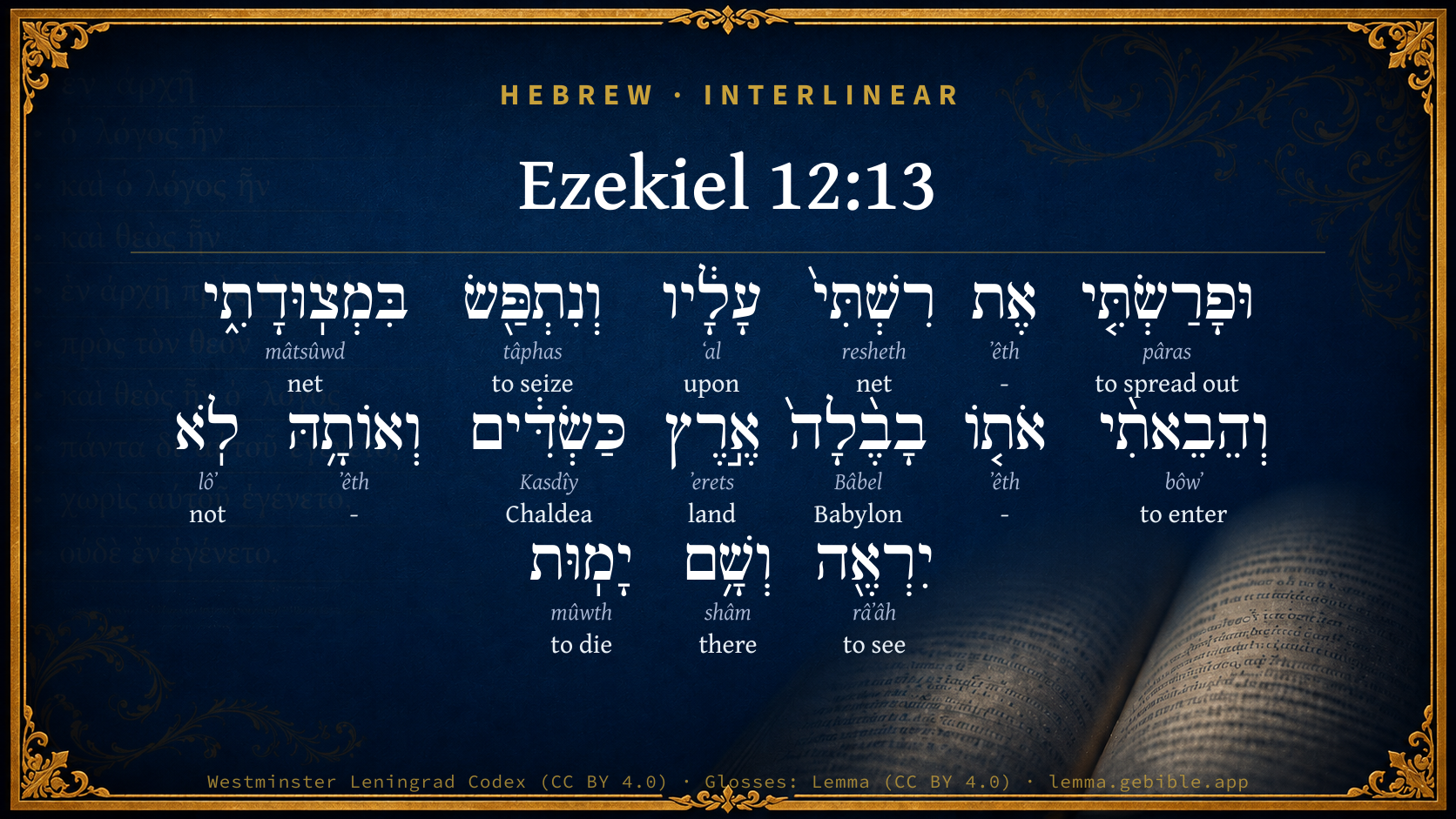
Hebrew (Westminster Leningrad Codex) Ezekiel 12:13 appears in the Hebrew Old Testament. The text above is from the Westminster Leningrad Codex. Each word links to its Strong’s number, a concise gloss, and parsing drawn from the Open Scriptures Hebrew Bible morphology. Click any word for its full Brown-Driver-Briggs (BDB) entry.
Download image
Cite this verse

Ezekiel 12:13 (World English Bible). Public Domain. Lemma interlinear Bible study tool, https://lemma.gebible.app/v/ezekiel/12/13.

Show BibTeX & RIS
BibTeX
RIS
English Translation
My net also will I spread on him, and he shall be taken in my snare; and I will bring him to Babylon to the land of the Chaldeans; yet shall he not see it, though he shall die there.
World English Bible · Public Domain
Download a study sheet

One document with this verse’s original text, its word-by-word gloss line, the meaning frame, cross-references with their text, attributed commentary, and full source and license credits — printable, and it pastes into notes with its structure intact.

This verse Autodidact and up

Study sheet (.html) Plain text (.txt)

A passage Seminary Student

Up to 50 verses in one chapter. A passage sheet keeps up to 6 commentary sources and 12 cross-references per verse, in the order this page ranks them, and says so on the sheet whenever that leaves anything out. Ask for a single verse and you get the Autodidact verse sheet above.

Everything on this page stays free to read, with no account — the sheet is a download of what is already on screen, not access to it.

Want to remove ads? Support Godless Engineer
Compare translations 3

The same verse in 3 English versions, stacked beneath the original-language interlinear above. Click any original word for its lexicon entry.

Each is an independent rendering of the whole verse — the interlinear is not word-aligned to these translations.

Highlighted words mark where these versions differ — a whole-verse word diff, not a word-by-word alignment.

  • World English Bible Public Domain
    My net also will I spread on him, and he shall be taken in my snare; and I will bring him to Babylon to the land of the Chaldeans; yet shall he not see it, though he shall die there.
  • King James Version Public Domain
    My net also will I spread upon him, and he shall be taken in my snare: and I will bring him to Babylon to the land of the Chaldeans; yet shall he not see it, though he shall die there.
  • unfoldingWord Literal Text CC BY-SA 4.0
    I will spread out my net over him and he will be caught in my snare; then I will bring him to Babylon, the land of the Chaldeans, but he will not see it. He will die there.

unfoldingWord Literal Text — © unfoldingWord, licensed CC BY-SA 4.0. Word-aligned USFM3 via Door43 (git.door43.org/unfoldingWord/en_ult).

Versions to compare (up to 4)

3 of 4 selected

Show all 18 translations

Every available English version of this verse, each an independent rendering of the whole verse.

  • World English Bible Public Domain
    My net also will I spread on him, and he shall be taken in my snare; and I will bring him to Babylon to the land of the Chaldeans; yet shall he not see it, though he shall die there.
  • Berean Standard Bible Public Domain
    But I will spread My net over him, and he will be caught in My snare. I will bring him to Babylon, the land of the Chaldeans; yet he will not see it, and there he will die.
  • Majority Standard Bible Public Domain
    But I will spread My net over him, and he will be caught in My snare. I will bring him to Babylon, the land of the Chaldeans; yet he will not see it, and there he will die.
  • King James Version Public Domain
    My net also will I spread upon him, and he shall be taken in my snare: and I will bring him to Babylon to the land of the Chaldeans; yet shall he not see it, though he shall die there.
  • American Standard Version (1901) Public Domain
    My net also will I spread upon him, and he shall be taken in my snare; and I will bring him to Babylon to the land of the Chaldeans; yet shall he not see it, though he shall die there.
  • Revised Version (1885) Public Domain
    My net also will I spread upon him, and he shall be taken in my snare: and I will bring him to Babylon to the land of the Chaldeans; yet shall he not see it, though he shall die there.
  • Geneva Bible (1599) Public Domain
    My net also will I spread vpon him, and he shall be taken in my net, and I will bring him to Babel to the lande of the Caldeans, yet shall he not see it, though he shall dye there.
  • Douay-Rheims (1899) Public Domain
    And I will spread my net over him, and he shall be taken in my net: and I will bring him into Babylon, into the land of the Chaldeans, and he shall not see it, and there he shall die.
  • Young's Literal Translation Public Domain
    And I have spread My net for him, and he hath been caught in My snare, and I have brought him in to Babylon, the land of the Chaldeans, and it he doth not see -- and there doth he die.
  • Literal Standard Version CC BY-SA 4.0
    And I have spread My net for him, and he has been caught in My snare, and I have brought him to Babylon, the land of the Chaldeans, and he does not see it—and he dies there.
  • Unlocked Literal Bible CC BY-SA 4.0
    I will spread out my net over him and he will be caught in my snare; then I will bring him to Babylon, the land of the Chaldeans, but he will not see it. He will die there.
  • unfoldingWord Literal Text CC BY-SA 4.0
    I will spread out my net over him and he will be caught in my snare; then I will bring him to Babylon, the land of the Chaldeans, but he will not see it. He will die there.
  • Darby Bible Public Domain
    And I will spread my net upon him, and he shall be taken in my snare; and I will bring him to Babylon to the land of the Chaldeans; but he shall not see it, and there shall he die.
  • World Messianic Bible Public Domain
    I will also spread my net on him, and he will be taken in my snare. I will bring him to Babylon to the land of the Kasdim; yet he will not see it, though he will die there.
  • Webster's Bible Public Domain
    My net also will I spread upon him, and he shall be taken in my snare: and I will bring him to Babylon to the land of the Chaldeans, yet shall he not see it, though he shall die there.
  • Free Bible Version CC BY-SA 4.0
    But I will catch him in my net; I will trap him in my snare. I will take him to Babylon in the country of Babylonia. However, he won't see it, and he'll die there.
  • Bible in Basic English Public Domain
    And my net will be stretched out on him, and he will be taken in my cords: and I will take him to Babylon to the land of the Chaldaeans; but he will not see it, and there death will come to him.
  • JPS Tanakh (1917) Public Domain
    My net also will I spread upon him, and he shall be taken in My snare; and I will bring him to Babylon to the land of the Chaldeans; yet shall he not see it, though he shall die there.

Literal Standard Version (2020), Covenant Press — licensed CC BY-SA 4.0. Text via the HelloAO Bible API (eBible.org). Unlocked Literal Bible (unfoldingWord) — licensed CC BY-SA 4.0. Text via the HelloAO Bible API (eBible.org). unfoldingWord Literal Text — © unfoldingWord, licensed CC BY-SA 4.0. Word-aligned USFM3 via Door43 (git.door43.org/unfoldingWord/en_ult). Free Bible Version, Dr. Jonathan Gallagher — licensed CC BY-SA 4.0. Text via the HelloAO Bible API (eBible.org).

Word by word

More ways to search: Search by grammar → Find every occurrence → Compare this word →

Practice this passage: Drill this verse → Learn its vocabulary →

רִשְׁתִּי֙
resheth
H7568
“net · my”
Noun, Common, Feminine, Singular, Construct + Suffix, Personal, 1st Person, Common, Singular
Part of Speech
Noun
Type
Common
Gender
Feminine
Number
Singular
State
Construct
Full BDB Definition

Origin: from H3423

TWOT: 920c

net - net - for catching - of judgment (figuratively) - of leaders leading people to sin - as a trap for man - network (brazen - for altar of tabernacle)
  1. וּפָרַשְׂתִּ֤י pâras H6566 “and · to spread out” Conjunction + Verb, Qal, Sequential Perfect, 1st Person, Common, Singular
  2. אֶת ʼêth H853 “-” Particle, Direct Object
  3. עָלָ֔יו ʻal H5921 “upon · him” Preposition + Suffix, Personal, 3rd Person, Masculine, Singular
  4. וְנִתְפַּ֖שׂ tâphas H8610 “and · to seize” Conjunction + Verb, Niphal, Sequential Perfect, 3rd Person, Masculine, Singular
  5. בִּמְצֽוּדָתִ֑י mâtsûwd H4686 “in/at · net · my” Preposition + Noun, Common, Feminine, Singular, Construct + Suffix, Personal, 1st Person, Common, Singular
  6. וְהֵבֵאתִ֨י bôwʼ H935 “and · to enter” Conjunction + Verb, Hiphil, Sequential Perfect, 1st Person, Common, Singular
  7. אֹת֤וֹ ʼêth H853 “- · him” Particle, Direct Object + Suffix, Personal, 3rd Person, Masculine, Singular
  8. בָבֶ֨לָה֙ Bâbel H894 “Babylon · toward” Noun, Proper + Suffix, Demonstrative
  9. אֶ֣רֶץ ʼerets H776 “land of” Noun, Common, Both, Singular, Construct
  10. כַּשְׂדִּ֔ים Kasdîy H3778 “Chaldea” Noun, Proper
  11. וְאוֹתָ֥הּ ʼêth H853 “and · - · her” Conjunction + Particle, Direct Object + Suffix, Personal, 3rd Person, Feminine, Singular
  12. לֹֽא lôʼ H3808 “not” Particle, Negative
  13. יִרְאֶ֖ה râʼâh H7200 “to see” Verb, Qal, Imperfect, 3rd Person, Masculine, Singular
  14. וְשָׁ֥ם shâm H8033 “and · there” Conjunction + Adverb
  15. יָמֽוּת mûwth H4191 “to die” Verb, Qal, Imperfect, 3rd Person, Masculine, Singular

About this verse

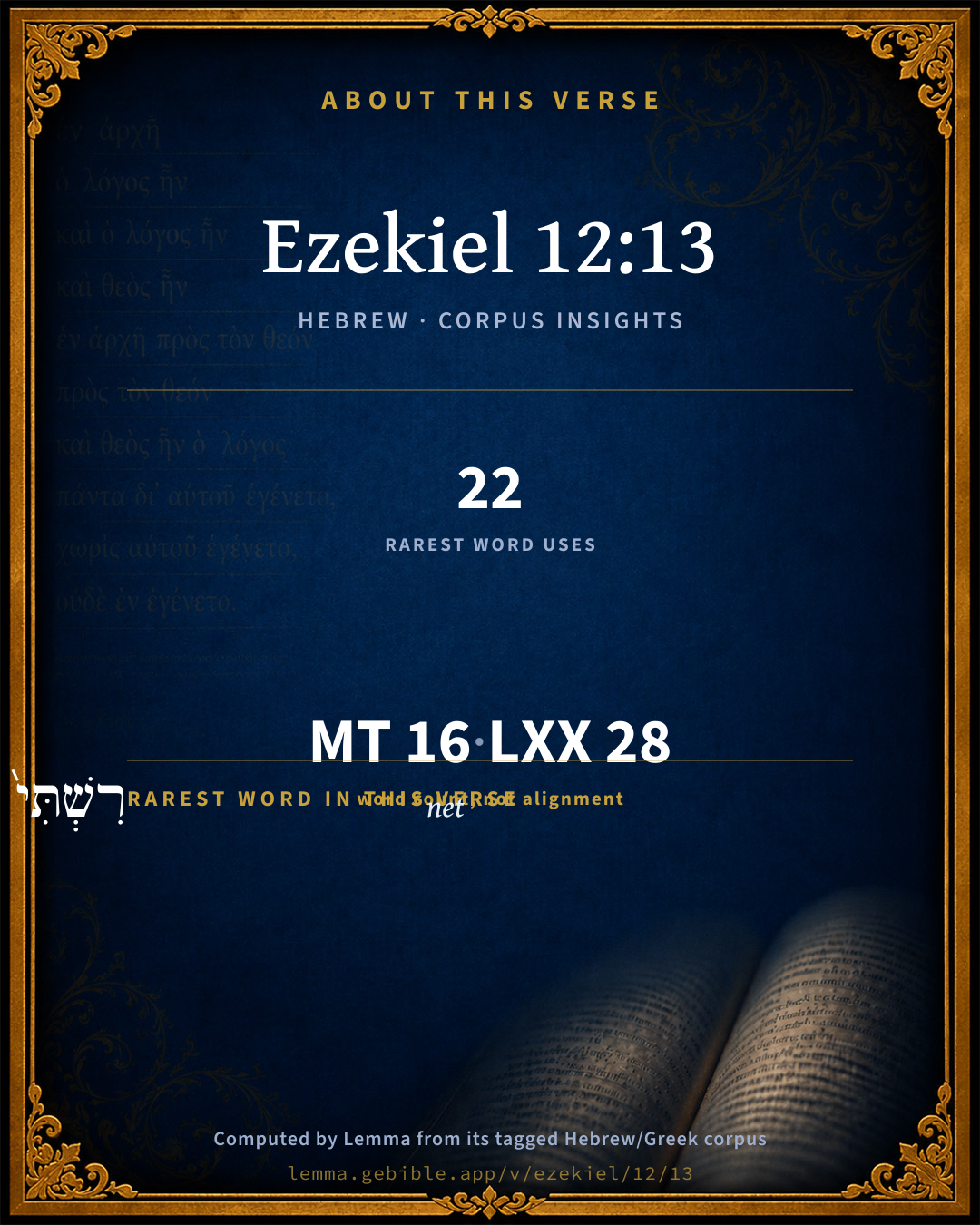
These counts appear in no published source. They are computed here, from the morphology-tagged text and Lemma’s own curated glosses. What Lemma adds →

16
words
14
distinct lemmas
Prophets
section

Notable vocabulary

The rarest word here is רִשְׁתִּי֙ net H7568 — appearing just 22 times in the whole Hebrew Bible.

Shared distinctive vocabulary

רִשְׁתִּי֙ net H7568 occurs in 21 verses of the Hebrew Bible. Also found in:

Grammatical profile

  • 5 verbs
  • 5 nouns
  • 1 preposition
  • 1 adverb
  • 4 particles

Verb forms

  • וּפָרַשְׂתִּ֤י Qal · Sequential Perfect
  • וְנִתְפַּ֖שׂ Niphal · Sequential Perfect
  • וְהֵבֵאתִ֨י Hiphil · Sequential Perfect
  • יִרְאֶ֖ה Qal · Imperfect
  • יָמֽוּת Qal · Imperfect

Hebrew & Septuagint length

In English translation the verse runs 40 words from the Hebrew and 41 from the Septuagint (LXX English) — closely comparable.

A rough comparison of the two English renderings, which tokenize alike — not a word-level alignment.

Word counts can differ between the Hebrew and the Greek without any difference in meaning — e.g. the Hebrew direct-object marker אֵת has no separate Greek word, and Greek often adds the article ὁ.

In the original languages it is 16 Hebrew tokens and 28 Greek tokens — but the two are counted differently (Hebrew bundles its prefixes and suffixes into one token; the Greek is in lemma form), so that isn’t a like-for-like length.

Cross-references

17

Topical passages linked to Ezekiel 12:13 in the Treasury of Scripture Knowledge — connected by theme and wording, ordered by reader-vote popularity; previews shown in the World English Bible.

  • Jeremiah 39:7 Moreover he put out Zedekiah's eyes, and bound him in fetters, to carry him to Babylon.
  • Ezekiel 17:20 I will spread my net on him, and he shall be taken in my snare, and I will bring him to Babylon, and will enter into judgment with him there for his trespass that he has trespassed against me.
  • Hosea 7:12 When they go, I will spread my net on them. I will bring them down like the birds of the sky. I will chastise them, as their congregation has heard.
  • Isaiah 24:17–18 Fear, and the pit, and the snare, are on you, O inhabitant of the earth.
  • 2 Kings 25:5–7 But the army of the Chaldeans pursued after the king, and overtook him in the plains of Jericho; and all his army was scattered from him.
  • Ezekiel 17:16 As I live, says the Lord Yahweh, surely in the place where the king dwells who made him king, whose oath he despised, and whose covenant he broke, even with him in the midst of Babylon he shall die.
  • Ezekiel 32:3 Thus says the Lord Yahweh: I will spread out my net on you with a company of many peoples; and they shall bring you up in my net.
  • Job 19:6 Know now that God has subverted me, And has surrounded me with his net.
  • Psalms 11:6 On the wicked he will rain blazing coals; Fire, sulfur, and scorching wind shall be the portion of their cup.
  • Jeremiah 34:3 and you shall not escape out of his hand, but shall surely be taken, and delivered into his hand; and your eyes shall see the eyes of the king of Babylon, and he shall speak with you mouth to mouth, and you shall go to Babylon.
  • Jeremiah 50:24 I have laid a snare for you, and you are also taken, Babylon, and you weren't aware: you are found, and also caught, because you have striven against Yahweh.
  • Jeremiah 52:8–11 But the army of the Chaldeans pursued after the king, and overtook Zedekiah in the plains of Jericho; and all his army was scattered from him.
  • Lamentations 1:13 From on high has he sent fire into my bones, and it prevails against them; He has spread a net for my feet, he has turned me back: He has made me desolate and faint all the day.
  • Lamentations 3:47 Fear and the pit are come on us, devastation and destruction.
  • Lamentations 4:19–20 Our pursuers were swifter than the eagles of the sky: They chased us on the mountains, they laid wait for us in the wilderness.
  • Ezekiel 19:8–9 Then the nations set against him on every side from the provinces; and they spread their net over him; he was taken in their pit.
  • Luke 21:35 For it will come like a snare on all those who dwell on the surface of all the earth.

Cross-references courtesy of OpenBible.info (CC BY 4.0).

Hebrew and Greek witnesses Masoretic Hebrew ↔ Greek Septuagint

The same verse in the two great witnesses to the Old Testament, shown verse-for-verse.

These are two independent witnesses, not word-aligned to each other, and the Septuagint is shown in lemma (dictionary) form.

Hebrew Ezekiel 12:13 Masoretic · Westminster Leningrad Codex

וּפָרַשְׂתִּ֤י אֶת רִשְׁתִּי֙ עָלָ֔יו וְנִתְפַּ֖שׂ בִּמְצֽוּדָתִ֑י וְהֵבֵאתִ֨י אֹת֤וֹ בָבֶ֨לָה֙ אֶ֣רֶץ כַּשְׂדִּ֔ים וְאוֹתָ֥הּ לֹֽא יִרְאֶ֖ה וְשָׁ֥ם יָמֽוּת

My net also will I spread on him, and he shall be taken in my snare; and I will bring him to Babylon to the land of the Chaldeans; yet shall he not see it, though he shall die there.

World English Bible · Public Domain

Greek LXX Ezekiel 12:13 Septuagint · lemma form

καί ἐκπεταννύω ὁ δίκτυον ἐγώ ἐπί αὐτός καί συνλαμβάνω ἐν ὁ περιοχή ἐγώ καί ἄγω αὐτός εἰς βαβυλών εἰς γῆ χαλδαῖος καί αὐτός οὐ ὁράω καί ἐκεῖ τελευτάω

And I will spread out my net upon him, and he shall be caught in my toils: and I will bring him to Babylon to the land of the Chaldeans; but he shall not see it, though he shall die there.

LXX2012 (modern English Septuagint) · Public Domain

Hebrew: Westminster Leningrad Codex (CC BY 4.0). Greek: Septuagint (public domain); English from LXX2012 (modern English Septuagint) (Public Domain). How the Septuagint differs from the Hebrew →

Targum (Aramaic paraphrase)

1

The Targum is the ancient Jewish Aramaic paraphrase of the Hebrew Scriptures — an interpretive translation, not the Hebrew text itself. Onkelos (literal) and Pseudo-Jonathan (expansive) render the Torah, and Jonathan the Prophets. Coverage is partial: where no permissively-licensed English translation exists for a verse, only the Aramaic is shown. This is verse-level text, not a word-by-word alignment to the Hebrew.

  1. Targum Jonathan Prophets (Joshua–Malachi)
    וְאֶפְרוֹס יַת מְצֻדָתִי עֲלוֹהִי וְיִתְאֲחַד בִּסְרִגְתִי וְאַגְלֵי יָתֵיהּ לְבָבֶל לִמְדִינַת אַרְעָא כַסָדָאִי וְיָתָהּ לָא יֶחֱזֵי וְתַמָן יְמוּת:

    (no public-domain English translation for this verse)

    Targum Jonathan — Aramaic: “Mikraot Gedolot” (public domain). English: “Sefaria Community Translation” (CC0 1.0 (public-domain dedication)); “London "Chaldee Paraphrase," 1871” (public domain). Text via Sefaria.

Commentary

Notes on Ezekiel 12:13 from classic Christian and Jewish commentators (each source and its license shown beneath its notes). The classic Christian expositions comment on the surrounding passage and are grouped to its opening verse, so a note may address several verses; the Jewish commentaries on the Tanakh (Rashi and others) are per-verse, so they appear only where the commentator wrote on this verse.

Lemma curates 59 commentaries, every one of them public domain or Creative Commons licensed, each selected and text-cleaned for this edition rather than reprinted as found. About our sources →

Trapp's Complete Commentary

John Trapp

Eze 12:13 My net also will I spread upon him, and he shall be taken in my snare: and I will bring him to Babylon [to] the land of the Chaldeans; yet shall he not see it, though he shall die there.

Ver. 13. My net also will I spread upon him.] Princes usually love hunting and fowling. Lo, the Chaldees shall hunt him and overcatch him.

And he shall be taken in my snare.] Snares are set secretly, catch suddenly, hold certainly. A stronghold the Hebrew word here used doth also signify. {a}

Yet shall he not see it.] For his eyes were put out at Riblah. {2Ki 25:7} And yet, behold, a greater blindness that befell him than this. Josephus {b} testifieth that Zedekiah not understanding these words of Ezekiel, and thinking them to be contrary to Jeremiah’s words, he resolved to believe neither of them.

{a} Jun.

{b} Joseph. Ant., lib. vi. x., cap. 10.

John Trapp, A Commentary or Exposition upon All the Books of the Old and New Testament (1647–1656) — public domain. Text from a community e-Sword module.

Geneva Bible (1599)

Geneva Bible translators

When the king shall think to escape by fleeing, I will take him in my net, as Ezek. 17:20 and 32:3.

Geneva Bible (1599) marginal notes — public domain. Text via Bolls.life.

Jamieson, Fausset & Brown

Robert Jamieson, A. R. Fausset & David Brown

My net--the Chaldean army. He shall be inextricably entangled in it, as in the meshes of a net. It is God's net (Job 19:6). Babylon was God's instrument (Isa 10:5). Called "a net" (Hab 1:14-16).

bring him to Babylon . . . ; yet shall he not see it--because he should be deprived of sight before he arrived there (Jer 52:11).

Jamieson, Fausset & Brown — Commentary Critical and Explanatory on the Whole Bible (1871) — public domain (CC PDM 1.0). Text via the HelloAO Bible API.

Adam Clarke's Commentary

Verse 13. I will bring - him to Babylon - yet shall he not see it] Because Nebuchadnezzar caused him to have his eyes put out at Riblah. To Babylon he was carried in his blind state, and there he died. In saying, My net also will I spread upon him, there is probably a reference to an ancient manner of fighting. One, who was called the retiarius, had a small casting net, which if he could throw over his antagonist's head, he then despatched him with his sword; if he missed his throw, he was obliged to run in order to get his net once more adjusted for another throw. In the mean time the other pursued him with all his speed to prevent this, and to despatch him; hence he was called secutor: the first the netman, the second the pursuer.

Adam Clarke's Commentary on the Bible (1810–1826) — public domain. Text from a community e-Sword/MySword module.

John Calvin's Commentaries

That was no slight slaughter, when Zedekiah at length, in his desperation, thought of flight, and thus descended into hidden trenches, as if seeking life in the tomb: thus was he reduced to extremities. But the Prophet now adds, that it would be useless, because notwithstanding this he should be taken by his enemies Besides, what God executed by means of the Chaldeans he properly transfers to himself. The Chaldeans laid their snares when advised of the king’s flight: they knew its direction, and hence they apprehended him. So God announces himself as the author: I, says he, will stretch out my net. This we know, that the Chaldeans did not leave their own country of their own accord, nor carry on the war in their own strength, nor take the king by their own counsel; but the whole affair was under the government of heaven. Men lent their aid, and seemed to carry’ on the work by their own labor; but unless God had provided for the event, all their endeavors had proved fruitless. Hence, as God had stirred up the Chaldeans to exact punishment from the king and the people, so he raised their minds to confidence, then he strengthened them to persist in the siege of the city, and afterwards opened their eyes, and sent persons to disclose the plans of the king, so that he might be seized in a cave, as it really happened. The whole of this was done by the secret providence of God. So diligently ought we to observe those places in which God shows that what seems to be the work of men is really his own. Even likeness does not want its weight; for we seem always to have some refuge in perplexity, and on whatever side we look around, some hope deceives us. But God announces that he has nets spread, by which we are surrounded on every side: hence when we seem to have a way of escape, God has hidden nets in which he encloses us. So that this place compares God to a hunter, and ourselves to wild beasts; for when a huntsman follows wild beasts, they seek for a way of escape and rush out there, but they are caught in nets: so also when we endeavor to elude God’s hands, we are entrapped and held by him: because when we wish to withdraw ourselves from his providence, we deserve that blindness which leads us to rush on our own destruction.

Hence I will spread my net for him, and he shall be taken in my snares, I will lead him away, says he, to Babylon The Prophet shows by degrees how formidably God’s vengeance should alight on Zedekiah and the whole people. It was already most miserable to be taken by the enemy and subjected to their lust and cruelty. If he had been slain, this would have been accomplished in a single moment, but God wished him to be drawn into exile; meanwhile he says that he should die at Babylon, without seeing the city, both of which were accomplished. Zedekiah then wasted away in exile, for he lay even to his death in filth and defilement. And although he was buried, as we saw in Jeremiah, yet this condition was most sorrowful — to fear through one’s whole lifetime some fresh wrath of an enemy. Then he was barbarously and inhumanly treated: his eyes were put out on the journey; and here it is said, he shall not see Babylon, and yet he shall arrive there and die there. Afterwards he saw his sons strangled in his sight: then his eyes were dug out — a spectacle more grievous than death. Now we may reflect on the kind of life a man must spend in exile, in prison, and in chains — since he was bound with chains, as the sacred narrative informs us — there to consume away by a slow death in a foul prison and in total darkness; yet all this happened to Zedekiah. We see then how God thunders against the Israelites, who thought themselves hardly treated in exile, since they might have remained safe at Jerusalem.

John Calvin's Commentaries (1540-1563) — public domain. Text from the Calvin Translation Society English edition (1840s-50s) via the Christian Classics Ethereal Library (ccel.org). Calvin's coverage is partial (roughly two-thirds of the Bible); uncommented books and verses are honest gaps, never fabricated. The 19th-century editor's footnotes and remarks are omitted so the notes are faithfully Calvin's own voice.

Ellicott's Commentary for English Readers

(13) Yet shall he not see it, though he shall die there.—The prophet does not explain how this could be; but Jeremiah (Jer_52:11) makes it plain by recording that Zedekiah’s eyes were put out in Riblah, before he was carried to Babylon. Josephus has a curious story (Antiq. x. 7, § 2), that Zedekiah was inclined to believe the warnings of Jeremiah that he should be carried captive to Babylon; but when Ezekiel sent this prophecy to Jerusalem, saying that he should not see the land, he conceived the two prophecies to be contradictory, and so disbelieved them both. Zedekiah’s death in Babylon is mentioned in Jer_52:11.

A Bible Commentary for English Readers, edited by Charles John Ellicott (1878–1897) — public domain. Text from a community e-Sword module.

The Cambridge Bible for Schools and Colleges

gen. ed. J. J. S. Perowne

13. The king’s flight shall be unavailing; he shall be captured and brought blinded to Babylon, where he shall die. As the Lord fought against Jerusalem in the siege, so it is he that ensures the capture of the king. It is in his net that he is ensnared and taken; Hos_7:12, “when they go, I will spread my net upon them; I will bring them down as the fowls of heaven.” Cf. Eze_17:20; Eze_32:3.

yet shall he not see it] The eyes of Zedekiah were put out by Nebuchadnezzar at Riblah. 2Ki_25:5 seq.; Jer_52:8; Jer_52:11.

The Cambridge Bible for Schools and Colleges (gen. ed. J. J. S. Perowne; Cambridge University Press, 1878–1918) — public domain. Text from a community e-Sword module.

John Gill's Exposition

And they shall know that I am the Lord,.... God omniscient, and can and do foresee and foretell future events, when the above things shall come to pass; and omnipotent, able to do what he purposed and declared he would; and true and faithful to his word, and holy and righteous in all his ways and works:

when I shall scatter them among the nations, and disperse them in the countries; of Egypt, Babylon, Media, and other places.

John Gill's Exposition of the Whole Bible (1746–1763) — public domain (CC PDM 1.0). Text via the HelloAO Bible API.

Albert Barnes' Notes on the Bible

Compare Jer 52:9 ff

Albert Barnes' Notes on the Bible (1834–1885) — public domain. Text from a community e-Sword/MySword module.

Haydock's Catholic Bible Commentary

Net, as was done in war, and to catch wild beasts, Jeremias xvi. 16. (Calmet) --- Not see it, because his eyes shall be put out by Nabuchodonosor. (Challoner) --- The false prophets thought they perceived a contradiction here; (Worthington) and Sedecias, confronting it with Jeremias xxxviii. 18., disregarded both. (Josephus, Antiquities x. 10.) --- This was more pardonable than for Paine to object this as an inconsistency, after the event has so clearly verified the predictions of both, and shewed their consent. (Haydock) --- The unhappy prince saw too late the true meaning. (Calmet) --- He was put in a cage, like a wild beast, and conveyed blind to Babylon. (St. Jerome)

George Leo Haydock (1774–1849), Haydock's Catholic Family Bible and Commentary, 1859 edition — public domain. Excludes Psalms (Douay-Rheims chapter numbering differs from Protestant) and Deuterocanonical books (Catholic canon only).

Matthew Poole's English Annotations

In the disguise this fugitive might possibly escape from the net of Nebuchadnezzar, and of his captains. But, poor Zedekiah, dost thou not at last see that the Babylonians are employed of God, and that God will bring thee into his own and into Nebuchadnezzar’s net.

Will I spread upon him; in allusion to those that take birds or fish in nets, they spread it to its full extent, so will God spread his net that it shall cover Zedekiah and his followers.

He shall be taken; mentioned as the principal, though he was not taken alone, many were taken with him.

I will bring him; the Chaldeans carried him, and God brought him to Babylon, so second causes co-work with the first.

To Babylon; which was the metropolis of the kingdom.

The land of the Chaldeans; that strange land where they were captives whom God sent before, and whither obstinate Jerusalemites must now go.

Yet shall he not see it; neither the land nor the city, though he shall spend the rest of his days there, and there die, but the Babylonish tyrant will put out his eyes at Riblah, 2Ki 25:6; Jer 39:5.

Matthew Poole's English Annotations on the Holy Bible (1683–1685) — public domain. Text from a community e-Sword/MySword module.

Whedon's Commentary on the Bible

Daniel D. Whedon

13. My net also will I spread upon him — The attempt to escape shall be a failure. The Babylonian king shall capture the fugitives and carry them to Chaldea, but the net in which they are taken is not Nebuchadnezzar’s, but Jehovah’s. These shrewd “captains” might have outwitted Nebuzaradan, but they could not evade the Almighty (Jer_39:4-7; Hos_7:12; Eze_17:20; Eze_32:3).

Yet shall he not see it — This explicit prophecy, that his eyes should be put out, was literally fulfilled — though Ezekiel himself does not record its fulfillment (2Ki_25:7; Jer_39:7; Jer_52:11). “Ezekiel had no solicitude to make out the truth of his own predictions.” — Cowles.

Daniel D. Whedon (gen. ed.), Commentary on the Old and New Testaments (1874–1909) — public domain. Text from a community e-Sword module.

The Pulpit Commentary

My net also will I spread, etc. Compare the same image in Lam_1:13. The prediction of ver. 12 is reiterated with emphasis. Zedekiah shall be in Babylon, yet shall not see. Josephus ("Ant.," 10. 7:2; 8:2) relates that Ezekiel sent this prophecy to Jerusalem, and thatZedekiah, finding an apparent discrepancy in the words that he should not see Babylon, and those of Jeremiah, (Jer_32:4 Jer_34:3) hardened himself in his unbelief. There is no reason, however, for supposing that Josephus had access to any other records than the books of the two prophets, and his narrative looks rather like an imagined history of what might have been.

God"s net.

I GOD SPREADS A NET.

1. God will not leave guilty men free. They have a time of liberty, but there will be a limit to this. Though they have a long tether, some day its end will be reached. Freedom is given to allow scope for choice. If the power of choice is abused, the freedom will be withdrawn.

2. God employs means for restraining the liberty of bad men. He does not lay hold of them with his hand; he uses a net. In the present instance the net was Nebuchadnezzar. That heathen monarch did not know that he was a mere instrument in the hand of God; yet did God so completely hold him in this respect that he called the man "my servant Nebuchadnezzar". (Jer_25:9) Thus God overrules the movements of kings.

3. These means may not be perceived by the unhappy victims. The net is a snare, and "in vain is a snare spread in the sight of any bind." We must not suppose that God really deceives his children. The Jews had been warned. But their eyes were blind and their ears deaf (ver. 2). The danger is not the less because men do not perceive it. Just when a man boasts of his greatest triumph the meshes of a Divine judgment may be drawing together about his doomed life.

II GOD ENSNARES IN HIS NET WHOMSOEVER HE WILL.

1. He designs the net for particular persons. In the verse before us it is spread for one man. There is no element of chance in the judgments of Heaven. God considers the case of each soul, and acts accordingly.

2. All the men caught in Gods net are sinners. He has no terrors for the good. He is not like the tempter, who ensnares men into evil. Every man who is caught in God"s net of judgment has been first ensnared in the devil"s net of sin.

3. The greatest are not beyond the reach of this net. In the present instance the net is spread expressly to catch no less a person than Zedekiah, the King of Jerusalem. Massive battlements and the serried ranks of a mighty army cannot keep off the invisible entanglement of the net of judgment.

III THERE IS NO EARTHLY MEANS OF ESCAPING FROM GOD"S NET. Its threads may be fine as gossamer, but they are strong as steel. Zedekiah was to be taken in the snare, and brought to Babylon in so helpless a state that he would not even see the place, for, as the event proved, his eyes were to be put out. The king fled by night from Jerusalem, but was caught by the Chaldeans near Jericho. As "the stars in their courses fought against Sisera," the course of armies and nations turned against the guilty Jews and their wicked king. There is no hope for the impenitent.

IV CHRIST HAS SPREAD A NEW NET OF SALVATION. He told his apostles that they should be fishers of men, (Mat_4:19) and he compared the kingdom of heaven to a dragnet. (Mat_13:47) The only way of escaping from the awful net of judgment is to permit one"s self to be taken in the saving net of the gospel.

The Pulpit Commentary (1880–1919), ed. H.D.M. Spence-Jones & Joseph S. Exell — public domain. Text from a community e-Sword module.

John Wesley's Explanatory Notes

It - Neither the land nor the city; for his eyes will be put out at Riblah.

John Wesley, Explanatory Notes Upon the Whole Bible (1754–1765) — public domain. Text via the GEBible commentary corpus.

Rashi

Rabbi Shlomo Yitzchaki (Rashi)

And I shall spread my net over him There was a cave [extending] from his house to the plains of Jericho, and he went out through the cave. What did the Holy One, blessed be He, do? He brought before the army of the Chaldeans a deer which was walking before them on the roof of the cave, and they [began] chasing it. And when Zedekiah emerged from the cave in the plains of Jericho, they saw him emerging and caught him.

but he will not see it because in Riblah in the land of Hamath, he [Nebuchadnezzar] called him to account and blinded his eyes. Afterwards, they brought him to Babylon, as is stated in the Book of (II) Kings (25:7 and in Jer. 39:7).

Rashi on the Tanakh — English translations: “The Judaica Press complete Tanach with Rashi, translated by A. J. Rosenberg” (CC BY 4.0); “Pentateuch with Rashi's commentary by M. Rosenbaum and A.M. Silbermann, 1929-1934” (public domain); “The Metsudah Tanach series, Lakewood, N.J” (CC BY 4.0); and “The Book of Joshua, Metsudah Publications, 1997” (CC BY 4.0). Text via Sefaria.

Lesson kit

Teaching starters — assembled from the data on this page, not authored interpretation. Every prompt links to the verse data it draws on. Edit before teaching.

Ezekiel, in the Prophets, opens this verse with 16 words (14 distinct Hebrew lemmas). Its most distinctive word is resheth (“net”). A historical commentator’s framing appears above. Read the whole chapter for the surrounding context.

Discussion questions

  1. What does “net” (resheth) contribute to the verse as a whole?
  2. Exodus 27:4 shares the word «net» with this verse. How do the two illuminate each other?
  3. The translations on this page render this verse differently — a whole-verse word diff, not a word-by-word alignment. What might account for the different wordings?
  4. The verb «וּפָרַשְׂתִּ֤י» is Qal Sequential Perfect. How does its form color the action?
  5. Reading how Trapp's Complete Commentary and Geneva Bible (1599) read this verse, where do the two commentators agree and where do they part?

Things to notice

Reading settings

Reading text

Shown beneath each verse's original-language words.

Old Testament
Old Testament edition

Read the OT as the Masoretic Hebrew (MT) or the Greek Septuagint (LXX).

English shown for the Greek Septuagint (in the Hebrew ↔ Greek comparison).

Comparing translations? Open the Compare panel on any verse page to stack up to four side by side.