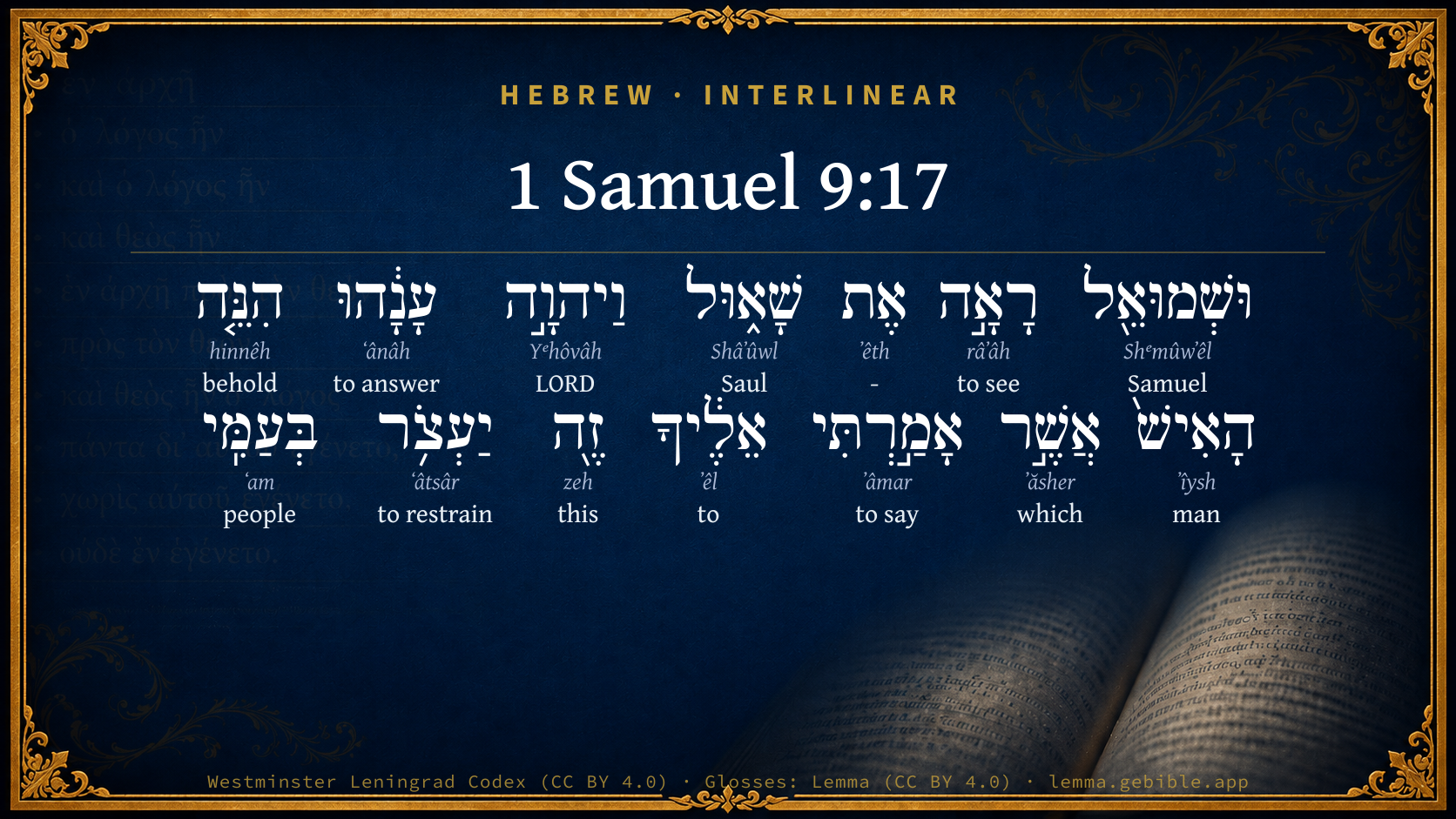
1 Samuel 9:17

Hebrew (Westminster Leningrad Codex) 1 Samuel 9:17 appears in the Hebrew Old Testament. The text above is from the Westminster Leningrad Codex. Each word links to its Strong’s number, a concise gloss, and parsing drawn from the Open Scriptures Hebrew Bible morphology. Click any word for its full Brown-Driver-Briggs (BDB) entry.
Download image
Cite this verse

1 Samuel 9:17 (World English Bible). Public Domain. Lemma interlinear Bible study tool, https://lemma.gebible.app/v/1-samuel/9/17.

Show BibTeX & RIS
BibTeX
RIS
English Translation
When Samuel saw Saul, Yahweh said to him, Behold, the man of whom I spoke to you! this same shall have authority over my people.
World English Bible · Public Domain
Download a study sheet

One document with this verse’s original text, its word-by-word gloss line, the meaning frame, cross-references with their text, attributed commentary, and full source and license credits — printable, and it pastes into notes with its structure intact.

This verse Autodidact and up

Study sheet (.html) Plain text (.txt)

A passage Seminary Student

Up to 50 verses in one chapter. A passage sheet keeps up to 6 commentary sources and 12 cross-references per verse, in the order this page ranks them, and says so on the sheet whenever that leaves anything out. Ask for a single verse and you get the Autodidact verse sheet above.

Everything on this page stays free to read, with no account — the sheet is a download of what is already on screen, not access to it.

Want to remove ads? Support Godless Engineer
Compare translations 3

The same verse in 3 English versions, stacked beneath the original-language interlinear above. Click any original word for its lexicon entry.

Each is an independent rendering of the whole verse — the interlinear is not word-aligned to these translations.

Highlighted words mark where these versions differ — a whole-verse word diff, not a word-by-word alignment.

  • World English Bible Public Domain
    When Samuel saw Saul, Yahweh said to him, Behold, the man of whom I spoke to you! this same shall have authority over my people.
  • King James Version Public Domain
    And when Samuel saw Saul, the LORD said unto him, Behold the man whom I spake to thee of! this same shall reign over my people.
  • unfoldingWord Literal Text CC BY-SA 4.0
    And Samuel saw Saul, and Yahweh answered him, “Behold the man whom I spoke to you! This will restrain my people.”

unfoldingWord Literal Text — © unfoldingWord, licensed CC BY-SA 4.0. Word-aligned USFM3 via Door43 (git.door43.org/unfoldingWord/en_ult).

Versions to compare (up to 4)

3 of 4 selected

Show all 18 translations

Every available English version of this verse, each an independent rendering of the whole verse.

  • World English Bible Public Domain
    When Samuel saw Saul, Yahweh said to him, Behold, the man of whom I spoke to you! this same shall have authority over my people.
  • Berean Standard Bible Public Domain
    When Samuel saw Saul, the LORD told him, “Here is the man of whom I spoke; he shall rule over My people.”
  • Majority Standard Bible Public Domain
    When Samuel saw Saul, the LORD told him, “Here is the man of whom I spoke; he shall rule over My people.”
  • King James Version Public Domain
    And when Samuel saw Saul, the LORD said unto him, Behold the man whom I spake to thee of! this same shall reign over my people.
  • American Standard Version (1901) Public Domain
    And when Samuel saw Saul, Jehovah said unto him, Behold, the man of whom I spake to thee! this same shall have authority over my people.
  • Revised Version (1885) Public Domain
    And when Samuel saw Saul, the LORD said unto him, Behold the man of whom I spake to thee! this same shall have authority over my people.
  • Geneva Bible (1599) Public Domain
    When Samuel therefore sawe Saul, the Lord answered him, See, this is the man whom I spake to thee of, he shall rule my people.
  • Douay-Rheims (1899) Public Domain
    And when Samuel saw Saul, the Lord said to him: Behold the man, of whom I spoke to thee, this man shall reign over my people.
  • Young's Literal Translation Public Domain
    When Samuel hath seen Saul, then hath Jehovah answered him, `Lo, the man of whom I have spoken unto thee; this `one' doth restrain My people.'
  • Literal Standard Version CC BY-SA 4.0
    When Samuel has seen Saul, then YHWH has answered him, “Behold, the man of whom I have spoken to you; this [one] restrains My people.”
  • Unlocked Literal Bible CC BY-SA 4.0
    When Samuel saw Saul, Yahweh told him, “Here is the man I told you about! He is the one who will rule over my people.”
  • unfoldingWord Literal Text CC BY-SA 4.0
    And Samuel saw Saul, and Yahweh answered him, “Behold the man whom I spoke to you! This will restrain my people.”
  • Darby Bible Public Domain
    And as Samuel saw Saul, Jehovah answered him, Behold the man of whom I spoke to thee! this man shall rule over my people.
  • World Messianic Bible Public Domain
    When Samuel saw Saul, the LORD said to him, “Behold, the man of whom I spoke to you! He will have authority over my people.”
  • Webster's Bible Public Domain
    And when Samuel saw Saul, the LORD said to him, Behold the man of whom I spoke to thee! this same shall reign over my people.
  • Free Bible Version CC BY-SA 4.0
    When Samuel saw Saul, the Lord said to him, “This is the man I told you about. He is the one who is going to rule my people.”
  • Bible in Basic English Public Domain
    And when Samuel saw Saul, the Lord said to him, This is the man of whom I gave you word! he it is who is to have authority over my people.
  • JPS Tanakh (1917) Public Domain
    And when Samuel saw Saul, the LORD spoke unto him: 'Behold the man of whom I said unto thee: This same shall have authority over My people.'

Literal Standard Version (2020), Covenant Press — licensed CC BY-SA 4.0. Text via the HelloAO Bible API (eBible.org). Unlocked Literal Bible (unfoldingWord) — licensed CC BY-SA 4.0. Text via the HelloAO Bible API (eBible.org). unfoldingWord Literal Text — © unfoldingWord, licensed CC BY-SA 4.0. Word-aligned USFM3 via Door43 (git.door43.org/unfoldingWord/en_ult). Free Bible Version, Dr. Jonathan Gallagher — licensed CC BY-SA 4.0. Text via the HelloAO Bible API (eBible.org).

Word by word

More ways to search: Search by grammar → Find every occurrence → Compare this word →

Practice this passage: Drill this verse → Learn its vocabulary →

יַעְצֹ֥ר
ʻâtsâr
H6113
“to restrain”
Verb, Qal, Imperfect, 3rd Person, Masculine, Singular
Part of Speech
Verb
Stem
Qal
Form
Imperfect
Person
3rd Person
Gender
Masculine
Number
Singular
Full BDB Definition

Origin: a primitive root

TWOT: 1675

to restrain, retain, close up, shut, withhold, refrain, stay, detain - (Qal) - to restrain, halt, stop - to retain - (Niphal) to be restrained, be stayed, be under restraint
  1. וּשְׁמוּאֵ֖ל Shᵉmûwʼêl H8050 “and · Samuel” Conjunction + Noun, Proper
  2. רָאָ֣ה râʼâh H7200 “to see” Verb, Qal, Perfect, 3rd Person, Masculine, Singular
  3. אֶת ʼêth H853 “-” Particle, Direct Object
  4. שָׁא֑וּל Shâʼûwl H7586 “Saul” Noun, Proper
  5. וַיהוָ֣ה Yᵉhôvâh H3068 “and · LORD” Conjunction + Noun, Proper
  6. עָנָ֔הוּ ʻânâh H6030 “to answer · him” Verb, Qal, Perfect, 3rd Person, Masculine, Singular + Suffix, Personal, 3rd Person, Masculine, Singular
  7. הִנֵּ֤ה hinnêh H2009 “behold” Particle, Demonstrative
  8. הָאִישׁ֙ ʼîysh H376 “the · man” Particle, Definite Article + Noun, Common, Masculine, Singular, Absolute
  9. אֲשֶׁ֣ר ʼăsher H834 “which” Particle, Relative
  10. אָמַ֣רְתִּי ʼâmar H559 “to say” Verb, Qal, Perfect, 1st Person, Common, Singular
  11. אֵלֶ֔יךָ ʼêl H413 “to · you” Preposition + Suffix, Personal, 2nd Person, Masculine, Singular
  12. זֶ֖ה zeh H2088 “this” Pronoun, Demonstrative, Masculine, Singular
  13. בְּעַמִּֽי ʻam H5971 “in/at · people · my” Preposition + Noun, Common, Masculine, Singular, Construct + Suffix, Personal, 1st Person, Common, Singular

About this verse

These counts appear in no published source. They are computed here, from the morphology-tagged text and Lemma’s own curated glosses. What Lemma adds →

14
words
14
distinct lemmas
Historical
section

Shared distinctive vocabulary

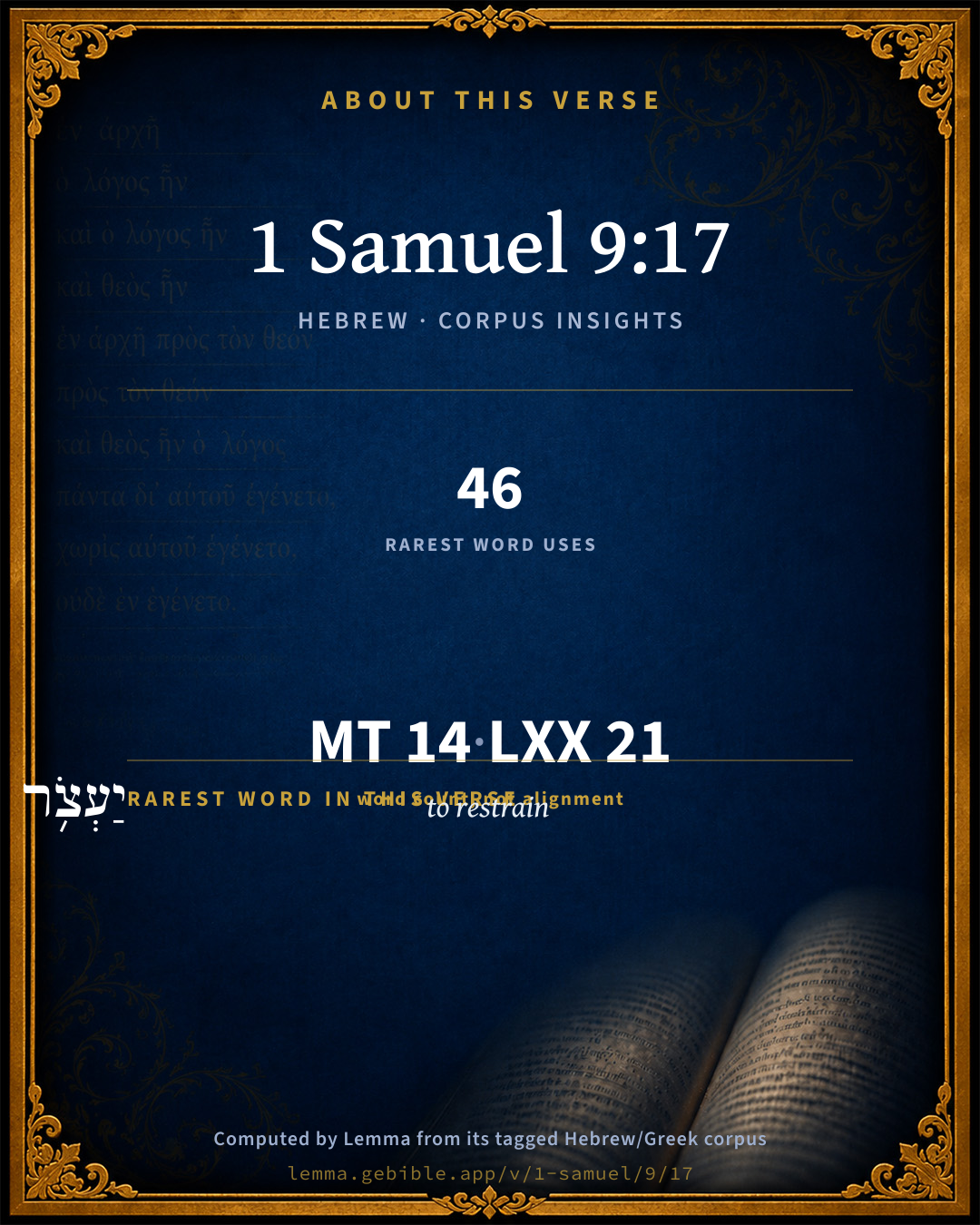
יַעְצֹ֥ר to restrain H6113 occurs in 45 verses of the Hebrew Bible. Also found in:

Grammatical profile

  • 4 verbs
  • 5 nouns
  • 1 pronoun
  • 1 preposition
  • 3 particles

Verb forms

  • רָאָ֣ה Qal · Perfect
  • עָנָ֔הוּ Qal · Perfect
  • אָמַ֣רְתִּי Qal · Perfect
  • יַעְצֹ֥ר Qal · Imperfect

Hebrew & Septuagint length

In English translation the verse runs 25 words from the Hebrew and 26 from the Septuagint (LXX English) — closely comparable.

A rough comparison of the two English renderings, which tokenize alike — not a word-level alignment.

Word counts can differ between the Hebrew and the Greek without any difference in meaning — e.g. the Hebrew direct-object marker אֵת has no separate Greek word, and Greek often adds the article ὁ.

In the original languages it is 14 Hebrew tokens and 21 Greek tokens — but the two are counted differently (Hebrew bundles its prefixes and suffixes into one token; the Greek is in lemma form), so that isn’t a like-for-like length.

Cross-references

8

Topical passages linked to 1 Samuel 9:17 in the Treasury of Scripture Knowledge — connected by theme and wording, ordered by reader-vote popularity; previews shown in the World English Bible.

  • Hosea 13:11 I have given you a king in my anger, And have taken him away in my wrath.
  • Acts 13:21 Afterward they asked for a king, and God gave to them Saul the son of Kish, a man of the tribe of Benjamin, for forty years.
  • 1 Samuel 3:13 For I have told him that I will judge his house forever, for the iniquity which he knew, because his sons did bring a curse on themselves, and he didn't restrain them.
  • 1 Samuel 16:6–12 It happened, when they had come, that he looked at Eliab, and said, Surely Yahweh's anointed is before him.
  • 2 Samuel 23:6–7 But the ungodly shall be all of them as thorns to be thrust away, Because they can't be taken with the hand
  • Nehemiah 13:19 It came to pass that, when the gates of Jerusalem began to be dark before the Sabbath, I commanded that the doors should be shut, and commanded that they should not be opened until after the Sabbath: and some of my servants set I over the gates, that there should no burden be brought in on the Sabbath day.
  • Nehemiah 13:25 I contended with them, and cursed them, and struck certain of them, and plucked off their hair, and made them swear by God, [saying], You shall not give your daughters to their sons, nor take their daughters for your sons, or for yourselves.
  • Romans 13:3–4 For rulers are not a terror to the good work, but to the evil. Do you desire to have no fear of the authority? Do that which is good, and you will have praise from the same,

Cross-references courtesy of OpenBible.info (CC BY 4.0).

Hebrew and Greek witnesses Masoretic Hebrew ↔ Greek Septuagint

The same verse in the two great witnesses to the Old Testament, shown verse-for-verse.

These are two independent witnesses, not word-aligned to each other, and the Septuagint is shown in lemma (dictionary) form.

Hebrew 1 Samuel 9:17 Masoretic · Westminster Leningrad Codex

וּשְׁמוּאֵ֖ל רָאָ֣ה אֶת שָׁא֑וּל וַיהוָ֣ה עָנָ֔הוּ הִנֵּ֤ה הָאִישׁ֙ אֲשֶׁ֣ר אָמַ֣רְתִּי אֵלֶ֔יךָ זֶ֖ה יַעְצֹ֥ר בְּעַמִּֽי

When Samuel saw Saul, Yahweh said to him, Behold, the man of whom I spoke to you! this same shall have authority over my people.

World English Bible · Public Domain

Greek LXX 1 Samuel 9:17 Septuagint · lemma form

καί σαμουηλ ὁράω ὁ σαούλ καί κύριος ἀποκρίνω αὐτός ἰδού ὁ ἄνθρωπος ὅς εἶπον σύ οὗτος ἄρχω ἐν ὁ λαός ἐγώ

And Samuel looked upon Saul, and the Lord answered him, Behold the man of whom I spoke to you, this one shall rule over my people.

LXX2012 (modern English Septuagint) · Public Domain

Hebrew: Westminster Leningrad Codex (CC BY 4.0). Greek: Septuagint (public domain); English from LXX2012 (modern English Septuagint) (Public Domain). How the Septuagint differs from the Hebrew →

Targum (Aramaic paraphrase)

1

The Targum is the ancient Jewish Aramaic paraphrase of the Hebrew Scriptures — an interpretive translation, not the Hebrew text itself. Onkelos (literal) and Pseudo-Jonathan (expansive) render the Torah, and Jonathan the Prophets. Coverage is partial: where no permissively-licensed English translation exists for a verse, only the Aramaic is shown. This is verse-level text, not a word-by-word alignment to the Hebrew.

  1. Targum Jonathan Prophets (Joshua–Malachi)
    וּשְׁמוּאֵל חֲזָא יַת שָׁאוּל וּמִן קֳדָם יְיָ אִתְאַמַר לֵיהּ הָא גַבְרָא דַאֲמָרִית לָךְ דֵין יַעְדֵי מַרְוָתָא מִן עַמִי:

    (no public-domain English translation for this verse)

    Targum Jonathan — Aramaic: “Mikraot Gedolot” (public domain). English: “Sefaria Community Translation” (CC0 1.0 (public-domain dedication)); “London "Chaldee Paraphrase," 1871” (public domain). Text via Sefaria.

Commentary

Notes on 1 Samuel 9:17 from classic Christian and Jewish commentators (each source and its license shown beneath its notes). The classic Christian expositions comment on the surrounding passage and are grouped to its opening verse, so a note may address several verses; the Jewish commentaries on the Tanakh (Rashi and others) are per-verse, so they appear only where the commentator wrote on this verse.

Lemma curates 59 commentaries, every one of them public domain or Creative Commons licensed, each selected and text-cleaned for this edition rather than reprinted as found. About our sources →

The Cambridge Bible for Schools and Colleges

gen. ed. J. J. S. Perowne

17. the Lord said unto him] Lit. Jehovah answered him; answered his mental question. Is this the man? 1Sa_9:17 is in close connexion with 1Sa_9:14, 1Sa_9:15-16 forming a parenthesis.

shall reign over my people] Lit. “shall restrain my people.” A peculiar word, contrasting the restraints of a settled government with the license of the time in which “every man did that which was right in his own eyes” (Jdg_21:25).

The Cambridge Bible for Schools and Colleges (gen. ed. J. J. S. Perowne; Cambridge University Press, 1878–1918) — public domain. Text from a community e-Sword module.

Trapp's Complete Commentary

John Trapp

1Sa 9:17 And when Samuel saw Saul, the LORD said unto him, Behold the man whom I spake to thee of! this same shall reign over my people.

Ver. 17. This same shall reign over my people.] Heb., Restrain my people, viz, from loose and lewd practices. Princes must do so, or they are guilty of a passive injustice at least. They are called "heirs of restraint." {Jdg 18:7, marg.}

John Trapp, A Commentary or Exposition upon All the Books of the Old and New Testament (1647–1656) — public domain. Text from a community e-Sword module.

Joseph Benson's Commentary

1Sa 9:17. The Lord said unto him — Most probably, by a divine, silent suggestion, or secret notification to his mind, without any voice, 1Sa 9:15. This same shall reign over my people — The phraseology in the original is peculiar, the word rendered reign, implying coercion and restraint; יעצר בעמי, jangzor begnammi, He shall rule my people sternly and rigidly, with an absolute, uncontrollable power. So the eastern monarchs ruled.

Joseph Benson's Commentary on the Old and New Testaments (1811–1818) — public domain. Text from a community e-Sword module.

Adam Clarke's Commentary

Verse 17. Behold the man whom I spake to thee of] What an intimate communion must Samuel have held with his God! A constant familiarity seems to have existed between them.

Adam Clarke's Commentary on the Bible (1810–1826) — public domain. Text from a community e-Sword/MySword module.

Ellicott's Commentary for English Readers

(17) Behold the man.—This verse, it must be remembered, follows closely on 1Sa_9:14, the statements of 1Sa_9:15-16 being parenthetical. The young Saul and his servant came up to accost the seer on his way to the sacred height; Samuel, at once impressed by the great stature and splendid beauty of the stranger coming towards him, asks his Master silently, “Lord, is this then he of whom Thou whisperest me yesterday, to whom the destinies of Thy people were to be confided?” The words “Behold the man,” &c., were the silent answer of God to the silent prayer of His old servant.

Shall reign.—The word “shall reign,” which was whispered by the “Spirit” to the listening heart of the seer, should rather have been translated, “shall control,” or “shall restrain.” It was a word which—looking on to Saul’s future reign—represented it as a stern, severe rule.

A Bible Commentary for English Readers, edited by Charles John Ellicott (1878–1897) — public domain. Text from a community e-Sword module.

John Gill's Exposition

And when Samuel saw Saul,.... Who could not but take notice of him for his height, and which might give him a suspicion he was the man the Lord had spoken of to him; and the rather, because this was the exact time in which he was to be sent to him, and therefore he fixed his eyes upon him: and that he might be assured it was he, and be left at no uncertainty about it:

the Lord said unto him; by a still small voice, or by an impulse upon his mind:

behold the man whom I spake to thee of; yesterday, this is he:

this same shall reign over my people; be their king, as they have desired: or "shall restrain" (k) them, keep them in due bounds, in the discharge of their duty to God and man; and keep them from doing that which is evil, or walking in evil ways, which is the business of a good king; or who shall restrain them from having their own will, but shall rule over them in an absolute manner, according to his own arbitrary will and pleasure.

(k) "cohibebit", Montanus; "continebit", Tigurine version; "retinebit", Drusius; i.e. "coercebit", Piscator.

John Gill's Exposition of the Whole Bible (1746–1763) — public domain (CC PDM 1.0). Text via the HelloAO Bible API.

Matthew Poole's English Annotations

Unto him, in his ear, as before 1Sa 9:15, by secret instinct, so as none but he could hear it.

Matthew Poole's English Annotations on the Holy Bible (1683–1685) — public domain. Text from a community e-Sword/MySword module.

The Pulpit Commentary

Jehovah said unto him. Literally, "Jehovah answered him." When Samuel saw the young stranger, struck by his towering height, he wondered within himself whether this were the destined hero who was to win freedom for Israel. The affirmation, therefore, came in answer to the question asked by his heart. The same shall reign over my people. More literally, the margin, "restrain in," i.e. coerce, control. The A.V, preferring as usual a general to an exact rendering, loses this plain indication that Soul"s would be a strict and stern rule.

HOMILIES BY D. FRASER Ver. 17.

The man, yet not the man.

I THE SANCTION GIVEN BY THE LORD TO SAUL"S ELEVATION. Instances may easily be adduced in which the writers of the Old Testament ascribed to the Lord directly what was only indirectly recognised or permitted by him; but in the present case there is obviously more than Divine allowance. Jehovah pointed out Saul to the prophet Samuel, and commanded that he should be anointed captain, or king. We account for this on that principle of Divine government which allows to men that which they most wish for, in order that they may learn wisdom from the result. The people of Israel had not asked the Lord for such a king as he might see fit to choose and appoint. They had asked the prophet for a warlike chief like the kings of the nations and tribes around them, and the Lord saw meet to let them have what they desired; the young giant Saul was just the style of man they sought, cast in the very mould they admired, and one that would teach them some painful lessons through experience. Therefore, though the Lord foresaw the disappointing career of Saul, he authorised Samuel to anoint him privately, and afterwards sanctioned his public selection and elevation to the royal dignity. Here was a leader to suit the fancy of the people strong, impetuous, valiant. Let them have Saul for their king. Such is the way of the Lord to this day, and in individual as well as national life. He admonishes and corrects us by letting us have our own way and be filled with our own devices. We are apt to complain in our disappointment at the result, that God himself sanctioned our course. No. We did not ask him to show us his way, that we might do his will; but took our own way, did our own pleasure; and he allowed, nay, facilitated our desire. Let the issue teach us to be more wary and more humble in time to come.

II EARLY PROGNOSTICS OF SAUL"S FAILURE.

1. The manner of his entrance on the page of history. How different fromthe first mention of David, faithfully keeping the sheep before he was anointed to be the royal shepherd of Israel, is the first appearance of the son of Kish in search of his father"s stray asses, and visiting the venerable prophet Samuel with no higher thought in his mind than to learn, if possible, where those asses were! He did not even know Samuel by sight, though he lived but at a short distance. He seems to have been an unreflecting rustic youth, with none of those premonitions of greatness which come early to the wise, and tend to give them seriousness of purpose and elevation of aim.

2. Indications of a fitful mind. We read nothing of Saul"s bearing before Samuel when informed of the destiny before hint. Probably he was stunned with surprise. But so soon as he left the prophet new currents of thought and feeling began to flow through his heart. A mood of mind fell on him more grave and earnest than had appeared in him before. The Old Testament way of saying it is, that "God gave him another heart;" for the change which passes on a man under the consciousness of a high vocation suddenly received is none the less of God than it is evidently born of the occasion, he sees things in a new light, feels new responsibilities; new springs of feeling and new capacities of speech and action reveal themselves in him. But Saul took every influence by fits and starts. He quickly gained, and as quickly lost. There was in him no steady growth of conviction or principle. When he fell in with men of religious fervour he was fervent too When he met the prophets chanting Jehovah"s praise he caught their rapture, and, joining their procession, lifted up his voice also in the sacred song. But it was a mere fit of piety. Of course Saul had been educated in the religion of his fathers, and in that sense knew the God of Israel; but it seems evident, from the surprise occasioned by his appearance among the prophets, that he had never shown any zeal for the glory and worship of Jehovah; and the sudden ecstasy at Gibeah, having no foundation of spiritual principle, came to nought. Alas! men may sing spiritual songs with emotion who have no enduring spiritual life. Men may catch the infection of religious enthusiasm, yet have no moral health or soundness. Men"s faces may glow with a fine ardour, and yet soon after be darkened by wicked passion. Pulses of high feeling and moods of noble desire may visit minds that yet are never moved by Divine grace, and therefore are liable to be mastered, after all, by evil temper and base envy. Occasional impulses are not sufficient. "Ye must be born again. F.

The Pulpit Commentary (1880–1919), ed. H.D.M. Spence-Jones & Joseph S. Exell — public domain. Text from a community e-Sword module.

Keil & Delitzsch

C. F. Keil & F. Delitzsch

When Samuel saw Saul, the Lord answered him, sc., in reply to the tacit inquiry, 'Is this he?' "Behold, this is the man of whom I spake to thee." עצר, coercere imperio.

Keil & Delitzsch — Biblical Commentary on the Old Testament (1861–1891) — public domain (CC PDM 1.0). Text via the HelloAO Bible API. (Old Testament only.)

unfoldingWord translationNotes

Door43 World Missions Community

Yahweh told him

"Yahweh told Samuel"

the seer

"the prophet of Yahweh"

translationWords

Samuel

Saul (OT)

Yahweh

rule

people of God

gate

high place

mind

unfoldingWord translationNotes — © Distant Shores Media and the Door43 World Missions Community, licensed CC BY-SA 4.0. Source: git.door43.org/Door43/en_tn.

Rashi

Rabbi Shlomo Yitzchaki (Rashi)

Will rule over My people. Will restrain [=will rule], similar to 'restrained [עָצוּר] and let free.' This is the function of the ruler, to restrain the people during war, that they not scatter or spread out one from another, and to restrain each one from doing evil. In our language, we call מַעֲצוֹרdestenir, in O.F.

Rashi on the Tanakh — English translations: “The Judaica Press complete Tanach with Rashi, translated by A. J. Rosenberg” (CC BY 4.0); “Pentateuch with Rashi's commentary by M. Rosenbaum and A.M. Silbermann, 1929-1934” (public domain); “The Metsudah Tanach series, Lakewood, N.J” (CC BY 4.0); and “The Book of Joshua, Metsudah Publications, 1997” (CC BY 4.0). Text via Sefaria.

Lesson kit

Teaching starters — assembled from the data on this page, not authored interpretation. Every prompt links to the verse data it draws on. Edit before teaching.

1 Samuel, in the Historical, opens this verse with 14 words (14 distinct Hebrew lemmas). Its most distinctive word is ʻâtsâr (“to restrain”). A historical commentator’s framing appears above. Read the whole chapter for the surrounding context.

Discussion questions

  1. How does “to restrain” (ʻâtsâr) shape what this verse is saying?
  2. How does Genesis 16:2, which shares the word «to restrain», read alongside this verse?
  3. These translations render this verse differently. What is at stake in choosing one wording over another?
  4. «רָאָ֣ה» is a Qal Perfect verb. How does that grammatical form shape the action described?
  5. Compare how The Cambridge Bible for Schools and Colleges and Trapp's Complete Commentary read this verse. Where do they agree or differ?

Things to notice

Reading settings

Reading text

Shown beneath each verse's original-language words.

Old Testament
Old Testament edition

Read the OT as the Masoretic Hebrew (MT) or the Greek Septuagint (LXX).

English shown for the Greek Septuagint (in the Hebrew ↔ Greek comparison).

Comparing translations? Open the Compare panel on any verse page to stack up to four side by side.