Isaiah 33:19

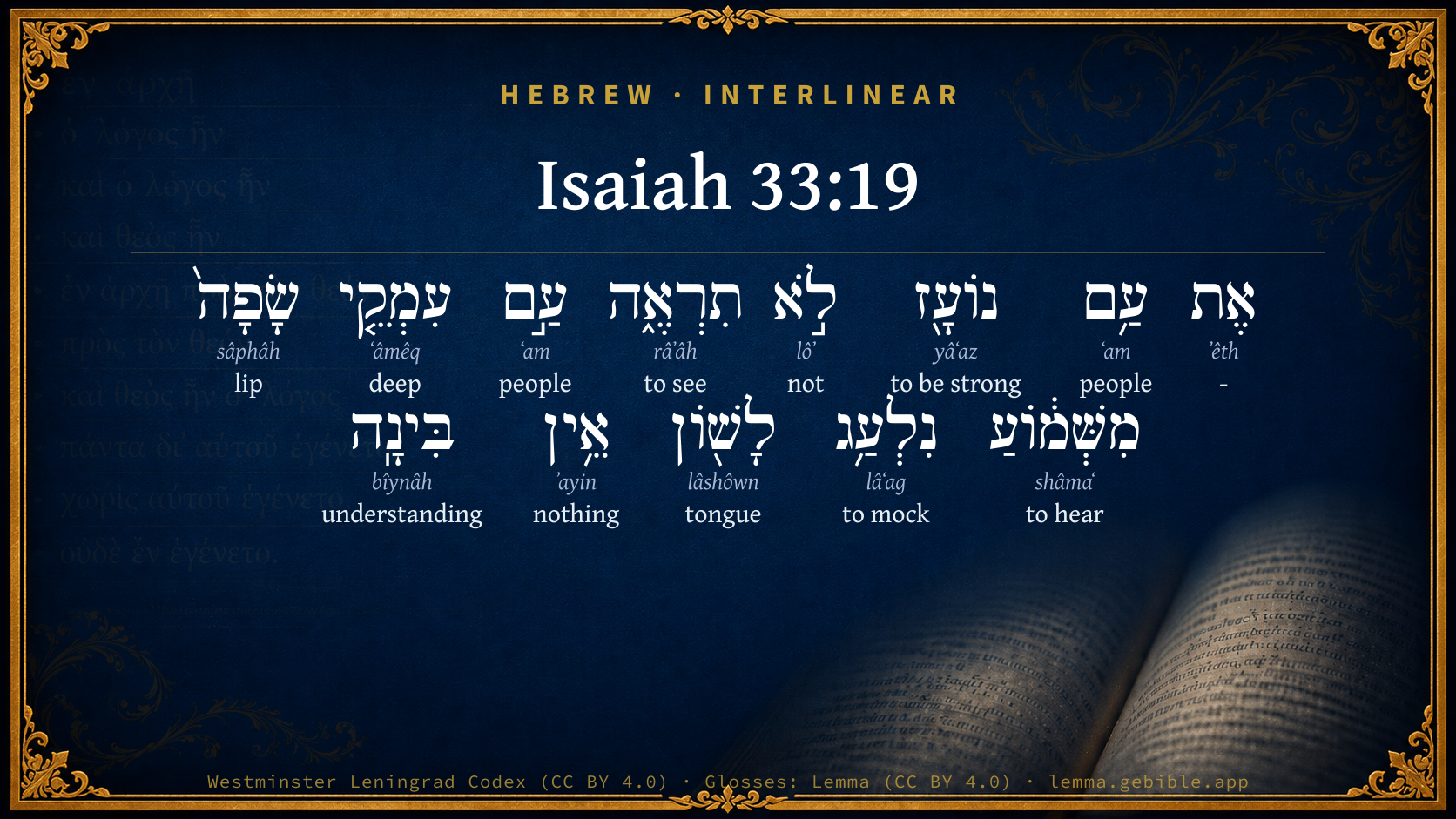
Hebrew (Westminster Leningrad Codex) Isaiah 33:19 appears in the Hebrew Old Testament. The text above is from the Westminster Leningrad Codex. Each word links to its Strong’s number, a concise gloss, and parsing drawn from the Open Scriptures Hebrew Bible morphology. Click any word for its full Brown-Driver-Briggs (BDB) entry.
Download image
Cite this verse

Isaiah 33:19 (World English Bible). Public Domain. Lemma interlinear Bible study tool, https://lemma.gebible.app/v/isaiah/33/19.

Show BibTeX & RIS
BibTeX
RIS
English Translation
You shall not see the fierce people, a people of a deep speech that you can not comprehend, of a strange language that you can not understand.
World English Bible · Public Domain
Highlights Full analysis ↓
Download a study sheet

One document with this verse’s original text, its word-by-word gloss line, the meaning frame, cross-references with their text, attributed commentary, and full source and license credits — printable, and it pastes into notes with its structure intact.

This verse Autodidact and up

Study sheet (.html) Plain text (.txt)

A passage Seminary Student

Up to 50 verses in one chapter. A passage sheet keeps up to 6 commentary sources and 12 cross-references per verse, in the order this page ranks them, and says so on the sheet whenever that leaves anything out. Ask for a single verse and you get the Autodidact verse sheet above.

Everything on this page stays free to read, with no account — the sheet is a download of what is already on screen, not access to it.

Want to remove ads? Support Godless Engineer
Compare translations 3

The same verse in 3 English versions, stacked beneath the original-language interlinear above. Click any original word for its lexicon entry.

Each is an independent rendering of the whole verse — the interlinear is not word-aligned to these translations.

Highlighted words mark where these versions differ — a whole-verse word diff, not a word-by-word alignment.

  • World English Bible Public Domain
    You shall not see the fierce people, a people of a deep speech that you can not comprehend, of a strange language that you can not understand.
  • King James Version Public Domain
    Thou shalt not see a fierce people, a people of a deeper speech than thou canst perceive; of a stammering tongue, that thou canst not understand.
  • unfoldingWord Literal Text CC BY-SA 4.0
    You will not see a people displaying arrogance, a people too deep of lip to hear, stammering of tongue, no understanding.

unfoldingWord Literal Text — © unfoldingWord, licensed CC BY-SA 4.0. Word-aligned USFM3 via Door43 (git.door43.org/unfoldingWord/en_ult).

Versions to compare (up to 4)

3 of 4 selected

Show all 18 translations

Every available English version of this verse, each an independent rendering of the whole verse.

  • World English Bible Public Domain
    You shall not see the fierce people, a people of a deep speech that you can not comprehend, of a strange language that you can not understand.
  • Berean Standard Bible Public Domain
    You will no longer see the insolent, a people whose speech is unintelligible, who stammer in a language you cannot understand.
  • Majority Standard Bible Public Domain
    You will no longer see the insolent, a people whose speech is unintelligible, who stammer in a language you cannot understand.
  • King James Version Public Domain
    Thou shalt not see a fierce people, a people of a deeper speech than thou canst perceive; of a stammering tongue, that thou canst not understand.
  • American Standard Version (1901) Public Domain
    Thou shalt not see the fierce people, a people of a deep speech that thou canst not comprehend, of a strange tongue that thou canst not understand.
  • Revised Version (1885) Public Domain
    Thou shalt not see the fierce people, a people of a deep speech that thou canst not perceive; of a strange tongue that thou canst not understand.
  • Geneva Bible (1599) Public Domain
    Thou shalt not see a fierce people, a people of a darke speache, that thou canst not perceiue, and of a stammering tongue that thou canst not vnderstande.
  • Douay-Rheims (1899) Public Domain
    The shameless people thou shalt not see, the people of profound speech: so that thou canst not understand the eloquence of his tongue, in whom there is no wisdom.
  • Young's Literal Translation Public Domain
    The strong people thou seest not, A people deeper of lip than to be understood, Of a scorned tongue, there is no understanding.
  • Literal Standard Version CC BY-SA 4.0
    You do not see the strong people, || A people deeper of lip than to be understood, || Of a scorned tongue, there is no understanding.
  • Unlocked Literal Bible CC BY-SA 4.0
    You will no longer see the defiant people, a people of a strange language that you do not understand.
  • unfoldingWord Literal Text CC BY-SA 4.0
    You will not see a people displaying arrogance, a people too deep of lip to hear, stammering of tongue, no understanding.
  • Darby Bible Public Domain
    Thou shalt no more see the fierce people, a people of a deeper speech than thou canst comprehend, of a stammering tongue that cannot be understood.
  • World Messianic Bible Public Domain
    You will no longer see the fierce people, a people of a deep speech that you can’t comprehend, with a strange language that you can’t understand.
  • Webster's Bible Public Domain
    Thou shalt not see a fierce people, a people of deeper speech than thou canst perceive; of a stammering tongue, that thou canst not understand.
  • Free Bible Version CC BY-SA 4.0
    You won't see these offensive people anymore with their barbaric language that sounds like someone stammering and is impossible to understand.
  • Bible in Basic English Public Domain
    Never again will you see the cruel people, a people whose tongue has no sense for you; whose language is strange to you.
  • JPS Tanakh (1917) Public Domain
    Thou shalt not see the fierce people; a people of a deep speech that thou canst not perceive, of a stammering tongue that thou canst not understand.

Literal Standard Version (2020), Covenant Press — licensed CC BY-SA 4.0. Text via the HelloAO Bible API (eBible.org). Unlocked Literal Bible (unfoldingWord) — licensed CC BY-SA 4.0. Text via the HelloAO Bible API (eBible.org). unfoldingWord Literal Text — © unfoldingWord, licensed CC BY-SA 4.0. Word-aligned USFM3 via Door43 (git.door43.org/unfoldingWord/en_ult). Free Bible Version, Dr. Jonathan Gallagher — licensed CC BY-SA 4.0. Text via the HelloAO Bible API (eBible.org).

Word by word

More ways to search: Search by grammar → Find every occurrence → Compare this word →

Practice this passage: Drill this verse → Learn its vocabulary →

נוֹעָ֖ז
yâʻaz
H3267
“being strong”
Verb, Niphal, Participle Active, Masculine, Singular, Absolute
Part of Speech
Verb
Stem
Niphal
Form
Participle Active
Gender
Masculine
Number
Singular
State
Absolute
Full BDB Definition

Origin: a primitive root

TWOT: 880

to be strong, be fierce (meaning dubious) - (Niphal) barbarous (participle)
  1. אֶת ʼêth H853 “-” Particle, Direct Object
  2. עַ֥ם ʻam H5971 “people” Noun, Common, Masculine, Singular, Absolute
  3. לֹ֣א lôʼ H3808 “not” Particle, Negative
  4. תִרְאֶ֑ה râʼâh H7200 “to see” Verb, Qal, Imperfect, 2nd Person, Masculine, Singular
  5. עַ֣ם ʻam H5971 “people” Noun, Common, Masculine, Singular, Absolute
  6. עִמְקֵ֤י ʻâmêq H6012 “deep of” Adjective, Adjective, Masculine, Plural, Construct
  7. שָׂפָה֙ sâphâh H8193 “lip” Noun, Common, Feminine, Singular, Absolute
  8. מִשְּׁמ֔וֹעַ shâmaʻ H8085 “from · to hear” Preposition + Verb, Qal, Infinitive Construct
  9. נִלְעַ֥ג lâʻag H3932 “mocked” Verb, Niphal, Participle Passive, Masculine, Singular, Construct
  10. לָשׁ֖וֹן lâshôwn H3956 “tongue” Noun, Common, Both, Singular, Absolute
  11. אֵ֥ין ʼayin H369 “nothing” Particle, Negative
  12. בִּינָֽה bîynâh H998 “understanding” Noun, Common, Feminine, Singular, Absolute

About this verse

These counts appear in no published source. They are computed here, from the morphology-tagged text and Lemma’s own curated glosses. What Lemma adds →

13
words
12
distinct lemmas
Prophets
section

Notable vocabulary

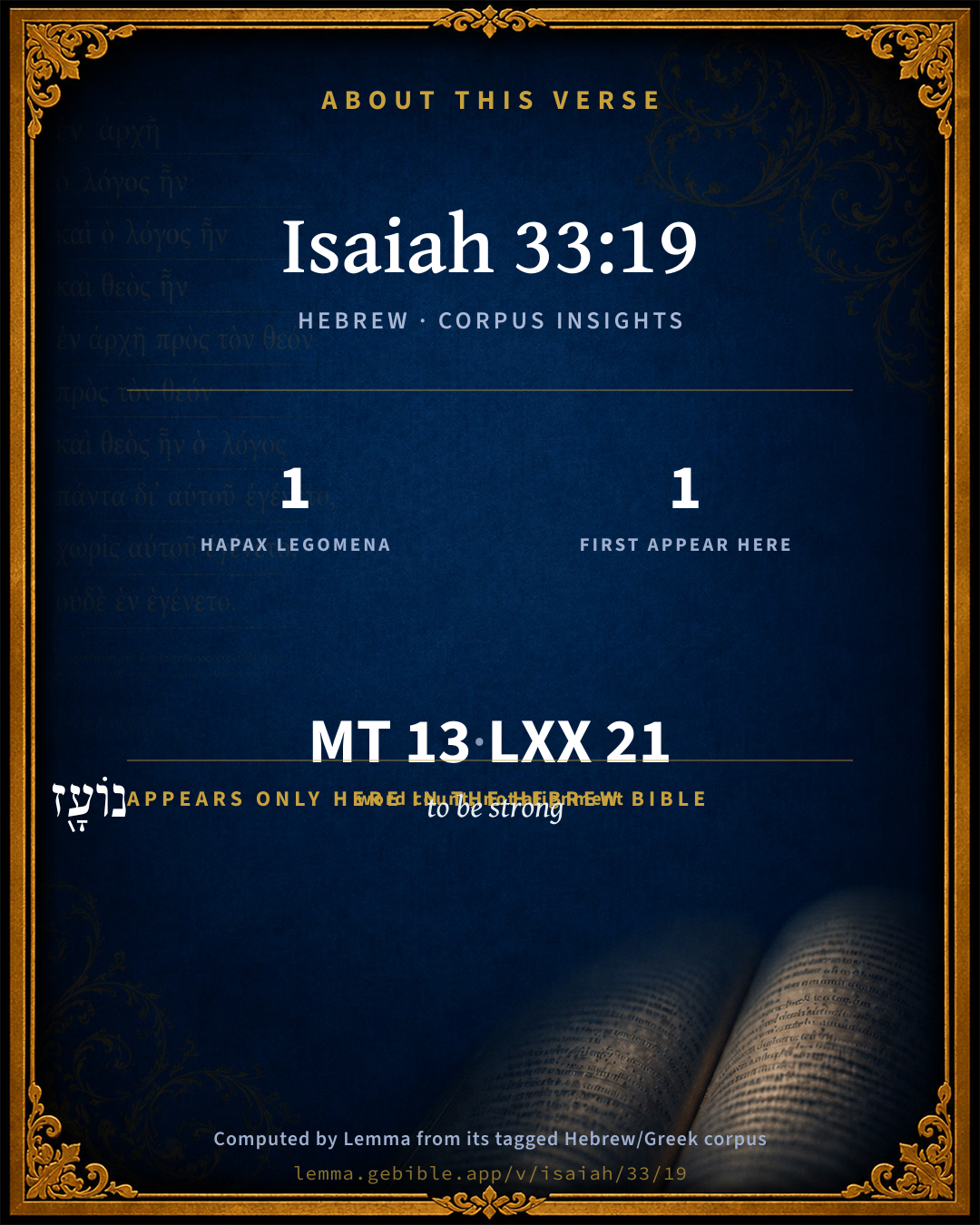
1 hapax legomenon — a word that appears only here in the entire Hebrew Bible:

  • נוֹעָ֖ז to be strong H3267

First appearance in Scripture

This word makes its first canonical appearance in the Hebrew Bible here:

  • נוֹעָ֖ז to be strong H3267

Shared distinctive vocabulary

עִמְקֵ֤י deep H6012 occurs in 4 verses of the Hebrew Bible. Also found in:

Grammatical profile

  • 4 verbs
  • 5 nouns
  • 1 adjective
  • 3 particles

Verb forms

  • נוֹעָ֖ז Niphal · Participle Active
  • תִרְאֶ֑ה Qal · Imperfect
  • מִשְּׁמ֔וֹעַ Qal · Infinitive Construct
  • נִלְעַ֥ג Niphal · Participle Passive

Repetition

A word recurs within this verse — often emphatic in Hebrew:

  • עַ֥ם people H5971 ×2

Hebrew & Septuagint length

In English translation the verse runs 27 words from the Hebrew and 38 from the Septuagint (LXX English) — the Septuagint runs noticeably longer here. See the side-by-side →

A rough comparison of the two English renderings, which tokenize alike — not a word-level alignment.

Word counts can differ between the Hebrew and the Greek without any difference in meaning — e.g. the Hebrew direct-object marker אֵת has no separate Greek word, and Greek often adds the article ὁ.

In the original languages it is 13 Hebrew tokens and 21 Greek tokens — but the two are counted differently (Hebrew bundles its prefixes and suffixes into one token; the Greek is in lemma form), so that isn’t a like-for-like length.

Cross-references

7

Topical passages linked to Isaiah 33:19 in the Treasury of Scripture Knowledge — connected by theme and wording, ordered by reader-vote popularity; previews shown in the World English Bible.

  • Isaiah 28:11 No, but by [men of] strange lips and with another language will he speak to this people;
  • Deuteronomy 28:49–50 Yahweh will bring a nation against you from far, from the end of the earth, as the eagle flies; a nation whose language you shall not understand;
  • Jeremiah 5:15 Behold, I will bring a nation on you from far, house of Israel, says Yahweh: it is a mighty nation, it is an ancient nation, a nation whose language you don't know, neither understand what they say.
  • Exodus 14:13 Moses said to the people, "Don't be afraid. Stand still, and see the salvation of Yahweh, which he will work for you today: for the Egyptians whom you have seen today, you shall never see them again.
  • 2 Kings 19:32 Therefore thus says Yahweh concerning the king of Assyria, He shall not come to this city, nor shoot an arrow there, neither shall he come before it with shield, nor cast up a mound against it.
  • Ezekiel 3:5–6 For you are not sent to a people of a strange speech and of a hard language, but to the house of Israel;
  • 1 Corinthians 14:21 In the law it is written, "By men of strange languages and by the lips of strangers I will speak to this people. Not even thus will they hear me, says the Lord."

Cross-references courtesy of OpenBible.info (CC BY 4.0).

Hebrew and Greek witnesses Masoretic Hebrew ↔ Greek Septuagint

The same verse in the two great witnesses to the Old Testament, shown verse-for-verse.

Here the Septuagint runs noticeably longer than the Hebrew — LXX2012 (modern English Septuagint) 38 words vs World English Bible 27. A rough length comparison of the two English translations, not a word-level alignment — read both below.

These are two independent witnesses, not word-aligned to each other, and the Septuagint is shown in lemma (dictionary) form.

Hebrew Isaiah 33:19 Masoretic · Westminster Leningrad Codex

אֶת עַ֥ם נוֹעָ֖ז לֹ֣א תִרְאֶ֑ה עַ֣ם עִמְקֵ֤י שָׂפָה֙ מִשְּׁמ֔וֹעַ נִלְעַ֥ג לָשׁ֖וֹן אֵ֥ין בִּינָֽה

You shall not see the fierce people, a people of a deep speech that you can not comprehend, of a strange language that you can not understand.

World English Bible · Public Domain

Greek LXX Isaiah 33:19 Septuagint · lemma form

μικρός καί μέγας λαός ὅς οὐ συνβουλεύω οὐδέ οἶδα βαθύφωνον ὥστε μή ἀκούω λαός φαυλίζω καί οὐ εἰμί ὁ ἀκούω σύνεσις

even the small and great people? with whom he took not counsel, neither did he understand a people of deep speech, so that a despised people should not hear, and there is no understanding to him that hears.

LXX2012 (modern English Septuagint) · Public Domain

Hebrew: Westminster Leningrad Codex (CC BY 4.0). Greek: Septuagint (public domain); English from LXX2012 (modern English Septuagint) (Public Domain). How the Septuagint differs from the Hebrew →

Targum (Aramaic paraphrase)

1

The Targum is the ancient Jewish Aramaic paraphrase of the Hebrew Scriptures — an interpretive translation, not the Hebrew text itself. Onkelos (literal) and Pseudo-Jonathan (expansive) render the Torah, and Jonathan the Prophets. Coverage is partial: where no permissively-licensed English translation exists for a verse, only the Aramaic is shown. This is verse-level text, not a word-by-word alignment to the Hebrew.

  1. Targum Jonathan Prophets (Joshua–Malachi)
    יַת מַרְוַת עַם תַּקִיף לָא תִכּוּל לְמֶחֱזֵי עַמָא דַהֲוָה עָמִיק מַמְלַלְהוֹן מִלְמִשְׁמַע מְלַעֲגִין בְּלִישָׁנְהוֹן מִדְלֵית בְּהוֹן סוּכְלְתָנוּ:

    Thou shalt not be able to see the government of a mighty people, whose language is so unintelligible that thou canst not understand it, whose tongue stammereth, because there is no understanding in them.

    Targum Jonathan — Aramaic: “Mikraot Gedolot” (public domain). English: “Sefaria Community Translation” (CC0 1.0 (public-domain dedication)); “London "Chaldee Paraphrase," 1871” (public domain). Text via Sefaria.

Commentary

Notes on Isaiah 33:19 from classic Christian and Jewish commentators (each source and its license shown beneath its notes). The classic Christian expositions comment on the surrounding passage and are grouped to its opening verse, so a note may address several verses; the Jewish commentaries on the Tanakh (Rashi and others) are per-verse, so they appear only where the commentator wrote on this verse.

Lemma curates 59 commentaries, every one of them public domain or Creative Commons licensed, each selected and text-cleaned for this edition rather than reprinted as found. About our sources →

Trapp's Complete Commentary

John Trapp

Isa 33:19 Thou shalt not see a fierce people, a people of a deeper speech than thou canst perceive; of a stammering tongue, [that thou canst] not understand.

Ver. 19. Thou shalt not see a fierce people.] Or, Look not upon a fierce people; or, as some render it, a barbarous people, of a stammering tongue, that thou canst not understand. Such as are most of the schoolmen. Seven years, said one, are but sufficient to understand the barbarisms of Scotus upon Lombard. But rather look upon Zion.

John Trapp, A Commentary or Exposition upon All the Books of the Old and New Testament (1647–1656) — public domain. Text from a community e-Sword module.

Joseph Benson's Commentary

Isa 33:19. Thou shalt not see a fierce people — As Moses said of the Egyptians, (Exo 14:13,) The Egyptians, whom you have seen to- day, you shall see them again no more; so I say of the Assyrians, that fierce and warlike people, whom thou hast seen, with great terror, near the walls of Jerusalem, thou shalt see them again no more; a people of a deeper speech, &c. — A foreign nation whose language is unknown to thee. Of a stammering tongue, &c. — Of which see on Isa 28:11.

Joseph Benson's Commentary on the Old and New Testaments (1811–1818) — public domain. Text from a community e-Sword module.

Tyndale Open Study Notes

Tyndale Open Resources

33:19 The strange, unknown language was the tongue of Assyria and later of Babylon (see 28:11).

Tyndale Open Study Notes — © Tyndale Open Resources, licensed CC BY-SA 4.0. Text via the HelloAO Bible API.

Jamieson, Fausset & Brown

Robert Jamieson, A. R. Fausset & David Brown

fierce people--The Assyrians shall not be allowed to enter Jerusalem (Kg2 19:32). Or, thou shalt not any longer see fierce enemies threatening thee as previously; such as the Assyrians, Romans, and the last Antichristian host that is yet to assail Jerusalem (Deu 28:49-50; Jer 5:15; Zac 14:2).

stammering--barbarous; so "deeper," &c., that is, unintelligible. The Assyrian tongue differed only in dialect from the Hebrew, but in the Assyrian levies were many of non-Semitic race and language, as the Medes, Elamites, &c. (see on Isa 28:11).

Jamieson, Fausset & Brown — Commentary Critical and Explanatory on the Whole Bible (1871) — public domain (CC PDM 1.0). Text via the HelloAO Bible API.

Ellicott's Commentary for English Readers

(19) Thou shalt not see a fierce people . . .—Better, The fierce people thou shalt not see . . . The words answer the question just asked. The whole Assyrian army, with their barbarous, unintelligible speech (Isa_28:11), shall have passed away.

A Bible Commentary for English Readers, edited by Charles John Ellicott (1878–1897) — public domain. Text from a community e-Sword module.

The Cambridge Bible for Schools and Colleges

gen. ed. J. J. S. Perowne

19. Thou shalt not see the fierce people] Some render “people of barbarous speech”; cf. ch. Isa_28:11.

of a deeper speech, &c.] (Eze_3:5), of too deep speech to be understood.

that thou canst not understand] Or, without sense.

The Cambridge Bible for Schools and Colleges (gen. ed. J. J. S. Perowne; Cambridge University Press, 1878–1918) — public domain. Text from a community e-Sword module.

John Gill's Exposition

Thou shalt not see a fierce people,.... A people of a fierce countenance, as in Dan 8:23 fierce in their looks, furious in their temper, cruel and bloodthirsty in their practices, confirmed and hardened in their sins, whose consciences are seared as with a red hot iron; a character given of the Papists, Ti1 4:2 these shall be no more seen nor feared:

a people of a deeper speech than thou canst perceive; than the people in common could, having their worship and devotion not in their mother tongue, but in the Latin tongue:

of a stammering tongue, that thou canst not understand: meaning the same as before, a barbarous language, as everyone is to those who understand it not; so the Syriac and Assyrian languages were to the Jews, Kg2 18:26 and so the Roman language to other nations; but now no more to be used in religious worship; nor shall the church of God be any more visited by Turks or Papists, and be in any dread of them more.

John Gill's Exposition of the Whole Bible (1746–1763) — public domain (CC PDM 1.0). Text via the HelloAO Bible API.

Albert Barnes' Notes on the Bible

Thou shalt not see a fierce people - Or, rather, ‘this fierce and boasting people you shall not see.’ They shall not enter the city; but though they are advancing with so much confidence, they shall be suddenly cut, off and destroyed. The word rendered “fierce,” (נועז nô‛âz from נעז yâ‛az), probably means strong, or wicked. Lowth renders it, ‘barbarous people,’ as if it were לועז lô‛ēz. Michaelis also adopts this reading by supposing an error in transcribing, a change of the Hebrew letter נ (n) into the Hebrew letter ל (l). Such a change might have easily occurred, but there is no authority from the manuscripts for making an alteration in the text The word strong, or mighty, agrees well with the connection.

A people of a deeper speech - A people whose language is so deep, that is, so dark, or obscure, that it cannot be understood by you. This refers to the army of the Assyrians, who spoke the Syrian language, which was understood by some of the Jews, but which was unintelligible to the mass (see Isa 36:11).

Than thou canst perceive - Than you can understand.

Of a stammering tongue - (see the note at Isa 28:11). Margin, ‘Ridiculous;’ a sense which the Hebrew will bear, but the more appropriate meaning is that of a barbarous, or unintelligible foreign language.

Albert Barnes' Notes on the Bible (1834–1885) — public domain. Text from a community e-Sword/MySword module.

Haydock's Catholic Bible Commentary

Shameless, unjust Assyrians, Luke xviii. 2. When shame is gone, people give way to every excess. --- Profound. Unknown to the Jews, 4 Kings xviii. 26. --- No wisdom, manners, or piety.

George Leo Haydock (1774–1849), Haydock's Catholic Family Bible and Commentary, 1859 edition — public domain. Excludes Psalms (Douay-Rheims chapter numbering differs from Protestant) and Deuterocanonical books (Catholic canon only).

Matthew Poole's English Annotations

Thou shalt not see a fierce people: as Moses said of the Egyptians, Exo 14:13, so I say of the Assyrians, that fierce and warlike people, whom thou-hast seen, with great terror, near the walls of Jerusalem, Thou shalt see them again no more.

A people of a deeper speech than thou canst perceive; a foreign nation, whose language is abstruse and unknown to thee.

Of a stammering tongue; of which see on Isa 28:11.

Matthew Poole's English Annotations on the Holy Bible (1683–1685) — public domain. Text from a community e-Sword/MySword module.

The Pulpit Commentary

Thou shalt not see a fierce people, etc.; rather, thou shalt see no more that barbarous people the Assyrians a people gruff of speech that rhea caner, or hear them, stammering of tongue that thee caner not understand them. (comp. Isa_28:11) The generation which witnessed the destruction of Sennacherib"s army probably did not see the Assyrians again. It was not till about B.C. 670 that Manasseh was "taken with hooks by the captains of the King of Assyria, and carried to Babylon". (2Ch_33:11)

The Pulpit Commentary (1880–1919), ed. H.D.M. Spence-Jones & Joseph S. Exell — public domain. Text from a community e-Sword module.

John Wesley's Explanatory Notes

A fierce - That fierce and warlike people, whom thou hast seen with terror, near the walls of Jerusalem, thou shalt see no more. A people - A foreign nation, whose language is unknown to thee.

John Wesley, Explanatory Notes Upon the Whole Bible (1754–1765) — public domain. Text via the GEBible commentary corpus.

J. A. Alexander on Isaiah

Joseph Addison Alexander

“The fierce (or determined) people thou shalt not see.” Thou shalt see no more the Assyrians, whose disappearance was implied in the questions of the foregoing verse. The essential idea seems to be that of firmness and decision, perhaps with the accessory idea of aggressive boldness. “A people deep of lip from hearing” (i.e., hard for thee to understand). Deep denotes obscure or unintelligible. The preposition before hearing, though not directly negative, is virtually so, as it denotes away from, which is really equivalent to so as not to hear or be heard. (See the note on Isa 5:6). “Barbarous tongue (or of a barbarous tongue), without meaning” (literally, there is no meaning). The verb in its other forms, means to mock or scoff, an idea closely connected, in the Hebrew usage, with that of foreign language, either because the latter seems ridiculous to those who do not understand it, or because unmeaning jargon is often used in mockery.

Joseph Addison Alexander, The Prophecies of Isaiah (1846–1847; New York: Scribner, 1870–1878) — public domain. Text from a community e-Sword module.

Rashi

Rabbi Shlomo Yitzchaki (Rashi)

A people of a strange tongue (נוֹעָז) like לוֹעֵז. These are all the heathens, whose language is not the holy tongue. ([Other editions read:] These are Assyria and Babylon, whose language is not the holy tongue.) ([Manuscripts read:] These are all the nations whose language is not the holy tongue.)

you shall not see You shall not esteem in your heart, for they shall all be dark and humble.

speech... obscure (שָׂפָה, lit. lip.) Comp. (Gen. 11:1) “And all the land was one speech (שָׂפָה).”

of stammering tongue (נִלְעָג לָשׁוֹן). Comp. (32:4) “The tongue of the stammerers (לְשׁוֹן עִלְּגִים),” (and of obscure speech. All this is a foreign language, for they do not understand the holy tongue.)

Rashi on the Tanakh — English translations: “The Judaica Press complete Tanach with Rashi, translated by A. J. Rosenberg” (CC BY 4.0); “Pentateuch with Rashi's commentary by M. Rosenbaum and A.M. Silbermann, 1929-1934” (public domain); “The Metsudah Tanach series, Lakewood, N.J” (CC BY 4.0); and “The Book of Joshua, Metsudah Publications, 1997” (CC BY 4.0). Text via Sefaria.

Ibn Ezra

Rabbi Abraham ibn Ezra

נועז We cannot say, whether the נ is radical, or the characteristic prefix of the Niphal; the word is hap. leg.; it means a stranger or a strange man; to consider לועז═נועז speaking a foreign language, is incorrect.

נלעג לשון Mocked for his tongue. People usually laugh at a language, which they cannot understand.

Ibn Ezra on the Tanakh — English translations: “Sefaria Community Translation” (CC0 1.0 (public-domain dedication)); “Yalkut, Sifsei Chachomim Chumash, Metsudah Publications, 2009” (CC BY 4.0); and “Commentary of Ibn Ezra on Isaiah - trans. by M. Friedlander, 1873” (public domain). Text via Sefaria.

Lesson kit

Teaching starters — assembled from the data on this page, not authored interpretation. Every prompt links to the verse data it draws on. Edit before teaching.

Isaiah, in the Prophets, opens this verse with 13 words (12 distinct Hebrew lemmas). Its most distinctive word is yâʻaz (“to be strong”). The Greek Septuagint runs longer here. A historical commentator’s framing appears above. Read the whole chapter for the surrounding context.

Discussion questions

  1. The word yâʻaz carries the sense “to be strong.” How does it shape the verse?
  2. 1 word here appears nowhere else in the Hebrew Bible. Why might the author reach for such rare wording?
  3. This is the first place “to be strong” appears in Scripture (first appears here). What does its debut here establish?
  4. How does Proverbs 9:18, which shares the word «deep», read alongside this verse?
  5. What does the repetition of “people” (2× in this one verse) do in this verse?
  6. The Septuagint runs longer here than the Hebrew. What might account for the difference?
  7. These translations render this verse differently. What is at stake in choosing one wording over another?
  8. «נוֹעָ֖ז» is a Niphal Participle Active verb. How does that grammatical form shape the action described?

Things to notice

  • 1 word in this verse appears nowhere else in the Hebrew Bible.
  • 1 word makes its first canonical appearance in Scripture here.
  • This verse counts 13 Hebrew ↔ 21 Greek words.
  • These translations choose different wording for 22 words in this verse.
  • “people” occurs 2× in this single verse.

Reading settings

Reading text

Shown beneath each verse's original-language words.

Old Testament
Old Testament edition

Read the OT as the Masoretic Hebrew (MT) or the Greek Septuagint (LXX).

English shown for the Greek Septuagint (in the Hebrew ↔ Greek comparison).

Comparing translations? Open the Compare panel on any verse page to stack up to four side by side.