
Isaiah 33:15

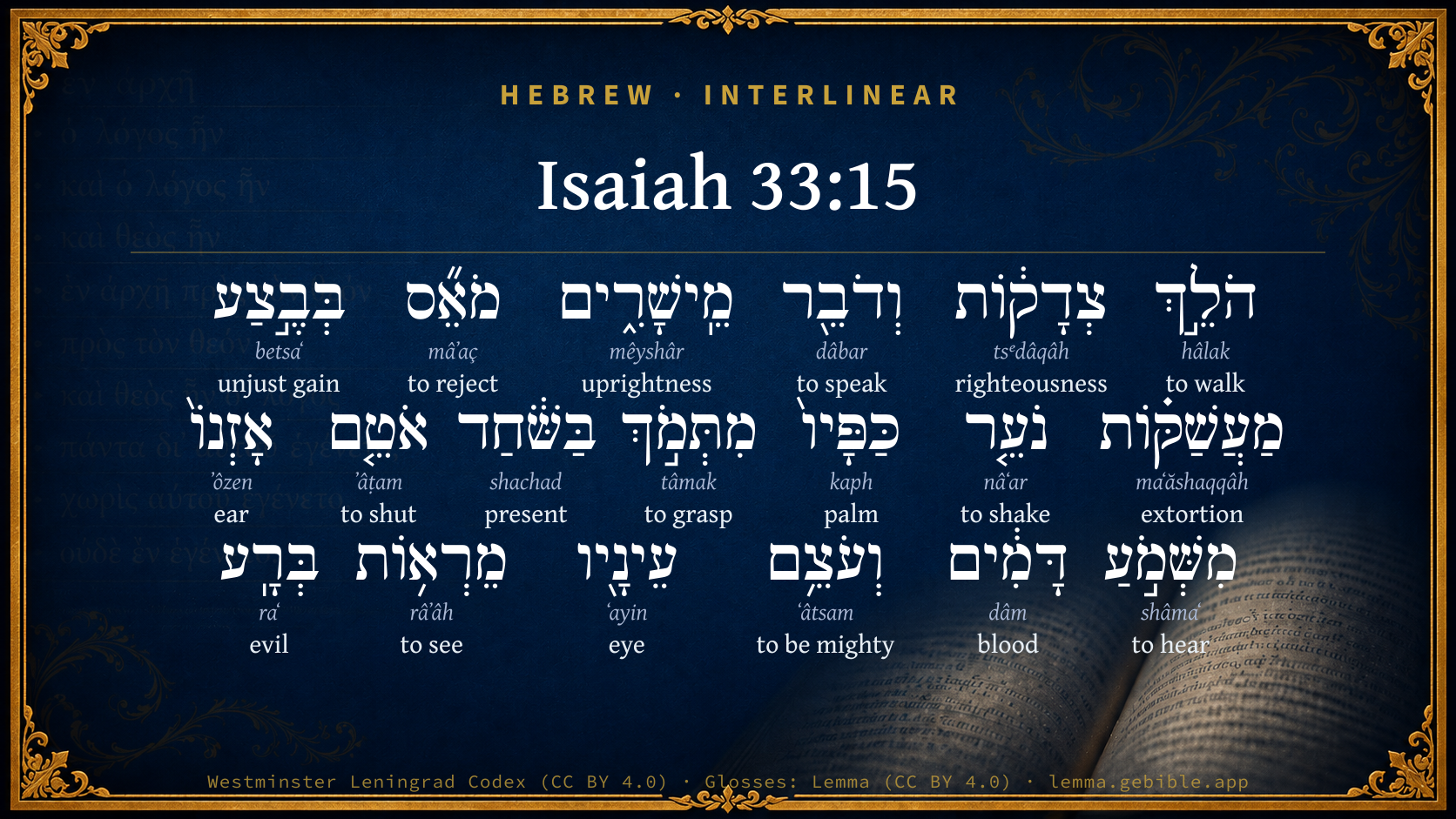
Hebrew (Westminster Leningrad Codex) Isaiah 33:15 appears in the Hebrew Old Testament. The text above is from the Westminster Leningrad Codex. Each word links to its Strong’s number, a concise gloss, and parsing drawn from the Open Scriptures Hebrew Bible morphology. Click any word for its full Brown-Driver-Briggs (BDB) entry.
Download image
Cite this verse

Isaiah 33:15 (World English Bible). Public Domain. Lemma interlinear Bible study tool, https://lemma.gebible.app/v/isaiah/33/15.

Show BibTeX & RIS
BibTeX
RIS
English Translation
He who walks righteously, and speaks blamelessly; he who despises the gain of oppressions, who shakes his hands from taking a bribe, who stops his ears from hearing of blood, and shuts his eyes from looking on evil:
World English Bible · Public Domain
Download a study sheet

One document with this verse’s original text, its word-by-word gloss line, the meaning frame, cross-references with their text, attributed commentary, and full source and license credits — printable, and it pastes into notes with its structure intact.

This verse Autodidact and up

Study sheet (.html) Plain text (.txt)

A passage Seminary Student

Up to 50 verses in one chapter. A passage sheet keeps up to 6 commentary sources and 12 cross-references per verse, in the order this page ranks them, and says so on the sheet whenever that leaves anything out. Ask for a single verse and you get the Autodidact verse sheet above.

Everything on this page stays free to read, with no account — the sheet is a download of what is already on screen, not access to it.

Want to remove ads? Support Godless Engineer
Compare translations 3

The same verse in 3 English versions, stacked beneath the original-language interlinear above. Click any original word for its lexicon entry.

Each is an independent rendering of the whole verse — the interlinear is not word-aligned to these translations.

Highlighted words mark where these versions differ — a whole-verse word diff, not a word-by-word alignment.

  • World English Bible Public Domain
    He who walks righteously, and speaks blamelessly; he who despises the gain of oppressions, who shakes his hands from taking a bribe, who stops his ears from hearing of blood, and shuts his eyes from looking on evil:
  • King James Version Public Domain
    He that walketh righteously, and speaketh uprightly; he that despiseth the gain of oppressions, that shaketh his hands from holding of bribes, that stoppeth his ears from hearing of blood, and shutteth his eyes from seeing evil;
  • unfoldingWord Literal Text CC BY-SA 4.0
    The one walking righteousnesses and speaking uprightnesses, the one despising the gain of oppressions, the one shaking his palms from taking hold of a bribe, the one stopping his ear from hearing of bloodshed, and the one shutting his eyes from looking on evil,

unfoldingWord Literal Text — © unfoldingWord, licensed CC BY-SA 4.0. Word-aligned USFM3 via Door43 (git.door43.org/unfoldingWord/en_ult).

Versions to compare (up to 4)

3 of 4 selected

Show all 18 translations

Every available English version of this verse, each an independent rendering of the whole verse.

  • World English Bible Public Domain
    He who walks righteously, and speaks blamelessly; he who despises the gain of oppressions, who shakes his hands from taking a bribe, who stops his ears from hearing of blood, and shuts his eyes from looking on evil:
  • Berean Standard Bible Public Domain
    He who walks righteously and speaks with sincerity, who refuses gain from extortion, whose hand never takes a bribe, who stops his ears against murderous plots and shuts his eyes tightly against evil—
  • Majority Standard Bible Public Domain
    He who walks righteously and speaks with sincerity, who refuses gain from extortion, whose hand never takes a bribe, who stops his ears against murderous plots and shuts his eyes tightly against evil—
  • King James Version Public Domain
    He that walketh righteously, and speaketh uprightly; he that despiseth the gain of oppressions, that shaketh his hands from holding of bribes, that stoppeth his ears from hearing of blood, and shutteth his eyes from seeing evil;
  • American Standard Version (1901) Public Domain
    He that walketh righteously, and speaketh uprightly; he that despiseth the gain of oppressions, that shaketh his hands from taking a bribe, that stoppeth his ears from hearing of blood, and shutteth his eyes from looking upon evil:
  • Revised Version (1885) Public Domain
    He that walketh righteously, and speaketh uprightly; he that despiseth the gain of oppressions, that shaketh his hands from holding of bribes, that stoppeth his ears from hearing of blood, and shutteth his eyes from looking upon evil;
  • Geneva Bible (1599) Public Domain
    Hee that walketh in iustice, and speaketh righteous things, refusing gaine of oppression, shaking his handes from taking of gifts, stopping his eares from hearing of blood, and shutting his eyes from seeing euill.
  • Douay-Rheims (1899) Public Domain
    He that walketh in justices, and speaketh truth, that casteth away avarice by oppression, and shaketh his hands from all bribes, that stoppeth his ears lest he hear blood, and shutteth his eyes that he may see no evil.
  • Young's Literal Translation Public Domain
    Whoso is walking righteously, And is speaking uprightly, Kicking against gain of oppressions, Shaking his hands from taking hold on a bribe, Stopping his ear from hearing of blood, And shutting his eyes from looking on evil,
  • Literal Standard Version CC BY-SA 4.0
    Whoever is walking righteously, || And is speaking uprightly, || Kicking against gain of oppressions, || Shaking his hands from taking hold on a bribe, || Stopping his ear from hearing of blood, || And shutting his eyes from looking on evil,
  • Unlocked Literal Bible CC BY-SA 4.0
    He who walks righteously and speaks honestly; who despises the gain of oppression, who shakes his hand so that it will not accept a bribe, who stops his ears from hearing about bloodshed, and who shuts his eyes from looking on evil—
  • unfoldingWord Literal Text CC BY-SA 4.0
    The one walking righteousnesses and speaking uprightnesses, the one despising the gain of oppressions, the one shaking his palms from taking hold of a bribe, the one stopping his ear from hearing of bloodshed, and the one shutting his eyes from looking on evil,
  • Darby Bible Public Domain
    -- He that walketh righteously, and speaketh uprightly; he that despiseth the gain of oppressions, that shaketh his hands from taking hold of bribes, that stoppeth his ears from hearing of blood, and shutteth his eyes from seeing evil:
  • World Messianic Bible Public Domain
    He who walks righteously and speaks blamelessly, he who despises the gain of oppressions, who gestures with his hands, refusing to take a bribe, who stops his ears from hearing of bloodshed, and shuts his eyes from looking at evil—
  • Webster's Bible Public Domain
    He that walketh righteously, and speaketh uprightly; he that despiseth the gain of oppressions, that shaketh his hands from holding of bribes, that stoppeth his ears from hearing of blood, and shutteth his eyes from seeing evil;
  • Free Bible Version CC BY-SA 4.0
    Those who live right and speak the truth, those who refuse to profit from extortion and refuse to take bribes, who don't listen to plots to kill people, who close their eyes rather than look at evil.
  • Bible in Basic English Public Domain
    He whose ways are true, and whose words are upright; he who gives no thought to the profits of false acts, whose hands have not taken rewards, who will have no part in putting men to death, and whose eyes are shut against evil;
  • JPS Tanakh (1917) Public Domain
    He that walketh righteously, and speaketh uprightly; he that despiseth the gain of oppressions, that shaketh his hands from holding of bribes, that stoppeth his ears from hearing of blood, and shutteth his eyes from looking upon evil;

Literal Standard Version (2020), Covenant Press — licensed CC BY-SA 4.0. Text via the HelloAO Bible API (eBible.org). Unlocked Literal Bible (unfoldingWord) — licensed CC BY-SA 4.0. Text via the HelloAO Bible API (eBible.org). unfoldingWord Literal Text — © unfoldingWord, licensed CC BY-SA 4.0. Word-aligned USFM3 via Door43 (git.door43.org/unfoldingWord/en_ult). Free Bible Version, Dr. Jonathan Gallagher — licensed CC BY-SA 4.0. Text via the HelloAO Bible API (eBible.org).

Word by word

More ways to search: Search by grammar → Find every occurrence → Compare this word →

Practice this passage: Drill this verse → Learn its vocabulary →

מַעֲשַׁקּ֗וֹת
maʻăshaqqâh
H4642
“extortions”
Noun, Common, Feminine, Plural, Absolute
Part of Speech
Noun
Type
Common
Gender
Feminine
Number
Plural
State
Absolute
Full BDB Definition

Origin: from H6231

TWOT: 1713e

extortionate deed, extortion
  1. הֹלֵ֣ךְ hâlak H1980 “walking” Verb, Qal, Participle Active, Masculine, Singular, Absolute
  2. צְדָק֔וֹת tsᵉdâqâh H6666 “righteous acts” Noun, Common, Feminine, Plural, Absolute
  3. וְדֹבֵ֖ר dâbar H1696 “and · speaking” Conjunction + Verb, Qal, Participle Active, Masculine, Singular, Absolute
  4. מֵֽישָׁרִ֑ים mêyshâr H4339 “uprightness” Noun, Common, Masculine, Plural, Absolute
  5. מֹאֵ֞ס mâʼaç H3988 “rejecting” Verb, Qal, Participle Active, Masculine, Singular, Absolute
  6. בְּבֶ֣צַע betsaʻ H1215 “in/at · unjust gain of” Preposition + Noun, Common, Masculine, Singular, Construct
  7. נֹעֵ֤ר nâʻar H5287 “shaking” Verb, Qal, Participle Active, Masculine, Singular, Absolute
  8. כַּפָּיו֙ kaph H3709 “palms · his” Noun, Common, Feminine, Dual, Construct + Suffix, Personal, 3rd Person, Masculine, Singular
  9. מִתְּמֹ֣ךְ tâmak H8551 “from · to grasp” Preposition + Verb, Qal, Infinitive Construct
  10. בַּשֹּׁ֔חַד shachad H7810 “in/at the · present” Preposition, Determined + Noun, Common, Masculine, Singular, Absolute
  11. אֹטֵ֤ם ʼâṭam H331 “shutting” Verb, Qal, Participle Active, Masculine, Singular, Absolute
  12. אָזְנוֹ֙ ʼôzen H241 “ear · his” Noun, Common, Feminine, Singular, Construct + Suffix, Personal, 3rd Person, Masculine, Singular
  13. מִשְּׁמֹ֣עַ shâmaʻ H8085 “from · to hear” Preposition + Verb, Qal, Infinitive Construct
  14. דָּמִ֔ים dâm H1818 “blood” Noun, Common, Masculine, Plural, Absolute
  15. וְעֹצֵ֥ם ʻâtsam H6105 “and · being mighty” Conjunction + Verb, Qal, Participle Active, Masculine, Singular, Absolute
  16. עֵינָ֖יו ʻayin H5869 “eyes · his” Noun, Common, Both, Dual, Construct + Suffix, Personal, 3rd Person, Masculine, Singular
  17. מֵרְא֥וֹת râʼâh H7200 “from · to see” Preposition + Verb, Qal, Infinitive Construct
  18. בְּרָֽע raʻ H7451 “in/at · evil” Preposition + Adjective, Adjective, Masculine, Singular, Absolute

About this verse

These counts appear in no published source. They are computed here, from the morphology-tagged text and Lemma’s own curated glosses. What Lemma adds →

19
words
19
distinct lemmas
Prophets
section

Notable vocabulary

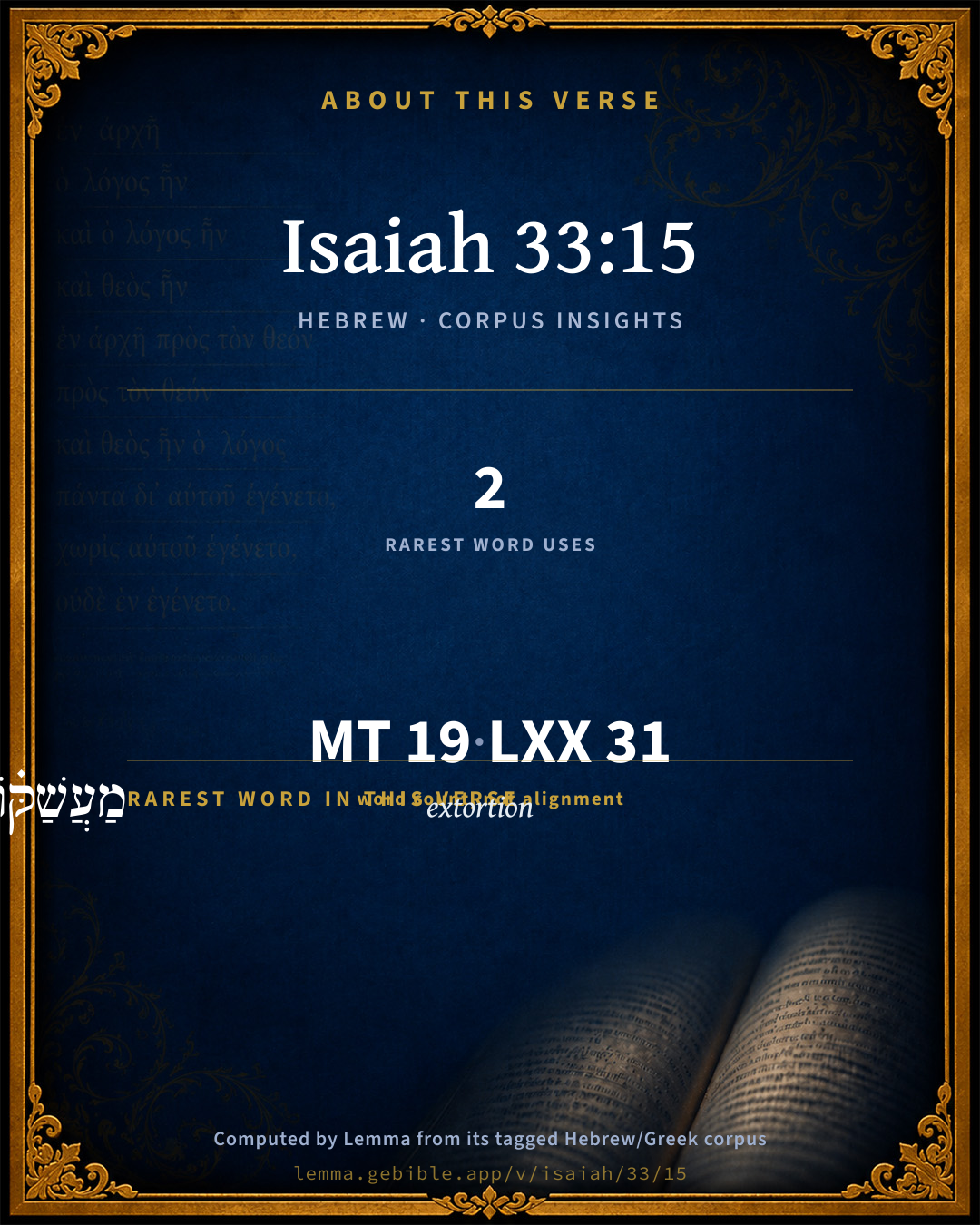
The rarest word here is מַעֲשַׁקּ֗וֹת extortion H4642 — appearing just 2 times in the whole Hebrew Bible.

Shared distinctive vocabulary

מַעֲשַׁקּ֗וֹת extortion H4642 occurs in 2 verses of the Hebrew Bible. Also found in:

Grammatical profile

  • 9 verbs
  • 9 nouns
  • 1 adjective

Verb forms

  • הֹלֵ֣ךְ Qal · Participle Active
  • וְדֹבֵ֖ר Qal · Participle Active
  • מֹאֵ֞ס Qal · Participle Active
  • נֹעֵ֤ר Qal · Participle Active
  • מִתְּמֹ֣ךְ Qal · Infinitive Construct
  • אֹטֵ֤ם Qal · Participle Active
  • מִשְּׁמֹ֣עַ Qal · Infinitive Construct
  • וְעֹצֵ֥ם Qal · Participle Active
  • מֵרְא֥וֹת Qal · Infinitive Construct

Hebrew & Septuagint length

In English translation the verse runs 38 words from the Hebrew and 38 from the Septuagint (LXX English) — the same length.

A rough comparison of the two English renderings, which tokenize alike — not a word-level alignment.

Word counts can differ between the Hebrew and the Greek without any difference in meaning — e.g. the Hebrew direct-object marker אֵת has no separate Greek word, and Greek often adds the article ὁ.

In the original languages it is 19 Hebrew tokens and 31 Greek tokens — but the two are counted differently (Hebrew bundles its prefixes and suffixes into one token; the Greek is in lemma form), so that isn’t a like-for-like length.

Cross-references

35

Topical passages linked to Isaiah 33:15 in the Treasury of Scripture Knowledge — connected by theme and wording, ordered by reader-vote popularity; previews shown in the World English Bible.

  • Psalms 119:37 Turn my eyes away from looking at worthless things. Revive me in your ways.
  • 1 John 3:7 Little children, let no one lead you astray. He who does righteousness is righteous, even as he is righteous.
  • Ephesians 5:11–13 Have no fellowship with the unfruitful works of darkness, but rather even reprove them.
  • Deuteronomy 16:19 You shall not wrest justice: you shall not respect persons; neither shall you take a bribe; for a bribe does blind the eyes of the wise, and pervert the words of the righteous.
  • Psalms 1:1–3 Blessed is the man who doesn't walk in the counsel of the wicked, Nor stand in the way of sinners, Nor sit in the seat of scoffers;
  • Psalms 24:4–5 He who has clean hands and a pure heart; Who has not lifted up his soul to falsehood, And has not sworn deceitfully.
  • Psalms 106:3 Blessed are those who keep justice. Blessed is one who does what is right at all times.
  • Isaiah 56:1–2 Thus says Yahweh, Keep you justice, and do righteousness; for my salvation is near to come, and my righteousness to be revealed.
  • Romans 2:7 to those who by patience in well-doing seek for glory and honor and incorruptibility, eternal life;
  • Titus 2:11–12 For the grace of God has appeared, bringing salvation to all men,
  • Psalms 15:1–2 Yahweh, who shall dwell in your sanctuary? Who shall live on your holy hill?
  • Psalms 26:1–2 Judge me, Yahweh, for I have walked in my integrity. I have trusted also in Yahweh without wavering.
  • Psalms 26:4–6 I have not sat with deceitful men, Neither will I go in with hypocrites.
  • Psalms 26:9–11 Don't gather my soul with sinners, Nor my life with bloodthirsty men;
  • Ezekiel 18:15–17 who has not eaten on the mountains, neither has lifted up his eyes to the idols of the house of Israel, has not defiled his neighbor's wife,
  • Malachi 2:6 The law of truth was in his mouth, and unrighteousness was not found in his lips. He walked with me in peace and uprightness, and turned many away from iniquity.
  • Luke 1:6 They were both righteous before God, walking blamelessly in all the commandments and ordinances of the Lord.
  • Luke 19:8 Zacchaeus stood and said to the Lord, "Behold, Lord, half of my goods I give to the poor. If I have wrongfully exacted anything of anyone, I restore four times as much."
  • Acts 8:18–23 Now when Simon saw that the Holy Spirit was given through the laying on of the apostles' hands, he offered them money,
  • James 5:4 Behold, the wages of the laborers who mowed your fields, which you have kept back by fraud, cry out, and the cries of those who reaped have entered into the ears of the Lord of Hosts.
  • 2 Peter 2:14–16 having eyes full of adultery, and who can't cease from sin; enticing unsettled souls; having a heart trained in greed; children of cursing;
  • Exodus 23:6–9 "You shall not deny justice to your poor people in their lawsuits.
  • Numbers 16:15 Moses was very angry, and said to Yahweh, "Don't respect their offering: I have not taken one donkey from them, neither have I hurt one of them."
  • 1 Samuel 12:3 Here I am: witness against me before Yahweh, and before his anointed: whose ox have I taken? or whose donkey have I taken? or whom have I defrauded? whom have I oppressed? or of whose hand have I taken a ransom to blind my eyes therewith? and I will restore it you.
  • 1 Samuel 24:4–7 The men of David said to him, Behold, the day of which Yahweh said to you, Behold, I will deliver your enemy into your hand, and you shall do to him as it shall seem good to you. Then David arose, and cut off the skirt of Saul's robe secretly.
  • 1 Samuel 26:8–11 Then said Abishai to David, God has delivered up your enemy into your hand this day: now therefore please let me strike him with the spear to the earth at one stroke, and I will not strike him the second time.
  • Nehemiah 5:7–13 Then I consulted with myself, and contended with the nobles and the rulers, and said to them, You exact usury, everyone of his brother. I held a great assembly against them.
  • Job 31:13–25 "If I have despised the cause of my man-servant Or of my maid-servant, When they contended with me;
  • Job 31:29–31 "If I have rejoiced at the destruction of him who hated me, Or lifted up myself when evil found him;
  • Isaiah 58:8 Then shall your light break forth as the morning, and your healing shall spring forth speedily; and your righteousness shall go before you; the glory of Yahweh shall by your rearward.
  • Jeremiah 5:26–28 For among my people are found wicked men: they watch, as fowlers lie in wait; they set a trap, they catch men.
  • Micah 7:3–4 Their hands are on that which is evil to do it diligently. The ruler and judge ask for a bribe; And the powerful man dictates the evil desire of his soul. Thus they conspire together.
  • Matthew 26:15 and said, "What are you willing to give me, that I should deliver him to you?" They weighed out for him thirty pieces of silver.
  • Luke 3:12–14 Tax collectors also came to be baptized, and they said to him, "Teacher, what must we do?"
  • Jeremiah 40:15–16 Then Johanan the son of Kareah spoke to Gedaliah in Mizpah secretly, saying, Please let me go, and I will kill Ishmael the son of Nethaniah, and no man shall know it: why should he take your life, that all the Jews who are gathered to you should be scattered, and the remnant of Judah perish?

Cross-references courtesy of OpenBible.info (CC BY 4.0).

Hebrew and Greek witnesses Masoretic Hebrew ↔ Greek Septuagint

The same verse in the two great witnesses to the Old Testament, shown verse-for-verse.

These are two independent witnesses, not word-aligned to each other, and the Septuagint is shown in lemma (dictionary) form.

Hebrew Isaiah 33:15 Masoretic · Westminster Leningrad Codex

הֹלֵ֣ךְ צְדָק֔וֹת וְדֹבֵ֖ר מֵֽישָׁרִ֑ים מֹאֵ֞ס בְּבֶ֣צַע מַעֲשַׁקּ֗וֹת נֹעֵ֤ר כַּפָּיו֙ מִתְּמֹ֣ךְ בַּשֹּׁ֔חַד אֹטֵ֤ם אָזְנוֹ֙ מִשְּׁמֹ֣עַ דָּמִ֔ים וְעֹצֵ֥ם עֵינָ֖יו מֵרְא֥וֹת בְּרָֽע

He who walks righteously, and speaks blamelessly; he who despises the gain of oppressions, who shakes his hands from taking a bribe, who stops his ears from hearing of blood, and shuts his eyes from looking on evil:

World English Bible · Public Domain

Greek LXX Isaiah 33:15 Septuagint · lemma form

πορεύομαι ἐν δικαιοσύνη λαλέω εὐθύς ὁδός μισέω ἀνομία καί ἀδικία καί ὁ χείρ ἀποσείω ἀπό δῶρον βαρύνω ὁ οὖς ἵνα μή ἀκούω κρίσις αἷμα καμμύω ὁ ὀφθαλμός ἵνα μή ὁράω ἀδικία

He that walks in righteousness, speaking rightly, hating transgression and iniquity, and shaking his hands from gifts, stopping his ears that he should not hear the judgment of blood, shutting his eyes that he should not see injustice.

LXX2012 (modern English Septuagint) · Public Domain

Hebrew: Westminster Leningrad Codex (CC BY 4.0). Greek: Septuagint (public domain); English from LXX2012 (modern English Septuagint) (Public Domain). How the Septuagint differs from the Hebrew →

Targum (Aramaic paraphrase)

1

The Targum is the ancient Jewish Aramaic paraphrase of the Hebrew Scriptures — an interpretive translation, not the Hebrew text itself. Onkelos (literal) and Pseudo-Jonathan (expansive) render the Torah, and Jonathan the Prophets. Coverage is partial: where no permissively-licensed English translation exists for a verse, only the Aramaic is shown. This is verse-level text, not a word-by-word alignment to the Hebrew.

  1. Targum Jonathan Prophets (Joshua–Malachi)
    אֲמַר נְבִיָא יַתְבוּן בָהּ צַדִיקַיָא כָּל דִמְהַלֵךְ בִּזְכוּ וּמְמַלֵיל כֵּיוָנָן מִתְרַחֵק מִמָמוֹן דִשְׁקַר מַרְחֵיק נַפְשֵׁיהּ מִן אֲנוּסִין מְנַע יְדוֹהִי מִלְקַבָּלָא שׁוֹחְדָא מְטַמְטֵים אוּדְנֵהּ מִלְמִשְׁמַע בְּאַשְׁדֵי דַם זַכַּאי וְכָל עֵינוֹהִי מִלְמֶחְזֵי בְּעָבְדֵי בוּשׁ:

    The prophet said, The just shall live in it, every one who walketh in righteousness, and speaketh honest things; removing himself to a distance from the mammon of iniquity; removing himself from oppressions, that restraineth his hands from holding a bribe, that stoppeth his ears from hearing of the shedding of innocent blood, and shutteth his eyes from looking at the workers of iniquity.

    Targum Jonathan — Aramaic: “Mikraot Gedolot” (public domain). English: “Sefaria Community Translation” (CC0 1.0 (public-domain dedication)); “London "Chaldee Paraphrase," 1871” (public domain). Text via Sefaria.

Commentary

Notes on Isaiah 33:15 from classic Christian and Jewish commentators (each source and its license shown beneath its notes). The classic Christian expositions comment on the surrounding passage and are grouped to its opening verse, so a note may address several verses; the Jewish commentaries on the Tanakh (Rashi and others) are per-verse, so they appear only where the commentator wrote on this verse.

Lemma curates 59 commentaries, every one of them public domain or Creative Commons licensed, each selected and text-cleaned for this edition rather than reprinted as found. About our sources →

Trapp's Complete Commentary

John Trapp

Isa 33:15 He that walketh righteously, and speaketh uprightly; he that despiseth the gain of oppressions, that shaketh his hands from holding of bribes, that stoppeth his ears from hearing of blood, and shutteth his eyes from seeing evil;

Ver. 15. He that walketh righteously,] q.d., Though you cannot, yet there are those that can, viz., "those that are in Christ Jesus, who walk not after the flesh, but after the Spirit." Surely to such there is "no one condemnation." {Rom 8:1} Christ standeth as a screen between the wrath of God and his elect, for whose sake also this paschal lamb was once for all roasted in the fire of his Father’s indignation, whereby they are not only "delivered from the wrath to come," {1Th 1:10} but also have "boldness and access with confidence by the faith of him." {Eph 3:12; Eph 2:18}

He that walketh righteously.] Through whose whole life righteousness runneth as the woof doth through the web, as the blood doth through the veins, &c.

And speaketh uprightly.] Heb., Evennesses. Non blasphema, impudica, fescennina; not the language of hell, but of Canaan. See Jas 3:2.

That despiseth the gain of oppressions.] The Mammon of iniquity; wealth gotten by force or fraud. A public person especially, as he should have nothing to lose, so he should have nothing to get; he should be above all price or sale. Nec prece nec precio, Neither by prayer nor request, should be his motto.

That shaketh his hands from holding of bribes.] He doth not only not do wrong, but not receive a gift, whereby he may be engaged or inclined to do it.

That stoppeth his ears from hearing of blood.] He not only does not shed it, but refuseth to hear any communing about such a business.

That shutteth his eyes from seeing of evil.] Lest his heart should thereby be betrayed, for vitiis nobis in animum per oculos est via, could a heathen {a} say. By the eyes evil getteth into the heart; by looking cometh lusting; and millions die of the wound in the eye.

{a} Quintil., Declam.

John Trapp, A Commentary or Exposition upon All the Books of the Old and New Testament (1647–1656) — public domain. Text from a community e-Sword module.

The Biblical Illustrator

Joseph S. Exell

Isa_33:15-16

He that walketh righteously

The citizens of Gods kingdom

I.

THE CHARACTER of the true citizens of Gods kingdom is expressed in general terms. Walketh righteously; speaketh uprightly.

II. The DETAILS are given in which the character is revealed. Despiseth the gain, &c. (Prof J. Skinner, D. D.)

The good man

I. THE GOOD MANS CHARACTER, which he preserves even in times of common iniquity.

II. THE GOOD MANS COMFORT, which he may preserve even in times of common calamity (Isa_33:16). (M. Henry.)

The rocky fortress and its inhabitant

We are going to look at the favoured people.

I. Let us NOTE THEIR CHARACTER. They are described in part in the words of our text, but I am obliged to go a little farther afield for one essential part of their character.

1. The true people of God who in the time of danger will be preserved are a people who display a humble, patient, present faith in God. They reveal their character in Isa_33:2, when they pray, O Lord, be gracious unto us; we have waited for Thee, &c. They are a praying people, who make their appeal to God under a sense of need: they are not fatalists, neither are they self-sufficient. They beseech the Lord to bless them not according to their own merit, but according to His grace. They are not a people who think that God will be gracious necessarily, for they are found crying to Him in earnest prayer. They are a trustful people. Furthermore, they are a waiting people: We have waited for Thee. If the Lord does not seem to hear their prayer at once, they nevertheless expect that He will do so. They are a people who have a present faith, which they exercise every day, saying, Be Thou their arm every morning! Every step they are depending, every morning they are looking up to the hills whence cometh their help. The description in our actual text is the portrait of their outer life; but a living faith is the secret basis and foundation of it all.

2. This being understood, our text gives a description of these people, setting out their various features.

(1) It first describes their feet, or how they walk: He that walketh righteously. When a man believes, his faith affects every part of him; it operate-s upon-his actions, thoughts, wishes, and designs; and it affects both his private and public life. One of the first evidences of a true belief in God is that a man walks righteously. He tries to act rightly towards his God and towards his fellow-men. The rule of right is the rule for him; not policy, nor the hope of gain, nor the desire to please, much less the lust of the flesh and the pride of life.

(2) The next feature that is described is his tongue--he speaketh uprightly. A man whose words are arrogant and boastful, cruel and slanderous, unreliable and deceptive, unchaste and impure, is no child of God. The grace of God very speedily sweetens a mans tongue. The doctor says, Put out your tongue, and he judges the symptoms of health or disease thereby; assuredly there is no better test of the inward character than the condition of the tongue. Out of thine own mouth will I judge thee is a fair decision.

(3) The next feature is the heart--he that despiseth the gain of oppressions. Not only does he not oppress any man, nor wish to gain anything by extortion; but he thinks such gain as might be made in that fashion to be utterly contemptible--he despises it. It little matters what our outward life may be, or even what our speech may be, if our heart is not affected by our religion. If grace only lies skin deep in thee, it has only saved thy skin, but not thy soul. Until grace touches the mainspring, it has done nothing to purpose: the heart must despise evil, as well as the lips denounce it. Until the well-head is sweetened, the streams are foul. Not only must I do right, but love right; not only must I avoid wrong, but hate wrong.

(4) The portrait does not omit the hands--those prominent actors both for good and evil. In Isaiahs day bribery was connected with every government office high and low; but the good man shaketh his hands from holding of bribes. If money was slipped into his hand before he was aware of it, he shook it off with indignation.

(5) Now comes the ear--that stoppeth his ears from hearing of blood. Men who delighted in war in olden time were apt to regale one another with their cruel deeds--whom they slew, and how they slew them. In Hezekiahs times, I warrant, tales were told blood-red with horror that would have made our ears to tingle, and these were greedily listened to by those of a coarse spirit; but the good man in Jerusalem would not hear them. Now it is not the hearing of blood alone that you and I must avoid, but the hearing of anything that is tainted, prurient, sceptical, depraving. The Christian wisely shuts the gate, lets down the portcullis, and pulls up the drawbridge, so that no filthy communication may come in by Ear-gate. The same sacred prudence prevents our reading books which are corrupt, or false. The righteous man knows that an ill tale cannot injure him if he never hears it, and therefore he denies his curiosity that he may preserve his memory undefiled. He is deaf to news about which a good man would be dumb. He has the blood upon his ear, to signify that his Lord has bought him with a price in that member, as well as in every other; yea, his ear is bored to the doorpost of truth, that he may hear it, and it only, with full intent of heart.

(6) The picture is complete when the eyes are mentioned--he shutteth his eyes from seeing evil. He cannot help seeing it as he goes along his pilgrimage through life; but he seeks not such a sight, and as much as he can he avoids it. Shortly, the text means just this, that a true believer is a man who has himself well in hand, having mastery over his whole manhood. He has a bit in the mouth of all the steeds which draw the chariot of life, and he holds them under due control. The true Christian is a man who keeps himself clear of the common sins of the age, the popular vices which flourish uncondemned. The sins mentioned in the text were those current in Jerusalem. The child of God was out of the fashion.

II. We OBSERVE THEIR SECURITY.

1. As it is pictorially described. The times are those of war: the battle rages in the plain, but he shall dwell on high; aloft upon the craggy rocks shall be his citadel. In times of invasion men resorted to the highest mountains and rocks, that there they might be sheltered among the lofty fastnesses. While others flee, this man shall dwell at ease, in permanent peace; and that dwelling shall be on the heights, far beyond the reach of the invader. Is not this glorious? The bands of robbers ravage all around, but they cannot plunder him; he looks down upon them, and defies their power. A believer dwells on the heights, his life is hid with Christ in God, he cannot be reached by the darts of the adversary. Yet, saith one, though he dwell on high, the enemy may reach him by scaling ladders, or by some other means of assault. By no means shall they smite him, for he shall have a place of defence. Yet, crieth one, these walls may be dashed down, or may fall into decay. Not so, for his place of defence shall be the munitions of rocks. Immutable strength shall gird him around both by day and by night for ever and ever. Yet, saith one, the enemy may starve a man out of his citadel: rock cities have been captured at last because the inhabitants have been pinched with hunger. But this also is provided for--His bread shall be given him. As the Lords chosen cannot be driven out, so they shall not be starved out; Ah, well, saith one, but even if bread could be conveyed into the fortress, yet these elevated positions cannot be readily supplied with water, and by thirst they may be forced to yield. The promise has thought of that also, for it is written, his waters shall be sure. It is a poetical description, but it is true in every jot and tittle, and so I ask you to accompany me while--

2. We consider this thing as it may be actually experienced. The man who believes in the Lord Jesus Christ, and lives as a Christian should live, dwells on the heights. His mind is lifted up above the common cares, and worries, and vexations of life. You have also found that you have had a place of defence in time of trouble. Though often assailed you have never been really injured. The poetic utterance, Thy bread shall be given thee, is also literally true. You may frequently reach the end of your provision, but you can never exhaust your Provider. The meal may come by handfuls, and the oil may only drip out drop by drop, but what matters? His bread shall be given him, refers also to heavenly bread. As for the waters, the living waters of grace and of the Holy Spirit, these shall always flow: in summer and winter shall the still waters be found at your side; yea, they shall be within you, a well of water springing up unto everlasting life.

III. SEEK THEIR FELICITY.

1. Shall I need to say, Do not try to obtain it by hypocrisy? Since they are so happy whom God favours, do not think that by getting your name into their church-book you will necessarily be favoured too.

2. Do not hope to win the bliss of the righteous by self-righteousness. (C. H.Spurgeon.)

Shutteth his eyes from seeing evil--

Shutting the eyes to evil

And shutteth his eyes from seeing evil--a wonderful expression in the original: so shutting his eyes as not even to wink, that is, not to open the lids for one transient moment that he may see where evil is, or know what evil is like, or what evil is doing, but shuts his eyes fast, and will not look at the devils image: he shall be calm in the storm. (J. Parker, D. D.)

Bad literature

1. It is not essential that a man should know all things; some knowledge is hurtful.

2. Thought moulds character: As a man thinketh, so is he.

3. The press should enlarge upon helpful knowledge, and give the least space to reports of depravity.

4. Hope, faith, visions of beauty and of virtue, are powerful educators. (Homiletic Review.)

The Biblical Illustrator, edited by Joseph S. Exell (c. 1880s–1900s) — public domain. Text from a community e-Sword module.

Joseph Benson's Commentary

Isa 33:15-16. He that walketh righteously — He who, being first made righteous by the justification of his person, and the renovation of his nature, (see on Gen 15:6, and Psa 32:1-2,) afterward practises righteousness in all its branches: (1Jn 3:7-8,) and particularly in all his dealings with men, of which the following clauses explain it; and speaketh uprightly — Hebrew, מישׁרים, uprightnesses, who speaks what is true and right, and with an holiest intention. Who does not think one thing and speak another, but whose word is to him as sacred as his oath; that despiseth the gain of oppressions — Who is so far from coveting gain unjustly gotten, that he despises it; thinks it a mean and sordid, as well as a wicked thing, to enrich himself by any injustice done to, or hardship put upon, his neighbour; that shaketh his hands from holding of bribes — Or, from taking, or receiving them, as תמךְis often rendered; who will not receive, much less will retain bribes; that stoppeth his ears, &c. — Who will not assent, or even hearken, to any counsels or practices tending to shed innocent blood; or to any kind of cruelty toward any one; or to any suggestions inciting him to revenge; and shutteth his eyes from seeing evil — That abhors the very sight of sin committed by others, and who himself watches against the occasions of it. Those that would preserve the purity of their souls, must keep a strict guard on the senses of their bodies; stop their ears to temptations, and turn away their eyes from beholding vanity. He shall dwell on high — Out of the reach of danger; his place of defence — the munitions of rocks — The divine power will keep him safe, as though he were in a tower, strong and impregnable, fortified by nature as well as art. God, the Rock of ages, will be his place of defence. Bread shall be given him, &c. — God will furnish him with all things needful. They that fear the Lord shall not want any thing that is good for them.

Joseph Benson's Commentary on the Old and New Testaments (1811–1818) — public domain. Text from a community e-Sword module.

The Preacher's Complete Homiletical Commentary

Joseph S. Exell (gen. ed.)

A BLESSED LIFE

Isa_33:15-17. He that walketh righteously, &c.

This is a gleam of bright sunshine after a heavy storm. It describes a truly happy, holy life, such as we may all attain, and may all well desire to be ours.

1. It is a gracious life. This is not specially mentioned here. We have only what is outward and visible described. But this always implies an inward hidden life. When we see such a great, green, spreading, fruitful tree of righteousness as this, we may always assuredly conclude that, deep in the heart out of sight, there must be a great, strong, living Lebanon-root of faith and love (Tit_2:12). This is the secret or source of all that follows (H. E. I. 2840, 2841, 4092–4095).

2. It is an upright life. “He that walketh righteously.” A man’s “walk” is his whole conduct in all the positions and relations in which he stands. All that this man does is conformed to the law of God and the example of Christ (Luk_1:6). “He speaketh uprightly.” Most important (Jas_3:2; Jas_1:26; P. D. 3384, 3394). “He despiseth the gain of oppressions.” He will not take advantage of his neighbour’s distress; will not be hard upon him when his back is at the wall; will not abuse his ignorance or simplicity by charging more than a commodity is worth. “He shaketh his hands from holding of bribes.” He abhors such temptations. Judas, from an awakened conscience, horror-struck at what he had done, cast the blood-money which he had received on the ground; but this man, from a clear, enlightened conscience, at peace with God, casts from him all that would offend the Lord. “He stoppeth his ears from hearing of blood.” There is a killing of character by slander and insinuation, but he will have none of it (P. D. 3108). “He shutteth his eyes from seeing evil.” He is like God; he cannot look upon sin. He hates it; can find no amusement in it; knows its tendency and its fearful end. Through the unguarded eye comes ruin (Jos_7:21; 2Sa_11:2). Pictures and descriptions of evil often destroy. Have we not here a beautiful, noble character? and yet this is what believing in Christ and walking in His footsteps will always produce. But there must be the root, Christ dwelling in the heart by faith, else the outward life, however fair and seemly, will be only a make-believe, a wretched caricature, that will break down in the time of trial, and be rejected in the day of the Lord.

3. It is a heavenly life. “He shall dwell on high.” His heart is set on things above (Eph_2:5-6; Col_3:1-3; Php_3:20). He has already come to Zion, the city of the living God, the heavenly Jerusalem: he really dwells on high (H. E. I. 2766–2779).

4. It is a safe life. His real all is above, beyond the reach of chance and change. He is still beset by foes, but he is safe. “His place of defence is the munitions of rocks” (Psa_18:2-3, &c.)

5. It is a well-supplied life. “His bread shall be given him, his water shall be sure” (Psa_34:10). But man needs more than bread to eat and raiment to put on; like the Master, the servant has meat to eat of which the world knows not (Psa_4:6-7; Psa_53:5-6). He has growing light, increasing life, fuller assurance, and fresh Ebenezers from day to day.

6. It is a hopeful life. “Thine eyes shall see the King in His beauty.” There is a blessed beginning of the fulfilment of this promise now (Joh_14:21-23; H. E. I. 974, 975). “They shall behold the land that is very far off.” To Christ’s friends things to come are revealed by the Holy Ghost. They see Jesus, already crowned with glory and honour, and fairer than the sons of men. Like the patriarchs, they see the city which hath foundations, whose builder and maker is God. Like Moses, they gaze the landscape over and gird their loins; they take courage and press on (H. E. I. 2771–2779).

Such a life leads to a blessed death. The two go together. We cannot have the one without the other. Balaam thought he could, but it was in vain. Such a life prepares for a happy meeting with the Lord, if He should come while we are still present on the earth (Mat_24:46).—John Milne: Gatherings from a Ministry, pp. 325–331.

The Preacher's Complete Homiletical Commentary (gen. ed. Joseph S. Exell; Funk & Wagnalls, c. 1892) — public domain (pre-1929). A full-Bible homiletical/sermon-outline anthology covering 65 of 66 books (2 John is absent from the source module). Text from a community e-Sword module.

Tyndale Open Study Notes

Tyndale Open Resources

33:15 A godly life provides evidence that an individual truly knows God (see Col 3:5-17; Jas 2:14-18; 1 Pet 1:14-16; 1 Jn 1:5-6).

Tyndale Open Study Notes — © Tyndale Open Resources, licensed CC BY-SA 4.0. Text via the HelloAO Bible API.

Jamieson, Fausset & Brown

Robert Jamieson, A. R. Fausset & David Brown

In contrast to the trembling "sinners in Zion" (Isa 33:14), the righteous shall be secure amid all judgments; they are described according to the Old Testament standpoint of righteousness (Psa 15:2; Psa 24:4).

stoppeth . . . ears . . . eyes--"Rejoiceth not in iniquity" (Co1 13:6; contrast Isa 29:20; Psa 10:3; Rom 1:32). The senses are avenues for the entrance of sin (Psa 119:37).

Jamieson, Fausset & Brown — Commentary Critical and Explanatory on the Whole Bible (1871) — public domain (CC PDM 1.0). Text via the HelloAO Bible API.

Adam Clarke's Commentary

Verse 15. That stoppeth his ears from hearing of blood - "Who stoppeth his ears to the proposal of bloodshed"] A MS. reads בדמים bedamim, "in blood."

Adam Clarke's Commentary on the Bible (1810–1826) — public domain. Text from a community e-Sword/MySword module.

Ellicott's Commentary for English Readers

(15, 16) He that walketh righteously . . .—The answer to the question shows that the words point not to endless punishments, but to the infinite holiness of God. The man who is true and just in all his dealings can dwell in closest fellowship with that holiness which is to others as a consuming fire. To him it is a protection and defence, a “rock fortress,” in which he can dwell securely, where he will find all that he needs for the sustenance of soul and body, the bread and the water of life. The picture of the righteous man is in part an echo, probably a conscious echo, of Psalms 15, 24

A Bible Commentary for English Readers, edited by Charles John Ellicott (1878–1897) — public domain. Text from a community e-Sword module.

The Cambridge Bible for Schools and Colleges

gen. ed. J. J. S. Perowne

15, 16. A triumphant answer to the fearful self-questionings of the ungodly. The passage closely resembles Psa_15:2 ff; Psa_24:4 f. First the character of the true citizen of God’s Kingdom is expressed in general terms, and then the details are given in which the character is revealed.

that shaketh his hands] The metaphor is a very suggestive one, the verb being the same as that used in Isa_33:9 of the trees shaking off their leaves. All these phrases, indeed, denote the keenest abhorrence of evil.

The Cambridge Bible for Schools and Colleges (gen. ed. J. J. S. Perowne; Cambridge University Press, 1878–1918) — public domain. Text from a community e-Sword module.

John Gill's Exposition

He that walketh righteously,.... These are the words of the prophet, in answer to those of the hypocrites. So the Targum,

"the prophet said, the righteous shall dwell in it;''

not in the devouring fire and everlasting burnings, but in Zion, in Jerusalem, on high, in the munition of rocks, safe from those burnings; for these words are to be connected not with the preceding, but with the following verse Isa 33:16, "thus, he that walketh righteously", &c. "he shall dwell on high", &c.; and such an one is he that walks by faith on Christ as his righteousness; that walks after the Spirit, and not after the flesh; that walks uprightly, according to the rule of the Gospel, and as becomes it; that walks in the ways of judgment and righteousness, in which Christ leads his people, and lives soberly, righteously, and godly:

and speaketh uprightly; or "uprightnesses" (b); upright things, what is in his heart, what is agreeable to the word of God, the standard of truth; who makes mention continually of the righteousness of Christ, and that only as his justifying one: and whose tongue talks of judgment, just and righteous things, and not what is corrupt, profane, impure, and impious:

he that despiseth the gain of oppressions; that which is got by oppression and rapine; the mammon of iniquity, as the Targum calls it; but reckons the gain of wisdom, and of godliness, exceeding preferable to it:

that shaketh his hand from holding of bribes; that will not receive any, but when they are put into his hands shakes them out, and will not retain them; expressing his abhorrence of such practices, and declaring that he is not to be influenced by such methods from speaking truth, and doing justice:

that stoppeth his ears from hearing of blood; or "bloods" (c); from hearing those that shed innocent blood, as the Targum; who will not hearken to any solicitations to shed blood; will not converse with men about it, or enter into schemes in order to it, much less join them in shedding it:

and shutteth his eyes from seeing evil; done by others; he abhors it in himself, and dislikes it in others; turns his eyes from beholding it, so far from taking pleasure in it, and in those that do it: all this is opposed to the hypocrisy, impiety, profaneness, rapine, bribery, murders, and wickedness of the church of Rome; see Rev 9:21.

(b) "qui loquitur recta", Piscator; "loquens recta", Cocceius; "loquens aequitates", Montanus. (c) "ab audiendo sanquines", Montanus; "ne audiat sanquines", Cocceius.

John Gill's Exposition of the Whole Bible (1746–1763) — public domain (CC PDM 1.0). Text via the HelloAO Bible API.

Albert Barnes' Notes on the Bible

He that walketh righteously - In this and the following verses the prophet presents, in contrast, the confidence and the security of the righteous. He first, in this verse, describes the characteristics of the righteous, and in the following verses their confidence in God, and their security and safety. The first characteristic of the righteous man is that he walks righteously; that is, he lives righteously; he does right.

And speaketh uprightly - The second characteristic - his words are well-ordered. lie is not false, perfidious, slanderous, or obscene in his words. If a private individual, his words are simple, honest, and true; if a magistrate, his decisions are according to justice.

He that despiseth the gain of oppressions - Margin, ‘Deceits’. The third characteristic - he abhors the gain that is the result of imposition, false dealing, and false weights. Or if it mean oppressions, as the word usually does, then the sense is, that he does not oppress the poor, or take advantage of their needy condition, or affix exorbitant prices, or extort payment in a manner that is harsh and cruel.

That shaketh his hands from holding of bribes - The fourth characteristic - this relates particularly to magistrates. They adjudge causes according to justice, and do not allow their judgment to be swayed by the prospect of reward.

That stoppeth his ears from hearing of blood - This is the fifth characteristic. It means, evidently, he who does not listen to a proposal to shed blood, or to any scheme of violence, and robbery, and murder (see the note at Isa 1:15).

And shutteth his eyes from seeing evil - He does not desire to see it; he is not found in the places where it is committed. A righteous man should not only have no part in evil, but he will keep himself if possible from being a witness of it. A man who sees all the evil that is going forward; that is present in every brawl and contention, is usually a man who has a fondness for such scenes, and who may be expected to take part in them. It is a remarkable fact that very few of the Society of Friends are ever seen in courts of justice as witnesses. The reason is, that they have no fondness for seeing the strifes and contentions of people, and are not found in those places where evil is usually committed. This is the sixth characteristic of the righteous man; and the sum of the whole is, that he keeps himself from all forms of iniquity.

Albert Barnes' Notes on the Bible (1834–1885) — public domain. Text from a community e-Sword/MySword module.

Haydock's Catholic Bible Commentary

Blood. Avoiding revenge, and punishing the guilty, without respect to persons. Such was Ezechias, and therefore his enemies could not hurt him.

George Leo Haydock (1774–1849), Haydock's Catholic Family Bible and Commentary, 1859 edition — public domain. Excludes Psalms (Douay-Rheims chapter numbering differs from Protestant) and Deuterocanonical books (Catholic canon only).

Matthew Poole's English Annotations

He that walketh righteously; who is just in all his dealings with men, of which the following clauses explain it: which is not spoken exclusively, as if piety towards God were not as necessary as righteousness towards men; but comprehensively, this being one evidence and a constant companion of piety.

Speaketh uprightly; who speaks truly and sincerely, what he really intends.

That despiseth; that refuseth it, not for politic reasons, as men sometimes may do, but from a contempt and abhorrency of injustice.

From holding; or, from taking or receiving; as this verb signifies, Pro 4:4; 5:5; 28:17. That will not receive, much less retain, bribes.

That stoppeth his ears from hearing of blood; who will not hearken or assent to any counsels or courses tending to shed innocent blood.

And shutteth his eyes from seeing evil; that abhorreth the very sight of sill committed by others, and guardeth his eyes from beholding occasions of sin; of which see on Job 31:1.

Matthew Poole's English Annotations on the Holy Bible (1683–1685) — public domain. Text from a community e-Sword/MySword module.

The Pulpit Commentary

He that walketh righteously, etc. The prophet answers the question which he has supposed to be asked. None can endure the revelation of the presence of God but the holy and the upright that hath clean hands, and a pure heart; who hath not lifted up his soul unto vanity, nor sworn deceitfully". (Psa_24:4; comp. Psa_15:2-5) Uprightness is then explained as consisting in six things mainly

(1) Just conduct;

(2) righteous speech;

(3) hatred of oppression;

(4) rejection of bribes;

(5) closing the ear against murderous suggestions;

(6) closing the eye against sinful sights.

We may compare with this summa, y those of the Psalms above quoted. No enumeration is complete, or intended to be complete. Isaiah"s has special reference to the favorite sins of the time injustice, (Isa_3:15 Isa_5:23) oppression, (Isa_1:17, 23 3:12, 14 5:7; etc.) the receiving of bribes, (Isa_1:23 Hos_4:18 Mic_3:11) and bloodshed. (Isa_1:15, 21 59:3)

The Pulpit Commentary (1880–1919), ed. H.D.M. Spence-Jones & Joseph S. Exell — public domain. Text from a community e-Sword module.

John Wesley's Explanatory Notes

He - Who is just in all his dealings. From hearing - Who will not hearken to any counsels, tending to shed innocent blood. From seeing - That abhors the very sight of sin committed by others, and guards his eyes from beholding occasions of sin.

John Wesley, Explanatory Notes Upon the Whole Bible (1754–1765) — public domain. Text via the GEBible commentary corpus.

Keil & Delitzsch

C. F. Keil & F. Delitzsch

The prophet answers their question. "He that walketh in righteousness, and speaketh uprightness; he that despiseth gain of oppressions, whose hand keepeth from grasping bribes; he that stoppeth his ear from hearing murderous counsel, and shutteth his eyes from looking at evil; he will dwell upon high places; rocky fastnesses are his castle; his bread is abundant, his waters inexhaustible." Isaiah's variation of Psa 15:1-5 and Psa 24:3-6 (as Jer 17:5-8 contains Jeremiah's variation of Psa 1:1-6). Tsedâqōth is the accusative of the object, so also is mēshârı̄m: he who walks in all the relations of life in the full measure of righteousness, i.e., who practises it continually, and whose words are in perfect agreement with his inward feelings and outward condition. The third quality is, that he not only does not seek without for any gain which injures the interests of his neighbour, but that he inwardly abhors it. The fourth is, that he diligently closes his hands, his ears, and his eyes, against all danger of moral pollution. Bribery, which others force into his hand, he throws away (cf., Neh 5:13); against murderous suggestions, or such as stimulate revenge, hatred, and violence, he stops his ear; and from sinful sights he closes his eyes firmly, and that without even winking. Such a man has no need to fear the wrath of God. Living according to the will of God, he lives in the love of God; and in that he is shut in as it were upon the inaccessible heights and in the impregnable walls of a castle upon a rock. He suffers neither hunger nor thirst; but his bread is constantly handed to him (nittân, partic.), namely, by the love of God; and his waters never fail, for God, the living One, makes them flow. This is the picture of a man who has no need to be alarmed at the judgment of God upon Asshur.

Keil & Delitzsch — Biblical Commentary on the Old Testament (1861–1891) — public domain (CC PDM 1.0). Text via the HelloAO Bible API. (Old Testament only.)

J. A. Alexander on Isaiah

Joseph Addison Alexander

This verse contains a description of the righteous man, not unlike that in the fifteenth and twenty-fourth Psalms. ‘Walking righteousnesses’ (i.e., leading a righteous life). Walk is a common Scriptural expression for the course of conduct. The plural form of the other word may either be used to mark it as an abstract term, or as an emphatic expression for fullness or completeness of rectitude. In order to retain the figure of walking, the preposition in may be supplied before the noun; but in the Hebrew it seems to be governed directly by the verb, or to qualify it as an adverb. “And speaking right things,” or (taking the plural merely as an abstract) rectitude or righteousness. The idea is not merely that of speaking truth as opposed to falsehood, but that of rectitude in speech as distinguished from rectitude of action. “Rejecting or despising (or combining both ideas, rejecting with contempt) the gain of oppressions or extortions. Shaking his hands from taking hold of the bribe,” an expressive gesture of indignant refusal. “Stopping his ears from hearing bloods,” (i.e., plans of murder). “Shutting his eyes from looking at evil”, (i.e., from conniving at it, or even beholding it as an indifferent spectator). According to the natural connection of the passage, this verse would seem to contain the answer to the question in v. 14, and is so understood by those who make the question mean, who can stand before this terrible Jehovah? But on the supposition of an allusion to eternal punishment, the answer is absurd, for it implies that the righteous man can or will endure it. This may either be regarded as a proof that there is no such allusion to eternal punishment in v. 14, or as a proof that this is not an answer to the question there recorded. Some separate this verse from the preceding context by a larger space than usual, making this the beginning, as it were, of a new paragraph. To this construction there is the less objection, as the sentence is evidently incomplete in this verse, the conclusion being added in the next.

Joseph Addison Alexander, The Prophecies of Isaiah (1846–1847; New York: Scribner, 1870–1878) — public domain. Text from a community e-Sword module.

unfoldingWord translationNotes

Door43 World Missions Community

He who walks

Here walking refers to living. AT: "He who lives" (See: Idiom)

who despises the gain of oppression

The noun phrase "the gain of oppression" can be expressed as a verb phrase. AT: "who hates the riches that come from harming other people" (See: Abstract Nouns)

shuts his eyes from looking on evil

Here "looking on" refers to approving of something. AT: "who do not approve of doing evil" (See: Idiom)

this is the man who will dwell on the heights, his place of defense will be the fortress among the cliffs

This speaks of the man being safe as if he lived in a home on a high hill. These two phrase are parallel and the second phrase describes the place where the man lives. AT: "he will be safe, like a man who home is built on a high hill, in a rocky place that is easy to defend" (See: Metaphor and Parallelism)

the heights

This refers to a high hill or mountainside. AT: "the high hill" or "the mountainside" (See: Metonymy)

the fortress among the cliffs

This speaks of rocky areas that are easy to defend as if they were actually fortresses. AT: "the large piles of rocks" (See: Metaphor)

will be in steady supply

"will always be available"

translationWords

walk

righteous

oppress

bribe

evil

unfoldingWord translationNotes — © Distant Shores Media and the Door43 World Missions Community, licensed CC BY-SA 4.0. Source: git.door43.org/Door43/en_tn.

Rashi

Rabbi Shlomo Yitzchaki (Rashi)

He who walks righteously Who will be found? One who walks righteously.

who shakes his hands (eskot in O.F.).

closes his ear (אֹטֵם) Comp. (I Kings 6:4) “transparent but closed (אֲטֻמִים).”

and closes (וְעֹצֵם) Comp. (supra 29:10) “And He has closed (וַיְעַצֵּם) your eyes.”

Rashi on the Tanakh — English translations: “The Judaica Press complete Tanach with Rashi, translated by A. J. Rosenberg” (CC BY 4.0); “Pentateuch with Rashi's commentary by M. Rosenbaum and A.M. Silbermann, 1929-1934” (public domain); “The Metsudah Tanach series, Lakewood, N.J” (CC BY 4.0); and “The Book of Joshua, Metsudah Publications, 1997” (CC BY 4.0). Text via Sefaria.

Ibn Ezra

Rabbi Abraham ibn Ezra

He that walketh, etc. בצדקות ═ צדקות In righteousness.

אוטם That stoppeth. Comp. יאטם that stoppeth (Ps. 58:5); although the two words are of two different conjugations.

ועוצם And shutteth. Comp. ויעצם and he shut, though not of the same conjugation.

Ibn Ezra on the Tanakh — English translations: “Sefaria Community Translation” (CC0 1.0 (public-domain dedication)); “Yalkut, Sifsei Chachomim Chumash, Metsudah Publications, 2009” (CC BY 4.0); and “Commentary of Ibn Ezra on Isaiah - trans. by M. Friedlander, 1873” (public domain). Text via Sefaria.

Lesson kit

Teaching starters — assembled from the data on this page, not authored interpretation. Every prompt links to the verse data it draws on. Edit before teaching.

Isaiah, in the Prophets, opens this verse with 19 words (19 distinct Hebrew lemmas). Its most distinctive word is maʻăshaqqâh (“extortion”). A historical commentator’s framing appears above. Read the whole chapter for the surrounding context.

Discussion questions

  1. The word maʻăshaqqâh carries the sense “extortion.” How does it shape the verse?
  2. How does Proverbs 28:16, which shares the word «extortion», read alongside this verse?
  3. The translations on this page render this verse differently — a whole-verse word diff, not a word-by-word alignment. What might account for the different wordings?
  4. «הֹלֵ֣ךְ» is a Qal Participle Active verb. How does that grammatical form shape the action described?
  5. Compare how Trapp's Complete Commentary and The Biblical Illustrator read this verse. Where do they agree or differ?

Things to notice

Reading settings

Reading text

Shown beneath each verse's original-language words.

Old Testament
Old Testament edition

Read the OT as the Masoretic Hebrew (MT) or the Greek Septuagint (LXX).

English shown for the Greek Septuagint (in the Hebrew ↔ Greek comparison).

Comparing translations? Open the Compare panel on any verse page to stack up to four side by side.