
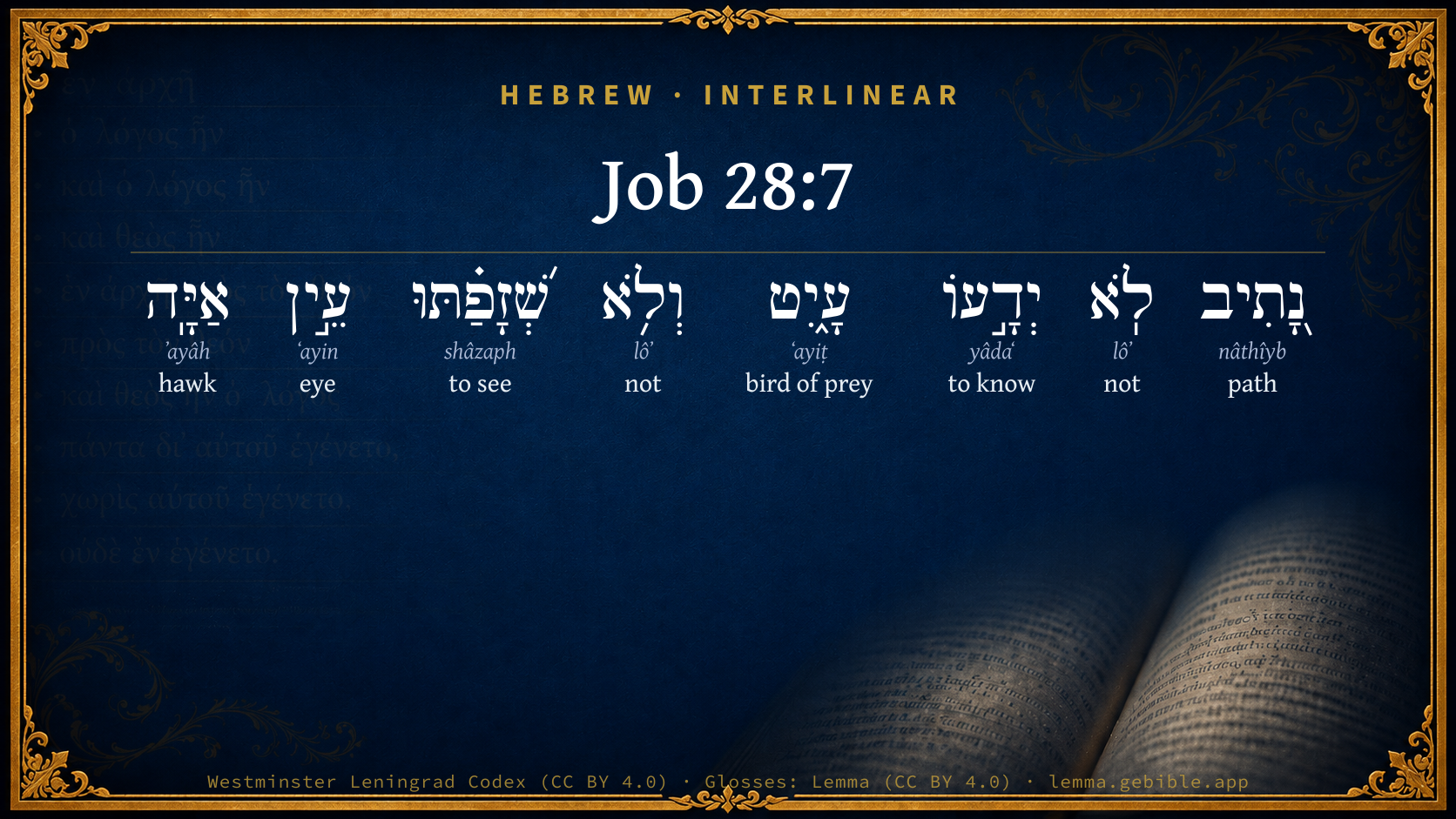
Job 28:7

Hebrew (Westminster Leningrad Codex) Job 28:7 appears in the Hebrew Old Testament. The text above is from the Westminster Leningrad Codex. Each word links to its Strong’s number, a concise gloss, and parsing drawn from the Open Scriptures Hebrew Bible morphology. Click any word for its full Brown-Driver-Briggs (BDB) entry.
Download image
Cite this verse

Job 28:7 (World English Bible). Public Domain. Lemma interlinear Bible study tool, https://lemma.gebible.app/v/job/28/7.

Show BibTeX & RIS
BibTeX
RIS
English Translation
That path no bird of prey knows, Neither has the falcon's eye seen it.
World English Bible · Public Domain
Download a study sheet

One document with this verse’s original text, its word-by-word gloss line, the meaning frame, cross-references with their text, attributed commentary, and full source and license credits — printable, and it pastes into notes with its structure intact.

This verse Autodidact and up

Study sheet (.html) Plain text (.txt)

A passage Seminary Student

Up to 50 verses in one chapter. A passage sheet keeps up to 6 commentary sources and 12 cross-references per verse, in the order this page ranks them, and says so on the sheet whenever that leaves anything out. Ask for a single verse and you get the Autodidact verse sheet above.

Everything on this page stays free to read, with no account — the sheet is a download of what is already on screen, not access to it.

Want to remove ads? Support Godless Engineer
Compare translations 3

The same verse in 3 English versions, stacked beneath the original-language interlinear above. Click any original word for its lexicon entry.

Each is an independent rendering of the whole verse — the interlinear is not word-aligned to these translations.

Highlighted words mark where these versions differ — a whole-verse word diff, not a word-by-word alignment.

  • World English Bible Public Domain
    That path no bird of prey knows, Neither has the falcon's eye seen it.
  • King James Version Public Domain
    There is a path which no fowl knoweth, and which the vulture's eye hath not seen:
  • unfoldingWord Literal Text CC BY-SA 4.0
    No bird of prey knows the path, and the eye of the falcon has not seen it.

unfoldingWord Literal Text — © unfoldingWord, licensed CC BY-SA 4.0. Word-aligned USFM3 via Door43 (git.door43.org/unfoldingWord/en_ult).

Versions to compare (up to 4)

3 of 4 selected

Show all 18 translations

Every available English version of this verse, each an independent rendering of the whole verse.

  • World English Bible Public Domain
    That path no bird of prey knows, Neither has the falcon's eye seen it.
  • Berean Standard Bible Public Domain
    No bird of prey knows that path; no falcon’s eye has seen it.
  • Majority Standard Bible Public Domain
    No bird of prey knows that path; no falcon’s eye has seen it.
  • King James Version Public Domain
    There is a path which no fowl knoweth, and which the vulture's eye hath not seen:
  • American Standard Version (1901) Public Domain
    That path no bird of prey knoweth, Neither hath the falcon's eye seen it:
  • Revised Version (1885) Public Domain
    That path no bird of prey knoweth, neither hath the falcon’s eye seen it:
  • Geneva Bible (1599) Public Domain
    There is a path which no foule hath knowen, neyther hath the kites eye seene it.
  • Douay-Rheims (1899) Public Domain
    The bird hath not known the path, neither hath the eye of the vulture beheld it.
  • Young's Literal Translation Public Domain
    A path -- not known it hath a ravenous fowl, Nor scorched it hath an eye of the kite,
  • Literal Standard Version CC BY-SA 4.0
    A path—a ravenous bird has not known it, || Nor has an eye of the falcon scorched it,
  • Unlocked Literal Bible CC BY-SA 4.0
    No bird of prey knows the path to it, nor has the falcon's eye seen it.
  • unfoldingWord Literal Text CC BY-SA 4.0
    No bird of prey knows the path, and the eye of the falcon has not seen it.
  • Darby Bible Public Domain
    It is a path no bird of prey knoweth, and the vulture's eye hath not seen it;
  • World Messianic Bible Public Domain
    That path no bird of prey knows, neither has the falcon’s eye seen it.
  • Webster's Bible Public Domain
    There is a path which no fowl knoweth, and which the vultur's eye hath not seen:
  • Free Bible Version CC BY-SA 4.0
    No birds of prey can see these paths, no falcon's eye can perceive.
  • Bible in Basic English Public Domain
    No bird has knowledge of it, and the hawk's eye has never seen it.
  • JPS Tanakh (1917) Public Domain
    That path no bird of prey knoweth, neither hath the falcon's eye seen it;

Literal Standard Version (2020), Covenant Press — licensed CC BY-SA 4.0. Text via the HelloAO Bible API (eBible.org). Unlocked Literal Bible (unfoldingWord) — licensed CC BY-SA 4.0. Text via the HelloAO Bible API (eBible.org). unfoldingWord Literal Text — © unfoldingWord, licensed CC BY-SA 4.0. Word-aligned USFM3 via Door43 (git.door43.org/unfoldingWord/en_ult). Free Bible Version, Dr. Jonathan Gallagher — licensed CC BY-SA 4.0. Text via the HelloAO Bible API (eBible.org).

Word by word

More ways to search: Search by grammar → Find every occurrence → Compare this word →

Practice this passage: Drill this verse → Learn its vocabulary →

About this verse

These counts appear in no published source. They are computed here, from the morphology-tagged text and Lemma’s own curated glosses. What Lemma adds →

8
words
7
distinct lemmas
Wisdom
section

Notable vocabulary

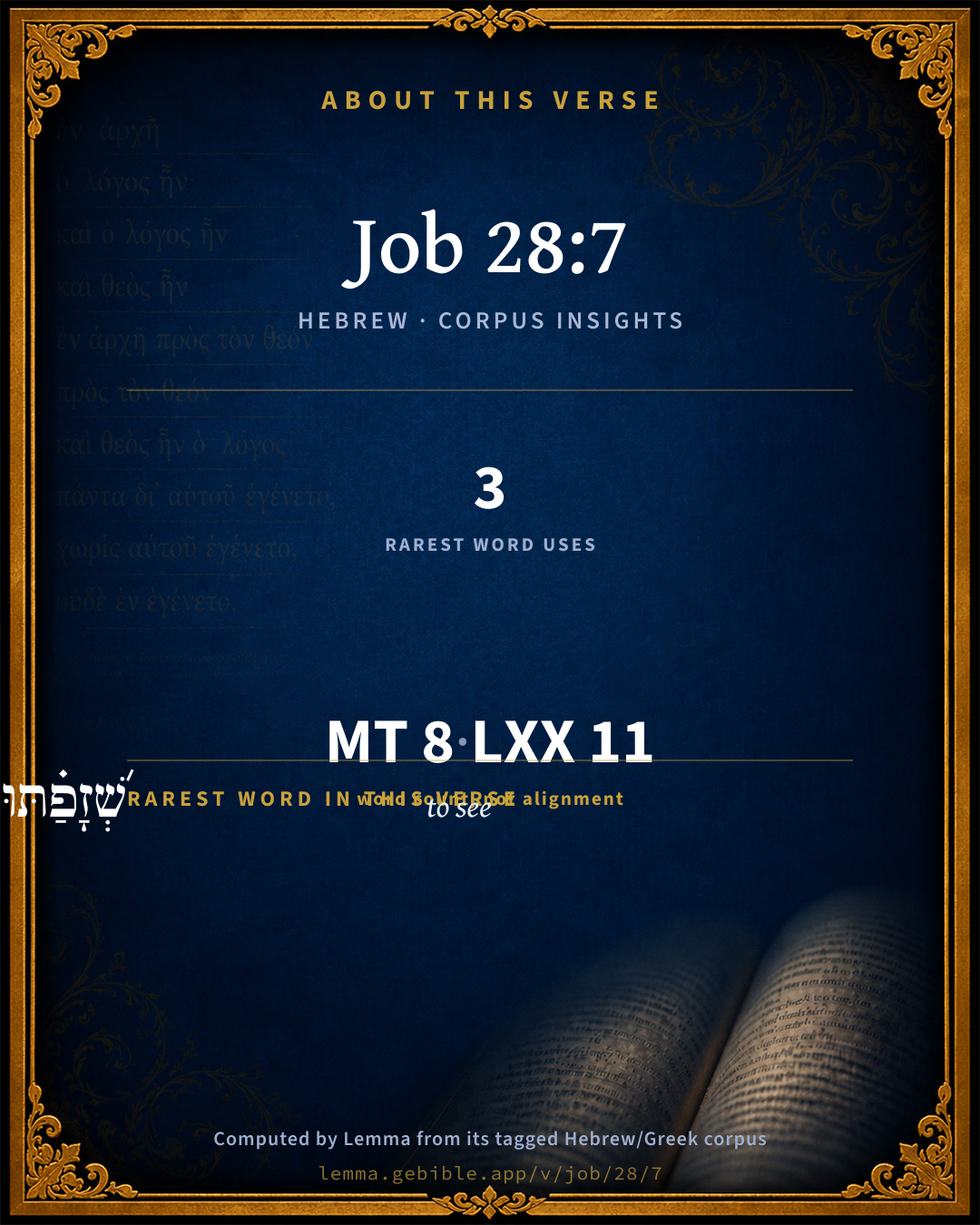
The rarest word here is שְׁ֝זָפַ֗תּוּ to see H7805 — appearing just 3 times in the whole Hebrew Bible.

Shared distinctive vocabulary

שְׁ֝זָפַ֗תּוּ to see H7805 occurs in 3 verses of the Hebrew Bible. Also found in:

Grammatical profile

  • 2 verbs
  • 4 nouns
  • 2 particles

Verb forms

  • יְדָ֣עוֹ Qal · Perfect
  • שְׁ֝זָפַ֗תּוּ Qal · Perfect

Repetition

A word recurs within this verse — often emphatic in Hebrew:

Hebrew & Septuagint length

In English translation the verse runs 14 words from the Hebrew and 19 from the Septuagint (LXX English) — closely comparable.

A rough comparison of the two English renderings, which tokenize alike — not a word-level alignment.

Word counts can differ between the Hebrew and the Greek without any difference in meaning — e.g. the Hebrew direct-object marker אֵת has no separate Greek word, and Greek often adds the article ὁ.

In the original languages it is 8 Hebrew tokens and 11 Greek tokens — but the two are counted differently (Hebrew bundles its prefixes and suffixes into one token; the Greek is in lemma form), so that isn’t a like-for-like length.

Cross-references

5

Topical passages linked to Job 28:7 in the Treasury of Scripture Knowledge — connected by theme and wording, ordered by reader-vote popularity; previews shown in the World English Bible.

  • Job 11:6 That he would show you the secrets of wisdom! For true wisdom has two sides. Know therefore that God exacts of you less than your iniquity deserves.
  • Job 28:21–23 Seeing it is hidden from the eyes of all living, And kept close from the birds of the sky.
  • Job 38:19 "What is the way to the dwelling of light? As for darkness, where is the place of it,
  • Job 38:24 By what way is the lightning distributed, Or the east wind scattered on the earth?
  • Romans 11:33 Oh the depth of the riches both of the wisdom and the knowledge of God! How unsearchable are his judgments, and his ways past tracing out!

Cross-references courtesy of OpenBible.info (CC BY 4.0).

Hebrew and Greek witnesses Masoretic Hebrew ↔ Greek Septuagint

The same verse in the two great witnesses to the Old Testament, shown verse-for-verse.

These are two independent witnesses, not word-aligned to each other, and the Septuagint is shown in lemma (dictionary) form.

Hebrew Job 28:7 Masoretic · Westminster Leningrad Codex

נָ֭תִיב לֹֽא יְדָ֣עוֹ עָ֑יִט וְלֹ֥א שְׁ֝זָפַ֗תּוּ עֵ֣ין אַיָּֽה

That path no bird of prey knows, Neither has the falcon's eye seen it.

World English Bible · Public Domain

Greek LXX Job 28:7 Septuagint · lemma form

τρίβος οὐ γιγνώσκω αὐτός πετεινόν καί οὐ παραβλέπω αὐτός ὀφθαλμός γύψ

There is a path, the fowl has not known it, neither has the eye of the vulture seen it:

LXX2012 (modern English Septuagint) · Public Domain

Hebrew: Westminster Leningrad Codex (CC BY 4.0). Greek: Septuagint (public domain); English from LXX2012 (modern English Septuagint) (Public Domain). How the Septuagint differs from the Hebrew →

Commentary

Notes on Job 28:7 from classic Christian and Jewish commentators (each source and its license shown beneath its notes). The classic Christian expositions comment on the surrounding passage and are grouped to its opening verse, so a note may address several verses; the Jewish commentaries on the Tanakh (Rashi and others) are per-verse, so they appear only where the commentator wrote on this verse.

Lemma curates 59 commentaries, every one of them public domain or Creative Commons licensed, each selected and text-cleaned for this edition rather than reprinted as found. About our sources →

Trapp's Complete Commentary

John Trapp

Job 28:7 [There is] a path which no fowl knoweth, and which the vulture’s eye hath not seen:

Ver. 7. There is a path which no fowl knoweth] That is, say some, those places where this gold lieth are so barren, as they bring forth nothing else but gold, nothing for fowls to feed upon, no, not discernible by the eye of the vulture, which excelleth in seeing afar off, and smelleth out his prey at a very great distance (Albert. Dionys. Aquin.). But men make their ways even here, to dig and find out gold, being herein more perspicacious and sagacious than the very vultures. The covetous would do well to consider, saith a good author, that for the most part those countries that are furnished with gold are destitute of better provision, both temporal and spiritual; that it lieth furthest from heaven, and the best of it in India, furthest from the Church; that though Adam had it in the first paradise, Gen 2:11-12, yet in the second we shall not need it; but God shall be our gold, and we shall have plenty of that which is better than silver, Job 22:25. That wise men have esteemed it as the stones of the streets, 2Ch 9:27, and that the children of wisdom might not possess it in their purses, Mat 10:9; that wicked men have the most of it as their portion, Psa 17:14, and that the devil danceth in rich and pleasant palaces, Isa 13:21-22, &c.

And which the vulture’s eye hath not seen] Or, the kite’s eye, or the pie’s, or the chough’s, which yet is said to be sitiens auri, desirous of gold, and to hide it when she hath gotten it, though she can make no use of it. Some good interpreters by this path in the text understand the mines themselves, those underground places, as far underground as the fowls fly above ground; and that are by them and the most prey seeking beasts unknown and untrod; yet thither goeth the miners, by his skill and industry, letting in both light and vital air, Quem follibus arte mirifica e sublimi deducit, ut respirent artifices, et alantur lucernae, which with wonderful art he by bellows bringeth from above into those low holes, that the workmen may breathe, and the lights may be kept burning.

John Trapp, A Commentary or Exposition upon All the Books of the Old and New Testament (1647–1656) — public domain. Text from a community e-Sword module.

Joseph Benson's Commentary

Job 28:7-8. There is a path which no fowl knoweth — Namely, in the bowels of the earth. Man by his industry goeth in mines under the earth, in paths where neither bird nor beast has ever entered. Which the vulture’s eye hath not seen — Whose eye is very quick and strong, and searches all places for its prey. The lion’s whelps — Hebrew, בני שׁחצ, benei shachatz, the sons of the wild beast, have not trodden it — The wildest beasts, who search for solitary places, have never made their den there, nor so much as approached it; nor the fierce lion passed by it — Which rangeth all places for prey. The birds and beasts have often led men to such places as otherwise they should never have found out; but they could not lead them to these mines; the finding out of them is a special gift of God.

Joseph Benson's Commentary on the Old and New Testaments (1811–1818) — public domain. Text from a community e-Sword module.

Jamieson, Fausset & Brown

Robert Jamieson, A. R. Fausset & David Brown

fowl--rather, "ravenous bird," or "eagle," which is the most sharp-sighted of birds (Isa 46:11). A vulture will spy a carcass at an amazing distance. The miner penetrates the earth by a way unseen by birds of keenest sight.

Jamieson, Fausset & Brown — Commentary Critical and Explanatory on the Whole Bible (1871) — public domain (CC PDM 1.0). Text via the HelloAO Bible API.

Adam Clarke's Commentary

Verse 7. There is a path which no fowl knoweth] The instinct of birds is most surprising. They traverse vast forests, c., in search of food, at a great distance from the place which they have chosen for their general residence and return in all weathers, never missing their track: they also find their own nest without ever mistaking another of the same kind for it. Birds of passage, also, after tarrying in a foreign clime for six or seven months, return to their original abode over kingdoms and oceans, without missing their way, or deviating in the least from the proper direction; not having a single object of sight to direct their peregrinations. In such cases even the keen scent of the vulture, and the quick, piercing sight of the eagle, would be of no use. It is possible that Job may here refer to undiscovered mines and minerals; that notwithstanding man had already discovered much, yet much remained undiscovered, especially in the internal structure and contents of the earth. Since his time innumerable discoveries have been made; and yet how little do we know! Our various conflicting and contradictory theories of the earth are full proofs of our ignorance, and strong evidences of our folly. The present dogmatical systems of geology itself are almost the ne plus ultra of brain-sick visionaries, and system-mad mortals. They talk as confidently of the structure of the globe, and the manner and time in which all was formed, as if they had examined every part from the centre to the circumference; though not a soul of man has ever penetrated two miles in perpendicular depth into the bowels of the earth.

And with this scanty, defective knowledge, they pretend to build systems of the universe, and blaspheme the revelation of God! Poor souls! All these things are to them a path which no fowl knoweth, which the vulture's eye hath not seen, on which the lion's whelps have not trodden, and by which the fierce lion have not passed. The wisdom necessary to such investigations is out of their reach; and they have not simplicity of heart to seek it where it may be found.

One of the Chaldee Targums gives a strange turn to this verse: - "The path of the tree of life Sammael, (Satan,) though flying like a bird, hath not known; nor hath the eye of Eve beheld it. The children of men have not walked in it; nor hath the serpent turned towards it."

Adam Clarke's Commentary on the Bible (1810–1826) — public domain. Text from a community e-Sword/MySword module.

The Cambridge Bible for Schools and Colleges

gen. ed. J. J. S. Perowne

7. there is a path] Rather, that path no eagle knoweth, lit.—a path which no eagle &c., the words taking up what is said in Job_28:6,—the way to the place of sapphires. The sharp-sighted birds of prey have not seen that path.

The Cambridge Bible for Schools and Colleges (gen. ed. J. J. S. Perowne; Cambridge University Press, 1878–1918) — public domain. Text from a community e-Sword module.

John Gill's Exposition

There is a path which no fowl knoweth,.... A path made by miners to the gold, silver, brass, and iron ores; to the places where gems and precious stones lie; the way to which was never seen, and could never have been discovered by the most sharp-sighted fowl, as "the eagle" (d); which some think is particularly intended; and the Greek word for an eagle seems to be derived from the word used in the text: this fowl, the king of birds, as it is the swiftest, it is the most quick-sighted of any; but, though it is eager, and looks out sharp after its prey, and which it beholds at a great distance, and in the most secret lurking places, and flies unto it, and seizes upon it at once, yet it never could look into the bowels of the earth, or discover a track leading thereunto; in this it is outdone by the diligent and laborious miner, who is not at a loss to make his way into the inmost and darkest recesses of the earth:

which the vulture's eye hath not seen; which is next to the eagle, and some of them are of the species of it, and is a very sharp-sighted creature, even to a proverb, as well as voracious, which makes it diligent to search everywhere for its prey; and yet this creature's sharp and piercing eye never saw the path the miners make by digging into the earth, in order to get metals and minerals from it. Some understand this path of subterraneous paths in nature, made of God, through which rivers of water pass that were never seen by creatures of the quickest sight; it may rather be applied to the paths of God in providence, which are unsearchable and past finding out, by men of the most sagacious and penetrating capacities, though they will hereafter be made manifest; and also to his paths of love, grace, and mercy towards the sons of men, which are the deep things of God, searched into and revealed by his Spirit, or otherwise could not be known; as well as to the ways and paths of righteousness and holiness, of faith and truth, of the word and ordinances God has revealed, as his mind and will his people should walk in, which otherwise would not be known, and are not by carnal men; and especially to the principal way and path, Christ Jesus, who is the way to the Father, the way to everlasting happiness, the way of life and salvation, the high way and way of holiness, in which men, though fools, shall not err, and of which some things are said in Isa 35:8; which greatly agree with what are said of this path, here and in Job 28:8, this way of peace is not known by carnal men, nor the things of it discerned by natural men, though ever so sagacious; see Rom 3:17.

(d) "ad id alludit aquiae Graecum vocabulum" Bochart. Hierozoic par. 1. l. 1. c. 9. col. 59. Broughton renders it "a kite".

John Gill's Exposition of the Whole Bible (1746–1763) — public domain (CC PDM 1.0). Text via the HelloAO Bible API.

Albert Barnes' Notes on the Bible

There is a path which no fowl knoweth - That is, a path in searching for gold and precious stones. The miner treads a way which is unseen by the bird of keenest vision. He penetrates into the deep darkness of the earth. The object of Job is to show the wisdom and the intrepidity of man in penetrating these dark regions in searching for sapphires and gold. The most far-sighted birds could not find their way to them. The most intrepid and fearless beasts of prey dared not adventure to those dangerous regions. The word rendered “fowl” (עיט ‛ayı̂ṭ) means either a ravenous beast, Jer 12:9, or more commonly a ravenous bird; see the notes at Isa 46:11. According to Bochart, Hieroz. P. 11. L. 11. c. viii. p. 195, the word here denotes a rapacious bird of any kind; a bird which has a keen vision.

Which the vulture’s eye hath not seen - The vulture is distinguished for the remarkable keenness of its vision. On the deserts of Arabia, it is said, when a camel dies, there is almost immediately discerned far in the distant sky, what seems at first to be a mere speck. As it draws nearer it is perceived to be a vulture that had marked the camel as he fell, and that comes to prey upon it. This bird is proverbial for the keenness of its sight.

Albert Barnes' Notes on the Bible (1834–1885) — public domain. Text from a community e-Sword/MySword module.

Haydock's Catholic Bible Commentary

Path of these metals, (Menochius) or a path in general. (Haydock) --- They fly, as beasts roam about, without keeping the high road; yet never miss their way, or fail to return to their own place, though they may have crossed the sea or woods, and been absent many months. This instinct is one of the wonders of nature. (Calmet)

George Leo Haydock (1774–1849), Haydock's Catholic Family Bible and Commentary, 1859 edition — public domain. Excludes Psalms (Douay-Rheims chapter numbering differs from Protestant) and Deuterocanonical books (Catholic canon only).

Matthew Poole's English Annotations

A path, to wit, in the dark depths and bowels of the earth. The vulture; whose eye is very quick and strong, and which searcheth all places for its prey, but cannot reach to these places, which yet the wisdom of man by the direction of God’s providence findeth out.

Matthew Poole's English Annotations on the Holy Bible (1683–1685) — public domain. Text from a community e-Sword/MySword module.

Whedon's Commentary on the Bible

Daniel D. Whedon

7. There is a path — The path — no fowl (rather, bird of prey) hath known it, and the vulture’s eye hath not seen it.

The vulture — The ayyah, Tristram supposes to have been the red kite; others, the vulture. So acute and farseeing is its vision, that the Talmud says, “It is in Babylon and seeth a carcass in the land of Israel.” The natural powers of the brute creation excited the astonishment of the ancients, even to the extent of adoration. On the outer cases of Egyptian mummies were painted with other figures those of the hawk or vulture. Mummied vultures remain to the present day. See PETTIGREW’S History of Mummies, chap. 14.

Daniel D. Whedon (gen. ed.), Commentary on the Old and New Testaments (1874–1909) — public domain. Text from a community e-Sword module.

The Pulpit Commentary

There is a path which no fowl knoweth; or, his is a path which no bird of prey knoweth (see the Revised Version). The miner"s path through the bowels of the earth is intended. And which the vulture"s eye hath not seen. The vulture is probably the most keen-sighted of birds, but it cannot even get a glimpse of the subterraneous path which the miner treads.

Vers. 7, 8. The miner"s path.

The vulture"s eye is keen, the lion"s whelps are daring; yet a path which these wild creatures never saw is known to the miner, and climbed by him in his search for precious metals. He penetrates into fearful ravines, climbs dizzy cliffs, follows dark passages far into the mountain-side, descends deep shafts down to the hidden regions of the earth.

I THE SUPERIORITY OF MIND TO INSTINCT. The senses of animals are keener than those of men; the sight of the bird and the scent of the wild beast greatly exceed our seeing and smell. Animals are stronger than men; we cannot emulate the vulture"s flight or the stroke of the lion"s paw. Yet, with duller senses and weaker muscles, we can rule over the animals; we can even beat them on their own ground. The superiority of man is the superiority of mind. Therefore, if he would retain and perfect this superiority, he must not sink down to the level of the beasts that perish. Sottish sensuality robs man of his supremacy. If it is by the mind that man conquers, it is disgraceful to live for the sake of the body. Only mental power gives so weak a creature as man any chance in the struggle for existence. Then it is most incongruous that bodily appetite should be permitted to enslave this power for its own low pleasures. Moreover, if the inner man is the higher man, that which is highest within is our truest and best self. The highest powers scale the highest peaks.

II THE TRIUMPH OF ENERGY. The miner knows his secret path and climbs it, because he is determined to search out the precious metals, no matter where he may have to go in pursuit of them. Here is manly vigour. Now, it is just this vigour joined to intelligence that gives man success in the battle of life. No one deserves to be prosperous without it. It is only an artificial state of society that allows the idle to be pampered in luxury. The healthy rule is that of St. Paul, "If any would not work, neither should he eat". (2Th_3:10) In the miner"s path we have an evidence of what effort can do. This same effort is needed in every branch of life. Industry is healthy and fruitful, and the old-fashioned duty can never be lessened by any change of circumstances. If men shrink from work they proclaim that their better nature is conquered in them. It will be a bad day for England when her old spirit of enterprise is given up. In the Christian life there is a call for the miner"s daring and energy. Here, too, heroic enterprises are undertaken by the nobler spirits. There are paths in spiritual experience that no one with a merely animal nature can ever see; but the brave sons of God walk thereon and find rare treasures by the way. Browning tells us"Life is to wake, not sleep; Rise, and not rest; but press From earth"s level, where blindly creep Things perfected, more or less, To heaven"s height, far and steep. W.F.A.

The Pulpit Commentary (1880–1919), ed. H.D.M. Spence-Jones & Joseph S. Exell — public domain. Text from a community e-Sword module.

John Wesley's Explanatory Notes

A path - In the bowels of the earth. Vulture's eye - Whose eye is very quick, and strong, and searcheth all places for its prey.

John Wesley, Explanatory Notes Upon the Whole Bible (1754–1765) — public domain. Text via the GEBible commentary corpus.

unfoldingWord translationNotes

Door43 World Missions Community

No bird of prey knows the path to it ... nor has the falcon's eye seen it

These clauses express a similar meaning. AT: "No bird of prey or falcon knows or has ever seen the path that goes to the mine" (See: Parallelism)

bird of prey

a bird that eats other animals

falcon

This may also be translated "hawk." Both are birds that hunt and eat other animals. You may translate this with a similar bird from your culture.

The proud animals have not walked such a path ... nor has the fierce lion passed there

These clauses also express similar meaning. (See: Parallelism)

The proud animals

This refers to very strong, wild animals.

translationWords

walk

lions

unfoldingWord translationNotes — © Distant Shores Media and the Door43 World Missions Community, licensed CC BY-SA 4.0. Source: git.door43.org/Door43/en_tn.

Rashi

Rabbi Shlomo Yitzchaki (Rashi)

A path unknown to brigands Heb. עיט. A band of robbers never passed by them.

and which the eye of a vulture did not see Since it sees more than other birds, and is therefore called רָאָה, because it stands in Babylon and sees a carcass in Eretz Israel. That is how it is explained in the Aggadah of Hullin (632); i.e., spies never discerned it.

Rashi on the Tanakh — English translations: “The Judaica Press complete Tanach with Rashi, translated by A. J. Rosenberg” (CC BY 4.0); “Pentateuch with Rashi's commentary by M. Rosenbaum and A.M. Silbermann, 1929-1934” (public domain); “The Metsudah Tanach series, Lakewood, N.J” (CC BY 4.0); and “The Book of Joshua, Metsudah Publications, 1997” (CC BY 4.0). Text via Sefaria.

Lesson kit

Teaching starters — assembled from the data on this page, not authored interpretation. Every prompt links to the verse data it draws on. Edit before teaching.

Job, in the Wisdom, opens this verse with 8 words (7 distinct Hebrew lemmas). Its most distinctive word is shâzaph (“to see”). A historical commentator’s framing appears above. Read the whole chapter for the surrounding context.

Discussion questions

  1. The word shâzaph carries the sense “to see.” How does it shape the verse?
  2. Job 20:9 shares the word «to see» with this verse. How do the two illuminate each other?
  3. “not” occurs 2× in this one verse. What is the effect of the repetition?
  4. These translations render this verse differently. What is at stake in choosing one wording over another?
  5. The verb «יְדָ֣עוֹ» is Qal Perfect. How does its form color the action?
  6. Reading how Trapp's Complete Commentary and Joseph Benson's Commentary read this verse, where do the two commentators agree and where do they part?

Things to notice

Reading settings

Reading text

Shown beneath each verse's original-language words.

Old Testament
Old Testament edition

Read the OT as the Masoretic Hebrew (MT) or the Greek Septuagint (LXX).

English shown for the Greek Septuagint (in the Hebrew ↔ Greek comparison).

Comparing translations? Open the Compare panel on any verse page to stack up to four side by side.