Psalms 50:23

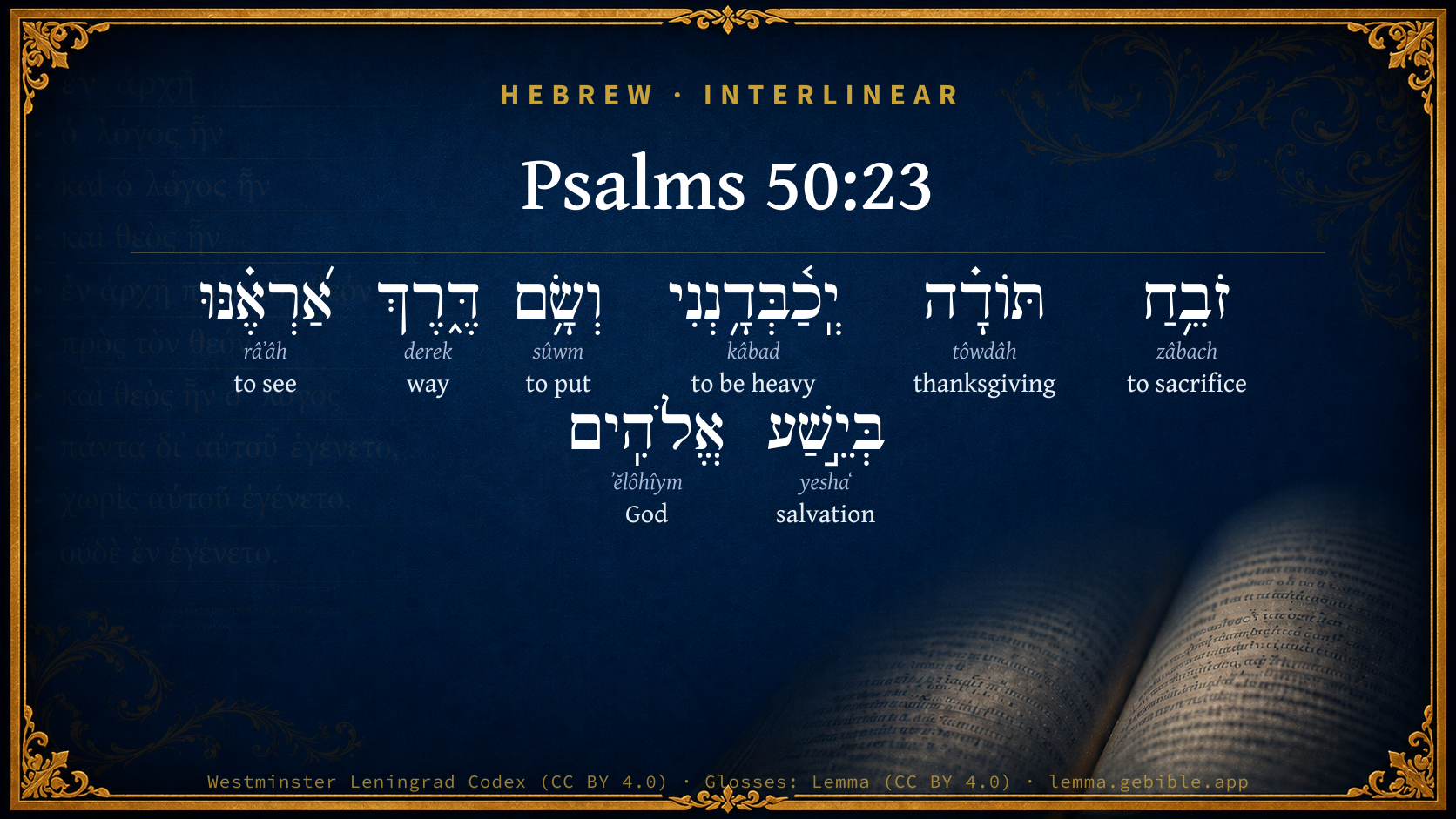
Hebrew (Westminster Leningrad Codex) Psalms 50:23 appears in the Hebrew Old Testament. The text above is from the Westminster Leningrad Codex. Each word links to its Strong’s number, a concise gloss, and parsing drawn from the Open Scriptures Hebrew Bible morphology. Click any word for its full Brown-Driver-Briggs (BDB) entry.
Download image
Cite this verse

Psalms 50:23 (World English Bible). Public Domain. Lemma interlinear Bible study tool, https://lemma.gebible.app/v/psalms/50/23.

Show BibTeX & RIS
BibTeX
RIS
English Translation
Whoever offers the sacrifice of thanksgiving glorifies me, And prepares his way so that I will show God's salvation to him."
World English Bible · Public Domain
Download a study sheet

One document with this verse’s original text, its word-by-word gloss line, the meaning frame, cross-references with their text, attributed commentary, and full source and license credits — printable, and it pastes into notes with its structure intact.

This verse Autodidact and up

Study sheet (.html) Plain text (.txt)

A passage Seminary Student

Up to 50 verses in one chapter. A passage sheet keeps up to 6 commentary sources and 12 cross-references per verse, in the order this page ranks them, and says so on the sheet whenever that leaves anything out. Ask for a single verse and you get the Autodidact verse sheet above.

Everything on this page stays free to read, with no account — the sheet is a download of what is already on screen, not access to it.

Want to remove ads? Support Godless Engineer
Compare translations 3

The same verse in 3 English versions, stacked beneath the original-language interlinear above. Click any original word for its lexicon entry.

Each is an independent rendering of the whole verse — the interlinear is not word-aligned to these translations.

Highlighted words mark where these versions differ — a whole-verse word diff, not a word-by-word alignment.

  • World English Bible Public Domain
    Whoever offers the sacrifice of thanksgiving glorifies me, And prepares his way so that I will show God's salvation to him."
  • King James Version Public Domain
    Whoso offereth praise glorifieth me: and to him that ordereth his conversation aright will I shew the salvation of God.
  • unfoldingWord Literal Text CC BY-SA 4.0
    The one sacrificing a thank offering glorifies me, and the one placing a way, I will make him look upon the salvation of God.”

unfoldingWord Literal Text — © unfoldingWord, licensed CC BY-SA 4.0. Word-aligned USFM3 via Door43 (git.door43.org/unfoldingWord/en_ult).

Versions to compare (up to 4)

3 of 4 selected

Show all 18 translations

Every available English version of this verse, each an independent rendering of the whole verse.

  • World English Bible Public Domain
    Whoever offers the sacrifice of thanksgiving glorifies me, And prepares his way so that I will show God's salvation to him."
  • Berean Standard Bible Public Domain
    He who sacrifices a thank offering honors Me, and to him who rights his way, I will show the salvation of God.”
  • Majority Standard Bible Public Domain
    He who sacrifices a thank offering honors Me, and to him who rightly orders his way, I will show the salvation of God.”
  • King James Version Public Domain
    Whoso offereth praise glorifieth me: and to him that ordereth his conversation aright will I shew the salvation of God.
  • American Standard Version (1901) Public Domain
    Whoso offereth the sacrifice of thanksgiving glorifieth me; And to him that ordereth his way `aright' Will I show the salvation of God. Psalm 51 For the Chief Musician. A Psalm of David; when Nathan the prophet came unto him, after he had gone in to Bathsheba.
  • Revised Version (1885) Public Domain
    Whoso offereth the sacrifice of thanksgiving glorifieth me; and to him that ordereth his conversation aright will I shew the salvation of God.
  • Geneva Bible (1599) Public Domain
    He that offereth praise, shall glorifie mee: and to him, that disposeth his way aright, will I shew the saluation of God.
  • Douay-Rheims (1899) Public Domain
    The sacrifice of praise shall glorify me: and there is the way by which I will shew him the salvation of God.
  • Young's Literal Translation Public Domain
    He who is sacrificing praise honoureth Me, As to him who maketh a way, I cause him to look on the salvation of God!
  • Literal Standard Version CC BY-SA 4.0
    He who is sacrificing praise honors Me, || As for him who makes a way, || I cause him to look on the salvation of God!
  • Unlocked Literal Bible CC BY-SA 4.0
    The one who offers a sacrifice of thanksgiving praises me, and to anyone who plans his path in the right way I will show God's salvation.”
  • unfoldingWord Literal Text CC BY-SA 4.0
    The one sacrificing a thank offering glorifies me, and the one placing a way, I will make him look upon the salvation of God.”
  • Darby Bible Public Domain
    Whoso offereth praise glorifieth me; and to him that ordereth [his] way will I shew the salvation of God.
  • World Messianic Bible Public Domain
    Whoever offers the sacrifice of thanksgiving glorifies me, and prepares his way so that I will show God’s salvation to him.”
  • Webster's Bible Public Domain
    Whoever offereth praise glorifieth me: and to him that ordereth his deportment aright will I show the salvation of God.
  • Free Bible Version CC BY-SA 4.0
    But those who give an offering of thanks honor me, and to those who follow the right I will show them the salvation of God.”
  • Bible in Basic English Public Domain
    Whoever makes an offering of praise gives glory to me; and to him who is upright in his ways I will make clear the salvation of God.
  • JPS Tanakh (1917) Public Domain
    Whoso offereth the sacrifice of thanksgiving honoureth Me; and to him that ordereth his way aright will I show the salvation of God.'

Literal Standard Version (2020), Covenant Press — licensed CC BY-SA 4.0. Text via the HelloAO Bible API (eBible.org). Unlocked Literal Bible (unfoldingWord) — licensed CC BY-SA 4.0. Text via the HelloAO Bible API (eBible.org). unfoldingWord Literal Text — © unfoldingWord, licensed CC BY-SA 4.0. Word-aligned USFM3 via Door43 (git.door43.org/unfoldingWord/en_ult). Free Bible Version, Dr. Jonathan Gallagher — licensed CC BY-SA 4.0. Text via the HelloAO Bible API (eBible.org).

Word by word

More ways to search: Search by grammar → Find every occurrence → Compare this word →

Practice this passage: Drill this verse → Learn its vocabulary →

תּוֹדָ֗ה
tôwdâh
H8426
“thanksgiving”
Noun, Common, Feminine, Singular, Absolute
Part of Speech
Noun
Type
Common
Gender
Feminine
Number
Singular
State
Absolute
Full BDB Definition

Origin: from H3034

TWOT: 847b

confession, praise, thanksgiving - give praise to God - thanksgiving in songs of liturgical worship, hymn of praise - thanksgiving choir or procession or line or company - thank-offering, sacrifice of thanksgiving - confession
  1. זֹבֵ֥חַ zâbach H2076 “sacrificing” Verb, Qal, Participle Active, Masculine, Singular, Absolute
  2. יְֽכַ֫בְּדָ֥נְנִי kâbad H3513 “to be heavy · me” Verb, Piel, Imperfect, 3rd Person, Masculine, Singular + Suffix, Personal, 1st Person, Common, Singular
  3. וְשָׂ֥ם sûwm H7760 “and · putting” Conjunction + Verb, Qal, Participle Active, Masculine, Singular, Absolute
  4. דֶּ֑רֶךְ derek H1870 “way” Noun, Common, Both, Singular, Absolute
  5. אַ֝רְאֶ֗נּוּ râʼâh H7200 “to see · him” Verb, Hiphil, Imperfect, 1st Person, Common, Singular + Suffix, Personal, 3rd Person, Masculine, Singular
  6. בְּיֵ֣שַׁע yeshaʻ H3468 “in/at · salvation of” Preposition + Noun, Common, Masculine, Singular, Construct
  7. אֱלֹהִֽים ʼĕlôhîym H430 “God(s)” Noun, Common, Masculine, Plural, Absolute

About this verse

These counts appear in no published source. They are computed here, from the morphology-tagged text and Lemma’s own curated glosses. What Lemma adds →

8
words
8
distinct lemmas
Wisdom
section

Shared distinctive vocabulary

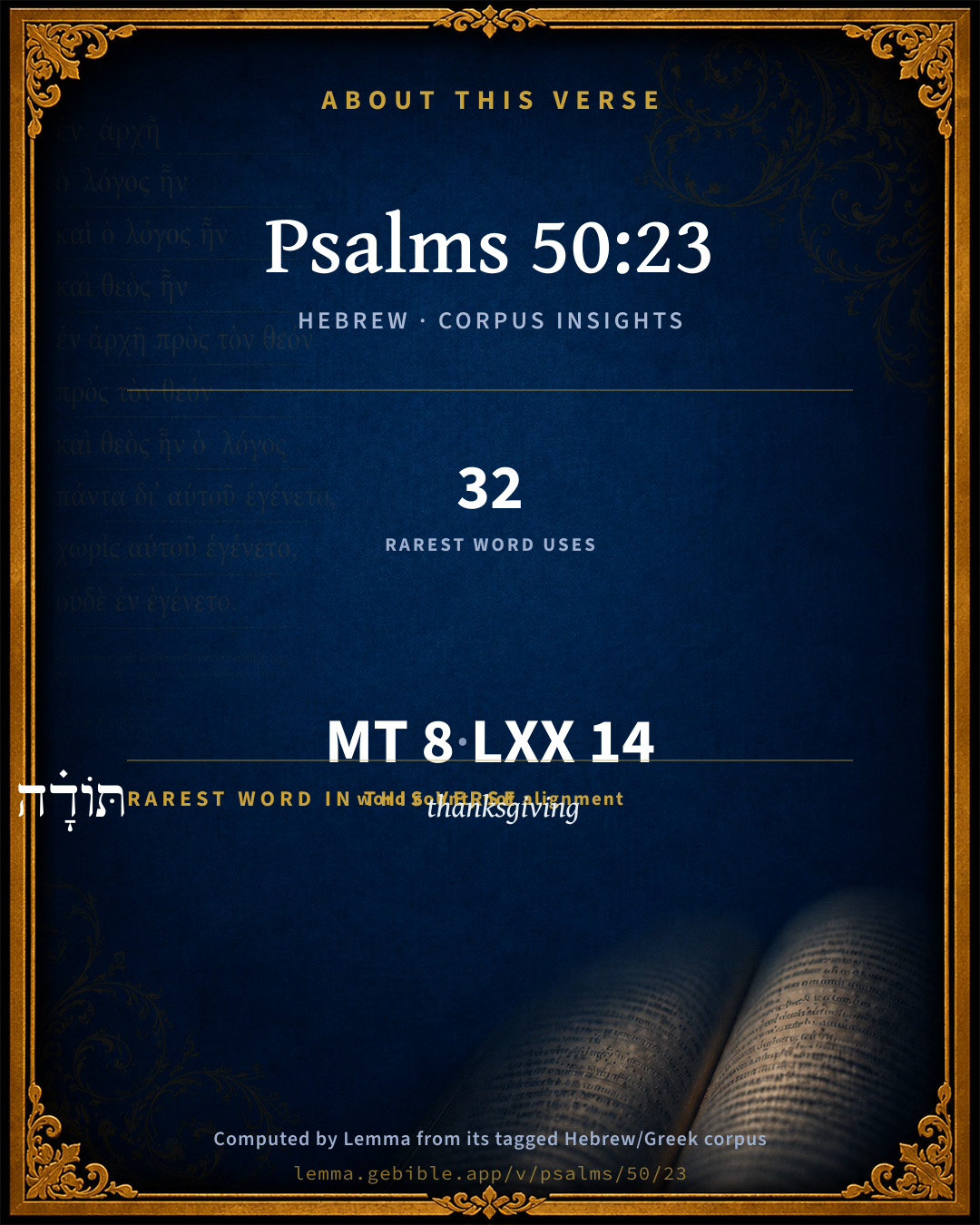
תּוֹדָ֗ה thanksgiving H8426 occurs in 30 verses of the Hebrew Bible. Also found in:

Grammatical profile

  • 4 verbs
  • 4 nouns

Verb forms

  • זֹבֵ֥חַ Qal · Participle Active
  • יְֽכַ֫בְּדָ֥נְנִי Piel · Imperfect
  • וְשָׂ֥ם Qal · Participle Active
  • אַ֝רְאֶ֗נּוּ Hiphil · Imperfect

Hebrew & Septuagint length

In English translation the verse runs 21 words from the Hebrew and 22 from the Septuagint (LXX English) — closely comparable.

A rough comparison of the two English renderings, which tokenize alike — not a word-level alignment.

Word counts can differ between the Hebrew and the Greek without any difference in meaning — e.g. the Hebrew direct-object marker אֵת has no separate Greek word, and Greek often adds the article ὁ.

In the original languages it is 8 Hebrew tokens and 14 Greek tokens — but the two are counted differently (Hebrew bundles its prefixes and suffixes into one token; the Greek is in lemma form), so that isn’t a like-for-like length.

Cross-references

29

Topical passages linked to Psalms 50:23 in the Treasury of Scripture Knowledge — connected by theme and wording, ordered by reader-vote popularity; previews shown in the World English Bible.

  • Psalms 91:16 I will satisfy him with long life, And show him my salvation."
  • Psalms 24:4–5 He who has clean hands and a pure heart; Who has not lifted up his soul to falsehood, And has not sworn deceitfully.
  • James 3:13 Who is wise and understanding among you? Let him show by his good conduct that his deeds are done in gentleness of wisdom.
  • Psalms 50:14–15 Offer to God the sacrifice of thanksgiving. Pay your vows to the Most High.
  • Psalms 86:12 I will praise you, Lord my God, with my whole heart. I will glorify your name forevermore.
  • Romans 12:1 Therefore I urge you, brothers, by the mercies of God, to present your bodies a living sacrifice, holy, acceptable to God, which is your spiritual service.
  • Psalms 25:14 The friendship of Yahweh is with those who fear him. He will show them his covenant.
  • Isaiah 12:2 Behold, God is my salvation. I will trust, and will not be afraid; for Yah, Yahweh, is my strength and song; and he has become my salvation."
  • Acts 13:26 Brothers, children of the stock of Abraham, and those among you who fear God, the word of this salvation is sent out to you.
  • John 7:17 If anyone desires to do his will, he will know about the teaching, whether it is from God, or if I am speaking from myself.
  • Philippians 1:27 Only let your manner of life be worthy of the Gospel of Christ, that, whether I come and see you or am absent, I may hear of your state, that you stand firm in one spirit, with one soul striving for the faith of the Gospel;
  • Psalms 85:13 Righteousness goes before him, And prepares the way for his steps.
  • Luke 2:30 For my eyes have seen your salvation,
  • Psalms 86:9 All nations you have made will come and worship before you, Lord. They shall glorify your name.
  • Galatians 1:24 And they glorified God in me.
  • Acts 10:2–4 a devout man, and one who feared God with all his house, who gave gifts for the needy generously to the people, and always prayed to God.
  • Romans 15:6 that with one accord you may with one mouth glorify the God and Father of our Lord Jesus Christ.
  • Romans 15:9 and that the Gentiles might glorify God for his mercy. As it is written, "Therefore will I give praise to you among the Gentiles, And sing to your name."
  • Galatians 6:16 As many as walk by this rule, peace and mercy be on them, and on God's Israel.
  • 1 Peter 1:15 but just as he who called you is holy, you yourselves also be holy in all of your behavior;
  • 1 Peter 2:9 But you are a chosen race, a royal priesthood, a holy nation, a people for God's own possession, that you may show forth the excellencies of him who called you out of darkness into his marvelous light:
  • Psalms 85:9 Surely his salvation is near those who fear him, That glory may dwell in our land.
  • John 8:31–32 Jesus therefore said to those Jews who had believed him, "If you remain in my word, then you are truly my disciples.
  • Isaiah 45:17 [But] Israel shall be saved by Yahweh with an everlasting salvation: you shall not be disappointed nor confounded world without end.
  • Acts 11:14 who will speak to you words by which you will be saved, you and all your house.'
  • Psalms 22:23 You who fear Yahweh, praise him! All you descendants of Jacob, glorify him! Stand in awe of him, all you descendants of Israel!
  • Psalms 27:6 Now my head will be lifted up above my enemies around me. I will offer sacrifices of joy in his tent. I will sing, yes, I will sing praises to Yahweh.
  • Isaiah 51:5–6 My righteousness is near, my salvation is gone forth, and my arms shall judge the peoples; the isles shall wait for me, and on my arm shall they trust.
  • Isaiah 49:6 yes, he says, It is too light a thing that you should be my servant to raise up the tribes of Jacob, and to restore the preserved of Israel: I will also give you for a light to the Gentiles, that you may be my salvation to the end of the earth.

Cross-references courtesy of OpenBible.info (CC BY 4.0).

Hebrew and Greek witnesses Masoretic Hebrew ↔ Greek Septuagint

The same verse in the two great witnesses to the Old Testament, shown verse-for-verse.

You’re reading Greek Psalm 49 (Hebrew Psalm 50). The Septuagint counts the superscription, so verse numbers can differ from the Hebrew — chapter-level alignment, not verse-by-verse. Numbering follows Rahlfs.

These are two independent witnesses, not word-aligned to each other, and the Septuagint is shown in lemma (dictionary) form.

Hebrew Psalms 50:23 Masoretic · Westminster Leningrad Codex

זֹבֵ֥חַ תּוֹדָ֗ה יְֽכַ֫בְּדָ֥נְנִי וְשָׂ֥ם דֶּ֑רֶךְ אַ֝רְאֶ֗נּוּ בְּיֵ֣שַׁע אֱלֹהִֽים

Whoever offers the sacrifice of thanksgiving glorifies me, And prepares his way so that I will show God's salvation to him."

World English Bible · Public Domain

Greek LXX Greek Psalm 49:23 Septuagint · lemma form

θυσία αἴνεσις δοξάζω ἐγώ καί ἐκεῖ ὁδός ὅς δεικνύω αὐτός ὁ σωτήριον ὁ θεός

The sacrifice of praise will glorify me: and that is the way wherein I will show to him the salvation of God.

LXX2012 (modern English Septuagint) · Public Domain

On this verse, Albert Barnes' Notes on the Bible discusses the Septuagint’s reading. Read the note in Commentary ↓

Hebrew: Westminster Leningrad Codex (CC BY 4.0). Greek: Septuagint (public domain); English from LXX2012 (modern English Septuagint) (Public Domain). How the Septuagint differs from the Hebrew →

Commentary

Notes on Psalms 50:23 from classic Christian and Jewish commentators (each source and its license shown beneath its notes). The classic Christian expositions comment on the surrounding passage and are grouped to its opening verse, so a note may address several verses; the Jewish commentaries on the Tanakh (Rashi and others) are per-verse, so they appear only where the commentator wrote on this verse.

Lemma curates 59 commentaries, every one of them public domain or Creative Commons licensed, each selected and text-cleaned for this edition rather than reprinted as found. About our sources →

Trapp's Complete Commentary

John Trapp

Psa 50:23 Whoso offereth praise glorifieth me: and to him that ordereth [his] conversation [aright] will I shew the salvation of God.

Ver. 23. Whoso offereth praise glorifieth me] So his praise be cordial, oral, real, with recognition of my benefits, estimation, retribution; this is the best sacrifice he can bring me.

And to him that ordereth his conversation aright] That walketh accurately and exactly; walketh as in a frame, treading gingerly, stepping warily, not lifting up one foot till he find sure footing for the other.

I will show the salvation of God] i.e. Give him a prospect of heaven here, and hereafter a full fruition of it.

John Trapp, A Commentary or Exposition upon All the Books of the Old and New Testament (1647–1656) — public domain. Text from a community e-Sword module.

The Biblical Illustrator

Joseph S. Exell

Psa_50:23

Whoso offereth praise glorifieth Me.

Songs of the Bible

I. The song of the new birth. Every believer has learned some of the notes of this song, for we enter the kingdom singing it. When in the world, the worlds songs--songs of merriment and glee--were in our esteem the richest and best; but when we saw Jesus, and heard the music of His grace, then the worlds songs could no longer express our joy. In all the miracles of Christ the first act of the healed one was to begin to praise. The leper, the paralytic, Bartimaeus, and all the others. And so with those whom Christ has saved.

II. The song of thanksgiving. How many of them we have in these psalms, but from some men you never hear them--they are always discontented and complaining. But think of our temporal mercies--our faculties of mind and body are daily mercies. Some never see them because they keep their eyes so fastened on the dark specks of disappointment and trial, and, seeing these only, they fancy these cover the whole of the sky. But it is not so. If God take from us one mercy, think how many we have left. Oliver Wendell Holmes has beautifully said, If one should give me a dish of sand, and tell me that there were particles of iron in it, I might search for them with my clumsy fingers and be unable to detect them; but take a magnet and swing through it, and the magnet will draw to it the particles of iron immediately. So let the thankful heart sweep through the day, and, as the magnet finds the iron, it will find in every hour some heavenly blessings: only the iron in Gods sand is always gold.

III. The song of victory. Listen to that song as it rises from Israels redeemed hosts on the bank of the Red Sea. No wonder that they felt like singing, for all the fears of yesterday had been buried in that sea. They did not sing thus in Egypt, for there they were slaves. And in the captivity, when a song was required of them by their captors, they said, We cannot sing the Lords song in a strange land. There are many psalms of David which are like a full orchestra of praise; but the majority of them are penitential cries, a singing as by the waters of Marah. And so it was with Israel of old, and it is so with the Church of to-day: the lamentations outnumber the praises; the defeats are more than the victories. And yet, though here they cannot be complete, we have our victories, and we ought even now to render praise for them.

IV. Songs in the night. See Paul and Silas in the prison at Philippi. But when we are free from the bondage of the world, we shall be as they, who at midnight sang praises. Let us also sing, so that the prisoners around may hear us.

V. The song before the throne--the heavenly song. What an immense company join in it. And it is a song without tears. Ours here are never that, But there they are tearless and eternal. (A. E. Kittridge, D. D.)

Glorifying God

I. We should re concerned to glorify God. This is the great end of our existence. Even inanimate beings do this (Psa_19:1-14.). And even wicked men may glorify God, for the wrath of man shall praise Him. But especially does He look for this from His own people. Now, one of the ways in which we do this is by offering praise. For in true praise exalted sentiments concerning Him fill the mind: there is a lively sense of His presence, and they speak well of His name. See the twelve exhortations to praise in the last of the psalms.

II. Our offering of praise will not be accepted unless it be accompanied with a conversation ordered aright. Praise-giving is good, but praise-living is better. But for this the grace of God is necessary.

III. Such conduct as this attracts Gods notice and regard. See text. To such persons God will show His salvation--temporal, spiritual, eternal. Have we interest in this salvation? (W. Jay.)

Praise

A subject, the importance of which it is not possible to overestimate, is here presented for our consideration--the offering of praise, connected more especially with the public service of the Church. Self-seeking in religion is far from being uncommon. It is chargeable upon numbers who may not be selfish in the grosser and more glaring forms of the commission of that sin. The almost exclusive consideration with such as are self-seekers in religion, is personal spiritual comfort. An essayist who wrote years ago, upon various forms of selfishness manifested in the conduct of professors of religion, has left on record this forcible description of those who make personal comfort in their religion not a means but an end. Epicures in religious comfort, they grow impatient if the cup of consolation be, for a moment, removed from their own lips. The amplitude of the Divine love seeks to comprehend the universe in its large and life-giving embrace and calls on our affections to arise and follow it in its vast diffusion, but this selfishness stays at home, builds itself in, and sees no glory in that love, but as it embraces a single point, and that point itself. To protect the spiritual system from so deleterious an influence, to prevent devotional exercises, whether public or private, from contracting the taint of selfishness, and to impart to them a healthy tone, it is expedient that there should be blended with them not only intercessory prayer but the homage of praise. As a faithful remembrancer, the Church ever puts us in mind of the fact that we are bound to praise Him for what He is in Himself, for the glory of His perfections, independent of what He is to us. Without the right ordering of the conversation--without practical evidence of sincere endeavour to walk worthy of the Lord unto all pleasing, no praise whatever can be offered to Him. The ever-living Intercessor, who has been exalted to the right hand of the Majesty in the heavens, imparts to praise as well as to supplication and giving of thanks and all other offerings the requisite value. By Him let us offer the sacrifice of praise continually, etc. Consolatory as sublime is the contemplation of the power and willingness of the ascended Christ to constitute our imperfect offerings worthy of presentation because of the infinite merit of His precious death and passion. There never rises within the breast of the sincere worshipper an aspiration of which He is unmindful, never is there formed a purpose of amendment of life, never is there heaved a sigh of the sorrow that worketh repentance, which is not observed by Him amidst the glories of that exalted estate in which He reigns as Head over all things to the Church. it is through Him that the adoration of the militant Church is united with that of those powers and principalities in heavenly places upon the purity of whose nature there never did, never shall pass a shadow of blemish. (C. E. Tisdall, D. D.)

To him that ordereth his conversation aright will I show the salvation of God.

Ordering the conversation aright

I. A man cannot order his conversation aright who does not seek and wait for the salvation of God. By the salvation of God we understand mans deliverance from sin and death and condemnation, through the great work of the atonement wrought by the Lord Jesus Christ.

II. The man does not seek the salvation of God aright who does not seek it in ordering his conversation aright (Psa_25:14; Hos_6:3). A man who sets about it earnestly, doing the will of God as far as he sees it, does not rest in that; he still looks to Christ, he still looks for Gods quickening Spirit to give life to his obedience, and that man is ordering his conversation aright. The Word of God warrants us, and the experience of Gods children in all ages warrants us, in saying that as He has not said Seek ye his in vain, so no man that seeks honestly to order his conversation aright shall fail to have shown to him, sooner or later, the salvation of God. (Hugh Stowell, M. A.)

The necessity of revelation, and a holy life

I. It is most worthy of the salvation of God, that it be understood of the general redemption of mankind by Jesus Christ. Both in the Old and New Testament everlasting life is offered to mankind by Christ, who is the only Mediator between God and man. And there is none other name under heaven given among men whereby we may be saved, neither is there salvation in any other. This knowledge was confined to very narrow limits; to a nation exceedingly small in proportion to the inhabitants of all the earth. The Revelation, besides, was dark, even where it was best known; particularly as to the resurrection of the dead, which is the anchor of our hope after this life, as also by reason of the ambiguity of the law under types and shadows of things to come; which represented a salvation to be given many ages after by this general Redeemer, who was not commonly believed in by the Jews before His coming, nor known by them when He appeared.

II. The knowledge of this salvation is above the reach of natural reason, and not to be attained but by revelation from God. In this assurance we stand unmoved against all vain suggestions of the impossibility of there being any such mysteries in the Christian religion, and of our own incapacity to believe things which our understanding cannot comprehend. Which assertions proceed from a bold but mistaken philosophy; ignorant of the great power of God; and not rightly distinguishing between the measure of knowledge, sufficient for faith and for demonstration; nor knowing that where the veracity of the affirmer, and the power of the author of any miracle are unquestionable, there we have a good authority to believe His relation of anything, though it shall be wonderful, and far above our capacity to comprehend.

III. It is a holy life which will render us the most capable of receiving this knowledge.

IV. Concluding observations.

1. If we are firmly secure of our true knowledge of the salvation of God, in the faith of that Church which we do profess, let us then keep this faith in purity of heart and true holiness of life, without which no man shall ever see the Lord.

2. If any man is serious in his inquiries after that knowledge which is to lead him to eternal life, let him then in the sincerity of his heart make this trial; and, from a good life, begin his searches after the knowledge of the salvation of God.

3. Wickedness of life is the most fatal step to infidelity, and sets us at the greatest distance from this knowledge of the salvation of God. (W. Whitfeld.)

The first step towards salvation

If these words mean anything, they must mean that the man who wishes to save his soul ought to endeavour, at least, to cast out directly whatever may be wrong in his practice. The text may be read also thus, Him who disposes or regulates his conduct, I will cause to enjoy the salvation of God. Then the words prescribe something preparatory, something to be done by any one and every one who honestly desires the being converted and saved. He is not to sit still, as one who waits for irresistible grace: let him forthwith observe what is wrong in his conversation--that is, in his manner of living and conduct--and let him at once set about correcting it. Now, thus did Christs forerunner, John the Baptist, in his preparatory ministry. He bade men cease from dishonest and evil conduct. Men asked him what they were to do, and he plainly told them. You must see at once, that nothing could be further removed than this proceeding of the Baptist from what is mystical and unintelligible; neither publicans nor soldiers could plead that there was nothing definite in the answers which they received--nothing on which they were unable to take hold, and forthwith to act. By going straightway into the business of everyday life, giving men something to do, and something, moreover, which it were idle to dispute that they had power to do, St. John impressed on his exhortations a practical and a tangible character. All that we have to ask you, at this stage of our inquiry, is, whether you do not perceive how exactly the exhortation of the Baptist bears out the promise of the psalmist in our text--how the one is based on the other; for in prescribing as preparatory to repentance, that the publican should cease from his extortion, and the soldier from his violence, was not St. John proceeding altogether upon the principle, that to him that ordereth his conversation aright shall be shown the salvation of God? Now, then, suppose we pass from the days of the Baptist to our own, and see whether, in our dealings with unconverted men, we ought not similarly to insist on a right ordering of the conversation, as preparatory to genuine religion. In place of contenting ourselves with a general exhortation to repentance, ought we not to descend into particulars--or rather, urge men to the correction of open faults, if they have any wish to be brought to genuine repentance? It is not on repentance, strictly speaking, that we should settle, but on something preliminary to repentance, and the passing over which, so as always to begin with repentance, is what (as we believe) makes our sermons go beyond the mass of unconverted hearers. It is Gods rule to give more to him who improves what he has. He therefore who strives to obey conscience may humbly hope for the higher aid of the Spirit of God. And if all of you who have yet the great work of repentance to effect will thus immediately commence the reforming what is guilty and prominently wrong in your conduct, indeed we dare promise that you shall see the salvation of God--see it here in the sacrifice of Christ--see it hereafter in the glories of heaven. Thus ordering your conversation aright--going, like the publican to the receipt of custom, and banishing thence extortion, or like the soldier to the ranks, and there extinguishing violence, ye will stand ready, by Gods help, to the being made truly contrite. In real contrition ye will hasten to Christ, as alone able to deliver; and through Christ ye shall take possession of the kingdom of heaven. (Henry Melvill, B. D.)

Asaphs theology

For Asaph, see 1Ch_6:39. He was a prophet, a musician, a poet. The main function of the prophet was to teach, illustrate and enforce the great moral and spiritual truths which lie at the foundation of all true religion. The main office of the Hebrew prophets was to preserve and enlarge that Gospel which, Paul says, was before the law. It is because this prophetic, this spiritual element pervades most of the psalms that the Psalter has become the hymn-book of the Church in all ages and in all lands. This is specially noticeable in Asaphs three psalms, which treat of the spirituality of all true worship, and of the mystery of the Divine providence--themes which have always had a singular attraction for all deeply religious and prophetic souls.

1. The fiftieth psalm has for its theme the spirituality of all true worship. Asaph suffers his imagination to play round this great theme. Asaph reaches his fine catholic conclusion, that none but those who sacrifice thanksgiving, and dispose their ways aright, can truly serve and please the Lord. This prophetic truth is the common property of the human race.

2. In Psa_77:1-20. Asaph, from slightly different points of view, deals with a problem interesting to all thoughtful minds. The root of his sorrow is, that the hand of the Most High doth change, that it moves uncertainly, inexplicably, as if it had no set purpose, and were working for no definite end. Apparently, the blessings promised to the righteous fell to the wicked, while the threatenings addressed to the wicked were fulfilled on the righteous.

Asaph offers us one or two calming and helpful thoughts which any of us to whom this problem is alive and pressing will acknowledge to be of unspeakable value.

1. He holds fast his faith, let facts say what they will, in the law of retribution. He is sure that punishment is the other half of sin, that the two cannot be divorced for long.

2. Then he discovers that as sin is its own punishment, so also piety is its own reward, but a reward in a far higher sense than that in which sin is its own punishment. For here ha does not dwell on and apply the law of retribution. No; God Himself is to be his reward.

3. He looks, and bids us look, for an everlasting reward, an immortality of service and joy. Afterwards receive me to glory. Asaphs two main contributions to the theology of his time, and of all time, were this doctrine of worship and this vindication of the ways of God with men. Neither of them was new. But they came with special force from the lips of one who was a minister of the altar, and who had himself passed through the agonies of doubt. They were not new then; they are not obsolete now. (Samuel Cox, D. D.)

Psa_51:1-19

`

The Biblical Illustrator, edited by Joseph S. Exell (c. 1880s–1900s) — public domain. Text from a community e-Sword module.

Joseph Benson's Commentary

Psa 50:23. Whoso offereth praise — Or, thanksgiving, as the word תודה, todah, is often rendered; glorifieth me — He, and he only, gives me the honour which I prize and require; and not he who loads my altar with a multitude of sacrifices. And to him, that ordereth his conversation aright — Hebrew, ושׁם דרךְ, vesham derech, that disposeth his way, namely, the way, or manner of his life: that is, that lives orderly, and according to rule: for sinners are said to walk disorderly, 2Th 3:6-11, and by chance, as it is in the Hebrew, Lev 26:21; Lev 26:23, which is opposed to order; and the Scriptures own no order but what God prescribes and approves; and, therefore, this word, aright, is properly added in our translation: Will I show — Hebrew, אראנו, arennu, I will make him to see, that is, to enjoy, as that verb is often used; the salvation of God, my salvation, that true and everlasting happiness, which I have prepared for all my true and faithful servants, and for them only: so false is that position of some of the Jewish rabbis, that every Israelite hath a portion in the world to come.

Joseph Benson's Commentary on the Old and New Testaments (1811–1818) — public domain. Text from a community e-Sword module.

J. A. Alexander on Psalms

Joseph Addison Alexander

22. (Psa 50:23) Oh consider this, forgetters of God, lest I rend and there be no deliverer. To both the argumentative invectives which precede there is added in conclusion a solemn exhortation, including both a warning or admonitory threatening and a promise. This verse contains the warning. The Hebrew particle of entreaty is not so well expressed by the now of the English Bible as by the Oh of the Prayer Book version. The image presented in the last clause is that of a ravenous beast, and more especially a lion. See above, on Psa 22:14 (13). No deliverer, or more literally none delivering. The description of those addressed, as forgetting (or forgetters of) God, suggests that both forms of hypocrisy exhibited in this psalm owe their origin to ignorance, mistaken notions, or oblivion, of God's attributes and purposes and former acts.

23. (Psa 50:23) (The man) sacrificing praise shall honour me, and prepare a way that I may shew him the salvation of God, that of which he is the author. This phrase is used instead of my salvation, for the sake of a more sonorous close. The common version of the first clause makes it an identical preposition: whoso offereth praise glorifieth me. At the same time it greatly weakens the expression by the use of the ambiguous term offer. The words are all borrowed from Psa 50:14-15, to which there is therefore a direct allusion, and by which the clause must be interpreted. It is really a promise that he whose offerings are genuine expressions of thanksgiving shall have cause or occasion to praise God for his mercies. The rest of the sentence is more doubtful. According to the construction above given, which sums to be required by the accents, the meaning is, that he who offers the right kind of sacrifice, as before explained, prepares the way, literally sets or lays a way, by which he shall himself attain to the experience of salvation. But as this confines the promise to the observance of the first great lesson taught in the psalm, we may give it a wider application, and the sentence a more regular form, by rendering the last clause thus, and (the man) ordering (his) way, I will shew the salvation of God. The man ordering his way, i.e. placing it, defining it, marking it out, is then contrasted with such as turn aside unto their crooked ways (Psa 125:5). The precise form of the construction is, (as to the man) ordering (his) way, I will shew him the salvation of God. This clause then has reference to the second lesson of the psalm (ver. 16-21), as the other to the first (ver. 7-15). The preposition before salva-tion in Hebrew often gives the verb to see the pregnant sense of gazing at or viewing with delight. See above, on Psa 22:18 (17), Psa 37:34.

Joseph Addison Alexander, The Psalms Translated and Explained (1850) — public domain. Text from a community e-Sword module.

Geneva Bible (1599)

Geneva Bible translators

Under the which is contained faith and invocation.

As God hath appointed.

That is, declare myself to be his Savior.

Geneva Bible (1599) marginal notes — public domain. Text via Bolls.life.

Jamieson, Fausset & Brown

Robert Jamieson, A. R. Fausset & David Brown

offereth praise-- (Psa 50:14), so that the external worship is a true index of the heart.

ordereth . . . aright--acts in a straight, right manner, opposed to turning aside (Psa 25:5). In such, pure worship and a pure life evince their true piety, and they will enjoy God's presence and favor.

Next: Psalms Chapter 51

Jamieson, Fausset & Brown — Commentary Critical and Explanatory on the Whole Bible (1871) — public domain (CC PDM 1.0). Text via the HelloAO Bible API.

Adam Clarke's Commentary

Verse 23. Whoso offereth praise] These are the very same words as those in Ps 50:14, זבח תודה; and should be read the same way independently of the points, zebach todah, "sacrifice the thank-offering." JESUS is the great eucharistic sacrifice; offer him up to God in your faith and prayers. By this sacrifice is God glorified, for in him is God well pleased; and it was by the grace or good pleasure of God that he tasted death for every man.

Ordereth his conversation] שם דרך sam derech, DISPOSETH his way. - Margin. Has his way THERE, שם דרך sham derech, as many MSS. and old editions have it; or makes that his custom.

Will I show the salvation of God.] אראנו arennu, I will cause him to see בישע beyesha, into the salvation of God; into God's method of saving sinners by Christ. He shall witness my saving power even to the uttermost; such a salvation as it became a God to bestow, and as a fallen soul needs to receive; the salvation from all sin, which Christ has purchased by his death. I sall scheu til him, the hele of God; that es JESHU, that he se him in the fairehed of his majeste. - Old Psalter.

ANALYSIS OF THE FIFTIETH PSALM

The prophet, by a prosopopaeia, brings in God prescribing rules for his own worship. The point in debate is: How God will be honoured in his own Church? And as none can teach this but God, he brings him in speaking to his people.

The Psalm has two general parts: -

I. The majesty and authority of the person who is to judge this debate, Ps 50:1-6.

II. The sentence which he pronounces, Ps 50:7-23.

The prophet begins with calling an assize. He summons a court, presents us with a judge, produces witnesses, cites those who are to answer, and, having seated the Judge on his throne, gives forth his charge.

I. First. He presents, 1. The Judge, in authority and majesty: "The mighty God, even the Lord, hath spoken," Ps 50:1.

2. The place to which he comes to hold his court - the Church: "Out of Zion, the perfection of beauty; God hath shined." To Zion the law was given; and out of Zion the law was to come, by which he would judge; and therefore it was rightly said, "Out of Zion the Lord hath shined."

3. His appearance, which is terrible. It was so when he gave his law on Mount Sinai; and it will be so when he comes to require it: "Our God shall come, and shall not keep silence; a fire shall devour before him, and it shall be very tempestuous round about him." See 2Pe 3:10; Lu 21:25-26.

Secondly. Those who are cited to appear before him - his saints - those who had undertaken to worship him as he had appointed: "Gather my saints together; those who have made a covenant with me by sacrifice."

Thirdly. Against these he produces his witnesses, whom he collects, 1. From heaven; 2. From earth. "He shall call the heavens from above, and the earth, that he may judge his people." Including the inhabitants of the whole earth, "from the rising of the sun until the going down thereof." And his award shall be universally approved: "The heavens shall declare his righteousness - his just method of procedure; for God himself is Judge."

II. Next follows the charge given by God himself the Judge; and, to engage attention, he proclaims: "Hear, O my people, and I will speak," c.

1. "I am God" therefore, worship and obedience are due to me from all creatures.

2. "I am thy God; and thou art my people;" therefore, due from thee especially.

3. "I will speak." I will judge and determine this controversy about my worship.

4. "I will testify against thee," and convict thee of what thou hast done amiss.

There is a twofold worship: 1. Ceremonial and external. 2. Spiritual and moral. And I will speak and testify of both.

It was the duty of the people to bring the sacrifice, and perform the ceremonies appointed by the law: but God is not pleased with the outward act merely; nothing pleases him where the heart and affections are wanting.

1. "I will not reprove thee for thy sacrifices." These thou bringest, and these I accept. But in this I reprove thee, because thou thinkest that I must be pleased with the external service, howsoever performed; and that thou hast a right to expect pardon and all other blessings.

2. Unless the heart be penitent, and the offerings be made in faith, I will not accept them: "I will take no bullock out of thy house, nor he-goat," c. And this for two reasons: -

1. I do not need them: "Every beast of the forest is mine - the cattle on a thousand hills - the fowls of the mountain - the wild beasts of the field - the world and its fulness."

2. My perfection is such that I could not use them: "Thinkest thou that I will eat the flesh of bulls, or drink the blood of goats?"

The heathen priests taught the people that the gods fed on the odour of the sacrifices and they represented them as complaining of being starved, when they were withheld!

For these reasons the sacrifices, as you have performed them, do not please me; but I shall acquaint you with those that do please me; thanksgiving and prayer or invocation.

1. Thankfulness: "Offer unto God thanksgiving, and pay thy vows," c.

2. Invocation: "Call upon me in the day of trouble."

Which being done, he makes an indenture with us:

1. On his part, that he will save us: "I will deliver thee."

2. On our part, that we give him the glory of our salvation: "Thou shalt glorify me."

3. And yet he makes an exception to some men's prayers and praises, hypocrites and impious men. Praise is not comely in the mouth of a sinner, and petitions offered by the profane shall not be heard.

1. "To the wicked God saith, What hast thou to do to declare my statutes," c.

2. The reason is: Thou professest to love me, but in works thou deniest me: for thou hatest instruction, and hast cast my words behind thee: how then can I be pleased with thee? I shall now prove this against thee.

1. Thou hast broken the eighth commandment: "Thou sawest the thief, and consentedst to him," - joinedst with him to carry off the spoil or, when he stole, thou didst receive.

2. Thou hast broken the seventh commandment. "Thou hast been a partaker with the adulterers."

3. And the ninth: "Thou givest thy mouth to evil, and thy tongue frameth deceit - thou sittest and speakest against thy brother, and slanderest thy own mother's son." Thou didst do all this deliberately. Thou didst sit and speak.

4. Thou hast broken the first commandment. Because I did not execute judgment upon thy evil works, "thou thoughtest that I was altogether such a one as thyself;" or, in a word, that there was no God, or none worthy of fear and reverence.

This wickedness I will not suffer to go unpunished; for the day will come when "I will reprove thee, - set thy sins in order before thee, and punish the wickedness which thou hast attempted to hide. Yet in judgment God remembers mercy; he gives warning to the wicked, and threatens that he may spare, and that they may repent and perish not.

1. Now, while you have respite, consider this, that God is not pleased with outward rites and formalities, and that they who trust in merely having performed them are far from being in a safe state. They do the outward work, and forget God. Take heed, lest as a lion he rush out upon you, and tear you to pieces.

2. To the pure and spiritual worshippers he makes a gracious promise of defence, help, and salvation. He who sacrifices the thank-offering, with an humble, believing heart, glorifies me; and to him who places his feet in that path, and THERE determinately abides, going the right way which God's word directs, I will show the salvation of God - he shall be saved; and shall know that he worships not God in vain. See the preceding notes on this Psalm.

Adam Clarke's Commentary on the Bible (1810–1826) — public domain. Text from a community e-Sword/MySword module.

John Calvin's Commentaries

23 Whoso offereth praise will glorify me This is the third time that the Psalmist has inculcated the truth, that the most acceptable sacrifice in God’s sight is praise, by which we express to him the gratitude of our hearts for his blessings. The repetition is not a needless one, and that on two accounts. In the first place, there is nothing with which we are more frequently chargeable than forgetfulness of the benefits of the Lord. Scarcely one out of a thousand attracts our notice; and if it does, it is only slightly, and, as it were, in passing. And, secondly, we do not assign that importance to the duty of praise which it deserves. We are apt to neglect it as something trivial, and altogether commonplace; whereas it constitutes the chief exercise of godliness, in which God would have us to be engaged during the whole of our life. In the words before us, the sacrifice of praise is asserted to form the true and proper worship of God. The words, will glorify me, imply that God is then truly and properly worshipped, and the glory which he requires yielded to him, when his goodness is celebrated with a sincere and grateful heart; but that all the other sacrifices to which hypocrites attach such importance are worthless in his estimation, and no part whatsoever of his worship. Under the word praise, however, is comprehended, as I have already noticed, both faith and prayer. There must be an experience of the goodness of the Lord before our mouths can be opened to praise him for it, and this goodness can only be experienced by faith. Hence it follows, that the whole of spiritual worship is comprehended under what is either presupposed in the exercise of praise, or flows from it. Accordingly, in the words which immediately follow, the Psalmist calls upon those who desired that their services should be approved of God, to order their way aright By the expression here used of ordering one’s way, some understand repentance or confession of sin to be meant; others, the taking out of the way such things as may prove grounds of offense, or obstacles in the way of others. It seems more probable that the Psalmist enjoins them to walk in the right way as opposed to that in which hypocrites are found, and intimates that God is only to be approached by those who seek him with a sincere heart and in an upright manner. By the salvation of God, I do not, with some, understand a great or signal salvation. God speaks of himself in the third person, the more clearly to satisfy them of the fact, that he would eventually prove to all his genuine worshippers how truly he sustained the character of their Savior.

John Calvin's Commentaries (1540-1563) — public domain. Text from the Calvin Translation Society English edition (1840s-50s) via the Christian Classics Ethereal Library (ccel.org). Calvin's coverage is partial (roughly two-thirds of the Bible); uncommented books and verses are honest gaps, never fabricated. The 19th-century editor's footnotes and remarks are omitted so the notes are faithfully Calvin's own voice.

Ellicott's Commentary for English Readers

(23) Offereth praise.—Better, sacrificeth thanksgiving, as in Psa_50:14; the poet here sums up what he has previously said. This clause must therefore be considered as addressed to the sincere formalist, the next to the openly wicked.

To him that ordereth . . .—Literally, as the text stands, placeth his way, which is hardly intelligible. The version of Symmachus suggests the reading tam, instead of sam, “to him who walks uprightly.” But being plainly intended for the ungodly, we want in this clause some mention of amendment; and if the poet wrote shab, we get, literally, him who has turned his way, i.e., who has changed his course of life.

A Bible Commentary for English Readers, edited by Charles John Ellicott (1878–1897) — public domain. Text from a community e-Sword module.

The Cambridge Bible for Schools and Colleges

gen. ed. J. J. S. Perowne

23. Whoso offereth praise] He that offereth the sacrifice of thanksgiving, as in Psa_50:14. This line sums up the teaching of Psa_50:7-15 on the nature of true worship: and it is natural to expect the second line to sum up the teaching of Psa_50:16-21 on the obligations of moral duty. This it does if the rendering of A.V. can be retained, ‘to him that ordereth his conversation aright,’ i.e. takes heed to his way of life, or orders it in accordance with My commandments. But aright is not in the Heb., and it is doubtful if this sense can fairly be extracted from the text. Hence the rendering of R.V. marg. has been proposed, and pretareth a way that I may shew him &c., which is grammatically unexceptionable, but does not fit the context. Probably some slight correction of the text is needed, such as, He that keepeth my way (Psa_18:21; Psa_37:34), or, my words (Psa_50:17; Psa_119:17; Psa_119:101), to him will I skew the salvation of God. Cp. Psa_91:16.

The Cambridge Bible for Schools and Colleges (gen. ed. J. J. S. Perowne; Cambridge University Press, 1878–1918) — public domain. Text from a community e-Sword module.

Albert Barnes' Notes on the Bible

Whoso offereth praise glorifieth me - That is, he truly honors me; he is a true worshipper; he meets with my approbation. The word here rendered ““offereth”” is the same which is used in Psa 50:14, and means “he that sacrifices:” here meaning, he that presents the sacrifice of praise. So the Septuagint: “the sacrifice of praise glorifies me.” So the Vulgate. The idea is, that the worship which God requires is “praise;” it is not the mere external act of homage; it is not the presentation of a bloody sacrifice; it is not the mere bending of the knee; it is not a mere outward form: it is that which proceeds from the heart, and which shows that there is there a spirit of true thankfulness, adoration, and love.

And to him that ordereth his conversation aright - Margin, as in Hebrew, “that disposeth his way.” Or, more literally, “To him that “prepares” or “plans” his way;” that is, to him who is attentive to his going; who seeks to walk in the right path; who is anxious to go in the road that leads to a happier world; who is careful that all his conduct shall be in accordance with the rules which God has prescribed.

Will I show the salvation of God - This may mean either, “I, the author of the psalm as a teacher” (compare Psa 32:8); or, “I” as referring to God - as a promise that “He” would instruct such an one. The latter is the probable meaning, as it is God that has been speaking in the previous verse. The “salvation of God” is the salvation of which God is the author; or, which he alone can give. The “idea” here is, that where there is a true desire to find the way of truth and salvation, God will impart needful instruction. He will not suffer such an one to wander away and be lost. See the notes at Psa 25:9.

The general ideas in the psalm, therefore, are

(1) that there is to be a solemn judgment of mankind;

(2) that the issues of that judgment will not be determined by the observance of the external forms of religion;

(3) that God will judge people impartially for their sins, though they observe those forms of religion; and

(4) that no worship of God can be acceptable which does not spring from the heart.

Albert Barnes' Notes on the Bible (1834–1885) — public domain. Text from a community e-Sword/MySword module.

Matthew Poole's English Annotations

Praise; or, thanksgiving as this word is rendered, Psa 50:14. See Poole "Psa 50:14".

Glorifieth me; he and he only gives me the honour that I require and prize, and not he who loads my altar with a multitude of sacrifices; whereby you vainly and falsely conceit that you please and glorify me, although in the mean time you live in the gross neglect of the more important duties of piety, and justice, and charity; whereas in truth you greatly dishonour me, and my worship and service, by your infamous lives.

That ordereth his conversation aright, Heb. that composeth or disposeth the way or manner of his (which pronoun is frequently understood) life, i.e. that lives orderly, and according to rule; for sinners are said to walk disorderly, 2Th 3:6,7,11, and by chance, as it is in the Hebrew text, Lev 26:21,23, which is opposed to order; and the Scripture owns no order but what God prescribes or approves; and therefore this word

aright is justly added in our translation.

Will I show, Heb. I will make him to see, i.e. to enjoy, as that verb is oft used, as we have showed again and again.

The salvation of God, i.e. my salvation; that true and everlasting happiness which I have prepared for all my faithful friends and servants, and for them only. So false is that position of some of the Jewish rabbins, that every Israelite hath a portion in the world to come.

Matthew Poole's English Annotations on the Holy Bible (1683–1685) — public domain. Text from a community e-Sword/MySword module.

The Treasury of David

Charles H. Spurgeon

Ver. 23. Whoso offereth praise glorifieth me. Praise is the best sacrifice; true, hearty, gracious thanksgiving from a renewed mind. Not the lowing of bullocks bound to the altar, but the songs of redeemed men are the music which the ear of Jehovah delights in. Sacrifice your loving gratitude, and God is honoured thereby. And to him that ordereth his conversation aright will I shew the salvation of God. Holy living is a choice evidence of salvation. He who submits his whole way to divine guidance, and is careful to honour God in his life, brings an offering which the Lord accepts through his dear Son; and such a one shall be more and more instructed, and made experimentally to know the Lord's salvation. He needs salvation, for the best ordering of the life cannot save us, but that salvation he shall have. Not to ceremonies, not to unpurified lips, is the blessing promised, but to grateful hearts and holy lives.

O Lord, give us to stand in the judgment with those who have worshipped thee aright and have seen thy salvation.

Ver. 23. Whoso offereth praise glorifieth me. Thanksgiving is a God exalting work. Though nothing can add the least cubit to God's essential glory, yet praise exalts him in the eyes of others. Praise is a setting forth of God's honour, a lifting up of his name, a displaying the trophy of his goodness, a proclaiming his excellency, a spreading his renown, a breaking open the box of ointment, whereby the sweet savour and perfume of God's name is sent abroad into the world. To him that ordereth his conversation aright. Though the main work of religion lies within, yet "our light must so shine, "that others may behold it; the foundation of sincerity is in the heart, yet its beautiful front piece appears in the conversation. The saints are called "jewels, "because they cast a sparkling lustre in the eyes of others. An upright Christian is like Solomon's temple, gold within and without: sincerity is a holy leaven, which if it be in the heart will work itself into the life, and make it swell and rise as high as heaven. Php 3:20. Thomas Watson.

Ver. 23.

1. Salvation is the work of God.

2. The evidence of salvation is holiness of heart and life.

3. The effect of that evidence is praise.

4. The tendency of that praise is to glorify God. God is not glorified by the doubts, and fears, and murmurings of his people, but by their praise. G. R.

Ver. 23. (last clause). The true order of life.

1. That first which is first.

2. That most which is most.

3. That ever which is ever.

4. That all which is all.

Charles H. Spurgeon's The Treasury of David (1869–1885) — public domain. Psalms only. Text from a community e-Sword/MySword module.

Whedon's Commentary on the Bible

Daniel D. Whedon

23. Whose offereth praise—Sacrificeth a todah, or peace offering, because he is reconciled to God. (See Psa_50:14,) That is, whose “offereth” heart-felt thanksgiving with the accustomed peace sacrifice, uniting the form and the spirit. This stands opposed to the formalist, Psa_50:7-13.

Ordereth his conversation—Hebrew, his way, that is, his daily moral life. This applies reprovingly to the immoral class, Psa_50:16-22. Thus, to worship God in spirit and truth, and to regulate the moral life according to the divine law, will alone assure “the salvation of God.”

Daniel D. Whedon (gen. ed.), Commentary on the Old and New Testaments (1874–1909) — public domain. Text from a community e-Sword module.

The Pulpit Commentary

Whose offereth praise glorifieth me: and to him that ordereth his conversation aright will I show the salvation of God. As the wicked have their parting warning, so the godly have their parting encouragement. God is "glorified" (see ver. 15) by those who offer him praise from a sincere heart; and if a man will lay down for himself a straight path and pursue it, God will "show him his salvation;" i.e. will bring him to peace and blessedness.

The Pulpit Commentary (1880–1919), ed. H.D.M. Spence-Jones & Joseph S. Exell — public domain. Text from a community e-Sword module.

John Wesley's Explanatory Notes

Glorifieth - He and he only gives me the honour that I require, and not he who loads my altar with sacrifices.

John Wesley, Explanatory Notes Upon the Whole Bible (1754–1765) — public domain. Text via the GEBible commentary corpus.

unfoldingWord translationNotes

Door43 World Missions Community

plans his path in the right way

God speaks of a the way a person lives as if it were a path that the person travels. AT: "lives his life the right way" (See: Metaphor)

I will show God's salvation

The abstract noun "salvation" can be stated as "save." God refers to himself in the third person. AT: "I will save him" (See: Abstract Nouns and First, Second, or Third Person)

translationWords

sacrifice

praise

save

unfoldingWord translationNotes — © Distant Shores Media and the Door43 World Missions Community, licensed CC BY-SA 4.0. Source: git.door43.org/Door43/en_tn.

Rashi

Rabbi Shlomo Yitzchaki (Rashi)

One who slaughters a confession sacrifice [One] who brings Me a sacrifice of repentance and confession for his iniquities, honors Me.

and [I will] prepare the way for the one who returns to Me. I teach and prepare the way for sinners to return to Me (and he who returns to Me—Shem Ephraim), I will show him My salvation.

Rashi on the Tanakh — English translations: “The Judaica Press complete Tanach with Rashi, translated by A. J. Rosenberg” (CC BY 4.0); “Pentateuch with Rashi's commentary by M. Rosenbaum and A.M. Silbermann, 1929-1934” (public domain); “The Metsudah Tanach series, Lakewood, N.J” (CC BY 4.0); and “The Book of Joshua, Metsudah Publications, 1997” (CC BY 4.0). Text via Sefaria.

Lesson kit

Teaching starters — assembled from the data on this page, not authored interpretation. Every prompt links to the verse data it draws on. Edit before teaching.

Psalms, in the Wisdom, opens this verse with 8 words (8 distinct Hebrew lemmas). Its most distinctive word is tôwdâh (“thanksgiving”). A historical commentator’s framing appears above. Read the whole chapter for the surrounding context.

Discussion questions

  1. The word tôwdâh carries the sense “thanksgiving.” How does it shape the verse?
  2. Leviticus 7:12 shares the word «thanksgiving» with this verse. How do the two illuminate each other?
  3. The translations on this page render this verse differently — a whole-verse word diff, not a word-by-word alignment. What might account for the different wordings?
  4. The verb «זֹבֵ֥חַ» is Qal Participle Active. How does its form color the action?
  5. Reading how Trapp's Complete Commentary and The Biblical Illustrator read this verse, where do the two commentators agree and where do they part?

Things to notice

Reading settings

Reading text

Shown beneath each verse's original-language words.

Old Testament
Old Testament edition

Read the OT as the Masoretic Hebrew (MT) or the Greek Septuagint (LXX).

English shown for the Greek Septuagint (in the Hebrew ↔ Greek comparison).

Comparing translations? Open the Compare panel on any verse page to stack up to four side by side.