Isaiah 52:10

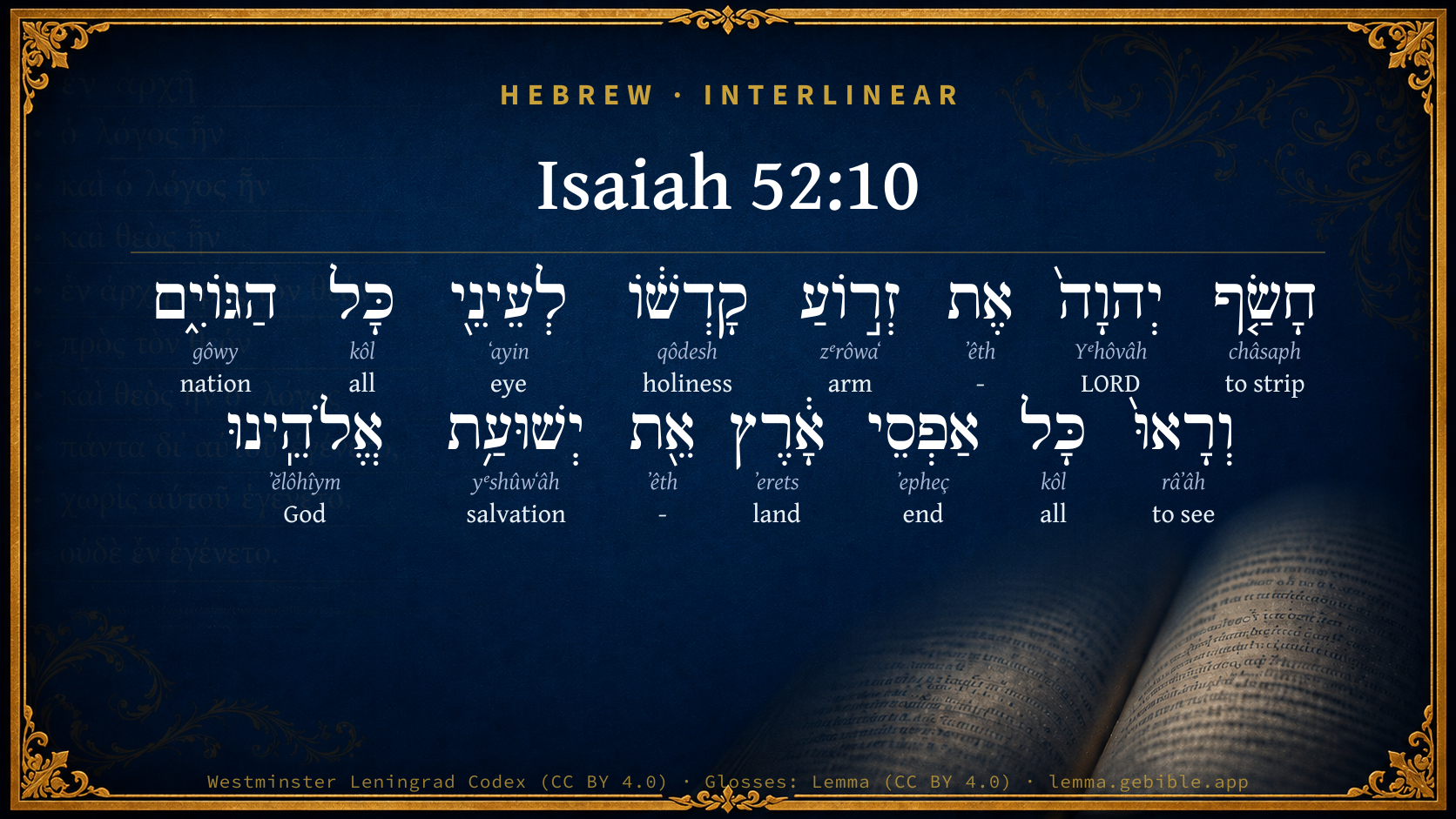
Hebrew (Westminster Leningrad Codex) Isaiah 52:10 appears in the Hebrew Old Testament. The text above is from the Westminster Leningrad Codex. Each word links to its Strong’s number, a concise gloss, and parsing drawn from the Open Scriptures Hebrew Bible morphology. Click any word for its full Brown-Driver-Briggs (BDB) entry.
Download image
Cite this verse

Isaiah 52:10 (World English Bible). Public Domain. Lemma interlinear Bible study tool, https://lemma.gebible.app/v/isaiah/52/10.

Show BibTeX & RIS
BibTeX
RIS
English Translation
Yahweh has made bare his holy arm in the eyes of all the nations; and all the ends of the earth have seen the salvation of our God.
World English Bible · Public Domain
Download a study sheet

One document with this verse’s original text, its word-by-word gloss line, the meaning frame, cross-references with their text, attributed commentary, and full source and license credits — printable, and it pastes into notes with its structure intact.

This verse Autodidact and up

Study sheet (.html) Plain text (.txt)

A passage Seminary Student

Up to 50 verses in one chapter. A passage sheet keeps up to 6 commentary sources and 12 cross-references per verse, in the order this page ranks them, and says so on the sheet whenever that leaves anything out. Ask for a single verse and you get the Autodidact verse sheet above.

Everything on this page stays free to read, with no account — the sheet is a download of what is already on screen, not access to it.

Want to remove ads? Support Godless Engineer
Compare translations 3

The same verse in 3 English versions, stacked beneath the original-language interlinear above. Click any original word for its lexicon entry.

Each is an independent rendering of the whole verse — the interlinear is not word-aligned to these translations.

Highlighted words mark where these versions differ — a whole-verse word diff, not a word-by-word alignment.

  • World English Bible Public Domain
    Yahweh has made bare his holy arm in the eyes of all the nations; and all the ends of the earth have seen the salvation of our God.
  • King James Version Public Domain
    The LORD hath made bare his holy arm in the eyes of all the nations; and all the ends of the earth shall see the salvation of our God.
  • unfoldingWord Literal Text CC BY-SA 4.0
    Yahweh has bared the arm of his holiness to the eyes of all of the nations, and all of the ends of the earth will see the salvation of our God. q1

unfoldingWord Literal Text — © unfoldingWord, licensed CC BY-SA 4.0. Word-aligned USFM3 via Door43 (git.door43.org/unfoldingWord/en_ult).

Versions to compare (up to 4)

3 of 4 selected

Show all 18 translations

Every available English version of this verse, each an independent rendering of the whole verse.

  • World English Bible Public Domain
    Yahweh has made bare his holy arm in the eyes of all the nations; and all the ends of the earth have seen the salvation of our God.
  • Berean Standard Bible Public Domain
    The LORD has bared His holy arm in the sight of all the nations; all the ends of the earth will see the salvation of our God.
  • Majority Standard Bible Public Domain
    The LORD has bared His holy arm in the sight of all the nations; all the ends of the earth will see the salvation of our God.
  • King James Version Public Domain
    The LORD hath made bare his holy arm in the eyes of all the nations; and all the ends of the earth shall see the salvation of our God.
  • American Standard Version (1901) Public Domain
    Jehovah hath made bare his holy arm in the eyes of all the nations; and all the ends of the earth have seen the salvation of our God.
  • Revised Version (1885) Public Domain
    The LORD hath made bare his holy arm in the eyes of all the nations; and all the ends of the earth shall see the salvation of our God.
  • Geneva Bible (1599) Public Domain
    The Lord hath made bare his holy arme in the sight of all the Gentiles, and all the endes of the earth shall see the saluation of our God.
  • Douay-Rheims (1899) Public Domain
    The Lord hath prepared his holy arm in the sight of all the Gentiles: and all the ends of the earth shall see the salvation of our God.
  • Young's Literal Translation Public Domain
    Jehovah hath made bare His holy arm Before the eyes of all the nations, And seen have all the ends of the earth, The salvation of our God.
  • Literal Standard Version CC BY-SA 4.0
    YHWH has made His holy arm bare || Before the eyes of all the nations, || And all the ends of the earth have seen || The salvation of our God.
  • Unlocked Literal Bible CC BY-SA 4.0
    Yahweh has bared his holy arm in the sight of all the nations; all the earth will see the salvation of our God.
  • unfoldingWord Literal Text CC BY-SA 4.0
    Yahweh has bared the arm of his holiness to the eyes of all of the nations, and all of the ends of the earth will see the salvation of our God. q1
  • Darby Bible Public Domain
    Jehovah hath made bare his holy arm in the sight of all the nations; and all the ends of the earth shall see the salvation of our God.
  • World Messianic Bible Public Domain
    The LORD has made his holy arm bare in the eyes of all the nations. All the ends of the earth have seen the salvation of our God.
  • Webster's Bible Public Domain
    The LORD hath made bare his holy arm in the eyes of all the nations: and all the ends of the earth shall see the salvation of our God.
  • Free Bible Version CC BY-SA 4.0
    The Lord has demonstrated his holy power to all the nations; the whole world will see our God's salvation.
  • Bible in Basic English Public Domain
    The Lord has let his holy arm be seen by the eyes of all nations; and all the ends of the earth will see the salvation of our God.
  • JPS Tanakh (1917) Public Domain
    The LORD hath made bare His holy arm in the eyes of all the nations; and all the ends of the earth shall see the salvation of our God.

Literal Standard Version (2020), Covenant Press — licensed CC BY-SA 4.0. Text via the HelloAO Bible API (eBible.org). Unlocked Literal Bible (unfoldingWord) — licensed CC BY-SA 4.0. Text via the HelloAO Bible API (eBible.org). unfoldingWord Literal Text — © unfoldingWord, licensed CC BY-SA 4.0. Word-aligned USFM3 via Door43 (git.door43.org/unfoldingWord/en_ult). Free Bible Version, Dr. Jonathan Gallagher — licensed CC BY-SA 4.0. Text via the HelloAO Bible API (eBible.org).

Word by word

More ways to search: Search by grammar → Find every occurrence → Compare this word →

Practice this passage: Drill this verse → Learn its vocabulary →

חָשַׂ֤ף
châsaph
H2834
“to strip”
Verb, Qal, Perfect, 3rd Person, Masculine, Singular
Part of Speech
Verb
Stem
Qal
Form
Perfect
Person
3rd Person
Gender
Masculine
Number
Singular
Full BDB Definition

Origin: a primitive root

TWOT: 766

to strip, strip off, lay bare, make bare, draw out - (Qal) - to strip off - to strip, lay bare - to draw (water), skim, take from the surface
  1. יְהוָה֙ Yᵉhôvâh H3068 “LORD” Noun, Proper
  2. אֶת ʼêth H853 “-” Particle, Direct Object
  3. זְר֣וֹעַ zᵉrôwaʻ H2220 “arm of” Noun, Common, Both, Singular, Construct
  4. קָדְשׁ֔וֹ qôdesh H6944 “holiness · his” Noun, Common, Masculine, Singular, Construct + Suffix, Personal, 3rd Person, Masculine, Singular
  5. לְעֵינֵ֖י ʻayin H5869 “to/for · eyes of” Preposition + Noun, Common, Both, Dual, Construct
  6. כָּל kôl H3605 “all of” Noun, Common, Masculine, Singular, Construct
  7. הַגּוֹיִ֑ם gôwy H1471 “the · nations” Particle, Definite Article + Noun, Common, Masculine, Plural, Absolute
  8. וְרָאוּ֙ râʼâh H7200 “and · to see” Conjunction + Verb, Qal, Sequential Perfect, 3rd Person, Common, Plural
  9. כָּל kôl H3605 “all of” Noun, Common, Masculine, Singular, Construct
  10. אַפְסֵי ʼepheç H657 “ends of” Noun, Common, Masculine, Plural, Construct
  11. אָ֔רֶץ ʼerets H776 “land” Noun, Common, Both, Singular, Absolute
  12. אֵ֖ת ʼêth H853 “-” Particle, Direct Object
  13. יְשׁוּעַ֥ת yᵉshûwʻâh H3444 “salvation of” Noun, Common, Feminine, Singular, Construct
  14. אֱלֹהֵֽינוּ ʼĕlôhîym H430 “God(s) · our” Noun, Common, Masculine, Plural, Construct + Suffix, Personal, 1st Person, Common, Plural

About this verse

These counts appear in no published source. They are computed here, from the morphology-tagged text and Lemma’s own curated glosses. What Lemma adds →

15
words
13
distinct lemmas
Prophets
section

Notable vocabulary

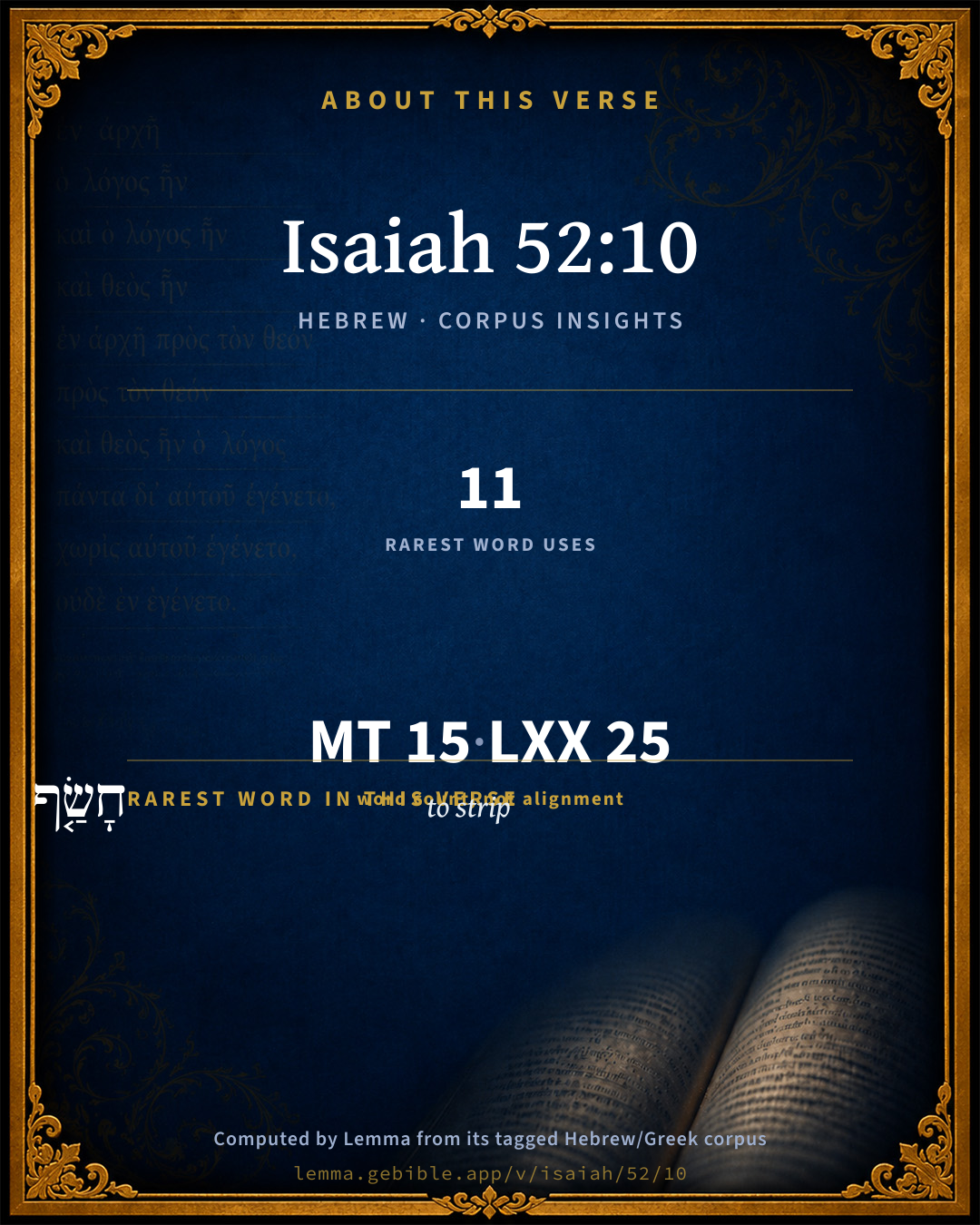
The rarest word here is חָשַׂ֤ף to strip H2834 — appearing just 11 times in the whole Hebrew Bible.

Shared distinctive vocabulary

חָשַׂ֤ף to strip H2834 occurs in 10 verses of the Hebrew Bible. Also found in:

Grammatical profile

  • 2 verbs
  • 11 nouns
  • 2 particles

Verb forms

  • חָשַׂ֤ף Qal · Perfect
  • וְרָאוּ֙ Qal · Sequential Perfect

Repetition

A word recurs within this verse — often emphatic in Hebrew:

Hebrew & Septuagint length

In English translation the verse runs 28 words from the Hebrew and 31 from the Septuagint (LXX English) — closely comparable.

A rough comparison of the two English renderings, which tokenize alike — not a word-level alignment.

Word counts can differ between the Hebrew and the Greek without any difference in meaning — e.g. the Hebrew direct-object marker אֵת has no separate Greek word, and Greek often adds the article ὁ.

In the original languages it is 15 Hebrew tokens and 25 Greek tokens — but the two are counted differently (Hebrew bundles its prefixes and suffixes into one token; the Greek is in lemma form), so that isn’t a like-for-like length.

Cross-references

11

Topical passages linked to Isaiah 52:10 in the Treasury of Scripture Knowledge — connected by theme and wording, ordered by reader-vote popularity; previews shown in the World English Bible.

  • Luke 3:6 All flesh will see God's salvation.'"
  • Revelation 14:6 I saw an angel flying in mid heaven, having an eternal Gospel to proclaim to those who dwell on the earth, and to every nation, tribe, language, and people.
  • Psalms 98:1–3 Sing to Yahweh a new song, For he has done marvelous things! His right hand, and his holy arm, have worked salvation for him.
  • Isaiah 51:9 Awake, awake, put on strength, arm of Yahweh; awake, as in the days of old, the generations of ancient times. Isn't it you who did cut Rahab in pieces, who pierced the monster?
  • Revelation 15:4 Who wouldn't fear you, Lord, And glorify your name? For you only are holy. For all the nations will come and worship before you. For your righteous acts have been revealed."
  • Isaiah 49:6 yes, he says, It is too light a thing that you should be my servant to raise up the tribes of Jacob, and to restore the preserved of Israel: I will also give you for a light to the Gentiles, that you may be my salvation to the end of the earth.
  • Acts 2:5–11 Now there were dwelling in Jerusalem Jews, devout men, from every nation under the sky.
  • Acts 13:47 For so has the Lord commanded us, saying, 'I have set you as a light for the Gentiles, That you should bring salvation to the uttermost parts of the earth.'"
  • Isaiah 66:18–19 For I [know] their works and their thoughts: [the time] comes, that I will gather all nations and languages; and they shall come, and shall see my glory.
  • Revelation 11:15–17 The seventh angel sounded, and great voices in heaven followed, saying, "The kingdom of the world has become the Kingdom of our Lord, and of his Christ. He will reign forever and ever!"
  • Psalms 22:27 All the ends of the earth shall remember and turn to Yahweh. All the relatives of the nations shall worship before you.

Cross-references courtesy of OpenBible.info (CC BY 4.0).

Hebrew and Greek witnesses Masoretic Hebrew ↔ Greek Septuagint

The same verse in the two great witnesses to the Old Testament, shown verse-for-verse.

These are two independent witnesses, not word-aligned to each other, and the Septuagint is shown in lemma (dictionary) form.

Hebrew Isaiah 52:10 Masoretic · Westminster Leningrad Codex

חָשַׂ֤ף יְהוָה֙ אֶת זְר֣וֹעַ קָדְשׁ֔וֹ לְעֵינֵ֖י כָּל הַגּוֹיִ֑ם וְרָאוּ֙ כָּל אַפְסֵי אָ֔רֶץ אֵ֖ת יְשׁוּעַ֥ת אֱלֹהֵֽינוּ

Yahweh has made bare his holy arm in the eyes of all the nations; and all the ends of the earth have seen the salvation of our God.

World English Bible · Public Domain

Greek LXX Isaiah 52:10 Septuagint · lemma form

καί ἀποκαλύπτω κύριος ὁ βραχίων αὐτός ὁ ἅγιος ἐνώπιον πᾶς ὁ ἔθνος καί ὁράω πᾶς ὁ ἄκρος ὁ γῆ ὁ σωτηρία ὁ παρά ὁ θεός

And the Lord shall reveal his holy arm in the sight of all the nations; and all the ends of the earth shall see the salvation that comes from our God.

LXX2012 (modern English Septuagint) · Public Domain

Hebrew: Westminster Leningrad Codex (CC BY 4.0). Greek: Septuagint (public domain); English from LXX2012 (modern English Septuagint) (Public Domain). How the Septuagint differs from the Hebrew →

Targum (Aramaic paraphrase)

1

The Targum is the ancient Jewish Aramaic paraphrase of the Hebrew Scriptures — an interpretive translation, not the Hebrew text itself. Onkelos (literal) and Pseudo-Jonathan (expansive) render the Torah, and Jonathan the Prophets. Coverage is partial: where no permissively-licensed English translation exists for a verse, only the Aramaic is shown. This is verse-level text, not a word-by-word alignment to the Hebrew.

  1. Targum Jonathan Prophets (Joshua–Malachi)
    גַלֵא יְיָ יַת דְרַע קוּדְשֵׁהּ לְעֵינֵי כָּל עַמְמַיָא וְיֶחֱזוּן כָּל דְבִסְיָפֵי אַרְעָא יַת פּוּרְקָנָא דֶאֱלָהָנָא:

    The Lord hath revealed His holy arm in the eyes of all the nations; and all that are in the ends of the earth shall see the salvation of our God.

    Targum Jonathan — Aramaic: “Mikraot Gedolot” (public domain). English: “Sefaria Community Translation” (CC0 1.0 (public-domain dedication)); “London "Chaldee Paraphrase," 1871” (public domain). Text via Sefaria.

Commentary

Notes on Isaiah 52:10 from classic Christian and Jewish commentators (each source and its license shown beneath its notes). The classic Christian expositions comment on the surrounding passage and are grouped to its opening verse, so a note may address several verses; the Jewish commentaries on the Tanakh (Rashi and others) are per-verse, so they appear only where the commentator wrote on this verse.

Lemma curates 59 commentaries, every one of them public domain or Creative Commons licensed, each selected and text-cleaned for this edition rather than reprinted as found. About our sources →

Trapp's Complete Commentary

John Trapp

Isa 52:10 The LORD hath made bare his holy arm in the eyes of all the nations; and all the ends of the earth shall see the salvation of our God.

Ver. 10. The Lord hath made bare his holy arm.] Nudavit, id est, exeruit, in answer to your prayer. {Isa 51:9} God oft answereth his praying people ad cardinem desiderii, {a} as Augustine saith, letteth it be to them even as they will. Scanderbeg ever fought against the Turks with his arm bare, and that with such fierceness that the blood did oftentimes burst out of his lips. It is written that he, with that bare arm of his, slow three thousand Turks in the time of his wars against them. {b}

Shall see the salvation of the Lord.] Shall see it and sing of it. {Isa 52:9}

{a} Confes., lib. v. cap. 8.

{b} Turk. Hist., fol. 287.

John Trapp, A Commentary or Exposition upon All the Books of the Old and New Testament (1647–1656) — public domain. Text from a community e-Sword module.

The Biblical Illustrator

Joseph S. Exell

Isa_52:10

The Lord hath made bare His holy arm

Gods arm made bare

When the heroes of old prepared for the fight they put on their armour; but when God prepares for battle He makes bare His arm.

Man has to look two ways--to his own defence, as well as to the offence of his enemy; God hath but one direction in which to cast His eye--the overthrow of His foeman; and He disregards all measures of defence, and scorns all armour. He makes bare His arm in the sight of all the people. When men would do their work in earnest, too, they sometimes strip themselves, like that warrior of old, who, when he went to battle with the Turks, would never fight them except with the bare arm. Such things as they, said he, I need not fear; they have more reason to fear my bare arm than I their scimitar. Men feel that they are prepared for a work when they have cast away their cumbrous garments. And so the prophet represents the Lord as laying aside for awhile the garments of His dignity, and making bare His arm, that He may do His work in earnest, and accomplish His purpose for the establishment of His Church. (C. H. Spurgeon.)

The great revival

I. THE CAUSE OF A TRUE REVIVAL. The Holy Spirit. While this is the only actual cause, yet there are instrumental causes; and the main instrumental cause of a great revival must be the bold, faithful, fearless preaching of the truth as it is in Jesus. Added to this, there must be the earnest prayers of the Church.

II. THE CONSEQUENCES OF A REVIVAL OF RELIGION. The minister begins to be warmed. The members of the Church grow more serious. Family duties are better attended to; the home circle is brought under better culture. There is an inquirers meeting held. The revival of the Church then touches the rest of society.

III. A CAUTION. Let all things be done decently, and in order. Distinguish between man and man. While, during a revival of religion, a very large number of people will be really converted, there will be a very considerable portion who will be merely excited with animal excitement, and whose conversion will not he genuine. Take care, ye that are officers in the Church, when ye see the people stirred up, that ye exercise still a holy caution, lest the Church become lowered in its standard of piety by the admission of persons not truly saved.

IV. With these words of caution, I shall now STIR YOU UP TO SEEK OF GOD A GREAT REVIVAL OF RELIGION throughout the length and breadth of this land. The Lord God hath sent us a blessing. One blessing is the earnest of many. (C. H. Spurgeon.)

All the ends of the earth shall see the salvation of our God

Tidings of salvation to the ends of the earth

I. THE SALVATION OF GOD. Salvation carries our meditations direct unto the names and the offices of Him, of whom it hath been said, Thou shalt call His name Jesus, for He shall save His people from their sins. And in this connection the whole scheme of mercy and eternal life bursts at once upon our view.

1. It is a great salvation.

2. An everlasting salvation.

3. A complete salvations.

4. A salvation all of God and of grace.

II. THE CERTAINTY OF THE ACCOMPLISHMENT OF THIS PROMISE, as an encouragement to us to do our duty. If all the ends of the earth shall see the salvation of our God, an imperious necessity is laid upon us to favour every opportunity which offers of sending the report of this salvation to all parts of the earth. The truth of the promise, and the certainty of its accomplishment, might be argued--

1. From the Divine purposes taken in connection with the first promise.

2. From the settlement with Abraham respecting the coming of his promised seed.

3. From the style of the prophets, and the expectations which they excite.

4. From the progress of Christianity through the world, in defiance of all the opposition which has been combined against it. (W. Taylor.)

The Biblical Illustrator, edited by Joseph S. Exell (c. 1880s–1900s) — public domain. Text from a community e-Sword module.

The Preacher's Complete Homiletical Commentary

Joseph S. Exell (gen. ed.)

THE GREAT REVIVAL

Isa_52:10. The Lord hath made bare His holy arm, &c.

When the heroes of old prepared for the fight, they put on their armour; but when God prepares for battle, He makes bare His arm, that He may do His work in earnest and accomplish His purpose for the establishment of His Church. Leaving the figure, which is a very great one, I will remind you that its meaning is fully carried out whenever God is pleased to send a great revival of religion. [1590]

[1590] The loose sleeve of the Arab shirt, as well as that of the outer garment, leaves the arm so completely free, that, in an instant, the left hand passing up the right arm, makes it bare; and this is done when a person—a soldier, for example, about to strike with the sword—intends to give his right arm full play. The image represents Jehovah as suddenly prepared to inflict some tremendous, yet righteous judgment, so effectual, that “all the ends of the world shall see the salvation of God.”—Jowett.

I. THE CAUSE OF A TRUE REVIVAL. The mere worldly man does not understand a revival, he cannot make it out. Why is it, that a sudden fit of godliness, as he would call it, a kind of sacred epidemic, should seize upon a mass of people all at once? It frequently occurs in the absence of all great evangelists; it cannot be traced to any particular means. There have been no special agencies used in order to bring it about, and yet it has come, just like a heavenly hurricane sweeping everything before it. What then is the cause? It is caused by the Holy Spirit alone. The day of Pentecost. Do not imagine when you hear of a sermon being made useful, that it was the sermon itself that did the work. But while this is the only actual cause, yet there are instrumental causes; and the main instrumental cause of a great revival must be bold, faithful, fearless preaching of the truth as it is in Jesus. But, added to this, there must be the earnest prayers of the Church. All in vain the most indefatigable ministry, unless the Church waters the seed sown with her abundant tears. Every revival has been commenced and attended by a large amount of prayer.

II. THE CONSEQUENCES OF A REVIVAL OF RELIGION.

1. Everything that our hearts could desire for the Church. The minister begins to be warmed. Directly after that, the revival begins to touch the people at large. A prayer meeting is summoned. The members of the Church grow solemn, more serious; family duties are better attended to, &c. And then comes the great result. There is an inquirers’ meeting held; the good brother who presides over it is astonished, he never saw so many coming in his life before.

2. The revival of the Church then touches the rest of society. Men, who do not come forward and profess religion, are more punctual in attending the means of grace. Men that used to swear give it up, &c.

III. SOME CAUTIONS.

1. If in any revival you see any strange contortions of the body, &c., always distinguish between things that differ. The Holy Spirit’s work is with the mind, not with the body.

2. Always distinguish between man and man in the work of revival. While during a revival of religion a very large number of people will be really converted, there will be a very considerable portion who will be merely excited with animal excitement, and whose conversion will not be genuine. Always expect that, and do not be surprised if you see it.

3. Do not relax the bonds of discipline.

CONCLUSION.—Stir you up to seek of God a great revival of religion throughout the length and breadth of this land. There are some of you who stand in the way—you are not consistent in your living; others that stand in the way of all progress; others are such sticklers for order, so given to everything that has been, that you do not care for any revival for fear we should hurt you. You who love Jesus with all your heart, and want to promote it, remember that men are dying around you by thousands. Did Christ give His whole life for their salvation, and will not you stir up your life to wrestle with God that His purpose may be accomplished on their behalf? As for you that fear not God, see how much ado we are making about you. Your souls are worth more than you think. Oh that you would believe in Christ to the salvation of your souls!—C. H. Spurgeon: Metropolitan Tabernacle Pulpit, No. 185.

THE SALVATION OF GOD UNIVERSALLY SEEN

(Missionary Sermon.)

Isa_52:10. And all the ends of the earth shall see the salvation of our God.

I. THE SALVATION WHICH IS TO BE REVEALED TO MANKIND.

1. Its nature: “the salvation of God.” There is no doubt a primary reference to the delivery of the Jews from captivity; but its main and ultimate reference is to the salvation of men by Christ, for in the verses which immediately follow our text, as also in the next chapter, we have a picture of the humiliation of the Saviour, and of its effects on mankind (see also Luk_3:3-6). It is salvation from the curse of a violated law, and from the bondage of sin; and it comprehends admission into heaven at death, the resurrection of the body in glory, and its reunion with the spirit for ever. Such being the nature and vastness of this salvation, it surpasses the limits of human or angelic agency. It is necessarily the salvation of God.—Contemplate, then,

2. Its divinity. It is the product of His infinite wisdom, His almighty power, His unchanging faithfulness, His boundless love.

II. ITS UNIVERSAL MANIFESTATION.

1. It was seen by “all the ends of the earth,” in the ministry and triumphs of the early ages. Whilst the comparative cessation of its early triumphs may be traced to the faithlessness of the Church, we may be assured that they have never been extinct. Throughout the darkest periods of the Church there were some who preached the good tidings. In every age the salvation of God has been seen, and its victories have probably been achieved to a far greater extent than has been known or recorded.

2. In the future the prediction of our text shall be yet more gloriously fulfilled.

(1.) The Gospel shall be preached in every land.

(2.) The salvation thus exhibited shall be everywhere triumphant. The reign of superstition and sin shall be brought to an end (H. E. I. 979, 1161–1168).

1. How much we owe to our Saviour for the provision of this salvation!

2. Ought it not to be our earnest desire to see this salvation for ourselves?

3. Ought we not to rejoice in prospect of the period when the prediction of our text shall be fulfilled?

4. Let us labour to accelerate the arrival of this period.—John Johnson, M.A.: Sermons, vol. i. pp. 389–418.

The Preacher's Complete Homiletical Commentary (gen. ed. Joseph S. Exell; Funk & Wagnalls, c. 1892) — public domain (pre-1929). A full-Bible homiletical/sermon-outline anthology covering 65 of 66 books (2 John is absent from the source module). Text from a community e-Sword module.

Tyndale Open Study Notes

Tyndale Open Resources

52:10 victory of our God: The rescue of God’s people from disgrace foreshadows an even greater victory when God will reign victoriously to the ends of the earth (note the many similarities with Ps 98:1-3).

Tyndale Open Study Notes — © Tyndale Open Resources, licensed CC BY-SA 4.0. Text via the HelloAO Bible API.

Geneva Bible (1599)

Geneva Bible translators

As ready to smite his enemies, and to deliver his people.

Geneva Bible (1599) marginal notes — public domain. Text via Bolls.life.

Jamieson, Fausset & Brown

Robert Jamieson, A. R. Fausset & David Brown

made bare . . . arm--metaphor from warriors who bare their arm for battle (Eze 4:7).

all . . . earth . . . see . . . salvation of . . . God--The deliverance wrought by God for Israel will cause all nations to acknowledge the Lord (Isa 66:18-20). The partial fulfilment (Luk 3:6) is a forerunner of the future complete fulfilment.

Jamieson, Fausset & Brown — Commentary Critical and Explanatory on the Whole Bible (1871) — public domain (CC PDM 1.0). Text via the HelloAO Bible API.

Ellicott's Commentary for English Readers

(10) The Lord hath made bare . . .—The warrior preparing for action throws off his mantle, tucks up the sleeve of his tunic, and leaves his outstretched arm free.

A Bible Commentary for English Readers, edited by Charles John Ellicott (1878–1897) — public domain. Text from a community e-Sword module.

The Cambridge Bible for Schools and Colleges

gen. ed. J. J. S. Perowne

10. Here (if not already in Isa_52:9) the prophet withdraws his gaze from the future, and describes Jehovah as preparing Himself for the conflict which leads to the joyous scene of Isa_52:7 f.

hath made bare his holy arm] throwing back the sleeveless upper garment from the right shoulder, in readiness for action: δεξιὸν ὦμον γυμνὸν ἔχων ἐν τῇ μάχῃ (Arrian, Alex. 5. 18, quoted by Dillmann). See the contrasted metaphor in Psa_74:11. his holy arm means “His divine arm” (Psa_98:1). The “arm” of Jehovah, as ch. Isa_51:9 (cf. also Isa_53:1).

shall see the salvation (i.e. the deliverance or “victory”) of our God] a different idea from that of Isa_45:22.

The Cambridge Bible for Schools and Colleges (gen. ed. J. J. S. Perowne; Cambridge University Press, 1878–1918) — public domain. Text from a community e-Sword module.

John Gill's Exposition

The Lord hath made bare his holy arm in the eyes of all the nations,.... Revealed his Gospel, which is a system of holy doctrines, and is the power of God unto salvation, openly, in the sight of all men, and given it a general spread all the world over; and with it has exerted his almighty power, in the marvellous conversion of multitudes of souls everywhere, in which his holiness, as well as his power, is displayed: or else Christ is here meant, who is the power of God; by whom he has made the world, and upholds it; by whom he has redeemed his people, and saved them; and by whom he keeps and preserves them; and by whom he will raise them from the dead at the last day; and who is holy in his nature, and in his works: this arm of his was made bare or revealed at his incarnation; is evidently seen in his word and ordinances; and will be more clearly revealed therein in the latter day, as he will be most fully manifested in person at the last day, even in the eyes of the whole world. The allusion is to military persons preparing for battle, especially in the eastern countries, where they wore loose and long garments, which they tucked up on their arms, that they might be more expeditious in it, and so in any other service. Scanderbeg used to fight the Turks with his arm bare, as the writer of his life observes.

And all the ends of the earth shall see the salvation of our God; the salvation which Christ, God manifest in the flesh, has wrought out: the people of God, in the several parts of the world, shall see their need of this salvation; the suitableness of it to them; the necessity of going to Christ for it; their interest in it; and shall partake of the blessings of it: or Christ himself is meant, the Saviour of God's providing, sending, and giving; of whom multitudes, in the several parts of the world, shall have a spiritual sight, by faith, in the latter day; and all shall have a corporeal sight of him, when he comes in person, or appears a second time, without sin unto salvation.

John Gill's Exposition of the Whole Bible (1746–1763) — public domain (CC PDM 1.0). Text via the HelloAO Bible API.

Albert Barnes' Notes on the Bible

The Lord hath made bare his holy arm - That is, in delivering his people from bondage. This metaphor is taken from warriors, who made bare the arm for battle; and the sense is, that God had come to the rescue of his people as a warrior, and that his interpositions would be seen and recognized and acknowledged by all the nations. The metaphor is derived from the manner in which the Orientals dressed. The following extract from Jowett’s Christian Researches will explain the language: ‘The loose sleeve of the Arab shirt, as well as that of the outer garment, leaves the arm so completely free, that in an instant the left hand passing up the right arm makes it bare; and this is done when a person, a soldier, for example, about to strike with the sword, intends to give the arm full play. The image represents Yahweh as suddenly prepared to inflict some tremendous, yet righteous judgment, so effectual “that all the ends of the earth shall see the salvation of God.”’ The phrase ‘holy arm,’ seems to mean that God would be engaged in a holy and just cause. It would not be an arm of conquest, or of oppression; but it would be made bare in a holy cause, and all its inflictions would be righteous.

And all the ends of the earth - For an explanation of the phrase ‘the ends of the earth,’ see the notes at Isa 40:28. The meaning here is, that the deliverance of his people referred to would be so remarkable as to be conspicuous to all the world. The most distant nations would see it, and would be constrained to recognize his hand. It was fulfilled in the rescue of the nation from the captivity at Babylon. The conquest of Babylon was an event that was so momentous in its consequences, as to be known to all the kingdoms of the earth; and the proclamation of Cyrus Ezr 1:1-2, and the consequent restoration of his people to their own land, were calculated to make the name of Yahweh known to all nations.

Albert Barnes' Notes on the Bible (1834–1885) — public domain. Text from a community e-Sword/MySword module.

Haydock's Catholic Bible Commentary

Arm. The Saviour, Luke i. 51.

George Leo Haydock (1774–1849), Haydock's Catholic Family Bible and Commentary, 1859 edition — public domain. Excludes Psalms (Douay-Rheims chapter numbering differs from Protestant) and Deuterocanonical books (Catholic canon only).

Matthew Poole's English Annotations

Hath made bare his holy arm; hath discovered and put forth his great power, which for a long time hath lain hid, and seemed to be idle.

All the ends of the earth shall see the salvation of our God; all nations of the world shall with astonishment behold the wonderful work of God, first in bringing his people out of Babylon, and afterwards in their redemption by Christ.

Matthew Poole's English Annotations on the Holy Bible (1683–1685) — public domain. Text from a community e-Sword/MySword module.

Whedon's Commentary on the Bible

Daniel D. Whedon

10. The Lord… made bare his… arm — As conqueror, Jehovah has effectually wrought deliverance, to which all nations are witnesses; and his salvation through Messiah is now to be published and embraced as far as to the ends of the earth, and to all ages unto the end of the world. The salvation of our God is the glorious Gospel of our Lord Jesus Christ. This salvation is for all.

Daniel D. Whedon (gen. ed.), Commentary on the Old and New Testaments (1874–1909) — public domain. Text from a community e-Sword module.

The Pulpit Commentary

The nations... the ends of the earth. It may well add to the general joy that the work wrought for Israel is not "a thing done in a corner," but one on which the eyes of the" nations" have been turned. and to which the attention of" the ends of the earth" has been called. (comp. Isa_41:5) The holy arm of Jehovah, made bare for battle, has been seen far and wide. The world has stood to gaze at the contest between Persia and Babylon.

The world taught through God"s dealings with his people.

In every age God"s elect people are set in the world"s eye; God"s ways with them are revelations of himself to all onlookers. The world is educated, elevated, by means of its elect nations, just as the social range, the Church sentiment, the doctrinal beliefs, and the family life are raised and toned by God"s elect sons and daughters. In this sense "no man liveth unto himself;" no national experience is limited to the nation; God"s salvations of some are intended to be, and are adapted to be, in varied senses, salvations for all. "The Lord makes bare his holy arm in the eyes of all the nations." The figure of "making bare the arm" is explained by the Eastern custom of wearing long and loose robes, and by the ancient custom of hand-to-hand conflict. The warrior, preparing for action, throws off his mantle, tucks up the sleeve of his tunic, and leaves his outstretched arm free." The prophet is thinking of the way in which news of the crossing of the Red Sea spread abroad among the nations then in Canaan, carrying great impressions of the august and awful power of Jehovah, the God of the Jews. In a similar but smaller way, the return from Babylon was noised abroad among the nations, carrying impressions of God"s faithfulness to his promise. And so with the salvation in Christ Jesus, which was but suggested and foreshadowed by all the previous deliverances; it was for the whole world, though it found its first sphere in the Jewish nation. "Beginning at Jerusalem," of it this must be thought and said"Salvation! let the echo fly The spacious earth around.

This topic is suited for a missionary sermon, and familiar truths may be set under the following headings.

I NEWS OF SALVATION IN CHRIST DESERVE TO BE KNOWN. It is the great salvation," the "common salvation," the "only salvation;" for there is "none other name under heaven, given among men, whereby we can be saved." It is a full salvation and a free salvation.

II NEWS OF SALVATION IN CHRIST WILL SURELY BE KNOWN. Whether we are pleased to aid the spreading or not. The word is running very swiftly. Like the sunshine, its light "is going out into all the world." Illustrate the spreading of the gospel, and its ameliorating and ennobling influences.

III WE MAY HAVE THE JOY OF MAKING THAT SALVATION KNOWN. Show in what practical ways, and plead for direct personal interest in all missionary work. R.T.

The Pulpit Commentary (1880–1919), ed. H.D.M. Spence-Jones & Joseph S. Exell — public domain. Text from a community e-Sword module.

Keil & Delitzsch

C. F. Keil & F. Delitzsch

Jehovah has wrought out salvation through judgment in the sight of all the world. "Jehovah hath made bare His holy arm before the eyes of all nations, and all the ends of the earth see the salvation of our God." As a warrior is accustomed to make bare his right arm up to the shoulder, that he may fight without encumbrance (exsertare humeros nudamque lacessere pugnan, as Statius says in Theb. i. 413), so has Jehovah made bare His holy arm, that arm in which holiness dwells, which shines with holiness, and which acts in holiness, that arm which has been hitherto concealed and therefore has appeared to be powerless, and that in the sight of the whole world of nations; so that all the ends of the earth come to see the reality of the work, which this arm has already accomplished by showing itself in its unveiled glory - in other words, "the salvation of our God."

Keil & Delitzsch — Biblical Commentary on the Old Testament (1861–1891) — public domain (CC PDM 1.0). Text via the HelloAO Bible API. (Old Testament only.)

J. A. Alexander on Isaiah

Joseph Addison Alexander

“Jehovah hath bared his holy arm to the eyes of all the nations, and all the ends of the earth have seen the salvation of our God.” The allusion in the first clause is to the ancient military practice of going into battle with the right arm and shoulder bare. The same Hebrew verb is used in the same application by Ezekiel (Eze 4:7). The baring of the arm may be mentioned as a preparation for the conflict, or the act of stretching it forth may be included. The bare arm is here in contrast either with the long sleeves of the female dress, or with the indolent insertion of the hand into the bosom (Psa 74:11). The exertion of God’s power is elsewhere expressed by the kindred figure of a great hand (Exo 14:30), a strong hand (Eze 20:34), or a hand stretched out (Isa 9:11). The act here described is the same that is described in Isa 51:9. The comparison of Jehovah to a warrior occurs above in Isa 42:13. Jehovah’s arm is here described as holy, in its widest sense, as denoting the divine perfection, or whatever distinguishes between God and man, perhaps with special reference to His power, as that by which His deity is most frequently and clearly manifested to His creatures. Compare this clause with Isa 18:3; Isa 33:13, and Psa 98:3, where it is repeated word for word. Another coincidence between this passage of Isaiah and that Psalm has been already pointed out in expounding the foregoing verse.

Joseph Addison Alexander, The Prophecies of Isaiah (1846–1847; New York: Scribner, 1870–1878) — public domain. Text from a community e-Sword module.

Rashi

Rabbi Shlomo Yitzchaki (Rashi)

has revealed Heb. חָשַׂף, has revealed.

Rashi on the Tanakh — English translations: “The Judaica Press complete Tanach with Rashi, translated by A. J. Rosenberg” (CC BY 4.0); “Pentateuch with Rashi's commentary by M. Rosenbaum and A.M. Silbermann, 1929-1934” (public domain); “The Metsudah Tanach series, Lakewood, N.J” (CC BY 4.0); and “The Book of Joshua, Metsudah Publications, 1997” (CC BY 4.0). Text via Sefaria.

Ibn Ezra

Rabbi Abraham ibn Ezra

Hath made bare His holy arm. He has shown His strength. It is a figure taken from the hero that slays with the strength of his arm.

אפסי The ends of. Some consider this word as hap. leg., its meaning being found from the context. According to others, it is to be compared with באפסו═באפס in his land (ver. 4); ואפסי and my land (47:8). To others the א is prosthetic; they compare, therefore, אפס with פיסת a handful (Ps. 72:16). I connect it with מי אפסים waters to the ankles (Ez. 47:3). It is not in the least surprising that the text attributes to God hand, foot, heart, and mouth; the meaning of such figures is well known. He who speaks, as well as he who is addressed, is a human being; the idea is therefore clothed in such language as can be understood by man.

Ibn Ezra on the Tanakh — English translations: “Sefaria Community Translation” (CC0 1.0 (public-domain dedication)); “Yalkut, Sifsei Chachomim Chumash, Metsudah Publications, 2009” (CC BY 4.0); and “Commentary of Ibn Ezra on Isaiah - trans. by M. Friedlander, 1873” (public domain). Text via Sefaria.

Lesson kit

Teaching starters — assembled from the data on this page, not authored interpretation. Every prompt links to the verse data it draws on. Edit before teaching.

Isaiah, in the Prophets, opens this verse with 15 words (13 distinct Hebrew lemmas). Its most distinctive word is châsaph (“to strip”). A historical commentator’s framing appears above. Read the whole chapter for the surrounding context.

Discussion questions

  1. The word châsaph carries the sense “to strip.” How does it shape the verse?
  2. How does Psalms 29:9, which shares the word «to strip», read alongside this verse?
  3. What does the repetition of “all” (2× in this one verse) do in this verse?
  4. These translations render this verse differently; the difference is in the English rendering, not the original. What questions does that raise?
  5. «חָשַׂ֤ף» is a Qal Perfect verb. How does that grammatical form shape the action described?
  6. Compare how Trapp's Complete Commentary and The Biblical Illustrator read this verse. Where do they agree or differ?

Things to notice

Reading settings

Reading text

Shown beneath each verse's original-language words.

Old Testament
Old Testament edition

Read the OT as the Masoretic Hebrew (MT) or the Greek Septuagint (LXX).

English shown for the Greek Septuagint (in the Hebrew ↔ Greek comparison).

Comparing translations? Open the Compare panel on any verse page to stack up to four side by side.