Isaiah 60:2

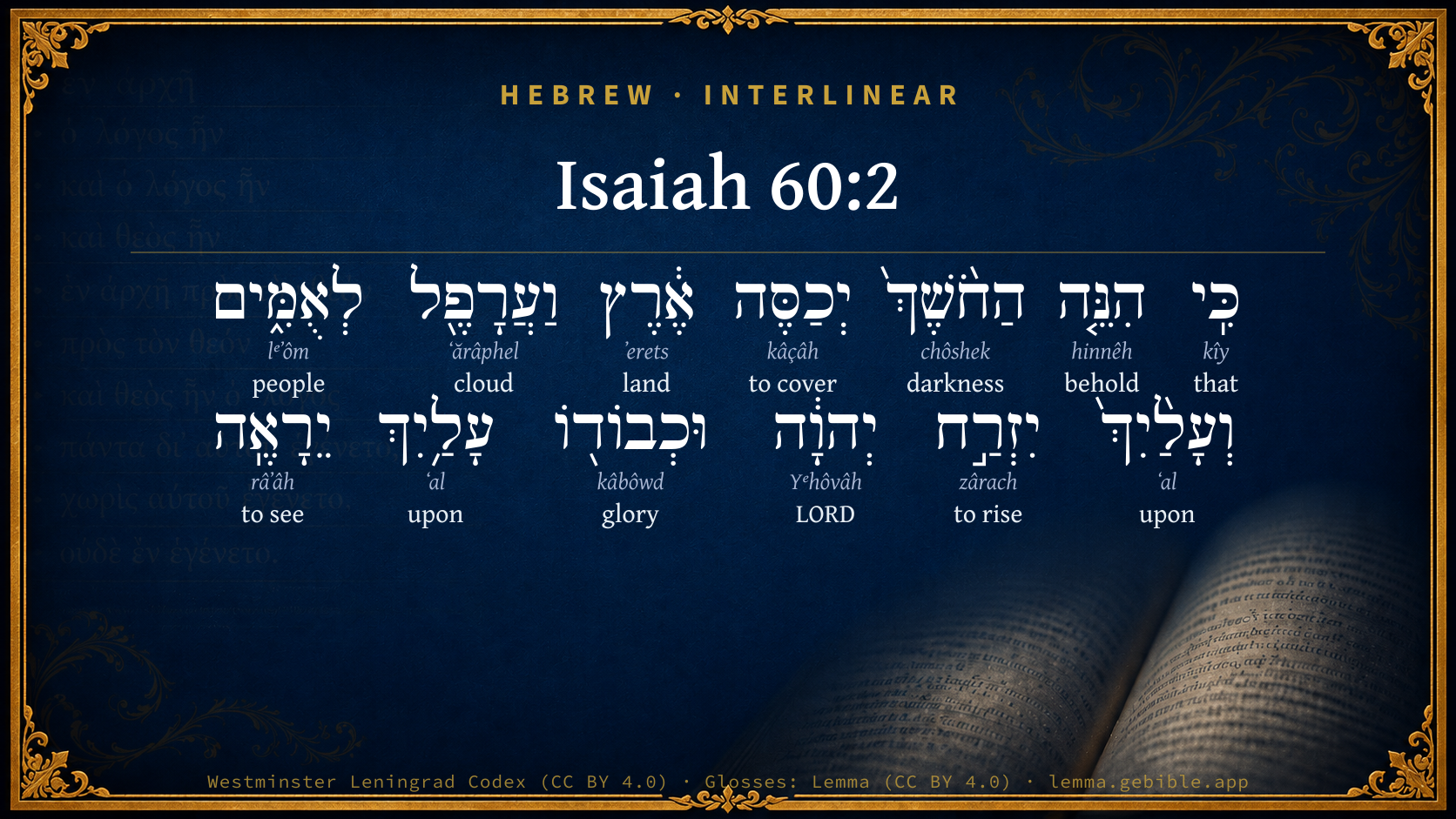
Hebrew (Westminster Leningrad Codex) Isaiah 60:2 appears in the Hebrew Old Testament. The text above is from the Westminster Leningrad Codex. Each word links to its Strong’s number, a concise gloss, and parsing drawn from the Open Scriptures Hebrew Bible morphology. Click any word for its full Brown-Driver-Briggs (BDB) entry.
Download image
Cite this verse

Isaiah 60:2 (World English Bible). Public Domain. Lemma interlinear Bible study tool, https://lemma.gebible.app/v/isaiah/60/2.

Show BibTeX & RIS
BibTeX
RIS
English Translation
For, behold, darkness shall cover the earth, and gross darkness the peoples; but Yahweh will arise on you, and his glory shall be seen on you.
World English Bible · Public Domain
Download a study sheet

One document with this verse’s original text, its word-by-word gloss line, the meaning frame, cross-references with their text, attributed commentary, and full source and license credits — printable, and it pastes into notes with its structure intact.

This verse Autodidact and up

Study sheet (.html) Plain text (.txt)

A passage Seminary Student

Up to 50 verses in one chapter. A passage sheet keeps up to 6 commentary sources and 12 cross-references per verse, in the order this page ranks them, and says so on the sheet whenever that leaves anything out. Ask for a single verse and you get the Autodidact verse sheet above.

Everything on this page stays free to read, with no account — the sheet is a download of what is already on screen, not access to it.

Want to remove ads? Support Godless Engineer
Compare translations 3

The same verse in 3 English versions, stacked beneath the original-language interlinear above. Click any original word for its lexicon entry.

Each is an independent rendering of the whole verse — the interlinear is not word-aligned to these translations.

Highlighted words mark where these versions differ — a whole-verse word diff, not a word-by-word alignment.

  • World English Bible Public Domain
    For, behold, darkness shall cover the earth, and gross darkness the peoples; but Yahweh will arise on you, and his glory shall be seen on you.
  • King James Version Public Domain
    For, behold, the darkness shall cover the earth, and gross darkness the people: but the LORD shall arise upon thee, and his glory shall be seen upon thee.
  • unfoldingWord Literal Text CC BY-SA 4.0
    For behold, darkness will cover the earth, and gloom, the peoples; but Yahweh will rise upon you, and his glory will be seen upon you.

unfoldingWord Literal Text — © unfoldingWord, licensed CC BY-SA 4.0. Word-aligned USFM3 via Door43 (git.door43.org/unfoldingWord/en_ult).

Versions to compare (up to 4)

3 of 4 selected

Show all 18 translations

Every available English version of this verse, each an independent rendering of the whole verse.

  • World English Bible Public Domain
    For, behold, darkness shall cover the earth, and gross darkness the peoples; but Yahweh will arise on you, and his glory shall be seen on you.
  • Berean Standard Bible Public Domain
    For behold, darkness covers the earth, and thick darkness is over the peoples; but the LORD will rise upon you, and His glory will appear over you.
  • Majority Standard Bible Public Domain
    For behold, darkness covers the earth, and thick darkness is over the peoples; but the LORD will rise upon you, and His glory will appear over you.
  • King James Version Public Domain
    For, behold, the darkness shall cover the earth, and gross darkness the people: but the LORD shall arise upon thee, and his glory shall be seen upon thee.
  • American Standard Version (1901) Public Domain
    For, behold, darkness shall cover the earth, and gross darkness the peoples; but Jehovah will arise upon thee, and his glory shall be seen upon thee.
  • Revised Version (1885) Public Domain
    For, behold, darkness shall cover the earth, and gross darkness the peoples: but the LORD shall arise upon thee, and his glory shall be seen upon thee.
  • Geneva Bible (1599) Public Domain
    For beholde, darkenesse shall couer the earth, and grosse darkenesse the people: but the Lord shall arise vpon thee, and his glory shall be seene vpon thee.
  • Douay-Rheims (1899) Public Domain
    For behold darkness shall cover the earth, and a mist the people: but the Lord shall arise upon thee, and his glory shall be seen upon thee.
  • Young's Literal Translation Public Domain
    For, lo, the darkness doth cover the earth, And thick darkness the peoples, And on thee rise doth Jehovah, And His honour on thee is seen.
  • Literal Standard Version CC BY-SA 4.0
    For behold, the darkness covers the earth, || And thick darkness the peoples, || And YHWH rises on you, || And His glory is seen on you.
  • Unlocked Literal Bible CC BY-SA 4.0
    Though darkness will cover the earth, and thick darkness the nations; yet Yahweh will arise upon you, and his glory will be seen on you.
  • unfoldingWord Literal Text CC BY-SA 4.0
    For behold, darkness will cover the earth, and gloom, the peoples; but Yahweh will rise upon you, and his glory will be seen upon you.
  • Darby Bible Public Domain
    For behold, darkness shall cover the earth, and gross darkness the peoples; but Jehovah will arise upon thee, and his glory shall be seen on thee.
  • World Messianic Bible Public Domain
    For behold, darkness will cover the earth, and thick darkness the peoples; but the LORD will arise on you, and his glory shall be seen on you.
  • Webster's Bible Public Domain
    For behold, the darkness shall cover the earth, and gross darkness the people: but the LORD will arise upon thee, and his glory will be seen upon thee.
  • Free Bible Version CC BY-SA 4.0
    Even though darkness covers the earth, and deep darkness covers the people, the Lord has risen to shine on you, and his glory appears over you.
  • Bible in Basic English Public Domain
    For truly, the earth will be dark, and the peoples veiled in blackest night; but the Lord will be shining on you, and his glory will be seen among you.
  • JPS Tanakh (1917) Public Domain
    For, behold, darkness shall cover the earth, and gross darkness the peoples; but upon thee the LORD will arise, and His glory shall be seen upon thee.

Literal Standard Version (2020), Covenant Press — licensed CC BY-SA 4.0. Text via the HelloAO Bible API (eBible.org). Unlocked Literal Bible (unfoldingWord) — licensed CC BY-SA 4.0. Text via the HelloAO Bible API (eBible.org). unfoldingWord Literal Text — © unfoldingWord, licensed CC BY-SA 4.0. Word-aligned USFM3 via Door43 (git.door43.org/unfoldingWord/en_ult). Free Bible Version, Dr. Jonathan Gallagher — licensed CC BY-SA 4.0. Text via the HelloAO Bible API (eBible.org).

Word by word

More ways to search: Search by grammar → Find every occurrence → Compare this word →

Practice this passage: Drill this verse → Learn its vocabulary →

וַעֲרָפֶ֖ל
ʻărâphel
H6205
“and · cloud”
Conjunction + Noun, Common, Masculine, Singular, Absolute
Part of Speech
Conjunction + Noun
Type
Common
Gender
Masculine
Number
Singular
State
Absolute
Full BDB Definition

Origin: probably from H6201

TWOT: 1701b

cloud, heavy or dark cloud, darkness, gross darkness, thick darkness
  1. כִּֽי kîy H3588 “that” Conjunction
  2. הִנֵּ֤ה hinnêh H2009 “behold” Particle, Demonstrative
  3. הַחֹ֨שֶׁךְ֙ chôshek H2822 “the · darkness” Particle, Definite Article + Noun, Common, Masculine, Singular, Absolute
  4. יְכַסֶּה kâçâh H3680 “to cover” Verb, Piel, Imperfect, 3rd Person, Masculine, Singular
  5. אֶ֔רֶץ ʼerets H776 “land” Noun, Common, Both, Singular, Absolute
  6. לְאֻמִּ֑ים lᵉʼôm H3816 “peoples” Noun, Common, Masculine, Plural, Absolute
  7. וְעָלַ֨יִךְ֙ ʻal H5921 “and · upon · you” Conjunction + Preposition + Suffix, Personal, 2nd Person, Feminine, Singular
  8. יִזְרַ֣ח zârach H2224 “to rise” Verb, Qal, Imperfect, 3rd Person, Masculine, Singular
  9. יְהוָ֔ה Yᵉhôvâh H3068 “LORD” Noun, Proper
  10. וּכְבוֹד֖וֹ kâbôwd H3519 “and · glory · his” Conjunction + Noun, Common, Both, Singular, Construct + Suffix, Personal, 3rd Person, Masculine, Singular
  11. עָלַ֥יִךְ ʻal H5921 “upon · you” Preposition + Suffix, Personal, 2nd Person, Feminine, Singular
  12. יֵרָאֶֽה râʼâh H7200 “to see” Verb, Niphal, Imperfect, 3rd Person, Masculine, Singular

About this verse

These counts appear in no published source. They are computed here, from the morphology-tagged text and Lemma’s own curated glosses. What Lemma adds →

13
words
12
distinct lemmas
Prophets
section

Notable vocabulary

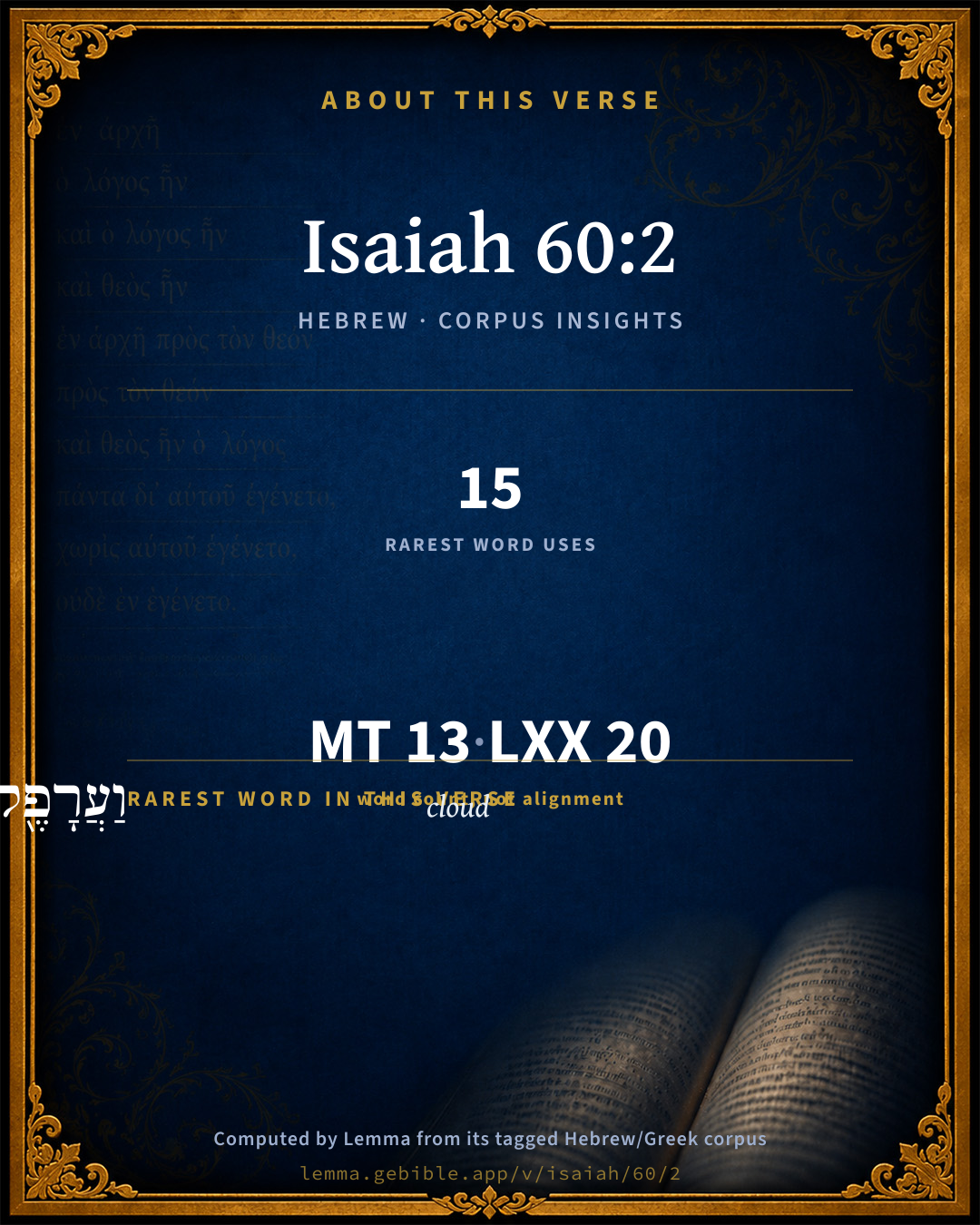
The rarest word here is וַעֲרָפֶ֖ל cloud H6205 — appearing just 15 times in the whole Hebrew Bible.

Shared distinctive vocabulary

וַעֲרָפֶ֖ל cloud H6205 occurs in 15 verses of the Hebrew Bible. Also found in:

Grammatical profile

  • 3 verbs
  • 6 nouns
  • 2 prepositions
  • 1 conjunction
  • 1 particle

Verb forms

  • יְכַסֶּה Piel · Imperfect
  • יִזְרַ֣ח Qal · Imperfect
  • יֵרָאֶֽה Niphal · Imperfect

Repetition

A word recurs within this verse — often emphatic in Hebrew:

  • וְעָלַ֨יִךְ֙ upon H5921 ×2

Hebrew & Septuagint length

In English translation the verse runs 26 words from the Hebrew and 30 from the Septuagint (LXX English) — closely comparable.

A rough comparison of the two English renderings, which tokenize alike — not a word-level alignment.

Word counts can differ between the Hebrew and the Greek without any difference in meaning — e.g. the Hebrew direct-object marker אֵת has no separate Greek word, and Greek often adds the article ὁ.

In the original languages it is 13 Hebrew tokens and 20 Greek tokens — but the two are counted differently (Hebrew bundles its prefixes and suffixes into one token; the Greek is in lemma form), so that isn’t a like-for-like length.

Cross-references

27

Topical passages linked to Isaiah 60:2 in the Treasury of Scripture Knowledge — connected by theme and wording, ordered by reader-vote popularity; previews shown in the World English Bible.

  • Colossians 1:13 who delivered us out of the power of darkness, and translated us into the Kingdom of the Son of his love;
  • 1 Peter 2:9 But you are a chosen race, a royal priesthood, a holy nation, a people for God's own possession, that you may show forth the excellencies of him who called you out of darkness into his marvelous light:
  • Acts 17:30–31 The times of ignorance therefore God overlooked. But now he commands that all people everywhere should repent,
  • Haggai 2:7–9 and I will shake all nations. The precious things of all nations will come, and I will fill this house with glory, says Yahweh of Hosts.
  • 2 Corinthians 4:4–6 in whom the god of this world has blinded the minds of the unbelieving, that the light of the Gospel of the glory of Christ, who is the image of God, should not dawn on them.
  • Ephesians 4:17–20 This I say therefore, and testify in the Lord, that you no longer walk as the rest of the Gentiles also walk, in the futility of their mind,
  • Malachi 4:2 But to you who fear my name shall the sun of righteousness arise with healing in its wings. You will go out, and leap like calves of the stall.
  • Acts 26:18 to open their eyes, that they may turn from darkness to light and from the power of Satan to God, that they may receive remission of sins and an inheritance among those who are sanctified by faith in me.'
  • Romans 1:21–32 Because, knowing God, they didn't glorify him as God, neither gave thanks, but became vain in their reasoning, and their senseless heart was darkened.
  • Leviticus 9:23 Moses and Aaron went into the Tent of Meeting, and came out, and blessed the people: and the glory of Yahweh appeared to all the people.
  • Numbers 16:19 Korah assembled all the congregation against them to the door of the tent of meeting: and the glory of Yahweh appeared to all the congregation.
  • Ezekiel 10:4 The glory of Yahweh mounted up from the cherub, [and stood] over the threshold of the house; and the house was filled with the cloud, and the court was full of the brightness of Yahweh's glory.
  • Acts 17:23 For as I passed along, and observed the objects of your worship, I found also an altar with this inscription: 'TO AN UNKNOWN GOD.' What therefore you worship in ignorance, this I announce to you.
  • 2 Corinthians 3:18 But we all, with unveiled face beholding as in a mirror the glory of the Lord, are transformed into the same image from glory to glory, even as from the Lord, the Spirit.
  • Habakkuk 3:3–4 God came from Teman, The Holy One from Mount Paran. Selah. His glory covered the heavens, And his praise filled the earth.
  • John 1:14 The Word became flesh, and lived among us. We saw his glory, such glory as of the one and only Son of the Father, full of grace and truth.
  • John 1:18 No one has seen God at any time. The one and only Son, who is in the bosom of the Father, he has declared him.
  • John 8:55 You have not known him, but I know him. If I said, 'I don't know him,' I would be like you, a liar. But I know him, and keep his word.
  • Acts 14:16 who in the generations gone by allowed all the nations to walk in their own ways.
  • 1 Kings 8:11 so that the priests could not stand to minister by reason of the cloud; for the glory of Yahweh filled the house of Yahweh.
  • Jeremiah 13:16 Give glory to Yahweh your God, before he cause darkness, and before your feet stumble on the dark mountains, and, while you look for light, he turn it into the shadow of death, and make it gross darkness.
  • Matthew 15:14 Leave them alone. They are blind guides of the blind. If the blind guide the blind, both will fall into a pit."
  • Matthew 23:19 You blind fools! For which is greater, the gift, or the altar that sanctifies the gift?
  • John 1:1 In the beginning was the Word, and the Word was with God, and the Word was God.
  • Hebrews 1:2–3 has at the end of these days spoken to us by his Son, whom he appointed heir of all things, through whom also he made the worlds.
  • Psalms 80:1 Hear us, Shepherd of Israel, You who lead Joseph like a flock, You who sit above the cherubim, shine forth.
  • Matthew 23:24 You blind guides, who strain out a gnat, and swallow a camel!

Cross-references courtesy of OpenBible.info (CC BY 4.0).

Hebrew and Greek witnesses Masoretic Hebrew ↔ Greek Septuagint

The same verse in the two great witnesses to the Old Testament, shown verse-for-verse.

These are two independent witnesses, not word-aligned to each other, and the Septuagint is shown in lemma (dictionary) form.

Hebrew Isaiah 60:2 Masoretic · Westminster Leningrad Codex

כִּֽי הִנֵּ֤ה הַחֹ֨שֶׁךְ֙ יְכַסֶּה אֶ֔רֶץ וַעֲרָפֶ֖ל לְאֻמִּ֑ים וְעָלַ֨יִךְ֙ יִזְרַ֣ח יְהוָ֔ה וּכְבוֹד֖וֹ עָלַ֥יִךְ יֵרָאֶֽה

For, behold, darkness shall cover the earth, and gross darkness the peoples; but Yahweh will arise on you, and his glory shall be seen on you.

World English Bible · Public Domain

Greek LXX Isaiah 60:2 Septuagint · lemma form

ἰδού σκότος καί γνόφος καλύπτω γῆ ἐπί ἔθνος ἐπί δέ σύ φαίνω κύριος καί ὁ δόξα αὐτός ἐπί σύ ὁράω

Behold, darkness shall cover the earth, and there shall be gross darkness on the nations: but the Lord shall appear upon you, and his glory shall be seen upon you.

LXX2012 (modern English Septuagint) · Public Domain

On this verse, Albert Barnes' Notes on the Bible discusses the Septuagint’s reading. Read the note in Commentary ↓

Hebrew: Westminster Leningrad Codex (CC BY 4.0). Greek: Septuagint (public domain); English from LXX2012 (modern English Septuagint) (Public Domain). How the Septuagint differs from the Hebrew →

Targum (Aramaic paraphrase)

1

The Targum is the ancient Jewish Aramaic paraphrase of the Hebrew Scriptures — an interpretive translation, not the Hebrew text itself. Onkelos (literal) and Pseudo-Jonathan (expansive) render the Torah, and Jonathan the Prophets. Coverage is partial: where no permissively-licensed English translation exists for a verse, only the Aramaic is shown. This is verse-level text, not a word-by-word alignment to the Hebrew.

  1. Targum Jonathan Prophets (Joshua–Malachi)
    אֲרֵי הָא חֲשׁוֹכָא יַחְפֵּי אַרְעָא וְקִבְלָא לְמַלְכְּוָתָא וּבִיךְ יִשְׁרֵי שְׁכִנְתָּא דַייָ וִיקָרֵהּ עֲלָךְ יִתְגְלֵי:

    For, behold, the darkness shall cover the earth, and gross darkness the kingdoms: but in thee the Shekinah of the Lord shall dwell, and His glory shall be revealed upon thee.

    Targum Jonathan — Aramaic: “Mikraot Gedolot” (public domain). English: “Sefaria Community Translation” (CC0 1.0 (public-domain dedication)); “London "Chaldee Paraphrase," 1871” (public domain). Text via Sefaria.

Commentary

Notes on Isaiah 60:2 from classic Christian and Jewish commentators (each source and its license shown beneath its notes). The classic Christian expositions comment on the surrounding passage and are grouped to its opening verse, so a note may address several verses; the Jewish commentaries on the Tanakh (Rashi and others) are per-verse, so they appear only where the commentator wrote on this verse.

Lemma curates 59 commentaries, every one of them public domain or Creative Commons licensed, each selected and text-cleaned for this edition rather than reprinted as found. About our sources →

Trapp's Complete Commentary

John Trapp

Isa 60:2 For, behold, the darkness shall cover the earth, and gross darkness the people: but the LORD shall arise upon thee, and his glory shall be seen upon thee.

Ver. 2. For, behold, the darkness shall cover the earth.] As once it did Egypt, {Exo 10:21} when there was light in the land of Goshen. So is there in the Church, when all the world besides lieth buried in a fog of ignorance and a bog of wickedness. Rhodes is always located in the sun. {a} The separation of the saints in light is a wonderful separation. {Exo 33:16}

But the Lord shall arise upon thee.] The Lord Christ, who is "the true light," {Joh 1:9} "the light of the world," {Joh 8:12} "the Sun of righteousness." {Mal 4:2} {See Trapp on "Mal 4:2"}

{a} Semper in sole sita est Rhodos.

John Trapp, A Commentary or Exposition upon All the Books of the Old and New Testament (1647–1656) — public domain. Text from a community e-Sword module.

The Biblical Illustrator

Joseph S. Exell

Isa_60:2-3

For, behold, the darkness shall cover the earth

The manifestation of Christ to the Gentiles

1.

The first token that was shown to the Gentile world that the great Light had arisen which was to cast its beams over them as well as over the small nation which alone hitherto had known God, was the wonderful star which was seen in the sky. This appeared but twice to the Magi--once to tell them to set out, and once to tell them that they had arrived. All the rest was faith.

2. It was the manifestation of the Redeemer, the Light of the world, to the Gentiles. But much had yet to be done before the Gentiles were received into the full equality of privilege and grace with the Jews. It was above thirty years yet before the rending of the veil of the temple showed that the partition-wall was broken down by the death of Christ, which divided Jew from Gentile; still longer before the commission was given to go and teach all nations, baptizing them into the name of the Holy Trinity; still longer before the vision at Joppa and the gift of the Holy Spirit at Ceasarea bade St. Peter baptize Cornelius, the first Gentile Christian, into the Church.

3. Let us claim our share in that exceeding great joy with which the wise men saw the first brightness of that star when they saw it in the East. If we do truth--that is to say, if we really,, try to please God, by living according to His will--then we come to the light, and our deeds will be made manifest that they are wrought in God. (G. Moberly.)

Zions glory

The prophet here reverts for a moment to the previous condition of the world, in order to describe, with more effect, the glorious change to be produced. He is not, therefore, to be understood as saying that Zion shall be glorious because, while the nations are in darkness, she is to enjoy exclusive light, but because the light imparted to her first shall draw the nations to her. (J. A. Alexander.)

The Biblical Illustrator, edited by Joseph S. Exell (c. 1880s–1900s) — public domain. Text from a community e-Sword module.

Joseph Benson's Commentary

Isa 60:2. For, behold, darkness shall cover the earth — Ignorance, idolatry, and all kinds of errors and vices; and gross darkness the people — Like that of Egypt; the most palpable blindness and infatuation as to divine things; but the Lord — Christ, the bright and morning-star, the day- spring from on high, or, rather, the Sun of righteousness, Rev 22:16; Luk 1:78; Mal 4:2; shall arise upon thee — By his gospel and his grace, bringing light to those that before sat in darkness, and in the shadow of death; and his glory shall be seen upon thee — Shall be wonderfully conspicuous. “The design of the Holy Spirit in this clause, as I suppose,” says Vitringa, “is to describe the state of the nations of the world, at the time when God should illuminate the church with this light, as if by a new advent of his Son, and a repeated manifestation of his divine kingdom. Almost all the world should be found in a similar state of darkness to that wherein the Son of God found it at his first coming; and if we might form any judgment from the state of things, from the darkness which now overspreads the earth, through the prevalence of Popery, infidelity, and immorality, in the countries professing Christianity, and Mohammedanism and paganism in the other regions of the earth, we may reasonably conclude, that these words of the prophet, at the period alluded to, will not want their exact completion.”

Joseph Benson's Commentary on the Old and New Testaments (1811–1818) — public domain. Text from a community e-Sword module.

Whedon's Commentary on the Bible

Daniel D. Whedon

2, 3. Darkness shall cover the earth — Apparently spoken of the Gentiles, whose “darkness” shall continue for awhile, but will be ultimately dissipated by the reflected light from Zion.

The Lord shall arise upon thee — Zion is brought into light, not as a spectacle, not to be in contrast with Gentiles engrossed in darkness; but to impart her light upon Gentiles.

This explains Isa_60:2. The Lord is risen upon the whole pagan world in that he has confided to Zion — that is, the whole Christian world — the duty of direct evangelization in every part of the earth. Thus (Isa_60:3) all nations are to walk in Zion’s light of truth and salvation.

Brightness of thy rising — The glory of Zion is to increase, and attract many and strong nations and kings, as by a light suddenly breaking on thickest gloom. The words here must not be weakened by a change to thy rising brightness. “Thy rising” is as the “sun of suns” coming over Jerusalem from the east and in surpassing splendour passing on to the west.

Daniel D. Whedon (gen. ed.), Commentary on the Old and New Testaments (1874–1909) — public domain. Text from a community e-Sword module.

Keil & Delitzsch

C. F. Keil & F. Delitzsch

It is now all darkness over mankind; but Zion is the east, in which this sun of suns will rise. Isa 60:2 "For, behold, the darkness covereth the earth, and deep darkness the nations; and Jehovah riseth over thee, and His glory becomes visible over thee." The night which settles upon the world of nations is not to be understood as meaning a night of ignorance and enmity against God. This prophecy no doubt stands in progressive connection with the previous one; but, according to Isa 59:19, the manifestation of judgment, through which Zion is redeemed, brings even the heathen from west to east, i.e., those who survive the judgment, to the fear of Jehovah. The idea is rather the following: After the judgments of God have passed, darkness in its greatest depth still covers the earth, and a night of clouds the nations. It is still night as on the first day, but a night which is to give place to light. Where, then, will the sun rise, by which this darkness is to be lighted up? The answer is, "Over Zion, the redeemed church of Israel." But whilst darkness still covers the nations, it is getting light in the Holy Land, for a sun is rising over Zion, viz., Jehovah in His unveiled glory. The consequence of this is, that Zion itself becomes thoroughly light, and that not for itself only, but for all mankind. When Jehovah has transformed Zion into the likeness of His own glory, Zion transforms all nations into the likeness of her own. Isa 60:3 "And nations walk to thy light, and kings to the shining of thy rays." Zion exerts such an attractive force, that nations move towards her light (ל הלך as in לביתו ni sa הלך and other similar expressions), and kings to the splendour of her rays, to share in them for themselves, and enjoy them with her. All earthly might and majesty station themselves in the light of the divine glory, which is reflected by the church.

Keil & Delitzsch — Biblical Commentary on the Old Testament (1861–1891) — public domain (CC PDM 1.0). Text via the HelloAO Bible API. (Old Testament only.)

Geneva Bible (1599)

Geneva Bible translators

Signifying, that all men are in darkness till God give them the light of his Spirit, and that this light shineth to none, but to those that are in his Church.

Geneva Bible (1599) marginal notes — public domain. Text via Bolls.life.

Jamieson, Fausset & Brown

Robert Jamieson, A. R. Fausset & David Brown

darkness . . . earth--the rest of the earth: in contrast with "light . . . upon thee" (Isa 60:1). The earth will be afterwards enlightened through Israel (Isa 9:2).

be seen--conspicuously: so the Hebrew.

Jamieson, Fausset & Brown — Commentary Critical and Explanatory on the Whole Bible (1871) — public domain (CC PDM 1.0). Text via the HelloAO Bible API.

Adam Clarke's Commentary

Verse 2. Darkness shall cover the earth] This is the state of the Gentile people.

Adam Clarke's Commentary on the Bible (1810–1826) — public domain. Text from a community e-Sword/MySword module.

Ellicott's Commentary for English Readers

(2) The darkness shall cover the earth . . .—The darkness which had shrouded Zion still spreads its veil over the heathen nations of the world, but they also are to share in the light which is to stream forth from the new Jerusalem. (Comp. Mal_4:2; Psa_84:11.)

A Bible Commentary for English Readers, edited by Charles John Ellicott (1878–1897) — public domain. Text from a community e-Sword module.

The Cambridge Bible for Schools and Colleges

gen. ed. J. J. S. Perowne

2, 3. While Zion is thus illuminated by the presence of Jehovah the heathen world still lies in darkness. Jerusalem is the one point of light on the earth’s surface, to which the nations and their kings are attracted. For people read with R.V. peoples.

but the Lord &c.] Better: but upon thee (emphatic) shall Jehovah arise.

The Cambridge Bible for Schools and Colleges (gen. ed. J. J. S. Perowne; Cambridge University Press, 1878–1918) — public domain. Text from a community e-Sword module.

John Gill's Exposition

For, behold, the darkness shall cover the earth, and gross darkness the people,.... Like that which covered the land of Egypt, when there was light in Goshen: and this may be meant either of the darkness of ignorance, idolatry, superstition, false doctrine, and false worship, that should cover the far greater part of the nations of the world, before this light and glory should break out, as it does at this day; some parts of it being covered with Pagan darkness, others with Mahometan darkness, and others with Papal darkness; and a very small spot it is where the light of the Gospel is, and that clear, but among a very few; for the most part it is not clear nor dark, it is not day nor night; and this is the evening time, in which, ere long, it shall be light; see Zac 14:6 or else this may design the distress that the antichristian states will be in, when this light shall break forth; the kingdom of the beast will be full of darkness, distress, and confusion, Rev 16:10,

but the Lord shall arise upon thee, and his glory shall be seen upon thee: as on the tabernacle of old, Lev 9:23 to which the allusion is, Isa 4:5 this shows that the light and glory of the Lord, in the preceding verse, design the Lord himself, and his gracious purpose, and the display of his glory in the Gospel now preached; and that it will be visible in the church, and taken notice of by others, and induce them, and even great personages, to come unto it, as follows: or "he shall be seen", or "appear", in "his glory upon thee"; so Ben Melech renders it, supposing that "in", is wanting; and so the sense is, that Christ shall appear in the glory of his person and of his offices, and especially his kingly office; and in the glory of his grace and righteousness, in the ministration of his word among his people. The Jews (r) apply this to the first coming of Christ, which belongs to his spiritual reign.

(r) T. Bab. Sanhedrin, fol. 99. 1.

John Gill's Exposition of the Whole Bible (1746–1763) — public domain (CC PDM 1.0). Text via the HelloAO Bible API.

Albert Barnes' Notes on the Bible

For behold - Lo, darkness covers the earth. This is designed to turn the attention to the fact that all the rest of the world would be enveloped in deep spiritual night.

Darkness - (See the notes at Isa 45:7).

Shall cover the earth - Shall envelope the whole world except where it is illuminated by the gospel. It is needless to say that this was the fact when the Messiah came, and that it is still extensively true also.

And gross darkness - Lowth renders this, ‘A thick vapor.’ Herder. ‘Deep obscurity.’ Septuagint, Γνόφος Gnophos - Cloud, shade, tempest. The Hebrew word (ערפל ‛ărâpel) usually denotes thick cloud, cloudy darkness, gloom; and is often applied to the thick clouds of a tempest Exo 20:18; Deu 4:11; Psa 18:10. It is a word of intenser meaning than that which is rendered ‘darkness’ (השׁך chôshek) and the idea here is, that the nations would be enveloped in a cloud of ignorance and sin so dense and obscure that no light could penetrate it - a description strikingly applicable to the whole pagan world.

But the Lord shall arise upon thee - Like the sun. That is, Yahweh would manifest his perfections to them in a glorious manner.

Shall be seen upon thee - There is more emphatic meaning in the original here than is conveyed in our translation. The Hebrew word (יראה yērâ'eh) does not mean merely that that glory would be visible, but that it would be conspicuous. It would be so bright and luminous that it would be seen afar - like a cloud or column of glory standing over Jerusalem that would be conspicuous to far distant people.

Albert Barnes' Notes on the Bible (1834–1885) — public domain. Text from a community e-Sword/MySword module.

Haydock's Catholic Bible Commentary

People. Babylon shall suffer, while thou art relieved. (Calmet) --- The Gentiles continue in darkness till they embrace the faith, ver. 3. (Haydock) --- Only those who are in the Church receive the light of truth. (Worthington)

George Leo Haydock (1774–1849), Haydock's Catholic Family Bible and Commentary, 1859 edition — public domain. Excludes Psalms (Douay-Rheims chapter numbering differs from Protestant) and Deuterocanonical books (Catholic canon only).

Matthew Poole's English Annotations

The darkness; either affliction and misery, a known metaphor; or ignorance and idolatry; as also all kinds of errors and immoralities, with which all that are out of the church are smutted and polluted: compare Eph 4:18,19.

Shall cover the earth; either,

1. General, all the inhabitants of the earth, such as through ignorance reject the gospel. Or rather,

2. More particular, the Babylonians, by a synecdoche of the whole for a part, in that dismal condition being harassed by Cyrus, whereby the Jews were delivered; this being also a type of the deliverance of God’s people by the Messiah, which this text principally intends.

Gross darkness; an allusion to that Egyptian darkness, Exo 10:21, &c.; palpable ignorance, the inlet and nursery to gross idolatry and all profaneness.

The Lord, i.e. Christ, Mal 4:2; Luk 1:77-79.

His glory shall be seen; shall be wonderfully conspicuous: as the Lord’s arising answers to the darkness covering the earth, so the glory being seen answers to that gross darkness. The sense is, that whereas the time was, that the people of God were under great calamities, while their enemies were in ease and prosperity, now it shall be quite contrary; now these shall be in adversity, and those in prosperity, a great turn of providence; and withal implies that this light of grace is a peculiar to his people, in respect of which all other prosperity is but darkness and misery; as light was peculiar to Goshen, when darkness was in all the Egyptian houses, Exo 10:23.

Matthew Poole's English Annotations on the Holy Bible (1683–1685) — public domain. Text from a community e-Sword/MySword module.

The Pulpit Commentary

For, behold, the darkness shall cover the earth. As in Egypt a "thick darkness" covered the whole land at the word of Moses, (Exo_10:22) while still "the children of Israel had light in their dwellings," so now the world and "the nations" of the world lay in a deep obscurity, into which scarcely a ray of light penetrated, while on Israel there dawned a glory which streamed from the throne of God, and at once transfigured her, and gave her the appearance of an angel of the Most High. In the radiance of this light she was to stand up and show herself, and then great results would follow.

The Pulpit Commentary (1880–1919), ed. H.D.M. Spence-Jones & Joseph S. Exell — public domain. Text from a community e-Sword module.

John Wesley's Explanatory Notes

The darkness - All kinds of errors. The Lord - Christ. Shall be seen - Shall be conspicuous; as the Lord's arising, to the darkness covering the earth, so the glory being seen, answers to that gross darkness.

John Wesley, Explanatory Notes Upon the Whole Bible (1754–1765) — public domain. Text via the GEBible commentary corpus.

J. A. Alexander on Isaiah

Joseph Addison Alexander

“For behold, the darkness shall cover the earth, and a gloom the nations, and upon thee shall Jehovah rise, and His glory upon thee shall be seen.” The general description in the first verse is now amplified and carried out into detail. Of this specification the verse before us contains only the beginning. To regard it as the whole would be to make the Prophet say the very opposite of what he does say. The perfection of the glory promised to the church is not to arise from its contrast with the darkness of the world around it, but from the diffusion of its light until that darkness disappears. The Prophet here reverts for a moment to the previous condition of the world, in order to describe with more effect the glorious change to be produced. He is not therefore to be understood as saying that Zion shall be glorious because while the nations are in darkness she is to enjoy exclusive light, but because the light imparted to her first shall draw the nations to her. Jehovah and His glory, which are jointly said to rise in the preceding verse, are here divided between two parallel members, and the rising predicated of the first alone.

Joseph Addison Alexander, The Prophecies of Isaiah (1846–1847; New York: Scribner, 1870–1878) — public domain. Text from a community e-Sword module.

unfoldingWord translationNotes

Door43 World Missions Community

General Information:

Isaiah is speaking to the people of Israel. He continues the metaphor about "light." (See: Isaiah 60:1)

Though darkness will cover the earth, and thick darkness the nations

Both of these phrases mean the same thing and are combined for emphasis. They refer to "spiritual darkness." This means all the other people of the world will not know Yahweh or how to please him. This is a metaphor for divine judgment. (See: Parallelism and Metaphor)

yet Yahweh will arise upon you

This means the light of God's presence will appear for the people of Israel, and it will show the way they should go. (See: Metaphor)

his glory will be seen on you

This can be stated in active form. AT: "the people of the nations will see his glory on you" (See: Active or Passive)

translationWords

darkness

nation

Yahweh

glory

light

king

unfoldingWord translationNotes — © Distant Shores Media and the Door43 World Missions Community, licensed CC BY-SA 4.0. Source: git.door43.org/Door43/en_tn.

Ibn Ezra

Rabbi Abraham ibn Ezra

For behold, the darkness will cover the earth. Comp. For distress shall come in like a flood (59:19).

וערפל לאמים And gross darkness—supply יכסה shall cover—the people.

But upon thee. Upon thee alone.

Ibn Ezra on the Tanakh — English translations: “Sefaria Community Translation” (CC0 1.0 (public-domain dedication)); “Yalkut, Sifsei Chachomim Chumash, Metsudah Publications, 2009” (CC BY 4.0); and “Commentary of Ibn Ezra on Isaiah - trans. by M. Friedlander, 1873” (public domain). Text via Sefaria.

Lesson kit

Teaching starters — assembled from the data on this page, not authored interpretation. Every prompt links to the verse data it draws on. Edit before teaching.

Isaiah, in the Prophets, opens this verse with 13 words (12 distinct Hebrew lemmas). Its most distinctive word is ʻărâphel (“cloud”). A historical commentator’s framing appears above. Read the whole chapter for the surrounding context.

Discussion questions

  1. The word ʻărâphel carries the sense “cloud.” How does it shape the verse?
  2. How does Exodus 20:21, which shares the word «cloud», read alongside this verse?
  3. What does the repetition of “upon” (2× in this one verse) do in this verse?
  4. These translations render this verse differently; the difference is in the English rendering, not the original. What questions does that raise?
  5. «יְכַסֶּה» is a Piel Imperfect verb. How does that grammatical form shape the action described?
  6. Compare how Trapp's Complete Commentary and The Biblical Illustrator read this verse. Where do they agree or differ?

Things to notice

Reading settings

Reading text

Shown beneath each verse's original-language words.

Old Testament
Old Testament edition

Read the OT as the Masoretic Hebrew (MT) or the Greek Septuagint (LXX).

English shown for the Greek Septuagint (in the Hebrew ↔ Greek comparison).

Comparing translations? Open the Compare panel on any verse page to stack up to four side by side.