
Isaiah 61:9

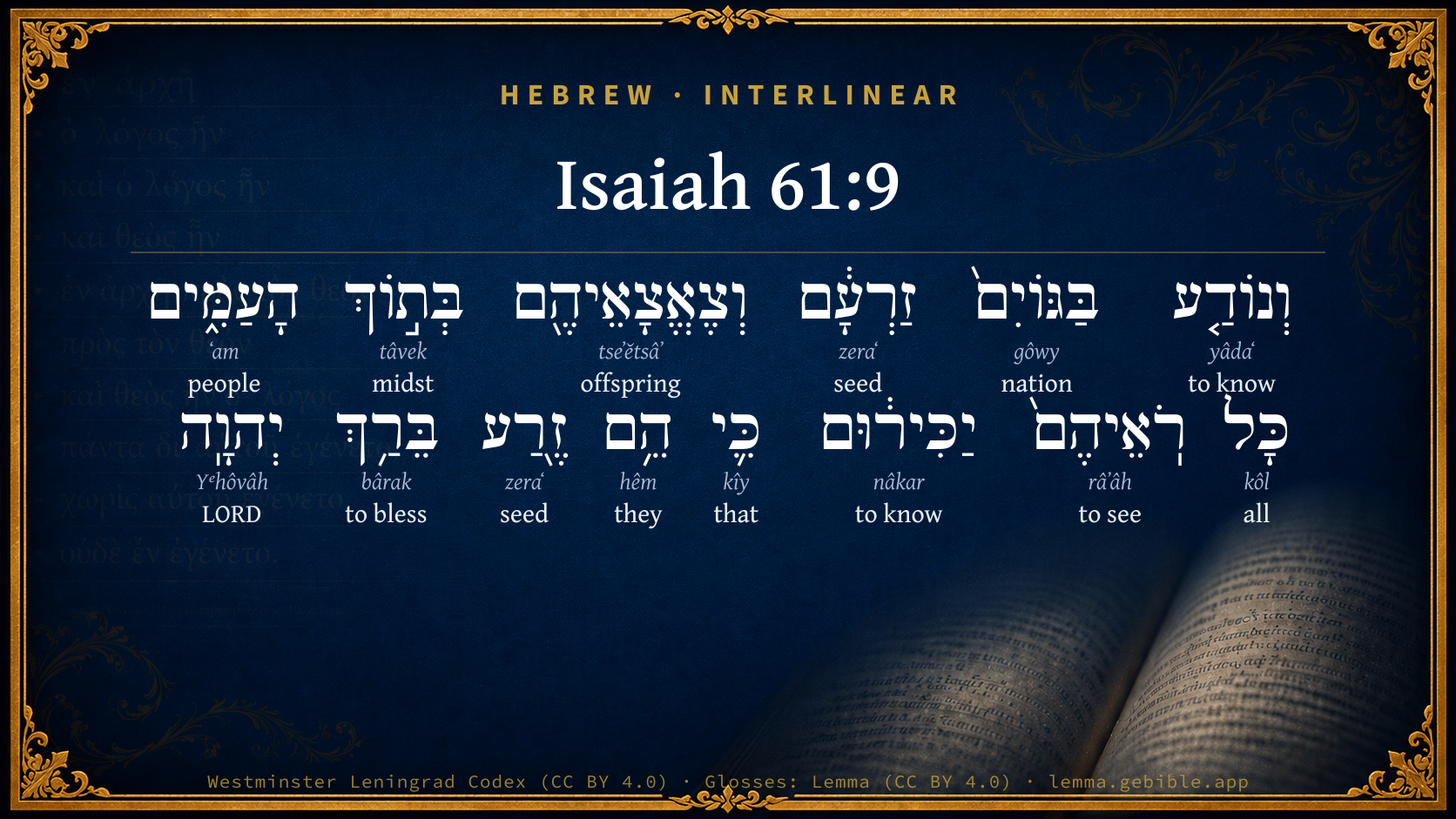
Hebrew (Westminster Leningrad Codex) Isaiah 61:9 appears in the Hebrew Old Testament. The text above is from the Westminster Leningrad Codex. Each word links to its Strong’s number, a concise gloss, and parsing drawn from the Open Scriptures Hebrew Bible morphology. Click any word for its full Brown-Driver-Briggs (BDB) entry.
Download image
Cite this verse

Isaiah 61:9 (World English Bible). Public Domain. Lemma interlinear Bible study tool, https://lemma.gebible.app/v/isaiah/61/9.

Show BibTeX & RIS
BibTeX
RIS
English Translation
Their seed shall be known among the nations, and their offspring among the peoples; all who see them shall acknowledge them, that they are the seed which Yahweh has blessed.
World English Bible · Public Domain
Download a study sheet

One document with this verse’s original text, its word-by-word gloss line, the meaning frame, cross-references with their text, attributed commentary, and full source and license credits — printable, and it pastes into notes with its structure intact.

This verse Autodidact and up

Study sheet (.html) Plain text (.txt)

A passage Seminary Student

Up to 50 verses in one chapter. A passage sheet keeps up to 6 commentary sources and 12 cross-references per verse, in the order this page ranks them, and says so on the sheet whenever that leaves anything out. Ask for a single verse and you get the Autodidact verse sheet above.

Everything on this page stays free to read, with no account — the sheet is a download of what is already on screen, not access to it.

Want to remove ads? Support Godless Engineer
Compare translations 3

The same verse in 3 English versions, stacked beneath the original-language interlinear above. Click any original word for its lexicon entry.

Each is an independent rendering of the whole verse — the interlinear is not word-aligned to these translations.

Highlighted words mark where these versions differ — a whole-verse word diff, not a word-by-word alignment.

  • World English Bible Public Domain
    Their seed shall be known among the nations, and their offspring among the peoples; all who see them shall acknowledge them, that they are the seed which Yahweh has blessed.
  • King James Version Public Domain
    And their seed shall be known among the Gentiles, and their offspring among the people: all that see them shall acknowledge them, that they are the seed which the LORD hath blessed.
  • unfoldingWord Literal Text CC BY-SA 4.0
    And their seed will be known among the nations, and their offspring, in the midst of the peoples. All the ones seeing them will recognize them, that they seed Yahweh has blessed.” q1

unfoldingWord Literal Text — © unfoldingWord, licensed CC BY-SA 4.0. Word-aligned USFM3 via Door43 (git.door43.org/unfoldingWord/en_ult).

Versions to compare (up to 4)

3 of 4 selected

Show all 18 translations

Every available English version of this verse, each an independent rendering of the whole verse.

  • World English Bible Public Domain
    Their seed shall be known among the nations, and their offspring among the peoples; all who see them shall acknowledge them, that they are the seed which Yahweh has blessed.
  • Berean Standard Bible Public Domain
    Their descendants will be known among the nations, and their offspring among the peoples. All who see them will acknowledge that they are a people the LORD has blessed.
  • Majority Standard Bible Public Domain
    Their descendants will be known among the nations, and their offspring among the peoples. All who see them will acknowledge that they are a people the LORD has blessed.
  • King James Version Public Domain
    And their seed shall be known among the Gentiles, and their offspring among the people: all that see them shall acknowledge them, that they are the seed which the LORD hath blessed.
  • American Standard Version (1901) Public Domain
    And their seed shall be known among the nations, and their offspring among the peoples; all that see them shall acknowledge them, that they are the seed which Jehovah hath blessed.
  • Revised Version (1885) Public Domain
    And their seed shall be known among the nations, and their offspring among the peoples: all that see them shall acknowledge them, that they are the seed which the LORD hath blessed.
  • Geneva Bible (1599) Public Domain
    And their seede shall be knowen among the Gentiles, and their buddes among the people. All that see them, shall know them, that they are the seede which the Lord hath blessed.
  • Douay-Rheims (1899) Public Domain
    And they shall know their seed among the Gentiles, and their offspring in the midst of peoples: all that shall see them, shall know them, that these are the seed which the Lord hath blessed.
  • Young's Literal Translation Public Domain
    And known among nations hath been their seed, And their offspring in the midst of the peoples, All their beholders acknowledge them, For they `are' a seed Jehovah hath blessed.
  • Literal Standard Version CC BY-SA 4.0
    And their seed has been known among the nations, || And their offspring in the midst of the peoples, || All their beholders acknowledge them, || For they [are] a seed YHWH has blessed.”
  • Unlocked Literal Bible CC BY-SA 4.0
    Their descendants will be known among the nations, and their offspring among the peoples. All who see them will acknowledge them, that they are the people whom Yahweh has blessed.
  • unfoldingWord Literal Text CC BY-SA 4.0
    And their seed will be known among the nations, and their offspring, in the midst of the peoples. All the ones seeing them will recognize them, that they seed Yahweh has blessed.” q1
  • Darby Bible Public Domain
    And their seed shall be known among the nations, and their offspring among the peoples: all that see them shall acknowledge them, that they are a seed that Jehovah hath blessed.
  • World Messianic Bible Public Domain
    Their offspring will be known among the nations, and their offspring among the peoples. All who see them will acknowledge them, that they are the offspring which the LORD has blessed.”
  • Webster's Bible Public Domain
    And their seed shall be known among the Gentiles, and their offspring among the people: all that see them shall acknowledge them, that they are the seed which the LORD hath blessed.
  • Free Bible Version CC BY-SA 4.0
    Their descendants will be acknowledged among the nations, and their children among the peoples. Everyone who sees them will agree that they are people that the Lord has blessed.
  • Bible in Basic English Public Domain
    And their seed will be noted among the nations, and their offspring among the peoples: it will be clear to all who see them that they are the seed to which the Lord has given his blessing.
  • JPS Tanakh (1917) Public Domain
    And their seed shall be known among the nations, and their offspring among the peoples; all that see them shall acknowledge them, that they are the seed which the LORD hath blessed.

Literal Standard Version (2020), Covenant Press — licensed CC BY-SA 4.0. Text via the HelloAO Bible API (eBible.org). Unlocked Literal Bible (unfoldingWord) — licensed CC BY-SA 4.0. Text via the HelloAO Bible API (eBible.org). unfoldingWord Literal Text — © unfoldingWord, licensed CC BY-SA 4.0. Word-aligned USFM3 via Door43 (git.door43.org/unfoldingWord/en_ult). Free Bible Version, Dr. Jonathan Gallagher — licensed CC BY-SA 4.0. Text via the HelloAO Bible API (eBible.org).

Word by word

More ways to search: Search by grammar → Find every occurrence → Compare this word →

Practice this passage: Drill this verse → Learn its vocabulary →

וְצֶאֱצָאֵיהֶ֖ם
tseʼĕtsâʼ
H6631
“and · offspring · their”
Conjunction + Noun, Common, Masculine, Plural, Construct + Suffix, Personal, 3rd Person, Masculine, Plural
Part of Speech
Conjunction + Noun
Type
Common
Gender
Masculine
Number
Plural
State
Construct
Full BDB Definition

Origin: from H3318

TWOT: 893b

offspring, produce, issue - offspring (of men) - produce (of earth) - descendants (metaphorical)
  1. וְנוֹדַ֤ע yâdaʻ H3045 “and · to know” Conjunction + Verb, Niphal, Sequential Perfect, 3rd Person, Masculine, Singular
  2. בַּגּוֹיִם֙ gôwy H1471 “in/at the · nations” Preposition, Determined + Noun, Common, Masculine, Plural, Absolute
  3. זַרְעָ֔ם zeraʻ H2233 “seed · their” Noun, Common, Masculine, Singular, Construct + Suffix, Personal, 3rd Person, Masculine, Plural
  4. בְּת֣וֹךְ tâvek H8432 “in/at · midst of” Preposition + Noun, Common, Masculine, Singular, Construct
  5. הָעַמִּ֑ים ʻam H5971 “the · peoples” Particle, Definite Article + Noun, Common, Masculine, Plural, Absolute
  6. כָּל kôl H3605 “all of” Noun, Common, Masculine, Singular, Construct
  7. רֹֽאֵיהֶם֙ râʼâh H7200 “seeing · them” Verb, Qal, Participle Active, Masculine, Plural, Construct + Suffix, Personal, 3rd Person, Masculine, Plural
  8. יַכִּיר֔וּם nâkar H5234 “to know · them” Verb, Hiphil, Imperfect, 3rd Person, Masculine, Plural + Suffix, Personal, 3rd Person, Masculine, Plural
  9. כִּ֛י kîy H3588 “that” Conjunction
  10. הֵ֥ם hêm H1992 “they” Pronoun, Personal, 3rd Person, Masculine, Plural
  11. זֶ֖רַע zeraʻ H2233 “seed” Noun, Common, Masculine, Singular, Absolute
  12. בֵּרַ֥ךְ bârak H1288 “to bless” Verb, Piel, Perfect, 3rd Person, Masculine, Singular
  13. יְהוָֽה Yᵉhôvâh H3068 “LORD” Noun, Proper

About this verse

These counts appear in no published source. They are computed here, from the morphology-tagged text and Lemma’s own curated glosses. What Lemma adds →

14
words
13
distinct lemmas
Prophets
section

Notable vocabulary

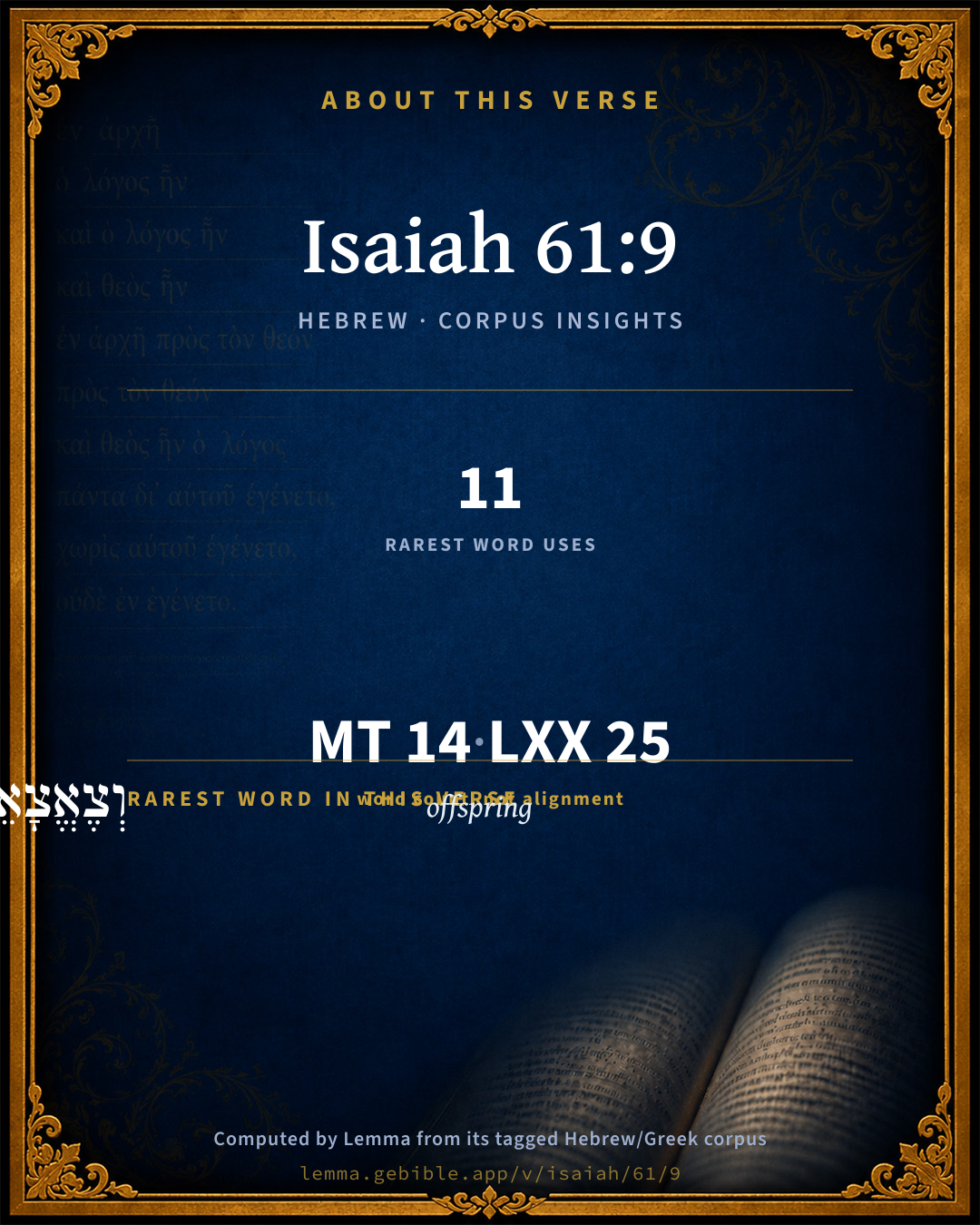
The rarest word here is וְצֶאֱצָאֵיהֶ֖ם offspring H6631 — appearing just 11 times in the whole Hebrew Bible.

Shared distinctive vocabulary

וְצֶאֱצָאֵיהֶ֖ם offspring H6631 occurs in 11 verses of the Hebrew Bible. Also found in:

Grammatical profile

  • 4 verbs
  • 8 nouns
  • 1 pronoun
  • 1 conjunction

Verb forms

  • וְנוֹדַ֤ע Niphal · Sequential Perfect
  • רֹֽאֵיהֶם֙ Qal · Participle Active
  • יַכִּיר֔וּם Hiphil · Imperfect
  • בֵּרַ֥ךְ Piel · Perfect

Repetition

A word recurs within this verse — often emphatic in Hebrew:

  • זַרְעָ֔ם seed H2233 ×2

Hebrew & Septuagint length

In English translation the verse runs 30 words from the Hebrew and 35 from the Septuagint (LXX English) — closely comparable.

A rough comparison of the two English renderings, which tokenize alike — not a word-level alignment.

Word counts can differ between the Hebrew and the Greek without any difference in meaning — e.g. the Hebrew direct-object marker אֵת has no separate Greek word, and Greek often adds the article ὁ.

In the original languages it is 14 Hebrew tokens and 25 Greek tokens — but the two are counted differently (Hebrew bundles its prefixes and suffixes into one token; the Greek is in lemma form), so that isn’t a like-for-like length.

Cross-references

7

Topical passages linked to Isaiah 61:9 in the Treasury of Scripture Knowledge — connected by theme and wording, ordered by reader-vote popularity; previews shown in the World English Bible.

  • Isaiah 44:3 For I will pour water on him who is thirsty, and streams on the dry ground; I will pour my Spirit on your seed, and my blessing on your offspring:
  • Psalms 115:14 May Yahweh increase you more and more, You and your children.
  • Genesis 22:18 In your seed will all the nations of the earth be blessed, because you have obeyed my voice."
  • Acts 3:26 God, having raised up his servant, Jesus, sent him to you first, to bless you, in turning away everyone of you from your wickedness."
  • Isaiah 65:23 They shall not labor in vain, nor bring forth for calamity; for they are the seed of the blessed of Yahweh, and their offspring with them.
  • Zechariah 8:13 It shall come to pass that, as you were a curse among the nations, house of Judah and house of Israel, so will I save you, and you shall be a blessing. Don't be afraid. Let your hands be strong."
  • Romans 9:3–4 For I could wish that I myself were accursed from Christ for my brothers' sake, my relatives according to the flesh,

Cross-references courtesy of OpenBible.info (CC BY 4.0).

Hebrew and Greek witnesses Masoretic Hebrew ↔ Greek Septuagint

The same verse in the two great witnesses to the Old Testament, shown verse-for-verse.

These are two independent witnesses, not word-aligned to each other, and the Septuagint is shown in lemma (dictionary) form.

Hebrew Isaiah 61:9 Masoretic · Westminster Leningrad Codex

וְנוֹדַ֤ע בַּגּוֹיִם֙ זַרְעָ֔ם וְצֶאֱצָאֵיהֶ֖ם בְּת֣וֹךְ הָעַמִּ֑ים כָּל רֹֽאֵיהֶם֙ יַכִּיר֔וּם כִּ֛י הֵ֥ם זֶ֖רַע בֵּרַ֥ךְ יְהוָֽה

Their seed shall be known among the nations, and their offspring among the peoples; all who see them shall acknowledge them, that they are the seed which Yahweh has blessed.

World English Bible · Public Domain

Greek LXX Isaiah 61:9 Septuagint · lemma form

καί γιγνώσκω ἐν ὁ ἔθνος ὁ σπέρμα αὐτός καί ὁ ἔκγονος αὐτός πᾶς ὁ ὅρος αὐτός ἐπιγιγνώσκω αὐτός ὅτι οὗτος εἰμί σπέρμα εὐλογέω ὑπό θεός

And their seed shall be known among the Gentiles, and their offspring in the midst of peoples: every one that sees them shall take notice of them, that they are a seed blessed of God;

LXX2012 (modern English Septuagint) · Public Domain

Hebrew: Westminster Leningrad Codex (CC BY 4.0). Greek: Septuagint (public domain); English from LXX2012 (modern English Septuagint) (Public Domain). How the Septuagint differs from the Hebrew →

Targum (Aramaic paraphrase)

1

The Targum is the ancient Jewish Aramaic paraphrase of the Hebrew Scriptures — an interpretive translation, not the Hebrew text itself. Onkelos (literal) and Pseudo-Jonathan (expansive) render the Torah, and Jonathan the Prophets. Coverage is partial: where no permissively-licensed English translation exists for a verse, only the Aramaic is shown. This is verse-level text, not a word-by-word alignment to the Hebrew.

  1. Targum Jonathan Prophets (Joshua–Malachi)
    וְיִתְרַבּוּן בְּעַמְמַיָא בְנֵיהוֹן וּבְּנֵי בְנֵיהוֹן בְּגוֹ מַלְכְּוָתָא כָּל חֶזְאֵיהוֹן יִשְׁתְּמוֹדְעִינוּן אֲרֵי אִינוּן זַרְעָא דְבָרְכֵהּ יְיָ:

    And their sons shall be magnified amongst the nations, and their sons' sons amongst the kingdoms: all that see them shall acknowledge them, that they are the seed which the Lord has blessed.

    Targum Jonathan — Aramaic: “Mikraot Gedolot” (public domain). English: “Sefaria Community Translation” (CC0 1.0 (public-domain dedication)); “London "Chaldee Paraphrase," 1871” (public domain). Text via Sefaria.

Commentary

Notes on Isaiah 61:9 from classic Christian and Jewish commentators (each source and its license shown beneath its notes). The classic Christian expositions comment on the surrounding passage and are grouped to its opening verse, so a note may address several verses; the Jewish commentaries on the Tanakh (Rashi and others) are per-verse, so they appear only where the commentator wrote on this verse.

Lemma curates 59 commentaries, every one of them public domain or Creative Commons licensed, each selected and text-cleaned for this edition rather than reprinted as found. About our sources →

Trapp's Complete Commentary

John Trapp

Isa 61:9 And their seed shall be known among the Gentiles, and their offspring among the people: all that see them shall acknowledge them, that they [are] the seed [which] the LORD hath blessed.

Ver. 9. And their seed shall be known among the Gentiles,] i.e., Shall be noted and noticed for eximious and exemplary: non aliunde noscibiles quam ex vitae emendatione, {a} as it was said of the primitive Christians, famous among the very heathens for their holy conversation. Pliny giveth a very honourable testimony of their innocence in his second epistle to Trajan. Those that stood with the Lamb had his Father’s name in their foreheads; {Rev 14:1} they led convincing lives, so that their friends could never sufficiently praise them, nor their foes justly find any fault with them. Such a one was Luther, Bucer, Bradford, &c. Christians should shine as lamps, show forth the power of godliness in their whole practice, do more than others possibly can do, {Mat 5:47} that all may see and say, "These are the seed that the Lord hath blessed," these are his darlings, his earthly angels. What a shame was it to those flagitious Jews that it should be asked, "Are these the people of Jehovah?" {Eze 36:20} And the like to profligate professors, that Papists should say, Are these your new gospellers? For certain, said one, {a} when he had read Christ’s sermon in the mount, either this is not gospel, or we are not right gospellers.

{a} Tertul. ad Scapul.

{b} Linaker.

John Trapp, A Commentary or Exposition upon All the Books of the Old and New Testament (1647–1656) — public domain. Text from a community e-Sword module.

The Biblical Illustrator

Joseph S. Exell

Isa_61:9

And their seed shall be known among the Gentiles

A blessed seed

The children of these persons themselves, that are now the blessed of the Lord, or their successors in profession, the Churchs seed, shall be accounted to the Lord for a generation (Psa_22:30).

1. They shall signalize themselves, and make their neighbours to take notice of them. They shall distinguish themselves by the gravity, seriousness, humility, and cheerfulness of their conversation, especially by that brotherly love by which all men shall know them to be Christs disciples; and they thus distinguishing themselves, God shall dignify them by making then the blessings of their age, and instruments of His glory; and by giving to remarkable tokens of His favour, which shall make them eminent, and go them respect from all about them.

2. God shall have the glory of this, for eve:. one shall attribute it to the blessing of God. (M. Henry.)

The life-testimony of the Christian missionary

The glorious fulfilment of this promise in its original and proper sense may be seen already in the influence exerted by the eloquent example of the missionary on the most ignorant and corrupted heathen, without waiting for the future restoration of the Jews to the land of their fathers. (J. A. Alexander.)

The seed which the Lord hath blessed

The blessed seed

I. THERE IS A SEED OR RACE WHICH THE LORD HATH BLESSED. Elsewhere it is described as the Israel of God (Gal_6:16). But it is neither co-extensive with, nor confined to, the descendants of Jacob (Rom_9:6 - Gal_3:28; Gal_4:28; Eph_3:6; Php_3:3). This seed God hath blessed abundantly.

1. With peace.

2. With purity.

3. With strength.

4. With hope.

5. With joy.

6. With that which is the source of the peace and hope and joy--an assurance of HIS love.

II. THERE ARE OUTWARD SIGNS BY WHICH THOSE WHO BELONG TO THE SEED WHICH THE LORD HATH BLESSED MAY BE INFALLIBLY KNOWN. God has distinguished HIS ancient people by certain physical characteristics which have survived through many generations and have proved indestructible by all changes of climate and condition, so that wherever any of them are found we may say with confidence, these are the children of Abraham. And there are certain marks by which all who belong to Gods spiritual Israel are as clearly marked off from their fellow-men. Such as--

1. Love for Christ.

2. Unworldiness.

3. Consistency. (J. Harris, M. A.)

The Biblical Illustrator, edited by Joseph S. Exell (c. 1880s–1900s) — public domain. Text from a community e-Sword module.

The Preacher's Complete Homiletical Commentary

Joseph S. Exell (gen. ed.)

THE BLESSED SEED

Isa_61:9. All that see them shall acknowledge them, that they are the seed which the Lord hath blessed.

I. There is a “seed” or race, “which the Lord hath blessed.” Elsewhere it is described as “the Israel of God” (Gal_6:16). But it is neither co-extensive with nor confined to the descendants of Jacob (Rom_9:6-8; Gal_4:28; Gal_3:28; Eph_3:6; Php_3:3).

1. This seed God hath blessed abundantly—with peace. Peace with God (Rom_5:1). Peace of conscience (Heb_10:2; Heb_10:22). Peace from the assaults of their enemies (Luk_1:74). Peace amid the cares of life (Php_4:6-7). Thus there is a glorious fulfilment of the promise (Psa_29:11).

2. With purity (1Jn_1:7-9; 1Th_5:23).

3. With strength (Joh_1:12; Col_1:11).

4. With hope (Rom_15:13; 1Pe_1:3).

5. With joy (1Pe_1:8; Rom_5:11).

6. With that which is the source and fountain of the peace, and hope, and joy—an assurance of His love (Rom_5:5; Rom_8:16). Are these blessings yours? Are you numbered among “the Israel of God”?

II. The blessings which God confers upon His people are chiefly in ward, but our text teaches us also, that there are outward signs by which those who belong to “the seed which the Lord hath blessed” may be infallibly known. “All that see them shall acknowledge,” &c. God has distinguished His ancient people by certain physical characteristics, which have survived through many generations, and have proved indestructible by all changes of climate and condition; so that wherever any of them are found we may say with confidence, these are the children of Abraham. They differ greatly from each other, and yet they preserve a family likeness by which they are unmistakably distinguished from all the rest of the human race. And there are certain marks by which all who belong to God’s spiritual Israel are as clearly marked off from their fellow-men. Such as—

1. Love for Christ. It is one undeniable and never-failing characteristic of the believer that he loves Jesus Christ in sincerity. His love for Christ will show itself in various ways—in an earnest endeavour to keep His commandments; in a cheerful submission to all His appointments; in self-sacrificing labour to extend His kingdom and promote His glory.

2. Unworldliness. The Christian is in the world, not of it.

3. Consistency. The conformity of his life to the principles he professes. Do these marks distinguish you? Let it be your daily prayer and endeavour that they may become more manifest in you.—James Harris, M.A.; Thursday Penny Pulpit, vol. vii. pp. 373–384.

Isa_61:10. I. The believer’s boast. II. Determination.—Dr. Lyth.

The Preacher's Complete Homiletical Commentary (gen. ed. Joseph S. Exell; Funk & Wagnalls, c. 1892) — public domain (pre-1929). A full-Bible homiletical/sermon-outline anthology covering 65 of 66 books (2 John is absent from the source module). Text from a community e-Sword module.

Tyndale Open Study Notes

Tyndale Open Resources

61:9 Their descendants: The covenant will be effective from generation to generation. • The Lord has blessed them in fulfillment of his promise to Abraham (Gen 12:1-2; see Isa 65:23).

Tyndale Open Study Notes — © Tyndale Open Resources, licensed CC BY-SA 4.0. Text via the HelloAO Bible API.

Geneva Bible (1599)

Geneva Bible translators

That is, of the Church.

Geneva Bible (1599) marginal notes — public domain. Text via Bolls.life.

Jamieson, Fausset & Brown

Robert Jamieson, A. R. Fausset & David Brown

known--honorably; shall be illustrious (Psa 67:2).

people--rather, "peoples."

seed . . . blessed-- (Isa 65:23).

Jamieson, Fausset & Brown — Commentary Critical and Explanatory on the Whole Bible (1871) — public domain (CC PDM 1.0). Text via the HelloAO Bible API.

Adam Clarke's Commentary

Verse 9. Their seed shall be known among the Gentiles] Both Jews and Gentiles are to make but one fold under one shepherd, Christ Jesus. But still, notwithstanding this, they may retain their peculiarity and national distinction; so that though they are known to be Christians, yet they shall appear to be converted Jews. After their conversion to Christianity this will necessarily be the case for a long time. Strange nations are not so speedily amalgamated, as to lose their peculiar cast of features, and other national distinctions.

Adam Clarke's Commentary on the Bible (1810–1826) — public domain. Text from a community e-Sword/MySword module.

Ellicott's Commentary for English Readers

(9) Their seed shall be known—i.e., as in Pro_31:23, shall be “renowned,” or “honourably recognised,” even by the heathen, as the people whom Jehovah hath blessed. (Comp. Isa_65:23.)

A Bible Commentary for English Readers, edited by Charles John Ellicott (1878–1897) — public domain. Text from a community e-Sword module.

The Cambridge Bible for Schools and Colleges

gen. ed. J. J. S. Perowne

9. In virtue of this everlasting covenant the blessing of Jehovah descends on their offspring (cf. ch. Isa_65:23), compelling the admiration of the world.

For Gentiles … people render with R.V., nations … peoples.

The Cambridge Bible for Schools and Colleges (gen. ed. J. J. S. Perowne; Cambridge University Press, 1878–1918) — public domain. Text from a community e-Sword module.

John Gill's Exposition

And their seed shall be known among the Gentiles, and their offspring among the people,.... Not only the Jews will be converted as a body in the latter day, but there will be a succession of converts among them in later ages, and will be known among Christian Gentiles by their faith and love, and good works and holy conversation; and will be taken notice of and acknowledged by them as brethren, and will be famous among them for religion and godliness:

all that see them shall acknowledge them, that they are the seed which the Lord hath blessed; that they are the spiritual seed of Abraham, as well as his carnal seed, and are blessed with him; blessed with all spiritual blessings in Christ, with faith in him, and with every other grace.

John Gill's Exposition of the Whole Bible (1746–1763) — public domain (CC PDM 1.0). Text via the HelloAO Bible API.

Albert Barnes' Notes on the Bible

And their seed - The figure here is taken from the feelings of a parent who desires his children to be esteemed, and who regards it as an honor that they become so distinguished that their fame extends to distant lands.

Shall be known - Shall be distinguished or honored. For this use of the word ‘known,’ see Psa 67:2; Psa 76:1; Psa 79:10.

And their offspring - (See the notes at Isa 48:19). The Chaldee and the Syriac render this, ‘Their children’s children.’ The sense is, that the true friends of the church shall be everywhere honored. Distant lands shall be acquainted with them, and shall be disposed to show them distinguished respect.

Among the people - The people of distant lands.

All that see them shall acknowledge them - The time shall come when the true friends of the Redeemer will be universally honored. They shall be regarded as the favored of the Lord; and instead of being persecuted and despised, the nations of the earth will regard them as worthy of their confidence and esteem.

Albert Barnes' Notes on the Bible (1834–1885) — public domain. Text from a community e-Sword/MySword module.

Haydock's Catholic Bible Commentary

Blessed. The Jews are visibly the reverse. The Church flourishes in spite of domestic and foreign enemies.

George Leo Haydock (1774–1849), Haydock's Catholic Family Bible and Commentary, 1859 edition — public domain. Excludes Psalms (Douay-Rheims chapter numbering differs from Protestant) and Deuterocanonical books (Catholic canon only).

Matthew Poole's English Annotations

Their seed shall be known among the Gentiles i.e. eminently; a promise of the increase of the church; such shall be their prosperity and multiplying, that they shall be known abroad by their great increase. Or else the meaning is, The church shall have a seed of the Gentiles, the borders of the church shall be enlarged; whereas it hath been confined as it were to one corner of the world, now it shall remain in one nation alone no more, but shall fill all the nations of the earth.

They are the seed which the Lord hath blessed; they shall be known to be the seed of Abraham, partly by their holy conversation, and partly by their exceeding blessings, it being the seed that the Lord had so often promised to bless. There shall be such visible characters of God’s love to them, and of God’s grace in them.

Matthew Poole's English Annotations on the Holy Bible (1683–1685) — public domain. Text from a community e-Sword/MySword module.

Whedon's Commentary on the Bible

Daniel D. Whedon

9. Their seed shall be known — Their posterity shall “be known” as a people divinely beloved; and that, too, among peoples once their oppressors.

Daniel D. Whedon (gen. ed.), Commentary on the Old and New Testaments (1874–1909) — public domain. Text from a community e-Sword module.

The Pulpit Commentary

Their seed shall be known; or, shall be illustrious (Lowth), renowned (Cheyne). A halo of renown still, in the eyes of many, attaches to Jewish descent. Among the people; rather, among the peoples. The seed which the Lord hath blessed; rather, a seed. The blessing has passed in the main to "the Israel of God". (Gal_6:16)

Blessed children.

"All that see them shall acknowledge them, that they are the seed which the Lord hath blessed." "Let the children of godly parents live in such a manner that they may be known to be such, that all who observe them may see in them the fruits of a good education, and an answer to the prayers that were put up for them." "Easterns value highly the retention of blessings through succeeding generations." Abraham, as the first father of the race, may be taken as the type of all fathers and mothers. Then the course of thought may be this

I THE PIOUS PATERNAL CHARACTER. As seen in Abraham, it includes:

1. Reverence. A due sense of the "unseen" is the secret of the sense of duty which lies at the basis of all real authority.

2. Uprightness. Which gives a certain firmness, almost sternness, which ensures a blended fear and confidence.

3. Obedience. A man"s own response to his sonship with God is the secret of his power to command the obedience of his children.

II THE SECURITY PATERNAL CHARACTER AFFORDS THAT FAMILIES WILL BE RULED. There is a strange idea entertained, that there is no strong rule in fatherhood. But every home must have its laws. The mightiest men of earth are not the giants with the big fists. The Davids of intellectual, moral, and emotional force are grander than all Sauls who stand heads above their fellows. The highest power of influence attends on character. Put a man of good character anywhere, and he proves to be a king; he rules. There is a natural authority belonging to parentage. This is not enough. It can he kept into the manhood of the children only as parents gain the higher power of moral character.

III THE RESULT OF GOOD RULING IS THAT THE CHILDREN TURN OUT WELL. How we dream over the future of our children! We may leave it all with God, if we are culturing ourselves into Christ-likeness, and watchfully anxious that this our Christ-likeness should shine well on them. But what do we mean by "our children turning out well"? Does that mean proving talented," marrying prudently," winning business successes? Or do we mean keeping well in the ways of the Lord, whatever may be their circumstances, and whatever may be their relations?

IV THROUGH GOOD PARENTS AND GOOD FAMILIES GOD"S PURPOSES IN THE WORLD ARE ACCOMPLISHED. Compare Dr. Horace Bushnell"s very striking expression, "The out-populating of the Christian stock." As are the families so will be the nation. We trust in virtuous homes, well-ruled families, godly fathers, and pious mothers. Blessed indeed are those children who grow up constrained to goodness by the example, influence, and authority of godly parents! R.T.

The Pulpit Commentary (1880–1919), ed. H.D.M. Spence-Jones & Joseph S. Exell — public domain. Text from a community e-Sword module.

John Wesley's Explanatory Notes

Shall be - That is, eminently a promise of the increase of the church; such shall be their prosperity, and multiplying, that they shall be known abroad by their great increase; or else, the meaning is, the church shall have a seed of the Gentiles, whereas the church has been confined to one corner of the world, now it shall remain in one nation alone no more, but shall fill all the nations of the earth. Hath blessed - There shall be such visible characters of God's love to them, and of God's grace in them.

John Wesley, Explanatory Notes Upon the Whole Bible (1754–1765) — public domain. Text via the GEBible commentary corpus.

J. A. Alexander on Isaiah

Joseph Addison Alexander

“Then shall be known among the nations their seed, and their issue in the midst of the peoples. All seeing them shall acknowledge them, that they are a seed Jehovah has blessed.” The first clause means that they shall be known among the nations in their true character as a seed or race highly favored of Jehovah. Issue means progeny or offspring, as in Isa 48:19. In order to apply this to the restored Jews, we must depart from the literal and obvious import of ‘among’ and ‘in the midst’, and understand them as denoting merely that they shall be heard of; for how can they be said to be among and in the midst of the nations at the very time when they are gathered from them to their own land. And yet the whole connection seems to favor the first meaning, and to show that they are here described as being scattered through the nations, and there recognized by clear distinctive marks as being God’s peculiar people, just as the Jews took knowledge of Peter and John that they had been with Jesus (Act 4:13). The later writers liken the construction to that in Gen 1:4, ‘God saw the light that it was good’; not simply saw that the light was good, but saw the light itself, and in so doing saw that it was good. So here the meaning is not merely that all seeing them shall acknowledge that they are a seed, etc., but that all seeing them shall recognize them, by recognizing the effects and evidences of the divine blessing. The ellipsis of the relative is the same in Hebrew and colloquial English. The true application of the verse is to the Israel of God in its diffusion among all the nations of the earth, who shall be constrained by what they see of their spirit, character, and conduct, to acknowledge that they are the seed which the Lord hath blessed. The glorious fulfillment of this promise in its original and proper sense, may be seen already in the influence exerted by the eloquent example of the missionary on the most ignorant and corrupted heathen, without waiting for the future restoration of the Jews to the land of their fathers.

Joseph Addison Alexander, The Prophecies of Isaiah (1846–1847; New York: Scribner, 1870–1878) — public domain. Text from a community e-Sword module.

Ibn Ezra

Rabbi Abraham ibn Ezra

And their seed shall be known. This prediction does not imply that Israel will again be scattered among the nations, but that they will be known among the nations, who will come up to the holy land to celebrate the feast of Tabernacles (comp. Zec. 14:16), and among them that will bring the tribute.

Ibn Ezra on the Tanakh — English translations: “Sefaria Community Translation” (CC0 1.0 (public-domain dedication)); “Yalkut, Sifsei Chachomim Chumash, Metsudah Publications, 2009” (CC BY 4.0); and “Commentary of Ibn Ezra on Isaiah - trans. by M. Friedlander, 1873” (public domain). Text via Sefaria.

Lesson kit

Teaching starters — assembled from the data on this page, not authored interpretation. Every prompt links to the verse data it draws on. Edit before teaching.

Isaiah, in the Prophets, opens this verse with 14 words (13 distinct Hebrew lemmas). Its most distinctive word is tseʼĕtsâʼ (“offspring”). A historical commentator’s framing appears above. Read the whole chapter for the surrounding context.

Discussion questions

  1. The word tseʼĕtsâʼ carries the sense “offspring.” How does it shape the verse?
  2. How does Job 5:25, which shares the word «offspring», read alongside this verse?
  3. What does the repetition of “seed” (2× in this one verse) do in this verse?
  4. These translations render this verse differently. What is at stake in choosing one wording over another?
  5. «וְנוֹדַ֤ע» is a Niphal Sequential Perfect verb. How does that grammatical form shape the action described?
  6. Compare how Trapp's Complete Commentary and The Biblical Illustrator read this verse. Where do they agree or differ?

Things to notice

Reading settings

Reading text

Shown beneath each verse's original-language words.

Old Testament
Old Testament edition

Read the OT as the Masoretic Hebrew (MT) or the Greek Septuagint (LXX).

English shown for the Greek Septuagint (in the Hebrew ↔ Greek comparison).

Comparing translations? Open the Compare panel on any verse page to stack up to four side by side.