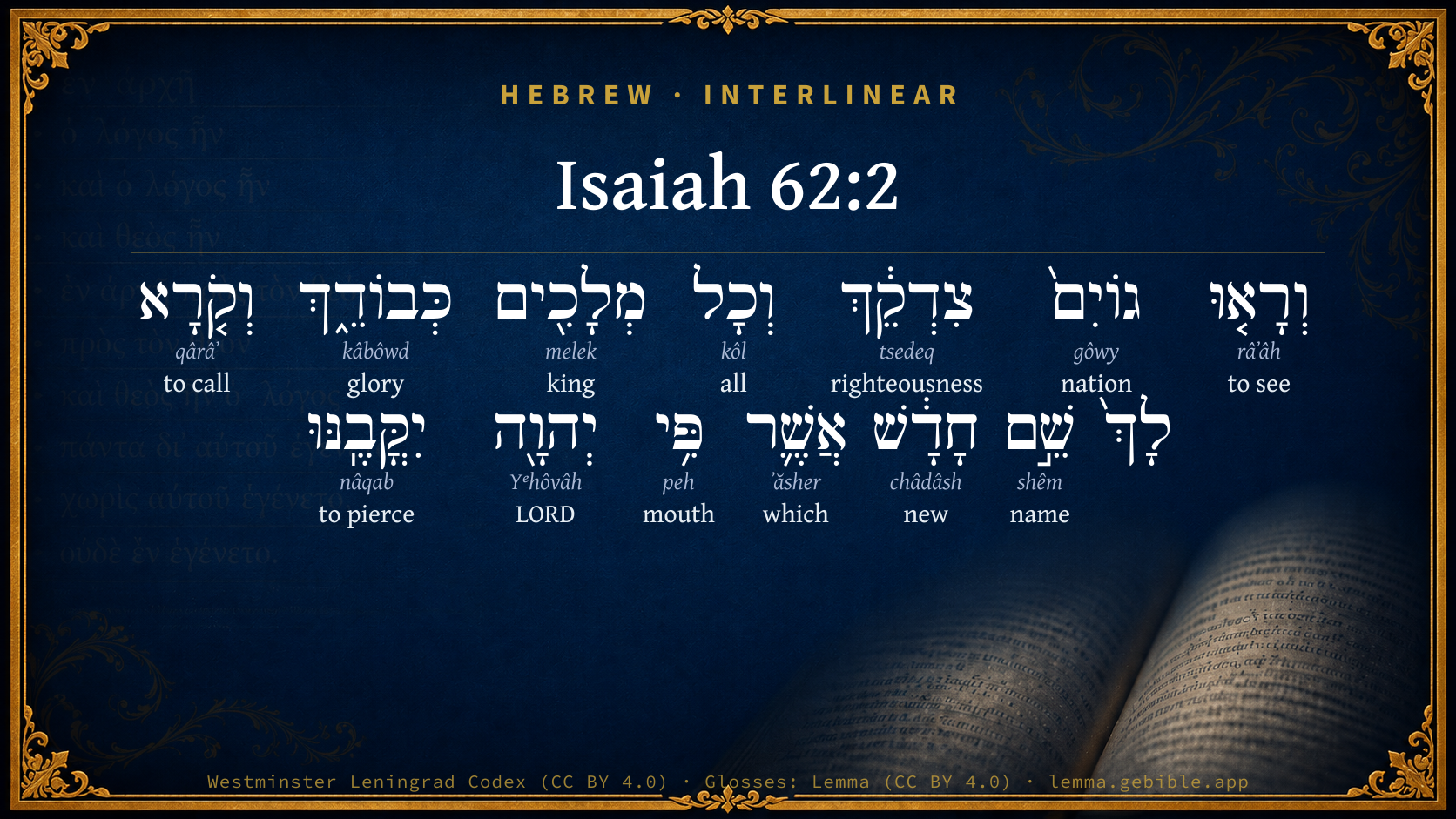
Isaiah 62:2

Hebrew (Westminster Leningrad Codex) Isaiah 62:2 appears in the Hebrew Old Testament. The text above is from the Westminster Leningrad Codex. Each word links to its Strong’s number, a concise gloss, and parsing drawn from the Open Scriptures Hebrew Bible morphology. Click any word for its full Brown-Driver-Briggs (BDB) entry.
Download image
Cite this verse

Isaiah 62:2 (World English Bible). Public Domain. Lemma interlinear Bible study tool, https://lemma.gebible.app/v/isaiah/62/2.

Show BibTeX & RIS
BibTeX
RIS
English Translation
The nations shall see your righteousness, and all kings your glory, and you shall be called by a new name, which the mouth of Yahweh shall name.
World English Bible · Public Domain
Download a study sheet

One document with this verse’s original text, its word-by-word gloss line, the meaning frame, cross-references with their text, attributed commentary, and full source and license credits — printable, and it pastes into notes with its structure intact.

This verse Autodidact and up

Study sheet (.html) Plain text (.txt)

A passage Seminary Student

Up to 50 verses in one chapter. A passage sheet keeps up to 6 commentary sources and 12 cross-references per verse, in the order this page ranks them, and says so on the sheet whenever that leaves anything out. Ask for a single verse and you get the Autodidact verse sheet above.

Everything on this page stays free to read, with no account — the sheet is a download of what is already on screen, not access to it.

Want to remove ads? Support Godless Engineer
Compare translations 3

The same verse in 3 English versions, stacked beneath the original-language interlinear above. Click any original word for its lexicon entry.

Each is an independent rendering of the whole verse — the interlinear is not word-aligned to these translations.

Highlighted words mark where these versions differ — a whole-verse word diff, not a word-by-word alignment.

  • World English Bible Public Domain
    The nations shall see your righteousness, and all kings your glory, and you shall be called by a new name, which the mouth of Yahweh shall name.
  • King James Version Public Domain
    And the Gentiles shall see thy righteousness, and all kings thy glory: and thou shalt be called by a new name, which the mouth of the LORD shall name.
  • unfoldingWord Literal Text CC BY-SA 4.0
    And the nations will see your righteousness, and all of the kings, your glory, and one will call to you a new name that the mouth of Yahweh will designate.

unfoldingWord Literal Text — © unfoldingWord, licensed CC BY-SA 4.0. Word-aligned USFM3 via Door43 (git.door43.org/unfoldingWord/en_ult).

Versions to compare (up to 4)

3 of 4 selected

Show all 18 translations

Every available English version of this verse, each an independent rendering of the whole verse.

  • World English Bible Public Domain
    The nations shall see your righteousness, and all kings your glory, and you shall be called by a new name, which the mouth of Yahweh shall name.
  • Berean Standard Bible Public Domain
    Nations will see your righteousness, and all kings your glory. You will be called by a new name that the mouth of the LORD will bestow.
  • Majority Standard Bible Public Domain
    Nations will see your righteousness, and all kings your glory. You will be called by a new name that the mouth of the LORD will bestow.
  • King James Version Public Domain
    And the Gentiles shall see thy righteousness, and all kings thy glory: and thou shalt be called by a new name, which the mouth of the LORD shall name.
  • American Standard Version (1901) Public Domain
    And the nations shall see thy righteousness, and all kings thy glory, and thou shalt be called by a new name, which the mouth of Jehovah shall name.
  • Revised Version (1885) Public Domain
    And the nations shall see thy righteousness, and all kings thy glory: and thou shalt be called by a new name, which the mouth of the LORD shall name.
  • Geneva Bible (1599) Public Domain
    And the Gentiles shall see thy righteousnesse, and all Kings thy glory: and thou shalt be called by a new name, which the mouth of the Lord shall name.
  • Douay-Rheims (1899) Public Domain
    And the Gentiles shall see thy just one, and all kings thy glorious one: and thou shalt be called by a new name, which the mouth of the Lord shall name.
  • Young's Literal Translation Public Domain
    And nations have seen thy righteousness, And all kings thine honour, And He is giving to thee a new name, That the mouth of Jehovah doth define.
  • Literal Standard Version CC BY-SA 4.0
    And nations have seen your righteousness, || And all kings your glory, || And He is giving a new name to you, || That the mouth of YHWH defines.
  • Unlocked Literal Bible CC BY-SA 4.0
    The nations will see your righteousness, and all kings your glory. You will be called by a new name that Yahweh will choose.
  • unfoldingWord Literal Text CC BY-SA 4.0
    And the nations will see your righteousness, and all of the kings, your glory, and one will call to you a new name that the mouth of Yahweh will designate.
  • Darby Bible Public Domain
    And the nations shall see thy righteousness, and all kings thy glory; and thou shalt be called by a new name, which the mouth of Jehovah will name.
  • World Messianic Bible Public Domain
    The nations will see your righteousness, and all kings your glory. You will be called by a new name, which the LORD’s mouth will name.
  • Webster's Bible Public Domain
    And the Gentiles shall see thy righteousness, and all kings thy glory: and thou shalt be called by a new name, which the mouth of the LORD shall name.
  • Free Bible Version CC BY-SA 4.0
    The nations will see the way you live right, and all the kings will see how you are blessed, and you will be called by a new name that the Lord gives you.
  • Bible in Basic English Public Domain
    And the nations will see your righteousness, and all kings your glory: and you will have a new name, given by the mouth of the Lord.
  • JPS Tanakh (1917) Public Domain
    And the nations shall see thy triumph, and all kings thy glory; and thou shalt be called by a new name, which the mouth of the LORD shall mark out.

Literal Standard Version (2020), Covenant Press — licensed CC BY-SA 4.0. Text via the HelloAO Bible API (eBible.org). Unlocked Literal Bible (unfoldingWord) — licensed CC BY-SA 4.0. Text via the HelloAO Bible API (eBible.org). unfoldingWord Literal Text — © unfoldingWord, licensed CC BY-SA 4.0. Word-aligned USFM3 via Door43 (git.door43.org/unfoldingWord/en_ult). Free Bible Version, Dr. Jonathan Gallagher — licensed CC BY-SA 4.0. Text via the HelloAO Bible API (eBible.org).

Word by word

More ways to search: Search by grammar → Find every occurrence → Compare this word →

Practice this passage: Drill this verse → Learn its vocabulary →

יִקֳּבֶֽנּוּ
nâqab
H5344
“to pierce · him”
Verb, Qal, Imperfect, 3rd Person, Masculine, Singular + Suffix, Personal, 3rd Person, Masculine, Singular
Part of Speech
Verb
Stem
Qal
Form
Imperfect
Person
3rd Person
Gender
Masculine
Number
Singular
Full BDB Definition

Origin: a primitive root

TWOT: 1409

to pierce, perforate, bore, appoint - (Qal) - to pierce, bore - to prick off, designate - (Niphal) to be pricked off, be designated, be specified - (Qal) to curse, blaspheme
  1. וְרָא֤וּ râʼâh H7200 “and · to see” Conjunction + Verb, Qal, Sequential Perfect, 3rd Person, Common, Plural
  2. גוֹיִם֙ gôwy H1471 “nations” Noun, Common, Masculine, Plural, Absolute
  3. צִדְקֵ֔ךְ tsedeq H6664 “righteousness · your” Noun, Common, Masculine, Singular, Construct + Suffix, Personal, 2nd Person, Feminine, Singular
  4. וְכָל kôl H3605 “and · all of” Conjunction + Noun, Common, Masculine, Singular, Construct
  5. מְלָכִ֖ים melek H4428 “kings” Noun, Common, Masculine, Plural, Absolute
  6. כְּבוֹדֵ֑ךְ kâbôwd H3519 “glory · your” Noun, Common, Both, Singular, Construct + Suffix, Personal, 2nd Person, Feminine, Singular
  7. וְקֹ֤רָא qârâʼ H7121 “and · to call” Conjunction + Verb, Pual, Sequential Perfect, 3rd Person, Masculine, Singular
  8. שֵׁ֣ם shêm H8034 “name” Noun, Common, Masculine, Singular, Absolute
  9. חָדָ֔שׁ châdâsh H2319 “new” Adjective, Adjective, Masculine, Singular, Absolute
  10. אֲשֶׁ֛ר ʼăsher H834 “which” Particle, Relative
  11. פִּ֥י peh H6310 “mouth of” Noun, Common, Masculine, Singular, Construct
  12. יְהוָ֖ה Yᵉhôvâh H3068 “LORD” Noun, Proper

About this verse

These counts appear in no published source. They are computed here, from the morphology-tagged text and Lemma’s own curated glosses. What Lemma adds →

14
words
13
distinct lemmas
Prophets
section

Notable vocabulary

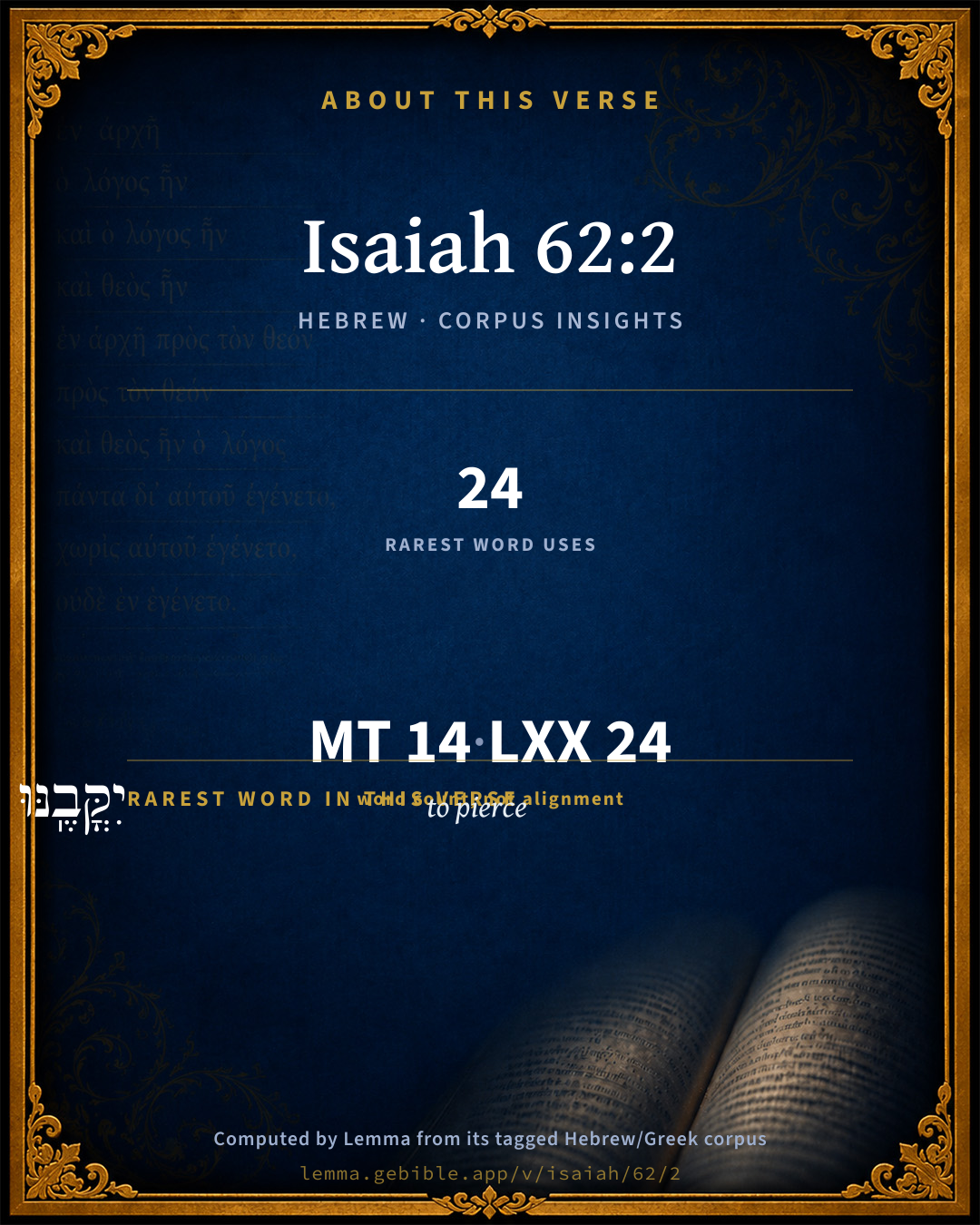
The rarest word here is יִקֳּבֶֽנּוּ to pierce H5344 — appearing just 24 times in the whole Hebrew Bible.

Shared distinctive vocabulary

יִקֳּבֶֽנּוּ to pierce H5344 occurs in 23 verses of the Hebrew Bible. Also found in:

Grammatical profile

  • 3 verbs
  • 8 nouns
  • 1 adjective
  • 1 preposition
  • 1 particle

Verb forms

  • וְרָא֤וּ Qal · Sequential Perfect
  • וְקֹ֤רָא Pual · Sequential Perfect
  • יִקֳּבֶֽנּוּ Qal · Imperfect

Hebrew & Septuagint length

In English translation the verse runs 27 words from the Hebrew and 25 from the Septuagint (LXX English) — closely comparable.

A rough comparison of the two English renderings, which tokenize alike — not a word-level alignment.

Word counts can differ between the Hebrew and the Greek without any difference in meaning — e.g. the Hebrew direct-object marker אֵת has no separate Greek word, and Greek often adds the article ὁ.

In the original languages it is 14 Hebrew tokens and 24 Greek tokens — but the two are counted differently (Hebrew bundles its prefixes and suffixes into one token; the Greek is in lemma form), so that isn’t a like-for-like length.

Cross-references

24

Topical passages linked to Isaiah 62:2 in the Treasury of Scripture Knowledge — connected by theme and wording, ordered by reader-vote popularity; previews shown in the World English Bible.

  • Isaiah 62:12 They shall call them The holy people, The redeemed of Yahweh: and you shall be called Sought out, A city not forsaken.
  • Genesis 17:5 Neither will your name any more be called Abram, but your name will be Abraham; for the father of a multitude of nations have I made you.
  • Isaiah 65:15 You shall leave your name for a curse to my chosen; and the Lord Yahweh will kill you; and he will call his servants by another name:
  • Revelation 2:17 He who has an ear, let him hear what the Spirit says to the assemblies. To him who overcomes, to him I will give of the hidden manna, and I will give him a white stone, and on the stone a new name written, which no one knows but he who receives it.
  • Isaiah 60:1–3 Arise, shine; for your light is come, and the glory of Yahweh is risen on you.
  • Isaiah 66:12 For thus says Yahweh, Behold, I will extend peace to her like a river, and the glory of the nations like an overflowing stream: and you shall suck [of it]; you shall be borne on the side, and shall be dandled on the knees.
  • Genesis 17:15 God said to Abraham, "As for Sarai your wife, you shall not call her name Sarai, but her name will be Sarah.
  • Isaiah 49:23 Kings shall be your nursing fathers, and their queens your nursing mothers: they shall bow down to you with their faces to the earth, and lick the dust of your feet; and you shall know that I am Yahweh; and those who wait for me shall not be disappointed.
  • Isaiah 62:4 You shall no more be termed Forsaken; neither shall your land any more be termed Desolate: but you shall be called Hephzibah, and your land Beulah; for Yahweh delights in you, and your land shall be married.
  • Isaiah 66:19 I will set a sign among them, and I will send such as escape of them to the nations, to Tarshish, Pul, and Lud, who draw the bow, to Tubal and Javan, to the isles afar off, who have not heard my fame, neither have seen my glory; and they shall declare my glory among the nations.
  • Genesis 32:28 He said, "Your name will no longer be called 'Jacob,' but, 'Israel,' for you have fought with God and with men, and have prevailed."
  • Psalms 72:10–11 The kings of Tarshish and of the isles will bring tribute. The kings of Sheba and Seba shall offer gifts.
  • Isaiah 49:6 yes, he says, It is too light a thing that you should be my servant to raise up the tribes of Jacob, and to restore the preserved of Israel: I will also give you for a light to the Gentiles, that you may be my salvation to the end of the earth.
  • Isaiah 52:10 Yahweh has made bare his holy arm in the eyes of all the nations; and all the ends of the earth have seen the salvation of our God.
  • Isaiah 61:9 Their seed shall be known among the nations, and their offspring among the peoples; all who see them shall acknowledge them, that they are the seed which Yahweh has blessed.
  • Acts 11:26 When he had found him, he brought him to Antioch. It happened, that for a whole year they were gathered together with the assembly, and taught many people. The disciples were first called Christians in Antioch.
  • Isaiah 60:16 You shall also suck the milk of the nations, and shall suck the breast of kings; and you shall know that I, Yahweh, am your Savior, and your Redeemer, the Mighty One of Jacob.
  • Jeremiah 33:16 In those days shall Judah be saved, and Jerusalem shall dwell safely; and this is [the name] by which she shall be called: Yahweh our righteousness.
  • Micah 5:8 The remnant of Jacob will be among the nations, In the midst of many peoples, Like a lion among the animals of the forest, Like a young lion among the flocks of sheep; Who, if he goes through, treads down and tears in pieces, And there is no one to deliver.
  • Isaiah 60:11 Your gates also shall be open continually; they shall not be shut day nor night; that men may bring to you the wealth of the nations, and their kings led captive.
  • Acts 9:15 But the Lord said to him, "Go your way, for he is my chosen vessel to bear my name before the nations and kings, and the children of Israel.
  • Acts 26:23 how the Christ must suffer, and how, by the resurrection of the dead, he would be first to proclaim light both to these people and to the Gentiles."
  • Colossians 1:23 if it is so that you continue in the faith, grounded and steadfast, and not moved away from the hope of the Gospel which you heard, which is being proclaimed in all creation under heaven; of which I, Paul, was made a servant.
  • Psalms 138:4–5 All the kings of the earth will give you thanks, Yahweh, For they have heard the words of your mouth.

Cross-references courtesy of OpenBible.info (CC BY 4.0).

Hebrew and Greek witnesses Masoretic Hebrew ↔ Greek Septuagint

The same verse in the two great witnesses to the Old Testament, shown verse-for-verse.

These are two independent witnesses, not word-aligned to each other, and the Septuagint is shown in lemma (dictionary) form.

Hebrew Isaiah 62:2 Masoretic · Westminster Leningrad Codex

וְרָא֤וּ גוֹיִם֙ צִדְקֵ֔ךְ וְכָל מְלָכִ֖ים כְּבוֹדֵ֑ךְ וְקֹ֤רָא לָךְ֙ שֵׁ֣ם חָדָ֔שׁ אֲשֶׁ֛ר פִּ֥י יְהוָ֖ה יִקֳּבֶֽנּוּ

The nations shall see your righteousness, and all kings your glory, and you shall be called by a new name, which the mouth of Yahweh shall name.

World English Bible · Public Domain

Greek LXX Isaiah 62:2 Septuagint · lemma form

καί ὁράω ἔθνος ὁ δικαιοσύνη σύ καί βασιλεύς ὁ δόξα σύ καί καλέω σύ ὁ ὄνομα σύ ὁ καινός ὅς ὁ κύριος ὀνομάζω αὐτός

And the Gentiles shall see your righteousness, and kings your glory: and one shall call you by a new name, which the Lord shall name.

LXX2012 (modern English Septuagint) · Public Domain

Hebrew: Westminster Leningrad Codex (CC BY 4.0). Greek: Septuagint (public domain); English from LXX2012 (modern English Septuagint) (Public Domain). How the Septuagint differs from the Hebrew →

Targum (Aramaic paraphrase)

1

The Targum is the ancient Jewish Aramaic paraphrase of the Hebrew Scriptures — an interpretive translation, not the Hebrew text itself. Onkelos (literal) and Pseudo-Jonathan (expansive) render the Torah, and Jonathan the Prophets. Coverage is partial: where no permissively-licensed English translation exists for a verse, only the Aramaic is shown. This is verse-level text, not a word-by-word alignment to the Hebrew.

  1. Targum Jonathan Prophets (Joshua–Malachi)
    וְיֶחְזוּן עַמְמַיָא זְכוּתִיךְ וְכָל מַלְכַיָא יְקָרִיךְ וְיִקְרוֹן לִיךְ שְׁמָא חַדְתָּא דִי בְמֵימְרֵהּ דַייָ יִפְרְשִׁינָהּ:

    And the Gentiles shall see thy righteousness, and all kings thy glory: and they shall call thee by a new name, which the Word of the Lord shall declare.

    Targum Jonathan — Aramaic: “Mikraot Gedolot” (public domain). English: “Sefaria Community Translation” (CC0 1.0 (public-domain dedication)); “London "Chaldee Paraphrase," 1871” (public domain). Text via Sefaria.

Commentary

Notes on Isaiah 62:2 from classic Christian and Jewish commentators (each source and its license shown beneath its notes). The classic Christian expositions comment on the surrounding passage and are grouped to its opening verse, so a note may address several verses; the Jewish commentaries on the Tanakh (Rashi and others) are per-verse, so they appear only where the commentator wrote on this verse.

Lemma curates 59 commentaries, every one of them public domain or Creative Commons licensed, each selected and text-cleaned for this edition rather than reprinted as found. About our sources →

Trapp's Complete Commentary

John Trapp

Isa 62:2 And the Gentiles shall see thy righteousness, and all kings thy glory: and thou shalt be called by a new name, which the mouth of the LORD shall name.

Ver. 2. And the Gentiles shall see thy righteousness.] The prophet here very artificially turneth his speech to the Church herself, as if he would pronounce his panegyric in her presence; and presently celebrateth her dignity and happiness herein, that the Gentiles should worship her, and be joined unto her. Some read it, "And the Gentiles shall see thy righteous One," - i.e., Christ, who came from the Jews, was preached to the Gentiles, believed on in the world, received up to glory. {1Ti 3:16}

And thou shalt be called by a new name,] viz., Hephzibah, i.e., My darling; and Beulah, i.e., A married woman. {Isa 62:4} There are that by this new name will have to be understood the name of sons and daughters of the Almighty. {Rev 2:17 2Co 6:18} Others the name of the Church Catholic. And others, again, the honourable name of Christians, which yet is at this day in Italy and at Rome a name of reproach, and usually abused to signify a fool or a dolt, as Dr Fulk proveth out of their own authors. {a}

{a} Fulk, Rhem. Test. on Acts xi.

John Trapp, A Commentary or Exposition upon All the Books of the Old and New Testament (1647–1656) — public domain. Text from a community e-Sword module.

The Biblical Illustrator

Joseph S. Exell

Isa_62:2

And thou shalt be called by a now name

The new name

(with Isa_62:12):--According to the Hebrew idiom, the name which expresses the nature and character of a person is used as equivalent to that nature and character.

The promises of these verses involve, accordingly, far more than appears upon the surface.

I. THE NEW NAME ABOLISHES THE OLD. In the prophetical writings Israels sins are very plainly described and very faithfully upbraided. The favoured people are called rebels and traitors, idolaters and spiritual adulterers. Upon their repentance, the old reproach is wiped away, and the old appellations are discarded. This is how Divine mercy treats all true penitents and believers. Former sins are forgotten, former rebukes are reversed, former sentences of condemnation are cancelled.

II. THE NEW NAME EXPRESSES A NEW CHARACTER. The Christian dispensation, by peculiar agencies and spiritual powers, for the removal of the nature and life of men (2Co_5:17). In accordance with the fact is the expression of the fact; in accordance with the new nature, the new birth, the new life, is the new name.

III. THE NEW NAME IS SIGNIFICANT OF A NEW STATE OF FAVOUR AND ACCEPTANCE. Especially those upon whom the great change has passed are the Lords. His possession and property, His beloved and honoured, for whom no privileges are too great and no dignities too eminent. The new name is His name who confers it, and who delights to deem and to call His beloved ones His own. (Homiletical Library.)

The Biblical Illustrator, edited by Joseph S. Exell (c. 1880s–1900s) — public domain. Text from a community e-Sword module.

The Preacher's Complete Homiletical Commentary

Joseph S. Exell (gen. ed.)

THE NEW NAMH

Isa_62:2; Isa_62:12. Thou shalt be called by a new name. And they shall call them, &c.

According to the Hebrew idiom, the name which expresses the nature and character of a person is used as equivalent to that nature and character. The promises of these verses involve accordingly, far more than appears upon the surface.

I. The new name abolishes the old, In the prophetical writings Israel’s sins are very plainly described and very faithfully upbraided. The favoured people are called rebels and traitors, idolaters and spiritual adulterers. Upon their repentance, the old reproach is wiped away, and the old appellations are discarded. This is how Divine mercy treats all true penitents and believers. Former sins are forgotten, former rebukes are reversed, former sentences of condemnation are cancelled.

II. The new name expresses a new character. The Christian dispensation provides, by peculiar agencies and spiritual powers, for the renewal of the nature and the life of men (2Co_5:17). In accordance with the fact is the expression of the fact; in accordance with the new nature, the new birth, the new life, is the new name. They who were unholy become the holy people, because, from being the bondsmen of sin, they have become the redeemed of the Lord.

III. The new name is significant of a new state of favour and acceptance. Especially those upon whom the great change has passed are “the Lord’s,”—His possession and property, His beloved and honoured, for whom no privileges are too great and no dignities too eminent. The new name is His name who confers it, and who delights to deem and to call His beloved ones His own.”—The Homiletical Library, vol. ii. p. 153.

The Preacher's Complete Homiletical Commentary (gen. ed. Joseph S. Exell; Funk & Wagnalls, c. 1892) — public domain (pre-1929). A full-Bible homiletical/sermon-outline anthology covering 65 of 66 books (2 John is absent from the source module). Text from a community e-Sword module.

Tyndale Open Study Notes

Tyndale Open Resources

62:2 The real beauty and glory of God’s people would not be seen in earthly treasures or a rebuilt city but would shine forth from their righteousness. Others would be drawn by this divine gift. • A new name reflects the change in Zion’s status (see 62:4).

Tyndale Open Study Notes — © Tyndale Open Resources, licensed CC BY-SA 4.0. Text via the HelloAO Bible API.

Geneva Bible (1599)

Geneva Bible translators

Thou shalt have a more excellent fame than thou hast had hitherto.

Geneva Bible (1599) marginal notes — public domain. Text via Bolls.life.

Jamieson, Fausset & Brown

Robert Jamieson, A. R. Fausset & David Brown

(Isa 11:10; Isa 42:1-6; Isa 49:7, Isa 49:22-23; Isa 60:3, Isa 60:5, Isa 60:16).

new name--expression of thy new and improved condition (Isa 62:4), the more valuable and lasting as being conferred by Jehovah Himself (Isa 62:12; Isa 65:15; Rev 2:17; Rev 3:12).

Jamieson, Fausset & Brown — Commentary Critical and Explanatory on the Whole Bible (1871) — public domain (CC PDM 1.0). Text via the HelloAO Bible API.

Ellicott's Commentary for English Readers

(2) Thou shalt be called by a new name . . .—So in Jer_33:16, the name of the restored city is to be “Jehovah our Righteousness.” The root-thought is that the altered state is to be embodied, as in the case of Abraham and Israel, in a new name. Here, however, the effect of the promise is heightened, as in Rev_2:17; Rev_3:12, by the absence of the new ‘name, as something which is to transcend all experience.

A Bible Commentary for English Readers, edited by Charles John Ellicott (1878–1897) — public domain. Text from a community e-Sword module.

The Cambridge Bible for Schools and Colleges

gen. ed. J. J. S. Perowne

2. And the Gentiles &c.] Rather, And nations. Cf. ch. Isa_60:3.

a new name] the symbol both of a new character and a new relation to God. Cf. Rev_2:17; Rev_3:12, ch. Isa_65:15.

which the mouth of the Lord shall name] Rather, shall determine (as Gen_30:28). This new name is a mystery (see Rev_2:17) yet to be disclosed, and is not to be brought into connexion with the names of Isa_62:4 and Isa_62:12.

The Cambridge Bible for Schools and Colleges (gen. ed. J. J. S. Perowne; Cambridge University Press, 1878–1918) — public domain. Text from a community e-Sword module.

John Gill's Exposition

And the Gentiles shall see thy righteousness,.... The innocence of her case, and the justness of her cause, and the vengeance took on her enemies, all being so clear as before declared; as well as her justifying righteousness, which being published in the Gospel to the Gentiles, they shall see it, embrace it, and shall be justified by it, Rom 1:17 or "thy righteous One", as the Vulgate Latin version, Christ:

and all kings thy glory; or, "thy glorious One", as the same version; her Lord in whom she glories, and who is a glory to her, whom kings shall fall down before and worship, Psa 72:10 or the glorious state of the church, which shall draw the eyes of kings unto it, and who shall promote it by bringing their glory into it, Isa 60:1. Vitringa thinks all this refers to the times of Constantine, before which kings had not seen the glory of the church, nor had she seen kings subject to her; but now they began to see the glory of the kingdom of Christ: but it is better to interpret it of the latter day, when not only kings begin to see, not a few of them, but all in general shall see it:

and thou shall be called by a new name, which the mouth of the Lord shall name; either "Jehovah Shammah", "The Lord is there"; his presence being among his church and people at this time in a remarkable manner, Eze 48:35 or Jehovah our righteousness; this being most clearly revealed, as before observed, Jer 33:16 or Christ, to whom she is so closely united, and so nearly allied, as to have his name on her, Co1 12:12 or the church, and church of God, and of Christ, names only to be met with in the New Testament, and under the Gospel dispensation; or the name of Christians from Christ, Act 11:26, or, as is more commonly received, the name of the sons of God, which the church of converted Jews shall have in the latter day, when the name of "Loammi" is taken off from them, Hos 1:10, and to this passage there may be an allusion in Rev 2:17. This name is a new name; a renewed one, at the time of regeneration and faith, which was anciently provided in predestination, and bestowed in the covenant of grace; a renowned one, better than that of sons and daughters of the greatest potentates, and attended with various privileges; a wonderful name, an instance of marvellous grace in God, who stood in no need of adopted ones, and to them so unworthy of it; and which is ever new, and will always continue; this blessing of grace is of God, and not of men, and is to be ascribed to the grace of God, Father, Son and Spirit. Kimchi makes this new name to be "Hephzibah", Isa 62:4, not amiss.

John Gill's Exposition of the Whole Bible (1746–1763) — public domain (CC PDM 1.0). Text via the HelloAO Bible API.

Albert Barnes' Notes on the Bible

And the Gentiles shall see - (see Isa 11:10 :÷ come a up I father me say Isa 49:22; Isa 60:3, Isa 60:5, Isa 60:16).

And all kings thy glory - (See the notes at Isa 49:7, Isa 49:23; Isa 52:15; Isa 60:3, Isa 60:10-11, Isa 60:16).

And thou shalt be called by a new name - A name which shall be significant and expressive of a greatly improved and favored condition (see Isa 62:4). The idea is, that they would not be in a condition in which a name denoting humiliation, poverty, and oppression would be appropriate, but in circumstances where a name expressive of prosperity would be adapted to express their condition. On the custom of giving significant names, see the notes at Isa 7:3; Isa 8:1.

Which the mouth of the Lord shall name - Which shall be the more valuable because Yahweh himself shall confer it, and which must therefore be appropriate (see the notes at Isa 62:4, Isa 62:12.)

Albert Barnes' Notes on the Bible (1834–1885) — public domain. Text from a community e-Sword/MySword module.

Haydock's Catholic Bible Commentary

One. No profane historian mentions what Cyrus did for the Jews; but all the world knows how much Christ has favoured his Church. (Calmet) --- Name. Thou shalt be no longer the rebellious Jerusalem, but the spouse and chosen people, the Church of Christ. (St. Ignatius of Antioch, ad Magnesians) (St. Jerome)

George Leo Haydock (1774–1849), Haydock's Catholic Family Bible and Commentary, 1859 edition — public domain. Excludes Psalms (Douay-Rheims chapter numbering differs from Protestant) and Deuterocanonical books (Catholic canon only).

Matthew Poole's English Annotations

Thy righteousness: see what is said in the foregoing verse: some read, thy Just One, viz. Jesus Christ. Kings, those that were wont to scorn thee, shall now’ be taken with the admiration of thy glory.

Thou shalt be called by a new name, which the mouth of the Lord shall name; not the seed of Abraham, or the children of Israel, but of God; that whereas they were by nature the children of wrath, now by grace they shall be the children of God. Or, another name, as it is said of tongues. Compare Mar 16:17, with Act 2:4. Or, a name, the honour whereof shall make them famous, as Gen 11:4; they shall be called Christians. Or, the church shall be more renowned than ever, both in respect of her condition, and so called Hephzi-bah; and of her relation, and so called Beulah; and this new name the Lord gives them accordingly, Isa 62:4.

Matthew Poole's English Annotations on the Holy Bible (1683–1685) — public domain. Text from a community e-Sword/MySword module.

Whedon's Commentary on the Bible

Daniel D. Whedon

2, 3. Gentiles shall see thy righteousness — The same thought in respect to the Gentiles as in Isa_60:3. They shall come to see the amazing moral superiority of Jehovah’s cause; and all kings, or men of power among them, shall be attracted thereto, and give it favour and advancement. Thus the Zion of God shall be called by a new name among them — a name of honour pre-eminently, because seen over all other religions to be of superior holiness and character throughout. The Lord Jehovah, in the march of his redemptive providences, will bring this around. In his hands, thus dispensing light, spirit, and power, Zion is to be seen as what she really is: A crown of glory… a royal diadem; terms implying an object of superbly glorious moral beauty.

Daniel D. Whedon (gen. ed.), Commentary on the Old and New Testaments (1874–1909) — public domain. Text from a community e-Sword module.

The Pulpit Commentary

The Gentiles shall see, etc. A continuation of the account of Israel"s final glory, as given in Isa_61:6-9. What the Gentiles are especially to see and admire is Israel"s righteousness. This may point to those acknowledgments of the purity and excellence of the early Church which were made by the heathen (Plin., "Epist.," 10:97), and which culminated in the saying, "See how these Christians love one another!" The sceptic Gibbon acknowledges, among the causes of the success of Christianity, "the virtues of the early Christians." All kings. (comp. Isa_49:7, 23 60:3 Psa_50:22:11) Thou shalt be called by a new name. (comp. vers. 4 and 12; and see also Isa_65:15) It is not altogether clear what the "new name" is, since in the remainder of the present chapter more than one name is suggested. Rosenmuller supposes" Hephzibah" to be meant. Dr. Kay suggests "the holy people," and notes that the title of "holy ones," or "saints," is given by St. Paul to all Christians. (Act_26:10 Rom_1:7 Rom_16:15 1Co_1:2, etc.) Mr. Cheyne thinks that it is some unknown title of honour, akin to that mentioned by Jeremiah "Jehovah our Righteousness". (Jer_33:16) "New names" will be given to individual saints in the heavenly kingdom. (Rev_2:17 Rev_3:12)

Vers. 2, 4, 12. The teaching of Scripture with respect to names.

Names are not spoken of in the Scriptures as unimportant, but as of a very high importance.

I A SPECIAL VALUE IS SET ON THE NAMES OF GOD. The names of God are significant, and set forth his nature. "El" is "the Great;" "Shaddai," "the Strong;" "Jehovah," "the Alone-existent." God selected this last name as that by which he would be especially known to the Jews, (Exo_3:14) and it became a sort of proper name with them and their neighbours. It was this name which was not to be taken in vain. (Exo_20:7) It came to be regarded as so holy that the Jews would not venture to pronounce it, but substituted the word "Adonai," or "Lord," whenever they read the Scriptures aloud. God himself is, in fact, in all his names; and nearly the same reverence is due to them which is due to him. Christians are baptized into the Name of the Father, the Son, and the Holy. (Mat_28:19) The Name of the God of Jacob defends them. (Psa_25:1) The Father keeps them through his Name. (Joh_17:11) They give thanks to his Name, (Heb_13:15) fear and glorify his Name, (Rev_15:4) confess and sing praise unto it. (Rom_15:9) Christ"s Name, through faith in his Name, m akes them strong, yea, gives them perfect soundness in the presence of all. (Act_3:16)

II A CERTAIN VALUE IS SET ON MEN"S NAMES. God assigns men; (Isa_7:14 Isa_8:3 Hos_1:4, Hos_1:6, 9 Mat_1:21 Luk_1:13, etc.) alters or modifies their names; (Gen_17:5, 15 2Sa_12:25, etc.) explains the mystical meaning of their; (Mat_16:18) gives them wholly new names. (Rev_3:12) The sacred writers also sometimes alter men"s names in contempt, or as a punishment. Thus Esh-Baal, "man of Paul," becomes Ish-Bosheth, "man of shame;" Merib-Baal becomes Mephi-Bosheth, and the like. The true name of Hezekiah"s father seems to have been Jehoahaz, "possession of Jehovah" (G. Smith, "Eponym Canon," p. 124); but the sacred writers, offended with him on account of his idolatries, would only call him Ahaz, "possession." Conquering kings sometimes required names of subject kings to be changed, apparently as a mark of submission and subserviency. Thus the name of Eliakim was turned to Jehoiakim by Pharaoh-Necho, (2Ki_23:34) and the name of Mattaniah to Zedekiah by Nebuchadnezzar. (2Ki_24:17) Altogether, human names are recognized as having an importance which profane writers are rarely found to attach to them.

III A CERTAIN VALUE IS SET ALSO ON THE NAMES OF PLACES. Importance is attached to the significance of place-names, and a meaning is found for them not always in accordance with their real etymologies. Babel (Babylon) was no doubt intended by the Babylonians to mean "the gate of God;" but the sacred writers saw in the name a derivation from balal, "to confound". (Gen_11:9) When places ceased to correspond to their names, the sacred writers freely altered the names, to suit the circumstances. Thus the Bethel of the patriarchs becomes the Beth-avert of Hosea, (Hos_4:15 Hos_5:8 Hos_10:5) Jeroboam"s idolatries having turned "the house of God" into "the house of nothingness." In the present chapter Jerusalem is supposed to have become "Azubah" on her destruction by the Babylonians, and to be about to be called "Hephzi-bah" on her restoration by the returned exiles. Another name given to her by Isaiah is "Ariel". (Isa_29:1) Eachname expresses some phase in her history or feature of her character.

The Lord"s new name for his people.

"And men shall call thee by a new name, which the mouth of Jehovah shall appoint". (compare, for the promise of a new name, Rev_2:17 Rev_3:12) Abram, brought into covenant with God, receives a new name Abraham. Jacob finds his triumph seal his acceptance with God, and he is henceforth known by a new name Israel. What the name is to be God only knows, but it will recognize the fact that the people had been faithful, and were rewarded for their faithfulness. A singular sentiment prevailed among the Jews in connection with this new naming. The possession of a new name came to be regarded among the pious as a demonstration that all sins committed under the old name were forgiven, and all decrees annulled which were issued against the sinner while possessed of his former appellation. Accordingly, at the approach of death, the Jews were wont to change the name of the dying person, and the reason of this custom will be perceived from the following prayer offered for the dying, to whom the new name has been given: "O God, take pity on A (his former name), and restore him to health, and let him henceforth be called B (the new name); and let him be glad in his new name, and let it be confirmed to him. Be pleased, we entreat thee, O God, that this change of name may abolish all the hard and evil decrees against him, and destroy the broad sentence. If death be decreed upon A (the former name), it is not decreed upon B (the new name), if an evil decree was made against A, lo! this hour he is another man, a new creature, and like a child born to a good life and length of days.

I THE NEW SAME INDICATES THE END OF THE OLD LIFE. Illustrate:

1. By the new name given in marriage, which closes up the old life in the father"s home.

2. By the new name given to those restored to Jerusalem, which intimated the close of the time of captivity in Babylon.

3. By the new name" Christian," which marks the end of the old heathen life, or pagan life.

4. By the new heavenly name, (as in Rev_2:17) which tells that the earth-conflict has ended in the victory of holiness. Apply to the Divine recognition of our final triumph over the old Adam, which is "corrupt according to the deceitful lusts.

II THE NEW NAME REMINDS MEN OF THE GRACE OF WHICH THEY ARE.MONUMENTS. It is very positively stated that God gives the name, to remind men of what he has done for them. The name "redeemed" keeps in mind the "Redeemer." The name "Christian" sets "Christ" ever before us. It is not our name for ourselves; it is Gods name for us, and so a constant reminder of what Almighty grace has done, and can do.

III THE NEW NAME INDICATES THE SPIRIT OF THE NEW LIFE. The name "holy city" calls attention to the fact that the people should be all holy, as those who are fully consecrated unto God. R.T.

The Pulpit Commentary (1880–1919), ed. H.D.M. Spence-Jones & Joseph S. Exell — public domain. Text from a community e-Sword module.

John Wesley's Explanatory Notes

A new name - The church shall be more renowned than ever, both in respect of her condition, and so called Hephzi-bah, and of her relation, and so called Beulah, and this new name the Lord gives them accordingly, ver. 4.

John Wesley, Explanatory Notes Upon the Whole Bible (1754–1765) — public domain. Text via the GEBible commentary corpus.

J. A. Alexander on Isaiah

Joseph Addison Alexander

“And nations shall see thy righteousness, and all kings thy glory; and there shall be called to thee a new name, which the mouth of Jehovah shall utter (or pronounce distinctly).” The mention of kings is intended to imply the submission even of the highest ranks to this new power. (Compare Isa 49:7; Isa 49:23; Isa 52:15). The idea evidently is that they shall witness it and stand astonished. The new name may be that which is afterwards stated in v. 4, or the expression may be understood more generally as denoting change of condition for the better. (See above, Isa 1:26; Isa 60:14, and compare Jer 3:16; Jer 33:16; Eze 48:35; Rev 2:17; Rev 3:12). Some suppose an allusion to the change in the name of the chosen people from Jew to Christian; but the former name is still applied to the spiritual Israel, in Rom 2:29 and Rev 2:9. (See below, on Isa 65:15). Others suppose an allusion to the ancient practice of imposing new names upon towns which have been ruined and rebuilt.

Joseph Addison Alexander, The Prophecies of Isaiah (1846–1847; New York: Scribner, 1870–1878) — public domain. Text from a community e-Sword module.

Rashi

Rabbi Shlomo Yitzchaki (Rashi)

shall pronounce Heb. יִקֳּבֶנּוּ, shall pronounce.

Rashi on the Tanakh — English translations: “The Judaica Press complete Tanach with Rashi, translated by A. J. Rosenberg” (CC BY 4.0); “Pentateuch with Rashi's commentary by M. Rosenbaum and A.M. Silbermann, 1929-1934” (public domain); “The Metsudah Tanach series, Lakewood, N.J” (CC BY 4.0); and “The Book of Joshua, Metsudah Publications, 1997” (CC BY 4.0). Text via Sefaria.

Ibn Ezra

Rabbi Abraham ibn Ezra

קורא Shall be called. It is Pual.

יקבנו Will name. Comp. אשר נקבו which are expressed (Num. 1:17)

Ibn Ezra on the Tanakh — English translations: “Sefaria Community Translation” (CC0 1.0 (public-domain dedication)); “Yalkut, Sifsei Chachomim Chumash, Metsudah Publications, 2009” (CC BY 4.0); and “Commentary of Ibn Ezra on Isaiah - trans. by M. Friedlander, 1873” (public domain). Text via Sefaria.

Lesson kit

Teaching starters — assembled from the data on this page, not authored interpretation. Every prompt links to the verse data it draws on. Edit before teaching.

Isaiah, in the Prophets, opens this verse with 14 words (13 distinct Hebrew lemmas). Its most distinctive word is nâqab (“to pierce”). A historical commentator’s framing appears above. Read the whole chapter for the surrounding context.

Discussion questions

  1. What does “to pierce” (nâqab) contribute to the verse as a whole?
  2. How does Genesis 30:28, which shares the word «to pierce», read alongside this verse?
  3. The translations on this page render this verse differently — a whole-verse word diff, not a word-by-word alignment. What might account for the different wordings?
  4. «וְרָא֤וּ» is a Qal Sequential Perfect verb. How does that grammatical form shape the action described?
  5. Compare how Trapp's Complete Commentary and The Biblical Illustrator read this verse. Where do they agree or differ?

Things to notice

Reading settings

Reading text

Shown beneath each verse's original-language words.

Old Testament
Old Testament edition

Read the OT as the Masoretic Hebrew (MT) or the Greek Septuagint (LXX).

English shown for the Greek Septuagint (in the Hebrew ↔ Greek comparison).

Comparing translations? Open the Compare panel on any verse page to stack up to four side by side.