Isaiah 40:5

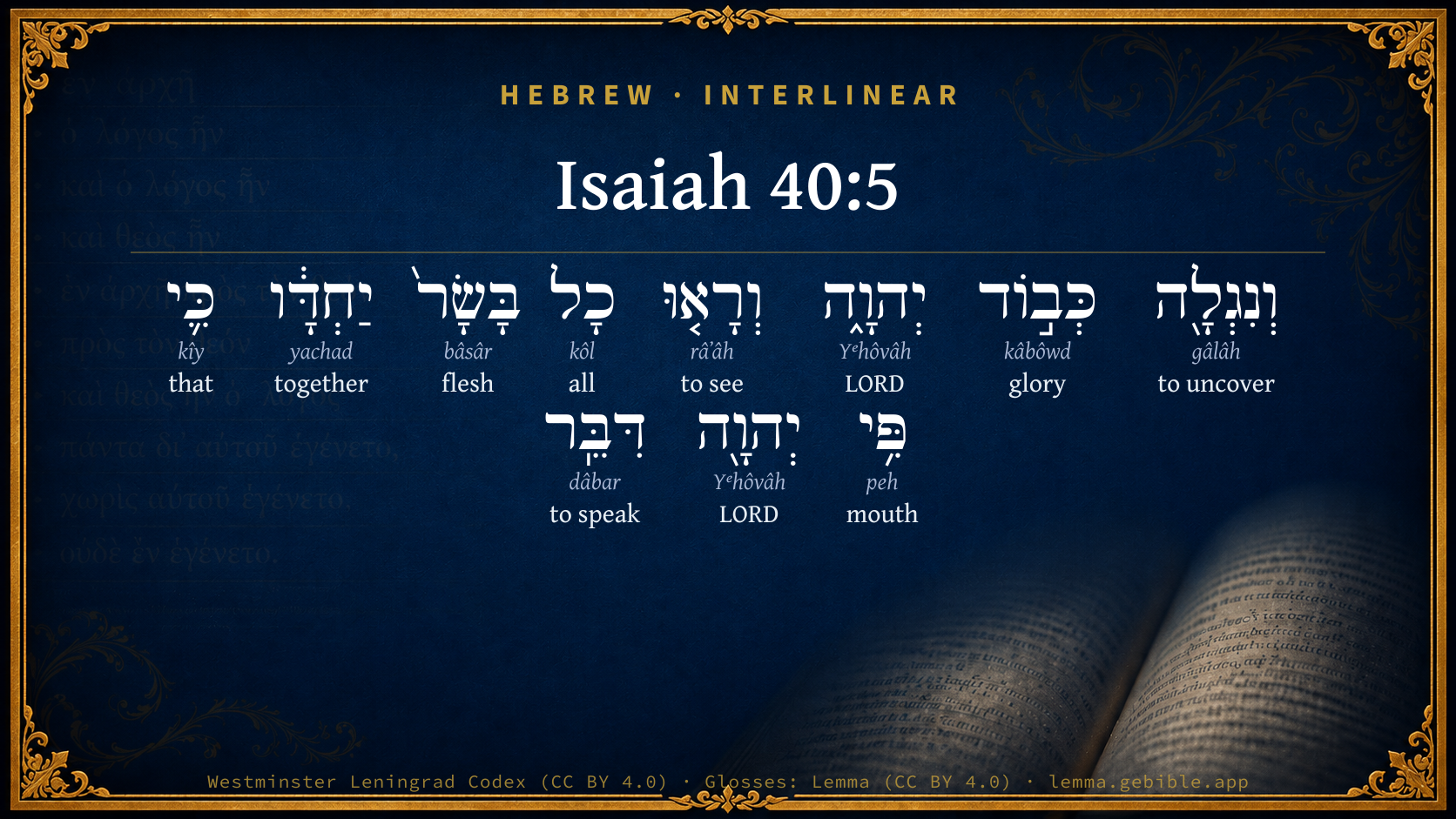
Hebrew (Westminster Leningrad Codex) Isaiah 40:5 appears in the Hebrew Old Testament. The text above is from the Westminster Leningrad Codex. Each word links to its Strong’s number, a concise gloss, and parsing drawn from the Open Scriptures Hebrew Bible morphology. Click any word for its full Brown-Driver-Briggs (BDB) entry.
Download image
Cite this verse

Isaiah 40:5 (World English Bible). Public Domain. Lemma interlinear Bible study tool, https://lemma.gebible.app/v/isaiah/40/5.

Show BibTeX & RIS
BibTeX
RIS
English Translation
and the glory of Yahweh shall be revealed, and all flesh shall see it together; for the mouth of Yahweh has spoken it.
World English Bible · Public Domain
Download a study sheet

One document with this verse’s original text, its word-by-word gloss line, the meaning frame, cross-references with their text, attributed commentary, and full source and license credits — printable, and it pastes into notes with its structure intact.

This verse Autodidact and up

Study sheet (.html) Plain text (.txt)

A passage Seminary Student

Up to 50 verses in one chapter. A passage sheet keeps up to 6 commentary sources and 12 cross-references per verse, in the order this page ranks them, and says so on the sheet whenever that leaves anything out. Ask for a single verse and you get the Autodidact verse sheet above.

Everything on this page stays free to read, with no account — the sheet is a download of what is already on screen, not access to it.

Want to remove ads? Support Godless Engineer
Compare translations 3

The same verse in 3 English versions, stacked beneath the original-language interlinear above. Click any original word for its lexicon entry.

Each is an independent rendering of the whole verse — the interlinear is not word-aligned to these translations.

Highlighted words mark where these versions differ — a whole-verse word diff, not a word-by-word alignment.

  • World English Bible Public Domain
    and the glory of Yahweh shall be revealed, and all flesh shall see it together; for the mouth of Yahweh has spoken it.
  • King James Version Public Domain
    And the glory of the LORD shall be revealed, and all flesh shall see it together: for the mouth of the LORD hath spoken it.
  • unfoldingWord Literal Text CC BY-SA 4.0
    And the glory of Yahweh will be revealed, and all flesh will see together,” for the mouth of Yahweh has spoken. q1

unfoldingWord Literal Text — © unfoldingWord, licensed CC BY-SA 4.0. Word-aligned USFM3 via Door43 (git.door43.org/unfoldingWord/en_ult).

Versions to compare (up to 4)

3 of 4 selected

Show all 18 translations

Every available English version of this verse, each an independent rendering of the whole verse.

  • World English Bible Public Domain
    and the glory of Yahweh shall be revealed, and all flesh shall see it together; for the mouth of Yahweh has spoken it.
  • Berean Standard Bible Public Domain
    And the glory of the LORD will be revealed, and all humanity together will see it. For the mouth of the LORD has spoken.”
  • Majority Standard Bible Public Domain
    And the glory of the LORD will be revealed, and all humanity together will see it.” For the mouth of the LORD has spoken.
  • King James Version Public Domain
    And the glory of the LORD shall be revealed, and all flesh shall see it together: for the mouth of the LORD hath spoken it.
  • American Standard Version (1901) Public Domain
    and the glory of Jehovah shall be revealed, and all flesh shall see it together; for the mouth of Jehovah hath spoken it.
  • Revised Version (1885) Public Domain
    and the glory of the LORD shall be revealed, and all flesh shall see it together: for the mouth of the LORD hath spoken it.
  • Geneva Bible (1599) Public Domain
    And the glory of the Lord shalbe reueiled, and all flesh shall see it together: for the mouth of the Lord hath spoken it.
  • Douay-Rheims (1899) Public Domain
    And the glory of the Lord shall be revealed, and all flesh together shall see, that the mouth of the Lord hath spoken.
  • Young's Literal Translation Public Domain
    And revealed hath been the honour of Jehovah, And seen `it' have all flesh together, For the mouth of Jehovah hath spoken.
  • Literal Standard Version CC BY-SA 4.0
    And the glory of YHWH has been revealed, || And all flesh have seen [it] together, || For the mouth of YHWH has spoken.”
  • Unlocked Literal Bible CC BY-SA 4.0
    and the glory of Yahweh will be revealed, and all people will see it together; for the mouth of Yahweh has spoken it.
  • unfoldingWord Literal Text CC BY-SA 4.0
    And the glory of Yahweh will be revealed, and all flesh will see together,” for the mouth of Yahweh has spoken. q1
  • Darby Bible Public Domain
    And the glory of Jehovah shall be revealed, and all flesh shall see [it] together: for the mouth of Jehovah hath spoken.
  • World Messianic Bible Public Domain
    The LORD’s glory shall be revealed, and all flesh shall see it together; for the mouth of the LORD has spoken it.”
  • Webster's Bible Public Domain
    And the glory of the LORD shall be revealed, and all flesh together shall see it: for the mouth of the LORD hath spoken it.
  • Free Bible Version CC BY-SA 4.0
    The Lord's glory will be revealed, and everyone will see it together. This is what the Lord has declared.”
  • Bible in Basic English Public Domain
    And the glory of the Lord will be made clear, and all flesh will see it together, for the mouth of the Lord has said it.
  • JPS Tanakh (1917) Public Domain
    And the glory of the LORD shall be revealed, and all flesh shall see it together; for the mouth of the LORD hath spoken it.'

Literal Standard Version (2020), Covenant Press — licensed CC BY-SA 4.0. Text via the HelloAO Bible API (eBible.org). Unlocked Literal Bible (unfoldingWord) — licensed CC BY-SA 4.0. Text via the HelloAO Bible API (eBible.org). unfoldingWord Literal Text — © unfoldingWord, licensed CC BY-SA 4.0. Word-aligned USFM3 via Door43 (git.door43.org/unfoldingWord/en_ult). Free Bible Version, Dr. Jonathan Gallagher — licensed CC BY-SA 4.0. Text via the HelloAO Bible API (eBible.org).

Word by word

More ways to search: Search by grammar → Find every occurrence → Compare this word →

Practice this passage: Drill this verse → Learn its vocabulary →

About this verse

These counts appear in no published source. They are computed here, from the morphology-tagged text and Lemma’s own curated glosses. What Lemma adds →

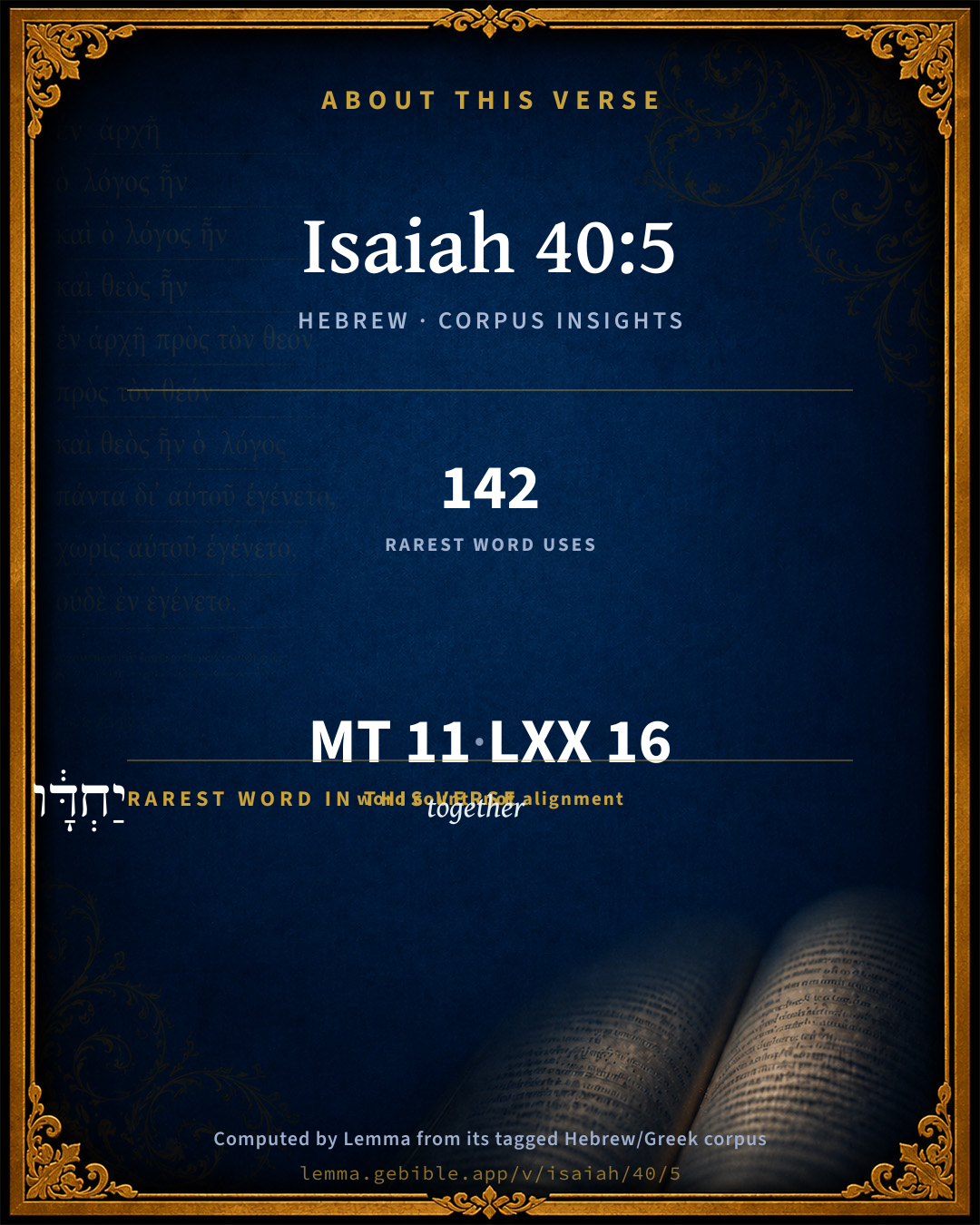
11
words
10
distinct lemmas
Prophets
section

Grammatical profile

  • 3 verbs
  • 6 nouns
  • 1 conjunction
  • 1 adverb

Verb forms

  • וְנִגְלָ֖ה Niphal · Sequential Perfect
  • וְרָא֤וּ Qal · Sequential Perfect
  • דִּבֵּֽר Piel · Perfect

Repetition

A word recurs within this verse — often emphatic in Hebrew:

  • יְהוָ֑ה LORD H3068 ×2

Hebrew & Septuagint length

In English translation the verse runs 23 words from the Hebrew and 23 from the Septuagint (LXX English) — the same length.

A rough comparison of the two English renderings, which tokenize alike — not a word-level alignment.

Word counts can differ between the Hebrew and the Greek without any difference in meaning — e.g. the Hebrew direct-object marker אֵת has no separate Greek word, and Greek often adds the article ὁ.

In the original languages it is 11 Hebrew tokens and 16 Greek tokens — but the two are counted differently (Hebrew bundles its prefixes and suffixes into one token; the Greek is in lemma form), so that isn’t a like-for-like length.

Cross-references

30

Topical passages linked to Isaiah 40:5 in the Treasury of Scripture Knowledge — connected by theme and wording, ordered by reader-vote popularity; previews shown in the World English Bible.

  • Habakkuk 2:14 For the earth will be filled with the knowledge of the glory of Yahweh, as the waters cover the sea.
  • Isaiah 52:10 Yahweh has made bare his holy arm in the eyes of all the nations; and all the ends of the earth have seen the salvation of our God.
  • Joel 2:28 "It will happen afterward, that I will pour out my Spirit on all flesh; And your sons and your daughters will prophesy. Your old men will dream dreams. Your young men will see visions.
  • Isaiah 60:1 Arise, shine; for your light is come, and the glory of Yahweh is risen on you.
  • Luke 3:6 All flesh will see God's salvation.'"
  • 2 Corinthians 4:6 seeing it is God who said, "Light will shine out of darkness," who has shone in our hearts, to give the light of the knowledge of the glory of God in the face of Jesus Christ.
  • Isaiah 11:9 They shall not hurt nor destroy in all my holy mountain; for the earth shall be full of the knowledge of Yahweh, as the waters cover the sea.
  • Acts 2:17 'It will be in the last days, says God, That I will pour out my Spirit on all flesh. Your sons and your daughters will prophesy. Your young men will see visions. Your old men will dream dreams.
  • Psalms 72:19 Blessed be his glorious name forever! Let the whole earth be filled with his glory! Amen and amen.
  • Isaiah 6:3 One called to another, and said, "Holy, holy, holy, is Yahweh of Hosts! The whole earth is full of his glory!"
  • Isaiah 58:14 then shall you delight yourself in Yahweh; and I will make you to ride on the high places of the earth; and I will feed you with the heritage of Jacob your father: for the mouth of Yahweh has spoken it.
  • John 1:14 The Word became flesh, and lived among us. We saw his glory, such glory as of the one and only Son of the Father, full of grace and truth.
  • Isaiah 66:23 It shall happen, that from one new moon to another, and from one Sabbath to another, shall all flesh come to worship before me, says Yahweh.
  • Revelation 21:23 The city has no need for the sun, neither of the moon, to shine, for the very glory of God illuminated it, and its lamp is the Lamb.
  • Isaiah 1:20 But if you refuse and rebel, you shall be devoured with the sword; For the mouth of Yahweh has spoken it."
  • Isaiah 35:2 It shall blossom abundantly, and rejoice even with joy and singing; the glory of Lebanon shall be given to it, the excellency of Carmel and Sharon: they shall see the glory of Yahweh, the excellency of our God.
  • Zechariah 2:13 Be silent, all flesh, before Yahweh; for he has roused himself from his holy habitation!"
  • John 12:41 Isaiah said these things when he saw his glory, and spoke of him.
  • 2 Corinthians 3:18 But we all, with unveiled face beholding as in a mirror the glory of the Lord, are transformed into the same image from glory to glory, even as from the Lord, the Spirit.
  • Hebrews 1:3 His Son is the radiance of his glory, the very image of his substance, and upholding all things by the word of his power, when he had by himself made purification for our sins, sat down on the right hand of the Majesty on high;
  • Psalms 96:6 Honor and majesty are before him. Strength and beauty are in his sanctuary.
  • Psalms 102:16 For Yahweh has built up Zion. He has appeared in his glory.
  • Isaiah 49:6 yes, he says, It is too light a thing that you should be my servant to raise up the tribes of Jacob, and to restore the preserved of Israel: I will also give you for a light to the Gentiles, that you may be my salvation to the end of the earth.
  • Jeremiah 9:12 Who is the wise man, that may understand this? and [who is] he to whom the mouth of Yahweh has spoken, that he may declare it? why is the land perished and burned up like a wilderness, so that none passes through?
  • Micah 4:4 But they will sit every man under his vine and under his fig tree; And no one will make them afraid: For the mouth of Yahweh of Hosts has spoken.
  • John 17:2 even as you gave him authority over all flesh, he will give eternal life to all whom you have given him.
  • Isaiah 66:16 For by fire will Yahweh execute judgment, and by his sword, on all flesh; and the slain of Yahweh shall be many.
  • Jeremiah 32:27 Behold, I am Yahweh, the God of all flesh: is there anything too hard for me?
  • Luke 2:10–14 The angel said to them, "Don't be afraid, for behold, I bring you good news of great joy which will be to all the people.
  • Luke 2:32 A light for revelation to the Gentiles, And the glory of your people Israel."

Cross-references courtesy of OpenBible.info (CC BY 4.0).

Hebrew and Greek witnesses Masoretic Hebrew ↔ Greek Septuagint

The same verse in the two great witnesses to the Old Testament, shown verse-for-verse.

These are two independent witnesses, not word-aligned to each other, and the Septuagint is shown in lemma (dictionary) form.

Hebrew Isaiah 40:5 Masoretic · Westminster Leningrad Codex

וְנִגְלָ֖ה כְּב֣וֹד יְהוָ֑ה וְרָא֤וּ כָל בָּשָׂר֙ יַחְדָּ֔ו כִּ֛י פִּ֥י יְהוָ֖ה דִּבֵּֽר

and the glory of Yahweh shall be revealed, and all flesh shall see it together; for the mouth of Yahweh has spoken it.

World English Bible · Public Domain

Greek LXX Isaiah 40:5 Septuagint · lemma form

καί ὁράω ὁ δόξα κύριος καί ὁράω πᾶς σάρξ ὁ σωτήριον ὁ θεός ὅτι κύριος λαλέω

And the glory of the Lord shall appear, and all flesh shall see the salvation of God: for the Lord has spoken it.

LXX2012 (modern English Septuagint) · Public Domain

On this verse, Jamieson, Fausset & Brown discusses the Septuagint’s reading. Read the note in Commentary ↓

Hebrew: Westminster Leningrad Codex (CC BY 4.0). Greek: Septuagint (public domain); English from LXX2012 (modern English Septuagint) (Public Domain). How the Septuagint differs from the Hebrew →

Targum (Aramaic paraphrase)

1

The Targum is the ancient Jewish Aramaic paraphrase of the Hebrew Scriptures — an interpretive translation, not the Hebrew text itself. Onkelos (literal) and Pseudo-Jonathan (expansive) render the Torah, and Jonathan the Prophets. Coverage is partial: where no permissively-licensed English translation exists for a verse, only the Aramaic is shown. This is verse-level text, not a word-by-word alignment to the Hebrew.

  1. Targum Jonathan Prophets (Joshua–Malachi)
    וְיִתְגְלֵי יְקָרָא דַייָ וְיֶחֱזוּן כָּל בְּנֵי בִשְׂרָא כַּחֲדָא אֲרֵי בְמֵימְרָא דַייָ גְזַר כֵּן:

    And the glory of the Lord shall be revealed, and all the sons of flesh shall see together, that by the WORD of the Lord it has been decreed thus.

    Targum Jonathan — Aramaic: “Mikraot Gedolot” (public domain). English: “Sefaria Community Translation” (CC0 1.0 (public-domain dedication)); “London "Chaldee Paraphrase," 1871” (public domain). Text via Sefaria.

Commentary

Notes on Isaiah 40:5 from classic Christian and Jewish commentators (each source and its license shown beneath its notes). The classic Christian expositions comment on the surrounding passage and are grouped to its opening verse, so a note may address several verses; the Jewish commentaries on the Tanakh (Rashi and others) are per-verse, so they appear only where the commentator wrote on this verse.

Lemma curates 59 commentaries, every one of them public domain or Creative Commons licensed, each selected and text-cleaned for this edition rather than reprinted as found. About our sources →

Trapp's Complete Commentary

John Trapp

Isa 40:5 And the glory of the LORD shall be revealed, and all flesh shall see [it] together: for the mouth of the LORD hath spoken [it].

Ver. 5. And the glory of the Lord shall be revealed,] i.e., Jesus Christ, the Lord of glory, {Jas 2:1} shall appear in the flesh. Some interpreters understand this whole sermon, ad literam, concerning Christ and redemption wrought by him, yet with an allusion to the Jews’ deliverance out of Babylon; for this was a type of that, like as Cyrus also was of Christ.

John Trapp, A Commentary or Exposition upon All the Books of the Old and New Testament (1647–1656) — public domain. Text from a community e-Sword module.

The Biblical Illustrator

Joseph S. Exell

Isa_40:5

And the glory of the Lord shall be revealed

The revelation of Gods glory

From this animating prophecy we may consider--

I.

THE GLORY OF THE LORD. When Isaiah was favoured with the Divine vision the angels sang, Holy, holy, holy is the Lord of hosts, the whole earth is full of His glory. Another inspired writer observes, The heavens declare the glory of God. In the display of this glory God hath clothed Himself with light as with a garment; and hath peculiarly manifested it in those two grand events, the creation and redemption of the world. Hence the glad tidings are emphatically called the glorious Gospel; and the spiritual instruction of the Gospel is called the light of the knowledge of the glory of God in the face of Jesus Christ. This plan of redemption is the arena of heaven, into which the angels desire to look. It is the rich assemblage of love and mercy, justice and faithfulness, truth and goodness.

II. THE REVELATION OF THE GLORY OF THE LORD. The dispensation under which God revealed Himself to our first parents is commonly called the Covenant of Works. The condition required was perfect obedience. By the sin of Adam and Eve this covenant was broken, and judgment passed on all to condemnation. The glory of the Lord shone round about our offending parents when the very sentence of condemnation was associated with an intimation of mercy. The glory of the Lord was first revealed in the promise that the seed of the woman should bruise the head of the serpent. As generations succeeded, it pleased the most High God gradually to reveal larger discoveries of this sovereign remedy of human woe. In the days of Abraham the promise of mercy was repeated (Gal_3:8; Gal_3:17). The inspired compositions of King David more explicitly unfolded the Divine glory in the redemption of sinners. The grand accomplishment of the words of our text was reserved for the personal appearance of the Son of God.

III. THE GLORIOUS EXTENT OF THIS REVELATION. All flesh shall see it together. At the period of this prophecy the earth was full of darkness and habitations of cruelty. The light of Israel was, comparatively, but as the light of a taper. The space which it illuminated was contracted. The glory of the Lord to be revealed under the Christian dispensation was to resemble the sun in the firmament: it was to shine for all kingdoms, nations, and languages under heaven. It was to be a light to lighten the Gentiles, and the glory of Gods people, Israel. The aspect of the present times encourages us to hope that the day is rapidly advancing when all flesh shall see the salvation of God.

IV. THE GLORY OF THIS ANIMATING PROSPECT IS CONFIRMED BY ITS CERTAINTY.

1. For the mouth of the Lord hath spoken it (2Ti_1:9; Psa_2:7-8; Isa_49:5-6; Isa_42:6; Joh_10:16; Joh_12:32).

V. THE DUTY OF MISSIONARY EXERTIONS IN ORDER TO PROMOTE THE REVELATION OF THIS GLORY.

1. Doth any one ask, Where is the authority for missionary exertions? It stands upon the authority of the Most High God.

2. The duty is great, as you regard the exceeding great love of the Lord Jesus Christ.

3. The duty is great, as you consider the personal obligation which you yourselves are under to missionary societies.

4. The duty is great, as God, in His bounty, hath entrusted you with talents to promote this charitable work. (Basil Wood, M. A.)

The glory of the King

The august manifestation promised.

I. AS TO ITS NATURE.

1. It is the King Messiah in person.

(1) The historical allusion is to the Shechinah.

(2) But prophetically it is applied to Christ. Jewish expositors apply it to Messiah. It follows, then, that--

2. The Shechinah was a type of Christ.

(1) It was an undoubted symbol of Divinity. It was the medium in which it pleased God to reveal Himself in ancient times. The complement of such a symbol must needs be a Divine person. The type cannot be grander than the antitype.

(2) It was a standing miracle. In it vapour and fire were miraculously supported in union. It is therefore called the support of cloud and fire. Pillar is an unfortunate translation of the Hebrew. A luminous canopy extending over London in its whole extent could scarcely be called a pillar. But the nation of Israel, whether in encampment or on march, could scarcely occupy less space. This miracle would set forth the wonderful union of the Godhead and manhood in the person of Christ.

(3) But further, on more nearly considering the Shechinah, it was found to enshrine a beatified human form. This is distinguished as the similitude of Jehovah (Exo_24:10-11; Num_12:8; Isa_6:1-5;Eze_1:26). This very thing is seen in the holy mount, only that the true humanity of Jesus transfigured is itself the similitude. Behold, then, the Image of the Invisible God; the brightness of His glory and the express image of His person.

(4) In this character Messiah will come when in full form He appears as the Dan_7:13; Mat_24:30; Mat_26:64; Act_1:11; Rev_1:7).

3. Meanwhile Christ reveals Himself in His Spirit. He displays--

(1) The glory of His wisdom.

(2) The glory of His power.

(3) The glory of mercy, justice, and holiness in His method of pardoning and saving sinners.

II. AS TO ITS EXTENT. All flesh shall see it together.

1. This term includes the Jew. The day is coming when all Israel shall be saved--when the nation shall become Christian.

2. It also comprehends the Gentile.

(1) Presage of the calling of the Gentiles was given when the Magi Worshipped at Bethlehem.

(2) Further presage was given when Jesus, though sent to the lost sheep of the house of Israel, nevertheless opened His ministry in Galilee of the Gentiles (Mat_4:12-16).

(3) It was also presaged in incidents of His ministry. The healing of the centurions servant. The preaching to the Samaritans (Joh_4:39; Joh_4:42). The healing of the Canaanites daughter (Mat_15:11-28).

3. The grand fulfilment is future.

(1) As yet all flesh have not seen the glory of the Lord. Certainly all flesh have not seen it together.

(2) But this shall be.

(3) Distinctions of Jew and Gentile will merge in the universal blaze of the glory of Christ.

III. AS TO ITS CERTAINTY. The mouth of the Lord hath spoken it.

1. The Lord can do it.

2. He will do it.

(1) His honour is pledged.

(3) His existence is pledged.

(3) He cannot deny Himself. The Scripture cannot be broken.

3. Are we prepared to meet Christ? (J. A. Macdonald, M. A.)

The Biblical Illustrator, edited by Joseph S. Exell (c. 1880s–1900s) — public domain. Text from a community e-Sword module.

Joseph Benson's Commentary

Isa 40:5. And the glory of the Lord shall be revealed — It was revealed in some sort when God brought his people out of Babylon: for that was a glorious work of God, in which he displayed his power, and love, and faithfulness in fulfilling his promises. But his glory was much more eminently revealed when Christ, the Lord of glory, was manifested in the flesh, and gave much clearer and fuller discoveries of God’s glorious wisdom, holiness, goodness, and other divine perfections, than ever before had been imparted to mankind, or to his church. And all flesh shall see it together — All nations, Jews as well as Gentiles. For the mouth of the Lord hath spoken it — Though it may seem incredible, yet God is able to accomplish it.

Joseph Benson's Commentary on the Old and New Testaments (1811–1818) — public domain. Text from a community e-Sword module.

Keil & Delitzsch

C. F. Keil & F. Delitzsch

The cry of the crier proceeds thus in Isa 40:5 : "And the glory of Jehovah will be revealed, and all flesh seeth together: for the mouth of Jehovah hath spoken it." The pret. cons. קנגלה is here apodosis imper. When the way is prepared for Jehovah the Coming One, the glory of the God of salvation will unveil itself (on the name Jehovah, which is applied to God, the absolute I, as living and revealing Himself in history, more especially in the history of salvation). His parousia is the revelation of His glory (Pe1 4:13). This revelation is made for the good of Israel, but not secretly or exclusively; for all the human race, called here designedly "all flesh" (kol bâsâr), will come to see it (compare Luk 3:6, "the salvation of God"). Man, because he is flesh, cannot see God without dying (Exo 33:20); but the future will fill up this gulf of separation. The object to the verb "see" is not what follows, as Rosenmller supposes, viz., "that the mouth of Jehovah hath spoken," for the word of promise which is here fulfilled is not one addressed to all flesh; nor does it mean, "see that Jehovah hath spoken with His own mouth," i.e., after having become man, as Stier maintains, for the verb required in this case would be מדבּר, not דּבּר. The clause, "for the mouth of Jehovah hath spoken it," is rather Isaiah's usual confirmation of the foregoing prophecy. Here the crier uses it to establish the certainty of what he foretells, provided that Israel will do what he summons it to perform.

Keil & Delitzsch — Biblical Commentary on the Old Testament (1861–1891) — public domain (CC PDM 1.0). Text via the HelloAO Bible API. (Old Testament only.)

Tyndale Open Study Notes

Tyndale Open Resources

40:5 The future revelation of God’s glory would include the return of Judah from exile but would also go beyond it. The New Testament confirmed that the revelation of God’s glory came in Jesus Christ (John 1:14; Heb 1:3). • The Lord has spoken: The coming salvation and judgment would certainly occur because the Lord, who keeps his word, had declared it (see Isa 1:20; 58:14).

Tyndale Open Study Notes — © Tyndale Open Resources, licensed CC BY-SA 4.0. Text via the HelloAO Bible API.

Geneva Bible (1599)

Geneva Bible translators

This miracle shall be so great, that it shall be known through all the world.

Geneva Bible (1599) marginal notes — public domain. Text via Bolls.life.

Jamieson, Fausset & Brown

Robert Jamieson, A. R. Fausset & David Brown

see it--The Septuagint for "it," has "the salvation of God." So Luk 3:6 (compare Luk 2:30, that is, Messiah); but the Evangelist probably took these words from Isa 52:10.

for--rather, "All flesh shall see that the mouth of Jehovah hath spoken it" [BENGEL].

Jamieson, Fausset & Brown — Commentary Critical and Explanatory on the Whole Bible (1871) — public domain (CC PDM 1.0). Text via the HelloAO Bible API.

Adam Clarke's Commentary

Verse 5. "The salvation of our God."] These words are added here by the Septuagint: το σωτηριον του Θεου, את ישועת אלהינו eth yesuath Eloheynu, as it is in the parallel place, Isa 52:10. The sentence is abrupt without it, the verb wanting its object; and I think it is genuine. Our English translation has supplied the word it, which is equivalent to this addition, from the Septuagint.

This omission in the Hebrew text is ancient, being prior to the Chaldee, Syriac, and Vulgate Versions: but the words stand in all the copies of the Septuagint, and they are acknowledged by Luke, Lu 3:6. The whole of this verse is wanting in one of my oldest MSS.

Adam Clarke's Commentary on the Bible (1810–1826) — public domain. Text from a community e-Sword/MySword module.

Ellicott's Commentary for English Readers

(5) The glory of the Lord shall be revealed.—Did the prophet think of a vision of a glory-cloud, like the Shechinah which he had seen in the Temple? or had he risen to the thought of the glory of character and will, of holiness and love? (Joh_1:14.)

All flesh.—The revelation is not for Israel only, but for mankind. So in Luk_3:6, the words are quoted from the LXX., “all flesh shall see the salvation of God.” The phrase meets us here for the first time, and occurs again in Isa_49:26; Isa_66:16; Isa_66:23-24, marking, so to speak, the growing catholicity of the prophet’s thoughts. (See Note on Isa_38:11.)

A Bible Commentary for English Readers, edited by Charles John Ellicott (1878–1897) — public domain. Text from a community e-Sword module.

The Cambridge Bible for Schools and Colleges

gen. ed. J. J. S. Perowne

5. In place of it together LXX. has “the salvation of God,” borrowing apparently from ch. Isa_52:10. See Luk_3:6.

for the mouth … it] This prophetic formula is nowhere else used by second Isaiah. The whole verse is deleted as a gloss by Duhm and Cheyne, but on grounds which seem insufficient.

The Cambridge Bible for Schools and Colleges (gen. ed. J. J. S. Perowne; Cambridge University Press, 1878–1918) — public domain. Text from a community e-Sword module.

John Gill's Exposition

And the glory of the Lord shall be revealed..... Christ himself, who is the brightness of his Father's glory, and his own glory, as the glory of the of the only begotten of the Father; the glorious perfections of his nature, seen in the miracles wrought, and in the doctrines taught by him; the glory of the divine Father, in the face or person of Christ; and the glory of his attributes, in the work of salvation by him; all which is most clearly discerned in the glass of the Gospel, or in the ministry of the word, by John, Christ himself, and his apostles:

and all flesh shall see it together; not the Jews only, but Gentiles also; not with their bodily eyes, but with the eyes of their understanding; even the salvation of the Lord, and his glory, as displayed in it, being set forth in the everlasting Gospel to the view of all; see Luk 3:7,

for the mouth of the Lord hath spoken it: that his glory should be revealed, and be visible to all, and therefore sure and certain; for what he has said he does, and what he has spoken he makes good. The Targum is,

"for by the word of the Lord it is so decreed;''

and therefore shall be fulfilled.

John Gill's Exposition of the Whole Bible (1746–1763) — public domain (CC PDM 1.0). Text via the HelloAO Bible API.

Albert Barnes' Notes on the Bible

And the glory of the Lord - The phrase here means evidently the majesty, power, or honor of Yahweh. He would display his power, and show himself to be a covenant-keeping God, by delivering his people from their bondage, and reconducting them to their own land. This glory and faithfulness would be shown in his delivering them from their captivity in Babylon; and it would be still more illustriously shown in his sending the Messiah to accomplish the deliverance of his people in later days.

And all flesh - All human beings. The word ‘flesh’ is often used to denote human nature, or mankind in general Gen 6:12; Psa 65:3; Psa 145:21. The idea is, that the deliverance of his people would be such a display of the divine interposition, so that all nations would discern the evidences of his power and glory. But there is a fullness and a richness in the language which allows that it is not to be confined to that event. It is more strikingly applicable to the advent of the Messiah - and to the fact that through him the glory of Yahweh would be manifest to all nations. Rosenmuller supposes that this should be translated,

And all flesh shall see together

That the mouth of Yahweh hath spoken it.

The Hebrew will bear this construction, but there is no necessity for departing from the translation in the common version. The Septuagint adds here the words ‘salvation of God’ so as to read it, ‘and all flesh shall see the salvation of God,’ and this reading has been adopted in Luk 3:6; or it may be more probable that Luke Luk 3:4-6 has quoted from different parts of Isaiah, and that he intended to quote that part, not from the version of the Septuagint, but from Isa 52:10. Lowth, on the authority of the Septuagint, proposes to restore these words to the Hebrew text. But the authority is insufficient. The Vulgate, the Chaldee, the Syriac, and the Hebrew manuscripts concur in the reading of the present Hebrew text, and the authority of the Septuagint is altogether insufficient to justify a change.

For the mouth of the Lord - The strongest possible confirmation that it would be fulfilled (see the note at Isa 34:16). The idea is, that God had certainly promised their deliverance from bondage; and that his interposition, in a manner which should attract the attention of all nations, was certainly purposed by him. Few events have ever more impressively manifested the glory of God than the redemption of his people from Babylon; none has occurred, or will ever occur, that will more impressively demonstrate his glory, wisdom, and faithfulness, than the redemption of the world by the Messiah.

Albert Barnes' Notes on the Bible (1834–1885) — public domain. Text from a community e-Sword/MySword module.

Haydock's Catholic Bible Commentary

Glory. God will rescue his people. Christ will redeem mankind.

George Leo Haydock (1774–1849), Haydock's Catholic Family Bible and Commentary, 1859 edition — public domain. Excludes Psalms (Douay-Rheims chapter numbering differs from Protestant) and Deuterocanonical books (Catholic canon only).

Matthew Poole's English Annotations

The glory of the Lord shall be revealed: so it was in some sort, when God brought them out of Babylon, which was a glorious work of God; but far more properly and eminently when Christ, who was the glorious God, was manifested in the flesh, and gave much clearer and fuller discoveries of God’s glorious wisdom, and holiness, and goodness, and other Divine perfections, than ever yet had been imparted to mankind and to the church.

All flesh; all nations, both Jews and Gentiles.

For the mouth of the Lord hath spoken it; though this may seem incredible, yet God is able to accomplish it.

Matthew Poole's English Annotations on the Holy Bible (1683–1685) — public domain. Text from a community e-Sword/MySword module.

The Pulpit Commentary

And the glory of the Lord shall be revealed. Then, when the preparation is complete, there shall be a revelation of the glory and might of Jehovah. The nature of the revelation is for the present shrouded in darkness; but it is a revelation which is not confined to Israel. All flesh shall see it together. It shall draw to it the attention of the human race at large. While the restoration of Israel to Palestine is the primary fulfilment of the prophecy, that restoration clearly does not exhaust its meaning, which points on to the restoration of all mankind to God"s favour in Christ by the epifaneia of his advent in the flesh, which has drown, or will draw, the eyes of "all flesh." For the mouth of the Lord hath spoken it. A repetition of the emphatic clause wherewith Isaiah had terminated the third section of his first prophecy. (Isa_1:20) It occurs again inIsa 58:14. No other writer uses the expression.

Christ, as the Lord"s Glory.

The glory of God is his forgiving and redeeming. And it is this glory that was dimly revealed in the raising up of Cyrus to deliver Israel from the bondage of Babylon, and brightly revealed in "raising up his Son Jesus, to bless men, by turning them from their iniquities." It may be shown that God, as the great Spirit, never can be seen or known by any creature, because all creatures are put under limitations of the senses. No creature can apprehend "essences;" he is limited to "accidents." Nobody has seen the sun; it is the glory, the shining, the ray, of the sun that reveals it to us. So "no man hath seen God at any time; the only begotten Son, which is in the bosom of the Father, he hath declared him." Christ is the "Image" of God, which we can see; the "Word" of God, which we can hear; the "Glory" of God, making a holy warmth about us, which we can feel. He is "the Brightness of the Father"s glory, the express Image of his Person." His revelation is made that we might know the true God, and in the knowledge find "eternal life." This view appears to be, in a very special manner, commended and enforced by the Apostle John, in his Gospel; and from this Gospel illustrations may be taken.

I GOD REVEALED IN JOHN"S PROLOGUE. Explain the figure of the "Word," as meaning the medium, or agency, by which God communicates his thought to men"s minds. It is, as it were, God translated for man"s apprehension. But the "Word" is a Person, and John says, "We beheld his glory, the glory as of the only begotten of the Father.

II GOD REVEALED AT CANA. Putting forth miraculous power to provide for man"s need, Christ showed God"s constant care of men, and led men"s thoughts to the mystery of God that was in him, for John says, "This beginning of miracles did Jesus... and manifested forth his glory.

III GOD REVEALED AT LAZARUS"S GRAVE. Pleading with Martha, our Lord spake thus: "Said I not unto thee, that, if thou wouldest believe, thou shouldest see the glory of God?

IV GOD REVEALED IN THE VOICE FROM HEAVEN. In a moment of sore trouble, Jesus exclaimed," Father, glorify thy Name;" as if he felt that his supreme work was to show the Father forth. "And there came a voice from heaven, saying, I have both glorified it, and will glorify it again". (Joh_12:28)

V GOD REVEALED AT THE SUPPER-TABLE. When Judas left the table, and the beginning of the end had evidently come, Jesus said, in a meditative, but most revealing way, "Now is the Son of man glorified, and God is glorified in him". (Joh_13:31; see also Joh_14:13)

VI GOD REVEALED IN THE HIGH-PRIESTLY PRAYER. This is our Lord"s supreme desire: "Father, glorify thy Son, that thy Son also may glorify thee." And this is his sublimest thought, as he looks back over his brief life: "I have glorified thee on the earth." Christ is the Glory that reveals God for us, "who by him do believe in God, that raised him up from the dead, and gave him glory; that our faith and hope might be in God. R.T.

The Pulpit Commentary (1880–1919), ed. H.D.M. Spence-Jones & Joseph S. Exell — public domain. Text from a community e-Sword module.

J. A. Alexander on Isaiah

Joseph Addison Alexander

“And the glory of Jehovah shall be revealed, and all flesh shall see (it), for the mouth of Jehovah speaks (or hath spoken).” The idea seems to be that as soon as the way is opened, the Lord will show Himself. To see God’s glory, is a common expression for recognizing His presence and agency in any event (See Exo 16:7; Isa 35:2; Isa 66:18). The specific reference of this verse to the restoration of the Jews from exile is not only gratuitous but inconsistent with the strength and comprehensiveness of its expressions. The simple meaning is, that when the way should be prepared, the glory of God would be universally displayed; a promise too extensive to be fully verified in that event or period of history.

Joseph Addison Alexander, The Prophecies of Isaiah (1846–1847; New York: Scribner, 1870–1878) — public domain. Text from a community e-Sword module.

Ibn Ezra

Rabbi Abraham ibn Ezra

And the glory, etc. When God will perform this miracle, then His glory will be revealed.

Ibn Ezra on the Tanakh — English translations: “Sefaria Community Translation” (CC0 1.0 (public-domain dedication)); “Yalkut, Sifsei Chachomim Chumash, Metsudah Publications, 2009” (CC BY 4.0); and “Commentary of Ibn Ezra on Isaiah - trans. by M. Friedlander, 1873” (public domain). Text via Sefaria.

Lesson kit

Teaching starters — assembled from the data on this page, not authored interpretation. Every prompt links to the verse data it draws on. Edit before teaching.

Isaiah, in the Prophets, opens this verse with 11 words (10 distinct Hebrew lemmas). Its most distinctive word is yachad (“together”). A historical commentator’s framing appears above. Read the whole chapter for the surrounding context.

Discussion questions

  1. The word yachad carries the sense “together.” How does it shape the verse?
  2. Habakkuk 2:14 shares this passage’s theme. How do the two illuminate each other?
  3. “LORD” occurs 2× in this one verse. What is the effect of the repetition?
  4. These translations render this verse differently; the difference is in the English rendering, not the original. What questions does that raise?
  5. The verb «וְנִגְלָ֖ה» is Niphal Sequential Perfect. How does its form color the action?
  6. Reading how Trapp's Complete Commentary and The Biblical Illustrator read this verse, where do the two commentators agree and where do they part?

Things to notice

Reading settings

Reading text

Shown beneath each verse's original-language words.

Old Testament
Old Testament edition

Read the OT as the Masoretic Hebrew (MT) or the Greek Septuagint (LXX).

English shown for the Greek Septuagint (in the Hebrew ↔ Greek comparison).

Comparing translations? Open the Compare panel on any verse page to stack up to four side by side.