Isaiah 26:10

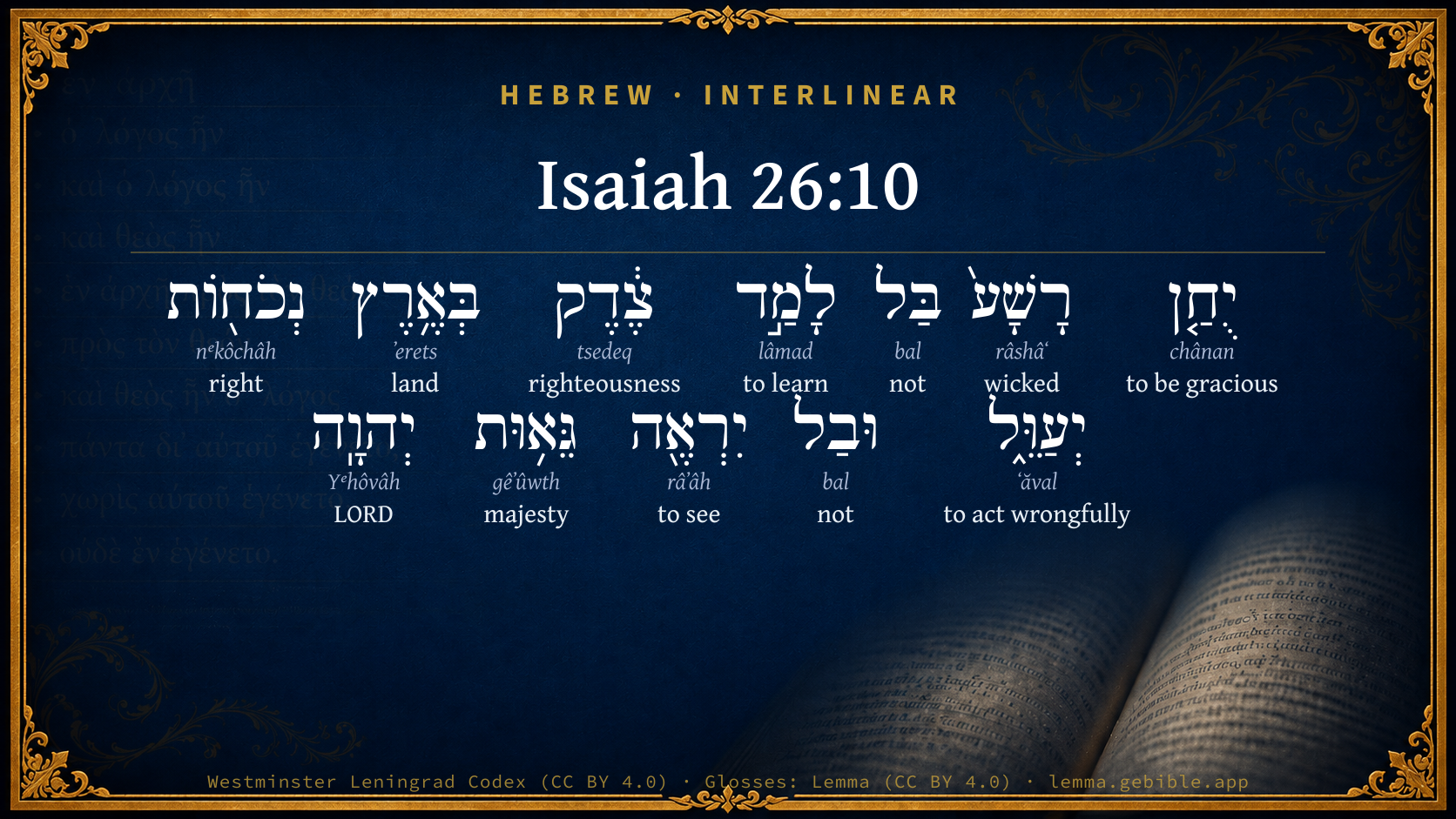
Hebrew (Westminster Leningrad Codex) Isaiah 26:10 appears in the Hebrew Old Testament. The text above is from the Westminster Leningrad Codex. Each word links to its Strong’s number, a concise gloss, and parsing drawn from the Open Scriptures Hebrew Bible morphology. Click any word for its full Brown-Driver-Briggs (BDB) entry.
Download image
Cite this verse

Isaiah 26:10 (World English Bible). Public Domain. Lemma interlinear Bible study tool, https://lemma.gebible.app/v/isaiah/26/10.

Show BibTeX & RIS
BibTeX
RIS
English Translation
Let favor be shown to the wicked, yet will he not learn righteousness; in the land of uprightness will he deal wrongfully, and will not see the majesty of Yahweh.
World English Bible · Public Domain
Highlights
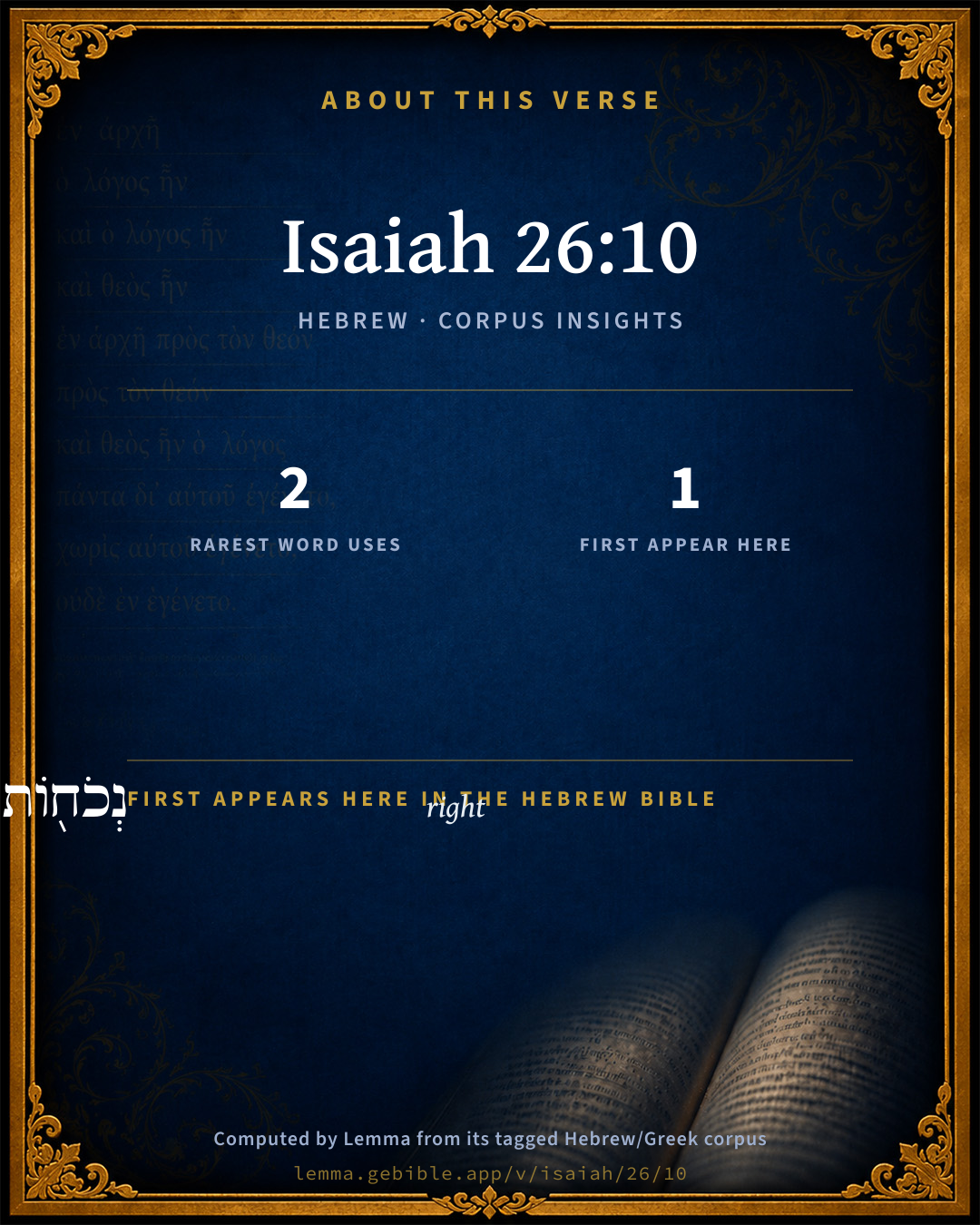
  • 1 first appearance in the Hebrew Bible
Full analysis ↓
Download a study sheet

One document with this verse’s original text, its word-by-word gloss line, the meaning frame, cross-references with their text, attributed commentary, and full source and license credits — printable, and it pastes into notes with its structure intact.

This verse Autodidact and up

Study sheet (.html) Plain text (.txt)

A passage Seminary Student

Up to 50 verses in one chapter. A passage sheet keeps up to 6 commentary sources and 12 cross-references per verse, in the order this page ranks them, and says so on the sheet whenever that leaves anything out. Ask for a single verse and you get the Autodidact verse sheet above.

Everything on this page stays free to read, with no account — the sheet is a download of what is already on screen, not access to it.

Want to remove ads? Support Godless Engineer
Compare translations 3

The same verse in 3 English versions, stacked beneath the original-language interlinear above. Click any original word for its lexicon entry.

Each is an independent rendering of the whole verse — the interlinear is not word-aligned to these translations.

Highlighted words mark where these versions differ — a whole-verse word diff, not a word-by-word alignment.

  • World English Bible Public Domain
    Let favor be shown to the wicked, yet will he not learn righteousness; in the land of uprightness will he deal wrongfully, and will not see the majesty of Yahweh.
  • King James Version Public Domain
    Let favour be shewed to the wicked, yet will he not learn righteousness: in the land of uprightness will he deal unjustly, and will not behold the majesty of the LORD.
  • unfoldingWord Literal Text CC BY-SA 4.0
    the wicked is favored, he does not learn righteousness. In a land of uprightness, he acts unjustly, and he does not see the majesty of Yahweh.

unfoldingWord Literal Text — © unfoldingWord, licensed CC BY-SA 4.0. Word-aligned USFM3 via Door43 (git.door43.org/unfoldingWord/en_ult).

Versions to compare (up to 4)

3 of 4 selected

Show all 18 translations

Every available English version of this verse, each an independent rendering of the whole verse.

  • World English Bible Public Domain
    Let favor be shown to the wicked, yet will he not learn righteousness; in the land of uprightness will he deal wrongfully, and will not see the majesty of Yahweh.
  • Berean Standard Bible Public Domain
    Though grace is shown to the wicked man, he does not learn righteousness. In the land of righteousness he acts unjustly and fails to see the majesty of the LORD.
  • Majority Standard Bible Public Domain
    Though grace is shown to the wicked man, he does not learn righteousness. In the land of righteousness he acts unjustly and fails to see the majesty of the LORD.
  • King James Version Public Domain
    Let favour be shewed to the wicked, yet will he not learn righteousness: in the land of uprightness will he deal unjustly, and will not behold the majesty of the LORD.
  • American Standard Version (1901) Public Domain
    Let favor be showed to the wicked, yet will he not learn righteousness; in the land of uprightness will he deal wrongfully, and will not behold the majesty of Jehovah.
  • Revised Version (1885) Public Domain
    Let favour be shewed to the wicked, yet will he not learn righteousness; in the land of uprightness will he deal wrongfully, and will not behold the majesty of the LORD.
  • Geneva Bible (1599) Public Domain
    Let mercie bee shewed to the wicked, yet hee will not learne righteousnesse: in the land of vprightnesse will he do wickedly, and will not beholde the maiestie of the Lord.
  • Douay-Rheims (1899) Public Domain
    Let us have pity on the wicked, but he will not learn justice: in the land of the saints he hath done wicked things, and he shall not see the glory of the Lord.
  • Young's Literal Translation Public Domain
    The wicked findeth favour, He hath not learned righteousness, In a land of straightforwardness he dealeth perversely, And seeth not the excellency of Jehovah.
  • Literal Standard Version CC BY-SA 4.0
    The wicked finds favor, || He has not learned righteousness, || He deals perversely in a land of straightforwardness, || And does not see the excellence of YHWH.
  • Unlocked Literal Bible CC BY-SA 4.0
    Let favor be shown to the wicked one, but he will not learn righteousness. In the land of uprightness he acts wickedly and does not see the majesty of Yahweh.
  • unfoldingWord Literal Text CC BY-SA 4.0
    the wicked is favored, he does not learn righteousness. In a land of uprightness, he acts unjustly, and he does not see the majesty of Yahweh.
  • Darby Bible Public Domain
    If favour be shewn to the wicked, he doth not learn righteousness: in the land of uprightness he dealeth unjustly, and beholdeth not the majesty of Jehovah.
  • World Messianic Bible Public Domain
    Let favor be shown to the wicked, yet he will not learn righteousness. In the land of uprightness he will deal wrongfully, and will not see the LORD’s majesty.
  • Webster's Bible Public Domain
    Let favor be shown to the wicked, yet he will not learn righteousness: in the land of uprightness he will deal unjustly, and will not behold the majesty of the LORD.
  • Free Bible Version CC BY-SA 4.0
    Though grace is shown to the wicked, they don't learn to do right. Even in a country where people do what's right, they continue to do evil and they don't think about how great the Lord is.
  • Bible in Basic English Public Domain
    Even if you are kind to the evil-doer, he will not go after righteousness; even in the land of the upright he will still go on in his wrongdoing, and will not see the glory of the Lord.
  • JPS Tanakh (1917) Public Domain
    Let favour be shown to the wicked, yet will he not learn righteousness; in the land of uprightness will he deal wrongfully, and will not behold the majesty of the LORD.

Literal Standard Version (2020), Covenant Press — licensed CC BY-SA 4.0. Text via the HelloAO Bible API (eBible.org). Unlocked Literal Bible (unfoldingWord) — licensed CC BY-SA 4.0. Text via the HelloAO Bible API (eBible.org). unfoldingWord Literal Text — © unfoldingWord, licensed CC BY-SA 4.0. Word-aligned USFM3 via Door43 (git.door43.org/unfoldingWord/en_ult). Free Bible Version, Dr. Jonathan Gallagher — licensed CC BY-SA 4.0. Text via the HelloAO Bible API (eBible.org).

Word by word

More ways to search: Search by grammar → Find every occurrence → Compare this word →

Practice this passage: Drill this verse → Learn its vocabulary →

יְעַוֵּ֑ל
ʻăval
H5765
“to act wrongfully”
Verb, Piel, Imperfect, 3rd Person, Masculine, Singular
Part of Speech
Verb
Stem
Piel
Form
Imperfect
Person
3rd Person
Gender
Masculine
Number
Singular
Full BDB Definition

Origin: a primitive root

TWOT: 1580

to act wrongfully or unjustly, deviate from - (Piel) to act wrongfully
  1. יֻחַ֤ן chânan H2603 “to be gracious” Verb, Hophal, Imperfect, 3rd Person, Masculine, Singular
  2. רָשָׁע֙ râshâʻ H7563 “wicked” Adjective, Adjective, Masculine, Singular, Absolute
  3. בַּל bal H1077 “not” Particle, Negative
  4. לָמַ֣ד lâmad H3925 “to learn” Verb, Qal, Perfect, 3rd Person, Masculine, Singular
  5. צֶ֔דֶק tsedeq H6664 “righteousness” Noun, Common, Masculine, Singular, Absolute
  6. בְּאֶ֥רֶץ ʼerets H776 “in/at · land of” Preposition + Noun, Common, Both, Singular, Construct
  7. נְכֹח֖וֹת nᵉkôchâh H5229 “right” Adjective, Adjective, Feminine, Plural, Absolute
  8. וּבַל bal H1077 “and · not” Conjunction + Particle, Negative
  9. יִרְאֶ֖ה râʼâh H7200 “to see” Verb, Qal, Imperfect, 3rd Person, Masculine, Singular
  10. גֵּא֥וּת gêʼûwth H1348 “majesty of” Noun, Common, Feminine, Singular, Construct
  11. יְהוָֽה Yᵉhôvâh H3068 “LORD” Noun, Proper

About this verse

These counts appear in no published source. They are computed here, from the morphology-tagged text and Lemma’s own curated glosses. What Lemma adds →

12
words
11
distinct lemmas
Prophets
section

Notable vocabulary

The rarest word here is יְעַוֵּ֑ל to act wrongfully H5765 — appearing just 2 times in the whole Hebrew Bible.

First appearance in Scripture

This word makes its first canonical appearance in the Hebrew Bible here:

  • נְכֹח֖וֹת right H5229

Shared distinctive vocabulary

יְעַוֵּ֑ל to act wrongfully H5765 occurs in 2 verses of the Hebrew Bible. Also found in:

Grammatical profile

  • 4 verbs
  • 4 nouns
  • 2 adjectives
  • 2 particles

Verb forms

  • יֻחַ֤ן Hophal · Imperfect
  • לָמַ֣ד Qal · Perfect
  • יְעַוֵּ֑ל Piel · Imperfect
  • יִרְאֶ֖ה Qal · Imperfect

Repetition

A word recurs within this verse — often emphatic in Hebrew:

Hebrew & Septuagint length

In English translation the verse runs 30 words from the Hebrew and 39 from the Septuagint (LXX English) — closely comparable.

A rough comparison of the two English renderings, which tokenize alike — not a word-level alignment.

Word counts can differ between the Hebrew and the Greek without any difference in meaning — e.g. the Hebrew direct-object marker אֵת has no separate Greek word, and Greek often adds the article ὁ.

Cross-references

29

Topical passages linked to Isaiah 26:10 in the Treasury of Scripture Knowledge — connected by theme and wording, ordered by reader-vote popularity; previews shown in the World English Bible.

  • Hosea 11:7 My people are determined to turn from me. Though they call to the Most High, He certainly won't exalt them.
  • John 5:37–38 The Father himself, who sent me, has testified about me. You have neither heard his voice at any time, nor seen his form.
  • Romans 2:4–5 Or do you despise the riches of his goodness, forbearance, and patience, not knowing that the goodness of God leads you to repentance?
  • Exodus 8:15 But when Pharaoh saw that there was a respite, he hardened his heart, and didn't listen to them, as Yahweh had spoken.
  • Exodus 8:31–32 Yahweh did according to the word of Moses, and he removed the swarms of flies from Pharaoh, from his servants, and from his people. There remained not one.
  • Exodus 9:34 When Pharaoh saw that the rain and the hail and the thunders were ceased, he sinned yet more, and hardened his heart, he and his servants.
  • Deuteronomy 32:15 But Jeshurun grew fat, and kicked: You have grown fat, you are grown thick, you are become sleek; Then he forsook God who made him, Lightly esteemed the Rock of his salvation.
  • Psalms 106:43 Many times he delivered them, But they were rebellious in their counsel, And were brought low in their iniquity.
  • Proverbs 1:32 For the backsliding of the simple will kill them. The careless ease of fools will destroy them.
  • Ecclesiastes 3:16 Moreover I saw under the sun, in the place of justice, that wickedness was there; and in the place of righteousness, that wickedness was there.
  • Jeremiah 2:7 I brought you into a plentiful land, to eat the fruit of it and the goodness of it; but when you entered, you defiled my land, and made my heritage an abomination.
  • Micah 2:10 Arise, and depart! For this is not your resting place, Because of uncleanness that destroys, Even with a grievous destruction.
  • Micah 3:10–12 They build up Zion with blood, And Jerusalem with iniquity.
  • Revelation 2:21 I gave her time to repent, but she refuses to repent of her sexual immorality.
  • 1 Samuel 15:17 Samuel said, "Though you were little in your own sight, weren't you made the head of the tribes of Israel? Yahweh anointed you king over Israel;
  • Psalms 28:4–5 Give them according to their work, and according to the wickedness of their doings. Give them according to the operation of their hands. Bring back on them what they deserve.
  • Psalms 78:54–58 He brought them to the border of his sanctuary, To this mountain, which his right hand had taken.
  • Psalms 143:10 Teach me to do your will, For you are my God. Your Spirit is good. Lead me in the land of uprightness.
  • Isaiah 2:10 Enter into the rock, And hide in the dust, From before the terror of Yahweh, And from the glory of his majesty.
  • Isaiah 5:12 The harp, lyre, tambourine, and flute, with wine, are at their feasts; But they don't regard the work of Yahweh, Neither have they considered the operation of his hands.
  • Isaiah 22:12–13 In that day did the Lord, Yahweh of Hosts, call to weeping, and to mourning, and to baldness, and to girding with sackcloth:
  • Isaiah 24:5 The earth also is polluted under the inhabitants of it; because they have transgressed the laws, violated the statutes, broken the everlasting covenant.
  • Isaiah 27:13 It shall happen in that day, that a great trumpet shall be blown; and they shall come who were ready to perish in the land of Assyria, and those who were outcasts in the land of Egypt; and they shall worship Yahweh in the holy mountain at Jerusalem.
  • Jeremiah 31:23 Thus says Yahweh of Hosts, the God of Israel, Yet again shall they use this speech in the land of Judah and in the cities of it, when I shall bring again their captivity: Yahweh bless you, habitation of righteousness, mountain of holiness.
  • Ezekiel 22:2–16 You, son of man, will you judge, will you judge the bloody city? then cause her to know all her abominations.
  • Hosea 9:3 They won't dwell in Yahweh's land; But Ephraim will return to Egypt, And they will eat unclean food in Assyria.
  • Hosea 13:6 According to their pasture, so were they filled; They were filled, and their heart was exalted. Therefore they have forgotten me.
  • Isaiah 32:6 For the fool will speak folly, and his heart will work iniquity, to practice profanity, and to utter error against Yahweh, to make empty the soul of the hungry, and to cause the drink of the thirsty to fail.
  • Isaiah 63:9–10 In all their affliction he was afflicted, and the angel of his presence saved them: in his love and in his pity he redeemed them; and he bore them, and carried them all the days of old.

Cross-references courtesy of OpenBible.info (CC BY 4.0).

Hebrew and Greek witnesses Masoretic Hebrew ↔ Greek Septuagint

The same verse in the two great witnesses to the Old Testament, shown verse-for-verse.

These are two independent witnesses, not word-aligned to each other, and the Septuagint is shown in lemma (dictionary) form.

Hebrew Isaiah 26:10 Masoretic · Westminster Leningrad Codex

יֻחַ֤ן רָשָׁע֙ בַּל לָמַ֣ד צֶ֔דֶק בְּאֶ֥רֶץ נְכֹח֖וֹת יְעַוֵּ֑ל וּבַל יִרְאֶ֖ה גֵּא֥וּת יְהוָֽה

Let favor be shown to the wicked, yet will he not learn righteousness; in the land of uprightness will he deal wrongfully, and will not see the majesty of Yahweh.

World English Bible · Public Domain

Greek LXX Isaiah 26:10 Septuagint · lemma form

παύω γάρ ὁ ἀσεβής οὐ μή μανθάνω δικαιοσύνη ἐπί ὁ γῆ ἀλήθεια οὐ μή ποιέω αἴρω ὁ ἀσεβής ἵνα μή ὁράω ὁ δόξα κύριος

For the ungodly one is put down: no one who will not learn righteousness on the earth, shall be able to do the truth: let the ungodly be taken away, that he see not the glory of the Lord.

LXX2012 (modern English Septuagint) · Public Domain

Hebrew: Westminster Leningrad Codex (CC BY 4.0). Greek: Septuagint (public domain); English from LXX2012 (modern English Septuagint) (Public Domain). How the Septuagint differs from the Hebrew →

Targum (Aramaic paraphrase)

1

The Targum is the ancient Jewish Aramaic paraphrase of the Hebrew Scriptures — an interpretive translation, not the Hebrew text itself. Onkelos (literal) and Pseudo-Jonathan (expansive) render the Torah, and Jonathan the Prophets. Coverage is partial: where no permissively-licensed English translation exists for a verse, only the Aramaic is shown. This is verse-level text, not a word-by-word alignment to the Hebrew.

  1. Targum Jonathan Prophets (Joshua–Malachi)
    יְהַבְתָּא לְהוֹן אַרְכָּא לְרַשִׁיעַיָא אִם יְתוּבוּן לְאוֹרַיְתָךְ וְלָא תָבוּ כָּל יוֹמִין דַהֲווֹ קַיָמִין יַעְבְּדוּן קְשׁוֹט עַל אַרְעָא חֲווֹ שַׁקָרִין אַף אִינוּן לָא יֶחֱזוּן בְּתוּשְׁבְּחַת יְקָרָךְ יְיָ:

    Thou hast granted unto the wicked continuance, that verily they should return to the law; but they did not return, all the days that they lived;—that they should practise truth in the earth, but they dealt falsely: yea, they will not regard the praise of thy glory, O Lord!

    Targum Jonathan — Aramaic: “Mikraot Gedolot” (public domain). English: “Sefaria Community Translation” (CC0 1.0 (public-domain dedication)); “London "Chaldee Paraphrase," 1871” (public domain). Text via Sefaria.

Commentary

Notes on Isaiah 26:10 from classic Christian and Jewish commentators (each source and its license shown beneath its notes). The classic Christian expositions comment on the surrounding passage and are grouped to its opening verse, so a note may address several verses; the Jewish commentaries on the Tanakh (Rashi and others) are per-verse, so they appear only where the commentator wrote on this verse.

Lemma curates 59 commentaries, every one of them public domain or Creative Commons licensed, each selected and text-cleaned for this edition rather than reprinted as found. About our sources →

Trapp's Complete Commentary

John Trapp

Isa 26:10 Let favour be shewed to the wicked, [yet] will he not learn righteousness: in the land of uprightness will he deal unjustly, and will not behold the majesty of the LORD.

Ver. 10. Let favour be shewed to the wicked, &c.] No fair means will work upon him, whatever foul may do. But as an evil stomach turneth good meat into bad humours, so here all is lost that is laid out upon them.

“ Ungentem pungit, pungentem rusticus ungit. ”

In the land of uprightness will he deal unjustly.] In the Church, where righteousness reigneth. Or, In a land of evenness he will wry and stray. Ye all know, saith holy Bradford in a certain letter of his, there was never more knowledge of God (viz, in good King Edward VI’s days), and less godly living and true serving of God. It was counted a folly to serve God sincerely; and earnest prayer was not passed upon. Preaching was but pastime: communion was counted too common, &c. {a}

And will not behold the majesty of the Lord.] Or, And he shall not see the majesty of the Lord - sc., in his heavenly kingdom. {Heb 12:14}

{a} Acts and Mon.

John Trapp, A Commentary or Exposition upon All the Books of the Old and New Testament (1647–1656) — public domain. Text from a community e-Sword module.

The Biblical Illustrator

Joseph S. Exell

Isa_26:10-11

Let favour be shewed to the wicked, yet will he not learn righteousness

Insensibility of the wicked

God has written, and spread before mankind, three large books, all of which are legible and intelligible to such as have eyes to see and a disposition of mind to read them with attention.

These are, the books of Nature, of Scripture, and of Providence. None of these books should be despised, overlooked, or neglected. To this last our attention is called by the words of the text.

I. WHAT IS IMPLIED IN LEARNING RIGHTEOUSNESS. It is true righteousness which is here meant.

1. Not hypocritical righteousness, like that of many of the Pharisees.

2. Not ceremonial righteousness, like that of most of the Jews, who confided in circumcision and other ceremonies of their law.

3. Not partial and inconstant righteousness, such as the tithing of mint, and anise, and cummin, and the neglecting of the weightier matters of the law, judgment, mercy, and faith (Mat_23:23).

4. Not merely external righteousness, such as that of St. Paul before his illumination, and that of all unawakened sinners.

5. Not our own righteousness (Php_3:9); a righteousness proceeding from and terminating in ourselves, performed by the mere strength of nature, and in obedience to an outward law; which implies neither forgiveness of the past, nor renovation for the present, nor holiness for the future, but leaves the soul under guilt, and in its natural state of depravity and weakness.

6. True righteousness is intended: that which was possessed by righteous Abel and others. It is that righteousness through which grace reigns unto eternal life (Rom_5:21). This righteousness must be learned by experience and practice. We must be heartily convinced of our unrighteousness, humbled on that account, and brought to repentance. We must cordially embrace Christ by faith. Consider the vast importance of learning righteousness in this sense. All other learning, as of sciences, arts, gaining wealth, or power, or honour, is, compared to this, insignificant.

This is the end of all providential dispensations, and especially of Gods judgments in the earth: to teach us righteousness.

II. WHEN IT IS REASONABLE TO EXPECT MANKIND WILL LEARN RIGHTEOUSNESS. When Thy judgments are in the earth. The judgments of God in Scripture often mean His ordinances, or His laws (Psa_119:7; Eze_5:6-8; Eze_5:10). These, if attended to, would teach us righteousness. But, alas! they are neglected or abused. It becomes, therefore, necessary God should give us judgments of another kind, and such as are here chiefly meant, as the sword, the famine, and the pestilence (Eze_7:15; Eze_14:12-21). These visitations cause thoughtfulness. They cause a spirit of prayer for Divine light and grace; the rectifying of our mistaken views of Gods government of the world, and of the nature and obligation of holiness; the acknowledgment of His righteousness in thus correcting us; humiliation and contrition; hatred to sin, the evil of which we are now so severely taught; reformation of life; deadness to the world, the vanity and misery of which we now see and feel. They cause us to seek all our happiness in God, as the only certain source of felicity, and they cause subjection to His will; these judgments naturally tending to subdue us. They actually do produce this effect on the people of God, and on persons disposed to be His people (Isa_26:8-9). It is, moreover, highly reasonable they should have this effect. Those thus chastised may hereby see that God governs the world, and that He does not connive at sin, but severely punishes it; and that it is an evil thing and bitter to forsake the Lord God, whether as individuals, families, or as a nation. But it may be asked, Will not gentler methods answer the same end? To answer this inquiry brings me to show--

III. IF THEY DO NOT LEARN RIGHTEOUSNESS THEN, THERE IS REASON TO FEAR THEY NEVER WILL (Isa_26:10). (J. Benson, D. D.)

Mans wickedness provokes Gods wrath

I. SINNERS WALK CONTRARY TO GOD, and refuse to comply with the means used for their reformation, and to answer the intentions of them.

1. Favour is showed to them. Yet it is all in vain. They will not learn righteousness; will not be led to repentance by the goodness of God.

2. They live in a land of uprightness, where religion is professed and is in reputation, and the Word of God preached, and where they have many good examples set them; yet there they will deal unjustly, and go on frowardly in their evil ways. They that do wickedly deal unjustly both with God and man, and with their own souls. Gods majesty appears in all the dispensations of His providence, but they regard it not, and therefore study not to answer the ends of those dispensations.

3. God lifts up His hand to give them warning, that they may, by repentance and prayer, make their peace with Him; but they take no notice of it, are not aware that God is angry with them, or coming forth against them; they will not see--and none so blind as those that will not sea--who ascribe that to chance or common fate which is manifestly a Divine rebuke.

II. GOD WILL AT LENGTH BE TOO HARD FOR THEM. When He judgeth He will overcome. They will not see, but they shall see. They will not see the evil of sin, and particularly the sin of hating and persecuting the people of God; but they shall see, by the tokens of Gods displeasure against them for it, and the deliverances in which God will plead His peoples cause, that what is done against them He takes as done against Himself, and will reckon for it accordingly. They shall see that they have done Gods people a great deal of wrong, and therefore shall be ashamed of their enmity, and envy towards them, and then in usage of such it deserved better treatment. (Matthew Henry.)

The Biblical Illustrator, edited by Joseph S. Exell (c. 1880s–1900s) — public domain. Text from a community e-Sword module.

Joseph Benson's Commentary

Isa 26:10-11. Let favour be showed to the wicked — If thou dost spare them, when thou chastisest thy own people, and grantest them health, prosperity, and other blessings; yet will they not learn righteousness — They will not be led to repentance by thy goodness; and therefore it is requisite thou shouldest send thy judgments into the earth, to reckon with men for abused mercies. In the land of uprightness — Even in thy church, and among thy people, where righteousness is taught, professed, and, among many, practised; and where unrighteousness is discountenanced and punished; will he — The wicked man, deal unjustly — Hebrew, יעול, will act perfidiously, perversely, or injuriously; and will not behold the majesty of the Lord — Although God gives such plain and clear discoveries of his majesty and glory, not only in his words, but also in his works, and in all the dispensations of his providence, whether those of justice, or those of grace; and especially in his glorious patience and mercy toward wicked men; yet they wilfully shut their eyes against these discoveries, and will not believe, or will not consider, and lay to heart, what a God of terrible and glorious majesty he is. Lord, when thy hand is lifted up — To smite and chastise them, in order that by repentance, faith, and prayer, they may make their peace with thee; they will not see — They will not take notice of it; are not aware that thou art angry with them, and about to execute thy judgments upon them. Nay, even when thou dost actually smite and punish them, they are guilty of the same obstinate blindness as when thou dost only threaten them, shutting their eyes against the clearest convictions of guilt and wrath, and ascribing to chance, common fate, or second causes, what is manifestly a divine correction and rebuke. They regard not the symptoms of their own ruin, but cry, “Peace, peace,” when thou, the holy and righteous God, art waging war against them. But they shall see — Whether they will or not. They shall know and feel, and that by sad experience, what they would not learn by other and easier ways. Atheists, scorners, and the carnally secure shall shortly feel what now they will not believe, that it is a fearful thing to fall into the hands of the living God. They will not see the evil of sin, and particularly the sin of hating and persecuting the people of God; but they shall, at length, be convinced to their sorrow, by the tokens of God’s displeasure against them for it, that what is done against his people, God takes as done against himself. And be ashamed for their envy at the people — They shall see that they have done God’s people a great deal of wrong, and therefore shall be ashamed of it, and of the enmity and envy which produced it. Yea, the fire of thine enemies, &c. — Such fire or wrath as thou usest to pour forth upon thy implacable enemies.

Joseph Benson's Commentary on the Old and New Testaments (1811–1818) — public domain. Text from a community e-Sword module.

Tyndale Open Study Notes

Tyndale Open Resources

26:10 God has shown kindness to the wicked. Although they deserve judgment (see also Rom 2:4; 2 Pet 3:9), he has been patient and forbearing and has blessed them. However, time will run out one day.

Tyndale Open Study Notes — © Tyndale Open Resources, licensed CC BY-SA 4.0. Text via the HelloAO Bible API.

Geneva Bible (1599)

Geneva Bible translators

The wicked though God show them evident signs of his grace, shall be never the better.

Geneva Bible (1599) marginal notes — public domain. Text via Bolls.life.

Jamieson, Fausset & Brown

Robert Jamieson, A. R. Fausset & David Brown

uprightness--rather, as in Isa 26:7, "prosperity," answering to "favor" in the parallelism, and in antithesis to "judgments in the earth" (Isa 26:9); where prosperity attends the wicked as well as the just, "he will not learn righteousness," therefore judgments must be sent that he may "learn" it [MAURER].

Jamieson, Fausset & Brown — Commentary Critical and Explanatory on the Whole Bible (1871) — public domain (CC PDM 1.0). Text via the HelloAO Bible API.

Ellicott's Commentary for English Readers

(10) Let favour be shewed to the wicked . . .—The thought of Isa_26:9 is presented under another aspect. The judgments of God manifested against evil are the only discipline by which the doers of evil can be taught; without the, under a system of mere tolerance and favour, they remain as they are. In the very “land of uprightness” (Psa_143:10) they will still work unrighteousness. “The mind is its own place,” and can make a hell of heaven itself. The eyes that see “the majesty of the Lord” are those of the pure in heart (Mat_5:8).

A Bible Commentary for English Readers, edited by Charles John Ellicott (1878–1897) — public domain. Text from a community e-Sword module.

The Cambridge Bible for Schools and Colleges

gen. ed. J. J. S. Perowne

10. the wicked probably includes both the heathen and the apostate Israelite.

the land of uprightness is the Holy Land; even there, surrounded by the institutions of a pure religion, the wicked outrages the dictates of morality, having no eyes for the majesty of Jehovah.

The Cambridge Bible for Schools and Colleges (gen. ed. J. J. S. Perowne; Cambridge University Press, 1878–1918) — public domain. Text from a community e-Sword module.

John Gill's Exposition

Let favour be showed to the wicked,.... As it often is in a providential way; they have the good things of this life, and sometimes more than heart could wish for; nor are they in trouble as other men; they have many mercies, and many deliverances; they have their portion here, and are filled with hidden treasure, and are spared when others are cut off; and, besides sparing mercy and providential goodness, sometimes enjoy the means of grace, have the word and ordinances:

yet will ye not learn righteousness; neither repent of sin, nor reform from it; though "the goodness of God" should, yet it does not, "lead" him "to repentance"; he neither learns the righteousness of God, nor of Christ, nor the insufficiency of his own righteousness, nor to live a truly righteous and godly life; all means and mercies will not do, without the efficacious grace of God:

in the land of uprightness will he deal unjustly; in the land of Judea, where were the laws and statutes of God, which were just and equitable, the word and worship of God, and many good men, who lived uprightly, and set good examples; and yet wicked men went on in their sinful courses. Jarchi interprets it of Jerusalem, and the temple, and of men's spoiling, plundering, and destroying there; and the Talmud (x) of wicked Esau, by whom the Romans are meant, that should destroy Jerusalem, and the land of Israel. It seems best to understand it of any land or country in later times, or present ones, where there is a good polity, good and wholesome laws are enacted, vice is corrected and punished, and virtue encouraged, and where also the Gospel is preached, and the ordinances of it administered; and yet, notwithstanding all laws, instructions, precepts, and precedents, such men will go on to live unrighteous and ungodly lives and conversations:

and will not behold the majesty of the Lord; visible in the government of the world; in the dispensations of his providence, in protecting and defending his own people, and in punishing of the wicked; in the Gospel, and in the success of it: in the effusion of the Spirit; and in the setting up of the kingdom of Christ in greater glory in the latter day.

(x) T. Bab. Megilla, fol. 6. 1. & Gloss. in ib.

John Gill's Exposition of the Whole Bible (1746–1763) — public domain (CC PDM 1.0). Text via the HelloAO Bible API.

Albert Barnes' Notes on the Bible

Let favor be showed to the wicked - This is designed as an illustration of the sentiment in the previous verse - that judgments were needful in order that wicked people might be brought to the ways of righteousness. The truth is general, that though wicked people are favored with success in their enterprises, yet the effect will not be to lead them to the ways of virtue and religion. How often is this illustrated in the conduct of wicked people! How often do they show, when rolling in wealth, or when surrounded with the comforts of the domestic circle, that they feel no need of the friendship of God, and that their heart has no response of gratitude to make for all his mercies! Hence, the necessity, according to the language of the song before us, that God should take away their property, remove their friends, or destroy their health, in order that they may be brought to honor him. To do this, is benevolence in God, for whatever is needful to bring the sinner to the love of God and to the ways of virtue, is kindness to his soul.

In the land of uprightness - Even when others are just and pious around him; when this is so much the general characteristic that it may be called ‘the land of integrity,’ yet he will pursue his way of iniquity, though in it he may be solitary. Such is his love of sin, that neither the favor of God nor the general piety around him - neither the mercy of his Maker nor the influence of holy examples, will lead him in the way of piety and truth.

Will not behold the majesty of the Lord - Will not see that which makes the Lord glorious in his dealings with people, so as to love and adore him. He is blind, and sees no evidence of loveliness in the character of God.

Albert Barnes' Notes on the Bible (1834–1885) — public domain. Text from a community e-Sword/MySword module.

Haydock's Catholic Bible Commentary

Justice. Clemency would therefore be ill placed. If the Israelites had not been led away captives, would they ever have been reformed?

George Leo Haydock (1774–1849), Haydock's Catholic Family Bible and Commentary, 1859 edition — public domain. Excludes Psalms (Douay-Rheims chapter numbering differs from Protestant) and Deuterocanonical books (Catholic canon only).

Matthew Poole's English Annotations

Let favour be showed to the wicked, yet will he not learn righteousness, this is the carriage of thy people; but the course of wicked men is directly contrary in all conditions; for if thou dost spare them, when thou punishest thine own people, they will not accept of that gracious invitation to repentance, nor walk worthy of so great a mercy.

In the land of uprightness; even in God’s church, and among his people, where righteousness is professed and taught, and by many practised; and where unrighteousness is discountenanced and punished; all which things are aggravations of his sin.

Will not behold the majesty of the Lord; although God gives such plain and clear discoveries of his majesty and glory, not only in his word, but also in his works, and especially in this glorious work of his patience and mercy to wicked men, yet they wilfully shut their eyes at it, and will not acknowledge it.

Matthew Poole's English Annotations on the Holy Bible (1683–1685) — public domain. Text from a community e-Sword/MySword module.

Whedon's Commentary on the Bible

Daniel D. Whedon

10. Let favour be showed — For a moment the song takes on the preceptive character. The idea is, the wicked will not learn that God’s goodness is bestowed on them to lead them to repentance and to do righteousness.

The land of uprightness — That is, in a situation the most favourable, among a people whose example is right. The wicked still do not amend, nor see the goodness and majesty of God.

Daniel D. Whedon (gen. ed.), Commentary on the Old and New Testaments (1874–1909) — public domain. Text from a community e-Sword module.

The Pulpit Commentary

Let favor be showed to the wicked. This is a further explanation of the reason why the righteous had so earnestly desired the coming of God"s judgments upon the earth. They had felt that further mercy and long-suffering wine thrown away upon the wicked, and "only did them harm" (Kay). When "favor was showed them," they did but persist in unrighteousness. In the land of uprightness will he deal unjustly. Even good example does not convert the wicked man. Though he live in a "land of righteousness," where God and his Law are acknowledged, where true religion is professed, where the gospel is preached, he will continue wicked, he will "deal unjustly;" he will not behold or, consider the majesty of the Lord.

Guilty insensibility.

The wise and good man will learn something from everything; the foolish and sinful man will learn nothing from anything. In whatever accents God may speak, this latter hears not his voice, and heeds not his will; he is guiltily insensible to all kinds of heavenly influence; he is

I UNTOUCHED BY THE VISITATION OF GOD"S GOODNESS. He does not "learn righteousness," though "favor be showed" to him by God. God may be, as he is, multiplying his mercies unto him, so that they are as the sands of the sea innumerable; visiting him by day and by night with loving-kindnesses continually renewed, besetting him behind and before with his guardianship, laying his hand of gentle power upon him in guidance and in blessing. But all is lost upon him he is unmindful of everything; he does not "learn righteousness;" he goes on, if not in oppression, or in vice, or in open atheism, yet in a guilty forgetfulness, in an unfilial indifference and ingratitude.

II UNINFLUENCED BY HUMAN EXAMPLE. "In the land of uprightness he deals unjustly." Around him are men worshipping God, working devotedly in his cause, living in accordance with his will, illustrating Christian virtues in the daily transactions and in the common relationships of life, bearing the best witness to the power and the excellency of Divine truth, supplying a source of influence which ought to tell on a human heart and to mould human character ; but this is of no avail. The hardened heart is unmoved, its apathy is undisturbed, its course unchanged.

III UNAFFECTED BY THE EVIDENCES OF GOD"S GREATNESS. "He will not behold the majesty of the Lord." There are three ways in which the majesty or the greatness of God is revealed to us, all of which deserve and demand our most patient and devout attention.

1. In the material world. In the sky, in the sea, in the mountain, in the storm, in the earthquake, etc. "With God," as manifested thus, "is terrible majesty"; (Job_37:22) and he who does "not regard the works of theLord, nor the operations of his hand," is guiltily blind to the majesty of the Lord.

2. In Divine providence. The majestic holiness of God is seen in the revelation of his wrath against impurity, intemperance, violence, passion, and all other evils; also in the revelation of his approval of righteousness and peace, in the ordering of our human lives. Whoso is unobservant of this is a wickedly dull scholar in a world where such plain lessons are to be learnt.

3. In the gospel of Jesus Christ. There the majesty of God"s character shines forth, and we see "the light of the glory of God in the face of Jesus Christ." In the Incarnation itself, in the character of Jesus Christ, in the severity of the sorrows he bore, in the depth of the shame to which he stooped, in the awful moral grandeur of the death he died, in the unspeakable glory of his heavenly mission, there, indeed, is the majesty of the Lord to be seen. He who will not dwell on this as on that which, above all other things, is worthy of his most patient and reverent regard, is one of "the wicked," with whom God "is angry.

LESSONS.

1. Let us be thankful if we are hearing and heeding the voice of God, if we are opening our hearts to the heavenly influence.

2. Let us take earnest heed to the fact that a guilty inattention leads on and down to a fatal deafness. C.

The Pulpit Commentary (1880–1919), ed. H.D.M. Spence-Jones & Joseph S. Exell — public domain. Text from a community e-Sword module.

John Wesley's Explanatory Notes

Will not learn - This is the carriage of thy people; but the course of wicked men is directly contrary in all conditions: for if thou dost spare them, they will not accept of that gracious invitation to repentance. In the land - Even in God's church, and among his people, where righteousness is taught and practiced. Will not behold - Tho' God gives such plain discoveries of his majesty and glory, not only in his word, but also in works, and especially in this glorious work of his patience and mercy to wicked men, yet they will not acknowledge it.

John Wesley, Explanatory Notes Upon the Whole Bible (1754–1765) — public domain. Text via the GEBible commentary corpus.

Keil & Delitzsch

C. F. Keil & F. Delitzsch

Here again the shiir has struck the note of a mâshâl. And proceeding in this tone, it pauses here once more to reflect as at the close of a strophe. "If favour is shown to the wicked man, he does not learn righteousness; in the most upright land he acts wickedly, and has no eye for the majesty of Jehovah." רשׁע יחן is a hypothetical clause, which is left to be indicated by the emphasis, like Neh 1:8 (Ewald, 357, b): granting that favour (chēn = "goodness," Rom 2:4) is constantly shown to the wicked man. "The most upright land:" 'eretz necochoth is a land in which everything is right, and all goes honourably. A worthless man, supposing he were in such a land, would still act knavishly; and of the majesty of Jehovah, showing itself in passing punishments of sin, though still sparing him, he would have no perception whatever. The prophet utters this with a painful feeling of indignation; the word bal indicating denial with emotion.

Keil & Delitzsch — Biblical Commentary on the Old Testament (1861–1891) — public domain (CC PDM 1.0). Text via the HelloAO Bible API. (Old Testament only.)

J. A. Alexander on Isaiah

Joseph Addison Alexander

“Let the wicked be favored, he does not learn righteousness: in the land of right he will do wrong, and will not see the exaltation of Jehovah.” The reasoning of the preceding verse is here continued. As it was there said that God’s judgments were necessary to teach men righteousness, so it is here said that continued prosperity is insufficient for that purpose. The wicked man will go on to do wickedly, even in the very place where right conduct is peculiarly incumbent. Though the verse is in the form of a general proposition, and as such admits of various applications, there is obvious reference to the Babylonians, who were not only emboldened by impunity to do wrong in the general, but to do it even in the land of right or rectitude, the holy land, Jehovah’s land, where such transgressions were peculiarly offensive.

Joseph Addison Alexander, The Prophecies of Isaiah (1846–1847; New York: Scribner, 1870–1878) — public domain. Text from a community e-Sword module.

unfoldingWord translationNotes

Door43 World Missions Community

Let favor be shown to the wicked one, but he will not learn righteousness

This can be stated in active form. AT: "Even if Yahweh is kind to wicked people, they still do not learn to do what is right" (See: Active or Passive)

the wicked one

This means wicked people in general. (See: Generic Noun Phrases)

In the land of uprightness

Here "land" represents the people who live there. AT: "In the land where the people do what is right" (See: Metonymy)

does not see the majesty of Yahweh

Here "see" represents realizing something. AT: "does not realize that Yahweh is great" (See: Metonymy)

translationWords

favor

evil

righteous

majesty

Yahweh

unfoldingWord translationNotes — © Distant Shores Media and the Door43 World Missions Community, licensed CC BY-SA 4.0. Source: git.door43.org/Door43/en_tn.

Rashi

Rabbi Shlomo Yitzchaki (Rashi)

Shall the wicked be favored who did not learn righteousness Should you favor the wicked Esau, who lived between two righteous men and did not learn righteousness?

in the land of uprightness Jerusalem and the Temple, he will deal unjustly, to pillage and spoil and to destroy.

and he does not see the pride of the Lord He did not regard Your pride and greatness. The expression, וּבַל יִרְאֶה, (lit., he shall not see,) is an expression of a habitual act, meaning: he did not see, he did not regard. Comp. (Job 1:5) “In this manner, Job was wont to do (יַעֲשֶׂה).”

Rashi on the Tanakh — English translations: “The Judaica Press complete Tanach with Rashi, translated by A. J. Rosenberg” (CC BY 4.0); “Pentateuch with Rashi's commentary by M. Rosenbaum and A.M. Silbermann, 1929-1934” (public domain); “The Metsudah Tanach series, Lakewood, N.J” (CC BY 4.0); and “The Book of Joshua, Metsudah Publications, 1997” (CC BY 4.0). Text via Sefaria.

Ibn Ezra

Rabbi Abraham ibn Ezra

יחן Let favour be shewn. A verb ע״ע; it is a form like יוסב is turned (28:27). —God is merciful to the wicked, but they will not learn righteousness; He has patience with them for a long time, they might perhaps improve.

In the land of uprightness. In the place where the people are upright, they (the wicked) will do wrong.

נבחות Straightforwardness. It is related to נכח before (Ex. 26:35); comp. נכחים right (2 Sam. 15:3). And will not behold, etc. He does not wish to consider the greatness of God.

Ibn Ezra on the Tanakh — English translations: “Sefaria Community Translation” (CC0 1.0 (public-domain dedication)); “Yalkut, Sifsei Chachomim Chumash, Metsudah Publications, 2009” (CC BY 4.0); and “Commentary of Ibn Ezra on Isaiah - trans. by M. Friedlander, 1873” (public domain). Text via Sefaria.

Lesson kit

Teaching starters — assembled from the data on this page, not authored interpretation. Every prompt links to the verse data it draws on. Edit before teaching.

Isaiah, in the Prophets, opens this verse with 12 words (11 distinct Hebrew lemmas). Its most distinctive word is ʻăval (“to act wrongfully”). A historical commentator’s framing appears above. Read the whole chapter for the surrounding context.

Discussion questions

  1. What does “to act wrongfully” (ʻăval) contribute to the verse as a whole?
  2. The word “right” first appears here in Scripture. What is being introduced at this debut?
  3. Psalms 71:4 shares the word «to act wrongfully» with this verse. How do the two illuminate each other?
  4. “not” occurs 2× in this one verse. What is the effect of the repetition?
  5. The translations on this page render this verse differently — a whole-verse word diff, not a word-by-word alignment. What might account for the different wordings?
  6. The verb «יֻחַ֤ן» is Hophal Imperfect. How does its form color the action?
  7. Reading how Trapp's Complete Commentary and The Biblical Illustrator read this verse, where do the two commentators agree and where do they part?

Things to notice

  • 1 word makes its first canonical appearance in Scripture here.
  • These translations choose different wording for 16 words in this verse.
  • “not” occurs 2× in this single verse.
  • 11 distinct Hebrew lemmas span 12 words in this verse.

Reading settings

Reading text

Shown beneath each verse's original-language words.

Old Testament
Old Testament edition

Read the OT as the Masoretic Hebrew (MT) or the Greek Septuagint (LXX).

English shown for the Greek Septuagint (in the Hebrew ↔ Greek comparison).

Comparing translations? Open the Compare panel on any verse page to stack up to four side by side.