Isaiah 57:18

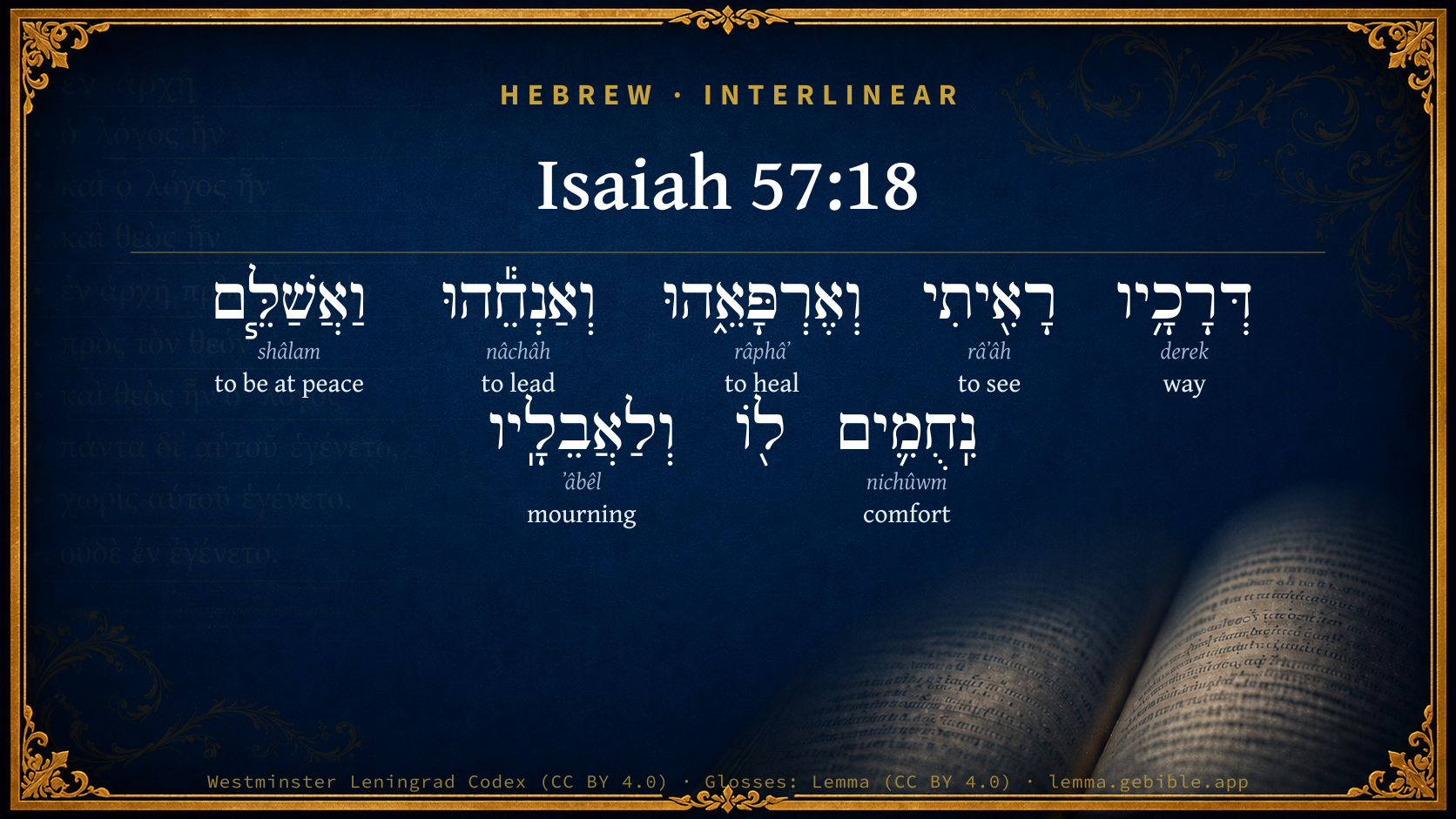
Hebrew (Westminster Leningrad Codex) Isaiah 57:18 appears in the Hebrew Old Testament. The text above is from the Westminster Leningrad Codex. Each word links to its Strong’s number, a concise gloss, and parsing drawn from the Open Scriptures Hebrew Bible morphology. Click any word for its full Brown-Driver-Briggs (BDB) entry.
Download image
Cite this verse

Isaiah 57:18 (World English Bible). Public Domain. Lemma interlinear Bible study tool, https://lemma.gebible.app/v/isaiah/57/18.

Show BibTeX & RIS
BibTeX
RIS
English Translation
I have seen his ways, and will heal him: I will lead him also, and restore comforts to him and to his mourners.
World English Bible · Public Domain
Highlights Full analysis ↓
Download a study sheet

One document with this verse’s original text, its word-by-word gloss line, the meaning frame, cross-references with their text, attributed commentary, and full source and license credits — printable, and it pastes into notes with its structure intact.

This verse Autodidact and up

Study sheet (.html) Plain text (.txt)

A passage Seminary Student

Up to 50 verses in one chapter. A passage sheet keeps up to 6 commentary sources and 12 cross-references per verse, in the order this page ranks them, and says so on the sheet whenever that leaves anything out. Ask for a single verse and you get the Autodidact verse sheet above.

Everything on this page stays free to read, with no account — the sheet is a download of what is already on screen, not access to it.

Want to remove ads? Support Godless Engineer
Compare translations 3

The same verse in 3 English versions, stacked beneath the original-language interlinear above. Click any original word for its lexicon entry.

Each is an independent rendering of the whole verse — the interlinear is not word-aligned to these translations.

Highlighted words mark where these versions differ — a whole-verse word diff, not a word-by-word alignment.

  • World English Bible Public Domain
    I have seen his ways, and will heal him: I will lead him also, and restore comforts to him and to his mourners.
  • King James Version Public Domain
    I have seen his ways, and will heal him: I will lead him also, and restore comforts unto him and to his mourners.
  • unfoldingWord Literal Text CC BY-SA 4.0
    I have seen his ways, and I will heal him, and I will lead him, and I will restore comforts to him and to his mourners,

unfoldingWord Literal Text — © unfoldingWord, licensed CC BY-SA 4.0. Word-aligned USFM3 via Door43 (git.door43.org/unfoldingWord/en_ult).

Versions to compare (up to 4)

3 of 4 selected

Show all 18 translations

Every available English version of this verse, each an independent rendering of the whole verse.

  • World English Bible Public Domain
    I have seen his ways, and will heal him: I will lead him also, and restore comforts to him and to his mourners.
  • Berean Standard Bible Public Domain
    I have seen his ways, but I will heal him; I will guide him and restore comfort to him and his mourners,
  • Majority Standard Bible Public Domain
    I have seen his ways, but I will heal him; I will guide him and restore comfort to him and his mourners,
  • King James Version Public Domain
    I have seen his ways, and will heal him: I will lead him also, and restore comforts unto him and to his mourners.
  • American Standard Version (1901) Public Domain
    I have seen his ways, and will heal him: I will lead him also, and restore comforts unto him and to his mourners.
  • Revised Version (1885) Public Domain
    I have seen his ways, and will heal him: I will lead him also, and restore comforts unto him and to his mourners.
  • Geneva Bible (1599) Public Domain
    I haue seene his wayes, and wil heale him: I wil leade him also, and restore comfort vnto him, and to those that lament him.
  • Douay-Rheims (1899) Public Domain
    I saw his ways, and I healed him, and brought him back, and restored comforts to him, and to them that mourn for him.
  • Young's Literal Translation Public Domain
    His ways I have seen, and I heal him, yea, I lead him, And recompense comforts to him and to his mourning ones.
  • Literal Standard Version CC BY-SA 4.0
    I have seen his ways, and I heal him, indeed, I lead him, || And repay comforts to him and to his mourning ones.
  • Unlocked Literal Bible CC BY-SA 4.0
    I have seen his ways, but I will heal him. I will lead him and comfort and console those who mourn for him,
  • unfoldingWord Literal Text CC BY-SA 4.0
    I have seen his ways, and I will heal him, and I will lead him, and I will restore comforts to him and to his mourners,
  • Darby Bible Public Domain
    I have seen his ways, and will heal him; and I will lead him, and will restore comforts unto him and to those of his that mourn.
  • World Messianic Bible Public Domain
    I have seen his ways, and will heal him. I will lead him also, and restore comforts to him and to his mourners.
  • Webster's Bible Public Domain
    I have seen his ways, and will heal him: I will lead him also, and restore comforts to him and to his mourners.
  • Free Bible Version CC BY-SA 4.0
    I know what they're doing, but I will heal them. I will lead them and comfort those who mourn,
  • Bible in Basic English Public Domain
    I have seen his ways, and I will make him well: I will give him rest, comforting him and his people who are sad.
  • JPS Tanakh (1917) Public Domain
    I have seen his ways, and will heal him; I will lead him also, and requite with comforts him and his mourners.

Literal Standard Version (2020), Covenant Press — licensed CC BY-SA 4.0. Text via the HelloAO Bible API (eBible.org). Unlocked Literal Bible (unfoldingWord) — licensed CC BY-SA 4.0. Text via the HelloAO Bible API (eBible.org). unfoldingWord Literal Text — © unfoldingWord, licensed CC BY-SA 4.0. Word-aligned USFM3 via Door43 (git.door43.org/unfoldingWord/en_ult). Free Bible Version, Dr. Jonathan Gallagher — licensed CC BY-SA 4.0. Text via the HelloAO Bible API (eBible.org).

Word by word

More ways to search: Search by grammar → Find every occurrence → Compare this word →

Practice this passage: Drill this verse → Learn its vocabulary →

נִֽחֻמִ֛ים
nichûwm
H5150
“comfort”
Noun, Common, Masculine, Plural, Absolute
Part of Speech
Noun
Type
Common
Gender
Masculine
Number
Plural
State
Absolute
Full BDB Definition

Origin: from H5162

TWOT: 1344b

comfort, compassion - comfort - compassion
  1. דְּרָכָ֥יו derek H1870 “ways · his” Noun, Common, Both, Plural, Construct + Suffix, Personal, 3rd Person, Masculine, Singular
  2. רָאִ֖יתִי râʼâh H7200 “to see” Verb, Qal, Perfect, 1st Person, Common, Singular
  3. וְאֶרְפָּאֵ֑הוּ râphâʼ H7495 “and · to heal · him” Conjunction + Verb, Qal, Imperfect, 1st Person, Common, Singular + Suffix, Personal, 3rd Person, Masculine, Singular
  4. וְאַנְחֵ֕הוּ nâchâh H5148 “and · to lead · him” Conjunction + Verb, Hiphil, Imperfect, 1st Person, Common, Singular + Suffix, Personal, 3rd Person, Masculine, Singular
  5. וַאֲשַׁלֵּ֧ם shâlam H7999 “and · to be at peace” Conjunction + Verb, Piel, Imperfect, 1st Person, Common, Singular
  6. וְלַאֲבֵלָֽיו ʼâbêl H57 “and · to/for · mourning · his” Conjunction + Preposition + Adjective, Adjective, Masculine, Plural, Construct + Suffix, Personal, 3rd Person, Masculine, Singular

About this verse

These counts appear in no published source. They are computed here, from the morphology-tagged text and Lemma’s own curated glosses. What Lemma adds →

8
words
7
distinct lemmas
Prophets
section

Notable vocabulary

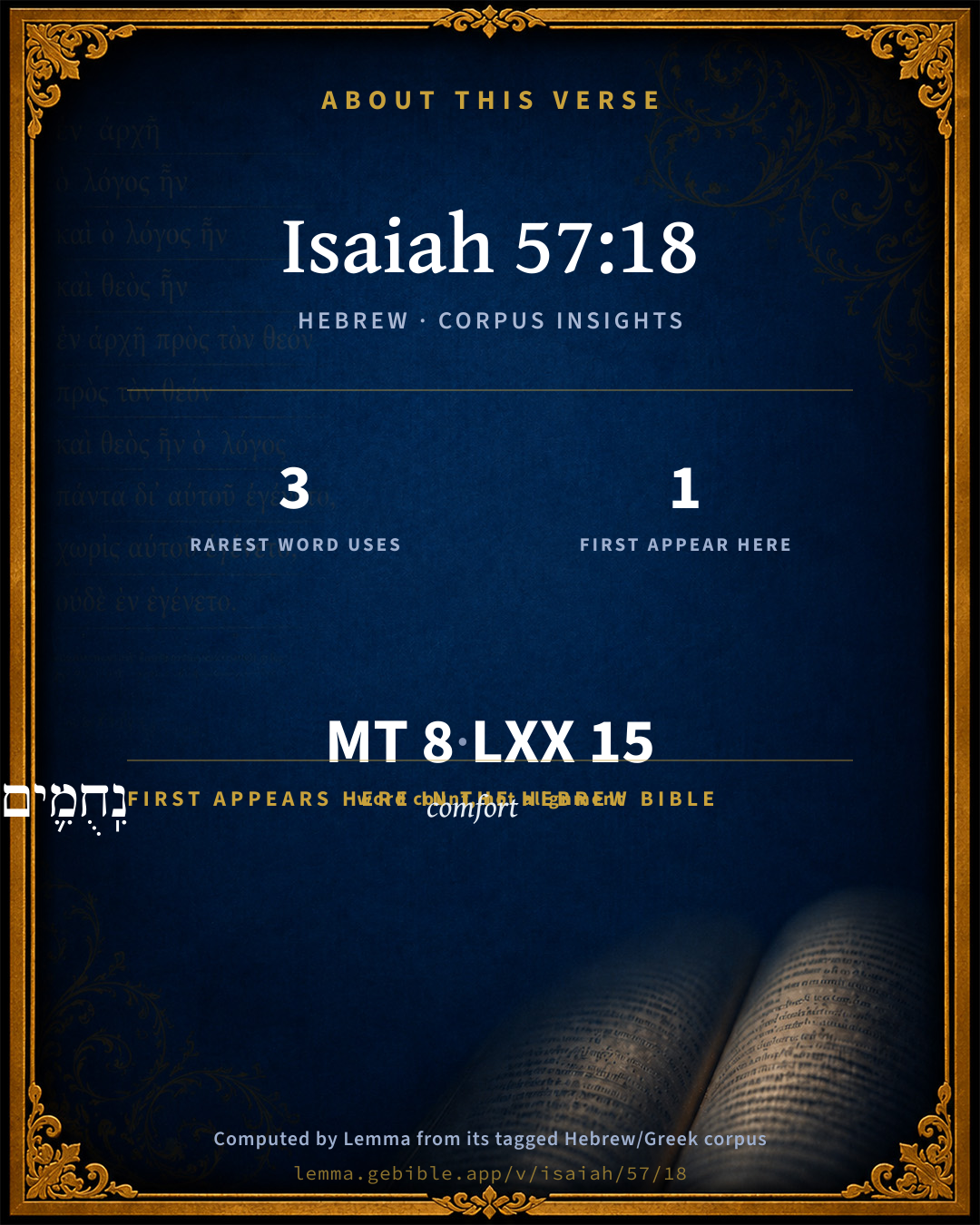
The rarest word here is נִֽחֻמִ֛ים comfort H5150 — appearing just 3 times in the whole Hebrew Bible.

First appearance in Scripture

This word makes its first canonical appearance in the Hebrew Bible here:

  • נִֽחֻמִ֛ים comfort H5150

Shared distinctive vocabulary

נִֽחֻמִ֛ים comfort H5150 occurs in 3 verses of the Hebrew Bible. Also found in:

Grammatical profile

  • 4 verbs
  • 2 nouns
  • 1 adjective
  • 1 preposition

Verb forms

  • רָאִ֖יתִי Qal · Perfect
  • וְאֶרְפָּאֵ֑הוּ Qal · Imperfect
  • וְאַנְחֵ֕הוּ Hiphil · Imperfect
  • וַאֲשַׁלֵּ֧ם Piel · Imperfect

Hebrew & Septuagint length

In English translation the verse runs 23 words from the Hebrew and 16 from the Septuagint (LXX English) — the Septuagint runs noticeably shorter here. See the side-by-side →

A rough comparison of the two English renderings, which tokenize alike — not a word-level alignment.

Word counts can differ between the Hebrew and the Greek without any difference in meaning — e.g. the Hebrew direct-object marker אֵת has no separate Greek word, and Greek often adds the article ὁ.

In the original languages it is 8 Hebrew tokens and 15 Greek tokens — but the two are counted differently (Hebrew bundles its prefixes and suffixes into one token; the Greek is in lemma form), so that isn’t a like-for-like length.

Cross-references

23

Topical passages linked to Isaiah 57:18 in the Treasury of Scripture Knowledge — connected by theme and wording, ordered by reader-vote popularity; previews shown in the World English Bible.

  • Jeremiah 33:6 Behold, I will bring it health and cure, and I will cure them; and I will reveal to them abundance of peace and truth.
  • Revelation 7:17 for the Lamb who is in the midst of the throne shepherds them, and leads them to springs of waters of life. And God will wipe away every tear from their eyes."
  • Jeremiah 3:22 Return, you backsliding children, I will heal your backsliding. Behold, we are come to you; for you are Yahweh our God.
  • Hosea 14:4–8 "I will heal their waywardness. I will love them freely; For my anger is turned away from him.
  • Jeremiah 31:3 Yahweh appeared of old to me, [saying], Yes, I have loved you with an everlasting love: therefore with loving kindness have I drawn you.
  • Isaiah 61:1–3 The Spirit of the Lord Yahweh is on me; because Yahweh has anointed me to preach good news to the humble; he has sent me to bind up the broken-hearted, to proclaim liberty to the captives, and the opening [of the prison] to those who are bound;
  • Jeremiah 13:17 But if you will not hear it, my soul shall weep in secret for [your] pride; and my eye shall weep sore, and run down with tears, because Yahweh's flock is taken captive.
  • Jeremiah 31:18–20 I have surely heard Ephraim bemoaning himself [thus], You have chastised me, and I was chastised, as a calf unaccustomed [to the yoke]: turn you me, and I shall be turned; for you are Yahweh my God.
  • Ezekiel 16:60–63 Nevertheless I will remember my covenant with you in the days of your youth, and I will establish to you an everlasting covenant.
  • Psalms 23:2 He makes me lie down in green pastures. He leads me beside still waters.
  • Psalms 51:12 Restore to me the joy of your salvation. Uphold me with a willing spirit.
  • Ecclesiastes 9:4 For to him who is joined with all the living there is hope; for a living dog is better than a dead lion.
  • Isaiah 1:18 "Come now, and let us reason together," says Yahweh: "Though your sins be as scarlet, they shall be as white as snow. Though they be red like crimson, they shall be as wool.
  • Isaiah 12:1 In that day you will say, "I will give thanks to you, Yahweh; for though you were angry with me, your anger has turned away and you comfort me.
  • Isaiah 30:26 Moreover the light of the moon shall be as the light of the sun, and the light of the sun shall be sevenfold, as the light of seven days, in the day that Yahweh binds up the hurt of his people, and heals the stroke of their wound.
  • Isaiah 49:10 They shall not hunger nor thirst; neither shall the heat nor sun strike them: for he who has mercy on them will lead them, even by springs of water will he guide them.
  • Isaiah 57:15 For thus says the high and lofty One who inhabits eternity, whose name is Holy: I dwell in the high and holy place, with him also who is of a contrite and humble spirit, to revive the spirit of the humble, and to revive the heart of the contrite.
  • Isaiah 66:10–13 Rejoice you with Jerusalem, and be glad for her, all you who love her: rejoice for joy with her, all you who mourn over her;
  • Isaiah 43:24–25 You have bought me no sweet cane with money, neither have you filled me with the fat of your sacrifices; but you have burdened me with your sins, you have wearied me with your iniquities.
  • Isaiah 48:8–11 Yes, you didn't hear; yes, you didn't know; yes, from of old your ear was not opened: for I knew that you did deal very treacherously, and was called a transgressor from the womb.
  • Ezekiel 36:22–38 Therefore tell the house of Israel, Thus says the Lord Yahweh: I don't do [this] for your sake, house of Israel, but for my holy name, which you have profaned among the nations, where you went.
  • Luke 15:20 "He arose, and came to his father. But while he was still far off, his father saw him, and was moved with compassion, and ran, and fell on his neck, and kissed him.
  • Romans 5:20 The law came in besides, that the trespass might abound; but where sin abounded, grace did abound more exceedingly;

Cross-references courtesy of OpenBible.info (CC BY 4.0).

Hebrew and Greek witnesses Masoretic Hebrew ↔ Greek Septuagint

The same verse in the two great witnesses to the Old Testament, shown verse-for-verse.

Here the Septuagint runs noticeably shorter than the Hebrew — LXX2012 (modern English Septuagint) 16 words vs World English Bible 23. A rough length comparison of the two English translations, not a word-level alignment — read both below.

These are two independent witnesses, not word-aligned to each other, and the Septuagint is shown in lemma (dictionary) form.

Hebrew Isaiah 57:18 Masoretic · Westminster Leningrad Codex

דְּרָכָ֥יו רָאִ֖יתִי וְאֶרְפָּאֵ֑הוּ וְאַנְחֵ֕הוּ וַאֲשַׁלֵּ֧ם נִֽחֻמִ֛ים ל֖וֹ וְלַאֲבֵלָֽיו

I have seen his ways, and will heal him: I will lead him also, and restore comforts to him and to his mourners.

World English Bible · Public Domain

Greek LXX Isaiah 57:18 Septuagint · lemma form

ὁ ὁδός αὐτός ὁράω καί ἰάομαι αὐτός καί παρακαλέω αὐτός καί δίδωμι αὐτός παράκλησις ἀληθινός

I have seen his ways, and healed him, and comforted him, and given him true comfort;

LXX2012 (modern English Septuagint) · Public Domain

Hebrew: Westminster Leningrad Codex (CC BY 4.0). Greek: Septuagint (public domain); English from LXX2012 (modern English Septuagint) (Public Domain). How the Septuagint differs from the Hebrew →

Targum (Aramaic paraphrase)

1

The Targum is the ancient Jewish Aramaic paraphrase of the Hebrew Scriptures — an interpretive translation, not the Hebrew text itself. Onkelos (literal) and Pseudo-Jonathan (expansive) render the Torah, and Jonathan the Prophets. Coverage is partial: where no permissively-licensed English translation exists for a verse, only the Aramaic is shown. This is verse-level text, not a word-by-word alignment to the Hebrew.

  1. Targum Jonathan Prophets (Joshua–Malachi)
    אוֹרַח תְּיוּבְתְּהוֹן גַלְיָא קֳדָמַי וְאֶשְׁבּוֹק לְהוֹן וַאֲרַחֵם עֲלֵיהוֹן וַאֲשַׁלֵם תַּנְחוּמִין לְהוֹן וּלְמִתְאַבְּלִין עֲלֵיהוֹן:

    The way of their repentance is revealed before me, and I will forgive them, and I will have compassion upon them, and requite consolations to them and to those that mourn with them.

    Targum Jonathan — Aramaic: “Mikraot Gedolot” (public domain). English: “Sefaria Community Translation” (CC0 1.0 (public-domain dedication)); “London "Chaldee Paraphrase," 1871” (public domain). Text via Sefaria.

Commentary

Notes on Isaiah 57:18 from classic Christian and Jewish commentators (each source and its license shown beneath its notes). The classic Christian expositions comment on the surrounding passage and are grouped to its opening verse, so a note may address several verses; the Jewish commentaries on the Tanakh (Rashi and others) are per-verse, so they appear only where the commentator wrote on this verse.

Lemma curates 59 commentaries, every one of them public domain or Creative Commons licensed, each selected and text-cleaned for this edition rather than reprinted as found. About our sources →

Trapp's Complete Commentary

John Trapp

Isa 57:18 I have seen his ways, and will heal him: I will lead him also, and restore comforts unto him and to his mourners.

Ver. 18. I have seen his ways.] His ways of covetousness, crossness, &c. I could be as cross as he for the heart of him, {Psa 18:26} but

I will heal him,] q.d., I see these froward children will lay nothing to heart; frowns will not humble them, blows will not benefit them; if I do not save them till they seek me, they will never be saved. Therefore I will work for mine own name’s sake. See Eze 20:8; Eze 20:14; Eze 20:22; Eze 20:44.

And restore comforts unto him, and to his mourners.] To those that mourn in secret for his sins and miseries; {Eze 9:4 Mat 5:4} and to others for their sakes, ratione consortii.

John Trapp, A Commentary or Exposition upon All the Books of the Old and New Testament (1647–1656) — public domain. Text from a community e-Sword module.

The Biblical Illustrator

Joseph S. Exell

Isa_57:18-19

I have seen his ways, and will heal him

Observing and healing

This could only be said of God--He alone can see the ways of man.

We have here--

I. A DIVINE ATTRIBUTE. Intimate knowledge of the ways of men. I have seen. God has no need to be told. Tale-bearers exaggerate and lie. God does not even trust His angels. They go about the world observing the evil and the good. But it is not upon their reports He acts. I know, He says, their thoughts. I have seen his ways. How solemnly should the fact impress us!

1. There is the man who makes a profession of religion. But that man knows how within him there exist the root and seeds of evil, that his life is a constant struggle, and sin with all its might is contending for the mastery. The deeper that mans piety is, he realizes with the greater pain his weakness and imperfection, and is horrified at the list which is written up against him by an observing God.

2. Not only the righteous are the subjects of Divine observation, but the wicked as well. The observations of Almighty God produce very different results according to the character of the person He observes. To the man who strives after the way of righteousness it is an encouragement and a warning. But to him who neglects religion and follows sin it is filled with terrible dread and is the precursor of ineffable judgment.

II. A DIVINE PROMISE. The humblest efforts after holiness arc regarded by the great King, and are noted equally with the failures. He sees the whole--the follies, the weaknesses, the struggles, and the regrets, and He isfilled with pity. He knows that unaided man cannot divert his way, and therefore He vouchsafes to give a promise, I will heal. In this promise we have--

1. A manifestation of love.

2. A manifestation of authority, Will heal. It is God only who can heal man.

Application:

1. God will come to those who seek Him. They draw nigh to Him, He draws nigh to them.

2. How joyous is the sound of healing to a sick man! Much more the promise of forgiven sin.

3. Time is passing quickly. What are your ways? Are they such as encourage the Divine advances or repel infinite love? (Homilist.)

The Divine Healer

I. DIVINE KNOWLEDGE.

II. DIVINE MERCY.

1. I will heal him, I will lead him also. We all need guidance, as we move on through this wilderness.

2. Another part of the healing is the happiness of mind which Christ bestows upon His reconciled people. I will heal him and restore comforts unto him.

3. Then, too, will follow praise. I create the fruit of the lips. The songs of heaven will be begun in your souls, even now upon earth.

4. Peace, settled peace. Peace, peace to him that is far off, and to him that is near, saith the Lord: and I will heal him. There is in that one word, peace, a treasury of blessedness which you may forego all else to buy. (C. Clayton, M. A.)

Wonder at Gods grace

There are a few objects in nature which never cease to astonish the beholder. I think Humboldt said he could never look upon the rolling prairies without astonishment: and I suppose some of us will never be able to look upon the ocean, or to see the sun rise or set, without feeling that we have before us something always fresh and always new. Now, I have been, not only for the love of it, but because of my calling of preaching it, a constant reader of Holy Scripture, and yet after these five-and-twenty years and more I frequently alight upon well-known passages which astonish me as much as ever. As if I had never heard them before, they come upon me, not merely with freshness, but even so as to cause amazement in my soul. This is one of those portions of Scripture. When I read the chapter describing the horrible wickedness of Israel--when I notice the strong terms which inspiration uses, and none of them too strong, to set forth the horrible wickedness of the nation--it staggers me. And then to see mercy following instead of judgment! It overwhelms me! I have seen his ways, and--it is not added, I will destroy him; I will sweep him away, but, I will heal him. Verily Gods grace, like the great mountains, cannot be scaled; like the deeps of the sea, it can never be fathomed, and, like space, it cannot be measured. It is, like God Himself, matchless, boundless. Oh, the depths! Oh, the depths! (C. H. Spurgeon.)

Amazing grace

I. The text declares that THE SINNER HAS BEEN OBSERVED OF THE LORD. Notice,

1. That Gods omniscience has observed the sinner. Man while living in rebellion against God is as much under His eye as the bees in a glass hive are under your eye when you stand and watch all their movements. The eye of Jehovah never sleeps it is never taken off from a single creature He has made. He sees man--sees him everywhere--sees him through and through; so that He not only hears his words, but knows his thoughts--does not merely behold his actions, but weighs his motives, and knows what is in the man as well as that which comes out of the man. God has seen your ways at home, your ways abroad, your ways in the shop, your ways in the bed-chamber, your ways within as well as your ways without--the ways of your judgment, the ways of your hope, the ways of yourdesire, the ways of your evil lustings, the ways of your murmurings, the ways of your pride. He has seen them all, and seen them perfectly and completely; and the wonder is that, after seeing all, He has not cut us down, but instead of it has proclaimed this amazing word of mercy, I have seen his ways, and will heal him.

2. But God had not only seen their ways in the sense of omniscience, but He had inspected their ways in the sense of judgment. He says, I was wroth and I hid Myself. Do not think because we preach free grace and dying love to you, and proclaim full pardon through the blood of Jesus, that therefore God winks at sin. No, He is a terrible God, and will by no means spare the guilty. And yet He whom the angels call Holy, holy, holy, Lord God of Sabaoth--the, jealous God, the. God who revengeth, and is furious against sin--even He has said, I have seen his ways, and will heal him.

3. The Lord had tested him. If you read the chapter through you will see that God says He had attempted to reclaim him by chastisements.

II. THE SINNER IS THE OBJECT OF DIVINE MERCY TO AN EXTRAORDINARY DEGREE.

1. Notice how God speaks. I will, I will. Now, I will and I shall are for the King; nay, in the highest sense they are only becoming when used by God Himself. It is not for you and me to say I will; we shall speak more wisely if we declare that we will if we can.

2. The disease that we suffer from is a disease He knows all about, because the text says, I have seen his ways.

3. Then the text goes on to say, I will lead him also. The poor soul of man, even when healed, does not know which way to go. There is not a more bewildered thing in this world than a poor sinner when first he is awakened. Have you ever gone with a candle into a barn where a number of birds have roosted? Have you disturbed them? Have you not seen how they dart hither and thither, and do not know which way to fly? The light confuses them. So it is when Christ comes to poor sinners. They do not know which way to go; they see a little, but the very light confuses them. Now, the loving Lord comes in, and He says, I will lead him also.

4. I will restore comforts to him. God begins by knocking our comforts away. He takes away the comfort we once had in our false peace, and He makes us mourn for sin. But after a while He restores comfort to us. What sort of comfort? The comfort of perfect forgiveness, the comfort of complete acceptance. The Father sets a warm kiss upon the childs cheek, and that is the comfort of adoption. Whereas we were heirs of earth, we become heirs of heaven, and have the comforts of hope. We receive the comfort of daily fellowship, for we are admitted to speak with God, and to draw near to Him; the comfort of perfect security, for we are led to feel that whether we live or die we are safe in the arms of Jesus; the comfort of a blessed prospect beyond the grave in the land of the hereafter, where the flowers shall never wither; the comfort of knowing that all things work together for good; the comfort of having the angels for our servants, and heaven for our home. I will restore comforts to him; and all this to the man of whom it is said, Thou didst debase thyself even unto hell. (C. H.Spurgeon.)

God sees the sinner

In the old time, when the Grecians worshipped images of their gods, it was said that when spiders stretched their webs across the eyelids of the image of Jupiter, the people were regular in their attendance to worship him. They liked to feel that the spiders webs prevented Jupiter from seeing their sins, and in their poor, feeble way were no doubt grateful to the insects for covering the eyes of a god who, they thought, would punish them for their sins if he could see their ways. (W. Birch.)

And restore comforts unto him. -

Comfort

The word comfort comes orginally from two Latin words, con and fortis, meaning much strength. In time of trouble, when you lift up your heart and bravely bear the bruden, the strength which enables you to do it is called comfort (W. Birch.)

Comforts

1. It is a great comfort have peace of mind. Many people have sought to obtain wealth, hoping it would give peace of mind; but they have been mistaken. But what a comfort it is to those who have obtained it! It flows from the knowledge that our sins are forgiven.

2. Another comfort is that God is with us.

3. What a comfort to know that God is our helper. His fingers are tender, and His heart is loving as that of a gentle mother.

4. It is a comfort to know that God is our strength in time of temptation. When an engine has to lift a weight which is beyond its usual work, the engineer stands at the steam gauge, and when the finger reaches near the danger point, he cries, Hold hard; it can do no more! If he allowed the engine to be pressed beyond the safety point, there might be an accident. Likewise, God knows the gauge of every mans heart. He knows exactly what trials you can bear, and how much temptation you can stand. He declares that no man shall be tempted above that he is able.

5. It is our comfort to know that God is our support in the pathway of our life.

6. Here is another comfort--that our God is the Friend of sinners. (W. Birch.)

The Biblical Illustrator, edited by Joseph S. Exell (c. 1880s–1900s) — public domain. Text from a community e-Sword module.

Joseph Benson's Commentary

Isa 57:18. I have seen his ways — I have taken notice of those evil ways in which he seems resolved to walk, and that he is neither reformed by mercies nor judgments; and will heal him — Or rather, yet I will heal him: although I might justly destroy him, and leave him to perish in his own ways, yet, of my mere mercy, and for my own name’s sake, I will pity this people, turn them from their sins, and bring them out of their troubles. Which promise was partly fulfilled when God restored them from Babylon, and will be more perfectly and evidently accomplished, when he shall convert them to the Christian faith in the latter days. And restore comforts unto him — Comforts as great as his troubles had been; and — Or rather, to wit; to his mourners — To those who are humbled under God’s hand, and that mourn in Zion for their own and other people’s sins, Isa 61:2-3; and Eze 9:4; and for the calamities of God’s church and people, Isa 66:10. The mourners here spoken of, Vitringa thinks, mean those true penitents, who lamented the scandals and offences of professing Christians in their times, under whom they grievously suffered, such as the Waldenses, the Lollards, and others who, by the mercy of God, were rescued from the errors and corruptions of the fallen church, when the light of the Reformation began to dawn.

Joseph Benson's Commentary on the Old and New Testaments (1811–1818) — public domain. Text from a community e-Sword module.

Tyndale Open Study Notes

Tyndale Open Resources

57:18 I will heal them anyway: Salvation is by God’s grace (see 19:22; 30:26; 53:5).

Tyndale Open Study Notes — © Tyndale Open Resources, licensed CC BY-SA 4.0. Text via the HelloAO Bible API.

Geneva Bible (1599)

Geneva Bible translators

Though they were obstinate, yet I did not withdraw my mercy from them.

Geneva Bible (1599) marginal notes — public domain. Text via Bolls.life.

Jamieson, Fausset & Brown

Robert Jamieson, A. R. Fausset & David Brown

Rather, "I have seen his ways (in sin), yet will I heal him," that is, restore Israel spiritually and temporally (Jer 33:6; Jer 3:22; Hos 14:4-5) [HORSLEY].

I will . . . restore comforts unto him and to his mourners--However, the phrase, "his mourners," favors English Version; "his ways" will thus be his ways of repentance; and God's pardon on "seeing" them answers to the like promise (Isa 61:2-3; Jer 31:18, Jer 31:20).

Jamieson, Fausset & Brown — Commentary Critical and Explanatory on the Whole Bible (1871) — public domain (CC PDM 1.0). Text via the HelloAO Bible API.

Adam Clarke's Commentary

Verse 18. I have seen his ways] Probably these verses refer to the restoration of the Jews from captivity.

Adam Clarke's Commentary on the Bible (1810–1826) — public domain. Text from a community e-Sword/MySword module.

Ellicott's Commentary for English Readers

(18) I have seen his ways . . .—The words have been interpreted: (1) of the evil ways described in the previous verse; (2) of the way of repentance into which Israel had been led by chastisement. (1) seems most in harmony with the context. The paths had been rough and thorny, but Jehovah presents Himself as the Healer to those who had been wounded by them, and leads them into a better way. The “mourners” are those who have been touched as with the “godly sorrow” of 2Co_7:10-11.

A Bible Commentary for English Readers, edited by Charles John Ellicott (1878–1897) — public domain. Text from a community e-Sword module.

The Cambridge Bible for Schools and Colleges

gen. ed. J. J. S. Perowne

18. I have seen his ways] Either “his sinful ways” or “the amendment of his ways.” The first view is perhaps more probable, in which case the words would be better joined to the preceding verse (so Duhm).

and will heal him] Or, “And I will heal him,”—beginning a new sentence. Cf. Hos_6:1; Hos_14:4; Jer_3:22.

For comforts read comfort.

his mourners] ch.Isa_61:2, Isa_66:10.

The Cambridge Bible for Schools and Colleges (gen. ed. J. J. S. Perowne; Cambridge University Press, 1878–1918) — public domain. Text from a community e-Sword module.

John Gill's Exposition

I have seen his ways, and will heal him,.... Either the ways of such who trust in the Lord, the ways of the humble and contrite, who are brought by repentance and reformation, by the dealings of God with them; these he sees, knows, and approves of, and heals their former backslidings; for though not all, yet some may be reformed hereby; or rather the ways of the froward, their evil ways, which are their own ways in opposition to God's ways, peculiar to themselves, of their own devising and choosing; these the Lord sees, resents, and corrects for, and yet graciously pardons them, which is meant by healing:

I will lead him also; out of those evil ways of his into the good and right way in which he should go; into the way of truth and paths of righteousness; for it is for want of evangelical light and knowledge that so many err from the truths of the Gospel, and from the simplicity of Gospel worship; but in the latter day the Spirit of truth shall be poured down from on high, and shall lead professors of real religion into all truth, and they shall speak a pure language, and worship the Lord with one consent:

and restore comforts to him, and to his mourners; that mourn over their own sins, and the sins of others; that mourn in Zion, and for Zion; for the corruptions in doctrine and worship crept into the reformed churches; for the want of church discipline and Gospel conversation; for the declensions of professors of religion, and the divisions among them; and for that worldly, earthly, and carnal spirit that prevails; for these, as bad as our times are, there are some that mourn publicly and privately; and to these, and to the church for their sakes, comfort shall be restored, by sending forth Gospel light, truth, and knowledge, which shall cover the earth as the waters the sea; by reviving primitive doctrines and ordinances; by blessing the word to the conversion of a multitude of sinners, and to the edification of saints; by causing brotherly love, peace, and spirituality, to abound among professors, and by blessing all the means of grace to the consolation of their souls; and by making particular applications of the blood, righteousness, and sacrifice of Christ, for pardon, justification, and atonement, the solid foundation of all true comfort.

John Gill's Exposition of the Whole Bible (1746–1763) — public domain (CC PDM 1.0). Text via the HelloAO Bible API.

Albert Barnes' Notes on the Bible

I have seen his ways - That is, either his ways of sin, or of repentance most probably it means the former; and the idea is, that God had seen how prone his people were to sin, and that he would now interpose and correct their proneness to sin against him, and remove from them the judgments which had been brought upon them in consequence of their crimes.

And will heal him - That is, I will pardon and restore him. Sin, in the Scriptures, is often represented as a disease, and pardon and salvation as a healing of the disease (2Ch 7:14; Psa 41:4; Jer 3:22; Jer 17:4; Jer 32:6; Hos 14:4; see the notes at Isa 6:10).

And to his mourners - To the pious portion that mourned over their sin; or to the nation which would sigh in their long and painful captivity in Babylon.

Albert Barnes' Notes on the Bible (1834–1885) — public domain. Text from a community e-Sword/MySword module.

Matthew Poole's English Annotations

I have seen his ways; I have taken notice of these evil ways in which he seems resolved to walk, and that he is neither bettered by mercies nor judgments.

And will heal him; or, yet I will heal him. Although I might justly destroy him, and leave him to perish in his own ways, yet of my mere mercy, and for my own name’s sake, I will pity him, and turn him from his sins, and bring him out of his troubles. And, or, to wit, the copulative conjunction being put expositively, as it is frequently,

to his mourners; to those who are humbled under God’s hand, that mourn in Zion, Isa 61:2,3, for their own and others’ sins, Eze 9:4, and for the calamities of God’s church and people, Isa 66:10.

Matthew Poole's English Annotations on the Holy Bible (1683–1685) — public domain. Text from a community e-Sword/MySword module.

Whedon's Commentary on the Bible

Daniel D. Whedon

18. I have seen his ways — Man’s ways. Either his ways of rebellion or his ways of repentance, it is uncertain which; perhaps both: the one caused God to withdraw his favour, the other, to return it. God is merciful, and will heal on sincere repentance. When backslidings are healed, then divine guidance and comfort follow.

To his mourners — Repenting Israel is meant. He accounts them as “mourners,” and imparts healing and consolation.

Daniel D. Whedon (gen. ed.), Commentary on the Old and New Testaments (1874–1909) — public domain. Text from a community e-Sword module.

The Pulpit Commentary

I have seen his ways, and will heal him. God had seen the wanderings of his people in perverse ways, and his heart had been touched with pity thereat. The good Shepherd follows and recalls the wanderers of the flock. When they have suffered hurt he "heals" them. He is willing to "lead" them also to go before them, and show them the way that they should walk in, (Isa_49:10 Eze_34:11-16) and "restore comforts" to them, especially to such of them as have begun to "mourn" over their perversity.

The Pulpit Commentary (1880–1919), ed. H.D.M. Spence-Jones & Joseph S. Exell — public domain. Text from a community e-Sword module.

John Wesley's Explanatory Notes

Mourners - To those who are humbled under God's hand, that mourn in Zion for their own and others sins.

John Wesley, Explanatory Notes Upon the Whole Bible (1754–1765) — public domain. Text via the GEBible commentary corpus.

J. A. Alexander on Isaiah

Joseph Addison Alexander

“His ways I have seen, and I will heal him, and will guide him, and restore comforts unto him and to his mourners.” The healing here meant is forgiveness and conversion, with a reference to Isa 6:10 and Psa 41:4. This obvious meaning of the figure creates a difficulty in explaining the foregoing words so as to make the connection appear natural. Some suppose an antithesis, and make the particle adversative. ‘I have seen his (evil) ways, but I will (nevertheless) heal him.’ There is then a promise of gratuitous forgiveness similar to that in Isa 43:25 and Isa 48:9. The promise to restore consolation implies not only that it had been once enjoyed but also that it should compensate for the intervening sorrows, as the Hebrew word means properly to make good or indemnify.

Joseph Addison Alexander, The Prophecies of Isaiah (1846–1847; New York: Scribner, 1870–1878) — public domain. Text from a community e-Sword module.

unfoldingWord translationNotes

Door43 World Missions Community

General Information:

Yahweh continues speaking.

his ways

"their ways." Here "his" refers to the people of Israel.

comfort and console those who mourn for him

"I will soothe and calm those who feel sad for the people's suffering because of their sinful behavior"

I create the fruit of the lips

Here "fruit of the lips" refers to what a person says. AT: "I cause them to praise and thank me" (See: Metonymy)

Peace, peace, to those who are far off

"I have made peace with them who are far off." The word "Peace" is repeated for emphasis.

translationWords

cure

comfort

create

fruit

peace

Yahweh

unfoldingWord translationNotes — © Distant Shores Media and the Door43 World Missions Community, licensed CC BY-SA 4.0. Source: git.door43.org/Door43/en_tn.

Rashi

Rabbi Shlomo Yitzchaki (Rashi)

I saw his ways when he humbled himself before Me, when troubles befell him.

and I will heal him, and I will lead him Heb. וְאַנְחֵהוּ. I will lead him in the way of healing. Alternatively, וְאַנְחֵהוּ is an expression of rest and tranquility.

him and his mourners to those who are troubled over him.

Rashi on the Tanakh — English translations: “The Judaica Press complete Tanach with Rashi, translated by A. J. Rosenberg” (CC BY 4.0); “Pentateuch with Rashi's commentary by M. Rosenbaum and A.M. Silbermann, 1929-1934” (public domain); “The Metsudah Tanach series, Lakewood, N.J” (CC BY 4.0); and “The Book of Joshua, Metsudah Publications, 1997” (CC BY 4.0). Text via Sefaria.

Ibn Ezra

Rabbi Abraham ibn Ezra

I have seen his ways, etc. This verse proves that my opinion concerning this book is right. His ways, that is, his repentance, or his innate evil inclination; comp. for the imagination of man’s heart is evil from his youth (Gen. 8:21).

And I will heal him, and I will lead him also. He is like an invalid, that has no strength to go by himself.

And I will restore comforts unto him for the calamity that had befallen him.

And to his mourners, that is, to his friends; people usually begin to mourn when they see their sick friend dying.

Ibn Ezra on the Tanakh — English translations: “Sefaria Community Translation” (CC0 1.0 (public-domain dedication)); “Yalkut, Sifsei Chachomim Chumash, Metsudah Publications, 2009” (CC BY 4.0); and “Commentary of Ibn Ezra on Isaiah - trans. by M. Friedlander, 1873” (public domain). Text via Sefaria.

Lesson kit

Teaching starters — assembled from the data on this page, not authored interpretation. Every prompt links to the verse data it draws on. Edit before teaching.

Isaiah, in the Prophets, opens this verse with 8 words (7 distinct Hebrew lemmas). Its most distinctive word is nichûwm (“comfort”). The Greek Septuagint runs shorter here. A historical commentator’s framing appears above. Read the whole chapter for the surrounding context.

Discussion questions

  1. What does “comfort” (nichûwm) contribute to the verse as a whole?
  2. The word “comfort” first appears here in Scripture. What is being introduced at this debut?
  3. Hosea 11:8 shares the word «comfort» with this verse. How do the two illuminate each other?
  4. Compared with the Hebrew, the Septuagint runs shorter here. What questions does that raise?
  5. The translations on this page render this verse differently — a whole-verse word diff, not a word-by-word alignment. What might account for the different wordings?
  6. The verb «רָאִ֖יתִי» is Qal Perfect. How does its form color the action?
  7. Reading how Trapp's Complete Commentary and The Biblical Illustrator read this verse, where do the two commentators agree and where do they part?

Things to notice

Reading settings

Reading text

Shown beneath each verse's original-language words.

Old Testament
Old Testament edition

Read the OT as the Masoretic Hebrew (MT) or the Greek Septuagint (LXX).

English shown for the Greek Septuagint (in the Hebrew ↔ Greek comparison).

Comparing translations? Open the Compare panel on any verse page to stack up to four side by side.