Ecclesiastes 4:3

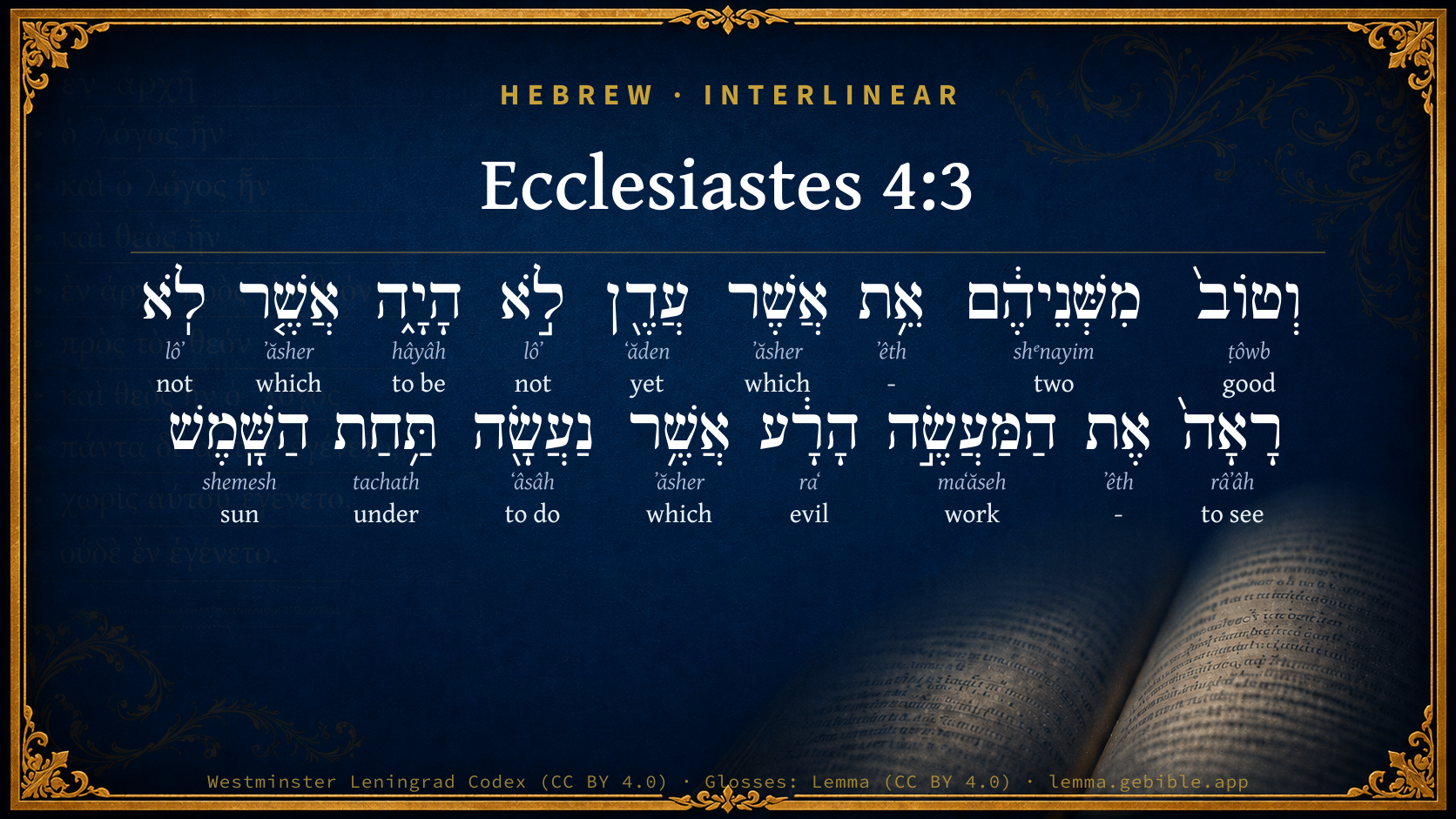
Hebrew (Westminster Leningrad Codex) Ecclesiastes 4:3 appears in the Hebrew Old Testament. The text above is from the Westminster Leningrad Codex. Each word links to its Strong’s number, a concise gloss, and parsing drawn from the Open Scriptures Hebrew Bible morphology. Click any word for its full Brown-Driver-Briggs (BDB) entry.
Download image
Cite this verse

Ecclesiastes 4:3 (World English Bible). Public Domain. Lemma interlinear Bible study tool, https://lemma.gebible.app/v/ecclesiastes/4/3.

Show BibTeX & RIS
BibTeX
RIS
English Translation
Yes, better than them both is him who has not yet been, who has not seen the evil work that is done under the sun.
World English Bible · Public Domain
Download a study sheet

One document with this verse’s original text, its word-by-word gloss line, the meaning frame, cross-references with their text, attributed commentary, and full source and license credits — printable, and it pastes into notes with its structure intact.

This verse Autodidact and up

Study sheet (.html) Plain text (.txt)

A passage Seminary Student

Up to 50 verses in one chapter. A passage sheet keeps up to 6 commentary sources and 12 cross-references per verse, in the order this page ranks them, and says so on the sheet whenever that leaves anything out. Ask for a single verse and you get the Autodidact verse sheet above.

Everything on this page stays free to read, with no account — the sheet is a download of what is already on screen, not access to it.

Want to remove ads? Support Godless Engineer
Compare translations 3

The same verse in 3 English versions, stacked beneath the original-language interlinear above. Click any original word for its lexicon entry.

Each is an independent rendering of the whole verse — the interlinear is not word-aligned to these translations.

Highlighted words mark where these versions differ — a whole-verse word diff, not a word-by-word alignment.

  • World English Bible Public Domain
    Yes, better than them both is him who has not yet been, who has not seen the evil work that is done under the sun.
  • King James Version Public Domain
    Yea, better is he than both they, which hath not yet been, who hath not seen the evil work that is done under the sun.
  • unfoldingWord Literal Text CC BY-SA 4.0
    But better than two of them the one who has not yet lived, who has not seen the evil deed that is being done under the sun.

unfoldingWord Literal Text — © unfoldingWord, licensed CC BY-SA 4.0. Word-aligned USFM3 via Door43 (git.door43.org/unfoldingWord/en_ult).

Versions to compare (up to 4)

3 of 4 selected

Show all 18 translations

Every available English version of this verse, each an independent rendering of the whole verse.

  • World English Bible Public Domain
    Yes, better than them both is him who has not yet been, who has not seen the evil work that is done under the sun.
  • Berean Standard Bible Public Domain
    But better than both is he who has not yet existed, who has not seen the evil that is done under the sun.
  • Majority Standard Bible Public Domain
    But better than both is he who has not yet existed, who has not seen the evil that is done under the sun.
  • King James Version Public Domain
    Yea, better is he than both they, which hath not yet been, who hath not seen the evil work that is done under the sun.
  • American Standard Version (1901) Public Domain
    yea, better than them both `did I esteem' him that hath not yet been, who hath not seen the evil work that is done under the sun.
  • Revised Version (1885) Public Domain
    yea, better than them both did I esteem him which hath not yet been, who hath not seen the evil work that is done under the sun.
  • Geneva Bible (1599) Public Domain
    And I count him better then them both, which hath not yet bin: for he hath not seene the euill workes which are wrought vnder the sunne.
  • Douay-Rheims (1899) Public Domain
    And I judged him happier than them both, that is not yet born, nor hath seen the evils that are done under the sun.
  • Young's Literal Translation Public Domain
    And better than both of them `is' he who hath not yet been, in that he hath not seen the evil work that hath been done under the sun.
  • Literal Standard Version CC BY-SA 4.0
    And better than both of them [is] he who has not yet been, in that he has not seen the evil work that has been done under the sun.
  • Unlocked Literal Bible CC BY-SA 4.0
    However, more fortunate than both of them is the one who has not yet lived, the one who has not seen any of the evil acts that are done under the sun.
  • unfoldingWord Literal Text CC BY-SA 4.0
    But better than two of them the one who has not yet lived, who has not seen the evil deed that is being done under the sun.
  • Darby Bible Public Domain
    and more fortunate than both is he who hath not yet been, who hath not seen the evil work that is done under the sun.
  • World Messianic Bible Public Domain
    Yes, better than them both is him who has not yet been, who has not seen the evil work that is done under the sun.
  • Webster's Bible Public Domain
    Yes, better is he than both they, who hath not yet been, who hath not seen the evil work that is done under the sun.
  • Free Bible Version CC BY-SA 4.0
    But best of all are those who have never existed—they haven't seen the evil things people do to each other here on earth.
  • Bible in Basic English Public Domain
    Yes, happier than the dead or the living seemed he who has not ever been, who has not seen the evil which is done under the sun.
  • JPS Tanakh (1917) Public Domain
    but better than they both is he that hath not yet been, who hath not seen the evil work that is done under the sun.

Literal Standard Version (2020), Covenant Press — licensed CC BY-SA 4.0. Text via the HelloAO Bible API (eBible.org). Unlocked Literal Bible (unfoldingWord) — licensed CC BY-SA 4.0. Text via the HelloAO Bible API (eBible.org). unfoldingWord Literal Text — © unfoldingWord, licensed CC BY-SA 4.0. Word-aligned USFM3 via Door43 (git.door43.org/unfoldingWord/en_ult). Free Bible Version, Dr. Jonathan Gallagher — licensed CC BY-SA 4.0. Text via the HelloAO Bible API (eBible.org).

Word by word

More ways to search: Search by grammar → Find every occurrence → Compare this word →

Practice this passage: Drill this verse → Learn its vocabulary →

עֲדֶ֖ן
ʻăden
  1. וְטוֹב֙ ṭôwb H2896 “and · good” Conjunction + Adjective, Adjective, Masculine, Singular, Absolute
  2. מִשְּׁנֵיהֶ֔ם shᵉnayim H8147 “from · two · their” Preposition + Adjective, Cardinal number, Masculine, Dual, Construct + Suffix, Personal, 3rd Person, Masculine, Plural
  3. אֵ֥ת ʼêth H853 “-” Particle, Direct Object
  4. אֲשֶׁר ʼăsher H834 “which” Particle, Relative
  5. לֹ֣א lôʼ H3808 “not” Particle, Negative
  6. הָיָ֑ה hâyâh H1961 “to be” Verb, Qal, Perfect, 3rd Person, Masculine, Singular
  7. אֲשֶׁ֤ר ʼăsher H834 “which” Particle, Relative
  8. לֹֽא lôʼ H3808 “not” Particle, Negative
  9. רָאָה֙ râʼâh H7200 “to see” Verb, Qal, Perfect, 3rd Person, Masculine, Singular
  10. אֶת ʼêth H853 “-” Particle, Direct Object
  11. הַמַּעֲשֶׂ֣ה maʻăseh H4639 “the · work” Particle, Definite Article + Noun, Common, Masculine, Singular, Absolute
  12. הָרָ֔ע raʻ H7451 “the · evil” Particle, Definite Article + Adjective, Adjective, Masculine, Singular, Absolute
  13. אֲשֶׁ֥ר ʼăsher H834 “which” Particle, Relative
  14. נַעֲשָׂ֖ה ʻâsâh H6213 “to do” Verb, Niphal, Perfect, 3rd Person, Masculine, Singular
  15. תַּ֥חַת tachath H8478 “under” Preposition
  16. הַשָּֽׁמֶשׁ shemesh H8121 “the · sun” Particle, Definite Article + Noun, Common, Both, Singular, Absolute

About this verse

These counts appear in no published source. They are computed here, from the morphology-tagged text and Lemma’s own curated glosses. What Lemma adds →

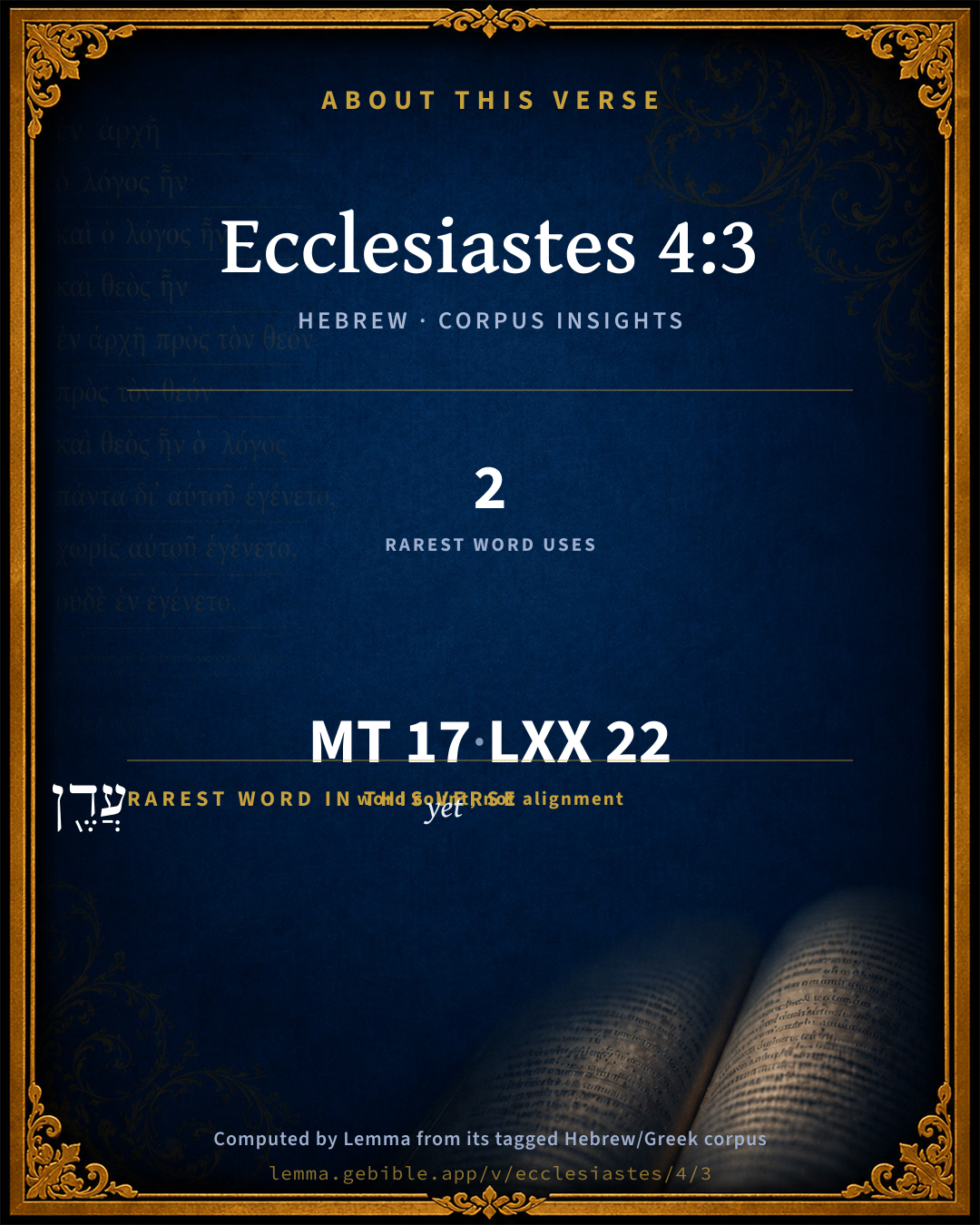
17
words
13
distinct lemmas
Wisdom
section

Notable vocabulary

The rarest word here is עֲדֶ֖ן yet H5728 — appearing just 2 times in the whole Hebrew Bible.

Shared distinctive vocabulary

עֲדֶ֖ן yet H5728 occurs in 2 verses of the Hebrew Bible. Also found in:

Grammatical profile

  • 3 verbs
  • 2 nouns
  • 3 adjectives
  • 1 preposition
  • 1 adverb
  • 7 particles

Verb forms

  • הָיָ֑ה Qal · Perfect
  • רָאָה֙ Qal · Perfect
  • נַעֲשָׂ֖ה Niphal · Perfect

Repetition

Words recur within this verse — often emphatic in Hebrew:

  • אֲשֶׁר which H834 ×3
  • לֹ֣א not H3808 ×2

Hebrew & Septuagint length

In English translation the verse runs 25 words from the Hebrew and 26 from the Septuagint (LXX English) — closely comparable.

A rough comparison of the two English renderings, which tokenize alike — not a word-level alignment.

Word counts can differ between the Hebrew and the Greek without any difference in meaning — e.g. the Hebrew direct-object marker אֵת has no separate Greek word, and Greek often adds the article ὁ.

In the original languages it is 17 Hebrew tokens and 22 Greek tokens — but the two are counted differently (Hebrew bundles its prefixes and suffixes into one token; the Greek is in lemma form), so that isn’t a like-for-like length.

Cross-references

11

Topical passages linked to Ecclesiastes 4:3 in the Treasury of Scripture Knowledge — connected by theme and wording, ordered by reader-vote popularity; previews shown in the World English Bible.

  • Luke 23:29 For behold, the days are coming in which they will say, 'Blessed are the barren, the wombs that never bore, and the breasts that never nursed.'
  • Ecclesiastes 6:3–5 If a man fathers a hundred children, and lives many years, so that the days of his years are many, but his soul is not filled with good, and moreover he has no burial; I say, that an untimely birth is better than he:
  • Matthew 24:19 But woe to those who are with child and to nursing mothers in those days!
  • Job 3:10–16 Because it didn't shut up the doors of my mother's womb, Nor did it hide trouble from my eyes.
  • Job 3:22 Who rejoice exceedingly, Are glad, when they can find the grave?
  • Job 10:18–19 "'Why, then, have you brought me forth out of the womb? I wish I had given up the spirit, and no eye had seen me.
  • Psalms 55:6–11 I said, "Oh that I had wings like a dove! Then I would fly away, and be at rest.
  • Ecclesiastes 2:17 So I hated life, because the work that is worked under the sun was grievous to me; for all is vanity and a chasing after wind.
  • Jeremiah 9:2–3 Oh that I had in the wilderness a lodging-place of wayfaring men; that I might leave my people, and go from them! for they are all adulterers, an assembly of treacherous men.
  • Jeremiah 20:17–18 because he didn't kill me from the womb; and so my mother would have been my grave, and her womb always great.
  • Ecclesiastes 1:14 I have seen all the works that are done under the sun; and, behold, all is vanity and a chasing after wind.

Cross-references courtesy of OpenBible.info (CC BY 4.0).

Hebrew and Greek witnesses Masoretic Hebrew ↔ Greek Septuagint

The same verse in the two great witnesses to the Old Testament, shown verse-for-verse.

These are two independent witnesses, not word-aligned to each other, and the Septuagint is shown in lemma (dictionary) form.

Hebrew Ecclesiastes 4:3 Masoretic · Westminster Leningrad Codex

וְטוֹב֙ מִשְּׁנֵיהֶ֔ם אֵ֥ת אֲשֶׁר עֲדֶ֖ן לֹ֣א הָיָ֑ה אֲשֶׁ֤ר לֹֽא רָאָה֙ אֶת הַמַּעֲשֶׂ֣ה הָרָ֔ע אֲשֶׁ֥ר נַעֲשָׂ֖ה תַּ֥חַת הַשָּֽׁמֶשׁ

Yes, better than them both is him who has not yet been, who has not seen the evil work that is done under the sun.

World English Bible · Public Domain

Greek LXX Ecclesiastes 4:3 Septuagint · lemma form

καί ἀγαθός ὑπέρ ὁ δύο οὗτος ὅστις οὔπω γίγνομαι ὅς οὐ ὁράω σύν ὁ ποίημα ὁ πονηρός ὁ ποιέω ὑπό ὁ ἥλιος

Better also than both these is he who has not yet been, who has not seen all the evil work that is done under the sun.

LXX2012 (modern English Septuagint) · Public Domain

Hebrew: Westminster Leningrad Codex (CC BY 4.0). Greek: Septuagint (public domain); English from LXX2012 (modern English Septuagint) (Public Domain). How the Septuagint differs from the Hebrew →

Commentary

Notes on Ecclesiastes 4:3 from classic Christian and Jewish commentators (each source and its license shown beneath its notes). The classic Christian expositions comment on the surrounding passage and are grouped to its opening verse, so a note may address several verses; the Jewish commentaries on the Tanakh (Rashi and others) are per-verse, so they appear only where the commentator wrote on this verse.

Lemma curates 59 commentaries, every one of them public domain or Creative Commons licensed, each selected and text-cleaned for this edition rather than reprinted as found. About our sources →

Trapp's Complete Commentary

John Trapp

Ecc 4:3 Yea, better [is he] than both they, which hath not yet been, who hath not seen the evil work that is done under the sun.

Ver. 3. Yea, better is he than both they.] The heathen could say, Optimum non nasci: proximum mori. Life is certainly a blessing of God, though never so calamitous. Why is living man sorrowful? saith the prophet: {Lam 3:39} and it is as if he should say, Man, if alive, hath some cause of comfort amidst all his miseries; if he may escape though but "with the skin of his teeth," {Job 19:20} and have his life for a prey, he should see matter of thankfulness, and say, "It is the Lord’s mercy that I am not consumed" {Lam 3:22} - that I am yet on this side hell. But those that have set their hearts upon earthly things, if ever they lose them, they are filled almost with unmedicineable sorrows; so as they will praise the dead above the living, and wish they had never been born. These are they whom Solomon in this sentence is by some thought to personate.

John Trapp, A Commentary or Exposition upon All the Books of the Old and New Testament (1647–1656) — public domain. Text from a community e-Sword module.

Geneva Bible (1599)

Geneva Bible translators

He speaketh according to the judgment of the flesh, which cannot abide to feel or see troubles.

Geneva Bible (1599) marginal notes — public domain. Text via Bolls.life.

Jamieson, Fausset & Brown

Robert Jamieson, A. R. Fausset & David Brown

not seen--nor experienced.

Jamieson, Fausset & Brown — Commentary Critical and Explanatory on the Whole Bible (1871) — public domain (CC PDM 1.0). Text via the HelloAO Bible API.

Adam Clarke's Commentary

Verse 3. Which hath not yet been] Better never to have been born into the world, than to have seen and suffered so many miseries.

Adam Clarke's Commentary on the Bible (1810–1826) — public domain. Text from a community e-Sword/MySword module.

The Cambridge Bible for Schools and Colleges

gen. ed. J. J. S. Perowne

3. Yea, better is he than both they] As the utterance of a personal feeling of despair we have a parallel in the words of Job (Ecc_3:11-16). As expressing a more generalised view of life we have multiform echoes of the thought in the Greek writers, of whose influence, direct or indirect, the book presents so many traces. Thus we have in Theognis:

Πάντων μὲν μὴ φῦναι ἐπιχθονίοισιν ἄριστον,

μηδʼ ἐσιδεῖν αὐγὰς ὀξέος ἠελίου·

φύντα δʼ ὄπως ὤκιστα πύλας Ἀΐδαο περῆσαι,

καὶ κεῖσθαι πολλὴν γῆν ἐπαμησάμενον.

“Best lot for men is never to be born,

Nor ever see the bright rays of the morn:

Next best, when born, to haste with quickest tread

Where Hades’ gates are open for the dead,

And rest with much earth gathered for our bed.”

425–428.

Or in Sophocles:

μὴ φῦναι τὸν ἄπαντα νικᾷ λόγον• τὸ δʼ, ἐπεὶ φανῇ,

βῆναι κεῖθεν ὄθεν περ ἤκει,

πολὺ δεύτερον, ὡς τάχιστα.

“Never to be at all

Excels all fame;

Quickly, next best, to pass

From whence we came.”

Oed. Col. 1225.

More remote but of yet deeper significance is the fact that the same feeling lies at the root of Buddhism and its search after Nirvana (annihilation or unconsciousness) as the one refuge from the burden of existence. Terrible as the depression thus indicated is, it is one step higher than the hatred of life which appeared in chs. Ecc_1:14, Ecc_2:17-18. That was simply the weariness of a selfish satiety; this, like the feeling of Çakya Mouni when he saw the miseries of old age and disease and death, and of the Greek Chorus just quoted, rose from the contemplation of the sorrows of humanity at large. It was better not to be than to see the evil work that was done under the sun. In marked contrast with this dark view of life we have the words: “Good were it for that man not to have been born” in Mat_26:24, as marking out an altogether exceptional instance of guilt and therefore of misery.

The Cambridge Bible for Schools and Colleges (gen. ed. J. J. S. Perowne; Cambridge University Press, 1878–1918) — public domain. Text from a community e-Sword module.

John Gill's Exposition

Yea, better is he than both they which hath not yet been,.... That is, an unborn person; who is preferred both to the dead that have seen oppression, and to the living that are under it; see Job 3:10. This supposes a person to be that never was, a mere nonentity; and the judgment made is according to sense, and regards the dead purely as such, and so as free from evils and sorrows, without any respect to their future state and condition; for otherwise an unborn person is not happier than the dead that die in Christ, and live with him: and it can only be true of those that perish, of whom indeed it might be said, that it would have been better for them if they had never been born, according to those words of Christ, Mat 26:24; and is opposed to the maxim of some philosophers, that a miserable being is better than none at all. The Jews, from this passage, endeavour to prove the pre-existence of human souls, and suppose that such an one is here meant, which, though created, was not yet sent into this world in a body, and so had never seen evil and sorrow; and this way some Christian writers have gone. It has been interpreted also of the Messiah, who in Solomon's time had not yet been a man, and never known sorrow, which he was to do, and has, and so more happy than the dead or living. But these are senses that will not bear; the first is best; and the design is to show the great unhappiness of mortals, that even a nonentity is preferred to them;

who hath not seen the evil work that is done under the sun? the evil works of oppressors, and the sorrows of the oppressed.

John Gill's Exposition of the Whole Bible (1746–1763) — public domain (CC PDM 1.0). Text via the HelloAO Bible API.

Haydock's Catholic Bible Commentary

Born. It is better to have no existence than to be in eternal misery, Matthew xxvi. 24. But the affliction of the just procureth glory for them. (Worthington) --- The pagan sages observed, that it was "best for mortals not to be born; and if they were, to die very soon." (Chalcid. and Theognis.) --- But they considered only temporal inconveniences. Religion has in view the danger of sin, and the desire of eternal happiness, Romans vii. 24.

George Leo Haydock (1774–1849), Haydock's Catholic Family Bible and Commentary, 1859 edition — public domain. Excludes Psalms (Douay-Rheims chapter numbering differs from Protestant) and Deuterocanonical books (Catholic canon only).

Matthew Poole's English Annotations

Which hath not yet been; who was never born. How this is true, see on the foregoing verse.

Not seen, i.e. not felt; for as seeing good is put for enjoying it, Ecc 2:24, so seeing evil is put for suffering it, as hath been more than once observed.

Matthew Poole's English Annotations on the Holy Bible (1683–1685) — public domain. Text from a community e-Sword/MySword module.

Whedon's Commentary on the Bible

Daniel D. Whedon

3. Better… not yet been — The dead have suffered; the living now suffer. The abortion that perishes unborn, as infants which never saw light, escapes all suffering. “They have slept, they have been at rest.” Very wretched must he be to whom cold and dark non-existence seems better than the warm experiences of life and action. Yet it has many times been expressed, if not felt.

“Not to be born, never to see the sun,

No worldly blessing is a greater one.”— Theognis.

Daniel D. Whedon (gen. ed.), Commentary on the Old and New Testaments (1874–1909) — public domain. Text from a community e-Sword module.

The Pulpit Commentary

Yea, better is he than both they, which hath not yet been. Thus we have Job"s passionate appeal, (Job_3:11) "Why died I not from the womb? why did I not give up the ghost when I came forth," etc.? And in the Greek poets the sentiment of the text is re-echoed. Thus Theognis, "Paroen.," 425

Pantwn men mhoisin ariston Mhd ejsidein aujgaov hjeliou Funta d opwv wkista pulav jAi"dao perhsai Kai keisqai pollhmenon

"Tis best for mortals never to be born, Nor ever see the swift sun"s burning rays; Next best, when born, to pass the gates of death Right speedily, and rest beneath the earth.

(Comp. Soph., "Ed. Colossians," 1225-1228.) Cicero, "Tusc. Disp.," 1:48, renders some lines from a lost play of Euripides to the same effect

Nam nos decebat, caetus celebrantes, domum Lugere, ubi esset aliquis in lucern editus, Humanae vitae varia reputantes mala; At qui labores metre finisset graves, Hunc omni amicos lauds et laetitia exsequi.

Herodotus (5. 4) relates how some of the Thracians had a custom of bemoaning a birth and rejoicing at a death. In our own Burial Service we thank God for delivering the departed "out of the miseries of this sinful world." Keble alludes to this barbarian custom in his poem on" The Third Sunday after Easter." Speaking of a Christian mother"s joy at a child"s birth, he says

No need for her to weep Like Thracian wives of yore, Save when in rapture still and deep Her thankful heart runs o"er. They mourned to trust their treasure on the main, Sure of the storm, unknowing of their guide: Welcome to her the peril and the pain, For well she knows the home where they may safely hide.

(See on Ecc_7:1; comp. Gray"s ode "On a Prospect of Eton College;" and for the classical notion concerning life and death, see Plato, "Laches," p. 195, 1, sqq.; "Gorgias," p. 512, A.) The Buddhist religion does not recommend suicide as an escape from the evils of life. It indeed regards man as master of his own life; but it considers suicide foolish, as it merely transfers a man"s position, the thread of life having to be taken up again under less favorable circumstances. See "A Buddhist Catechism," by Subhadra Bhikshu (London: Redway, 1890). Who hath not seen the evil work that is done under the sun. He repeats the words, "under the sun," from ver. 1, in order to show that he is speaking of facts that came under his own regard outward phenomena which any thoughtful observer might notice (so again ver. 7).

The Pulpit Commentary (1880–1919), ed. H.D.M. Spence-Jones & Joseph S. Exell — public domain. Text from a community e-Sword module.

John Wesley's Explanatory Notes

Better is he - Who was never born. Not seen - Not felt: for as seeing good is put for enjoying it, so seeing evil is put for suffering it.

John Wesley, Explanatory Notes Upon the Whole Bible (1754–1765) — public domain. Text via the GEBible commentary corpus.

Rashi

Rabbi Shlomo Yitzchaki (Rashi)

yet Heb. עֲדֶן, [like] עֲדַיִן.

who has not seen I saw in Midrash Koheleth (Zuta pp. 117, 125): These are the 974 generations that were decreed to be created, but were not created.

Rashi on the Tanakh — English translations: “The Judaica Press complete Tanach with Rashi, translated by A. J. Rosenberg” (CC BY 4.0); “Pentateuch with Rashi's commentary by M. Rosenbaum and A.M. Silbermann, 1929-1934” (public domain); “The Metsudah Tanach series, Lakewood, N.J” (CC BY 4.0); and “The Book of Joshua, Metsudah Publications, 1997” (CC BY 4.0). Text via Sefaria.

Lesson kit

Teaching starters — assembled from the data on this page, not authored interpretation. Every prompt links to the verse data it draws on. Edit before teaching.

Ecclesiastes, in the Wisdom, opens this verse with 17 words (13 distinct Hebrew lemmas). Its most distinctive word is ʻăden (“yet”). A historical commentator’s framing appears above. Read the whole chapter for the surrounding context.

Discussion questions

  1. The word ʻăden carries the sense “yet.” How does it shape the verse?
  2. How does Ecclesiastes 4:2, which shares the word «yet», read alongside this verse?
  3. What does the repetition of “which” (3× in this one verse) do in this verse?
  4. The translations on this page render this verse differently — a whole-verse word diff, not a word-by-word alignment. What might account for the different wordings?
  5. «הָיָ֑ה» is a Qal Perfect verb. How does that grammatical form shape the action described?
  6. Compare how Trapp's Complete Commentary and Geneva Bible (1599) read this verse. Where do they agree or differ?

Things to notice

Reading settings

Reading text

Shown beneath each verse's original-language words.

Old Testament
Old Testament edition

Read the OT as the Masoretic Hebrew (MT) or the Greek Septuagint (LXX).

English shown for the Greek Septuagint (in the Hebrew ↔ Greek comparison).

Comparing translations? Open the Compare panel on any verse page to stack up to four side by side.