
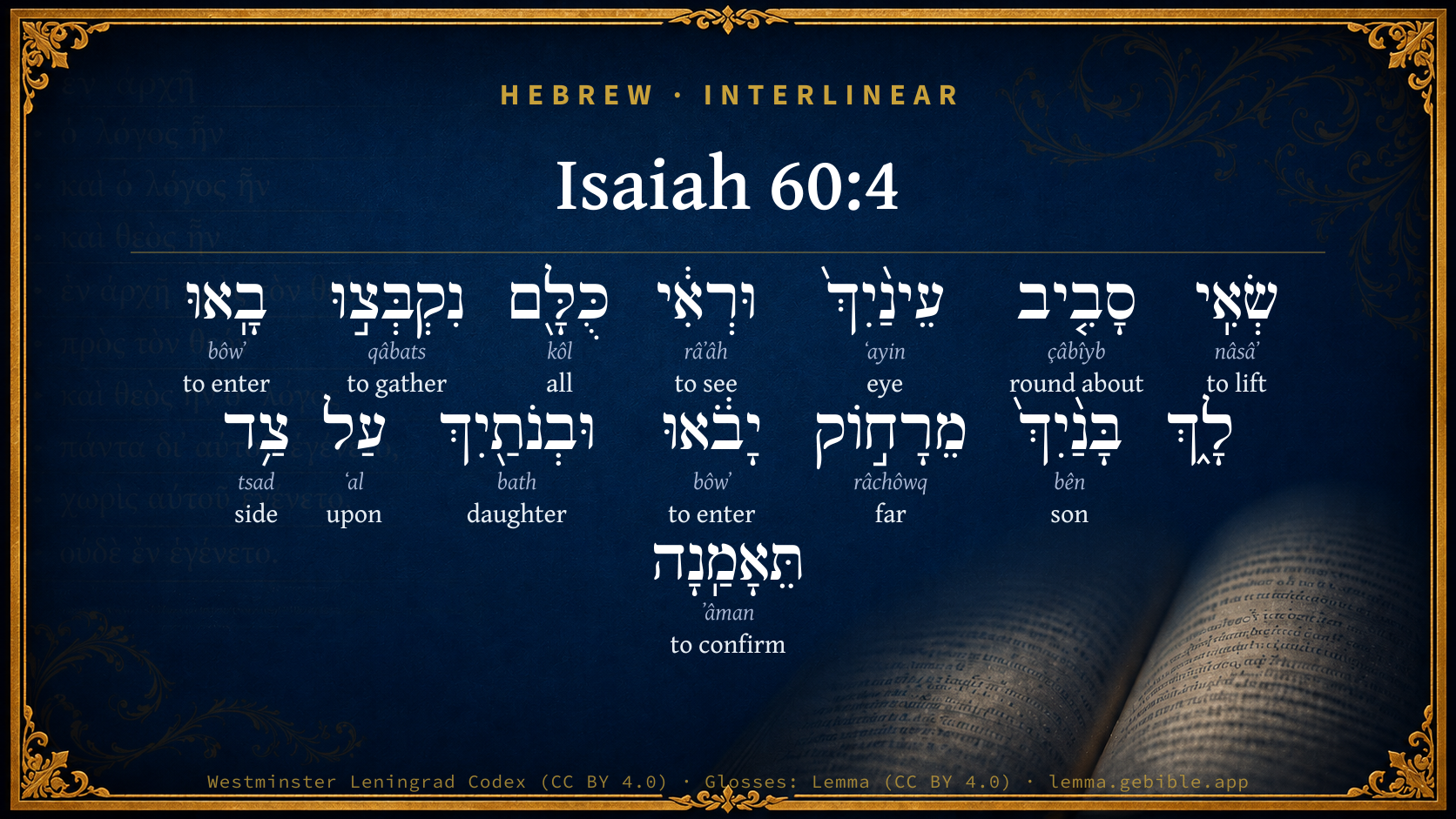
Isaiah 60:4

Hebrew (Westminster Leningrad Codex) Isaiah 60:4 appears in the Hebrew Old Testament. The text above is from the Westminster Leningrad Codex. Each word links to its Strong’s number, a concise gloss, and parsing drawn from the Open Scriptures Hebrew Bible morphology. Click any word for its full Brown-Driver-Briggs (BDB) entry.
Download image
Cite this verse

Isaiah 60:4 (World English Bible). Public Domain. Lemma interlinear Bible study tool, https://lemma.gebible.app/v/isaiah/60/4.

Show BibTeX & RIS
BibTeX
RIS
English Translation
Lift up your eyes round about, and see: they all gather themselves together, they come to you; your sons shall come from far, and your daughters shall be carried in the arms.
World English Bible · Public Domain
Download a study sheet

One document with this verse’s original text, its word-by-word gloss line, the meaning frame, cross-references with their text, attributed commentary, and full source and license credits — printable, and it pastes into notes with its structure intact.

This verse Autodidact and up

Study sheet (.html) Plain text (.txt)

A passage Seminary Student

Up to 50 verses in one chapter. A passage sheet keeps up to 6 commentary sources and 12 cross-references per verse, in the order this page ranks them, and says so on the sheet whenever that leaves anything out. Ask for a single verse and you get the Autodidact verse sheet above.

Everything on this page stays free to read, with no account — the sheet is a download of what is already on screen, not access to it.

Want to remove ads? Support Godless Engineer
Compare translations 3

The same verse in 3 English versions, stacked beneath the original-language interlinear above. Click any original word for its lexicon entry.

Each is an independent rendering of the whole verse — the interlinear is not word-aligned to these translations.

Highlighted words mark where these versions differ — a whole-verse word diff, not a word-by-word alignment.

  • World English Bible Public Domain
    Lift up your eyes round about, and see: they all gather themselves together, they come to you; your sons shall come from far, and your daughters shall be carried in the arms.
  • King James Version Public Domain
    Lift up thine eyes round about, and see: all they gather themselves together, they come to thee: thy sons shall come from far, and thy daughters shall be nursed at thy side.
  • unfoldingWord Literal Text CC BY-SA 4.0
    Lift up your eyes around and see; all of them gather themselves, they come to you. Your sons will come from faraway, and your daughters will be supported on the side.

unfoldingWord Literal Text — © unfoldingWord, licensed CC BY-SA 4.0. Word-aligned USFM3 via Door43 (git.door43.org/unfoldingWord/en_ult).

Versions to compare (up to 4)

3 of 4 selected

Show all 18 translations

Every available English version of this verse, each an independent rendering of the whole verse.

  • World English Bible Public Domain
    Lift up your eyes round about, and see: they all gather themselves together, they come to you; your sons shall come from far, and your daughters shall be carried in the arms.
  • Berean Standard Bible Public Domain
    Lift up your eyes and look around: They all gather and come to you; your sons will come from afar, and your daughters will be carried on the arm.
  • Majority Standard Bible Public Domain
    Lift up your eyes and look around: They all gather and come to you; your sons will come from afar, and your daughters will be carried on the arm.
  • King James Version Public Domain
    Lift up thine eyes round about, and see: all they gather themselves together, they come to thee: thy sons shall come from far, and thy daughters shall be nursed at thy side.
  • American Standard Version (1901) Public Domain
    Lift up thine eyes round about, and see: they all gather themselves together, they come to thee; thy sons shall come from far, and thy daughters shall be carried in the arms.
  • Revised Version (1885) Public Domain
    Lift up thine eyes round about, and see: they all gather themselves together, they come to thee: thy sons shall come from far, and thy daughters shall be carried in the arms.
  • Geneva Bible (1599) Public Domain
    Lift vp thine eyes round about, and beholde: all these are gathered, and come to thee: thy sonnes shall come from farre, and thy daughters shalbe nourished at thy side.
  • Douay-Rheims (1899) Public Domain
    Lift up thy eyes round about, and see: all these are gathered together, they are come to thee: thy sons shah come from afar, and thy daughters shall rise up at thy side.
  • Young's Literal Translation Public Domain
    Lift up round about thine eyes and see, All of them have been gathered, they have come to thee, Thy sons from afar do come, And thy daughters on the side are supported.
  • Literal Standard Version CC BY-SA 4.0
    “Lift up your eyes around and see, || All of them have been gathered, they have come to you, || Your sons come from afar, || And your daughters are supported on the side.
  • Unlocked Literal Bible CC BY-SA 4.0
    Look all around and see. They all gather themselves together and come to you. Your sons will come from far, and your daughters will be carried in their arms.
  • unfoldingWord Literal Text CC BY-SA 4.0
    Lift up your eyes around and see; all of them gather themselves, they come to you. Your sons will come from faraway, and your daughters will be supported on the side.
  • Darby Bible Public Domain
    Lift up thine eyes round about, and see: all they gather themselves together, they come to thee: thy sons come from afar, and thy daughters are carried upon the side.
  • World Messianic Bible Public Domain
    “Lift up your eyes all around, and see: they all gather themselves together. They come to you. Your sons will come from far away, and your daughters will be carried in arms.
  • Webster's Bible Public Domain
    Lift up thy eyes around, and see: all they assemble themselves, they come to thee: thy sons shall come from far, and thy daughters shall be nursed at thy side.
  • Free Bible Version CC BY-SA 4.0
    Look all around you, and see everyone gathering and coming to you—your sons returning from far away, your young daughters being carried on the hip.
  • Bible in Basic English Public Domain
    Let your eyes be lifted up, and see: they are all coming together to you: your sons will come from far, and your daughters taken with loving care.
  • JPS Tanakh (1917) Public Domain
    Lift up thine eyes round about, and see: they all are gathered together, and come to thee; thy sons come from far, and thy daughters are borne on the side.

Literal Standard Version (2020), Covenant Press — licensed CC BY-SA 4.0. Text via the HelloAO Bible API (eBible.org). Unlocked Literal Bible (unfoldingWord) — licensed CC BY-SA 4.0. Text via the HelloAO Bible API (eBible.org). unfoldingWord Literal Text — © unfoldingWord, licensed CC BY-SA 4.0. Word-aligned USFM3 via Door43 (git.door43.org/unfoldingWord/en_ult). Free Bible Version, Dr. Jonathan Gallagher — licensed CC BY-SA 4.0. Text via the HelloAO Bible API (eBible.org).

Word by word

More ways to search: Search by grammar → Find every occurrence → Compare this word →

Practice this passage: Drill this verse → Learn its vocabulary →

צַ֥ד
tsad
H6654
“side”
Noun, Common, Masculine, Singular, Absolute
Part of Speech
Noun
Type
Common
Gender
Masculine
Number
Singular
State
Absolute
Full BDB Definition

Origin: contr from an unused root meaning to sidle off

TWOT: 1876a

side
  1. שְׂאִֽי nâsâʼ H5375 “lift” Verb, Qal, Imperative, 2nd Person, Feminine, Singular
  2. סָבִ֤יב çâbîyb H5439 “round about” Noun, Common, Both, Singular, Absolute
  3. עֵינַ֨יִךְ֙ ʻayin H5869 “eyes · your” Noun, Common, Both, Dual, Construct + Suffix, Personal, 2nd Person, Feminine, Singular
  4. וּרְאִ֔י râʼâh H7200 “and · see” Conjunction + Verb, Qal, Imperative, 2nd Person, Feminine, Singular
  5. כֻּלָּ֖ם kôl H3605 “all · their” Noun, Common, Masculine, Singular, Construct + Suffix, Personal, 3rd Person, Masculine, Plural
  6. נִקְבְּצ֣וּ qâbats H6908 “to gather” Verb, Niphal, Perfect, 3rd Person, Common, Plural
  7. בָֽאוּ bôwʼ H935 “to enter” Verb, Qal, Perfect, 3rd Person, Common, Plural
  8. בָּנַ֨יִךְ֙ bên H1121 “sons · your” Noun, Common, Masculine, Plural, Construct + Suffix, Personal, 2nd Person, Feminine, Singular
  9. מֵרָח֣וֹק râchôwq H7350 “from · far” Preposition + Adjective, Adjective, Masculine, Singular, Absolute
  10. יָבֹ֔אוּ bôwʼ H935 “to enter” Verb, Qal, Imperfect, 3rd Person, Masculine, Plural
  11. וּבְנֹתַ֖יִךְ bath H1323 “and · daughters · your” Conjunction + Noun, Common, Feminine, Plural, Construct + Suffix, Personal, 2nd Person, Feminine, Singular
  12. עַל ʻal H5921 “upon” Preposition
  13. תֵּאָמַֽנָה ʼâman H539 “to confirm” Verb, Niphal, Imperfect, 3rd Person, Feminine, Plural

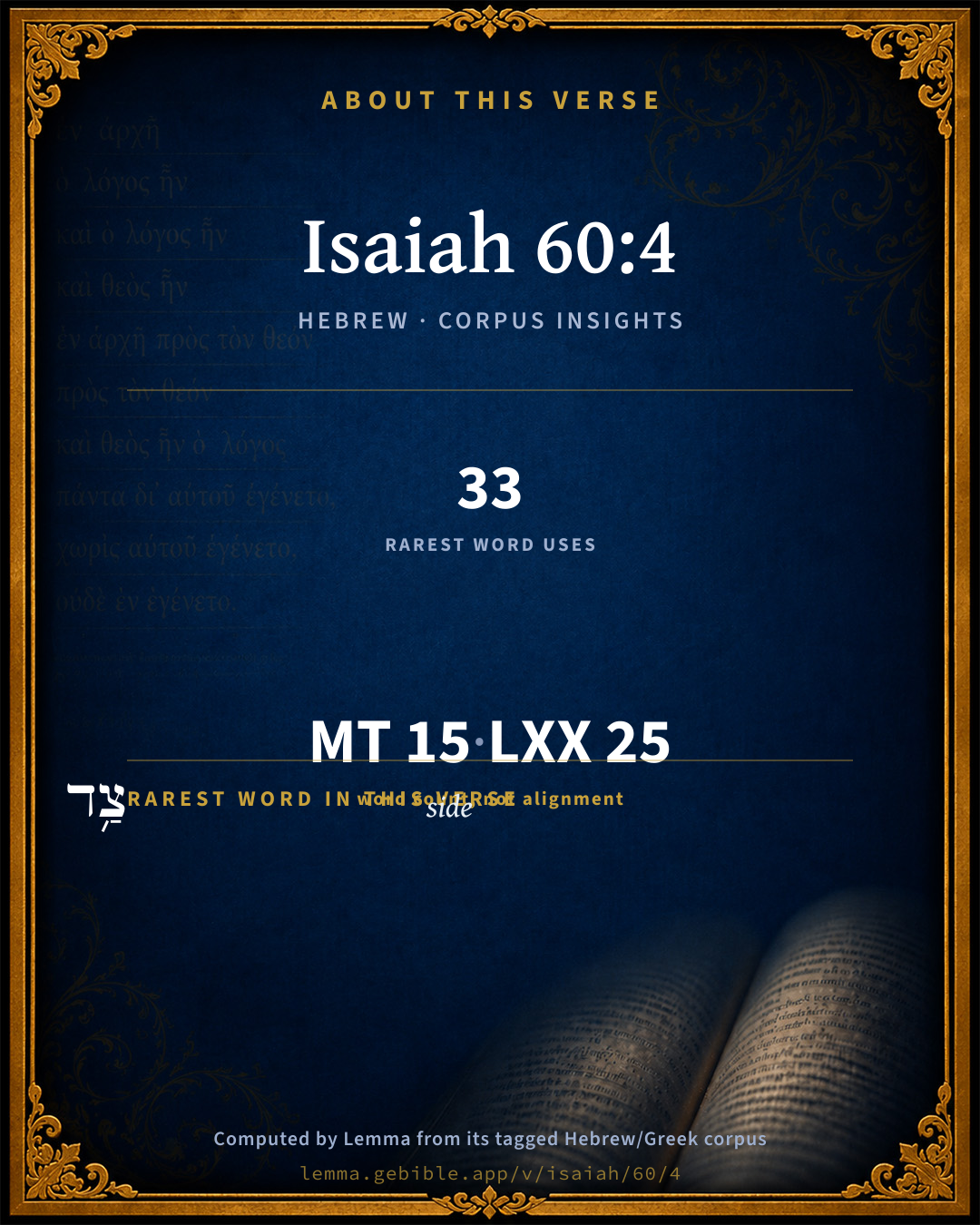
About this verse

These counts appear in no published source. They are computed here, from the morphology-tagged text and Lemma’s own curated glosses. What Lemma adds →

15
words
13
distinct lemmas
Prophets
section

Shared distinctive vocabulary

צַ֥ד side H6654 occurs in 27 verses of the Hebrew Bible. Also found in:

Grammatical profile

  • 6 verbs
  • 6 nouns
  • 1 adjective
  • 2 prepositions

Verb forms

  • שְׂאִֽי Qal · Imperative
  • וּרְאִ֔י Qal · Imperative
  • נִקְבְּצ֣וּ Niphal · Perfect
  • בָֽאוּ Qal · Perfect
  • יָבֹ֔אוּ Qal · Imperfect
  • תֵּאָמַֽנָה Niphal · Imperfect

Repetition

A word recurs within this verse — often emphatic in Hebrew:

  • בָֽאוּ to enter H935 ×2

Hebrew & Septuagint length

In English translation the verse runs 32 words from the Hebrew and 27 from the Septuagint (LXX English) — closely comparable.

A rough comparison of the two English renderings, which tokenize alike — not a word-level alignment.

Word counts can differ between the Hebrew and the Greek without any difference in meaning — e.g. the Hebrew direct-object marker אֵת has no separate Greek word, and Greek often adds the article ὁ.

In the original languages it is 15 Hebrew tokens and 25 Greek tokens — but the two are counted differently (Hebrew bundles its prefixes and suffixes into one token; the Greek is in lemma form), so that isn’t a like-for-like length.

Cross-references

10

Topical passages linked to Isaiah 60:4 in the Treasury of Scripture Knowledge — connected by theme and wording, ordered by reader-vote popularity; previews shown in the World English Bible.

  • Isaiah 42:6 I, Yahweh, have called you in righteousness, and will hold your hand, and will keep you, and give you for a covenant of the people, for a light of the Gentiles;
  • Isaiah 49:18 Lift up your eyes round about, and see: all these gather themselves together, and come to you. As I live, says Yahweh, you shall surely clothe you with them all as with an ornament, and gird yourself with them, like a bride.
  • Isaiah 49:20–22 The children of your bereavement shall yet say in your ears, The place is too small for me; give place to me that I may dwell.
  • Galatians 3:28–29 There is neither Jew nor Greek, there is neither slave nor free man, there is neither male nor female; for you are all one in Christ Jesus.
  • Isaiah 43:6 I will tell the north, Give up; and to the south, Don't keep back; bring my sons from far, and my daughters from the end of the earth;
  • Isaiah 66:11–12 that you may suck and be satisfied with the breasts of her consolations; that you may milk out, and be delighted with the abundance of her glory.
  • Matthew 8:11 I tell you that many will come from the east and the west, and will sit down with Abraham, Isaac, and Jacob in the Kingdom of Heaven,
  • Acts 13:44 The next Sabbath almost the whole city was gathered together to hear the word of God.
  • Isaiah 11:12 He will set up an ensign for the nations, and will assemble the outcasts of Israel, and gather together the dispersed of Judah from the four corners of the earth.
  • John 4:35 Don't you say, 'There are yet four months until the harvest?' Behold, I tell you, lift up your eyes, and look at the fields, that they are white for harvest already.

Cross-references courtesy of OpenBible.info (CC BY 4.0).

Hebrew and Greek witnesses Masoretic Hebrew ↔ Greek Septuagint

The same verse in the two great witnesses to the Old Testament, shown verse-for-verse.

These are two independent witnesses, not word-aligned to each other, and the Septuagint is shown in lemma (dictionary) form.

Hebrew Isaiah 60:4 Masoretic · Westminster Leningrad Codex

שְׂאִֽי סָבִ֤יב עֵינַ֨יִךְ֙ וּרְאִ֔י כֻּלָּ֖ם נִקְבְּצ֣וּ בָֽאוּ לָ֑ךְ בָּנַ֨יִךְ֙ מֵרָח֣וֹק יָבֹ֔אוּ וּבְנֹתַ֖יִךְ עַל צַ֥ד תֵּאָמַֽנָה

Lift up your eyes round about, and see: they all gather themselves together, they come to you; your sons shall come from far, and your daughters shall be carried in the arms.

World English Bible · Public Domain

Greek LXX Isaiah 60:4 Septuagint · lemma form

αἴρω κύκλος ὁ ὀφθαλμός σύ καί ὁράω συνἄγω ὁ τέκνον σύ ἰδού ἥκω πᾶς ὁ υἱός σύ μακρόθεν καί ὁ θυγάτηρ σύ ἐπί ὦμος αἴρω

Lift up your eyes round about, and behold your children gathered: all your sons have come from far, and your daughters shall be borne on men's shoulders.

LXX2012 (modern English Septuagint) · Public Domain

On this verse, Adam Clarke's Commentary discusses the Septuagint’s reading. Read the note in Commentary ↓

Hebrew: Westminster Leningrad Codex (CC BY 4.0). Greek: Septuagint (public domain); English from LXX2012 (modern English Septuagint) (Public Domain). How the Septuagint differs from the Hebrew →

Targum (Aramaic paraphrase)

1

The Targum is the ancient Jewish Aramaic paraphrase of the Hebrew Scriptures — an interpretive translation, not the Hebrew text itself. Onkelos (literal) and Pseudo-Jonathan (expansive) render the Torah, and Jonathan the Prophets. Coverage is partial: where no permissively-licensed English translation exists for a verse, only the Aramaic is shown. This is verse-level text, not a word-by-word alignment to the Hebrew.

  1. Targum Jonathan Prophets (Joshua–Malachi)
    זְקוּפִי יְרוּשְׁלֵם סְחוֹר סְחוֹר עֵינָךְ וְחַזֵי כָּל בְּנֵי עַם גַלְוָתָךְ דְמִתְכַּנְשִׁין וְאָתָן לְגַוִיךְ בְּנָךְ מֵרָחִיק יֵיתוּן וּבְנָתָךְ עַל גִסְסִין יִתְנַסְבָן:

    Lift up thine eyes, O Jerusalem, round about, and see all the children of the people of thy captivity, who are gathered together: thy sons shall come from far into thy midst, and thy daughters shall be carried upon the arms.

    Targum Jonathan — Aramaic: “Mikraot Gedolot” (public domain). English: “Sefaria Community Translation” (CC0 1.0 (public-domain dedication)); “London "Chaldee Paraphrase," 1871” (public domain). Text via Sefaria.

Commentary

Notes on Isaiah 60:4 from classic Christian and Jewish commentators (each source and its license shown beneath its notes). The classic Christian expositions comment on the surrounding passage and are grouped to its opening verse, so a note may address several verses; the Jewish commentaries on the Tanakh (Rashi and others) are per-verse, so they appear only where the commentator wrote on this verse.

Lemma curates 59 commentaries, every one of them public domain or Creative Commons licensed, each selected and text-cleaned for this edition rather than reprinted as found. About our sources →

The Cambridge Bible for Schools and Colleges

gen. ed. J. J. S. Perowne

4. shall be nursed at thy side] Rather, shall be nursed on the side, i.e. carried on the hip, the Eastern mode of carrying young children. Cf. ch. Isa_66:12, Isa_49:22. The idea, therefore, is the same as in ch. Isa_49:22 f.; the nurses who bring back the children representing the heathen nations. see Muir, Life of Mahomet, p. 8 (abridged Ed.): ‘Thou gavest me this bite upon my back, when I carried thee on my hip’.

4, 5. In this and the two following strophes two things are closely associated: the restoration of Zion’s banished children, and the influx of wealth from all parts of the world. The first half of Isa_60:4 is repeated literally from ch. Isa_49:18.

The Cambridge Bible for Schools and Colleges (gen. ed. J. J. S. Perowne; Cambridge University Press, 1878–1918) — public domain. Text from a community e-Sword module.

Trapp's Complete Commentary

John Trapp

Isa 60:4 Lift up thine eyes round about, and see: all they gather themselves together, they come to thee: thy sons shall come from far, and thy daughters shall be nursed at [thy] side.

Ver. 4. Lift up thine eyes.] As from a watchtower; for so Zion signifieth.

All they gather themselves together, &c.] See Isa 49:18.

Thy daughters shall be nursed at thy side.] Like sucking children, they shall suck, and be satisfied. {Isa 66:11} The Vulgate version here hath surgent for sugent; as it hath unus de similibus for unus e millibus {Job 33:23} and evertit for everrit {Luk 15:8} with other such gross mistakes not a few.

John Trapp, A Commentary or Exposition upon All the Books of the Old and New Testament (1647–1656) — public domain. Text from a community e-Sword module.

The Biblical Illustrator

Joseph S. Exell

Isa_60:4-5

Lift up thine eyes round about

The Gentiles gathered

I.

THE GATHERING OF THE GENTILES TO ZION. From every quarter--from far--from beyond the sea. With all the forces.

II. ZIONS EMOTIONS. She sees and overflows with joy. (R. A. Bertram.)

Nursed at thy side

Rather, on thy side, i.e carried on the hip, the

Eastern mode of carrying young children (Isa_66:12). (Prof. J. Skinner, D. D.)

Church-membership

The Churchs children first be nursed at her side, not sent out to be nursed among strangers. They that would enjoy the dignities and privileges of Christs family must submit to the discipline of it. (M. Henry.)

The Biblical Illustrator, edited by Joseph S. Exell (c. 1880s–1900s) — public domain. Text from a community e-Sword module.

Joseph Benson's Commentary

Isa 60:4-5. Lift up thine eyes round about — Or, in a circle, into all parts of the earth. He seems to refer to the apostles and disciples, with their successors, carrying the gospel into all quarters of the world. And because it would be, as it were, a thing incredible, he bids them lift up their eyes, as if they were to behold it in some vision, or upon some watch-tower in Jerusalem. See the like expression Isa 49:18. All they gather themselves together — He speaks of the coming in of all nations to embrace the gospel, and unite themselves to the Christian Church. Thy sons shall come from far — From the remotest parts, having heard the report of thee. And thy daughters shall be nursed at thy side — Shall be brought unto thee tenderly, as it were in persons’ arms, (Isa 49:22,) and shall have their education with thee from their infancy: there, where alone the sincere milk of the word is to be had, must the church’s newborn babes be nursed, that they may grow thereby, 1Pe 2:2. Then thou shalt see — With delight, the multitudes of thy children running to thee; and flow together — As when two rivers meet, and, joining their waters, run sweetly together, as one and the same river. This denotes the abundance of their united joys and delights. Or the words may mean, they shall flock together to behold such an amazing sight. And thy heart shall fear — Or stand amazed, to see such multitudes come to the Lord Christ; and be enlarged — Both with joy and love. Because the abundance of the sea — The islands of the sea, the nations; shall be converted unto thee — Shall turn to thee in religion and affection; they that formerly so much hated thee shall now love thee. Or the sense is, The wealth and traffic of those who trade by sea, the riches of the merchants, shall be converted to thy use rather than to the use of the owners thereof. The forces of the Gentiles shall come unto thee — Thou shalt not only have the wealth, but the strength of the nations to stand by thee, to protect thee, and aid thy endeavours to evangelize the world.

Joseph Benson's Commentary on the Old and New Testaments (1811–1818) — public domain. Text from a community e-Sword module.

Geneva Bible (1599)

Geneva Bible translators

An infinite number from all countries, as Isa. 49:18.

Geneva Bible (1599) marginal notes — public domain. Text via Bolls.life.

Jamieson, Fausset & Brown

Robert Jamieson, A. R. Fausset & David Brown

Lift up . . . eyes--Jerusalem is addressed as a female with eyes cast down from grief.

all they . . . they--The Gentile peoples come together to bring back the dispersed Hebrews, restore their city, and worship Jehovah with offerings.

nursed at thy side--rather "carried at thy side." It is the custom in the East to carry the children astride on the hip, with the arms around the body (Isa 66:12).

Jamieson, Fausset & Brown — Commentary Critical and Explanatory on the Whole Bible (1871) — public domain (CC PDM 1.0). Text via the HelloAO Bible API.

Adam Clarke's Commentary

Verse 4. Shall be nursed at thy side - "Shall be carried at the side."] For תאמנה teamanah, shall be nursed, the Septuagint and Chaldee read תנשאנה tinnasenah, shall be carried. A MS. has על כתף תנשאנה al catheph tinnasenah, "shall be carried on the shoulder;" instead of על צד תאמנה al tsad teamanah, "shall be nursed on the side." Another MS. has both כתף catheph and צד tsad. Another MS. has it thus: תאמנה:תנשאנה tinnasenah : teamanah, with a line drawn over the first word. Sir John Chardin says that it is the general custom in the east to carry their children astride upon the hip with the arm round their body. His MS. note on this place is as follows: - Coutume en Orient de porter les enfans sur le coste a; califourchon sur la hanche: cette facon est generale aux Indes; les enfans se tiennent comme cela, et la personne qui les porte les embrasse et serre par le corps; parceque sont (ni) emmaillottes, ni en robes qui les embrassent. "In the east it is the custom to carry the children on the haunch, with the legs astride. This is the general custom in India. The children support themselves in this way, and the arm of the nurse goes round the body and presses the child close to the side; and this they can easily do, as the children are not swathed, nor encumbered with clothes." Non brachiis occidentalium more, sed humeris, divaricatis tibiis, impositos circumferunt. "They carry them about, not in their arms after the manner of the western nations, but on their shoulders; the children being placed astride." Cotovic. Iter. Syr. cap. xiv. This last quotation seems to favour the reading על כתף al catheph, on the shoulder, as the Septuagint likewise do: but upon the whole I think that על צד תנשאנה al tsad tinnasenah is the true reading, which the Chaldee favours; and I have accordingly followed it. See Isa 66:12. - L. This mode of carrying children is as common in India as carrying them in the arms is in Europe.

Adam Clarke's Commentary on the Bible (1810–1826) — public domain. Text from a community e-Sword/MySword module.

Ellicott's Commentary for English Readers

(4) Lift up thine eyes . . .—Repeated from Isa_49:18.

Thy daughters shall be nursed at thy side . . .—Asin Isa_66:12, the words point to the Eastern custom of carrying young children on the hip of their mother, with their arms clasped round her waist.

A Bible Commentary for English Readers, edited by Charles John Ellicott (1878–1897) — public domain. Text from a community e-Sword module.

John Gill's Exposition

Lift up thine eyes round about, and see,.... The Gentiles and kings coming to Christ and his church; the vast number of converts flocking from all parts of the world to join themselves to the church of Christ, and to behold the wonderful work of God among the Jews now converted. The Targum is,

"lift up thine eyes O Jerusalem, round about, and see all the children of the people of thy captivity:''

all they gather themselves, and come to thee: this seems to have respect not to the Gentiles, as before; but to the Jews themselves, who are scattered up and down in the world; but now, being in a wonderful manner converted, shall gather together in a body, and go up to Jerusalem, where a Christian church of them will be formed, and to which they will join themselves; or this may respect the kings, Isa 60:2,

thy sons shall come from far; such as are of the seed of Abraham, children of the Jews, and now born again, and so Zion's sons; these shall come from the furthest parts of the earth, where they are, and incorporate themselves with their brethren:

and thy daughters shall be nursed at thy side; by the ministers of the word, and with the sincere milk of it, and the breasts of Gospel ordinances; see Th1 2:7. The Targum is, "shall be carried at their sides" (s): and the Septuagint and Arabic versions, on their shoulders; and so refers to the manner of their being brought, and not to their bringing up; see Isa 49:22, but the former sense is best. Ben Melech interprets it of their being nursed up at the side of great personages, kings and queens, according to Isa 49:23. The word "thy" is not in the original; and it may be as well: rendered "at their side", as is supplied by some (t).

(s) "Ad latus portabuntur", Vitringa. (t) "ad latus illorum", Gataker.

John Gill's Exposition of the Whole Bible (1746–1763) — public domain (CC PDM 1.0). Text via the HelloAO Bible API.

Albert Barnes' Notes on the Bible

Lift up thine eyes - Jerusalem is here addressed as a female with eyes cast down from grief. She is directed to lift them up, and to see the great multitudes that were flocking to her. Wherever she could turn her eyes, she would behold them hastening to come to her. In this verse and the following verses, the prophet goes into a particular statement of what he referred to in general terms in Isa 60:3. The first thing which be specifies is, that the dispersed sons and daughters of the Jewish people would be gathered back.

Thy sons shall come from far - They who have been driven into exile into distant lands shall again return. This is in accordance with the predictions so often made in Isaiah, that the scattered sons of the Jewish people would be again collected (see the notes at Isa 49:17-18.)

And thy daughters shall be nursed at thy side - The Septuagint renders this, ‘And thy daughters shall be borne upon the shoulders’ (ἐπ ̓ ὤμων ἀρθήσονται ep' ōmōn arthēsontai). Lowth also says, that one manuscript reads it ‘upon shoulders,’ and another has both ‘shoulder’ and ‘side.’ The translation of the Septuagint, and these different readings of the manuscripts have probably been caused by the supposed improbability of the fact, that children were nursed or carried on the side (compare Isa 49:22). But Sir John Chardin says that it is the general custom in the East to carry the children astride upon the hip, with the arms around the body. The word, however, which is rendered ‘nursed’ in our translation (תאמנה tē'âmanâh from אמן 'âman), means, properly, “to stay, to sustain, support; to bear or carry a child” Num 11:12; hence, “to be faithful, firm.” It is not certain that it is in any instance used in the sense of nursing; but it more probably means here, they shall be borne. It implies that the church would evince deep solicitude for the education and welfare of the young - as a mother does for her children; and that it would be one of the blessings of those times that that solicitude should be felt and manifested.

Albert Barnes' Notes on the Bible (1834–1885) — public domain. Text from a community e-Sword/MySword module.

Haydock's Catholic Bible Commentary

Rise up. St. Jerome, "suck," as the Hebrew may imply. (Calmet) --- Septuagint, "shall be carried on the shoulders." (Haydock) --- This may refer to the captives and to the Church.

George Leo Haydock (1774–1849), Haydock's Catholic Family Bible and Commentary, 1859 edition — public domain. Excludes Psalms (Douay-Rheims chapter numbering differs from Protestant) and Deuterocanonical books (Catholic canon only).

Matthew Poole's English Annotations

Lift up thine eyes round abrupt; or in a circle; into all parts of the earth: it seems to relate to the apostles and disciples, with their successors, carrying the gospel into all parts of the world. And in regard it would be as it were a thing incredible, he bids them lift up their eyes, as if they were to behold it in some vision, or upon some watch tower in Jerusalem: there is the like expression Isa 49:18.

All they gather themselves together: he speaks more particularly, either of the Jews flocking from all parts to Jerusalem, when they shall hear of their return from Babylon, which may be true in the type; or especially, of the coming in of some of all nations to the gospel.

Thy sons shall come from far, and thy daughters shall be nursed at thy side; the same thing, only for elegancy’ sake expressed in its parts; the sense respects both persons and place; as to persons, Thy sons and thy daughters also shall be brought unto thee tenderly, as it were in arms, Isa 49:22, where by thy side, by equivalent expressions of arms, bosoms, and shoulders, is supplied with reference to them both, and may import they shall be brought unto the church of Christ as unto their mother; and it may be further observed, that where the masculine gender is joined with the feminine of the same species, it notes multitude and variety, as Ecc 2:8, men singers and women singers, i.e. all sorts and variety of vocal music: and as to place, Both thy sons and thy daughters that are not only near, but also afar off, shall come to thee, as we say, far and near, Act 2:39; or it is the same with what was said before, round about in all quarters of the world; from far noting the longitude, and ad latus, at or on thy side, the latitude, and even those that perhaps were before at enmity one with another.

Matthew Poole's English Annotations on the Holy Bible (1683–1685) — public domain. Text from a community e-Sword/MySword module.

Whedon's Commentary on the Bible

Daniel D. Whedon

4. Lift up thine eyes — Zion is directed to look about her, and see the crowds approaching from afar. The crowds consist of dispersed Jews, thy sons; and more numerously of heathen as well.

Thy daughters — The sons walk, the daughters are carried. Words used to heighten the parallelism.

Daniel D. Whedon (gen. ed.), Commentary on the Old and New Testaments (1874–1909) — public domain. Text from a community e-Sword module.

The Pulpit Commentary

Lift up thine eyes. (see Isa_49:18) Thy sons... thy daughters. Not so much Jews of the dispersion, as Gentiles, who will become thy adopted "sons" and "daughters." Shall be nursed at thy side; rather, shall be carried on thy side. Oriental mothers often carry a small child on their hip, with the,arm round it to prevent its falling off.

The Pulpit Commentary (1880–1919), ed. H.D.M. Spence-Jones & Joseph S. Exell — public domain. Text from a community e-Sword module.

Keil & Delitzsch

C. F. Keil & F. Delitzsch

Zion is now exhorted, as in Isa 49:18, to lift up her eyes, and turn them in all directions; for she is the object sought by an approaching multitude. "Lift up thine eyes round about, and see: they all crowd together, they come to thee: thy sons come from afar, and thy daughters are carried hither upon arms." The multitude that are crowding together and coming near are the diaspora of her sons and daughters that have been scattered far away (Isa 11:12), and whom the heathen that are now drawing near to her bring with them, conducting them and carrying them, so that they cling "to the side" (Isa 66:12) of those who are carrying them upon their arms and shoulders (Isa 49:22). תּאמנה is softened from תאמנּה, the pausal form for אתמנה (compare the softening in Rut 1:13), from אמן, to keep, fasten, support; whence אמן, אמנת, a foster-father, a nurse who has a child in safe keeping.

Keil & Delitzsch — Biblical Commentary on the Old Testament (1861–1891) — public domain (CC PDM 1.0). Text via the HelloAO Bible API. (Old Testament only.)

J. A. Alexander on Isaiah

Joseph Addison Alexander

“Lift up thine eyes round about (i.e., in all directions) and see; all of them are gathered, they come to thee, thy sons from afar shall come, and thy daughters at the side shall be borne.” See Isa 43:5-7 and Isa 49:18-23. Those who confine these prophecies to the Babylonish exile, understand this as describing the agency of heathen states and sovereigns in the restoration. But in this, as in the parallel passages, there is, by a strange coincidence, no word or phrase implying restoration or return, but the image is evidently that of enlargement and accession; the children thus brought to Zion being not those whom she had lost, but such as she had never before known, as is evident from Isa 49:21.

Joseph Addison Alexander, The Prophecies of Isaiah (1846–1847; New York: Scribner, 1870–1878) — public domain. Text from a community e-Sword module.

unfoldingWord translationNotes

Door43 World Missions Community

General Information:

Here Yahweh begins speaking.

They all gather themselves

"They" refers to the rest of the people of Israel who will come together to return to Jerusalem.

your daughters will be carried in their arms

This can be stated in active form. AT: "they will carry your daughters in their arms" or "they will carry your daughters on their hips" (See: Active or Passive)

Then you will look and be radiant, and your heart shall rejoice and overflow

These phrases share similar meanings and emphasize that they will be very happy because of what will happen in Jerusalem. (See: Parallelism)

the abundance of the sea

This refers to the riches and goods that will come to Jerusalem by way of shipping, perhaps from along the Mediterranean Sea.

be poured out to you

This describes that the abundance will be like water that gushes out. (See: Metaphor)

translationWords

son

heart

joy

nation

unfoldingWord translationNotes — © Distant Shores Media and the Door43 World Missions Community, licensed CC BY-SA 4.0. Source: git.door43.org/Door43/en_tn.

Rashi

Rabbi Shlomo Yitzchaki (Rashi)

shall be raised on [their] side [Jonathan renders:] on the flanks, the flanks of the kings, they will be raised.

Rashi on the Tanakh — English translations: “The Judaica Press complete Tanach with Rashi, translated by A. J. Rosenberg” (CC BY 4.0); “Pentateuch with Rashi's commentary by M. Rosenbaum and A.M. Silbermann, 1929-1934” (public domain); “The Metsudah Tanach series, Lakewood, N.J” (CC BY 4.0); and “The Book of Joshua, Metsudah Publications, 1997” (CC BY 4.0). Text via Sefaria.

Ibn Ezra

Rabbi Abraham ibn Ezra

All they. All thy sons and daughters, whom the prophet is going to mention; it may also refer to kings (ver. 3).

תאמנה Shall be nursed. Comp. ויהי אמן and he brought up (Est. 2:7)

Ibn Ezra on the Tanakh — English translations: “Sefaria Community Translation” (CC0 1.0 (public-domain dedication)); “Yalkut, Sifsei Chachomim Chumash, Metsudah Publications, 2009” (CC BY 4.0); and “Commentary of Ibn Ezra on Isaiah - trans. by M. Friedlander, 1873” (public domain). Text via Sefaria.

Lesson kit

Teaching starters — assembled from the data on this page, not authored interpretation. Every prompt links to the verse data it draws on. Edit before teaching.

Isaiah, in the Prophets, opens this verse with 15 words (13 distinct Hebrew lemmas). Its most distinctive word is tsad (“side”). A historical commentator’s framing appears above. Read the whole chapter for the surrounding context.

Discussion questions

  1. How does “side” (tsad) shape what this verse is saying?
  2. How does Genesis 6:16, which shares the word «side», read alongside this verse?
  3. What does the repetition of “to enter” (2× in this one verse) do in this verse?
  4. The translations on this page render this verse differently — a whole-verse word diff, not a word-by-word alignment. What might account for the different wordings?
  5. «שְׂאִֽי» is a Qal Imperative verb. How does that grammatical form shape the action described?
  6. Compare how The Cambridge Bible for Schools and Colleges and Trapp's Complete Commentary read this verse. Where do they agree or differ?

Things to notice

Reading settings

Reading text

Shown beneath each verse's original-language words.

Old Testament
Old Testament edition

Read the OT as the Masoretic Hebrew (MT) or the Greek Septuagint (LXX).

English shown for the Greek Septuagint (in the Hebrew ↔ Greek comparison).

Comparing translations? Open the Compare panel on any verse page to stack up to four side by side.