Isaiah 17:7

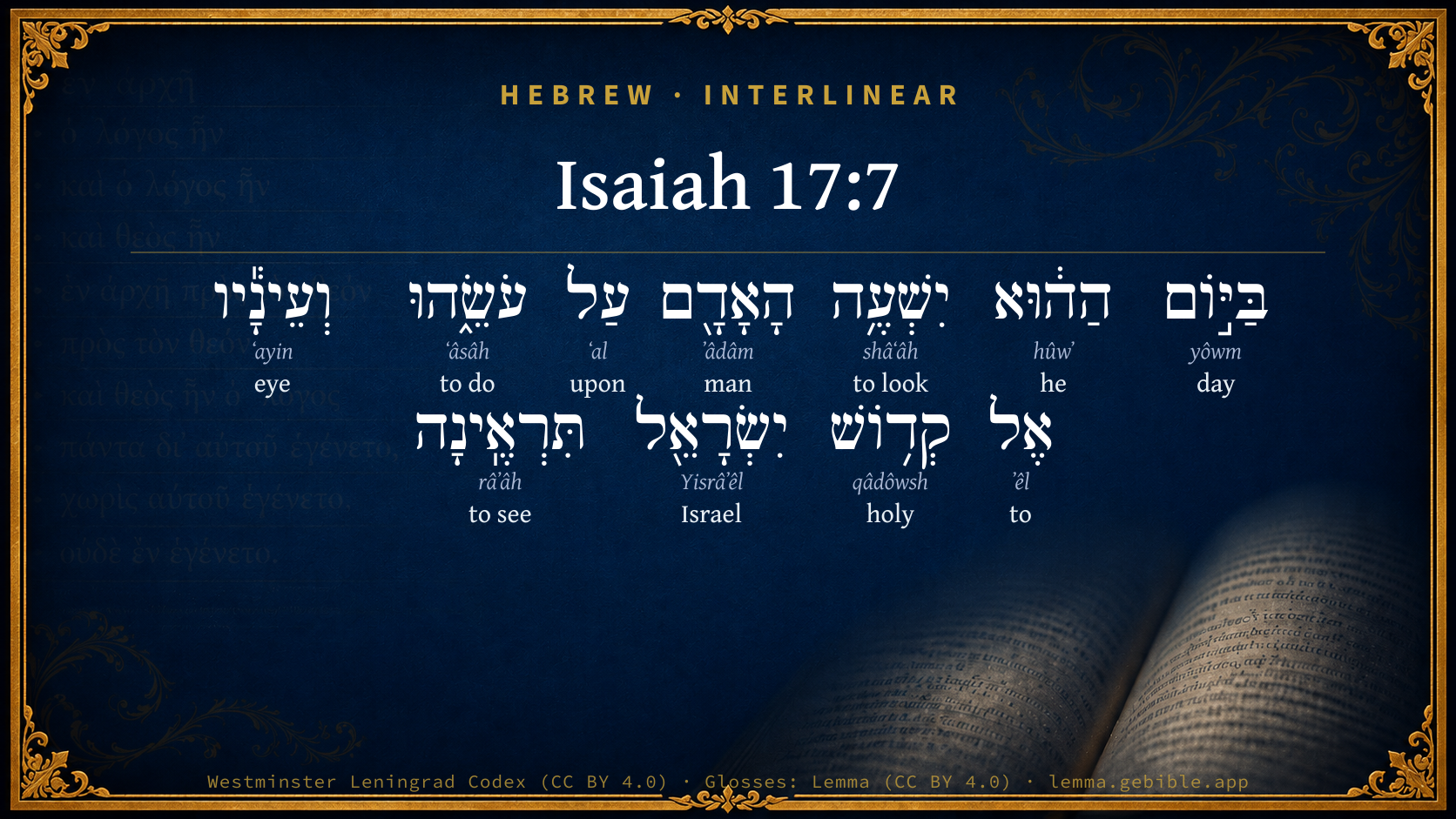
Hebrew (Westminster Leningrad Codex) Isaiah 17:7 appears in the Hebrew Old Testament. The text above is from the Westminster Leningrad Codex. Each word links to its Strong’s number, a concise gloss, and parsing drawn from the Open Scriptures Hebrew Bible morphology. Click any word for its full Brown-Driver-Briggs (BDB) entry.
Download image
Cite this verse

Isaiah 17:7 (World English Bible). Public Domain. Lemma interlinear Bible study tool, https://lemma.gebible.app/v/isaiah/17/7.

Show BibTeX & RIS
BibTeX
RIS
English Translation
In that day shall men look to their Maker, and their eyes shall have respect to the Holy One of Israel.
World English Bible · Public Domain
Download a study sheet

One document with this verse’s original text, its word-by-word gloss line, the meaning frame, cross-references with their text, attributed commentary, and full source and license credits — printable, and it pastes into notes with its structure intact.

This verse Autodidact and up

Study sheet (.html) Plain text (.txt)

A passage Seminary Student

Up to 50 verses in one chapter. A passage sheet keeps up to 6 commentary sources and 12 cross-references per verse, in the order this page ranks them, and says so on the sheet whenever that leaves anything out. Ask for a single verse and you get the Autodidact verse sheet above.

Everything on this page stays free to read, with no account — the sheet is a download of what is already on screen, not access to it.

Want to remove ads? Support Godless Engineer
Compare translations 3

The same verse in 3 English versions, stacked beneath the original-language interlinear above. Click any original word for its lexicon entry.

Each is an independent rendering of the whole verse — the interlinear is not word-aligned to these translations.

Highlighted words mark where these versions differ — a whole-verse word diff, not a word-by-word alignment.

  • World English Bible Public Domain
    In that day shall men look to their Maker, and their eyes shall have respect to the Holy One of Israel.
  • King James Version Public Domain
    At that day shall a man look to his Maker, and his eyes shall have respect to the Holy One of Israel.
  • unfoldingWord Literal Text CC BY-SA 4.0
    In that day, a man will gaze at his Maker, and his eyes will look to the Holy of Israel.

unfoldingWord Literal Text — © unfoldingWord, licensed CC BY-SA 4.0. Word-aligned USFM3 via Door43 (git.door43.org/unfoldingWord/en_ult).

Versions to compare (up to 4)

3 of 4 selected

Show all 18 translations

Every available English version of this verse, each an independent rendering of the whole verse.

  • World English Bible Public Domain
    In that day shall men look to their Maker, and their eyes shall have respect to the Holy One of Israel.
  • Berean Standard Bible Public Domain
    In that day men will look to their Maker and turn their eyes to the Holy One of Israel.
  • Majority Standard Bible Public Domain
    In that day men will look to their Maker and turn their eyes to the Holy One of Israel.
  • King James Version Public Domain
    At that day shall a man look to his Maker, and his eyes shall have respect to the Holy One of Israel.
  • American Standard Version (1901) Public Domain
    In that day shall men look unto their Maker, and their eyes shall have respect to the Holy One of Israel.
  • Revised Version (1885) Public Domain
    In that day shall a man look unto his Maker, and his eyes shall have respect to the Holy One of Israel.
  • Geneva Bible (1599) Public Domain
    At that day shall a man looke to his maker, and his eyes shall looke to the holy one of Israel.
  • Douay-Rheims (1899) Public Domain
    In that day man shall bow down himself to his Maker, and his eyes shall look to the Holy One of Israel.
  • Young's Literal Translation Public Domain
    In that day doth man look to His Maker, Yea, his eyes to the Holy One of Israel look,
  • Literal Standard Version CC BY-SA 4.0
    In that day man looks to His Maker, || Indeed, his eyes look to the Holy One of Israel,
  • Unlocked Literal Bible CC BY-SA 4.0
    On that day men will look toward their Maker, and their eyes will look to the Holy One of Israel.
  • unfoldingWord Literal Text CC BY-SA 4.0
    In that day, a man will gaze at his Maker, and his eyes will look to the Holy of Israel.
  • Darby Bible Public Domain
    In that day shall man look to his Maker, and his eyes shall have regard to the Holy One of Israel.
  • World Messianic Bible Public Domain
    In that day, people will look to their Maker, and their eyes will have respect for the Holy One of Israel.
  • Webster's Bible Public Domain
    At that day shall a man look to his Maker, and his eyes shall have respect to the Holy One of Israel.
  • Free Bible Version CC BY-SA 4.0
    At that time people will pay attention to their Creator and look to the Holy One of Israel.
  • Bible in Basic English Public Domain
    In that day a man's heart will be turned to his Maker, and his eyes to the Holy One of Israel.
  • JPS Tanakh (1917) Public Domain
    In that day shall a man regard his Maker, and his eyes shall look to the Holy One of Israel.

Literal Standard Version (2020), Covenant Press — licensed CC BY-SA 4.0. Text via the HelloAO Bible API (eBible.org). Unlocked Literal Bible (unfoldingWord) — licensed CC BY-SA 4.0. Text via the HelloAO Bible API (eBible.org). unfoldingWord Literal Text — © unfoldingWord, licensed CC BY-SA 4.0. Word-aligned USFM3 via Door43 (git.door43.org/unfoldingWord/en_ult). Free Bible Version, Dr. Jonathan Gallagher — licensed CC BY-SA 4.0. Text via the HelloAO Bible API (eBible.org).

Word by word

More ways to search: Search by grammar → Find every occurrence → Compare this word →

Practice this passage: Drill this verse → Learn its vocabulary →

יִשְׁעֶ֥ה
shâʻâh
H8159
“to look”
Verb, Qal, Imperfect, 3rd Person, Masculine, Singular
Part of Speech
Verb
Stem
Qal
Form
Imperfect
Person
3rd Person
Gender
Masculine
Number
Singular
Full BDB Definition

Origin: a primitive root

TWOT: 2429

to look at or to, regard, gaze at or about - (Qal) to gaze at, regard, behold, look about - (Hiphil) to look away, cause gaze to turn away - (Hithpael) to look in dismay, gaze about (in anxiety)
  1. בַּיּ֣וֹם yôwm H3117 “in/at the · day” Preposition, Determined + Noun, Common, Masculine, Singular, Absolute
  2. הַה֔וּא hûwʼ H1931 “the · he” Particle, Definite Article + Pronoun, Personal, 3rd Person, Masculine, Singular
  3. הָאָדָ֖ם ʼâdâm H120 “the · man” Particle, Definite Article + Noun, Common, Masculine, Singular, Absolute
  4. עַל ʻal H5921 “upon” Preposition
  5. עֹשֵׂ֑הוּ ʻâsâh H6213 “doing · him” Verb, Qal, Participle Active, Masculine, Singular, Construct + Suffix, Personal, 3rd Person, Masculine, Singular
  6. וְעֵינָ֕יו ʻayin H5869 “and · eyes · his” Conjunction + Noun, Common, Both, Dual, Construct + Suffix, Personal, 3rd Person, Masculine, Singular
  7. אֶל ʼêl H413 “to” Preposition
  8. קְד֥וֹשׁ qâdôwsh H6918 “holy of” Adjective, Adjective, Masculine, Singular, Construct
  9. יִשְׂרָאֵ֖ל Yisrâʼêl H3478 “Israel” Noun, Proper
  10. תִּרְאֶֽינָה râʼâh H7200 “to see” Verb, Qal, Imperfect, 3rd Person, Feminine, Plural

About this verse

These counts appear in no published source. They are computed here, from the morphology-tagged text and Lemma’s own curated glosses. What Lemma adds →

11
words
11
distinct lemmas
Prophets
section

Notable vocabulary

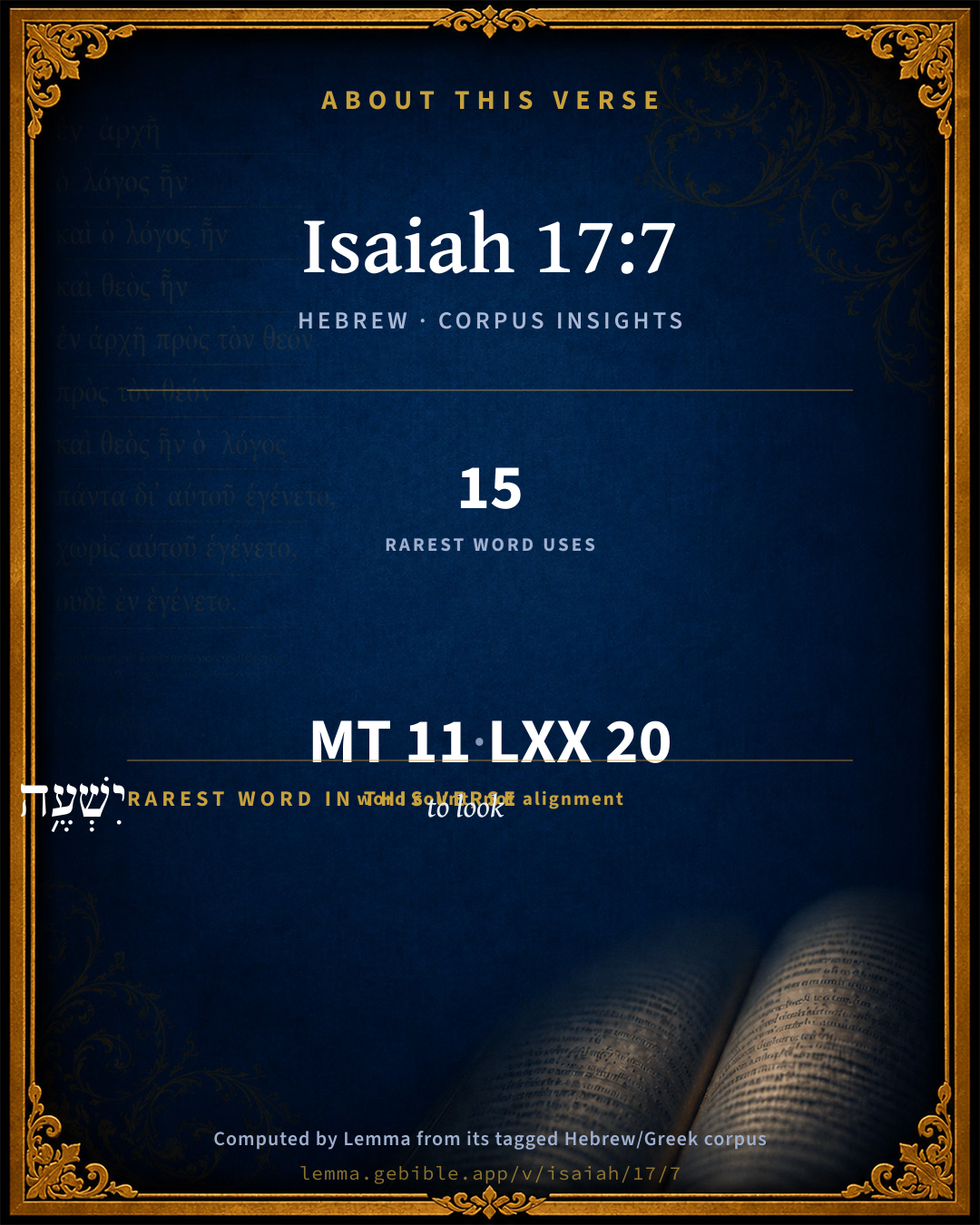
The rarest word here is יִשְׁעֶ֥ה to look H8159 — appearing just 15 times in the whole Hebrew Bible.

Shared distinctive vocabulary

יִשְׁעֶ֥ה to look H8159 occurs in 15 verses of the Hebrew Bible. Also found in:

Grammatical profile

  • 3 verbs
  • 4 nouns
  • 1 adjective
  • 1 pronoun
  • 2 prepositions

Verb forms

  • יִשְׁעֶ֥ה Qal · Imperfect
  • עֹשֵׂ֑הוּ Qal · Participle Active
  • תִּרְאֶֽינָה Qal · Imperfect

Hebrew & Septuagint length

In English translation the verse runs 21 words from the Hebrew and 24 from the Septuagint (LXX English) — closely comparable.

A rough comparison of the two English renderings, which tokenize alike — not a word-level alignment.

Word counts can differ between the Hebrew and the Greek without any difference in meaning — e.g. the Hebrew direct-object marker אֵת has no separate Greek word, and Greek often adds the article ὁ.

In the original languages it is 11 Hebrew tokens and 20 Greek tokens — but the two are counted differently (Hebrew bundles its prefixes and suffixes into one token; the Greek is in lemma form), so that isn’t a like-for-like length.

Cross-references

18

Topical passages linked to Isaiah 17:7 in the Treasury of Scripture Knowledge — connected by theme and wording, ordered by reader-vote popularity; previews shown in the World English Bible.

  • Micah 7:7 But as for me, I will look to Yahweh. I will wait for the God of my salvation. My God will hear me.
  • Hosea 6:1 "Come, and let us return to Yahweh; For he has torn us to pieces, And he will heal us; He has injured us, And he will bind up our wounds.
  • Hosea 3:5 Afterward the children of Israel shall return, and seek Yahweh their God, and David their king, and shall come with trembling to Yahweh and to his blessings in the last days.
  • Judges 10:15–16 The children of Israel said to Yahweh, We have sinned: do you to us whatever seems good to you; only deliver us, we pray you, this day.
  • 2 Chronicles 30:10–11 So the posts passed from city to city through the country of Ephraim and Manasseh, even to Zebulun: but they ridiculed them, and mocked them.
  • 2 Chronicles 30:18–20 For a multitude of the people, even many of Ephraim and Manasseh, Issachar and Zebulun, had not cleansed themselves, yet did they eat the Passover otherwise than it is written. For Hezekiah had prayed for them, saying, The good Yahweh pardon everyone
  • 2 Chronicles 31:1 Now when all this was finished, all Israel who were present went out to the cities of Judah, and broke in pieces the pillars, and hewed down the Asherim, and broke down the high places and the altars out of all Judah and Benjamin, in Ephraim also and Manasseh, until they had destroyed them all. Then all the children of Israel returned, every man to his possession, into their own cities.
  • 2 Chronicles 35:17–18 The children of Israel who were present kept the Passover at that time, and the feast of unleavened bread seven days.
  • Isaiah 10:20–21 It shall come to pass in that day, that the remnant of Israel, and those who are escaped of the house of Jacob, shall no more again lean on him who struck them, but shall lean on Yahweh, the Holy One of Israel, in truth.
  • Isaiah 19:22 Yahweh will strike Egypt, smiting and healing; and they shall return to Yahweh, and he will be entreated of them, and will heal them.
  • Isaiah 22:11 you made also a reservoir between the two walls for the water of the old pool. But you didn't look to him who had done this, neither did you have respect for him who purposed it long ago.
  • Isaiah 24:14–15 These shall lift up their voice, they shall shout; for the majesty of Yahweh they cry aloud from the sea.
  • Isaiah 29:18–19 In that day shall the deaf hear the words of the book, and the eyes of the blind shall see out of obscurity and out of darkness.
  • Isaiah 29:24 They also who err in spirit shall come to understanding, and those who murmur shall receive instruction.
  • Jeremiah 3:12–14 Go, and proclaim these words toward the north, and say, Return, you backsliding Israel, says Yahweh; I will not look in anger on you; for I am merciful, says Yahweh, I will not keep [anger] forever.
  • Jeremiah 3:18–23 In those days the house of Judah shall walk with the house of Israel, and they shall come together out of the land of the north to the land that I gave for an inheritance to your fathers.
  • Jeremiah 31:4–10 Again will I build you, and you shall be built, O virgin of Israel: again shall you be adorned with your tambourines, and shall go forth in the dances of those who make merry.
  • Hosea 14:1–3 Israel, return to Yahweh your God; For you have fallen because of your sin.

Cross-references courtesy of OpenBible.info (CC BY 4.0).

Hebrew and Greek witnesses Masoretic Hebrew ↔ Greek Septuagint

The same verse in the two great witnesses to the Old Testament, shown verse-for-verse.

These are two independent witnesses, not word-aligned to each other, and the Septuagint is shown in lemma (dictionary) form.

Hebrew Isaiah 17:7 Masoretic · Westminster Leningrad Codex

בַּיּ֣וֹם הַה֔וּא יִשְׁעֶ֥ה הָאָדָ֖ם עַל עֹשֵׂ֑הוּ וְעֵינָ֕יו אֶל קְד֥וֹשׁ יִשְׂרָאֵ֖ל תִּרְאֶֽינָה

In that day shall men look to their Maker, and their eyes shall have respect to the Holy One of Israel.

World English Bible · Public Domain

Greek LXX Isaiah 17:7 Septuagint · lemma form

ὁ ἡμέρα ἐκεῖνος πείθω εἰμί ἄνθρωπος ἐπί ὁ ποιέω αὐτός ὁ δέ ὀφθαλμός αὐτός εἰς ὁ ἅγιος ὁ ἰσραήλ ἐνβλέπω

In that day a man shall trust in him that made him, and his eyes shall have respect to the Holy One of Israel.

LXX2012 (modern English Septuagint) · Public Domain

Hebrew: Westminster Leningrad Codex (CC BY 4.0). Greek: Septuagint (public domain); English from LXX2012 (modern English Septuagint) (Public Domain). How the Septuagint differs from the Hebrew →

Targum (Aramaic paraphrase)

1

The Targum is the ancient Jewish Aramaic paraphrase of the Hebrew Scriptures — an interpretive translation, not the Hebrew text itself. Onkelos (literal) and Pseudo-Jonathan (expansive) render the Torah, and Jonathan the Prophets. Coverage is partial: where no permissively-licensed English translation exists for a verse, only the Aramaic is shown. This is verse-level text, not a word-by-word alignment to the Hebrew.

  1. Targum Jonathan Prophets (Joshua–Malachi)
    בְּעִדָנָא הַהִיא יִסְתְּמֵיךְ אֱנָשָׁא לְפוּלְחַן עָבְדֵיהּ וְעֵינוֹהִי לְמֵימַר קַדִישָׁא דְיִשְׂרָאֵל יְסַבְּרוּן:

    At that time a man shall stay himself upon the service of his Maker, and his eyes shall hopefully look for the WORD, the Holy One of Israel.

    Targum Jonathan — Aramaic: “Mikraot Gedolot” (public domain). English: “Sefaria Community Translation” (CC0 1.0 (public-domain dedication)); “London "Chaldee Paraphrase," 1871” (public domain). Text via Sefaria.

Commentary

Notes on Isaiah 17:7 from classic Christian and Jewish commentators (each source and its license shown beneath its notes). The classic Christian expositions comment on the surrounding passage and are grouped to its opening verse, so a note may address several verses; the Jewish commentaries on the Tanakh (Rashi and others) are per-verse, so they appear only where the commentator wrote on this verse.

Lemma curates 59 commentaries, every one of them public domain or Creative Commons licensed, each selected and text-cleaned for this edition rather than reprinted as found. About our sources →

Trapp's Complete Commentary

John Trapp

Isa 17:7 At that day shall a man look to his Maker, and his eyes shall have respect to the Holy One of Israel.

Ver. 7. At that day shall a man look to his Maker.] The elect among the Israelites shall do so, having been whipped home as before. There is an elegance in the original, as there are many in this prophet, that cannot be translated. Here also, and in the next verse, we have a description of true repentance, the right fruit of affliction sanctified. Penitence and punishment are words of one derivation.

John Trapp, A Commentary or Exposition upon All the Books of the Old and New Testament (1647–1656) — public domain. Text from a community e-Sword module.

The Biblical Illustrator

Joseph S. Exell

Isa_17:7-8

At that day shall a man look to his Maker

Sanctified affliction

We are led to consider the designs of God in the afflictions of His people.

I. TO RECALL THEIR WANDERING HEARTS TO HIMSELF. A man will look to his Maker--

1. With a suppliant eye, to find in Him sources of consolation and a rock of defence such as the world cannot furnish (Psa_123:1-2; Jh 2:1).

2. With a penitent eye (Luk_22:62; Zec_12:10).

3. With a confiding and believing eye (chap. 8:17).

4. With a rejoicing eye (Rom_5:11; Hab_3:18).

II. TO RAISE THEIR ESTIMATE OF THE HOLINESS OF THE DIVINE CHARACTER AND THE RECTITUDE OF THE DIVINE DISPENSATIONS. Shall have respect unto the Holy One of Israel.

III. TO SEPARATE THEM FROM ALL SINFUL AND IDOLATROUS DEPENDENCES. He shall not look, etc.

IV. TO ENDEAR THE MERCY THAT MINGLES WITH THE TRIALS. This appears--

1. In the moderate degree in which Gods people are corrected, compared with the final and exterminating judgments which fall upon the wicked. Damascus was to be utterly destroyed (Isa_17:1), but a remnant was to be left to Israel (Isa_17:5). Gods people always see that He has afflicted them less than they deserve (Lam_3:22).

2. In the alleviations of their trials.

3. In the triumphant issue of the whole. (S. Thodey.)

The Biblical Illustrator, edited by Joseph S. Exell (c. 1880s–1900s) — public domain. Text from a community e-Sword module.

Joseph Benson's Commentary

Isa 17:7-8. At that day shall a man — Those few men that are left; look to his Maker — They shall sincerely respect, trust in, and worship God, and God only. In other words, at that time, when God shall execute these severe judgments upon the Ephraimites, some, being fully convinced by experience that they had been deceived by their false prophets, and that their worship of idols had turned out as the true prophets foretold, shall turn themselves, by sincere repentance, to the God of their fathers, and, renouncing the errors of former times, and all their sins, shall worship and serve him in true faith and obedience.

Joseph Benson's Commentary on the Old and New Testaments (1811–1818) — public domain. Text from a community e-Sword module.

The Preacher's Complete Homiletical Commentary

Joseph S. Exell (gen. ed.)

SANCTIFIED AFFLICTION

Isa_17:7-8. At that day shall a man look, &c.

In the prophecies of terror to guilty nations there is always some provision of comfort for God’s faithful and penitent people. His prophets were commissioned to minister hope to His friends, while they foretold misery to His enemies. In the text Isaiah, predicting the overthrow of the ten tribes, furnishes consolation to the faithful remnant who had not yielded to the prevalent idolatry (Isa_17:6), and declares that the judgments he announced would result in the conversion of many who had been ensnared by it. We are thus led to consider the designs of God in the afflictions of His people.

I. To recall their wandering hearts to Himself. “At that day shall a man look to his Maker” (H. E. I., 56–59, 66–70). This is the result of sanctified affliction. Whenever it is seen, it shows that the processes of grace have been combined with the trials of providence, and that the health of the spirit has been restored by the Physician of souls. Otherwise affliction hardens, and the man goes back with greater eagerness to worldliness or iniquity, as the retreating wave presently rolls back upon the beach with greater velocity than before (H. E. I., 223–228). But not so if the healing influence has been sought and found. Then “a man will look to his Maker”—

1. With a suppliant eye, to find in Him sources of consolation and a rock of defence such as the world cannot furnish (Psa_123:1-2; Jon_2:1).

2. With a penitent eye (Luk_22:62; Zec_12:10).

3. With a confiding and believing eye (chap. Isa_8:17).

4. With a rejoicing eye (Rom_5:11; Hab_3:18).

II. To raise their estimate of the holiness of the Divine character and the rectitude of the Divine dispensations. “Shall have respect unto the Holy One of Israel.” Sin begins with a diminished sense of God’s holiness, and conversion is marked by a renewed impression of it (Psa_51:4).

III. To separate them from all sinful and idolatrous dependencies. “He shall not look,” &c. The sin of the ten tribes was idolatry (2Ki_17:16), but here it is foretold that it shall be brought to an end. Those who had been guilty of this folly and this sin would not even look at the altars and the images they had fashioned with such care. So God aims by His afflictive providences to separate His people from everything in which they put an exaggerated and unworthy trust (H. E. I., 110, 111).

IV. To endear the mercy that mingles with the trials. This appears—

1. In the moderate degree in which God’s people are corrected, compared with the final and exterminating judgments which fall upon the wicked. Damascus was to be utterly destroyed (Isa_17:1), but a remnant was to be left to Israel (Isa_17:5; see also chap. Isa_27:7-9). God’s people always see that He has afflicted them less than they deserve (Lam_3:22) [1042]

2. In the alleviations of their trials (H. E. I., 117–121).

3. In the triumphant issue of the whole. They are delivered from the idolatry by which they were degraded (H. E. I., 116).—Samuel Thodey.

[1042] See Outline: GOD’S RELUCTANCE TO PUNISH, chap. Isa_1:9.

The Preacher's Complete Homiletical Commentary (gen. ed. Joseph S. Exell; Funk & Wagnalls, c. 1892) — public domain (pre-1929). A full-Bible homiletical/sermon-outline anthology covering 65 of 66 books (2 John is absent from the source module). Text from a community e-Sword module.

Tyndale Open Study Notes

Tyndale Open Resources

17:7 The people referred to here are either Israelites or humanity at large. • look . . . turn their eyes: They will again put their trust in the Lord.

Tyndale Open Study Notes — © Tyndale Open Resources, licensed CC BY-SA 4.0. Text via the HelloAO Bible API.

Geneva Bible (1599)

Geneva Bible translators

He showeth that God’s corrections ever bring forth some fruit, and cause his to turn from their sins, and to humble themselves to him.

Geneva Bible (1599) marginal notes — public domain. Text via Bolls.life.

Jamieson, Fausset & Brown

Robert Jamieson, A. R. Fausset & David Brown

look to his Maker--instead of trusting in their fortresses-- (Isa 17:3; Mic 7:7).

Jamieson, Fausset & Brown — Commentary Critical and Explanatory on the Whole Bible (1871) — public domain (CC PDM 1.0). Text via the HelloAO Bible API.

Ellicott's Commentary for English Readers

(7) At that day shall a man look to his Maker.—The words are words of warning hardly less than of promise. There is to be a return to the true faith of Israel, but that return will be brought about by a bitter experience of the results of idolatry. The eyes of men will turn in that hour of their calamity to the Holy One of Israel.

A Bible Commentary for English Readers, edited by Charles John Ellicott (1878–1897) — public domain. Text from a community e-Sword module.

The Cambridge Bible for Schools and Colleges

gen. ed. J. J. S. Perowne

7. look to his Maker] cf. Isa_22:11. “Look to,” i.e. regard with trust and veneration.

7, 8. These verses do not necessarily point to a conversion of the few surviving Ephraimites. They rather describe the impression produced by the vindication of Jehovah’s righteousness on mankind at large. Both in thought and structure, they interrupt the continuity of the oracle, and may have been inserted later (doubtless by the prophet himself). If they are removed we have three equal strophes, the first two ending with a “saith Jehovah,” and the last two beginning with “in that day.”

The Cambridge Bible for Schools and Colleges (gen. ed. J. J. S. Perowne; Cambridge University Press, 1878–1918) — public domain. Text from a community e-Sword module.

John Gill's Exposition

At that day shall a man look to his Maker,.... The one only living and true God, who has made him, and not he himself, nor any other creature; that is, such as are left, as before described, the remnant, according to the election of grace; these shall look to God for help and assistance, for supply, support, and protection; and to Christ particularly, who is the Maker of all things, without whom was not any thing made that is made, for all spiritual blessings; for righteousness and strength, for peace and pardon, for food, and all comfortable supplies of grace, for life and salvation; who is set up to be looked unto for these things; to whom men are directed and encouraged to look for them, both by himself, and by his ministers, and to whom saints in all ages have looked and have not been disappointed; and to this sense the following words incline:

and his eyes shall have respect to the Holy One of Israel; who in this prophecy is said to be the Redeemer, Isa 43:14 he is the Holy One that sprung from literal Israel; and is the sanctifier of mystical Israel; to which agrees the Targum,

"and his eyes shall hope for the Word of the Holy One of Israel:''

the Word by whom all things were made in the beginning, and who was made flesh and dwelt among men.

John Gill's Exposition of the Whole Bible (1746–1763) — public domain (CC PDM 1.0). Text via the HelloAO Bible API.

Albert Barnes' Notes on the Bible

At that day shall a man look to his Maker - Instead of confiding in their strongly fortified places and armies, they shall look for aid and protection to the God that made them, and who alone can help them. National afflictions and judgments often have the effect to turn the eyes of even a wicked and rebellious people to God. They feel their danger; they are convinced of their guilt; they see that no one but God can protect them; and for a time they are willing, even by humiliation and fasting, to seek the divine protection.

His eyes shall have respect ... - He shall look up to, or regard.

The Holy One of Israel - The God of Israel; the true God. As the Syrians were allied with the kingdom of Samaria or Ephraim, they were, of course, acquainted with the true God, and in some sense acknowledged him. In these times of impending calamity, they would be led to seek him, and implore his aid and protection. There is no reason to believe, however, that they would turn permanently to him, or become his true worshippers.

Albert Barnes' Notes on the Bible (1834–1885) — public domain. Text from a community e-Sword/MySword module.

Haydock's Catholic Bible Commentary

Israel. They obeyed the summons of Ezechias and of Josias, (2 Paralipomenon xxx. 1., and xxxiv. 6.) and every after followed the same worship as Juda. (Calmet)

George Leo Haydock (1774–1849), Haydock's Catholic Family Bible and Commentary, 1859 edition — public domain. Excludes Psalms (Douay-Rheims chapter numbering differs from Protestant) and Deuterocanonical books (Catholic canon only).

Matthew Poole's English Annotations

Shall a man, those few men that are left,

look to his Maker, they shall sincerely respect, and trust, and worship (all which are understood by looking to) God, and God only, as the next verse explains it. Their afflictions shall at last bring them to repentance.

Matthew Poole's English Annotations on the Holy Bible (1683–1685) — public domain. Text from a community e-Sword/MySword module.

Whedon's Commentary on the Bible

Daniel D. Whedon

7, 8. At that day — The day when calamity comes on Damascus and Ephraim, and the Assyrians carry away the people. It is matter of history, that after the Assyrian conquest and the deportation of the great body of Israel, many that were left accepted Hezekiah’s call to return to the worship of Jehovah at Jerusalem. 2Ch_30:11.

Shall not look to the altars — Israel and Judah were both enticed to Syrian and Phoenician worship. Ahaz had ordered a copy of the altar at Damascus for the temple at Jerusalem. 2Ki_16:10-12.

Either the groves, or the images — Both these had usurped the place of Jehovah. The one, Asherim, are called “groves” by the old writers; they were used for idol and licentious worship. Modern writers regard them as images of the Phoenician Venus, serving essentially the same purpose. The other, Chamanim, are supposed to be sun-gods representing Baal, the male deity. The “images” were figures of the sun standing upon the altars of Baal. More precise information cannot be given, owing to the danger of confounding the many local varieties of Shemitic mythology. See WILKINS’S Phoenicia and Israel.

Daniel D. Whedon (gen. ed.), Commentary on the Old and New Testaments (1874–1909) — public domain. Text from a community e-Sword module.

The Pulpit Commentary

At that day shall a man look to his Maker. We have evidence of this revulsion of feeling on the part of Israel in the statement of Chronicles that, in the reign of Josiah, offerings of money were made for the temple service by men of Manasseh and Ephraim, and of all the remnant of Israel," which the Levites collected and brought to Jerusalem. (2Ch_34:9)

Vers. 7, 8. The function of adversity.

I THE PREVALENCE OF TROUBLE IN THIS WORLD OF SIN. "That day" was the day of national disaster, and, therefore, of individual distress. In the more settled and durable condition of modern times and Western lands, we are much less liable to suffer from this particular cause. But civilization brings its own perils and its own troubles, and while sin lasts "the day" of sorrow will be continually recurring. How many are the sources whence it may spring! Pecuniary embarrassment; disappointment; the loss of kindred or friends, or (what is worse) the loss of their love and their friendship; humiliation; ill health, and the fear of sudden removal from those who are clinging, and perhaps dependent; a sense of guilt before God; a sense of defeat as a Christian aspirant or Christian workman, etc.

II GOD"S PURPOSE IN SENDING IT.

1. God does send it. (See Amo_3:6) He directly inflicts it, or he furthers it in his Divine providence, or, at the least, he permits it. (see, also, Mat_10:29)

2. He sends it to draw us to himself.

(1) To withdraw us from the inferior and the untrustworthy objects; that a man may "not look to the altars, the work of his hands;" that we may discover, what we are so slow to learn, that all human help and all earthly securities are insufficient and unavailing; that these things of our own devising and constructing, which our fingers have made, break down in the time of our distress, and leave us "naked to our enemies.

(2) To draw us to the mighty and the holy One. Our Maker will not want the power to redeem us. The Holy One of Israel will not fail to sanctify to us the evil he has sent us. He draws us to himself that, at his throne of grace, in sacred fellowship with him, we may be drown to penitence, to trustfulness, to prayerfulness, to the consecration or the rededication of our lives to his service. C.

Eyes turned to God only.

Cheyne"s translation is, "In that day shall the earth-born look towards his Maker, and his eyes shall have regard to the Holy One of Israel." The reference seems to be to those who, after the Assyrian conquest of Israel accepted Hezekiah"s invitation, returned to Jerusalem, giving up their confidence in idols, and looking with single eye to Jehovah, and serving him with sincere hearts. The figure suggests for consideration the possible attitudes of human vision towards God.

I THERE IS THE BLINDED VISION. Two things blind:

1. Ignorance, as illustrated in the case of the heathen.

2. Willfulness, as illustrated in all who are living in sin. The one blindness is a calamity, calling forth our pity; the other is a crime, calling for ore" indignation. There is also a judicial blindness the stroke of God upon those who have misused their eyesight, keeping it fixed on vanity, not lifted up to the heavens, "from whence cometh man"s help." They who will not see shall not be able to see.

II THERE IS THE DIMMED VISION. Influenced by surrounding atmospheres of

(1) thought;

(2) social custom;

(3) familiar errors.

Nowadays men are sadly suffering from dimmed vision. Fogs of prevailing unbelief are for a time half hiding God, and even Christians are troubled lest the dimness should prove to be in their eyes. The evil is only in the medium through which the eye looks.

III THERE IS THE DIVIDED VISION. Which can see both God and self, and trios hard to keep both, side by side, in the field. Of some in the olden times it was said, "They feared the Lord, and served other gods;" and this must be the description of very many in the modern. "Their heart is divided." They cannot see "Jesus only.

IV THERE IS THE CLEARED VISION. Oftentimes cleansed and purified by the medicine of affliction, as in the association of the text. God"s chastisements are his teaching us to see.

V THERE IS THE CONCENTRATED VISION. Eyes turned to God only. The sign of entire devotement; full consecration. An eye single, and fixed on one object. This one thing I will do, "I will lift up mine eyes unto the hills." Plead the call and persuasion of the risen and living Christ, "Anoint thine eyes with eye-salve, that thou mayest see. R.T.

The Pulpit Commentary (1880–1919), ed. H.D.M. Spence-Jones & Joseph S. Exell — public domain. Text from a community e-Sword module.

John Wesley's Explanatory Notes

A man - Those few men that are left. Look - They shall sincerely respect, and trust, and worship God, and God only.

John Wesley, Explanatory Notes Upon the Whole Bible (1754–1765) — public domain. Text via the GEBible commentary corpus.

J. A. Alexander on Isaiah

Joseph Addison Alexander

“In that day man shall turn to his Maker, and his eyes to the Holy One of Israel shall look.” Maker is here used in a pregnant sense to describe God, not merely as the natural creator of mankind, but as the maker of Israel, the author of their privileges, and their covenant God. (Compare Deu 32:6). The same idea is expressed by the parallel phrase, Holy One of Israel, for the import of which see above, Isa 1:4. It is matter of history, that after the Assyrian conquest and the general deportation of the people, many accepted Hezekiah’s invitation and returned to the worship of Jehovah at Jerusalem (2Ch 30:11), and this reformation is alluded to as still continued in the times of Josiah (2Ch 34:9). At the same time the words may be intended to suggest that a similar effect might be expected to result from similar causes it later times.

Joseph Addison Alexander, The Prophecies of Isaiah (1846–1847; New York: Scribner, 1870–1878) — public domain. Text from a community e-Sword module.

Rashi

Rabbi Shlomo Yitzchaki (Rashi)

shall turn Heb. יִשְׁעֶה, shall turn to his Maker. Comp. (Gen. 4:4) “And the Lord turned (וַיִּשַׁע) to Abel.”

man the righteous men remaining among them.

Rashi on the Tanakh — English translations: “The Judaica Press complete Tanach with Rashi, translated by A. J. Rosenberg” (CC BY 4.0); “Pentateuch with Rashi's commentary by M. Rosenbaum and A.M. Silbermann, 1929-1934” (public domain); “The Metsudah Tanach series, Lakewood, N.J” (CC BY 4.0); and “The Book of Joshua, Metsudah Publications, 1997” (CC BY 4.0). Text via Sefaria.

Ibn Ezra

Rabbi Abraham ibn Ezra

ישעה האדם על עשהו Shall a man look to his maker. Man will renounce his own powers, because of the Lord, and this is the true confidence in God (comp. 2 Sam. 22:42).

And his eyes shall see, etc. They shall no more see the worship of idols, for they will only visit places sanctified to the worship of the Lord.

Ibn Ezra on the Tanakh — English translations: “Sefaria Community Translation” (CC0 1.0 (public-domain dedication)); “Yalkut, Sifsei Chachomim Chumash, Metsudah Publications, 2009” (CC BY 4.0); and “Commentary of Ibn Ezra on Isaiah - trans. by M. Friedlander, 1873” (public domain). Text via Sefaria.

Lesson kit

Teaching starters — assembled from the data on this page, not authored interpretation. Every prompt links to the verse data it draws on. Edit before teaching.

Isaiah, in the Prophets, opens this verse with 11 words (11 distinct Hebrew lemmas). Its most distinctive word is shâʻâh (“to look”). A historical commentator’s framing appears above. Read the whole chapter for the surrounding context.

Discussion questions

  1. How does “to look” (shâʻâh) shape what this verse is saying?
  2. Genesis 4:4 shares the word «to look» with this verse. How do the two illuminate each other?
  3. The translations on this page render this verse differently — a whole-verse word diff, not a word-by-word alignment. What might account for the different wordings?
  4. The verb «יִשְׁעֶ֥ה» is Qal Imperfect. How does its form color the action?
  5. Reading how Trapp's Complete Commentary and The Biblical Illustrator read this verse, where do the two commentators agree and where do they part?

Things to notice

Reading settings

Reading text

Shown beneath each verse's original-language words.

Old Testament
Old Testament edition

Read the OT as the Masoretic Hebrew (MT) or the Greek Septuagint (LXX).

English shown for the Greek Septuagint (in the Hebrew ↔ Greek comparison).

Comparing translations? Open the Compare panel on any verse page to stack up to four side by side.