Isaiah 64:4

Hebrew (Westminster Leningrad Codex) Isaiah 64:4 appears in the Hebrew Old Testament. The text above is from the Westminster Leningrad Codex. Each word links to its Strong’s number, a concise gloss, and parsing drawn from the Open Scriptures Hebrew Bible morphology. Click any word for its full Brown-Driver-Briggs (BDB) entry.
Download image
Cite this verse

Isaiah 64:4 (World English Bible). Public Domain. Lemma interlinear Bible study tool, https://lemma.gebible.app/v/isaiah/64/4.

Show BibTeX & RIS
BibTeX
RIS
English Translation
For from of old men have not heard, nor perceived by the ear, neither has the eye seen a God besides you, who works for him who waits for him.
World English Bible · Public Domain
Download a study sheet

One document with this verse’s original text, its word-by-word gloss line, the meaning frame, cross-references with their text, attributed commentary, and full source and license credits — printable, and it pastes into notes with its structure intact.

This verse Autodidact and up

Study sheet (.html) Plain text (.txt)

A passage Seminary Student

Up to 50 verses in one chapter. A passage sheet keeps up to 6 commentary sources and 12 cross-references per verse, in the order this page ranks them, and says so on the sheet whenever that leaves anything out. Ask for a single verse and you get the Autodidact verse sheet above.

Everything on this page stays free to read, with no account — the sheet is a download of what is already on screen, not access to it.

Want to remove ads? Support Godless Engineer
Compare translations 3

The same verse in 3 English versions, stacked beneath the original-language interlinear above. Click any original word for its lexicon entry.

Each is an independent rendering of the whole verse — the interlinear is not word-aligned to these translations.

Highlighted words mark where these versions differ — a whole-verse word diff, not a word-by-word alignment.

  • World English Bible Public Domain
    For from of old men have not heard, nor perceived by the ear, neither has the eye seen a God besides you, who works for him who waits for him.
  • King James Version Public Domain
    For since the beginning of the world men have not heard, nor perceived by the ear, neither hath the eye seen, O God, beside thee, what he hath prepared for him that waiteth for him.
  • unfoldingWord Literal Text CC BY-SA 4.0
    And from eternity they have not heard, they have not listened; an eye has not seen a God besides you, he works for the one waiting for him.

unfoldingWord Literal Text — © unfoldingWord, licensed CC BY-SA 4.0. Word-aligned USFM3 via Door43 (git.door43.org/unfoldingWord/en_ult).

Versions to compare (up to 4)

3 of 4 selected

Show all 18 translations

Every available English version of this verse, each an independent rendering of the whole verse.

  • World English Bible Public Domain
    For from of old men have not heard, nor perceived by the ear, neither has the eye seen a God besides you, who works for him who waits for him.
  • Berean Standard Bible Public Domain
    From ancient times no one has heard, no ear has perceived, no eye has seen any God besides You, who acts on behalf of those who wait for Him.
  • Majority Standard Bible Public Domain
    From ancient times no one has heard, no ear has perceived, no eye has seen any God besides You, who acts on behalf of those who wait for Him.
  • King James Version Public Domain
    For since the beginning of the world men have not heard, nor perceived by the ear, neither hath the eye seen, O God, beside thee, what he hath prepared for him that waiteth for him.
  • American Standard Version (1901) Public Domain
    For from of old men have not heard, nor perceived by the ear, neither hath the eye seen a God besides thee, who worketh for him that waiteth for him.
  • Revised Version (1885) Public Domain
    For from of old men have not heard, nor perceived by the ear, neither hath the eye seen a God beside thee, which worketh for him that waiteth for him.
  • Geneva Bible (1599) Public Domain
    For since the beginning of the world they haue not heard nor vnderstande with the eare, neither hath ye eye seene another God beside thee, which doeth so to him that waiteth for him.
  • Douay-Rheims (1899) Public Domain
    From the beginning of the world they have not heard, nor perceived with the ears: the eye hath not seen, O God, besides thee, what things thou hast prepared for them that wait for thee.
  • Young's Literal Translation Public Domain
    Even from antiquity `men' have not heard, They have not given ear, Eye hath not seen a God save Thee, He doth work for those waiting for Him.
  • Literal Standard Version CC BY-SA 4.0
    Even from antiquity [men] have not heard, || They have not given ear, || Eye has not seen a God except You, || He works for those waiting for Him.
  • Unlocked Literal Bible CC BY-SA 4.0
    Since ancient times no one has heard or perceived, nor eye seen any God besides you, who does things for him who waits for him.
  • unfoldingWord Literal Text CC BY-SA 4.0
    And from eternity they have not heard, they have not listened; an eye has not seen a God besides you, he works for the one waiting for him.
  • Darby Bible Public Domain
    Never have [men] heard, nor perceived by the ear, nor hath eye seen a God beside thee, who acteth for him that waiteth for him.
  • World Messianic Bible Public Domain
    For from of old men have not heard, nor perceived by the ear, nor has the eye seen a God besides you, who works for him who waits for him.
  • Webster's Bible Public Domain
    \\64:5\\Thou meetest him that rejoiceth, and worketh righteousness, those that remember thee in thy ways: behold, thou art wroth; for we have sinned: in those is continuance, and we shall be saved.
  • Free Bible Version CC BY-SA 4.0
    Since the beginning, no one has heard about, no one has paid attention to, and no one has seen any God except you, the one who helps those who place their confidence in you.
  • Bible in Basic English Public Domain
    Will you not have mercy on him who takes pleasure in doing righteousness, even on those who keep in mind your ways? Truly you were angry, and we went on doing evil, and sinning against you in the past.
  • JPS Tanakh (1917) Public Domain
    (64-3) And whereof from of old men have not heard, nor perceived by the ear, neither hath the eye seen a God beside Thee, who worketh for him that waiteth for Him.

Literal Standard Version (2020), Covenant Press — licensed CC BY-SA 4.0. Text via the HelloAO Bible API (eBible.org). Unlocked Literal Bible (unfoldingWord) — licensed CC BY-SA 4.0. Text via the HelloAO Bible API (eBible.org). unfoldingWord Literal Text — © unfoldingWord, licensed CC BY-SA 4.0. Word-aligned USFM3 via Door43 (git.door43.org/unfoldingWord/en_ult). Free Bible Version, Dr. Jonathan Gallagher — licensed CC BY-SA 4.0. Text via the HelloAO Bible API (eBible.org).

Word by word

More ways to search: Search by grammar → Find every occurrence → Compare this word →

Practice this passage: Drill this verse → Learn its vocabulary →

לִמְחַכֵּה
châkâh
H2442
“to/for · waiting”
Preposition + Verb, Piel, Participle Active, Masculine, Singular, Construct
Part of Speech
Preposition + Verb
Stem
Piel
Form
Participle Active
Gender
Masculine
Number
Singular
State
Construct
Full BDB Definition

Origin: a primitive root [apparently akin to H2707 through the idea of piercing]

TWOT: 645

to wait, wait for, await - (Qal) to wait for - (Piel) - to wait, tarry - to wait (in ambush) - to wait for, long for
  1. וּמֵעוֹלָ֥ם ʻôwlâm H5769 “and · from · forever” Conjunction + Preposition + Noun, Common, Masculine, Singular, Absolute
  2. לֹא lôʼ H3808 “not” Particle, Negative
  3. שָׁמְע֖וּ shâmaʻ H8085 “to hear” Verb, Qal, Perfect, 3rd Person, Common, Plural
  4. לֹ֣א lôʼ H3808 “not” Particle, Negative
  5. הֶאֱזִ֑ינוּ ʼâzan H238 “to hear” Verb, Hiphil, Perfect, 3rd Person, Common, Plural
  6. עַ֣יִן ʻayin H5869 “eye” Noun, Common, Both, Singular, Absolute
  7. לֹֽא lôʼ H3808 “not” Particle, Negative
  8. רָאָ֗תָה râʼâh H7200 “to see” Verb, Qal, Perfect, 3rd Person, Feminine, Singular
  9. אֱלֹהִים֙ ʼĕlôhîym H430 “God(s)” Noun, Common, Masculine, Plural, Absolute
  10. זוּלָ֣תְךָ֔ zûwlâh H2108 “except · you” Preposition + Suffix, Personal, 2nd Person, Masculine, Singular
  11. יַעֲשֶׂ֖ה ʻâsâh H6213 “to do” Verb, Qal, Imperfect, 3rd Person, Masculine, Singular

About this verse

These counts appear in no published source. They are computed here, from the morphology-tagged text and Lemma’s own curated glosses. What Lemma adds →

13
words
10
distinct lemmas
Prophets
section

Notable vocabulary

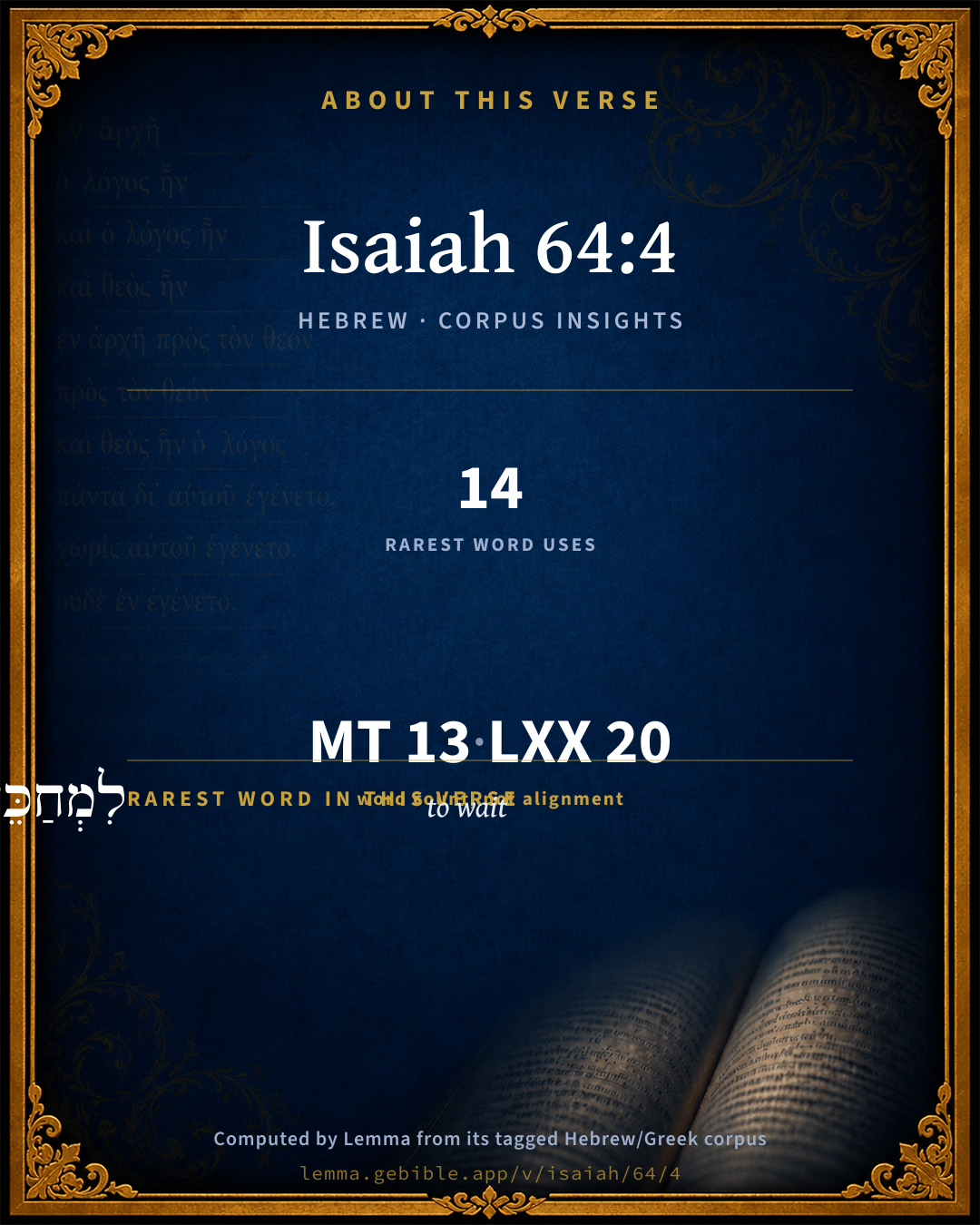
The rarest word here is לִמְחַכֵּה to wait H2442 — appearing just 14 times in the whole Hebrew Bible.

Shared distinctive vocabulary

לִמְחַכֵּה to wait H2442 occurs in 13 verses of the Hebrew Bible. Also found in:

Grammatical profile

  • 5 verbs
  • 3 nouns
  • 2 prepositions
  • 3 particles

Verb forms

  • שָׁמְע֖וּ Qal · Perfect
  • הֶאֱזִ֑ינוּ Hiphil · Perfect
  • רָאָ֗תָה Qal · Perfect
  • יַעֲשֶׂ֖ה Qal · Imperfect
  • לִמְחַכֵּה Piel · Participle Active

Repetition

A word recurs within this verse — often emphatic in Hebrew:

Hebrew & Septuagint length

In English translation the verse runs 30 words from the Hebrew and 29 from the Septuagint (LXX English) — closely comparable.

A rough comparison of the two English renderings, which tokenize alike — not a word-level alignment.

Word counts can differ between the Hebrew and the Greek without any difference in meaning — e.g. the Hebrew direct-object marker אֵת has no separate Greek word, and Greek often adds the article ὁ.

In the original languages it is 13 Hebrew tokens and 20 Greek tokens — but the two are counted differently (Hebrew bundles its prefixes and suffixes into one token; the Greek is in lemma form), so that isn’t a like-for-like length.

Cross-references

26

Topical passages linked to Isaiah 64:4 in the Treasury of Scripture Knowledge — connected by theme and wording, ordered by reader-vote popularity; previews shown in the World English Bible.

  • 1 Corinthians 2:9–10 But as it is written, "Things which an eye didn't see, and an ear didn't hear, Which didn't enter into the heart of man, These God has prepared for those who love him."
  • Psalms 31:19 Oh how great is your goodness, Which you have laid up for those who fear you, Which you have worked for those who take refuge in you, Before the sons of men!
  • James 5:7 Be patient therefore, brothers, until the coming of the Lord. Behold, the farmer waits for the precious fruit of the earth, being patient over it, until it receives the early and late rain.
  • Isaiah 25:9 It shall be said in that day, Behold, this is our God; we have waited for him, and he will save us: this is Yahweh; we have waited for him, we will be glad and rejoice in his salvation.
  • Psalms 130:5 I wait for Yahweh. My soul waits. I hope in his word.
  • Ephesians 3:17–21 that Christ may dwell in your hearts through faith; to the end that you, being rooted and grounded in love,
  • Colossians 1:26–27 the mystery which has been hidden for ages and generations. But now it has been revealed to his saints,
  • Genesis 49:18 I have waited for your salvation, Yahweh.
  • Lamentations 3:25–26 Yahweh is good to those who wait for him, to the soul that seeks him.
  • Isaiah 30:18 Therefore will Yahweh wait, that he may be gracious to you; and therefore will he be exalted, that he may have mercy on you: for Yahweh is a God of justice; blessed are all those who wait for him.
  • John 14:3 If I go and prepare a place for you, I will come again, and will receive you to myself; that where I am, you may be there also.
  • 1 John 3:1–2 Behold, how great a love the Father has bestowed on us, that we should be called children of God! For this cause the world doesn't know us, because it didn't know him.
  • Matthew 25:34 Then the King will tell those on his right hand, 'Come, blessed of my Father, inherit the Kingdom prepared for you from the foundation of the world;
  • Ephesians 3:5–10 which in other generations was not made known to the children of men, as it has now been revealed to his holy apostles and prophets in the Spirit;
  • 1 Timothy 3:16 Without controversy, the mystery of godliness is great: God was revealed in the flesh, Justified in the spirit, Seen by angels, Preached among the nations, Believed on in the world, And received up in glory.
  • Hebrews 11:16 But now they desire a better country, that is, a heavenly one. Therefore God is not ashamed of them, to be called their God, for he has prepared a city for them.
  • Psalms 62:1 My soul rests in God alone. My salvation is from him.
  • Luke 2:25 Behold, there was a man in Jerusalem whose name was Simeon. This man was righteous and devout, looking for the consolation of Israel, and the Holy Spirit was on him.
  • Romans 8:19 For the creation waits with eager expectation for the children of God to be revealed.
  • 1 Corinthians 1:7 so that you come behind in no gift; waiting for the revelation of our Lord Jesus Christ;
  • Romans 8:23–25 Not only so, but ourselves also, who have the first fruits of the Spirit, even we ourselves groan within ourselves, waiting for adoption, the redemption of our body.
  • 1 John 4:10 In this is love, not that we loved God, but that he loved us, and sent his Son as the atoning sacrifice for our sins.
  • 1 Thessalonians 1:10 and to wait for his Son from heaven, whom he raised from the dead-- Jesus, who delivers us from the wrath to come.
  • Revelation 21:1–4 I saw a new heaven and a new earth: for the first heaven and the first earth have passed away, and the sea is no more.
  • Revelation 22:1–5 He showed me a river of water of life, clear as crystal, proceeding out of the throne of God and of the Lamb,
  • Revelation 21:22–24 I saw no temple in it, for the Lord God, the Almighty, and the Lamb, are its temple.

Cross-references courtesy of OpenBible.info (CC BY 4.0).

Hebrew and Greek witnesses Masoretic Hebrew ↔ Greek Septuagint

The same verse in the two great witnesses to the Old Testament, shown verse-for-verse.

These are two independent witnesses, not word-aligned to each other, and the Septuagint is shown in lemma (dictionary) form.

Hebrew Isaiah 64:4 Masoretic · Westminster Leningrad Codex

וּמֵעוֹלָ֥ם לֹא שָׁמְע֖וּ לֹ֣א הֶאֱזִ֑ינוּ עַ֣יִן לֹֽא רָאָ֗תָה אֱלֹהִים֙ זוּלָ֣תְךָ֔ יַעֲשֶׂ֖ה לִמְחַכֵּה לֽוֹ

For from of old men have not heard, nor perceived by the ear, neither has the eye seen a God besides you, who works for him who waits for him.

World English Bible · Public Domain

Greek LXX Isaiah 64:4 Septuagint · lemma form

συναντάω γάρ ὁ ποιέω ὁ δίκαιος καί ὁ ὁδός σύ μιμνήσκω ἰδού σύ ὀργίζω καί ἐγώ ἁμαρτάνω διά οὗτος πλανάω

From of old we have not heard, neither have our eyes seen a God beside you, and your works which you will perform to them that wait for mercy.

LXX2012 (modern English Septuagint) · Public Domain

On this verse, The Cambridge Bible for Schools and Colleges discusses the Septuagint’s reading. Read the note in Commentary ↓

Hebrew: Westminster Leningrad Codex (CC BY 4.0). Greek: Septuagint (public domain); English from LXX2012 (modern English Septuagint) (Public Domain). How the Septuagint differs from the Hebrew →

Targum (Aramaic paraphrase)

1

The Targum is the ancient Jewish Aramaic paraphrase of the Hebrew Scriptures — an interpretive translation, not the Hebrew text itself. Onkelos (literal) and Pseudo-Jonathan (expansive) render the Torah, and Jonathan the Prophets. Coverage is partial: where no permissively-licensed English translation exists for a verse, only the Aramaic is shown. This is verse-level text, not a word-by-word alignment to the Hebrew.

  1. Targum Jonathan Prophets (Joshua–Malachi)
    מִתְעַרְעִין קֳדָמָךְ עוֹבָדֵי אַבְהָתָנָא צַדִיקַיָא דַחֲדִיא לְמֶעְבַּד רְעוּתָךְ בִּקְשׁוֹט וּבְזָכוּ בְּאוֹרַח טוּבָךְ וְרַחֲמָךְ הֲווֹ דְכִירִין לִדְחַלְתָּךְ הָא בְּכָל עִדַן דַהֲוָה רְגַז מִן קֳדָמָךְ עֲלָנָא עַל דְחַבְנָא בְהוֹן בְּעוֹבָדֵי אֲבָהָתָנָא צַדִיקַיָא דְמִן עַלְמָא אֲנַחְנָא מִתְפָּרְקִין:

    The works of our righteous fathers were acceptable in Thy sight, who rejoiced to do Thy will in truth and in righteousness: in the way of Thy goodness and mercy they remembered Thy fear whenever Thy wrath from Thy presence was upon us, because we had sinned: on account of the works of our righteous fathers, we have been saved.

    Targum Jonathan — Aramaic: “Mikraot Gedolot” (public domain). English: “Sefaria Community Translation” (CC0 1.0 (public-domain dedication)); “London "Chaldee Paraphrase," 1871” (public domain). Text via Sefaria.

Commentary

Notes on Isaiah 64:4 from classic Christian and Jewish commentators (each source and its license shown beneath its notes). The classic Christian expositions comment on the surrounding passage and are grouped to its opening verse, so a note may address several verses; the Jewish commentaries on the Tanakh (Rashi and others) are per-verse, so they appear only where the commentator wrote on this verse.

Lemma curates 59 commentaries, every one of them public domain or Creative Commons licensed, each selected and text-cleaned for this edition rather than reprinted as found. About our sources →

The Cambridge Bible for Schools and Colleges

gen. ed. J. J. S. Perowne

4–7. This difficult passage contains (1) an appeal to that which distinguishes Jehovah from all other deities: He is the only God who works for them that wait for Him in the way of righteousness; (2) a confession of the people’s sinful condition due to the persistency of the divine wrath. A contrast between these thoughts is probably intended; the severity of Jehovah’s dealings with Israel seems at variance with His known character. But the text is in some places hopelessly corrupt, and the exact sense is somewhat uncertain.

For since the beginning … heard] Lit. “And from of old they have not heard.” It is tempting (with Duhm) to take this as a relative clause parallel to and continuing Isa_64:3 (“… terrible things which we hoped not for, and which from of old men have not heard”). There is an awkwardness, however, in commencing a new sentence with the next clause, and still greater difficulty in carrying on the sentence of Isa_64:3 to the word “seen” (Hitzig). Accepting the traditional division, Isa_64:4 will read nearly as in R.V., And from of old men have not heard, have not perceived by the ear, no eye hath seen a God beside Thee, Who worketh for him that waiteth for Him. The rendering of A.V. is partly accommodated to St Paul’s language in 1Co_2:9, where, however, a different text (not the LXX.) seems to be followed. Jerome says that the Apostle’s words are found in certain Apocalyptic books, although he will not admit that they are quoted from them.

“Worketh for”=“sheweth Himself active on behalf of”; without obj., as Gen_30:30; Psa_37:5.

The Cambridge Bible for Schools and Colleges (gen. ed. J. J. S. Perowne; Cambridge University Press, 1878–1918) — public domain. Text from a community e-Sword module.

Trapp's Complete Commentary

John Trapp

Isa 64:4 For since the beginning of the world [men] have not heard, nor perceived by the ear, neither hath the eye seen, O God, beside thee, [what] he hath prepared for him that waiteth for him.

Ver. 4. For since the beginning of the world men have not heard,] scil., The mysteries of the gospel revealed by the Spirit; whereunto the angels also desire to look, as the apostles witness. {1Co 2:9 1Pe 1:12}

Neither hath the eye seen, O God, besides thee.] Or, A God beside thee, i.e., That can do as thou doest.

For him that waiteth for him.] For "them that love him," saith the apostle. It is by faith and hope that we wait upon God; now Faith, Hope, and Charity are near of kin, and never severed. All that truly love God are well content to wait for him, yea, to want, if he see it fit, being desirous rather that God may be glorified, than themselves gratified.

John Trapp, A Commentary or Exposition upon All the Books of the Old and New Testament (1647–1656) — public domain. Text from a community e-Sword module.

The Biblical Illustrator

Joseph S. Exell

Isa_64:4

Yet since the beginning of the world men have not heard

God absolutely alone in His graciousness

From of old men have not heard, nor perceived, nor has eye seen a God beside Thee, who acted for him that waits for Him.

(F. Delitzsch, D. D.)

Mystery revealed

There is perhaps, nothing more likely to withhold us from a diligent process of self-examination as to our position in reference to heaven, or to induce a sort of belief that such self-examination may safely be spared, because we have not sufficient material for conducting it, than the convenient supposition of the incomprehensibleness of heaven, and our utter incompetence with our present set of faculties to the understanding what heaven is. The words of our text are those which St. Paul quotes, when he says--Eye hath not seen, nor ear heard, neither have entered into the heart of man, the things which God hath prepared for them that love Him. And there are no words more frequently or more unhesitatingly quoted than these, as if it were heaven which the writer had in view. This is only an instance of popular misapplication of Scripture. The words may, indeed, be accommodated to heaven; but as used, whether by Isaiah or St. Paul, they have nothing whatever to do with heaven; and it is nothing but by that common habit of detaching a text from the context, and thus suiting it to our own purpose without concern as to the drift of the writer, that the words are in every ones mouth whensoever discourse turns on the invisible world.

I. CONSIDER WHAT IS THE TRUE IMPORT AND MEANING OF THE PASSAGE, whether as it occurs in the writings of Isaiah, or those of St. Paul. The chapter in which our text occurs contains an earnest prayer for the manifestation of Gods power, and this prayer is generally considered as that of the first converts from among the dispersed Jews, when the nation of Israel shall be about to be reunited in the Church. It is a devout and most importunate call for some such mighty interference as had been vouchsafed to Israel in earlier days, when God made bare His holy arm, and wrought wondrously on behalf of His people. Those words are a declaration that when God shall interfere, as we yet believe that He will, on behalf of His ancient people, gathering them from their dispersion, engrafting them into His Church, and reinstating them in the land from which they have so long been exiled, there will be such exhibitions of His greatness, and goodness, and awfulness, as shall immeasurably surpass the expectations even of those who, most diligent in remembering the marvels of old, have also been most patient in awaiting the fulfilment of the long-cherished promise. Without going more at length into an examination of the prayer recorded by Isaiah, we may safely say that it is not to heaven that the suppliants refer when they use the language Eye hath not seen, etc. And if, as used by the prophet, the words do not refer to heaven, do they as thus used by the apostle? (1Co_2:1-16). You can hardly fail to perceive, if you look attentively at the context, that it is the Gospel of which St. Paul speaks--the plan of salvation through Christ, and Him crucified. And it is to this Gospel that he applies the words which are so commonly quoted, as though he spake of heaven. What are his next words?

But God hath revealed them unto us by His Spirit. So, then, you see the mysteriousness of which St. Paul speaks was at an end.

II. We wish to suppose that the words were used of heaven, and to EXAMINE WHETHER EVEN THEN THEY WOULD AT ALL WARRANT MEN IN NOT ENDEAVOURING TO ASCERTAIN THEIR FITNESS FOR THE INHERITANCE OF THE SAINTS. We believe of heaven, that its joys far transcend our highest imaginations, and are only imperfectly, if at all, to be apprehended by our present senses and feelings, w e are not afraid to say of heaven--Eye hath not seen, nor ear heard, neither have entered into the heart of man, the things which God hath laid up for the righteous, but do the words prove that we can know nothing about heaven? Then, what mean the words which so immediately follow--But God hath revealed them unto us by His Spirit! Heaven is a mystery to the natural man. Its joys are such as lie beyond his comprehension; so that if described to him, they do not come home to his understanding. Its occupations are such that, when mentioned, they appear to him as if they must be burdens, so devoid are they of the elements for which he possesses any relish or taste. It is not, however, thus with the spiritual man. Unto him there hath come a revelation of the happiness of heaven, seeing that he has whisperings even now of that holiness which is happiness, and therefore can understand, and will be taught to feel that happiness is to be holy even as God is holy. We tell you of heaven as of that whereof there hath been made a revelation to every believer in the felt agreement between what is told him of happiness hereafter, and what is experienced by him of happiness here. And it is just one of the worst delusions to which any man can make himself a prey to suppose that he may have a place prepared for him in heaven, and yet be without proof that he is himself being prepared for that place. Heaven is not so much a place as it is a character; neither is hell so much a place as it is a character. You may already decide whether you are in possession of the tastes without which you could not enjoy heaven, without which you could not find it heaven, even if through some strange distribution you were admitted amongst its inmates. Submit yourselves to the Spirit; obey His impulses; follow His suggestions; cherish His presence; dread His absence. And thus may you become gradually fitted for that blessed abode which Eye hath not seen, but which, nevertheless, may be so unfolded to those who are so growing in grace, that they can already,, drink of that river which proceedeth from the throne of God, and of the Lamb, and already join in the anthem of the redeemed. (H. Melvill, B. D.)

The Biblical Illustrator, edited by Joseph S. Exell (c. 1880s–1900s) — public domain. Text from a community e-Sword module.

Keil & Delitzsch

C. F. Keil & F. Delitzsch

After the long period governed by לוּא has thus been followed by the retrospect in Isa 64:3 (4.), it is absolutely impossible that Isa 64:4 (5a) should be intended as an optative, in the sense of "O that thou wouldst receive him that," etc., as Stier and others propose. The retrospect is still continued thus: "Thou didst meet him that rejoiceth to work righteousness, when they remembered Thee in Thy ways." צדק ועשׂה שׂשׂ is one in whom joy and right action are paired, and is therefore equivalent to לעשׂות שׂשׂ. At the same time, it may possibly be more correct to take צדק as the object of both verses, as Hofmann does in the sense of "those who let what is right be their joy, and their action also;" for though שׂוּשׂ (שׂישׂ) cannot be directly construed with the accusative of the object, as we have already observed at Isa 8:6 and Isa 35:1, it may be indirectly, as in this passage and Isa 65:18. On pâga‛, "to come to meet," in the sense of "coming to the help of," see at Isa 47:3; it is here significantly interchanged with בּדרכיך of the minor clause bidrâkhekhâ yizkerūkhâ, "those who remember Thee in Thy ways" (for the syntax, compare Isa 1:5 and Isa 26:16): "When such as love and do right, walking in Thy ways, remembered Thee (i.e., thanked Thee for grace received, and longed for fresh grace), Thou camest again and again to meet them as a friend."

But Israel appeared to have been given up without hope to the wrath of this very God. Isa 64:4 (5b). "Behold, Thou, Thou art enraged, and we stood as sinners there; already have we been long in this state, and shall we be saved?" Instead of hēn ‛attâh (the antithesis of now and formerly), the passage proceeds with hēn 'attâh. There was no necessity for 'attâh with qâtsaphtâ; so that it is used with special emphasis: "Behold, Thou, a God who so faithfully accepts His own people, hast broken out in wrath." The following word ונּחטא cannot mean "and we have sinned," but is a fut. consec., and therefore must mean at least, "then we have sinned" (the sin inferred from the punishment). It is more correct, however, to take it, as in Gen 43:9, in the sense of, "Then we stand as sinners, as guilty persons:" the punishment has exhibited Israel before the world, and before itself, as what it really is (consequently the fut. consec. does not express the logical inference, but the practical consequence). As ונחטא has tsakeph, and therefore the accents at any rate preclude Shelling's rendering, "and we have wandered in those ways from the very earliest times," we must take the next two clauses as independent, if indeed בהם is to be understood as referring to בדרכיך. Stier only goes halfway towards this when he renders it, "And indeed in them (the ways of God, we sinned) from of old, and should we be helped?" This is forced, and yet not in accordance with the accents. Rosenmller and Hahn quite satisfy this demand when they render it, "Tamen in viis tuis aeternitas ut salvemur;" but ‛ōlâm, αἰών, in this sense of αἰωνιότης, is not scriptural. The rendering adopted by Besser, Grotius, and Starck is a better one: "(Si vero) in illis (viis tuis) perpetuo (mansissemus), tunc servati fuerimus" (if we had continued in Thy ways, then we should have been preserved). But there is no succession of tenses here, which could warrant us in taking ונוּשׁע as a paulo-post future; and Hofmann's view is syntactically more correct, "In them (i.e., the ways of Jehovah) eternally, we shall find salvation, after the time is passed in which He has been angry and we have sinned" (or rather, been shown to be guilty). But we question the connection between בהם and רדכיך in any form. In our view the prayer suddenly takes a new turn from hēn (behold) onwards, just as it did with lū' (O that) in Isa 64:1; and רדכיך in Isa 64:5 stands at the head of a subordinate clause. Hence בהם must refer back to ונחטא קצפת ("in Thine anger and in our sins," Schegg). There is no necessity, however, to search for nouns to which to refer בּהם. It is rather to be taken as neuter, signifying "therein" (Eze 33:18, cf., Psa 90:10), like עליהם, thereupon = thereby (Isa 38:16), בּהן therein (Isa 37:16), מהם thereout (Isa 30:6), therefrom (Isa 44:15). The idea suggested by such expressions as these is no doubt that of plurality (here a plurality of manifestations of wrath and of sins), but one which vanishes into the neuter idea of totality. Now we do justice both to the clause without a verb, which, being a logical copula, admits simply of a present sumus; and also to ‛ōlâm, which is the accusative of duration, when we explain the sentence as meaning, "In this state we are and have been for a long time." ‛Olâm is used in other instances in these prophecies to denote the long continuance of the sate of punishment (see Isa 42:14; Isa 57:11), since it appeared to the exiles as an eternity (a whole aeon), and what lay beyond it as but a little while (mits‛âr, Isa 63:18). The following word ונוּשׁע needs no correction. There is no necessity to change it into ונּתע, as Ewald proposes, after the lxx καὶ ἐπλανήθημεν ("and we fell into wandering"), or what would correspond still more closely to the lxx (cf., Isa 46:8, פשׁעים, lxx πεπλανήμενοι), but is less appropriate here, into ונּפשׁע ("and we fell into apostasy"), the reading supported by Lowth and others. If it were necessary to alter the text at all, we might simply transpose the letters, and read וּנשׁוּע, "and cried for help." But if we take it as a question, "And shall we experience salvation - find help?" there is nothing grammatically inadmissible in this (compare Isa 28:28), and psychologically it is commended by the state of mind depicted in Isa 40:27; Isa 59:10-12. Moreover, what follows attaches itself quite naturally to this.

Keil & Delitzsch — Biblical Commentary on the Old Testament (1861–1891) — public domain (CC PDM 1.0). Text via the HelloAO Bible API. (Old Testament only.)

Geneva Bible (1599)

Geneva Bible translators

S. Paul useth the same kind of admiration, 1 Cor. 2:9, marveling at God’s great benefit showed to his Church, by the preaching of the Gospel.

Geneva Bible (1599) marginal notes — public domain. Text via Bolls.life.

Jamieson, Fausset & Brown

Robert Jamieson, A. R. Fausset & David Brown

perceived by the ear--Paul (Co1 2:9) has for this, "nor have entered into the heart of man"; the virtual sense, sanctioned by his inspired authority; men might hear with the outward ear, but they could only by the Spirit "perceive" with the "heart" the spiritual significancy of God's acts, both those in relation to Israel, primarily referred to here, and those relating to the Gospel secondarily, which Paul refers to.

O God . . . what he . . . prepared--rather, "nor hath eye seen a god beside thee who doeth such things." They refer to God's past marvellous acts in behalf of Israel as a plea for His now interposing for His people; but the Spirit, as Paul by inspiration shows, contemplated further God's revelation in the Gospel, which abounds in marvellous paradoxes never before heard of by carnal ear, not to be understood by mere human sagacity, and when foretold by the prophets not fully perceived or credited; and even after the manifestation of Christ not to be understood save through the inward teaching of the Holy Ghost. These are partly past and present, and partly future; therefore Paul substitutes "prepared" for "doeth," though his context shows he includes all three. For "waiteth" he has "love Him"; godly waiting on Him must flow from love, and not mere fear.

Jamieson, Fausset & Brown — Commentary Critical and Explanatory on the Whole Bible (1871) — public domain (CC PDM 1.0). Text via the HelloAO Bible API.

Adam Clarke's Commentary

Verse 4. For since the beginning of the world men have not heard - "For never have men heard"] St. Paul is generally supposed to have quoted this passage of Isaiah, Isa 64:1; Isa 2:9; and Clemens Romanus in his first epistle has made the same quotation, very nearly in the same words with the apostle. But the citation is so very different both from the Hebrew text and the version of the Septuagint, that it seems very difficult, if not impossible, to reconcile them by any literal emendation, without going beyond the bounds of temperate criticism. One clause, "neither hath it entered into the heart of man," (which, by the way, is a phrase purely Hebrew, עלה על לב alah al leb, and should seem to belong to the prophet,) is wholly left out; and another is repeated without force or propriety; viz., "nor perceived by the ear," after, "never have heard:" and the sense and expression of the apostle is far preferable to that of the Hebrew text. Under these difficulties I am at a loss what to do better, than to offer to the reader this, perhaps disagreeable, alternative: either to consider the Hebrew text and Septuagint in this place as wilfully disguised and corrupted by the Jews; of which practice in regard to other quotations in the New Testament from the Old, they lie under strong suspicions, (see Dr. Owen on the version of the Septuagint, sect. vi.-ix.;) or to look upon St. Paul's quotation as not made from Isaiah, but from one or other of the two apocryphal books, entitled, The Ascension of Esaiah, and the Apocalypse of Elias, in both of which this passage was found; and the apostle is by some supposed in other places to have quoted such apocryphal writings. As the first of these conclusions will perhaps not easily be admitted by many, so I must fairly warn my readers that the second is treated by Jerome as little better than heresy. See his comment on this place of Isaiah. - L. I would read the whole verse thus; "Yea, from the time of old they have not heard, they have not hearkened to, an eye hath not seen a God besides thee. He shall work for that one that waiteth for him." This I really think on the whole to be the best translation of the original.

The variations on this place are as follows: for שמעו shameu, they have heard, a MS. and the Septuagint read שמענו shamanu, we have heard: for the second לא lo, not, sixty-nine MSS. and four editions have ולא velo, and not, and the Syriac, Chaldee, and Vulgate. And so ועין veayin, and eye, Septuagint and Syriac. את eth, the, (emphatic,) is added before אלהים Elohim, God, in MS. Bodleian. למחכי limechakkey, to them that wait, plural, two MSS. and all the ancient Versions. - L.

Adam Clarke's Commentary on the Bible (1810–1826) — public domain. Text from a community e-Sword/MySword module.

Ellicott's Commentary for English Readers

(4) Neither hath the eye seen, O God, beside thee . . .—The best commentators are in favour of rendering, Neither hath the eye seen a God beside Thee, who will work for him that waiteth for Him. The sense is not that God alone knows what He hath prepared, but that no man knows (sight and hearing being used as including all forms of spiritual apprehension) any god who does such great things as He does. St. Paul, in 1Co_2:9, applies the words freely, after his manner, to the eternal blessings which God prepares for His people. Clement of Rome (chap. 34), it may be noted, makes a like application of the words, giving “those who wait for Him” (as in Isaiah), instead of “those who love Him.”

A Bible Commentary for English Readers, edited by Charles John Ellicott (1878–1897) — public domain. Text from a community e-Sword module.

John Gill's Exposition

For since the beginning of the world men have not heard, nor perceived by the ear,.... Not only the things unexpected, undesired, and undeserved, had been done for the Lord's people of old; but there were other things, unheard of and unseen, which God, in his secret counsels, had prepared for them; and for which reason his appearance in his providential dispensations was the more to be desired and entreated. The Apostle Paul has cited this passage in Co1 2:9 and applied it to Gospel times, and to evangelical truths, which are not discoverable by the light of nature; had there not been a revelation from God, the ears of men had never heard them, nor the eyes of men ever seen them:

neither hath the eye seen, O God, besides thee; and though there is a revelation made, yet, unless God gives men eyes to see, and ears to hear, divine truths will remain unknown to them; and those who have knowledge of them, it is but imperfect; perfect knowledge of them is reserved to another state. These are mysteries and, though revealed, remain so; the modes of them being unknown, or the manner how they are is inscrutable; such as the mode of each Person's subsisting in the Trinity; and how the two natures, human and divine, are united in the person of Christ. Moreover, under the Old Testament dispensation, these things were not so clearly revealed as now; they were the fellowship of the mystery hid in God, the treasure of Gospel truths hid in the field of the Scriptures; they were wrapped up in the dark figures and shadows of the ceremonial law, and expressed in obscure prophecies; they were kept secret since the beginning of the world, from ages and generations past, and, not so made known, as now, to the holy apostles and prophets; a more full and clear knowledge of them was reserved to Gospel times. This may also include the blessings of grace, more peculiarly prepared and provided for the church of Christ under the Gospel dispensation, especially in the latter part of it, as the promise of the Spirit; more spiritual light and knowledge; peace in abundance, and such as passeth all understanding; and particularly what will be enjoyed in the personal reign of Christ, described in so pompous a manner, Rev 20:1 and it may be applied to the glories of the future state, which are such as the eye of man has never seen, nor his ear heard; and, as the apostle adds, have not entered into the heart of man to conceive of; and, as Jarchi paraphrases the words here,

"the eye of any prophet hath not seen what God will do for him that waits for him, except thine eyes, thou, O God;''

having cited a passage of their Rabbins out of the Talmud (o), which interprets the words of the world to come,

"all the prophets say, they all of them prophesied only of the days of the Messiah; but as to the world to come, eye hath not seen, &c.''

Some read the words, "neither has the eye seen God besides thee who will do for him that waiteth for him" (p); that is, none besides thee, O Christ, who lay in the bosom of the Father, and was privy to all, Joh 1:18, what

he hath prepared for him that waiteth for him; the apostle quotes it, "for them that love him"; which describes the same persons; for those that wait for the Lord love him, and those that love him will wait for him; as Old Testament saints did for the first coming of Christ, and as New Testament saints now wait on him, in the ministry of his word and ordinances, for his spiritual presence, and also are waiting for his second coming, and for the ultimate glory; and for such persons unseen and unheard of things are prepared in the counsels and purposes of God, and in the covenant of his grace; Christ, and all things with him; the Gospel, and the truths of it, ordained before the world was; and all the blessings of grace and glory. The Targum is,

"and since the world was, ear hath not heard the voice of mighty deeds, nor hearkened to the speech of trembling; nor hath eye seen, what thy people saw, the Shechinah of the glory of the Lord, for there is none besides thee, what thou wilt do to thy people, the righteous, who were of old, who wait for thy salvation.''

(o) T. Bab. Sabbat, fol. 63. 1. & Sanhedrin, fol. 99. 1. (p) "nono oculus vidit Deum praeter te, faciat expectanti ipsum", Montanus; "qui faciat sic expectanti se", Pagninus, Munster.

John Gill's Exposition of the Whole Bible (1746–1763) — public domain (CC PDM 1.0). Text via the HelloAO Bible API.

Albert Barnes' Notes on the Bible

For since the beginning of the world - This verse is quoted, though not literally, by the apostle Paul, as illustrating the effects of the gospel in producing happiness and salvation (see the notes at 1Co 2:9). The meaning here is, that nowhere else among people had there been such blessings imparted, and such happiness enjoyed; or so many proofs of love and protection, as among those who were the people of God, and who feared him.

Men have not heard - In no nation in all past time have deeds been heard of such as thou hast performed.

Nor perceived by the ear - Paul 1Co 2:9 renders this ‘neither have entered into the heart of man,’ ‘which,’ says Lowth, ‘is a phrase purely Hebrew, and which should seem to belong to the prophet.’ The phrase, ‘Nor perceived by the ear,’ he says, is repeated without force or propriety, and he seems to suppose that this place has been either willfully corrupted by the Jews, or that Paul made his quotation from some Apocryphal book - either the ascension of Esaiah, or the Apocalypse of Elias, in both of which the passage is found as quoted by Paul. The phrase is wholly omitted by the Septuagint and the Arabic, but is found in the Vulgate and Syriac. There is no authority from the Hebrew manuscripts to omit it.

Neither hath the eye seen - The margin here undoubtedly expresses the true sense. So Lowth renders it, ‘Nor hath the eye seen a God beside thee, which doeth such things for those that trust in him.’ In a similar manner, the Septuagint translates it, ‘Neither have our eyes seen a God beside thee (οὐδὲ οἱ ὀφθαλμοὶ ἡμῶν εἶδον θεὸν πλήν σου oude hoi ophthalmoi hēmōn eidon theon plēn sou), and thy works which thou hast done for those who wait for mercy.’ The sense is, no eye had ever seen such a God as Yahweh; one who so richly rewarded those who put their trust in him. In the Hebrew, the word rendered ‘O God,’ may be either in the accusative or vocative case, and the sense is, that Yahweh was a more glorious rewarder and protector than any of the gods which had ever been worshipped by the nations.

What he hath prepared - Hebrew, יעשׂה ya‛ăs'eh - ‘He doeth,’ or will do. So the Septuagint, Ἅ ποιήσεις Ha poiēseis - ‘What thou wilt do.’ The sense given by our translators - ‘What he hath prepared,’ has been evidently adopted to accommodate the passage to the sense given by Paul 1Co 2:9, ἅἠτοίμασεν, κ.τ.λ. ha ētoimasen, etc. ‘What God has prepared.’ But the idea is, in the Hebrew, not what God has prepared or laid up in the sense of preserving it for the future; but what he bad already done in the past. No god had done what he had; no human being had ever witnessed such manifestations from any other god.

For him that waiteth for him - Lowth and Noyes, ‘For him who trusteth in him.’ Paul renders this, ‘For them that love him,’ and it is evident that he did not intend to quote this literally, but meant to give the general sense. The idea in the Hebrew is, ‘For him who waits (למחכה limchakēh) for Yahweh,’ that is, who feels his helplessness, and relies on him to interpose and save him. Piety is often represented as an attitude of waiting on God Psa 25:3, Psa 25:5, Psa 25:21; Psa 27:14; Psa 37:9; Psa 130:5. The sense of the whole verse is, that God in his past dealings had given manifestations of his existence, power, and goodness, to those who were his friends, which had been furnished nowhere else. To those interpositions the suppliants appeal, as a reason why he should again interpose, and why he should save them in their heavy calamities.

Albert Barnes' Notes on the Bible (1834–1885) — public domain. Text from a community e-Sword/MySword module.

Haydock's Catholic Bible Commentary

Thee. Never was deliverance more unexpected or miraculous. St. Paul quotes this passage, to shew the wisdom manifested in the incarnation, 1 Corinthians ii. 9. It is commonly applied to the glory of heaven.

George Leo Haydock (1774–1849), Haydock's Catholic Family Bible and Commentary, 1859 edition — public domain. Excludes Psalms (Douay-Rheims chapter numbering differs from Protestant) and Deuterocanonical books (Catholic canon only).

Matthew Poole's English Annotations

Whereas there are but three ways whereby men ordinarily come to the knowledge of a thing, viz. by the ear, either our own hearing, or by hearsay; and by the eye; and by reason, which the apostle adds, where he makes use of this text, 1Co 2:9; two of them are mentioned here.

Besides thee; with reference either to the gods that do them. never any other god could do like time; or to things done, never any

besides thee could do such things as were never seen or heard of. He refers to those terrible things mentioned in the former verse. It seems to be clear by comparing this with Deu 4:31-35. Not to be restrained to these, but to be applied to all the wonderful works that God at all times wrought for his people. And thus they are a plea with God, that they might well expect such things from him now, that had done such wonderful things for their fathers of old.

That waiteth for him; the apostle hath it, that love him, 1Co 2:9, to show that none can wait on him that love him not; so all that love him will wait on him. This may be taken with reference both to the state of grace and glory, those incomprehensible things that are exhibited through Christ in the mysteries of the gospel, as well as the good things of this present life, which the prophet may here literally aim at; it being not unusual for the prophets.in mentioning these temporal things to point at spiritual, especially being things that do so well suit with each other.

Matthew Poole's English Annotations on the Holy Bible (1683–1685) — public domain. Text from a community e-Sword/MySword module.

Whedon's Commentary on the Bible

Daniel D. Whedon

4. Since the beginning of the world — Or, beginning of Israel’s history.

Men have not heard — Men of other nations have not witnessed, by ear or eye, such displays of divine power in relation to Israel, nor did mind ever conceive of them. This proverbial style (for such it is) is applied by St. Paul (1Co_2:9) to the Gospel as a mystery, or something hidden till revealed by the Holy Spirit.

Daniel D. Whedon (gen. ed.), Commentary on the Old and New Testaments (1874–1909) — public domain. Text from a community e-Sword module.

The Pulpit Commentary

Neither hath the eye seen, O God, beside thee, what he hath prepared, etc.; rather, as in the margin, neither hath the eye seen a God, beside thee, which worketh for him that waiteth upon him. The only "living God" who really works for his votaries, and does them good service, is Jehovah. (comp. Isa_41:23, 24 44:9, etc.)

Man"s ignorance of God"s goodness to him.

"For from of old men have not heard, nor perceived by the ear, neither hath the eye seen a God beside thee, which worketh for him that waiteth for him" (Revised Version). A very old weakness of humanity it is to try and find somebody who may be preferred to God, and this comes out of the fact that God is so very imperfectly known, or else is so very strangely misunderstood. A hint is here given us of the reason why there is so much misunderstanding of Godhe has to be waited for. It is quite true of him that he is always working for us; but it is also true that he is often a long time in the working out of his purposes. Then, because men cannot get what they want done done quick, they foolishly begin to think that God cannot do it for them, or will not do it for them. They fail to see the Lord"s goodness. The point of impression may be, that in all the reviews we can take of the past, God has surely wrought good things, even if he has been long at the working. We may, therefore, cherish trustful thoughts concerning him, and be quite willing to leave the unfoldings of all the future in his supreme control.

I REVIEW GOD"S WAYS or EDUCATING THE WORLD. What a long time of preparation before he could manifest his Son, and, through him, teach the world the Divine fatherhood!

II REVIEW GOD"S WAYS OF TRAINING THE JEWS. Their good things were always long in coming. Canaan was forty years away from Egypt. Restoration was seventy years away from judgment.

III REVIEW GOD"S WAYS OF SANCTIFYING HIS CHURCH. Our hardest work nowadays is to hold fast the conviction that the Church is sanctifying, for the process seems so long, and the waiting-time is so trying.

IV REVIEW GOD"S DEALINGS IN PERSONAL LIVES. Who of us has not had to learn the lesson of the goodness of God in what he holds off, out of our reach, and makes us wait for and work for long? Do not let us, then, ever mistake God. It is ours to wait for him, and to wait on him, but we may hold the good cheer of this faith he is surely "working for every one that can wait for him. R.T.

The Pulpit Commentary (1880–1919), ed. H.D.M. Spence-Jones & Joseph S. Exell — public domain. Text from a community e-Sword module.

John Wesley's Explanatory Notes

Besides thee - This is to be applied to all the wonderful works, that God at all times wrought for his people: and thus they are a plea with God, that they might well expect such things from him now, that had done such wonderful things for their fathers. Waiteth - This may be taken with reference both to the state of grace and glory, those incomprehensible things that are exhibited through Christ in the mysteries of the gospel.

John Wesley, Explanatory Notes Upon the Whole Bible (1754–1765) — public domain. Text via the GEBible commentary corpus.

J. A. Alexander on Isaiah

Joseph Addison Alexander

“And from eternity they have not heard, they have not perceived by the ear, the eye hath not seen, a God beside Thee (who) will do for (one) waiting for Him.” This verse assigns a reason why such fearful things should be expected from Jehovah, namely because He alone had proved Himself able to perform them. The verbs are indefinite, and mean that ‘men in general have not heard’, or, as we should say, that ‘no one has heard’, or in a passive form, ‘it has not been heard’. ‘Do’ may be either taken absolutely, or as governing them, (i.e., the fearful things mentioned in v. 2.) Waiting for God implies faith, hope, and patient acquiescence. (See above, on Isa 40:31) The construction here given is the one now commonly adopted, and is also given in the margin of the English Bible, while the text of that version makes God a vocative, and ascribes to Him not only the doing but the knowledge of the fearful things in question. This construction agrees better with Paul’s quotation (1Co 2:9) of the words as descriptive of the gospel as a mystery or something hidden till revealed by the Spirit. (Compare Rom 16:26, and Mat 13:17). But in this, as in many other cases, the apostle, by deliberately varying the form of the expression, shows that it was not his purpose to interpret the original passage, but simply to make use of its terms in expressing his own thoughts on a kindred subject.

Joseph Addison Alexander, The Prophecies of Isaiah (1846–1847; New York: Scribner, 1870–1878) — public domain. Text from a community e-Sword module.

Rashi

Rabbi Shlomo Yitzchaki (Rashi)

You smote him who rejoiced and worked righteousness Heb. פָּגַעְתָּ. Comp. (I Kings 2:34) “and he fell (וַיִּפְגַּע) upon him and slew him.” You removed from us and slew the righteous, who would rejoice to work righteousness, and with the ways of Your mercies, they would mention You in their prayer.

behold,...You When You became wroth with us for all that we would sin. through them of old we were saved; with their prayer. [Rashi according to Parshandatha; Printed editions are erroneous.]

we would be saved A present tense [i.e., a continual procedure.]

Rashi on the Tanakh — English translations: “The Judaica Press complete Tanach with Rashi, translated by A. J. Rosenberg” (CC BY 4.0); “Pentateuch with Rashi's commentary by M. Rosenbaum and A.M. Silbermann, 1929-1934” (public domain); “The Metsudah Tanach series, Lakewood, N.J” (CC BY 4.0); and “The Book of Joshua, Metsudah Publications, 1997” (CC BY 4.0). Text via Sefaria.

Ibn Ezra

Rabbi Abraham ibn Ezra

פגעת וגו׳ Thou didst meet him, etc. When thou wast angry in former days, thou didst meet the righteous; comp. Had not Moses, his chosen, stood before Him in the breach, to turn away His wrath? (Ps. 106:23). It may also be rendered, Thou acceptedst the prayer of him, etc. Comp. לא אפגע אדם I will not accept the prayer of any man (47:3; 53:12).

את שש Him that rejoiced. The righteous man that rejoiced in God.

In Thy ways. The ways which Thou hast taught us through the faithful of Thy house.

הן אתה קצפת ונחטא But now Thou art wroth, for we have sinned, or Behold Thou wast angry, for we had sinned.

בהם Through them, that is, through the righteous men. עולם The disappearance of the wrath.

ונושע And we were saved. It is the imperfect.

Ibn Ezra on the Tanakh — English translations: “Sefaria Community Translation” (CC0 1.0 (public-domain dedication)); “Yalkut, Sifsei Chachomim Chumash, Metsudah Publications, 2009” (CC BY 4.0); and “Commentary of Ibn Ezra on Isaiah - trans. by M. Friedlander, 1873” (public domain). Text via Sefaria.

Lesson kit

Teaching starters — assembled from the data on this page, not authored interpretation. Every prompt links to the verse data it draws on. Edit before teaching.

Isaiah, in the Prophets, opens this verse with 13 words (10 distinct Hebrew lemmas). Its most distinctive word is châkâh (“to wait”). A historical commentator’s framing appears above. Read the whole chapter for the surrounding context.

Discussion questions

  1. What does “to wait” (châkâh) contribute to the verse as a whole?
  2. How does 2 Kings 7:9, which shares the word «to wait», read alongside this verse?
  3. What does the repetition of “not” (3× in this one verse) do in this verse?
  4. These translations render this verse differently. What is at stake in choosing one wording over another?
  5. «שָׁמְע֖וּ» is a Qal Perfect verb. How does that grammatical form shape the action described?
  6. Compare how The Cambridge Bible for Schools and Colleges and Trapp's Complete Commentary read this verse. Where do they agree or differ?

Things to notice

Reading settings

Reading text

Shown beneath each verse's original-language words.

Old Testament
Old Testament edition

Read the OT as the Masoretic Hebrew (MT) or the Greek Septuagint (LXX).

English shown for the Greek Septuagint (in the Hebrew ↔ Greek comparison).

Comparing translations? Open the Compare panel on any verse page to stack up to four side by side.