
Isaiah 6:10

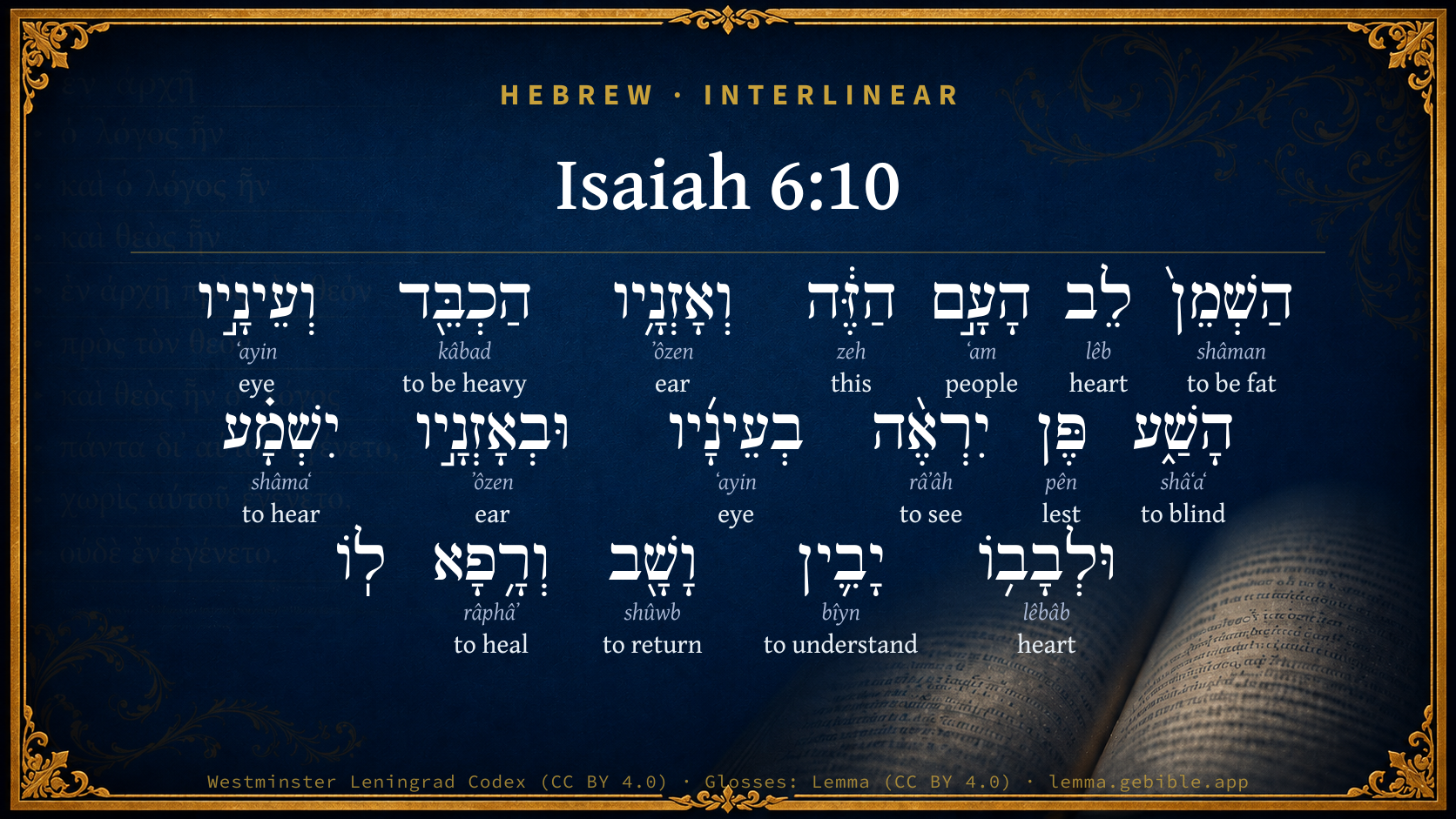
Hebrew (Westminster Leningrad Codex) Isaiah 6:10 appears in the Hebrew Old Testament. The text above is from the Westminster Leningrad Codex. Each word links to its Strong’s number, a concise gloss, and parsing drawn from the Open Scriptures Hebrew Bible morphology. Click any word for its full Brown-Driver-Briggs (BDB) entry.
Download image
Cite this verse

Isaiah 6:10 (World English Bible). Public Domain. Lemma interlinear Bible study tool, https://lemma.gebible.app/v/isaiah/6/10.

Show BibTeX & RIS
BibTeX
RIS
English Translation
Make the heart of this people fat; Make their ears heavy, and shut their eyes; Lest they see with their eyes, And hear with their ears, And understand with their heart, And turn again, and be healed."
World English Bible · Public Domain
Download a study sheet

One document with this verse’s original text, its word-by-word gloss line, the meaning frame, cross-references with their text, attributed commentary, and full source and license credits — printable, and it pastes into notes with its structure intact.

This verse Autodidact and up

Study sheet (.html) Plain text (.txt)

A passage Seminary Student

Up to 50 verses in one chapter. A passage sheet keeps up to 6 commentary sources and 12 cross-references per verse, in the order this page ranks them, and says so on the sheet whenever that leaves anything out. Ask for a single verse and you get the Autodidact verse sheet above.

Everything on this page stays free to read, with no account — the sheet is a download of what is already on screen, not access to it.

Want to remove ads? Support Godless Engineer
Compare translations 3

The same verse in 3 English versions, stacked beneath the original-language interlinear above. Click any original word for its lexicon entry.

Each is an independent rendering of the whole verse — the interlinear is not word-aligned to these translations.

Highlighted words mark where these versions differ — a whole-verse word diff, not a word-by-word alignment.

  • World English Bible Public Domain
    Make the heart of this people fat; Make their ears heavy, and shut their eyes; Lest they see with their eyes, And hear with their ears, And understand with their heart, And turn again, and be healed."
  • King James Version Public Domain
    Make the heart of this people fat, and make their ears heavy, and shut their eyes; lest they see with their eyes, and hear with their ears, and understand with their heart, and convert, and be healed.
  • unfoldingWord Literal Text CC BY-SA 4.0
    Make the heart of this people fat, and make his ears heavy, and make his eyes shut, lest he see with his eyes and hear with his ears and his heart understand and he turn and one heal him.”

unfoldingWord Literal Text — © unfoldingWord, licensed CC BY-SA 4.0. Word-aligned USFM3 via Door43 (git.door43.org/unfoldingWord/en_ult).

Versions to compare (up to 4)

3 of 4 selected

Show all 18 translations

Every available English version of this verse, each an independent rendering of the whole verse.

  • World English Bible Public Domain
    Make the heart of this people fat; Make their ears heavy, and shut their eyes; Lest they see with their eyes, And hear with their ears, And understand with their heart, And turn again, and be healed."
  • Berean Standard Bible Public Domain
    Make the hearts of this people calloused; deafen their ears and close their eyes. Otherwise they might see with their eyes, hear with their ears, understand with their hearts, and turn and be healed.”
  • Majority Standard Bible Public Domain
    Make the hearts of this people calloused; deafen their ears and close their eyes. Otherwise they might see with their eyes, hear with their ears, understand with their hearts, and turn and be healed.”
  • King James Version Public Domain
    Make the heart of this people fat, and make their ears heavy, and shut their eyes; lest they see with their eyes, and hear with their ears, and understand with their heart, and convert, and be healed.
  • American Standard Version (1901) Public Domain
    Make the heart of this people fat, and make their ears heavy, and shut their eyes; lest they sea with their eyes, and hear with their ears, and understand with their heart, and turn again, and be healed.
  • Revised Version (1885) Public Domain
    Make the heart of this people fat, and make their ears heavy, and shut their eyes; lest they see with their eyes, and hear with their ears, and understand with their heart, and turn again, and be healed.
  • Geneva Bible (1599) Public Domain
    Make the heart of this people fatte, make their eares heauie, and shut their eyes, lest they see with their eyes, and heare with their eares, and vnderstand with their hearts, and conuert, and he heale them.
  • Douay-Rheims (1899) Public Domain
    Blind the heart of this people, and make their ears heavy, and shut their eyes: lest they see with their eyes, and hear with their ears, and understand with their heart, and be converted and I heal them.
  • Young's Literal Translation Public Domain
    Declare fat the heart of this people, And its ears declare heavy, And its eyes declare dazzled, Lest it see with its eyes, And with its ears hear, and its heart consider, And it hath turned back, and hath health.'
  • Literal Standard Version CC BY-SA 4.0
    Declare the heart of this people fat, || And declare its ears heavy, || And declare its eyes dazzled, || Lest it see with its eyes, || And hear with its ears, and consider with its heart, || And it has turned back, and has health.”
  • Unlocked Literal Bible CC BY-SA 4.0
    Make the heart of this people insensitive, and their ears dull, and blind their eyes. Otherwise they might see with their eyes, hear with their ears, and understand with their heart, and then turn and be healed.”
  • unfoldingWord Literal Text CC BY-SA 4.0
    Make the heart of this people fat, and make his ears heavy, and make his eyes shut, lest he see with his eyes and hear with his ears and his heart understand and he turn and one heal him.”
  • Darby Bible Public Domain
    Make the heart of this people fat, and make their ears heavy, and blind their eyes; lest they see with their eyes, and hear with their ears, and understand with their heart, and be converted, and healed.
  • World Messianic Bible Public Domain
    Make the heart of this people fat. Make their ears heavy, and shut their eyes; lest they see with their eyes, hear with their ears, understand with their heart, and turn again, and be healed.”
  • Webster's Bible Public Domain
    Make the heart of this people fat, and make their ears heavy, and shut their eyes; lest they see with their eyes, and hear with their ears, and understand with their heart, and convert, and be healed.
  • Free Bible Version CC BY-SA 4.0
    Make the minds of this people insensitive; make their ears deaf and shut their eyes. Otherwise they might see with their eyes, hear with their ears, understand with their minds, and repent and be healed.”
  • Bible in Basic English Public Domain
    Make the hearts of this people fat, and let their ears be stopped, and their eyes shut; for fear that they may see with their eyes, and be hearing with their ears, and their heart may become wise, and they may be turned to me and made well.
  • JPS Tanakh (1917) Public Domain
    Make the heart of this people fat, and make their ears heavy, and shut their eyes; lest they, seeing with their eyes, and hearing with their ears, and understanding with their heart, return, and be healed.'

Literal Standard Version (2020), Covenant Press — licensed CC BY-SA 4.0. Text via the HelloAO Bible API (eBible.org). Unlocked Literal Bible (unfoldingWord) — licensed CC BY-SA 4.0. Text via the HelloAO Bible API (eBible.org). unfoldingWord Literal Text — © unfoldingWord, licensed CC BY-SA 4.0. Word-aligned USFM3 via Door43 (git.door43.org/unfoldingWord/en_ult). Free Bible Version, Dr. Jonathan Gallagher — licensed CC BY-SA 4.0. Text via the HelloAO Bible API (eBible.org).

Word by word

More ways to search: Search by grammar → Find every occurrence → Compare this word →

Practice this passage: Drill this verse → Learn its vocabulary →

הַשְׁמֵן֙
shâman
H8080
“be fat”
Verb, Hiphil, Imperative, 2nd Person, Masculine, Singular
Part of Speech
Verb
Stem
Hiphil
Form
Imperative
Person
2nd Person
Gender
Masculine
Number
Singular
Full BDB Definition

Origin: a primitive root

TWOT: 2410

to be or become fat, grow fat - (Qal) fat (substantive) - (Hiphil) to make fat, show fatness
  1. לֵב lêb H3820 “heart of” Noun, Common, Masculine, Singular, Construct
  2. הָעָ֣ם ʻam H5971 “the · people” Particle, Definite Article + Noun, Common, Masculine, Singular, Absolute
  3. הַזֶּ֔ה zeh H2088 “the · this” Particle, Definite Article + Pronoun, Demonstrative, Masculine, Singular
  4. וְאָזְנָ֥יו ʼôzen H241 “and · ears · his” Conjunction + Noun, Common, Feminine, Dual, Construct + Suffix, Personal, 3rd Person, Masculine, Singular
  5. הַכְבֵּ֖ד kâbad H3513 “be heavy” Verb, Hiphil, Imperative, 2nd Person, Masculine, Singular
  6. וְעֵינָ֣יו ʻayin H5869 “and · eyes · his” Conjunction + Noun, Common, Both, Dual, Construct + Suffix, Personal, 3rd Person, Masculine, Singular
  7. הָשַׁ֑ע shâʻaʻ H8173 “blind” Verb, Hiphil, Imperative, 2nd Person, Masculine, Singular
  8. פֶּן pên H6435 “lest” Conjunction
  9. יִרְאֶ֨ה râʼâh H7200 “to see” Verb, Qal, Imperfect, 3rd Person, Masculine, Singular
  10. בְעֵינָ֜יו ʻayin H5869 “in/at · eyes · his” Preposition + Noun, Common, Both, Dual, Construct + Suffix, Personal, 3rd Person, Masculine, Singular
  11. וּבְאָזְנָ֣יו ʼôzen H241 “and · in/at · ears · his” Conjunction + Preposition + Noun, Common, Feminine, Dual, Construct + Suffix, Personal, 3rd Person, Masculine, Singular
  12. יִשְׁמָ֗ע shâmaʻ H8085 “to hear” Verb, Qal, Imperfect, 3rd Person, Masculine, Singular
  13. וּלְבָב֥וֹ lêbâb H3824 “and · heart · his” Conjunction + Noun, Common, Masculine, Singular, Construct + Suffix, Personal, 3rd Person, Masculine, Singular
  14. יָבִ֛ין bîyn H995 “to understand” Verb, Qal, Imperfect, 3rd Person, Masculine, Singular
  15. וָשָׁ֖ב shûwb H7725 “and · to return” Conjunction + Verb, Qal, Sequential Perfect, 3rd Person, Masculine, Singular
  16. וְרָ֥פָא râphâʼ H7495 “and · to heal” Conjunction + Verb, Qal, Sequential Perfect, 3rd Person, Masculine, Singular

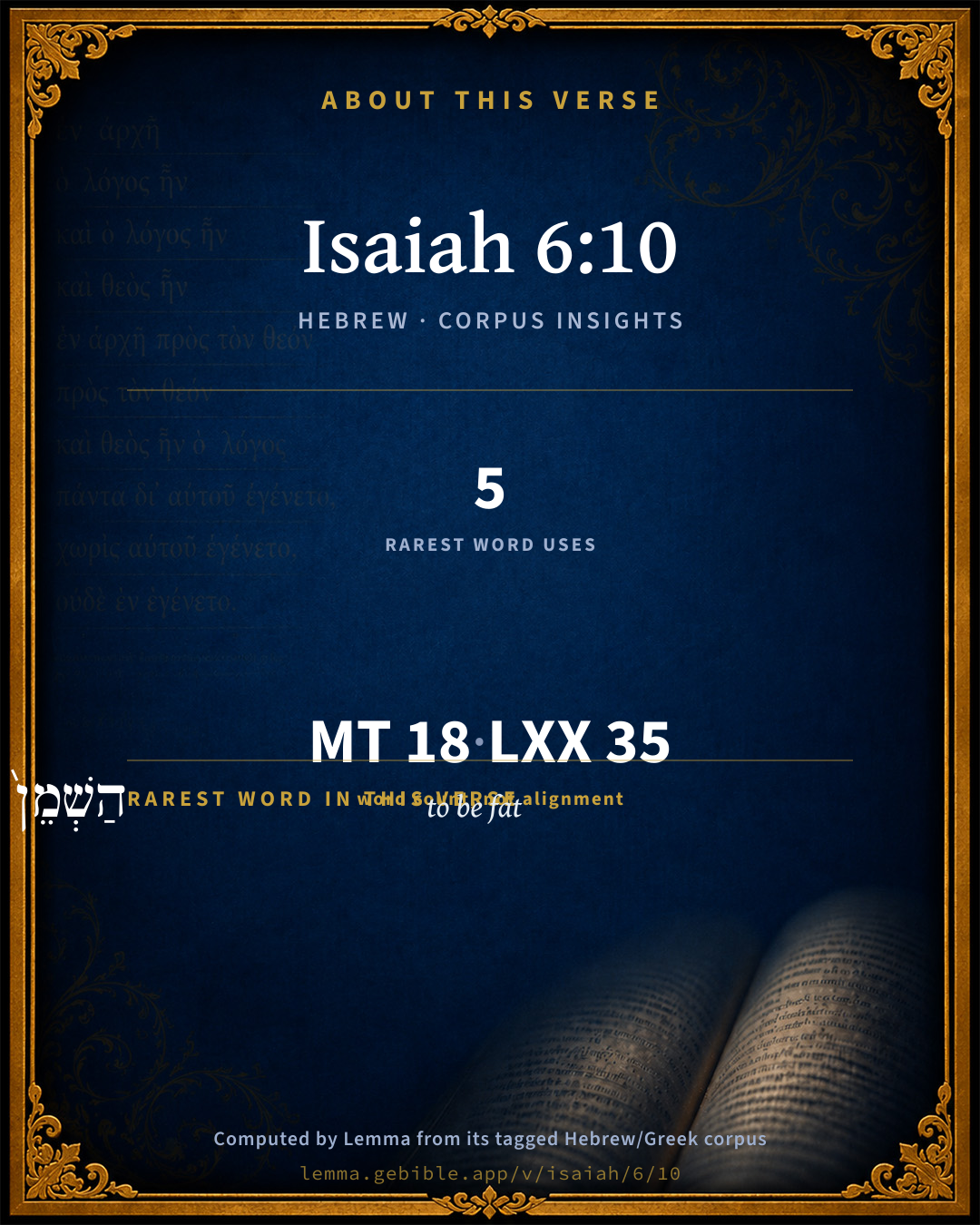
About this verse

These counts appear in no published source. They are computed here, from the morphology-tagged text and Lemma’s own curated glosses. What Lemma adds →

18
words
15
distinct lemmas
Prophets
section

Notable vocabulary

The rarest word here is הַשְׁמֵן֙ to be fat H8080 — appearing just 5 times in the whole Hebrew Bible.

Shared distinctive vocabulary

הַשְׁמֵן֙ to be fat H8080 occurs in 4 verses of the Hebrew Bible. Also found in:

Grammatical profile

  • 8 verbs
  • 7 nouns
  • 1 pronoun
  • 1 preposition
  • 1 conjunction

Verb forms

  • הַשְׁמֵן֙ Hiphil · Imperative
  • הַכְבֵּ֖ד Hiphil · Imperative
  • הָשַׁ֑ע Hiphil · Imperative
  • יִרְאֶ֨ה Qal · Imperfect
  • יִשְׁמָ֗ע Qal · Imperfect
  • יָבִ֛ין Qal · Imperfect
  • וָשָׁ֖ב Qal · Sequential Perfect
  • וְרָ֥פָא Qal · Sequential Perfect

Repetition

Words recur within this verse — often emphatic in Hebrew:

  • וְאָזְנָ֥יו ear H241 ×2
  • וְעֵינָ֣יו eye H5869 ×2

Hebrew & Septuagint length

In English translation the verse runs 37 words from the Hebrew and 47 from the Septuagint (LXX English) — closely comparable.

A rough comparison of the two English renderings, which tokenize alike — not a word-level alignment.

Word counts can differ between the Hebrew and the Greek without any difference in meaning — e.g. the Hebrew direct-object marker אֵת has no separate Greek word, and Greek often adds the article ὁ.

In the original languages it is 18 Hebrew tokens and 35 Greek tokens — but the two are counted differently (Hebrew bundles its prefixes and suffixes into one token; the Greek is in lemma form), so that isn’t a like-for-like length.

Cross-references

20

Topical passages linked to Isaiah 6:10 in the Treasury of Scripture Knowledge — connected by theme and wording, ordered by reader-vote popularity; previews shown in the World English Bible.

  • Matthew 13:15 For this people's heart has grown callous, Their ears are dull of hearing, They have closed their eyes; Or else perhaps they might perceive with their eyes, Hear with their ears, Understand with their heart, And should turn again; And I would heal them.'
  • Acts 28:27 For this people's heart has grown callous. Their ears are dull of hearing. Their eyes they have closed. Lest they should see with their eyes, Hear with their ears, Understand with their heart, And would turn again, And I would heal them.'
  • Jeremiah 5:21 Hear now this, foolish people, and without understanding; who have eyes, and don't see; who have ears, and don't hear:
  • Jeremiah 6:10 To whom shall I speak and testify, that they may hear? behold, their ear is uncircumcised, and they can't listen: behold, the word of Yahweh is become to them a reproach; they have no delight in it.
  • John 3:19–20 This is the judgment, that the light has come into the world, and men loved the darkness rather than the light; for their works were evil.
  • Zechariah 7:11 But they refused to listen, and turned their backs, and stopped their ears, that they might not hear.
  • Isaiah 29:10 For Yahweh has poured out on you the spirit of deep sleep, and has closed your eyes, the prophets; and your heads, the seers, has he covered.
  • Isaiah 63:17 O Yahweh, why do you make us to err from your ways, and harden our heart from your fear? Return for your servants' sake, the tribes of your inheritance.
  • Deuteronomy 2:30 But Sihon king of Heshbon would not let us pass by him; for Yahweh your God hardened his spirit, and made his heart obstinate, that he might deliver him into your hand, as at this day.
  • Psalms 17:10 They close up their callous hearts. With their mouth they speak proudly.
  • Ezekiel 3:6–11 not to many peoples of a strange speech and of a hard language, whose words you can not understand. Surely, if I sent you to them, they would listen to you.
  • Deuteronomy 32:15 But Jeshurun grew fat, and kicked: You have grown fat, you are grown thick, you are become sleek; Then he forsook God who made him, Lightly esteemed the Rock of his salvation.
  • Exodus 10:27 But Yahweh hardened Pharaoh's heart, and he wouldn't let them go.
  • Exodus 11:10 Moses and Aaron did all these wonders before Pharaoh, and Yahweh hardened Pharaoh's heart, and he didn't let the children of Israel go out of his land.
  • Exodus 14:17 I, behold, I will harden the hearts of the Egyptians, and they shall go in after them: and I will get myself honor over Pharaoh, and over all his host, over his chariots, and over his horsemen.
  • Psalms 119:70 Their heart is as callous as the fat, But I delight in your law.
  • Isaiah 19:22 Yahweh will strike Egypt, smiting and healing; and they shall return to Yahweh, and he will be entreated of them, and will heal them.
  • Exodus 7:3 I will harden Pharaoh's heart, and multiply my signs and my wonders in the land of Egypt.
  • Acts 3:19 "Repent therefore, and turn again, that your sins may be blotted out, so that there may come times of refreshing from the presence of the Lord,
  • 2 Corinthians 2:16 to the one a stench from death to death; to the other a sweet aroma from life to life. Who is sufficient for these things?

Cross-references courtesy of OpenBible.info (CC BY 4.0).

Hebrew and Greek witnesses Masoretic Hebrew ↔ Greek Septuagint

The same verse in the two great witnesses to the Old Testament, shown verse-for-verse.

These are two independent witnesses, not word-aligned to each other, and the Septuagint is shown in lemma (dictionary) form.

Hebrew Isaiah 6:10 Masoretic · Westminster Leningrad Codex

הַשְׁמֵן֙ לֵב הָעָ֣ם הַזֶּ֔ה וְאָזְנָ֥יו הַכְבֵּ֖ד וְעֵינָ֣יו הָשַׁ֑ע פֶּן יִרְאֶ֨ה בְעֵינָ֜יו וּבְאָזְנָ֣יו יִשְׁמָ֗ע וּלְבָב֥וֹ יָבִ֛ין וָשָׁ֖ב וְרָ֥פָא לֽוֹ

Make the heart of this people fat; Make their ears heavy, and shut their eyes; Lest they see with their eyes, And hear with their ears, And understand with their heart, And turn again, and be healed."

World English Bible · Public Domain

Greek LXX Isaiah 6:10 Septuagint · lemma form

παχύνω γάρ ὁ καρδία ὁ λαός οὗτος καί ὁ οὖς αὐτός βαρέως ἀκούω καί ὁ ὀφθαλμός αὐτός καμμύω μήποτε ὁράω ὁ ὀφθαλμός καί ὁ οὖς ἀκούω καί ὁ καρδία συνἴημι καί ἐπιστρέφω καί ἰάομαι αὐτός

For the heart of this people has become gross, and their ears are dull of hearing, and their eyes have they closed; lest they should see with their eyes, and hear with their ears, and understand with their heart, and be converted, and I should heal them.

LXX2012 (modern English Septuagint) · Public Domain

On this verse, Jamieson, Fausset & Brown discusses the Septuagint’s reading. Read the note in Commentary ↓

Hebrew: Westminster Leningrad Codex (CC BY 4.0). Greek: Septuagint (public domain); English from LXX2012 (modern English Septuagint) (Public Domain). How the Septuagint differs from the Hebrew →

Targum (Aramaic paraphrase)

1

The Targum is the ancient Jewish Aramaic paraphrase of the Hebrew Scriptures — an interpretive translation, not the Hebrew text itself. Onkelos (literal) and Pseudo-Jonathan (expansive) render the Torah, and Jonathan the Prophets. Coverage is partial: where no permissively-licensed English translation exists for a verse, only the Aramaic is shown. This is verse-level text, not a word-by-word alignment to the Hebrew.

  1. Targum Jonathan Prophets (Joshua–Malachi)
    טַפֵּישׁ לִבֵּיהּ דְעַמָא הָדֵין וְאוּדְנוֹהִי יַקֵר וְעֵינוֹהִי עַמְעָם דִלְמָא יֶחֱזוּן בְּעֵינֵיהוֹן וּבְאוּדְנֵיהוֹן יִשְׁמְעוּן וּבְלִבְּהוֹן יִסְתַּכְּלוּן וִיתוּבוּן וְיִשְׁתְּבֵק לְהוֹן:

    Make the heart of this people fat, and make their ears heavy, and darken their eyes; lest they see with their eyes, and hear with their ears, and understand with their heart, and repent, and it shall be forgiven them.

    Targum Jonathan — Aramaic: “Mikraot Gedolot” (public domain). English: “Sefaria Community Translation” (CC0 1.0 (public-domain dedication)); “London "Chaldee Paraphrase," 1871” (public domain). Text via Sefaria.

Commentary

Notes on Isaiah 6:10 from classic Christian and Jewish commentators (each source and its license shown beneath its notes). The classic Christian expositions comment on the surrounding passage and are grouped to its opening verse, so a note may address several verses; the Jewish commentaries on the Tanakh (Rashi and others) are per-verse, so they appear only where the commentator wrote on this verse.

Lemma curates 59 commentaries, every one of them public domain or Creative Commons licensed, each selected and text-cleaned for this edition rather than reprinted as found. About our sources →

Trapp's Complete Commentary

John Trapp

Isa 6:10 Make the heart of this people fat, and make their ears heavy, and shut their eyes; lest they see with their eyes, and hear with their ears, and understand with their heart, and convert, and be healed.

Ver. 10. Make the heart of this people fat,] sc., By preaching to them the Word of God, which, because they regard not, it shall become unto them a savour of death, as sweet ointments kill beetles, as a shrill voice hurteth weak ears, as lime is kindled by cold water cast upon it. Of such a fat heart beware. Fat things are less sensible, and fat hearted people are noted by Aristotle for dull and stupid. There is not a greater mischief can befall a man on this side hell than to be given up to a dead and dedolent disposition, such as was that of those {Eph 4:18} of the Jews in Christ’s time, and ever since, and of many Papists, who continue blind in the midst of so much light, and will not renounce those errors whereof they are clearly convinced.

And make their ears heavy.] Preach them to hell. This is an accidental effect of the word preached, and proceedeth from men’s corruptions. {Zec 7:11} But as a hard heart, so a heavy ear is a singular judgment. {Act 7:51} Antagoras, reciting his "Thebais," a book that he had made, among the Boeotians, and they little regarding him, he folded up his book, and said, Ye may well be called Boeotians, quia boum habetis aures, for ye have oxes’ ears - playing upon the notation of their name. {a}

Lest they should see with their eyes, &c.] Or, That they may not see with their eyes, or hear, &c., but be as so many sots and stocks or statues, that have eyes and see not, &c., to their utter ruin and destruction. Neither is there any the least injustice in such a proceeding. An apprentice hath given him by his master a candle to light him to bed, which he abuseth to light him to game or drink. Hereupon his master taketh it from him, bloweth it out, and sendeth him darkling to bed, in the way whereto he breaketh his arms or his face by some fall: will any man blame the master, since the candle was his, and allowed for use? I think not. Think the like here.

And convert.] Which at times they would not, now they shall not; but having made a match with mischief, they shall henceforth have enough of it; they "love to have it so"; {Jer 5:31} they "forsake their own mercies"; {Jon 2:8} they are miserable by their own election.

And be healed,] i.e., Pardoned and purged. Atque hic pulchre exprimitur, saith one, ordo obtinendae salutis; and here is excellently set forth the order of obtaining salvation. For (1.) It is requisite that we have ears to hear, and eyes to see - not ears stopped, and eyes daubed up as these had; (2.) That what we hear and see, we understand with the heart - that is, that there be yielded thereunto both assent of the mind and consent of the will, this is faith; (3.) That we turn to the Lord by true repentance, and then we are sure of healing, which is by pardon of sin, and power against it.

{a} Erasm. Apophth.

John Trapp, A Commentary or Exposition upon All the Books of the Old and New Testament (1647–1656) — public domain. Text from a community e-Sword module.

The Biblical Illustrator

Joseph S. Exell

Isa_6:10

Make the heart of this people fat

The power of self-cursing

Make the heart of this people fat, etc.

By this it is not meant that Isaiah was to aim at and put forth what power he possessed to lead the people of Judah deeper and ever deeper into error and sire That was an errand on which God was morally incapable of sending him. His business was to teach them, not error, but truth; to set them an example not of rebellion, but obedience to the Divine win; to diminish and do away with their moral insensibility and wickedness, not increase them. The meaning is, that they would so act that the effect of all his diligence and ingenuity to instruct and reform them would be to render them still more stupid and wicked, and still more the objects of the Lords displeasure. Accordingly, both in Mat_13:14-15 and Act_28:25-27, we find the passage so quoted and interpreted as to bring out the guilt of the people themselves, and constrain us to throw all the blame on them. (G. Cron, M. A.)

The Biblical Illustrator, edited by Joseph S. Exell (c. 1880s–1900s) — public domain. Text from a community e-Sword module.

Tyndale Open Study Notes

Tyndale Open Resources

6:10 Isaiah was God’s agent to stimulate blindness and deafness in the wicked and sight and hearing in the godly (see also 29:9-10, 18; 35:5; 42:7, 16-19; 43:8; 56:10; 59:10). • turn to me for healing: The Lord was ready to heal those who truly repented, but not those who merely wanted to avoid judgment while holding on to their sinful ways.

Tyndale Open Study Notes — © Tyndale Open Resources, licensed CC BY-SA 4.0. Text via the HelloAO Bible API.

Jamieson, Fausset & Brown

Robert Jamieson, A. R. Fausset & David Brown

Make . . . fat-- (Psa 119:17). "Render them the more hardened by thy warnings" [MAURER]. This effect is the fruit, not of the truth in itself, but of the corrupt state of their hearts, to which God here judicially gives them over (Isa 63:17). GESENIUS takes the imperatives as futures. "Proclaim truths, the result of which proclamation will be their becoming the more hardened" (Rom 1:28; Eph 4:18); but this does not so well as the former set forth God as designedly giving up sinners to judicial hardening (Rom 11:8; Th2 2:11). In the first member of the sentence, the order is, the heart, ears, eyes; in the latter, the reverse order, the eyes, ears, heart. It is from the heart that corruption flows into the ears and eyes (Mar 7:21-22); but through the eyes and ears healing reaches the heart (Rom 10:17), [BENGEL]. (Jer 5:21; Eze 12:2; Zac 7:11; Act 7:57; Ti2 4:4). In Mat 13:15, the words are quoted in the indicative, "is waxed gross" (so the Septuagint), not the imperative, "make fat"; God's word as to the future is as certain as if it were already fulfilled. To see with one's eyes will not convince a will that is opposed to the truth (compare Joh 11:45-46; Joh 12:10-11). "One must love divine things in order to understand them" [PASCAL].

be healed--of their spiritual malady, sin (Isa 1:6; Psa 103:3; Jer 17:14).

Jamieson, Fausset & Brown — Commentary Critical and Explanatory on the Whole Bible (1871) — public domain (CC PDM 1.0). Text via the HelloAO Bible API.

Adam Clarke's Commentary

Verse 10. Make the heart of this people fat - "Gross"] The prophet speaks of the event, the fact as it would actually happen, not of God's purpose and act by his ministry. The prophets are in other places said to perform the thing which they only foretell: -

"Lo! I have given thee a charge this day

Over the nations, and over the kingdoms;

To pluck up, and to pull down;

To destroy, and to demolish;

To build, and to plant."

Jer 1:10.

And Ezekiel says, "When I came to destroy the city," that is, as it is rendered in the margin of our version, "when I came to prophesy that the city should be destroyed; " Eze 43:3. To hear, and not understand; to see, and not perceive; is a common saying in many languages. Demosthenes uses it, and expressly calls it a proverb: ὡστε το της παροιμιας ὁρωντας μη ὁρᾳν, και ακουοντας μη ακουειν; Contra Aristogit. I., sub fin. The prophet, by the bold figure in the sentiment above mentioned, and the elegant form and construction of the sentence, has raised it from a common proverb into a beautiful mashal, and given it the sublime air of poetry.

Or the words may be understood thus, according to the Hebrew idiom: "Ye certainly hear, but do not understand; ye certainly see, but do not acknowledge." Seeing this is the case, make the heart of this people fat - declare it to be stupid and senseless; and remove from them the means of salvation, which they have so long abused.

There is a saying precisely like this in AEschylus: -

- - - βλεποντες εβλεπον ματην,

Κλυοντες ουκ ηκουον. AESCH. Prom. Vinct. 456.

"Seeing, they saw in vain; and hearing, they

did not understand."

And shut - "Close up"] השע hasha. This word Sal. ben Melec explains to this sense, in which it is hardly used elsewhere, on the authority of Onkelos. He says it means closing up the eyes, so that one cannot see; that the root is שוע shava, by which word the Targum has rendered the word טח tach, Le 14:42, וטח את בית vetach eth beith, "and shall plaster the house." And the word טח tach is used in the same sense, Isa 44:18. So that it signifies to close up the eyes by some matter spread upon the lids. Mr. Harmer very ingeniously applies to this passage a practice of sealing up the eyes as a ceremony, or as a kind of punishment used in the East, from which the image may possibly be taken. Observ. ii. 278.

With their heart - "With their hearts"] ובלבבו ubilebabo, fifteen MSS. of Kennicott's and fourteen of De Rossi's, and two editions, with the Septuagint, Syriac, Chaldee, and Vulgate.

And be healed - "And I should heal"] veer pa, Septuagint, Vulgate. So likewise Mt 13:14; Joh 12:40; Ac 28:27.

Adam Clarke's Commentary on the Bible (1810–1826) — public domain. Text from a community e-Sword/MySword module.

Ellicott's Commentary for English Readers

(10) Make the heart of this people fat.—The thought is the same as that of the “hardening” of Pharaoh’s heart (Exo_8:19; Exo_9:34, &c) and that of Sihon (Deu_2:30). It implies the reckless headstrong will which defies restraint and warnings. So the poets of Greece, in their thoughts as to the Divine government of the world, recognised the truth that there is a judicial blindness and, as it were, insanity of will that comes as the consequence of sinful deeds ( Æsch. Agam. 370-386). The mediaeval adage, “Quem Deus vult perdere prius dementat,” expresses one aspect of the same law; but the vult perdere is excluded by the clearer revelation of the Divine purpose (Eze_18:23; 1Ti_2:4; 2Pe_2:9), as “not willing that any should perish.”

Shut their eyes.—Literally, as in Isa_29:10, daub, or besmear. Possibly the phrase refers to the barbarous practice, not unknown in the East, of thus closing the eyes as a punishment. Burder (Oriental Customs, i. 98) mentions a son of the Great Mogul who was thus punished by his father. For the ethical fact, as well as for the phrase, we may (with Cheyne) compare Shakespeare—

“For when we in our viciousness grow hard,

Oh, misery on’t, the wise gods seal our eyes.”

A Bible Commentary for English Readers, edited by Charles John Ellicott (1878–1897) — public domain. Text from a community e-Sword module.

The Cambridge Bible for Schools and Colleges

gen. ed. J. J. S. Perowne

10. Make the heart … fat] i.e. callous, unfeeling, Psa_119:70. In Hebrew idiom, the “heart” includes the understanding. shut (lit. smear) its eyes] cf. Isa_29:10, Isa_44:18, Isa_42:19 f.

The difficulties created in our minds by this startling, and even harsh, statement of a great law of the spiritual world, are partly due to the tendency of Scripture writers to refer all things immediately to the will of God. To the Hebrew mind what we call secondary causes scarcely exist, at least in the sphere of religion. That which, in given circumstances, is the inevitable result of God’s providential dispensations is viewed absolutely, apart from its conditions, as a distinct divine purpose. The truth revealed to Isaiah is that the unbelief of his countrymen amounts to an incapacity for divine things, which can only be intensified by the further disclosure of the truth of God. And this, which is the inevitable issue of his own prophetic mission, is represented to him as Jehovah’s intention in sending him. Isaiah realises the profound truth that the most decisive and searching judgment to which men are subjected lies in the abundance of the revelations of God vouchsafed to them. It is a principle often appealed to in the New Testament, and frequently in the very words of our prophet (Mat_13:14 f. and parallels; Act_16:26 f.; Rom_11:8). “This is the judgment that the light is come into the world, and men loved the darkness rather than the light; for their works were evil” (Joh_3:19).

The Cambridge Bible for Schools and Colleges (gen. ed. J. J. S. Perowne; Cambridge University Press, 1878–1918) — public domain. Text from a community e-Sword module.

John Gill's Exposition

Make the heart of this people fat,.... Gross and heavy, stupid and unteachable, hard and obdurate; which is sometimes done by the preaching of the Gospel, through the wickedness of man's heart, that being the savour of death unto death to some, just as the sun hardens the clay; or declare that their hearts are thus gross and stupid; or that I will give them up to a judicial hardness of heart:

and make their ears heavy: that they cannot hear the word, so as to understand it; they having stopped the ear, and plucked away the shoulder, it is in righteous judgment that they are given up to such an insensibility as not to be capable of hearing and understanding what is delivered in the ministry of the word:

and shut their eyes; they having wilfully shut their own eyes against all evidence of the Messiah, and the truth of his doctrines, they are given up to a judicial blindness; which still continues upon them, and will until the fulness of the Gentiles is brought in:

lest they see with their eyes, and hear with their ears, and understated with their heart; though only in a notional way, the things relating to the Messiah, the truths of the Gospel, and the ordinances thereof, and what may belong to their outward peace:

and convert; or turn themselves by external repentance and reformation:

and be healed: or forgiven in such sense as to be preserved from national ruin; which God willed not; for seeing they went such great lengths in sin, in rejecting the Messiah, and his Gospel, they were given up to a reprobate mind, to do things that were not convenient, that they might be destroyed; which destruction is after prophesied of.

John Gill's Exposition of the Whole Bible (1746–1763) — public domain (CC PDM 1.0). Text via the HelloAO Bible API.

Albert Barnes' Notes on the Bible

Make the heart - The word “heart” here is used in the sense of the “mind” - to denote all their mental powers. It is commonly used in this sense in the Scriptures.

Fat - Gross, heavy, dull, stupid. That is, go and proclaim such “truth” to them as shall have this effect - as shall irritate, provoke, enrage them; truth, whose delivery shall be attended, in their gross and corrupt hearts, with this blinding and infatuating influence the effect would be produced by the corrupt state of their hearts, not by any native tendency of the truth, and still less by any direct divine influence. ‘Go, and proclaim truth to a corrupt and sensual people, and the result will be that they will not hear; they are so wicked that they will not attend to it; they will become even more hardened; yet go, and though certain of producing this effect, still proclaim it;’ see this passage explained in the notes at Joh 12:40.

Their ears heavy - Dull, stupid, insensible.

And shut their eyes - The word used here means “to spread over,” and then to close. It denotes here the state of mind which is more and more indisposed to attend to the truth.

And be healed - Be restored from the malady of sin; be recovered and pardoned. Sin is often represented as a painful, loathsome malady, and forgiveness as restoration from such a malady; Isa 30:26; Ps. 103; Psa 41:3-4; 2Ch 7:14; Jer 3:22; Jer 17:14. We may learn here,

(1) That the effect of truth is often to irritate people and make them more wicked.

(2) The truth must, nevertheless, be proclaimed.

This effect is not the fault of the truth; and it is often well that the heart should be known, and the true effect should be seen.

Albert Barnes' Notes on the Bible (1834–1885) — public domain. Text from a community e-Sword/MySword module.

Haydock's Catholic Bible Commentary

Blind. The prophets are said to do what they denounce. (St. Thomas Aquinas, [Summa Theologiae] 1. q. xxiv. 3.) (Sanctius) --- Septuagint, "heavy or gross is the heart," &c. The authors of the New Testament quote it thus less harshly. --- Them. Is God unwilling to heal? Why then does he send his prophet? (Calmet) --- He intimates that all the graces offered would be rendered useless by the hardened Jews. (St. Isidore. Pelus 2. ep. 270.) --- Hebrew may be, "surely they will not see," &c. (Calmet)

George Leo Haydock (1774–1849), Haydock's Catholic Family Bible and Commentary, 1859 edition — public domain. Excludes Psalms (Douay-Rheims chapter numbering differs from Protestant) and Deuterocanonical books (Catholic canon only).

Matthew Poole's English Annotations

Fat, i.e. stupid and senseless; for the fat which is in the body is without sense; and fatness in the heart makes it dull and heavy. Thus this phrase is used Psa 119:70. And this seems best to agree with the following words. This making of their hearts fat is here ascribed to the prophet, as it is ascribed to God in the repetition of this prophecy, Joh 12:40, because God inflicted this judgment upon them by the ministry of the prophet, partly by way of prediction, foretelling that this would be the effect of his preaching; and partly by way of judicial operation, withdrawing the light and help of his Spirit, and giving them up to the power and arts of Satan, and to their own mistakes and lusts, whereby they are easily and commonly led to turn God’s word, as they do other things, into occasions of sin.

Make their ears heavy; make them dull of hearing, as Isa 59:1; Zec 7:11, as sometimes the ears are made by an excessive noise.

Shut their eyes, Heb. daub their eyes, as the word is used also Isa 44:18.

Lest they see; that they may not be able, as before they were not willing, to see.

Convert; turn from their sinful practices unto God.

Be healed of sin, which is the disease of the soul, by remission and sanctification, and of all the deadly effects of sin.

Matthew Poole's English Annotations on the Holy Bible (1683–1685) — public domain. Text from a community e-Sword/MySword module.

Whedon's Commentary on the Bible

Daniel D. Whedon

10. Make the heart… fat — The prophet Jeremiah (Jer_1:10) was verbally directed to produce effects which he only predicted. Here Isaiah is directed to cause results which will doubtless take place, but are not necessary effects of his action. His prophecy is not responsible for results produced by the hardness of the people to whom it is delivered. Lest depends upon heavy. The heaviness or torpidity is vigilant “lest” conversion should follow the prophet’s gospel.

Daniel D. Whedon (gen. ed.), Commentary on the Old and New Testaments (1874–1909) — public domain. Text from a community e-Sword module.

The Pulpit Commentary

Make the heart of this people fat. Isaiah is commanded to effect by his preaching that which his preaching would, in fact, effect. It would not awaken the people out of their apathy, it would not stir them to repentance; therefore it would only harden and deaden them. The words have a national, not an individual, application. Shut their eyes; literally, besmear their eyes; or, seal them up. Such sealing has been employed by Oriental monarchs as a punishment. And convert; i.e. "turn to God." Our translators have used the word in an intransitive sense.

The Pulpit Commentary (1880–1919), ed. H.D.M. Spence-Jones & Joseph S. Exell — public domain. Text from a community e-Sword module.

John Wesley's Explanatory Notes

Fat - Stupid and senseless. This making of their hearts fat, is here ascribed to the prophet, as it is ascribed to God in the repetition of this prophecy, John xii, 40, because God inflicted this judgment upon them by the ministry of the prophet, partly by way of prediction, foretelling that this would be the effect of his preaching; and partly by withdrawing the light and help of his Spirit. Heavy - Make them dull of hearing. Lest - That they may not be able, as before they were not willing to see. Convert - Turn to God.

John Wesley, Explanatory Notes Upon the Whole Bible (1754–1765) — public domain. Text via the GEBible commentary corpus.

J. A. Alexander on Isaiah

Joseph Addison Alexander

As the foregoing verse contains a prediction of the people’s insensibility, but under the form of a command or exhortation to themselves, so this predicts the same event, as the result of Isaiah’s labors, under the form of a command to him. “Make fat, gross, callous, the heart of this people,” (i.e., their affections or their minds in general), “and its ears make heavy,” dull or hard of hearing, “and its eyes smear,” close or blind, “lest it see with its eyes, and with its ears hear: and their heart understand,” perceive or feel, “and it turn,” (i.e., repent and be converted), “and be healed,” or literally, and one heal it, the indefinite construction being equivalent in meaning to a passive. The thing predicted is judicial blindness, as the natural result and righteous retribution of the national depravity. This end would be promoted by the very preaching of the truth, and therefore a command to preach was in effect a command to blind and harden them. The act required of the Prophet is here joined with its ultimate effect, while the intervening circumstances, namely, the people’s sin and the withholding of God’s grace, are passed by in silence. But although not expressed, they are implied in this command. The essential idea is their insensibility, considered as the fruit of their own depravity, as the execution of God’s righteous judgment, and as the only visible result of Isaiah’s labors. In giving Isaiah his commission, it was natural to make the last of these ideas prominent, and hence the form of exhortation or command in which the prophecy is here presented. Make them insensible, not by an immediate act of power, nor by any direct influence whatever, but by doing your duty, which their wickedness and God’s righteous judgments will allow to have no other effect. In other cases, where his personal agency no longer needed to be set forth or alluded to, the verse is quoted, not as a command, but as a description of the people, or as a declaration of God’s agency in making them insensible. Thus in Mat 13:15, and in Act 28:26, the Septuagint version is retained, in which the people’s own guilt is the prominent idea: ‘for this people’s heart is waxed gross, and their ears are dull of hearing, and their eyes they have closed, lest’ etc. In Joh 12:40, on the other hand, the sentence takes a new form, in order to bring out distinctly the idea of judicial blindness: ‘He hath blinded their eyes and hardened their heart, lest,’ etc. Both these ideas are in fact included in the meaning of the passage, though its form is different, in order to suit the occasion upon which it was originally uttered.

Joseph Addison Alexander, The Prophecies of Isaiah (1846–1847; New York: Scribner, 1870–1878) — public domain. Text from a community e-Sword module.

unfoldingWord translationNotes

Door43 World Missions Community

General Information:

Yahweh continues to tell Isaiah what he must do when Yahweh sends him to preach to the people.

Make the heart of this people insensitive

Here "heart" represents a person's mind. A person who does not think clearly and is unable to understand and care about what is happening is spoken of as if his heart were insensitive. AT: "Make these people unable to understand" or "Make the minds of these people dull" (See: Metonymy and Metaphor)

Make the heart of this people

It may be more natural to translate "heart" and "this" as plurals. AT: "Make the hearts of these people"

Make the heart ... insensitive

This command means that Yahweh will use Isaiah's message to cause the people to understand even less and to make them less sensitive to what Yahweh is doing.

their ears dull, and blind their eyes

"make it so that they cannot hear, and make it so that they cannot see." Isaiah making people to not understand Yahweh's message or what he is doing is spoken of as if Isaiah were making them deaf and blind. (See: Metaphor)

they might see with their eyes, hear with their ears

People being able to understand Yahweh's message and what he is doing is spoken of as if the people were able physically to see and hear. (See: Metaphor)

understand with their heart

Here "heart" represents as person's mind. Truly understanding something and caring about what is happening is spoken of as if the people were to understand with their hearts. (See: Metonymy)

then turn

Repenting and starting to obey Yahweh is spoken of as if the people were physically to turn towards him. AT: "follow me again" or "then start trusting in me again" (See: Metaphor)

be healed

This can be stated in active form. AT: "I would heal them" (See: Active or Passive)

translationWords

heart

people group

turn

cure

unfoldingWord translationNotes — © Distant Shores Media and the Door43 World Missions Community, licensed CC BY-SA 4.0. Source: git.door43.org/Door43/en_tn.

Rashi

Rabbi Shlomo Yitzchaki (Rashi)

This people’s heart is becoming fat [This structure] הַשְׁמֵן resembles (Exodus 8:11), “And making his heart heavy (הַכְבֵּד),” an expression of a continuous action. Their heart continuously becomes fatter, angrajjsant in O.F., and his ears are becoming heavier and heavier, [i.e., harder and harder] of hearing.

and his eyes are becoming sealed Plastered, comp. (infra 44:18) “For their eyes are plastered from seeing.” הִטּוֹחַ (Leviticus 14:43) is translated into Aramaic as דְאִתְשַׁע. We, thereby, equate the two words הָשַׁע and טָח.

lest he see with his eyes They intended not to hearken to the words of the prophets, for they fear lest His words please them, and they will understand with their heart, and return to Me, and this will be their cure.

Rashi on the Tanakh — English translations: “The Judaica Press complete Tanach with Rashi, translated by A. J. Rosenberg” (CC BY 4.0); “Pentateuch with Rashi's commentary by M. Rosenbaum and A.M. Silbermann, 1929-1934” (public domain); “The Metsudah Tanach series, Lakewood, N.J” (CC BY 4.0); and “The Book of Joshua, Metsudah Publications, 1997” (CC BY 4.0). Text via Sefaria.

Ibn Ezra

Rabbi Abraham ibn Ezra

השמן Make fat. According to some it is infinitive, like הקטר To burn incense (1 Sam. 3:16); and הׇשַׁע likewise, like הׇרַע To do evil (Lev. 5:4); but this cannot be so, because of the conjunction פן lest. They are all rather imperative forms. We know that the prophet cannot make the heart fat; he shall only declare their heart to be so; there are many instances like it.

הׇשַׁע Shut. Comp. תשעינה Will be shut (32:3). In Chaldee, this word שעה has the same meaning. The imperative Hiphil ought to be הֶשֶׁע like הֶרֶף, but the guttural letter ע causes the alteration; the form הָשַׁע can also be derived from a verb (שעע) ע״ע

Ibn Ezra on the Tanakh — English translations: “Sefaria Community Translation” (CC0 1.0 (public-domain dedication)); “Yalkut, Sifsei Chachomim Chumash, Metsudah Publications, 2009” (CC BY 4.0); and “Commentary of Ibn Ezra on Isaiah - trans. by M. Friedlander, 1873” (public domain). Text via Sefaria.

Lesson kit

Teaching starters — assembled from the data on this page, not authored interpretation. Every prompt links to the verse data it draws on. Edit before teaching.

Isaiah, in the Prophets, opens this verse with 18 words (15 distinct Hebrew lemmas). Its most distinctive word is shâman (“to be fat”). A historical commentator’s framing appears above. Read the whole chapter for the surrounding context.

Discussion questions

  1. How does “to be fat” (shâman) shape what this verse is saying?
  2. Deuteronomy 32:15 shares the word «to be fat» with this verse. How do the two illuminate each other?
  3. “ear” occurs 2× in this one verse. What is the effect of the repetition?
  4. These translations render this verse differently. What is at stake in choosing one wording over another?
  5. The verb «הַשְׁמֵן֙» is Hiphil Imperative. How does its form color the action?
  6. Reading how Trapp's Complete Commentary and The Biblical Illustrator read this verse, where do the two commentators agree and where do they part?

Things to notice

Reading settings

Reading text

Shown beneath each verse's original-language words.

Old Testament
Old Testament edition

Read the OT as the Masoretic Hebrew (MT) or the Greek Septuagint (LXX).

English shown for the Greek Septuagint (in the Hebrew ↔ Greek comparison).

Comparing translations? Open the Compare panel on any verse page to stack up to four side by side.