
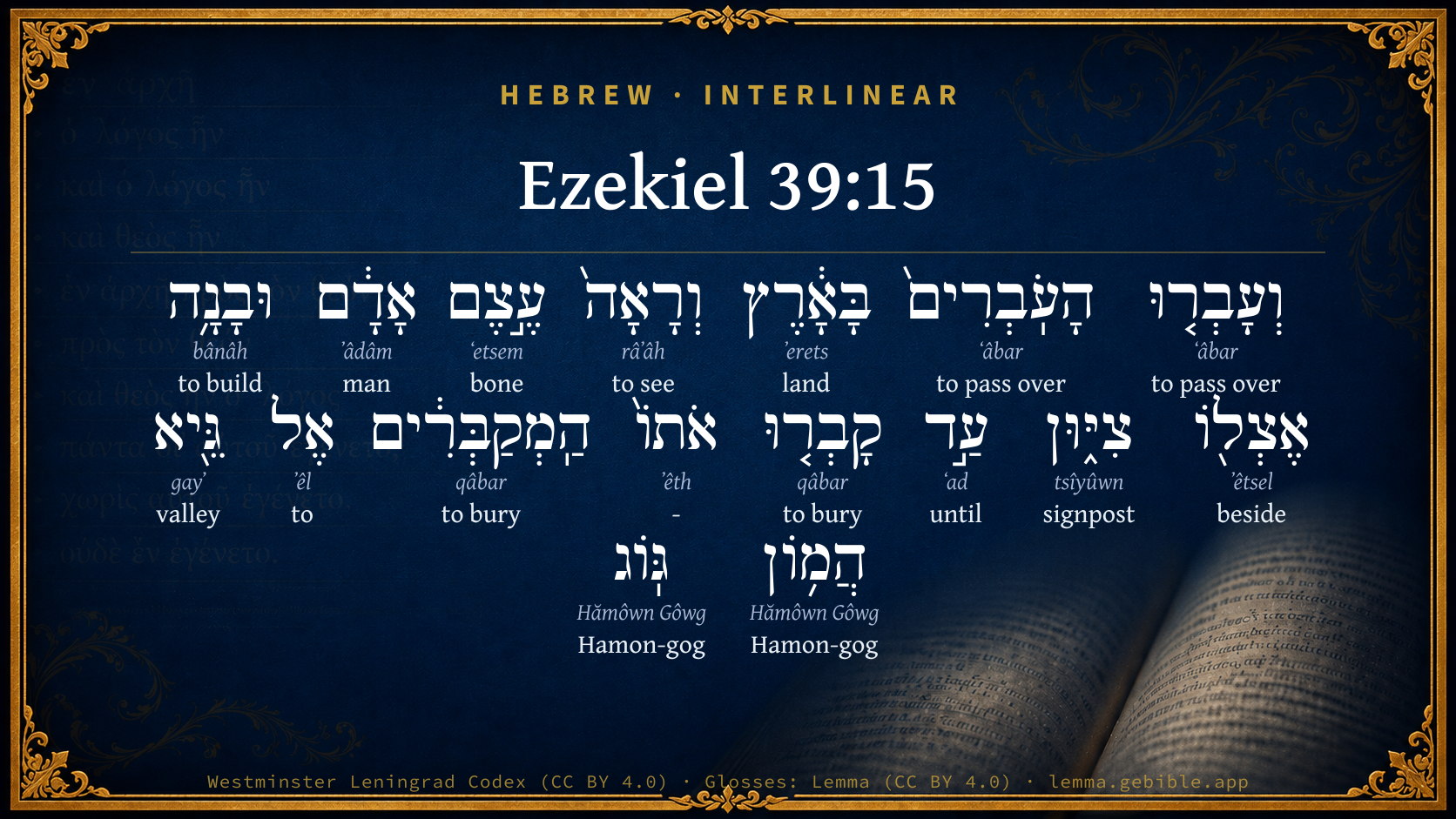
Ezekiel 39:15

Hebrew (Westminster Leningrad Codex) Ezekiel 39:15 appears in the Hebrew Old Testament. The text above is from the Westminster Leningrad Codex. Each word links to its Strong’s number, a concise gloss, and parsing drawn from the Open Scriptures Hebrew Bible morphology. Click any word for its full Brown-Driver-Briggs (BDB) entry.
Download image
Cite this verse

Ezekiel 39:15 (World English Bible). Public Domain. Lemma interlinear Bible study tool, https://lemma.gebible.app/v/ezekiel/39/15.

Show BibTeX & RIS
BibTeX
RIS
English Translation
Those who pass through the land shall pass through; and when any sees a man's bone, then shall he set up a sign by it, until the undertakers have buried it in the valley of Hamon Gog.
World English Bible · Public Domain
Download a study sheet

One document with this verse’s original text, its word-by-word gloss line, the meaning frame, cross-references with their text, attributed commentary, and full source and license credits — printable, and it pastes into notes with its structure intact.

This verse Autodidact and up

Study sheet (.html) Plain text (.txt)

A passage Seminary Student

Up to 50 verses in one chapter. A passage sheet keeps up to 6 commentary sources and 12 cross-references per verse, in the order this page ranks them, and says so on the sheet whenever that leaves anything out. Ask for a single verse and you get the Autodidact verse sheet above.

Everything on this page stays free to read, with no account — the sheet is a download of what is already on screen, not access to it.

Want to remove ads? Support Godless Engineer
Compare translations 3

The same verse in 3 English versions, stacked beneath the original-language interlinear above. Click any original word for its lexicon entry.

Each is an independent rendering of the whole verse — the interlinear is not word-aligned to these translations.

Highlighted words mark where these versions differ — a whole-verse word diff, not a word-by-word alignment.

  • World English Bible Public Domain
    Those who pass through the land shall pass through; and when any sees a man's bone, then shall he set up a sign by it, until the undertakers have buried it in the valley of Hamon Gog.
  • King James Version Public Domain
    And the passengers that pass through the land, when any seeth a man's bone, then shall he set up a sign by it, till the buriers have buried it in the valley of Hamongog.
  • unfoldingWord Literal Text CC BY-SA 4.0
    As these men pass through the land, when they see any human bone, they will put a marker by it, until gravediggers come and bury it in the Valley of Hamon Gog.

unfoldingWord Literal Text — © unfoldingWord, licensed CC BY-SA 4.0. Word-aligned USFM3 via Door43 (git.door43.org/unfoldingWord/en_ult).

Versions to compare (up to 4)

3 of 4 selected

Show all 18 translations

Every available English version of this verse, each an independent rendering of the whole verse.

  • World English Bible Public Domain
    Those who pass through the land shall pass through; and when any sees a man's bone, then shall he set up a sign by it, until the undertakers have buried it in the valley of Hamon Gog.
  • Berean Standard Bible Public Domain
    As they pass through the land, anyone who sees a human bone will set up a pillar next to it, until the gravediggers have buried it in the Valley of Hamon-gog.
  • Majority Standard Bible Public Domain
    As they pass through the land, anyone who sees a human bone will set up a pillar next to it, until the gravediggers have buried it in the Valley of Hamon-gog.
  • King James Version Public Domain
    And the passengers that pass through the land, when any seeth a man's bone, then shall he set up a sign by it, till the buriers have buried it in the valley of Hamongog.
  • American Standard Version (1901) Public Domain
    And they that pass through the land shall pass through; and when any seeth a man's bone, then shall he set up a sign by it, till the buriers have buried it in the valley of Hamon-gog.
  • Revised Version (1885) Public Domain
    And they that pass through the land shall pass through; and when any seeth a man’s bone, then shall he set up a sign by it, till the buriers have buried it in the valley of Hamon-gog.
  • Geneva Bible (1599) Public Domain
    And the trauailers that passe through the land, if any see a mans bone, then shall he set vp a signe by it, till the buriers haue buried it, in the valley of Hamon-Gog.
  • Douay-Rheims (1899) Public Domain
    And they shall go about passing through the land: and when they shall see the bone of a man, they shall set up a sign by it, till the buriers bury it in the valley of the multitude of Cog.
  • Young's Literal Translation Public Domain
    And those passing by have passed through the land, and seen a bone of man, and one hath constructed near it a sign till those burying have buried it in the valley of the multitude of Gog.
  • Literal Standard Version CC BY-SA 4.0
    And those passing by have passed through the land, and seen a bone of man, and one has constructed a sign near it until those burying have buried it in the valley of the multitude of Gog.
  • Unlocked Literal Bible CC BY-SA 4.0
    As these men pass through the land, when they see any human bone, they will put a marker by it, until gravediggers come and bury it in the Valley of Hamon Gog.
  • unfoldingWord Literal Text CC BY-SA 4.0
    As these men pass through the land, when they see any human bone, they will put a marker by it, until gravediggers come and bury it in the Valley of Hamon Gog.
  • Darby Bible Public Domain
    And the passers-by shall pass through the land, and when [any] seeth a man's bone, he shall set up a sign by it, till the buriers have buried it in the Valley of Hamon-Gog.
  • World Messianic Bible Public Domain
    Those who search through the land will pass through; and when anyone sees a man’s bone, then he will set up a sign by it, until the undertakers have buried it in the valley of Hamon Gog.
  • Webster's Bible Public Domain
    And as passengers pass through the land, when any seeth a man's bone, then shall he set up a sign by it, till the buriers have buried it in the valley of Hamon-gog.
  • Free Bible Version CC BY-SA 4.0
    As they search the country, if they find a human bone they will place a marker next to it so that those in charge of burials can have it buried in the Valley of Gog's Army.
  • Bible in Basic English Public Domain
    And while they go through the land, if anyone sees a man's bone, he is to put up a sign by the place till those who are doing the work have put it in the earth in the valley of Hamon-gog.
  • JPS Tanakh (1917) Public Domain
    And when they that pass through shall pass through the land, and any seeth a man's bone, then shall he set up a sign by it, till the buriers have buried it in the valley of Hamon-gog.

Literal Standard Version (2020), Covenant Press — licensed CC BY-SA 4.0. Text via the HelloAO Bible API (eBible.org). Unlocked Literal Bible (unfoldingWord) — licensed CC BY-SA 4.0. Text via the HelloAO Bible API (eBible.org). unfoldingWord Literal Text — © unfoldingWord, licensed CC BY-SA 4.0. Word-aligned USFM3 via Door43 (git.door43.org/unfoldingWord/en_ult). Free Bible Version, Dr. Jonathan Gallagher — licensed CC BY-SA 4.0. Text via the HelloAO Bible API (eBible.org).

Word by word

More ways to search: Search by grammar → Find every occurrence → Compare this word →

Practice this passage: Drill this verse → Learn its vocabulary →

צִיּ֑וּן
tsîyûwn
H6725
“signpost”
Noun, Common, Masculine, Singular, Absolute
Part of Speech
Noun
Type
Common
Gender
Masculine
Number
Singular
State
Absolute
Full BDB Definition

Origin: from the same as H6723 in the sense of conspicuousness [compare H5329 ]

TWOT: 1887a

signpost, monument, market
  1. וְעָבְר֤וּ ʻâbar H5674 “and · to pass over” Conjunction + Verb, Qal, Sequential Perfect, 3rd Person, Common, Plural
  2. הָעֹֽבְרִים֙ ʻâbar H5674 “the · passing over” Particle, Definite Article + Verb, Qal, Participle Active, Masculine, Plural, Absolute
  3. בָּאָ֔רֶץ ʼerets H776 “in/at the · land” Preposition, Determined + Noun, Common, Both, Singular, Absolute
  4. וְרָאָה֙ râʼâh H7200 “and · to see” Conjunction + Verb, Qal, Sequential Perfect, 3rd Person, Masculine, Singular
  5. עֶ֣צֶם ʻetsem H6106 “bone of” Noun, Common, Feminine, Singular, Construct
  6. אָדָ֔ם ʼâdâm H120 “man” Noun, Common, Masculine, Singular, Absolute
  7. וּבָנָ֥ה bânâh H1129 “and · to build” Conjunction + Verb, Qal, Sequential Perfect, 3rd Person, Masculine, Singular
  8. אֶצְל֖וֹ ʼêtsel H681 “beside · him” Preposition + Suffix, Personal, 3rd Person, Masculine, Singular
  9. עַ֣ד ʻad H5704 “until” Preposition
  10. קָבְר֤וּ qâbar H6912 “to bury” Verb, Qal, Perfect, 3rd Person, Common, Plural
  11. אֹתוֹ֙ ʼêth H853 “- · him” Particle, Direct Object + Suffix, Personal, 3rd Person, Masculine, Singular
  12. הַֽמְקַבְּרִ֔ים qâbar H6912 “the · burying” Particle, Definite Article + Verb, Piel, Participle Active, Masculine, Plural, Absolute
  13. אֶל ʼêl H413 “to” Preposition
  14. גֵּ֖יא gayʼ H1516 “valley of” Noun, Common, Both, Singular, Construct
  15. הֲמ֥וֹן Hămôwn Gôwg H1996 “Hamon-gog” Noun, Proper
  16. גּֽוֹג Hămôwn Gôwg H1996 “Hamon-gog” Noun, Proper

About this verse

These counts appear in no published source. They are computed here, from the morphology-tagged text and Lemma’s own curated glosses. What Lemma adds →

17
words
14
distinct lemmas
Prophets
section

Notable vocabulary

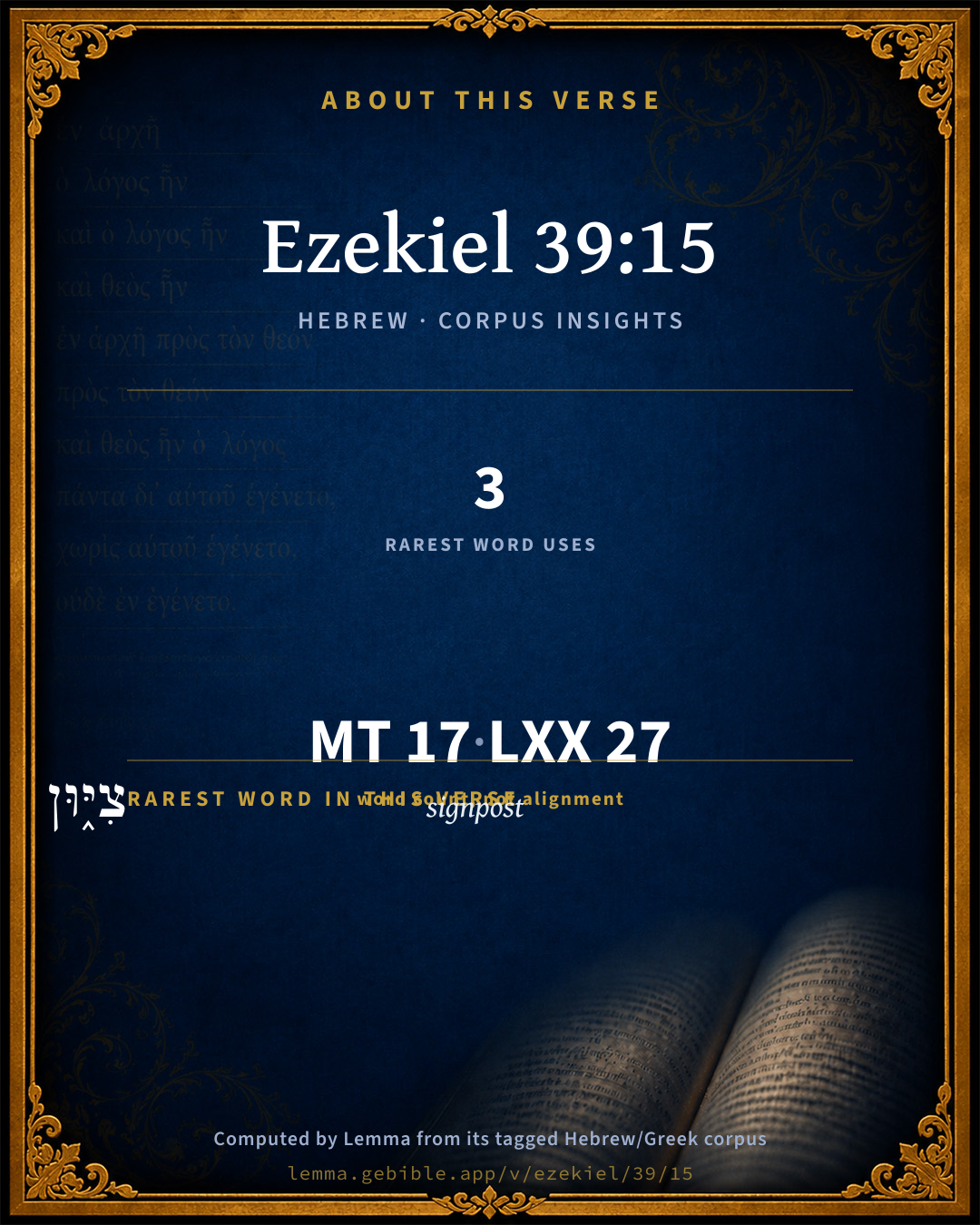
The rarest word here is צִיּ֑וּן signpost H6725 — appearing just 3 times in the whole Hebrew Bible.

Shared distinctive vocabulary

צִיּ֑וּן signpost H6725 occurs in 3 verses of the Hebrew Bible. Also found in:

Grammatical profile

  • 6 verbs
  • 7 nouns
  • 3 prepositions
  • 1 particle

Verb forms

  • וְעָבְר֤וּ Qal · Sequential Perfect
  • הָעֹֽבְרִים֙ Qal · Participle Active
  • וְרָאָה֙ Qal · Sequential Perfect
  • וּבָנָ֥ה Qal · Sequential Perfect
  • קָבְר֤וּ Qal · Perfect
  • הַֽמְקַבְּרִ֔ים Piel · Participle Active

Repetition

Words recur within this verse — often emphatic in Hebrew:

  • וְעָבְר֤וּ to pass over H5674 ×2
  • קָבְר֤וּ to bury H6912 ×2
  • הֲמ֥וֹן Hamon-gog H1996 ×2

Hebrew & Septuagint length

In English translation the verse runs 37 words from the Hebrew and 35 from the Septuagint (LXX English) — closely comparable.

A rough comparison of the two English renderings, which tokenize alike — not a word-level alignment.

Word counts can differ between the Hebrew and the Greek without any difference in meaning — e.g. the Hebrew direct-object marker אֵת has no separate Greek word, and Greek often adds the article ὁ.

In the original languages it is 17 Hebrew tokens and 27 Greek tokens — but the two are counted differently (Hebrew bundles its prefixes and suffixes into one token; the Greek is in lemma form), so that isn’t a like-for-like length.

Cross-references

1

Topical passages linked to Ezekiel 39:15 in the Treasury of Scripture Knowledge — connected by theme and wording, ordered by reader-vote popularity; previews shown in the World English Bible.

  • Luke 11:44 Woe to you, scribes and Pharisees, hypocrites! For you are like hidden graves, and the men who walk over them don't know it."

Cross-references courtesy of OpenBible.info (CC BY 4.0).

Hebrew and Greek witnesses Masoretic Hebrew ↔ Greek Septuagint

The same verse in the two great witnesses to the Old Testament, shown verse-for-verse.

These are two independent witnesses, not word-aligned to each other, and the Septuagint is shown in lemma (dictionary) form.

Hebrew Ezekiel 39:15 Masoretic · Westminster Leningrad Codex

וְעָבְר֤וּ הָעֹֽבְרִים֙ בָּאָ֔רֶץ וְרָאָה֙ עֶ֣צֶם אָדָ֔ם וּבָנָ֥ה אֶצְל֖וֹ צִיּ֑וּן עַ֣ד קָבְר֤וּ אֹתוֹ֙ הַֽמְקַבְּרִ֔ים אֶל גֵּ֖יא הֲמ֥וֹן גּֽוֹג

Those who pass through the land shall pass through; and when any sees a man's bone, then shall he set up a sign by it, until the undertakers have buried it in the valley of Hamon Gog.

World English Bible · Public Domain

Greek LXX Ezekiel 39:15 Septuagint · lemma form

καί πᾶς ὁ διαπορεύομαι ὁ γῆ καί ὁράω ὀστέον ἄνθρωπος οἰκοδομέω παρά αὐτός σημεῖον ἕως ὅστις θάπτω αὐτός ὁ θάπτω εἰς ὁ γαι ὁ πολυάνδριον ὁ γωγ

And every one that goes through the land, and sees a man's bone, shall set up a mark by it, until the buriers shall have buried it in the valley, the burial place of Gog.

LXX2012 (modern English Septuagint) · Public Domain

Hebrew: Westminster Leningrad Codex (CC BY 4.0). Greek: Septuagint (public domain); English from LXX2012 (modern English Septuagint) (Public Domain). How the Septuagint differs from the Hebrew →

Targum (Aramaic paraphrase)

1

The Targum is the ancient Jewish Aramaic paraphrase of the Hebrew Scriptures — an interpretive translation, not the Hebrew text itself. Onkelos (literal) and Pseudo-Jonathan (expansive) render the Torah, and Jonathan the Prophets. Coverage is partial: where no permissively-licensed English translation exists for a verse, only the Aramaic is shown. This is verse-level text, not a word-by-word alignment to the Hebrew.

  1. Targum Jonathan Prophets (Joshua–Malachi)
    וְעָדֵי אוֹרְחָא דְעָדָן בְּאַרְעָא דִי אִם יֶחֱזֵי גַרְמָא דֶאֱנָשָׁא וְיִבְנֵי לְוָתֵיהּ צִיוּנָא עַד דְיִקְבְּרוּן יָתֵיהּ דִי מְקַבְּרִין בְּחֵילַת אִתְרְגוּשַׁת גוֹג:

    (no public-domain English translation for this verse)

    Targum Jonathan — Aramaic: “Mikraot Gedolot” (public domain). English: “Sefaria Community Translation” (CC0 1.0 (public-domain dedication)); “London "Chaldee Paraphrase," 1871” (public domain). Text via Sefaria.

Commentary

Notes on Ezekiel 39:15 from classic Christian and Jewish commentators (each source and its license shown beneath its notes). The classic Christian expositions comment on the surrounding passage and are grouped to its opening verse, so a note may address several verses; the Jewish commentaries on the Tanakh (Rashi and others) are per-verse, so they appear only where the commentator wrote on this verse.

Lemma curates 59 commentaries, every one of them public domain or Creative Commons licensed, each selected and text-cleaned for this edition rather than reprinted as found. About our sources →

Trapp's Complete Commentary

John Trapp

Eze 39:15 And the passengers [that] pass through the land, when [any] seeth a man’s bone, then shall he set up a sign by it, till the buriers have buried it in the valley of Hamongog.

Ver. 15. Then shall he set up a sign by it.] A statue, pillar, or sepulchral monument, that the butlers may bury it. Oh that in like sort God would cause the prophet, all relics and rags of Popery, and other heresy, together with the unclean spirit, to pass out of our land. {Zec 13:2}

John Trapp, A Commentary or Exposition upon All the Books of the Old and New Testament (1647–1656) — public domain. Text from a community e-Sword module.

Jamieson, Fausset & Brown

Robert Jamieson, A. R. Fausset & David Brown

First "all the people of the land" engaged in the burying for seven months; then special men were employed, at the end of the seven months, to search for any still left unburied. The passers-by helped them by setting up a mark near any such bones, in order to keep others from being defiled by casually touching them, and that the buriers might come and remove them. Denoting the minute care to put away every relic of heathen pollution from the Holy Land.

Jamieson, Fausset & Brown — Commentary Critical and Explanatory on the Whole Bible (1871) — public domain (CC PDM 1.0). Text via the HelloAO Bible API.

The Cambridge Bible for Schools and Colleges

gen. ed. J. J. S. Perowne

15. Render with R.V., And they that pass through the land (the searchers) shall pass through; and when any seeth a man’s bone, then shall he set up (lit. build) a sign (or pillar), &c. On Hamon-Gog cf. Eze_39:11.

The Cambridge Bible for Schools and Colleges (gen. ed. J. J. S. Perowne; Cambridge University Press, 1878–1918) — public domain. Text from a community e-Sword module.

John Gill's Exposition

And the passengers that pass through the land,.... Not along with the searchers, but that travel through it upon business in it, or in other lands:

when any seeth a man's bone, then shall he set up a sign by it; as he passes along, if he happens to see a human bone in the way, or hard by, he shall stop and lay a stone, or a heap of stones, by it, or some such mark or token, signifying that a man's bone lies there:

till the buriers have buried it in the valley of Hamon-gog, that is, which sign shall continue till searchers come that way and take up the bone, and carry it to be buried in the valley of Hamon-gog; for carcasses and bones were not to be buried in the place where they were found, but to be brought and interred in this common place of sepulture.

John Gill's Exposition of the Whole Bible (1746–1763) — public domain (CC PDM 1.0). Text via the HelloAO Bible API.

Haydock's Catholic Bible Commentary

Buriers. These might be foreign slaves, or Jews, who followed this employment. (Calmet) --- They would be habitually (Haydock) unclean, and their company would be carefully avoided. Those who sought after the dead remains, contracted no uncleanness. (Calmet)

George Leo Haydock (1774–1849), Haydock's Catholic Family Bible and Commentary, 1859 edition — public domain. Excludes Psalms (Douay-Rheims chapter numbering differs from Protestant) and Deuterocanonical books (Catholic canon only).

Matthew Poole's English Annotations

Order should be taken to inform travellers, if they lighted on any bone or bones of men, as they journeyed, that they were desired to set up some mark at them, that thereby the public officers appointed to gather and bury them might find and carry those bones to the common burying-place.

When any seeth a man’s bone: many of Gog’s soldiers were torn by beasts, which if some of the greater beasts did, the lesser could not, break and devour the bones, but with the flesh these were dragged about by beasts, or scattered by the eagles and vultures, and so lay divided from the body; of these the prophet speaks.

Matthew Poole's English Annotations on the Holy Bible (1683–1685) — public domain. Text from a community e-Sword/MySword module.

The Pulpit Commentary

Verse 15 describes the method of procedure these "searchers" and "buriers," should follow. If these were distinct from each other, the "searchers if they were the same, any others on discovering a man"s bone should set up a sign by it; literally, build near it a pillar; erect a heap of stone (comp. 2Ki_23:17; Jer_31:21) to call the attention of the butlers, who, on coming to the spot, should inter it in the valley of Hamon-gog.

The Pulpit Commentary (1880–1919), ed. H.D.M. Spence-Jones & Joseph S. Exell — public domain. Text from a community e-Sword module.

Rashi

Rabbi Shlomo Yitzchaki (Rashi)

And when they that pass through the land shall pass Wayfarers who see a human bone

will construct a marker next to it as a sign that there is a bone of a dead body there, in order that wayfarers and those who prepare ritually pure food should stay away from it. until the men of continuous employment, designated to search, will come and bury it.

Rashi on the Tanakh — English translations: “The Judaica Press complete Tanach with Rashi, translated by A. J. Rosenberg” (CC BY 4.0); “Pentateuch with Rashi's commentary by M. Rosenbaum and A.M. Silbermann, 1929-1934” (public domain); “The Metsudah Tanach series, Lakewood, N.J” (CC BY 4.0); and “The Book of Joshua, Metsudah Publications, 1997” (CC BY 4.0). Text via Sefaria.

Lesson kit

Teaching starters — assembled from the data on this page, not authored interpretation. Every prompt links to the verse data it draws on. Edit before teaching.

Ezekiel, in the Prophets, opens this verse with 17 words (14 distinct Hebrew lemmas). Its most distinctive word is tsîyûwn (“signpost”). A historical commentator’s framing appears above. Read the whole chapter for the surrounding context.

Discussion questions

  1. What does “signpost” (tsîyûwn) contribute to the verse as a whole?
  2. How does 2 Kings 23:17, which shares the word «signpost», read alongside this verse?
  3. What does the repetition of “to pass over” (2× in this one verse) do in this verse?
  4. The translations on this page render this verse differently — a whole-verse word diff, not a word-by-word alignment. What might account for the different wordings?
  5. «וְעָבְר֤וּ» is a Qal Sequential Perfect verb. How does that grammatical form shape the action described?
  6. Compare how Trapp's Complete Commentary and Jamieson, Fausset & Brown read this verse. Where do they agree or differ?

Things to notice

Reading settings

Reading text

Shown beneath each verse's original-language words.

Old Testament
Old Testament edition

Read the OT as the Masoretic Hebrew (MT) or the Greek Septuagint (LXX).

English shown for the Greek Septuagint (in the Hebrew ↔ Greek comparison).

Comparing translations? Open the Compare panel on any verse page to stack up to four side by side.