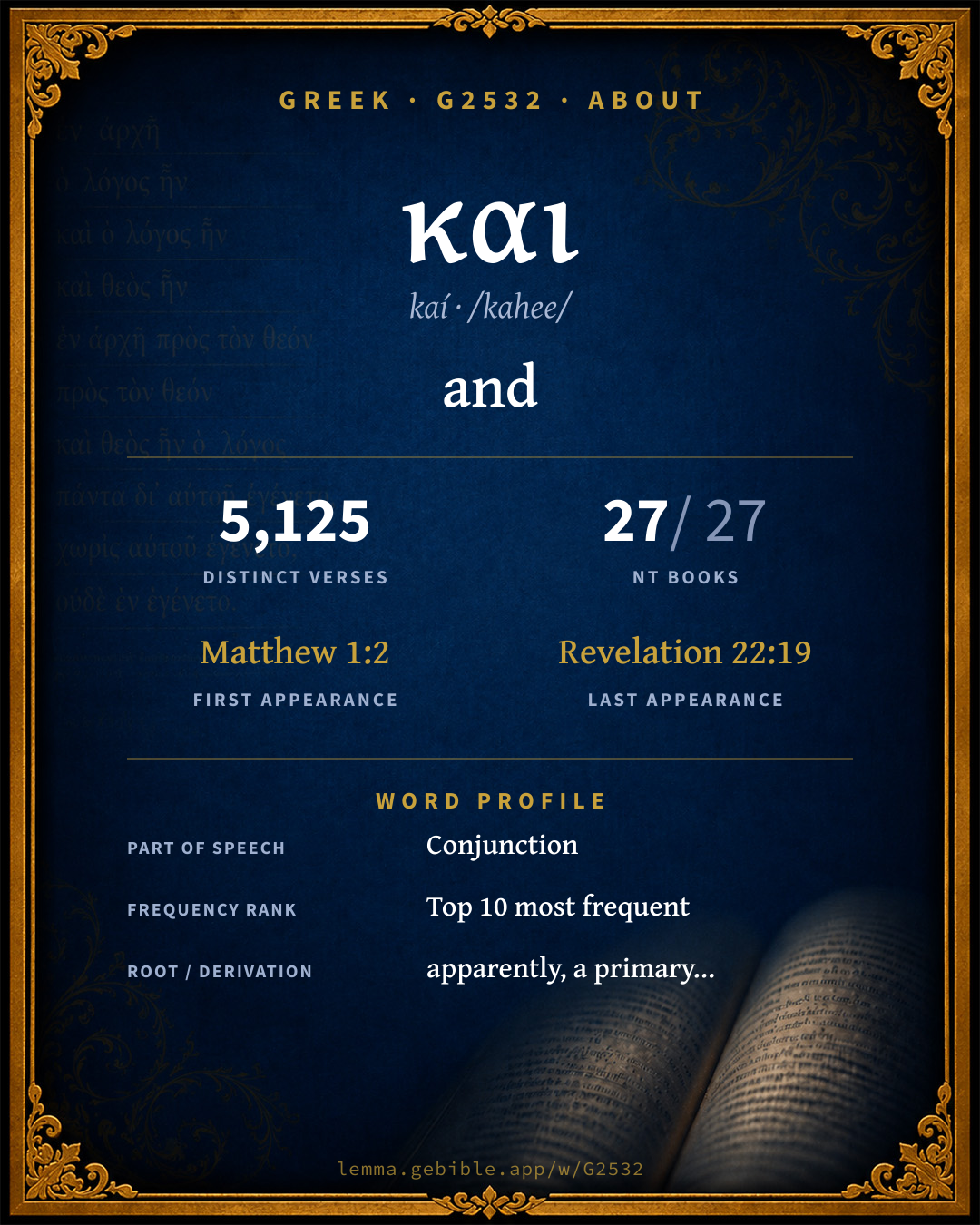
καί
and
Full lexicon entry — Thayer's Greek Lexicon
From Thayer's Greek Lexicon
Where this word appears
Grammar key — what these labels mean
Part of speech
- Conjunction
- A joining word linking words or clauses.
Page 9 of 26 — showing verses 1,601–1,800 of 5,125 distinct verses where G2532 appears, across 27 books. Click any verse to open its interlinear word-by-word view. Verse text shown in the World English Bible for context — . Each verse’s Greek form is shown with its reference; the English is not keyword-highlighted, since the data carries no word-level English alignment. Use “Compare translations” on any verse to read it across multiple English versions. This concordance covers the Greek New Testament; Septuagint (Greek Old Testament) occurrences of this word are not indexed here.
Luke 829 verses
- Luke 9:52 καὶ καὶ conj conj and sent messengers before his face. They went, and entered into a village of the Samaritans, so as to prepare for him.
- Luke 9:53 καὶ conj They didn't receive him, because he was traveling with his face set towards Jerusalem.
- Luke 9:54 καὶ καὶ conj conj When his disciples, James and John, saw this, they said, "Lord, do you want us to command fire to come down from the sky, and destroy them, just as Elijah did?"
- Luke 9:56 καὶ conj For the Son of Man didn't come to destroy men's lives, but to save them." They went to another village.
- Luke 9:57 Καὶ conj As they went on the way, a certain man said to him, "I want to follow you wherever you go, Lord."
- Luke 9:58 καὶ καὶ conj conj Jesus said to him, "The foxes have holes, and the birds of the sky have nests, but the Son of Man has no place to lay his head."
- Luke 9:61 καὶ conj Another also said, "I want to follow you, Lord, but first allow me to bid farewell to those who are at my house."
- Luke 9:62 καὶ conj But Jesus said to him, "No one, having put his hand to the plow, and looking back, is fit for the Kingdom of God."
- Luke 10:1 καὶ καὶ καὶ conj conj conj Now after these things, the Lord also appointed seventy others, and sent them two by two ahead of him into every city and place, where he was about to come.
- Luke 10:6 καὶ conj If a son of peace is there, your peace will rest on him; but if not, it will return to you.
- Luke 10:7 καὶ conj Remain in that same house, eating and drinking the things they give, for the laborer is worthy of his wages. Don't go from house to house.
- Luke 10:8 καὶ καὶ conj conj Into whatever city you enter, and they receive you, eat the things that are set before you.
- Luke 10:9 καὶ καὶ conj conj Heal the sick who are therein, and tell them, 'The Kingdom of God has come near to you.'
- Luke 10:10 καὶ conj But into whatever city you enter, and they don't receive you, go out into the streets of it and say,
- Luke 10:11 καὶ conj 'Even the dust from your city that clings to us, we wipe off against you. Nevertheless know this, that the Kingdom of God has come near to you.'
- Luke 10:13 καὶ καὶ conj conj "Woe to you, Chorazin! Woe to you, Bethsaida! For if the mighty works had been done in Tyre and Sidon which were done in you, they would have repented long ago, sitting in sackcloth and ashes.
- Luke 10:14 καὶ conj But it will be more tolerable for Tyre and Sidon in the judgment than for you.
- Luke 10:15 καὶ conj You, Capernaum, who are exalted to heaven, will be brought down to Hades.
- Luke 10:16 καὶ conj Whoever listens to you listens to me, and whoever rejects you rejects me. Whoever rejects me rejects him who sent me."
- Luke 10:17 καὶ conj The seventy returned with joy, saying, "Lord, even the demons are subject to us in your name!"
- Luke 10:19 καὶ καὶ καὶ conj conj conj Behold, I give you authority to tread on serpents and scorpions, and over all the power of the enemy. Nothing will in any way hurt you.
- Luke 10:21 καὶ καὶ καὶ καὶ conj conj conj conj In that same hour Jesus rejoiced in the Holy Spirit, and said, "I thank you, O Father, Lord of heaven and earth, that you have hidden these things from the wise and understanding, and revealed them to little children. Yes, Father, for so it was well-pleasing in your sight."
- Luke 10:22 καὶ καὶ καὶ καὶ conj conj conj conj Turning to the disciples, he said, "All things have been delivered to me by my Father. No one knows who the Son is, except the Father, and who the Father is, except the Son, and he to whomever the Son desires to reveal him."
- Luke 10:23 Καὶ conj Turning to the disciples, he said privately, "Blessed are the eyes which see the things that you see,
- Luke 10:24 καὶ καὶ καὶ καὶ conj conj conj conj for I tell you that many prophets and kings desired to see the things which you see, and didn't see them, and to hear the things which you hear, and didn't hear them."
- Luke 10:25 Καὶ conj Behold, a certain lawyer stood up and tested him, saying, "Teacher, what shall I do to inherit eternal life?"
- Luke 10:27 καὶ καὶ καὶ καὶ conj conj conj conj He answered, "You shall love the Lord your God with all your heart, with all your soul, with all your strength, and with all your mind; and your neighbor as yourself."
- Luke 10:28 καὶ conj He said to him, "You have answered correctly. Do this, and you will live."
- Luke 10:29 καὶ conj But he, desiring to justify himself, asked Jesus, "Who is my neighbor?"
- Luke 10:30 καὶ καὶ καὶ conj conj conj Jesus answered, "A certain man was going down from Jerusalem to Jericho, and he fell among robbers, who both stripped him and beat him, and departed, leaving him half dead.
- Luke 10:31 καὶ conj By chance a certain priest was going down that way. When he saw him, he passed by on the other side.
- Luke 10:32 καὶ καὶ conj conj In the same way a Levite also, when he came to the place, and saw him, passed by on the other side.
- Luke 10:33 καὶ conj But a certain Samaritan, as he traveled, came where he was. When he saw him, he was moved with compassion,
- Luke 10:34 καὶ καὶ καὶ conj conj conj came to him, and bound up his wounds, pouring on oil and wine. He set him on his own animal, and brought him to an inn, and took care of him.
- Luke 10:35 καὶ καὶ καὶ conj conj conj On the next day, when he departed, he took out two denarii, and gave them to the host, and said to him, 'Take care of him. Whatever you spend beyond that, I will repay you when I return.'
- Luke 10:37 καὶ conj He said, "He who showed mercy on him." Then Jesus said to him, "Go and do likewise."
- Luke 10:38 καὶ conj It happened as they went on their way, he entered into a certain village, and a certain woman named Martha received him into her house.
- Luke 10:39 καὶ καὶ conj conj She had a sister called Mary, who also sat at Jesus' feet, and heard his word.
- Luke 10:41 καὶ conj Jesus answered her, "Martha, Martha, you are anxious and troubled about many things,
- Luke 11:1 Καὶ καὶ conj conj It happened, that when he finished praying in a certain place, one of his disciples said to him, "Lord, teach us to pray, just as John also taught his disciples."
- Luke 11:4 καὶ καὶ καὶ conj conj conj Forgive us our sins, For we ourselves also forgive everyone who is indebted to us. Bring us not into temptation, But deliver us from the evil one.'"
- Luke 11:5 Καὶ καὶ καὶ conj conj conj He said to them, "Which of you, if you go to a friend at midnight, and tell him, 'Friend, lend me three loaves of bread,
- Luke 11:6 καὶ conj for a friend of mine has come to me from a journey, and I have nothing to set before him,'
- Luke 11:7 καὶ conj and he from within will answer and say, 'Don't bother me. The door is now shut, and my children are with me in bed. I can't get up and give it to you'?
- Luke 11:8 καὶ conj I tell you, although he will not rise and give it to him because he is his friend, yet because of his persistence, he will get up and give him as many as he needs.
- Luke 11:9 καὶ καὶ καὶ conj conj conj "I tell you, keep asking, and it will be given you. Keep seeking, and you will find. Keep knocking, and it will be opened to you.
- Luke 11:10 καὶ καὶ conj conj For everyone who asks receives. He who seeks finds. To him who knocks it will be opened.
- Luke 11:11 καὶ conj "Which of you fathers, if your son asks for bread, will give him a stone? Or if he asks for a fish, he won't give him a snake instead of a fish, will he?
- Luke 11:12 καὶ conj Or if he asks for an egg, he won't give him a scorpion, will he?
- Luke 11:14 Καὶ καὶ καὶ conj conj conj He was casting out a demon, and it was mute. It happened, when the demon had gone out, the mute man spoke; and the multitudes marveled.
- Luke 11:17 καὶ conj But he, knowing their thoughts, said to them, "Every kingdom divided against itself is brought to desolation. A house divided against itself falls.
- Luke 11:18 καὶ conj If Satan also is divided against himself, how will his kingdom stand? For you say that I cast out demons by Beelzebul.
- Luke 11:22 καὶ conj But when someone stronger attacks him and overcomes him, he takes from him his whole armor in which he trusted, and divides his spoils.
- Luke 11:23 καὶ conj "He that is not with me is against me. He who doesn't gather with me scatters.
- Luke 11:24 καὶ conj The unclean spirit, when he has gone out of the man, passes through dry places, seeking rest, and finding none, he says, 'I will turn back to my house from which I came out.'
- Luke 11:25 καὶ καὶ conj conj When he returns, he finds it swept and put in order.
- Luke 11:26 καὶ καὶ καὶ conj conj conj Then he goes, and takes seven other spirits more evil than himself, and they enter in and dwell there. The last state of that man becomes worse than the first."
- Luke 11:27 καὶ conj It came to pass, as he said these things, a certain woman out of the multitude lifted up her voice, and said to him, "Blessed is the womb that bore you, and the breasts which nursed you!"
- Luke 11:28 καὶ conj But he said, "On the contrary, blessed are those who hear the word of God, and keep it."
- Luke 11:29 καὶ conj When the multitudes were gathering together to him, he began to say, "This is an evil generation. It seeks after a sign. No sign will be given to it but the sign of Jonah, the prophet.
- Luke 11:30 καὶ conj For even as Jonah became a sign to the Ninevites, so will also the Son of Man be to this generation.
- Luke 11:31 καὶ καὶ conj conj The Queen of the South will rise up in the judgment with the men of this generation, and will condemn them: for she came from the ends of the earth to hear the wisdom of Solomon; and behold, one greater than Solomon is here.
- Luke 11:32 καὶ καὶ conj conj The men of Nineveh will stand up in the judgment with this generation, and will condemn it: for they repented at the preaching of Jonah, and behold, one greater than Jonah is here.
- Luke 11:34 καὶ καὶ conj conj The lamp of the body is the eye. Therefore when your eye is good, your whole body is also full of light; but when it is evil, your body also is full of darkness.
- Luke 11:39 καὶ καὶ conj conj The Lord said to him, "Now you Pharisees cleanse the outside of the cup and of the platter, but your inward part is full of extortion and wickedness.
- Luke 11:40 καὶ conj You foolish ones, didn't he who made the outside make the inside also?
- Luke 11:41 καὶ conj But give for gifts to the needy those things which are within, and behold, all things will be clean to you.
- Luke 11:42 καὶ καὶ καὶ καὶ conj conj conj conj But woe to you Pharisees! For you tithe mint and rue and every herb, but you bypass justice and the love of God. You ought to have done these, and not to have left the other undone.
- Luke 11:43 καὶ conj Woe to you Pharisees! For you love the best seats in the synagogues, and the greetings in the marketplaces.
- Luke 11:44 καὶ conj Woe to you, scribes and Pharisees, hypocrites! For you are like hidden graves, and the men who walk over them don't know it."
- Luke 11:45 καὶ conj One of the lawyers answered him, "Teacher, in saying this you insult us also."
- Luke 11:46 καὶ καὶ conj conj He said, "Woe to you lawyers also! For you load men with burdens that are difficult to carry, and you yourselves won't even lift one finger to help carry those burdens.
- Luke 11:47 καὶ conj Woe to you! For you build the tombs of the prophets, and your fathers killed them.
- Luke 11:48 καὶ conj So you testify and consent to the works of your fathers. For they killed them, and you build their tombs.
- Luke 11:49 καὶ καὶ καὶ καὶ conj conj conj conj Therefore also the wisdom of God said, 'I will send to them prophets and apostles; and some of them they will kill and persecute,
- Luke 11:51 καὶ conj from the blood of Abel to the blood of Zachariah, who perished between the altar and the sanctuary.' Yes, I tell you, it will be required of this generation.
- Luke 11:52 καὶ conj Woe to you lawyers! For you took away the key of knowledge. You didn't enter in yourselves, and those who were entering in, you hindered."
- Luke 11:53 καὶ καὶ conj conj As he said these things to them, the scribes and the Pharisees began to be terribly angry, and to draw many things out of him;
- Luke 12:2 καὶ conj But there is nothing covered up, that will not be revealed, nor hidden, that will not be known.
- Luke 12:3 καὶ conj Therefore whatever you have said in the darkness will be heard in the light. What you have spoken in the ear in the inner chambers will be proclaimed on the housetops.
- Luke 12:4 καὶ conj "I tell you, my friends, don't be afraid of those who kill the body, and after that have no more that they can do.
- Luke 12:6 καὶ conj "Aren't five sparrows sold for two assaria coins? Not one of them is forgotten by God.
- Luke 12:7 καὶ conj But the very hairs of your head are all numbered. Therefore don't be afraid. You are of more value than many sparrows.
- Luke 12:8 καὶ conj "I tell you, everyone who confesses me before men, him will the Son of Man also confess before the angels of God;
- Luke 12:10 καὶ conj Everyone who speaks a word against the Son of Man will be forgiven, but those who blaspheme against the Holy Spirit will not be forgiven.
- Luke 12:11 καὶ καὶ conj conj When they bring you before the synagogues, the rulers, and the authorities, don't be anxious how or what you will answer, or what you will say;
- Luke 12:15 καὶ conj He said to them, "Beware! Keep yourselves from covetousness, for a man's life doesn't consist of the abundance of the things which he possesses."
- Luke 12:17 καὶ conj He reasoned within himself, saying, 'What will I do, because I don't have room to store my crops?'
- Luke 12:18 καὶ καὶ καὶ καὶ conj conj conj conj He said, 'This is what I will do. I will pull down my barns, and build bigger ones, and there I will store all my grain and my goods.
- Luke 12:19 καὶ conj I will tell my soul, "Soul, you have many goods laid up for many years. Take your ease, eat, drink, be merry."'
- Luke 12:21 καὶ conj So is he who lays up treasure for himself, and is not rich toward God."
- Luke 12:23 καὶ conj Life is more than food, and the body is more than clothing.
- Luke 12:24 καὶ conj Consider the ravens: they don't sow, they don't reap, they have no warehouse or barn, and God feeds them. How much more valuable are you than birds!
- Luke 12:28 καὶ conj But if this is how God clothes the grass in the field, which today exists, and tomorrow is cast into the oven, how much more will he clothe you, O you of little faith?
- Luke 12:29 καὶ καὶ καὶ conj conj conj Don't seek what you will eat or what you will drink; neither be anxious.
- Luke 12:31 καὶ conj But seek God's Kingdom, and all these things will be added to you.
- Luke 12:33 καὶ conj Sell that which you have, and give gifts to the needy. Make for yourselves purses which don't grow old, a treasure in the heavens that doesn't fail, where no thief approaches, neither moth destroys.
- Luke 12:34 καὶ conj For where your treasure is, there will your heart be also.
- Luke 12:35 καὶ conj "Let your loins be girded and your lamps burning.
- Luke 12:36 καὶ καὶ conj conj Be like men watching for their lord, when he returns from the marriage feast; that, when he comes and knocks, they may immediately open to him.
- Luke 12:37 καὶ καὶ conj conj Blessed are those servants, whom the lord will find watching when he comes. Most assuredly I tell you, that he will dress himself, and make them recline, and will come and serve them.
- Luke 12:38 καὶ conj They will be blessed if he comes in the second or third watch, and finds them so.
- Luke 12:40 καὶ conj Therefore be ready also, for the Son of Man is coming in an hour that you don't expect him."
- Luke 12:41 καὶ conj Peter said to him, "Lord, are you telling this parable to us, or to everybody?"
- Luke 12:42 καὶ conj The Lord said, "Who then is the faithful and wise steward, whom his lord will set over his household, to give them their portion of food at the right times?
- Luke 12:45 καὶ καὶ καὶ καὶ conj conj conj conj But if that servant says in his heart, 'My lord delays his coming,' and begins to beat the menservants and the maidservants, and to eat and drink, and to be drunken,
- Luke 12:46 καὶ καὶ καὶ conj conj conj then the lord of that servant will come in a day when he isn't expecting him, and in an hour that he doesn't know, and will cut him in two, and place his portion with the unfaithful.
- Luke 12:47 καὶ conj That servant, who knew his lord's will, and didn't prepare, nor do what he wanted, will be beaten with many stripes,
- Luke 12:48 καὶ conj but he who didn't know, and did things worthy of stripes, will be beaten with few stripes. To whoever much is given, of him will much be required; and to whom much was entrusted, of him more will be asked.
- Luke 12:49 καὶ conj "I came to throw fire on the earth. I wish it were already kindled.
- Luke 12:50 καὶ conj But I have a baptism to be baptized with, and how distressed I am until it is accomplished!
- Luke 12:52 καὶ conj For from now on, there will be five in one house divided, three against two, and two against three.
- Luke 12:53 καὶ καὶ καὶ conj conj conj They will be divided, father against son, and son against father; mother against daughter, and daughter against her mother; mother-in-law against her daughter-in-law, and daughter-in-law against her mother-in-law."
- Luke 12:54 καὶ καὶ conj conj He said to the multitudes also, "When you see a cloud rising from the west, immediately you say, 'A shower is coming,' and so it happens.
- Luke 12:55 καὶ καὶ conj conj When a south wind blows, you say, 'There will be a scorching heat,' and it happens.
- Luke 12:56 καὶ conj You hypocrites! You know how to interpret the appearance of the earth and the sky, but how is it that you don't interpret this time?
- Luke 12:57 καὶ conj Why don't you judge for yourselves what is right?
- Luke 12:58 καὶ καὶ conj conj For when you are going with your adversary before the magistrate, try diligently on the way to be released from him, lest perhaps he drag you to the judge, and the judge deliver you to the officer, and the officer throw you into prison.
- Luke 12:59 καὶ conj I tell you, you will by no means get out of there, until you have paid the very last penny."
- Luke 13:2 καὶ conj Jesus answered them, "Do you think that these Galileans were worse sinners than all the other Galileans, because they suffered such things?
- Luke 13:4 καὶ conj Or those eighteen, on whom the tower in Siloam fell, and killed them; do you think that they were worse offenders than all the men who dwell in Jerusalem?
- Luke 13:6 καὶ καὶ conj conj He spoke this parable. "A certain man had a fig tree planted in his vineyard, and he came seeking fruit on it, and found none.
- Luke 13:7 καὶ καὶ conj conj He said to the vine dresser, 'Behold, these three years I have come looking for fruit on this fig tree, and found none. Cut it down. Why does it waste the soil?'
- Luke 13:8 καὶ καὶ conj conj He answered, 'Lord, leave it alone this year also, until I dig around it, and fertilize it.
- Luke 13:11 καὶ καὶ καὶ conj conj conj Behold, there was a woman who had a spirit of infirmity eighteen years, and she was bent over, and could in no way straighten herself up.
- Luke 13:12 καὶ conj When Jesus saw her, he called her, and said to her, "Woman, you are freed from your infirmity."
- Luke 13:13 καὶ καὶ καὶ conj conj conj He laid his hands on her, and immediately she stood up straight, and glorified God.
- Luke 13:14 καὶ conj The ruler of the synagogue, being indignant because Jesus had healed on the Sabbath, said to the multitude, "There are six days in which men ought to work. Therefore come on those days and be healed, and not on the Sabbath day!"
- Luke 13:15 καὶ καὶ conj conj Therefore the Lord answered him, "You hypocrites! Doesn't each one of you free his ox or his donkey from the stall on the Sabbath, and lead him away to water?
- Luke 13:16 καὶ conj Ought not this woman, being a daughter of Abraham, whom Satan had bound eighteen long years, be freed from this bondage on the Sabbath day?"
- Luke 13:17 καὶ καὶ conj conj As he said these things, all his adversaries were disappointed, and all the multitude rejoiced for all the glorious things that were done by him.
- Luke 13:18 καὶ conj He said, "What is the Kingdom of God like? To what shall I compare it?
- Luke 13:19 καὶ καὶ καὶ conj conj conj It is like a grain of mustard seed, which a man took, and put in his own garden. It grew, and became a large tree, and the birds of the sky lodged in its branches."
- Luke 13:20 Καὶ conj Again he said, "To what shall I compare the Kingdom of God?
- Luke 13:22 Καὶ καὶ καὶ conj conj conj He went on his way through cities and villages, teaching, and traveling on to Jerusalem.
- Luke 13:24 καὶ conj "Strive to enter in by the narrow door, for many, I tell you, will seek to enter in, and will not be able.
- Luke 13:25 καὶ καὶ καὶ καὶ conj conj conj conj When once the master of the house has risen up, and has shut the door, and you begin to stand outside, and to knock at the door, saying, 'Lord, Lord, open to us!' then he will answer and tell you, 'I don't know you or where you come from.'
- Luke 13:26 καὶ καὶ conj conj Then you will begin to say, 'We ate and drink in your presence, and you taught in our streets.'
- Luke 13:27 καὶ conj He will say, 'I tell you, I don't know where you come from. Depart from me, all you workers of iniquity.'
- Luke 13:28 καὶ καὶ καὶ καὶ conj conj conj conj There will be weeping and gnashing of teeth, when you see Abraham, Isaac, Jacob, and all the prophets, in the Kingdom of God, and yourselves being thrown outside.
- Luke 13:29 καὶ καὶ καὶ καὶ καὶ conj conj conj conj conj They will come from the east, west, north, and south, and will sit down in the Kingdom of God.
- Luke 13:30 καὶ καὶ conj conj Behold, there are some who are last who will be first, and there are some who are first who will be last."
- Luke 13:31 καὶ conj On that same day, some Pharisees came, saying to him, "Get out of here, and go away, for Herod wants to kill you."
- Luke 13:32 καὶ καὶ καὶ καὶ conj conj conj conj He said to them, "Go and tell that fox, 'Behold, I cast out demons and perform cures today and tomorrow, and the third day I complete my mission.
- Luke 13:33 καὶ καὶ conj conj Nevertheless I must go on my way today and tomorrow and the next day, for it can't be that a prophet perish outside of Jerusalem.'
- Luke 13:34 καὶ καὶ conj conj "Jerusalem, Jerusalem, that kills the prophets, and stones those who are sent to her! How often I wanted to gather your children together, like a hen gathers her own brood under her wings, and you refused!
- Luke 14:1 Καὶ καὶ conj conj It happened, when he went into the house of one of the rulers of the Pharisees on a Sabbath to eat bread, that they were watching him.
- Luke 14:2 καὶ conj Behold, a certain man who had dropsy was in front of him.
- Luke 14:3 καὶ καὶ conj conj Jesus, answering, spoke to the lawyers and Pharisees, saying, "Is it lawful to heal on the Sabbath?"
- Luke 14:4 καὶ καὶ conj conj But they were silent. He took him, and healed him, and let him go.
- Luke 14:5 καὶ καὶ conj conj He answered them, "Which of you, if your son or an ox fell into a well, wouldn't immediately pull him out on a Sabbath day?"
- Luke 14:6 καὶ conj They couldn't answer him regarding these things.
- Luke 14:9 καὶ καὶ καὶ conj conj conj and he who invited both of you would come and tell you, 'Make room for this person.' Then you would begin, with shame, to take the lowest place.
- Luke 14:11 καὶ conj For everyone who exalts himself will be humbled, and whoever humbles himself will be exalted."
- Luke 14:12 καὶ καὶ καὶ conj conj conj He also said to the one who had invited him, "When you make a dinner or a supper, don't call your friends, nor your brothers, nor your kinsmen, nor rich neighbors, or perhaps they might also return the favor, and pay you back.
- Luke 14:14 καὶ conj and you will be blessed, because they don't have the resources to repay you. For you will be repaid in the resurrection of the righteous."
- Luke 14:16 καὶ conj But he said to him, "A certain man made a great supper, and he invited many people.
- Luke 14:17 καὶ conj He sent out his servant at supper time to tell those who were invited, 'Come, for everything is ready now.'
- Luke 14:18 καὶ καὶ conj conj They all as one began to make excuses. "The first said to him, 'I have bought a field, and I must go and see it. Please have me excused.'
- Luke 14:19 καὶ καὶ conj conj "Another said, 'I have bought five yoke of oxen, and I must go try them out. Please have me excused.'
- Luke 14:20 καὶ καὶ conj conj "Another said, 'I have married a wife, and therefore I can't come.'
- Luke 14:21 καὶ καὶ καὶ καὶ καὶ καὶ conj conj conj conj conj conj "That servant came, and told his lord these things. Then the master of the house, being angry, said to his servant, 'Go out quickly into the streets and lanes of the city, and bring in the poor, maimed, blind, and lame.'
- Luke 14:22 καὶ καὶ conj conj "The servant said, 'Lord, it is done as you commanded, and there is still room.'
- Luke 14:23 καὶ καὶ καὶ conj conj conj "The lord said to the servant, 'Go out into the highways and hedges, and compel them to come in, that my house may be filled.
- Luke 14:25 καὶ conj Now great multitudes were going with him. He turned and said to them,
- Luke 14:26 καὶ καὶ καὶ καὶ καὶ καὶ καὶ conj conj conj conj conj conj conj "If anyone comes to me, and doesn't hate his own father, mother, wife, children, brothers, and sisters, yes, and his own life also, he can't be my disciple.
- Luke 14:27 καὶ conj Whoever doesn't bear his own cross, and come after me, can't be my disciple.
- Luke 14:29 καὶ conj Or perhaps, when he has laid a foundation, and is not able to finish, everyone who sees begins to mock him,
- Luke 14:30 καὶ conj saying, 'This man began to build, and wasn't able to finish.'
- Luke 14:34 καὶ conj Salt is good, but if the salt becomes flat and tasteless, with what do you season it?
- Luke 15:1 καὶ conj Now all the tax collectors and sinners were coming close to him to hear him.
- Luke 15:2 καὶ καὶ καὶ conj conj conj The Pharisees and the scribes murmured, saying, "This man welcomes sinners, and eats with them."
- Luke 15:4 καὶ καὶ conj conj "Which of you men, if you had one hundred sheep, and lost one of them, wouldn't leave the ninety-nine in the wilderness, and go after the one that was lost, until he found it?
- Luke 15:5 καὶ conj When he has found it, he carries it on his shoulders, rejoicing.
- Luke 15:6 καὶ καὶ conj conj When he comes home, he calls together his friends and his neighbors, saying to them, 'Rejoice with me, for I have found my sheep which was lost!'
- Luke 15:8 καὶ καὶ conj conj Or what woman, if she had ten drachma coins, if she lost one drachma coin, wouldn't light a lamp, sweep the house, and seek diligently until she found it?
- Luke 15:9 καὶ καὶ conj conj When she has found it, she calls together her friends and neighbors, saying, 'Rejoice with me, for I have found the drachma which I had lost.'
- Luke 15:12 καὶ καὶ conj conj The younger of them said to his father, 'Father, give me my share of your property.' He divided his livelihood between them.
- Luke 15:13 καὶ καὶ conj conj Not many days after, the younger son gathered all of this together and traveled into a far country. There he wasted his property with riotous living.
- Luke 15:14 καὶ conj When he had spent all of it, there arose a severe famine in that country, and he began to be in need.
- Luke 15:15 καὶ καὶ conj conj He went and joined himself to one of the citizens of that country, and he sent him into his fields to feed pigs.
- Luke 15:16 καὶ καὶ conj conj He wanted to fill his belly with the husks that the pigs ate, but no one gave him any.
- Luke 15:18 καὶ καὶ conj conj I will get up and go to my father, and will tell him, "Father, I have sinned against heaven, and in your sight.
- Luke 15:20 καὶ καὶ καὶ καὶ conj conj conj conj "He arose, and came to his father. But while he was still far off, his father saw him, and was moved with compassion, and ran, and fell on his neck, and kissed him.
- Luke 15:21 καὶ conj The son said to him, 'Father, I have sinned against heaven, and in your sight. I am no longer worthy to be called your son.'
- Luke 15:22 καὶ καὶ καὶ conj conj conj "But the father said to his servants, 'Bring out the best robe, and put it on him. Put a ring on his hand, and shoes on his feet.
- Luke 15:23 καὶ καὶ conj conj Bring the fattened calf, kill it, and let us eat, and celebrate;
- Luke 15:24 καὶ καὶ καὶ conj conj conj for this, my son, was dead, and is alive again. He was lost, and is found.' They began to celebrate.
- Luke 15:25 καὶ καὶ conj conj "Now his elder son was in the field. As he came near to the house, he heard music and dancing.
- Luke 15:26 καὶ conj He called one of the servants to him, and asked what was going on.
- Luke 15:27 καὶ conj He said to him, 'Your brother has come, and your father has killed the fattened calf, because he has received him back safe and healthy.'
- Luke 15:28 καὶ conj But he was angry, and would not go in. Therefore his father came out, and begged him.
- Luke 15:29 καὶ καὶ conj conj But he answered his father, 'Behold, these many years I have served you, and I never disobeyed a commandment of yours, but you never gave me a goat, that I might celebrate with my friends.
- Luke 15:31 καὶ conj "He said to him, 'Son, you are always with me, and all that is mine is yours.
- Luke 15:32 καὶ καὶ καὶ καὶ conj conj conj conj But it was appropriate to celebrate and be glad, for this, your brother, was dead, and is alive again. He was lost, and is found.'"
- Luke 16:1 καὶ καὶ conj conj He also said to his disciples, "There was a certain rich man who had a manager. An accusation was made to him that this man was wasting his possessions.
- Luke 16:2 καὶ conj He called him, and said to him, 'What is this that I hear about you? Give an accounting of your management, for you can no longer be manager.'
- Luke 16:5 καὶ conj Calling each one of his lord's debtors to him, he said to the first, 'How much do you owe to my lord?'
- Luke 16:6 καὶ conj He said, 'A hundred batos of oil.' He said to him, 'Take your bill, and sit down quickly and write fifty.'
- Luke 16:7 καὶ conj Then said he to another, 'How much do you owe?' He said, 'A hundred cors of wheat.' He said to him, 'Take your bill, and write eighty.'
About this entry
At a glance — auto-summarized from this page’s data, not written by a person. Every figure links to its source below. This summary describes the numbers; it doesn’t interpret them.
At its core, και (kaí) means “and.” Scripture first uses it in Matthew 1:2. With 5,125 verses in 27 books, it is one of the most common word in the Greek New Testament. Sharing its root, it stands alongside καγω, καιγε and καιπερ. Each statement above links to its evidence; the full detail follows below.
Gloss history
Strong's 1890 vs modern scholarship

About this word
Strong's G2532 catalogs a Greek word from the Greek New Testament.
These counts are not copied from any lexicon or concordance. They are computed here, from the morphology-tagged Greek New Testament. What Lemma adds →
- 5,125
- distinct verses
- The word appears in 5,125 distinct verses.
- 27 / 27
- NT books
- The word appears in 27 of 27 New Testament books.
- #2
- by frequency
- Top 10 most frequent Greek words (rank 2 of 5,347 Greek words by occurrence).
View all 5,125 occurrences in the concordance →
By section of the New Testament
By traditional corpus
Conventional, traditional groupings — biblical authorship is debated, so this is a traditional corpus grouping, not an authorship claim. Some books belong to more than one corpus (Luke is in both the Gospels and the Lukan corpus, and so on), so these shares overlap and need not total 100%. Each figure is a share of the word’s 5,125 distinct verses.
- Gospels 2,619 verses · 51%
- Lukan (Luke–Acts) 1,489 verses · 29%
- Pauline corpus 1,026 verses · 20%
- Johannine 995 verses · 19%
- Revelation 370 verses · 7%
- General (Catholic) Epistles 277 verses · 5%
- Hebrews 173 verses · 3%
How translations render this word
Counts come from each version’s own published word-to-Strong’s tagging or interlinear alignment — an approximate guide to how each version renders this word, not a word-level alignment the data otherwise carries. Because each total is that version’s own tagged count, the per-version totals vary from one another and need not match the appearance or distinct-verse counts above. These counts may also differ from a printed concordance because Lemma counts each distinctly tagged rendering and does not collapse phrase taggings into a single head-word total. This is a fixed set of word-tagged versions (KJV, ASV, BSB, ULT) and does not change with the reading translation you choose elsewhere. Each version’s license is shown beside its name below (and on Sources).
- King James Version: And 8,097×, Also 500×, Even 101×
- American Standard Version: And 7,750×, Also 433×, Even 110×
- Berean Standard Bible: And 5,240×, Then 278×, Also 156×
- unfoldingWord Literal Text: And 7,949×, Also 596×, But 132×
King James Version Public Domain
Renders G2532 across 9,091 tagged occurrences — most commonly:
Plus other, less common renderings. Plus 72 renderings that appear only once — usually multi-word phrases or single function words the recovered tagging swept in, not distinct renderings. Not rendered by a distinct English word in 156 further occurrences.
American Standard Version Public Domain
Renders G2532 across 8,928 tagged occurrences — most commonly:
Plus other, less common renderings. Plus 227 renderings that appear only once — usually multi-word phrases or single function words the recovered tagging swept in, not distinct renderings. Not rendered by a distinct English word in 83 further occurrences.
Berean Standard Bible Public Domain
Renders G2532 across 6,415 tagged occurrences — most commonly:
Plus other, less common renderings. Plus 44 renderings that appear only once — usually multi-word phrases or single function words the recovered tagging swept in, not distinct renderings. Not rendered by a distinct English word in 2,467 further occurrences.
unfoldingWord Literal Text CC BY-SA 4.0
Renders G2532 across 9,016 tagged occurrences — most commonly:
Plus other, less common renderings. Plus 20 renderings that appear only once — usually multi-word phrases or single function words the recovered tagging swept in, not distinct renderings. Not rendered by a distinct English word in 3 further occurrences.
Senses in Thayer's
The 1 sense Thayer's distinguishes for this word, in lexicon order (not ranked by frequency or importance). The full entry — with sub-senses — is in the Lexicon Entry tab.
- and, also, even, indeed, but Frequency count based on 1894 Scrivener Greek New Testament.
Word origin
Origin: apparently, a primary particle, having a copulative and sometimes also a cumulative force
Apparently a primary particle having a copulative and sometimes also a cumulative force; and also even so then too etc.; often used in connection (or composition) with other particles or small words : - and also both but even for if indeed likewise moreover or so that then therefore when yea yet.
— Strong’s Exhaustive Concordance (1890), public domain.
Forms in the corpus
The 5 distinct written forms G2532 takes in the Greek New Testament, most frequent first — each parse links to that case’s occurrences in the concordance.
| Form | Parsing | Example | Uses |
|---|---|---|---|
| καὶ kaì | Conjunction | Matthew 1:2 | 8,661 |
| Καὶ Kaì | Conjunction | Matthew 4:21 | 274 |
| καί kaí | Conjunction | Matthew 15:4 | 29 |
| Καί Kaí | Conjunction | Luke 19:39 | 4 |
| και kai | Conjunction | John 7:53 | 1 |
Same root — word family
Other Thayer's entries built from the same root as G2532, grouped by Strong’s listed origin. These share a root / origin per the lexicon — not necessarily a shared meaning. Each links to that word’s own entry.
Derived from this word
- καγω kagṓ G2504 and I
- καιγε kaíge G2534 and indeed
- καιπερ kaíper G2539 although
- καιτοι kaítoi G2543 and yet
- κακει kakeî G2546 and there
- κακειθεν kakeîthen G2547 of place
- κακεινος kakeînos G2548 and he
- καν kán G2579 and if
Compare all same-root words → Showing 4 of 9 — not the complete family. They share a root, not necessarily a meaning.
Septuagint usage
The same Greek word και appears 47,643 times in the Greek Old Testament (Septuagint), across 18,587 verses in 38 books.
- 47,643
- LXX occurrences
- Tagged occurrences of this Greek word in the Septuagint.
- 18,587
- verses
- Distinct Septuagint verses containing this word.
- 38 / 39
- OT books
- The word appears in 38 of the 39 Old Testament books.
Sample Septuagint occurrences
- Genesis 1:1 καί
- Exodus 1:3 καί
- Leviticus 1:1 καί
- Numbers 1:1 καί
- Deuteronomy 1:1 καί
- Joshua 1:1 καί
- Judges 1:1 καί
- Ruth 1:1 καί
- 1 Samuel 1:1 καί
- 2 Samuel 1:1 καί
- 1 Kings 1:1 καί
- 2 Kings 1:1 καί
Septuagint occurrences (same lexeme)
Every verse where the same Strong’s number (G2532) appears in the Greek Septuagint — showing the first 50 of 18,587. Verse text shown in the World English Bible for context; the Greek form is the matched word — the English is not keyword-highlighted.
- Genesis 1:1 καί In the beginning God created the heavens and the earth.
- Genesis 1:2 καί Now the earth was formless and empty. Darkness was on the surface of the deep. God's Spirit was hovering over the surface of the waters.
- Genesis 1:3 καί God said, "Let there be light," and there was light.
- Genesis 1:4 καί God saw the light, and saw that it was good. God divided the light from the darkness.
- Genesis 1:5 καί God called the light Day, and the darkness he called Night. There was evening and there was morning, one day.
- Genesis 1:6 καί God said, "Let there be an expanse in the midst of the waters, and let it divide the waters from the waters."
- Genesis 1:7 καί God made the expanse, and divided the waters which were under the expanse from the waters which were above the expanse, and it was so.
- Genesis 1:8 καί God called the expanse sky. There was evening and there was morning, a second day.
- Genesis 1:9 καί God said, "Let the waters under the sky be gathered together to one place, and let the dry land appear," and it was so.
- Genesis 1:10 καί God called the dry land Earth, and the gathering together of the waters he called Seas. God saw that it was good.
- Genesis 1:11 καί God said, "Let the earth put forth grass, herbs yielding seed, and fruit trees bearing fruit after their kind, with its seed in it, on the earth," and it was so.
- Genesis 1:12 καί The earth brought forth grass, herbs yielding seed after their kind, and trees bearing fruit, with its seed in it, after their kind: and God saw that it was good.
- Genesis 1:13 καί There was evening and there was morning, a third day.
- Genesis 1:14 καί God said, "Let there be lights in the expanse of sky to divide the day from the night; and let them be for signs, and for seasons, and for days and years;
- Genesis 1:15 καί and let them be for lights in the expanse of sky to give light on the earth," and it was so.
- Genesis 1:16 καί God made the two great lights: the greater light to rule the day, and the lesser light to rule the night. He also made the stars.
- Genesis 1:17 καί God set them in the expanse of sky to give light to the earth,
- Genesis 1:18 καί and to rule over the day and over the night, and to divide the light from the darkness. God saw that it was good.
- Genesis 1:19 καί There was evening and there was morning, a fourth day.
- Genesis 1:20 καί God said, "Let the waters swarm with swarms of living creatures, and let birds fly above the earth in the open expanse of sky."
- Genesis 1:21 καί God created the large sea creatures, and every living creature that moves, with which the waters swarmed, after their kind, and every winged bird after its kind. God saw that it was good.
- Genesis 1:22 καί God blessed them, saying, "Be fruitful, and multiply, and fill the waters in the seas, and let birds multiply on the earth."
- Genesis 1:23 καί There was evening and there was morning, a fifth day.
- Genesis 1:24 καί God said, "Let the earth bring forth living creatures after their kind, cattle, creeping things, and animals of the earth after their kind," and it was so.
- Genesis 1:25 καί God made the animals of the earth after their kind, and the cattle after their kind, and everything that creeps on the ground after its kind. God saw that it was good.
- Genesis 1:26 καί God said, "Let us make man in our image, after our likeness: and let them have dominion over the fish of the sea, and over the birds of the sky, and over the cattle, and over all the earth, and over every creeping thing that creeps on the earth."
- Genesis 1:27 καί God created man in his own image. In God's image he created him; male and female he created them.
- Genesis 1:28 καί God blessed them. God said to them, "Be fruitful, multiply, fill the earth, and subdue it. Have dominion over the fish of the sea, over the birds of the sky, and over every living thing that moves on the earth."
- Genesis 1:29 καί God said, "Behold, I have given you every herb yielding seed, which is on the surface of all the earth, and every tree, which bears fruit yielding seed. It will be your food.
- Genesis 1:30 καί To every animal of the earth, and to every bird of the sky, and to everything that creeps on the earth, in which there is life, I have given every green herb for food." And it was so.
- Genesis 1:31 καί God saw everything that he had made, and, behold, it was very good. There was evening and there was morning, the sixth day.
- Genesis 2:1 καί The heavens and the earth were finished, and all the host of them.
- Genesis 2:2 καί On the seventh day God finished his work which he had made; and he rested on the seventh day from all his work which he had made.
- Genesis 2:3 καί God blessed the seventh day, and made it holy, because he rested in it from all his work which he had created and made.
- Genesis 2:4 καί This is the history of the generations of the heavens and of the earth when they were created, in the day that Yahweh God made earth and the heavens.
- Genesis 2:5 καί No plant of the field was yet in the earth, and no herb of the field had yet sprung up; for Yahweh God had not caused it to rain on the earth. There was not a man to till the ground,
- Genesis 2:6 καί but a mist went up from the earth, and watered the whole surface of the ground.
- Genesis 2:7 καί Yahweh God formed man from the dust of the ground, and breathed into his nostrils the breath of life; and man became a living soul.
- Genesis 2:8 καί Yahweh God planted a garden eastward, in Eden, and there he put the man whom he had formed.
- Genesis 2:9 καί Out of the ground Yahweh God made every tree to grow that is pleasant to the sight, and good for food; the tree of life also in the midst of the garden, and the tree of the knowledge of good and evil.
- Genesis 2:12 καί and the gold of that land is good. There is aromatic resin and the onyx stone.
- Genesis 2:13 καί The name of the second river is Gihon: the same river that flows through the whole land of Cush.
- Genesis 2:14 καί The name of the third river is Hiddekel: this is the one which flows in front of Assyria. The fourth river is the Euphrates.
- Genesis 2:15 καί Yahweh God took the man, and put him into the garden of Eden to dress it and to keep it.
- Genesis 2:16 καί Yahweh God commanded the man, saying, "Of every tree of the garden you may freely eat:
- Genesis 2:17 καί but of the tree of the knowledge of good and evil, you shall not eat of it: for in the day that you eat of it you will surely die."
- Genesis 2:18 καί Yahweh God said, "It is not good that the man should be alone; I will make him a helper suitable for him."
- Genesis 2:19 καί Out of the ground Yahweh God formed every animal of the field, and every bird of the sky, and brought them to the man to see what he would call them. Whatever the man called every living creature, that was its name.
- Genesis 2:20 καί The man gave names to all cattle, and to the birds of the sky, and to every animal of the field; but for man there was not found a helper suitable for him.
- Genesis 2:21 καί Yahweh God caused a deep sleep to fall on the man, and he slept; and he took one of his ribs, and closed up the flesh in its place.
These are occurrences of the same Greek lexeme (G2532) in the Septuagint — not a translation of any one Hebrew word. The store carries no word-level Hebrew↔Greek alignment, so no Hebrew original is asserted here. Counts come from the recovered LXX Strong's tagging — high-frequency vocabulary is well covered, while rare or late forms may be untagged — so they reflect tagged occurrences and may slightly undercount.