Luke 12:57

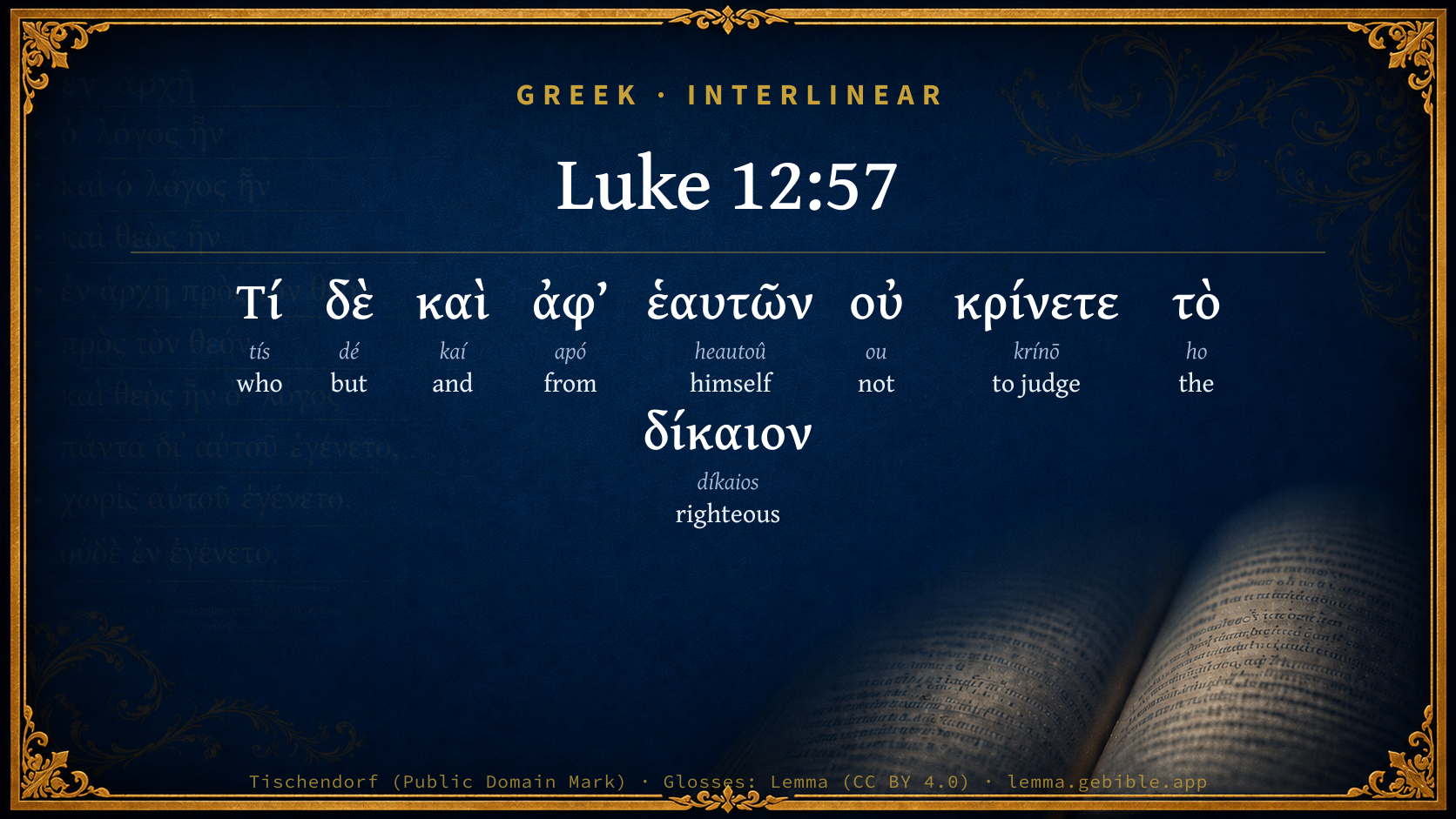
Greek (Tischendorf 8th ed.) Luke 12:57 appears in the Greek New Testament. The text above is from the Tischendorf 8th edition. Each word links to its Strong’s number and a concise gloss. Click any word for its full Thayer’s Greek Lexicon entry.
Download image
Cite this verse

Luke 12:57 (World English Bible). Public Domain. Lemma interlinear Bible study tool, https://lemma.gebible.app/v/luke/12/57.

Show BibTeX & RIS
BibTeX
RIS
English Translation
Why don't you judge for yourselves what is right?
World English Bible · Public Domain
Download a study sheet

One document with this verse’s original text, its word-by-word gloss line, the meaning frame, cross-references with their text, attributed commentary, and full source and license credits — printable, and it pastes into notes with its structure intact.

This verse Autodidact and up

Study sheet (.html) Plain text (.txt)

A passage Seminary Student

Up to 50 verses in one chapter. A passage sheet keeps up to 6 commentary sources and 12 cross-references per verse, in the order this page ranks them, and says so on the sheet whenever that leaves anything out. Ask for a single verse and you get the Autodidact verse sheet above.

Everything on this page stays free to read, with no account — the sheet is a download of what is already on screen, not access to it.

Want to remove ads? Support Godless Engineer
Compare translations 3

The same verse in 3 English versions, stacked beneath the original-language interlinear above. Click any original word for its lexicon entry.

Each is an independent rendering of the whole verse — the interlinear is not word-aligned to these translations.

Highlighted words mark where these versions differ — a whole-verse word diff, not a word-by-word alignment.

  • World English Bible Public Domain
    Why don't you judge for yourselves what is right?
  • King James Version Public Domain
    Yea, and why even of yourselves judge ye not what is right?
  • unfoldingWord Literal Text CC BY-SA 4.0
    And why do you not even judge for yourselves righteous?

unfoldingWord Literal Text — © unfoldingWord, licensed CC BY-SA 4.0. Word-aligned USFM3 via Door43 (git.door43.org/unfoldingWord/en_ult).

Versions to compare (up to 4)

3 of 4 selected

Show all 19 translations

Every available English version of this verse, each an independent rendering of the whole verse.

  • World English Bible Public Domain
    Why don't you judge for yourselves what is right?
  • Berean Standard Bible Public Domain
    And why don’t you judge for yourselves what is right?
  • Majority Standard Bible Public Domain
    And why don’t you judge for yourselves what is right?
  • King James Version Public Domain
    Yea, and why even of yourselves judge ye not what is right?
  • American Standard Version (1901) Public Domain
    And why even of yourselves judge ye not what is right?
  • Revised Version (1885) Public Domain
    And why even of yourselves judge ye not what is right?
  • Geneva Bible (1599) Public Domain
    Yea, and why iudge ye not of your selues what is right?
  • Douay-Rheims (1899) Public Domain
    And why even of yourselves, do you not judge that which is just?
  • Young's Literal Translation Public Domain
    `And why, also, of yourselves, judge ye not what is righteous?
  • Literal Standard Version CC BY-SA 4.0
    And why, also, of yourselves, do you not judge what is righteous?
  • Unlocked Literal Bible CC BY-SA 4.0
    Why do you not judge what is right for yourselves?
  • unfoldingWord Literal Text CC BY-SA 4.0
    And why do you not even judge for yourselves righteous?
  • Darby Bible Public Domain
    And why even of yourselves judge ye not what is right?
  • World Messianic Bible Public Domain
    “Why don’t you judge for yourselves what is right?
  • Webster's Bible Public Domain
    And why even of yourselves judge ye not what is right?
  • Free Bible Version CC BY-SA 4.0
    Why don't you think for yourselves and judge what's the right thing to do?
  • Bible in Basic English Public Domain
    And why are you, in your hearts, unable to be judges of what is right?
  • Text-Critical English NT CC BY 4.0
    “Why do you not judge for yourselves what is right?
  • Tyndale New Testament (1534) Public Domain
    Ye and why iudge ye not of youre selves what is righte?

Literal Standard Version (2020), Covenant Press — licensed CC BY-SA 4.0. Text via the HelloAO Bible API (eBible.org). Unlocked Literal Bible (unfoldingWord) — licensed CC BY-SA 4.0. Text via the HelloAO Bible API (eBible.org). unfoldingWord Literal Text — © unfoldingWord, licensed CC BY-SA 4.0. Word-aligned USFM3 via Door43 (git.door43.org/unfoldingWord/en_ult). Free Bible Version, Dr. Jonathan Gallagher — licensed CC BY-SA 4.0. Text via the HelloAO Bible API (eBible.org).

Word by word

More ways to search: Search by grammar → Find every occurrence → Compare this word →

Practice this passage: Drill this verse → Learn its vocabulary →

δίκαιον
díkaios
G1342
“righteous”
Adjective, Accusative, Singular, Neuter
Part of Speech
Adjective
Case
Accusative
Number
Singular
Gender
Neuter
Full Thayer's Definition

Origin: from G1349

TDNT: 05:02,2

1. righteous, observing divine laws a. in a wide sense, upright, righteous, virtuous, keeping the commands of God 1. of those who seem to themselves to be righteous, who pride themselves to be righteous, who pride themselves in their virtues, whether real or imagined 2. innocent, faultless, guiltless 3. used of him whose way of thinking, feeling, and acting is wholly conformed to the will of God, and who therefore needs no rectification in the heart or life 1a b. only Christ truly 1. approved of or acceptable of God c. in a narrower sense, rendering to each his due and that in a judicial sense, passing just judgment on others, whether expressed in words or shown by the manner of dealing with them
  1. Τί tís G5101 “who” Interrogative pronoun, Accusative, Singular, Neuter
  2. δὲ dé G1161 “but” Conjunction
  3. καὶ kaí G2532 “and” Conjunction
  4. ἀφ’ apó G575 “from” Preposition
  5. ἑαυτῶν heautoû G1438 “himself” Reflexive pronoun, 2nd person, Genitive, Plural, Masculine
  6. οὐ ou G3756 “not” Particle, Negative
  7. κρίνετε krínō G2919 “to judge” Verb, Present, Active, Indicative, 2nd person, Plural
  8. τὸ ho G3588 “the” Article, Accusative, Singular, Neuter

About this verse

These counts appear in no published source. They are computed here, from the morphology-tagged text and Lemma’s own curated glosses. What Lemma adds →

9
words
9
distinct lemmas
Gospels
section

Cross-references

7

Topical passages linked to Luke 12:57 in the Treasury of Scripture Knowledge — connected by theme and wording, ordered by reader-vote popularity; previews shown in the World English Bible.

  • John 7:24 Don't judge according to appearance, but judge righteous judgment."
  • Deuteronomy 32:29 Oh that they were wise, that they understood this, That they would consider their latter end!
  • Acts 2:40 With many other words he testified, and exhorted them, saying, "Save yourselves from this crooked generation!"
  • Acts 13:26–38 Brothers, children of the stock of Abraham, and those among you who fear God, the word of this salvation is sent out to you.
  • 1 Corinthians 11:14 Doesn't even nature itself teach you that if a man has long hair, it is a dishonor to him?
  • Matthew 21:32 For John came to you in the way of righteousness, and you didn't believe him, but the tax collectors and the prostitutes believed him. When you saw it, you didn't even repent afterward, that you might believe him.
  • Luke 21:30 When they are already budding, you see it and know by your own selves that the summer is already near.

Cross-references courtesy of OpenBible.info (CC BY 4.0).

Commentary

Notes on Luke 12:57 from classic Christian and Jewish commentators (each source and its license shown beneath its notes). The classic Christian expositions comment on the surrounding passage and are grouped to its opening verse, so a note may address several verses; the Jewish commentaries on the Tanakh (Rashi and others) are per-verse, so they appear only where the commentator wrote on this verse.

Lemma curates 59 commentaries, every one of them public domain or Creative Commons licensed, each selected and text-cleaned for this edition rather than reprinted as found. About our sources →

Joseph Benson's Commentary

Luk 12:57. Why even of yourselves — Without any external sign; judge ye not what is right? — Why do ye not discern and acknowledge the intrinsic excellence of my doctrine, and gather from such obvious promises how you ought to receive it, and behave toward me? The prediction of the coming of the Son of man, to punish the Jews for their perfidy and rebellion, was a loud call to a national repentance. Wherefore, as the improvement of that prediction, he exhorted them to a speedy reformation, telling them that common sense, with a very small degree of reflection, would point it out to them as the very best thing they could do for averting the impending judgments of God.

Joseph Benson's Commentary on the Old and New Testaments (1811–1818) — public domain. Text from a community e-Sword module.

Bengel's Gnomon

Johann Albrecht Bengel

Luk 12:57. [Δὲ, but) What precedes has respect to faith; but what is here treated of has respect to love. The matters which are set forth in this place ought to be accounted of the greatest importance, inasmuch as out of the whole range of whatever is just, this one thing alone is mentioned to the people by Jesus.—V. g.]—καὶ ἀφʼ ἑαυτῶν) of your own accord, even without signs, and irrespective of the consideration of this present time. So ἀφʼ ἑαυτῶν, ch. Luk 21:30. Comp. Mat 16:3, note. [Or else the phrase, ἀφʼ ἑαυτῶν, expresses this: Before that the Judge pronounces sentence, and the matter become known to you, to your cost, from some other quarter (than by yourselves settling the matter in dispute). Often one, when admonished as to what is just or unjust, is compelled thereby to perceive the s truth. But it would be better for him to infer it “of himself.” Nabal came to know subsequently, when taught it, in what way he ought to have received and entertained David; but previously he neglected to use reflection.—V. g.]—τὸ δίκαιον) what is true and just, and conducive to true peace; Luk 12:58, with which comp. Luk 12:51 and Luk 12:13 as to the quarrel between the brothers. The kingdom of Christ is a kingdom of justice [‘righteousness:’ Heb 1:8-9; Psa 45:6-7].

58. Γὰρ, for) Γὰρ, for, is often employed where the discussion follows the proposition [statement of subject].—ὑπάγεις, goest) although against thy will.—ἀντιδίκου, adversary) the plaintiff, to whom thou art bound to repay the debt, Luk 12:59.—ἄρχοντα, prince) the judge [or magistrate].—ἀπηλλάχθαι, to be delivered) by any negotiation, or on any condition whatever. A friendly compromise is wont to be recommended, even in civil cases. This is a favourable (agreeable) kind of division.[125]—ΚΑΤΑΣΎΡῌ, hurry thee off by force [hale thee]) The power of the offended party is great: so much so, as sometimes to snap asunder the tie which binds the soul to the body.[126]—Τῷ ΠΡΆΚΤΟΡΙ, to the officer who exacts what is due) the avenger or executioner. Satan himself is a party in the action (plaintiff), not an executioner.[127][128]

[125] Luk 12:51. The parting asunder, by a compromise and reconciliation, of those who meet for litigation, is a good kind of διαμερισμὸς.—ED. and TRANSL.

[126] i.e. The violence of a quarrel sometimes hastens the death of the delinquent through fear and chagrin.—ED. and TRANSL.

[127] Reus, non executor. Rev 12:10; Job 1:9; Job 2:5; Zec 3:1. Perhaps Beng, however, means by reus, “Satan is himself a condemned criminal.” 2Pe 2:4; Jud 1:6.—ED. and TRANSL.

[128] Bengel, J. A. (1860). Vol. 2: Gnomon of the New Testament (M. E. Bengel & J. C. F. Steudel, Ed.) (A. R. Fausset, Trans.) (1–116). Edinburgh: T&T Clark.

Bengel's Gnomon of the New Testament — English translation (T&T Clark, Edinburgh, 1860) — public domain. Text from a community e-Sword module.

Meyer's Critical & Exegetical Commentary

Heinrich August Wilhelm Meyer

Luk_12:57-59. See on Mat_5:25 f. Pott (de natura … orat. mont. p. 13), Kuinoel, de Wette refuse to acknowledge any connection (comp. Euthymius Zigabenus: ἐφʼ ἕτερον μετέβη λόγον), and assume a mistaken reminiscence, suggested by the affinity of δοκιμάζειν and κρίνειν. But Luke did not weave together the discourses of Jesus in so thoughtless a manner. The train of thought, even although the connection is less clear and appropriate, is as follows: As, however, it turns to your reproach that ye do not rightly estimate the present time, so not less also is it your reproach that ye do not of your own selves judge what is duty. Jesus refers to the duty of repentance which is still seasonable, and by means of the rhetorical figure metaschematismussince He pictures repentance as an agreement with an adversary who has a pecuniary claim to make, but by this adversary He means (not the devil, Euthymius Zigabenus, nor the poor, Michaelis; but) God, to whom man is a debtor

He represents this duty of repentance as still seasonable, in order not to incur the divine punishment, like the accused person who still seasonably comes to terms with his creditor.

καὶ ἀφʼ ἑαυτῶν] even of yourselves, even of your own independent judgment. Comp. Bengel: sine signis et citra considerationem hujus temporis. These words indicate the progressive advance of the discourse. Comp. on Luk_21:30.

Luk_12:58. γάρ] explanatory.

ὡς] is the simple sicuti: As thou, namely, art in the act of going away with thine adversary to an archon (in correspondence with this condition of time and circumstance), give diligence on the way, etc.; while you are still on the way, before it is too late, make the attempt, that may avert the danger. ὑπάγεις has the emphasis (comp. subsequently ἐν τῇ ὁδῷ); so close is the time of decision! Both the ἄρχων and the κριτής must be considered as local magistrates (κριτής not as an assessor of the Sanhedrim, with which κατασύρῃ is not in accord, for this certainly cannot be taken as a dragging to Jerusalem). Comp. κρίσις, Mat_5:21, and the remark thereafter. By one of the archons, i.e. of the chief city officials, who, namely, is a competent person in matters of debt, the accused is recognised as liable to pay, and in default of payment the κριτής, who happens to be subordinate to the ἄρχων, orders compulsion to be used. For the rest, this handing over from one official to another belongs to the details of civic procedure, without being intended for special interpretation.

δὸς ἐργασίαν] da operam, a Latin idiom, probably taken from the common speech, Hermogenes, de Invent. iii. 5. 7; Salmasius and Tittmann (Synon. p. 102), following Theophylact, erroneously interpret: give interest. This is not the meaning of ἐργασία, and the Israelites were forbidden to take interest from one another (Michaelis, Mos. R. § 154 f.; Saalschütz, M. R. pp. 184, 278, 857).

ἀπηλλάχθαι ἀπʼ αὐτοῦ] in order to be delivered from him, Xen. Anab. vii. 1. 4; Plat. Legg. ix. p. 868 D; Josephus, Antt. x. 6. 2, and elsewhere. The genitive might also stand alone, Thuc. iii. 63; Dem. 11. 16, 237. 14, and elsewhere, and the passages in Kypke and Loesner. Settlement is to be conceived of as obtained by payment or by arrangement. Comp. Dem. 34:22.

ὁ πράκτωρ] exactor, collector, bailiff. In Athens the collector of the court fees and fines was so called (Böckh, Staatshaush. I. pp. 167, 403; Hermann, Staatsalterth. § 151. 3). The πράκτωρ also is part of the imagery, without contemplating thereby any special interpretation (otherwise, the angels would have to be understood, Mat_13:41 f.).

τὸ ἔσχ. λεπτόν] (Mar_12:42): to wit, of the debt sued for. But this terminus in the punitive condition depicted (in the Gehenna) is never attained. Comp. on Mat_18:34.

Meyer — Critical and Exegetical Commentary on the New Testament — English translation by Peter Christie, edited by Frederick Crombie (T&T Clark, 1880) — public domain. Text from a community e-Sword module.

Expositor's Greek Testament

ed. W. Robertson Nicoll

Luk 12:57 . ἀφʼ ἑαυτῶν , from or of yourselves ( sua sponte , Palairet); without needing any one to tell you the right; implying that the persons addressed were destitute of the average moral insight ( cf. Luk 21:30 ).

The Expositor's Greek Testament, edited by W. Robertson Nicoll (1897–1910) — public domain. Text from a community e-Sword module.

Geneva Bible (1599)

Geneva Bible translators

Men that are blinded with the love of themselves, and therefore are detestable and stubborn, shall bear the reward of their folly.

Geneva Bible (1599) marginal notes — public domain. Text via Bolls.life.

Jamieson, Fausset & Brown

Robert Jamieson, A. R. Fausset & David Brown

why even of yourselves, &c.--They might say, To do this requires more knowledge of Scripture and providence than we possess; but He sends them to their own conscience, as enough to show them who He was, and win them to immediate discipleship.

Jamieson, Fausset & Brown — Commentary Critical and Explanatory on the Whole Bible (1871) — public domain (CC PDM 1.0). Text via the HelloAO Bible API.

Adam Clarke's Commentary

Verse 57. And why - judge ye] Even without the express declarations of the prophets, ye might, from what ye see and hear yourselves, discern that God has now visited his people in such a manner as he never did before.

Adam Clarke's Commentary on the Bible (1810–1826) — public domain. Text from a community e-Sword/MySword module.

Ellicott's Commentary for English Readers

(57) Yea, and why even of yourselves judge ye not what is right?—Better, judge that which is just. The meaning of the words is not that they did not know what was right, but that they did not act upon their knowledge. They were passing an unrighteous judgment on the preachers of repentance, on the Baptist and on the Christ, because they came to tell them of the time of their visitation, when their action ought to have been as true and spontaneous as their daily judgment about the weather. It is possible, though not, I think, probable, that the question “Why even of yourselves . . .” may have some reference to the request of the disciple, in Luk_12:13, that our Lord would act as judge.

A Bible Commentary for English Readers, edited by Charles John Ellicott (1878–1897) — public domain. Text from a community e-Sword module.

The Cambridge Bible for Schools and Colleges

gen. ed. J. J. S. Perowne

57. even of yourselves] i.e. without the necessity for my thus pointing out to you facts which are so plain.

what is right] what is your duty to do under circumstances so imminent.

The Cambridge Bible for Schools and Colleges (gen. ed. J. J. S. Perowne; Cambridge University Press, 1878–1918) — public domain. Text from a community e-Sword module.

John Gill's Exposition

I tell thee,.... The Syriac version before these words, prefixes an "Amen", or "verily", for the sake of the stronger affirmation, which seems to be taken from Mat 5:26

thou shalt not depart thence; get out of prison:

till thou hast paid the very last mite: of the sum in debate, which was what the Jews call a "prutah", and that was the eighth part of an Italian farthing, and half a common farthing; See Gill on Mar 12:42, with this agrees what Mainonides says (y), that

"when he that lends, requires what he has lent, though he is rich, and the borrower is distressed, and straitened for food, there is no mercy showed him in judgment, but his debt is, demanded of him, , "unto the last prutah, or mite".''

(y) Hilchot M. vah. c. 1. sect. 4.

Next: Luke Chapter 13

John Gill's Exposition of the Whole Bible (1746–1763) — public domain (CC PDM 1.0). Text via the HelloAO Bible API.

Trapp's Complete Commentary

John Trapp

55 And when ye see the south wind blow, ye say, There will be heat; and it cometh to pass.

56 Ye hypocrites, ye can discern the face of the sky and of the earth; but how is it that ye do not discern this time?

57 Yea, and why even of yourselves judge ye not what is right?

Ver. 57. Yea, and why even of yourselves] By consulting with your own consciences, which would, if rightly dealt with, tell you, that I am that Messiah you have so long looked for.

John Trapp, A Commentary or Exposition upon All the Books of the Old and New Testament (1647–1656) — public domain. Text from a community e-Sword module.

Matthew Poole's English Annotations

Our Saviour made use of this expression, Mat 5:25,26, to persuade peace between brethren; here he useth it to persuade men to acquaint themselves with God, and be at peace. He had been treating of the last judgment; there was no fitter foundation upon which he could build all exhortation to repentance, and making our peace with God. In not doing of it, he telleth his hearers that they did not of themselves judge what was right, for if they did, they would judge themselves as much concerned to come to an agreement with God, as they did ordinarily to come to an agreement with men. Now if amongst men they had an adversary, they did not judge it prudence to stand out with him till the sentence of the judge were past, and they were imprisoned, not to come out till they had paid every farthing of the debt and charges wherein they were condemned; but to agree while they were in the way, before they came to a final judgment in the case, that so, having compounded the case, they might avoid the judgment. So in the case between God and their souls, if they judged right, they would judge that it was not their wisdom to stand out till the irrevocable sentence of condemnation was passed upon them, but in the way, during the time of this life, they would make their peace with God, and reform their lives before that great and terrible day came. It is a sign the papists are at a woeful loss for arguments to prove purgatory, when they make use of this text, because it is said, thou shalt not depart thence till thou hast paid the very last mite, as if this text spake of a prison for souls from which there is an outlet. Such another argument will prove, from Psa 110:1, that Christ shall not sit at the right hand of his Father, because God only said to him. Sit there until I make thine enemies thy footstool; and that Joseph knew Mary after Christ was born, because it is said, Mat 1:25, he knew her not till she had brought forth her firstborn Son. But we have before showed that that term, though it be exclusive of a time past, yet doth not determine a future time.

Matthew Poole's English Annotations on the Holy Bible (1683–1685) — public domain. Text from a community e-Sword/MySword module.

Whedon's Commentary on the Bible

Daniel D. Whedon

57. Yea—Even without any extraordinary signs or omens.

Even of yourselves—From the intuitive convictions of your own conscience.

Judge ye not—As between my Gospel and the leaven of the Pharisees.

What is right—Accordant with truth and righteousness, and worthy of God. The dealings of God with man all accord with the ultimate standard of right.

Daniel D. Whedon (gen. ed.), Commentary on the Old and New Testaments (1874–1909) — public domain. Text from a community e-Sword module.

The Pulpit Commentary

Individual responsibility.

"Why even of yourselves judge ye not what is right?" Those to whom our Lord was speaking were men of intelligence, education, religious privilege. They exercised their mental faculties with great keenness on some subjects (vers. 54, 55): why could they not recognize the supreme fact of their time, viz. that the Messiah was before them (ver. 56)? why did they not employ their powers to discern between the false and the true, between the evil and the good?

I THAT WE MAY NOT DEVOLVE OUR ACCOUNTABILITY FOR HOLDING THE TRUTH on any one or any body of men. It has not been merely "the right of private judgment" which has been in question, which some have striven so hard to withhold, and which others have suffered so much to obtain or to preserve. It has been the sacred duty of determining for ourselves what is the mind and the will of God, the solemn obligation to put into use the talents he has committed to our care. We are to discharge this duty under all circumstances and whoever may propose to relieve us of it. We may not delegate it:

1. To the State. The State may prescribe Islamism in one region, Confucianism in another, Catholicism in a third; but we are not at liberty to make our religious creed depend on the latitude and longitude where we reside.

2. To the Church; or Jesus Christ himself would have been criminal, for he entirely disregarded the decision of the "council," and the Christian Church has, in its collective capacity, spoken differently in different times and places.

3. To society; that is frequently at fault.

4. To the parent. For a time this is necessary, right, becoming, praiseworthy; but the time comes when the son must no longer shield himself behind his filial obedience, he must think and must decide for himself. If we are possessed of ordinary human powers and privileges we must "of ourselves judge what is fight." It is a solemn burden, a sacred duty, which our Creator has laid on each human spirit he has called into being.

II THAT GOD HAS GIFTED US WITH A SPIRITUAL NATURE for this very purpose. He has endowed us with reason, or with that faculty which intuitively perceives the great and deep truths which are presented to it; with conscience, the faculty which commends and condemns, filling with inward joy or inward pain; with judgment, the faculty that compares and concludes, and arrives at just decisions as to the thing that should be done, the way that should be taken. It is, indeed, only too true that a long course of sin will warp and degrade this spiritual nature of ours; but where there is as much enlightenment as the Jews of our Lord"s time had, and as we ourselves possess, we ought to be able by its means "to judge what is right.

III THAT THE HEALTHFUL ACTION OF OUR SPIRITUAL NATURE IS ONE LARGE PART OF OUR PROBATION. If "the light that is in us be darkness," if our conscience is misdirecting us, it is because we have been wrong, it is because we have not been true to ourselves. Sin has weakened or even distorted our faculty of spiritual discernment. But if we are true to ourselves, if we

(1) honestly seek to know what the will of God is concerning ourselves and others;

(2) faithfully endeavor to do what we believe to be his will;

(3) earnestly ask for Divine guidance in our pursuit of wisdom; we shall be "led into the truth." We may not see everything in the light in which other truehearted people see it, but we shall recognize those great leading truths which bring us into right relation to God, which constrain us to take a right attitude toward our brethren, which light up our earthly path and conduct us to our home.

1. We may not refuse our responsibility under any plea, not even that of humility. It would be pleasant to say, "We will leave to others who can do it better the work of deciding what is true, which message is from God, which path leads heavenwards." But we may not say this without declining the sacred duty our heavenly Father devolves on each one of his children.

2. Accepting our post as truth-seekers, we must do our work conscientiously, thoroughly, without prejudice.

3. We may be sure that Christ will grant us all the Divine aid we need if we honestly endeavor and devoutly pray. C.

The Pulpit Commentary (1880–1919), ed. H.D.M. Spence-Jones & Joseph S. Exell — public domain. Text from a community e-Sword module.

John Wesley's Explanatory Notes

Why even of yourselves, without any external sign, judge ye not what is right? - Why do ye not discern and acknowledge the intrinsic excellence of my doctrine?

John Wesley, Explanatory Notes Upon the Whole Bible (1754–1765) — public domain. Text via the GEBible commentary corpus.

unfoldingWord translationNotes

Door43 World Missions Community

Why do you not judge what is right for yourselves?

Jesus uses a question to rebuke the crowd. It can be translated as a statement. AT: "You yourselves should discern what is right." (See: Rhetorical Question)

for yourselves

"on your own initiative"

For when you go ... bit of money

Jesus uses a hypothetical situation to teach the crowd. His point is that they should resolve the things they are able to resolve without involving the public courts. This can be restated to make it clear it might not happen. AT: "For if you were to go ... bit of money" (See: Hypothetical Situations)

when you go

Though Jesus is talking to a crowd, the situation he is presenting is something that a person would go through alone. So in some languages the word "you" would be singular. (See: Forms of You)

settle the matter with him

"settle the matter with your adversary"

the judge

This refers to the magistrate, but the term here is more specific and threatening.

does not deliver you

"does not take you"

the very last bit of money

"the entire amount of money that your adversary demands"

translationWords

judge

adversary

magistrate

judge, judges

prison

unfoldingWord translationNotes — © Distant Shores Media and the Door43 World Missions Community, licensed CC BY-SA 4.0. Source: git.door43.org/Door43/en_tn.

Cambridge Greek Testament for Schools and Colleges

57. καὶ ἀφ’ ἑαυτῶν. I.e. without the necessity for my thus pointing out to you facts which are so plain.

τὸ δίκαιον. What is your duty to do under circumstances so imminent?

Cambridge Greek Testament for Schools and Colleges (Cambridge University Press, 1896; 21 vols, various authors incl. Carr, Maclear, Plummer, Farrar, Lumby, Moule, M. R. James, Simcox) — public domain. Text from a community e-Sword module.

Alford’s Greek Testament

Henry Alford

57.] In what follows, our Lord takes occasion from the request about the inheritance, which had begun this discourse, to pass to infinitely more solemn matters. There is, I think, no denying that the κρίνειν τὸ δίκ. and the ὁ ἀντίδικός σ. have a reference to that request, in the ability and duty of every man to ‘judge what is right:’—but the sense of the words far outruns that reference, and treats of loftier things. ‘Why do ye not discern of yourselves your true state—that which is just—the justice of your case as before God? You are going (the course of your life is the journey) with your adversary (the just and holy law of God) before the magistrate (God Himself); therefore by the way take pains (δὸς ἐργ., da operam—a Latinism: there is no reference to interest of money, as Thl.,—who also has the other interpretation,—supposes) to be delivered from him (by repentance, and faith in the Son of God, see Psa 2:12), lest he drag thee to the judge (κριτής—who adjudges the case and inflicts the fine; that is, the Son, to whom all judgment is committed), and the judge deliver thee to the exactor (see Mat 13:41), and the exactor cast thee into prison’ (ditto, ver. 42).

Henry Alford, The Greek Testament (1849–1861) — public domain. Text from a community e-Sword module.

International Critical Commentary

57. τί δὲ καὶ αιφʼ ἑαυτῶν. “But why even of yourselves, out of your own hearts and consciences,” without information from externals: comp. 21:30. Or possibly, “Of yourselves also, ” as readily (εὐθέως) as in the case of the weather. In either case ἀφʼ ἑαυτῶν comes first for emphasis. For δὲ καὶ see small print on 3:9.

International Critical Commentary — older volumes (1896–1929), various authors — public domain. Text from a community e-Sword module.

Vincent's Word Studies in the New Testament

Marvin R. Vincent

Of yourselves. In the exercise of your ordinary habits of observation which you apply to the heavens.

Marvin R. Vincent, Word Studies in the New Testament (1887–1900) — public domain. Text from a community e-Sword/MySword module.

Lesson kit

Teaching starters — assembled from the data on this page, not authored interpretation. Every prompt links to the verse data it draws on. Edit before teaching.

Luke, in the Gospels, opens this verse with 9 words (9 distinct Greek lemmas). Its most distinctive word is díkaios (“righteous”). A historical commentator’s framing appears above. Read the whole chapter for the surrounding context.

Discussion questions

  1. How does “righteous” (díkaios) shape what this verse is saying?
  2. John 7:24 shares this passage’s theme. How do the two illuminate each other?
  3. The translations on this page render this verse differently — a whole-verse word diff, not a word-by-word alignment. What might account for the different wordings?
  4. Reading how Joseph Benson's Commentary and Bengel's Gnomon read this verse, where do the two commentators agree and where do they part?

Things to notice

Reading settings

Reading text

Shown beneath each verse's original-language words.

Old Testament
Old Testament edition

Read the OT as the Masoretic Hebrew (MT) or the Greek Septuagint (LXX).

English shown for the Greek Septuagint (in the Hebrew ↔ Greek comparison).

Comparing translations? Open the Compare panel on any verse page to stack up to four side by side.