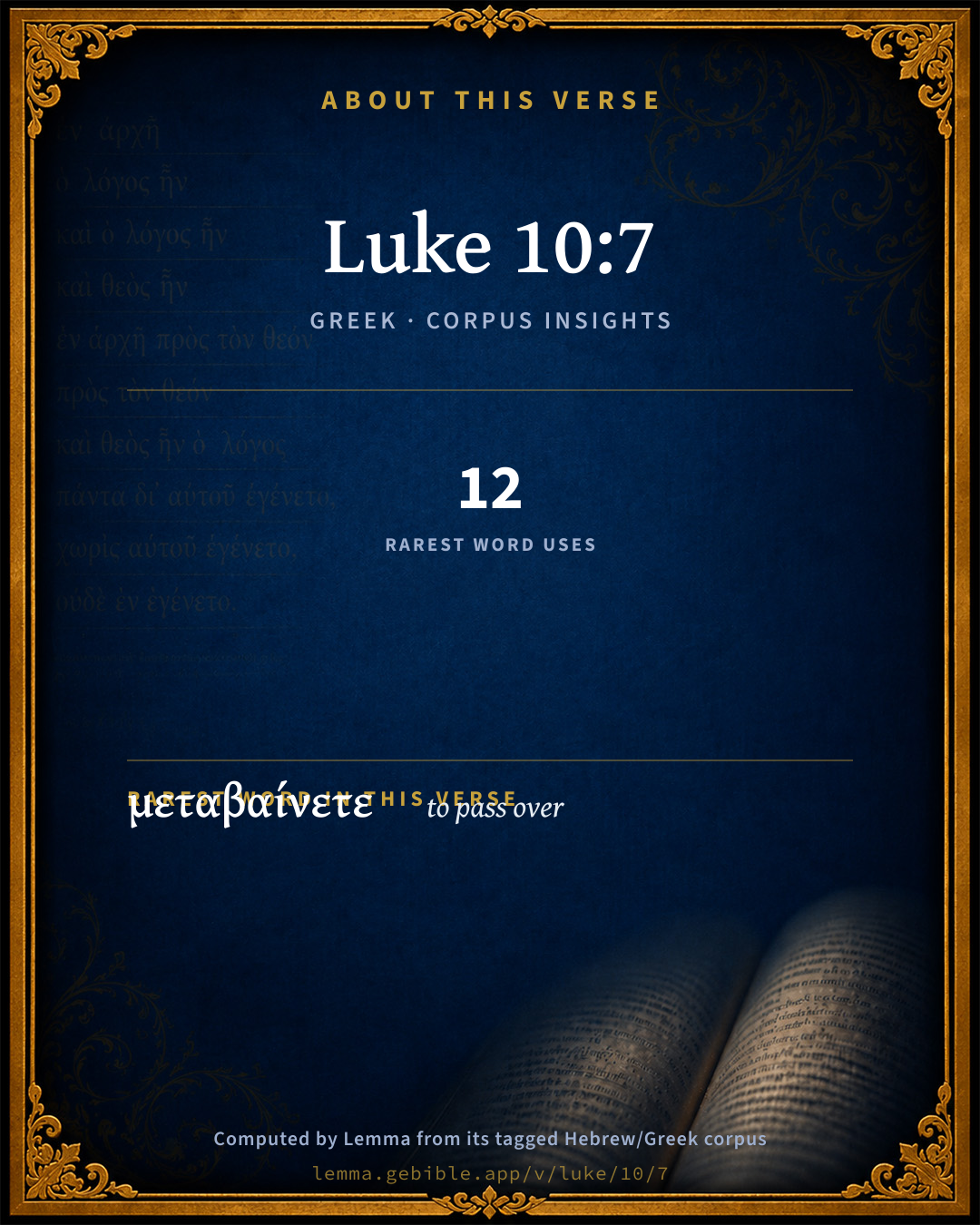
Luke 10:7

Greek (Tischendorf 8th ed.) Luke 10:7 appears in the Greek New Testament. The text above is from the Tischendorf 8th edition. Each word links to its Strong’s number and a concise gloss. Click any word for its full Thayer’s Greek Lexicon entry.

Download image
Cite this verse

Luke 10:7 (World English Bible). Public Domain. Lemma interlinear Bible study tool, https://lemma.gebible.app/v/luke/10/7.

Show BibTeX & RIS
BibTeX
RIS
English Translation
Remain in that same house, eating and drinking the things they give, for the laborer is worthy of his wages. Don't go from house to house.
World English Bible · Public Domain
Download a study sheet

One document with this verse’s original text, its word-by-word gloss line, the meaning frame, cross-references with their text, attributed commentary, and full source and license credits — printable, and it pastes into notes with its structure intact.

This verse Autodidact and up

Study sheet (.html) Plain text (.txt)

A passage Seminary Student

Up to 50 verses in one chapter. A passage sheet keeps up to 6 commentary sources and 12 cross-references per verse, in the order this page ranks them, and says so on the sheet whenever that leaves anything out. Ask for a single verse and you get the Autodidact verse sheet above.

Everything on this page stays free to read, with no account — the sheet is a download of what is already on screen, not access to it.

Want to remove ads? Support Godless Engineer
Compare translations 3

The same verse in 3 English versions, stacked beneath the original-language interlinear above. Click any original word for its lexicon entry.

Each is an independent rendering of the whole verse — the interlinear is not word-aligned to these translations.

Highlighted words mark where these versions differ — a whole-verse word diff, not a word-by-word alignment.

  • World English Bible Public Domain
    Remain in that same house, eating and drinking the things they give, for the laborer is worthy of his wages. Don't go from house to house.
  • King James Version Public Domain
    And in the same house remain, eating and drinking such things as they give: for the labourer is worthy of his hire. Go not from house to house.
  • unfoldingWord Literal Text CC BY-SA 4.0
    And remain in that house, eating and drinking from them, for the laborer worthy of his wages. Do not move around from house to house.

unfoldingWord Literal Text — © unfoldingWord, licensed CC BY-SA 4.0. Word-aligned USFM3 via Door43 (git.door43.org/unfoldingWord/en_ult).

Versions to compare (up to 4)

3 of 4 selected

Show all 19 translations

Every available English version of this verse, each an independent rendering of the whole verse.

  • World English Bible Public Domain
    Remain in that same house, eating and drinking the things they give, for the laborer is worthy of his wages. Don't go from house to house.
  • Berean Standard Bible Public Domain
    Stay at the same house, eating and drinking whatever you are offered. For the worker is worthy of his wages. Do not move around from house to house.
  • Majority Standard Bible Public Domain
    Stay at the same house, eating and drinking whatever you are offered. For the worker is worthy of his wages. Do not move around from house to house.
  • King James Version Public Domain
    And in the same house remain, eating and drinking such things as they give: for the labourer is worthy of his hire. Go not from house to house.
  • American Standard Version (1901) Public Domain
    And in that same house remain, eating and drinking such things as they give: for the laborer is worthy of his hire. Go not from house to house.
  • Revised Version (1885) Public Domain
    And in that same house remain, eating and drinking such things as they give: for the labourer is worthy of his hire. Go not from house to house.
  • Geneva Bible (1599) Public Domain
    And in that house tary still, eating and drinking such things as by them shall be set before you: for the labourer is worthy of his wages. Goe not from house to house.
  • Douay-Rheims (1899) Public Domain
    And in the same house, remain, eating and drinking such things as they have: for the labourer is worthy of his hire. Remove not from house to house.
  • Young's Literal Translation Public Domain
    `And in that house remain, eating and drinking the things they have, for worthy `is' the workman of his hire; go not from house to house,
  • Literal Standard Version CC BY-SA 4.0
    And remain in that house, eating and drinking the things they have, for worthy [is] the workman of his hire; do not go from house to house,
  • Unlocked Literal Bible CC BY-SA 4.0
    Remain in that same house, eating and drinking what they provide, for the laborer is worthy of his wages. Do not move around from house to house.
  • unfoldingWord Literal Text CC BY-SA 4.0
    And remain in that house, eating and drinking from them, for the laborer worthy of his wages. Do not move around from house to house.
  • Darby Bible Public Domain
    And in the same house abide, eating and drinking such things as they have; for the workman is worthy of his hire. Remove not from house to house.
  • World Messianic Bible Public Domain
    Remain in that same house, eating and drinking the things they give, for the laborer is worthy of his wages. Don’t go from house to house.
  • Webster's Bible Public Domain
    And in the same house remain, eating and drinking such things as they give: for the laborer is worthy of his hire. Go not from house to house.
  • Free Bible Version CC BY-SA 4.0
    Stay in that house, eating and drinking whatever they give you, for a worker deserves to be paid. Don't go from house to house.
  • Bible in Basic English Public Domain
    And keep in that same house, taking what food and drink they give you: for the worker has a right to his reward. Do not go from house to house.
  • Text-Critical English NT CC BY 4.0
    Remain in the same house, eating and drinking whatever they provide, for the worker is worthy of his wages. Do not go from house to house.
  • Tyndale New Testament (1534) Public Domain
    And in the same housse tary still eatinge and drinkinge soche as they have. For the laborer is worthy of his rewarde. Go not from housse to housse:

Literal Standard Version (2020), Covenant Press — licensed CC BY-SA 4.0. Text via the HelloAO Bible API (eBible.org). Unlocked Literal Bible (unfoldingWord) — licensed CC BY-SA 4.0. Text via the HelloAO Bible API (eBible.org). unfoldingWord Literal Text — © unfoldingWord, licensed CC BY-SA 4.0. Word-aligned USFM3 via Door43 (git.door43.org/unfoldingWord/en_ult). Free Bible Version, Dr. Jonathan Gallagher — licensed CC BY-SA 4.0. Text via the HelloAO Bible API (eBible.org).

Word by word

More ways to search: Search by grammar → Find every occurrence → Compare this word →

Practice this passage: Drill this verse → Learn its vocabulary →

μεταβαίνετε
metabaínō
G3327
“to pass over”
Verb, Present, Active, Imperative, 2nd person, Plural
Part of Speech
Verb
Tense
Present
Voice
Active
Mood
Imperative
Person
2nd person
Number
Plural
Full Thayer's Definition

Origin: from G3326 and the base of G939

TDNT: 09:43,9

1. to pass over from one place to another, to remove, depart
  1. ἐν en G1722 “in” Preposition
  2. αὐτῇ autós G846 “he” Personal pronoun, Dative, Singular, Feminine
  3. δὲ dé G1161 “but” Conjunction
  4. τῇ ho G3588 “the” Article, Dative, Singular, Feminine
  5. οἰκίᾳ oikía G3614 “house” Noun, Dative, Singular, Feminine
  6. μένετε ménō G3306 “to remain” Verb, Present, Active, Imperative, 2nd person, Plural
  7. ἔσθοντες esthíō G2068 “to eat” Verb, Present, Active, Participle, Nominative, Plural, Masculine
  8. καὶ kaí G2532 “and” Conjunction
  9. πίνοντες pínō G4095 “to drink” Verb, Present, Active, Participle, Nominative, Plural, Masculine
  10. τὰ ho G3588 “the” Article, Accusative, Plural, Neuter
  11. παρ’ pará G3844 “from” Preposition
  12. αὐτῶν autós G846 “he” Personal pronoun, Genitive, Plural, Masculine
  13. ἄξιος áxios G514 “worthy” Adjective, Nominative, Singular, Masculine
  14. γὰρ gár G1063 “for” Conjunction
  15. ὁ ho G3588 “the” Article, Nominative, Singular, Masculine
  16. ἐργάτης ergátēs G2040 “worker” Noun, Nominative, Singular, Masculine
  17. τοῦ ho G3588 “the” Article, Genitive, Singular, Masculine
  18. μισθοῦ misthós G3408 “wages” Noun, Genitive, Singular, Masculine
  19. αὐτοῦ autós G846 “he” Personal pronoun, Genitive, Singular, Masculine
  20. μὴ mḗ G3361 “not” Particle, Negative
  21. ἐξ ek G1537 “from” Preposition
  22. οἰκίας oikía G3614 “house” Noun, Genitive, Singular, Feminine
  23. εἰς eis G1519 “into” Preposition
  24. οἰκίαν oikía G3614 “house” Noun, Accusative, Singular, Feminine

About this verse

These counts appear in no published source. They are computed here, from the morphology-tagged text and Lemma’s own curated glosses. What Lemma adds →

25
words
18
distinct lemmas
Gospels
section

Notable vocabulary

The rarest word here is μεταβαίνετε to pass over G3327 — appearing just 12 times in the whole Greek New Testament.

Shared distinctive vocabulary

μεταβαίνετε to pass over G3327 occurs in 11 verses of the Greek New Testament. Also found in:

Repetition

Words recur within this verse:

  • οἰκίᾳ house G3614 ×3
  • τῇ the G3588 ×4
  • αὐτῇ he G846 ×3

Cross-references

15

Topical passages linked to Luke 10:7 in the Treasury of Scripture Knowledge — connected by theme and wording, ordered by reader-vote popularity; previews shown in the World English Bible.

  • 1 Timothy 5:17–18 Let the elders who rule well be counted worthy of double honor, especially those who labor in the word and in teaching.
  • Matthew 10:10–11 Take no bag for your journey, neither two coats, nor shoes, nor staff: for the laborer is worthy of his food.
  • 1 Corinthians 9:4–15 Have we no right to eat and to drink?
  • 2 Timothy 2:6 The farmers who labor must be the first to get a share of the crops.
  • Deuteronomy 12:18–19 but you shall eat them before Yahweh your God in the place which Yahweh your God shall choose, you, and your son, and your daughter, and your man-servant, and your maid-servant, and the Levite who is within your gates: and you shall rejoice before Yahweh your God in all that you put your hand to.
  • Galatians 6:6 But let him who is taught in the word share all good things with him who teaches.
  • 3 John 1:5–8 Beloved, you do a faithful work in whatever you accomplish for those who are brothers and strangers.
  • Mark 6:10 He said to them, "Wherever you enter into a house, stay there until you depart from there.
  • Deuteronomy 12:12 You shall rejoice before Yahweh your God, you, and your sons, and your daughters, and your men-servants, and your maid-servants, and the Levite who is within your gates, because he has no portion nor inheritance with you.
  • Luke 9:4 Into whatever house you enter, stay there, and depart from there.
  • Acts 16:15 When she and her household were baptized, she begged us, saying, "If you have judged me to be faithful to the Lord, come into my house, and stay." So she persuaded us.
  • Acts 16:34 He brought them up into his house, and set food before them, and rejoiced greatly, with all his household, having believed in God.
  • Philippians 4:17–18 Not that I seek for the gift, but I seek for the fruit that increases to your account.
  • Acts 16:40 They went out of the prison, and entered into Lydia's house. When they had seen the brothers, they encouraged them, and departed.
  • 1 Timothy 5:13 Besides, they also learn to be idle, going about from house to house. Not only idle, but also gossips and busybodies, saying things which they ought not.

Cross-references courtesy of OpenBible.info (CC BY 4.0).

Commentary

Notes on Luke 10:7 from classic Christian and Jewish commentators (each source and its license shown beneath its notes). The classic Christian expositions comment on the surrounding passage and are grouped to its opening verse, so a note may address several verses; the Jewish commentaries on the Tanakh (Rashi and others) are per-verse, so they appear only where the commentator wrote on this verse.

Lemma curates 59 commentaries, every one of them public domain or Creative Commons licensed, each selected and text-cleaned for this edition rather than reprinted as found. About our sources →

Joseph Benson's Commentary

Luk 10:7-9. And in the same house remain — As long as you stay in the town or village: eating and drinking — Cheerfully and contentedly; such things as they give — Neither suspect your being welcome, nor be afraid of being troublesome; for the labourer — In the work of the ministry, if he be indeed a labourer; is worthy of his hire — It is not an act of charity, but of justice, in them who are taught in the Word, to communicate to them that teach: and whatever kindness they show you, it is but a small return for the kindness you do them in bringing them the glad tidings of peace. Go not from house to house — Be content with whatever fare you meet with; and never create any unnecessary trouble in the family where you are, nor quit your lodgings to seek others, in hope of better accommodations during the short stay you make in a place. And heal the sick that are therein — Which, as I direct, so I shall empower you to do; And say unto them, The kingdom of God, &c. — Publish the approach of the kingdom of God; its approach to them; and that they stand fair for an admission into it, if they will but obey the call of God, and turn to him without delay. Say, Now is the day of your visitation; see that you understand and improve it. Observe, reader! It is well to be made sensible of our advantages and opportunities, that we may lay hold on and embrace them. When the kingdom of God comes nigh to us, it concerns us to go forth to meet it.

Joseph Benson's Commentary on the Old and New Testaments (1811–1818) — public domain. Text from a community e-Sword module.

Tyndale Open Study Notes

Tyndale Open Resources

10:7 Don’t move around from home to home: See study note on 9:4. • because those who work deserve their pay: Those who minister for Jesus should receive compensation from those they serve (see also 1 Cor 9:14; 1 Tim 5:18).

Tyndale Open Study Notes — © Tyndale Open Resources, licensed CC BY-SA 4.0. Text via the HelloAO Bible API.

Bengel's Gnomon

Johann Albrecht Bengel

Luk 10:7. Τὰ παρʼ αὐτῶν, such things as are in their house) with frugality and freedom (frankness): as you shall find them.—τοῦ μισθοῦ, of his hire) It was lawful for them to receive their food: they must not seek to get money, although they are not ordered altogether to refuse even that. But, on the other hand again, the hire is worthy of a labourer (one who earns it by work): there must be no idleness.

Bengel's Gnomon of the New Testament — English translation (T&T Clark, Edinburgh, 1860) — public domain. Text from a community e-Sword module.

Meyer's Critical & Exegetical Commentary

Heinrich August Wilhelm Meyer

Luk_10:7. Comp. Luk_9:4; Mat_10:11.

ἐν αὐτῇ δὲ τῇ οἰκίᾳ] not: in eadem autem domo (Vulgate, Luther, Bleek), but as it does not run ἐν τῇ αὐτῇ οἰκίᾳ: but in the house (in question) itself, which has inhabitants so worthy.

μένετε] the more specific explanation μὴ μεταβαίνετε κ.τ.λ. follows.

As to ἔσθοντες, as it is also to be read here, see on Luk_7:33.

τὰ παρʼ αὐτῶν] that which is theirs (comp. Mar_5:26). See Bernhardy, p. 255. Not different from this is τὰ παρατιθέμενα ὑμῖν, Luk_10:8. The messengers were to partake without hesitation of the provisions of the people, for, etc. This statement of the reason, however, should have prevented Baur from explaining it of the unhesitating partaking of heathen meats (according to 1Co_9:7 f., Luk_10:27), even apart from the fact that no mention is made of heathen houses at all. This is also in opposition to Köstlin, p. 234; Hilgenfeld, Evang. p. 183, and Weizsäcker, p. 163.

Meyer — Critical and Exegetical Commentary on the New Testament — English translation by Peter Christie, edited by Frederick Crombie (T&T Clark, 1880) — public domain. Text from a community e-Sword module.

Expositor's Greek Testament

ed. W. Robertson Nicoll

Luk 10:7 . ἐν αὐτῇ τῇ οἰκίᾳ : verbally distinct from ἐν τῇ αὐτῇ , etc., but really meaning the same thing = “in that same house,” R. V [100] τὰ παρʼ αὐτῶν , eating and drinking the meat and drink which belong to them , as if they were your own: libere et velut vestro jure , Grotius. ἄξιος γὰρ assigns the reason: your food is your hire; it belongs to you of right as wages for work done.

[100] Revised Version.

The Expositor's Greek Testament, edited by W. Robertson Nicoll (1897–1910) — public domain. Text from a community e-Sword module.

Geneva Bible (1599)

Geneva Bible translators

Take up your lodging in that house, which ye first enter into, that is, be not careful for commodious lodging, as men do which purpose to stay long in a place: for here is not instituted that solemn preaching of the Gospel, which was used afterward ,when the Churches were settled: but these are sent abroad to all the coasts of Judea, to give them to understand, that the last Jubilee is at hand.

Geneva Bible (1599) marginal notes — public domain. Text via Bolls.life.

Adam Clarke's Commentary

Verse 7. The labourer is worthy] See on Mt 10:8; Mt 10:12.

Go not from house to house.] See Clarke on Mt 10:11. It would be a great offence among the Hindoos if a guest, after being made welcome at a house, were to leave it and go to another.

Adam Clarke's Commentary on the Bible (1810–1826) — public domain. Text from a community e-Sword/MySword module.

Ellicott's Commentary for English Readers

(7) And in the same house remain.—See Note on Mat_10:11.

The labourer is worthy of his hire.—See Note on Mat_10:10. The exact reproduction of the words by St. Paul in 1Ti_5:18, as a citation from “the Scripture,”’ is every way interesting. The Apostle could scarcely have failed to have become acquainted, during his long companionship with St. Luke, with the materials which the Evangelist was collecting for his great work. We can hardly doubt, accordingly, that he quotes this as one of the sayings of the Lord Jesus, as he quotes another in Act_20:35, and clothes it with the same authority as the older Scripture. On this assumption, the Gospel of St. Luke must have been, in part, at least, written and recognised at the time when the Pastoral Epistles were written.

A Bible Commentary for English Readers, edited by Charles John Ellicott (1878–1897) — public domain. Text from a community e-Sword module.

The Cambridge Bible for Schools and Colleges

gen. ed. J. J. S. Perowne

7. eating and drinking such things as they give] As a plain right. 1Co_9:4; 1Co_9:7-11.

the labourer is worthy of his hire] Referred to by St Paul, 1Ti_5:18. Doubtless he may have been aware that our Lord had used it, but the saying was probably proverbial.

The Cambridge Bible for Schools and Colleges (gen. ed. J. J. S. Perowne; Cambridge University Press, 1878–1918) — public domain. Text from a community e-Sword module.

John Gill's Exposition

And in the same house remain,.... Where the sons of peace are, and the peace rests, and into which you are invited, and kindly received and used:

eating and drinking such things as they give; or rather, "such things as are with them", as the Vulgate Latin renders it; or "of that which is theirs", as the Syriac version; all one, and with as much freedom, as if they were your own; the reason follows,

for the labourer is worthy of his hire; what you eat and drink is your due; what you ought to have; your diet is a debt, and not a gratuity; See Gill on Mat 10:10.

go not from house to house; as if fickle and inconstant, as if not satisfied with your lodging and entertainment, and as seeking out for other and better, or as if burdensome where they were; See Gill on Mat 10:11. The Jews have a proverb, expressing the inconvenience and expensiveness, and the danger of moving from place to place:

"he that goes, , "from house to house", (loses his) shirt, (i.e. comes to distress and poverty,) from place to place (his) life (e);''

or he is in great danger of losing his life.

(e) Bereshit Rabba, sect. 39. fol. 34. 3.

John Gill's Exposition of the Whole Bible (1746–1763) — public domain (CC PDM 1.0). Text via the HelloAO Bible API.

Trapp's Complete Commentary

John Trapp

7 And in the same house remain, eating and drinking such things as they give: for the labourer is worthy of his hire. Go not from house to house.

Ver. 7. See Mat 10:11-15.

John Trapp, A Commentary or Exposition upon All the Books of the Old and New Testament (1647–1656) — public domain. Text from a community e-Sword module.

Albert Barnes' Notes on the Bible

See the notes at Mat 10:11. On this passage Dr. Thomson (“The Land and the Book,” vol. i. p. 534) remarks: “The reason (for the command, ‘Go not from house to house’) is very obvious to one acquainted with Oriental customs. When a stranger arrives in a village or an encampment, the neighbors, one after another, must invite him to eat with them. There is a strict etiquette about it, involving much ostentation and hypocrisy, and a failure in the due observance of this system of hospitality is violently resented, and often leads to alienations and feuds among neighbors; it also consumes much time, causes unusual distraction of mind, leads to levity, and every way counteracts the success of a spiritual mission.”

Albert Barnes' Notes on the Bible (1834–1885) — public domain. Text from a community e-Sword/MySword module.

Whedon's Commentary on the Bible

Daniel D. Whedon

7. Go not from house to house—Spend not your time in convivial visits.

Daniel D. Whedon (gen. ed.), Commentary on the Old and New Testaments (1874–1909) — public domain. Text from a community e-Sword module.

The Pulpit Commentary

And in the same house remain.... Go not from house to house. Similar instructions were given in the case of the sending out the twelve as missionaries. One house and family were to be selected as the centre of their work. (see note on Luk_9:4) Eating and drinking such things as they give: for the labourer is worthy of his hire.

Our due.

"The laborer is worthy of his hire." What is it that we deserve? The answer depends entirely on the light in which we regard the question. We may look at it in three aspects.

I OUR UNWORTHINESS OF.ANYTHING. If God were to give to us exactly what we deserve, everything of every kind being taken into account, we should receive nothing more. For, weighing in one scale all that we owe to him for everything he has been to us and wrought for us and bestowed upon us, and in the other scale what response we have made to him in gratitude, love, service, we should "be found wanting," and could claim nothing. We are not worthy the least of all his mercies. All that he gives us is so much beyond our desert.

II OUR OBLIGATIONS TO ONE ANOTHER. It is well that we do not make these a "matter of account," as tradesmen do with the articles they supply to one another, only paying the balance now and then. For who would decide on which side that balance lay? And of how much beauty and excellence would our daily life be divested! The true and wise course is to make acknowledgment of every kindness received, the warmer gratitude for the greater favor, but some thanks for the least indebtedness, not waiting to consider who is the greater debtor of the two. We are to "owe no man anything" only in the sense that we are to be ever paying and therefore ever cancelling our debts. But we are to be constantly indebted to one another. Poor and small indeed would that human life be which did not owe much to the service of others. What we are to seek after is not a life without obligation, but a life in which we are very freely placing our neighbors in our debt by the kindness we show them, and in which we are making very free acknowledgment of all that we owe to the love and the service we receive. Every laborer should receive his hire, his duo reward, and among others the Christian workman should be rightly recompensed.

1. It is a matter of righteousness, as between man and man; faithful service should have its meet reward; and this reward should be in

a. affectionate honor, and

b. substantial, material support.

2. When rightly rendered, the reward received will be an incentive to fuller labor and more energetic service.

3. The payment of the reward will react beneficially on him that pays it he will appreciate more highly the ministry he receives.

III GOD"S GRACIOUS AND GENEROUS OFFER. Though (as said) we can claim nothing from God as our right, yet he is pleased to offer us much. Our Lord has told us

(1) that the humblest service, done in a true and loyal spirit, shall certainly be rewarded; (Mat_10:41, Mat_10:42) and

(2) that the reward we shall hereafter receive will be in proportion to the fidelity of our service here. (Luk_19:16-19) Our tone and spirit will be that of men who are not conscious of deserving anything. (Mat_25:37) But his spirit and action will be that of a magnanimous Master, and he will make the most of all that we have done, (Mat_25:40) and count us worthy of a large reward. C.

The Pulpit Commentary (1880–1919), ed. H.D.M. Spence-Jones & Joseph S. Exell — public domain. Text from a community e-Sword module.

John Wesley's Explanatory Notes

Matt. x, 11.

John Wesley, Explanatory Notes Upon the Whole Bible (1754–1765) — public domain. Text via the GEBible commentary corpus.

Burkitt's Expository Notes on the New Testament

William Burkitt

Here our Saviour gives his disciples sundry directions, how to manage themselves in this expedition for preaching the gospel.

He enjoins them, 1. To observe the rules of decency in going from place to place; having entered a house to continue there, not changing their lodging, and going from house to house, thereby avoiding all show of lightness and inconstancy, and testifying all gravity and stayedness in their behavior; this being a special means to win authority to their persons and ministry.

2. He gives them a power to work miracles for the confirming of the doctrine which they preached: Heal the sick that are therein. This was necessary, partly to procure reverence to their person, being poor and unlearned men; and partly to gain credit and authority to their doctrine: for the doctrine of faith in the Messiah, as now come and exhibited in the flesh, being a strange and new doctrine to the Jews, the truth and certainty of it was to be extraordinarily ratified and confirmed by working miracles; one sort of which was healing of diseases in an extraordinary manner.

Observe, 3. How Christ encouraged his disciples against the want of success: he bids them denounce the judgments of God by shaking off the dust of their feet; which action was emblematical, and signified that God in like manner would shake off them, and esteem them no better than the vilest dust.

Learn hence, that those which despise the message that the ministers of the gospel bring, shall hereafter find the dust of their feet, and the ashes of their graves to give a judicial testimony against them in the day of Christ. Wherever the word is preached, it is for a testimony, either a testimony for, or against a people. For, if the dust of a minister’s feet bear witness against a people, their sermons much more.

Observe, lastly, the dreadful judgment denounced by our Saviour against the contemners of his disciples’ doctrine: Verily it shall be more tolerable for Sodom and Gomorrah in the day of judgment than for that city.

William Burkitt's Expository Notes on the New Testament (1700–1703) — public domain. Text from a community e-Sword module.

Cambridge Greek Testament for Schools and Colleges

7. ἐν αὐτῇ τῇ οἰκίᾳ. Not ‘in the same house’ as in A. V[223] (which would require ἐν τῇ αὐτῇ) but ‘in this house.’ St Luke however is fond of the collocation αὐτῇ τῇ for the ἐκείνῃ τῇ of the other Evangelists. The perf. means that the kingdom ‘has drawn near,’ and therefore ‘is near.’

[223] A. V. Authorised Version.

ἔσθοντες καὶ πίνοντες τὰ παρ’ αὐτῶν. As a plain right. 1Co 9:4; 1Co 9:7-11. τὰ παρ’ αὐτῶν means ‘the things from them,’ i.e. what they give.

ἄξιος γὰρ ὁ ἐργάτης τοῦ μισθοῦ αὐτοῦ. Referred to by St Paul, 1Ti 5:18. Doubtless he may have been aware that our Lord had used it, but the saying was probably proverbial.

Cambridge Greek Testament for Schools and Colleges (Cambridge University Press, 1896; 21 vols, various authors incl. Carr, Maclear, Plummer, Farrar, Lumby, Moule, M. R. James, Simcox) — public domain. Text from a community e-Sword module.

Alford’s Greek Testament

Henry Alford

7-12.] See on Mat 10:11-15. The particular directions here are different.

7.] ἐν αὐτῇ δὲ τῇ οἰκ., but in the (that) house itself (see ver. 5, where it was last spoken of, the inhabitants having been since mentioned) remain. Beware of rendering it in the same house, q. d. ἐν δὲ τῇ αὐτῇ οἰκ.

τὰ παρʼ αὐτῶν, the things which come from them; which are theirs, and by them set before you: cf. ver. 8.

Henry Alford, The Greek Testament (1849–1861) — public domain. Text from a community e-Sword module.

International Critical Commentary

7. ἐν αὐτῇ δὲ τῇ οἰκίᾳ μένετε. Not “in the same house” (as all English Versions, Vulg. and Luther), which would be ἐν τῇ αὐτῇ οἰκίᾳ, but “in that very house,” viz. the one which has given a welcome. Comp. 2:38, 12:12, 13:1, 31, 20:19, 23:12, 24:13, 33; in all which places RV. has rightly “that very.” But here it has “that same,” and ver. 21 it changes “that” (AV.) to “that same.” Lk. prefers ἐν αὐτῇ τῇ ὤρᾳ, ἡμέρᾳ, κ.τ.λ. The other Evangelists prefer ἐν ἐκείνῃ τῇ ὤρᾳ, κ.τ.λ.

ἔσθοντες. The poetic form ἔσθω is very rare in prose: comp. 7:33, 22:30; Mar 1:6; Lev 17:10; Isa 9:20; Ecclus. 20:18.

τὰ παρʼ αὐτῶν. What their entertainers provide: they are to consider themselves as members of the family, not as intruders; for their food and shelter are salary and not alms. Comp. τὰ παρʼ ὑμῶν, “the bounty which you provide” (Php 4:18), and see Lft. on Gal 1:12. The injunction is parallel to 1Co 9:7, not to 1Co 10:27. Christ is freeing them from sensitiveness about accepting entertainment, not from scruples about eating food provided by heathen.

ἄξιος γὰρ ἐργάτης τοῦ μισθοῦ αὐτοῦ. Mat 10:10 has τῆς τροφῆς αὐτοῦ. Epiphanius combines the two with Luk 3:14: ἄξιος γὰρ ὁ ἐργ. τ. μισθ. αὐτοῦ καὶ ἀρκετὸν ἀρκετὸν τῷ ἐργαζομένῳ ἡ τροφὴ αὐτοῦ (Hær. lxxx 5, p. 1072 A). Much more interesting is the quotation in 1Ti 5:18, which has been made an objection to the genuineness of the Epistle. But it is probable (1) that λέγει γὰρ ἡ γραφή applies only to Βοῦν ἀλοῶντα οὐ φιμώσεις, and (2) that Ἄξιος ὁ ἐργάτης τοῦ μισθοῦ αὐτοῦ is given as a well-known proverb or saying of Christ. See Introduction, § 6, i. a.

μὴ μεταβαίνετε ἐξ οἰκίας εἰς οἰκίαν. “Do not go on changing,” i.e. μένετε. They were not to fear being burdensome to their first entertainers, nor to go back to those who had rejected them, still less to seek more pleasant quarters. Perhaps also this is a warning against accepting numerous invitations which would waste precious time. To this day in the East travellers who arrive at an Arab village are overwhelmed with a round of invitations (Lasserre, Évangiles, p. 324). Note the exact and original antithesis between ἐξ and εἰς, “Out of” and “into the interior of.”

International Critical Commentary — older volumes (1896–1929), various authors — public domain. Text from a community e-Sword module.

Vincent's Word Studies in the New Testament

Marvin R. Vincent

The workman is worthy, etc. See on Mt 10:10.

Marvin R. Vincent, Word Studies in the New Testament (1887–1900) — public domain. Text from a community e-Sword/MySword module.

Godet's Commentaries

Frédéric Louis Godet

Vers. 7-9. “And in the same house remain, eating and drinking such things as they give: for the labourer is worthy of his hire. Go not from house to house. 8 And into whatsoever city ye enter, and they receive you, eat such things as are set before you: 9 And heal the sick that are therein, and say unto them, The kingdom of God is come nigh unto you.”

A favourable reception is supposed. The messenger of Christ, regarding his entrance into that house above everything else as a providential event, is to fix his residence there during the entire period of his stay in that place (see on Luk 9:4). ᾿Εν αὐτῇ τῇ οἰκίᾳ, not “in the same house,” as if it were ἐν τῇ αὐτῇ οἰκίᾳ, but, “in that same house which he entered at first.” They are, besides, to regard themselves immediately as members of the family, and to eat without scruple the bread of their hosts. It is the price of their labour. They give more than they receive.

In Luk 10:8 Jesus applies the same principle to the whole city which shall receive them. Their arrival resembles a triumphal entrance: they are served with food; the sick are brought to them; they speak publicly. It is a mistake to find in the words of Paul, Πᾶν τὸ παρατιθέμενον ἐσθίετε (1Co 10:27), an allusion to this Luk 10:8; the object of the two sayings is entirely different. There is here no question whatever as to the cleanness or uncleanness of the viands; we are yet in a Jewish world.

The accus. government ἐφ᾿ ὑμᾶς, unto (upon) you, expresses the efficacy of the message, its action upon the individuals concerned. The perf. ἤγγικε indicates that the approach of the kingdom of God is thenceforth a fact. It is near; the presence of the messengers of the Messiah is the proof.

Frédéric Louis Godet — Commentaries on Luke, John, Romans, and 1 Corinthians — English translation (T&T Clark, Edinburgh, 1870s–1890s) — public domain. Text from a community e-Sword module.

Lesson kit

Teaching starters — assembled from the data on this page, not authored interpretation. Every prompt links to the verse data it draws on. Edit before teaching.

Luke, in the Gospels, opens this verse with 25 words (18 distinct Greek lemmas). Its most distinctive word is metabaínō (“to pass over”). A historical commentator’s framing appears above. Read the whole chapter for the surrounding context.

Discussion questions

  1. What does “to pass over” (metabaínō) contribute to the verse as a whole?
  2. How does Matthew 8:34, which shares the word «to pass over», read alongside this verse?
  3. What does the repetition of “house” (3× in this one verse) do in this verse?
  4. These translations render this verse differently. What is at stake in choosing one wording over another?
  5. Compare how Joseph Benson's Commentary and Tyndale Open Study Notes read this verse. Where do they agree or differ?

Things to notice

Reading settings

Reading text

Shown beneath each verse's original-language words.

Old Testament
Old Testament edition

Read the OT as the Masoretic Hebrew (MT) or the Greek Septuagint (LXX).

English shown for the Greek Septuagint (in the Hebrew ↔ Greek comparison).

Comparing translations? Open the Compare panel on any verse page to stack up to four side by side.