Luke 13:18

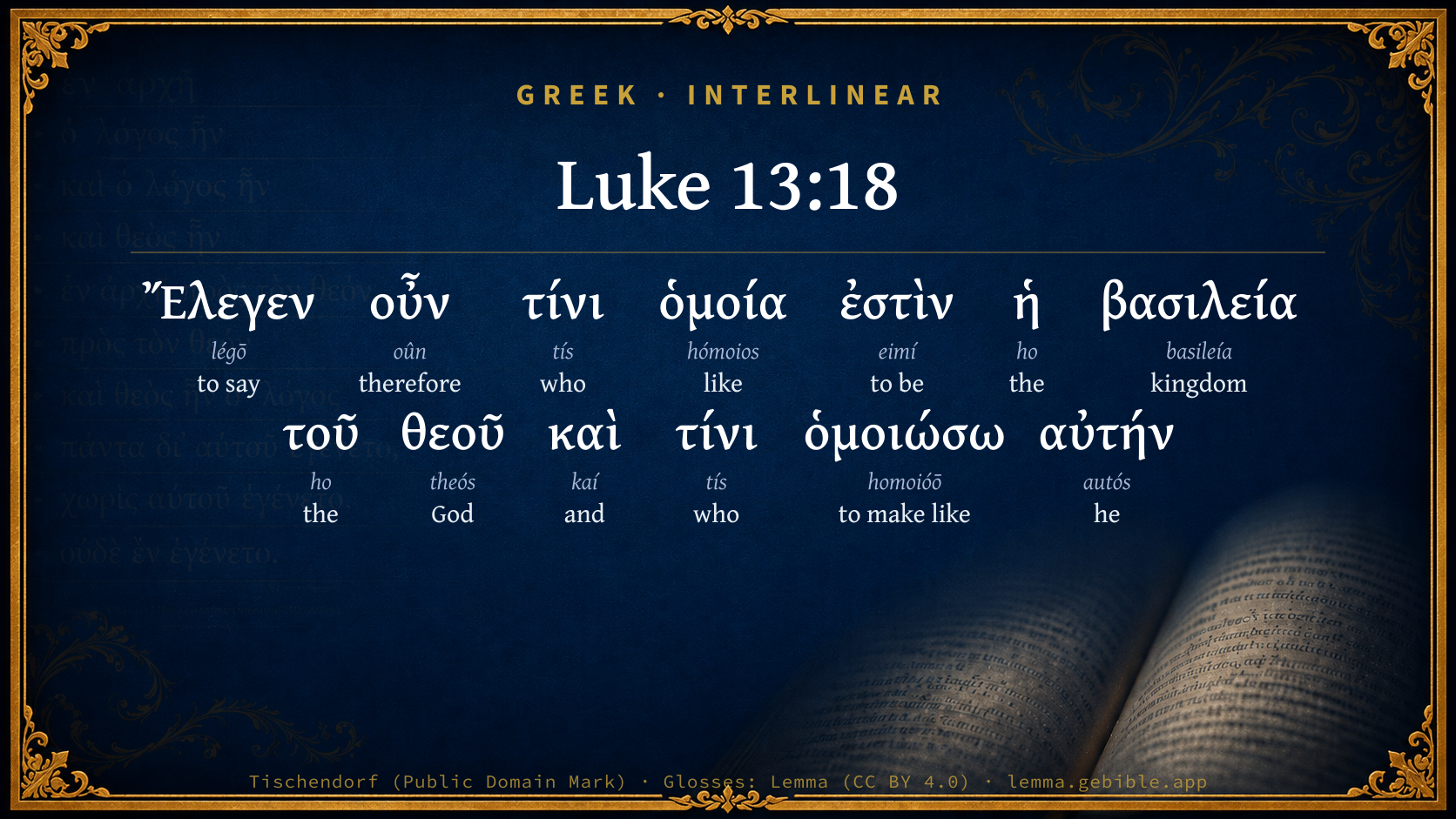
Greek (Tischendorf 8th ed.) Luke 13:18 appears in the Greek New Testament. The text above is from the Tischendorf 8th edition. Each word links to its Strong’s number and a concise gloss. Click any word for its full Thayer’s Greek Lexicon entry.
Download image
Cite this verse

Luke 13:18 (World English Bible). Public Domain. Lemma interlinear Bible study tool, https://lemma.gebible.app/v/luke/13/18.

Show BibTeX & RIS
BibTeX
RIS
English Translation
He said, "What is the Kingdom of God like? To what shall I compare it?
World English Bible · Public Domain
Download a study sheet

One document with this verse’s original text, its word-by-word gloss line, the meaning frame, cross-references with their text, attributed commentary, and full source and license credits — printable, and it pastes into notes with its structure intact.

This verse Autodidact and up

Study sheet (.html) Plain text (.txt)

A passage Seminary Student

Up to 50 verses in one chapter. A passage sheet keeps up to 6 commentary sources and 12 cross-references per verse, in the order this page ranks them, and says so on the sheet whenever that leaves anything out. Ask for a single verse and you get the Autodidact verse sheet above.

Everything on this page stays free to read, with no account — the sheet is a download of what is already on screen, not access to it.

Want to remove ads? Support Godless Engineer
Compare translations 3

The same verse in 3 English versions, stacked beneath the original-language interlinear above. Click any original word for its lexicon entry.

Each is an independent rendering of the whole verse — the interlinear is not word-aligned to these translations.

Highlighted words mark where these versions differ — a whole-verse word diff, not a word-by-word alignment.

  • World English Bible Public Domain
    He said, "What is the Kingdom of God like? To what shall I compare it?
  • King James Version Public Domain
    Then said he, Unto what is the kingdom of God like? and whereunto shall I resemble it?
  • unfoldingWord Literal Text CC BY-SA 4.0
    Then he said, “What is the kingdom of God like, and to what will I compare it?

unfoldingWord Literal Text — © unfoldingWord, licensed CC BY-SA 4.0. Word-aligned USFM3 via Door43 (git.door43.org/unfoldingWord/en_ult).

Versions to compare (up to 4)

3 of 4 selected

Show all 19 translations

Every available English version of this verse, each an independent rendering of the whole verse.

  • World English Bible Public Domain
    He said, "What is the Kingdom of God like? To what shall I compare it?
  • Berean Standard Bible Public Domain
    Then Jesus asked, “What is the kingdom of God like? To what can I compare it?
  • Majority Standard Bible Public Domain
    Then Jesus asked, “What is the kingdom of God like? To what can I compare it?
  • King James Version Public Domain
    Then said he, Unto what is the kingdom of God like? and whereunto shall I resemble it?
  • American Standard Version (1901) Public Domain
    He said therefore, Unto what is the kingdom of God like? and whereunto shall I liken it?
  • Revised Version (1885) Public Domain
    He said therefore, Unto what is the kingdom of God like? and whereunto shall I liken it?
  • Geneva Bible (1599) Public Domain
    Then said he, What is the kingdome of God like? or whereto shall I compare it?
  • Douay-Rheims (1899) Public Domain
    He said therefore: To what is the kingdom of God like, and whereunto shall I resemble it
  • Young's Literal Translation Public Domain
    And he said, `To what is the reign of God like? and to what shall I liken it?
  • Literal Standard Version CC BY-SA 4.0
    And He said, “To what is the Kingdom of God like? And to what will I liken it?
  • Unlocked Literal Bible CC BY-SA 4.0
    Then Jesus said, “What is the kingdom of God like, and what can I compare it to?
  • unfoldingWord Literal Text CC BY-SA 4.0
    Then he said, “What is the kingdom of God like, and to what will I compare it?
  • Darby Bible Public Domain
    And he said, To what is the kingdom of God like? and to what shall I liken it?
  • World Messianic Bible Public Domain
    He said, “What is God’s Kingdom like? To what shall I compare it?
  • Webster's Bible Public Domain
    Then said he, To what is the kingdom of God like? and to what shall I resemble it?
  • Free Bible Version CC BY-SA 4.0
    Then Jesus asked, “So what is the kingdom of God like? What should I compare it to?
  • Bible in Basic English Public Domain
    Then he said, What is the kingdom of God like? what comparison may I make of it?
  • Text-Critical English NT CC BY 4.0
    Then Jesus said, “What is the kingdom of God like? To what should I compare it?
  • Tyndale New Testament (1534) Public Domain
    Then sayde he: What is the kyngdome of God lyke? or wherto shall I compare it?

Literal Standard Version (2020), Covenant Press — licensed CC BY-SA 4.0. Text via the HelloAO Bible API (eBible.org). Unlocked Literal Bible (unfoldingWord) — licensed CC BY-SA 4.0. Text via the HelloAO Bible API (eBible.org). unfoldingWord Literal Text — © unfoldingWord, licensed CC BY-SA 4.0. Word-aligned USFM3 via Door43 (git.door43.org/unfoldingWord/en_ult). Free Bible Version, Dr. Jonathan Gallagher — licensed CC BY-SA 4.0. Text via the HelloAO Bible API (eBible.org).

Word by word

More ways to search: Search by grammar → Find every occurrence → Compare this word →

Practice this passage: Drill this verse → Learn its vocabulary →

ὁμοιώσω
homoióō
G3666
“to make like”
Verb, Future, Active, Indicative, 1st person, Singular
Part of Speech
Verb
Tense
Future
Voice
Active
Mood
Indicative
Person
1st person
Number
Singular
Full Thayer's Definition

Origin: from G3664

TDNT: 08:08,7

1. to be made like 2. to liken, compare a. illustrate by comparisons
  1. Ἔλεγεν légō G3004 “to say” Verb, Imperfect, Active, Indicative, 3rd person, Singular
  2. οὖν oûn G3767 “therefore” Conjunction
  3. τίνι tís G5101 “who” Interrogative pronoun, Dative, Singular, Neuter
  4. ὁμοία hómoios G3664 “like” Adjective, Nominative, Singular, Feminine
  5. ἐστὶν eimí G1510 “to be” Verb, Present, Active, Indicative, 3rd person, Singular
  6. ἡ ho G3588 “the” Article, Nominative, Singular, Feminine
  7. βασιλεία basileía G932 “kingdom” Noun, Nominative, Singular, Feminine
  8. τοῦ ho G3588 “the” Article, Genitive, Singular, Masculine
  9. θεοῦ theós G2316 “God” Noun, Genitive, Singular, Masculine
  10. καὶ kaí G2532 “and” Conjunction
  11. τίνι tís G5101 “who” Interrogative pronoun, Dative, Singular, Neuter
  12. αὐτήν autós G846 “he” Personal pronoun, Accusative, Singular, Feminine

About this verse

These counts appear in no published source. They are computed here, from the morphology-tagged text and Lemma’s own curated glosses. What Lemma adds →

13
words
11
distinct lemmas
Gospels
section

Notable vocabulary

The rarest word here is ὁμοιώσω to make like G3666 — appearing just 15 times in the whole Greek New Testament.

Shared distinctive vocabulary

ὁμοιώσω to make like G3666 occurs in 15 verses of the Greek New Testament. Also found in:

Repetition

Words recur within this verse:

Cross-references

8

Topical passages linked to Luke 13:18 in the Treasury of Scripture Knowledge — connected by theme and wording, ordered by reader-vote popularity; previews shown in the World English Bible.

  • Mark 4:30–34 He said, "How will we liken the Kingdom of God? Or with what parable will we illustrate it?
  • Matthew 13:31–32 He set another parable before them, saying, "The Kingdom of Heaven is like a grain of mustard seed, which a man took, and sowed in his field;
  • Luke 17:21 neither will they say, 'Look, here!' or, 'Look, there!' for behold, the Kingdom of God is within you."
  • Mark 4:26 He said, "The Kingdom of God is as if a man should cast seed on the earth,
  • Luke 13:20 Again he said, "To what shall I compare the Kingdom of God?
  • Matthew 13:24 He set another parable before them, saying, "The Kingdom of Heaven is like a man who sowed good seed in his field,
  • Lamentations 2:13 What shall I testify to you? what shall I liken to you, daughter of Jerusalem? What shall I compare to you, that I may comfort you, virgin daughter of Zion? For your breach is great like the sea: who can heal you?
  • Luke 7:31 But the Lord said, "To what then will I liken the people of this generation? What are they like?

Cross-references courtesy of OpenBible.info (CC BY 4.0).

Commentary

Notes on Luke 13:18 from classic Christian and Jewish commentators (each source and its license shown beneath its notes). The classic Christian expositions comment on the surrounding passage and are grouped to its opening verse, so a note may address several verses; the Jewish commentaries on the Tanakh (Rashi and others) are per-verse, so they appear only where the commentator wrote on this verse.

Lemma curates 59 commentaries, every one of them public domain or Creative Commons licensed, each selected and text-cleaned for this edition rather than reprinted as found. About our sources →

Matthew Henry's Commentary

Here is, I. The gospel's progress foretold in two parables, which we had before, Mat 13:31-33. The kingdom of the Messiah is the kingdom of God, for it advances his glory; this kingdom was yet a mystery, and people were generally in the dark, and under mistakes, about it. Now, when we would describe a thing to those that are strangers to it, we choose to do it by similitudes. "Such a person you know not, but I will tell you whom he is like;" so Christ undertakes here to show what the kingdom of God is like (Luk 13:18): "Whereunto shall I liken the kingdom of God? Luk 13:20. It will be quite another thing from what you expect, and will operate, and gain its point, in quite another manner." 1. "You expect it will appear great, and will arrive at its perfection all of a sudden; but you are mistaken, it is like a grain of mustard-seed, a little thing, takes up but little room, makes but a little figure, and promises but little; yet, when sown in soil proper to receive it, it waxes a great tree," Luk 13:19. Many perhaps were prejudiced against the gospel, and loth to come in to the obedience of it, because its beginning was so small; they were ready to say of Christ, Can this man save us? And of his gospel, Is this likely ever to come to any thing? Now Christ would remove this prejudice, by assuring them that though its beginning was small its latter end should greatly increase; so that many should come, should come upon the wing, should fly like a cloud, to lodge in the branches of it with more safety and satisfaction than in the branches of Nebuchadnezzar's tree, Dan 4:21. 2. "You expect it will make its way by external means, by subduing nations and vanquishing armies, though it shall work like leaven, silently and insensibly, and without any force or violence, Luk 13:21. A little leaven leaveneth the whole lump; so the doctrine of Christ will strangely diffuse its relish into the world of mankind: in this it triumphs, that the savour of the knowledge of it is unaccountably made manifest in every place, beyond what one could have expected, Co2 2:14. But you must give it time, wait for the issue of the preaching of the gospel to the world, and you will find it does wonders, and alters the property of the souls of men. By degrees the whole will be leavened, even as many as are, like the meal to the leaven, prepared to receive the savour of it."

II. Christ's progress towards Jerusalem recorded: He went through the cities and villages, teaching and journeying, Luk 13:22. Here we find Christ an itinerant, but an itinerant preacher, journeying towards Jerusalem, to the feast of dedication, which was in the winter, when travelling was uncomfortable, yet he would be about his Father's business; and therefore, whatever cities or villages he could make in his way, he gave them a sermon or two, not only in the cities, but in the country villages. Wherever Providence brings us, we should endeavour to be doing all the good we can.

Matthew Henry's Commentary on the Whole Bible (1708–1710) — public domain (CC PDM 1.0). Text via the HelloAO Bible API.

Jamieson, Fausset & Brown

Robert Jamieson, A. R. Fausset & David Brown

MISCELLANEOUS TEACHINGS. (Luk 13:18-30)

mustard seed . . . leaven--(See on Mar 4:30-32). The parable of "the Leaven" sets forth, perhaps, rather the inward growth of the kingdom, while "the Mustard Seed" seems to point chiefly to the outward. It being a woman's work to knead, it seems a refinement to say that "the woman" here represents the Church, as the instrument of depositing the leaven. Nor does it yield much satisfaction to understand the "three measures of meal" of that threefold division of our nature into "spirit, soul, and body," (alluded to in Th1 5:23) or of the threefold partition of the world among the three sons of Noah (Gen 10:32), as some do. It yields more real satisfaction to see in this brief parable just the all-penetrating and assimilating quality of the Gospel, by virtue of which it will yet mould all institutions and tribes of men, and exhibit over the whole earth one "Kingdom of our Lord and of His Christ." (See on Rev 11:15).

Jamieson, Fausset & Brown — Commentary Critical and Explanatory on the Whole Bible (1871) — public domain (CC PDM 1.0). Text via the HelloAO Bible API.

The Biblical Illustrator

Joseph S. Exell

Luk_13:18-19

Unto what is the kingdom of God like?

--

On the kingdom of God

The kingdom of God is an expression of various significations in the sacred volume. Sometimes is meant by it the universal dominion of the Deity; sometimes the final blessedness to which the saints are heirs; and in a more confined sense it frequently signifies the gospel state, or Church of Christ. In this last sense, it is used in the text; and the thing signified is illustrated by a comparison, remarkable for that aptness and beauty, with which all our Saviours parables are distinguished.

I. We are first led by the resemblance, to which our Saviour likens His kingdom, to remark THE SMALLNESS OF CHRISTIANITY IS ITS BEGINNING. Seeking for the symbol with careful consideration, He chooses one, proverbial among the Jews for littleness, the smallest object possessed of life and expansive force. Small as is the symbol, it is not smaller than the thing it was designed to represent. An obscure prophecy was the first germ of Christianity, and its only label, a simple rite: the prophecy-Gods promise to the woman, and sacrifice--the rite. We have ever to bless our God that-as early as death laid claim to our race, the seed, whose fruit is to nourish us into immortality, was sown by His hand; and in due season made to spring up into lively appearance before an expecting and wondering world.

II. This brings me to remark, from the image which Christ furnishes in the text of the kingdom of God, ITS PROGRESSIVE CHARACTER. In the visible ministry of the Messiah and promulgation of the gospel it assumed its definite appearance. This took place under the most unfavourable circumstances. The soil in which it appeared was incongruous with its nature, and the clime inclement. In its genuine state Christianity had to withstand many a blast; to endure both chilling cold and scorching heat; to encounter everything which could threaten to check its growth, and crush it in the dust. But it was a plant of an inherent vigour, which no climate could kill, nor rudeness impair; and, under the fostering care of Him who rules all seasons and disposes all events, it grew daily, it rose in height, and spread the wonder of the world; it became established.

III. This brings me to observe, THAT THE PARABLE CARRIES US FORWARD TO A PERFECTED GROWTH AND TRIUMPHANT STATE OF THE GOSPEL KINGDOM. Though now it presents the sure refuge to all people, its branches are not filled; there is room for much further growth, and dread occasion for much pruning. As yet, defiling vines cling to the stately tree, obstructing its spread, and defacing its beauty. As yet, the Jews look not on Him whom they pierced; and to many Gentile tribes, the Cross is foolishness. As yet, there is need to cry to the children of men, Know the Lord; and many of them are fluttering wildly, and wandering into dangers, for want of the places in which they may find rest and shelter. But the figure by which the Church is described, and which has appeared hitherto so apt and exact, apprises us of a mature and triumphant state of our Redeemers kingdom. The plant of the little seed, through its progressive growth, is to attain to a perfect height, and strength, and greatness. It is to become a great tree; yea, greater than all the trees that are in the earth. Its root is fixed; and it shall continue to extend its growth till all the inhabitants of our world rejoice in the shadow of the branches of it. The Christian religion is composed of such elements; there are in it such principles and arrangements as suggest of themselves that if it be true it is designed for universal extension and perpetual duration. We have now considered the beautiful and exact resemblance furnished by Christ of the kingdom of God. There are inferences from this subject of great weight and variety. Let me entreat your patience while I adduce only a few which are too instructive to be omitted.

1. The first is, that this is one of those singularly important comparisons or parables which are not only illustrative but prophetic.

2. Another important inference from what has been said is, that the gospel is the object of constant providential care.

3. The last inference I shall make from our Saviours lively representation of His kingdom is, the encouragement it is calculated to afford to His pious people. (Bishop Dehon.)

It is like a grain of mustard-seed

The mustard-seed

The kingdom of heaven is like to a grain of mustard-seed--which indeed is is the least of all seeds. It is no exception to the law of growth which prevails throughout nature, and exemplifies how what is mightiest is often the product of what is apparently feeblest. Not only the giant oak, capable of defying the fiercest storms, but whole forests which yield materials for a nations fleets, may have lain wrapped up within a single tiny acorn. In history, whatever has been most enduring and has exerted most influence, has been born in obscurity and feebleness, and grown up by almost imperceptible stages--whereas, whatever has, like the gourd of Jonah, arisen to its full height of a sudden, has withered and died away with the same rapidity that it arose. But Christianity is the most striking instance of the kind. Its fountain-head is the manger of a stable in a small Judeau town. There is a strange unobtrusiveness about the character and mission of the Author and Finisher of our faith. When we know who He was, the only begotten Son of God, and what His purpose was--the salvation of the world--we might expect to see Him take up a position full in the worlds view, attracting to Himself mans whole attention, making kings His deputies, and philosophers His apostles, and orators His heralds, and armed captains His attendants. But no! the manger of a stable was His cradle--poverty, hard labours, great sorrows, keen sufferings, were His constant companions. It was the little seed-corn which had to be dropped into the ground and die ere the earth could bear a harvest of righteousness and peace. It was that by the preaching of which a few poor, illiterate Galilean fishermen were called upon to brave anal overcome the opposition which all the wealth, authority, antiquity, military force, taste, and philosophy, as well as ignorance and sin, of the world, could muster against them, to conquer the prejudices of the Jews, to undermine the superstitions under which Rome had grown up to be the mistress of the world, to confound the subtleties and wisdom of the Greeks, and to dispel the darkness of heathenism. It looked the most hopeless of tasks. There are instruction and warning for us in that. The gospel is the most emphatic protest against judging of things by their outward appearance. It is the solemn and decisive testimony of God to the superiority of spiritual principle over material magnificence. It casts down power and might to exalt spirit and truth. Many persons have an eye only to behold external and worldly greatness. There is no hope for any one, however, so long as he persists in looking at things with that dull, unspiritual eye. The gospel, in all that is distinctive of it, is spiritual, and can only be spiritually discerned. The parable having told us that the gospel in its origin is small, weak, and apparently insignificant, proceeds to speak of its growth, of its amazing progress. From the least of seeds it becomes the greatest of herbs; from an almost invisible grain it rises into a tree, where the birds of the air find shelter. It is unnecessary to insist that the history of the last eighteen hundred years has amply verified this representation. The Church, which at Pentecost only numbered a few score of persons, soon counted its adherents by thousands, burst the trammels of Judaism, and, even in the lifetime of its first apostles, established itself, without any other instrumentality than the foolishness of preaching, in all the large towns of the civilized world. All Europe and America are now more or less under its sway, and it is advancing with slow but sure steps to the conquest of the entire earth. It is more important to observe, as the text specially calls on us to do, that this long history is throughout a growth--that it may be fitly likened to a seed becoming a tree. Let us so look at it for a little, and see what lessons it has for our profit.

1. This is the first. The whole of Christianity, in so far as it is true, once lay in a small compass. All the truths, all the institutions, all the virtues which it embodies, may be traced back to a single life as their germ. The mustard tree was wholly in the mustard-seed. The oak, great although it now is, once lay wrapped up entire in the acorn. All that properly belongs to it lay folded there. Nothing save what is foreign and hurtful, nothing save excrescences and parasites, have come from any other source. The influences of light and heat, and wind and dew, have only brought out what was there from the first, It is so, likewise, with Christianity. It has grown up through eighteen hundred years, it covers now a very large portion of the earth, but all that truly belongs to it even at this hour has sprung from the lowly life of Jesus. All that is good in its creeds, its institutions, the conduct it inspires, has germinated from some word of His--has lain as a thought in His mind or an affection in His heart; and whatever man has introduced of his own into religious belief or practice is only an excrescence, a parasite, a cause of weakness and decay. The lowliest life ever lived on earth has thus been infinitely the most fruitful. The least of all seeds has become the greatest among herbs.

2. The seed has not only all the rudiments of the future tree within it, but the life which unfolds them and sends out first the root and trunk, and then the branches, leaves, blossoms, and fruit. And the word of the gospel has likewise an indestructible principle of vitality, which cannot be repressed, cannot be arrested. It grows by the very necessity of its nature, under the influence of grace, just as the living seed, by the very necessity of its nature, under a genial sky cannot remain in the ground, but sends up blade and bud and branch. There is in this assertion no latent fatalism. Although the gospel has indeed been in history like a tree growing out of a living seed, it follows not that human will has had nothing to do with its progress.

There is nothing in history, properly so called, with which human will has not had to do. Every improvement it tells of has been effected by human self-denial and toil. The country we live in was once covered with putrid morasses and gloomy forests, and yielded only a scanty and impure subsistence to a few hordes of wandering savages. Now its morasses are dried up, its forests cleared away, large cities stand thick strewn over it, its well-cultivated plains yield food enough for millions, and its industry produces an annual revenue the most enormous. What has wrought the change? Labour, and labour alone--labour of mind and of body. Not an inch of conquest has been won without mental exertion and physical toil, without anxious thought and an active hand. Religion is no exception to this rule, but its most striking example. It has had nobler and more numerous martyrs and missionaries--has called forth more heroic labours and costlier sacrifices--than all other causes together. And this is quite consistent with the fact that the gospel grows by a life of its own--that though mans labour is needed to apply and diffuse it, he neither makes it nor puts life and fruitfulness into it--that he receives it with these in itself, so that if he cast it into the ground it will spring and grow up of its own Divine energy, and according to its own Divine laws.

3. Growth implies increasing divergence and definiteness of parts and functions. It is a separation of the one into the many, a change from the simple to the complex, from the vague to the distinct. The seed out of which a plant issues is at first uniform in tissue and composition, but soon it divides into two parts, afterwards new contrasts appear in each of these, and it is by endless such changes that the complex combination of tissues and organs in a perfect plant is produced. While the parts are thus increased in number, each of them becomes more prominent in itself, more sharply distinguished from others, and more strictly confined to its own special use. Wherever growth takes place, this is the process traceable. It is what we see in every herb, in every animal, in civilization, in government, language, science, and art. Different as all these are in themselves, there is only the one way in which they can grow, in which they can truly progress. The kingdom of God conforms to the same conditions. Its history has consisted throughout in the evolution of doctrines, institutions, and modes of life, out of a very simple germ. Our elaborate systems of theological science so far as true, our manifold institutions for religious and benevolent purposes so far as good, our endlessly diversified modes of social being so far as right, are developments of the living word of the gospel, in which, however, they lay enfolded only as the tree in its seed, as results in their principle, as special and definite dogmas in broad and general statements.

Those who say, Let us cast to the winds our creeds, our systems, our definite dogmas, and return to the primitive simplicity of apostolic men, forget that God has not left it to the worlds own will to return of a sudden, or to return at all, to the point from which it has taken eighteen centuries for it to advance. They might as well counsel us to throw off all the laws and institutions, all the countless arrangements of the elaborated civilization in which we live, and retrograde to the rude and simple life of the earliest dwellers in Asia and Europe. We are where we are, where long ages of thought and toil have placed us, and, even if ungrateful enough to desire it, there is no going back for us now.

4. The growth of the kingdom of God has been continuous. We may fail to measure its progress from day to day, because it is not rapid, but slow, not with observation, but without it. There is still another truth involved, and it is one which we must not despise because it is simple. Growth requires time. God has everywhere placed that as an inevitable separation between germination and maturity, between the seed and the perfect tree. Let us conform, then, to the condition. When we are despondent or angry because our labours in a Christian cause are not crowned with immediate success, we are no wiser than the little child who deposits a seed in the ground and is grieved not to see it springing up on the very day it has done so. (R. Flint.)

The mustard-seed and the leaven

I. THE GERM OF THE KINGDOM.

1. It is something new. Watch that sower: he takes the seed and plants it in his garden. The seed suits the soil, but it was not in the soil at first. It came from above, out of the sewers hand.

2. The germ is small at first: like to a grain--a very small particle--of mustard-seed, which a man took.

II. ITS GROWTH.

III. THE GLORY OF THE KINGDOM.

1. The kingdom is one, though it belongs to all ages and nations. Christ speaks of a kingdom, never of kingdoms. A tree is a unity, for though it has many leaves and branches, it has but one root and one life-sap. Those who are sundered by seas, and ages, and thousands of influences, are all made one by Christ.

2. It is a world-wide kingdom. As the tree is for every bird from any quarter of heaven that wishes its shelter, so Christs religion is for all sorts of people.

3. And it blesses, and only blesses. It creates and increases all that is bright and joyous. Christs is a kingdom of love, of help, of grace, of salvation, and heaven is its end.

4. It will become very great though very small in its beginnings. (J. Wells, M. A.)

The external progress of the kingdom as illustrated by the growth of the mustard-seed

It is ever important to remember that Christianity, at first like a small grain of seed, spread throughout the world, until the nations of the earth came to flock like birds to its protecting shelter, by no aid except its own inherent spiritual power. There was nothing to help it in the character of its early teachers. There was nothing to make its progress easy in the conditions of the Jewish and Gentile worlds. It came to the Jewish world, and found it saturated with thoughts of Jewish exclusiveness, and full of hopes of an earthly Deliverer. There was nothing in the teaching of this Messiah to appeal to the one, or to pander to the other. It told the Jew that his dreams of a temporal Messiah were futile, that it was a kingdom of spiritual power--not supported by external force or conquering by arms--which it had come to establish amongst men. Thus, though it appealedto no religious or national instinct in the Jew, though it was hostile to both, Christianity triumphed. Nor, again, in the Gentile world, represented by the two great nations of Greece or Rome, was there any congenial soil for the little seed of early Christendom to take root in, and find its sustenance. The Greek world was full of the pride of intellect, and the worship of sensuous beauty, and to it Christianity came with no scheme of a newfangled philosophy, with no subtleties of scholastic ethics. The preaching of the Cross of Christ, the teaching of a religion of self-sacrifice and love, so simple that the child could understand it, was its message. It presented as the object of their adoration and worship no incarnation of physical beauty, no image of physical strength, but a Nazarene upon a cross--His features so marred with sorrow that there was no beauty in Him that they should desire Him. And yet this Christianity had an inherent force of its own, before which the intellectual pride and the philosophic genius of Greece had to bow at last in submission. St. Paul preached at Athens, and not a few but felt as they listened, within sight of their own Academy, and beneath the shadow of honeyed Hymettus where the sages had trod, that this new preacher taught, with a power not of this world, a grander faith, which must outlast even the city of the Violet Crown. The wave spread still westward to Rome--proud mistress of the world. It fared as ill with her material and political strength as it had done with the intellectual force of Athens. To those who worshipped force and were glutted with military conquests, this new faith came preaching tenderness, forgiveness, charity. To Rome, who saw her eagles swoop in the farthest east and west, it proclaimed the supremacy of spiritual triumphs-it preached the deliverance of the captive--the brotherhood of nations. At first only whispered in prison cells, or flung to the beasts of the arena, or its holy symbol grasped in feeble hands, and pressed to dying breasts of martyrs, the religion of Christ soon won its way over every obstacle, and at last Christianity entered the imperial palace, and wore the diadem of the Caesars: Now, when we turn from these triumphs of Christianity to examine what means she employed for her propagation, we can find nothing, humanly speaking, to account for it. Twelve men--Jews, without hereditary distinction; without political influence; without (except in one or two cases) intellectual acquirements--these were the men who--without any aid on earth; with a gospel that was opposed to every national, and philosophic, and religious prejudice of Jew, and Greek, and Roman; which was hostile to every feeling of pride and selfishness in the human heart--accomplished the grandest and most stupendous revolution the world had ever seen. People say sometimes that they find it hard to believe the miracles on which Christianity is based--surely the grandest, greatest miracle is the existence of Christianity itself. If, then, there were nothing in the outside world to which it appealed; nothing in the natural hearts of men which it came to satisfy: if we cannot discover in the characters of those who preached it any human reason to explain its progress--how are we to account for the spread of Christs kingdom, except by attributing it to some spiritual power of its own? (T. T. Shore, M. A.)

The Biblical Illustrator, edited by Joseph S. Exell (c. 1880s–1900s) — public domain. Text from a community e-Sword module.

Joseph Benson's Commentary

Luk 13:18-21. Then said he, Unto what is the kingdom of God like? — After the Lord had thus silenced the ruler of the synagogue, and while he observed the rejoicings of the people, he reflected with pleasure on the reason and truth which so effectually supported his kingdom. For he delivered a second time the parables of the grain of mustard-seed, and of the leaven, to show the efficacious operation of the gospel upon the minds of men, and its speedy propagation through the world in spite of all opposition. See notes on Mat 13:31-33.

Joseph Benson's Commentary on the Old and New Testaments (1811–1818) — public domain. Text from a community e-Sword module.

The Preacher's Complete Homiletical Commentary

Joseph S. Exell (gen. ed.)

CRITICAL NOTES

Luk_13:19. Like a grain of mustard seed.—So small in size as to be a proverbial comparison among the Jews for anything exceedingly small. Garden.—Mat_13:31 has “field.” A great tree.—Omit “great,” omitted in R.V. The plant in question sometimes grows as high as a man on horseback. The points of comparison are the insignificant beginning and the great outward extension of the kingdom of God founded by Jesus Christ. Birds of the air.—I.e., birds attracted by the pungent seed of the plant. Lodged.—I.e., found a shelter (cf. Luk_9:58). The Church is a place of shelter and of food.

Luk_13:21. Leaven.—“Except in this parable, leaven in Scripture (being connected with corruption and fermentation) is used as a type of sin. See Luk_12:1; Exo_12:15-20; 1Co_5:6-8; Gal_5:9. Here, however, the only point considered is its rapid, and unseen, and effectual working” (Farrar). The idea, too, of the wholesome effect produced by leaven in the making of bread may be associated with the figure. Three measures of meal.—Probably the amount usually kneaded at one time (Gen_18:6). The various allegorical explanations of this detail that have been given are more than usually frivolous and farfetched. Till the whole was leavened.—The process of change resulting in a complete transformation. This is a companion picture to that of the mustard seed, the latter setting forth the outward extension of the kingdom, the former the inward transformation effected by it. The comparison may also be extended to the effect produced by the gospel upon the character of the individual believer, when external life and habits, and the whole inner being, come under the influence of Christian truth.

MAIN HOMILETICS OF THE PARAGRAPH.—Luk_13:18-21

In these two parables our Lord sets forth a bright and cheering aspect of the future of the kingdom, exhibiting in the first of them its growth from small beginnings to great magnitude, and in the second its transforming influence on the mass in which it is deposited.

I. Outward growth.—The parable of the little mustard seed, as that of the sower, takes the process of vegetation as emblematic of the growth of the kingdom; but the sower barely appears, though His agency is part of the essence of the representation, and the place where the plant grows is “His garden.” But the seed is now the kingdom itself, and the only points brought into notice are the contrasted smallness of the beginning and bulk of the growth at the end. Jesus does not speak as a botanist, but in popular language; and it is enough to know that the mustard seed was a common proverbial illustration of extreme minuteness, and that the herb was a miracle of growth as compared with its tiny origin. The application is too plain to need any interpretation. It strikes home at once to the many among the first listeners who had recoiled from the (as it seemed to them) dreadful down-come from the long-cherished national hopes to the obscure Galilæan peasant and His handful of followers. He stole into the world in a despised corner of a despised land. He gathered a few believers, spoke some gentle words, laid His hands on a few sick folk, and then died. What proud incredulity would have curled the lips of men of influence and culture in that day, if they had been pointed to Him and His disciples, and bidden to see there the mightiest force, destined to universal dominion! The lesson is not less needed now than then. God’s great things have ever small beginnings, even as the seed of the “big trees” in California is smaller than that of many a much humbler conifer. The world’s great things begin large and dwindle fast. We have to learn reverence for the smallest seed which has vitality, and confidence that the quantity, and still more the quality, of the life in the little black packet of latent possibility is not measured by its size. So we shall not be led away by vulgar admiration of the big, which we mistake for the great and Divine, nor discouraged and impatient if a heritage be not “gotten hastily at the beginning.” The parable brings the small seed into sharp contrast with the large results, and implies the world-wide spread of the kingdom. The picturesque touch of the birds lighting on the branches is probably an allusion to Eze_17:23, and a definite prophecy of the coming of the nations to partake in its blessings. The fowls of the air sing among the branches. Souls weary of flight fold their tired wings, and find rest, shelter, and joy there.

II. Inward change.—The parable of the leaven completes the picture of the growth of the kingdom by describing its inward operation, as the former does its outward growth. It spreads in space and increases in bulk; but it transforms inert matter into its own nature, and thus grows by assimilation. The eccentric interpretation of the leaven as the emblem of evil is disposed of by observing that it is the kingdom, and not its corruption, which is like unto leaven, and by remembering that the meal is improved, not spoiled, by it. The main lessons lie

(1) in the addition of the leaven to the meal, teaching that the quickening influence comes from without; that, in a word, if human society is ever to contain a kingdom of heaven, and be transformed thereby, it must be imparted, not developed. They lie

(2) in the hiding of the leaven, by which is taught the same truth of secret beginnings as in the former parable. They lie

(3) in the manner of the leaven’s working, which is fermentation. So the gospel stirs up movement in the dead man. Christ comes to bring peace at the end, but He must first bring a sword. Leaven works from within outwards. The gospel is planted in the depths of the individual spirit, and gradually permeates the whole being. It works underground in society, and only re-models institutions as the result of having remodelled men. The lesson lies further in the assimilative power of the leaven, which changes each particle of the meal, and, by means of each in turn, transmits the transforming power to the outer unleavened particles. It lies, finally, in hopes suggested by that “till the whole was leavened,” which foretells the permeating of the mass with quickening influence, and the complete assimilation of the individual to it.—Maclaren.

SUGGESTIVE COMMENTS ON Luk_13:18-21

The Kingdom of God.

I. Its rapid growth.

II. Its transforming power.

Emblems of the Kingdom.

I. Lessons from the mustard seed.—

1. Its personal teaching.

2. Its prophetical teaching.

II. Lessons from the leaven.—

1. The source of grace.

2. The secrecy of its workings.

3. The certainty of its success.—W. Taylor.

The Kingdom of God.

I. Its gradual extension.—Our Lord corrects the fatal error of His countrymen, that the kingdom of God would come as a sudden outbreak of Divine power. It is to grow, from small beginnings, in the hearts of men. How gradual it is in the individual we know from sad experience. How gradual among the nations the observation of eighteen hundred years has shown us. Yet we must never despair. Seed has in it the germ of life, a power of endless development, and is certain to fulfil in God’s own time its marvellous destination.

II. Its secret growth.—Not to be inaugurated by pomp and circumstance, or by the literal appearance of the Son of Man in the clouds of heaven. Jesus corrects this error in the parable of the leaven. He teaches the quiet, unobtrusive character of true religion—how unnoticeable is its first infusion; how far beneath the human eye its growth. Religion is a hidden life, and it works spontaneously, by its own secret vitality, till it leavens the whole mass of society.—Griffith.

Fulfilment of the Prophesies here Contained.

I. The way in which these parabolic prophecies of the spread of the gospel have already been fulfilled is a proof of its divinity.

II. These parables open up delightful views of the future history of the Church, and furnish us with a call and an encouragement to exert ourselves for the universal diffusion of the gospel.—Foote.

Increase of Bulk and Change of Character.—In the one parable, that of the Mustard Seed, the kingdom is conceived of as a visible society, which is susceptible of increase in its bulk by addition to the number of its membership. In the other parable, that of the Leaven, the kingdom is conceived of as a moral or spiritual power, which is susceptible of increase in the transforming influence which it exerts on those who are subject to its operation.—Bruce.

The Conversion of the World.

I. The process is to take its rise from small and very unpromising beginnings, and yet shall prevail speedily to a vast extent.

II. The change is to be wrought by pacific means only, without the intervention of any force or violence whatsoever.

The Mustard Seed.

There are three great chapters in the history of Christ’s kingdom.

I. The germ.—It is something new. It is small at first.

II. The growth.

III. The glory.—The kingdom is one, though belonging to all ages and nations. It is a world-wide kingdom. It blesses and only blesses. It will yet become very great. We may be very hopeful about the future of the kingdom.—Wells.

Mustard Seed.

I. The kingdom of heaven: its apparent insignificance.

II. Its vitality.

III. Its future grandeur.

Leaven.

I. The kind of change which Christianity works in the world.

II. The method by which this change is wrought.

The Kingdom of God has Two Kinds of Power.

I. A power of extension, by which it gradually embraces all peoples, and—

II. A power of transformation, by which it renews gradually the whole of human life. The natural symbol of the first is a seed, which in a brief space of time attains an increase disproportioned to its small size at first; that of the second, a small portion of leaven, which is capable of exerting its regenerative influence upon a large mass.—Godet.

Vitality and Influence.

I. Inherent vitality; development from within.

II. Contagious influence; a change wrought from acquiring a new force from without.

Progress and Growth.

I. Progress from a small beginning to a glorious consummation.

II. The cause of growth—the inherent, unquenchable life of the kingdom.

III. The manner of growth—silent, secret, unobserved.

Hopefulness and Patience Inculcated.—These parables inculcate

(1) hopefulness, and

(2) patience amid circumstances fitted to breed despondency and discouragement.

Luk_13:18-19.

I. General reference.—In the general sense, the insignificant beginnings of the kingdom are set forth; the little babe cast in the manger at Bethlehem; the Man of Sorrows, with no place to lay His head; the crucified One; or, again, the hundred and twenty names who were the seed of the Church after the Lord had ascended. Then we have the kingdom of God waxing onward and spreading its branches here and there, and different nations coming unto it.

II. Individual reference.—The individual application of the parable points to the small beginnings of Divine grace; a word, a thought, a passing sentence, may prove to be the little seed which eventually fills and shadows the whole heart and being, and calls all thoughts, all passions all delights, to come and shelter under it.—Alford.

Luk_13:19. “A tree.”—The greatness of size attained by the mustard plant in the East causes it to rank as a tree as compared with garden herbs, though not as a great tree as compared with other trees.

“Lodged in the branches.”—Christ’s kingdom shall attract multitudes by the shelter and protection which it offers; shelter, as it has often proved, from worldly oppression, shelter from the great power of the devil. Itself a tree of life whose leaves are for medicine and whose fruit for food, all who need the healing of their soul’s hurts, all who need the satisfying of their soul’s hunger, shall betake themselves to it.—Trench.

The Lesson of the Parable.—The lesson of the parable obviously is:

(1) that the kingdom of heaven was to be, and was, small and apparently insignificant in its beginning; but

(2) that it was to rise into a magnitude that would far overtop all rival institutions. The Jews expected that it would begin as a full-grown tree, and they were scandalised at the apparent insignificance of our Lord’s position and following.

Luk_13:19-21. “A man … a woman.”—The two actions of sowing seed and of making bread are appropriated and assigned to a man and a woman respectively, in accordance with the different occupations usually followed by those of each sex. Any identification of the woman with the Church is therefore out of the question.

Luk_13:20-21.

I. General reference.—In the penetrating of the whole mass of humanity, by degrees, by the influence of the Spirit of God, so strikingly witnessed in the earlier ages by the dropping of heathen customs and worship—in modern times more gradually and secretly advancing, but still to be plainly seen in the various abandonments of criminal and unholy practices (as, e.g., in our own time of slavery and duelling, and the increasing abhorrence of war among Christian men), and without doubt in the end to be signally and universally manifested.

II. Individual reference.—In the transforming power of the “new leaven” on the whole being of individuals. In fact, the parable does nothing less than set forth to us the mystery of regeneration, both in its first act, which can be but once, as the leaven is but once hidden, and also in the consequent renewal of the Holy Spirit, which, as the ulterior working of the leaven, is continual and progressive.—Alford.

Luk_13:21. “It is like leaven.”—The leaven—

1. Only acts upon meal—it would produce no effect upon sand—so there is an affinity between the gospel and man’s nature.

2. It penetrates to every part of the mass in which it is placed.

3. It operates gradually.

4. It produces a wholesome change—renders the meal more suitable for food.

“Took and hid.”—“Took” from without, “and hid”—i.e., put it where it seemed lost in the larger mass.

“The whole was leavened.”—

1. The whole heart of each man (1Co_10:5).

2. The whole world (Luk_24:47).

A Secret Influence.—The gospel has such a secret, invisible influence on the hearts of men—to change them and affect them, and all the actions that flow from them—that it is fitly resembled to leaven; so mixed thoroughly with the whole that, although it appeareth not in any part visibly, yet every part hath a tincture from it.—Hammond.

A Permanent Change.—Just as it is impossible that the leaven, after it is once mixed with the dough, can ever again be separated from it, because it has changed the nature of the dough; in like manner it is impossible that Christians can be severed from Christ.

The Spiritual Leaven.

I. Christ, the Son of God, became man and dwelt among us.

II. Converted men, women, and children, are let into the openings of corrupt humanity, and hidden in its heart.—Arnot.

“Leavened.”—The parable indicates that the influence is internal and noiseless, not dependent upon external organisation so much as upon quiet personal agency and example, since the leaven transforms the dough lying next, until it is all leavened.—Popular Commentary.

“The whole.”—

1. The individual.

2. The family.

3. Society at large.

The Two Main Ideas Illustrated by the Parable are—

(1) that the kingdom of heaven, when Divinely introduced into the mass, did not attract attention, but

(2) it began silently to operate, and will continue to operate until the whole of human society is brought under its influence.

The Preacher's Complete Homiletical Commentary (gen. ed. Joseph S. Exell; Funk & Wagnalls, c. 1892) — public domain (pre-1929). A full-Bible homiletical/sermon-outline anthology covering 65 of 66 books (2 John is absent from the source module). Text from a community e-Sword module.

Lange's Commentary on the Holy Scriptures

F. The Nature, the Entrance, the Conflict of the Kingdom of God. Luk_13:18-35

1. Parables (Luk_13:18-21)

18Then said he, Unto what is the kingdom of God like? and whereunto shall I resemble 19[compare] it? It is like a grain of mustard seed, which a man took, and cast into his garden; and it grew, and waxed [became] a great tree; and the fowls [birds] 20of the air lodged in the branches of it. And3 again he said, Whereunto shall I liken the kingdom of God? 21It is like leaven, which a woman took and hid in three measures of meal [flour], till the whole was leavened.

EXEGETICAL AND CRITICAL

General Remarks.—Comp. the remarks on the parallel passage in Matthew and Mark. The manner in which Luke connects these two parables with the preceding (ἔλεγεν οὖν) is so loose that nothing constrains us to assume that the Saviour delivered them immediately after the previously mentioned miracle. The true historical connection in which they originally belong is found exclusively in Matthew and Mark; and on what ground Luke communicates them precisely here, is hard to determine otherwise than conjecturally. According to Meyer, Jesus, after the conclusion of the previous scene, Luk_13:17, sees Himself warranted in entertaining the most glorious hopes for the Messianic kingdom, which He then expresses in these parables. According to Lange, both parables in the sense of the Evangelist serve to explain the last narrative of healing, each one a particular side of it. According to Schleiermacher, these parables contain a reference to that which the Saviour had just been teaching in the synagogue. It is, however, hard to deny that Luk_13:17 makes the impression of a formula of conclusion (Strauss), and that with Luk_13:18 a new Pericope in Luke’s account of the journey begins.

Luk_13:18. Unto what is the kingdom of God like?—According to Mar_4:30 also, the parable of the Mustard-Seed begins with such a subjective and familiar exclamation; more objective is the representation in Matthew. That, moreover, the question of the Saviour does not give witness to actual uncertainty and perplexity, but rather belongs to the familiar and dramatic form of His address, is, of course, understood.

Luk_13:19. A grain of mustard seed.—See Mat_13:32. The scientific objection that the mustard-seed is by no means the smallest of all the species of seeds on earth, is doubtless most simply refuted by the observation that here it is by no means littleness in and of itself, but littleness in relation to the great plant which came forth from this seed, and which, especially in Palestine, reached often a considerable height. At the time of Jesus, also, the mustard-seed was sometimes used by the scribes as an image to indicate the extreme of littleness. So, for example, was the earth in comparison with the universe compared with a mustard-seed, and this was named “hardly a seed.” See Lightfoot, ad loc.

Into his garden.—In Matthew only “his field,” in Mark “the earth,” is mentioned. Moreover, the mustard-seed in Luke simply becomes εἰς δένδρον μέγα, while the comparison with other plants mentioned in Mark and Luke is here omitted. Variations of this kind, however, do not entitle us to assume that the Saviour uttered this parable twice. We find, at least here in Luke, rather an express reference back to what has been previously uttered than, so soon again, a repetition of it. In Mark the beautiful conclusion of the parable is elaborated in a most graphic manner.

Luk_13:20. ΙΙαλίν, Again.—Now follows the parable of the Leaven, which Mark has passed over, and which only Matthew in addition, Luk_13:33, communicates, with whose account that of Luke agrees ad literam. See Lange, ad loc. The view of Stier, who here by the three measures of meal understands, with other things, the three sons of Noah, whose posterity must be thoroughly leavened with Christianity, and afterwards the three parts of the world according to ancient geography (so that Columbus, in 1492, would, in this respect, have destroyed the correctness of this parable), shows, perhaps, much genius, but yet is also tolerably arbitrary. Quite as groundless and untenable is it to find here an allusion to the trichotomy of man, as of a microcosm according to body, soul, and spirit. How much more simple, on the other hand, is Bengel’s remark as to this number three, “quantum uno tempore ab homine portari, vel ad pinsendum sumi soleret.” Comp. Gen_18:6.

DOCTRINAL AND ETHICAL

1. Both parables, that of the Mustard-Seed and that of the Leaven, refer to the same fundamental thought, to the blessed spreading abroad of the kingdom of God, first in the extensive, afterwards, also, in the intensive, sense. They belong very especially to those parables of the Saviour which bear the prophetic character, and in every century of Christianity find in greater or less degree their fulfilment. With the first parable this was especially the case in the time of Constantine the Great; with the second, in the middle ages, on the diffusion of Christianity in different European states through the influence of the Catholic Church. Every interpretation, however, which assumes that these parables have been realized not only a parte potiori, but exclusively, in a single period of the Christian Church, is to be unconditionally rejected.

2. The intention with which the Saviour refers by a double image to the blessed extension of His kingdom could be no other than this, to take away scandal at the poor, weak, first beginnings of the same, and to encourage His disciples, when they should afterwards have to begin their work with a scarcely perceptible commencement.

3. The here-expressed principle: maximum e minimo, is unquestionably the fundamental idea of the kingdom of God, and presents a specific distinction between this and the kingdoms of the world, in whose history commonly the reverse, minimum e maximo, is contained.

4. It is from a Christological point of view remarkable how the Saviour here not only expresses an obscure expectation of a quiet faith, but the utmost possible certainty of the triumph of His kingdom, notwithstanding the most manifold opposition. Before the eye of His spirit the Future has become To-day, and the history of the development of many centuries is concentrated into a moment of time. If He now begins to inquire with what He shall best compare this kingdom, we cannot suppress the inquiry, with what shall we compare the King Himself? Compare Isa_40:25.

HOMILETICAL AND PRACTICAL

The history of the development of the kingdom of God: 1. From small beginnings; 2. with visible blessing; 3. to an astounding greatness.—The parable of the Mustard-Seed the image of the history: 1. Of the Founder of the kingdom of God; 2. of the Church generally; 3. of every Christian life in particular.—The Leaven: 1. Leaven leavens only meal (inward affinity of the Gospel to the heart); 2. the whole meal (harmonious development of all the powers of man and of mankind through Christianity); but, 3. only gradually, comp. 2Co_3:18, and 1Jn_2:12-14; 1 John 4. in secret (1Pe_3:4), yet Song of Solomon , 5. that it does not rest so long as yet a part of the mass of meal has not been leavened.—Does the parable of the Leaven give a good ground for the doctrine of an ἀποκατάστασις σπάντων?—The distinction between the working of the leaven in the mere mass of meal, and of the working of the Spirit of God in the heart; the sphere of physical necessity and of moral freedom to be carefully held separate.—The kneading woman the image of the restless activity which is required in the kingdom of God, and for the same.—Labor for the kingdom of God: 1. Apparently insignificant; 2. continually unwearying; 3. and finally, blessed labor.—If the meal has once been worked through, we must then leave the leaven time and quiet for its effect.—Resemblance of the Gospel and the leaven.—The leaven a minute, powerful, wholesome, penetrating substance.—The Word of God must be carefully mingled with everything human: “nil humani a se alienum putat.”—The kingdom of God follows, in the whole of mankind, no other course of development than in every individual.—The past, the present, and the future, considered in the light of these two parables.—The development of the kingdom of God from small beginnings a revelation of the glory of God. Even by this the kingdom of God stands above us: 1. As a creation of God’s own omnipotence; 2. an instructive theatre of the wisdom of God; 3. an inestimable benefit of the love of God.—The development of the kingdom of God from small beginnings an awakening voice: 1. To thankful faith; 2. to spiritual growth; 3. to enduring zeal.—These parables the image of Israel, the glory of Christendom, the hope of the heathen world.—The distinction between human philanthropy and the, delivering love of the Lord. The first turns itself as much as possible to the collective mass, and seeks in this way to work upon the individual; the second turns to the single individual, in order to press through to the collective mass.

Starke:—Hedinger:—Christianity infects by word, example, and conversation. Happy he who stands in the fellowship of the saints in light.—Brentius:—There are neither words nor similitudes enough to depict the beauty of the kingdom of God.—Bibl. Wirt.:—The Gospel changes and renews the man the more, the longer it works upon him.—We must guard well against this, that we be not like such a leavened dough which quickly rises and quickly falls again, and so our conversion and godliness be more a puffing-up than of a firm, abiding character.

Eylert:—The course of the development of the Divine kingdom on earth: 1. Little is the beginning; 2. gradual the progress; 3. great and glorious the issue.—Arndt:—The inward activity of the kingdom of heaven: 1. Where; 2. how; 3. what it works.—A. Schweizer:—From the least there comes the greatest.—The penetrating nature of the kingdom of God: 1. Because its aim is to lay hold of everything human; 2. because its power as Divine is victorious; 3. because the whole heart of its ministers is engaged for it (a sermon upon the kingdom of God, Zurich, 1851).—For other ideas see on the parallels in Matthew and Mark.

Footnotes:

[3]Luk_13:20.—The καί of the Recepta, expunged by Scholz and Tischendorf, but defended again by Meyer, appears to us very suspicious.

Lange's Commentary on the Holy Scriptures (Critical, Doctrinal, and Homiletical), ed. John Peter Lange, English translation edited by Philip Schaff (1864–1880) — public domain. Text from a community e-Sword module.

Godbey's Commentary on the New Testament

William B. Godbey

THE MUSTARD-SEED AND THE LEAVEN

Luk 13:18-21 “Then He said, To what is the kingdom of God like, and to what shall I liken it? It is like the seed of mustard, which a man, having taken, cast into his garden, and it grew and became a tree, and the fowls of the air lodged in its branches.” The trees in the Old World are not large comparatively with this country. The mustard-tree is one of the largest in and about Palestine. If you ever go to that country, you will find some nice specimens of it at the Fountain Enrogel, near the southern coast of the Dead Sea. While the tree is one of the largest in that country, the seed, as you know in the case of the mustard-plant in this country, is very small.

The kingdom of God, when introduced into the heart by the Holy Spirit, like almost everything else, originates with a very small beginning, growing and developing, not only through this life, but all eternity. Hence it is the most progressive thing of which we have any information, not only filling the body, but utilizing the mind, to reach out its Briarean arms, and circle the world in its enterprises of love and mercy, envelop the globe with the light of the Divine glory, leaping away from the earth, sweeping out, winging its flight from world to world, realizing enlargement of capacity and fellowship, deepening, broadening, and towering through the flight of eternal ages. The lodging of the birds in the branches evidently omens no good to the tree, but magnifies the conception, not only of that exalted philanthropy peculiar to the kingdom of God, but the enhancement of its magnitude as well.

“And again he said, To what shall I liken the kingdom of God? It is like unto leaven, which a woman having taken, hid in three measures of meal until the whole was leavened.” “Leaven” has no definition but “corruption,” fermentation, sourness, etc. The idea that it must be substantially like the kingdom is incompatible with its lexical meaning and Scriptural use. Paul says, “A little leaven leaveneth the whole lump;” i.e., a few bad men in a Church will corrupt all the balance. A few rotten potatoes in a barrel will rot the entire quantity.

“Purify away the old leaven, in order that you may be a new lump, as you are without leaven; for Christ indeed was made our Passover.” (1Co 5:6-7.)

Here we are exhorted to purify away all the old leaven; i. e., all sin, and thus become free from the leaven, like Christ, who is our Passover. They were required diligently to remove all leaven out of their houses before the Passover, and eat unleavened bread, as the leaven symbolizes sin. The idea that leaven here, or anywhere else in the Bible, means the grace of God, is flatly contradictory of the plain and unmistakable word. Leaven corrupts everything, and invariably turns it sour, thus symbolizing sin and nothing but sin; while the grace of God sweetens everything with which it comes in contact, thus the very opposite of the sour leaven. The three races of mankind are said to have originated from the house of Noah — Ham, meaning “black,” and being a black man, receiving Africa from his father, and becoming the ancestor of the black races; Shem, which means “red,” being a red man, receiving Asia for his portion, and becoming the ancestor of all the brown races of Asia and America, which was originally populated from Asia, evidently crossing at Behring’s Strait; Japheth, which means “white,” being a white man, receiving Europe for his inheritance, and becoming the ancestor of all the Caucasian races. These all received the leaven of sin from Mother Eve, which has inhered in fallen humanity without exception in all the dispersions, whether beneath tropical skies, or amid the green fields of the temperate zone, or shivering in the icy wigwams around the North Pole, human depravity everywhere cropping out in corruption, impurity, bitterness, and sourness, thus extending the leaven to the ends of the earth. Now where is the point of similitude? We have already given it. While the mustard-seed, so very small, developing into a great tree, lodging and feeding the fowls of the air, symbolizes the wonderful and inscrutable progress of grace in the heart and life, the leaven symbolizes the transcendent interpenetrating power of the kingdom, going everywhere, from nation to nation, and literally reaching the whole world Many nations who are now wrapped in the fogs of Mohammedanism and heathenism, once flourished through rolling centuries in the kingdom of God. You must remember those Moslem wars desolated Africa and Asia eight hundred years, with few intermissions, doing their utmost to exterminate Christianity from the globe, largely: succeeding in many of the most populous countries of Asia and Africa, and the most fruitful fields of apostolical labor. Christianity will spread despite all the powers of earth and hell, which in bygone ages, through rolling centuries, did their utmost to exterminate it in blood and fire, slaughtering two hundred millions of martyrs, Yet Christianity moves on with the tread of a giant to the conquest of the world, and is destined actually to go everywhere, revolutionizing every country: under heaven.

William B. Godbey, Commentary on the New Testament (1896–1900) — public domain. Text from a community e-Sword module.

Tyndale Open Study Notes

Tyndale Open Resources

13:18-21 The parables of the mustard seed and the yeast reveal the nature of the Kingdom of God. Like a mustard seed, it grows from a tiny size until it becomes large; like yeast leavening dough, it permeates the entire world.

Tyndale Open Study Notes — © Tyndale Open Resources, licensed CC BY-SA 4.0. Text via the HelloAO Bible API.

Bengel's Gnomon

Johann Albrecht Bengel

Luk 13:18. Τίνι, to what) Comp. ch. Luk 7:31. [The Saviour had put forth the same similes, as to the grain of mustard and the leaven, at about the interval of a year before this, as recorded in Matthew, ch. Luk 13:31; Luk 13:33, and also in Mark, ch. Luk 4:31.—Harm., p. 404.]—ἡ βασιλεία, the kingdom) Many were about to enter it of the Jews and Gentiles: comp. Luk 13:17; Luk 13:29.

Bengel's Gnomon of the New Testament — English translation (T&T Clark, Edinburgh, 1860) — public domain. Text from a community e-Sword module.

Meyer's Critical & Exegetical Commentary

Heinrich August Wilhelm Meyer

Luk_13:18-20. Comp. on Mat_13:31-33; Mar_4:31 f.

ἔλεγε οὖν] does not introduce the parables which follow in an indefinite and random manner (Strauss, I. p. 626; comp. de Wette and Holtzmann), which is erroneously inferred from Luk_13:17 regarded as a closing remark, and denies to Luke even the commonest skill in the management of his materials; but after the conclusion of the preceding incident (Luk_13:17) Jesus, in consequence (οὖν, see the critical remarks) of the joy manifested by the people, sees Himself justified in conceiving the fairest hopes on behalf of the Messianic kingdom, and these He gives utterance to in these parables. This is how we find it in Luke; and his mode of connecting them with the context is so consistent with the facts, that from this quarter there is no opposition to our assuming as original in this place what, if not an exact repetition of the two parables already spoken at Matthew 13 and Mark 4, was at least an express reference to them. Even in the source of his narrative of the journey from which Luke draws from Luk_9:51 onwards, they might have been connected with the foregoing section, Luk_13:10-17.

Luk_13:19. εἰς κῆπον ἑαυτοῦ] into a garden belonging to himself, where it was protected, where he could observe and foster it, etc.

Luk_13:20. πάλιν] once more; for the question of Luk_13:18 is repeated.

Meyer — Critical and Exegetical Commentary on the New Testament — English translation by Peter Christie, edited by Frederick Crombie (T&T Clark, 1880) — public domain. Text from a community e-Sword module.

Expositor's Greek Testament

ed. W. Robertson Nicoll

Luk 13:18-21 . The parables of the mustard seed and the leaven (Mat 13:31-33 , Mar 4:30-32 ). Lk. may have introduced these parables here either because the joy of the people was in his view the occasion of their being spoken, Jesus taking it as a good omen for the future, or because he found in his source the two things, the cure and the parabolic speech, recorded together as incidents of the same meeting in the synagogue. In either case it is implied that the parables were spoken in a synagogue, in the latter case as a part of a regular synagogue address. This is the interesting feature in Lk.’s report of these parables. It is the only instance in which parables are connected with synagogue addresses as their occasion. The connection is every way credible, both from the nature of the two parables, and from the fact that Jesus was wont to speak to the people in parables. How many unrecorded parables He must have spoken in His synagogue addresses on His preaching tour through Galilee, e.g. (Mar 1:39 ).

The Expositor's Greek Testament, edited by W. Robertson Nicoll (1897–1910) — public domain. Text from a community e-Sword module.

Adam Clarke's Commentary

Verse 18. - 19. The kingdom - is like a grain of mustard seed] See Clarke on Mt 13:31.

Adam Clarke's Commentary on the Bible (1810–1826) — public domain. Text from a community e-Sword/MySword module.

Ellicott's Commentary for English Readers

(18-21) Then said he, Unto what is the kingdom of God like?—See Notes on Mat_13:31-33. The first impression with most readers, in the absence of any apparent trace of sequence, is that we have an isolated fragment of our Lord’s teaching, torn from the context in which we find it in St. Matthew. On the other hand, we must remember (1) that our Lord was in the synagogue, and it was on the Sabbath day, and that so both time and place called for teaching of some kind; and (2) that the parables that follow may well be regarded but as samples of the teaching which those who were in the synagogue had treasured up in their memories. They were fit and edifying parables at any time; not least so, assuredly, at this. When proof had been given that the Kingdom of God had indeed come nigh unto men, it was well to set before them something as to its nature, its extent, its mode of working inwardly and outwardly; and the fact that the similitudes which did this had been used before, did not necessarily make them inapplicable or unprofitable when used again.

A Bible Commentary for English Readers, edited by Charles John Ellicott (1878–1897) — public domain. Text from a community e-Sword module.

The Cambridge Bible for Schools and Colleges

gen. ed. J. J. S. Perowne

18-21. The Mustard Seed and the Leaven.

18. Unto what is the kingdom of God like?] For this solemn introduction see Isa_40:18.

The Cambridge Bible for Schools and Colleges (gen. ed. J. J. S. Perowne; Cambridge University Press, 1878–1918) — public domain. Text from a community e-Sword module.

John Gill's Exposition

Then said he, unto what is the kingdom of God like?.... The same with the kingdom of heaven, in Mat 13:31 and so the Ethiopic version reads it here, "and whereunto shall I resemble it?" of this way of speaking; see Gill on Mar 4:30.

.

Luke 13:19

luk 13:19

luk 13:19

luk 13:19It is like a grain of mustard seed,.... Both for its smallness at first, and its after increase; wherefore both the Evangelists Matthew and Mark observe, that it "is the least of all seed": which is true of the ministry of the Gospel, of the Gospel church state, and of the grace of God in the hearts of his people:

which a man took and cast into his garden; the Ethiopic version renders it, "and sowed in his field", as in Mat 13:31 though mustard used to be sowed in gardens as well as in fields. (x) Says R. Simeon ben Chelphetha, I have one stalk of mustard seed, , "in my garden": so (y) Buxtorf translates it. And by the place in the text, where this seed is cast, may be meant, either the "field" of the world, where the Gospel is preached, and churches are raised; or the "garden" of the church, where the word and ordinances are administered, and in the hearts of the members of it, the grace of God is implanted and increased; see Sol 4:12

and it grew and waxed a great tree, which may design the spread of the Gospel in the world, the flourishing state of the church of Christ, and the growth of grace in the hearts of believers.

And the fowls of the air lodged in the branches of it; the Syriac version reads in the singular number, "the fowl of the air"; not Satan, and his principalities and powers, which devour the seed sown by the wayside; nor the angels of heaven; but rather gracious men on earth, who sit under the shadow of a Gospel ministry with great delight; and "make their nests", as the Persic version here renders the words, and take up their residence in Gospel churches; See Gill on Mat 13:31, Mat 13:32, Mar 4:31, Mar 4:32.

(x) T. Hieros. Peah, fol 20. 2. (y) Lex. Talmud. col. 823.

John Gill's Exposition of the Whole Bible (1746–1763) — public domain (CC PDM 1.0). Text via the HelloAO Bible API.

Trapp's Complete Commentary

John Trapp

18 Then said he, Unto what is the kingdom of God like? and whereunto shall I resemble it?

Ver. 18. See Mar 4:30-31.

John Trapp, A Commentary or Exposition upon All the Books of the Old and New Testament (1647–1656) — public domain. Text from a community e-Sword module.

Albert Barnes' Notes on the Bible

See these parables explained in the notes at Mat 13:31-32.

Albert Barnes' Notes on the Bible (1834–1885) — public domain. Text from a community e-Sword/MySword module.

Matthew Poole's English Annotations

See Poole on "Mat 13:31", and following verses to Mat 13:33. They are two parables by which Christ foretells the great success of the gospel, notwithstanding the present small appearance of the efficacy of it.

Matthew Poole's English Annotations on the Holy Bible (1683–1685) — public domain. Text from a community e-Sword/MySword module.

Whedon's Commentary on the Bible

Daniel D. Whedon

18-21. Our Lord, in view of the spirit of faith and joy produced in the hearts of the people in consequence of this miracle, and its triumphant justification, instructs them now, by two parables, in the mysteries of his kingdom. The scene is still within the synagogue; and the continuance of Jesus in discourse shows the effect of his favour with the people in spite of the subdued hostility of the ruler. The two parables occur in Matthew, chapter 13, where see our notes.

Daniel D. Whedon (gen. ed.), Commentary on the Old and New Testaments (1874–1909) — public domain. Text from a community e-Sword module.

The Pulpit Commentary

Vers. 18-21. The Lord, is two little prophetic parables tells the people how strangely and mightily his religion would spread over the earth.

Then said he, Unto what is the kingdom of God like? and whereunto shall I resemble it? In the seventeenth verse after the Lord"s words spoken to his enemies, who took exception at his miracle of healing worked for the poor woman who had been bent for eighteen years, because he had done it on the sabbath day we read how "all his adversaries were ashamed; and all the people rejoiced for all the glorious things that were done by him." This discomfiture of the hypocrites, and the honest joy of the simple folk over a noble and Divine deed of mercy, accompanied by brave, kind words, seem to have suggested to the Master the subject of the two little parables of the mustard seed and the leaven, in which parables the growth of his glorious kingdom was foreshadowed from very small beginnings. The very small beginning he could discern in what then surrounded him.

Vers. 18, 19. The growth of the kingdom of God.

When we think of it we cannot fail to be impressed with the confidence, amounting even to the sublime, which Jesus Christ cherished in the triumph of his sacred cause. For consider

I THE UTTER INSIGNIFICANCE of "the kingdom" at its commencement. At first it was represented by one Jewish Carpenter, a young Man born of very humble parents, unlearned and untravelled, without any pecuniary resources whatever, regarded with disfavour by the social and the ecclesiastical authorities of his time, teaching doctrines that were either above popular apprehension or that ran counter to popular prejudices, unable to find a single man who thoroughly sympathized with him in his great design, moving steadily and fearlessly on toward persecution, betrayal, an ignominious and early death. Here was a grain indeed, something which, to the eye of man, was utterly insignificant and destined to perish in a very short time. Had we lived then and exercised our judgment upon the prospects of the nascent faith called by its Founder "the kingdom of God," we should certainly have concluded that in fifty years at the utmost it would have disappeared as a living power, and would only have remained, if it survived in any form at all, as a tradition of the past. But let us glance at

II ITS MARVELLOUS GROWTH. Truly the least of all seeds has become the greatest of all herbs; the grain has grown and become a "great tree." In spite of

(1) the determined opposition of other faiths, which resented and resisted its claim to supplant them;

(2) the sanguinary violence of the civil power, which almost everywhere strove to drown it in the blood of its adherents;

(3) the hostility of the human heart, which has opposed itself continually to its purity, its spirituality, its unselfishness;

(4) the deadly injury done to it by the inconsistency, the unfaithfulness, the dissensions of its own disciples; it spread with wonderful rapidity. In three centuries it triumphed over the paganism of the known world; it has become the accepted faith of Europe and of (the greater part of) America, and of many "islands of the sea;" it has gained a firm foothold in the other continents, in the midst of the most venerable systems of religious error. Since the purification of its creed and the awakening of its members to their high privileges, it has made an immense advance toward the goal of a complete triumph; it has proved itself to be a benign and elevating power wherever it has been planted; it is the refuge, the strength, the hope, of the human world. What are

III ITS PROSPECTS?

1. It has numerous enemies who predict that it will decline and die. They regard it as a spent force that must give place to other powers. But this prediction has been often made before, and it has been falsified by the event.

2. Its friends are more numerous, and they are more intelligent, and they are more energetic and self-denying than they ever were at any former period in its history.

3. It holds truth which ministers to the wants of the human world its sorrows, its sins, its aspirations such as no other doctrine can pretend to. There is but one Jesus Christ in the history of the human race; but one Saviour from sin, one unfailing Refuge and Friend in life and in death.

4. God is with us in our work of faith and our labour of love. The crucified Lord will "draw all men unto him," and his salvation shall cover the earth, because the power which prevails against all finite forces is on its side. "All power is given unto me in heaven and in earth. Go ye therefore, and teach all nations," etc.. (Mat_28:18, Mat_28:19) C.

The Pulpit Commentary (1880–1919), ed. H.D.M. Spence-Jones & Joseph S. Exell — public domain. Text from a community e-Sword module.

John Wesley's Explanatory Notes

Matt. xiii, 31; Mark iv, 30.

John Wesley, Explanatory Notes Upon the Whole Bible (1754–1765) — public domain. Text via the GEBible commentary corpus.

Kretzmann's Popular Commentary

Paul E. Kretzmann

Parables and Teachings.

The parables of the mustard-seed and the leaven:

v. 18. Then said He, Unto what is the kingdom of God like, and whereunto shall I resemble it?

v. 19. It is like a grain of mustard-seed, which a man took and cast into his garden; and it grew and waxed a great tree; and the fowls of the air lodged in the branches of it.

v. 20. And again He said, Whereunto shall I liken the kingdom of God?

v. 21. It is like leaven, which a woman took and hid in three measures of meal, till the whole was leavened.

In the effort to bring the great truths of the kingdom of God home to His hearers, to teach them in what way the Word takes hold of the hearts and exerts its wonderful power upon them, in what manner the Gospel is spread throughout the world and people are being added to the Church of Christ at all times, the Lord uses the simplest and homeliest examples. He points to incidents, to happenings of everyday life with which the people were familiar, allusions which they ought to be able to understand. See Mat 13:31-33; Mar 4:30-32. The seed of the mustard-tree is very small, and yet, if it sprouts in good soil and grows without hindrance, it grows to be a good-sized tree, whose branches are large enough to serve as a roosting-place for quite a number of birds. The Church of Jesus was at first so small as to appear insignificant, but in the course of time the power of the Gospel, which was proclaimed in the Church, proved its omnipotent quality by overcoming opposition of every nature, so that now people from every nation have been added to the number of believers. A pinch of leaven may seem small in comparison with three measures of flour, and yet its power is such as to leaven the entire mass. Even thus the power of the Word is exerted in the hearts of the individual believers as well as in the Church at large, influencing. people even beyond the organization of the so-called visible Church. The power of God unto salvation is a power also unto sanctification. And the high ideals of Christianity have inspired the conduct of entire nations.

Paul E. Kretzmann, Popular Commentary of the Bible (1921–1924) — public domain. Text from a community e-Sword module.

Burkitt's Expository Notes on the New Testament

William Burkitt

Our Saviour’s design in both these parables, is to keep his disciples and followers from being offended at the small beginnings of his kingdom, and to foretell the future great success of the gospel, notwithstanding the present small appearance of the efficacy of it.

To this purpose he compares the kingdom of God, that is the gospel church, to a grain of mustard seed, which being one of the least seeds, yet in that country grew into so large a tree, that the birds did roost and lodge in the boughs of it. He also likens it to leaven, which quickly diffuses itself through the whole mass and lump, instantly turning a great heap of meal into its own nature. Christ shows hereby of what a spreading nature the doctrine of the gospel would be, notwithstanding all the malice and opposition of wicked men.

Learn hence, that how small beginnings soever the gospel had in its first plantation, yet by the fructifying blessing of God, and the influence of the Holy Spirit, it has had and shall have, a wonderful increase.

William Burkitt's Expository Notes on the New Testament (1700–1703) — public domain. Text from a community e-Sword module.

The People's New Testament

B. W. Johnson

18–21. For notes on the parables of the Mustard Seed and Leaven, see Matt. 13:31–33.

B. W. Johnson's The People's New Testament with Notes (1889–1891) — public domain. Electronic text from the Christian Classics Ethereal Library (CCEL) ThML edition.

unfoldingWord translationNotes

Door43 World Missions Community

Connecting Statement:

Jesus begins to tell a parable to the people in the synagogue. (See: Parables)

What is the kingdom of God like ... what can I compare it to?

Jesus uses two questions to introduce what he is about to teach. AT: "I will tell you what the kingdom of God is like ... what I can compare it to." (See: Rhetorical Question)

what can I compare it to?

This is basically the same as the previous question. Some languages can use both questions, and some would use only one. (See: Parallelism)

It is like a mustard seed

Jesus compares the kingdom to a mustard seed. AT: "The kingdom of God is like a mustard seed" (See: Simile)

a mustard seed

A mustard seed is a very small seed that grows into a large plant. If this seed is not known, the phrase can be translated with the name of another seed like it or simply as "a small seed." (See: Translate Unknowns)

threw into his garden

"planted in his garden." People planted some kinds of seeds by throwing them so that they scattered in the garden. (See: Assumed Knowledge and Implicit Information)

a big tree

The word "big" is an exaggeration that contrasts the tree with the tiny seed. AT: "a very large shrub" (See: Hyperbole and Generalization)

birds of heaven

"birds of the sky." AT: "birds that fly in the sky" or "birds"

translationWords

kingdom of God

heaven

unfoldingWord translationNotes — © Distant Shores Media and the Door43 World Missions Community, licensed CC BY-SA 4.0. Source: git.door43.org/Door43/en_tn.

Cambridge Greek Testament for Schools and Colleges

18–21. THE MUSTARD SEED AND THE LEAVEN

18. οὖν. אBL, Vulg[272] It[273] &c. It was altered to δὲ because the reference was misunderstood.

[272] Vulg. Vulgate.

[273] It. Old Latin Version (Itala).

18. ἔλεγεν οὖν. The οὖν is a reference to the joy of the multitude which proved the growth of the Kingdom of God.

τίνι ὁμοία ἐστὶν ἡ βασιλεία τοῦ θεοῦ; For this solemn introduction see Isa 40:18.

Cambridge Greek Testament for Schools and Colleges (Cambridge University Press, 1896; 21 vols, various authors incl. Carr, Maclear, Plummer, Farrar, Lumby, Moule, M. R. James, Simcox) — public domain. Text from a community e-Sword module.

Alford’s Greek Testament

Henry Alford

18-21.] These two parables, found in Matthew as above, and the former of them in Mar 4:30-32, seem to have been again spoken by our Lord at this time, in reference to the progress of His Gospel indicated in ver. 17. οὖν, ver. 18, is important, as pointing out the connexion.]

Henry Alford, The Greek Testament (1849–1861) — public domain. Text from a community e-Sword module.

International Critical Commentary

18-21. The Parables of the Mustard Seed and of the Leaven. The former is given by all three (Mat 13:31, Mat 13:32; Mar 4:30-32), the latter by two (Mat 13:33). Thus Mt. as well as Lk. places them together. Both parables set forth the small beginning, gradual spread, and immense development of the Kingdom of God, the one from without, the other from within. Externally the Kingdom will at last embrace all nations; internally, it will transform the whole of human life. Often before this Jesus has mentioned the Kingdom of God (6:20, 7:28, 8:10, 9:2, 27, 60, 62, 10:9, 11, 11:20): here He explains some of its characteristics. Mk. places the Mustard Seed immediately after the parables of the Sower and of the Seed growing secretly; Mt. after those of the Sower and of the Tares. But neither gives any note of connexion. Whereas the οὖν of Lk. clearly connects this teaching with the preceding incident.1

18, 19. The Parable of the Mustard Seed.

18. Ἔλεγεν οὖν. It is a needlessly violent hypothesis to regard this as a fragment torn from its context, so that the οὖν refers to something not recorded. On the other hand, it is a little forced to connect the οὖν with the enthusiasm of the multitude for His teaching and miracles. This success is but an earnest of far greater triumphs. It is safer to refer it back to ver. 11. After the interruption caused by the hypocritical remonstrance He continued His teaching. With the double question which introduces the parable comp. τίνι ὡμοιώσατε κύριον, καὶ τίνι ὁμοιώματι ὡμοιώσατε αὐτόν; (Isa 40:18). The parable itself is more condensed in Lk. than in Mk. and Mt.

International Critical Commentary — older volumes (1896–1929), various authors — public domain. Text from a community e-Sword module.

Lesson kit

Teaching starters — assembled from the data on this page, not authored interpretation. Every prompt links to the verse data it draws on. Edit before teaching.

Luke, in the Gospels, opens this verse with 13 words (11 distinct Greek lemmas). Its most distinctive word is homoióō (“to make like”). A historical commentator’s framing appears above. Read the whole chapter for the surrounding context.

Discussion questions

  1. How does “to make like” (homoióō) shape what this verse is saying?
  2. Matthew 6:8 shares the word «to make like» with this verse. How do the two illuminate each other?
  3. “who” occurs 2× in this one verse. What is the effect of the repetition?
  4. These translations render this verse differently. What is at stake in choosing one wording over another?
  5. Reading how Matthew Henry's Commentary and Jamieson, Fausset & Brown read this verse, where do the two commentators agree and where do they part?

Things to notice

Reading settings

Reading text

Shown beneath each verse's original-language words.

Old Testament
Old Testament edition

Read the OT as the Masoretic Hebrew (MT) or the Greek Septuagint (LXX).

English shown for the Greek Septuagint (in the Hebrew ↔ Greek comparison).

Comparing translations? Open the Compare panel on any verse page to stack up to four side by side.