
Luke 12:42

Greek (Tischendorf 8th ed.) Luke 12:42 appears in the Greek New Testament. The text above is from the Tischendorf 8th edition. Each word links to its Strong’s number and a concise gloss. Click any word for its full Thayer’s Greek Lexicon entry.
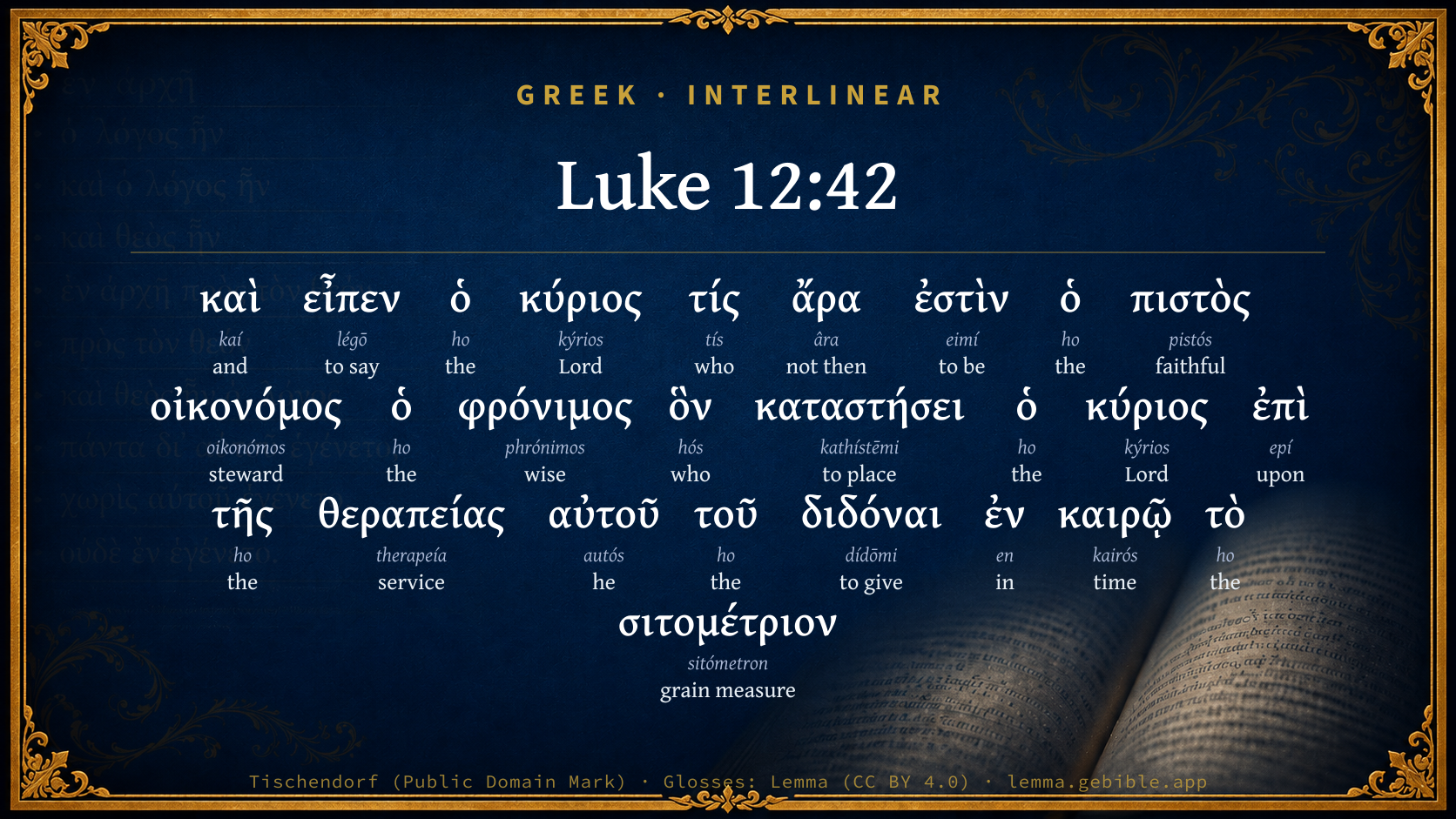
Download image
Cite this verse

Luke 12:42 (World English Bible). Public Domain. Lemma interlinear Bible study tool, https://lemma.gebible.app/v/luke/12/42.

Show BibTeX & RIS
BibTeX
RIS
English Translation
The Lord said, "Who then is the faithful and wise steward, whom his lord will set over his household, to give them their portion of food at the right times?
World English Bible · Public Domain
Highlights
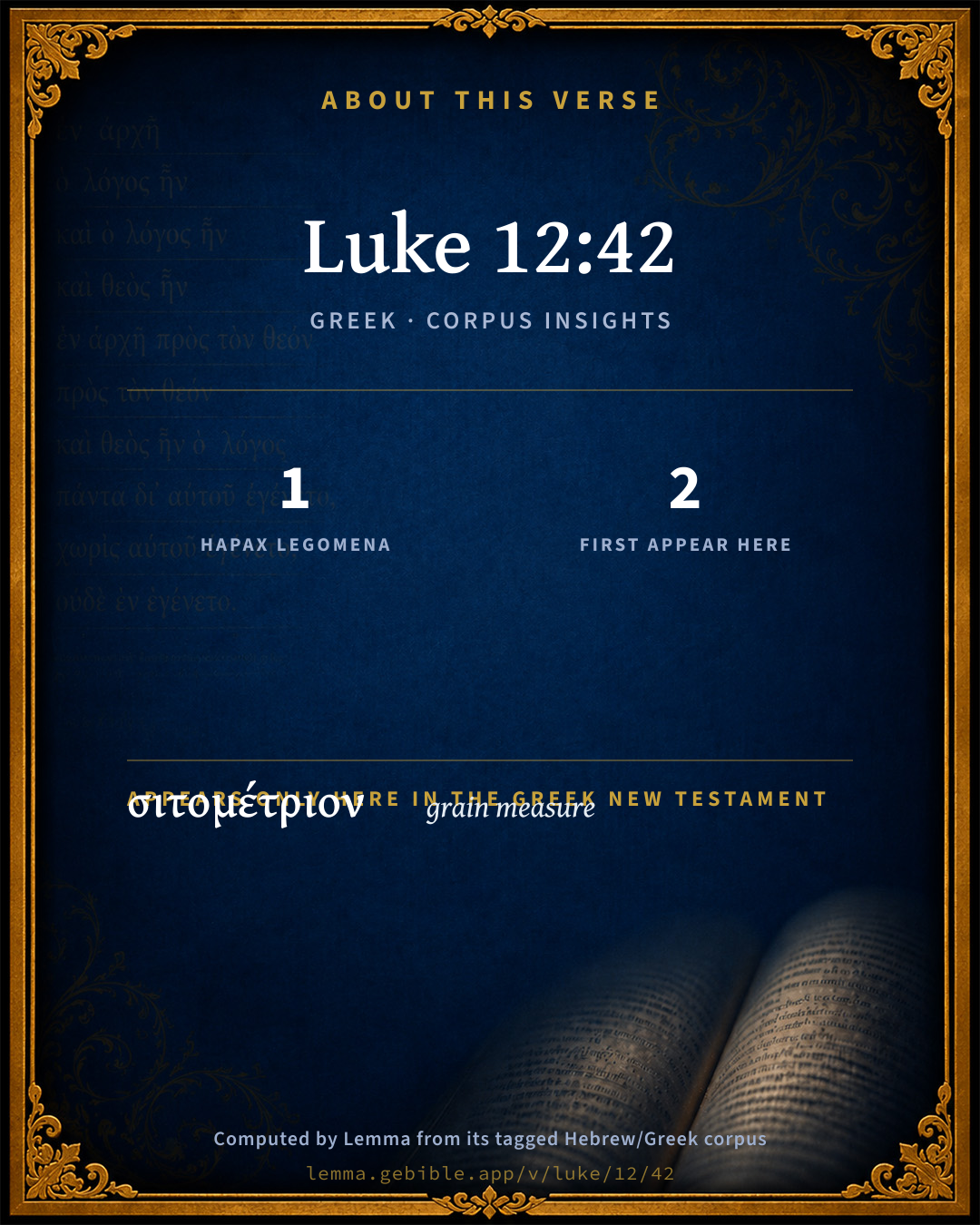
  • 1 hapax legomenon — only here in the Greek New Testament
  • 2 first appearances in the Greek New Testament
Full analysis ↓
Download a study sheet

One document with this verse’s original text, its word-by-word gloss line, the meaning frame, cross-references with their text, attributed commentary, and full source and license credits — printable, and it pastes into notes with its structure intact.

This verse Autodidact and up

Study sheet (.html) Plain text (.txt)

A passage Seminary Student

Up to 50 verses in one chapter. A passage sheet keeps up to 6 commentary sources and 12 cross-references per verse, in the order this page ranks them, and says so on the sheet whenever that leaves anything out. Ask for a single verse and you get the Autodidact verse sheet above.

Everything on this page stays free to read, with no account — the sheet is a download of what is already on screen, not access to it.

Want to remove ads? Support Godless Engineer
Compare translations 3

The same verse in 3 English versions, stacked beneath the original-language interlinear above. Click any original word for its lexicon entry.

Each is an independent rendering of the whole verse — the interlinear is not word-aligned to these translations.

Highlighted words mark where these versions differ — a whole-verse word diff, not a word-by-word alignment.

  • World English Bible Public Domain
    The Lord said, "Who then is the faithful and wise steward, whom his lord will set over his household, to give them their portion of food at the right times?
  • King James Version Public Domain
    And the Lord said, Who then is that faithful and wise steward, whom his lord shall make ruler over his household, to give them their portion of meat in due season?
  • unfoldingWord Literal Text CC BY-SA 4.0
    And the Lord said, “Who then is the faithful, wise manager whom the master will appoint over his care to give them their portion of food in time?

unfoldingWord Literal Text — © unfoldingWord, licensed CC BY-SA 4.0. Word-aligned USFM3 via Door43 (git.door43.org/unfoldingWord/en_ult).

Versions to compare (up to 4)

3 of 4 selected

Show all 19 translations

Every available English version of this verse, each an independent rendering of the whole verse.

  • World English Bible Public Domain
    The Lord said, "Who then is the faithful and wise steward, whom his lord will set over his household, to give them their portion of food at the right times?
  • Berean Standard Bible Public Domain
    And the Lord answered, “Who then is the faithful and wise manager, whom the master puts in charge of his servants to give them their portion at the proper time?
  • Majority Standard Bible Public Domain
    And the Lord answered, “Who then is the faithful and wise manager, whom the master puts in charge of his servants to give them their portion at the proper time?
  • King James Version Public Domain
    And the Lord said, Who then is that faithful and wise steward, whom his lord shall make ruler over his household, to give them their portion of meat in due season?
  • American Standard Version (1901) Public Domain
    And the Lord said, Who then is the faithful and wise steward, whom his lord shall set over his household, to give them their portion of food in due season?
  • Revised Version (1885) Public Domain
    And the Lord said, Who then is the faithful and wise steward, whom his lord shall set over his household, to give them their portion of food in due season?
  • Geneva Bible (1599) Public Domain
    And the Lord saide, Who is a faithfull steward and wise, whom the master shall make ruler ouer his householde, to giue them their portion of meate in season?
  • Douay-Rheims (1899) Public Domain
    And the Lord said: Who (thinkest thou) is the faithful and wise steward, whom his lord setteth over his family, to give them their measure of wheat in due season
  • Young's Literal Translation Public Domain
    And the Lord said, `Who, then, is the faithful and prudent steward whom the lord shall set over his household, to give in season the wheat measure?
  • Literal Standard Version CC BY-SA 4.0
    And the LORD said, “Who, then, is the faithful and prudent steward whom the lord will set over his household, to give in season the wheat measure?
  • Unlocked Literal Bible CC BY-SA 4.0
    The Lord said, “Who then is the faithful and wise manager whom his lord will set over his other servants to give them their portion of food at the right time?
  • unfoldingWord Literal Text CC BY-SA 4.0
    And the Lord said, “Who then is the faithful, wise manager whom the master will appoint over his care to give them their portion of food in time?
  • Darby Bible Public Domain
    And the Lord said, Who then is the faithful and prudent steward, whom his lord will set over his household, to give the measure of corn in season?
  • World Messianic Bible Public Domain
    The Lord said, “Who then is the faithful and wise steward, whom his lord will set over his household, to give them their portion of food at the right times?
  • Webster's Bible Public Domain
    And the Lord said, Who then is that faithful and wise steward, whom his lord shall make ruler over his household, to give them their portion of provisions in due season?
  • Free Bible Version CC BY-SA 4.0
    The Lord replied, “Who then is the trustworthy and wise manager, the one person in the household that the master puts in charge to share out their food at the right time?
  • Bible in Basic English Public Domain
    And the Lord said, Who then is the wise and responsible servant whom his lord will put in control of his family, to give them their food at the right time?
  • Text-Critical English NT CC BY 4.0
    The Lord said, “Who then is the faithful and wise steward, whom his master will set over his household, to give them their portion of food at the proper time?
  • Tyndale New Testament (1534) Public Domain
    And the Lorde sayde: If there be any faith full servaut and wise whom his Lorde shall make ruler over his housholde to geve them their duetie of meate at due season:

Literal Standard Version (2020), Covenant Press — licensed CC BY-SA 4.0. Text via the HelloAO Bible API (eBible.org). Unlocked Literal Bible (unfoldingWord) — licensed CC BY-SA 4.0. Text via the HelloAO Bible API (eBible.org). unfoldingWord Literal Text — © unfoldingWord, licensed CC BY-SA 4.0. Word-aligned USFM3 via Door43 (git.door43.org/unfoldingWord/en_ult). Free Bible Version, Dr. Jonathan Gallagher — licensed CC BY-SA 4.0. Text via the HelloAO Bible API (eBible.org).

Word by word

More ways to search: Search by grammar → Find every occurrence → Compare this word →

Practice this passage: Drill this verse → Learn its vocabulary →

σιτομέτριον
sitómetron
G4620
“grain measure”
Noun, Accusative, Singular, Neuter
Part of Speech
Noun
Case
Accusative
Number
Singular
Gender
Neuter
Full Thayer's Definition

Origin: from G4621 and G3358

TDNT: None

1. a measured 'portion of' grain or 'food'
  1. καὶ kaí G2532 “and” Conjunction
  2. εἶπεν légō G3004 “to say” Verb, Aorist, Active, Indicative, 3rd person, Singular
  3. ὁ ho G3588 “the” Article, Nominative, Singular, Masculine
  4. κύριος kýrios G2962 “Lord” Noun, Nominative, Singular, Masculine
  5. τίς tís G5101 “who” Interrogative pronoun, Nominative, Singular, Masculine
  6. ἄρα âra G687 “not then” Particle, Interrogative
  7. ἐστὶν eimí G1510 “to be” Verb, Present, Active, Indicative, 3rd person, Singular
  8. ὁ ho G3588 “the” Article, Nominative, Singular, Masculine
  9. πιστὸς pistós G4103 “faithful” Adjective, Nominative, Singular, Masculine
  10. οἰκονόμος oikonómos G3623 “steward” Noun, Nominative, Singular, Masculine
  11. ὁ ho G3588 “the” Article, Nominative, Singular, Masculine
  12. φρόνιμος phrónimos G5429 “wise” Adjective, Nominative, Singular, Masculine
  13. ὃν hós G3739 “who” Relative pronoun, Accusative, Singular, Masculine
  14. καταστήσει kathístēmi G2525 “to place” Verb, Future, Active, Indicative, 3rd person, Singular
  15. ὁ ho G3588 “the” Article, Nominative, Singular, Masculine
  16. κύριος kýrios G2962 “Lord” Noun, Nominative, Singular, Masculine
  17. ἐπὶ epí G1909 “upon” Preposition
  18. τῆς ho G3588 “the” Article, Genitive, Singular, Feminine
  19. θεραπείας therapeía G2322 “service” Noun, Genitive, Singular, Feminine
  20. αὐτοῦ autós G846 “he” Personal pronoun, Genitive, Singular, Masculine
  21. τοῦ ho G3588 “the” Article, Genitive, Singular, Neuter
  22. διδόναι dídōmi G1325 “to give” Verb, Present, Active, Infinitive
  23. ἐν en G1722 “in” Preposition
  24. καιρῷ kairós G2540 “time” Noun, Dative, Singular, Masculine
  25. τὸ ho G3588 “the” Article, Accusative, Singular, Neuter

About this verse

These counts appear in no published source. They are computed here, from the morphology-tagged text and Lemma’s own curated glosses. What Lemma adds →

26
words
19
distinct lemmas
Gospels
section

Notable vocabulary

1 hapax legomenon — a word that appears only here in the entire Greek New Testament:

  • σιτομέτριον grain measure G4620

First appearance in Scripture

These words make their first canonical appearance in the Greek New Testament here:

  • οἰκονόμος steward G3623
  • σιτομέτριον grain measure G4620

Shared distinctive vocabulary

θεραπείας service G2322 occurs in 3 verses of the Greek New Testament. Also found in:
Repetition

Words recur within this verse:

Cross-references

23

Topical passages linked to Luke 12:42 in the Treasury of Scripture Knowledge — connected by theme and wording, ordered by reader-vote popularity; previews shown in the World English Bible.

  • Matthew 24:45–46 "Who then is the faithful and wise servant, whom his lord has set over his household, to give them their food in due season?
  • 1 Corinthians 4:1–2 So let a man think of us as Christ's servants, and stewards of God's mysteries.
  • Hebrews 13:17 Obey your leaders and submit to them, for they watch on behalf of your souls, as those who will give account, that they may do this with joy, and not with groaning, for that would be unprofitable for you.
  • 1 Peter 4:10 According as each has received a gift, be ministering it among yourselves, as good stewards of the grace of God in its various forms.
  • 1 Peter 5:1–4 I exhort the elders among you, as a fellow elder, and a witness of the sufferings of Christ, and who will also share in the glory that will be revealed.
  • Luke 19:15–19 "It happened when he had come back again, having received the kingdom, that he commanded these servants, to whom he had given the money, to be called to him, that he might know what they had gained by conducting business.
  • Acts 20:28 Take heed, therefore, to yourselves, and to all the flock, in which the Holy Spirit has made you overseers, to shepherd the assembly of the Lord and God which he purchased with his own blood.
  • 2 Timothy 4:2 preach the word; be urgent in season and out of season; reprove, rebuke, and exhort, with all patience and teaching.
  • Proverbs 15:23 Joy comes to a man with the reply of his mouth. How good is a word at the right time!
  • Isaiah 50:4 The Lord Yahweh has given me the tongue of those who are taught, that I may know how to sustain with words him who is weary: he wakens morning by morning, he wakens my ear to hear as those who are taught.
  • Ezekiel 34:3 You eat the fat, and you clothe you with the wool, you kill the fatlings; but you don't feed the sheep.
  • John 21:15–17 So when they had eaten their breakfast, Jesus said to Simon Peter, "Simon, son of Jonah, do you love me more than these?" He said to him, "Yes, Lord; you know that I have affection for you." He said to him, "Feed my lambs."
  • 1 Timothy 5:17 Let the elders who rule well be counted worthy of double honor, especially those who labor in the word and in teaching.
  • Titus 1:7 For the overseer must be blameless, as God's steward; not self-pleasing, not easily angered, not given to wine, not violent, not greedy for dishonest gain;
  • Hebrews 3:5 Moses indeed was faithful in all his house as a servant, for a testimony of those things which were afterward to be spoken,
  • Hebrews 13:7 Remember your leaders, men who spoke to you the word of God, and considering the results of their conduct, imitate their faith.
  • Jeremiah 23:4 I will set up shepherds over them, who shall feed them; and they shall fear no more, nor be dismayed, neither shall any be lacking, says Yahweh.
  • Matthew 13:52 He said to them, "Therefore, every scribe who has been made a disciple in the Kingdom of Heaven is like a man who is a householder, who brings out of his treasure new and old things."
  • Matthew 20:8 When evening had come, the lord of the vineyard said to his steward, 'Call the laborers and pay them their wages, beginning from the last to the first.'
  • Matthew 25:20–23 He who received the five talents came and brought another five talents, saying, 'Lord, you delivered to me five talents. Behold, I have gained another five talents besides them.'
  • Luke 7:13 When the Lord saw her, he had compassion on her, and said to her, "Don't cry."
  • Luke 16:1–31 He also said to his disciples, "There was a certain rich man who had a manager. An accusation was made to him that this man was wasting his possessions.
  • 1 Timothy 3:15 but if I wait long, that you may know how men ought to behave themselves in the house of God, which is the assembly of the living God, the pillar and ground of the truth.

Cross-references courtesy of OpenBible.info (CC BY 4.0).

Commentary

Notes on Luke 12:42 from classic Christian and Jewish commentators (each source and its license shown beneath its notes). The classic Christian expositions comment on the surrounding passage and are grouped to its opening verse, so a note may address several verses; the Jewish commentaries on the Tanakh (Rashi and others) are per-verse, so they appear only where the commentator wrote on this verse.

Lemma curates 59 commentaries, every one of them public domain or Creative Commons licensed, each selected and text-cleaned for this edition rather than reprinted as found. About our sources →

The Biblical Illustrator

Joseph S. Exell

Luk_12:42-44

That faithful and wise steward

Our stewardship

I.

HERE IS REPRESENTED A SITUATION OF WEIGHTY RESPONSIBILITY. A stewardship. All responsibility on the part of man is owing to God.

1. And first, my brethren, let it be remarked that God, on this principle and in this relationship of responsibility, or of stewardship, has endowed us with natural faculties: faculties which impart to us a dominion and empire over the various orders of that material creation by which we are surrounded; faculties which enable us to distinguish between right and wrong, between good and evil; faculties which therefore entitle us to comprehend the purposes for which moral government is formed; and faculties which permit our assimilation to the attributes and image of our Maker, that assimilation by which, most of all, He is dignified and honoured. There are, my brethren, you observe in these cases, entrustments which are committed to all, and the improvement of which is required from all, excepting, indeed, in cases of sad and mysterious affliction, or where it is usurped by madness. And those who, from time to time, have conceived, whether truly or falsely, that they have received an amount of natural faculties greater than the ordinary measure, must always remember, with deep and with prayerful solemnity, that what remains for them is nothing but humility, and seriousness, and diligence, and prayer.

2. Secondly, let it be observed that upon this principle and assimilation of stewardship God has also endowed us with many advantages and blessings. The comforts that men derive from their measure of worldly substance and competency, whatever it may be, and the comforts which they derive from the intimacies of friendship and the sweet and tender endearments of private and domestic life, ought not to escape enumeration, and ought not to be meanly esteemed.

3. God, on this principle of stewardship, has also endowed us with many religious privileges. He has endowed us with many religious privileges: that is to say, those means that are eminently adapted to instruct His creatures in the knowledge of His will, and to prepare them and guide their feet into the ways of quietness and peace.

II. Here is presented AN IMPORTANT CHARACTER BY WHICH THIS SITUATION IS DISTINGUISHED. The Redeemer, you observe, speaks of the faithful and wise stewards love to the cause of his master. What we intend now to remark on this is, that these are the attributes which it is desirable that every human being should sustain with respect to that stewardship under which he is placed.

1. To be faithful and wise stewards, men must ascertain the nature of the duty which is imposed.

2. To be faithful and wise stewards, men must love the duty which is imposed.

3. To be faithful and wise stewards, men must practically perform the duty which is imposed.

4. To be faithful and wise stewards, men must habitually contemplate the account to be rendered of the duty which is imposed.

III. THE DELIGHTFUL RESULTS IN WHICH THE MAINTENANCE OF THAT CHARACTER IN THAT SITUATION IS TO TERMINATE.

1. The public approbation of the Divine Master.

2. The introduction to substantial honour, and perfect and eternal happiness. (J. Parsons.)

A faithful steward

The other day! [Rev. F. S. Cook, D.D., in Altering the Gospel] received a communication from a lawyer, who says that a very large owner has discovered that a very small piece of property belongs to him, and not to the small proprietor in whose possession it has for a very long time remained. The matter seemed a trifling one. We had a conference, and there came the steward with the lawyers, and he was furnished with maps, and, putting on his spectacles, examined them with great care. Why? It was a small matter to him, but because he was a steward he was expected to be faithful. And when he found that this small piece of ground belonged to his lord he was determined to have it. So let me say--as stewards of the gospel of God-never give up one verse, one doctrine, one word of the truth of God. Let us be faithful to that committed to us, it is not ours to alter. We have but to declare that which we have received.

Christian devotedness

Did you never read Henry Martyns life, a polished scholar, a man of learning and repute, giving up all for Christ to go to Persia and there to die without having seen a convert, perhaps, and yet content to live, content to die, in far-off lands for his Masters sake? Did you never read of Brainerd far away among the Indians, toiling on, and in his old age teaching a poor black child its letters, and thanking God that when he could not preach, he could yet teach the child its letters, and so do something for his dear Lord who had done so much for him? Ay, did you never read and think of even St. Francis Xavier, papist as he was? Yet what a man, how consecrated, how zealous! with all his errors, and all his mistakes, and all his faults, yet passing over sea and land, penetrating forests, and daring death a thousand times, that he might spread abroad the poor misguided doctrines which he believed. As much as I hate his teaching, I admire his all but miraculous zeal. When I think of some such men; when I would fain censure their mistakes, I can only censure myself that I cannot even so much as think, or cannot do more than think of living such a life as they lived. (C. H. Spurgeon.)

Blessed is that servant

The blessedness of the well-employed servant

I. WE ARE ARE OF US SERVANTS AND STEWARDS, AND ARE TO BE IN EMPLOYMENT. We must be doing. Religion is no idle and lazy thing, it is not sluggish and sleepy, it is not drowsy and lethargic, but it is lively and active, vigorous and operative, and always puts us upon holy endeavours and enterprizes. A Christian is not made to stand still and dig nothing. His soul and all its faculties were given him for some great design, and fitted for some excellent use and work.

II. IT IS NOT ENOUGH TO BE EMPLOYED AND TO BE DOING SOMETHING; WE MUST BE SO DOING--doing our Masters work. We had better be doing nothing than not be so doing--so run, that ye may attain, saith the apostle. The racer may run, and with full speed, and yet never reach the goal, never obtain the prize, for he may run out of the way, and make haste from the mark. And though he keeps the way, he may not be swift enough. The manner as well as the matter o! religion is to be minded, and the latter of these chiefly. I shall endeavour, then, to explain this duty of a Christian in my text; I will show you what it is to be so doing, and I pray God the several particulars, which are all plain and intelligible, may have influence on our lives and practices, that when our Lord shall come, we may be found employed about these following things.

1. Meditating and examining ourselves, serious consideration and reflection on our ways. The Christian is to be busied within doors; he is to be rifling his own breast, and taking account of the inward frame and disposition of his heart.

2. Watching is another exercise meant here by the so doing, as you may see in Luk_12:37-38 of this chapter. You are, then, to watch over your hearts, and to keep them with all diligence. And moreover, you are to watch over your actions and lives; you must avoid the occasions of every vice, and keep a strict guard over your senses, which are the common inlets to sin, and betray you to the commission of the greatest follies. Behold! I come as a thief (saith Christ), blessed is he that wateheth Rev_16:15).

3. Praying is another good and laudable posture to be found in when our Lord cometh. Watch and pray go hand in hand together, and they are never more seasonable than when we are expecting the coming of our Lord.

4. Lamenting and sorrowing for our sins is to be so doing; and is another good work to be found in when we are to depart hence, and appear before the impartial tribunal of heaven. Our sins and failings are very numerous, our slips and offences are many and frequent, and we cannot sufficiently lament and bewail our folly, and implore the Divine pardon, and invoke the assistance of the Holy Spirit, but let us resolve to do it with all our might, and with sincere and upright hearts, that our present sorrows and lamentations may give us an entrance into undisturbed joy and felicity.

5. Whilst we have opportunity, let us reckon it our duty and interest to be constantly attending on Gods holy ordinances, not only that of prayer (before mentioned), but that of reading and hearing Gods Word; also the Holy Communion.

6. Doing of works of charity to the souls and bodies of our brethren is an acceptable employment, and will render our last accounts easy to us.

7. Serving God in the several particular callings and places wherein He hath set you is a work which you should endeavour to be found doing. Let me tell you, you serve God by your secular vocations; you may bring glory to Him even by your worldly employment, though it be never so mean and contemptible. The poorest labourer, by a conscientious discharge of his proper trust, by diligence and honesty, is in a capacity to honour his Maker and the religion which he professes. Every one in the sphere and orb wherein Providence hath fixed him must act, move, and influence. Serve God with constancy both in your general and particular calling. This is Christianity, and this will bring a blessing upon you and yours.

III. OUR LORD WILL COME AND TAKE AN ACCOUNT OF WHAT WE HAVE DONE. The Master will come and visit His servants whom He hath set on work. My brethren, our Lord observes and minds what we do; He takes notice whether we be idle or watchful, whether we busy ourselves about His work or Satans. And it will not be long before He comes and reckons with us for all our past demeanour. The days of accounting are these two, death and the last judgment. These are the set times of our Lords coming, and none can reverse and escape them. The voluptuous and debauched person must appear before that great tribunal, and give an account of his wild and brutish deportment; the unclean person who shunned the light, and thought to conceal his folly by darkness and retirements, must then appear and stand out in the open view of the world, and be accountable for his lewd and lascivious practices. The profane swearer, who blasphemed the holy name of God and His Son Jesus, must then bow and prostrate himself to Him whom he before profaned. The mighty oppressor, who escaped here the earthly judge, and by his wealth and power made himself too great for human judicature, must stand at that great bar and submit to the fatal sentence. The hypocrite, who thought to deceive God as well as his neighbours, shall appear then in his true shape, which he never did before. The uncharitable man, the fomenter of strife and discord, the man that haled others before the judge, must himself appear before the Judge of heaven and earth, and answer for all his unchristian and unbrotherly behaviour.

IV. THOSE SERVANTS WHOM CHRIST AT HIS COMING SHALL FIND ABOUT HIS WORK AND BUSINESS ARE IN A BLESSED AND HAPPY CONDITION.

1. How comfortable must it needs be to a holy person that he hath not only all his lifetime endeavoured sincerely to serve his God, and to do all the good he could in the world, but that, by Gods grace assisting him, he hath persevered in the same course until death; and now that he is to depart this life he is not employed in the works of darkness, he is not displeasing God, and offending good men, but he is about his Masters business, and he expires his last breath in the discharge of his duty. Blessedness is entailed on the servant who thus behaves himself. If you consider the nature of the thing itself it cannot be otherwise, for he being made by God to serve Him, and to be wholly at His beck and disposal, it must needs be that his satisfaction and happiness should consist in conforming himself to Gods will, and in acting according to His laws and commands. I may add likewise that God will protect His servants in the discharge of His own work. They are safe whilst they are doing what He sets them about. Come what will, they cannot be miserable. The summary application of all may be that of 2Pe_3:11. Seeing, then, that all these things shall be dissolved (seeing that the day of the Lord approaches, and Christ will come to judge thee speedily, either at death or at the last judgment), what manner of persons ought ye to be in all holy conversation and godliness? how exemplary should your lives and conversations be? how zealous should you show yourselves in all the exercises of religion. Give me leave to direct you (as to this great matter) in these few words:

1. Pray more fervently. Unite all your forces now and wrestle with God, and cry mightily unto Him for yourselves, for this place where you inhabit, and for the whole land of your nativity.

2. Disengage your affections more resolvedly from the world. You are convinced by this time, surely, that the world is vain and uncertain. Dote not on its enjoyments, sink not your souls into earth, plunge them not into the mire, be indifferent as to all things here below, and be ready to part with any of this worlds goods.

3. Oppose vice more vigorously than ever, and the rather because of those many strong temptations you meet with in this degenerate and corrupted age.

4. Breathe after heaven more passionately. Let the ill things which you behold here below be the occasion of raising your thoughts and desires toward those mansions above where nothing inhabits but what is pure and holy.

5. Let your lives and actions acquaint the world how mindful you are of that great account which you are to give at the coming of the Lord. Desire to be found doing your Masters work, and then be not solicitous about the wages, but assure yourselves that that will be a recompense far beyond your thoughts and wishes. Wherefore comfort one another with these words. (John Edwards, D. D.)

The faithful servant

I. THE FAITHFUL PRINCIPLES OF THE TRUE SERVANT OF GOD.

1. He views God as an ever-present Master.

2. He acknowledges God as the Giver of life and salvation to his perishing soul.

II. THE HONOURABLE OCCUPATIONS OF THE TRUE SERVANT OF GOD. He considers himself to be entrusted with various gifts; not for his own pleasure, but for Gods glory; not for selfish ends, but for the highest good of his fellow-creatures. All that he possesses he considers as being his Lords goods; and he does not dare to waste any part of them. He takes an inventory of what is committed to him, and occupies or trades therewith. He turns everything to good account; he squanders nothing. To this end, moreover, he often reviews his own proceedings; and these self-examinations are preparatory to that last solemn hour when it shall be said, Give an account of thy stewardship; for thou mayest be no longer steward. See how he dedicates his talents to the Most High, and employs all his mind for God! What poor, ignorant sinners, whether at home, or heathen abroad, can I bring to the knowledge of Christ? What afflicted person can I comfort? What tempted servant of Christ can I succour? What neighbour, or friend, or relative, that is unconverted, can I win to Christ? Thus, moreover, he lays out his time; his years, his days, his very hours are engaged for God.

III. THE GENEROUS DISPOSITIONS OF THE TRUE SERVANT OF GOD. In one word--love. Therefore, nothing is irksome, nothing burdensome.

IV. THE REWARD WHICH SHALL BE GIVEN TO THE TRUE SERVANT OF GOD.

1. He is commended.

2. He is promoted.

3. He is admitted to joys inconceivable. (Dr. Jowett, M. A.)

The blessedness of the faithful servant

I. THE HONOURABLE OCCUPATION DESCRIBED IS THAT OF A SERVANT DILIGENTLY EMPLOYED IN HIS MASTERS WORK.

1. Labour is not necessarily and essentially a curse. Adam in Eden. Labour in itself is invigorating, promoting the welfare of the body and the cheerfulness of the mind, while it tends to keep the heart from the power of those temptations which find in the idle and unoccupied an easy prey. It is idleness in all its forms against which the displeasure of our God is expressed with repeated emphasis in the sacred Scriptures. And labour is honourable, whether in the lowly engagements of those who tread the humbler walks of life, or in the more imposing pursuits of those who occupy the prominent stations of society; whether the miner who labours in the bowels of the earth, or the author who with his pen records the processes and results of laborious thought for the guidance of his fellowmen. God has prescribed labour as one of the lasting arrangements of the social world. Everything is full of labour, from the glowing seraph, who flies through boundless space, the willing agent of Almighty will, down to those mysterious laws which keep the universe in being and secure its destined aims; and man is to be no exception, his varied powers of body and of mind were bestowed, net to evaporate in listless, dreamy idleness, to be prostituted for the needs of selfishness and pleasure, but to be employed in active, healthful toil; hence we say labour is honourable. And if prescribed and honourable in the social world, much more so is its relation to the religion of Jesus. He would have no idlers in His kingdom. The idea of our text is that of a servant diligently engaged with his work. Now this, you know, is not the case with all; by some it is done partially, sluggishly, grudgingly, fitfully; but the character here described is supposed to recognize his obligation, without which no one will prove a faithful servant; to carry out his obligations with perseverance, feeling that every day has its claim, and every hour its demand; and further, seeking his Masters approbation, and thus making his labour his delight, as will always be the case when the smile of approbation is felt to be a coveted reward and a gratifying recompense. This we have described as an honourable position, and contrast justifies the representation. How unlike the trifler and the profligate is the course of the faithful servant!

2. Such a character is honourable in the unprejudiced estimate of the world. To whom do we look back with reverence and esteem? To the men who lived solely for selfish ends, either that they might amass a fortune or obtain a name? or to those who spent their all in riotous living? Oh no, they have passed into a silence as complete as the destruction they have secured, or are remembered only as warnings to others to avoid their folly and escape their doom. It is the patriot toiling or suffering for his countrys good. A Howard or a Fry risking the infection of disease in their efforts to alleviate the sufferings or restrain the progress of guilt--the humble, devoted instructor of youthful ignorance--the faithful pastor--the sanctified intellect--the self-denying philanthropist--these are they whom the world, with all its evils, yet delights to honour--whose names are embalmed in fragrant recollection, who are looked upon as men who are held up for the admiring imitation of succeeding generations--these, the servants diligently and faithfully engaged in their work, are the lights of the world and the salt of the earth.

3. Such characters are honourable in the approving representations of Gods own Word.

II. CONSIDER THE BLESSEDNESS WITH WHICH SUCH COURSE SHALL BE CROWNED. Blessed is that servant, whom his Lord when He cometh shall find so doing.

1. Here we are referred to a solemn event, the coming of the Master.

2. And yet further, the form of our text suggests to us the uncertainty of the mode and the moment of the Masters arrival. Uncertainty--not with Him, for known unto God are all things from the foundation of the world, but uncertainty as respects ourselves; the moment is hastening on, but we know it not--the mode is arranged and fixed, but it is not revealed. Nor can any careful induction of facts lead us to any reliable conclusion as to what awaits us--under what circumstances, or at what time, the Master will come to us. Sometimes we see the servant left to toil on through the whole extent of the wilderness, like Joshua and Caleb, while others enter the promised land in the springtide of their youth or in the full yet undecayed maturity of advanced years: wearisome sickness sometimes makes the exhausted traveller cry, Come, Lord Jesus, come quickly, while others, spared the struggle and the dying strife, drop the coil of mortality and soar away on more than eagles wings, and find themselves at rest. None, none can tell the hour or foresee the mode by which he shall be summoned to the final interview, yet the event with all its details is determined and known to Him in whom we live and move and have our being. The time is settled when, by the slow process of decay, or suddenly without previous notice, amid scenes of pleasure, the occupations of business, or in the solitude of retirement, we shall hear the Masters voice, and be called to appear before Him. (Henry Madgin.)

The Biblical Illustrator, edited by Joseph S. Exell (c. 1880s–1900s) — public domain. Text from a community e-Sword module.

Tyndale Open Study Notes

Tyndale Open Resources

12:42 The faithful, sensible servant was a household manager. Wealthy homeowners appointed gifted and educated slaves as chief executive officers over their affairs.

Tyndale Open Study Notes — © Tyndale Open Resources, licensed CC BY-SA 4.0. Text via the HelloAO Bible API.

Bengel's Gnomon

Johann Albrecht Bengel

Luk 12:42. Τίς, who) The Lord does not expressly reply to the question of Peter; but yet He intimates, that He addresses the parable strictly to the disciples (for the steward is distinct from the household committed to him): and He shapes His address to them in the singular number, so as thereby to stimulate them singly and individually the more. Then in Luk 12:54-55, He says something to all then present, reproving the people, inasmuch as, not as yet having become sensible of the truth of the Messiah’s first Advent, they were not able to comprehend the doctrine of the Second Advent.—καταστήσει, shall appoint [‘make’]) The Future tense: because it is faithfulness [which had yet to be proved] that makes the servant worthy to be appointed over the household. A new καταστήσει, shall appoint [‘make’], follows in Luk 12:44. There is a gradation from the charge over the ‘household,’ to that over “all that He hath” [all his goods, τοῖς ὑπάρχουσιν αὐτοῦ].

Bengel's Gnomon of the New Testament — English translation (T&T Clark, Edinburgh, 1860) — public domain. Text from a community e-Sword module.

Meyer's Critical & Exegetical Commentary

Heinrich August Wilhelm Meyer

Luk_12:42-44. In the pregnant style characteristic of Jesus as it most of all appears in John, He makes no direct reply to that question, but proceeds with His parable of the servants, and among these He now for the first time begins to speak of that one (the apostles generally cannot be described in Luk_12:42-46) whom He, before His departure, would set over the rest of the household as οἰκονόμος (the post destined for Peter!). He depicts his great recompense in the event of his being faithful, and his heavy punishment in the event of his being unfaithful (down to Luk_12:48); and He consequently made Peter, whose question betrayed an inconsiderate exaltation above the crowd, understand His reply to mean: Instead of meddling with that question, thou hast thine own consequent position to keep in view with fear and trembling! Then, however, Luk_12:47 f., he links on the general law of retribution under which every one comes, and which every one has to lay to heart. As to the reference of τίς ἄρα, and the relation of the question to Luk_12:43, see on Mat_24:45 f.

Meyer — Critical and Exegetical Commentary on the New Testament — English translation by Peter Christie, edited by Frederick Crombie (T&T Clark, 1880) — public domain. Text from a community e-Sword module.

Expositor's Greek Testament

ed. W. Robertson Nicoll

Luk 12:42 . ὁ Κύριος , the Lord, in narrative. τίς ἄρα , etc.: in Mt. this is connected immediately with the thought in Luk 12:40 , so that Peter’s interpellation appears as an interruption of a continuous discourse. Some variations from Mt.’s text are noticeable in Lk.’s version: οἰκονόμος for δοῦλος , καταστήσει (future) for κατέστησεν (aorist), θεραπείας for οἰκετείας , σιτομέτριον for τροφὴν . These changes, according to Weiss and Holtzmann (H. C.), are due to the parable being connected with the Apostles, and one can see some plausibility in the hypothesis so far as the first two variations are concerned. The question: who then, etc., is supposed to answer itself: who but each of you apostles, who especially but you Peter?

Luk 12:42 . σιτομέτριον , the due portion of food; a word of late Greek. Phryn., p. 383, forbids the use of σιτομετρεῖσθαι , and enjoins separation of the compound into its elements: σίτον , μετρεῖσθαι . The noun occurs here only; the verb in Gen 47:12 and occasionally in late Greek authors.

The Expositor's Greek Testament, edited by W. Robertson Nicoll (1897–1910) — public domain. Text from a community e-Sword module.

Geneva Bible (1599)

Geneva Bible translators

That is, every month such measure of corn as was appointed them.

Geneva Bible (1599) marginal notes — public domain. Text via Bolls.life.

Jamieson, Fausset & Brown

Robert Jamieson, A. R. Fausset & David Brown

Who then, &c.--answering the question indirectly by another question, from which they were left to gather what it would be:--To you certainly in the first instance, representing the "stewards" of the "household" I am about to collect, but generally to all "servants" in My house.

faithful and wise--Fidelity is the first requisite in a servant, wisdom (discretion and judgment in the exercise of his functions), the next.

steward--house steward, whose it was to distribute to the servants their allotted portion of food.

shall make--will deem fit to be made.

Jamieson, Fausset & Brown — Commentary Critical and Explanatory on the Whole Bible (1871) — public domain (CC PDM 1.0). Text via the HelloAO Bible API.

Adam Clarke's Commentary

Verse 42. Faithful and wise steward] See Clarke on Mt 24:45; where the several parts of the steward's office are mentioned and explained. Those appear to have been stewards among the Jews, whose business it was to provide all the members of a family, not only with food, but with raiment.

Adam Clarke's Commentary on the Bible (1810–1826) — public domain. Text from a community e-Sword/MySword module.

Ellicott's Commentary for English Readers

(42-46) Who then is that faithful and wise steward?—See Notes on Mat_24:45-51. Here the words come as an answer to Peter’s question. The promise was spoken, not for the Twelve only, but for every faithful and wise steward. The words are as the germ of the parable which sets forth the wisdom, though not the faithfulness, of the Unjust Steward (Luk_16:8-10). If wisdom and prudence alone deserved the praise there bestowed on it, what would be due to wisdom and faithfulness united? In St. Paul’s words, “It is required in stewards that a man be found faithful” (1Co_4:2), we may, perhaps, recognise one of the many traces left on his Epistles by the companionship of St. Luke. (See Introduction.)

A Bible Commentary for English Readers, edited by Charles John Ellicott (1878–1897) — public domain. Text from a community e-Sword module.

The Cambridge Bible for Schools and Colleges

gen. ed. J. J. S. Perowne

42. Who then is that faithful and wise steward] Our Lord, in the deeply instructive method which He often adopted, did not answer the question, but taught the only lesson which was needful for the questioner. St Paul perhaps refers to these words of Christ in 1Co_4:1-2.

their portion of meat in due season] “Take heed therefore unto yourselves, and to all the flock over which the Holy Ghost hath made you overseers, to feed the church of God,” Act_20:28.

The Cambridge Bible for Schools and Colleges (gen. ed. J. J. S. Perowne; Cambridge University Press, 1878–1918) — public domain. Text from a community e-Sword module.

John Gill's Exposition

Blessed is that servant,.... Who is faithful and wise, rules well, and discharges his trust with integrity, and disposes of the provisions of the house, in his hands, with great discretion and prudence:

whom his Lord, when he cometh; to take vengeance on the wicked Jews, or by death, or at judgment:

shall find so doing; behaving as a good ruler, and as a wise and faithful steward.

John Gill's Exposition of the Whole Bible (1746–1763) — public domain (CC PDM 1.0). Text via the HelloAO Bible API.

Trapp's Complete Commentary

John Trapp

42 And the Lord said, Who then is that faithful and wise steward, whom his lord shall make ruler over his household, to give them their portion of meat in due season?

Ver. 42. See Mat 24:46-51.

John Trapp, A Commentary or Exposition upon All the Books of the Old and New Testament (1647–1656) — public domain. Text from a community e-Sword module.

Whedon's Commentary on the Bible

Daniel D. Whedon

42. Who then is—Our Lord in effect says that every man may apply the warning to his own case. In his discourse on the Mount of Olives (Mar_13:37) our Lord expressly extended the warning to ALL: What I say unto you I say unto all. Perhaps our Lord means here to indicate that the all includes more than that whole congregation, and embraces the great, congregation of the entire Church and world between the two advents. See our note on Luk_18:8, and also supplementary note on Matthew 25.

Who is that faithful and wise steward?—Whoever and whenever and wherever he is, blessed is he!

Daniel D. Whedon (gen. ed.), Commentary on the Old and New Testaments (1874–1909) — public domain. Text from a community e-Sword module.

The Pulpit Commentary

Vers. 42-44. And the Lord said, Who then is that faithful and wise steward, whom his lord shall make ruler over his household, to give them their portion of meat in due season? Blessed is that servant, whom his lord when he cometh shall find so doing. Of a truth I say unto you, that he will make him ruler over all that he hath. Jesus goes on with his discourse. Apparently he pays no heed to Peter"s question, but really he answers it fully, giving in fact more details on the subject of rewards to the faithful in the life to come than even Peter"s question required. "Who then," asks the Lord, "is that faithful and wise steward, whom his lord shall make ruler ever his household?" Who? Peter must answer the question. This steward should be Peter himself and each of Peter"s chosen companions. This high position of steward in the household of the Lord should be filled by those whom Jesus had specially chosen. If, when he came again, the Lord found these faithful to their solemn trust, then these should receive a still higher and grander recompense even than that inconceivably splendid reward (mentioned in ver. 37) which had so struck Peter; and the higher recompense which these, the faithful and wise stewards, should then receive would be the being made rulers over all that the Lord hath. The answer of the Master then told Peter that all his followers, if found true and loyal, should receive the reward promised (in ver. 37) to the watching servants, who in the world to come would be not the servants but the friends of God. While the few, the chosen apostles of the Lord, if they endured to the end, if they were found wise and faithful, to them would be given in the new life a yet more glorious recompense; they would be set in some special position of government and dominion in the glorious city of God. This teaches, too, indirectly, but with great clearness, that in the heaven-life all Christ"s redeemed will enjoy in the friendship of God a perfect blessedness. Still, in that perfect blessedness which will be the heritage of all the redeemed, there will still be degrees in glory.

The Pulpit Commentary (1880–1919), ed. H.D.M. Spence-Jones & Joseph S. Exell — public domain. Text from a community e-Sword module.

John Wesley's Explanatory Notes

Who is that faithful and wise steward - Our Lord's answer manifestly implies, that he had spoken this parable primarily (though not wholly) to the ministers of his word: Whom his Lord shall make ruler over his household - For his wisdom and faithfulness.

John Wesley, Explanatory Notes Upon the Whole Bible (1754–1765) — public domain. Text via the GEBible commentary corpus.

Cambridge Greek Testament for Schools and Colleges

42. ὁ κύριος. St Luke uses this later designation of our Lord about 12 times.

τίς ἄρα ἐστὶν ὁ πιστὸς οἰκονόμος ὁ φρόνιμος; Our Lord, in the deeply instructive method which He often adopted, did not answer the question, but taught the only lesson which was needful for the questioner. St Paul perhaps refers to these words of Christ in 1Co 4:1-2.

ἐν καιρῷ τὸ σιτομέτριον. “Take heed therefore unto yourselves, and to all the flock over which the Holy Ghost hath made you overseers, to feed the church of God,” Act 20:28. σιτομέτριον (diarium) is found only in St Luke.

Cambridge Greek Testament for Schools and Colleges (Cambridge University Press, 1896; 21 vols, various authors incl. Carr, Maclear, Plummer, Farrar, Lumby, Moule, M. R. James, Simcox) — public domain. Text from a community e-Sword module.

International Critical Commentary

42. Τίς ἄρα ἐστίν. Christ answers one question by another which does not tell the questioner exactly what he wishes to know, but what it concerns him to know. It is enough that each who hears recognizes that he is an οἰκανόμος with responsibilities. This was true in the highest sense of the Apostles. The οἰκονόμος here is a dispensator (Vulg.) or villicus (d), a superior slave left in charge of the household and estate (see on 16:1). Other names are ordinarius, actor, procurator, the meanings of which seem to have varied at different periods and on different estates. Becker, Gallus, Excursus 3. p. 204, Eng. tr. Hatch seems to assume that dispenstor and villicus were terms of fixed and invariable meaning (Bibl. Grk. p. 62). With πιστός comp. Num 12:7; 1Sa 22:14; and with φρόνιμος comp. 16:8; Gen 41:39. With θεραπείας (abstr. for concr.) comp. ἐχάρη δὲ Φαραὼ καὶ ἡ θεραπεία αὐτοῦ (Gen 45:16). Contrast Luk 9:11.

σιτομέτριον. “A measured portion of food, ration.” These rations on Roman estates were served out daily, weekly, or monthly. The word occurs nowhere else, but σιτομτρεῖν is found (Gen 47:12, Gen 47:14). Comp. Hor. Ep. i. 14. 40. See instances in Wetst, and in Deissmann, Bible Studies, p. 158.

International Critical Commentary — older volumes (1896–1929), various authors — public domain. Text from a community e-Sword module.

Vincent's Word Studies in the New Testament

Marvin R. Vincent

That faithful and wise steward. Lit., that faithful steward, the wise man.

Household [θεραπειας] . From its original meaning of waiting on, attendance (Luk 9:11), it comes to mean the retinue of attendants; the body of household servants.

Portion of meat [σιτομετριον] . Lit., measure of food.

In due season. At the appointed time for distributing rations. See on Mt 24:45.

Marvin R. Vincent, Word Studies in the New Testament (1887–1900) — public domain. Text from a community e-Sword/MySword module.

Lesson kit

Teaching starters — assembled from the data on this page, not authored interpretation. Every prompt links to the verse data it draws on. Edit before teaching.

Luke, in the Gospels, opens this verse with 26 words (19 distinct Greek lemmas). Its most distinctive word is sitómetron (“grain measure”). A historical commentator’s framing appears above. Read the whole chapter for the surrounding context.

Discussion questions

  1. What does “grain measure” (sitómetron) contribute to the verse as a whole?
  2. This verse holds 1 word here found nowhere else in the Greek New Testament. What might the rare word draw attention to?
  3. 2 words here appear for the first time in Scripture. What is being introduced at this debut?
  4. Luke 9:11 shares the word «service» with this verse. How do the two illuminate each other?
  5. “Lord” occurs 2× in this one verse. What is the effect of the repetition?
  6. These translations render this verse differently; the difference is in the English rendering, not the original. What questions does that raise?
  7. Reading how The Biblical Illustrator and Tyndale Open Study Notes read this verse, where do the two commentators agree and where do they part?

Things to notice

  • 1 word in this verse appears nowhere else in the Greek New Testament.
  • 2 words make their first canonical appearance in Scripture here.
  • These translations choose different wording for 18 words in this verse.
  • “Lord” occurs 2× in this single verse.
  • 19 distinct Greek lemmas span 26 words in this verse.

Reading settings

Reading text

Shown beneath each verse's original-language words.

Old Testament
Old Testament edition

Read the OT as the Masoretic Hebrew (MT) or the Greek Septuagint (LXX).

English shown for the Greek Septuagint (in the Hebrew ↔ Greek comparison).

Comparing translations? Open the Compare panel on any verse page to stack up to four side by side.