
Luke 12:11

Greek (Tischendorf 8th ed.) Luke 12:11 appears in the Greek New Testament. The text above is from the Tischendorf 8th edition. Each word links to its Strong’s number and a concise gloss. Click any word for its full Thayer’s Greek Lexicon entry.
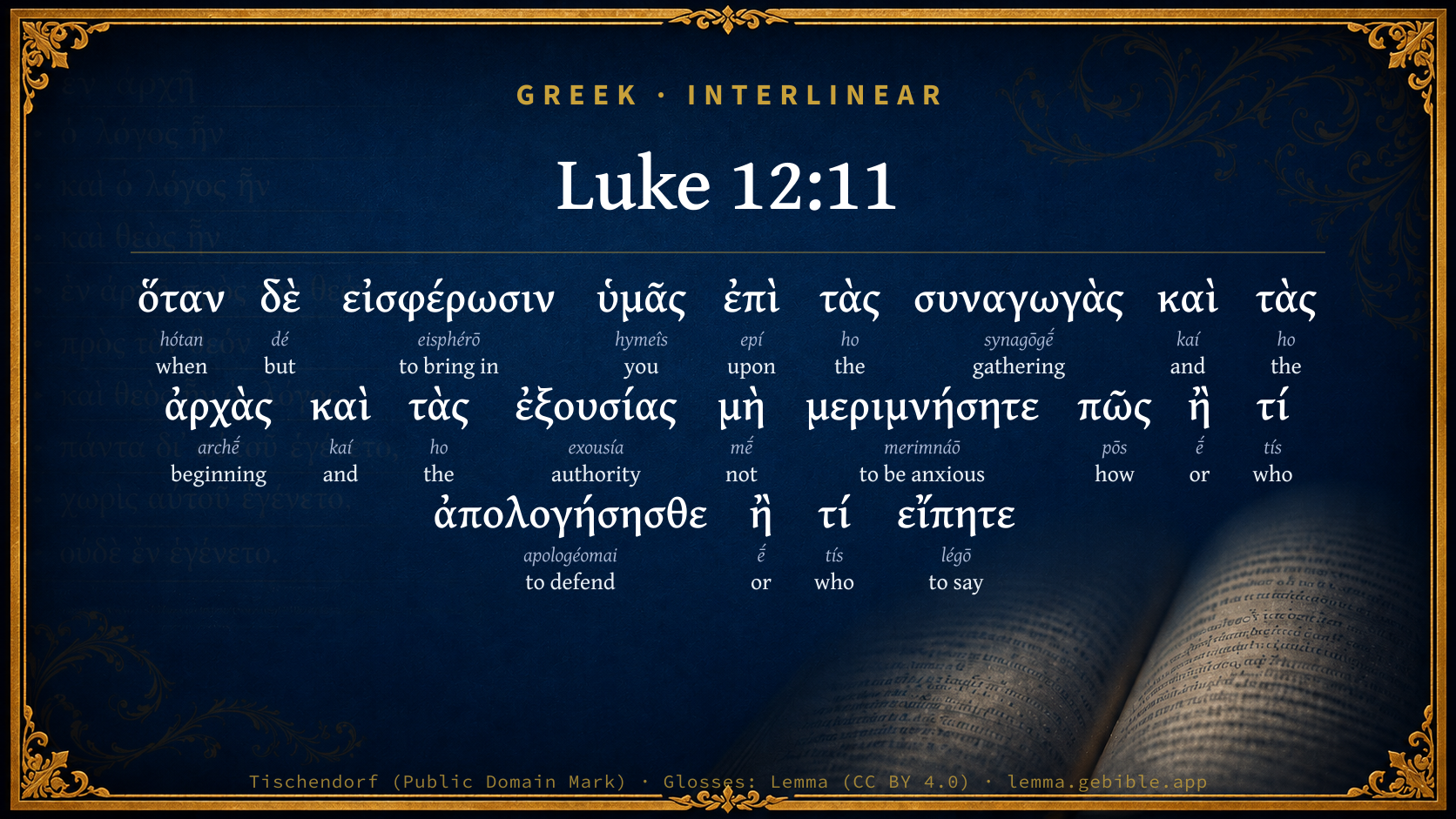
Download image
Cite this verse

Luke 12:11 (World English Bible). Public Domain. Lemma interlinear Bible study tool, https://lemma.gebible.app/v/luke/12/11.

Show BibTeX & RIS
BibTeX
RIS
English Translation
When they bring you before the synagogues, the rulers, and the authorities, don't be anxious how or what you will answer, or what you will say;
World English Bible · Public Domain
Highlights
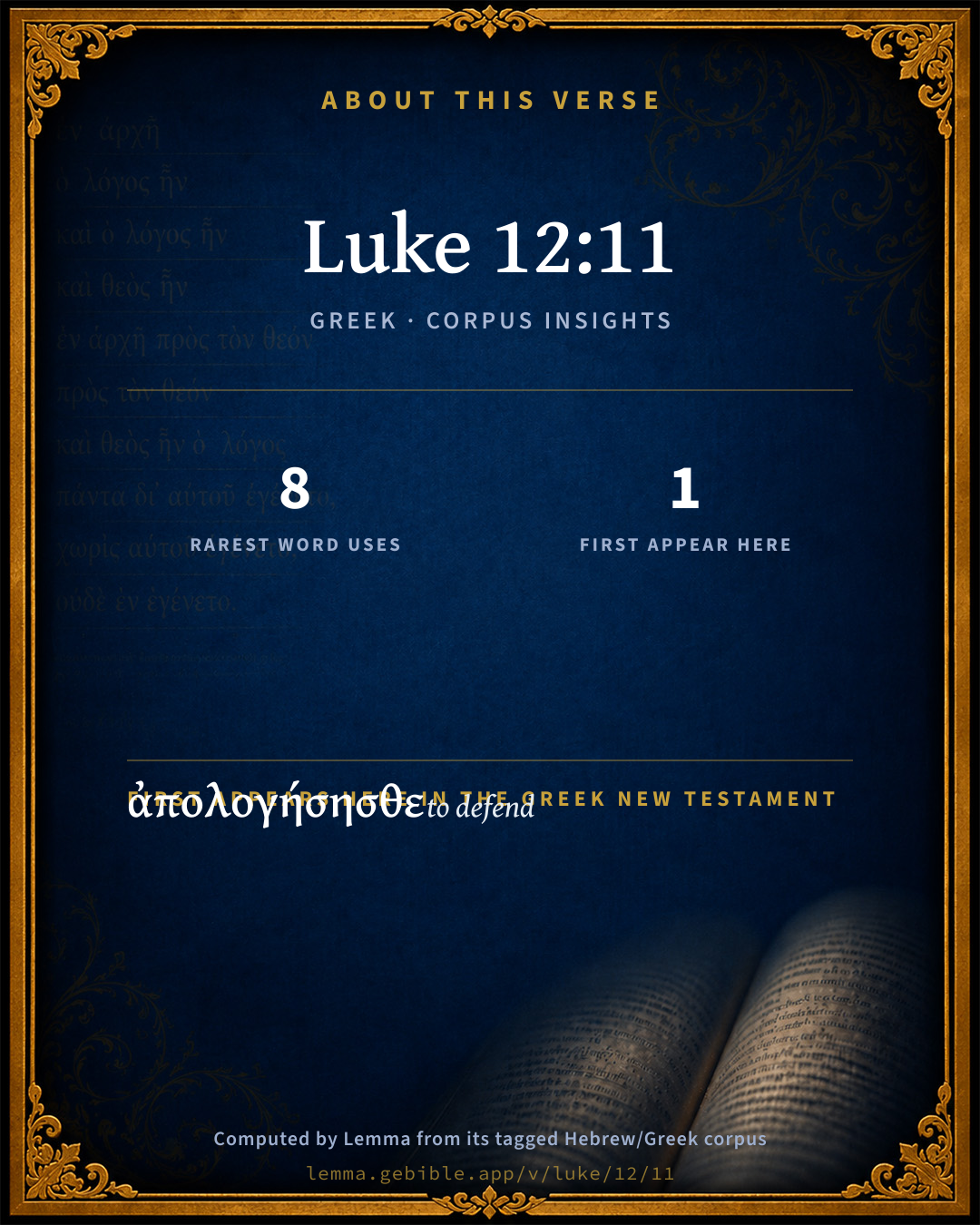
  • 1 first appearance in the Greek New Testament
Full analysis ↓
Download a study sheet

One document with this verse’s original text, its word-by-word gloss line, the meaning frame, cross-references with their text, attributed commentary, and full source and license credits — printable, and it pastes into notes with its structure intact.

This verse Autodidact and up

Study sheet (.html) Plain text (.txt)

A passage Seminary Student

Up to 50 verses in one chapter. A passage sheet keeps up to 6 commentary sources and 12 cross-references per verse, in the order this page ranks them, and says so on the sheet whenever that leaves anything out. Ask for a single verse and you get the Autodidact verse sheet above.

Everything on this page stays free to read, with no account — the sheet is a download of what is already on screen, not access to it.

Want to remove ads? Support Godless Engineer
Compare translations 3

The same verse in 3 English versions, stacked beneath the original-language interlinear above. Click any original word for its lexicon entry.

Each is an independent rendering of the whole verse — the interlinear is not word-aligned to these translations.

Highlighted words mark where these versions differ — a whole-verse word diff, not a word-by-word alignment.

  • World English Bible Public Domain
    When they bring you before the synagogues, the rulers, and the authorities, don't be anxious how or what you will answer, or what you will say;
  • King James Version Public Domain
    And when they bring you unto the synagogues, and unto magistrates, and powers, take ye no thought how or what thing ye shall answer, or what ye shall say:
  • unfoldingWord Literal Text CC BY-SA 4.0
    And when they bring you to the synagogues and the rulers and the authorities, do not worry about how or what you should speak in your defense or what you should say,

unfoldingWord Literal Text — © unfoldingWord, licensed CC BY-SA 4.0. Word-aligned USFM3 via Door43 (git.door43.org/unfoldingWord/en_ult).

Versions to compare (up to 4)

3 of 4 selected

Show all 19 translations

Every available English version of this verse, each an independent rendering of the whole verse.

  • World English Bible Public Domain
    When they bring you before the synagogues, the rulers, and the authorities, don't be anxious how or what you will answer, or what you will say;
  • Berean Standard Bible Public Domain
    When you are brought before synagogues, rulers, and authorities, do not worry about how to defend yourselves or what to say.
  • Majority Standard Bible Public Domain
    When you are brought before synagogues, rulers, and authorities, do not worry about how to defend yourselves or what to say.
  • King James Version Public Domain
    And when they bring you unto the synagogues, and unto magistrates, and powers, take ye no thought how or what thing ye shall answer, or what ye shall say:
  • American Standard Version (1901) Public Domain
    And when they bring you before the synagogues, and the rulers, and the authorities, be not anxious how or what ye shall answer, or what ye shall say:
  • Revised Version (1885) Public Domain
    And when they bring you before the synagogues, and the rulers, and the authorities, be not anxious how or what ye shall answer, or what ye shall say:
  • Geneva Bible (1599) Public Domain
    And when they shall bring you vnto the Synagogues, and vnto the rulers and Princes, take no thought howe, or what thing ye shall answere, or what yee shall speake.
  • Douay-Rheims (1899) Public Domain
    And when they shall bring you into the synagogues, and to magistrates and powers, be not solicitous how or what you shall answer, or what you shall say;
  • Young's Literal Translation Public Domain
    `And when they bring you before the synagogues, and the rulers, and the authorities, be not anxious how or what ye may reply, or what ye may say,
  • Literal Standard Version CC BY-SA 4.0
    And when they bring you before the synagogues, and the rulers, and the authorities, do not be anxious how or what you may reply, or what you may say,
  • Unlocked Literal Bible CC BY-SA 4.0
    When they bring you before the synagogues, the rulers, and the authorities, do not worry about how you will speak in your defense, or what you will say,
  • unfoldingWord Literal Text CC BY-SA 4.0
    And when they bring you to the synagogues and the rulers and the authorities, do not worry about how or what you should speak in your defense or what you should say,
  • Darby Bible Public Domain
    But when they bring you before the synagogues and rulers and the authorities, be not careful how or what ye shall answer, or what ye shall say;
  • World Messianic Bible Public Domain
    When they bring you before the synagogues, the rulers, and the authorities, don’t be anxious how or what you will answer or what you will say;
  • Webster's Bible Public Domain
    And when they bring you to the synagogues, and before magistrates, and powers, be not solicitous how or what thing ye shall answer, or what ye shall say:
  • Free Bible Version CC BY-SA 4.0
    When you're brought to trial before synagogues, rulers, and authorities, don't worry about how to defend yourself, or what you should say.
  • Bible in Basic English Public Domain
    And when they take you before the Synagogues and the authorities and the rulers, take no thought about what answers you will give, or what you will say:
  • Text-Critical English NT CC BY 4.0
    When you are brought before synagogues, rulers, and authorities, do not be anxious about how or what you should speak in your own defense, or what you should say,
  • Tyndale New Testament (1534) Public Domain
    When they bringe you vnto the synagoges and vnto the rulers and officers take no thought how or what thinge ye shall answer or what ye shall speake.

Literal Standard Version (2020), Covenant Press — licensed CC BY-SA 4.0. Text via the HelloAO Bible API (eBible.org). Unlocked Literal Bible (unfoldingWord) — licensed CC BY-SA 4.0. Text via the HelloAO Bible API (eBible.org). unfoldingWord Literal Text — © unfoldingWord, licensed CC BY-SA 4.0. Word-aligned USFM3 via Door43 (git.door43.org/unfoldingWord/en_ult). Free Bible Version, Dr. Jonathan Gallagher — licensed CC BY-SA 4.0. Text via the HelloAO Bible API (eBible.org).

Word by word

More ways to search: Search by grammar → Find every occurrence → Compare this word →

Practice this passage: Drill this verse → Learn its vocabulary →

εἰσφέρωσιν
eisphérō
G1533
“to bring in”
Verb, Present, Active, Subjunctive, 3rd person, Plural
Part of Speech
Verb
Tense
Present
Voice
Active
Mood
Subjunctive
Person
3rd person
Number
Plural
Full Thayer's Definition

Origin: from G1519 and G5342

TDNT: 10:04,1

1. to bring into, in or to 2. to lead into
  1. ὅταν hótan G3752 “when” Conjunction
  2. δὲ dé G1161 “but” Conjunction
  3. ὑμᾶς hymeîs G5210 “you” Personal pronoun, 2nd person, Accusative, Plural
  4. ἐπὶ epí G1909 “upon” Preposition
  5. τὰς ho G3588 “the” Article, Accusative, Plural, Feminine
  6. συναγωγὰς synagōgḗ G4864 “gathering” Noun, Accusative, Plural, Feminine
  7. καὶ kaí G2532 “and” Conjunction
  8. τὰς ho G3588 “the” Article, Accusative, Plural, Feminine
  9. ἀρχὰς archḗ G746 “beginning” Noun, Accusative, Plural, Feminine
  10. καὶ kaí G2532 “and” Conjunction
  11. τὰς ho G3588 “the” Article, Accusative, Plural, Feminine
  12. ἐξουσίας exousía G1849 “authority” Noun, Accusative, Plural, Feminine
  13. μὴ mḗ G3361 “not” Particle, Negative
  14. μεριμνήσητε merimnáō G3309 “to be anxious” Verb, Aorist, Active, Subjunctive, 2nd person, Plural
  15. πῶς pōs G4459 “how” Adverb, Interrogative
  16. ἢ ḗ G2228 “or” Particle
  17. τί tís G5101 “who” Interrogative pronoun, Accusative, Singular, Neuter
  18. ἀπολογήσησθε apologéomai G626 “to defend” Verb, Aorist, Middle deponent, Subjunctive, 2nd person, Plural
  19. ἢ ḗ G2228 “or” Particle
  20. τί tís G5101 “who” Interrogative pronoun, Accusative, Singular, Neuter
  21. εἴπητε légō G3004 “to say” Verb, Aorist, Active, Subjunctive, 2nd person, Plural

About this verse

These counts appear in no published source. They are computed here, from the morphology-tagged text and Lemma’s own curated glosses. What Lemma adds →

22
words
17
distinct lemmas
Gospels
section

Notable vocabulary

The rarest word here is εἰσφέρωσιν to bring in G1533 — appearing just 8 times in the whole Greek New Testament.

First appearance in Scripture

This word makes its first canonical appearance in the Greek New Testament here:

  • ἀπολογήσησθε to defend G626

Shared distinctive vocabulary

εἰσφέρωσιν to bring in G1533 occurs in 8 verses of the Greek New Testament. Also found in:
Repetition

Words recur within this verse:

Cross-references

8

Topical passages linked to Luke 12:11 in the Treasury of Scripture Knowledge — connected by theme and wording, ordered by reader-vote popularity; previews shown in the World English Bible.

  • Matthew 10:17–20 But beware of men: for they will deliver you up to councils, and in their synagogues they will scourge you.
  • Acts 4:5–7 It happened in the morning, that their rulers, elders, and scribes were gathered together in Jerusalem.
  • Luke 12:22 He said to his disciples, "Therefore I tell you, don't be anxious for your life, what you will eat, nor yet for your body, what you will wear.
  • Luke 21:12–14 But before all these things, they will lay their hands on you and will persecute you, delivering you up to synagogues and prisons, bringing you before kings and governors for my name's sake.
  • Matthew 23:34 Therefore, behold, I send to you prophets, wise men, and scribes. Some of them you will kill and crucify; and some of them you will scourge in your synagogues, and persecute from city to city;
  • Mark 13:9–11 But watch yourselves, for they will deliver you up to councils. You will be beaten in synagogues. You will stand before rulers and kings for my sake, for a testimony to them.
  • Acts 6:9–15 But some of those who were of the synagogue called "The Libertines," and of the Cyrenians, of the Alexandrians, and of those of Cilicia and Asia arose, disputing with Stephen.
  • Acts 5:27–32 When they had brought them, they set them before the council. The high priest questioned them,

Cross-references courtesy of OpenBible.info (CC BY 4.0).

Commentary

Notes on Luke 12:11 from classic Christian and Jewish commentators (each source and its license shown beneath its notes). The classic Christian expositions comment on the surrounding passage and are grouped to its opening verse, so a note may address several verses; the Jewish commentaries on the Tanakh (Rashi and others) are per-verse, so they appear only where the commentator wrote on this verse.

Lemma curates 59 commentaries, every one of them public domain or Creative Commons licensed, each selected and text-cleaned for this edition rather than reprinted as found. About our sources →

Matthew Poole's English Annotations

See Poole on "Mt 10:19-20", See Poole on "Mr 13:11". See Poole on "Luk 12:11"

Matthew Poole's English Annotations on the Holy Bible (1683–1685) — public domain. Text from a community e-Sword/MySword module.

The Biblical Illustrator

Joseph S. Exell

Luk_12:11-12

The Holy Ghost shall teach you

Divine help for ministers in discharging their duties

The advice and promise contained in these verses were very suitable to the disciples, many of whom were soon to be called before Jewish and Roman courts of various kinds for the sake of Christ.

Plain and illiterate as the disciples generally were, they would be ready to be much alarmed at the thought of appearing before civil and ecclesiastical rulers and judges, not only from the apprehension that they might be condemned if they did not plead their cause aright, but still more from the apprehension that from some failure in judgment, or memory, or eloquence, on their part, the cause of the gospel might suffer--which was dearer to them than their life. Their Lord, therefore, wisely and graciously counselled and encouraged them in that prospect. Take ye no thought, said He; not that prudent thought was unbecoming, or that they were to be rash, and speak unadvisedly with their lips: but they were forbidden to take anxious, perplexing, and disquieting thought, as the word might be rendered, and as He said on another occasion, Take no thought for the morrow. Such thought as that, at the time they were speaking, would have argued distrust in God, and would have thrown them into such confusion as would have incapacitated them from speaking as they ought. They were not to be studious of making a fine appearance; nor were they to be apprehensive that the Lord would allow either them to be put to shame, or His own cause to suffer. Nay, as spoken to those who were under the influence of plenary inspiration, these words forbade them to spend time in premeditation on their defence of themselves, or on their declaration of the gospel, for it is thus expressed in Mark, Take no thought beforehand what ye shall speak, neither do ye premeditate. Take ye no thought, as it is in Luke, how, or what thing, that is, either as to the manner or matter of what ye shall answer, or say in defence of yourselves; or what ye shall say, that is, what ye shall say in declaring the truth before your accusers and audience, be they what they may. And to encourage them to this, He assures them that the Holy Spirit would suggest to them at the time whatever was proper to be said, and would direct and strengthen them to say it in the best manner. Now, all this is often exemplified very strikingly in the Acts of the Apostles, in which we read of several of the disciples being carried before different courts, where they trusted in God, and had this promise so fulfilled to them as to enable them to speak, and in every way to conduct themselves, in the most becoming and noble manner. As to the application of these words to the succeeding ages of the Church; it becomes all Christians, and especially Christian ministers, neither presumptuously to abuse them, nor unbelievingly to neglect the legitimate encouragement which they contain. It would certainly be a gross perversion of this passage, if any preachers were now to imagine that it would countenance them in ordinary eases in coming forward to preach without previous study. Now that miraculous inspiration has ceased, they have to seek their knowledge from the Word of God, and in the way of diligent, persevering, and prayerful application of mind; that they may bring forward abundance of suitable matter, in the best way of which, all their other duties being considered, they are capable. Whatever might be the rule in cases of emergency, even the inspired teachers themselves were required thus to stir up the gift of God that was in them; and therefore much more is such diligence necessary in those who have no such inspiration. It is no difficult matter, indeed, for a man who abounds in self-confidence and readiness of expression to speak often and long, in a certain way, of the things of God with little or no preparation, but it is a poor boast to boast of such a habit; it is a poor compliment to the intelligence of his audience to indulge it; there will be no need for him or his admirers to proclaim that his effusions are extemporary, for that will be but too evident. In many cases this is, doubtless, under the guise of zeal, the refuge of indolence; and it would be well for him to consider whether he be not labouring under an error in imagining that there is anything peculiarly spiritual or praiseworthy in offering to God that which costs him nothing. The words which were addressed to inspired Timothy are surely at least as suitable in this view to ordinary teachers: Give attendance to reading, to exhortation, to doctrine. Neglect not the gift that is in thee, which was given thee by prophecy, with the laying on of the hands of the presbytery. Meditate upon these things, give thyself wholly to them, that thy profiting may appear to all. Take heed unto thyself, and unto the doctrine; continue in them; for in doing this thou shalt both save thyself and them that hear thee. In a different sense, David prepared with all his might for the house of his God. Because the preacher, too, was wise, he still taught the people knowledge, yea, he gave good heed, and sought out, and set in order many proverbs. If due diligence be not used, to expect the help of the Spirit is not faith, but presumption. At the same time there is much direction and encouragement here to ministers when they are in the way of duty. The spirit of this passage teaches them not to fail to declare the will of God when they are suddenly called on to do so in the course of providence. They are not to hang back or to hesitate then, but are to discharge the duty in the best way they can under God. On extraordinary occasions they may expect, though not miraculous, yet extraordinary, assistance. They may expect that their strength will be as their day; that their Masters grace will be sufficient for them, and that His strength will be made perfect in their weakness. Nor need they be afraid to speak, in any circumstances, however trying or dangerous, into which their Lord brings them. (James Foote, M. A.)

Martyrs inspired by the Spirit

You will be struck in reading Foxes Acts and Monuments to find how many of the humblest men and women acted as if they were of noblest blood. In every age the line of martyrs has been a line of true nobility. When the King of France told Bernard Palissy that, if he did not change his sentiments, he should be compelled to surrender him to the Inquisition, the brave potter said to the king, You say I shall be compelled, and yet you are a king; but I, though only a poor potter, cannot be compelled to do other than I think to be right, Surely the potter was more royal than the king. The cases are numberless, and should be as household words among you, in which humble men, feeble women, and little children have shown a heroism which chivalry could not equal. The Spirit of God has taken the wise in their own craftiness, and answered the learned out of the mouths of babes. The answers of uneducated persons among the martyrs were frequently so put to the point, and hit the nail so well on the head, that you might almost suppose they had been composed by an assembly of divines; they came from a better source, for they were given by the Holy Spirit. The bearing of the bleeding witnesses for our Lord has been worthy of their office, and right well have they earned the title of The noble army of martyrs. (C. H. Spurgeon.)

Providential prompting

Some time ago a town missionary had in his district a man who never would suffer any Christian man to come into his house. The missionary was warned by many that he would get a broken head if he ventured on a visit. He therefore kept from the house, though it troubled him to pass it by. He made a matter of prayer of it, as was his wont, and one morning ventured into the lions den; when the man said, What have you come here for? … Well, sir, he said, I have been conversing with people in all the houses along here, and I have passed you by because I heard you objected to it; but somehow I thought it looked cowardly to avoid you, and therefore I have called. Come in, then, the man said; sit down. Now you are going to talk to me about the Bible. Perhaps you do not know much about it yourself. I am going to ask you a question, and if you can answer it, you shall come again; if you do not answer it, I will bundle you downstairs. Now, he said, do you take me? Yes, said the other, I do take you. Well, then, this is the question: Where do you find the word girl in the Bible, and how many times do you find it? The city missionary said, The word girl occurs only once in the Bible, and that is in the Book of Joel, the third chapter and the third verse: They sold a girl for wine. You are right; but I would not have believed you knew it, or else I would have asked you some other question. You may come again. But, said the missionary, I should like you to know how I came to know it. This very morning I was praying for direction from God; and when I was reading my morning chapter, I came upon this passage: There shall be boys and girls playing in the streets of Jerusalem; and I found that the word girl did not occur anywhere else but in Joel. The result of that story, however odd it seems, was that the missionary was permitted to call; and the man took an interest in his visits, and the whole family were the better, the man and his wife and one of his children becoming members of a Church some time afterwards. Is not God the answerer of prayer?

The Biblical Illustrator, edited by Joseph S. Exell (c. 1880s–1900s) — public domain. Text from a community e-Sword module.

Joseph Benson's Commentary

Luk 12:11-12. When they bring you unto the synagogues — Let me add, however others may be affected by this testimony of the Spirit, one happy effect of its operation shall be to furnish you, my apostles, for a proper and honourable discharge of your office in its most difficult parts: and therefore when, in the opposition you shall meet with from your persecutors, they shall bring you into the synagogues, to be tried in the judicial courts assembled there; And unto magistrates and powers — Before greater magistrates and supreme powers, whether Jewish or heathen; — Take ye no thought how ye shall answer — Be not solicitous about the matter or manner of your defence, nor how to express yourselves. Though they may have not only your liberty but your lives in their hands, yet be not anxious what apology you shall make for yourselves, or what you shall advance in defence of the gospel you preach. For the Holy Ghost shall teach you — For in these seasons of the greatest difficulty and extremity, the Spirit of God shall suggest to your minds the answers you ought to give to the most captious inquiries, and most invidious charges of your enemies. Proper thoughts and expressions shall flow in upon you as fast as you can utter them, so that with undaunted courage you shall be able to vindicate the honour of the gospel, and to confound the most artful or most potent of your adversaries. See on Mat 10:19-20; Mar 13:11.

Joseph Benson's Commentary on the Old and New Testaments (1811–1818) — public domain. Text from a community e-Sword module.

Tyndale Open Study Notes

Tyndale Open Resources

12:11-12 brought to trial: Jesus predicted persecution from Jews in the synagogues and from Gentile rulers and authorities. Paul and other apostles faced both kinds of persecution throughout Acts.

Tyndale Open Study Notes — © Tyndale Open Resources, licensed CC BY-SA 4.0. Text via the HelloAO Bible API.

Bengel's Gnomon

Johann Albrecht Bengel

Luk 12:11. Ἢ τί εἴπητε, or what ye shall say) Even independent of the absolute need there is of a defence [τί ἀπολογήσησθε; independent of the defence in answer to the charge, which you must necessarily make].

Bengel's Gnomon of the New Testament — English translation (T&T Clark, Edinburgh, 1860) — public domain. Text from a community e-Sword module.

Meyer's Critical & Exegetical Commentary

Heinrich August Wilhelm Meyer

Luk_12:11-12. But when they bring youfollowing out this denial of me and blasphemy against the Spiritto the synagogues, etc.

πῶς ἢ τί] Care not about the kind and manner, or the substance of your defence. See also on Mat_10:19; Mar_13:11. On ἀπολογ. τί, comp. Xen. Mem. iv. 8. 4; Dem. 227. 13; Plat. Gorg. p. 521 A, Phaed. p. 69 D, Polit. 4, p. 420 B; Act_24:10.

Meyer — Critical and Exegetical Commentary on the New Testament — English translation by Peter Christie, edited by Frederick Crombie (T&T Clark, 1880) — public domain. Text from a community e-Sword module.

Expositor's Greek Testament

ed. W. Robertson Nicoll

Luk 12:11 . τὰς ἀρχὰς καὶ τὰς ἐξουσίας : a general reference to heathen tribunals in place of Mt.’s συνέδρια (Luk 10:17 ). “Synagogues,” representing Jewish tribunals, retained.

The Expositor's Greek Testament, edited by W. Robertson Nicoll (1897–1910) — public domain. Text from a community e-Sword module.

Godet's Commentaries

Frédéric Louis Godet

Vers. 11 and 12. The Aid.—“When they bring you unto the synagogues, and before magistrates and powers, take ye no thought how or what thing ye shall answer, or what ye shall say: 12. For the Holy Ghost shall teach you in the same hour what ye ought to say.” — Jesus seems to take pleasure in enumerating all the different kinds of powers whose hostility they shall have to feel.—Συναγωγαί, the Jewish tribunals, having a religious character; ἀρχαί, Gentile authorities, purely civil, from provincial prefects up to the emperor; ἐξουσίαι, any power whatsoever. But let them not make preparation to plead! Their answer will be supplied to them on the spot, both as to its form (πῶς, how) and substance (τί, what). And their part will not be confined to defending themselves; they will take the offensive; they will bear testimony (τί εἴπητε, what ye shall say). In this respect, also, everything shall be given them. Witness Peter and Stephen before the Sanhedrim, St. Paul before Felix and Festus; they do not merely defend their person; they preach the gospel. Thus the Holy Spirit will so act in them, that they shall only have to yield themselves to Him as His mouthpiece. The parallel passage occurs in Matthew in the instructions given to the Twelve (Luk 10:19-20). The form is different enough to prove that the two compilations are not founded on the same text. Comp. also a similar thought (Joh 15:26-27).

This saying attests the reality of the psychological phenomenon of inspiration. Jesus asserts that the Spirit of God can so communicate with the spirit of man, that the latter shall be only the organ of the former.

Holtzmann sees in all those sayings, Luk 12:1-12, only a combination of materials arbitrarily connected by Luke, and placed here in a fictitious framework. A discourse specially addressed to the disciples seems to him out of place in the midst of this crowd (p. 151). Yet he cannot help making an exception of Luk 12:1-3, which may be regarded as suitably spoken before a large multitude. But if we admit ever so little the historical truth of the striking words, I say unto you, you my friends (Luk 12:4), we must acknowledge that they serve to distinguish the disciples from other persons present, and who are not of the same mind. The promise addressed to faithful confessors (Luk 12:9) also receives from the hostile surroundings a quite peculiar appropriateness. The threat of Luk 12:10 supposes the presence of adversaries who have calumniated Jesus. In short, the announcement of persecutions, and the promise of the Holy Spirit’s aid, Luk 12:11-12, find a natural explanation if, at the very moment, the disciples were in a perilous situation. All the elements of this discourse are thus in perfect keeping with the historical frame in which it is set by Luke. And this frame is only an invention of the evangelist!

9. The Position of Man and of the Believer in relation to this World’s Goods: Luk 12:13-59.

The occasion of this new discourse is supplied by an unexpected event, and without any relation to what had just happened. This piece embraces: 1 st. A historical introduction (Luk 12:13-14); 2 d. A discourse addressed by Jesus to the multitude on the value of earthly goods to man in general (Luk 12:15-21); 3 d. A discourse, which He addresses specially to the disciples, on the position which their new faith gives them in respect of those goods (Luk 12:22-40); 4 th. A still more special application of the same truth to the apostles (Luk 12:41-53); 5 th. In closing, Jesus returns to the people, and gives them a last warning, based on the threatening character of present circumstances (Luk 12:54-59).

Frédéric Louis Godet — Commentaries on Luke, John, Romans, and 1 Corinthians — English translation (T&T Clark, Edinburgh, 1870s–1890s) — public domain. Text from a community e-Sword module.

Geneva Bible (1599)

Geneva Bible translators

It is a great and hard conflict to confess the truth, yet he that can do all things, and is almighty, will not be wanting to the weakest which strive and contend in his appointed time.

Geneva Bible (1599) marginal notes — public domain. Text via Bolls.life.

Adam Clarke's Commentary

Verse 11. Unto magistrates and powers] See Mt 10:17-20.

Take ye no thought] See Mt 6:25; Mt 10:19.

Adam Clarke's Commentary on the Bible (1810–1826) — public domain. Text from a community e-Sword/MySword module.

Ellicott's Commentary for English Readers

(11) And when they bring you unto the synagogues.—See Note on Mat_10:18-19. What had been a special promise to the Twelve is now extended to all whom the Lord calls His friends. Note, as characteristic of St. Luke’s phraseology, the combination “magistrates” (better, principalities, or authorities) and “powers,” the same combination of the two words meeting us again in Luk_20:20, and 1Co_15:24; Eph_3:10; Col_1:16; Col_2:15; Tit_3:1. It would seem to be one of the many phrases which had passed from the Evangelist to the Apostle, or conversely.

A Bible Commentary for English Readers, edited by Charles John Ellicott (1878–1897) — public domain. Text from a community e-Sword module.

The Cambridge Bible for Schools and Colleges

gen. ed. J. J. S. Perowne

11. unto the synagogues, and unto magistrates, and powers] The ‘synagogues’ were the small Jewish tribunals of synagogue officials in every town, which had the power of inflicting scourging for minor religious offences. ‘Magistrates’ and ‘powers’ would be the superior authorities Jewish or Gentile.

take ye no thought] Rather, be not anxiously careful.

how or what thing] i.e. about either the manner and line, or the phraseology of your defence.

The Cambridge Bible for Schools and Colleges (gen. ed. J. J. S. Perowne; Cambridge University Press, 1878–1918) — public domain. Text from a community e-Sword module.

John Gill's Exposition

And when they bring you unto the synagogues,.... Of the Jews, to be examined and scourged by the rulers of them:

and unto magistrates and powers; Heathen ones; the Persic version reads, "princes and kings"; and the Ethiopic version, "princes, kings, and judges"; see Mat 10:18

Take ye no thought how, or what thing ye shall answer, or what ye shall say; be not anxiously concerned, neither about the manner, nor the matter of your answer, apology, and defence: in the first part of this clause, the Syriac, Persic, and Ethiopic versions, only read, "how"; and the Arabic version only, "what"; See Gill on Mat 10:19.

John Gill's Exposition of the Whole Bible (1746–1763) — public domain (CC PDM 1.0). Text via the HelloAO Bible API.

Trapp's Complete Commentary

John Trapp

11 And when they bring you unto the synagogues, and unto magistrates, and powers, take ye no thought how or what thing ye shall answer, or what ye shall say:

Ver. 11. Take ye no thought] See the note on Mat 10:19, and Mar 13:11. Alice Driver, martyr, at her examination, put all the doctors to silence, so that they had not a word to say, but one looked upon another. Then she said, Have ye no more to say? God be honoured; you be not able to resist the Spirit of God in me, a poor woman. I was an honest poor man’s daughter, never brought up in the university as you have been. But I have driven the plough many a time before my father, I thank God; yet notwithstanding in the defence of God’s truth, and in the cause of my Master, Christ, by his grace I will set my foot against the foot of any of you all, in the maintenance and defence of the same. And if I had a thousand lives it should go for payment thereof. So the chancellor condemned her, and she returned to the prison as joyful as the bird of the day. (Acts and Mon.)

John Trapp, A Commentary or Exposition upon All the Books of the Old and New Testament (1647–1656) — public domain. Text from a community e-Sword module.

Albert Barnes' Notes on the Bible

See the notes at Mat 10:17-20.

Albert Barnes' Notes on the Bible (1834–1885) — public domain. Text from a community e-Sword/MySword module.

Whedon's Commentary on the Bible

Daniel D. Whedon

11. Bring you unto the synagogues—The same directions as were given to the Apostles, (Mat_10:19,) are now given for all who may be destined to the same persecutions. The terms synagogues, magistrates, powers, are much more limited than kings and rulers.

Daniel D. Whedon (gen. ed.), Commentary on the Old and New Testaments (1874–1909) — public domain. Text from a community e-Sword module.

The Pulpit Commentary

And when they bring you unto the synagogues, and unto magistrates, and powers, take ye no thought how or what thing ye shall answer. The Master comes back again to his old calm, and continues his loving instructions to his disciples; and turning again to the little group of his friends, he says. to them." When they bring you before hostile tribunals, special help, you will find, will be given you. Have no fear, then, that you will be wanting in wisdom or courage; the Holy Spirit of God will be your Advocate, and will whisper to you words for your defense." The best example of this supernatural aid to the accused followers of Jesus which we possess is the grave and stately apology of Stephen before the Sanhedrin. Peter"s speech before the same tribunal, and Paul"s before Felix and Festus, are also fair instances.

The Pulpit Commentary (1880–1919), ed. H.D.M. Spence-Jones & Joseph S. Exell — public domain. Text from a community e-Sword module.

John Wesley's Explanatory Notes

Take no thought - Be not solicitous about the matter or manner of your defense; nor how to express yourselves. Matt. x, 19; Luke xxi, 12.

John Wesley, Explanatory Notes Upon the Whole Bible (1754–1765) — public domain. Text via the GEBible commentary corpus.

Burkitt's Expository Notes on the New Testament

William Burkitt

Here our Saviour acquaints his apostles, that for preaching his doctrine, and professing his religion, they should be brought before all sorts of magistrates, and into all kinds of courts; but advised them when they should be so brought, not to be anxiously thoughtful, or solicitously careful what they should say, for it should be suggested to them by the Holy Ghost, what they should speak in that hour.

Thence note, that though the truth of Christ may be opposed, yet the defenders of it shall never be ashamed; for rather than they shall want a tongue to plead for it, God himself will prompt them by his Holy Spirit, and furnish them with such arguments to defend the truth, as all their adversaries shall not be able to gainsay: In that hour the Holy Ghost shall teach you what ye ought to say.

William Burkitt's Expository Notes on the New Testament (1700–1703) — public domain. Text from a community e-Sword module.

The People's New Testament

B. W. Johnson

11, 12. When they bring you unto the synagogues. See notes on Matt. 10:19, 20.

B. W. Johnson's The People's New Testament with Notes (1889–1891) — public domain. Electronic text from the Christian Classics Ethereal Library (CCEL) ThML edition.

unfoldingWord translationNotes

Door43 World Missions Community

When they bring you

It is not stated who brings them into judgment.

before the synagogues

"into the synagogues to question you before the religious leaders"

rulers ... authorities

It may be necessary to combine these into one statement. AT: "other people who have power in the country"

in that hour

"at that time" or "then"

translationWords

synagogue

rule

authority

Holy Spirit

teach

hour, hours

unfoldingWord translationNotes — © Distant Shores Media and the Door43 World Missions Community, licensed CC BY-SA 4.0. Source: git.door43.org/Door43/en_tn.

Cambridge Greek Testament for Schools and Colleges

11. ἢ τί. אBL La[250] Ti[251] W.H[252] It is omitted in D.

[250] La. Lachmann.

[251] Ti. Tischendorf.

[252] W.H. Westcott and Hort.

11. ἐπὶ τὰς συναγωγὰς καὶ τὰς ἀρχὰς καὶ τὰς ἐξουσίας. The “synagogues” were the small Jewish tribunals of synagogue officials in every town, which had the power of inflicting scourging for minor religious offences. “Magistrates” and “powers” are the superior authorities Jewish or Gentile. “Magistrates” comes from the Vulg[263] magistratus, through Wyclif.

[263] Vulg. Vulgate.

μὴ μεριμνήσητε. ‘Be not anxiously careful.’

πῶς ἢ τί. I.e. about either the manner and line, or the phraseology of your defence.

Cambridge Greek Testament for Schools and Colleges (Cambridge University Press, 1896; 21 vols, various authors incl. Carr, Maclear, Plummer, Farrar, Lumby, Moule, M. R. James, Simcox) — public domain. Text from a community e-Sword module.

International Critical Commentary

11, 12. Comp. 21:14, 15, which is parallel to both Mat 10:19, Mat 10:20 and Mar 13:11, but not so close to them in wording as these verses are. The connexion here is evident. There is no need to be afraid of committing this unpardonable blasphemy by illadvised language before a persecuting tribunal; for the Holy Spirit Himself will direct their words.

11. εἰσφέρωσιν ὑμᾶς ἐπὶ τὰς συναγωγάς. In all four passages their being brought before synagogues is mentioned. The elders of the synagogue were responsible for discipline. They held courts, and could sentence to excommunication (6:22; Joh 9:22, Joh 12:42, Joh 16:2), or scourging (Mat 10:17), which was inflicted by the ὑπηρέτης (see on 4:20). Schürer, Jewish People in the T. of J. C. ii. pp. 59-67 ; Derenbourg, Hist. de la Pal. pp. 86 ff. The ἀρχαί and ἐξουσίαι would include the Sanhedrin and Gentile tribunals.

μὴ μεριμνήσητε πῶς ἤ τί ἀπολογήσησθε. Neither the form nor the matter of the defence is to cause great anxiety beforehand. Sec on ver. 22 and 10:41 Excepting Rom 2:15 and 2Co 12:19, ἀπολογεῖσθαι is peculiar to Lk. (21:14 and six times in Acts). Here Mt. and Mk. have λαλήσητε.

D 157, a b c d e ff2i l q Syr-Cur. Syr-Sin. Aeth, omit ἤ τί, which may possibly come from Mat 10:19. If so, this is a Western non-interpolation. See note at the end of ch, 24. WH. bracket.

International Critical Commentary — older volumes (1896–1929), various authors — public domain. Text from a community e-Sword module.

Vincent's Word Studies in the New Testament

Marvin R. Vincent

Answer [απολογησησθε] . See on 1Pe 3:15.

Marvin R. Vincent, Word Studies in the New Testament (1887–1900) — public domain. Text from a community e-Sword/MySword module.

Lesson kit

Teaching starters — assembled from the data on this page, not authored interpretation. Every prompt links to the verse data it draws on. Edit before teaching.

Luke, in the Gospels, opens this verse with 22 words (17 distinct Greek lemmas). Its most distinctive word is eisphérō (“to bring in”). A historical commentator’s framing appears above. Read the whole chapter for the surrounding context.

Discussion questions

  1. How does “to bring in” (eisphérō) shape what this verse is saying?
  2. The word “to defend” first appears here in Scripture. What is being introduced at this debut?
  3. Matthew 6:13 shares the word «to bring in» with this verse. How do the two illuminate each other?
  4. “the” occurs 3× in this one verse. What is the effect of the repetition?
  5. The translations on this page render this verse differently — a whole-verse word diff, not a word-by-word alignment. What might account for the different wordings?
  6. Reading how Matthew Poole's English Annotations and The Biblical Illustrator read this verse, where do the two commentators agree and where do they part?

Things to notice

  • 1 word makes its first canonical appearance in Scripture here.
  • These translations choose different wording for 19 words in this verse.
  • “the” occurs 3× in this single verse.
  • 17 distinct Greek lemmas span 22 words in this verse.

Reading settings

Reading text

Shown beneath each verse's original-language words.

Old Testament
Old Testament edition

Read the OT as the Masoretic Hebrew (MT) or the Greek Septuagint (LXX).

English shown for the Greek Septuagint (in the Hebrew ↔ Greek comparison).

Comparing translations? Open the Compare panel on any verse page to stack up to four side by side.