Luke 14:23

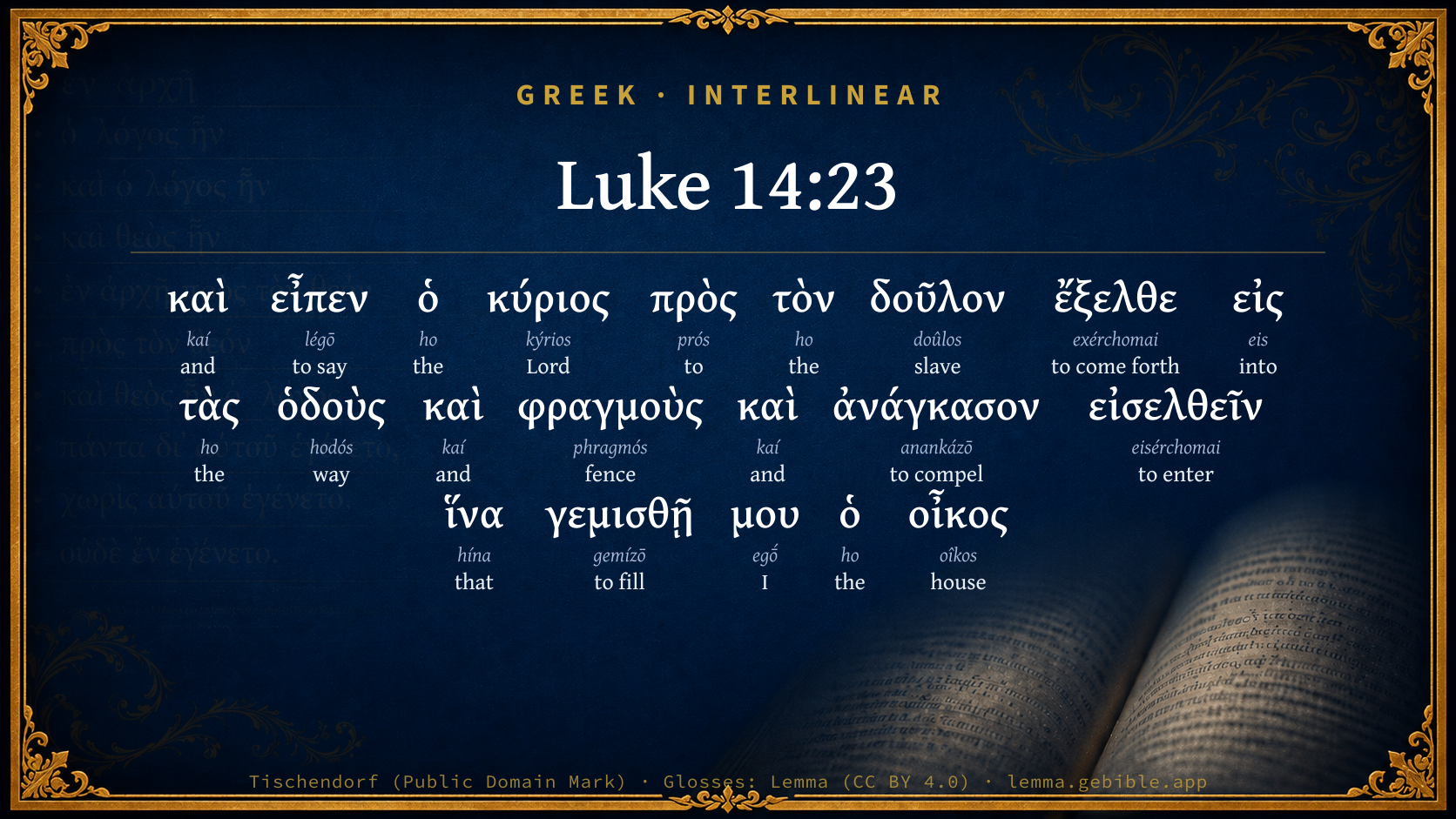
Greek (Tischendorf 8th ed.) Luke 14:23 appears in the Greek New Testament. The text above is from the Tischendorf 8th edition. Each word links to its Strong’s number and a concise gloss. Click any word for its full Thayer’s Greek Lexicon entry.
Download image
Cite this verse

Luke 14:23 (World English Bible). Public Domain. Lemma interlinear Bible study tool, https://lemma.gebible.app/v/luke/14/23.

Show BibTeX & RIS
BibTeX
RIS
English Translation
"The lord said to the servant, 'Go out into the highways and hedges, and compel them to come in, that my house may be filled.
World English Bible · Public Domain
Download a study sheet

One document with this verse’s original text, its word-by-word gloss line, the meaning frame, cross-references with their text, attributed commentary, and full source and license credits — printable, and it pastes into notes with its structure intact.

This verse Autodidact and up

Study sheet (.html) Plain text (.txt)

A passage Seminary Student

Up to 50 verses in one chapter. A passage sheet keeps up to 6 commentary sources and 12 cross-references per verse, in the order this page ranks them, and says so on the sheet whenever that leaves anything out. Ask for a single verse and you get the Autodidact verse sheet above.

Everything on this page stays free to read, with no account — the sheet is a download of what is already on screen, not access to it.

Want to remove ads? Support Godless Engineer
Compare translations 3

The same verse in 3 English versions, stacked beneath the original-language interlinear above. Click any original word for its lexicon entry.

Each is an independent rendering of the whole verse — the interlinear is not word-aligned to these translations.

Highlighted words mark where these versions differ — a whole-verse word diff, not a word-by-word alignment.

  • World English Bible Public Domain
    "The lord said to the servant, 'Go out into the highways and hedges, and compel them to come in, that my house may be filled.
  • King James Version Public Domain
    And the lord said unto the servant, Go out into the highways and hedges, and compel them to come in, that my house may be filled.
  • unfoldingWord Literal Text CC BY-SA 4.0
    And the master said to the servant, ‘Go out into the roads and hedges and compel to come in, so that my house may be filled.

unfoldingWord Literal Text — © unfoldingWord, licensed CC BY-SA 4.0. Word-aligned USFM3 via Door43 (git.door43.org/unfoldingWord/en_ult).

Versions to compare (up to 4)

3 of 4 selected

Show all 19 translations

Every available English version of this verse, each an independent rendering of the whole verse.

  • World English Bible Public Domain
    "The lord said to the servant, 'Go out into the highways and hedges, and compel them to come in, that my house may be filled.
  • Berean Standard Bible Public Domain
    So the master told his servant, ‘Go out to the highways and hedges and compel them to come in, so that my house will be full.
  • Majority Standard Bible Public Domain
    So the master told his servant, ‘Go out to the highways and hedges and compel them to come in, so that my house will be full.
  • King James Version Public Domain
    And the lord said unto the servant, Go out into the highways and hedges, and compel them to come in, that my house may be filled.
  • American Standard Version (1901) Public Domain
    And the lord said unto the servant, Go out into the highways and hedges, and constrain `them' to come in, that my house may be filled.
  • Revised Version (1885) Public Domain
    And the lord said unto the servant, Go out into the highways and hedges, and constrain them to come in, that my house may be filled.
  • Geneva Bible (1599) Public Domain
    Then the master sayd to the seruaunt, Goe out into the hie wayes, and hedges, and compell them to come in, that mine house may bee filled.
  • Douay-Rheims (1899) Public Domain
    And the Lord said to the servant: Go out into the highways and hedges, and compel them to come in, that my house may be filled.
  • Young's Literal Translation Public Domain
    `And the lord said unto the servant, Go forth to the ways and hedges, and constrain to come in, that my house may be filled;
  • Literal Standard Version CC BY-SA 4.0
    And the lord said to the servant, Go forth into the ways and hedges, and constrain to come in, that my house may be filled;
  • Unlocked Literal Bible CC BY-SA 4.0
    The master said to the servant, 'Go out into the highways and hedges and compel them to come in, that my house may be filled.
  • unfoldingWord Literal Text CC BY-SA 4.0
    And the master said to the servant, ‘Go out into the roads and hedges and compel to come in, so that my house may be filled.
  • Darby Bible Public Domain
    And the lord said to the bondman, Go out into the ways and fences and compel to come in, that my house may be filled;
  • World Messianic Bible Public Domain
    “The lord said to the servant, ‘Go out into the highways and hedges, and compel them to come in, that my house may be filled.
  • Webster's Bible Public Domain
    And the lord said to the servant, Go out into the highways and hedges, and compel them to come in, that my house may be filled.
  • Free Bible Version CC BY-SA 4.0
    So the master told the servant, ‘Go out on the country roads and lanes, and make people come—I want my house to be full.
  • Bible in Basic English Public Domain
    And the lord said to the servant, Go out into the roads and the fields, and make them come in, so that my house may be full.
  • Text-Critical English NT CC BY 4.0
    So the master said to the servant, ‘Go out to the highways and hedges and compel people to come in, so that my house may be filled.
  • Tyndale New Testament (1534) Public Domain
    And the lorde sayd to the servaunt: Go out into the hye wayes and hedges and compell them to come in that my housse maye be filled.

Literal Standard Version (2020), Covenant Press — licensed CC BY-SA 4.0. Text via the HelloAO Bible API (eBible.org). Unlocked Literal Bible (unfoldingWord) — licensed CC BY-SA 4.0. Text via the HelloAO Bible API (eBible.org). unfoldingWord Literal Text — © unfoldingWord, licensed CC BY-SA 4.0. Word-aligned USFM3 via Door43 (git.door43.org/unfoldingWord/en_ult). Free Bible Version, Dr. Jonathan Gallagher — licensed CC BY-SA 4.0. Text via the HelloAO Bible API (eBible.org).

Word by word

More ways to search: Search by grammar → Find every occurrence → Compare this word →

Practice this passage: Drill this verse → Learn its vocabulary →

φραγμοὺς
phragmós
G5418
“fence”
Noun, Accusative, Plural, Masculine
Part of Speech
Noun
Case
Accusative
Number
Plural
Gender
Masculine
Full Thayer's Definition

Origin: from G5420

TDNT: None

1. a hedge, a fence 2. that which separates, prevents two from coming together
  1. καὶ kaí G2532 “and” Conjunction
  2. εἶπεν légō G3004 “to say” Verb, Aorist, Active, Indicative, 3rd person, Singular
  3. ὁ ho G3588 “the” Article, Nominative, Singular, Masculine
  4. κύριος kýrios G2962 “Lord” Noun, Nominative, Singular, Masculine
  5. πρὸς prós G4314 “to” Preposition
  6. τὸν ho G3588 “the” Article, Accusative, Singular, Masculine
  7. δοῦλον doûlos G1401 “slave” Noun, Accusative, Singular, Masculine
  8. ἔξελθε exérchomai G1831 “to come forth” Verb, Aorist, Active, Imperative, 2nd person, Singular
  9. εἰς eis G1519 “into” Preposition
  10. τὰς ho G3588 “the” Article, Accusative, Plural, Feminine
  11. ὁδοὺς hodós G3598 “way” Noun, Accusative, Plural, Feminine
  12. καὶ kaí G2532 “and” Conjunction
  13. καὶ kaí G2532 “and” Conjunction
  14. ἀνάγκασον anankázō G315 “to compel” Verb, Aorist, Active, Imperative, 2nd person, Singular
  15. εἰσελθεῖν eisérchomai G1525 “to enter” Verb, Aorist, Active, Infinitive
  16. ἵνα hína G2443 “that” Conjunction
  17. γεμισθῇ gemízō G1072 “to fill” Verb, Aorist, Passive, Subjunctive, 3rd person, Singular
  18. μου egṓ G1473 “I” Personal pronoun, 1st person, Genitive, Singular
  19. ὁ ho G3588 “the” Article, Nominative, Singular, Masculine
  20. οἶκος oîkos G3624 “house” Noun, Nominative, Singular, Masculine

About this verse

These counts appear in no published source. They are computed here, from the morphology-tagged text and Lemma’s own curated glosses. What Lemma adds →

21
words
16
distinct lemmas
Gospels
section

Notable vocabulary

The rarest word here is φραγμοὺς fence G5418 — appearing just 4 times in the whole Greek New Testament.

Shared distinctive vocabulary

φραγμοὺς fence G5418 occurs in 4 verses of the Greek New Testament. Also found in:

Repetition

Words recur within this verse:

Cross-references

26

Topical passages linked to Luke 14:23 in the Treasury of Scripture Knowledge — connected by theme and wording, ordered by reader-vote popularity; previews shown in the World English Bible.

  • Matthew 22:9–10 Go therefore to the intersections of the highways, and as many as you may find, invite to the marriage feast.'
  • Colossians 1:28 whom we proclaim, admonishing every man and teaching every man in all wisdom, that we may present every man perfect in Christ Jesus;
  • Acts 13:47–48 For so has the Lord commanded us, saying, 'I have set you as a light for the Gentiles, That you should bring salvation to the uttermost parts of the earth.'"
  • 2 Corinthians 5:11 Knowing therefore the fear of the Lord, we persuade men, but we are revealed to God; and I hope that we are revealed also in your consciences.
  • 2 Corinthians 5:20 We are therefore ambassadors on behalf of Christ, as though God were entreating by us. We beg you on behalf of Christ, be reconciled to God.
  • 2 Timothy 4:2 preach the word; be urgent in season and out of season; reprove, rebuke, and exhort, with all patience and teaching.
  • Matthew 28:19–20 Therefore go, and make disciples of all nations, baptizing them in the name of the Father and of the Son and of the Holy Spirit,
  • Acts 18:6 When they opposed him and blasphemed, he shook out his clothing and said to them, "Your blood be on your own heads! I am clean. From now on, I will go to the Gentiles!"
  • Acts 28:28 "Be it known therefore to you, that the salvation of God is sent to the Gentiles. They will also listen."
  • Romans 10:18 But I say, didn't they hear? Yes, most assuredly, "Their sound went out into all the earth, Their words to the ends of the world."
  • Colossians 1:23 if it is so that you continue in the faith, grounded and steadfast, and not moved away from the hope of the Gospel which you heard, which is being proclaimed in all creation under heaven; of which I, Paul, was made a servant.
  • Psalms 98:3 He has remembered his loving kindness and his faithfulness toward the house of Israel. All the ends of the earth have seen the salvation of our God.
  • Isaiah 11:10 It shall happen in that day, that the root of Jesse, who stands for an ensign of the peoples, to him shall the nations seek; and his resting-place shall be glorious.
  • Acts 22:21–22 "He said to me, 'Depart, for I will send you out far from here to the Gentiles.'"
  • 2 Corinthians 6:1 Working together, we entreat also that you not receive the grace of God in vain,
  • Matthew 21:43 "Therefore I tell you, the Kingdom of God will be taken away from you, and will be given to a nation bringing forth its fruits.
  • Acts 9:15 But the Lord said to him, "Go your way, for he is my chosen vessel to bear my name before the nations and kings, and the children of Israel.
  • Acts 10:44–48 While Peter was still speaking these words, the Holy Spirit fell on all those who heard the word.
  • Acts 11:18–21 When they heard these things, they held their peace, and glorified God, saying, "Then God has also granted to the Gentiles repentance to life!"
  • Acts 26:18–20 to open their eyes, that they may turn from darkness to light and from the power of Satan to God, that they may receive remission of sins and an inheritance among those who are sanctified by faith in me.'
  • Romans 11:13–14 For I speak to you who are Gentiles. Since then as I am an apostle to Gentiles, I glorify my ministry;
  • 1 Corinthians 9:19–23 For though I was free from all, I brought myself under bondage to all, that I might gain the more.
  • Ephesians 2:11–22 Therefore remember that once you, the Gentiles in the flesh, who are called "uncircumcision" by that which is called "circumcision," (in the flesh, made by hands);
  • Isaiah 27:13 It shall happen in that day, that a great trumpet shall be blown; and they shall come who were ready to perish in the land of Assyria, and those who were outcasts in the land of Egypt; and they shall worship Yahweh in the holy mountain at Jerusalem.
  • Isaiah 49:5–6 Now says Yahweh who formed me from the womb to be his servant, to bring Jacob again to him, and that Israel be gathered to him (for I am honorable in the eyes of Yahweh, and my God is become my strength);
  • Romans 15:9–12 and that the Gentiles might glorify God for his mercy. As it is written, "Therefore will I give praise to you among the Gentiles, And sing to your name."

Cross-references courtesy of OpenBible.info (CC BY 4.0).

Commentary

Notes on Luke 14:23 from classic Christian and Jewish commentators (each source and its license shown beneath its notes). The classic Christian expositions comment on the surrounding passage and are grouped to its opening verse, so a note may address several verses; the Jewish commentaries on the Tanakh (Rashi and others) are per-verse, so they appear only where the commentator wrote on this verse.

Lemma curates 59 commentaries, every one of them public domain or Creative Commons licensed, each selected and text-cleaned for this edition rather than reprinted as found. About our sources →

Tyndale Open Study Notes

Tyndale Open Resources

14:23 Go out into the country lanes: These invitees might be a reference to the Gentiles to whom the Good News eventually went (cp. Acts 9:15; 13:46-48; 18:4-6; Rom 11:11-12).

Tyndale Open Study Notes — © Tyndale Open Resources, licensed CC BY-SA 4.0. Text via the HelloAO Bible API.

Bengel's Gnomon

Johann Albrecht Bengel

Luk 14:23. Φραγμοὺς, hedges) which are the house-walls of beggars [the only kind of houses they have.]—[εἰς τὰς ὁδοὺς, into the highways) Pure unmixed paganism is hereby meant.—V. g.]—ἀνάγκασον εἰσελθεῖν, compel them to come in) It is not compulsion of every kind that is meant: for he who is altogether dragged or hurried by force cannot be said to come in [which implies a voluntary act]. Comp. the ἠνάγκασεν, Mat 14:22, “He constrained His disciples,” etc. [which does not mean physical force compulsion, but by urgent command induced]; 2Co 12:11; Gal 2:14; παραβιάζεσθαι, in Luk 24:29; Act 16:15. It was in altogether different ways that Saul, when mad with zeal for Judaism, compelled men, and Paul the servant of Jesus Christ compelled men. [The later the call is, the more strongly urgent in proportion is he; Luk 14:23, εἰπεῖν, say, Luk 14:17, εἰσάγαγε, bring in, Luk 14:21, ἀνάγκασον, compel, Luk 14:23, are in successive gradation (form an ascending climax).—V. g.]—γεμισθῇ, may be filled) Neither nature nor grace admits of a vacuum. The blessed ones form a multitude, which acquires the greatest portion of its fulness in the last periods of the world. [In consonance with this is the prophecy that Christ after “having seen the travail of His soul shall be satisfied,” Isa 53:11.—V. g.]

Bengel's Gnomon of the New Testament — English translation (T&T Clark, Edinburgh, 1860) — public domain. Text from a community e-Sword module.

Expositor's Greek Testament

ed. W. Robertson Nicoll

Luk 14:23 . ὁδοὺς καὶ φραγμοὺς , “highways and hedges”; the main roads and the footpaths running between the fields, alongside of the hedges (Hahn); these, in the country , answering to the streets and lanes in the town . The people to be found there are not necessarily lower down socially than those called within the city, perhaps not so low, but they are without, representing in the interpretation the Gentiles . ἀνάγκασον , compel; reflects in the first place the urgent desire of the master to have an absolutely full house, in the second the feeling that pressure will be needed to overcome the incredulity of country people as to the invitation to them being meant seriously. They would be apt to laugh in the servant’s face. ἵνα γεμισθῇ : the house must be full, no excuse to be taken; but for a curious reason.

The Expositor's Greek Testament, edited by W. Robertson Nicoll (1897–1910) — public domain. Text from a community e-Sword module.

Jamieson, Fausset & Brown

Robert Jamieson, A. R. Fausset & David Brown

highways and hedges--outside the city altogether; historically, the heathen, sunk in the lowest depths of spiritual wretchedness, as being beyond the pale of all that is revealed and saving, "without Christ, strangers from the covenant of promise, having no hope, and without God in the world" (Eph 2:12); generally, all such still. Thus, this parable prophetically contemplates the extension of the kingdom of God to the whole world; and spiritually, directs the Gospel invitations to be carried to the lowest strata, and be brought in contact with the outermost circles, of human society.

compel them to come in--not as if they would make the "excuses" of the first class, but because it would be hard to get them over two difficulties: (1) "We are not fit company for such a feast." (2) "We have no proper dress, and are ill in order for such a presence." How fitly does this represent the difficulties and fears of the sincere! How is this met? "Take no excuse--make them come as they are--bring them along with you." What a directory for ministers of Christ!

that my house may be filled--"Grace no more than nature will endure a vacuum" [BENGEL].

Jamieson, Fausset & Brown — Commentary Critical and Explanatory on the Whole Bible (1871) — public domain (CC PDM 1.0). Text via the HelloAO Bible API.

Adam Clarke's Commentary

Verse 23. Compel them to come in] αναγκασον, Prevail on them by the most earnest entreaties. The word is used by Matthew, Mt 14:22, and by Mark, Mr 6:45; in both which places, when Christ is said, αναγκαζειν, to constrain his disciples to get into the vessel, nothing but his commanding or persuading them to do it can be reasonably understood. The Latins use cogo, and compello, in exactly the same sense, i.e. to prevail on by prayers, counsels, entreaties, c. See several examples in Bishop PEARCE, and in KYPKE. No other kind of constraint is ever recommended in the Gospel of Christ every other kind of compulsion is antichristian, can only be submitted to by cowards and knaves, and can produce nothing but hypocrites, See at the end of the chapter. Lu 14:34

Adam Clarke's Commentary on the Bible (1810–1826) — public domain. Text from a community e-Sword/MySword module.

Ellicott's Commentary for English Readers

(23) The highways and hedges.—In the frame-work of the parable, this points to a yet lower class of the population of an Eastern country—to the tramps and the squatters who had no home, and who were content to sleep under the shelter of a hedge or fence. For the most part, these were low walls or palisades, rather than hedges in the English sense of the word. In the application of the parable, the men thus brought in can hardly be any other than the wanderers of the outlying Gentile world.

Compel them to come in.—It would have seemed all but incredible, had it not been too painfully and conspicuously true, that men could have seen in these words a sanction to the employment of force and pains and penalties as means of converting men to the faith of Christ. To us it seems almost a truism to say that such means may produce proselytes and hypocrites, but cannot possibly produce converts. There is, of course, something that answers to this “compulsion” in the work of Christian preachers, but the weapons of their warfare are not carnal (2Co_10:4), and the constraint which they bring to bear on men is that of “the love of Christ” (2Co_5:14) The only instances of the other kind of compulsion in the Apostolic age are when Saul “compelled” men and women to blaspheme (Act_26:11), or the Judaisers “compelled” Gentile converts to be circumcised (Gal_2:14; Gal_6:12).

That my house may be filled.—It is obvious that we cannot introduce space-limits into the interpretation of the parable. The gates of the Father’s house are open for evermore, and in its “many mansions” (Joh_14:2) there is, and ever will be, room for all who come.

A Bible Commentary for English Readers, edited by Charles John Ellicott (1878–1897) — public domain. Text from a community e-Sword module.

The Cambridge Bible for Schools and Colleges

gen. ed. J. J. S. Perowne

23. into the highways and hedges] i.e. outside the city; intimating the ultimate call of the Gentiles.

compel them to come in] By such moral suasion as that described in 2Ti_4:2. The compulsion wanted is that used by Paul the Apostle, not by Saul the Inquisitor. The abuse of the word “Compel” in the cause of intolerance is one of the many instances which prove the deadliness of that mechanical letter-worship which attributes infallibility not only to Scripture, but even to its own ignorant misinterpretations. The compulsion is merciful, not sanguinary; it is a compulsion to inward acceptance, not to outward conformity; it is employed to overcome the humble despair of the penitent, not the proud resistance of the heretic. Otherwise it would have been applied, not to the poor suffering outcasts, but to the haughty and privileged persons who had refused the first invitation. Yet even Augustine shews some tendency to this immoral perversion of the words in his “Foris invefiiatur necessitas, nascitur intus voluntas.” Others apply it to threats of eternal punishment, and a ministry which dwells on lessons of wrath.

The Cambridge Bible for Schools and Colleges (gen. ed. J. J. S. Perowne; Cambridge University Press, 1878–1918) — public domain. Text from a community e-Sword module.

John Gill's Exposition

For I say unto you,.... Most solemnly affirm it, and even swear to it, nothing is more certain, or will be found more true:

that none of those men that were bidden: the impenitent and unbelieving Jews, the Scribes, and Pharisees, and the greater part of the nation; who first had the Gospel published to them, who are the many that were called, though few were chosen, and therefore came not; nor did, nor

shall taste of my supper: nor had they so much as a superficial knowledge of the Gospel, of the truths, blessings, promises, and ordinances of it; being given up to judicial blindness and hardness of heart; and from whom, in a little while, the Gospel was wholly taken; and is not yet afforded to them as a body; nor will till the latter day, when the veil shall be taken away, and they shall turn to the Lord, and all Israel shall be saved; but as for the first disbelievers and rejecters of Christ among the Jews, they died in their sins, and perished eternally.

John Gill's Exposition of the Whole Bible (1746–1763) — public domain (CC PDM 1.0). Text via the HelloAO Bible API.

Trapp's Complete Commentary

John Trapp

23 And the lord said unto the servant, Go out into the highways and hedges, and compel them to come in, that my house may be filled.

Ver. 23. Compel them] This may be meant (saith Mr Perkins) of the Christian magistrate; for that is the magistrate’s duty in respect of the outward profession.

John Trapp, A Commentary or Exposition upon All the Books of the Old and New Testament (1647–1656) — public domain. Text from a community e-Sword module.

Albert Barnes' Notes on the Bible

Go out into the highways - Since enough had not been found in the lanes and streets, he commands the servant to go into the roads - the public highways out of the city, as well as to the streets “in” it - and invite them also.

Hedges - A hedge is the inclosure around a field or vineyard. It was commonly made of thorns, which were planted thick, and which kept the cattle out of the vineyard. “A common plant for this purpose is the prickly pear, a species of cactus, which grows several feet high, and as thick as a man’s body, armed with sharp thorns, and thus forming an almost impervious defense” (Professor Hackett, “Scripture Illustrations,” p. 174). Those in the hedges were poor laborers employed in planting them or trimming them - people of the lowest class and of great poverty. By his directing them to go first into the streets of the city and then into the highways, we are not to understand our Saviour as referring to different classes of people, but only as denoting the “earnestness” with which God offers salvation to people, and his willingness that the most despised should come and live. Some parts of parables are thrown in for the sake of “keeping,” and they should not be pressed or forced to obtain any obscure or fanciful signification. The great point in this parable was, that God would call in the Gentiles after the Jews had rejected the gospel. This should be kept always in view in interpreting all the parts of the parable.

Compel them - That is, urge them, press them earnestly, one and all. Do not hear their excuses on account of their poverty and low rank of life, but urge them so as to overcome their objections and lead them to the feast. This expresses the “earnestness” of the man; his anxiety that his table should be filled, and his purpose not to reject any on account of their poverty, or ignorance, or want of apparel. So God is earnest in regard to the most polluted and vile. He commands his servants, his ministers, to “urge” them to come, to “press” on them the salvation of the gospel, and to use all the means in their power to bring into heaven poor and needy sinners.

Albert Barnes' Notes on the Bible (1834–1885) — public domain. Text from a community e-Sword/MySword module.

Haydock's Catholic Bible Commentary

Compel them to come in. This is almost the only expression in the New Testament, which can give to the intolerant a plea for persecution. The spirit of the gospel is the spirit of mildness, and the compulsion which it authorizes to bring infidels or heretics into the Church, is such as we use towards our friends, when we press them to accept of our hospitality. The great pope, St. Gregory, forbade the Jews to be persecuted in Rome, who refused to receive the faith of Christ. "Tat is a new and unheard of kind of preaching," says he, "which demands assent by stripes." (Haydock)

George Leo Haydock (1774–1849), Haydock's Catholic Family Bible and Commentary, 1859 edition — public domain. Excludes Psalms (Douay-Rheims chapter numbering differs from Protestant) and Deuterocanonical books (Catholic canon only).

Whedon's Commentary on the Bible

Daniel D. Whedon

23. Go out—Overpass the boundaries of the theocracy.

Highways and hedges—In the mild climate of the East these refuges are plentifully stocked with their squalid inhabitants. To the Jew this would suggest the Gentile races. And thus, in the kingdom of the Messiah on earth, we have the prelude to what is described as taking place in the kingdom of the Messiah to come, (Luk_13:28-30.) So that Jesus, pausing in the parable, speaks in his own literal person, addressing the company present. This makes Jesus, stepping out of parable into literal, disclose himself as the parabolic inviter, and they as the rejecters, with a most thrilling impressiveness. In a similar manner Jesus oversteps the parabolic nature in Mat_25:40, as we have intimated in our note on the 35th verse of that chapter. See also note on Luk_12:46.

Daniel D. Whedon (gen. ed.), Commentary on the Old and New Testaments (1874–1909) — public domain. Text from a community e-Sword module.

The Pulpit Commentary

And the lord said unto the servant, Go out into the highways and hedges. Hitherto the parable-story has been dealing with the past and the present of Israel; it now becomes prophetic, and speaks of a state of things to be. The third series of invitations is not addressed to inhabitants of a city. No walls hem in these far-scattered dwellers among the highways and hedges of the world. This time the master of the house asks to his great banquet those who live in the isles of the Gentiles. And compel them to some in. A greater pressure is put on this class of outsiders than was tried upon the favoured first invited. The indifferent ones were left to themselves. They knew, or professed to know and to appreciate, the nature of that feast in heaven, the invitation to which they treated apparently with so much honour, and really with such contempt. But these outsiders the Divine Host would treat differently. To them the notion of a pitying, loving God was quite a strange thought; these must be compelled must be brought to him with the gentle force which the angels used when they laid hold of the hand of lingering Lot, and brought him out of the doomed city of the plain. Thus faithful men, intensely convinced of the truth of their message, compel others, by the bright earnestness of their words and life, to join the company of those who are going up to the feast above. Anselm thinks that God may be also said to compel men to come in when he drives them by calamities to seek and find refuge with him and in his Church. That my house may be filled. In ver. 22 the servant, who knew well his master"s mind and his master"s house too, and its capabilities, tells his lord how, after many had accepted the invitation and were gone in to the banquet, "yet there was room." The master of the house, approving his servant"s words, confirms them by repeating, "Bring in more andyet more, that my house may be filled." Bengel comments here with his quaint grace in words to which no translation can do justice: "Nee natura nec gratis patitur vacuum." Our God, with his burning love for souls, will never bear to contemplate a half-empty heaven. "Messiah will see of the travail of his soul, and be satisfied." "The love of God," says Godet, "is great; it requires a multitude of guests; it will not have a seat empty. The number of the elect is, as it were, determined beforehand by the riches of the Divine glory, which cannot find complete reflection without a certain number of human beings. The invitation will, therefore, be continued, and consequently the history of our race prolonged, until that number be reached.

Spiritual breadth.

The parable presents the gospel as a sacred feast prepared by the Divine Lord for the hungering hearts of men. The invitation is declined by one and another, who have inclinations for other and lower good than that which is thus provided. Hence the measures taken to supply their room. The text suggests

I THE LARGENESS OF GOD"S LOVING PURPOSE, God wills that his house "shall be filled." This house of his grace is built on a large scale; in it are "many mansions," many rooms. The magnitude of it answers to the greatness of his power and to the boundlessness of his love. The number of the ultimately redeemed will be vast indeed. To this point:

1. The hopes of all holy and generous souls.

2. The terms of predictive Scripture.

3. The attributes of the wise, strong, benignant Father of men.

4. The duration of the redemptive scheme.

5. The character of the redemptive work the Incarnation, the sorrow, the shame, the death, of the Son of God.

God"s loving purpose is to gather a multitude which no man can number into the heavenly home, into the eternal mansions,

II THE FULNESS OF THE DIVINE COMMISSION. Those who represent the Lord of the feast are to "go into the highways and hedges, and compel men to come in." No people are to be excluded; no efforts are to be spared; no "stone is to be left unturned "to win men to the feast. There is to be a sacred compulsion used rather than the efforts of the "servants" should be unsuccessful. Here is no warrant for persecution. No two things can conceivably be further apart from one another than the use of violence and the spirit of Christ. To employ cruelty in order to compel men into Christianity is worse than a senseless solecism; it is a flagrant and guilty contradiction. There are other and nobler ways of "compelling men to come in" to the kingdom and the Church of Christ ways which are not discordant but harmonious with the spirit and the teaching of the Lord of love. They are such as these:

1. The constant and irresistible beauty of our daily life. The "waters" of spiritual loveliness "wear" the hardest stones of spiritual obduracy.

2. Occasional magnanimity of Christian conduct. Men are often compelled to bow down in admiration and even in reverence before some deed of noble self-sacrifice, of lofty heroism.

3. Convincing presentation of the Christian argument. The truth of Christ may be presented so cumulatively, so forcibly, so directly, so practically, so winningly, so affectionately, that the most defiant are abashed, the most prejudiced are convinced, the most impervious are penetrated, the most insensible are moved and won; they are compelled to come in.

4. Earnest persistency of Christian zeal. There is a blind, imprudent zeal, which is worse than worthless, which only teases and torments, which does not allure but drives to a greater distance. But there is also a wise, holy, Divine persistency, which will not be refused, which employs every weapon in the sacred armoury, which knows how to wait in patience as well as how to work in ardour, which, like the patient Saviour himself, "stands at the door, and knocks." This is the zeal which continues to plead with men for God, and ceases not to plead with God for men, until the barriers are broken down, until the indifference is broken up, until the heart looks up to heaven and cries, "What shall I do that I may inherit eternal life C

The Pulpit Commentary (1880–1919), ed. H.D.M. Spence-Jones & Joseph S. Exell — public domain. Text from a community e-Sword module.

John Wesley's Explanatory Notes

Compel them to come in - With all the violence of love, and the force of God's word. Such compulsion, and such only, in matters of religion, was used by Christ and his apostles.

John Wesley, Explanatory Notes Upon the Whole Bible (1754–1765) — public domain. Text via the GEBible commentary corpus.

unfoldingWord translationNotes

Door43 World Missions Community

Connecting Statement:

Jesus finishes his parable.

the highways and hedges

This refers to roads and paths outside of the city. AT: "the main roads and paths outside of the city"

compel them to come in

"demand that they come in"

compel them

The word "them" refers to anyone the servants find. "compel anyone you find to come in"

that my house may be filled

"so that people may fill my house"

For I say to you

The word "you" is plural, so it is unclear to whom it is addressed. (See: Forms of You)

those men

The word here for "men" means "male adults" and not just people in general.

who were invited

This can be stated in active form. AT: "whom I invited" (See: Active or Passive)

will taste my dinner

"will enjoy the dinner I have prepared"

unfoldingWord translationNotes — © Distant Shores Media and the Door43 World Missions Community, licensed CC BY-SA 4.0. Source: git.door43.org/Door43/en_tn.

Cambridge Greek Testament for Schools and Colleges

23. εἰς τὰς ὁδοὺς καὶ φραγμούς, i.e. outside the city; intimating the ultimate call of the Gentiles.

ἀνάγκασον εἰσελθεῖν. Constrain them to come in; by such moral suasion as that described in 2Ti 4:2. For this use of ἀναγκάζω comp. Mat 14:22. The compulsion wanted is that used by Paul the Apostle, not by Saul the Inquisitor. The abuse of the word “Compel” in the cause of intolerance is one of the many instances which prove the deadliness of that mechanical letter-worship which attributes infallibility not only to Scripture, but even to its own ignorant misinterpretations. The compulsion is merciful, not sanguinary; it is a compulsion to inward acceptance, not to outward conformity; it is employed to overcome the humble despair of the penitent, not the proud resistance of the heretic. Otherwise it would have been applied, not to the poor suffering outcasts, but to the haughty and privileged persons who had refused the first invitation. Yet even Augustine shews some tendency to this immoral perversion of the words in his “Forisinveniatur necessitas, nascitur intus voluntas.” Others apply it to threats of eternal punishment, and a ministry which dwells on lessons of wrath. Maldonatus well says “adeo rogandos … ut quodammodo compelli videantur.” Those who refused the invitation were not dragged in.

Cambridge Greek Testament for Schools and Colleges (Cambridge University Press, 1896; 21 vols, various authors incl. Carr, Maclear, Plummer, Farrar, Lumby, Moule, M. R. James, Simcox) — public domain. Text from a community e-Sword module.

Alford’s Greek Testament

Henry Alford

23.] The calling of the Gentiles, outside the city; in the country (Mat 22:9, Mat 22:10).

ἀνάγκ. εἰσελθ.] Is there not here an allusion to Infant Baptism? for remember, the εἰσελθόντες are good and bad. (Matt. l. c.)

Henry Alford, The Greek Testament (1849–1861) — public domain. Text from a community e-Sword module.

International Critical Commentary

23. φραγμούς. “Hedges”(φράσσω = “I fence in”): Mat 21:33 ; Mar 12:1. Just as πλατεῖαι καὶ π̔ῦμαι represent the public roads inside the city, so ὁδοὶ καὶ φραγμοί the public roads outside the city; and this command is invitation to the heathen.

ἀνάγκασον εἰσελθεῖν. By persuasion. A single servant could not use force, and those who refused were not dragged in. Comp. Mar 6:45 |7verbar; and παρεβιάσαντο (24:29; Act 16:15). The text gives no sanction to religious persecution. By showing that physical force was not used it rather condemns it.

ἵνα γεμισθῇ μου ὁ οἶκος. Nec natura nec gratia patitur vacuum (Beng.). We are not told the result of this third invitation; but we may conclude that the Gentiles fill the void which the unbelief of the Jews has left (Rom 11:25). In Mt. the result of the second invitation is ἐπλήσθη ὀ νυμφών, and there is no third. Augustine interprets this third summons as a call to heretics, which cannot be correct.

International Critical Commentary — older volumes (1896–1929), various authors — public domain. Text from a community e-Sword module.

Vincent's Word Studies in the New Testament

Marvin R. Vincent

Hedges [φραγμους] . See on Mt 21:33. It may mean either a hedge, or a place enclosed with a hedge. Here the hedges beside which vagrants rest.

Compel. Compare constrained, Mt 14:22; Act 26:11; Gal 6:12. Not to use force, but to constrain them against the reluctance which such poor creatures would feel at accepting the invitation of a great Lord. May be filled [γεμισθη] . A very strong word; properly of loading a ship. "Nature and grace alike abhor a vacuum" (Bengel).

Marvin R. Vincent, Word Studies in the New Testament (1887–1900) — public domain. Text from a community e-Sword/MySword module.

Lesson kit

Teaching starters — assembled from the data on this page, not authored interpretation. Every prompt links to the verse data it draws on. Edit before teaching.

Luke, in the Gospels, opens this verse with 21 words (16 distinct Greek lemmas). Its most distinctive word is phragmós (“fence”). A historical commentator’s framing appears above. Read the whole chapter for the surrounding context.

Discussion questions

  1. The word phragmós carries the sense “fence.” How does it shape the verse?
  2. How does Matthew 21:33, which shares the word «fence», read alongside this verse?
  3. What does the repetition of “the” (4× in this one verse) do in this verse?
  4. These translations render this verse differently; the difference is in the English rendering, not the original. What questions does that raise?
  5. Compare how Tyndale Open Study Notes and Bengel's Gnomon read this verse. Where do they agree or differ?

Things to notice

Reading settings

Reading text

Shown beneath each verse's original-language words.

Old Testament
Old Testament edition

Read the OT as the Masoretic Hebrew (MT) or the Greek Septuagint (LXX).

English shown for the Greek Septuagint (in the Hebrew ↔ Greek comparison).

Comparing translations? Open the Compare panel on any verse page to stack up to four side by side.