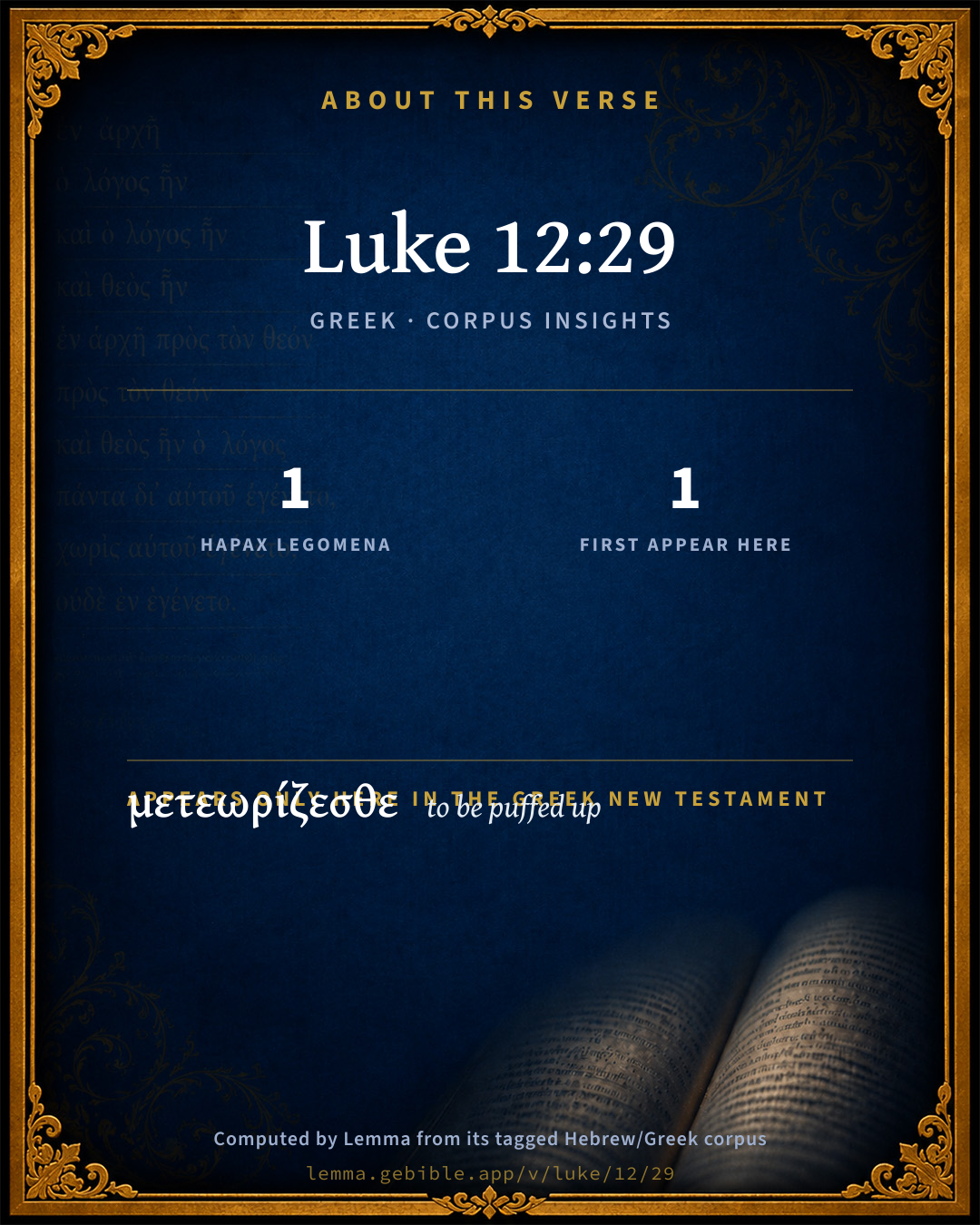
Luke 12:29

Greek (Tischendorf 8th ed.) Luke 12:29 appears in the Greek New Testament. The text above is from the Tischendorf 8th edition. Each word links to its Strong’s number and a concise gloss. Click any word for its full Thayer’s Greek Lexicon entry.
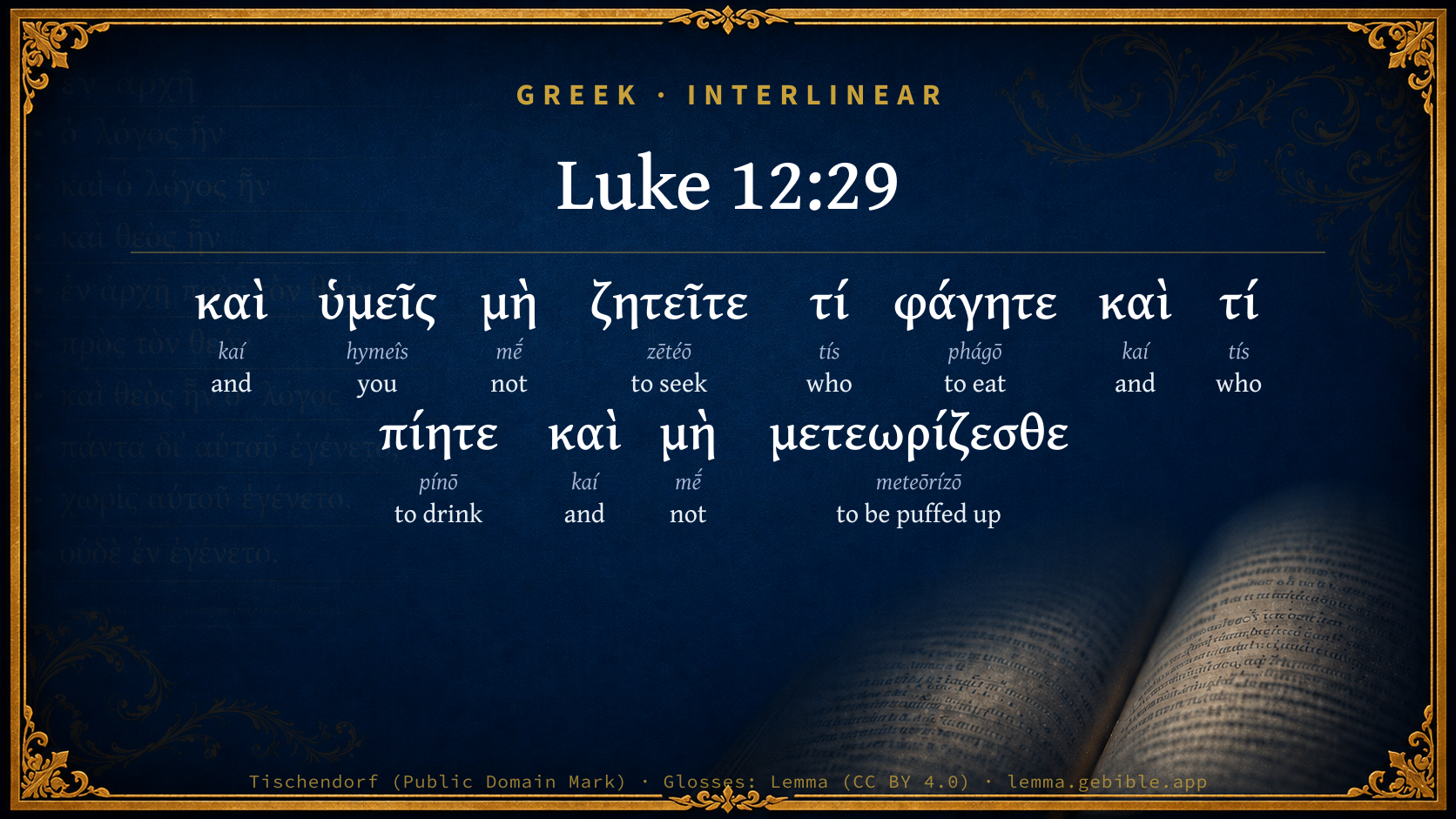
Download image
Cite this verse

Luke 12:29 (World English Bible). Public Domain. Lemma interlinear Bible study tool, https://lemma.gebible.app/v/luke/12/29.

Show BibTeX & RIS
BibTeX
RIS
English Translation
Don't seek what you will eat or what you will drink; neither be anxious.
World English Bible · Public Domain
Highlights
  • 1 hapax legomenon — only here in the Greek New Testament
  • 1 first appearance in the Greek New Testament
Full analysis ↓
Download a study sheet

One document with this verse’s original text, its word-by-word gloss line, the meaning frame, cross-references with their text, attributed commentary, and full source and license credits — printable, and it pastes into notes with its structure intact.

This verse Autodidact and up

Study sheet (.html) Plain text (.txt)

A passage Seminary Student

Up to 50 verses in one chapter. A passage sheet keeps up to 6 commentary sources and 12 cross-references per verse, in the order this page ranks them, and says so on the sheet whenever that leaves anything out. Ask for a single verse and you get the Autodidact verse sheet above.

Everything on this page stays free to read, with no account — the sheet is a download of what is already on screen, not access to it.

Want to remove ads? Support Godless Engineer
Compare translations 3

The same verse in 3 English versions, stacked beneath the original-language interlinear above. Click any original word for its lexicon entry.

Each is an independent rendering of the whole verse — the interlinear is not word-aligned to these translations.

Highlighted words mark where these versions differ — a whole-verse word diff, not a word-by-word alignment.

  • World English Bible Public Domain
    Don't seek what you will eat or what you will drink; neither be anxious.
  • King James Version Public Domain
    And seek not ye what ye shall eat, or what ye shall drink, neither be ye of doubtful mind.
  • unfoldingWord Literal Text CC BY-SA 4.0
    And you, do not seek what you might eat and what you might drink, and do not be anxious.

unfoldingWord Literal Text — © unfoldingWord, licensed CC BY-SA 4.0. Word-aligned USFM3 via Door43 (git.door43.org/unfoldingWord/en_ult).

Versions to compare (up to 4)

3 of 4 selected

Show all 19 translations

Every available English version of this verse, each an independent rendering of the whole verse.

  • World English Bible Public Domain
    Don't seek what you will eat or what you will drink; neither be anxious.
  • Berean Standard Bible Public Domain
    And do not be concerned about what you will eat or drink. Do not worry about it.
  • Majority Standard Bible Public Domain
    And do not be concerned about what you will eat or drink. Do not worry about it.
  • King James Version Public Domain
    And seek not ye what ye shall eat, or what ye shall drink, neither be ye of doubtful mind.
  • American Standard Version (1901) Public Domain
    And seek not ye what ye shall eat, and what ye shall drink, neither be ye of doubtful mind.
  • Revised Version (1885) Public Domain
    And seek not ye what ye shall eat, and what ye shall drink, neither be ye of doubtful mind.
  • Geneva Bible (1599) Public Domain
    Therefore aske not what yee shall eate, or what ye shall drinke, neither hag you in suspense.
  • Douay-Rheims (1899) Public Domain
    And seek not you what you shall eat, or what you shall drink: and be not lifted up on high.
  • Young's Literal Translation Public Domain
    `And ye -- seek not what ye may eat, or what ye may drink, and be not in suspense,
  • Literal Standard Version CC BY-SA 4.0
    And you—do not seek what you may eat, or what you may drink, and do not be in suspense,
  • Unlocked Literal Bible CC BY-SA 4.0
    Do not look for what you will eat and what you will drink, and do not be anxious.
  • unfoldingWord Literal Text CC BY-SA 4.0
    And you, do not seek what you might eat and what you might drink, and do not be anxious.
  • Darby Bible Public Domain
    And *ye*, seek not what ye shall eat or what ye shall drink, and be not in anxiety;
  • World Messianic Bible Public Domain
    “Don’t seek what you will eat or what you will drink; neither be anxious.
  • Webster's Bible Public Domain
    And seek ye not what ye shall eat, or what ye shall drink, neither be ye of doubtful mind.
  • Free Bible Version CC BY-SA 4.0
    Don't be concerned about what you're going to eat or drink—don't worry about it.
  • Bible in Basic English Public Domain
    And do not give overmuch thought to your food and drink, and let not your mind be full of doubts.
  • Text-Critical English NT CC BY 4.0
    And do not be concerned about what you will eat or what you will drink; do not be anxious about such things.
  • Tyndale New Testament (1534) Public Domain
    And axe not what ye shall eate or what ye shall drinke nether clyme ye vp an hye

Literal Standard Version (2020), Covenant Press — licensed CC BY-SA 4.0. Text via the HelloAO Bible API (eBible.org). Unlocked Literal Bible (unfoldingWord) — licensed CC BY-SA 4.0. Text via the HelloAO Bible API (eBible.org). unfoldingWord Literal Text — © unfoldingWord, licensed CC BY-SA 4.0. Word-aligned USFM3 via Door43 (git.door43.org/unfoldingWord/en_ult). Free Bible Version, Dr. Jonathan Gallagher — licensed CC BY-SA 4.0. Text via the HelloAO Bible API (eBible.org).

Word by word

More ways to search: Search by grammar → Find every occurrence → Compare this word →

Practice this passage: Drill this verse → Learn its vocabulary →

μετεωρίζεσθε
meteōrízō
G3349
“to be puffed up”
Verb, Present, Passive, Imperative, 2nd person, Plural
Part of Speech
Verb
Tense
Present
Voice
Passive
Mood
Imperative
Person
2nd person
Number
Plural
Full Thayer's Definition

Origin: "from a compound of G3326 and a collateral form of G142 or perhaps rather G109 (cf "meteor")"

TDNT: 4:630,*

1. to rise up on high a. to put a ship [out to sea] up upon the deep b. to raise up fortifications 2. metaph. a. to lift up one's soul, raise his spirits 1. to buoy up with hope 2. to inflate with pride 3. to be elated 4. to take one airs, be puffed up with pride b. by a metaphor taken from ships that are tossed about on the deep by winds and waves 1. to cause one to waver or fluctuate in the mind 2. to agitate or harass with cares 3. to make anxious
  1. καὶ kaí G2532 “and” Conjunction
  2. ὑμεῖς hymeîs G5210 “you” Personal pronoun, 2nd person, Nominative, Plural
  3. μὴ mḗ G3361 “not” Particle, Negative
  4. ζητεῖτε zētéō G2212 “to seek” Verb, Present, Active, Imperative, 2nd person, Plural
  5. τί tís G5101 “who” Interrogative pronoun, Accusative, Singular, Neuter
  6. φάγητε phágō G5315 “to eat” Verb, Aorist, Active, Subjunctive, 2nd person, Plural
  7. καὶ kaí G2532 “and” Conjunction
  8. τί tís G5101 “who” Interrogative pronoun, Accusative, Singular, Neuter
  9. πίητε pínō G4095 “to drink” Verb, Aorist, Active, Subjunctive, 2nd person, Plural
  10. καὶ kaí G2532 “and” Conjunction
  11. μὴ mḗ G3361 “not” Particle, Negative

About this verse

These counts appear in no published source. They are computed here, from the morphology-tagged text and Lemma’s own curated glosses. What Lemma adds →

12
words
8
distinct lemmas
Gospels
section

Notable vocabulary

1 hapax legomenon — a word that appears only here in the entire Greek New Testament:

  • μετεωρίζεσθε to be puffed up G3349

First appearance in Scripture

This word makes its first canonical appearance in the Greek New Testament here:

  • μετεωρίζεσθε to be puffed up G3349

Repetition

Words recur within this verse:

Cross-references

4

Topical passages linked to Luke 12:29 in the Treasury of Scripture Knowledge — connected by theme and wording, ordered by reader-vote popularity; previews shown in the World English Bible.

  • Matthew 6:31 "Therefore don't be anxious, saying, 'What will we eat?', 'What will we drink?' or, 'With what will we be clothed?'
  • Luke 12:22 He said to his disciples, "Therefore I tell you, don't be anxious for your life, what you will eat, nor yet for your body, what you will wear.
  • Luke 22:35 He said to them, "When I sent you out without purse, and wallet, and shoes, did you lack anything?" They said, "Nothing."
  • Luke 10:7–8 Remain in that same house, eating and drinking the things they give, for the laborer is worthy of his wages. Don't go from house to house.

Cross-references courtesy of OpenBible.info (CC BY 4.0).

Commentary

Notes on Luke 12:29 from classic Christian and Jewish commentators (each source and its license shown beneath its notes). The classic Christian expositions comment on the surrounding passage and are grouped to its opening verse, so a note may address several verses; the Jewish commentaries on the Tanakh (Rashi and others) are per-verse, so they appear only where the commentator wrote on this verse.

Lemma curates 59 commentaries, every one of them public domain or Creative Commons licensed, each selected and text-cleaned for this edition rather than reprinted as found. About our sources →

The Biblical Illustrator

Joseph S. Exell

Luk_12:29

Neither be ye of doubtful mind

A new parable

Our Lord here crushes a whole world of meaning into a single word, which, as we study it, resolves itself into a bright, impressive picture or parable.

The phrase really comes to this: Do not toss about in the windy offing, when you may ride safely in the sheltered haven. And if we take it in connection with what goes before and what comes after, we find that the complete parable runs thus: Do not toss about on the wide dangerous sea of Care, on which so many make shipwreck, but rather take shelter in the safe and tranquil harbour of Trust in God. Had our Lord paused to expand the parable, and had He thrown it into the form which most of His parables assume, He might have used some such words as these: The Kingdom of God is like unto a large and tranquil harbour, into which all who sail across the stormy sea of life may enter and be at rest. Now the calm and simple ideal of life which Christ here holds up before us is one that has a special claim on us, and a special charm, in days such as these when most men are seeking outward good--seeking wealth and worldly advancement--with a passionate and feverish eagerness. Who does not long, at least at times, to escape

The heavy trouble, the bewildering care

That weighs us down who live and earn our bread?

Who is not weary of the strain, the waste, the ungenerous rivalry, the intense and protracted drudgery which what men call success in life demands? Who does not see that the pursuit of what we call comfort is well-nigh taking all comfort out of our days? Who does not admit, in any moment of cool reflection, that the general homage to wealth is becoming a degrading and unmanly idolatry, inducing false estimates of character, and leading men to value the means of living above the true ends of life? What we should admire in our neighbours, what we should chiefly aim at for ourselves, is not a gay and wealthy outside of circumstance, but noble character--virtue, wisdom, piety, inward worth. And this is the aim, the ideal, which the Lord Jesus sets before us. He bids us seek first the Kingdom of God; and the Kingdom of God is within us, not without. He would have us cultivate those graces of spiritual character which fit us both to meet any circumstances and changes of circumstances in this life, and to enter with the joy of a foreseen triumph on the dark and narrow avenue which leads to the life to come. If we take His counsel, He promises us an absolute freedom from care. He assures us that we shall ride safely in a sheltered port instead of tossing on the heaving storm-swept sea. Not that He prohibits care and thought. A man must take thought, must study and plan and contrive, if he is to be a wise man. We may make the voyages which the necessities of life demand, and bring home much store of merchandise; but then, we are to have a home, a city of the soul to which we may repair; and when we reach it, we are not to cast anchor in the windy offing, but to take refuge in the tranquil haven. That is to say, we are to attend to the duties and labours of life, attend to them with diligence, give our best thought and care to them; but, when these duties and labours are discharged, we are not to vex our souls with an incessant anxiety as to the issue of our toils; we are to leave that with God, and not to be careful because He cares for us. So, again, forethought is no more forbidden than thought. A wise man, a man with discourse of reason, i.e., a man in whom reason is not dumb and inert, must look before and after. There would be no unity in his life, no continuous development and activity, no linking on of month to month and year to year, if he did not look forward and scheme for the future as well as for the present. What Christ forbids is so looking onward to to-morrow as to cloud to-day, so anticipating the future as to darken the present. And this is the very point at which we commonly fail. To-day may be well enough, we admit; or, at the worst, we could get through its tasks and endure its trials. But what of to-morrow? What of the future? How shall we meet the toils and losses and troubles we foresee? Now it is from this pernicious habit of borrowing trouble from the future, as though we had not enough of it in the present, that Christ would save us. Trust in God for the future, He says; Do your duty today, and leave to-morrow with Him. And let this trust be your tranquil haven, your harbour of refuge, whenever the waves of Care run high. Rest and refit in the harbour to-night; and if, when the morning breaks, you have to sail out into a stormy sea, you will at least be in a better condition to meet it. (S. Cox, D. D.)

Possessions and prospects

Perhaps I am speaking to some child of poverty. I remember a beautiful story applicable to you. The late Lady Huntingdon, passing by a low, mean-looking cottage one day, heard a faint, soft sound inside, and drew up to the door, when she heard a voice uttering these words, O my God, I thank Thee that I have all this--the Lord Jesus now and heaven at last. Thought the listener, what can this mean? Curiosity is strong; and giving the door a little touch, she saw an aged one--a poor woman, eighty years of age--with a pitcher of water and a crust, and her hands raised in the attitude of thanksgiving, and her words were, O Lord, I thank Thee that I have all this, and the Lord Jesus Christ, and heaven at last. Rest in His word. My God shall supply all your need. Oh, sweet the scant supply where there is a confiding, joyous heart! Birds of song sing as merrily just before their breakfast, though they dont know where it is to come from, as they do when they have got it. And the God who watches over the bird will not neglect you. Lacked ye anything? said the Lord to the seventy, who had been sent out without any worldly emoluments; and they answered, No, Lord. Many a saint at the close of his pilgrimage can say the same; can say, Notwithstanding all the vicissitudes and changes and losses that I have endured, God has given me food and raiment, and I have, not wanting much, wanted for nothing. (J. Denham Smith.)

Confidence in God

Never did man die of hunger who served God faithfully, Cuthbert would say, when nightfall found them supperless in the waste. Look at that eagle overhead! God can feed us through him if He will--and once, at least, he owed his meal to a fish that the scared bird let fall. A snowstorm drove his boat on the coast of Fife. The snow closes the road along the shore, moaned his comrades; the storm bars our way over sea. There is still the way of heaven that lies open, said Cuthbert. (J. R. Green, Short History. )

The Biblical Illustrator, edited by Joseph S. Exell (c. 1880s–1900s) — public domain. Text from a community e-Sword module.

MacLaren's Expositions of Holy Scripture

Alexander MacLaren

Luke

ANXIOUS ABOUT EARTH, OR EARNEST ABOUT THE KINGDOM

STILLNESS IN STORM

Luk 12:29.

I think that these words convey no very definite idea to most readers. The thing forbidden is not very sharply defined by the expression which our translators have employed, but the original term is very picturesque and precise.

The word originally means ‘to be elevated, to be raised as a meteor,’ and comes by degrees to mean to be raised in one special way-namely, as a boat is tossed by a tough sea. So there is a picture in this prohibition which the fishermen and folk dwelling by the Sea of Galilee with its sudden squalls would understand: ‘Be not pitched about’; now on the crest, now in the trough of the wave.

The meaning, then, is substantially identical with that of the previous words, ‘Take no thought for your life,’ with this difference, that the figures by which the thing prohibited is expressed are different, and that the latter saying is wider than the former.

The former prohibits ‘taking thought,’ by which our Lord of course means not reasonable foresight, but anxious foreboding. And the word which He uses, meaning at bottom as it does, ‘to be distracted or rent asunder,’ conveys a striking picture of the wretched state to which such anxiety brings a man. Nothing tears us to pieces like foreboding care. Then our text forbids the same anxiety, as well as other fluctuations of feeling that come from setting our hopes and hearts on aught which can change; and its figurative representation of the misery that follows on fastening ourselves to the perishable, is that of the poor little skiff, at one moment high on the crest of the billow, at the next down in the trough of the sea.

So both images point to the unrest of worldliness, and while the unrest of care is uppermost in the one, the other includes more than simply care, and warns us that all occupation with simply creatural things, all eager seeking after ‘what ye shall eat or what ye shall drink’ or after more refined forms of earthly good, brings with it the penalty and misery of ‘for ever tossing on the tossing wave.’ Whosoever launches out on to that sea is sure to be buffeted about. Whoso sets his heart on the uncertainty of anything below the changeless God will without doubt be driven from hope to fear, from joy to sorrow, and his soul will be agitated as his idols change, and his heart will be desolate when his idols perish.

Our Lord, we say, forbids our being thus tossed about. He seems to believe that it is in our own power to settle whether we shall be or no. That sounds strange; one can fancy the answer: ‘What is the use of telling a man not to be buffeted about by storm? Why, he cannot help it. If the sea is running high the little boat cannot lie quiet as if in smooth water. Do not talk to me about not being moved, unless you can say to the tumbling sea of life, “Peace, be still!” and make it

‘quite forget to rave,

While birds of peace sit brooding on the charmed wave.’

The objection is sound after a fashion. Change there must be, and fluctuation of feeling. But there is such a thing as ‘peace subsisting at the heart of endless agitation.’ You may remember the attempt that was made some years ago to build a steamer in which the central saloon was to hang perfectly still while the outer hull of the ship pitched and rolled with the moving sea. It was a failure, but the theory was sound and looked practicable. At any rate, it is a parable of what may be in our lives. If I might venture, without seeming irreverence, to modernise and so to illustrate this command of our Lord’s, I would say, that He here bids us do for our life’s voyage across a stormy sea, exactly what the ‘Bessemer’ ship was an attempt to do in its region-so to poise and control the oscillations of the central soul that however the outward life may be buffeted about, there may be moveless rest within. He knows full well that we must have rough weather, but He would have us counteract the motion of the sea, and keep our hearts in stillness. ‘In the world ye shall have tribulation,’ but in Him ye may have peace.

He does not wish us to be blind to the facts of life, but to take all the facts into our vision. A partial view of the so-called facts certainly will lead to tumultuous alternations of hope and fear, of joy and sorrow. But if you will take them all into account, you can be quiet and at rest. For here is a fact as real as the troubles and changes of life: ‘Your Father knoweth that ye have need of these things.’ Ah! the recognition of that will keep our inmost hearts full of sweet peace, whatever may befall the outward life. Only take all the facts of your condition, and accept Christ’s word for that greatest and surest of all-the loving Father’s knowledge of your needs, and it will not be hard to obey Christ’s command, and keep yourself still, because fixed on Him.

But now consider the teachings here as to the true source of the agitation which our Lord forbids. The precept itself affords no light on that subject, but the context shows us the true origin of the evil.

The first point to observe is how remarkably our Lord identifies this anxiety and restlessness which He forbids with what at first sight seems its exact opposite, namely a calmness and peace which he also condemns as wholly bad. The whole series of warnings of which our text is part begins with the story of the rich man whose ground brought forth plentifully. His fault was not that he was tossed about with care and a doubtful mind, but the very opposite. His sin was in saying, ‘Soul, thou hast much goods laid up for many years; take thine ease, eat, drink, and be merry.’

Notice, then, that our Lord begins by pointing out the great madness and the great sin of being thus at rest, and trusting in earthly possessions: and then with a ‘Therefore, I say unto you,’ He turns to the opposite pole of worldly feeling, and shows us how, although opposite, it is yet related. The warning, ‘Take no thought for your life’ follows as an inference from the picture of the folly of the man that lays up treasure for himself and is not rich towards God.

That is to say, the two faults are kindred and in some sense the same. The rich fool stretching himself out to rest on the pile of his possessions, and the poor fool tossing about on the billows of unquiet thought, are at bottom under the influence of the same folly, though their circumstances are opposite, and their moods seem to be so too.

The one man is just the other turned inside out. When he is rich and has got plenty of outward goods, he has no anxiety, because he thinks that they are supreme and all-sufficient. When he is poor and has not got enough of them, he has no rest, because he thinks that they are supreme and all-sufficient. Anxious care and satisfied possession are at bottom the very same thing. The man who says, ‘My mountain stands strong,’ because he has got a quantity of money or the like; and the man who says, ‘Oh, dear me, what is going to become of me?’ because he thinks he has not got enough, only need to exchange circumstances and they will exchange cries.

The same figure is concave or convex according to the side from which you look at it. From one it swells out into rounded fullness; from the other it gapes as in empty hungriness. So the rich fool of the preceding parable and the anxious, troubled man of my text are the same man looked at from opposite sides or set in opposite circumstances. The root of both the rest of the one and of the anxiety of the other is the over-estimate of outward good.

Then, still further, notice how our Lord here brands this forbidden fluctuation of feeling as being at bottom pure heathenism. Most significant double reasons for our text follow it, introduced by a double ‘for.’ The first reason is, ‘For all these things do the nations of the world seek after’; the second is, ‘For your Father knoweth that ye have need of these things.’ The former points the lesson of the contradiction between such trouble of mind and the position of disciples. For pure heathens it is all natural; for men who do not know that they have a Father in heaven, there is nothing strange or anomalous in care and anxiety, nor in the race after riches. But for you, it is in diametrical contradiction to all your professions, in flagrant inconsistency with all your belief, in flat denial of that mighty truth that you have a Father who cares for you, and that His love is enough. Every time you yield to such cares or thoughts you are going down to the level of pure heathenism. That is a sharp saying. Our Lord’s steady hand wields the keen dissecting-knife here, and lays bare with unsparing cuts the ugly growth. We give the thing condemned a great many honourable names, such as ‘laying up for a rainy day,’ or ‘taking care for the future of my children,’ or ‘providing things honest in the sight of all men,’ and a host of others, with which we gloss and gild over unchristian worldly-mindedness.

There are actions and feelings which are rightly described by such phrases, that are perfectly right, and against them Jesus Christ never said a word.

But much of what we deceive ourselves by calling reasonable foresight is rooted distrust of God, and much practical heathenism creeps into our lives under the guise of ‘proper prudence.’ The ordinary maxims of the world christen many things by names of virtues and yet they remain vices notwithstanding.

I do not know that there is any region in which Christian men have more to be on their guard, lest they be betrayed into deadening inconsistencies, than this of the true limits of care for material wealth, and of provision for the future outward life.

Those of us, especially, who are engaged in business, and who live in our great commercial cities, have hard work to keep from dropping down to the heathen level which is adopted on all sides. It is not easy for such a man to resist the practical belief that money is the one thing needful, and he the happy man who has made a fortune. The false estimate of worldly good is in the air about us, and we have to be on our guard, or else, before we know where we are, we shall have breathed the stupefying poison and feel its narcotic influence slackening the pulses and dimming the eye of our spirits. We need special watchfulness and prayer, or we shall not escape this subtle danger, which is truly for many of us ‘the pestilence that walketh in darkness.’

So be not tossed about by these secularities, for the root of them all is heathenish distrust of your Father in heaven.

Then, finally, we have the cure for all agitation. Christ here puts in our own hands, in that thought, ‘Your Father knoweth that ye have need of these things,’ the one weapon with which we can conquer. There is the true anchorage for tempest-tossed spirits, the land-locked haven where they can ride, whatever winds blow and waves break outside the bar.

I remarked that our Lord here seemed to give an injunction which the facts of life would prevent our obeying, and so it would be, had He not pointed us to that firm truth, which, if we believe it, will keep us unmoved. There is no more profitless expenditure of breath than the ordinary moralist’s exhortations to, or warnings against, states of feeling and modes of mind. Our emotions are very partially under our direct control. Life cannot be calm by willing to be so. But what we can do is to think of a truth which will sway our moods. If you can substitute some other thought for the one which breeds the emotion you condemn, it will fall silent of itself, just as the spindles will stop if you shut off steam, or the mill-wheel if you turn the stream in another direction. So Christ gives us a great thought to cherish, knowing that if we let it have fair play in our minds, we shall be at rest: ‘Your Father knoweth that ye have need of these things.’ Surely that is enough for calmness. Why should, or how can we be, troubled if we believe that?

‘He knows.’ What a wonderful confidence in His heart and resources is silently implied in that word! If He knows that you need, you may be quite sure that you will not want. ‘He knows’; and His fatherly heart is our guarantee that to know and to supply our need, are one and the same thing with Him; and His deep treasure of exhaustless good is our guarantee that our need can never go beyond His fullness, nor He ever, like us, see a sorrow He cannot comfort, a want that He cannot meet.

Enough that He knows; ‘the rest goes without saying.’ The whole burden of solicitude is shifted off our shoulders, if once we get into the light of that great truth. A man is made restful in the midst of all the changes and storms of life, not by trying to work himself into tranquillity, not by mere dint of coercing his feelings through sheer force of will, not by ignoring any facts, but simply by letting this truth stand before his mind. It scatters cares, as the silent moon has power, by her mild white light, to clear away a whole skyful of piled blacknesses.

One other word of practical advice, as to how to carry out this injunction, is suggested by the context, which goes on, ‘Seek ye first the kingdom of God.’

A boat will roll most when, from lack of a strong hand at the helm, she has got broadside to the run of the sea. There she lies rocking about just as the blow of the wave may fall, and drifting wherever the wind may take her. There are two directions in which she will be comparatively steady; one, when her head is kept as near the wind as may be, and the other when she runs before it. Either will be quieter than washing about anyhow. May we make a parable out of that? If you want to have as little pitching and tossing as possible on your voyage, keep a good strong hand on the tiller. Do not let the boat lie in the trough of the sea, but drive her right against the wind, or as near it as she will sail. That is to say, have a definite aim to which you steer, and keep a straight course for that. So Christ says to us here. Be not filled with agitations, but seek the Kingdom. The definite pursuit of the higher good will deaden the lower anxieties. The active energies called out in the daily efforts to bring my whole being under the dominion of the sovereign will of God, will deliver me from a crowd of tumultuous desires and forebodings. I shall have neither leisure nor inclination to be anxious about outward things, when I am engaged and absorbed in seeking the kingdom. So ‘bear up and steer right onward,’ and it will be smooth sailing.

Sometimes, too, we shall have to try the other tack, and run before the storm, which again will give us the minimum of commotion. That, being translated, is, ‘Let the winds and the waves sometimes have their way.’ Yield to them in the sweetness of submission and the strength of resignation. Even when all the stormy winds strive on the surface sea, recognise them as God’s messengers ‘fulfilling His word.’ Submission is not rudderless yielding to the gale, that tosses us on high and sinks us again, as the waves list. This frees us from their power, even while they roll mountains high.

Then keep firm trust in your Father’s knowledge; strenuously seek the kingdom. In quietness accept the changeful methods of his unchanging providence. Thus shall your hearts be kept in peace amidst the storm of life, with the happy thought, ‘So He bringeth them unto their desired haven.’

Alexander MacLaren, Expositions of Holy Scripture (1904–1910) — public domain. Text from a community e-Sword module.

Bengel's Gnomon

Johann Albrecht Bengel

Luk 12:29. Καὶ ὑμεῖς, so ye also) as the ravens and the lilies.—μὴ μετεωρίζεσθε) Μετέωρος means elevated, lifted aloft: whence μετεωρίζεσθαι is, to be borne up aloft, or to be kept in a state of elevation [and so, suspense]. It is said of a mind elated, or tossed to and fro. He who is anxious with cares is driven hither and thither: being in suspense, he fluctuates in feelings, and is seized with dizziness. For which reason, what in the parallel passage of Matthew is μεριμνᾶν (to be distracted with solicitudes), is expressed in Luke by μετεωρίζεσθαι. Pricæus compares with this the language found in Josephus, μετέωρον εἶναι καὶ κραδαίνεσθαι: and in Suidas, μετέωροι καὶ πρὸς τὸ μέλλον σαλεύοντες. Cic. i. xv. ad Att., Ep. 14, “Ita sum μετέωρος et magnis cogitationibus impeditus.”

Bengel's Gnomon of the New Testament — English translation (T&T Clark, Edinburgh, 1860) — public domain. Text from a community e-Sword module.

Expositor's Greek Testament

ed. W. Robertson Nicoll

Luk 12:29 . μετεωρίζεσθε : a ἅπ . λεγ . in N.T. and variously rendered. The meaning that best suits the connection of thought is that which finds in the word the figure of a boat tempest-tossed, but that which is best supported by usage points rather to high-mindedness, vain thoughts. The Vulgate renders nolite in sublime tolli = lift not yourselves up to lofty claims (Meyer); do not be ambitious, be content with humble things, a perfectly congruous counsel. Still the rendering: be not as tempest-tossed vessels, vexed with care, is a finer thought and more what we expect. Hahn renders: do not gaze with strained vision heavenwards, anxiously looking for help. Pricaeus: “ex futuro suspendi”. Theophylact gives a paraphrase which in a way combines the two senses. He defines meteorismus as distraction ( περισπασμὸν ), and a restless movement of the mind, thinking now of one thing now of another, leaping from this to that, and always fancying higher things ( ἀεὶ τὰ ὑψηλότερα φανταζομένου ).

The Expositor's Greek Testament, edited by W. Robertson Nicoll (1897–1910) — public domain. Text from a community e-Sword module.

Godet's Commentaries

Frédéric Louis Godet

Vers. 29-34. The Application.—“And seek not ye what ye shall eat, or what ye shall drink, neither be ye of doubtful mind. 30. For all these things do the nations of the world seek after: and your Father knoweth that ye have need of these things. 31. But rather seek ye the kingdom of God; and all these things shall be added unto you. 32. Fear not, little flock; for it is your Father’s good pleasure to give you the kingdom. 33. Sell that ye have, and give alms; provide yourselves bags which wax not old, a treasure in the heavens that faileth not, where no thief approacheth, neither moth corrupteth. 34. For where your treasure is, there will your heart be also.”

With the cares which He leaves to the men of this world (Luk 12:29-30) Jesus contrasts the care which He recommends to His own (Luk 12:31-34).—Καί (Luk 12:29): and consequently.—῾Υμεῖς, ye, might contrast men with the lower creatures cited as examples, the ravens, the lilies. But according to Luk 12:30, this pronoun rather serves to distinguish the disciples from men who have no faith, from the nations of this world. Jesus thus designates not only the heathen,—in that case He would have said simply the nations,—but also the Jews, who, by refusing to enter into the βασιλεία, condemn themselves to become a people of this world like the rest, and remain outside of the true people of God, to whom Jesus is here speaking (the little flock, Luk 12:32).

Πλήν (Luk 12:31): “All this false seeking swept away, there remains only one which is worthy of you.” “The kingdom of God,” as always: that state, first internal, then social, in which the human will is nothing but the free agent of the divine will. All these things, to wit, food and clothing, shall be given over and above the kingdom which ye seek exclusively, as earthly blessings were given to the young Solomon over and above the wisdom which alone he had asked. Καί: and on this single condition. — Πάντα was easily omitted after ταῦτα by a mistake of sight (confusion of the two τα). Bleek acknowledges that this passage is more suitably put in Luke than by Matthew in the Sermon on the Mount, where the entire piece on confidence is only very indirectly connected with the charge of covetousness addressed to the Pharisees.

The expression little flock, Luk 12:32, corresponds with the critical position of the small group of disciples in the midst of undecided or hostile myriads, Luk 12:1; it recalls the you, my friends, Luk 12:4. Jesus here gives consolation to the believer for times when the interests of the kingdom of God place him in a position of earthly privation (Gess). The a fortiori argument of Luk 12:23 is here, Luk 12:32, reproduced in a higher sphere: “Will not He who has provided with so much love for your eternal well-being, provide more certainly still for your poor earthly maintenance?” What faithful servant would have to disquiet himself about his food in the house of the master for whom he works day and night? And when this master is a Father! It was from experience that Jesus spoke in such a style.

From the duty of being unconcerned about the acquisition of riches, Jesus passes, Luk 12:33, to that of their wise employment when they are possessed. This precept constitutes, according to De Wette, the great heresy of Luke, or, according to Keim, that of his Ebionite document—salvation by the meritorious virtue of voluntary poverty and almsgiving. But let us first remark, that we have here to do with believers, who as such already possess the kingdom (Luk 12:32), and do not require to merit it. Then, when Jesus says sell, give..., is it a commandment? Is it not the sense rather: “Have no fear; only do so! If you do, you will find it again.” Finally, for a member of the society of believers at this period, was not the administration of earthly property a really difficult thing? Was not every disciple more or less in the position of Jesus Himself, who, having once begun His ministry, had required to break off His trade as a carpenter? The giving away of earthly goods is here presented, first as a means of personal emancipation, that the giver might be able to accompany Jesus, and become one of the instruments of His work; then as a gladsome liberality proceeding from love, and fitted to enrich our heaven eternally. In all this there is nothing peculiar to Luke, nor to his alleged Ebionite document. Comp. in respect of the first aspect, the history of the rich young man (in the three Syn.); and, in respect to the second, the word of Jesus in Matthew: “Inasmuch as ye have done it unto one of the least...ye have done it unto me,” and the whole of the judgment scene (Mat 25:31-46).

It must not be forgotten that the kingdom of God at this period was identified with the person of Jesus, and the society of disciples who accompanied Him. To follow Jesus (literally) in His peregrinations was the only way of possessing this treasure, and of becoming fit to spread it in consequence. Then, as we have seen, it was an army not merely of believers, but of evangelists, that Jesus was now labouring to form. If they had remained attached to the soil of their earthly property, they would have been incapable of following and serving Him without looking backwards (Luk 9:62). The essential character of such a precept alone is permanent. The form in which Jesus presented it arose from the present condition of the kingdom of God. The mode of fulfilling it varies. There are times when, to disentangle himself and practise Christian love, the believer must give up everything; there are other times when, to secure real freedom and be the better able to give, he must keep and administer. When Paul thus expressed the Christian duty, possessing as though they possessed not (1Co 7:29), it is evident that all he had in view was the disengaged and charitable spirit commended by Jesus, and that he modified the transient form which this precept had assumed. There is in the expressions of Jesus a sort of enthusiasm of disdain for those earthly treasures in which the natural man places his happiness: “Get rid of those goods; by giving them away, change them into heavenly treasures, and ye shall have made a good bargain!” This is the being rich toward God (Luk 12:21). Every gift made by human love constitutes in the eyes of God the impersonation of love, a debt payable in heaven. Love regards love with affection, and will find means to requite it.

By this mode of acting, the believer finds that he has a treasure in heaven. Now it is a law of psychology (Luk 12:34) that the heart follows the treasure; so, your treasure once put in God, your heart will rise unceasingly toward Him. This new attitude of the believer, who lives here below with the eye of his heart turned heavenwards, is what Jesus describes in the sequel. The heart, once set free from its earthly burden, will live on the new attachment to which it is given up, and on the expectation with which it is thus inspired, Luk 12:35-38.

Frédéric Louis Godet — Commentaries on Luke, John, Romans, and 1 Corinthians — English translation (T&T Clark, Edinburgh, 1870s–1890s) — public domain. Text from a community e-Sword module.

Geneva Bible (1599)

Geneva Bible translators

A Metaphor taken of things that hang in the air, for they that are careful for this worldly life, and hang upon the arm of man, have always wavering and doubtful minds, swaying sometimes this way, and sometimes that way.

Geneva Bible (1599) marginal notes — public domain. Text via Bolls.life.

Jamieson, Fausset & Brown

Robert Jamieson, A. R. Fausset & David Brown

of doubtful, &c.--unsettled mind; put off your balance.

Jamieson, Fausset & Brown — Commentary Critical and Explanatory on the Whole Bible (1871) — public domain (CC PDM 1.0). Text via the HelloAO Bible API.

Adam Clarke's Commentary

Verse 29. Neither be ye of doubtful mind.] Or, in anxious suspense, μη μετεωριζεσθε. Raphelius gives several examples to prove that the meaning of the word is, to have the mind agitated with useless thoughts, and vain imaginations concerning food, raiment, and riches, accompanied with perpetual uncertainty.

Adam Clarke's Commentary on the Bible (1810–1826) — public domain. Text from a community e-Sword/MySword module.

The Cambridge Bible for Schools and Colleges

gen. ed. J. J. S. Perowne

29. neither be ye of doubtful mind] Literally, “Do not toss about like boats in the offing,”—a metaphor for suspense. Cicero says, “So I am in suspense (μετέωρος) and entangled in great perplexities.” Ad Att. xv. 14.

The Cambridge Bible for Schools and Colleges (gen. ed. J. J. S. Perowne; Cambridge University Press, 1878–1918) — public domain. Text from a community e-Sword module.

John Gill's Exposition

And seek not what ye shall eat, or what ye shall drink,.... That is, in an anxious and distressing manner, with a tormenting and vexatious care; otherwise food is to be both asked of God every day, and to be sought for and after in the use of proper means:

neither be ye of doubtful minds; questioning and distrusting that ye shall have any thing to eat or drink: be not fickle, unstable, and inconstant, and wandering in your thoughts about these things, like the meteors in the air, which are carried about here and there; let not your minds be disturbed and distracted about them; or be anxiously solicitous for them; See Gill on Mat 6:31.

John Gill's Exposition of the Whole Bible (1746–1763) — public domain (CC PDM 1.0). Text via the HelloAO Bible API.

Trapp's Complete Commentary

John Trapp

28 If then God so clothe the grass, which is to day in the field, and to morrow is cast into the oven; how much more will he clothe you, O ye of little faith?

29 And seek not ye what ye shall eat, or what ye shall drink, neither be ye of doubtful mind.

Ver. 29. Neither be ye of doubtful mind] μη μετεωριζεσθε. Hang not in suspense, as meteors do in the air, not certain whether to hang or fall to the ground. Meteora dicta volunt quod animos hominum suspensos, dubios, et quasi fluctuantes faciant. Aristotle himself confesseth, that of some meteors he knew not what to say, though of some other he could say somewhat. One interpreter renders this word, "make not discourses in the air," as the covetous man doth, when his head is tossed with the cares of getting or fears of losing commodity; or it may note his endless framing of projects for the compassing of his desires. The Syriac rendereth it, "Let not your thoughts be distracted about these things." Surely as a clock can never stand still, so long as the plummets hang thereat; so neither can a worldling’s heart, for cares and anxieties. These suffer him not to rest night nor day; being herein like unto the flies of Egypt, or those tyrants, Isa 16:10.

John Trapp, A Commentary or Exposition upon All the Books of the Old and New Testament (1647–1656) — public domain. Text from a community e-Sword module.

Haydock's Catholic Bible Commentary

And be not lifted up on high.[1] St. Augustine (lib. ii. QQ. Evang. q. 29. t. 3, part 4, p. 257.) expounds it thus: do not value yourselves for the plenty and variety you have of things to eat. Others, by the Greek, look upon it as a metaphor, taken from meteors in the air, that appear high, and as it were in suspense whether to remain there or to fall down; so that they expound it: be not distracted and disturbed with various thoughts and cares how to live. (Witham)

===============================

[BIBLIOGRAPHY]

Nolite in sublime tolli, Greek: me meteorizesthe; See St. Augustine, incipit superbire de talibus. lib. v. QQ. Evang. Q. 29.

====================

George Leo Haydock (1774–1849), Haydock's Catholic Family Bible and Commentary, 1859 edition — public domain. Excludes Psalms (Douay-Rheims chapter numbering differs from Protestant) and Deuterocanonical books (Catholic canon only).

The Pulpit Commentary

And seek not ye what ye shall eat, or what ye shall drink. Again, after the moving, touching words we have been commenting on, does the Lord return to the pressing injunction with which he began his lessons to his disciples upon the parable of the "rich fool." Trouble not yourselves about your eating and drinking. This repeated insistence of the Master upon this point in the future lives of his disciples has evidently a deeper significance than a mere injunction to cast all their care on him, and not to be over-anxious about their poor earthly maintenance. This was, of course, the first lesson they had to learn from these words; but beneath all this they could, and no doubt often in later days did, read in the words a clear expression of their dear Lord"s will in favor of the utmost simplicity in all matters of food and drink. His own must be marked men here, ever frugal and temperate even to abstemiousness. It is a grave question whether his Church has ever fully grasped the Master"s meaning here. Neither be ye of doubtful mind; literally, do not toss about like boats in the offing (so Dr. Farrar very happily). The word is not found elsewhere in New Testament writers, but it is known in classic writers. Its use here is one of the many signs of St. Luke"s high culture.

The Pulpit Commentary (1880–1919), ed. H.D.M. Spence-Jones & Joseph S. Exell — public domain. Text from a community e-Sword module.

John Wesley's Explanatory Notes

Neither be ye of a doubtful mind - The word in the original signifies, any speculations or musings in which the mind fluctuates, or is suspended (like meteors in the air) in an uneasy hesitation.

John Wesley, Explanatory Notes Upon the Whole Bible (1754–1765) — public domain. Text via the GEBible commentary corpus.

unfoldingWord translationNotes

Door43 World Missions Community

Do not look for what you will eat and what you will drink

"Do not focus on what you will eat and drink" or "Do not greatly desire more to eat and drink"

all the nations of the world

Here "nations" refers to "unbelievers." AT: "all people of other nations" or "all the unbelievers in the world" (See: Metonymy)

your Father

This is an important title for God. (See: Translating Son and Father)

translationWords

nation

God the Father

unfoldingWord translationNotes — © Distant Shores Media and the Door43 World Missions Community, licensed CC BY-SA 4.0. Source: git.door43.org/Door43/en_tn.

Cambridge Greek Testament for Schools and Colleges

29. μὴ μετεωρίζεσθε. Here alone in the N.T. Literally, ‘Do not toss about like boats in the offing,’—a metaphor for suspense. Cicero says, “So I am in suspense (μετέωρος) and entangled in great perplexities.” Ad Att. XV. 14. It is like the Latin fluctuo and fluito.

Cambridge Greek Testament for Schools and Colleges (Cambridge University Press, 1896; 21 vols, various authors incl. Carr, Maclear, Plummer, Farrar, Lumby, Moule, M. R. James, Simcox) — public domain. Text from a community e-Sword module.

Alford’s Greek Testament

Henry Alford

29.] μετεωρίζ., certainly not ‘nolite in sublime tolli,’ Vulg.; which Meyer approves, and Luther has adopted. For what have high thoughts to do with the present subject,—which is, the duty of dismissing anxiety and over-carefulness, in confidence on God’s paternal care? It is, be not anxious, ‘at sea,’ tossed about between hope and fear. So Thucyd. (ii. 8) describes Greece as being πᾶσα μετέωρος when the two first cities were at war.

Henry Alford, The Greek Testament (1849–1861) — public domain. Text from a community e-Sword module.

International Critical Commentary

29. καὶ ὑμεῖς μὴ ζητεῖτε. “And do you cease to seek”: comp Ver. 11, 6:30, 37, 7:13, 8:49, 50, 52, etc. Mt. has the aor. μεριμνήσητε.

μὴ μετεωρίζεσθε. In class. Grk. and in LXX (Psa 130:1; Psa_2 Mac, 5:17, 2 Mac, 7:34) this would probably mean, “Be not lifted up, do not exalt yourselves, seek not high things.” So the Vulg. nolite in sublime tolli. Old Latin texts differ: nolite solliciti esse; nec solliciti sitis (c); non abalienetis vos (d): and many omit the passage. Luth. fahret nicht hoch her. Tyn. Cov. and Cran. “neither clyme ye up an high.” But most commentators interpret it as a metaphor from ships tossing at sea: “Waver not anxiously, not tossed about with cares.” Comp. μετέωρον ἐν φόβῳ of a criminal expecting punishment (Jos. B. J. iv. 2, 5); and see S. Cox, who turns the word into a parable, Expositor, 1st series, 1. P. 249, 1875. Edersheim contends for the LXX meaning, “be not uplifted” (L. & T. 2. p. 217). The verb is one of the rarer which are common to N.T., Philo, and Plutarch.

International Critical Commentary — older volumes (1896–1929), various authors — public domain. Text from a community e-Sword module.

Vincent's Word Studies in the New Testament

Marvin R. Vincent

Be ye of doubtful mind [μετεωριζεσθε] . Only here in New Testament. The verb primarily means to raise to a height; buoy up, as with false hopes; and so to unsettle, or excite, or keep in fluctuation. Thus Thucydides says of the war between Athens and Sparta : "All Hellas was excited [μετεωρος] by the coming conflict between the two chief cities" (ii. 8).

Marvin R. Vincent, Word Studies in the New Testament (1887–1900) — public domain. Text from a community e-Sword/MySword module.

Lesson kit

Teaching starters — assembled from the data on this page, not authored interpretation. Every prompt links to the verse data it draws on. Edit before teaching.

Luke, in the Gospels, opens this verse with 12 words (8 distinct Greek lemmas). Its most distinctive word is meteōrízō (“to be puffed up”). A historical commentator’s framing appears above. Read the whole chapter for the surrounding context.

Discussion questions

  1. The word meteōrízō carries the sense “to be puffed up.” How does it shape the verse?
  2. 1 word here appears nowhere else in the Greek New Testament. Why might the author reach for such rare wording?
  3. This is the first place “to be puffed up” appears in Scripture (first appears here). What does its debut here establish?
  4. How does Matthew 6:31, which shares this passage’s theme, read alongside this verse?
  5. What does the repetition of “and” (3× in this one verse) do in this verse?
  6. The translations on this page render this verse differently — a whole-verse word diff, not a word-by-word alignment. What might account for the different wordings?
  7. Compare how The Biblical Illustrator and MacLaren's Expositions of Holy Scripture read this verse. Where do they agree or differ?

Things to notice

  • 1 word in this verse appears nowhere else in the Greek New Testament.
  • 1 word makes its first canonical appearance in Scripture here.
  • These translations choose different wording for 10 words in this verse.
  • “and” occurs 3× in this single verse.
  • 8 distinct Greek lemmas span 12 words in this verse.

Reading settings

Reading text

Shown beneath each verse's original-language words.

Old Testament
Old Testament edition

Read the OT as the Masoretic Hebrew (MT) or the Greek Septuagint (LXX).

English shown for the Greek Septuagint (in the Hebrew ↔ Greek comparison).

Comparing translations? Open the Compare panel on any verse page to stack up to four side by side.