
Luke 14:2

Greek (Tischendorf 8th ed.) Luke 14:2 appears in the Greek New Testament. The text above is from the Tischendorf 8th edition. Each word links to its Strong’s number and a concise gloss. Click any word for its full Thayer’s Greek Lexicon entry.
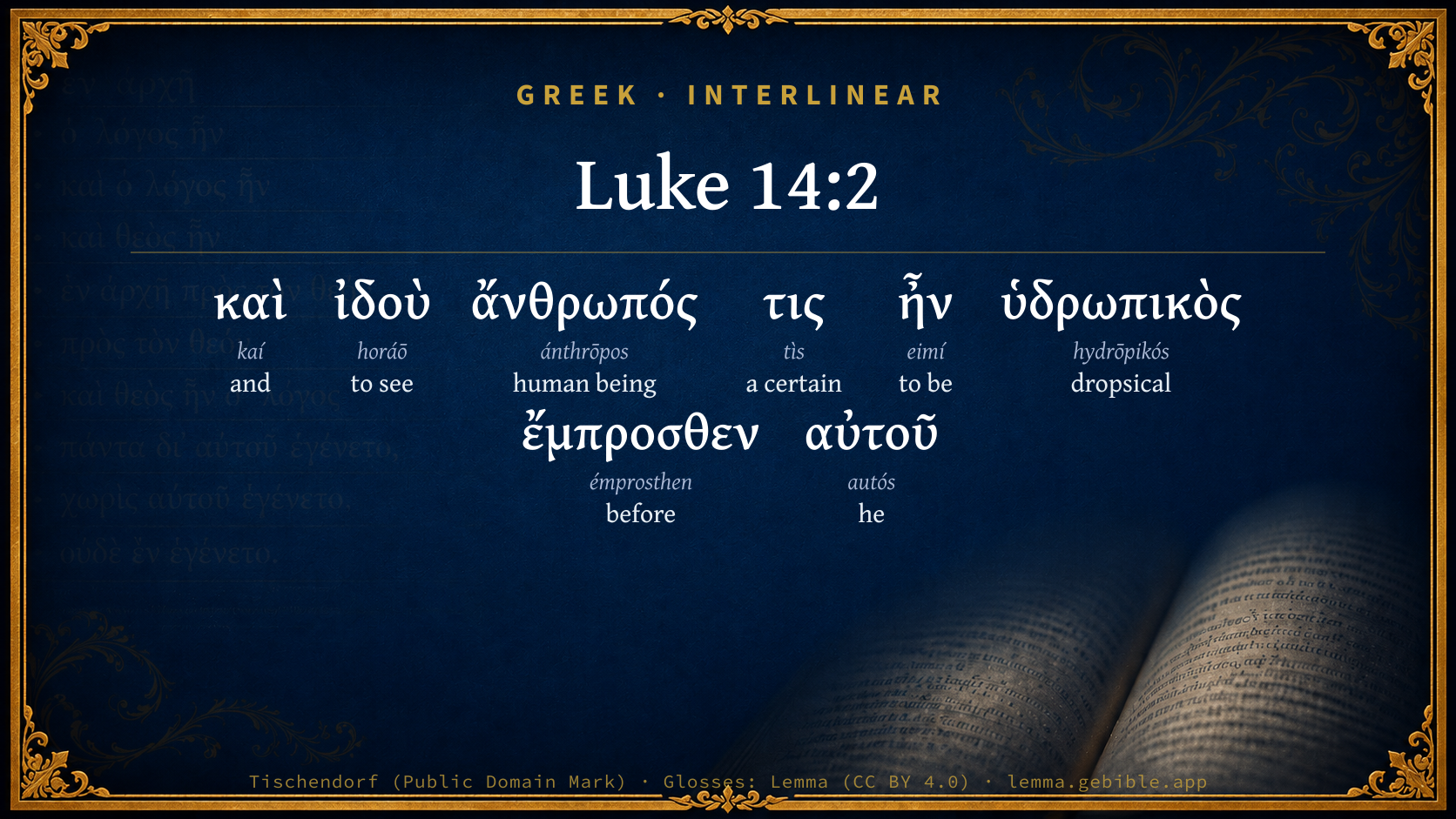
Download image
Cite this verse

Luke 14:2 (World English Bible). Public Domain. Lemma interlinear Bible study tool, https://lemma.gebible.app/v/luke/14/2.

Show BibTeX & RIS
BibTeX
RIS
English Translation
Behold, a certain man who had dropsy was in front of him.
World English Bible · Public Domain
Highlights
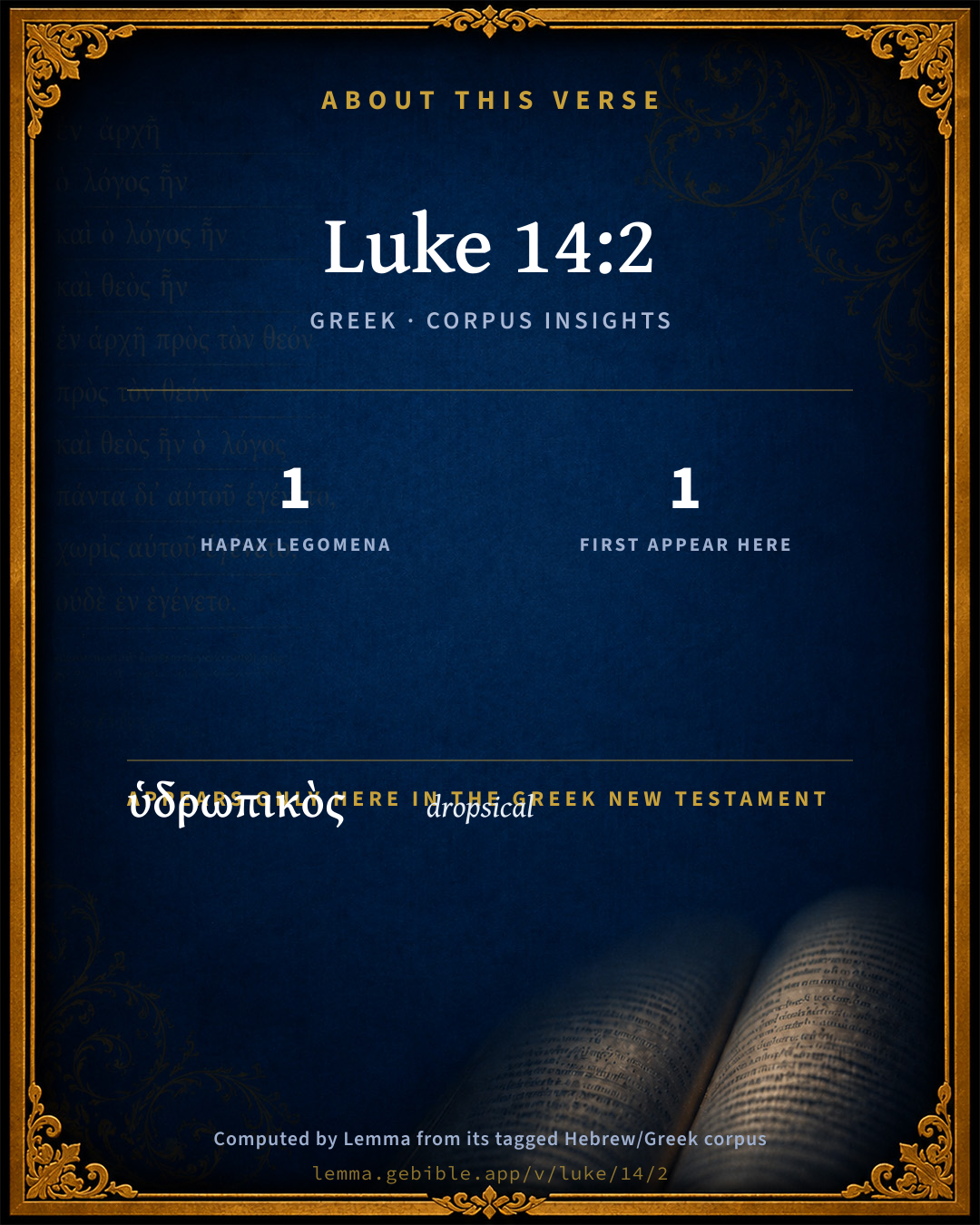
  • 1 hapax legomenon — only here in the Greek New Testament
  • 1 first appearance in the Greek New Testament
Full analysis ↓
Download a study sheet

One document with this verse’s original text, its word-by-word gloss line, the meaning frame, cross-references with their text, attributed commentary, and full source and license credits — printable, and it pastes into notes with its structure intact.

This verse Autodidact and up

Study sheet (.html) Plain text (.txt)

A passage Seminary Student

Up to 50 verses in one chapter. A passage sheet keeps up to 6 commentary sources and 12 cross-references per verse, in the order this page ranks them, and says so on the sheet whenever that leaves anything out. Ask for a single verse and you get the Autodidact verse sheet above.

Everything on this page stays free to read, with no account — the sheet is a download of what is already on screen, not access to it.

Want to remove ads? Support Godless Engineer
Compare translations 3

The same verse in 3 English versions, stacked beneath the original-language interlinear above. Click any original word for its lexicon entry.

Each is an independent rendering of the whole verse — the interlinear is not word-aligned to these translations.

Highlighted words mark where these versions differ — a whole-verse word diff, not a word-by-word alignment.

  • World English Bible Public Domain
    Behold, a certain man who had dropsy was in front of him.
  • King James Version Public Domain
    And, behold, there was a certain man before him which had the dropsy.
  • unfoldingWord Literal Text CC BY-SA 4.0
    And behold, a certain man who was edematous before him.

unfoldingWord Literal Text — © unfoldingWord, licensed CC BY-SA 4.0. Word-aligned USFM3 via Door43 (git.door43.org/unfoldingWord/en_ult).

Versions to compare (up to 4)

3 of 4 selected

Show all 19 translations

Every available English version of this verse, each an independent rendering of the whole verse.

  • World English Bible Public Domain
    Behold, a certain man who had dropsy was in front of him.
  • Berean Standard Bible Public Domain
    Right there before Him was a man with dropsy.
  • Majority Standard Bible Public Domain
    Right there before Him was a man with dropsy.
  • King James Version Public Domain
    And, behold, there was a certain man before him which had the dropsy.
  • American Standard Version (1901) Public Domain
    And behold, there was before him a certain man that had the dropsy.
  • Revised Version (1885) Public Domain
    And behold, there was before him a certain man which had the dropsy.
  • Geneva Bible (1599) Public Domain
    And beholde, there was a certaine man before him, which had the dropsie.
  • Douay-Rheims (1899) Public Domain
    And behold, there was a certain man before him that had the dropsy.
  • Young's Literal Translation Public Domain
    and lo, there was a certain dropsical man before him;
  • Literal Standard Version CC BY-SA 4.0
    and behold, there was a certain dropsical man before Him;
  • Unlocked Literal Bible CC BY-SA 4.0
    Behold, there in front of him was a man who was suffering from edema.
  • unfoldingWord Literal Text CC BY-SA 4.0
    And behold, a certain man who was edematous before him.
  • Darby Bible Public Domain
    And behold, there was a certain dropsical [man] before him.
  • World Messianic Bible Public Domain
    Behold, a certain man who had dropsy was in front of him.
  • Webster's Bible Public Domain
    And behold, there was a certain man before him who had the dropsy.
  • Free Bible Version CC BY-SA 4.0
    A man was there whose arms and legs were swollen.
  • Bible in Basic English Public Domain
    And a certain man was there who had a disease.
  • Text-Critical English NT CC BY 4.0
    And behold, there in front of him was a man suffering from dropsy.
  • Tyndale New Testament (1534) Public Domain
    And beholde ther was a man before him which had the dropsye.

Literal Standard Version (2020), Covenant Press — licensed CC BY-SA 4.0. Text via the HelloAO Bible API (eBible.org). Unlocked Literal Bible (unfoldingWord) — licensed CC BY-SA 4.0. Text via the HelloAO Bible API (eBible.org). unfoldingWord Literal Text — © unfoldingWord, licensed CC BY-SA 4.0. Word-aligned USFM3 via Door43 (git.door43.org/unfoldingWord/en_ult). Free Bible Version, Dr. Jonathan Gallagher — licensed CC BY-SA 4.0. Text via the HelloAO Bible API (eBible.org).

Word by word

More ways to search: Search by grammar → Find every occurrence → Compare this word →

Practice this passage: Drill this verse → Learn its vocabulary →

About this verse

These counts appear in no published source. They are computed here, from the morphology-tagged text and Lemma’s own curated glosses. What Lemma adds →

8
words
8
distinct lemmas
Gospels
section

Notable vocabulary

1 hapax legomenon — a word that appears only here in the entire Greek New Testament:

  • ὑδρωπικὸς dropsical G5203

First appearance in Scripture

This word makes its first canonical appearance in the Greek New Testament here:

  • ὑδρωπικὸς dropsical G5203

Shared distinctive vocabulary

ἔμπροσθεν before G1715 occurs in 45 verses of the Greek New Testament. Also found in:
Commentary

Notes on Luke 14:2 from classic Christian and Jewish commentators (each source and its license shown beneath its notes). The classic Christian expositions comment on the surrounding passage and are grouped to its opening verse, so a note may address several verses; the Jewish commentaries on the Tanakh (Rashi and others) are per-verse, so they appear only where the commentator wrote on this verse.

Lemma curates 59 commentaries, every one of them public domain or Creative Commons licensed, each selected and text-cleaned for this edition rather than reprinted as found. About our sources →

Tyndale Open Study Notes

Tyndale Open Resources

14:2 whose arms and legs were swollen (or who had dropsy): Dropsy, medically known as edema, is an accumulation of fluid in tissues or a body cavity that causes swelling. It is usually a symptom of a more serious illness.

Tyndale Open Study Notes — © Tyndale Open Resources, licensed CC BY-SA 4.0. Text via the HelloAO Bible API.

Bengel's Gnomon

Johann Albrecht Bengel

Luk 14:2. Ὑδρωπικὸς, a man in the dropsy) who was brought hither for this very reason.

Bengel's Gnomon of the New Testament — English translation (T&T Clark, Edinburgh, 1860) — public domain. Text from a community e-Sword module.

Expositor's Greek Testament

ed. W. Robertson Nicoll

Luk 14:2-6 . ὑδρωπικὸς ( ὕδρωψ ): here only in N.T., a solitary instance of this disease among the healing acts of Jesus. No conceivable reason for its being mentioned except that it was a fact. ἔμπροσθεν αὐτοῦ , before Him, so that He could not fail to see him; bow there as guest, as brought by the Pharisees to tempt Jesus, come there of his own motion in hope to be cured, though not asking out of reverence for the Sabbath and in fear of its strict guardians (Euthy. Zig.) not indicated.

The Expositor's Greek Testament, edited by W. Robertson Nicoll (1897–1910) — public domain. Text from a community e-Sword module.

Adam Clarke's Commentary

Verse 2. The dropsy.] υδρωπικος, dropsical; from υδωπ, water, and ωψ, the countenance, because in this disorder the face of the patient is often very much bloated. Probably the insidious Pharisee had brought this dropsical man to the place, not doubting that our Lord's eye would affect his heart, and that he would instantly cure him; and then he could most plausibly accuse him for a breach of the Sabbath. If this were the case, and it is likely, how deep must have been the perfidy and malice of the Pharisee!

Adam Clarke's Commentary on the Bible (1810–1826) — public domain. Text from a community e-Sword/MySword module.

Ellicott's Commentary for English Readers

(2) A certain man before him which had the dropsy.—This is the only miracle of the kind recorded in the Gospels. The term which St. Luke uses is strictly technical (hydropikos), and we may fairly see in the narrative another illustration of his professional character. He, more than others, had been led to specific inquiries as to the nature of the diseases which our Lord had healed. (See Introduction.) The man may have been an invited guest, or the feast may have been one of the semi-public ones in which the richer Pharisees displayed their hospitality.

A Bible Commentary for English Readers, edited by Charles John Ellicott (1878–1897) — public domain. Text from a community e-Sword module.

The Cambridge Bible for Schools and Colleges

gen. ed. J. J. S. Perowne

2. And behold, there was a certain man before him, which had the dropsy] The verse represents with inimitable vividness the flash of recognition with which the Lord at once grasped the whole meaning of the scene. The dropsical man was not one of the guests; he stood as though by accident in the promiscuous throng which may always enter an Oriental house during a meal. But his presence was no accident. The dropsy is an unsightly, and was regarded as an incurable, disease. The Pharisaic plot had therefore been concocted with that complex astuteness which marks in other instances (Luk_20:19-38; Joh_8:5) also the deadliness of their purpose. They argued (i) that He could not ignore the presence of a man conspicuously placed in front of Him; (ii) that perhaps He might fail .in the cure of a disease exceptionally inveterate; (iii) that if He did heal the man on the Sabbath day there would be room for another charge before the synagogue or the Sanhedrin. One element which kindled our Lord’s indignation against the Pharisees for these crafty schemes was the way in which they made a mere tool of human misery and human shame.

The Cambridge Bible for Schools and Colleges (gen. ed. J. J. S. Perowne; Cambridge University Press, 1878–1918) — public domain. Text from a community e-Sword module.

John Gill's Exposition

And behold, there was a certain man before him,.... Who sat just before him, as he was at table; who either came there of himself, in order to receive a cure; or rather, since it was in a private house, and he at table too, was brought and set there on purpose by the Pharisees, to try whether Christ would heal him on the sabbath day, that they might have somewhat against him; which they doubted not but he would do, knowing his compassionate and beneficent disposition to do good to creatures in distress, whenever he had an opportunity:

which had the dropsy: or "gathered waters", as the Syriac version renders it; was filled with water, which is the nature of that disease, and distinguishes it from what is called the dry dropsy: this disease is a preternatural collection of serum, or water in some part of the body; or a too great proportion thereof in the blood. The "dropsy" acquires different names, from the different parts it afflicts, or the different parts the waters are collected in; that of the "abdomen", or lower belly, called simply and absolutely "dropsy", is particularly denominated "ascites"; that of the whole habit of the body, "anasarca", or "leucophlegmatia"; that of the head, "hydrocephalus"; that of the scrotum, "hydrocele".---There is also a species of this disease, supposed to be caused instead of water, by a collection of wind, called "tympanites"; and by Hippocrates, the "dry dropsy": we also meet with dropsies of the breast, pericardium, uterus, ovaries, &c. The causes of dropsies in general, are whatever may obstruct the serous part of the blood, so as to make it stagnate in the vessels; or burst the vessels themselves, so as to let the blood out among the membranes; or weaken and relax the tone of the vessels; or this the blood, and make it watery; or lessen perspiration. These causes are various, viz. sometimes acute diseases, scirrhous tumours of any of the more noble viscera, excessive evacuations, particularly haemorrhages, hard drinking, &c. The "ascites", or "water dropsy" of the "abdomen", is the most usual case, and what we particularly call the "dropsy": its symptoms are tumours, first of the feet and legs, and afterwards of the "abdomen." which keep continually growing; and if the belly be struck or shook, there is heard a quashing of water: add to this, three other attendants, viz. a dyspnoea, intense thirst, and sparing urine; with which may be numbered heaviness, listlessness, costiveness, a light fever, and an emaciation of the body (i). Such we must suppose to be the case of this man, and that he was now in such a condition, as to be thought incurable.

(i) Chamber's Cyclopaedia on the word "Dropsy".

John Gill's Exposition of the Whole Bible (1746–1763) — public domain (CC PDM 1.0). Text via the HelloAO Bible API.

Trapp's Complete Commentary

John Trapp

2 And, behold, there was a certain man before him which had the dropsy.

Ver. 2. A certain man before him] A fit object, and that was sufficient to move him to mercy, who himself, by sympathy, took our infirmities and bare our sicknesses.

John Trapp, A Commentary or Exposition upon All the Books of the Old and New Testament (1647–1656) — public domain. Text from a community e-Sword module.

Albert Barnes' Notes on the Bible

A certain man before him - In what way he came there we know not. He might have been one of the Pharisee’s family, or might have been placed there by the Pharisees to see whether he would heal him. This last supposition is not improbable, since it is said in Luk 14:1 that they watched him.

The dropsy - A disease produced by the accumulation of water in various parts of the body; very distressing, and commonly incurable.

Albert Barnes' Notes on the Bible (1834–1885) — public domain. Text from a community e-Sword/MySword module.

Haydock's Catholic Bible Commentary

Our divine Saviour, regardless of the wicked designs which these Pharisees meditated to destroy him, cures the sick man, who did not dare to ask the favour of him, for fear of the Pharisees. He could only persuade himself to stand in his presence, hoping that Christ would at length cast a compassionate look upon him: who being well pleased with him, did not demand of him if he wished to be cured, but without demur proceeded to work this stupendous miracle in his behalf. (St. Cyril) --- In which Christ did not so much consider whether the action would give scandal to the Pharisees, as whether it would afford the sick man comfort; intimating, that we ought ever to disregard the raillery of the fools, and the scandal which men of this world may take at our actions, as often as they are for the honour of God, and the good of our neighbour. (Theophylactus)

George Leo Haydock (1774–1849), Haydock's Catholic Family Bible and Commentary, 1859 edition — public domain. Excludes Psalms (Douay-Rheims chapter numbering differs from Protestant) and Deuterocanonical books (Catholic canon only).

Whedon's Commentary on the Bible

Daniel D. Whedon

2. And behold—As if it were a sudden and unexpected object.

A certain man—How he came there Luke was not very likely to be informed; especially if, as some plausibly think, he was put there for the occasion by the treacherous Pharisees.

Before him—As Jesus sat perhaps on the divan before the company had taken seats at the table. For it was, probably, that strife for precedence at the table which called forth the lesson from our Lord which follows.

Dropsy—A disease in which the body or some part of it is filled with water; most usually the abdomen. It is attended with difficulty of breathing, intense thirst, and diminished urine. The body is emaciated, feverish, and feeble, and the spirit despondent. In some cases it is held incurable.

Daniel D. Whedon (gen. ed.), Commentary on the Old and New Testaments (1874–1909) — public domain. Text from a community e-Sword module.

The Pulpit Commentary

And, behold, there was a certain man before him which had the dropsy. This was the scheme of the Pharisee host. The sick man was not one of the invited guests; with the freedom which attends a feast in a large Oriental house, the afflicted man was introduced, as though by chance, with other lookers-on. The skilful plotters stationed him in a prominent position, where the eyes of the strange Guest would at once fall on him. The situation is described by the evangelist with dramatic clearness: "And, behold, there was a certain man before him which," etc. In an instant Jesus grasped the whole situation. It was the sabbath, and there before him was one grievously sick with a deadly chronic malady. Would he pass by contrary to his wont-such a sufferer? Would he heal him on the sabbath day? Could he? perhaps thought the crafty foes of the great Physician-Teacher. The disease was a deadly one, utterly incur. able, as they thought, by earthly means.

The Pulpit Commentary (1880–1919), ed. H.D.M. Spence-Jones & Joseph S. Exell — public domain. Text from a community e-Sword module.

John Wesley's Explanatory Notes

There was a certain man before him - It does not appear that he was come thither with any insidious design. Probably he came, hoping for a cure, or perhaps was one of the family.

John Wesley, Explanatory Notes Upon the Whole Bible (1754–1765) — public domain. Text via the GEBible commentary corpus.

The People's New Testament

B. W. Johnson

2–6. A certain man who had the dropsy. Either a guest or one who came to be healed.

Is it lawful? Conscious that they were watching him, he asked them a question which they declined to answer. The “tradition” said it was unlawful.

Which of you shall have an ass? See notes on Matt. 12:11.

B. W. Johnson's The People's New Testament with Notes (1889–1891) — public domain. Electronic text from the Christian Classics Ethereal Library (CCEL) ThML edition.

Cambridge Greek Testament for Schools and Colleges

2. καὶ ἰδοὺ ἄνθρωπός τις ἦν ὑδρωπικὸς ἔμπροσθεν αὐτοῦ. The verse represents with inimitable vividness the flash of recognition with which the Lord at once grasped the whole meaning of the scene. The dropsical man was not one of the guests; he stood as though by accident in the promiscuous throng which may always enter an Oriental house during a meal. But his presence was no accident. The dropsy is an unsightly, and was regarded as an incurable, disease. The Pharisaic plot had therefore been concocted with that complex astuteness which marks in other instances (Luk 20:19-38; Joh 8:5) also the deadliness of their purpose. They argued (i) that He could not ignore the presence of a man conspicuously placed in front of Him; (ii) that perhaps He might fail in the cure of a disease exceptionally inveterate; (iii) that if He did heal the man on the Sabbath day there would be room for another charge before the synagogue or the Sanhedrin. One element which kindled our Lord’s indignation against the Pharisees for these crafty schemes was the way in which they made a mere tool of human misery and human shame.

Cambridge Greek Testament for Schools and Colleges (Cambridge University Press, 1896; 21 vols, various authors incl. Carr, Maclear, Plummer, Farrar, Lumby, Moule, M. R. James, Simcox) — public domain. Text from a community e-Sword module.

Alford’s Greek Testament

Henry Alford

2.] ἔμπρ. αὐτ., not as a guest: see ver. 4, and compare ch. 7:37, and note on ib. ver. 45. ἦν ἱστάμενος καὶ μὴ τολμῶν μὲν ζητῆσαι θεραπείαν διὰ τὸ σάββ. καὶ τοὺς Φαρ. φαινόμενος δὲ μόνον, ἵνα ἰδὼν οἰκτειρήσῃ τοῦτον ἀφʼ ἑαυτοῦ καὶ ἀπαλλάξῃ τοῦ ὕδρωπος. It does not appear, though it is certainly possible, that he was set there by the Pharisees on purpose. This was before the meal (ver. 7).

Henry Alford, The Greek Testament (1849–1861) — public domain. Text from a community e-Sword module.

International Critical Commentary

2. καὶ ἰδοὺ ἄνθρωπός τι̣ς. We are left in doubt whether the man was placed there as a trap, which the absence of γάρ does not disprove, or was there by accident, or had come in the hope of being healed. The last is probable: but the ἰδού seems to imply that his presence was unexpected by the company, and perhaps by the host. He was probably not an invited guest, as ἀπέλυσεν (ver. 4) appears to show. But in an Eastern house he would have no difficulty in obtaining admission (Tristram, Eastern Customs, pp. 36, 81): and, if he hoped to be healed, he would take care to appear ἔμποσθεν αὐτοῦ. Note the τις vv. 2, 19, 20.

ὑδρωπικός. Not elsewhere in bibl. Grk., but freq. in medical writers. The disease seems to be indicated as a curse Num 5:21, Num 5:22; comp. Psa 109:18. Comp. Hor. Carm. ii. 2, 13.

International Critical Commentary — older volumes (1896–1929), various authors — public domain. Text from a community e-Sword module.

Vincent's Word Studies in the New Testament

Marvin R. Vincent

Which had the dropsy [υδρωπικος] . Lit., a dropsical man. The usual way of marking a dropsical patient in medical language.

Marvin R. Vincent, Word Studies in the New Testament (1887–1900) — public domain. Text from a community e-Sword/MySword module.

Lesson kit

Teaching starters — assembled from the data on this page, not authored interpretation. Every prompt links to the verse data it draws on. Edit before teaching.

Luke, in the Gospels, opens this verse with 8 words (8 distinct Greek lemmas). Its most distinctive word is hydrōpikós (“dropsical”). A historical commentator’s framing appears above. Read the whole chapter for the surrounding context.

Discussion questions

  1. What does “dropsical” (hydrōpikós) contribute to the verse as a whole?
  2. This verse holds 1 word here found nowhere else in the Greek New Testament. What might the rare word draw attention to?
  3. The word “dropsical” first appears here in Scripture. What is being introduced at this debut?
  4. Matthew 5:16 shares the word «before» with this verse. How do the two illuminate each other?
  5. These translations render this verse differently. What is at stake in choosing one wording over another?
  6. Reading how Tyndale Open Study Notes and Bengel's Gnomon read this verse, where do the two commentators agree and where do they part?

Things to notice

  • 1 word in this verse appears nowhere else in the Greek New Testament.
  • 1 word makes its first canonical appearance in Scripture here.
  • These translations choose different wording for 8 words in this verse.
  • 8 distinct Greek lemmas span 8 words in this verse.

Reading settings

Reading text

Shown beneath each verse's original-language words.

Old Testament
Old Testament edition

Read the OT as the Masoretic Hebrew (MT) or the Greek Septuagint (LXX).

English shown for the Greek Septuagint (in the Hebrew ↔ Greek comparison).

Comparing translations? Open the Compare panel on any verse page to stack up to four side by side.