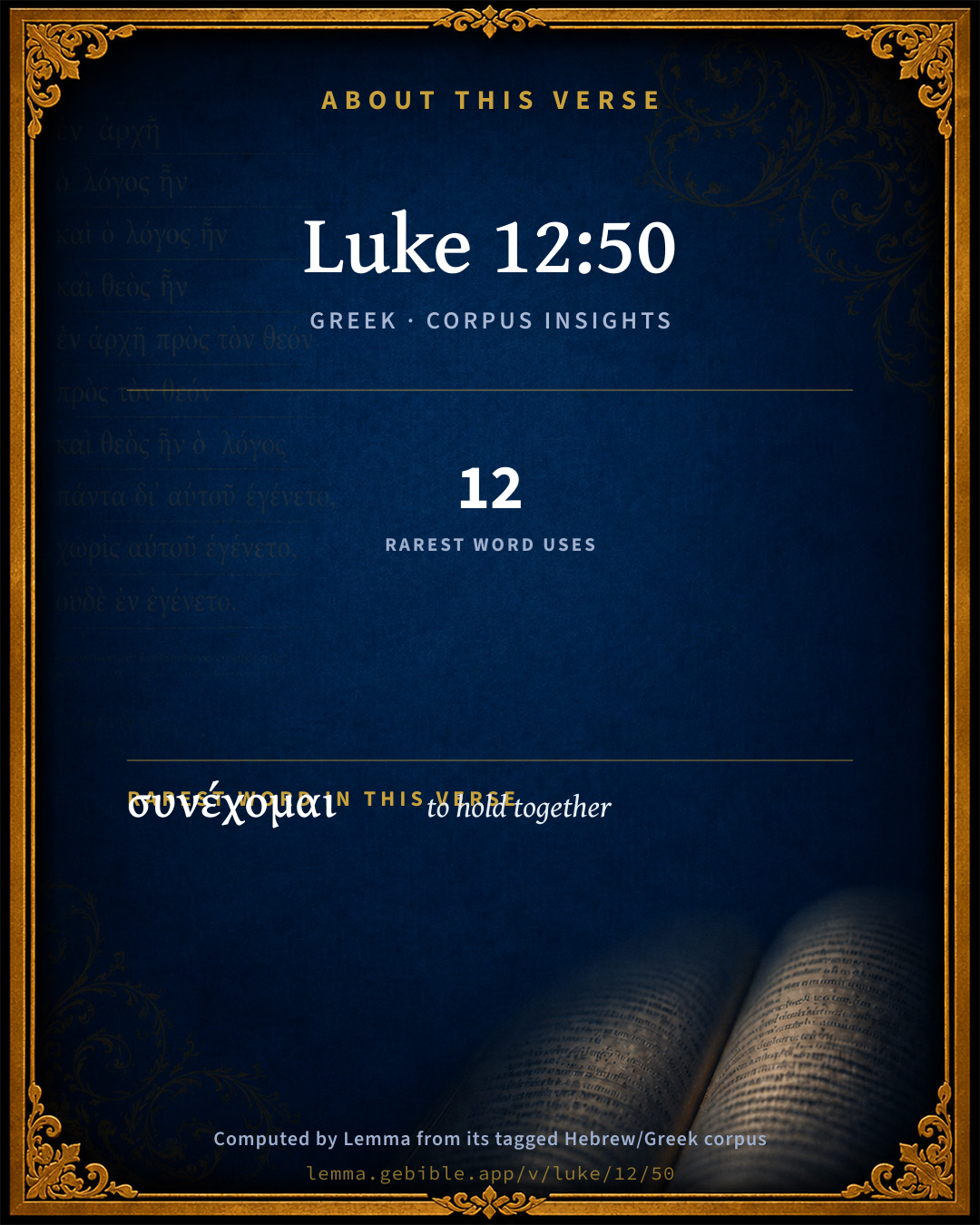
Luke 12:50

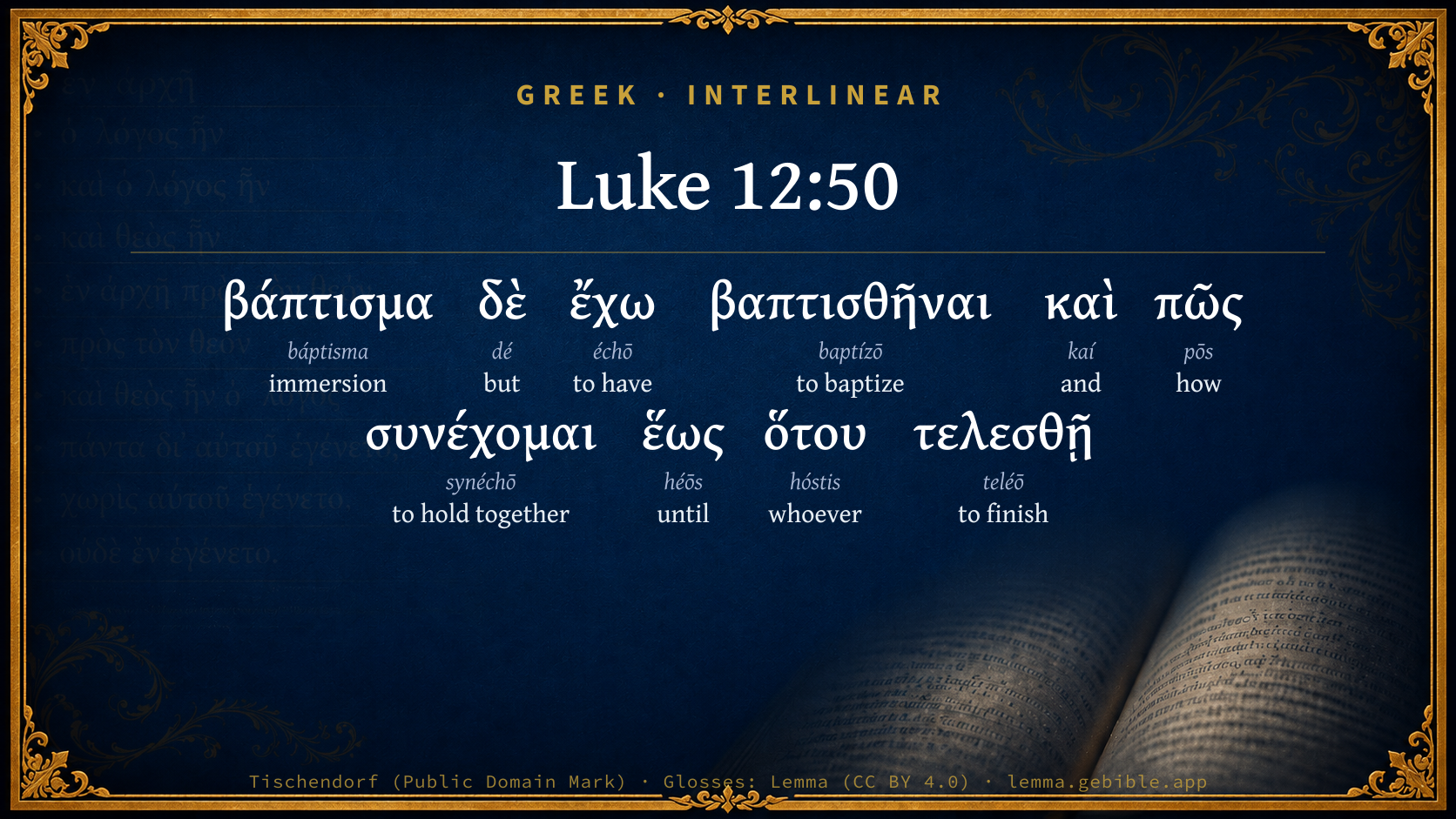
Greek (Tischendorf 8th ed.) Luke 12:50 appears in the Greek New Testament. The text above is from the Tischendorf 8th edition. Each word links to its Strong’s number and a concise gloss. Click any word for its full Thayer’s Greek Lexicon entry.
Download image
Cite this verse

Luke 12:50 (World English Bible). Public Domain. Lemma interlinear Bible study tool, https://lemma.gebible.app/v/luke/12/50.

Show BibTeX & RIS
BibTeX
RIS
English Translation
But I have a baptism to be baptized with, and how distressed I am until it is accomplished!
World English Bible · Public Domain
Download a study sheet

One document with this verse’s original text, its word-by-word gloss line, the meaning frame, cross-references with their text, attributed commentary, and full source and license credits — printable, and it pastes into notes with its structure intact.

This verse Autodidact and up

Study sheet (.html) Plain text (.txt)

A passage Seminary Student

Up to 50 verses in one chapter. A passage sheet keeps up to 6 commentary sources and 12 cross-references per verse, in the order this page ranks them, and says so on the sheet whenever that leaves anything out. Ask for a single verse and you get the Autodidact verse sheet above.

Everything on this page stays free to read, with no account — the sheet is a download of what is already on screen, not access to it.

Want to remove ads? Support Godless Engineer
Compare translations 3

The same verse in 3 English versions, stacked beneath the original-language interlinear above. Click any original word for its lexicon entry.

Each is an independent rendering of the whole verse — the interlinear is not word-aligned to these translations.

Highlighted words mark where these versions differ — a whole-verse word diff, not a word-by-word alignment.

  • World English Bible Public Domain
    But I have a baptism to be baptized with, and how distressed I am until it is accomplished!
  • King James Version Public Domain
    But I have a baptism to be baptized with; and how am I straitened till it be accomplished!
  • unfoldingWord Literal Text CC BY-SA 4.0
    But I have a baptism to be baptized with, and how I am distressed until it is completed!

unfoldingWord Literal Text — © unfoldingWord, licensed CC BY-SA 4.0. Word-aligned USFM3 via Door43 (git.door43.org/unfoldingWord/en_ult).

Versions to compare (up to 4)

3 of 4 selected

Show all 19 translations

Every available English version of this verse, each an independent rendering of the whole verse.

  • World English Bible Public Domain
    But I have a baptism to be baptized with, and how distressed I am until it is accomplished!
  • Berean Standard Bible Public Domain
    But I have a baptism to undergo, and how distressed I am until it is accomplished!
  • Majority Standard Bible Public Domain
    But I have a baptism to undergo, and how distressed I am until it is accomplished!
  • King James Version Public Domain
    But I have a baptism to be baptized with; and how am I straitened till it be accomplished!
  • American Standard Version (1901) Public Domain
    But I have a baptism to be baptized with; and how am I straitened till it be accomplished!
  • Revised Version (1885) Public Domain
    But I have a baptism to be baptized with; and how am I straitened till it be accomplished!
  • Geneva Bible (1599) Public Domain
    Notwithstanding I must be baptized with a baptisme, and how am I grieued, till it be ended?
  • Douay-Rheims (1899) Public Domain
    And I have a baptism wherewith I am to be baptized: and how am I straitened until it be accomplished?
  • Young's Literal Translation Public Domain
    but I have a baptism to be baptized with, and how am I pressed till it may be completed!
  • Literal Standard Version CC BY-SA 4.0
    But I have an immersion to be immersed with, and how I am pressed until it may be accomplished!
  • Unlocked Literal Bible CC BY-SA 4.0
    But I have a baptism to be baptized with, and how I am distressed until it is completed!
  • unfoldingWord Literal Text CC BY-SA 4.0
    But I have a baptism to be baptized with, and how I am distressed until it is completed!
  • Darby Bible Public Domain
    But I have a baptism to be baptised with, and how am I straitened until it shall have been accomplished!
  • World Messianic Bible Public Domain
    But I have a immersion to be immersed with, and how distressed I am until it is accomplished!
  • Webster's Bible Public Domain
    But I have a baptism to be baptized with; and how am I straitened till it shall be accomplished!
  • Free Bible Version CC BY-SA 4.0
    But I have a baptism to go through, and I'm in agony, wishing it was over!
  • Bible in Basic English Public Domain
    But there is a baptism which I have to undergo; and how am I kept back till it is complete!
  • Text-Critical English NT CC BY 4.0
    But I have a baptism to be baptized with, and how consumed I am with it until it is completed!
  • Tyndale New Testament (1534) Public Domain
    Not with stondinge I must be baptised with a baptyme: and how am I payned till it be ended?

Literal Standard Version (2020), Covenant Press — licensed CC BY-SA 4.0. Text via the HelloAO Bible API (eBible.org). Unlocked Literal Bible (unfoldingWord) — licensed CC BY-SA 4.0. Text via the HelloAO Bible API (eBible.org). unfoldingWord Literal Text — © unfoldingWord, licensed CC BY-SA 4.0. Word-aligned USFM3 via Door43 (git.door43.org/unfoldingWord/en_ult). Free Bible Version, Dr. Jonathan Gallagher — licensed CC BY-SA 4.0. Text via the HelloAO Bible API (eBible.org).

Word by word

More ways to search: Search by grammar → Find every occurrence → Compare this word →

Practice this passage: Drill this verse → Learn its vocabulary →

συνέχομαι
synéchō
G4912
“to hold together”
Verb, Present, Passive, Indicative, 1st person, Singular
Part of Speech
Verb
Tense
Present
Voice
Passive
Mood
Indicative
Person
1st person
Number
Singular
Full Thayer's Definition

Origin: from G4862 and G2192

TDNT: 21:37,1

1. to hold together a. any whole, lest it fall to pieces or something fall away from it 2. to hold together with constraint, to compress a. to press together with the hand b. to hold one's ears, to shut the heavens that it may not rain c. to press on every side 1. of a besieged city 2. of a strait, that forces a ship into a narrow channel 3. of a cattle squeeze, that pushing in on each side, forcing the beast into a position where it cannot move so the farmer can administer medication 3. to hold completely a. to hold fast 1. of a prisoner b. metaph. 1. to be held by, closely occupied with any business 2. in teaching the word 3. to constrain, oppress, of ills laying hold of one and distressing him 4. to be held with, afflicted with, suffering from 5. to urge, impel 3b 4. of the soul
  1. βάπτισμα báptisma G908 “immersion” Noun, Accusative, Singular, Neuter
  2. δὲ dé G1161 “but” Conjunction
  3. ἔχω échō G2192 “to have” Verb, Present, Active, Indicative, 1st person, Singular
  4. βαπτισθῆναι baptízō G907 “to baptize” Verb, Aorist, Passive, Infinitive
  5. καὶ kaí G2532 “and” Conjunction
  6. πῶς pōs G4459 “how” Adverb
  7. ἕως héōs G2193 “until” Adverb
  8. ὅτου hóstis G3748 “whoever” Relative pronoun, Genitive, Singular, Neuter, Attic form
  9. τελεσθῇ teléō G5055 “to finish” Verb, Aorist, Passive, Subjunctive, 3rd person, Singular

About this verse

These counts appear in no published source. They are computed here, from the morphology-tagged text and Lemma’s own curated glosses. What Lemma adds →

10
words
10
distinct lemmas
Gospels
section

Notable vocabulary

The rarest word here is συνέχομαι to hold together G4912 — appearing just 12 times in the whole Greek New Testament.

Shared distinctive vocabulary

συνέχομαι to hold together G4912 occurs in 12 verses of the Greek New Testament. Also found in:

Cross-references

11

Topical passages linked to Luke 12:50 in the Treasury of Scripture Knowledge — connected by theme and wording, ordered by reader-vote popularity; previews shown in the World English Bible.

  • John 12:27–28 "Now my soul is troubled. What shall I say? 'Father, save me from this time?' But for this cause I came to this time.
  • John 19:30 When Jesus therefore had received the vinegar, he said, "It is finished." He bowed his head, and gave up his spirit.
  • Mark 10:32–38 They were on the way, going up to Jerusalem; and Jesus was going in front of them, and they were amazed; and those who followed were afraid. He again took the twelve, and began to tell them the things that were going to happen to him.
  • John 4:34 Jesus said to them, "My food is to do the will of him who sent me, and to accomplish his work.
  • John 7:6–8 Jesus therefore said to them, "My time has not yet come, but your time is always ready.
  • Psalms 40:8 I delight to do your will, my God. Yes, your law is within my heart."
  • Matthew 20:17–22 As Jesus was going up to Jerusalem, he took the twelve disciples aside, and on the way he said to them,
  • John 7:10 But when his brothers had gone up to the feast, then he also went up, not publicly, but as it were in secret.
  • John 10:39–41 They sought again to seize him, and he went out of their hand.
  • John 18:11 Jesus therefore said to Peter, "Put the sword into its sheath. The cup which the Father has given me, shall I not surely drink it?"
  • Acts 20:22 Now, behold, I go bound by the Spirit to Jerusalem, not knowing what will happen to me there;

Cross-references courtesy of OpenBible.info (CC BY 4.0).

Commentary

Notes on Luke 12:50 from classic Christian and Jewish commentators (each source and its license shown beneath its notes). The classic Christian expositions comment on the surrounding passage and are grouped to its opening verse, so a note may address several verses; the Jewish commentaries on the Tanakh (Rashi and others) are per-verse, so they appear only where the commentator wrote on this verse.

Lemma curates 59 commentaries, every one of them public domain or Creative Commons licensed, each selected and text-cleaned for this edition rather than reprinted as found. About our sources →

The Biblical Illustrator

Joseph S. Exell

Luk_12:50

I have a baptism to be baptized with--

Intensity in Christian service

I.

OF THIS INTENSITY CHRIST HIMSELF WAS THE PERFECT EXAMPLE. Fervour reached white heat in the Son of Man, and the service of the kingdom received the whole of it. Do you think these words were spoken calmly? As we listen to the Speaker, we are conscious of the strain, the tension of spirit, the travail of soul! And what was it that moved the Saviour so profoundly, that made His soul exceeding sorrowful? His death on the cross, and burial in Josephs tomb; but not these things regarded by themselves; death and the grave had less terror for Him than for the saintliest of His followers; but He thought of these in their august and solemn relations to His redeeming work. In His cross and passion, love to God and love to man were mysteriously and perfectly blended; His surrender to God was absolute and entire, wanting nothing; while the appeal of His love to man, unsurpassed in tenderness, maintains to-day its unrivalled influence and power. St. Paul used Christs word--straitened, in another and most significant connection: The love of Christ constraineth us. Christ was Himself constrained, that He might constrain His servants by His own great love to the end of time. This revelation of love to God and man in the death of Christ by no means adequately accounts for the agitation of the Saviours soul. We must go deeper; unless we do so we have no sufficient clue to the mystery of this hour. The beginning of Christs passion was reached; already He is the Sin-bearer. Our text, then, is not the cry of the hireling, bent only on accomplishing his day, longing eagerly for the last hour and the close of his task; it is something infinitely nobler, the cry of the only-begotten of the Father, shut up, urged, pressed, filled with pain, panting as one oppressed in breathing, till His Fathers will is done. Behold the perfect Example I If we wish to gauge this intensity, and know how great it is, let us place it side by side with our own low aims, calculating love, measured efforts, and frequently barren lives. Strangers to devotion, to intense devotion, cannot properly serve under such a King.

II. CAN WE. WITH THIS PATTERN BEFORE US, GET ANY HINTS RESPECTING THE SPRING OF SUCH INTENSITY? HOW is the fire kindled? What is the secret? When Christ spoke, He was in close touch with His Father. The Baptism was appointed; not self-chosen, not accidental, but set down in the Fathers will; recognized as being there, and accepted in the teeth of natural shrinking. Surely this is evidence of fellowship without a break, high and habitual fellowship with God, therefore, is one secret of intense life in souls. A second secret of intense life, then, is familiarity with Holy Scripture. Men of the Bible may be furnaces, icebergs they can never be. And the passage, taken as a whole, indicates clear insight into the sins and sorrows of men, and a true estimate of our needs. The Speaker knew what was in man; was in close contact with man; saw our ruin, accepted the risks, and rendered at all costs the needed help. A third secret of intense life is, keep touch with men. We want to kindle the holy fire and keep it burning--then brethren, we must hold much converse with Christ. The planets get light and heat from the sun; we from the Sun of Righteousness. We must look into the face of Christ and gain power for work by habitual, sustained, and abundant communion with Him.

III. We are now in a position To APPRECIATE SOME OF THE SALIENT FEATURES OF THIS INTENSITY IN CHRISTIAN SERVICE. It is not concern about our own safety; by the whole diameter of the globe it is divided from that. How much solicitude we expend on ourselves! Are we Gods sons? Are our evidences clear and bright? Definite answers to such inquiries we ought to get. Till we get them this holy passion can find no sufficient room within us. The intense spirit, the Christ-spirit, only possesses souls that can swing out of self. All Christs anxiety and travail of soul was about others--about God, His Father, the revelation of His mind, the establishment ofHis rule, and the winning of men to obedience--about man, His brother, his waywardness and misery; the remedy, how it could be provided and how applied. We must be like Him I The noblest in us is impossible while we are occupied with ourselves. The mother at the bed-side of her fever-stricken child forgets self, so does the fireman as through flame and smoke he rushes to the rescue. Then heroism grows sublime, and becomes an inspiration. This intensity is not distinguished by exemption from trial, even the trial of apparent failure. Certain discoursings on earnestness in Christian work are depressing. We see how the purest are often most tried, and the best and most skilful husbandmen have longest to wait for the fruit. It is enough for the servant to be as his Lord. What equipment was His--wisdom, stature, favour with God and man; and the Holy Spirit withoutmeasure. What Divine patience! The crown of enduring influence and ultimate success intensity like our Masters will assuredly wear. When Christ spoke, it appeared as if His was the only soul fired by this passion. Like Pompeys pillar, He was solitary, conspicuously alone I Then the good soil received the precious grain of wheat; it died, and from that moment was no longer alone! Pauls letters are rich in passages which breathe the intense spirit of our text. The case of John, the beloved disciple, is, if possible, more remarkable. He caught fire early; the holy passion was aglow in him. After the Council at Jerusalem he disappeared from view. For fifty years we hear nothing of him; but in the calm, loving utterances of his Epistles, and the penetrating light of his profound Gospel, we have evidence of the strength of a long hidden fire. It glowed till the century ended, when other fires were extinguished. Thus Christ reproduced Himself--the fire-circle enlarged; candidates for this baptism multiplied; and to-day no power is so fresh, so vigorous, and so aggressive as the power of Jesus Christ. Enduring influence and final triumph still lie with intense earnestness. It brings into line every power we possess, and allies each with the power of God. Why could not we cast him out? cried the humiliated disciples. Because you didnt believe you could, was Christs startling reply. The intense man ever believes he can; faith in God renders all things possible. The man of faith burns his way when he cannot bore it; and while the calculating halt in the initial stages of their task and cannot succeed, he stands radiant with the joy of an accomplished work. Everywhere we have machinery; power is the thing wanted. I gained no theology from Dr. Chalmers, said Robertson, of Irvine, but I gained enthusiasm. (J. R. Wood.)

The Suretys baptism

The baptism of the Son of God, here spoken of by Himself, was the baptism of wrath; for He who was made sin for us must be baptized with this baptism. It is the knowledge of this fiery baptism of our Divine Surety that gives to us the reconciliation and the peace which, as sinners, we need. It was of this fiery baptism that He Himself spoke when He said, Now is My soul troubled. This baptism the Son of God must undergo; and He knew this. It was appointed Him of the Father, and arranged in the eternal covenant. I have a baptism to be baptized with. He knew it; He knew the reason of it; He knew the result of it; and He knew that it could not pass away from Him. He had come to fulfil all righteousness; He had come to be made a curse for us. In this awful utterance of our Substitute, as He looked forward to the cross, we have--

I. A LONGING FOR THE BAPTISM. He desired its accomplishment. He knew the results depending on it, and these were so divinely glorious, so eternally blessed, that He could not but long for it--He could not but be straitened till it was accomplished. The cup was inexpressibly bitter, but the recompence for drinking it was so vast, that He could not but long for the hour when it should be put into His hands.

II. THE CONSCIOUSNESS OF FEAR AND BITTER ANGUISH IN CONTEMPLATING IT. He was truly man, both in body and soul. His Divine nature did not relieve Him of one grief, or make His sufferings mere shadows. It fitted Him for being filled with more sorrow than any man could be. It conferred on Him an awful, we may say a Divine, capacity of endurance, and so made him the subject of sharper pain and profounder grief than otherwise he could have been.

III. THE STRAITENING IN REGARD TO ITS ACCOMPLISHMENT. Like Paul, He was in a strait between things which pressed in opposite ways, and which must continue to press till the work was done.

1. He was straitened between the anticipated pain, and the thought of the result of that pain.

2. He was straitened between grace and righteousness. Till the great sacrifice was offered, there might be said to be conflict between these two things. Between His love to the sinner and His love to the Father there was conflict; between His desire to save the former and His zeal to glorify the latter there was something wanting to produce harmony. He knew that this something was at hand, that His baptism of suffering was to be the reconciliation; and He pressed forward to the cross, as one that could not rest till the discordance were removed--as one straitened in spirit till the great reconciliation should be effected. (H. Bonar, D. D.)

The sense in which Christ was straitened

The manner in which our Saviour here expresses Himself, fully evinces that His heart was greatly set upon this important baptism. He was straitened till it was accomplished! The word sunechomaia, which is here translated straitened, will admit of the following variations or different readings of our Lords words:

1. How am I pressed together, and under a ponderous weight of imputed sin, and its dreadful concomitants! The Lord laid on Him, as the Head of the Church, and Surety of the covenant--the iniquities of us all. And He bore our sins in His own body on the tree. To be thus straitened was no way inconsistent with the final accomplishment of the work in which He stood engaged: for His work of suffering is over, and Jesus our Saviour is straitened no more! His being thus straitened in His human views of the work, and in the feelings of human nature, does not suppose Him to be merely human, though it certainly proves Him to have been really human. Each nature operates in Him, according to its essential properties. The Divine nature knows all things; upholds all things; rules all things; and acts, by its presence, everywhere. The human nature was born, yielded obedience, died, and rose again. But it is the same person, the same Christ, that acts all these things; the one nature being His, no less than the other.

2. How am I straitened, may be read thus--How am I held fast in the grasp of almighty justice, and bound fast with cords (Psa_118:27) of legal authority, and bonds of covenant engagements! Infinite love to His people, and to the honour of Deity as demanded by the person of the Father, bound Him fast in bonds, which secured eternal salvation. Justice held fast the bondsman, till all demands were fully paid. But when His baptism was accomplished, His person was free, and His people redeemed. Immanuel is straitened no more; He is held under judgment no more; when He became innocent (as the mediator of His people) or free from all sin, and had wrought all righteousness, justice could demand no more. He was delivered for our offences, and rose again for our justification. That baptism which so straitened our Lord, my brethren, hath made us for ever free indeed! O Thou immortal Deliverer of sin-bound captives, accept and maintain in Thy free people, perpetual hallelujahs to Thy redeeming name!

3. Again, How am I straitened, may be understood--how am I afflicted and distressed in mind. My soul is exceedingly sorrowful, said our agonizing Lord. O what love is here! He took our sorrows, He bore our stripes, He endured the curse for us; and thus He made our peace for ever.

4. Once more. How am I urged and constrained. For this sense of the word, see 2Co_5:14. Jesus was first bound with His people in union indissoluble. He could not bat feel the strongest desire for their redemption, whose persons and welfare lay so near His heart. He was urged by the desire of having the work accomplished. Justice called upon Him for her right; and the joy set before Him excited Him to His important baptism, out of which He knew He should surely emerge, and ascend to the enjoyment of the glory which He had with the Father before the world was. His baptism is now accomplished, and He is straitened no more! Who, then, shall bind the members, since the Head is free? (J. Stevens.)

Christs baptism of suffering

The phraseology is by no means unusual which represents afflictions and trials as a baptism with which an individual must be baptized. In addressing the sons of Zebedee, Christ had asked, Can ye drink of the baptism that I drink of, and can ye be baptized with the baptism that I am baptized with? In the Old Testament, moreover, the Psalmist speaks of entering into deep water, which is manifestly the same imagery as that employed in the New. There is a peculiar beauty in this form of expression, when the party to whom it is applied is a righteous and God-fearing man. Baptism is the being dipped in the water, the being sprinkled with the water, and not the being drowned or completely overwhelmed. The form of expression denotes that, however tremendous the affliction may be, it shall not be finally destructive; nay, that it shall issue in addition to what has already been attained. For the word baptism, in its very essence, has reference to some essential change, so that the man when baptized is presumed to enter on a state from which he had been previously excluded. It will be needful that you carry with you this general view of baptism, as rightly introductory to, and symbolical of, an alteration in circumstances or state, if you would enter fully into our Lords meaning when He speaks in our text--But I have a baptism to be baptized with; and how am I straitened till it be accomplished! The whole structure of the sentence is in exact keeping with the common notion of baptism, seeing that a condition of greater freedom is evidently looked forward to by Christ, as certain to result from those waves of fire through which He had to pass. He laboured under a species of bondage prior to His agony and death; and the consequence of the agony and death would, He knew, be deliverance from this bondage. There is, therefore, peculiar fitness in His describing that agony and death as a baptism with which He should be baptized. A change was to take place; and for the bringing about of that change, immersion in a deep ocean of trouble was actually indispensable.

I. CONSIDER CHRISTS AGONY AS A BAPTISM. Now, it was a stupendously great work which our blessed Lord undertook in His mission to earth. He had assumed human nature in union with the Divine, and thus stood in the attitude of the representative of mankind. He was no solitary and isolated being acting out for Himself the duties which, as a creature, He owed to the Creator; He was the Surety of the whole of our race; and in the very minutest circumstance of His life we have a close and important concern. He took our transgressions just as well as those of all others living on the earth, and cast them into the waves, and then they rolled on an immensity of wrath, and the innocent Surety bowed down, and trembled, and sank beneath the impetuous torrent. Not, however, that this is the only reason why our Lords agony and passion may be characterized as a baptism. We have spoken to you of baptism as introductory to some alteration in state or condition. The word only applies to cases in which some change is presumed, as the result of immersion, to have taken place either literally or symbolically. But, with respect to the sufferings of Christ, they agree in every point with the declaration which limits the applicability of the phrase. The baptism of our Lord was such, that length of time was not needful in order to give effect to endurance. Each instant of our Suretys anguish, seeing that He was God as well as man, was equivalent to such countless ages of human punishment, that it was enough for justice that he should be immersed in the water, and then quickly emerge. This fallen creation, tottering under the curse, was then plunged into an abyss of wrath, and sparkled as a renovated thing so soon as He arose above its surface. The agony in Gethsemane was only for a brief season; the ignominy of the crucifixion was soon brought to a close; the imprisonment of the grave quickly gave way; and then He who bore our sins in His own body on the tree, was literally baptized with the baptism of bitterness. The woe, infinite in extent, was but finite in duration--Thou wilt not leave My soul in hell; neither wilt Thou suffer thine Holy One to see corruption. He must descend into darkness, that the waves and the storms might go over Him. Anguish--He must endure it; contumely--He must submit to it; the hidings of His Fathers face--even this, the bitterest and most grievous of all, must be encountered. But then this enduring, this wrestling, they were but for a brief season. He did not tarry in the waters, though it was needful He should be covered by them. And thus the emerging and immersion follow so closely one on the other, that you cannot better describe the great work than by saying of our Lord, that He had a baptism to be baptized with.

II. CONSIDER IN WHAT RESPECTS IT WAS THAT THE SAVIOUR WAS STRAITENED TILL THIS BAPTISM WAS ACCOMPLISHED. The work of redemption was not complete, and Christ therefore was straitened, as unable to exhibit a finished deliverance. The Spirit was not yet poured out on His followers; and therefore was He straitened, inasmuch as He could not preach the deep mysteries of His gospel. Conflict with Satan was not concluded, and therefore was he straitened in His human nature, being still exposed to all his attacks. And, lastly, He had not yet won the headship over all things, and therefore was He straitened by being circumscribed in Himself, in place of expanding into myriads. These, with like reasons, serve to explain, in a degree, the expression of our text; though we frankly confess that so awful and inscrutable is everything connected with the anguish of the Mediator, that we can only be said to catch glimmerings of a fulness which would overwhelm us, as we may suppose, with amazement and dread.

III. LET US COMMEND TO YOU, IN CONCLUSION, THE NOBLE DESIRE OF ST. PAUL. That I may know Christ, and the power of His resurrection, and the fellowship of His sufferings, being made conformable unto His death. There is to be wonderful analogy between the firstborn and His people, and we call on you to examine whether you find it realized in your own experience. Unto each of us there remains the baptism of death; a baptism in the truest and most literal sense; for we do but pass through the Jordan, and not stay in the waters. But are we straitened? Do we feel ourselves straitened till this baptism is accomplished? Let us have no evasion and no subterfuge. We are predestined to be conformed to the image of God; and as He was straitened, so, if we belong to Him, shall we also be straitened. Who can be a real Christian and not feel straitened? It is our very profession that we are but strangers and pilgrims below; that our home is above. There is a law in our members warring against the law of our mind--the good that we would we do not--the evil that we would not we do--we bear about with us a body of sin and death--we see only through a glass darkly--it doth not yet appear what we shall be. Are we not then straitened? I would give my soul to heavenly music, to communings with the glorious beings of the invisible world; but the flesh clogs the spirit, weighs it, and presses it down, and thus am I straitened. I would love God with all my heart, with all my soul, and with all my strength; abstracting myself from things that perish in the using, and centring myself on the joys that are laid up for the faithful; but my affections are seized on by the creature; the visible prevails over the invisible, and thus I am straitened. I would mount even now on the wings of faith, realizing the promise that they who wait on the Lord shall renew their strength; they shall mount with wings as eagles. I would walk to and fro through the inheritance of the saints, but the things of time hang lead on the pinion, and thus I am straitened. I would have my thoughts by day and my dreams by night coloured by the pencil of Christian hope; but indwelling corruption throws a stain on the picture, and thus I am straitened. (H. Melvill, B. D.)

The Lamb of God hastening to the altar

Christs eagerness for the consummation of His sacrificial mission sublimely pathetic and heroic.

I. The cross loomed up in His thought with increasing vividness and more absorbing interest toward the last.

II. Eager for the suspense to be changed to certainty. For the Fathers glory to be magnified. For the ending of the curse, and the beginning of the blessing.

III. Eager to make the supreme proof of His love to sinners, and to see the result. I, if I be lifted up, etc.

IV. Eager to return by the gateway of the cross to the Fathers bosom. (Homiletic Review.)

Christs longing for the completion of His work

The great truth which the text exhibits, is the entire and intense devotedness of Christ to the completion of His mediatorial suffering, with a view to its subsequent and sublime results.

I. We have to show, first, THAT THE SAVIOUR UNIFORMLY EXHIBITED THE DEEP CONCERN WHICH THE TEXT EXPRESSES FOR THE COMPLETION OF HIS MEDIATORIAL WORK ON EARTH.

1. To say that He had not been beguiled or surprised into the work of our redemption would be saying but little, He had undertaken it intelligently, and with the distinct foresight of all the liabilities which it involved. He had looked into the darkest recesses of depravity in the human heart, and had sounded the lowest depths of human misery, before He came to expiate the one or relieve the other.

2. To say that He had not been forced into the great undertaking, would be saying but little.

3. To say that the ardour evinced in the text for the completion of His work was not of new or sudden growth, would be saying but little. A large and interesting class of Scriptures exist to prove that there never was a moment in which, even prior to His incarnation, He did not anticipate its completion with similar intensity of desire.

4. To say that He did not neglect the work which was given Him to do, would be saying but little. My meat, said He, is to do the will of Him that sent Me, and to finish His work--in other words, His devotedness was entire. For their sakes, said He, I sanctify Myself--and He did so.

5. And not only was His devotedness entire, including the consecration of all His powers, it was eager and intense, not allowing the unnecessary delay of a moment, nor admitting of the slightest increase. To say that four thousand years were allowed to elapse prior to His advent, is no objection whatever to this statement. It only reminds us that His devotedness, ardent as it was, was yet regulated by wisdom--that His zeal was not the zeal of improvident precipitation--that He did not sacrifice one interest to another.

II. BUT WHY THIS EAGER AND INTENSE DESIRE TO REACH THE GOAL OF HIS HUMILIATION? Surely He was not in love with suffering! Let us proceed, secondly, to specify some of the reasons which account for it, and we shall find that it was not only explicable and justifiable, but infinitely necessary--well for a guilty world that His zeal was not a particle less.

1. For what? He had undertaken to minister to the relief of a world groaning in its misery--and all that misery was before Him. He did not--by necessity of nature He could not--content Himself, as we do, with vague impressions of human woe. He saw it with a distinctness and felt it with a power which made it all His own. He felt that its every sigh and its every struggle was, in effect, a distinct appeal that He would hasten the work of deliverance, and He was straitened until the work was accomplished.

2. But there was more than misery to be remedied--there was guilt, the cause of it all--and that He had undertaken to atone for. He knew the history of sin.

3. But more still There was more than the misery of man to be remedied--more than the rights of justice to be satisfied; there was the character of God to be embodied and made manifest as the God of love--and He had undertaken that. And hence the anxiety of Christ to perform the act which should prove it. For to wipe off every stain from the character of God, and to present it in its real glory, infinitely outweighed with Him every ether consideration.

4. And this reminds us of another reason to account for His eagerness to reach the cross--the glory which should accrue to God in the salvation of mankind.

III. But we have to show, thirdly, THAT THOUGH THE GREAT CRISIS IS PASSED, THE CONCERN OF CHRIST FOR THE SALVATION OF MAN IS UNDIMINISHED. True, as far as that concern involved suffering it has ceased.

1. Would you admit that a person discovered urgency for an object if he lost not a moment in arranging for its attainment? No sooner had the Saviour emerged from the tomb than He summoned His disciples, and began to prepare them for their missions to the ends of the earth.

2. Does a person discover intense concern for an object, if he consecrates all his power to its attainment? The Saviour did this. As soon as He could say in His mediatorial capacity, All power is mine, He added, Go preach the gospel to every creature.

3. Does a person discover intense concern for an object if he not only consecrates all his own power to it, but if the first use which he makes of that power be to secure and employ the agency of others? In the loftiest sense, the Saviour did this. The first agency which He engaged after He ascended the mediatorial throne was that of the Holy Spirit--the great agent of the universe.

4. Does a person discover intense concern for an object, if he commands and lays under tribute the instrumentality of every one belonging to him for its attainment?

5. But speak we of the fact that Christ has thus laid all the members of His Church under solemn obligation, as a proof of His unabated solicitude for human salvation; from the concluding Book of Scripture, the Book of the Revelation, there is reason to believe that He has engaged the agency of every angel in heaven for the same object.

6. But why this continued solicitude on the part of Christ? it may be asked. Has not His great sacrifice been not only offered, but accepted? and is He not now exalted in consequence to the right hand of God? Yes; but His concern relates now to the proclamation of His atoning sacrifice throughout the world, and to the salvation of those who rely on it. Having provided the means of salvation, He is now for pressing on to the end.

IV. Brethren, WHAT SHOULD BE THE PRACTICAL APPLICATION OF THIS SUBJECT? If the devotedness of Christ to the salvation of man was such that He not only agonized on the cross, but even agonized for it, and if His Divine solicitude be still undiminished--then, surely, the Christian cannot render less than entire devotedness to the same object. Accordingly, the Saviour claims every Christian here for Himself. Your character is to be a reproduction of the character of Christ. The disinterestedness which appeared in Christ is to reappear in you. The tenderness of Christ--His untold solicitude for human souls--is to live over again in your tones of entreaty, your wrestling prayers for their salvation. The blood of the cross itself is, in a sense, to stream forth again in your tears of anguish, your voluntary and vicarious self-sacrifice to draw men to Christ.

2. But if we thus sympathize with Christ, we shall see the importance of everything calculated to promote the object of His solicitude. Viewed in connection with these objects, nothing we do is insignificant--an act apparently trivial, a word, a look, acquires a character of infinite moment.

3. But this reminds us, next, that if we truly sympathize with Christ, we shall not be satisfied with merely providing the means of usefulness, or with putting them into action--we shall be deeply anxious to see the end of all such means accomplished. The Saviour was not only straitened till He had reached the cross--till He had provided salvation; all the solicitude which He then felt for the means, He now feels for the end.

4. But this subject reminds us, brethren, finally, that if we truly sympathize with Christ, we shall be conscious of deep humiliation at our past apathy, and of holy impatience and concern to see the designs of His death realized in the salvation of our fellow-men. And ask we for motives to this? Is it nothing that Christ expects it? Is it nothing that He has turned His whole self into a sacrifice, compared with which nothing else deserves the name? and that He has devolved it on us to multiply as far as we can the copies of His character in our own? Is it nothing, again, that others have felt this? Yes; the duty is not only obligatory but practicable, for others have felt it. And should it not urge our languid movements into zealous activity when we reflect that the time is short?

5. And achieved it shall be. How should the prospect quicken our activity and inflame our desire! To think that the scene of the Saviours humiliation shall be the scene of His ultimate triumph. (J. Harris, D. D.)

The shadow of the coming cross

Those who maintain that the crucifixion was an afterthought in the mind of Christ: that no vision of it clouded His pathway, and no place was assigned for it when He began first to preach and to teach, have read those narratives to very little purpose. Holman Hunt, the modern evangelist of art, was much nearer the truth on this matter when he painted his celebrated picture, The Shadow of Death, in which he clearly reveals his opinion that, whilst yet a horny-handed workman in the obscure carpenters shop at Nazareth, making yokes and ploughs for the husbandmen of Galilee, the shadow of the coming cross fell upon the pathway of Christ, and gave an unwonted solemnity to a young manhood, in all else so natural. (J. Cuttell.)

The Biblical Illustrator, edited by Joseph S. Exell (c. 1880s–1900s) — public domain. Text from a community e-Sword module.

Tyndale Open Study Notes

Tyndale Open Resources

12:50 a terrible baptism of suffering: God’s judgment is often pictured as an overwhelming flood (Pss 18:4; 42:7; 69:1-2; Isa 8:7-8; 30:27-28; Jon 2:5).

Tyndale Open Study Notes — © Tyndale Open Resources, licensed CC BY-SA 4.0. Text via the HelloAO Bible API.

Bengel's Gnomon

Johann Albrecht Bengel

Luk 12:50. Βάπτισμα δε) But a baptism, and that too a baptism completely consummated, must precede the fire, and the kindling of it.—ἔχω βαπτισθῆναι) Comp. Mar 10:38.—πῶς συνέχομαι, how am I straitened [severely pressed]) Joh 12:27 [“Now is My soul troubled,” etc.]; Mat 26:37. The nearer His passion approached, the greater were the emotions by which He was affected. The preceding formula, What will I? indicates the mere will and inclination by itself; but the words, How am I straitened (with which comp. Php 1:23; 2Co 5:14), implies the will struggling forth through opposing objects and obstructions.—τελεσθῇ, it shall have been accomplished [finished, consummated]) Comp. Joh 19:30 [τετέλεσται, It is finished or consummated].

Bengel's Gnomon of the New Testament — English translation (T&T Clark, Edinburgh, 1860) — public domain. Text from a community e-Sword module.

Meyer's Critical & Exegetical Commentary

Heinrich August Wilhelm Meyer

Luk_12:50. δέ] places in face of the εἰ ἤδη ἀνήφθη! just wished for, what is still to happen first: But I have a baptism, to be baptized with. This baptism is His deep passion awaiting Him, into which He is to be plunged (comp. on Mar_10:38); and He has this baptism as the destiny ordained for Him, and consequently appropriated to Him.

καὶ πῶς συνέχομαι κ.τ.λ.] and how am I distressed (comp. Luk_8:37; Dem. 1484. 23, 1472. 18) till the time that it shall be accomplished! A true and vivid expression of human shrinking at the presentment of the agonies that were imminent, similar to what we find in Gethsemane and at Joh_12:27. It was a misapprehension of the human feeling of Jesus and of the whole tenor of the context, to make out of συνέχομαι an urgency of longing (ὡσανεὶ ἀγωνιῶ διὰ τὴν βραδυτῆτα, Euthymius Zigabenus, comp. Theophylact). So also de Wette and Bleek, who wrongly appeal to Php_1:23. See on the passage, also on 2Co_5:14. Jesus does not long for and hasten to death, but He submits Himself to and obeys the counsel of God (comp. Joh_12:27; Php_2:8; Rom_5:19, and elsewhere), when His hour is come (Joh_13:1 and elsewhere). Ewald takes the question as making in sense a negative assertion: I must not make myself anxious (comp. on πῶς, Luk_12:56), I must in all patience allow this worst suffering to befall me. This agrees with Ewalds view of τί θέλω κ.τ.λ., Luk_12:49; but, according to our view, it does not correspond with the parallelism. And Jesus actually experienced anguish of heart (comp. 2Co_2:4, συνοχὴ καρδίας) at the thought of His passion, without detracting from His patience and submissiveness.

Meyer — Critical and Exegetical Commentary on the New Testament — English translation by Peter Christie, edited by Frederick Crombie (T&T Clark, 1880) — public domain. Text from a community e-Sword module.

Expositor's Greek Testament

ed. W. Robertson Nicoll

Luk 12:50 . βάπτισμα : before the fire can be effectually kindled there must come for the kindler His own baptism of blood, of which therefore Jesus naturally speaks here with emotion. πῶς συνέχομαι , how am I pressed on every side, either with fervent desire (Euthy., Theophy., De Wette, Schanz, etc.), or with fear, shrinking from the cup (Meyer, J. Weiss, Holtzmann, Hahn).

The Expositor's Greek Testament, edited by W. Robertson Nicoll (1897–1910) — public domain. Text from a community e-Sword module.

Jamieson, Fausset & Brown

Robert Jamieson, A. R. Fausset & David Brown

But . . . a baptism, &c.--clearly, His own bloody baptism, first to take place.

how . . . straitened--not, "how do I long for its accomplishment," as many understand it, thus making it but a repetition of Luk 12:49; but "what a pressure of spirit is upon Me."

till it be accomplished--till it be over. Before a promiscuous audience, such obscure language was fit on a theme like this; but oh, what surges of mysterious emotion in the view of what was now so near at hand does it reveal!

Jamieson, Fausset & Brown — Commentary Critical and Explanatory on the Whole Bible (1871) — public domain (CC PDM 1.0). Text via the HelloAO Bible API.

Adam Clarke's Commentary

Verse 50. But I have a baptism] The fire, though already kindled, cannot burn up till after the Jews have put me to death: then the Roman sword shall come, and the Spirit of judgment, burning, and purification shall be poured out.

Adam Clarke's Commentary on the Bible (1810–1826) — public domain. Text from a community e-Sword/MySword module.

Ellicott's Commentary for English Readers

(50) I have a baptism to be baptized with.—Here we have a point of contact with the words spoken to the sons of Zebedee. (See Notes on Mat_20:22, and Mar_10:38.) The baptism of which the Lord now speaks is that of one who is come into deep waters, so that the floods pass over him, over whose head have passed and are passing the waves and billows of many and great sorrows. Yet here, too, the Son of Man does not shrink or draw back. What He felt most keenly, in His human nature, was the pain, the constraint of expectation. He was, in that perfect humanity of His, harassed and oppressed, as other sufferers have been, by the thought of what was coming, more than by the actual suffering when it came.

A Bible Commentary for English Readers, edited by Charles John Ellicott (1878–1897) — public domain. Text from a community e-Sword module.

The Cambridge Bible for Schools and Colleges

gen. ed. J. J. S. Perowne

50. a baptism to be baptized with] Mat_20:22.

how am I straitened] i.e. How heavy is the burden that rests upon me; how vast are the obstacles through which I have to press onwards.

It is the same spirit that spoke in “What thou doest, do quickly.” The word is found in 2Co_5:14; Php_1:23.

till it be accomplished] Joh_19:28; Joh_19:30.

The Cambridge Bible for Schools and Colleges (gen. ed. J. J. S. Perowne; Cambridge University Press, 1878–1918) — public domain. Text from a community e-Sword module.

John Gill's Exposition

Suppose ye that I am come to give peace on earth?.... To set up a temporal kingdom, in great pomp, and outward peace and tranquility? Christ came to make peace with God for men, and to give the Gospel of peace, and spiritual and eternal peace to men; but not external peace, especially that, which is not consistent with the preservation of truth:

I tell you, nay; whatever suppositions you have made, or whatever notions you have entertained, I solemnly affirm, and you may depend upon it, I am not come into the world on any such account, as to establish outward peace among men;

but rather division; so he calls the Gospel, which in Matthew is styled a "sword"; and the Ethiopic version seems to have read both here, since it renders it, "but a sword that I may divide": the Gospel is the sword of the Spirit, which divides asunder soul and Spirit, and separates a man from his former principles and practices; and sets men apart from one another, even the nearest relations, at the greatest distance; and is, through the sin of man, the occasion of great contention, discord, and division.

John Gill's Exposition of the Whole Bible (1746–1763) — public domain (CC PDM 1.0). Text via the HelloAO Bible API.

Trapp's Complete Commentary

John Trapp

50 But I have a baptism to be baptized with; and how am I straitened till it be accomplished!

Ver. 50. And how am I staitened] This painful preconceit of his passion was a part of our Saviour’s passion. This made him spend many a night in prayer, bewailing our sins, and imploring God’s grace, and he was heard in that which he requested, Heb 5:7.

John Trapp, A Commentary or Exposition upon All the Books of the Old and New Testament (1647–1656) — public domain. Text from a community e-Sword module.

Albert Barnes' Notes on the Bible

A baptism - See the notes at Mat 20:22.

Am I straitened - How do I earnestly desire that it were passed! Since these sufferings “must” be endured, how anxious am I that the time should come! Such were the feelings of the Redeemer in view of his approaching dying hour. We may learn from this:

That it is not improper to “feel deeply” at the prospect of dying. It is a sad, awful, terrible event; and it is impossible that we should look at it aright “without” feeling - scarcely without trembling. It is not improper to desire that the time should come, and that the day of our release should draw nigh, Phi 1:23. To the Christian, death is but the entrance to life; and since the pains of death “must” be endured, and since they lead to heaven, it matters little how soon he passes through these sorrows, and rises to his eternal rest.

Albert Barnes' Notes on the Bible (1834–1885) — public domain. Text from a community e-Sword/MySword module.

Haydock's Catholic Bible Commentary

I am to be baptized, with troubles and sufferings. --- And how am I straitened? &c. not with fear, but with an earnest desire of suffering. (Witham)

George Leo Haydock (1774–1849), Haydock's Catholic Family Bible and Commentary, 1859 edition — public domain. Excludes Psalms (Douay-Rheims chapter numbering differs from Protestant) and Deuterocanonical books (Catholic canon only).

Matthew Poole's English Annotations

This baptism, spoken of here by our Saviour, is the same mentioned Mat 20:22,23, and can be understood of nothing but his passion, the accomplishment of which he hints us was to be before the fire (before mentioned) would blaze up on the earth. Concerning this he saith he was straitened till it was accomplished: not that he willed the influencing of the heart of Judas to betray him, the heart of Pilate to condemn him, or the hearts of the wicked Jews to accuse, condemn, and crucify him; but he willed these events, for the manifestation of the glory of his Father, in the redemption of the world by him. As the woman big with child heartily wishes that the hour of her travail were come and over, not for the pain’s sake, which she must endure, but for her own ease’ sake, and the joy she should have of a child born into the world.

Matthew Poole's English Annotations on the Holy Bible (1683–1685) — public domain. Text from a community e-Sword/MySword module.

Whedon's Commentary on the Bible

Daniel D. Whedon

50. A baptism—The baptism is the terrible paroxysm of inward agony. There is no such antithesis here as some find between the fire of strife (or as some say, of the Holy Spirit) and water of baptism. The fire is indeed the strife which the Gospel will eventuate. The baptism is the passion of the garden and the cross which he was about to undergo. (See note on Mat_20:22.)

Straitened—Compressed and grasped as if by a pressure enclosing on every side.

Our Lord now (Luk_12:51-55) shows that his present conflict with these Pharisees and its consummation are but the type of the more extended conflict in which all are to be engaged on one side or the other, and continue so until his second coming. Next (Luk_12:56-57) he earnestly invokes them to be attentive to the omens by which they were warned to choose the right in the great moral battle; and last (Luk_12:58-59) he presses all to a quick decision in view of the final magistrate, judge, officer, and prison. See notes on Mat_10:34-38.

Daniel D. Whedon (gen. ed.), Commentary on the Old and New Testaments (1874–1909) — public domain. Text from a community e-Sword module.

The Pulpit Commentary

But I have a baptism to he baptized with; and how am I straitened till it be accomplished! The baptism he here speaks of was the baptism of pain and suffering and death what we call the Passion of the Lord. He knew it must all be gone through, to bring about the blessed result for which he left his home in heaven; but he looked on to it, nevertheless, with terror and shrinking. "He is under pressure," says Godet, "to enter into this suffering because he is in haste to get out of it, mournfully impatient to have done with a painful task." This passage of the discourse of Jesus here has been called "a prelude of Gethsemane."

The Pulpit Commentary (1880–1919), ed. H.D.M. Spence-Jones & Joseph S. Exell — public domain. Text from a community e-Sword module.

John Wesley's Explanatory Notes

But I have a baptism to be baptized with - I must suffer first, before I can set up my kingdom. And how I long to fight my way through all!

John Wesley, Explanatory Notes Upon the Whole Bible (1754–1765) — public domain. Text via the GEBible commentary corpus.

The People's New Testament

B. W. Johnson

50. I have a baptism. Of suffering. That of the cross. Straitened. Feeling the burden in anticipation.

B. W. Johnson's The People's New Testament with Notes (1889–1891) — public domain. Electronic text from the Christian Classics Ethereal Library (CCEL) ThML edition.

Cambridge Greek Testament for Schools and Colleges

50. βάπτισμα … βαπτισθῆναι. Mat 20:22; Rom 6:3.

πῶς συνέχομαι. Comp. συνεχομένη πυρετῷ, Luk 4:38. O how heavy is the burden that rests upon me; how vast are the obstacles through which I have to press onwards. It is the same spirit that spoke in, “What thou doest, do quickly.” The word is found in 2Co 5:14; Php 1:23.

ἕως ὅτου τελεσθῇ. Joh 19:28; Joh 19:30.

Cambridge Greek Testament for Schools and Colleges (Cambridge University Press, 1896; 21 vols, various authors incl. Carr, Maclear, Plummer, Farrar, Lumby, Moule, M. R. James, Simcox) — public domain. Text from a community e-Sword module.

Alford’s Greek Testament

Henry Alford

50.] The symbolic nature of Baptism is here to be borne in mind. Baptism = Death. The figure in the Sacrament is the drowning,—the burial, in the water, of the old man and the resurrection of the new man: see 1Pe 3:20-22, and notes. The Lord’s Baptism was His Death, in which the Body inherited from the first Adam (ἐν ὁμοιώματι σαρκὸς ἁμαρτίας) was buried, and the new Body (τὸ σῶμα τῆς δόξης αὐτοῦ) raised again: see Rom 6:1-11, but especially ver. 10. And He was straitened (the best possible rendering) till this was accomplished:—i.e. in anxiety and trouble of spirit.

The δέ here implies, but first, i.e. before that fire can be shed abroad. Here we have then, as Stier expresses it, a ‘passio inchoata’ of our Lord; the first utterance of that deep anguish, which afterwards broke forth so plentifully,—but coupled at the same time with holy zeal for the great work to be accomplished.

Henry Alford, The Greek Testament (1849–1861) — public domain. Text from a community e-Sword module.

International Critical Commentary

50. βάπτισμα δὲ ἔχω βαπτισθῆναι. Having used the metaphor of fire, Christ now uses the metaphor of water. The one sets forth the result of His owning as it affects the world, the other as it affects Himself. The world is lit up with flames, and Christ is bathed in blood: Mar 10:38. His passion is a flood in which He must be plunged. The metaphor is a common one in O.T. Psa 69:2, Psa 69:3, Psa 69:14, Psa 69:15, 42:7, 124:4, Psa 69:5, 144:7; Isa 43:2. Jordan in flood and mountain torrents in spate would suggest such figures. See on 9:22.

πῶς συνέχομαι ἔως ὅτου τελεσθῇ. “How am I oppressed, afflictect until it be finished”: comp. 8:37; Job 3:24. The prospect of His sufferings was a perpetual Gethsemane: comp. Joh 12:27. While He longed to accomplish His Father’s will, possibly His human will craved a shortening of the waiting. Comp. συνέχομαι δὲ ἐκ τῶν δύο (Php 1:23). With τελεσθῇ comp. τελέλεσται, Joh 19:28, Joh 19:30

International Critical Commentary — older volumes (1896–1929), various authors — public domain. Text from a community e-Sword module.

Vincent's Word Studies in the New Testament

Marvin R. Vincent

Am I straitened. See on ch. Luk 4:38, and compare 2Co 5:14; Phi 1:23. Wyc., constrained.

Marvin R. Vincent, Word Studies in the New Testament (1887–1900) — public domain. Text from a community e-Sword/MySword module.

Lesson kit

Teaching starters — assembled from the data on this page, not authored interpretation. Every prompt links to the verse data it draws on. Edit before teaching.

Luke, in the Gospels, opens this verse with 10 words (10 distinct Greek lemmas). Its most distinctive word is synéchō (“to hold together”). A historical commentator’s framing appears above. Read the whole chapter for the surrounding context.

Discussion questions

  1. What does “to hold together” (synéchō) contribute to the verse as a whole?
  2. How does Matthew 4:24, which shares the word «to hold together», read alongside this verse?
  3. These translations render this verse differently; the difference is in the English rendering, not the original. What questions does that raise?
  4. Compare how The Biblical Illustrator and Tyndale Open Study Notes read this verse. Where do they agree or differ?

Things to notice

Reading settings

Reading text

Shown beneath each verse's original-language words.

Old Testament
Old Testament edition

Read the OT as the Masoretic Hebrew (MT) or the Greek Septuagint (LXX).

English shown for the Greek Septuagint (in the Hebrew ↔ Greek comparison).

Comparing translations? Open the Compare panel on any verse page to stack up to four side by side.