Luke 16:5

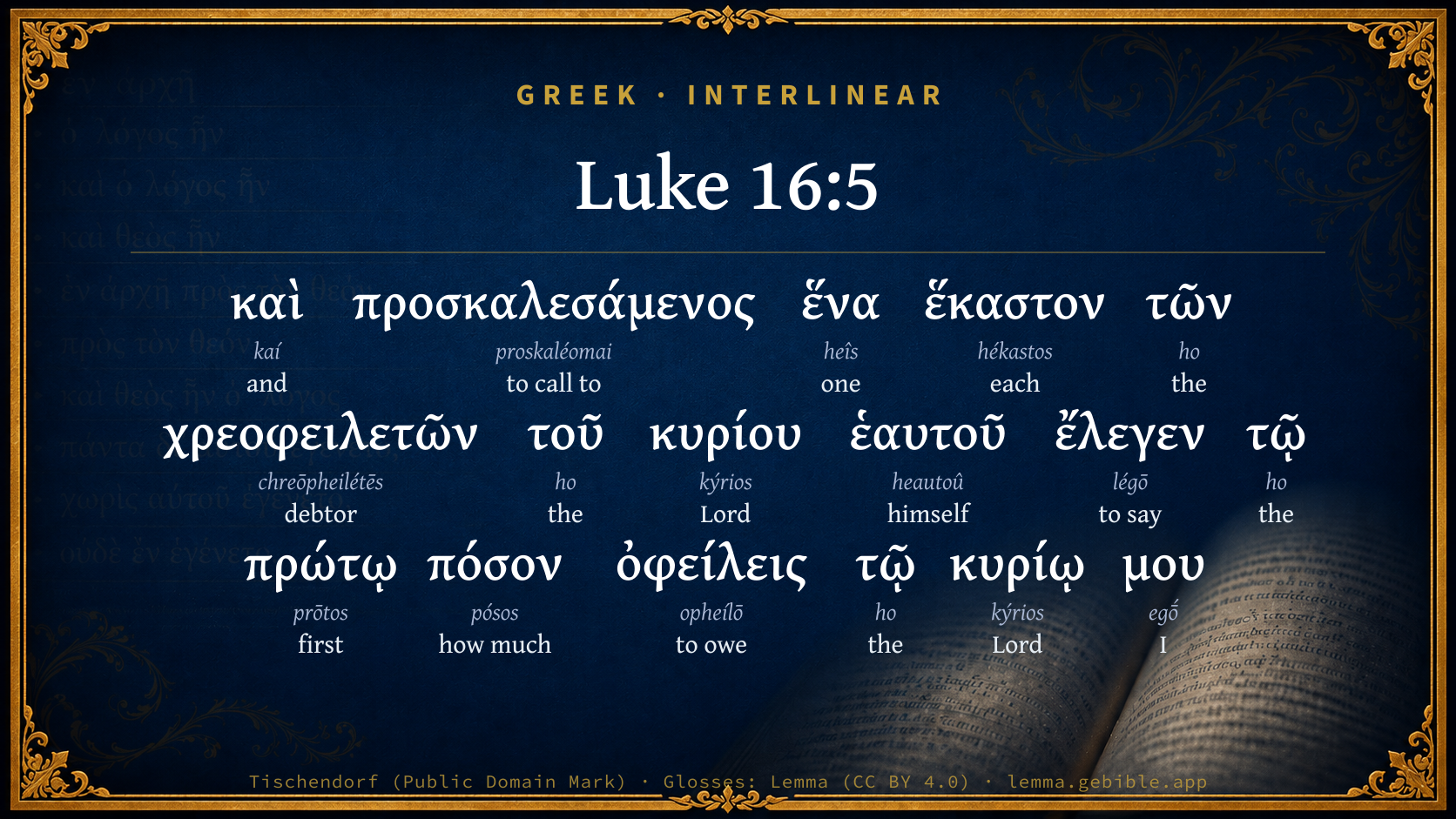
Greek (Tischendorf 8th ed.) Luke 16:5 appears in the Greek New Testament. The text above is from the Tischendorf 8th edition. Each word links to its Strong’s number and a concise gloss. Click any word for its full Thayer’s Greek Lexicon entry.
Download image
Cite this verse

Luke 16:5 (World English Bible). Public Domain. Lemma interlinear Bible study tool, https://lemma.gebible.app/v/luke/16/5.

Show BibTeX & RIS
BibTeX
RIS
English Translation
Calling each one of his lord's debtors to him, he said to the first, 'How much do you owe to my lord?'
World English Bible · Public Domain
Download a study sheet

One document with this verse’s original text, its word-by-word gloss line, the meaning frame, cross-references with their text, attributed commentary, and full source and license credits — printable, and it pastes into notes with its structure intact.

This verse Autodidact and up

Study sheet (.html) Plain text (.txt)

A passage Seminary Student

Up to 50 verses in one chapter. A passage sheet keeps up to 6 commentary sources and 12 cross-references per verse, in the order this page ranks them, and says so on the sheet whenever that leaves anything out. Ask for a single verse and you get the Autodidact verse sheet above.

Everything on this page stays free to read, with no account — the sheet is a download of what is already on screen, not access to it.

Want to remove ads? Support Godless Engineer
Compare translations 3

The same verse in 3 English versions, stacked beneath the original-language interlinear above. Click any original word for its lexicon entry.

Each is an independent rendering of the whole verse — the interlinear is not word-aligned to these translations.

Highlighted words mark where these versions differ — a whole-verse word diff, not a word-by-word alignment.

  • World English Bible Public Domain
    Calling each one of his lord's debtors to him, he said to the first, 'How much do you owe to my lord?'
  • King James Version Public Domain
    So he called every one of his lord's debtors unto him, and said unto the first, How much owest thou unto my lord?
  • unfoldingWord Literal Text CC BY-SA 4.0
    And having summoned each one of the debtors of his master, he said to the first one, ‘How much do you owe to my master?’

unfoldingWord Literal Text — © unfoldingWord, licensed CC BY-SA 4.0. Word-aligned USFM3 via Door43 (git.door43.org/unfoldingWord/en_ult).

Versions to compare (up to 4)

3 of 4 selected

Show all 19 translations

Every available English version of this verse, each an independent rendering of the whole verse.

  • World English Bible Public Domain
    Calling each one of his lord's debtors to him, he said to the first, 'How much do you owe to my lord?'
  • Berean Standard Bible Public Domain
    And he called in each one of his master’s debtors. ‘How much do you owe my master?’ he asked the first.
  • Majority Standard Bible Public Domain
    And he called in each one of his master’s debtors. ‘How much do you owe my master?’ he asked the first.
  • King James Version Public Domain
    So he called every one of his lord's debtors unto him, and said unto the first, How much owest thou unto my lord?
  • American Standard Version (1901) Public Domain
    And calling to him each one of his lord's debtors, he said to the first, How much owest thou unto my lord?
  • Revised Version (1885) Public Domain
    And calling to him each one of his lord’s debtors, he said to the first, How much owest thou unto my lord?
  • Geneva Bible (1599) Public Domain
    Then called he vnto him euery one of his masters detters, and said vnto the first, Howe much owest thou vnto my master?
  • Douay-Rheims (1899) Public Domain
    Therefore calling together every one of his lord's debtors, he said to the first: How much dost thou owe my lord?
  • Young's Literal Translation Public Domain
    `And having called near each one of his lord's debtors, he said to the first, How much dost thou owe to my lord?
  • Literal Standard Version CC BY-SA 4.0
    And having called near each one of his lord’s debtors, he said to the first, How much do you owe to my lord?
  • Unlocked Literal Bible CC BY-SA 4.0
    Then the manager called for each one of his master's debtors, and he asked the first one, 'How much do you owe to my master?'
  • unfoldingWord Literal Text CC BY-SA 4.0
    And having summoned each one of the debtors of his master, he said to the first one, ‘How much do you owe to my master?’
  • Darby Bible Public Domain
    And having called to [him] each one of the debtors of his own lord, he said to the first, How much owest thou to my lord?
  • World Messianic Bible Public Domain
    Calling each one of his lord’s debtors to him, he said to the first, ‘How much do you owe to my lord?’
  • Webster's Bible Public Domain
    So he called every one of his lord's debtors, and said to the first, How much owest thou to my lord?
  • Free Bible Version CC BY-SA 4.0
    So he invited all those who were in debt to his master to come and see him. He asked the first one, ‘How much do you owe my master?’
  • Bible in Basic English Public Domain
    And sending for every one who was in debt to his lord he said to the first, What is the amount of your debt to my lord?
  • Text-Critical English NT CC BY 4.0
    So he summoned each one of his master's debtors. He said to the first, ‘How much do yoʋ owe my master?’
  • Tyndale New Testament (1534) Public Domain
    Then called he all his masters detters and sayd vnto the fyrst: how moche owest thou vnto my master?

Literal Standard Version (2020), Covenant Press — licensed CC BY-SA 4.0. Text via the HelloAO Bible API (eBible.org). Unlocked Literal Bible (unfoldingWord) — licensed CC BY-SA 4.0. Text via the HelloAO Bible API (eBible.org). unfoldingWord Literal Text — © unfoldingWord, licensed CC BY-SA 4.0. Word-aligned USFM3 via Door43 (git.door43.org/unfoldingWord/en_ult). Free Bible Version, Dr. Jonathan Gallagher — licensed CC BY-SA 4.0. Text via the HelloAO Bible API (eBible.org).

Word by word

More ways to search: Search by grammar → Find every occurrence → Compare this word →

Practice this passage: Drill this verse → Learn its vocabulary →

χρεοφειλετῶν
chreōpheilétēs
G5533
“debtor”
Noun, Genitive, Plural, Masculine
Part of Speech
Noun
Case
Genitive
Number
Plural
Gender
Masculine
Full Thayer's Definition

Origin: from a derivative of G5531 and G3781

TDNT: None

1. a debtor
  1. καὶ kaí G2532 “and” Conjunction
  2. προσκαλεσάμενος proskaléomai G4341 “to call to” Verb, Aorist, Middle deponent, Participle, Nominative, Singular, Masculine
  3. ἕνα heîs G1520 “one” Adjective, Accusative, Singular, Masculine
  4. ἕκαστον hékastos G1538 “each” Adjective, Accusative, Singular, Masculine
  5. τῶν ho G3588 “the” Article, Genitive, Plural, Masculine
  6. τοῦ ho G3588 “the” Article, Genitive, Singular, Masculine
  7. κυρίου kýrios G2962 “Lord” Noun, Genitive, Singular, Masculine
  8. ἑαυτοῦ heautoû G1438 “himself” Reflexive pronoun, 3rd person, Genitive, Singular, Masculine
  9. ἔλεγεν légō G3004 “to say” Verb, Imperfect, Active, Indicative, 3rd person, Singular
  10. τῷ ho G3588 “the” Article, Dative, Singular, Masculine
  11. πρώτῳ prōtos G4413 “first” Adjective, Dative, Singular, Masculine, Superlative
  12. πόσον pósos G4214 “how much” Correlative/interrogative pronoun, Accusative, Singular, Neuter
  13. ὀφείλεις opheílō G3784 “to owe” Verb, Present, Active, Indicative, 2nd person, Singular
  14. τῷ ho G3588 “the” Article, Dative, Singular, Masculine
  15. κυρίῳ kýrios G2962 “Lord” Noun, Dative, Singular, Masculine
  16. μου egṓ G1473 “I” Personal pronoun, 1st person, Genitive, Singular

About this verse

These counts appear in no published source. They are computed here, from the morphology-tagged text and Lemma’s own curated glosses. What Lemma adds →

17
words
13
distinct lemmas
Gospels
section

Notable vocabulary

The rarest word here is χρεοφειλετῶν debtor G5533 — appearing just 2 times in the whole Greek New Testament.

Shared distinctive vocabulary

χρεοφειλετῶν debtor G5533 occurs in 2 verses of the Greek New Testament. Also found in:

Repetition

Words recur within this verse:

  • κυρίου Lord G2962 ×2
  • τῶν the G3588 ×4

Cross-references

2

Topical passages linked to Luke 16:5 in the Treasury of Scripture Knowledge — connected by theme and wording, ordered by reader-vote popularity; previews shown in the World English Bible.

  • Luke 7:41–42 "A certain lender had two debtors. The one owed five hundred denarii, and the other fifty.
  • Matthew 18:24 When he had begun to reconcile, one was brought to him who owed him ten thousand talents.

Cross-references courtesy of OpenBible.info (CC BY 4.0).

Commentary

Notes on Luke 16:5 from classic Christian and Jewish commentators (each source and its license shown beneath its notes). The classic Christian expositions comment on the surrounding passage and are grouped to its opening verse, so a note may address several verses; the Jewish commentaries on the Tanakh (Rashi and others) are per-verse, so they appear only where the commentator wrote on this verse.

Lemma curates 59 commentaries, every one of them public domain or Creative Commons licensed, each selected and text-cleaned for this edition rather than reprinted as found. About our sources →

Joseph Benson's Commentary

Luk 16:5-7. So he called, &c. — In pursuance of this scheme he sent for all those of his lord’s debtors whom he could hope to oblige by so fraudulent a proposal, determining to lower the several articles in his book, which stood chargeable to the account of each of them: and said to the first, How much owest thou — How much hast thou agreed to pay for the rent of the ground thou occupiest, or of how much hast thou acknowledged the receipt? And he said, A hundred measures of oil — The word βατους, here rendered measures, is evidently derived from the Hebrew בתים, which we render baths, in the Old Testament. According to Bishop Cumberland, a bath contained about seven gallons two quarts and half a pint. And he said, Take thy bill — Σου το γραμμα, thy writing; the writing in which thou hast promised the payment of so many baths as rent, or in which thou hast acknowledged the receipt of so many. The writing, whatever it was, was doubtless of the obligatory kind, and probably in the hand-writing of the tenant, or debtor, who thereby bound himself to pay these baths, and was signed by the steward, who here ordered him to alter, or write it over again, and make himself liable to pay only fifty, instead of a hundred. The word κορους, rendered measures, in the next verse, is the כור, or homer, of the Hebrews, containing about eight bushels and a half, standard measure. The twenty homers which he allowed the debtors to deduct, would contain one hundred and seventy bushels of wheat, and might be as valuable as fifty baths, or three hundred and seventy-eight gallons of oil; so that the obligation conferred on both those debtors might be equal.

Joseph Benson's Commentary on the Old and New Testaments (1811–1818) — public domain. Text from a community e-Sword module.

Tyndale Open Study Notes

Tyndale Open Resources

16:5-7 The manager called in his master’s debtors and reduced their debts, thus making friends who would help him during his unemployment.

Tyndale Open Study Notes — © Tyndale Open Resources, licensed CC BY-SA 4.0. Text via the HelloAO Bible API.

Bengel's Gnomon

Johann Albrecht Bengel

Luk 16:5. Ἕνα ἓκαστσν, every one) in order that he might put as many as possible under obligations to him; therefore two instances merely, for the sake of example, are subjoined in the following verses.

Bengel's Gnomon of the New Testament — English translation (T&T Clark, Edinburgh, 1860) — public domain. Text from a community e-Sword module.

Meyer's Critical & Exegetical Commentary

Heinrich August Wilhelm Meyer

Luk_16:5-7. Τῶν χρεωφειλ.] of the debtors they had borrowed, the natural products named from the stores of the rich man. This agrees better with the word, the opposite of which is δανειστής (Luk_7:41; Plut. Caes. 12), than the notion of tenants.

From ἕνα ἕκαστον it is seen that subsequently the two debtors are mentioned by way of example.

τοῦ κυρίου ἑαυτοῦ] By the debtors of his own master he knew how to help himself.

πόσον ὀφείλεις κ.τ.λ.] Going to work promptly and surely, he questions their own acknowledgment of obligation, which must agree with the contents of the bond.

Luk_16:6. βάτους] ὁ δὲ βάτος (בַּת) δίναται χωρῆσαι ξέστας ἑβδομήκοντα δύο, Josephus, Antt. viii. 2. 9. Therefore equal to an Attic μετρητής.

δέξαι] take away. The steward, who has the documents in his keeping, gives up the bill (τὰ γράμματα, that which is written, in the plural used even of one document, see on Gal_6:11), that the debtor may alter the number. Usually, that he may write a new bond with the smaller amount. But this is not contained in the words; moreover, for that purpose not the surrender of the document, but its destruction, would have been necessary.

καθίσας] pictorial. ταχέως belongs not to this graphic detail, καθίσας (Luther and others, including Ewald), but to γράψον; the latter corresponds to the haste to which the carrying out of an injustice urges.

Luk_16:7. ἑτέρῳ] to another. Comp. Luk_19:20.

κόρους] ὁ δὲ κόρος (כֹּר) δύναται μεδίμνους ἀττικοὺς δέκα, Josephus, Antt. xv. 9. 2.

The diversity of the deduction, Luk_16:6-7, is merely the change of the concrete picturing without any special purpose in view. Comp. already Euthymius Zigabenus.

Meyer — Critical and Exegetical Commentary on the New Testament — English translation by Peter Christie, edited by Frederick Crombie (T&T Clark, 1880) — public domain. Text from a community e-Sword module.

Expositor's Greek Testament

ed. W. Robertson Nicoll

Luk 16:5 . ἕνα ἕκαστον : he sees them one by one, not all together. These debtors might be farmers, who paid their rents in kind, or persons who had got supplies of goods from the master’s stores; which of the two of no consequence to the point of the parable. τῷ πρώτῳ , the first, in the parable = to one. Two cases mentioned, a first and a second ( ἑτέρῳ ), two, out of many; enough to exemplify the method. It is assumed that all would take advantage of the unprincipled concession; those who had accused him and those who had possibly been already favoured in a similar manner, bribed to speak well of him.

The Expositor's Greek Testament, edited by W. Robertson Nicoll (1897–1910) — public domain. Text from a community e-Sword module.

Jamieson, Fausset & Brown

Robert Jamieson, A. R. Fausset & David Brown

fifty . . . fourscore--deducting a half from the debt of the one, and a fifth from that of the other.

Jamieson, Fausset & Brown — Commentary Critical and Explanatory on the Whole Bible (1871) — public domain (CC PDM 1.0). Text via the HelloAO Bible API.

Ellicott's Commentary for English Readers

(5) So he called every one of his lord’s debtors.—The debtors might be either men who had bought their wheat and their oil at the hands of the steward; or, as the sequel renders more probable, tenants who, after the common custom of the East, paid their rent in kind. Who, we ask, are the “debtors,” in the interpretation of the parable? The Lord’s Prayer supplies the answer to that question. The “debtors” are those who have sinned against God, who have left undone the things which they were bound to do, who have made no return for the outward blessings they have received. The unfaithful Church or party tries to secure its position by working on the lower nature of those who have the sense of that burden upon them. It neither gives the sense of peace or pardon, nor asserts the righteous severity of God’s commandments. It keeps their consciences uneasy, and traffics in its absolutions.

A Bible Commentary for English Readers, edited by Charles John Ellicott (1878–1897) — public domain. Text from a community e-Sword module.

The Cambridge Bible for Schools and Colleges

gen. ed. J. J. S. Perowne

5. So he called every one of his lord’s debtors unto him] In the East rents are paid in kind, and a responsible steward, if left quite uncontrolled, has the amplest opportunity to defraud his lord, because the produce necessarily varies from year to year. The unjust steward would naturally receive from the tenants much more than he acknowledged in his accounts.

The Cambridge Bible for Schools and Colleges (gen. ed. J. J. S. Perowne; Cambridge University Press, 1878–1918) — public domain. Text from a community e-Sword module.

John Gill's Exposition

So he called every one of his Lord's debtors,.... Either the Gentiles, who were greatly indebted to God, having sinned against him, and the law, and light of nature, at a great rate; into whose affections, houses, and palaces, the Jews found ways and means to introduce themselves; and, in process of time, got leave to have synagogues built, and their worship set up again: or else the Jews, their countrymen; since these were under those stewards, tutors, and governors, and were debtors to do the whole law; and had, by breaking the law, contracted large debts; and against whom the ceremonial law stood as an handwriting: these the steward called

unto him, and said unto the first, how much owest thou unto my Lord? and it is observable, that the debts of these men, of the first, lay in oil, and of the other in wheat; things much used in the ceremonial law, in the observance of which they had been, greatly deficient; see

John Gill's Exposition of the Whole Bible (1746–1763) — public domain (CC PDM 1.0). Text via the HelloAO Bible API.

Trapp's Complete Commentary

John Trapp

5 So he called every one of his lord’s debtors unto him, and said unto the first, How much owest thou unto my lord?

Ver. 5. How much owest thou?] Some are ever owing; and may say of debt, as the strumpet Quartilla did of her virginity, Iunonem meam iratam habeam, si unquam me meminerim virginem fuisse. Petron.

John Trapp, A Commentary or Exposition upon All the Books of the Old and New Testament (1647–1656) — public domain. Text from a community e-Sword module.

Albert Barnes' Notes on the Bible

Called every one - As he was “steward,” he had the management of all the affairs, and, of course, debts were to be paid to him.

Debtors - Those who “owed” his master, or perhaps “tenants;” those who rented land of his master.

Albert Barnes' Notes on the Bible (1834–1885) — public domain. Text from a community e-Sword/MySword module.

Whedon's Commentary on the Bible

Daniel D. Whedon

5. So he called—His purpose is to gain the favour of the tenants by cancelling a large part of the rents due This was a fraud upon his landlord; but he was one of the children of this world. (Luk_16:8.)

Every one—So that they might all be in the plot and none be on the landlord’s side.

Debtors—Who owed for rents.

Daniel D. Whedon (gen. ed.), Commentary on the Old and New Testaments (1874–1909) — public domain. Text from a community e-Sword module.

The Pulpit Commentary

Vers. 5, 6, and 7 simply paint in the details of the interesting picture of the parable. This singular plan of providing for himself by becoming a benefactor of the debtor, remarks Professor Bruce, was by no means the only possible one under the circumstances; but the Speaker of the pa-table made his hero make choice of it as the aim of the imaginary narrative was to teach the value of beneficence as a passport into the eternal habitations. Various explanations have been suggested to account for the difference in the gifts to the debtors. It is probable that when our Lord spoke the parable, reasons for these varied gifts were given, such as the circumstances of the debtors. It is scarcely now worth while to frame ingenious guesses respecting the details, which apparently do not affect the grand lessons which the story was intended to teach.

Ver. 5. Our indebtedness to our Lord.

"How much owest thou unto my Lord?" Taking these words quite apart from the context to which they properly belong, we may let them suggest to us the very profitable question, how much we, as individual men, owe to him who is the Lord of all.

I WE OWE HIM FAR MORE THAN WE CAN ESTIMATE. Who shall say how much we owe our God when we consider:

1. The intrinsic value of his gifts to us. How much are we indebted to him who gave us our being itself; who gave us our physical, mental, and spiritual capacities; who has been preserving us in existence; who has been supplying all our wants?

2. The wisdom of his gifts; their moderation, not too large and liberal for our good; the conditions under which he grants them in such wise that all manner of virtues are developed in us by our necessary exertions to obtain them.

3. The love which inspires them. The value of a gift is always greatly enhanced by the good will which prompted its bestowal. God"s gifts to us his children should be very much more highly valued by us because all that he gives to us is prompted by his Fatherly interest in us; all his kindnesses are loving-kindnesses.

4. The costliness of one supreme Gift. "He spared not his own Son, but delivered him up for us all." The costliness of that surpassing Gift is such as we have no standards to compute, no language to express.

II EACH ONE OF US HAS HIS OWN SPECIAL INDEBTEDNESS. "How much owest thou unto my Lord?

1. One man has been long spared in sin, and has been reclaimed at last; he owes peculiar gratitude for long patience and merciful interposition at the last.

2. Another has had his rebelliousness suddenly and mightily broken down; he is under peculiar obligation for God"s redeeming and transforming grace.

3. A third has been led almost from the first by the constraining influences of the home and the Church; he owes very much for the earliness and the constancy and the gentleness of the Divine visitation. Which of these three owes most to the heavenly Father, to the Divine Saviour, to the renewing Spirit? Who shall say? But we can say this, that

III WE ALL OWE MORE THAN WE CAN HOPE TO PAY. We are all in the position of him who "owed ten thousand talents," and had not to pay. (Mt 18) When we consider the unmeasured and practically immeasurable amount of our indebtedness to God, and also consider the feebleness of our power to respond, we conclude that there is but one way of reconciliation, and that is a generous cancelling of our great debt. We can only cast ourselves on the abounding mercy of God in Jesus Christ our Lord, and accept his forgiving love in him. For his sake he will forgive us "all that debt," will treat us as those who are absolutely free and pure: then will uprising and overflowing gratitude fill our hearts, and the future of our lives will be a holy and happy sacrifice, the offering of our filial love. C.

The Pulpit Commentary (1880–1919), ed. H.D.M. Spence-Jones & Joseph S. Exell — public domain. Text from a community e-Sword module.

unfoldingWord translationNotes

Door43 World Missions Community

his master's debtors

"the people who were in debt to his master" or "the people who owed things to his master." In this story the debtors owed olive oil and wheat.

He said ... He said to him

"The debtor said ... the manager said to the debtor"

A hundred baths of olive oil

This was about 3,000 liters of olive oil. (See: Biblical Volume)

hundred ... fifty ... eighty

"100 ... 50 ... 80" (See: Numbers)

Take your bill

A "bill" is a piece of paper that tells how much someone owes.

the manager said to another ... He said ... He said to him

"the manager said to another debtor ... The debtor said ... The manager said to the debtor"

A hundred cors of wheat

You may convert this to a modern measure. AT: "twenty thousand liters of wheat" or "a thousand baskets of wheat" (See: Biblical Volume)

write eighty

"write eighty cors of wheat." You may convert this to a modern measure. AT: "write sixteen thousand liters" or "write eight hundred baskets"

translationWords

lord

olive

oil

wheat

unfoldingWord translationNotes — © Distant Shores Media and the Door43 World Missions Community, licensed CC BY-SA 4.0. Source: git.door43.org/Door43/en_tn.

Cambridge Greek Testament for Schools and Colleges

5. προσκαλεσάμενος ἕνα ἕκαστον. In the East rents are paid in kind, and a responsible steward, if left quite uncontrolled, has the amplest opportunity to defraud his lord, because the produce necessarily varies from year to year. The unjust steward would naturally receive from the tenants much more than he acknowledged in his accounts.

Cambridge Greek Testament for Schools and Colleges (Cambridge University Press, 1896; 21 vols, various authors incl. Carr, Maclear, Plummer, Farrar, Lumby, Moule, M. R. James, Simcox) — public domain. Text from a community e-Sword module.

Alford’s Greek Testament

Henry Alford

5.] It is more natural to suppose that these χρεοφειλέται had borrowed, i.e. not yet paid for these articles of food out of the stores of the rich man, than that they were contractors to the amounts specified.

τοῦ κ. ἑαυτοῦ, of his own lord,—shewing the unprincipled boldness of his plan for saving himself; as we express the same when we say, ‘he robbed his own father.’

Henry Alford, The Greek Testament (1849–1861) — public domain. Text from a community e-Sword module.

International Critical Commentary

5. χρεοφιλετῶν. Comp. 7:41; Pro 29:13; Job 31:37. They paid in kind, and the steward had sometimes received more from them than he had put down in the accounts. This time he makes the amount paid agree with the amount entered by reducing the amount paid. He thus curries favour with the debtors, and to some extent lessens the number of his manifest defalcations. The covenants were kept by the steward; and he now hands to each debtor his written agreement,—Δέξαι σου τὰ γράμματα,—in order that the debtor may reduce the amount which he covenanted to pay. The debtor gained on this last payment. The steward gained on the previous payments.

International Critical Commentary — older volumes (1896–1929), various authors — public domain. Text from a community e-Sword module.

Vincent's Word Studies in the New Testament

Marvin R. Vincent

He called. Alford and Trench think that the debtors were together; but the words seem to me to indicate that he dealt with them separately. He called to him each one, and said unto the first; after that [επειτα] another.

Marvin R. Vincent, Word Studies in the New Testament (1887–1900) — public domain. Text from a community e-Sword/MySword module.

Lesson kit

Teaching starters — assembled from the data on this page, not authored interpretation. Every prompt links to the verse data it draws on. Edit before teaching.

Luke, in the Gospels, opens this verse with 17 words (13 distinct Greek lemmas). Its most distinctive word is chreōpheilétēs (“debtor”). A historical commentator’s framing appears above. Read the whole chapter for the surrounding context.

Discussion questions

  1. The word chreōpheilétēs carries the sense “debtor.” How does it shape the verse?
  2. How does Luke 7:41, which shares the word «debtor», read alongside this verse?
  3. What does the repetition of “Lord” (2× in this one verse) do in this verse?
  4. The translations on this page render this verse differently — a whole-verse word diff, not a word-by-word alignment. What might account for the different wordings?
  5. Compare how Joseph Benson's Commentary and Tyndale Open Study Notes read this verse. Where do they agree or differ?

Things to notice

Reading settings

Reading text

Shown beneath each verse's original-language words.

Old Testament
Old Testament edition

Read the OT as the Masoretic Hebrew (MT) or the Greek Septuagint (LXX).

English shown for the Greek Septuagint (in the Hebrew ↔ Greek comparison).

Comparing translations? Open the Compare panel on any verse page to stack up to four side by side.