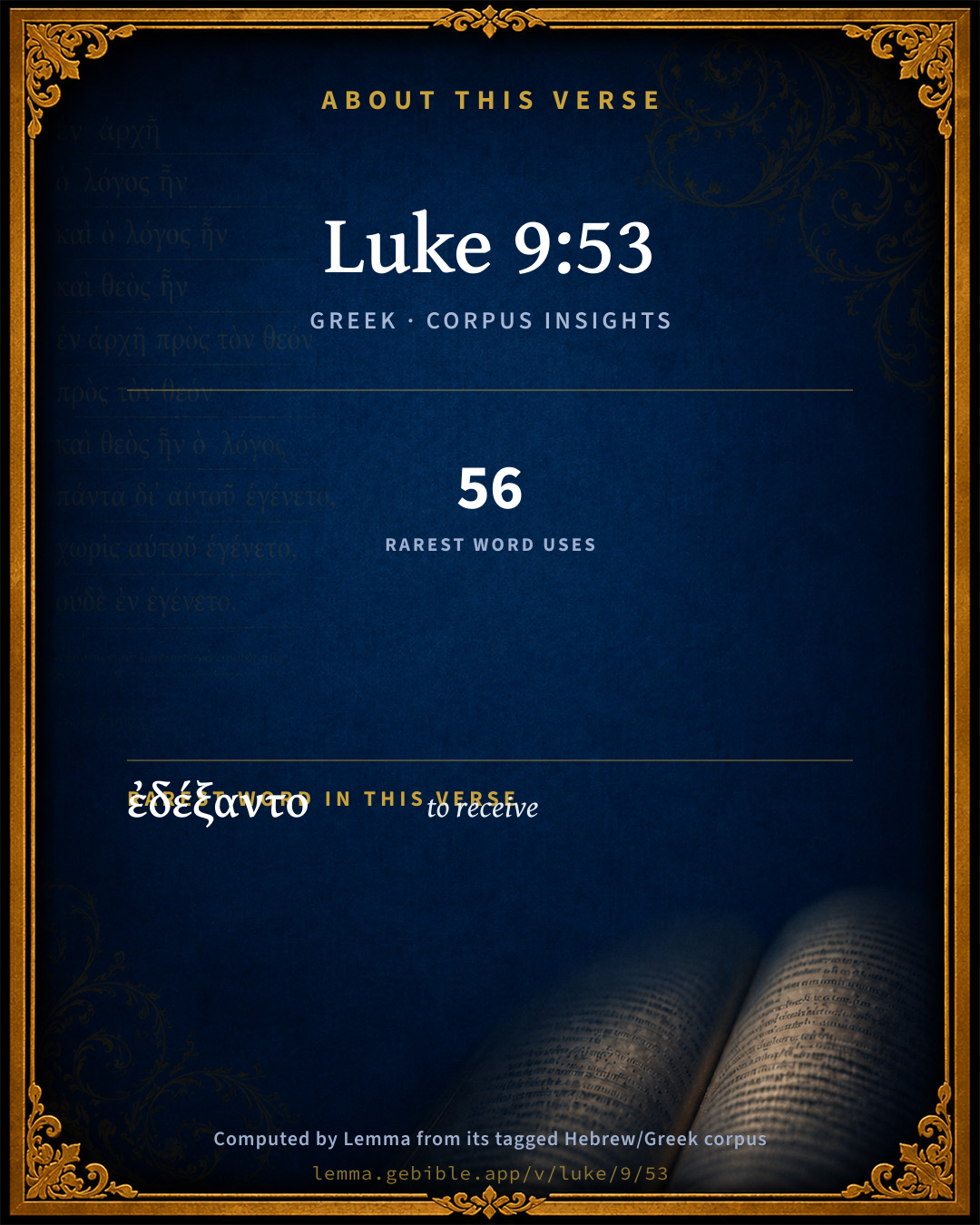
Luke 9:53

Greek (Tischendorf 8th ed.) Luke 9:53 appears in the Greek New Testament. The text above is from the Tischendorf 8th edition. Each word links to its Strong’s number and a concise gloss. Click any word for its full Thayer’s Greek Lexicon entry.
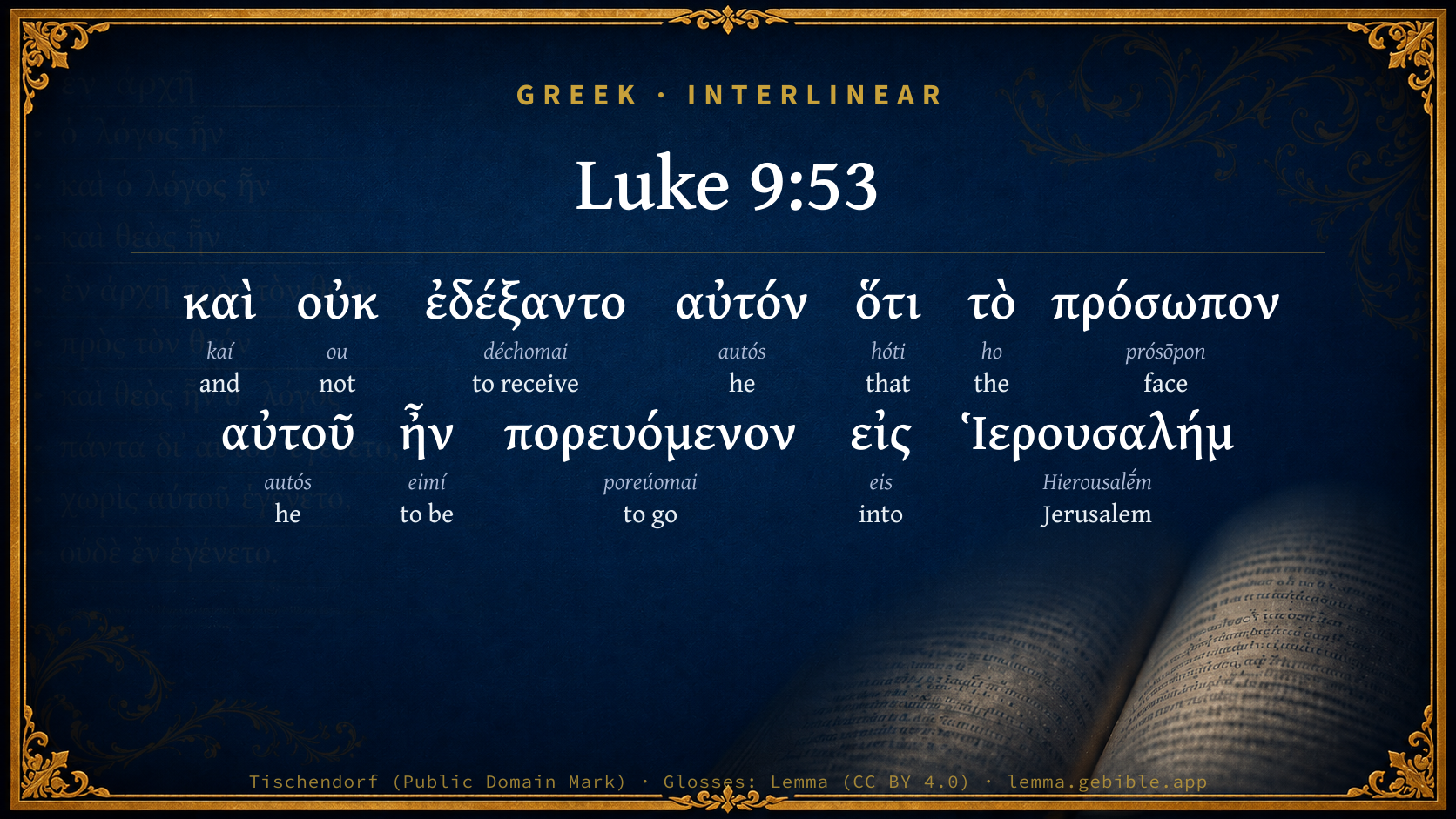
Download image
Cite this verse

Luke 9:53 (World English Bible). Public Domain. Lemma interlinear Bible study tool, https://lemma.gebible.app/v/luke/9/53.

Show BibTeX & RIS
BibTeX
RIS
English Translation
They didn't receive him, because he was traveling with his face set towards Jerusalem.
World English Bible · Public Domain
Download a study sheet

One document with this verse’s original text, its word-by-word gloss line, the meaning frame, cross-references with their text, attributed commentary, and full source and license credits — printable, and it pastes into notes with its structure intact.

This verse Autodidact and up

Study sheet (.html) Plain text (.txt)

A passage Seminary Student

Up to 50 verses in one chapter. A passage sheet keeps up to 6 commentary sources and 12 cross-references per verse, in the order this page ranks them, and says so on the sheet whenever that leaves anything out. Ask for a single verse and you get the Autodidact verse sheet above.

Everything on this page stays free to read, with no account — the sheet is a download of what is already on screen, not access to it.

Want to remove ads? Support Godless Engineer
Compare translations 3

The same verse in 3 English versions, stacked beneath the original-language interlinear above. Click any original word for its lexicon entry.

Each is an independent rendering of the whole verse — the interlinear is not word-aligned to these translations.

Highlighted words mark where these versions differ — a whole-verse word diff, not a word-by-word alignment.

  • World English Bible Public Domain
    They didn't receive him, because he was traveling with his face set towards Jerusalem.
  • King James Version Public Domain
    And they did not receive him, because his face was as though he would go to Jerusalem.
  • unfoldingWord Literal Text CC BY-SA 4.0
    But they did not welcome him, because his face was going to Jerusalem.

unfoldingWord Literal Text — © unfoldingWord, licensed CC BY-SA 4.0. Word-aligned USFM3 via Door43 (git.door43.org/unfoldingWord/en_ult).

Versions to compare (up to 4)

3 of 4 selected

Show all 19 translations

Every available English version of this verse, each an independent rendering of the whole verse.

  • World English Bible Public Domain
    They didn't receive him, because he was traveling with his face set towards Jerusalem.
  • Berean Standard Bible Public Domain
    But the people there refused to welcome Him, because He was heading for Jerusalem.
  • Majority Standard Bible Public Domain
    But the people there refused to welcome Him, because He was heading for Jerusalem.
  • King James Version Public Domain
    And they did not receive him, because his face was as though he would go to Jerusalem.
  • American Standard Version (1901) Public Domain
    And they did not receive him, because his face was `as though he were' going to Jerusalem.
  • Revised Version (1885) Public Domain
    And they did not receive him, because his face was as though he were going to Jerusalem.
  • Geneva Bible (1599) Public Domain
    But they woulde not receiue him, because his behauiour was, as though he would go to Hierusalem.
  • Douay-Rheims (1899) Public Domain
    And they received him not, because his face was of one going to Jerusalem.
  • Young's Literal Translation Public Domain
    and they did not receive him, because his face was going on to Jerusalem.
  • Literal Standard Version CC BY-SA 4.0
    and they did not receive Him, because His face was going on to Jerusalem.
  • Unlocked Literal Bible CC BY-SA 4.0
    But the people there did not welcome him, because he had set his face to go to Jerusalem.
  • unfoldingWord Literal Text CC BY-SA 4.0
    But they did not welcome him, because his face was going to Jerusalem.
  • Darby Bible Public Domain
    And they did not receive him, because his face was [turned as] going to Jerusalem.
  • World Messianic Bible Public Domain
    They didn’t receive him, because he was traveling with his face set toward Jerusalem.
  • Webster's Bible Public Domain
    And they did not receive him, because his face was as though he would go to Jerusalem.
  • Free Bible Version CC BY-SA 4.0
    But the people would not welcome him because he was determined to press on to Jerusalem.
  • Bible in Basic English Public Domain
    But they would not have him there, because he was clearly going to Jerusalem.
  • Text-Critical English NT CC BY 4.0
    But the people there refused to welcome him, because his face was set to go to Jerusalem.
  • Tyndale New Testament (1534) Public Domain
    But they wolde not receave him be cause his face was as though he wolde goo to Ierusalem.

Literal Standard Version (2020), Covenant Press — licensed CC BY-SA 4.0. Text via the HelloAO Bible API (eBible.org). Unlocked Literal Bible (unfoldingWord) — licensed CC BY-SA 4.0. Text via the HelloAO Bible API (eBible.org). unfoldingWord Literal Text — © unfoldingWord, licensed CC BY-SA 4.0. Word-aligned USFM3 via Door43 (git.door43.org/unfoldingWord/en_ult). Free Bible Version, Dr. Jonathan Gallagher — licensed CC BY-SA 4.0. Text via the HelloAO Bible API (eBible.org).

Word by word

More ways to search: Search by grammar → Find every occurrence → Compare this word →

Practice this passage: Drill this verse → Learn its vocabulary →

ἐδέξαντο
déchomai
G1209
“to receive”
Verb, Aorist, Middle deponent, Indicative, 3rd person, Plural
Part of Speech
Verb
Tense
Aorist
Voice
Middle deponent
Mood
Indicative
Person
3rd person
Number
Plural
Full Thayer's Definition

Origin: middle voice of a primary verb

TDNT: 02:50,1

1. to take with the hand a. to take hold of, take up 2. to take up, receive a. used of a place receiving one b. to receive or grant access to, a visitor, not to refuse intercourse or friendship 1. to receive hospitality 2. to receive into one's family to bring up or educate c. of the thing offered in speaking, teaching, instructing 1. to receive favourably, give ear to, embrace, make one's own, approve, not to reject d. to receive. i.e. to take upon one's self, sustain, bear, endure 3. to receive, get a. to learn
  1. καὶ kaí G2532 “and” Conjunction
  2. οὐκ ou G3756 “not” Particle, Negative
  3. αὐτόν autós G846 “he” Personal pronoun, Accusative, Singular, Masculine
  4. ὅτι hóti G3754 “that” Conjunction
  5. τὸ ho G3588 “the” Article, Nominative, Singular, Neuter
  6. πρόσωπον prósōpon G4383 “face” Noun, Nominative, Singular, Neuter
  7. αὐτοῦ autós G846 “he” Personal pronoun, Genitive, Singular, Masculine
  8. ἦν eimí G1510 “to be” Verb, Imperfect, Active, Indicative, 3rd person, Singular
  9. πορευόμενον poreúomai G4198 “to go” Verb, Present, Middle or Passive deponent, Participle, Nominative, Singular, Neuter
  10. εἰς eis G1519 “into” Preposition
  11. Ἱερουσαλήμ Hierousalḗm G2419 “Jerusalem” Noun, Proper, indeclinable

About this verse

These counts appear in no published source. They are computed here, from the morphology-tagged text and Lemma’s own curated glosses. What Lemma adds →

12
words
11
distinct lemmas
Gospels
section

Shared distinctive vocabulary

ἐδέξαντο to receive G1209 occurs in 45 verses of the Greek New Testament. Also found in:

Repetition

A word recurs within this verse:

  • αὐτόν he G846 ×2

Cross-references

3

Topical passages linked to Luke 9:53 in the Treasury of Scripture Knowledge — connected by theme and wording, ordered by reader-vote popularity; previews shown in the World English Bible.

  • John 4:9 The Samaritan woman therefore said to him, "How is it that you, being a Jew, ask for a drink from me, a Samaritan woman?" (For Jews have no dealings with Samaritans.)
  • John 4:40–42 So when the Samaritans came to him, they begged him to stay with them. He stayed there two days.
  • Luke 9:48 and said to them, "Whoever receives this little child in my name receives me. Whoever receives me receives him who sent me. For whoever is least among you all, this one will be great."

Cross-references courtesy of OpenBible.info (CC BY 4.0).

Commentary

Notes on Luke 9:53 from classic Christian and Jewish commentators (each source and its license shown beneath its notes). The classic Christian expositions comment on the surrounding passage and are grouped to its opening verse, so a note may address several verses; the Jewish commentaries on the Tanakh (Rashi and others) are per-verse, so they appear only where the commentator wrote on this verse.

Lemma curates 59 commentaries, every one of them public domain or Creative Commons licensed, each selected and text-cleaned for this edition rather than reprinted as found. About our sources →

Bengel's Gnomon

Johann Albrecht Bengel

Luk 9:53. Ὅτι, because) It was openly manifest that He was seeking to reach Jerusalem: this the Samaritans regarded with aversion [as being bitter enemies to Jewish ordinances of worship.—V. g.]—πρόσωπον, face) So the LXX. 2Sa 17:11, καὶ τὸ πρόσωπόν σου πορευόμενον ἐν μέσῳ αὐτῶν. “Whithersoever the face is turned, thither is directed the ardour of mind which conquers every difficulty.

Bengel's Gnomon of the New Testament — English translation (T&T Clark, Edinburgh, 1860) — public domain. Text from a community e-Sword module.

Jamieson, Fausset & Brown

Robert Jamieson, A. R. Fausset & David Brown

did not receive him, because, &c.--The Galileans, in going to the festivals at Jerusalem, usually took the Samaritan route [JOSEPHUS, Antiquities, 20.6.1], and yet seem to have met with no such inhospitality. But if they were asked to prepare quarters for the Messiah, in the person of one whose "face was as though He would go to Jerusalem," their national prejudices would be raised at so marked a slight upon their claims. (See on Joh 4:20).

Jamieson, Fausset & Brown — Commentary Critical and Explanatory on the Whole Bible (1871) — public domain (CC PDM 1.0). Text via the HelloAO Bible API.

Adam Clarke's Commentary

Verse 53. His face was] They saw he was going up to Jerusalem to keep the feast; (it was the feast of tabernacles, Joh 7:2); and knowing him thereby to be a Jew, they would afford nothing for his entertainment; for, in religious matters, the Samaritans and Jews had no dealings: see Joh 4:9. The Samaritans were a kind of mongrel heathens; they feared Jehovah, and served other gods, 2Kg 17:34. They apostatized from the true religion, and persecuted those who were attached to it. See an account of them, Mt 16:1. Those only who have deserted the truth of God, or who are uninfluenced by it, hate them who embrace and act by it. When a man has once decidedly taken the road to heaven, he can have but little credit any longer in the world, 1Jo 3:1.

Adam Clarke's Commentary on the Bible (1810–1826) — public domain. Text from a community e-Sword/MySword module.

Ellicott's Commentary for English Readers

(53) They did not receive him.—The reason thus given exactly agrees with what has been stated above. It will be remembered that when He had visited Samaria before, it was on His return, not directly from Jerusalem, but from some unknown region of Judæa where He had been baptising (Joh_3:22; Joh_4:3).

A Bible Commentary for English Readers, edited by Charles John Ellicott (1878–1897) — public domain. Text from a community e-Sword module.

The Cambridge Bible for Schools and Colleges

gen. ed. J. J. S. Perowne

53. they did not receive him] The aorist implies that they at once rejected Him. The Samaritans had shewn themselves heretofore not ill-disposed (Joh_4:39), and St Luke himself delights to record favourable notices of them (Luk_10:33, Luk_17:18). But (i) there was always a recrudescence of hatred between the Jews and the Samaritans at the recurrence of the annual feasts, (ii) Their national jealousy would not allow them to receive a Messiah whose goal was not Gerizim, but Jerusalem, (iii) They would not sanction the passage of a multitude of Jews through their territory, since the Jews frequently (though not always, Jos. Antt. xx. 6, § 1) chose the other route on the East of the Jordan.

as though he would go to Jerusalem] This national hatred between Jews and Samaritans (Joh_4:9) still continues, and at the present day it is mainly due to the fanaticism of the Jews. In our Lord’s day the Jews called the Samaritans ‘Cuthites’ (2Ki_17:24), aliens (2Ki_17:18), ‘that foolish people that dwell in Sichem’ (Sir_1:25-26), and other opprobrious names. They accused them of continuous idolatry (2 Kings 17), and charged them with false fire-signals, and with having polluted the Temple by scattering it with dead men’s bones (Jos. Antt. xx. 6, § I, Luk_18:2, § 2; B.J. 11. 12, § 3). No doubt originally their Monotheism was very hybrid, being mixed up with five heathen religions (2Ki_17:33; 2Ki_17:37); but they had gradually laid aside idolatry, and it was as much a calumny of the ancient Jews to charge them with the worship of Rachel’s amulets (Gen_35:4) as for modern Jews to call them ‘worshippers of the pigeon’ (Frankl. Jews in the East, 11. 334). But the deadly exacerbation between the two nations, which began after the Exile (Ezr_4:1-10; Neh_4:1-16; Neh_4:6), had gone on increasing by perpetual collision since the building of the Temple on Gerizim by the renegade priest Manasseh and Sanballat (Neh_13:28; Jos. Antt. xi. 7, xii. 5, § 5), which was destroyed by John Hyrcanus B.C. 129.

The Cambridge Bible for Schools and Colleges (gen. ed. J. J. S. Perowne; Cambridge University Press, 1878–1918) — public domain. Text from a community e-Sword module.

John Gill's Exposition

For the son of man,.... Meaning himself, in his state of humiliation:

is not come to destroy men's lives; the word "men's" is omitted in the Vulgate Latin, Syriac, and Persic versions: and both words, "men's lives", are left out in the Arabic version:

but to save them; as they might easily observe, by his casting out devils from the bodies of men, and healing all sorts of diseases: and therefore, though it was agreeably to the legal dispensation, and the times of Elijah, to punish offenders in such a manner, it was not agreeably to the Gospel dispensation, and to the ends of the Messiah's coming into the world: so far in this verse, and the latter part of the former verse, are left out in five ancient copies of Beza's, and in the Ethiopic version, but are in the rest of the Eastern versions, and in other copies, and are rightly retained:

and they went to another village; in Samaria, more civil and courteous, and less prejudiced, and where they got lodging and entertainment.

John Gill's Exposition of the Whole Bible (1746–1763) — public domain (CC PDM 1.0). Text via the HelloAO Bible API.

Trapp's Complete Commentary

John Trapp

52 And sent messengers before his face: and they went, and entered into a village of the Samaritans, to make ready for him.

53 And they did not receive him, because his face was as though he would go to Jerusalem.

Ver. 53. And they did not receive him] Such is the hatred that idolaters bear against all God’s true worshippers. Illam domum in qua inventus fuerit haereticus diruendam decernimus: It was a decree of the Council of Toulouse against the Albigenses.

John Trapp, A Commentary or Exposition upon All the Books of the Old and New Testament (1647–1656) — public domain. Text from a community e-Sword module.

Albert Barnes' Notes on the Bible

They did not receive him - Did not entertain him hospitably, or receive him with kindness.

Because his face was ... - Because they ascertained that he was going to Jerusalem. One of the subjects of dispute between the Jews and Samaritans pertained to the proper situation of the temple. The Jews contended that it should be at Jerusalem; the Samaritans, on Mount Gerizim, and accordingly they had built one there. They had probably heard of the miracles of Jesus, and that he claimed to be the Messiah. Perhaps they had hoped that he would decide that “they” were right in regard to the building of the temple. Had he decided the question in that way, they would have received him as the Messiah gladly; but when they saw that he was going among the Jews - that “by going” he would decide in their favor, they resolved to have nothing to do with him, and they rejected him. And from this we may learn:

That people wish all the teachers of religion to fall in with their own views. That if a doctrine does not accord with their selfish desires, they are very apt to reject it. That if a religious teacher or a doctrine favors a rival sect, it is commonly rejected without examination. And, That people, from a regard to their own views and selfishness, often reject the true religion, as the Samaritans did the Son of God, and bring upon themselves swift destruction.

Albert Barnes' Notes on the Bible (1834–1885) — public domain. Text from a community e-Sword/MySword module.

Whedon's Commentary on the Bible

Daniel D. Whedon

53. Did not receive him—As but a single village is mentioned as thus rejecting Jesus, it would seem that his journey was generally pleasant.

Face… would go to Jerusalem—We have described the enmity between the Samaritans and Jews in our note upon Mat_10:5. This religious hate was doubtless more intense at the Feast time, and upon those who were going to Jerusalem rather than to Gerizim. Hence the ordinary route of the Passover caravan was on the eastern side of the Jordan, avoiding Samaria.

Daniel D. Whedon (gen. ed.), Commentary on the Old and New Testaments (1874–1909) — public domain. Text from a community e-Sword module.

The Pulpit Commentary

And they did not receive him, because his face was as though he would go to Jerusalem. Here the kindly overtures were rejected by the inhabitants of the Samaritan village in question. The reason alleged by them was that this Teacher, who wished to come among them, was on his way up to worship at the rival temple at Jerusalem.

The Pulpit Commentary (1880–1919), ed. H.D.M. Spence-Jones & Joseph S. Exell — public domain. Text from a community e-Sword module.

John Wesley's Explanatory Notes

His face was as though he would go to Jerusalem - It plainly appeared, he was going to worship at the temple, and thereby, in effect, to condemn the Samaritan worship at Mount Gerizim.

John Wesley, Explanatory Notes Upon the Whole Bible (1754–1765) — public domain. Text via the GEBible commentary corpus.

The People's New Testament

B. W. Johnson

53, 54. They did not receive him. Because he was evidently journeying to Jerusalem. This stirred up their bigotry. They thus not only refused Jesus as a prophet, but violated the sacred duties of hospitality. The refusal to receive a religious teacher was considered a rejection of his claims.

Wilt thou that we command fire? These gentle apostles were filled with wrath at the insult to the Master. Their zeal for the Lord led them into a sanguinary feeling that was sinful. Thus, often, religious zeal has led men to sinful acts and a persecuting spirit. As Elias did? See 2 Kings 1:9–12.

B. W. Johnson's The People's New Testament with Notes (1889–1891) — public domain. Electronic text from the Christian Classics Ethereal Library (CCEL) ThML edition.

Cambridge Greek Testament for Schools and Colleges

53. οὐκ ἐδέξαντο αὐτόν. The aorist implies that they at once rejected Him. The Samaritans had shewn themselves heretofore not ill-disposed (Joh 4:39), and St Luke himself delights to record favourable notices of them (Luk 10:33, Luk 17:18). But (i) there was always a recrudescence of hatred between the Jews and the Samaritans at the recurrence of the annual feasts. (ii) Their national jealousy would not allow them to receive a Messiah whose goal was not Gerizim, but Jerusalem. (iii) They would not sanction the passage of a multitude of Jews through their territory, since the Jews frequently (though not always, Jos. Antt. xx. 6, § 1) chose the other route on the East of the Jordan.

τὸ πρόσωπον αὐτοῦ ἦν πορευόμενον. This again is a strange Hebraic form of expression, taken from the LXX[208] 2Sa 17:11.

[208] LXX. Septuagint.

εἰς Ἱερουσαλήμ. This national hatred between Jews and Samaritans (Joh 4:9) still continues, and at the present day it is mainly due to the fanaticism of the Jews. In our Lord’s day the Jews called the Samaritans ‘Cuthites’ (2Ki 17:24), aliens (Luk 17:18), ‘that foolish people that dwell in Sichem’ (Sir 50:25-26), and other opprobrious names. They accused them of continuous idolatry (2 Kings 17), and charged them with false fire-signals, and with having polluted the Temple by scattering it with dead men’s bones (Jos. Antt. XX. 6, § 1, XVIII. 2, § 2; B. J. II. 12, § 3). No doubt originally their Monotheism was very hybrid, being mixed up with five heathen religions (2Ki 17:33; 2Ki 19:37); but they had gradually laid aside idolatry, and it was as much a calumny of the ancient Jews to charge them with the worship of Rachel’s amulets (Gen 35:4) as for modern Jews to call them ‘worshippers of the pigeon’ (Frankl. Jews in the East, II. 334). But the deadly exacerbation between the two nations, which began after the Exile (Ezr 4:1-10; Neh 4:1-16; Neh 4:6), had gone on increasing by perpetual collision since the building of the Temple on Gerizim by Sanballat and the renegade priest Manasseh (Neh 13:28; Jos. Antt. XI. 7, XII. 5, § 5), which was destroyed by John Hyrcanus B.C. 129.

Cambridge Greek Testament for Schools and Colleges (Cambridge University Press, 1896; 21 vols, various authors incl. Carr, Maclear, Plummer, Farrar, Lumby, Moule, M. R. James, Simcox) — public domain. Text from a community e-Sword module.

International Critical Commentary

53. οὐκ ἐδέξαντο αὐτόν, ὅτι. The feeling was reciprocal. Some Jews taught that a Samaritan’s bread was as defiling swine’s flesh: comp. Joh 4:9, Joh 4:20. The fact that He was on His way to keep a feast at Jerusalem, thus repudiating the Samaritan temple on Mount Gerizim, increased the animosity of the Samaritans. Jos. Ant. xx. 6, 1; B. J. ii. 12. 3-7; Vita, 52; Wetst; on Joh 4:20.

τὸ πορόσωπον αὐτοῦ ἦν πορευόμενον. Another Hebraism: comp. 2Sa 17:11. Galileans in journeying to Jerusalem often went round by Peræa, in order to avoid the churlishness of the Samaritans: and this our Lord may possibly have done after this attempt to bring Jews and Samaritans together as guests and hosts had failed. The hospitality which He had received at Sychar many months before this (Joh 4:40) would not abolish the prejudices of all Samaritan towns and villages for ever.

International Critical Commentary — older volumes (1896–1929), various authors — public domain. Text from a community e-Sword module.

Lesson kit

Teaching starters — assembled from the data on this page, not authored interpretation. Every prompt links to the verse data it draws on. Edit before teaching.

Luke, in the Gospels, opens this verse with 12 words (11 distinct Greek lemmas). Its most distinctive word is déchomai (“to receive”). A historical commentator’s framing appears above. Read the whole chapter for the surrounding context.

Discussion questions

  1. What does “to receive” (déchomai) contribute to the verse as a whole?
  2. Matthew 10:14 shares the word «to receive» with this verse. How do the two illuminate each other?
  3. “he” occurs 2× in this one verse. What is the effect of the repetition?
  4. The translations on this page render this verse differently — a whole-verse word diff, not a word-by-word alignment. What might account for the different wordings?
  5. Reading how Bengel's Gnomon and Jamieson, Fausset & Brown read this verse, where do the two commentators agree and where do they part?

Things to notice

Reading settings

Reading text

Shown beneath each verse's original-language words.

Old Testament
Old Testament edition

Read the OT as the Masoretic Hebrew (MT) or the Greek Septuagint (LXX).

English shown for the Greek Septuagint (in the Hebrew ↔ Greek comparison).

Comparing translations? Open the Compare panel on any verse page to stack up to four side by side.