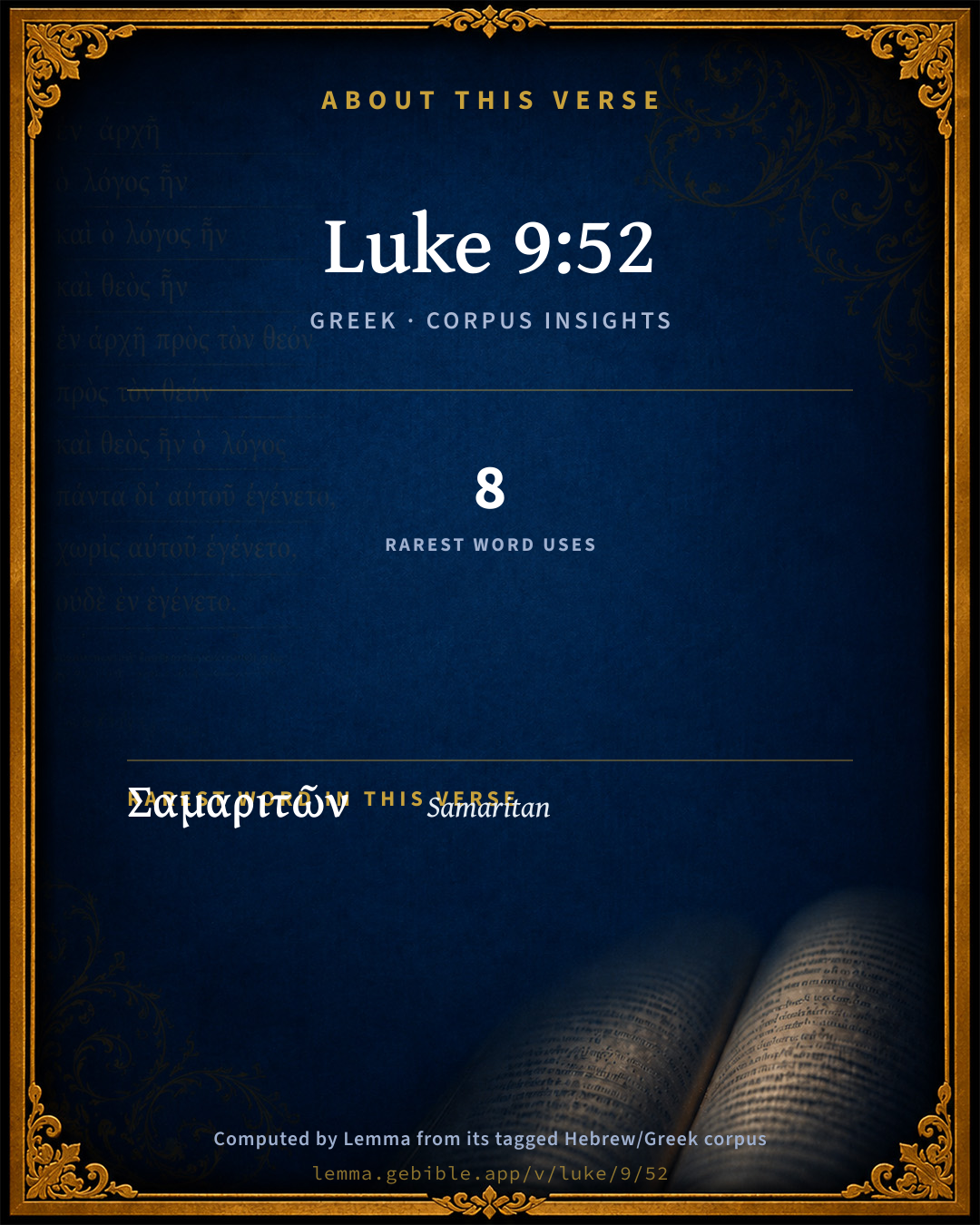
Luke 9:52

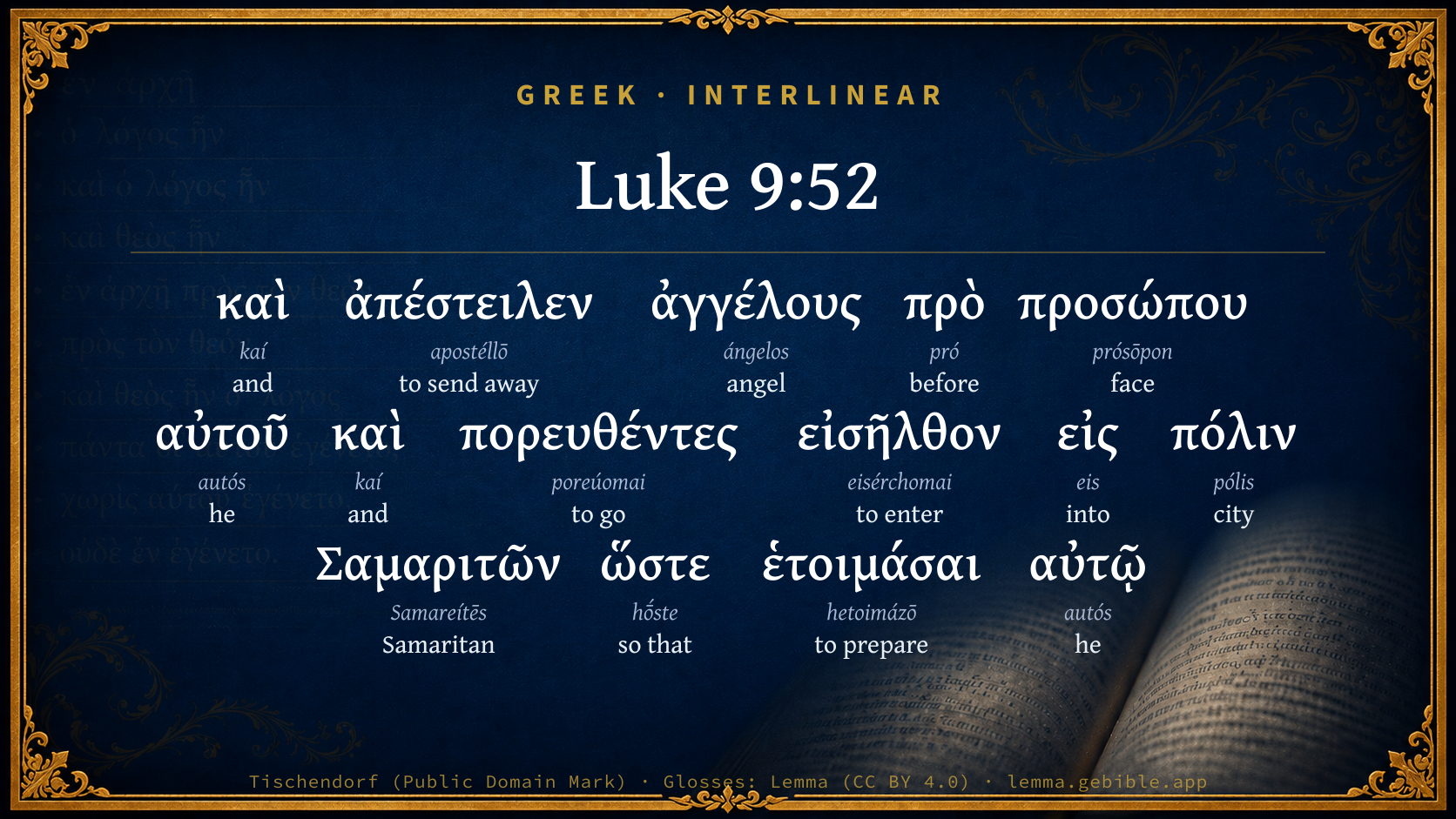
Greek (Tischendorf 8th ed.) Luke 9:52 appears in the Greek New Testament. The text above is from the Tischendorf 8th edition. Each word links to its Strong’s number and a concise gloss. Click any word for its full Thayer’s Greek Lexicon entry.
Download image
Cite this verse

Luke 9:52 (World English Bible). Public Domain. Lemma interlinear Bible study tool, https://lemma.gebible.app/v/luke/9/52.

Show BibTeX & RIS
BibTeX
RIS
English Translation
and sent messengers before his face. They went, and entered into a village of the Samaritans, so as to prepare for him.
World English Bible · Public Domain
Download a study sheet

One document with this verse’s original text, its word-by-word gloss line, the meaning frame, cross-references with their text, attributed commentary, and full source and license credits — printable, and it pastes into notes with its structure intact.

This verse Autodidact and up

Study sheet (.html) Plain text (.txt)

A passage Seminary Student

Up to 50 verses in one chapter. A passage sheet keeps up to 6 commentary sources and 12 cross-references per verse, in the order this page ranks them, and says so on the sheet whenever that leaves anything out. Ask for a single verse and you get the Autodidact verse sheet above.

Everything on this page stays free to read, with no account — the sheet is a download of what is already on screen, not access to it.

Want to remove ads? Support Godless Engineer
Compare translations 3

The same verse in 3 English versions, stacked beneath the original-language interlinear above. Click any original word for its lexicon entry.

Each is an independent rendering of the whole verse — the interlinear is not word-aligned to these translations.

Highlighted words mark where these versions differ — a whole-verse word diff, not a word-by-word alignment.

  • World English Bible Public Domain
    and sent messengers before his face. They went, and entered into a village of the Samaritans, so as to prepare for him.
  • King James Version Public Domain
    And sent messengers before his face: and they went, and entered into a village of the Samaritans, to make ready for him.
  • unfoldingWord Literal Text CC BY-SA 4.0
    And he sent messengers before his face, and they went entered into a Samaritan village so as to prepare for him.

unfoldingWord Literal Text — © unfoldingWord, licensed CC BY-SA 4.0. Word-aligned USFM3 via Door43 (git.door43.org/unfoldingWord/en_ult).

Versions to compare (up to 4)

3 of 4 selected

Show all 19 translations

Every available English version of this verse, each an independent rendering of the whole verse.

  • World English Bible Public Domain
    and sent messengers before his face. They went, and entered into a village of the Samaritans, so as to prepare for him.
  • Berean Standard Bible Public Domain
    He sent messengers on ahead, who went into a village of the Samaritans to make arrangements for Him.
  • Majority Standard Bible Public Domain
    He sent messengers on ahead, who went into a village of the Samaritans to make arrangements for Him.
  • King James Version Public Domain
    And sent messengers before his face: and they went, and entered into a village of the Samaritans, to make ready for him.
  • American Standard Version (1901) Public Domain
    and sent messengers before his face: and they went, and entered into a village of the Samaritans, to make ready for him.
  • Revised Version (1885) Public Domain
    and sent messengers before his face: and they went, and entered into a village of the Samaritans, to make ready for him.
  • Geneva Bible (1599) Public Domain
    And sent messengers before him: and they went and entred into a towne of the Samaritans, to prepare him lodging.
  • Douay-Rheims (1899) Public Domain
    And he sent messengers before his face; and going, they entered into a city of the Samaritans, to prepare for him.
  • Young's Literal Translation Public Domain
    and he sent messengers before his face, and having gone on, they went into a village of Samaritans, to make ready for him,
  • Literal Standard Version CC BY-SA 4.0
    and He sent messengers before His face, and having gone on, they went into a village of Samaritans, to make ready for Him,
  • Unlocked Literal Bible CC BY-SA 4.0
    He sent messengers on ahead of him, and they went and entered into a Samaritan village to prepare everything for him.
  • unfoldingWord Literal Text CC BY-SA 4.0
    And he sent messengers before his face, and they went entered into a Samaritan village so as to prepare for him.
  • Darby Bible Public Domain
    And he sent messengers before his face. And having gone they entered into a village of the Samaritans that they might make ready for him.
  • World Messianic Bible Public Domain
    and sent messengers before his face. They went and entered into a village of the Samaritans, so as to prepare for him.
  • Webster's Bible Public Domain
    And sent messengers before his face: and they went and entered into a village of the Samaritans, to make ready for him.
  • Free Bible Version CC BY-SA 4.0
    He sent messengers on ahead to a Samaritan village to get things ready for him.
  • Bible in Basic English Public Domain
    And he sent men before: and they came to a small town of Samaria to make ready for him.
  • Text-Critical English NT CC BY 4.0
    He sent messengers on ahead, who went and entered a village of the Samaritans to make preparations for him.
  • Tyndale New Testament (1534) Public Domain
    and sent messengers before him. And they went and entred into a citie of the Samaritans to make redy for him.

Literal Standard Version (2020), Covenant Press — licensed CC BY-SA 4.0. Text via the HelloAO Bible API (eBible.org). Unlocked Literal Bible (unfoldingWord) — licensed CC BY-SA 4.0. Text via the HelloAO Bible API (eBible.org). unfoldingWord Literal Text — © unfoldingWord, licensed CC BY-SA 4.0. Word-aligned USFM3 via Door43 (git.door43.org/unfoldingWord/en_ult). Free Bible Version, Dr. Jonathan Gallagher — licensed CC BY-SA 4.0. Text via the HelloAO Bible API (eBible.org).

Word by word

More ways to search: Search by grammar → Find every occurrence → Compare this word →

Practice this passage: Drill this verse → Learn its vocabulary →

Σαμαριτῶν
Samareítēs
G4541
“Samaritan”
Noun, Genitive, Plural, Masculine
Part of Speech
Noun
Case
Genitive
Number
Plural
Gender
Masculine
Full Thayer's Definition

Origin: from G4540

TDNT: 08:29,0

1. a Samaritan, a. an inhabitant of the city of Samaria b. an inhabitant of the region of Samaria
  1. καὶ kaí G2532 “and” Conjunction
  2. ἀπέστειλεν apostéllō G649 “to send away” Verb, Aorist, Active, Indicative, 3rd person, Singular
  3. ἀγγέλους ángelos G32 “angel” Noun, Accusative, Plural, Masculine
  4. πρὸ pró G4253 “before” Preposition
  5. προσώπου prósōpon G4383 “face” Noun, Genitive, Singular, Neuter
  6. αὐτοῦ autós G846 “he” Personal pronoun, Genitive, Singular, Masculine
  7. καὶ kaí G2532 “and” Conjunction
  8. πορευθέντες poreúomai G4198 “to go” Verb, Aorist, Passive deponent, Participle, Nominative, Plural, Masculine
  9. εἰσῆλθον eisérchomai G1525 “to enter” Verb, Aorist, Active, Indicative, 3rd person, Plural
  10. εἰς eis G1519 “into” Preposition
  11. πόλιν pólis G4172 “city” Noun, Accusative, Singular, Feminine
  12. ὥστε hṓste G5620 “so that” Conjunction
  13. ἑτοιμάσαι hetoimázō G2090 “to prepare” Verb, Aorist, Active, Infinitive
  14. αὐτῷ autós G846 “he” Personal pronoun, Dative, Singular, Masculine

About this verse

These counts appear in no published source. They are computed here, from the morphology-tagged text and Lemma’s own curated glosses. What Lemma adds →

15
words
13
distinct lemmas
Gospels
section

Notable vocabulary

The rarest word here is Σαμαριτῶν Samaritan G4541 — appearing just 8 times in the whole Greek New Testament.

Shared distinctive vocabulary

Σαμαριτῶν Samaritan G4541 occurs in 8 verses of the Greek New Testament. Also found in:

Repetition

Words recur within this verse:

  • καὶ and G2532 ×2
  • αὐτοῦ he G846 ×2

Cross-references

9

Topical passages linked to Luke 9:52 in the Treasury of Scripture Knowledge — connected by theme and wording, ordered by reader-vote popularity; previews shown in the World English Bible.

  • Matthew 10:5 Jesus sent these twelve out, and charged them, saying, "Don't go among the Gentiles, and don't enter into any city of the Samaritans.
  • 2 Kings 17:24–33 The king of Assyria brought men from Babylon, and from Cuthah, and from Avva, and from Hamath and Sepharvaim, and placed them in the cities of Samaria instead of the children of Israel; and they possessed Samaria, and lived in the cities of it.
  • Luke 10:1 Now after these things, the Lord also appointed seventy others, and sent them two by two ahead of him into every city and place, where he was about to come.
  • Luke 10:33 But a certain Samaritan, as he traveled, came where he was. When he saw him, he was moved with compassion,
  • Luke 17:16 He fell on his face at Jesus' feet, giving him thanks; and he was a Samaritan.
  • John 8:48 Then the Jews answered him, "Don't we say well that you are a Samaritan, and have a demon?"
  • Ezra 4:1–5 Now when the adversaries of Judah and Benjamin heard that the children of the captivity were building a temple to Yahweh, the God of Israel;
  • Malachi 3:1 "Behold, I send my messenger, and he will prepare the way before me; and the Lord, whom you seek, will suddenly come to his temple; and the messenger of the covenant, whom you desire, behold, he comes!" says Yahweh of hosts.
  • Luke 7:27 This is he of whom it is written, 'Behold, I send my messenger before your face, Who will prepare your way before you.'

Cross-references courtesy of OpenBible.info (CC BY 4.0).

Commentary

Notes on Luke 9:52 from classic Christian and Jewish commentators (each source and its license shown beneath its notes). The classic Christian expositions comment on the surrounding passage and are grouped to its opening verse, so a note may address several verses; the Jewish commentaries on the Tanakh (Rashi and others) are per-verse, so they appear only where the commentator wrote on this verse.

Lemma curates 59 commentaries, every one of them public domain or Creative Commons licensed, each selected and text-cleaned for this edition rather than reprinted as found. About our sources →

Tyndale Open Study Notes

Tyndale Open Resources

9:52-53 a Samaritan village: Jews and Samaritans had a history of conflict and racial prejudice; they hated each other (see study note on 10:33). The Samaritans, who worshiped on Mount Gerizim, probably assumed that Jesus was traveling to Jerusalem to worship there.

Tyndale Open Study Notes — © Tyndale Open Resources, licensed CC BY-SA 4.0. Text via the HelloAO Bible API.

Bengel's Gnomon

Johann Albrecht Bengel

Luk 9:52. Ἑτοιμάσαι, to make ready) viz. whatever needed to be made ready. The great number of those accompanying Him required this: nor was Jesus wont in His place of lodging to blend with the crowd.

Bengel's Gnomon of the New Testament — English translation (T&T Clark, Edinburgh, 1860) — public domain. Text from a community e-Sword module.

Meyer's Critical & Exegetical Commentary

Heinrich August Wilhelm Meyer

Luk_9:52-53. Ἀγγέλους does not as yet mean the Seventy (Neander), and ὥστε is as at Luk_4:29.

ἑτοιμάσαι αὐτῷ] to make preparation for Him (comp. Mar_14:15), i.e. in this case: ἑτοιμάσαι ὑποδοχὴν πρὸς καταγωγὴν αὐτοῦ, Euthymius Zigabenus.

Luk_9:53. καὶ οὐκ ἐδέξαντο αὐτόν] which rejection was accomplished by the refusal given to the messengers that He had sent before, see Luk_9:52. That Jesus Himself followed them is not implied in the passage.

ὅτι τὸ πρόσωπον, not because generally He was journeying towards Jerusalem (ἐναντίως γὰρ οἱ Σαμαρεῖται πρὸς τοὺς Ἱεροσολυμίτας διέκειντο, Euthymius Zigabenus; so usually), for through Samaria passed the usual pilgrims road of the Galilaeans, Josephus, Antt. xx. 6. 1; Vit. 52; comp. Joh_4:4; nor yet because they were unwilling to lodge so large a Jewish procession as the train of disciples (Lange, of which, however, nothing appears),but because they regarded an alleged. Messiah journeying towards Jerusalem as not being the actual Messiah. We must think of the messengers themselves announcing Jesus as the Messiah, although, besides, according to John 4, the knowledge of His Messianic call might have already penetrated from Galilee to the Samaritan villages; but the Samaritans did not expect of the Messiah (see the expositors on Joh_4:25) the observance of festivals in Jerusalem, but the restoration and glorification of the worship upon Gerizim. (Comp. Bertholdt, Christol. p. 21 f.) The expression τὸ πρόσωπ. αὐτοῦ ἦν πορευόμ. is a Hebraism, Exo_33:14; 2Sa_17:11.

Meyer — Critical and Exegetical Commentary on the New Testament — English translation by Peter Christie, edited by Frederick Crombie (T&T Clark, 1880) — public domain. Text from a community e-Sword module.

Expositor's Greek Testament

ed. W. Robertson Nicoll

Luk 9:52-56 . Samaritan intolerance . εἰς κώμην Σαμαρειτῶν : this indicates an intention to go southward through Samaritan territory. Not an unusual thing. Josephus (Antiq., xx., vi. 1) states that it was the custom for Galileans going to Jerusalem to the feasts to pass through Samaria. ἐτοιμάσαι α ., to prepare for Him, i.e. , to find lodgings for the night. ὥστε in view of the sequel can only express tendency or intention. οὐκ ἐδέξαντο α .: the aorist, implying “that they at once rejected Him,” Farrar (C. G. T.). ὅτι introduces the reason: Christ’s face was, looked like, going to Jerusalem. In view of what Josephus states, this hardly accounts for the inhospitable treatment. Perhaps the manner of the messengers had something to do with it. Had Jesus gone Himself the result might have been different. Perhaps He was making an experiment to see how His followers and the Samaritans would get on together. In that case the result would make Him change His plan, and turn aside from Samaria into Peraea. If so then Baur’s idea of a Samaritan ministry is a misnomer.

The Expositor's Greek Testament, edited by W. Robertson Nicoll (1897–1910) — public domain. Text from a community e-Sword module.

Godet's Commentaries

Frédéric Louis Godet

Vers. 52-56. The Refusal.

This tentative message of Jesus does not prove, as Meyer and Bleek think, that He had the intention of penetrating farther into Samaria, and of going directly to Jerusalem in that way. He desired to do a work in the north of that province, like that which had succeeded so admirably in the south (John 4).

The sending of messengers was indispensable, on account of the numerous retinue which accompanied Him. The reading πόλιν (Luk 9:52), though less supported, appears to us preferable to the reading κώμην, which is probably taken from Luk 9:56.

In general, the Samaritans put no obstacle in the way of Jews travelling through their country. It was even by this route, according to Josephus, that the Galileans usually went to Jerusalem; but Samaritan toleration did not go so far as to offer hospitality. The aim of Jesus was to remove the wall which for long centuries had separated the two peoples.

The Hebraism, τὸ πρόσωπον πορευόμενον (Luk 9:53), פָּנִים הֹלְכִים (Exo 33:14; 2Sa 17:11), proves an Aramaic document.

The conduct of James and John betrays a state of exaltation, which was perhaps still due to the impression produced by the transfiguration scene. The proposal which they make to Jesus seems to be related to the recent appearance of Elias. This remark does not lose its truth, even if the words, as did Elias, which several Alex. omit, are not authentic.

Perhaps this addition was meant to extenuate the fault of the disciples; but it may also have been left out to prevent the rebuke of Jesus from falling on the prophet, or because the Gnostics employed this passage against the authority of the O. T. (Tertullian, Adv. Marc. 4.23). The most natural supposition after all is, that the passage is an explanatory gloss.

Is the surname of sons of thunder, given by Jesus to James and John, to be dated from this circumstance? We think not. Jesus would not have perpetuated the memory of a fault committed by His two beloved disciples.

The phrase, He turned (Luk 9:55), is explained by the fact that Jesus was walking at the head of the company.

A great many Alex. and Byz. MSS. agree in rejecting the last words of this verse, And said, Ye know not; but the oldest versions, the Itala and Peschito, confirm its authenticity; and it is probable that the cause of the omission is nothing else than the confounding of the words KAI EME with the following KAI ΕΠορεύθη. They may be understood in three ways: either interrogatively, “Know ye not what is the new spiritual reign which I bring in, and of which you are to be the instruments, that of meekness?”—or affirmatively, with the same sense, “Ye know not yet...” The third meaning is much more severe: “Ye know not of what spirit you are the instruments when speaking thus; you think that you are working a miracle of faith in my service, but you are obeying a spirit alien from mine.” This last meaning, which is that of St. Augustine and of Calvin, is more in keeping with the expression ἐπετίμησεν, He rebuked them.

The following words (Luk 9:56), For the Son of man is not come to destroy men’s lives, but to save them, are wanting in the same authorities as the preceding, and in the Cantabrigian besides. It is a gloss brought in from Luk 19:10 and Mat 18:11. In these words there are, besides, numerous variations, as is usual in interpolated passages. Here, probably, we have the beginning of those many alterations in the text which are remarked in this piece. The copyists, rendered distrustful by the first gloss, seem to have taken the liberty of making arbitrary corrections in the rest of the passage. The suspicion of Gnostic interpolations may have equally contributed to the same result.

Jesus offered, but did not impose Himself (Luk 8:37); He withdrew. Was the other village where He was received Jewish or Samaritan? Jewish, most probably; otherwise the difference of treatment experienced in two villages belonging to the same people would have been more expressly emphasized.

Frédéric Louis Godet — Commentaries on Luke, John, Romans, and 1 Corinthians — English translation (T&T Clark, Edinburgh, 1870s–1890s) — public domain. Text from a community e-Sword module.

Jamieson, Fausset & Brown

Robert Jamieson, A. R. Fausset & David Brown

messengers before his face . . . to make ready for him--He had not done this before; but now, instead of avoiding, He seems to court publicity--all now hastening to maturity.

Jamieson, Fausset & Brown — Commentary Critical and Explanatory on the Whole Bible (1871) — public domain (CC PDM 1.0). Text via the HelloAO Bible API.

Adam Clarke's Commentary

Verse 52. Sent messengers] αγγελους, angels, literally; but this proves that the word angel signifies a messenger of any kind, whether Divine or human. The messengers in this case were probably James and John.

Adam Clarke's Commentary on the Bible (1810–1826) — public domain. Text from a community e-Sword/MySword module.

Ellicott's Commentary for English Readers

(52) And sent messengers before his face.—It is remarkable that the words “Samaria” and “Samaritan” do not occur at all in St. Mark, and in St. Matthew in one passage only (Mat_10:5), and then in the command given to the Twelve that they were not to enter into any city of the Samaritans. St. Luke, on the other hand, seems to have carried his inquiries into that country, and to have treasured up whatever he could find of our Lord’s acts and words in relation to it. This seems accordingly the right place for a short account of the region and the people, and of their relations, in our Lord’s time, to their neighbours of Judæa and Galilee. The city of Samaria (the modern Sebastieh) first comes into notice as built by Omri to be the capital of the kingdom of Israel (1Ki_16:23-24). It continued to occupy that position till its capture by Salmaneser, B.C. 721. After the deportation of the ten tribes, Esar-haddon (Ezr_4:2; Ezr_4:10), after the manner of the great monarchs of the East, brought a mingled race from Babylon, and Cuthah, and Ava, and Hamath, and Sepharvaim (2Ki_17:24), to occupy the district thus left depopulated, and from these the Samaritans of later history were descended. They were accordingly of alien races, and their neighbours of Judæa kept up the memory of their foreign origin by speaking of them as Cuthæans. Under the influence of a priest of Israel sent by the king of Assyria, they became worshippers of Jehovah (2Ki_17:41), and on the return of Judah and Benjamin from the Captivity, they sought to be admitted as co-religionists, to share with them in the work of rebuilding the Temple, and therefore to obtain like privileges as worshippers in its courts. That claim was, however, refused, and they in return, B.C. 409, guided by Manasseh, a priest who had been expelled from Jerusalem by Nehemiah. for an unlawful marriage with the daughter of Sanballat the Horonite (Neh_13:28), obtained permission from the Persian king, Darius Nothus, to erect a temple on Mount Gerizim. Josephus, it should be added (Ant. xi. 7), places the whole story much later, in the time of Darius Nothus and Alexander the Great. The new worship thus started, placed them at once in the position of a rival and schismatical sect, and their after-history presented the usual features of such antagonism. They refused all hospitality to pilgrims on their way to Jerusalem, or would way-lay and maltreat them on their journey. They mocked the more distant Jews by false signals of the rising of the Paschal moon at Jerusalem. (See Note on Luk_6:1.) They found their way into the Temple, and profaned it by scattering dead men’s bones on the sacred pavement (Jos. Ant. xviii. 2, § 2; xx. 6, § 1). Outrages of this kind rankled in the memory of the Jews, and they, in their turn, looked on the Samaritans as worse than heathen, “had no dealings with them” (Joh_4:9), cursed them in their synagogues, and even the wise of heart among them, like the son of Sirach, named them as a people that they abhorred (Sir_1:25-26). Probably in consequence of this bitter hostility, the Samaritans became more and more jealous in their observance of the Law, boasted that they possessed the authentic copy of it, substituted Gerizim for Ebal in Deu_27:4, to support its claim to sanctity, and maintained that it, and not the Temple at Jerusalem, was the chosen sanctuary of Jehovah. They too were looking for the Messiah, who would come as a prophet, and tell them all things (Joh_4:25). Such was the relative position of the two races in the time of our Lord’s ministry, and we cannot wonder that He should have shrunk (if we may so speak) from bringing His disciples at the outset of their work into contact with a people who hated all Jews, and whom all Jews had learnt to hate in return. He Himself, however, had not shrunk from that contact; and some few of the disciples, at all events, had, at an early period of His work, learnt that He saw in them those whom He owned as the sheep of His flock, though not of that fold. In the narrative now before us we find Him apparently endeavouring to continue the work which had then begun so successfully. (See Note on Joh_4:39.)

A Bible Commentary for English Readers, edited by Charles John Ellicott (1878–1897) — public domain. Text from a community e-Sword module.

The Cambridge Bible for Schools and Colleges

gen. ed. J. J. S. Perowne

52. sent messengers] Some think that they were two of the Seventy disciples; others that they were James and John.

into a village of the Samaritans] On the way to Judaea from Galilee He would doubtless avoid Nazareth, and therefore His road probably lay over Mount Tabor, past Little Hermon (see Luk_7:11), past Nain, Enaor, and Shunem. The first Samaritan village at which He would arrive would be En Gannim (Fountain of Gardens), now Jenin (2Ki_9:27), a pleasant village at the first pass into the Samaritan hills. The inhabitants are still described as “fanatical, rude, and rebellious” (Thomson, Land and Book, II. xxx.). The Samaritans are not mentioned in St Mark, and only once in St Matthew (Mat_10:5).

to make ready for him] As He was now accompanied not only by the Twelve, but by a numerous multitude of followers, His unannounced arrival would have caused embarrassment. But, further than this, He now openly avowed Himself as the Christ.

The Cambridge Bible for Schools and Colleges (gen. ed. J. J. S. Perowne; Cambridge University Press, 1878–1918) — public domain. Text from a community e-Sword module.

John Gill's Exposition

But he turned and rebuked them,.... He turned himself about to them, and looking upon them with a stern countenance, sharply reproved them for their intemperate zeal, their passion of wrath, and anger, and desire of revenge:

and said, ye know not what manner of spirit ye are of; or do not consider that this is not the true spirit of zeal, but of anger and revenge; and is not agreeable to the spirit of the meek and humble followers of Christ, or to the Spirit of God, and those gifts of his bestowed on them, nor to the spirit of the Gospel dispensation: so good men, for want of attention, may not know sometimes from what spirit they act; taking that for a good one, which is a very bad one; being covered with specious pretenses of love and zeal, and the examples of former saints; not observing the difference of persons; times, and things.

John Gill's Exposition of the Whole Bible (1746–1763) — public domain (CC PDM 1.0). Text via the HelloAO Bible API.

Albert Barnes' Notes on the Bible

Sent messengers - In the original the word is “angels;” and the use of that word here shows that the word “angel” in the Bible does not always mean heavenly beings.

To make ready - To prepare a place, lodgings, refreshments. He had no reason to expect that he would experience any kind treatment from the Samaritans if he came suddenly among them, and if they saw that he was going to Jerusalem. He therefore made provision beforehand, and thus has shown us that it is not “improper’ to look out beforehand for the supply of our wants, and to guard against want and poverty.

Samaritans - See the notes at Mat 10:5. They had no dealings with the Jews, Joh 4:9.

Albert Barnes' Notes on the Bible (1834–1885) — public domain. Text from a community e-Sword/MySword module.

Haydock's Catholic Bible Commentary

Messengers, &c. St. Jerome believes that Christ sent true angels before him to announce his coming. The Greek word aggelos, generally signifies an angel; but it likewise means a messenger. Most interpreters believe he sent James and John, to prepare what was necessary for provisions and lodging. This precaution was necessary, as he was always followed by great crowds. The history, from verse 51 to the end of the chapter, is mentioned by none of the evangelists, except St. Luke. (Calmet)

George Leo Haydock (1774–1849), Haydock's Catholic Family Bible and Commentary, 1859 edition — public domain. Excludes Psalms (Douay-Rheims chapter numbering differs from Protestant) and Deuterocanonical books (Catholic canon only).

Matthew Poole's English Annotations

The land of Canaan was by Joshua divided among all the twelve tribes of Israel, as we read in the book of Joshua, Jos 14:1-15; 15:1-63; 16:1-10; 17:1-18 Saul, David, and Solomon (after the death of Joshua, the judges, and Samuel) ruled over them all; but Rehoboam the son of Solomon, following the counsel of the young men in his counsels, ten tribes revolted from the house of David, 1Ki 12:16-19. Jeroboam brought them to idolatry, Luk 9:28,29, setting up calves at Dan and Bethel. So as that there was a perpetual difference between the Israelites and those that adhered to the house of David, both upon a civil and religious account. This held for about two hundred and sixty years. In the time of Hoshea, their last king, the king of Assyria, after a siege of three years, takes Samaria their head city. Of this we have an account, 2Ki 17:6, as also of those sins which had provoked God to give them up into his hands. 2Ki 17:24 we read that the king of Assyria brought men from Babylon, Cuthah, Ava, Hamath, and Sepharvaim, and placed them in the cities of Samaria instead of the children of Israel. He removed the most of the Jews, 2Ki 17:6, and placed them in Halah and in Habor by the Driver of Gozan, and in the cities of the Medes. After this there were several mutations in the government of those countries. We must not imagine that all the Jews were carried away, but the chief and principal men; and we read in 2Ki 17:1-41, that a priest was sent back to instruct the new colonies how to worship the God of the country; because the lions infesting them, they conceived their non acquaintance with the methods of worship used toward the God of that country was the cause of it, 2Ki 17:26,27. But yet the people of the several nations brought thither worshipped their several idols, as may be read there, 2Ki 17:29. After this, about a hundred and sixty years, these places came under the dominion of Cyrus, who gave the Jews a liberty to return, but it chiefly concerned those that belonged to the kingdom of Judah, for we read, Ezr 1:5, that they were the fathers of Judah and Benjamin that rose up to return. The Samaritans were their enemies as to the building of the temple, Ezr 4:4,5. After this, they fell under the power, first of the Grecians, then of the Romans, under which they at this time were. This old feud, both upon the account of their former civil difference, and their difference in religion, still held, so as there was a great enmity (especially occasioned by their difference in religion) betwixt those who belonged to the tribes of Judah and Benjamin, and the Samaritans, who were indeed idolaters. The Jews (for so now were they only called who adhered to the house of David) had no dealings with them, Joh 4:9; though it be the opinion of some that there were common civilities between them, and that the rigidness lay on the Jewish part, rather than the Samaritans’. Galilee lay beyond Samaria, and it should seem was more generally inhabited by native Jews. The king of Assyria planted his colonies (it is probable) more in that which was now more strictly called Samaria, which lay in the heart of the land; which might be the reason that the inhabitants of that part now called Samaria were more absurd and gross in their worship than the inhabitants of Galilee, amongst whom Christ so long preached. From whence (as was before said) Christ going to Jerusalem to the feast was to pass. The Samaritans refused to receive him, which ordinarily, it is said, they did not to passengers, but possibly their knowing that he was going to the feast was the cause, or his attendants might be more than they liked. When we come to Joh 4:1-54 we shall hear more of the religious differences between the Jews and the Samaritans. This is enough to have at present noted.

Matthew Poole's English Annotations on the Holy Bible (1683–1685) — public domain. Text from a community e-Sword/MySword module.

Whedon's Commentary on the Bible

Daniel D. Whedon

52. Sent messengers—The messengers were procured in Galilee; sent, doubtless, from Capernaum, being probably prepared before the conversation with his brothers in John 7. So that he could start upon his journey as soon as they had departed upon theirs, and, as he had the cross route, he might arrive first, if he had the same destination, namely, Jerusalem.

Before his face—Though unknown to the world and secret from his brothers, there was, as Alford says, “something of state” in this procedure. The purpose was to secure a safe and rapid transit through Samaria; as well as to summon a select body of his followers to form the organization of

the Seventy. To make ready for him—He had doubtless not a few adherents in Samaria, and these messengers would provide for him safety where there was danger, entertainment where there were friends, and means of instruction if there were ready hearers.

Daniel D. Whedon (gen. ed.), Commentary on the Old and New Testaments (1874–1909) — public domain. Text from a community e-Sword module.

The Pulpit Commentary

And sent messengers before his face. Probably, as the sequel shows, these were John and James. This was necessary at this period of the Lord"s life. A numerous company now usually followed the Lord; it is probable that many of those most devoted to him, both men and women, scarcely ever left him, now that the popular enthusiasm was waning, and the number of his deadly enemies increasing. And they went, and entered into a village of the Samaritans, to make ready for him. These Samaritans were the descendants of a, mixed race brought by Esarhaddon (eighth century B.C.) from Babylon, Cuthah, Ava, Hamath, and Sepharvaim, to replace the ten tribes carried captive to the East. These became worshippers of Jehovah, and, on the return of Judah and Benjamin from captivity, sought to be allowed to share in the rebuilding of the temple, and then to be admitted as Jews to share in the religious privileges of the chosen race. Their wishes, however, were not complied with. They subsequently erected a rival temple on Mount Gerizim, and henceforward were known as a schismatical sect, and continued in a state of deadly enmity with the orthodox Jews. This bitter hatred is noticed in the New Testament, (see Joh_4:9) where it is stated that the Jews "had no dealings with the Samaritans," whom they looked on as worse than heathen. In the synagogues these Samaritans were cursed. The Son of Sirach named them as a people that they abhorred (Ecc 1:25, Ecc 1:26); and in the Talmud we read this terrible passage, "Let not the Samaritans have part in the resurrection!" This hatred, however, we know, was not shared in by our Lord, and on more than one occasion we find him dealing gently and lovingly with this race.

The Pulpit Commentary (1880–1919), ed. H.D.M. Spence-Jones & Joseph S. Exell — public domain. Text from a community e-Sword module.

John Wesley's Explanatory Notes

He sent messengers to make ready - A lodging and needful entertainment for him and those with him.

John Wesley, Explanatory Notes Upon the Whole Bible (1754–1765) — public domain. Text via the GEBible commentary corpus.

Burkitt's Expository Notes on the New Testament

William Burkitt

Our Saviour was now going from Galilee to Jerusalem, and being to pass through a village of Samaria, he sent messengers before him to prepare entertainment for him. The Son of God, who was heir of all things, sends to, and sues for a lodging in, a Samaritan cottage.

Oh blessed Saviour, how can we be abased enough for thee, who thus neglected thyself fo us! It was thy pleasure to appear, not in the figure of a prince, but in the form of a servant, yet the people in the Samaritan village would not receive him!

Strange! To hear the Son of God sue for a lodging, and be denied; but the reason was, the difference of religion which was between the Jews and the Samaritans: the Jews worshipped at the temple of their own, built upon Mount Gerizim. Upon the building of this new temple there arose so great a feud between the Jews and the Samaritans, and in the process of time such an implacable hatred, that they would not show a common civility to one another. A Samaritan’s bread to a Jew, was no better than swine’s flesh; they would rather thirst than drink a draught of Samaritan water.

Hence we learn, that no enmity is so desperate as that which arises from matters of religion.

William Burkitt's Expository Notes on the New Testament (1700–1703) — public domain. Text from a community e-Sword module.

Cambridge Greek Testament for Schools and Colleges

52. ἀπέστειλεν ἀγγέλους. Some think that they were two of the Seventy disciples; others that they were James and John.

εἰς κώμην Σαμαριτῶν. On the way to Judaea from Galilee He would doubtless avoid Nazareth, and therefore His road probably lay over Mount Tabor, past little Hermon (see Luk 7:11), past Nain, En-dor, and Shunem. The first Samaritan village at which He would arrive would be En Gannîm (Fountain of Gardens), now Jenîn (2Ki 9:27), a pleasant village at the first pass into the Samaritan hills. The inhabitants are still described as “fanatical, rude, and rebellious” (Thomson, Land and Book, II. XXX.). The Samaritans are not mentioned in St Mark, and only once in St Matthew (Mat 10:5).

ὥστε ἑτοιμάσαι αὐτῷ. The ὥστε is one of the many analytic expressions (being here intended to help out the force of the infinitive) which mark the decadence of language. ὥστε gradually acquires some of the final (telic) force which ἵνα loses. As He was now accompanied not only by the Twelve, but by a numerous multitude of followers, His unannounced arrival would have caused embarrassment. But, further than this, He now openly avowed Himself as the Christ.

Cambridge Greek Testament for Schools and Colleges (Cambridge University Press, 1896; 21 vols, various authors incl. Carr, Maclear, Plummer, Farrar, Lumby, Moule, M. R. James, Simcox) — public domain. Text from a community e-Sword module.

Alford’s Greek Testament

Henry Alford

52.] ἀγγέλους, who have been assumed without reason to have been James and John.

Σαμαρ.] On the enmity of the Jews and Samaritans, see note, Joh 4:9. The publicity now courted by our Lord is in remarkable contrast to His former avoidance of notice, and is a feature of the close of His ministry, giving rise to the accusation of ch. 23:5.

ὥστε ἑτ. αὐτῷ must mean something more, surely, than to provide board and lodging; there is a solemnity about the sentence which forbids that supposition. It must have been to announce the coming of Jesus as the Messiah, which He did not conceal in Samaria, as in Judæa and Galilee, see Joh 4:26; and the refusal of the Samaritans must have been grounded on the jealousy excited by the preference shewn for the Jewish rites and metropolis.

They expected that the Messiah would have confirmed their anti-Jewish rites and Gerizim temple, instead of going up solemnly to Jerusalem, and thereby condemning them.

Henry Alford, The Greek Testament (1849–1861) — public domain. Text from a community e-Sword module.

International Critical Commentary

52. ἀπέοτειλεν ἀγγέλους. It is vain to speculate who these were. Probably it was a new measure; but perhaps was no more than a temporary precaution, owing to the probability of unfriendly treatment in Samaritan territory. See on ἀπέσταλκεν 6:18.

πρὸ προσώπου αὐτοῦ. Another Hebraism: comp. 7:27, 10:1; Exo 32:34, Exo 32:33:2, Exo 32:34:6; Lev 18:24; Num 33:52; Deu 1:21, etc.

Σαμαρειτῶν. Jesus is taking the direct route from Galilee to Judæa. This is the first mention of the Samaritans by Lk. Comp. 10:33, 17:16; Mat 10:5; Joh 4:9, Joh 4:39, Joh 4:8:48; Act 8:25. Mk. does not mention them. For the more important treatises in the copious literature on the subject see Schürer, Jewish People, ii. 1, p. 5; Herzog, Pro 2:13: pp. 351-355; Schaff’s Herzog, 3 4. p. 2104; Hausrath, N.T. Times, 1. pp. 14-27; Edersh. L.& T. 1. pp. 394-403, Hist. of J. N. p. 249.

ὡς ἑτοιμάσαι αὐτῷ. This (א B), and not ὥστε, seems to be the true reading. Comp. Act 20:24, if ὡς τελειῶσαι is right there: also 3 Mal 1:2; Mal_4 Mac. 14:1. Purpose is implied. No case of ὡς c. infin. denoting result is found in N.T. Burton., § 372.

International Critical Commentary — older volumes (1896–1929), various authors — public domain. Text from a community e-Sword module.

Lesson kit

Teaching starters — assembled from the data on this page, not authored interpretation. Every prompt links to the verse data it draws on. Edit before teaching.

Luke, in the Gospels, opens this verse with 15 words (13 distinct Greek lemmas). Its most distinctive word is Samareítēs (“Samaritan”). A historical commentator’s framing appears above. Read the whole chapter for the surrounding context.

Discussion questions

  1. How does “Samaritan” (Samareítēs) shape what this verse is saying?
  2. How does Matthew 10:5, which shares the word «Samaritan», read alongside this verse?
  3. What does the repetition of “and” (2× in this one verse) do in this verse?
  4. These translations render this verse differently; the difference is in the English rendering, not the original. What questions does that raise?
  5. Compare how Tyndale Open Study Notes and Bengel's Gnomon read this verse. Where do they agree or differ?

Things to notice

Reading settings

Reading text

Shown beneath each verse's original-language words.

Old Testament
Old Testament edition

Read the OT as the Masoretic Hebrew (MT) or the Greek Septuagint (LXX).

English shown for the Greek Septuagint (in the Hebrew ↔ Greek comparison).

Comparing translations? Open the Compare panel on any verse page to stack up to four side by side.