Luke 10:23

Greek (Tischendorf 8th ed.) Luke 10:23 appears in the Greek New Testament. The text above is from the Tischendorf 8th edition. Each word links to its Strong’s number and a concise gloss. Click any word for its full Thayer’s Greek Lexicon entry.
Download image
Cite this verse

Luke 10:23 (World English Bible). Public Domain. Lemma interlinear Bible study tool, https://lemma.gebible.app/v/luke/10/23.

Show BibTeX & RIS
BibTeX
RIS
English Translation
Turning to the disciples, he said privately, "Blessed are the eyes which see the things that you see,
World English Bible · Public Domain
Download a study sheet

One document with this verse’s original text, its word-by-word gloss line, the meaning frame, cross-references with their text, attributed commentary, and full source and license credits — printable, and it pastes into notes with its structure intact.

This verse Autodidact and up

Study sheet (.html) Plain text (.txt)

A passage Seminary Student

Up to 50 verses in one chapter. A passage sheet keeps up to 6 commentary sources and 12 cross-references per verse, in the order this page ranks them, and says so on the sheet whenever that leaves anything out. Ask for a single verse and you get the Autodidact verse sheet above.

Everything on this page stays free to read, with no account — the sheet is a download of what is already on screen, not access to it.

Want to remove ads? Support Godless Engineer
Compare translations 3

The same verse in 3 English versions, stacked beneath the original-language interlinear above. Click any original word for its lexicon entry.

Each is an independent rendering of the whole verse — the interlinear is not word-aligned to these translations.

Highlighted words mark where these versions differ — a whole-verse word diff, not a word-by-word alignment.

  • World English Bible Public Domain
    Turning to the disciples, he said privately, "Blessed are the eyes which see the things that you see,
  • King James Version Public Domain
    And he turned him unto his disciples, and said privately, Blessed are the eyes which see the things that ye see:
  • unfoldingWord Literal Text CC BY-SA 4.0
    And having turned around to the disciples, he said privately, “Blessed the eyes that see what you see!

unfoldingWord Literal Text — © unfoldingWord, licensed CC BY-SA 4.0. Word-aligned USFM3 via Door43 (git.door43.org/unfoldingWord/en_ult).

Versions to compare (up to 4)

3 of 4 selected

Show all 19 translations

Every available English version of this verse, each an independent rendering of the whole verse.

  • World English Bible Public Domain
    Turning to the disciples, he said privately, "Blessed are the eyes which see the things that you see,
  • Berean Standard Bible Public Domain
    Then Jesus turned to the disciples and said privately, “Blessed are the eyes that see what you see.
  • Majority Standard Bible Public Domain
    Then Jesus turned to the disciples and said privately, “Blessed are the eyes that see what you see.
  • King James Version Public Domain
    And he turned him unto his disciples, and said privately, Blessed are the eyes which see the things that ye see:
  • American Standard Version (1901) Public Domain
    And turning to the disciples, he said privately, Blessed `are' the eyes which see the things that ye see:
  • Revised Version (1885) Public Domain
    And turning to the disciples, he said privately, Blessed are the eyes which see the things that ye see:
  • Geneva Bible (1599) Public Domain
    And he turned to his disciples, and said secretly, Blessed are the eyes, which see that ye see.
  • Douay-Rheims (1899) Public Domain
    And turning to his disciples, he said: Blessed are the eyes that see the things which you see.
  • Young's Literal Translation Public Domain
    And having turned unto the disciples, he said, by themselves, `Happy the eyes that are perceiving what ye perceive;
  • Literal Standard Version CC BY-SA 4.0
    And having turned to the disciples, He said, by themselves, “Blessed the eyes that are perceiving what you perceive;
  • Unlocked Literal Bible CC BY-SA 4.0
    Then he turned around to the disciples and said privately, “Blessed are those who see the things that you see.
  • unfoldingWord Literal Text CC BY-SA 4.0
    And having turned around to the disciples, he said privately, “Blessed the eyes that see what you see!
  • Darby Bible Public Domain
    And having turned to the disciples privately he said, Blessed are the eyes which see the things that ye see.
  • World Messianic Bible Public Domain
    Turning to the disciples, he said privately, “Blessed are the eyes which see the things that you see,
  • Webster's Bible Public Domain
    And he turned himself to his disciples, and said privately, Blessed are the eyes which see the things that ye see.
  • Free Bible Version CC BY-SA 4.0
    When they were by themselves Jesus turned to the disciples and told them, “Those who see what you're seeing should be really happy!
  • Bible in Basic English Public Domain
    And, turning to the disciples, he said privately, Happy are the eyes which see the things you see:
  • Text-Critical English NT CC BY 4.0
    Then he turned to the disciples and said privately, “Blessed are the eyes that see what you see!
  • Tyndale New Testament (1534) Public Domain
    And he turned to his disciples and sayde secretly: Happy are the eyes which se that ye se.

Literal Standard Version (2020), Covenant Press — licensed CC BY-SA 4.0. Text via the HelloAO Bible API (eBible.org). Unlocked Literal Bible (unfoldingWord) — licensed CC BY-SA 4.0. Text via the HelloAO Bible API (eBible.org). unfoldingWord Literal Text — © unfoldingWord, licensed CC BY-SA 4.0. Word-aligned USFM3 via Door43 (git.door43.org/unfoldingWord/en_ult). Free Bible Version, Dr. Jonathan Gallagher — licensed CC BY-SA 4.0. Text via the HelloAO Bible API (eBible.org).

Word by word

More ways to search: Search by grammar → Find every occurrence → Compare this word →

Practice this passage: Drill this verse → Learn its vocabulary →

στραφεὶς
stréphō
G4762
“to turn”
Verb, Aorist, Passive, Participle, Nominative, Singular, Masculine
Part of Speech
Verb
Tense
Aorist
Voice
Passive
Mood
Participle
Case
Nominative
Number
Singular
Gender
Masculine
Full Thayer's Definition

Origin: strengthened from the base of G5157

TDNT: 18:54,1

1. to turn, turn around 2. to turn one's self (i.e. to turn the back to one a. of one who no longer cares for another) b. metaph. to turn one's self from one's course of conduct, i.e. to change one's mind
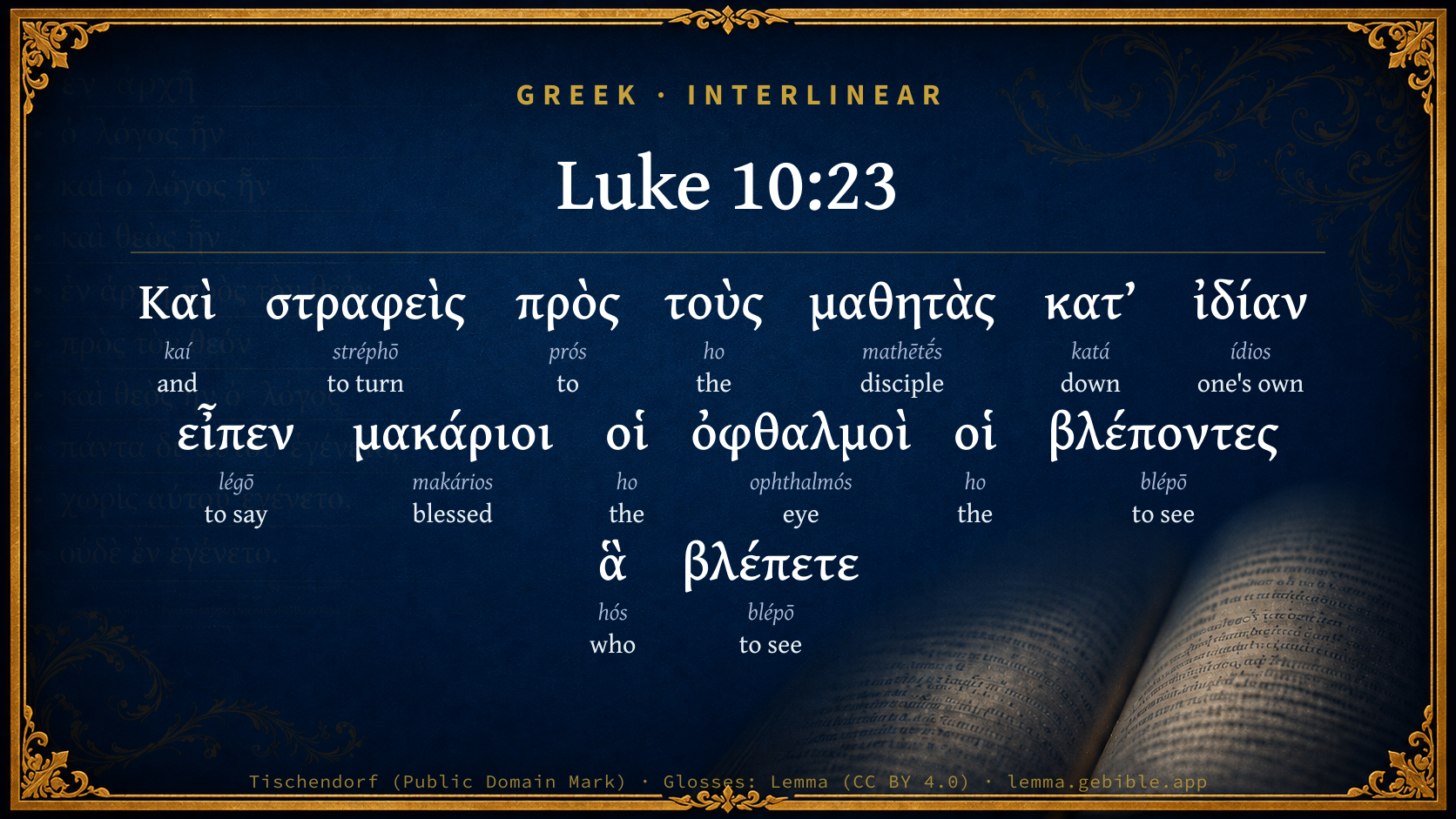
  1. Καὶ kaí G2532 “and” Conjunction
  2. πρὸς prós G4314 “to” Preposition
  3. τοὺς ho G3588 “the” Article, Accusative, Plural, Masculine
  4. μαθητὰς mathētḗs G3101 “disciple” Noun, Accusative, Plural, Masculine
  5. κατ’ katá G2596 “down” Preposition
  6. ἰδίαν ídios G2398 “one's own” Adjective, Accusative, Singular, Feminine
  7. εἶπεν légō G3004 “to say” Verb, Aorist, Active, Indicative, 3rd person, Singular
  8. μακάριοι makários G3107 “blessed” Adjective, Nominative, Plural, Masculine
  9. οἱ ho G3588 “the” Article, Nominative, Plural, Masculine
  10. ὀφθαλμοὶ ophthalmós G3788 “eye” Noun, Nominative, Plural, Masculine
  11. οἱ ho G3588 “the” Article, Nominative, Plural, Masculine
  12. βλέποντες blépō G991 “to see” Verb, Present, Active, Participle, Nominative, Plural, Masculine
  13. ἃ hós G3739 “who” Relative pronoun, Accusative, Plural, Neuter
  14. βλέπετε blépō G991 “to see” Verb, Present, Active, Indicative, 2nd person, Plural

About this verse

These counts appear in no published source. They are computed here, from the morphology-tagged text and Lemma’s own curated glosses. What Lemma adds →

15
words
12
distinct lemmas
Gospels
section

Notable vocabulary

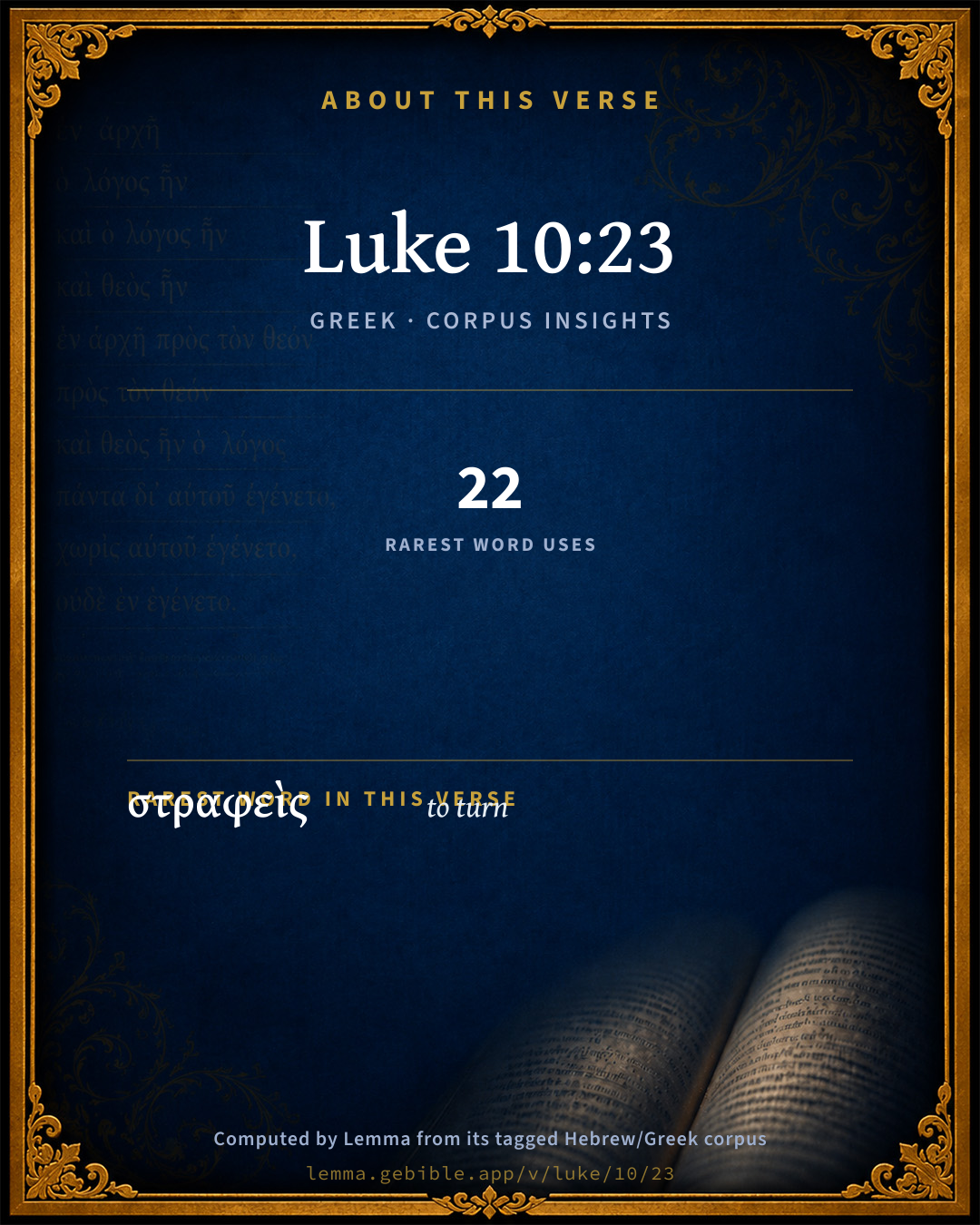
The rarest word here is στραφεὶς to turn G4762 — appearing just 22 times in the whole Greek New Testament.

Shared distinctive vocabulary

στραφεὶς to turn G4762 occurs in 22 verses of the Greek New Testament. Also found in:

Repetition

Words recur within this verse:

  • βλέποντες to see G991 ×2
  • τοὺς the G3588 ×3

Cross-references

1

Topical passages linked to Luke 10:23 in the Treasury of Scripture Knowledge — connected by theme and wording, ordered by reader-vote popularity; previews shown in the World English Bible.

  • Matthew 13:16–17 "But blessed are your eyes, for they see; and your ears, for they hear.

Cross-references courtesy of OpenBible.info (CC BY 4.0).

Commentary

Notes on Luke 10:23 from classic Christian and Jewish commentators (each source and its license shown beneath its notes). The classic Christian expositions comment on the surrounding passage and are grouped to its opening verse, so a note may address several verses; the Jewish commentaries on the Tanakh (Rashi and others) are per-verse, so they appear only where the commentator wrote on this verse.

Lemma curates 59 commentaries, every one of them public domain or Creative Commons licensed, each selected and text-cleaned for this edition rather than reprinted as found. About our sources →

The Biblical Illustrator

Joseph S. Exell

Luk_10:23-24

Blessed are the eyes which see the things that ye see

The gospel privileges

I.

THE THINGS HERE SPOKEN OF. The blessings of Christs revelation.

II. TO WHOM THEY WERE DEVISED. Not only to the great, but to the good. Not merely to the mighty kings of Nineveh, Assyria, Babylon, Egypt, Greece, and Rome, but to the holy and righteous--to Moses, to David, to Elijah.

III. To WHOM THEY WERE REVEALED. To the poor, despised, illiterate; to fishermen on the Galilean sea; to the sisters at Bethany; and, following in their train, to us at the present, whatever our character or position.

IV. THE OVERWHELMING PRIVILEGE WE ENJOY. More favoured than kings; more honoured than prophets; higher in the scale than all who have gone before.

V. THE HEIGHT OF OUR RESPONSIBILITY. If the prophets scarcely were saved, how shall it be with the present generation, if they neglect the privileges they enjoy? (The Preachers Analyst.)

Difference between the patriarchal, Jewish, and Christian dispensations

It is a common, but very just observation, that we are seldom dulysensible of the value of our blessings till we are deprived of them. This remark is applicable to our case, under the Christian dispensation. How few persons bless God that they dwell in the days of the Son of Man! The way to know how much we are distinguished, is, carefully to compare our situation with that of our fellow-creatures.

I. Let us survey the state of the HEATHEN WORLD. Place yourself, for a moment, amongst them, and consider what would then be your situation with respect to knowledge and virtue.

1. As to knowledge--everything among the heathens was obscure and uncertain.

2. In the heathen world also vice dreadfully prevailed. And what authority was there to check its prevalence? What principles strong enough to enable men to resist it? Their worship was base and degrading, offered in general to idols representing beings who were described as the patrons of corruption.

II. But let us turn our eyes from the state of the heathens, to the fairer view of those who were in some measure enlightened by Divine knowledge. To speak first of the PATRIARCHAL DISPENSATION--One great instance of its inferiority was its want of clear and sufficient authority. Probably the laws and observances enjoined by it were first communicated by God to Adam, and transmitted by him to his children. Now it is easy to see that such a religion would become more and more obscure, imperfect, and corrupt in every succeeding generation. Many things would be forgotten, many misunderstood, many improperly added. On the Mosaic DISPENSATION we now proceed to offer a few remarks. It may be considered as having been inferior to the Christian in the following particulars.

1. It was chiefly composed of types and shadows, of forms and ceremonies.

2. The Jewish dispensation abounded with severe and burdensome impositions.

3. The Mosaic dispensation is inferior to the Christian, inasmuch as the latter is founded upon better promises--better, as being of a more sublime and excellent nature, as being promises of spiritual and eternal things; such as grace, pardon, peace, and eternal life.

4. Another remarkable circumstance, in which the superiority of our dispensation consists, is, the larger and more abundant communication of the Holy Spirit.

5. Further: The Christian dispensation excels the Mosaic in the manner of its establishment.

6. The Christian dispensation is superior to the Jewish, in respect to the spirit of its institution. The spirit of the gospel is a spirit of liberty. (John Venn, M. A.)

National privileges

This is a noble text, and yet an awful one, for if it does not increase our godliness, it will certainly increase our condemnation. It tells us that we, even the meanest amongst us, are more favoured by God than the kings, and judges, and conquerors of the old world; that we have more light and knowledge of God than even the prophets David, Isaiah, Jeremiah, and Ezekiel, to whom Gods glory appeared in visible shape. It tells us that we see things which they longed to see and could not; that words are spoken to us for which their ears longed in vain; that they, though they died in hope, yet received not the promises, God having provided some better things for us, that they without us should not be made perfect.

1. Now, what was this which they longed for, and had not, and yet we have? It is this--a Saviour and a Saviours kingdom. All wise and holy hearts for ages--as well heathen as Jews--had has this longing. They wanted a Saviour--one who should free them from sin and conquer evil. They longed for a heavenly kingdom also. They saw that men got worse and worse as time rolled on, and that all the laws in the world could never make them good. They longed for a kingdom of God, a golden age, a regeneration of the world, as they called it, and rightly.

2. And now this kingdom is come, and the King of it, the Saviour of men, is Jesus Christ, the Son of God. Long men prayed, and long men waited, and at last, in the fulness of Gods good time, just when the night seemed darkest, and, under the abominations of the Roman Empire, religion, honesty, and common decency seemed to have died out, the Sun of

Righteousness rose on the dead and rotten world, to bring life and immortality to light.

3. And that we might not doubt that we too belonged to this kingdom, God has placed in this land His ministers and teachers, Christs Sacraments, Christs Churches, Christs Bible; that from our cradle to our grave we might see that we belonged, as sworn servants and faithful children, to the great Father in heaven and Jesus Christ, the King of the earth.

4. Thus, all that all men have longed for we possess; we want no more, and we shall have no more. If, under the present state of things, we cannot be holy, we shall never be holy. Blessed indeed are the eyes which see what you see, and hear what you bear; prophets and kings have desired to see and hear them, and have not seen or heard 1 But if you, cradled among all these despised honours and means of grace, bring forth no fruit in your lives--shut out from yourselves the thought of your high calling in Christ Jesus, what shall be your end but ruin? He that despises Christ, Christ will despise him. And say not to yourselves as many do, We are church-goers--we are all safe. I say to you, God is able, from among the negro and the savage--aye, God is able of these stones to raise up children, while those of you, the children of the kingdom, who lived in the Church of your fathers, and never used or loved her or Christ her King, shall be cast into outer darkness, where shall be weeping and gnashing of teeth. (Charles Kingsley.)

Vainly they tried the deeps to sound

Even of their own prophetic thought,

When of Christ crucified and crowned

His Spirit in them taught:

But He their aching gaze repressed

Which sought behind the veil to see,

For not without us fully blessed

Or perfect might they be.

The rays of the Almightys face

No sinners eye might then receive;

Only the meekest man found grace

To see His skirts and live.

But we as in a glass espy

The glory of His countenance,

Not in a whirlwind hurrying by

The two presumptuous glance.

But with mild radiance every hour

From our dear Saviours face benign

Bent on us with transforming power,

Till we, too, faintly shine.

Sprinkled with His atoning blood

Safely before our God we stand,

As on the rock the prophet stood,

Beneath His shadowing hand.

Blessed eyes which see the things we see!

And yet this tree of life hath proved

To many a soul a poison-tree,

Beheld, and not beloved.

(John Keble.)

Our privileges

The privileges here referred to. What are the things we see and hear? Many answers might be given. We might tell of the progress of science, commerce, civilization--progress that is stupendous, amazing; and there is nothing of all this but has its value. But these are not the things that make us blessed. What are they? An Infant, cradled in a manger, shepherds and wise men bowing near--a meek and lowly Man, standing in the midst of a crowd, teaching and healing, while mockery and hatred look on--a Sufferer stretched upon a cross, His visage marred more than any man, and His form more than the sons of men--an opening sepulchre, and a figure rising, ascending, received up into glory--these are the things we see. Meanwhile, we hear the song of angels, proclaiming the birth of Messiah, and foretelling His glory--we hear the sweeter voice of Messiahs self, when gracious words proceed out of His mouth. Such are the things we see and hear: all of them, you perceive, referring to Christ--His Incarnation, Teaching, Life, Death, and Resurrection. And this isthe gospel! In this God reveals His purposes of mercy. Such is the gospel as we receive it--more complete than when our Lord spake the words of the text to His disciples. The position of ancient saints with regard to these privileges. Many prophets and righteous men have desired, etc. The fact here stated is two-fold: they had the desire--but it remained ungratified.

Take some passages by way of illustration. Christ says of Abraham: He rejoiced to see My day: and he saw it--that is, he exulted with the desire to see, and, by lively faith, clearly pictured it forth. Hero then is a specimen of the position of the patriarchs--Just as Moses climbed Mount Pisgah, and looked on Canaan, though he never crossed the Jordan: so Abraham climbed the mount of faith, and descried the distant scenes of our Lords life. How natural was the desire! The man who has taken an earnest part in some great undertaking naturally longs to see it accomplished. They desired to see the things that we see, and to hear the things that we hear. And yet--their desire remained ungratified. In this there is much that is instructive.

1. See the calm steady procession of the purposes of God! He has appointed a time for everything and nothing can derange His plan.

2. See the trial He gives His peoples faith! It is so still, is it not? How many of our hearts desires He denies us now. The faith of the ancient saints was tried--and strengthened by trial; and thus they became strong in faith, giving glory to God.

3. Brethren, let us prize our privileges. Here they are, in rich abundance; yet how often are we dull and cold in the midst of them all!

4. Impenitent man--beware! You, too, are surrounded by privileges. Isaiah, David, Daniel never saw what you see.

5. Some are coming after us, who will know more than we do. When we pass away, others will arise; and in regard to position, we are to them as the prophets were to us.

6. But those who have gone before--have not they, too, outstripped us? Think--what do they see and hear? We cannot tell!

7. O happy time when the whole Church shall be complete in glory! (F. Tucker.)

The Biblical Illustrator, edited by Joseph S. Exell (c. 1880s–1900s) — public domain. Text from a community e-Sword module.

Tyndale Open Study Notes

Tyndale Open Resources

10:23 that see what you have seen: The disciples witnessed the arrival of God’s promised salvation, the inauguration of the Kingdom of God.

Tyndale Open Study Notes — © Tyndale Open Resources, licensed CC BY-SA 4.0. Text via the HelloAO Bible API.

Bengel's Gnomon

Johann Albrecht Bengel

Luk 10:23. Καὶ στραφεὶς, and having turned) Luke is wont accurately to note the pauses and turns in the Lord’s discourses. Jesus had prayed to the Father: after that, He had spoken concerning the Father: now He directs His discourse to the disciples apart.

Bengel's Gnomon of the New Testament — English translation (T&T Clark, Edinburgh, 1860) — public domain. Text from a community e-Sword module.

Meyer's Critical & Exegetical Commentary

Heinrich August Wilhelm Meyer

Luk_10:23-24. See on Mat_13:16 f., where the historical connection is quite different. But the significant beatitude may have been spoken on different occasions, especially with a different reference of meaning (as here in particular βλέπειν has a different sense from what it has in Matthew).

καὶ στραφεὶς κ.τ.λ.] Here we have a further step in the narrative (comp. Luk_10:22), which is marked by κατʼ ἰδίαν, to be taken along with στραφείς. This turning, which excluded the others who were present (see Luk_10:25), is to be regarded as perceptible by the movement and gesture of the speaker. Lucas accurate notare solet pausas et flexus sermonum Domini, Bengel. Consequently the reproach of inappropriateness, occasioned by the omission of δεῦτε πρός με πάντες (in Matthew), does not touch Luke (Holtzmann, p. 147; Weiss).

καὶ βασιλεῖς] peculiar to Luke. Think of David, Solomon, Hezekiah, and others.

ἰδεῖν … ἀκούετε] The point of the contrast varies: to see what ye see … and to hear what ye (actually) hear. Comp. on 2Co_11:29.

Meyer — Critical and Exegetical Commentary on the New Testament — English translation by Peter Christie, edited by Frederick Crombie (T&T Clark, 1880) — public domain. Text from a community e-Sword module.

Expositor's Greek Testament

ed. W. Robertson Nicoll

Luk 10:23 . στραφεὶς : a second impressive gesture, if that in Luk 10:22 be retained, implying that Jesus now more directly addresses the disciples. But the first στραφεὶς is altogether doubtful. εἶπε : the word, spoken κατʼ ἰδίαν to the disciples, is substantially = Mat 13:16 , there referring to the happiness conferred on the disciples in being privileged to hear their Master’s parabolic teaching. βασιλεῖς : in place of Mt.’s δίκαιοι , which expresses an idea more intelligible to Jews than to Gentiles.

The Expositor's Greek Testament, edited by W. Robertson Nicoll (1897–1910) — public domain. Text from a community e-Sword module.

Godet's Commentaries

Frédéric Louis Godet

Vers. 23 and 24. “And He turned Him unto His disciples, and said privately, Blessed are the eyes which see the things that ye see: 24 For I tell you, that many prophets and kings have desired to see those things which ye see, and have not seen them; and to hear those things which ye hear, and have not heard them.” Elevated as was the conception which the disciples had of the person and work of Jesus, they were far from appreciating at its full value the fact of His appearance, and the privilege of being the agents of such a Master. At this solemn hour Jesus seeks to open their eyes. But He cannot express Himself publicly on the subject. It is, as it were, in an undertone that He makes this revelation to them, Luk 10:23-24. This last sentence admirably finishes the piece. We find it in Matthew 13, applied to the new mode of teaching which Jesus had just employed by making use of the form of parables. The expression, those things which ye see, is incompatible with this application, which is thus swept away by the text of Matthew himself.

Luke here omits the beautiful passage with which Matthew (Mat 11:28-30) closes this discourse: “Come unto me...” If he had known such words, would he have omitted them? Is not this invitation in the most perfect harmony with the spirit of his Gospel? Holtzmann, who feels how much the theory of the employment of a common source is compromised by this omission, endeavours to explain it. He supposes that Luke, as a good Paulinist, must have taken offence at the word ταπεινός, humble, when applied to Christ, as well as at the terms yoke and burden, which recalled the Law too strongly. And it is in face of Luk 22:27, “I am among you as he that serveth...,” and of Luk 16:17, “It is easier for heaven and earth to pass, than one tittle of the law to fail...,” that such reasons are advanced! His extremity here drives Holtzmann to use one of those Tübingen processes which he himself combats throughout his whole book.

Modern criticism denies the historical character of this second mission. It is nothing more, Baur alleges, than an invention of Luke to lower the mission of the Twelve, and to exalt that of Paul and his assistants, of whom our seventy are provided as the precursors. With what satisfaction does not this Luke, who is silent as to the effects of the sending of the Twelve, describe those of the present mission! He goes the length of applying to the latter, and that designedly, part of the instructions which Jesus had given (Matthew 10) in regard to the former! Besides, the other Gospels nowhere mention those seventy evangelists whose mission Luke is pleased to relate! Holtzmann, who likewise denies the historical character of the narrative, does not, however, ascribe to Luke any deliberate fraud. The explanation of the matter is, according to him, a purely literary one. Of the two sources which Matthew and Luke consulted, the former—that is, the original Mark—recorded the sending of the Twelve with a few brief instructions, such as we have found in Luk 9:1-6 and Mar 6:7-13; the second, the Logia, contained the full and detailed discourse which Jesus must have delivered on the occasion, as we read it Matthew 10. The author of our first Gospel saw that the discourse of the Logia applied to the sending of the Twelve mentioned in the original Mark, and attached it thereto. Luke had not the same perspicacity. After having related the mission of the Twelve (Luk 9:1-6) after the proto-Mark, he found the great discourse in the Logia; and to get a suitable place for it, he thought that he must create a situation at his own hand. With this view, but without the least purpose of a dogmatic kind, he imagined a second mission, that of the seventy.

But if the origin of this narrative were as Baur supposes, how should only the Twelve reappear later in the Gospel of Luke (Luk 17:5, Luk 18:31), without ever a word more of those seventy? How should Luke in the Acts make no mention of those latter? Was it not easy and natural, after having invented them, to give them a part to play in the mission organized under Paul’s direction? An author does not lie in good earnest, only to forget thereafter to make use of his fraud. We have found that, as to the mission of the Twelve, Luke says at least (Luk 9:10), “And the apostles, when they were returned, told Him all that they had done” (remark the ὅσα, stronger than the simple ἅ); while Matthew, after the discourse, adds not a single word about the mission and its results! In short, the narrative of the sending of the seventy is so far from being a Paulinist invention, that in a work of the second century, proceeding from the sect most hostile to Paul, we find the following passage put in the mouth of Peter (Recognit. Clem. 1.24): “He first chose us twelve, whom He called apostles; then He chose seventy-two other disciples from among the most faithful.” The old historians have undoubtedly been somewhat arbitrary in numbering among those seventy many persons whom they designate as having formed part of them. But this false application proves nothing against the fact itself; on the contrary, it attests the impression which the Church had of its reality.

The opinion of Holtzmann would charge the sacred historian with an arbitrariness incompatible with the serious love of historical truth which is expressed, according to Holtzmann himself, in his introduction. Besides, we shall see (Luk 17:1-10) how entirely foreign such procedure was to the mind of Luke. When, finally, we consider the internal perfection of his whole narrative, the admirable correspondence between the emotions of our Lord and the historical event which gives rise to them, have we not a sufficient guarantee for the reality of this episode? As the account of the healing of the lunatic child is the masterpiece of Mark, this description of the sending of the seventy disciples is the pearl of Luke.

Frédéric Louis Godet — Commentaries on Luke, John, Romans, and 1 Corinthians — English translation (T&T Clark, Edinburgh, 1870s–1890s) — public domain. Text from a community e-Sword module.

Geneva Bible (1599)

Geneva Bible translators

The difference of the old Testament and the new consisteth in the measure of revelation.

Geneva Bible (1599) marginal notes — public domain. Text via Bolls.life.

Jamieson, Fausset & Brown

Robert Jamieson, A. R. Fausset & David Brown

(See on Mat 13:16-17).

Jamieson, Fausset & Brown — Commentary Critical and Explanatory on the Whole Bible (1871) — public domain (CC PDM 1.0). Text via the HelloAO Bible API.

Adam Clarke's Commentary

Verse 23. Blessed are the eyes which see the things that ye see] There is a similar saying to this among the rabbins, in Sohar. Genes., where it is said, "Blessed is that generation which the earth shall bear, when the King Messiah cometh."

Adam Clarke's Commentary on the Bible (1810–1826) — public domain. Text from a community e-Sword/MySword module.

Ellicott's Commentary for English Readers

(23-24) Blessed are the eyes which see the things that ye see . . .—Another instance of repeated words, St. Matthew reporting them as spoken after the parable of the Sower (Mat_13:16. See Note on that verse).

A Bible Commentary for English Readers, edited by Charles John Ellicott (1878–1897) — public domain. Text from a community e-Sword module.

The Cambridge Bible for Schools and Colleges

gen. ed. J. J. S. Perowne

23. Blessed are the eyes] Comp. Mat_13:16.

The Cambridge Bible for Schools and Colleges (gen. ed. J. J. S. Perowne; Cambridge University Press, 1878–1918) — public domain. Text from a community e-Sword module.

John Gill's Exposition

And he turned him unto his disciples,.... Both to the twelve apostles, and seventy disciples;

and said privately; or to them apart: the phrase "privately" is wanting in the Vulgate Latin version:

blessed are the eyes that see the things that ye see; the person of the Messiah, his kingdom setting up in the world, miracles wrought by him, and Satan falling before him; See Gill on Mat 13:16.

John Gill's Exposition of the Whole Bible (1746–1763) — public domain (CC PDM 1.0). Text via the HelloAO Bible API.

Trapp's Complete Commentary

John Trapp

23 And he turned him unto his disciples, and said privately, Blessed are the eyes which see the things that ye see:

Ver. 23. Blessed are the eyes, &c.] How blessed, then, are they that hear this arch-prophet in heaven. Moses and Elias, conversing with Christ on the mount, could much better discourse about his decease, and other divine doctrines, than ever they could while here upon earth. An infant of one day there is much beyond the deepest doctor here.

John Trapp, A Commentary or Exposition upon All the Books of the Old and New Testament (1647–1656) — public domain. Text from a community e-Sword module.

Albert Barnes' Notes on the Bible

See the notes at Mat 13:16-17.

Albert Barnes' Notes on the Bible (1834–1885) — public domain. Text from a community e-Sword/MySword module.

Matthew Poole's English Annotations

See Poole on "Mat 13:16", and See Poole on "Mat 13:17".

Matthew Poole's English Annotations on the Holy Bible (1683–1685) — public domain. Text from a community e-Sword/MySword module.

Whedon's Commentary on the Bible

Daniel D. Whedon

23. Privately—To congratulate them particularly on the blessedness of the Gospel revelation to them in connection with the Seventy. These scenes are unknown and unappreciated by the great ones of the day; but the holier spirits of past ages had, and the unborn spirits of future ages will have, their eyes fixed on them. There was for the former a Christ in prophecy, for whose form they had looked with anxious expectation; and there is a Christ in history for the latter, on whom the best thinkers look back with wonder.

Daniel D. Whedon (gen. ed.), Commentary on the Old and New Testaments (1874–1909) — public domain. Text from a community e-Sword module.

The Pulpit Commentary

Vers. 23, 24. And he turned him unto his disciples, and said privately, Blessed are the eyes which see the things that ye see: for I tell you, that many prophets and kings have desired to see those things which ye see. Alluding, especially, to such prophets and their words as Balaam (in Num_24:17) and Jacob. (in Gen_49:18) Keble has a quaint verse here, striking, as is usual with him, the central truth "Save that each little voice in turn Some glorious truth proclaims; What sages would have died to learn, Now taught by cottage dames.

These last words, the evangelist expressly says, were spoken privately. In fact, such a statement could only have been addressed to the inner circle to those men (not exclusively the twelve) who had been much under the immediate influence of the Lord"s teaching about himself. Gradually their sense as to who and what he was becoming more acute. Glimpses of his Divinity ever and anon flashed before their eyes. But, to the last, their faith was very weak and wavering. Such words as these, after what had gone before, must have sunk deep into many of the listeners" hearts.

Vers. 23, 24. Apostolic advantage and disadvantage.

Our Lord compares the position of his apostles with that of the great and enviable of past times. We may follow his thought and may also pursue the same line of comparison in our own times. We look at their position

I As RELATED TO DISTINGUISHED MEN BEFORE THE ADVENT.

1. It was one of some disadvantage; they were men in a very much humbler position than many of the great in past days. Great kings had lived in a social state and with pleasant surroundings to which they could lay no claim; in society they were nowhere; of this world"s luxuries and trappings they had nothing. Moreover, they were in a much less powerful position than some of the great men that had gone. Prophets had made or unmade kings; or they had delivered laws or changed customs, materially affecting the civil, social, moral, and religious life of the nation; witness Moses, Samuel, Elijah, Elisha, Nehemiah, John. The apostles of our Lord were not doing anything of this kind when he spoke to them; they had done very little of a public character thus far; their influence had not been felt in the life of their countrymen.

2. It was one of glorious advantage in one respect. They had the most distinguished honor of being the personal attendants upon the Messiah himself. They not only saw his face and heard his words, but they ministered to his wants; they rendered him service; and, by rendering him service, they contributed largely and importantly to the well-being of all later generations.

3. It was one of greater honor than they themselves supposed; for he at whose feet they sat and of whose truth they drank was One very much higher than they imagined even their Messiah would be; and he wrought a greater good for a larger world than they conceived it possible even for the Anointed of God to work.

II AS RELATED TO OURSELVES.

1. Their position was one of supreme privilege in one great particular they attended upon and they served Jesus Christ himself, in his own Person. That was an honor which stands by itself; it is unique; of its kind it is unapproachable. Let any disciple of the later time reach any imaginable position; he must feel that in actually ministering to our Lord, supplying his necessities, being sympathetically as well as bodily present "with him in his trials," helping him in his supreme and critical work, the apostles of our Lord stand pre-eminent.

2. And in being the.first to publish the gospel after our Lord"s ascension they also stand in the very front rank.

3. It was also a very distinct advantage to receive Christian truth direct, without intervening media, with nothing to subtract from it or to add to it; they had truth at the fountain source, uncorrupted by the channels through which it passed.

4. But they were subject to some disadvantage also.

(1) Jesus Christ was not, in his Divine Person, so fully revealed to them as he has been to us; that would have made free and full fellowship utterly impossible.

(2) His doctrine was not as complete at the time of our text as it afterwards became; for his death, resurrection, and ascension constitute a very large part of Christian truth.

(3) They had not the advantage of Christian experience we possess. All the thoughts of wise Christian thinkers during many centuries; all the recorded experience of multitudes of Christian lives; all the moral and spiritual workings and triumphs of Christian truth and principle under many skies and through many ages; these are ours as they were not theirs. Our privilege, even as compared with theirs, is very great indeed. Perchance our Lord would tell us, if he spake to us to-day, that it is as great as theirs, and that our responsibility answers to our privilege. C.

The Pulpit Commentary (1880–1919), ed. H.D.M. Spence-Jones & Joseph S. Exell — public domain. Text from a community e-Sword module.

John Wesley's Explanatory Notes

Matt. xiii, 16.

John Wesley, Explanatory Notes Upon the Whole Bible (1754–1765) — public domain. Text via the GEBible commentary corpus.

Kretzmann's Popular Commentary

Paul E. Kretzmann

The Good Samaritan.

The blessedness of Christ’s disciples:

v. 23. And He turned Him unto His disciples, and said privately, Blessed are the eyes which see the things that ye see.

v. 24. For I tell you that many prophets and kings have desired to see those things which ye see, and have not seen them; and to hear those things which ye hear, and have not heard them.

The disciples were not conscious of their great privilege, nor did they value it as highly as they should have. Jesus, therefore, addresses Himself to them alone and impresses upon them the glories of their station and of their calling as disciples and believers. Happy were their eyes since they were privileged to see Jesus, the Savior of the world, in the flesh. Many prophets and kings of the Old Testament had looked forward to the appearance of the Messiah with great longing, Gen 49:18; 2Sa 7:12. There had been many a Simeon and many an Anna that were longing to see the Savior with their own eyes. All this had fallen to the lot of the disciples without their seeking. They saw the eternal Word who was made flesh; they saw His glory, the glory as of the Only-Begotten of the Father, full of grace and truth; they heard from His own mouth the Word of eternal life. We Christians of the New Testament do not share the disadvantages of the believers of old. For though we are not able to see Jesus in the flesh, we have Him with us always, until the end of the world, Mat 28:20. And He is with us in His Word, in and through which we have communion with the Son and with the Father. "As though He would say: Now is a blessed time, a pleasant year, a time of mercy; the thing which now is present is so precious that the eyes which see it are fittingly called blessed. For till now the Gospel had not been preached so openly and clearly before everybody; the Holy Ghost had not been given openly, but was still hidden, and had little success. But Christ began the work of the Holy Ghost, and the apostles afterward carried it on with all earnestness; therefore He here in general calls those blessed that see and hear such grace."

Paul E. Kretzmann, Popular Commentary of the Bible (1921–1924) — public domain. Text from a community e-Sword module.

Burkitt's Expository Notes on the New Testament

William Burkitt

From the very first giving out of the promise of Christ to Adam after the fall, Gen 3:15 There was in all good men a longing desire and expectation to see that person who should be so great a blessing to mankind. Prophets and kings desired to see the promised Messiah.

Now, says our Saviour to his disciples, Blessed are you, for you have seen with the eyes of your body what others only saw with the eyes of their mind; with your bodily eyes you have seen the promised Messiah coming in the flesh, and also the miracles to confirm you that I am he, have been wrought before your eyes; therefore blessed are the eyes of your body, which have beheld me corporally; and blessed also are the eyes of your mind, which have beheld me spiritually. A sight of Christ by a believing eye, much more by a glorified eye, is a blessed sight. Blessed are those eyes which see Christ in his dispensations of glory hereafter.

William Burkitt's Expository Notes on the New Testament (1700–1703) — public domain. Text from a community e-Sword module.

The People's New Testament

B. W. Johnson

23, 24. See notes on Matt. 13:16, 17. A similar occasion calls for the same language here recorded.

B. W. Johnson's The People's New Testament with Notes (1889–1891) — public domain. Electronic text from the Christian Classics Ethereal Library (CCEL) ThML edition.

unfoldingWord translationNotes

Door43 World Missions Community

Then he turned around to the disciples and said privately

The word "privately" indicates that he was alone with his disciples. AT: "Later, when he was alone with his disciples, he turned to them and said" (See: Assumed Knowledge and Implicit Information)

Blessed are those who see the things that you see

This probably refers to the good works and miracles that Jesus was doing. AT: "How good it is for those who see the things that you see me doing" (See: Assumed Knowledge and Implicit Information)

and they did not see them

This implies that Jesus was not yet doing those things. AT: "but could not see them because I was not doing them yet" (See: Assumed Knowledge and Implicit Information)

the things that you hear

This probably refers to the teaching of Jesus. AT: "the things that you have heard me say" (See: Assumed Knowledge and Implicit Information)

and they did not hear them

This implies that Jesus was not yet teaching. AT: "but could not hear them because I had not yet started to teach" (See: Assumed Knowledge and Implicit Information)

translationWords

disciple

bless

prophet

king

unfoldingWord translationNotes — © Distant Shores Media and the Door43 World Missions Community, licensed CC BY-SA 4.0. Source: git.door43.org/Door43/en_tn.

Cambridge Greek Testament for Schools and Colleges

23. μακάριοι οἱ ὀφθαλμοί. Comp. Mat 13:16.

Cambridge Greek Testament for Schools and Colleges (Cambridge University Press, 1896; 21 vols, various authors incl. Carr, Maclear, Plummer, Farrar, Lumby, Moule, M. R. James, Simcox) — public domain. Text from a community e-Sword module.

Alford’s Greek Testament

Henry Alford

23.] This verse should not be marked off from ver. 22 by a new paragraph, as is done in the E. V.: much less, as in the Gospel for the 13th Sunday after Trinity, joined with what follows: except perhaps that the lesson taught us by its occurring there is an appropriate one, as shewing us how the grace of Christian love, which is the subject of the following parable, fulfils and abounds over, legal obedience. It is in connexion with the preceding, and comes as the conclusion after the thanksgiving in ver. 21. A similar saying of our Lord occurs Mat 13:16, Mat 13:17, but uttered altogether on a different occasion and in a different connexion.

Henry Alford, The Greek Testament (1849–1861) — public domain. Text from a community e-Sword module.

International Critical Commentary

23, 24. In Mat 13:16, Mat 13:17 this saying, with some slight differences, occurs in quite another connexion, viz. after the explanation of the reason to Christ’s speaking in parables. If the words were uttered only once, Lk. appears to give the actual position. The κατʼ ἰδίαν seems to imply some interval between vv. 22 and 23. Christ’s thanksgiving seems to have been uttered publicly, in the place where the returning Seventy met Him.

23. ἃ βλέπετε . The absence of ὑμεῖς is remarkable. Contrast ὑμῶν δὲ μακάριοι οἰ ὀφθαλμοί (Mat 13:16). Lk. has no equivalent to καὶ τὰ ὦτα [ὑμῶν] ὅτι ἀκούουσιν. Comp. μακάριοι οἰ γινόμενοι ἐν ταῖς ἡμέραις ἐκείναις ἰδεῖν τὰ ἀγαθά (Ps. Sol. 17:50, 18:7).

International Critical Commentary — older volumes (1896–1929), various authors — public domain. Text from a community e-Sword module.

Lesson kit

Teaching starters — assembled from the data on this page, not authored interpretation. Every prompt links to the verse data it draws on. Edit before teaching.

Luke, in the Gospels, opens this verse with 15 words (12 distinct Greek lemmas). Its most distinctive word is stréphō (“to turn”). A historical commentator’s framing appears above. Read the whole chapter for the surrounding context.

Discussion questions

  1. The word stréphō carries the sense “to turn.” How does it shape the verse?
  2. How does Matthew 5:39, which shares the word «to turn», read alongside this verse?
  3. What does the repetition of “to see” (2× in this one verse) do in this verse?
  4. The translations on this page render this verse differently — a whole-verse word diff, not a word-by-word alignment. What might account for the different wordings?
  5. Compare how The Biblical Illustrator and Tyndale Open Study Notes read this verse. Where do they agree or differ?

Things to notice

  • These translations choose different wording for 9 words in this verse.
  • “to see” occurs 2× in this single verse.
  • 12 distinct Greek lemmas span 15 words in this verse.

Reading settings

Reading text

Shown beneath each verse's original-language words.

Old Testament
Old Testament edition

Read the OT as the Masoretic Hebrew (MT) or the Greek Septuagint (LXX).

English shown for the Greek Septuagint (in the Hebrew ↔ Greek comparison).

Comparing translations? Open the Compare panel on any verse page to stack up to four side by side.