Luke 11:39

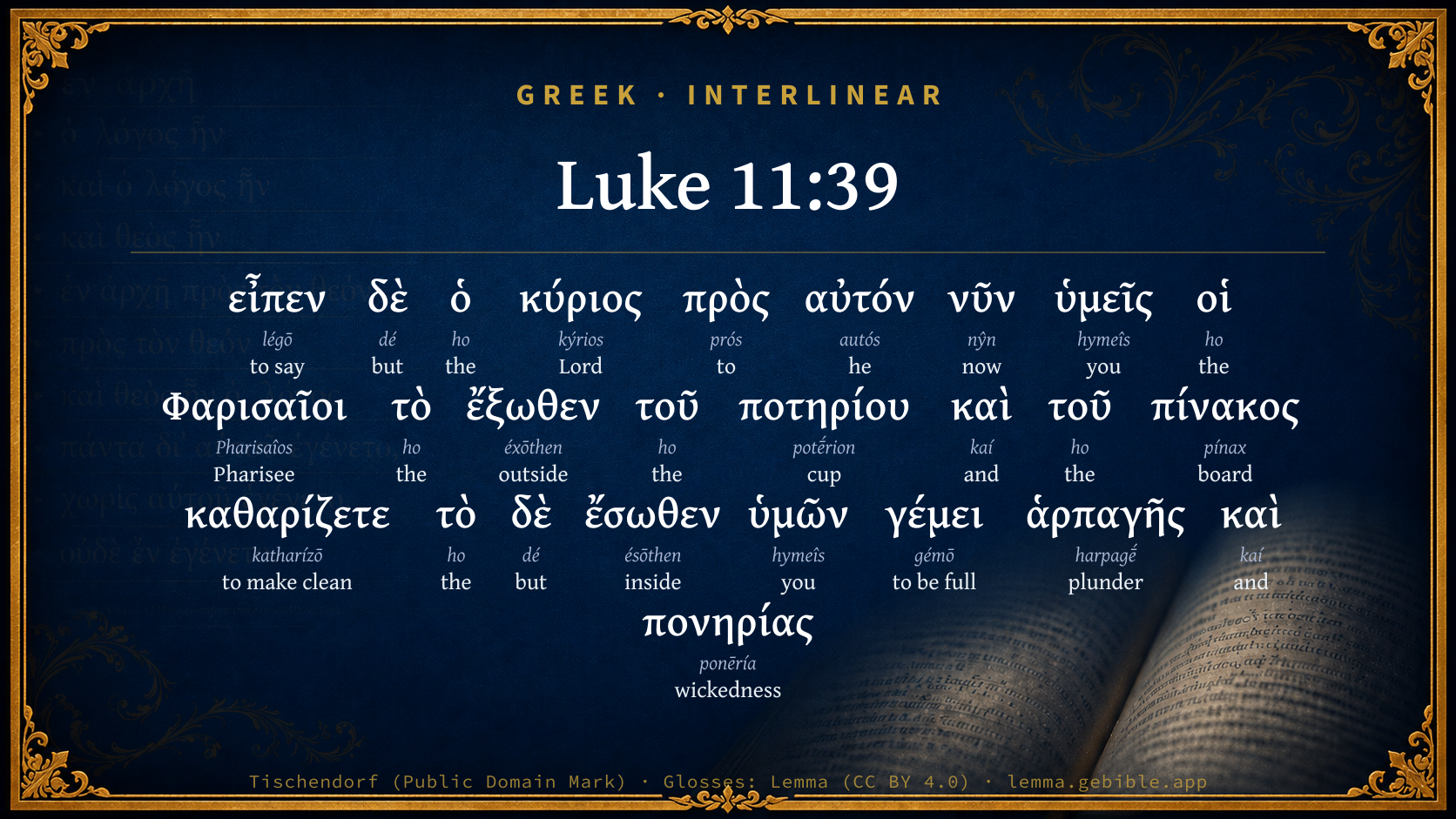
Greek (Tischendorf 8th ed.) Luke 11:39 appears in the Greek New Testament. The text above is from the Tischendorf 8th edition. Each word links to its Strong’s number and a concise gloss. Click any word for its full Thayer’s Greek Lexicon entry.
Download image
Cite this verse

Luke 11:39 (World English Bible). Public Domain. Lemma interlinear Bible study tool, https://lemma.gebible.app/v/luke/11/39.

Show BibTeX & RIS
BibTeX
RIS
English Translation
The Lord said to him, "Now you Pharisees cleanse the outside of the cup and of the platter, but your inward part is full of extortion and wickedness.
World English Bible · Public Domain
Download a study sheet

One document with this verse’s original text, its word-by-word gloss line, the meaning frame, cross-references with their text, attributed commentary, and full source and license credits — printable, and it pastes into notes with its structure intact.

This verse Autodidact and up

Study sheet (.html) Plain text (.txt)

A passage Seminary Student

Up to 50 verses in one chapter. A passage sheet keeps up to 6 commentary sources and 12 cross-references per verse, in the order this page ranks them, and says so on the sheet whenever that leaves anything out. Ask for a single verse and you get the Autodidact verse sheet above.

Everything on this page stays free to read, with no account — the sheet is a download of what is already on screen, not access to it.

Want to remove ads? Support Godless Engineer
Compare translations 3

The same verse in 3 English versions, stacked beneath the original-language interlinear above. Click any original word for its lexicon entry.

Each is an independent rendering of the whole verse — the interlinear is not word-aligned to these translations.

Highlighted words mark where these versions differ — a whole-verse word diff, not a word-by-word alignment.

  • World English Bible Public Domain
    The Lord said to him, "Now you Pharisees cleanse the outside of the cup and of the platter, but your inward part is full of extortion and wickedness.
  • King James Version Public Domain
    And the Lord said unto him, Now do ye Pharisees make clean the outside of the cup and the platter; but your inward part is full of ravening and wickedness.
  • unfoldingWord Literal Text CC BY-SA 4.0
    But the Lord said to him, “Now you Pharisees clean the outside of the cup and of the bowl, but the inside of you is full of greed and evil.

unfoldingWord Literal Text — © unfoldingWord, licensed CC BY-SA 4.0. Word-aligned USFM3 via Door43 (git.door43.org/unfoldingWord/en_ult).

Versions to compare (up to 4)

3 of 4 selected

Show all 19 translations

Every available English version of this verse, each an independent rendering of the whole verse.

  • World English Bible Public Domain
    The Lord said to him, "Now you Pharisees cleanse the outside of the cup and of the platter, but your inward part is full of extortion and wickedness.
  • Berean Standard Bible Public Domain
    “Now then,” said the Lord, “you Pharisees clean the outside of the cup and dish, but inside you are full of greed and wickedness.
  • Majority Standard Bible Public Domain
    Then the Lord said, “Now you Pharisees clean the outside of the cup and dish, but inside you are full of greed and wickedness.
  • King James Version Public Domain
    And the Lord said unto him, Now do ye Pharisees make clean the outside of the cup and the platter; but your inward part is full of ravening and wickedness.
  • American Standard Version (1901) Public Domain
    And the Lord said unto him, Now ye the Pharisees cleanse the outside of the cup and of the platter; but your inward part is full of extortion and wickedness.
  • Revised Version (1885) Public Domain
    And the Lord said unto him, Now do ye Pharisees cleanse the outside of the cup and of the platter; but your inward part is full of extortion and wickedness.
  • Geneva Bible (1599) Public Domain
    And the Lord saide to him, In deede yee Pharises make cleane the outside of the cuppe, and of the platter: but the inwarde part is full of rauening and wickednesse.
  • Douay-Rheims (1899) Public Domain
    And the Lord said to him: Now you Pharisees make clean the outside of the cup and of the platter; but your inside is full of rapine and iniquity.
  • Young's Literal Translation Public Domain
    And the Lord said unto him, `Now do ye, the Pharisees, the outside of the cup and of the plate make clean, but your inward part is full of rapine and wickedness;
  • Literal Standard Version CC BY-SA 4.0
    And the LORD said to him, “Now you, the Pharisees, make the outside of the cup and of the plate clean, but your inward part is full of robbery and wickedness.
  • Unlocked Literal Bible CC BY-SA 4.0
    But the Lord said to him, “Now then, you Pharisees clean the outside of cups and bowls, but the inside of you is filled with greed and evil.
  • unfoldingWord Literal Text CC BY-SA 4.0
    But the Lord said to him, “Now you Pharisees clean the outside of the cup and of the bowl, but the inside of you is full of greed and evil.
  • Darby Bible Public Domain
    But the Lord said to him, Now do ye Pharisees cleanse the outside of the cup and of the dish, but your inward [parts] are full of plunder and wickedness.
  • World Messianic Bible Public Domain
    The Lord said to him, “Now you Pharisees cleanse the outside of the cup and of the platter, but your inward part is full of extortion and wickedness.
  • Webster's Bible Public Domain
    And the Lord said to him, Now do ye Pharisees make clean the outside of the cup and the platter; but your inward part is full of ravening and wickedness.
  • Free Bible Version CC BY-SA 4.0
    So the Lord told him, “You Pharisees clean the outside of the cup and the dish, but inside you're full of greed and wickedness.
  • Bible in Basic English Public Domain
    And the Lord said to him, You Pharisees make the outside of the cup and the plate clean; but inside you are thieves and full of evil.
  • Text-Critical English NT CC BY 4.0
    So the Lord said to him, “You Pharisees clean the outside of the cup and the platter, but inside you are filled with thoughts of robbery and wickedness.
  • Tyndale New Testament (1534) Public Domain
    And the Lorde sayde to him: Now do the Pharises make clene the out side of the cup and of the platter: but youre inwarde parties are full of raveninge and wickednes.

Literal Standard Version (2020), Covenant Press — licensed CC BY-SA 4.0. Text via the HelloAO Bible API (eBible.org). Unlocked Literal Bible (unfoldingWord) — licensed CC BY-SA 4.0. Text via the HelloAO Bible API (eBible.org). unfoldingWord Literal Text — © unfoldingWord, licensed CC BY-SA 4.0. Word-aligned USFM3 via Door43 (git.door43.org/unfoldingWord/en_ult). Free Bible Version, Dr. Jonathan Gallagher — licensed CC BY-SA 4.0. Text via the HelloAO Bible API (eBible.org).

Word by word

More ways to search: Search by grammar → Find every occurrence → Compare this word →

Practice this passage: Drill this verse → Learn its vocabulary →

ἁρπαγῆς
harpagḗ
G724
“plunder”
Noun, Genitive, Singular, Feminine
Part of Speech
Noun
Case
Genitive
Number
Singular
Gender
Feminine
Full Thayer's Definition

Origin: from G726

TDNT: None

1. the act of plundering, robbery 2. plunder spoil
  1. εἶπεν légō G3004 “to say” Verb, Aorist, Active, Indicative, 3rd person, Singular
  2. δὲ dé G1161 “but” Conjunction
  3. ὁ ho G3588 “the” Article, Nominative, Singular, Masculine
  4. κύριος kýrios G2962 “Lord” Noun, Nominative, Singular, Masculine
  5. πρὸς prós G4314 “to” Preposition
  6. αὐτόν autós G846 “he” Personal pronoun, Accusative, Singular, Masculine
  7. νῦν nŷn G3568 “now” Adverb
  8. ὑμεῖς hymeîs G5210 “you” Personal pronoun, 2nd person, Nominative, Plural
  9. οἱ ho G3588 “the” Article, Nominative, Plural, Masculine
  10. Φαρισαῖοι Pharisaîos G5330 “Pharisee” Noun, Nominative, Plural, Masculine
  11. τὸ ho G3588 “the” Article, Accusative, Singular, Neuter
  12. ἔξωθεν éxōthen G1855 “outside” Adverb
  13. τοῦ ho G3588 “the” Article, Genitive, Singular, Neuter
  14. ποτηρίου potḗrion G4221 “cup” Noun, Genitive, Singular, Neuter
  15. καὶ kaí G2532 “and” Conjunction
  16. τοῦ ho G3588 “the” Article, Genitive, Singular, Masculine
  17. πίνακος pínax G4094 “board” Noun, Genitive, Singular, Masculine
  18. καθαρίζετε katharízō G2511 “to make clean” Verb, Present, Active, Indicative, 2nd person, Plural
  19. τὸ ho G3588 “the” Article, Nominative, Singular, Neuter
  20. δὲ dé G1161 “but” Conjunction
  21. ἔσωθεν ésōthen G2081 “inside” Adverb
  22. ὑμῶν hymeîs G5210 “you” Personal pronoun, 2nd person, Genitive, Plural
  23. γέμει gémō G1073 “to be full” Verb, Present, Active, Indicative, 3rd person, Singular
  24. καὶ kaí G2532 “and” Conjunction
  25. πονηρίας ponēría G4189 “wickedness” Noun, Genitive, Singular, Feminine

About this verse

These counts appear in no published source. They are computed here, from the morphology-tagged text and Lemma’s own curated glosses. What Lemma adds →

26
words
18
distinct lemmas
Gospels
section

Notable vocabulary

The rarest word here is ἁρπαγῆς plunder G724 — appearing just 3 times in the whole Greek New Testament.

Shared distinctive vocabulary

ἁρπαγῆς plunder G724 occurs in 3 verses of the Greek New Testament. Also found in:

Repetition

Words recur within this verse:

Cross-references

24

Topical passages linked to Luke 11:39 in the Treasury of Scripture Knowledge — connected by theme and wording, ordered by reader-vote popularity; previews shown in the World English Bible.

  • Titus 1:15 To the pure, all things are pure; but to those who are defiled and unbelieving, nothing is pure; but both their mind and their conscience are defiled.
  • Genesis 6:5 Yahweh saw that the wickedness of man was great in the earth, and that every imagination of the thoughts of his heart was only evil continually.
  • Proverbs 30:12 There is a generation that is pure in their own eyes, Yet are not washed from their filthiness.
  • Matthew 7:15 "Beware of false prophets, who come to you in sheep's clothing, but inwardly are ravening wolves.
  • Luke 16:15 He said to them, "You are those who justify yourselves in the sight of men, but God knows your hearts. For that which is exalted among men is an abomination in the sight of God.
  • Matthew 15:19 For out of the heart come forth evil thoughts, murders, adulteries, sexual sins, thefts, false testimony, and blasphemies.
  • Matthew 23:25–26 "Woe to you, scribes and Pharisees, hypocrites! For you clean the outside of the cup and of the platter, but within they are full of extortion and unrighteousness.
  • John 12:6 Now he said this, not because he cared for the poor, but because he was a thief, and having the money box, used to steal what was put into it.
  • Acts 5:3 But Peter said, "Ananias, why has Satan filled your heart to lie to the Holy Spirit, and to keep back part of the price of the land?
  • Acts 8:21–23 You have neither part nor lot in this matter, for your heart isn't right before God.
  • James 4:8 Draw near to God, and he will draw near to you. Cleanse your hands, you sinners; and purify your hearts, you double-minded.
  • 2 Chronicles 25:2 He did that which was right in the eyes of Yahweh, but not with a perfect heart.
  • 2 Chronicles 31:20–21 Thus did Hezekiah throughout all Judah; and he worked that which was good and right and faithful before Yahweh his God.
  • Psalms 22:13 They open their mouths wide against me, Lions tearing prey and roaring.
  • Proverbs 26:25 When his speech is charming, don't believe him; For there are seven abominations in his heart:
  • Jeremiah 4:14 Jerusalem, wash your heart from wickedness, that you may be saved. How long shall your evil thoughts lodge within you?
  • Ezekiel 22:25 There is a conspiracy of her prophets in the midst of it, like a roaring lion ravening the prey: they have devoured souls; they take treasure and precious things; they have made her widows many in the midst of it.
  • Ezekiel 22:27 Her princes in the midst of it are like wolves ravening the prey, to shed blood, [and] to destroy souls, that they may get dishonest gain.
  • Zephaniah 3:3 Her princes in the midst of her are roaring lions. Her judges are evening wolves. They leave nothing until the next day.
  • Matthew 12:33–35 "Either make the tree good, and its fruit good, or make the tree corrupt, and its fruit corrupt; for the tree is known by its fruit.
  • Luke 7:13 When the Lord saw her, he had compassion on her, and said to her, "Don't cry."
  • John 13:2 After supper, the devil having already put into the heart of Judas Iscariot, Simon's son, to betray him,
  • Galatians 1:14 I advanced in the Jews' religion beyond many of my own age among my countrymen, being more exceedingly zealous for the traditions of my fathers.
  • 2 Timothy 3:5 holding a form of godliness, but having denied the power thereof. Turn away from these, also.

Cross-references courtesy of OpenBible.info (CC BY 4.0).

Commentary

Notes on Luke 11:39 from classic Christian and Jewish commentators (each source and its license shown beneath its notes). The classic Christian expositions comment on the surrounding passage and are grouped to its opening verse, so a note may address several verses; the Jewish commentaries on the Tanakh (Rashi and others) are per-verse, so they appear only where the commentator wrote on this verse.

Lemma curates 59 commentaries, every one of them public domain or Creative Commons licensed, each selected and text-cleaned for this edition rather than reprinted as found. About our sources →

Matthew Poole's English Annotations

We have much the same, though delivered in another form, with a denunciation of a woe, See Poole on "Mat 23:25". We must not imagine that our Saviour here reflects upon the cleansing of vessels in which we put our meat and drink, for undoubtedly, as to them, the Pharisees washed both the inside and the outside. And the conceit of them is amiss who think that by the inward part, Luk 11:39, he means the meat in their dishes, which was gotten indeed by ravening, and wickedness, extortion, &c.; for it is a hard interpretation of the inward part of the platter, to say, by it is meant the meat in the platter; but neither doth our Saviour say, the inward part of the dish, but your inward part, by which he plainly means the soul. Our Saviour doth therefore certainly compare the Pharisees to dishes or platters washed or scoured only on the outside, and blames their hypocrisy in this, that they were mighty solicitous about an outside purity and cleanness, but for the inward purity of the heart and soul, they took no care at all about that; they were very scrupulous about undefiled hands, but nothing at all about having their souls and inward powers and affections undefiled. This he telleth them was most egregious folly, for God, that made the body, made the soul also, and therefore would exact a purity in the inward as well as the outward man, especially considering that he loveth truth in the inward parts.

Matthew Poole's English Annotations on the Holy Bible (1683–1685) — public domain. Text from a community e-Sword/MySword module.

Tyndale Open Study Notes

Tyndale Open Resources

11:39 The Pharisees had meticulous rules for ceremonially cleaning cups and utensils for religious purity. Jesus accused them of cleaning only the outside of the cup (following external rules) but leaving the inside . . . filthy (keeping unrighteousness in their hearts).

Tyndale Open Study Notes — © Tyndale Open Resources, licensed CC BY-SA 4.0. Text via the HelloAO Bible API.

Bengel's Gnomon

Johann Albrecht Bengel

Luk 11:39. [Εἶπε δὲ ὁ Κύριος, but the Lord said) Jesus spake these things which here follow in Galilee first, subsequently at Jerusalem (Mat 23:1-39). In Galilee He said, in this passage [Luk 11:49], “I will send [Future] Prophets and Apostles among them.” Then also at Jerusalem [Mat 23:34], He said, “Behold, I send” [Present]: To wit, in the intervening time He was come nearer to the actual sending of them.—Harm., p. 398.]—νῦν, now) The particle has the force of demonstrating a thing present: on this account the LXX. employ it for הנה, Behold, 2Ki 7:6; and in this passage it at the same time involves an antithesis between external purity and impurity; in the same way as nunc among the Latins has often the force of atqui.—τὸ ἔξωθεν) that which is exterior (the outside): for instance, the exterior of a very clean cup.—τὸ ἔσωθεν ὑμῶν) your interior (inner man), viz. your manner of life.—γέμει, is full) like a cup or dish. First, ἔξωθεν and ἔσωθεν are adverbs; then in Matthew, ch. Luk 23:25-26, it is the cup and the dish that are said to be full, γέμειν: in Luke it is “the inward part” itself of the Pharisees. The exterior of vessels is not only convex, but also concave [what is commonly, though not correctly, called the inside]: the interior is both the heart and the manner of life.[111] It makes no difference whether ἁρπαγὴ, rapine, be taken, in the material sense, for the thing carried off, or, in the formal sense, for rapaciousness. However, it is taken in the formal sense, inasmuch as in Matthew ἀκρασία or ἀδικία, intemperance or injustice, and in Luke πονηρία, malignity, wickedness, are added. It may be thus paraphrased: Ye Pharisees keep clean the part in the vessel which is exterior; but your interior is full of rapaciousness and malignity. Ye fools, did not He, who made the exterior thing, to wit, the vessel, at the same time also make the interior thing, namely, the heart? But as concerns those things which are in the vessel [which is but the exterior thing], give alms, and behold all things, your whole manner of life, are clean to you, whatever be the case as regards the vessel, whether it be more or less clean.

[111] Not what is commonly called the inside of a cup: τὸ ἔσωθεν, according to Beng., applies here only to the heart, and not to the cup figuratively.—ED. and TRANSL.

Bengel's Gnomon of the New Testament — English translation (T&T Clark, Edinburgh, 1860) — public domain. Text from a community e-Sword module.

Expositor's Greek Testament

ed. W. Robertson Nicoll

Luk 11:39 . ὁ Κύριος , once more this title in narrative. νῦν : variously taken as = igitur or = ecce , or as a strictly temporal particle = now “a silent contrast with a better πάλαι ” (Meyer). Hahn affirms that νῦν at the beginning of a sentence can mean nothing else than “now”. But Raphel, in support of the second of the above senses (“admirationem quandam declarat”), quotes from Arrian νῦν δύναταί τις ὠφελῆσαι καὶ ἄλλους , μὴ αὐτὸς ὠφελημένος ( Epict. , lib. iii., cap. 23, 1). Bengel cites 2Ki 7:6 , Sept [109] , where νῦν in the first position is the equivalent for הִנֵּה ( vide Sweet’s edition). Lo! ecce! seems best to suit the situation, which demands a lively emotional word. Godet happily renders: “Vous voilà bien! Je vous prends sur le fait.” πίνακος for Mt.’s παροψίδος (Luk 23:25 ). τὸ ἔσωθεν ὑμῶν , your inside, instead of the inside of the dishes in Mt. The idea is that the food they take into their bodies is the product of plunder and wickedness ( πονηρίας = ἀκρασίας , Mt.).

[109] Septuagint.

The Expositor's Greek Testament, edited by W. Robertson Nicoll (1897–1910) — public domain. Text from a community e-Sword module.

Jamieson, Fausset & Brown

Robert Jamieson, A. R. Fausset & David Brown

cup and platter--remarkable example of our Lord's way of drawing the most striking illustrations of great truths from the most familiar objects and incidents of life.

ravening--rapacity.

Jamieson, Fausset & Brown — Commentary Critical and Explanatory on the Whole Bible (1871) — public domain (CC PDM 1.0). Text via the HelloAO Bible API.

Adam Clarke's Commentary

Verse 39. Ye - make clean the outside] See Clarke on Mt 23:25.

Adam Clarke's Commentary on the Bible (1810–1826) — public domain. Text from a community e-Sword/MySword module.

Ellicott's Commentary for English Readers

(39) Now do ye Pharisees make clean the outside of the cup.—See Note on Mat_23:25. The verses that follow stand in the relation to the great discourse against the Pharisees in that chapter, as the Sermon on the Plain (Luke 6) does to the Sermon on the Mount. Here, too, we recognise another instance, not of a narrative misplaced, but of words actually repeated. All past experiences, all faults previously noted, were gathered at last into one great and terrible invective. We note, as an instance of independence, St. Luke’s use of a different Greek word for “platter,” viz., that which is elsewhere (Mat_14:8; Mat_14:11) better translated charger, the large central dish, as distinguished from the smaller “platter” or side-dish. For the “excess” of St. Matthew, St. Luke has the more generic “wickedness.” From one point of view the words are more startling here than in their context in St. Matthew. There they are spoken as in open conflict with a class, here they are addressed to an individual member of the class, and by One whom he had invited as a guest. It must be remembered, however, that there was a touch of supercilious scorn in all these invitations, still more, perhaps, in the looks and whispers in which the wonder in this instance showed itself; and the words point to secret sins which the Searcher of hearts knew, and which it was necessary to reprove.

A Bible Commentary for English Readers, edited by Charles John Ellicott (1878–1897) — public domain. Text from a community e-Sword module.

The Cambridge Bible for Schools and Colleges

gen. ed. J. J. S. Perowne

39. Now do ye Pharisees] Doubtless other circumstances besides the mere supercilious astonishment of the Pharisee led to the vehement rebuke. The eightfold woe in Matthew 23 is fuller than here. Jesus denounces their frivolous scrupulosity (39), combined with gross insincerity (42), their pride (43), and their corruption (44).

make clean the outside of the cup and the platter] Mar_7:4, “washing of cups, and pots, brazen vessels, and of tables.” On one occasion the Sadducees seeing them busied in washing the great Golden Candelabrum sneeringly observed that they would wash the Sun itself if they could get the opportunity.

your inward part is full of ravening and wickedness] i.e. of greed, and of the depravity which causes it. A slightly different turn of expression is given in Mat_23:25-26. See Excursus VI. on Sects of the Jews; and compare these denunciations with those delivered in the Temple on the last day (Tuesday in Passion Week) of the Lord’s public ministry, Mat_23:25-28. The early Christian heretics reflected the character of these Pharisees in their mixture of elaborate profession with real godlessness, Tit_1:15-16.

The Cambridge Bible for Schools and Colleges (gen. ed. J. J. S. Perowne; Cambridge University Press, 1878–1918) — public domain. Text from a community e-Sword module.

John Gill's Exposition

But rather give alms of such things as ye have,.... The phrase , is variously rendered, and so furnishes out various senses: the Syriac version renders it, "give that which is", which is yours; or "which is given to you", as the Persic version, and agrees with ours, "such things as ye have"; and which carries in it but a very odd sense; for none can give of that which they have not. The Vulgate Latin version reads, "that which is over and above"; superfluous substance, and which may be easily spared without hurting a man, or his family: others, "as much as you can": according to a man's ability, and as God has prospered him in the world. The Ethiopic version renders it, "that which is necessary"; which the necessities of the poor call for, and is right and proper to give them: and the Arabic version, very foreign from the sense of the phrase, reads, "before every thing"; above all things give alms. But the true sense of it is contained in the literal version of it, "things that are within"; that is, that are within the cup and the platter; give meat and drink to the poor, your platters and cups are full of, gotten by injustice and oppression. Some read it not imperatively, "give", but indicatively, "ye do give": you oppress and defraud men, devour widows' houses, and fill your own with the spoils of others; and then give out of your cups and platters drink to the thirsty, and meat to the hungry, to make atonement for your avarice and extortion:

and behold all things are clean unto you; that is, according to their own opinion, who fancied that alms deeds justified them in the sight of God, cleansed them from their sins, delivered them from hell, and gave them a title to eternal life; See Gill on Mat 6:1 for it can never be thought to be our Lord's meaning in earnest, that either their persons, or what they had, should be pure and clean unto them, by giving a part of their ill-gotten goods to the poor; but he speaks their sense, in an ironic way. From this opinion of theirs it is, that the Hebrew word, which signifies "to be clean", is used by them for giving alms: so it is said (y), that

"R. Jonathan and Resh Lekish went down to bathe themselves in the baths of Tiberias; and a certain poor man met them, and said unto them, , "give me alms"; they said unto him, when we come back we will , "give thee alms":''

and so the Mahometans call alms by the same name, because they imagine that they cleanse their other substance from pollution, and their souls from avarice.

(y) Vajikra Rabba, Sect. 34. fol. 174. 2. Vid. fol. 173. 3, 4. & 174. 4.

John Gill's Exposition of the Whole Bible (1746–1763) — public domain (CC PDM 1.0). Text via the HelloAO Bible API.

Trapp's Complete Commentary

John Trapp

39 And the Lord said unto him, Now do ye Pharisees make clean the outside of the cup and the platter; but your inward part is full of ravening and wickedness.

Ver. 39. See Mat 23:25.

John Trapp, A Commentary or Exposition upon All the Books of the Old and New Testament (1647–1656) — public domain. Text from a community e-Sword module.

Albert Barnes' Notes on the Bible

See Mat 23:25. “Ravening.” Robbery, plunder. Here the sense is that the cup and platter were filled with what had been unjustly taken from others. That is, they lived by their wickedness; their food was procured by dishonesty and extortion. This was a most terrible charge; and as it was applied, among others, to the man who had invited the Saviour to dine with him, it shows that nothing would prevent his dealing faithfully with the souls of people. Even in the Pharisee’s own house, and when expressly invited to partake of his hospitality, he loved his soul so much that he faithfully warned him of his crimes.

Albert Barnes' Notes on the Bible (1834–1885) — public domain. Text from a community e-Sword/MySword module.

Whedon's Commentary on the Bible

Daniel D. Whedon

39-44. On words similar to these we have annotated in Matthew 23. That our Lord under similar circumstances should use similar thoughts and expressions, and even quote the same Scripture passage, is perfectly natural. The lawyer who has essentially the same cause to plead, though with different parties, would of course go through the same argument, quote the same authorities, and even make the same impassioned appeal to the same emotions. The popular orator in a political canvass repeats the same speech to rouse the passions of successive audiences. The physician a hundred times finds the same symptoms grouped in the same disease, and applies the same medicines. The author, even a Strauss, publishes thousands of copies of the same book. The singer, when encored, goes through the same notes and strains to excite the same feelings. Why then should not he who has once gone through with an impressive and unsurpassable train of thought, employ it a second and a third time, under precisely similar demands? Our Saviour was perpetually meeting the same sort of men, who were suffering the same diseases, and needing the same truths and dealings. The same sort of facts and teachings would therefore occur not only twice but thrice and four times.

39. The Lord said unto him—In this verse our Lord depicts, by a very impressive image, the contrast between the external ritual purity and the internal moral impurity of the pharisaical classes.

Daniel D. Whedon (gen. ed.), Commentary on the Old and New Testaments (1874–1909) — public domain. Text from a community e-Sword module.

The Pulpit Commentary

Vers. 39, 40. And the Lord said unto him, Now do ye Pharisees make clean the outside of the cup and the platter; but your inward part is full of ravening and wickedness. Ye fools, did not he that made that which is without make that which is within also? Many of the words spoken on this occasion had been uttered by the Master previously. The variations in them, slight though they be, necessitate often quite a different interpretation. This helps us to come to the conclusion that in these cases the Lord must have spoken such sayings on different occasions. In this place, for instance, in the report of a similar accusation levelled against the Pharisees reported by St. Matthew, (Mat_23:25) the second clause of the verse, which treats of the outside of the cup and the platter, reads thus: but within they are full of extortion and excess." The meaning of this is while every care had been taken to purify the cup and the dish, no pains whatever had been paid to the source whence came the contents of these. They were too often the proceeds of extortion, they were too frequently consumed with self-indulgence. But here, in St. Luke, the second clause reads, "your inward part is full of ravening and wickedness." The meaning of these words is, "In spite of your extreme care for the vessels of your table, your whole moral life is unclean and defiled. Are you not," argues the Master, "fools to lay down such strict rules to avoid outward defilement, while within, in the soul, you allow all manner of wickedness? Surely God, who created the things we see and touch, created the soul also!"

The Pulpit Commentary (1880–1919), ed. H.D.M. Spence-Jones & Joseph S. Exell — public domain. Text from a community e-Sword module.

John Wesley's Explanatory Notes

Now ye Pharisees - Probably many of them were present at the Pharisee's house. Matt. xxiii, 25.

John Wesley, Explanatory Notes Upon the Whole Bible (1754–1765) — public domain. Text via the GEBible commentary corpus.

The People's New Testament

B. W. Johnson

39–52. The Lord said unto him. The denunciation of the Pharisees and lawyers contained in these verses is found in similar language in Matthew, chapter 23. That address was spoken in the temple. There is no improbability about the Lord speaking the same discourse twice to the same class of opposers. See the notes on Matt. 23:1–36. Verse 41 is peculiar to Luke. Give for alms, etc. The Pharisees were careful for the outside; careless for what was within; but the Lord says: “Give for alms the within;” i. e., let your hearts and lives be full of compassion, and it will make you clean.

Ye tithe mint. See note on Matt. 23:23.

Ye love the uppermost seats. See note on Matt. 23:6.

Ye build the sepulchres. See notes on Matt. 23:29, 30.

Taken away the key of knowledge. Matt. 23:13, in different words, gives the thought. See note there.

B. W. Johnson's The People's New Testament with Notes (1889–1891) — public domain. Electronic text from the Christian Classics Ethereal Library (CCEL) ThML edition.

unfoldingWord translationNotes

Door43 World Missions Community

General Information:

Jesus begins to speak to the Pharisee using a metaphor. He compares the way they clean cups and bowls to how they clean themselves. (See: Metaphor)

the outside of cups and bowls

Washing of the outside of containers was a part of the ritual practices of the Pharisees. (See: Assumed Knowledge and Implicit Information)

but the inside of you is filled with greed and evil

This part of the metaphor contrasts the careful way they clean the outside of the dishes with the way they ignore their own internal condition. (See: Metaphor)

You senseless men

This expression can refer to men or women, even though all of the Pharisees to whom Jesus was speaking to here were men.

Did not the one who made the outside also make the inside?

Jesus uses a question to rebuke the Pharisees for not understanding that what is in their hearts matters to God. This can be translated as a statement. AT: "The one who made the outside also made the inside!" (See: Rhetorical Question)

Give to the poor what is inside

This refers to what they should be doing with their cups and bowls. AT: "Give to the poor what is inside your cups and bowls" or "Be generous to the poor" (See: Assumed Knowledge and Implicit Information)

all things will be clean for you

"you will be completely clean" or "you will be clean both inside and outside"

translationWords

lord

Pharisee

evil

unfoldingWord translationNotes — © Distant Shores Media and the Door43 World Missions Community, licensed CC BY-SA 4.0. Source: git.door43.org/Door43/en_tn.

Cambridge Greek Testament for Schools and Colleges

39. νῦν ὑμεῖς οἱ Φαρισαῖοι. Doubtless other circumstances besides the mere supercilious astonishment of the Pharisee led to the vehement rebuke. The eightfold woe in Matthew 23. is fuller than here. Jesus denounces their frivolous scrupulosity (39), combined with gross insincerity (42), their pride (43), and their corruption (44).

τὸ ἔξωθεν τοῦ ποτηρίου καὶ τοῦ πίνακος. Mar 7:4, “washing of cups, and pots, brazen vessels, and of tables.” On one occasion the Sadducees seeing Pharisees busied in washing the great Golden Candelabrum sneeringly observed that they would wash the Sun itself if they could get the opportunity.

τὸ δὲ ἔσωθεν ὑμῶν γέμει ἁρπαγῆς καὶ πονηρίας, i.e. of greed, and of the depravity which causes it. A slightly different turn of expression is given in Mat 23:25-26. ἁρπαγὴ is πλεονεξία carried into action. Mar 7:22. See Excursus VI. on Sects of the Jews; and compare these denunciations with those delivered in the Temple on the last day (Tuesday in Passion Week) of the Lord’s public ministry, Mat 23:25-28. The early Christian heretics reflected the character of these Pharisees in their mixture of elaborate profession with real godlessness, Tit 1:15-16.

Cambridge Greek Testament for Schools and Colleges (Cambridge University Press, 1896; 21 vols, various authors incl. Carr, Maclear, Plummer, Farrar, Lumby, Moule, M. R. James, Simcox) — public domain. Text from a community e-Sword module.

Alford’s Greek Testament

Henry Alford

39.] There is not the least improbability or incongruity in our Lord’s having thus spoken as a guest at a meal (as Strauss, Schleiermacher, De Wette, &c., maintain);—His solemn work of reproof and teaching was never suspended out of mere compliment,—nor were the intentions of the Pharisees towards Him so friendly as these invitations seem to imply. They were given mostly from deference to popular opinion, and from no love to Him;—sometimes even with a directly hostile object. See vv. 53, 54, and compare also ch. 7:44-46. Observe also, that the severest parts of the discourse in Matt. (vv. 13-22, 33) were not uttered on this occasion.

νῦν, i.e. as instanced by your present conduct—Here is an instance of your, &c.

τοῦ ποτ. κ. τ. πίν.] Understand, ‘in the proverb’—or perhaps the application is left to be enthymematically filled up, for the next clause presupposes it.

τὸ ἔξωθεν and τὸ ἔσωθεν of a man, are not the outside and inside of the body—but the outside apparent conduct, and the inner unseen motives.

Some difficulty has been found in the parallelism of τὸ ἔξωθεν τοῦ ποτηρίου κ. πίνακος, and τὸ ἔσωθεν ὑμῶν: and a proposal has been made (to which I am surprised to see Bleek giving his adhesion) to take ὑμῶν with what follows: “the inside (of the cup and platter) is full of your plunder and wickedness.” But surely all verisimilitude is against this, as well as the emphatic position thus given to ὑμῶν. The simple fact is, that the parable and its interpretation are intermixed throughout the whole, the mind of the hearer being left to find its own way in allotting each its part.

Ver. 40 seems clearly to me to be a question, and to mean, as E. V., Did not He, who made the outside, make the inside also?—i.e. if His works have become unclean and polluted through sin, what is the use of only partially purging them,—not accomplishing the purgation?—must not the cleansing, to be good for any thing, extend to the whole?

The making ὁ ποιήσας to mean, ‘he who has cleansed,’ and a negative, instead of an interrogative sentence—‘ye fools, he who has cleansed the outside has not cleansed the inside also’—gives, especially as the same was more strongly implied in ver. 39, the most frigid sense imaginable; and I can only (still, after his second edition) wonder that Stier, after Kuinoel and others, should have adopted it.

Henry Alford, The Greek Testament (1849–1861) — public domain. Text from a community e-Sword module.

International Critical Commentary

39. εἶπεν δὲ ὁ κύριος. The use of ὁ Κύριος here (see on 5:17 and 7:13) perhaps has special point. The Pharisee might rega Him as an ordinary guest; but He has a message to deliver to him.

Νυσν. The meaning is not certain; but it probably refers to time, and is not merely concessive. “It was not so formerly, but is is the fact now,” comp. 2Co 7:9 and Col 1:24, where see Lft. Or, “Here we have a case in point.” comp. 2Ki 7:6. Or, “This is what you as a matter of fact do,” in contrast to what you ought to do—πλὴν τὰ ἐνόντα δότε. With the whole saying comp. Mat 23:25. For πίνακος Mt. has παροψίδος: comp. Mar 6:25; Mat 14:8.

τὸ δὲ ἔσωθεν ὑμωσν. Here the outside of the cup and platter is contrasted with the hearts of the Pharisees. In Mt the point is the outside of the vessels is kept clean, while the meat and drink in them are the proceeds of rapacity and the means of excess (ἀκΠασίας). Comp. ἐν ποικιλίᾳ ἁμαρτιωσν καὶ ἀκρασίαις (Ps. Son 4:3): amantes convivia devoratores gulæ (Assump. Mos vii. 4). Here some make τὸ ἔσωθεν mean the inside of the vessels, and take ὑμωσν with ἁρπαγησς κ. πονηρίας. But the position of ὑμωσν is conclusive against this. Others make τὸ ἔσωθεν ὑμωσν mean “your inward parts” in the literal sense. “You can keep the vessels from polluting the food; but that will not prevent the food, which is already polluted by the way in which it was obtained, from filling you with uncleanness.” But this is not probable. For Jewish trifling about clean and unclean vessels seeSchoettg. and Wetst. on Mat 23:25, Mat 23:26; and for the moral sterility of such teaching, Pressensé, Le Sièle Apstolique, p. 90.

International Critical Commentary — older volumes (1896–1929), various authors — public domain. Text from a community e-Sword module.

Vincent's Word Studies in the New Testament

Marvin R. Vincent

Platter [πινακος] . The word rendered charger in Mt 14:8, on which see note. Compare, also, paroyiv, platter, Mt 23:25.

Marvin R. Vincent, Word Studies in the New Testament (1887–1900) — public domain. Text from a community e-Sword/MySword module.

Lesson kit

Teaching starters — assembled from the data on this page, not authored interpretation. Every prompt links to the verse data it draws on. Edit before teaching.

Luke, in the Gospels, opens this verse with 26 words (18 distinct Greek lemmas). Its most distinctive word is harpagḗ (“plunder”). A historical commentator’s framing appears above. Read the whole chapter for the surrounding context.

Discussion questions

  1. What does “plunder” (harpagḗ) contribute to the verse as a whole?
  2. How does Matthew 23:25, which shares the word «plunder», read alongside this verse?
  3. What does the repetition of “the” (6× in this one verse) do in this verse?
  4. These translations render this verse differently. What is at stake in choosing one wording over another?
  5. Compare how Matthew Poole's English Annotations and Tyndale Open Study Notes read this verse. Where do they agree or differ?

Things to notice

Reading settings

Reading text

Shown beneath each verse's original-language words.

Old Testament
Old Testament edition

Read the OT as the Masoretic Hebrew (MT) or the Greek Septuagint (LXX).

English shown for the Greek Septuagint (in the Hebrew ↔ Greek comparison).

Comparing translations? Open the Compare panel on any verse page to stack up to four side by side.