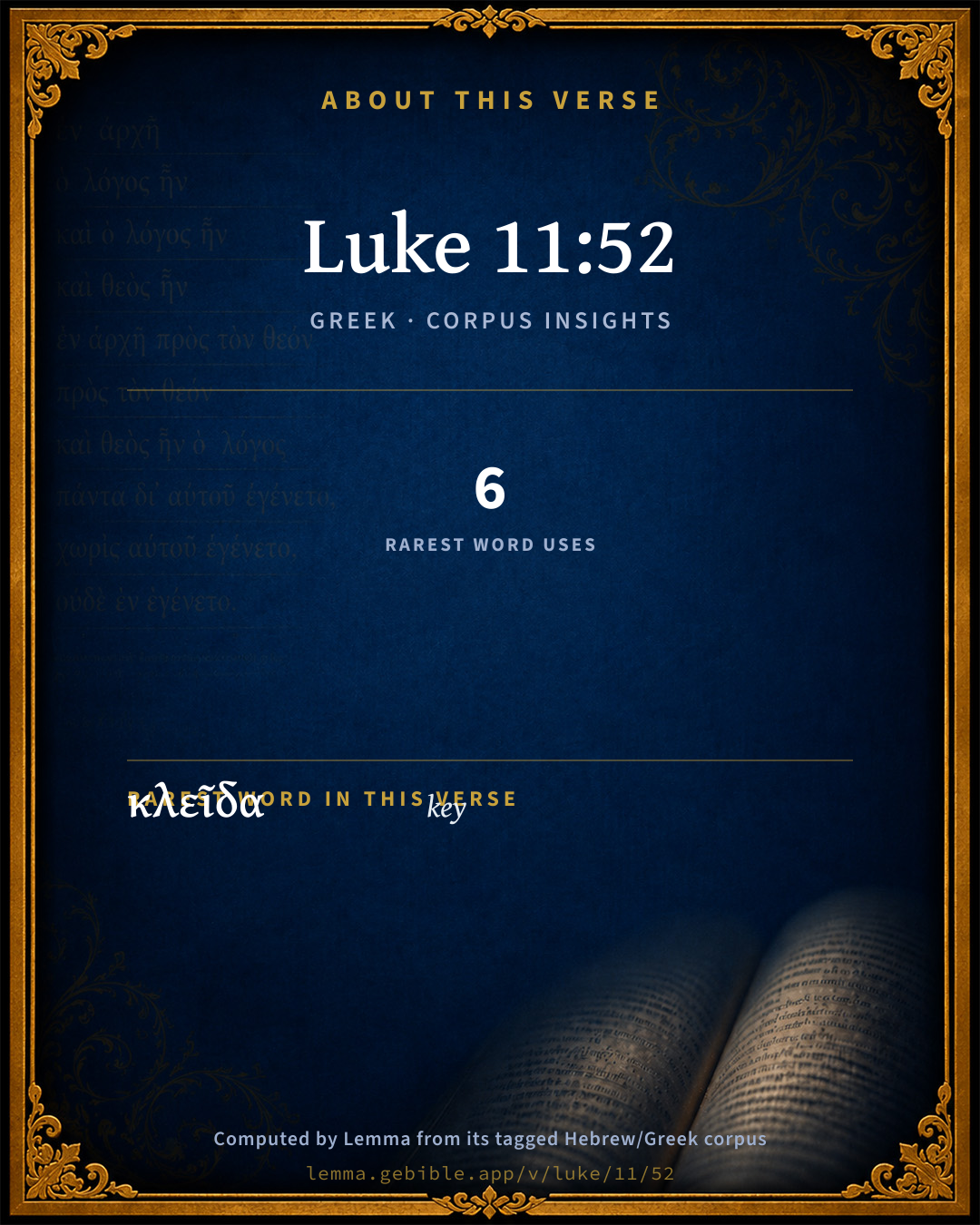
Luke 11:52

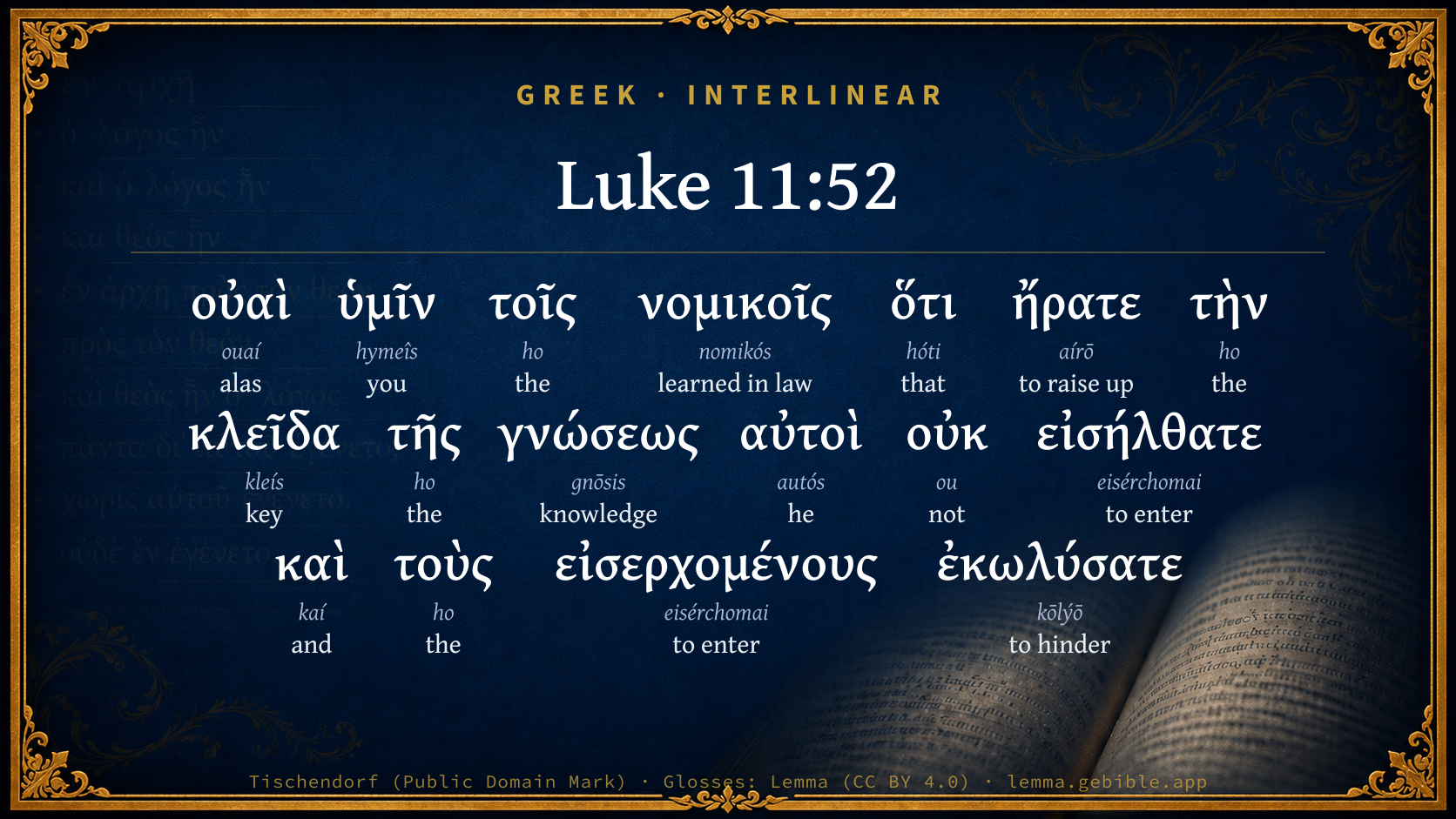
Greek (Tischendorf 8th ed.) Luke 11:52 appears in the Greek New Testament. The text above is from the Tischendorf 8th edition. Each word links to its Strong’s number and a concise gloss. Click any word for its full Thayer’s Greek Lexicon entry.
Download image
Cite this verse

Luke 11:52 (World English Bible). Public Domain. Lemma interlinear Bible study tool, https://lemma.gebible.app/v/luke/11/52.

Show BibTeX & RIS
BibTeX
RIS
English Translation
Woe to you lawyers! For you took away the key of knowledge. You didn't enter in yourselves, and those who were entering in, you hindered."
World English Bible · Public Domain
Download a study sheet

One document with this verse’s original text, its word-by-word gloss line, the meaning frame, cross-references with their text, attributed commentary, and full source and license credits — printable, and it pastes into notes with its structure intact.

This verse Autodidact and up

Study sheet (.html) Plain text (.txt)

A passage Seminary Student

Up to 50 verses in one chapter. A passage sheet keeps up to 6 commentary sources and 12 cross-references per verse, in the order this page ranks them, and says so on the sheet whenever that leaves anything out. Ask for a single verse and you get the Autodidact verse sheet above.

Everything on this page stays free to read, with no account — the sheet is a download of what is already on screen, not access to it.

Want to remove ads? Support Godless Engineer
Compare translations 3

The same verse in 3 English versions, stacked beneath the original-language interlinear above. Click any original word for its lexicon entry.

Each is an independent rendering of the whole verse — the interlinear is not word-aligned to these translations.

Highlighted words mark where these versions differ — a whole-verse word diff, not a word-by-word alignment.

  • World English Bible Public Domain
    Woe to you lawyers! For you took away the key of knowledge. You didn't enter in yourselves, and those who were entering in, you hindered."
  • King James Version Public Domain
    Woe unto you, lawyers! for ye have taken away the key of knowledge: ye entered not in yourselves, and them that were entering in ye hindered.
  • unfoldingWord Literal Text CC BY-SA 4.0
    Woe to you lawyers, because you have taken away the key of knowledge; you have not entered yourselves, and you have hindered the ones entering.”

unfoldingWord Literal Text — © unfoldingWord, licensed CC BY-SA 4.0. Word-aligned USFM3 via Door43 (git.door43.org/unfoldingWord/en_ult).

Versions to compare (up to 4)

3 of 4 selected

Show all 19 translations

Every available English version of this verse, each an independent rendering of the whole verse.

  • World English Bible Public Domain
    Woe to you lawyers! For you took away the key of knowledge. You didn't enter in yourselves, and those who were entering in, you hindered."
  • Berean Standard Bible Public Domain
    Woe to you experts in the law! For you have taken away the key to knowledge. You yourselves have not entered, and you have hindered those who were entering.”
  • Majority Standard Bible Public Domain
    Woe to you experts in the law! For you have taken away the key to knowledge. You yourselves have not entered, and you have hindered those who were entering.”
  • King James Version Public Domain
    Woe unto you, lawyers! for ye have taken away the key of knowledge: ye entered not in yourselves, and them that were entering in ye hindered.
  • American Standard Version (1901) Public Domain
    Woe unto you lawyers! for ye took away the key of knowledge: ye entered not in yourselves, and them that were entering in ye hindered.
  • Revised Version (1885) Public Domain
    Woe unto you lawyers! for ye took away the key of knowledge: ye entered not in yourselves, and them that were entering in ye hindered.
  • Geneva Bible (1599) Public Domain
    Wo be to you, Lawyers: for ye haue taken away the key of knowledge: ye entred not in your selues, and them that came in, ye forbade.
  • Douay-Rheims (1899) Public Domain
    Woe to you lawyers, for you have taken away the key of knowledge: you yourselves have not entered in, and those that were entering in, you have hindered.
  • Young's Literal Translation Public Domain
    `Wo to you, the lawyers, because ye took away the key of the knowledge; yourselves ye did not enter; and those coming in, ye did hinder.'
  • Literal Standard Version CC BY-SA 4.0
    Woe to you, the lawyers, because you took away the key of the knowledge; you yourselves did not enter; and you hindered those coming in.”
  • Unlocked Literal Bible CC BY-SA 4.0
    Woe to you teachers of Jewish laws, because you have taken away the key of knowledge; you do not enter in yourselves, and you hinder those who are entering.”
  • unfoldingWord Literal Text CC BY-SA 4.0
    Woe to you lawyers, because you have taken away the key of knowledge; you have not entered yourselves, and you have hindered the ones entering.”
  • Darby Bible Public Domain
    Woe unto you, the doctors of the law, for ye have taken away the key of knowledge; yourselves have not entered in, and those who were entering in ye have hindered.
  • World Messianic Bible Public Domain
    Woe to you Torah scholars! For you took away the key of knowledge. You didn’t enter in yourselves, and those who were entering in, you hindered.”
  • Webster's Bible Public Domain
    Woe to you, lawyers! for ye have taken away the key of knowledge: ye have not entered in yourselves, and them that were entering in ye hindered.
  • Free Bible Version CC BY-SA 4.0
    Shame on you lawyers! You have removed the key of knowledge. You didn't go in yourselves, and you prevented others from going in too.”
  • Bible in Basic English Public Domain
    A curse is on you, teachers of the law! for you have taken away the key of knowledge: you did not go in yourselves, and you got in the way of those who were going in.
  • Text-Critical English NT CC BY 4.0
    Woe to you lawyers! For you have taken away the key of knowledge. You yourselves have not entered, and you have hindered those who were trying to enter.”
  • Tyndale New Testament (1534) Public Domain
    Wo be to you lawears: for ye have taken awaye the keye of knowledge ye entred not in youre selves and them that came in ye forbade.

Literal Standard Version (2020), Covenant Press — licensed CC BY-SA 4.0. Text via the HelloAO Bible API (eBible.org). Unlocked Literal Bible (unfoldingWord) — licensed CC BY-SA 4.0. Text via the HelloAO Bible API (eBible.org). unfoldingWord Literal Text — © unfoldingWord, licensed CC BY-SA 4.0. Word-aligned USFM3 via Door43 (git.door43.org/unfoldingWord/en_ult). Free Bible Version, Dr. Jonathan Gallagher — licensed CC BY-SA 4.0. Text via the HelloAO Bible API (eBible.org).

Word by word

More ways to search: Search by grammar → Find every occurrence → Compare this word →

Practice this passage: Drill this verse → Learn its vocabulary →

κλεῖδα
kleís
G2807
“key”
Noun, Accusative, Singular, Feminine
Part of Speech
Noun
Case
Accusative
Number
Singular
Gender
Feminine
Full Thayer's Definition

Origin: from G2808

TDNT: 15:24,4

1. a key a. since the keeper of the keys has the power to open and to shut b. metaph. in the NT to denote power and authority of various kinds
  1. οὐαὶ ouaí G3759 “alas” Interjection
  2. ὑμῖν hymeîs G5210 “you” Personal pronoun, 2nd person, Dative, Plural
  3. τοῖς ho G3588 “the” Article, Dative, Plural, Masculine
  4. νομικοῖς nomikós G3544 “learned in law” Adjective, Dative, Plural, Masculine
  5. ὅτι hóti G3754 “that” Conjunction
  6. ἤρατε aírō G142 “to raise up” Verb, Aorist, Active, Indicative, 2nd person, Plural
  7. τὴν ho G3588 “the” Article, Accusative, Singular, Feminine
  8. τῆς ho G3588 “the” Article, Genitive, Singular, Feminine
  9. γνώσεως gnōsis G1108 “knowledge” Noun, Genitive, Singular, Feminine
  10. αὐτοὶ autós G846 “he” Personal pronoun, Nominative, Plural, Masculine
  11. οὐκ ou G3756 “not” Particle, Negative
  12. εἰσήλθατε eisérchomai G1525 “to enter” Verb, Aorist, Active, Indicative, 2nd person, Plural
  13. καὶ kaí G2532 “and” Conjunction
  14. τοὺς ho G3588 “the” Article, Accusative, Plural, Masculine
  15. εἰσερχομένους eisérchomai G1525 “to enter” Verb, Present, Middle or Passive deponent, Participle, Accusative, Plural, Masculine
  16. ἐκωλύσατε kōlýō G2967 “to hinder” Verb, Aorist, Active, Indicative, 2nd person, Plural

About this verse

These counts appear in no published source. They are computed here, from the morphology-tagged text and Lemma’s own curated glosses. What Lemma adds →

17
words
13
distinct lemmas
Gospels
section

Notable vocabulary

The rarest word here is κλεῖδα key G2807 — appearing just 6 times in the whole Greek New Testament.

Shared distinctive vocabulary

κλεῖδα key G2807 occurs in 6 verses of the Greek New Testament. Also found in:

Repetition

Words recur within this verse:

  • εἰσήλθατε to enter G1525 ×2
  • τοῖς the G3588 ×4

Cross-references

8

Topical passages linked to Luke 11:52 in the Treasury of Scripture Knowledge — connected by theme and wording, ordered by reader-vote popularity; previews shown in the World English Bible.

  • Matthew 23:13 "Woe to you, scribes and Pharisees, hypocrites! For you devour widows' houses, and as a pretense you make long prayers. Therefore you will receive greater condemnation.
  • Malachi 2:7 For the priest's lips should keep knowledge, and they should seek the law at his mouth; for he is the messenger of Yahweh of Hosts.
  • Acts 4:17–18 But so that this spreads no further among the people, let's threaten them, that from now on they don't speak to anyone in this name."
  • Luke 11:45–46 One of the lawyers answered him, "Teacher, in saying this you insult us also."
  • John 9:24–34 So they called the man who was blind a second time, and said to him, "Give glory to God. We know that this man is a sinner."
  • John 7:47–52 The Pharisees therefore answered them, "You aren't also led astray, are you?
  • Luke 19:39–40 Some of the Pharisees from the multitude said to him, "Teacher, rebuke your disciples!"
  • Acts 5:40 They agreed with him. Summoning the apostles, they beat them and charged them not to speak in the name of Jesus, and let them go.

Cross-references courtesy of OpenBible.info (CC BY 4.0).

Commentary

Notes on Luke 11:52 from classic Christian and Jewish commentators (each source and its license shown beneath its notes). The classic Christian expositions comment on the surrounding passage and are grouped to its opening verse, so a note may address several verses; the Jewish commentaries on the Tanakh (Rashi and others) are per-verse, so they appear only where the commentator wrote on this verse.

Lemma curates 59 commentaries, every one of them public domain or Creative Commons licensed, each selected and text-cleaned for this edition rather than reprinted as found. About our sources →

The Biblical Illustrator

Joseph S. Exell

Luk_11:52

Ye have taken away the key of knowledge

The sin of perverting Scripture

The last woe pronounced by our Saviour against the Scribes and Pharisees, is for perverting the Holy Scriptures, and keeping the true sense and knowledge of them from the people: this St.

Luke here calls, the taking away the key of knowledge from men; alluding to a custom among the Jews, in admission of their doctors. Those that had authority given them to interpret the law and the prophets, were solemnly admitted into that office, by delivering to them a key and a table-book; so that by the key of knowledge is meant the interpretation and understanding of the Scriptures, and by taking away that key is signified--

1. That they arrogated to themselves the sole power of understanding and interpreting the Holy Scriptures.

2. That they kept the true knowledge of the Scriptures from the people, especially the prophecies which concern the kingdom and coming of the Messias; and so they hindered men from embracing our Saviours doctrine, who were otherwise well enough disposed for it.

Learn--

1. That the written Word is the key whereby an entrance into heaven is opened unto men.

2. That the use of this key, or the knowledge of the Word of God, is absolutely and indispensibly necessary in order to salvation.

3. That great is the guilt, and inexcusable the fault of those who deny the people the use of this key, and deprive them of the knowledge of the Holy Scriptures, which alone can make them wise unto salvation.

4. That such as do so, shut the kingdom of heaven against men, endeavouring what in them lies to hinder their salvation. Men may miscarry with their knowledge, but they are sure to perish for lack of knowledge. (W. Burkitt.)

Hinderers

Some unpublished thoughts on Hinderers and Hindrances, written by Frances Ridley Havergal, were forwarded by her sister Maria V.

G. Havergal to the editor of The Sunday Magazine. We glean the following from the second paper, which appeared in the September, 1885, issue:--A letter from Ernest at last! And the sister eagerly gives her father the morning budget at the breakfast table. Her mother watches, for gloom gathers on the fathers face as he reads it. Silently the letter is given to the mother, and he passes through the open window to the pleasant terrace-walk beneath. The sister guesses in vain, What can Ernest have written? The father paced up and down, thinking of the position he himself had won, and which he had hoped would be a stepping-stone for his son to one far higher, in which his many gifts of mind and heart would shine with no common effulgence. He had hoped his son would carry out and develop many schemes of benevolence he had set on foot. But that mornings letter was as a mighty crucible, wherein the mans devotedness to Him who had given him that darling son was to be tested and analyzed. What was that letter?--College, Cambridge. DEAR FATHER,--Will you listen to your sons request for your consent, your blessing, your prayers? Father, there is a burning impulse within me, a new life-pulse seems beating in my soul, a still deep voice ever sounding in my ears, Go ye into all the world, and preach the gospel to every creature. Years ago that same voice called me, when I first heard stories about the heathen and their idols, and when standing by my mother I looked at the Church Missionary Societys green picture-book (Juvenile Instructor), of white men preaching to the heathen. Silently, but surely, has that call followed me. I have cried earnestly, Lord, what wilt Thou have me to do? and again the heavenly whisper comes, Go ye. Therefore, though never before breathed to any but God, this is no sudden thought, no unconsidered plan. Father, let me go, let me take the cup of living water to him that is ready to perish. I should like to tread the very footsteps of Him who came to seek and to save that which was lost, to search in His name for the other sheep, which are not of this fold. I know the hopes and the intentions which you have cherished for my future; but is not a missionarys joy a nobler gain, the missionarys crown a nobler ambition than any ether? And what if the time came when, among the multitude out of all nations and kindreds and tongues, I might be permitted to recognize some who first heard a Saviours name from my unworthy lips! My own dear mother! her heart will be with me in this; I know she lent me to the Lord. Dearest father, I believe Christ has called me; will you let me obey His voice? Your loving son, ERNEST. Reader, what would your answer have been? Would you have hindered? The father could not brook that the talents of his son, the pride of his ancestral hall, should go forth into the gloom and obscurity of distant shores. But who can tell how bitterly that question, Father, will you hinder me? returned to his mind when the bell tolled for the early death of that loved and devoted son!

Hindering

A young Savoyard, a poor little chimney-sweep, one day purchased a Testament, for which he paid ten sons (rather less than fivepence of English money), and set himself immediately to read it. Delighted to possess the Word of God, he, in his simplicity, ran to the priest to show him the good bargain he had made with his savings. The priest looked at the book, and told the young Savoyard that it came from the hands of heretics, and that it was a book forbidden to be read. The poor boy replied that everything he had read in the book told him about Christ; and beside, said he, it is so beautiful! You shall see how beautiful it is, said the priest, seizing it and casting it into the fire. The young Savoyard went away weeping. (W. Denton.)

Lamentable effect of hindering

Hume, the historian, received a religious education from his mother, but as he approached manhood confirmed infidelity succeeded. Maternal partlality, however, alarmed at first, came at length to look with less and less pain upon his declension, and filial love and reverence seemed to have been absorbed in the pride of philosophical scepticism; for Hume applied himself with unwearied, and, unhappily, with successful, efforts to sap the foundation of his mothers faith. Having succeeded, he went abroad, and as he was returning an express met him in London, with a letter from his mother informing him that she was in a deep decline. She said she found herself without any support in her distress; that he had taken away that only source of comfort upon which, in all eases of affliction, she used to rely; and that she now found her mind sinking into despair. She conjured him to hasten to her, or at least to send her a letter containing such consolations as philosophy could afford to a dying mortal. Hume was overwhelmed with anguish on receiving this letter, and hastened to Scotland, travelling day and night; but before he arrived his mother expired.

The Biblical Illustrator, edited by Joseph S. Exell (c. 1880s–1900s) — public domain. Text from a community e-Sword module.

Joseph Benson's Commentary

Luk 11:52. Wo unto you, lawyers! for ye have taken away the key of knowledge — Ye have obscured and destroyed the true knowledge of the Messiah, which is the key both of the present and the future kingdom of heaven. Or, by your wrong interpretations of Scripture, you have filled the people with strong prejudices against the gospel, so that you not only reject it yourselves, but hinder others from receiving it. See on Mat 23:13.

Joseph Benson's Commentary on the Old and New Testaments (1811–1818) — public domain. Text from a community e-Sword module.

Tyndale Open Study Notes

Tyndale Open Resources

11:52 the key to knowledge: See Matt 16:19; 23:13.

Tyndale Open Study Notes — © Tyndale Open Resources, licensed CC BY-SA 4.0. Text via the HelloAO Bible API.

Bengel's Gnomon

Johann Albrecht Bengel

Luk 11:52. Ἤρατε) ye have taken away. [They had thrust themselves into the ecclesiastical office: and he who neglected them was left bound in all kinds of ignorance.—V. g.]—τὴν κλεῖδα τῆς γνώσεως, the key of knowledge) i.e. true knowledge, viz. of the Messiah (ch. Luk 20:41), which is the key of the kingdom of the heavens.—οὐκ εἰσήλθετε, ye have not entered in) into the kingdom of the heavens.

Bengel's Gnomon of the New Testament — English translation (T&T Clark, Edinburgh, 1860) — public domain. Text from a community e-Sword module.

Meyer's Critical & Exegetical Commentary

Heinrich August Wilhelm Meyer

Luk_11:52. See on Mat_23:14. The genitive of the thing with τ. κλεῖδα denotes that which is opened by the key (Mat_16:19; Rev_1:18; Rev_9:1; Rev_20:1), since here we are not to supply τῆς βασιλείας with κλεῖδα, and take τ. γνώσεως as a genitive of apposition (Düsterdieck in the Stud. u. Krit. 1865, p. 750). Comp. Isa_22:22.

The γνῶσις, the knowledge κατʼ ἐξοχήν, i.e. the knowledge of the divine saving truth, as this was given in the manifestation and the preaching of Christ, is compared to a closed house, to get into which the key is needed. The νομικοί have taken away this key, i.e. they have by means of their teaching, opposed as it is to the saving truth (because only directed to traditional knowledge and fulfilling of the law), made the people incapable of recognising this truth.

ἤρατε] tulistis (Vulgate); the reading ἀπεκρύψατε found in D is a correct gloss. If they had recognised and taught, as Paul did subsequently, the law as παιδαγωγὸς εἰς Χριστόν (Gal_3:24), they would have used the key for the true knowledge for themselves and others, but not taken it away,[150] and made it inaccessible for use. They have taken it away; so entirely in opposition to their theocratic position of being the κλειδοῦχοι have they acted.

On the figurative idea of the key of knowledge, comp. Luk_8:10 : ὑμῖν δέδοται γνῶναι τὰ μυστήρια τῆς βασιλείας τ. Θεοῦ. The aorists are altogether to be taken in the sense of the completed treatment; they indicate what the νομικοί have accomplished by their efforts: τοὺς εἰσερχομένους, however, are those who were intending to enter.

[150] Ahrens, Amt d. Schlüssel, p. 9 ff., takes ἤρατε as: ye bear (more strictly: ye have taken to you) the key of knowledge, to wit: as those who ought to be its οἰκονόμοι. Thus, however, the reason of the οὐαί would not yet appear in ὅτι ἤρατε κ.τ.λ., nor until the following αὐτοὶ οὐκ κ.τ.λ.; and hence the latter would have required to be linked on by ἀλλά, or at least by δέ; or else instead of ἤρατε the participle would have required to be used. Many of the older commentators, as Erasmus, Elsner, Wolf, Maldonatus, took ἤρατε as: ye have arrogated to yourselves, which, however, it does not mean.

Meyer — Critical and Exegetical Commentary on the New Testament — English translation by Peter Christie, edited by Frederick Crombie (T&T Clark, 1880) — public domain. Text from a community e-Sword module.

Expositor's Greek Testament

ed. W. Robertson Nicoll

Luk 11:52 . Final woe on the lawyers, a kind of anticlimax. Cf. Mt., where the pathetic apostrophe to Jerusalem follows and concludes the discourse. τὴν κλεῖδα τῆς γνώσεως , the key which is knowledge (genitive of apposition) admitting to the Kingdom of God. Many take it = the key to knowledge.

The Expositor's Greek Testament, edited by W. Robertson Nicoll (1897–1910) — public domain. Text from a community e-Sword module.

Geneva Bible (1599)

Geneva Bible translators

You have hidden and taken away, so that it cannot be found anywhere.

They have of long time chiefly hindered the people, from entering into the knowledge of God, which ought to be the doorkeepers of the Church.

Geneva Bible (1599) marginal notes — public domain. Text via Bolls.life.

Jamieson, Fausset & Brown

Robert Jamieson, A. R. Fausset & David Brown

key of knowledge--not the key to open knowledge, but knowledge, the only key to open heaven. In Mat 23:13, they are accused of shutting heaven; here of taking away the key, which was worse. A right knowledge of God's Word is eternal life (Joh 17:3); but this they took away from the people, substituting for it their wretched traditions.

Jamieson, Fausset & Brown — Commentary Critical and Explanatory on the Whole Bible (1871) — public domain (CC PDM 1.0). Text via the HelloAO Bible API.

Adam Clarke's Commentary

Verse 52. Ye have taken away the key of knowledge] By your traditions ye have taken away the true method of interpreting the prophecies: ye have given a wrong meaning to those scriptures which speak of the kingdom of the Messiah, and the people are thereby hindered from entering into it. See Clarke on Mt 23:13.

Adam Clarke's Commentary on the Bible (1810–1826) — public domain. Text from a community e-Sword/MySword module.

Ellicott's Commentary for English Readers

(52) Woe unto you, lawyers!—The “woe” in this case is uttered against those who were, by their very calling, the professed interpreters of the Law. Its form rests on the fact that each scribe or “doctor of the law,” in the full sense of the term, was symbolically admitted to his office by the delivery of a key. His work was to enter with that key into the treasure-chambers of the house of the interpreter, and to bring forth thence “things new and old” (Mat_13:52). The sin of the “lawyers” of that time, the “divines” as we should call them, was that they claimed a monopoly of the power to interpret, and yet did not exercise the power. Wearisome minuteness, a dishonest and demoralising casuistry, fantastic legends, these took the place of a free and reverential study of the meaning of the sacred Books. Those who “were entering in,” answer to the souls not far from the kingdom of God, waiting for the consolation of Israel, pressing as with eagerness to the spiritual meaning of Law and Prophet. Such, at one stage of his life, must have been the Evangelist himself. This, it will be noted, is the third occurrence of the word in St. Luke’s Gospel. (See Notes on Luk_8:16; Luk_11:33.) It is obvious that the passage, as a whole, throws light on the promise of the “keys” of the kingdom made to Peter. (See Note on Mat_16:19.)

A Bible Commentary for English Readers, edited by Charles John Ellicott (1878–1897) — public domain. Text from a community e-Sword module.

The Cambridge Bible for Schools and Colleges

gen. ed. J. J. S. Perowne

52. ye have taken away the key of knowledge] A key was the regular symbol of the function of a scribe (Mat_13:52; Mat_16:19), which was to open the meaning of the Holy Books. The crime charged against them here is their selfish exclusiveness. They declared that only rich and well-born people could be scribes; and while they refused to teach the mass of the people, they at the same time called them ‘accursed’ for not knowing the law, and spoke about them in terms of the bitterest scorn and detestation. “Ye have caused many to stumble at the law,” Mal_2:8.

The Cambridge Bible for Schools and Colleges (gen. ed. J. J. S. Perowne; Cambridge University Press, 1878–1918) — public domain. Text from a community e-Sword module.

John Gill's Exposition

Laying wait for him,.... To ensnare and entangle him, watching his words, observing what he said, and laying hold thereon:

and seeking to catch something out of his mouth; like beasts of prey, or hunters, that were watching for their prey; or lay ambush, diligently looking out, and greedily catching at every thing they thought for their purpose:

that they might accuse him; either of heresy or sedition, to the Jewish sanhedrim, or the Roman governor.

Next: Luke Chapter 12

John Gill's Exposition of the Whole Bible (1746–1763) — public domain (CC PDM 1.0). Text via the HelloAO Bible API.

Trapp's Complete Commentary

John Trapp

52 Woe unto you, lawyers! for ye have taken away the key of knowledge: ye entered not in yourselves, and them that were entering in ye hindered.

Ver. 52. Woe unto you, lawyers] I see well, said father Latimer, that whosoever will be busy with Vae vobis, woe to you, he shall shortly after come coram nobis, face to face to us, as Christ did. (Acts and Mon.)

For ye have taken away the key of knowledge] By taking away the Scriptures, and all good means of knowledge; as do also the Jesuits to this day. At Dole, a university in Burgundy, they have not only debarred the people of the Protestant books, but especially also forbid them to talk of God, either in good sort or bad. In Italy they not only prohibit the books of the reformed writers, but also hide their own treatises, in which the tenet of the Protestants is recited, only to be confuted; so that you shall seldom there meet with Bellarmine’s works, or any of the like nature, to be sold.

John Trapp, A Commentary or Exposition upon All the Books of the Old and New Testament (1647–1656) — public domain. Text from a community e-Sword module.

Albert Barnes' Notes on the Bible

Woe unto you, lawyers! - See the notes at Mat 23:13.

The key of knowledge - A key is made to open a lock or door. By their false interpretation of the Old Testament they had taken away the true key or method of understanding it. They had hindered the people from understanding it aright. “You endeavor to prevent the people also from understanding the Scriptures respecting the Messiah, and those who were coming to “me” ye hindered.” If there is any sin of special magnitude, it is that of keeping the people in ignorance; and few people are so guilty as they who by false instructions prevent them from coming to a knowledge of the truth, and embracing it as it is in Jesus.

Albert Barnes' Notes on the Bible (1834–1885) — public domain. Text from a community e-Sword/MySword module.

Haydock's Catholic Bible Commentary

You have taken away the key of knowledge. A comparison of a master that locks others out. As if Christ said: you pretend, as masters and teachers, to open and expound the law and the prophets; and by your false doctrine and interpretations, you neither observe the law, nor permit others to observe it. See Matthew xxiii. 13. (Witham) --- The key of knowledge is faith; for by faith we come to the knowledge of truth, according to that of Isaias, How shall they understand, if they have not believed? Cap. vii, (according to Septuagint) these doctors of the law took away the key of science, by not allowing the people to believe in Christ. (St. Cyril in St. Thomas Aquinas)

George Leo Haydock (1774–1849), Haydock's Catholic Family Bible and Commentary, 1859 edition — public domain. Excludes Psalms (Douay-Rheims chapter numbering differs from Protestant) and Deuterocanonical books (Catholic canon only).

Matthew Poole's English Annotations

Matthew saith, Mat 23:13, for ye shut up the kingdom of heaven against men, &c. I take the sense of these words to be, You have taken away knowledge, which is the key by which men enter into the kingdom of God. Though knowledge itself be but a common gift, and men may have great measures of it, and yet perish for ever, 1Co 13:2, yet it is the foundation of all saving grace. How shall they believe in him of whom, they have not heard? Rom 10:14. So, how shall they obey a rule they do not know, or repent of those sins which they do not know to be so? So as those that are the hinderers of people’s coming to the knowledge of the will of God, are the vilest instruments upon earth in hindering men’s and women’s salvation. The papists are highly guilty of this, in keeping their laity from the Scriptures in a language intelligible to them. But how were the scribes guilty of this? The Jews were never hindered from reading or hearing of the law; it was read in their synagogues every sabbath day. But we must know that knowledge is highly advantaged by an interpretation of the mind and will of God. But how did the scribes take away this? They preached and interpreted the law of God.

Answer. They gave not the true sense of it, but so preached that people were scarce any whit the wiser, as to the knowledge of the law of God, only they made people understand their traditions and ceremonies: their doctrines were the traditions of men. Now they occupying the places of teachers, and no better discharging their work, instead of giving, took away knowledge from them, and proved blind leaders of the blind. Whoever they are that arrogate to themselves the office of teaching, and supplying the places of teachers, and either do not make preaching, and instruction of the people under their charge, their business, or who preach in styles and methods their people understand not, or who preach other things than what they prove to be the revealed will of God, fall deeply under the condemnation of this text. See Poole on "Mat 23:13".

Matthew Poole's English Annotations on the Holy Bible (1683–1685) — public domain. Text from a community e-Sword/MySword module.

The Pulpit Commentary

Woe unto you, lawyers! for ye have taken away the key of knowledge: ye entered not in yourselves, and them that were entering in ye hindered. The Talmud gives us the clue to the Master"s words of bitter reproach here. There were very many, in that restless age of inquiry, waiting for the consolation of Israel, who longed to enter into the real meaning of psalm and prophecy; but the scribe, the lawyer, and the doctor, with their strange and unreal interpretations, their wild and fantastic legends, their own often meaningless additions, effectually hindered all real study of the Divine oracles. The Talmud in the form we now possess it well represents the teaching of these schools so bitterly censured by the Lord.

The Pulpit Commentary (1880–1919), ed. H.D.M. Spence-Jones & Joseph S. Exell — public domain. Text from a community e-Sword module.

John Wesley's Explanatory Notes

Ye have taken away the key of knowledge - Ye have obscured and destroyed the knowledge of the Messiah, which is the key of both the present and the future kingdom of heaven; the kingdom of grace and glory. Ye have not entered in - Into the present kingdom of heaven.

John Wesley, Explanatory Notes Upon the Whole Bible (1754–1765) — public domain. Text via the GEBible commentary corpus.

unfoldingWord translationNotes

Door43 World Missions Community

Connecting Statement:

Jesus finishes responding to the Jewish teacher.

you have taken away the key of knowledge ... hinder those who are entering

Jesus speaks about God's truth as if it were in a house that the teachers refuse to enter and will not let others have the key to enter either. This means the teachers do not truly know God, and they prevent others from knowing him as well. (See: Metaphor)

the key

This represents the means of access, as to a house or storage room.

you do not enter in yourselves

"you yourselves do not go in to get knowledge"

translationWords

woe

scribe

know

unfoldingWord translationNotes — © Distant Shores Media and the Door43 World Missions Community, licensed CC BY-SA 4.0. Source: git.door43.org/Door43/en_tn.

Cambridge Greek Testament for Schools and Colleges

52. ἤρατε τὴν κλεῖδα τῆς γνώσεως. D reads ἀπεκρύψατε, Ye concealed the key, but that is implied in their taking it away and rendering it inaccessible. Our Lord here denounces the common spirit of theological exclusiveness and pride. A key was the regular symbol of the function of a scribe (Mat 13:52; Mat 16:19), which was to open the meaning of the Holy Books. The crime charged against them here is their selfish exclusiveness. They declared that only rich and well-born people could be scribes; and while they refused to teach the mass of the people, they at the same time called them ‘accursed’ for not knowing the law, and spoke about them in terms of the bitterest scorn and detestation. “Ye have caused many to stumble at the law,” Mal 2:8.

τοὺς εἰσερχομένους ἐκωλύσατε. The aorist and present imply ‘ye repelled at the threshold those who were trying to enter.’

Cambridge Greek Testament for Schools and Colleges (Cambridge University Press, 1896; 21 vols, various authors incl. Carr, Maclear, Plummer, Farrar, Lumby, Moule, M. R. James, Simcox) — public domain. Text from a community e-Sword module.

Alford’s Greek Testament

Henry Alford

52.] ἤρ. τὴν κλ. τῆς γν. = κλείετε τὴν βασ. τ. οὐ. ἔμπροσθεν τ. ἀνθ. Matt. ver. 14, which words are the best explanation of our text:—the key of knowledge (i.e. not of, as admitting to, knowledge—but the key is the knowledge), being that right understanding of the Law and Prophets, which should shew Him to the people, of whom they testified; this the expounders of Scripture had taken away, neither themselves entering, nor permitting those to enter who were otherwise doing so,—and thus shutting the kingdom of heaven in men’s faces.

Henry Alford, The Greek Testament (1849–1861) — public domain. Text from a community e-Sword module.

International Critical Commentary

52. τὴν κλεῖδα τῆς γνώσεως. “The key which opens the door to knowledge,” not “which is knowledge”: the gen. is not one of apposition. There is no reference to a supposed ceremony by which a “doctor of the law” was “symbolically admitted to his office by the delivery of a key.” No such ceremony appears to have existed. The knowledge is that of the way of salvation, which can be obtained from Scripture. But the scribes had cut off access to this knowledge, first, by their false interpretations; and, secondly, by their contempt for the people, whom they considered to be unworthy of instruction or incapable of enlightenment. Their false interpretations were fatal to themselves (αὐτοὶ οὐκ εἰσήλθατε) as well as to others. See Hort, Judaistic Christianity. p. 141 ; Recog. Clem. i. 54, 2:30, 46. Excepting in the Apocalypse (1:18, 3:7, 9:1, 20:1), κλείς occurs only Mat 16:19. The reading ἐκρύψατε (D and some Versions) for ἤρατε is an interpretative gloss. Note that here Lk. has νομικοί where Mt. (23:14) has γραμματεισς, and comp. 12:44.

τοὺς εἰσερχομένους. “Those who were continually trying to enter” (imperf. part.). The aorists indicate what was done once for all and absolutely.

International Critical Commentary — older volumes (1896–1929), various authors — public domain. Text from a community e-Sword module.

Godet's Commentaries

Frédéric Louis Godet

Ver. 52: The Monopoly of Theology.—“Woe unto you, lawyers! for ye have taken away the key of knowledge: ye entered not in yourselves, and them that were entering in ye hindered.” The religious despotism with which Jesus in the third place charges the scribes, is a natural consequence of their fanatical attachment to the letter. This last rebuke corresponds to the third which He had addressed to the Pharisees—the pernicious influence exercised by them over the whole people. Jesus represents knowledge (γνῶσις) under the figure of a temple, into which the scribes should have led the people, but whose gate they close, and hold the key with jealous care. This knowledge is not that of the gospel, a meaning which would lead us outside the domain of the scribes; it is the real living knowledge of God, such as might already be found, at least to a certain extent, in the O. T. The key is the Scriptures, the interpretation of which the scribes reserved exclusively to themselves. But their commentaries, instead of tearing aside the veil of the letter, that their hearers might penetrate to the spirit, thickened it, on the contrary, as if to prevent Israel from beholding the face of the living God who revealed Himself in the O. T., and from coming into contact with Him. The pres. part. εἰσερχόμενοι denotes those who were ready to rise to this vital knowledge, and who only lacked the sound interpretation of Scripture to bring them to it.

Matthew, in a long discourse which he puts into the mouth of Jesus in the temple (chap. 23), has combined in one compact mass the contents of those two apostrophes addressed to the Pharisees and lawyers, which are so nicely distinguished by Luke. Jesus certainly uttered in the temple, as Matthew relates, a vigorous discourse addressed to the scribes and Pharisees. Luke himself (Luk 20:45-47) indicates the time, and gives a summary of it. But it cannot be doubted that here, as in the Sermon on the Mount, the first Gospel has combined many sayings uttered on different occasions. The distribution of accusations between the Pharisees and lawyers, as we find it in Luke, corresponds perfectly to the characters of those two classes. The question of the scribe (Luk 11:45) seems to be indisputably authentic. Thus Luke shows himself here again the historian properly so called.

Frédéric Louis Godet — Commentaries on Luke, John, Romans, and 1 Corinthians — English translation (T&T Clark, Edinburgh, 1870s–1890s) — public domain. Text from a community e-Sword module.

Lesson kit

Teaching starters — assembled from the data on this page, not authored interpretation. Every prompt links to the verse data it draws on. Edit before teaching.

Luke, in the Gospels, opens this verse with 17 words (13 distinct Greek lemmas). Its most distinctive word is kleís (“key”). A historical commentator’s framing appears above. Read the whole chapter for the surrounding context.

Discussion questions

  1. The word kleís carries the sense “key.” How does it shape the verse?
  2. Matthew 16:19 shares the word «key» with this verse. How do the two illuminate each other?
  3. “to enter” occurs 2× in this one verse. What is the effect of the repetition?
  4. These translations render this verse differently; the difference is in the English rendering, not the original. What questions does that raise?
  5. Reading how The Biblical Illustrator and Joseph Benson's Commentary read this verse, where do the two commentators agree and where do they part?

Things to notice

  • These translations choose different wording for 9 words in this verse.
  • “to enter” occurs 2× in this single verse.
  • 13 distinct Greek lemmas span 17 words in this verse.

Reading settings

Reading text

Shown beneath each verse's original-language words.

Old Testament
Old Testament edition

Read the OT as the Masoretic Hebrew (MT) or the Greek Septuagint (LXX).

English shown for the Greek Septuagint (in the Hebrew ↔ Greek comparison).

Comparing translations? Open the Compare panel on any verse page to stack up to four side by side.