
Luke 11:53

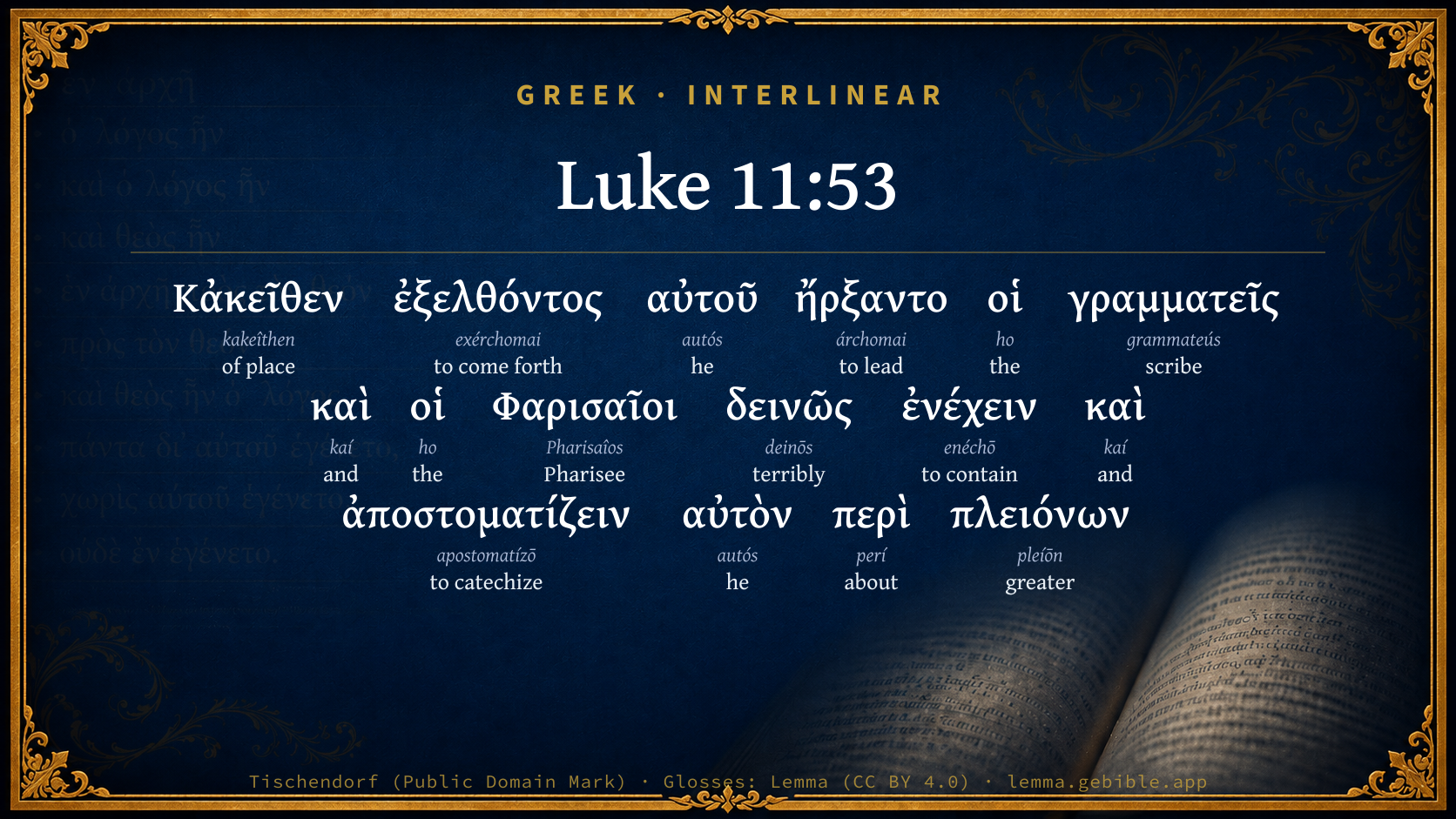
Greek (Tischendorf 8th ed.) Luke 11:53 appears in the Greek New Testament. The text above is from the Tischendorf 8th edition. Each word links to its Strong’s number and a concise gloss. Click any word for its full Thayer’s Greek Lexicon entry.
Download image
Cite this verse

Luke 11:53 (World English Bible). Public Domain. Lemma interlinear Bible study tool, https://lemma.gebible.app/v/luke/11/53.

Show BibTeX & RIS
BibTeX
RIS
English Translation
As he said these things to them, the scribes and the Pharisees began to be terribly angry, and to draw many things out of him;
World English Bible · Public Domain
Highlights
  • 1 hapax legomenon — only here in the Greek New Testament
  • 1 first appearance in the Greek New Testament
Full analysis ↓
Download a study sheet

One document with this verse’s original text, its word-by-word gloss line, the meaning frame, cross-references with their text, attributed commentary, and full source and license credits — printable, and it pastes into notes with its structure intact.

This verse Autodidact and up

Study sheet (.html) Plain text (.txt)

A passage Seminary Student

Up to 50 verses in one chapter. A passage sheet keeps up to 6 commentary sources and 12 cross-references per verse, in the order this page ranks them, and says so on the sheet whenever that leaves anything out. Ask for a single verse and you get the Autodidact verse sheet above.

Everything on this page stays free to read, with no account — the sheet is a download of what is already on screen, not access to it.

Want to remove ads? Support Godless Engineer
Compare translations 3

The same verse in 3 English versions, stacked beneath the original-language interlinear above. Click any original word for its lexicon entry.

Each is an independent rendering of the whole verse — the interlinear is not word-aligned to these translations.

Highlighted words mark where these versions differ — a whole-verse word diff, not a word-by-word alignment.

  • World English Bible Public Domain
    As he said these things to them, the scribes and the Pharisees began to be terribly angry, and to draw many things out of him;
  • King James Version Public Domain
    And as he said these things unto them, the scribes and the Pharisees began to urge him vehemently, and to provoke him to speak of many things:
  • unfoldingWord Literal Text CC BY-SA 4.0
    he went out from there, the scribes and the Pharisees began to oppose him fiercely and to argue against him about many things,

unfoldingWord Literal Text — © unfoldingWord, licensed CC BY-SA 4.0. Word-aligned USFM3 via Door43 (git.door43.org/unfoldingWord/en_ult).

Versions to compare (up to 4)

3 of 4 selected

Show all 19 translations

Every available English version of this verse, each an independent rendering of the whole verse.

  • World English Bible Public Domain
    As he said these things to them, the scribes and the Pharisees began to be terribly angry, and to draw many things out of him;
  • Berean Standard Bible Public Domain
    As Jesus went on from there, the scribes and Pharisees began to oppose Him bitterly and to ply Him with questions about many things,
  • Majority Standard Bible Public Domain
    As Jesus said these things to them, the scribes and Pharisees began to oppose Him bitterly and to ply Him with questions about many things,
  • King James Version Public Domain
    And as he said these things unto them, the scribes and the Pharisees began to urge him vehemently, and to provoke him to speak of many things:
  • American Standard Version (1901) Public Domain
    And when he was come out from thence, the scribes and the Pharisees began to press upon `him' vehemently, and to provoke him to speak of many things;
  • Revised Version (1885) Public Domain
    And when he was come out from thence, the scribes and the Pharisees began to press upon him vehemently, and to provoke him to speak of many things;
  • Geneva Bible (1599) Public Domain
    And as he sayde these things vnto them, the Scribes and Pharises began to vrge him sore, and to prouoke him to speake of many things,
  • Douay-Rheims (1899) Public Domain
    And as he was saying these things to them, the Pharisees and the lawyers began violently to urge him, and to oppress his mouth about many things,
  • Young's Literal Translation Public Domain
    And in his speaking these things unto them, the scribes and the Pharisees began fearfully to urge and to press him to speak about many things,
  • Literal Standard Version CC BY-SA 4.0
    And in His speaking these things to them, the scribes and the Pharisees began fearfully to urge and to press Him to speak about many things,
  • Unlocked Literal Bible CC BY-SA 4.0
    After Jesus left there, the scribes and the Pharisees opposed him and argued with him about many things,
  • unfoldingWord Literal Text CC BY-SA 4.0
    he went out from there, the scribes and the Pharisees began to oppose him fiercely and to argue against him about many things,
  • Darby Bible Public Domain
    And as he said these things to them, the scribes and the Pharisees began to press him urgently, and to make him speak of many things;
  • World Messianic Bible Public Domain
    As he said these things to them, the scribes and the Pharisees began to be terribly angry, and to draw many things out of him,
  • Webster's Bible Public Domain
    And as he said these things to them, the scribes and the Pharisees began to urge him vehemently, and to solicit him to speak of many things;
  • Free Bible Version CC BY-SA 4.0
    As Jesus was leaving, the religious teachers and the Pharisees began to attack him aggressively, asking questions to provoke him.
  • Bible in Basic English Public Domain
    And when he had come out of that place, the scribes and the Pharisees came round him angrily, questioning him about more things;
  • Text-Critical English NT CC BY 4.0
    As he was saying these things to them, the scribes and the Pharisees began to oppose him fiercely and to question him closely about many things,
  • Tyndale New Testament (1534) Public Domain
    When he thus spake vnto them the lawears and the Pharises began to wexe busye about him and to stop his mouth with many questions

Literal Standard Version (2020), Covenant Press — licensed CC BY-SA 4.0. Text via the HelloAO Bible API (eBible.org). Unlocked Literal Bible (unfoldingWord) — licensed CC BY-SA 4.0. Text via the HelloAO Bible API (eBible.org). unfoldingWord Literal Text — © unfoldingWord, licensed CC BY-SA 4.0. Word-aligned USFM3 via Door43 (git.door43.org/unfoldingWord/en_ult). Free Bible Version, Dr. Jonathan Gallagher — licensed CC BY-SA 4.0. Text via the HelloAO Bible API (eBible.org).

Word by word

More ways to search: Search by grammar → Find every occurrence → Compare this word →

Practice this passage: Drill this verse → Learn its vocabulary →

ἀποστοματίζειν
apostomatízō
G653
“to catechize”
Verb, Present, Active, Infinitive
Part of Speech
Verb
Tense
Present
Voice
Active
Mood
Infinitive
Full Thayer's Definition

Origin: from G575 and a (presumed) derivative of G4750

TDNT: None

1. to recite from memory a. to repeat to a pupil (anything) for him to commit to memory 2. to ply with questions, to catechise, and so to entice to answers
  1. Κἀκεῖθεν kakeîthen G2547 “of place” Adverb, Aramaic form
  2. ἐξελθόντος exérchomai G1831 “to come forth” Verb, Aorist, Active, Participle, Genitive, Singular, Masculine
  3. αὐτοῦ autós G846 “he” Personal pronoun, Genitive, Singular, Masculine
  4. ἤρξαντο árchomai G756 “to lead” Verb, Aorist, Middle deponent, Indicative, 3rd person, Plural
  5. οἱ ho G3588 “the” Article, Nominative, Plural, Masculine
  6. γραμματεῖς grammateús G1122 “scribe” Noun, Nominative, Plural, Masculine
  7. καὶ kaí G2532 “and” Conjunction
  8. οἱ ho G3588 “the” Article, Nominative, Plural, Masculine
  9. Φαρισαῖοι Pharisaîos G5330 “Pharisee” Noun, Nominative, Plural, Masculine
  10. δεινῶς deinōs G1171 “terribly” Adverb
  11. ἐνέχειν enéchō G1758 “to contain” Verb, Present, Active, Infinitive
  12. καὶ kaí G2532 “and” Conjunction
  13. αὐτὸν autós G846 “he” Personal pronoun, Accusative, Singular, Masculine
  14. περὶ perí G4012 “about” Preposition
  15. πλειόνων pleíōn G4119 “greater” Adjective, Genitive, Plural, Neuter, Comparative

About this verse

These counts appear in no published source. They are computed here, from the morphology-tagged text and Lemma’s own curated glosses. What Lemma adds →

16
words
13
distinct lemmas
Gospels
section

Notable vocabulary

1 hapax legomenon — a word that appears only here in the entire Greek New Testament:

  • ἀποστοματίζειν to catechize G653

First appearance in Scripture

This word makes its first canonical appearance in the Greek New Testament here:

  • ἀποστοματίζειν to catechize G653

Shared distinctive vocabulary

δεινῶς terribly G1171 occurs in 2 verses of the Greek New Testament. Also found in:
Repetition

Words recur within this verse:

Cross-references

7

Topical passages linked to Luke 11:53 in the Treasury of Scripture Knowledge — connected by theme and wording, ordered by reader-vote popularity; previews shown in the World English Bible.

  • Psalms 22:12–13 Many bulls have surrounded me. Strong bulls of Bashan have encircled me.
  • Isaiah 9:12 the Syrians before, and the Philistines behind; and they shall devour Israel with open mouth. For all this his anger is not turned away, but his hand is stretched out still.
  • Jeremiah 18:18 Then said they, Come, and let us devise devices against Jeremiah; for the law shall not perish from the priest, nor counsel from the wise, nor the word from the prophet. Come, and let us strike him with the tongue, and let us not give heed to any of his words.
  • Jeremiah 20:10 For I have heard the defaming of many, terror on every side. Denounce, and we will denounce him, [say] all my familiar friends, those who watch for my fall; peradventure he will be persuaded, and we shall prevail against him, and we shall take our revenge on him.
  • Luke 20:20 They watched him, and sent out spies, who pretended to be righteous, that they might trap him in something he said, so as to deliver him up to the power and authority of the governor.
  • Luke 20:27 Some of the Sadducees came to him, those who deny that there is a resurrection.
  • 1 Corinthians 13:5 doesn't behave itself inappropriately, doesn't seek its own way, is not provoked, takes no account of evil;

Cross-references courtesy of OpenBible.info (CC BY 4.0).

Commentary

Notes on Luke 11:53 from classic Christian and Jewish commentators (each source and its license shown beneath its notes). The classic Christian expositions comment on the surrounding passage and are grouped to its opening verse, so a note may address several verses; the Jewish commentaries on the Tanakh (Rashi and others) are per-verse, so they appear only where the commentator wrote on this verse.

Lemma curates 59 commentaries, every one of them public domain or Creative Commons licensed, each selected and text-cleaned for this edition rather than reprinted as found. About our sources →

Joseph Benson's Commentary

Luk 11:53-54. As he said these things, the scribes and Pharisees began to urge him — The freedom which Jesus now took with the Pharisee and his guests, provoked them exceedingly, for they were guilty of the crimes which he laid to their charge; and to be revenged, they urged him to speak upon a variety of topics relative to religion and government, hoping that he might let something drop which would render him either obnoxious to the magistrate or to the people.

Joseph Benson's Commentary on the Old and New Testaments (1811–1818) — public domain. Text from a community e-Sword module.

Bengel's Gnomon

Johann Albrecht Bengel

Luk 11:53. Δεινῶς, vehemently) Under this vehemence there was lurking a cunning design. See following verse.—ἀποστοματίζειν) Ἀποστοματίζω, I urge (whether myself or another), to give vent to [random or hasty] words from the mouth. With this comp. the following verse.

Bengel's Gnomon of the New Testament — English translation (T&T Clark, Edinburgh, 1860) — public domain. Text from a community e-Sword module.

Meyer's Critical & Exegetical Commentary

Heinrich August Wilhelm Meyer

Luk_11:53-54. Κἀκεῖθεν ἐξελθόντος αὐτοῦ] (see the critical remarks) and when He had gone forth thence (from the Pharisees house, Luk_11:37).

As to the distinction between γραμματεῖς and νομικοί, see on Mat_22:35. The νομικοί are included in the γραμματ. κ. Φαρισ. Comp. on Luk_11:45.

ἐνέχειν] not: to be angry (as usually interpreted), which would require a qualifying addition such as χόλον (Herod. i. 118, vi. 119, viii. 27), but: they began terribly to give heed to Him, which in accordance with the context is to be understood of hostile attention (enmity). So also Mar_6:19; Gen_49:23; Test. XII. Patr. p. 682; in the good sense: Jamblichus, Vit. Pyth. 6.

ἀποστοματίζειν[151]] means first of all: to recite away from the mouth, i.e. by heart (Plat. Euthyd. p. 276 C, 277 A; Wetstein in loc.); then transitively: to get out of one by questioning (Pollux, ii. 102; Suidas: ἀποστοματίζειν φασὶ τὸν διδάσκαλον, ὅταν κελεύει τὸν παῖδα λέγειν ἄττα ἀπὸ στόματος). See Ruhnken, Tim. p. 43 f. So here; it is the ἀπαιτεῖν αὐτοσχεδίους κ. ἀνεπισκέπτους ἀποκρίσεις ἐρωτημάτων δολερῶν, Euthymius Zigabenus.

Luk_11:54. According to the corrected reading (see the critical remarks): while they lay in wait for Him, in order to catch up (to get by hunting) something out of His mouth. See instances of θηρεῦσαι in this metaphorical sense, in Wetstein.

[151] The Vulgate has os ejus opprimere, whereby it expresses the reading ἐπιστομίζειν, which still occurs in a few cursives. Luther follows the Vulgate.

Meyer — Critical and Exegetical Commentary on the New Testament — English translation by Peter Christie, edited by Frederick Crombie (T&T Clark, 1880) — public domain. Text from a community e-Sword module.

Expositor's Greek Testament

ed. W. Robertson Nicoll

Luk 11:53 . The foregoing discourse, though toned down as compared with Mt., was more than the hearers could stand. The result is a more hostile attitude towards the free-spoken Prophet than the classes concerned have yet shown, at least in the narrative of Lk. They began δεινῶς ἐνέχειν , to be sorely nettled at Him ( cf. Mar 6:19 ). Euthy. gives as equivalents ἐγκοτεῖν , ὀργίζεσθαι . The Vulgate has graviter insistere , to press hard, which A.V [112] and R.V [113] follow. Field (Ot. Nor.) decides for the former sense = the scribes and Pharisees began to be very angry. ἀποστοματίζειν : Grimm gives three meanings to speak from memory ( ἀπὸ στόματος ); to repeat to a pupil that he may commit to memory; to ply with questions so as to entice to offhand answers. In this third sense the word must be taken here as it is by Theophy. (and by Euthy.: ἀπαιτεῖν αὐτοσχεδίους καὶ ἀνεπισκέπτους ἀποκρίσεις ἐρωτημάτων δολερῶν = to seek offhand ill-considered answers to crafty questions).

[112] Authorised Version.

[113] Revised Version.

The Expositor's Greek Testament, edited by W. Robertson Nicoll (1897–1910) — public domain. Text from a community e-Sword module.

International Critical Commentary

53. κἀκεισθεν ἐξελθόντος αὐτους. In their vehemence they followed Him out of the Pharisee’s house. But it by no means follows from what they did in their excitement that “the Pharisee’s feast had been a base plot to entrap Jesus.”

The text of this verse exhibits an extraordinary number of variations. The above is the reading of א; B C L 33, Boh. For it A D X, Latt. SyrCur. substitute Λέγοντος δὲ αὐτους ταυστα πρὸς αὐτούς or πρὸς τὸν λαόν: and to this D X Latt. Syr-Cur. add ἐνώπιον παντὸς τους λαους or τους ὀχλους. For of οἱ γραμματεισς κ. οἱ φαρ. D and various Lat. texts give of φαρ κ. οἱ νομικοί, legis periti (Vulg. cdef). For δεινωσς ἐνέχειν C has δεινωσς ἐπέχειν, H δ. συνέχειν, and D S with various Lat. texts δ. ἔχειν: male habere (b d q), male so habere (a), graviter habere (c e i), graviter ferre (1), and moleste ferre (1), representing δ. ἔχειν, while graviter insistere (Vulg.) is Jerome’s correction to represent δ. ἐνέχειν. Again, for ἀποστοματίζειν αὐτόν D and most Lat. texts substitute συνβάλλειν αὐτωσͅ: comminare illi (a), committere cum illo (b i l q r), committere illi (d), conferre cum eo (c), conferre illi (e), altercari cum illo (f) representing συμβάλλειν αὐτωσͅ, while os ejus opprimere (Vulg.) represents ἐπιστομίζειν. Not one represents ἀποστοματίζεν.

ἐνέχειν. In Mar 6:19 and Gen 49:23 (the only place in which the act. occurs in LXX) this verb is followed by a dat. It may be doubted whether χόλον, which is expressed Hdt. i. 118. 1, vi. 119. 2, viii. 27. 1, is here to be understood. If anything is to be understood, τὸν νουσν is more probable, as in the analogous cases of ἐπέχειν (which C here reads) and προσέχειν. The meaning appears to be that they “watched Him intensely, were actively on the alert against Him”; which suits Gen 49:23 (ἐνεισχον αὐτωσͅ κύριοι τοξευμάτων) as well as the context here. But external pressure may be the meaning in both places, although in Mar 6:19 internal feeling suits the context better (“cherished a age against”). In the gloss of Hesychius, ἐνέχει· μνησικακεις, ἔγκειται (? ἐγκοτεις), it is possible that μνησικακεις refers to Mar 6:19 and ἔγκειται (or ἐγκοτεις) to Luk 11:53. See Field, Otium; Norvic. iii. pp. 22, 45, and the note in Wordsworth’s Vulgate.

ἀποστοματίζειν. Originally, “to dictate what is to be learned by heart and recited” (Plato, Euthyd. 276 C, 277 A); hence τὰ ἀποστοματίζομενα, “the dictated lesson” (Arist. Soph. El. iv. 1). Thence it passed, either to the pupil’s part, mere recitation, as of the Sibyl reciting verses (Plut. Thes. 24.); or to the teacher’s part, the plying with questions “to provoke to answer,” as here. See Wetst. ad loc., and Hatch, Bib. Grk. P. 40.

International Critical Commentary — older volumes (1896–1929), various authors — public domain. Text from a community e-Sword module.

Geneva Bible (1599)

Geneva Bible translators

They proposed many questions to him, to draw something out of his mouth, which they might traitorously carp at.

The more the world is reprehended, the worse it is, and yet must we not betray the truth.

Geneva Bible (1599) marginal notes — public domain. Text via Bolls.life.

Jamieson, Fausset & Brown

Robert Jamieson, A. R. Fausset & David Brown

Exceedingly vivid and affecting. They were stung to the quick--and can we wonder?--yet had not materials for the charge they were preparing against Him.

provoke him, &c.--"to harass Him with questions."

Next: Luke Chapter 12

Jamieson, Fausset & Brown — Commentary Critical and Explanatory on the Whole Bible (1871) — public domain (CC PDM 1.0). Text via the HelloAO Bible API.

Adam Clarke's Commentary

Verse 53. Began to urge him vehemently] δεινως ενεχειν, They began to be furious. They found themselves completely unmasked in the presence of a vast concourse of people. See Lu 12:1, (for we can not suppose that all this conversation passed while Christ was at meat in the Pharisee's house, as Matthew, Mt 23:25, shows that these words were spoken on another occasion.) They therefore questioned him on a variety of points, and hoped, by the multitude and impertinence of their questions, to puzzle or irritate him, so as to induce him to speak rashly, (for this is the import of the word αποστοματιζειν,) that they might find some subject of accusation against him. See Wetstein and Kypke.

A MINISTER of the Gospel of God should, above all men, be continent of his tongue; his enemies, in certain cases, will crowd question upon question, in order so to puzzle and confound him that he may speak unadvisedly with his lips, and thus prejudice the truth he was labouring to promote and defend. The following is a good prayer, which all who are called to defend or proclaim the truths of the Gospel may confidently offer to their God. "Let thy wisdom and light, O Lord, disperse their artifice and my darkness! Cast the bright beams of thy light upon those who have to defend themselves against subtle and deceitful men! Raise and animate their hearts, that they may not be wanting to the cause of truth. Guide their tongue, that they may not be deficient in prudence, nor expose thy truth by any indiscretions or unseasonable transports of zeal. Let meekness, gentleness, and longsuffering influence and direct their hearts; and may they ever feel the full weight of that truth: The wrath of man worketh not the righteousness of God!" The following advice of one of the ancients is good: Στηθι ἑδαιος ὡς ακμων τυπτομενος, καλου γαρ αθλητου δερεσθαι και νικᾳν. "Stand thou firm as a beaten anvil: for it is the part of a good soldier to be flayed alive, and yet conquer."

Adam Clarke's Commentary on the Bible (1810–1826) — public domain. Text from a community e-Sword/MySword module.

Ellicott's Commentary for English Readers

(53) And as he said these things unto them.—The better MSS. give, “When He had gone forth from thence . . . ,” as though Jesus had left the house after uttering the “woe” of Luk_11:52, and was followed by the crowd of angry and embittered disputants.

To provoke him to speak.—The Greek verb has literally the sense of “causing to speak impromptu, without thought,” and is happily enough rendered by the English text.

A Bible Commentary for English Readers, edited by Charles John Ellicott (1878–1897) — public domain. Text from a community e-Sword module.

The Cambridge Bible for Schools and Colleges

gen. ed. J. J. S. Perowne

53. And as he said these things] Rather (with א, B, C, L), when He had gone forth from thence. The Pharisees in their anger followed Him.

to urge him vehemently] It is clear from this and the following verse that the Pharisee’s feast had been a base plot to entrap Jesus. None of His disciples seem to have been with Him, nor any of the people; and after these stern rebukes the Pharisees surrounded Him in a most threatening and irritating manner, in “a scene of violence perhaps unique in the Life of Jesus.

to provoke him to speak of many things] Perhaps “to cross-question Him,” or to catch words from His mouth about very many things. The classical sense of the verb apostomatizein is ‘to dictate.’

The Cambridge Bible for Schools and Colleges (gen. ed. J. J. S. Perowne; Cambridge University Press, 1878–1918) — public domain. Text from a community e-Sword module.

Trapp's Complete Commentary

John Trapp

53 And as he said these things unto them, the scribes and the Pharisees began to urge him vehemently, and to provoke him to speak of many things:

Ver. 53. To urge him vehemently] ενεχειν. Out of deep displeasure to bear an aching tooth towards him (as Herodias did toward the Baptist, Mar 6:19), waiting him a shrewd turn.

And to provoke him to speak] αποστοματιζειν. Not to stop his mouth about many things, as the Rhemists falsely render it. They asked him captious questions to make him an offender for a word, Isa 29:21.

John Trapp, A Commentary or Exposition upon All the Books of the Old and New Testament (1647–1656) — public domain. Text from a community e-Sword module.

Albert Barnes' Notes on the Bible

To urge him vehemently - To press upon him “violently.” They were enraged against him. They therefore pressed upon him; asked him many questions; sought to entrap him, that they might accuse him.

Provoke him ... - This means that they put many questions to him about various matters, without giving him proper time to answer. They proposed questions as fast as possible, and about as many things as possible, that they might get him, in the hurry, to say something that would be wrong, that they might thus accuse him. This was a remarkable instance of their cunning, malignity, and unfairness.

Albert Barnes' Notes on the Bible (1834–1885) — public domain. Text from a community e-Sword/MySword module.

Haydock's Catholic Bible Commentary

And to oppress (i.e. stop) his mouth about many things.[2] This is the literal signification of the Greek: they started one question upon another, to raise confusion and confound the answers. (Witham)

===============================

[BIBLIOGRAPHY]

Et os ejus opprimere de multis: Greek: apostomatizein auton peri pleionon.

====================

George Leo Haydock (1774–1849), Haydock's Catholic Family Bible and Commentary, 1859 edition — public domain. Excludes Psalms (Douay-Rheims chapter numbering differs from Protestant) and Deuterocanonical books (Catholic canon only).

Matthew Poole's English Annotations

Herein the vile genius of these wretched men was seen, Christ was become their enemy because he told them the truth; his reproofs in order to their reformation and amendment do but fill them with madness against him. Nor are wicked and malicious men at any time fair enemies.

They urge him vehemently, and provoke him to speak of many things; they lie at the catch, in wait for him; hoping that in his many words, and answers to their many captious questions, they should hear something from him, upon which they might form an accusation against him to Pilate, the Roman governor, for his blood was that they thirsted after. If it were thus done to the green tree, let us not wonder if it be so done also to the dry. The hearts and practices of malicious and wicked men, in succeeding generations, do (as in a glass) answer the hearts of persons of their spirits and morals in preceding generations. Malice will never regard justice or equity.

Matthew Poole's English Annotations on the Holy Bible (1683–1685) — public domain. Text from a community e-Sword/MySword module.

Whedon's Commentary on the Bible

Daniel D. Whedon

53. Provoke—The word here used in the Greek is applied to the practice among teachers of requiring the pupil to speak and answer accurately from memory. Hence, to put prepared questions and require immediate answers, in order to draw out expressions of hostility to Moses and the traditions, to the Temple, or to the Jewish nation, or to Caesar; so as to excite the hierarchy, the people, or the civil authorities against him.

Daniel D. Whedon (gen. ed.), Commentary on the Old and New Testaments (1874–1909) — public domain. Text from a community e-Sword module.

The Pulpit Commentary

And as he said these things unto them. The older authorities here, instead of these words, read, and when he was gone out from thence. Thus, after uttering the last "woe," Jesus appears abruptly to have risen and left the house of his Pharisee entertainers. A crowd of angry men, composed of scribes and lawyers and friends of the Pharisee party, appear to have followed the Galilaean Teacher, whose words just spoken had publicly shown the estimation in which he held the great schools of religious thought which then in great measure guided public Jewish opinion. From henceforth there could be only one end to the unequal combat. The bold outspoken Teacher must, at all hazards, be put out of the way.

The Pulpit Commentary (1880–1919), ed. H.D.M. Spence-Jones & Joseph S. Exell — public domain. Text from a community e-Sword module.

The People's New Testament

B. W. Johnson

53, 54. The scribes and the Pharisees. For the manner in which they tried to entrap Jesus, see the 22d chapter of Matthew, and the 8th and 10th of John.

B. W. Johnson's The People's New Testament with Notes (1889–1891) — public domain. Electronic text from the Christian Classics Ethereal Library (CCEL) ThML edition.

unfoldingWord translationNotes

Door43 World Missions Community

General Information:

This is the end of the part of the story where Jesus eats at the Pharisee's house. These verses tell the reader what happens after the main part of the story ends.

After Jesus left there

"After Jesus left the Pharisee's house"

argued with him ... trying to trap him

The scribes and Pharisees did not argue in order to defend their views, but to try to trap Jesus so they could accuse him of breaking the law of God.

trying to trap him in his own words

This means they wanted Jesus to say something wrong so that they could accuse him. (See: Metaphor)

translationWords

scribe

Pharisee

word

unfoldingWord translationNotes — © Distant Shores Media and the Door43 World Missions Community, licensed CC BY-SA 4.0. Source: git.door43.org/Door43/en_tn.

Cambridge Greek Testament for Schools and Colleges

53. κἀκεῖθεν ἐξελθόντος αὐτοῦ, אBCL Ti[237] W.H[238] In AD La[239] we have λέγοντος δὲ αὐτοῦ ταῦτα πρὸς αὐτούς. There are other variations.

[237] Ti. Tischendorf.

[238] W.H. Westcott and Hort.

[239] La. Lachmann.

53. κἀκεῖθεν ἐξελθόντος αὐτοῦ. ‘When He had gone forth from thence.’ The Pharisees in their anger followed Him out of the house. The breach between Jesus and the constituted religious teachers was more open and violent than it had ever been before.

δεινῶς ἐνέχειν. ‘To press vehemently upon Him,’ not physically but in a circle of bitter hostile inquirers. It is clear from this and the following verse that the Pharisee’s feast had been a base plot to entrap Jesus. None of His disciples seem to have been with Him, nor any of the people; and after these stern rebukes the Pharisees surrounded Him in a most threatening and irritating manner, in “a scene of violence perhaps unique in the Life of Jesus.”

ἀποστοματίζειν αὐτὸν περὶ πλειόνων. Perhaps ‘to cross-question Him,’ or ‘to catch words from His mouth about very many things.’ The classical sense of the verb ἀποστοματίζειν is ‘to dictate.’ Euthymius explains it to mean ‘to demand impromptu and ill-considered answers of treacherous questions.’ The Vulgate “os ejus opprimere” follows the reading ἐπιστομίζειν.

Cambridge Greek Testament for Schools and Colleges (Cambridge University Press, 1896; 21 vols, various authors incl. Carr, Maclear, Plummer, Farrar, Lumby, Moule, M. R. James, Simcox) — public domain. Text from a community e-Sword module.

Alford’s Greek Testament

Henry Alford

53.] ἐνέχ. (αὐτῷ understood, see reff.) to press vehemently upon Him with a hostile view; a sense confined apparently to N.T. and LXX.

ἀποστ.] ἀποστοματίζειν φασὶ τὸν διδάσκαλον, ὅταν κελεύει τὸν παῖδα λέγειν ἄττα ἀπὸ στόματος. Suidas. So it will mean, to examine Him,—to question Him,—especially, we may suppose, on such things as would require answers out of, or expository of, the Law, as they catechized in schools.

Henry Alford, The Greek Testament (1849–1861) — public domain. Text from a community e-Sword module.

Vincent's Word Studies in the New Testament

Marvin R. Vincent

To urge him vehemently [δεινως ενεχειν] . See on Mr 6:19.

Provoke to speak [αποστοματιζειν] . Only here is New Testament.

From ajpo, from, and stoma, the mouth. Originally to dictate to a pupil what he is to learn by heart. Thus Plato : "When the grammar - master dictated [αποστοματιζοι] to you" (" Euthydemus, " 276). Hence to catechize, with the idea of putting words into Christ 's mouth, and making him say what they wanted him to say.

Marvin R. Vincent, Word Studies in the New Testament (1887–1900) — public domain. Text from a community e-Sword/MySword module.

Godet's Commentaries

Frédéric Louis Godet

Vers. 53 and 54: Historical Conclusion.

These verses describe a scene of violence, perhaps unique, in the life of Jesus. Numerous variations prove the very early alteration of the text. According to the reading of the principal Alex., And when He had gone thence, this scene must have taken place after Jesus had left the Pharisee’s house; but this reading seems designed to establish a closer connection with what follows (Luk 12:1 et seq.), and produces the impression of a gloss. On the other hand, the omission of the words, and seeking, and that they might accuse Him, in B. L. (Luk 11:54), renders the turn of expression more simple and lively. The reading ἀποστομίζειν (to blunt) has no meaning. We must read ἀποστοματίζειν, to utter, and then to cause to utter.

Frédéric Louis Godet — Commentaries on Luke, John, Romans, and 1 Corinthians — English translation (T&T Clark, Edinburgh, 1870s–1890s) — public domain. Text from a community e-Sword module.

Lesson kit

Teaching starters — assembled from the data on this page, not authored interpretation. Every prompt links to the verse data it draws on. Edit before teaching.

Luke, in the Gospels, opens this verse with 16 words (13 distinct Greek lemmas). Its most distinctive word is apostomatízō (“to catechize”). A historical commentator’s framing appears above. Read the whole chapter for the surrounding context.

Discussion questions

  1. The word apostomatízō carries the sense “to catechize.” How does it shape the verse?
  2. 1 word here appears nowhere else in the Greek New Testament. Why might the author reach for such rare wording?
  3. This is the first place “to catechize” appears in Scripture (first appears here). What does its debut here establish?
  4. How does Matthew 8:6, which shares the word «terribly», read alongside this verse?
  5. What does the repetition of “he” (2× in this one verse) do in this verse?
  6. These translations render this verse differently. What is at stake in choosing one wording over another?
  7. Compare how Joseph Benson's Commentary and Bengel's Gnomon read this verse. Where do they agree or differ?

Things to notice

  • 1 word in this verse appears nowhere else in the Greek New Testament.
  • 1 word makes its first canonical appearance in Scripture here.
  • These translations choose different wording for 16 words in this verse.
  • “he” occurs 2× in this single verse.
  • 13 distinct Greek lemmas span 16 words in this verse.

Reading settings

Reading text

Shown beneath each verse's original-language words.

Old Testament
Old Testament edition

Read the OT as the Masoretic Hebrew (MT) or the Greek Septuagint (LXX).

English shown for the Greek Septuagint (in the Hebrew ↔ Greek comparison).

Comparing translations? Open the Compare panel on any verse page to stack up to four side by side.