

Luke 11:22
Greek (Tischendorf 8th ed.) Luke 11:22 appears in the Greek New Testament. The text above is from the Tischendorf 8th edition. Each word links to its Strong’s number and a concise gloss. Click any word for its full Thayer’s Greek Lexicon entry.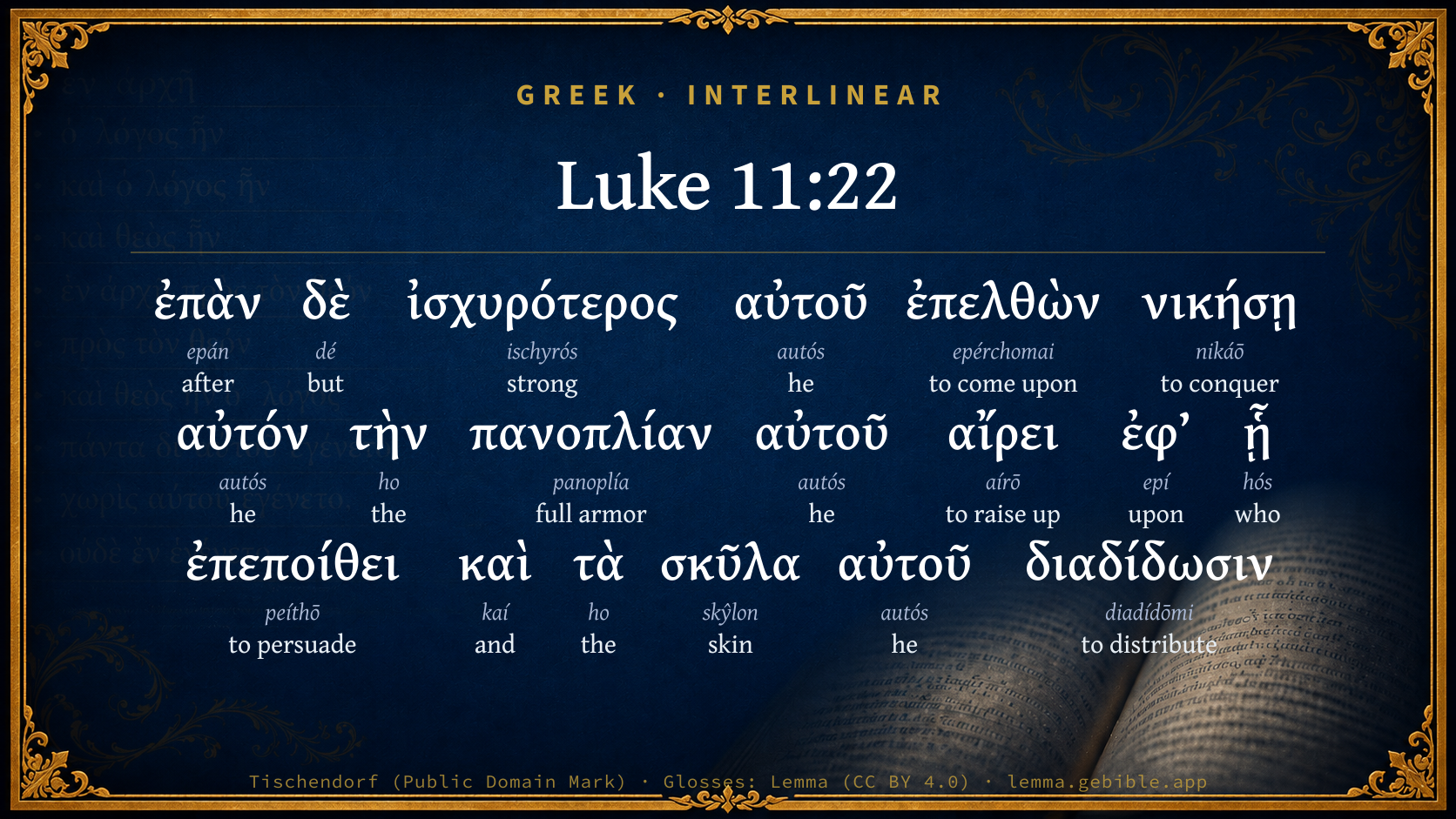
But when someone stronger attacks him and overcomes him, he takes from him his whole armor in which he trusted, and divides his spoils.
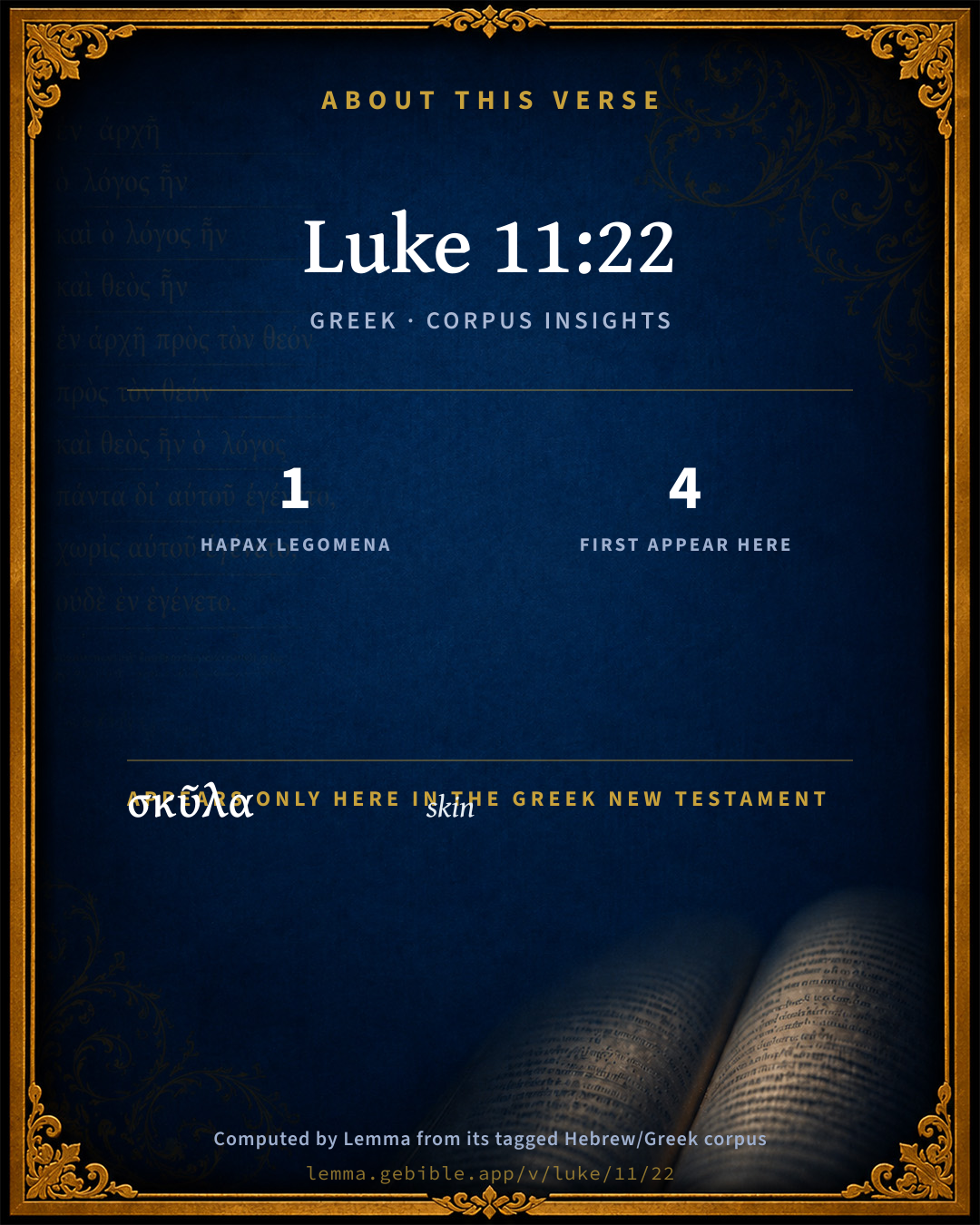
- 1 hapax legomenon — only here in the Greek New Testament
- 4 first appearances in the Greek New Testament
Download a study sheet
One document with this verse’s original text, its word-by-word gloss line, the meaning frame, cross-references with their text, attributed commentary, and full source and license credits — printable, and it pastes into notes with its structure intact.
This verse Autodidact and up
A passage Seminary Student
Up to 50 verses in one chapter. A passage sheet keeps up to 6 commentary sources and 12 cross-references per verse, in the order this page ranks them, and says so on the sheet whenever that leaves anything out. Ask for a single verse and you get the Autodidact verse sheet above.
Everything on this page stays free to read, with no account — the sheet is a download of what is already on screen, not access to it.
Compare translations 3
The same verse in 3 English versions, stacked beneath the original-language interlinear above. Click any original word for its lexicon entry.
Each is an independent rendering of the whole verse — the interlinear is not word-aligned to these translations.
Highlighted words mark where these versions differ — a whole-verse word diff, not a word-by-word alignment.
-
World English Bible Public Domain
But when someone stronger attacks him and overcomes him, he takes from him his whole armor in which he trusted, and divides his spoils.
-
King James Version Public Domain
But when a stronger than he shall come upon him, and overcome him, he taketh from him all his armour wherein he trusted, and divideth his spoils.
-
unfoldingWord Literal Text CC BY-SA 4.0
but when a stronger than he attacks him, he will overcome him, take away his armor in which he trusted, and divide his spoils.
unfoldingWord Literal Text — © unfoldingWord, licensed CC BY-SA 4.0. Word-aligned USFM3 via Door43 (git.door43.org/unfoldingWord/en_ult).
Show all 19 translations
Every available English version of this verse, each an independent rendering of the whole verse.
-
World English Bible Public Domain
But when someone stronger attacks him and overcomes him, he takes from him his whole armor in which he trusted, and divides his spoils.
-
Berean Standard Bible Public Domain
But when someone stronger attacks and overpowers him, he takes away the armor in which the man trusted, and then he divides up his plunder.
-
Majority Standard Bible Public Domain
But when someone stronger attacks and overpowers him, he takes away the armor in which the man trusted, and then he divides up his plunder.
-
King James Version Public Domain
But when a stronger than he shall come upon him, and overcome him, he taketh from him all his armour wherein he trusted, and divideth his spoils.
-
American Standard Version (1901) Public Domain
but when a stronger than he shall come upon him, and overcome him, he taketh from him his whole armor wherein he trusted, and divideth his spoils.
-
Revised Version (1885) Public Domain
but when a stronger than he shall come upon him, and overcome him, he taketh from him his whole armour wherein he trusted, and divideth his spoils.
-
Geneva Bible (1599) Public Domain
But when a stronger then hee, commeth vpon him, and ouercommeth him: hee taketh from him all his armour wherein he trusted, and deuideth his spoiles.
-
Douay-Rheims (1899) Public Domain
But if a stronger than he come upon him, and overcome him; he will take away all his armour wherein he trusted, and will distribute his spoils.
-
Young's Literal Translation Public Domain
but when the stronger than he, having come upon `him', may overcome him, his whole-armour he doth take away in which he had trusted, and his spoils he distributeth;
-
Literal Standard Version CC BY-SA 4.0
but when the stronger than he, having come on [him], may overcome him, he takes away his whole armor in which he had trusted, and he distributes his spoils;
-
Unlocked Literal Bible CC BY-SA 4.0
but when a stronger man overcomes him, the stronger man takes away the armor from the man, and plunders the man's possessions.
-
unfoldingWord Literal Text CC BY-SA 4.0
but when a stronger than he attacks him, he will overcome him, take away his armor in which he trusted, and divide his spoils.
-
Darby Bible Public Domain
but when the stronger than he coming upon [him] overcomes him, he takes away his panoply in which he trusted, and he will divide the spoil [he has taken] from him.
-
World Messianic Bible Public Domain
But when someone stronger attacks him and overcomes him, he takes from him his whole armor in which he trusted, and divides his plunder.
-
Webster's Bible Public Domain
But when a stronger than he shall come upon him, and overcome him, he taketh from him all his armor in which he trusted, and divideth his spoils.
-
Free Bible Version CC BY-SA 4.0
But if a stronger man comes and defeats him, taking from him all his weapons that he depended on, then he can carry off all his possessions.
-
Bible in Basic English Public Domain
But when one who is stronger makes an attack on him and overcomes him, he takes away his instruments of war, in which he had put his faith, and makes division of his goods.
-
Text-Critical English NT CC BY 4.0
But when a stronger man attacks and overpowers him, he takes away all the armor in which the man trusted and then distributes the plunder.
-
Tyndale New Testament (1534) Public Domain
But when a stronger then he cometh vpo him and overcometh him: he taketh from him his harnes wherin he trusted and devideth his gooddes.
Literal Standard Version (2020), Covenant Press — licensed CC BY-SA 4.0. Text via the HelloAO Bible API (eBible.org). Unlocked Literal Bible (unfoldingWord) — licensed CC BY-SA 4.0. Text via the HelloAO Bible API (eBible.org). unfoldingWord Literal Text — © unfoldingWord, licensed CC BY-SA 4.0. Word-aligned USFM3 via Door43 (git.door43.org/unfoldingWord/en_ult). Free Bible Version, Dr. Jonathan Gallagher — licensed CC BY-SA 4.0. Text via the HelloAO Bible API (eBible.org).
Word by word
More ways to search: Search by grammar → Find every occurrence → Compare this word →
Practice this passage: Drill this verse → Learn its vocabulary →
- Appears 1× in the Greek New Testament
- First appears here
- Part of Speech
- Noun
- Case
- Accusative
- Number
- Plural
- Gender
- Neuter
Full Thayer's Definition
- ἐπὰν epán G1875 “after” Conjunction
- δὲ dé G1161 “but” Conjunction
- ἰσχυρότερος ischyrós G2478 “strong” Adjective, Nominative, Singular, Masculine, Comparative
- αὐτοῦ autós G846 “he” Personal pronoun, Genitive, Singular, Masculine
- ἐπελθὼν epérchomai G1904 “to come upon” Verb, Aorist, Active, Participle, Nominative, Singular, Masculine
- νικήσῃ nikáō G3528 “to conquer” Verb, Aorist, Active, Subjunctive, 3rd person, Singular
- αὐτόν autós G846 “he” Personal pronoun, Accusative, Singular, Masculine
- τὴν ho G3588 “the” Article, Accusative, Singular, Feminine
- πανοπλίαν panoplía G3833 “full armor” Noun, Accusative, Singular, Feminine
- αὐτοῦ autós G846 “he” Personal pronoun, Genitive, Singular, Masculine
- αἴρει aírō G142 “to raise up” Verb, Present, Active, Indicative, 3rd person, Singular
- ἐφ’ epí G1909 “upon” Preposition
- ᾗ hós G3739 “who” Relative pronoun, Dative, Singular, Feminine
- ἐπεποίθει peíthō G3982 “to persuade” Verb, Pluperfect, Active, Indicative, 3rd person, Singular
- καὶ kaí G2532 “and” Conjunction
- τὰ ho G3588 “the” Article, Accusative, Plural, Neuter
- σκῦλα skŷlon G4661 “skin” Noun, Accusative, Plural, Neuter
- αὐτοῦ autós G846 “he” Personal pronoun, Genitive, Singular, Masculine
- διαδίδωσιν diadídōmi G1239 “to distribute” Verb, Present, Active, Indicative, 3rd person, Singular
About this verse
These counts appear in no published source. They are computed here, from the morphology-tagged text and Lemma’s own curated glosses. What Lemma adds →
- 19
- words
- 15
- distinct lemmas
- Gospels
- section
Notable vocabulary
1 hapax legomenon — a word that appears only here in the entire Greek New Testament:
- σκῦλα skin G4661
First appearance in Scripture
These words make their first canonical appearance in the Greek New Testament here:
Shared distinctive vocabulary
ἐπὰν after G1875 occurs in 3 verses of the Greek New Testament. Also found in:
Cross-references
9Topical passages linked to Luke 11:22 in the Treasury of Scripture Knowledge — connected by theme and wording, ordered by reader-vote popularity; previews shown in the World English Bible.
- Isaiah 49:24–25 Shall the prey be taken from the mighty, or the lawful captives be delivered?
- Isaiah 53:12 Therefore will I divide him a portion with the great, and he shall divide the spoil with the strong; because he poured out his soul to death, and was numbered with the transgressors: yet he bore the sin of many, and made intercession for the transgressors.
- Genesis 3:15 I will put enmity between you and the woman, and between your offspring and her offspring. He will bruise your head, and you will bruise his heel."
- Colossians 2:15 having stripped the principalities and the powers, he made a show of them openly, triumphing over them in it.
- 1 John 3:8 He who sins is of the devil, for the devil has been sinning from the beginning. To this end the Son of God was revealed, that he might destroy the works of the devil.
- 1 John 4:4 You are of God, little children, and have overcome them; because greater is he who is in you than he who is in the world.
- Isaiah 27:1 In that day Yahweh with his hard and great and strong sword will punish leviathan the swift serpent, and leviathan the crooked serpent; and he will kill the monster that is in the sea.
- Isaiah 63:1–4 Who is this who comes from Edom, with dyed garments from Bozrah? this who is glorious in his clothing, marching in the greatness of his strength? I who speak in righteousness, mighty to save.
- Revelation 20:1–3 I saw an angel coming down out of heaven, having the key of the abyss and a great chain in his hand.
Cross-references courtesy of OpenBible.info (CC BY 4.0).
Lesson kit
Teaching starters — assembled from the data on this page, not authored interpretation. Every prompt links to the verse data it draws on. Edit before teaching.
Luke, in the Gospels, opens this verse with 19 words (15 distinct Greek lemmas). Its most distinctive word is skŷlon (“skin”). A historical commentator’s framing appears above. Read the whole chapter for the surrounding context.
Discussion questions
- The word skŷlon carries the sense “skin.” How does it shape the verse?
- 1 word here appears nowhere else in the Greek New Testament. Why might the author reach for such rare wording?
- 4 words make their first appearance in Scripture here. What does this debut establish?
- How does Matthew 2:8, which shares the word «after», read alongside this verse?
- What does the repetition of “he” (4× in this one verse) do in this verse?
- The translations on this page render this verse differently — a whole-verse word diff, not a word-by-word alignment. What might account for the different wordings?
- Compare how Bengel's Gnomon and Expositor's Greek Testament read this verse. Where do they agree or differ?
Things to notice
- 1 word in this verse appears nowhere else in the Greek New Testament.
- 4 words make their first canonical appearance in Scripture here.
- These translations choose different wording for 21 words in this verse.
- “he” occurs 4× in this single verse.
- 15 distinct Greek lemmas span 19 words in this verse.
Commentary
Notes on Luke 11:22 from classic Christian and Jewish commentators (each source and its license shown beneath its notes). The classic Christian expositions comment on the surrounding passage and are grouped to its opening verse, so a note may address several verses; the Jewish commentaries on the Tanakh (Rashi and others) are per-verse, so they appear only where the commentator wrote on this verse.
Lemma curates 59 commentaries, every one of them public domain or Creative Commons licensed, each selected and text-cleaned for this edition rather than reprinted as found. About our sources →
Bengel's Gnomon
Johann Albrecht Bengel
Bengel's Gnomon of the New Testament — English translation (T&T Clark, Edinburgh, 1860) — public domain. Text from a community e-Sword module.
Expositor's Greek Testament
ed. W. Robertson Nicoll
The Expositor's Greek Testament, edited by W. Robertson Nicoll (1897–1910) — public domain. Text from a community e-Sword module.
Jamieson, Fausset & Brown
Robert Jamieson, A. R. Fausset & David Brown
Jamieson, Fausset & Brown — Commentary Critical and Explanatory on the Whole Bible (1871) — public domain (CC PDM 1.0). Text via the HelloAO Bible API.
The Cambridge Bible for Schools and Colleges
gen. ed. J. J. S. Perowne
The Cambridge Bible for Schools and Colleges (gen. ed. J. J. S. Perowne; Cambridge University Press, 1878–1918) — public domain. Text from a community e-Sword module.
John Gill's Exposition
John Gill's Exposition of the Whole Bible (1746–1763) — public domain (CC PDM 1.0). Text via the HelloAO Bible API.
Cambridge Greek Testament for Schools and Colleges
Cambridge Greek Testament for Schools and Colleges (Cambridge University Press, 1896; 21 vols, various authors incl. Carr, Maclear, Plummer, Farrar, Lumby, Moule, M. R. James, Simcox) — public domain. Text from a community e-Sword module.
International Critical Commentary
International Critical Commentary — older volumes (1896–1929), various authors — public domain. Text from a community e-Sword module.
Vincent's Word Studies in the New Testament
Marvin R. Vincent
Marvin R. Vincent, Word Studies in the New Testament (1887–1900) — public domain. Text from a community e-Sword/MySword module.