
Luke 11:17

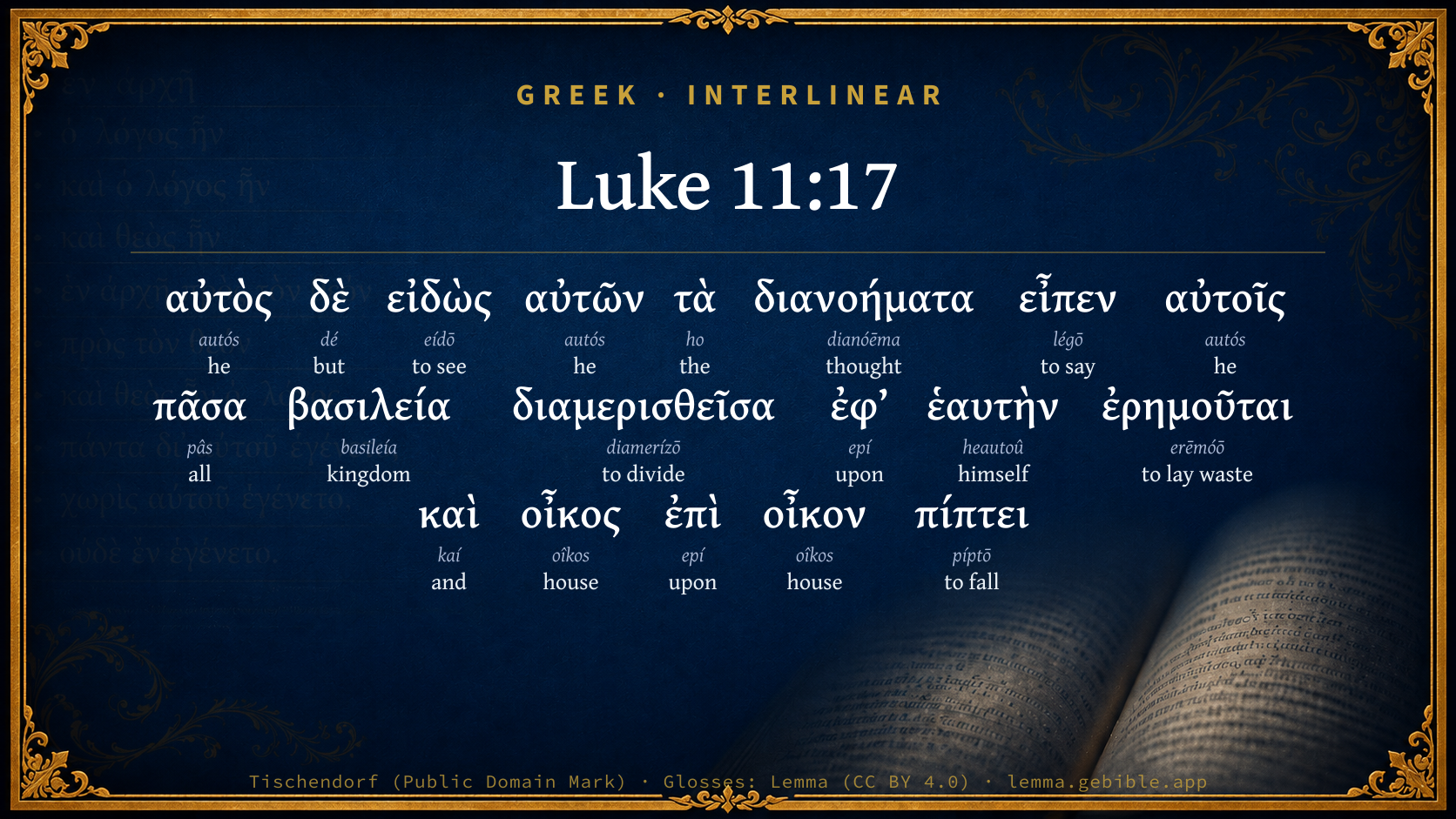
Greek (Tischendorf 8th ed.) Luke 11:17 appears in the Greek New Testament. The text above is from the Tischendorf 8th edition. Each word links to its Strong’s number and a concise gloss. Click any word for its full Thayer’s Greek Lexicon entry.
Download image
Cite this verse

Luke 11:17 (World English Bible). Public Domain. Lemma interlinear Bible study tool, https://lemma.gebible.app/v/luke/11/17.

Show BibTeX & RIS
BibTeX
RIS
English Translation
But he, knowing their thoughts, said to them, "Every kingdom divided against itself is brought to desolation. A house divided against itself falls.
World English Bible · Public Domain
Highlights
  • 1 hapax legomenon — only here in the Greek New Testament
  • 1 first appearance in the Greek New Testament
Full analysis ↓
Download a study sheet

One document with this verse’s original text, its word-by-word gloss line, the meaning frame, cross-references with their text, attributed commentary, and full source and license credits — printable, and it pastes into notes with its structure intact.

This verse Autodidact and up

Study sheet (.html) Plain text (.txt)

A passage Seminary Student

Up to 50 verses in one chapter. A passage sheet keeps up to 6 commentary sources and 12 cross-references per verse, in the order this page ranks them, and says so on the sheet whenever that leaves anything out. Ask for a single verse and you get the Autodidact verse sheet above.

Everything on this page stays free to read, with no account — the sheet is a download of what is already on screen, not access to it.

Want to remove ads? Support Godless Engineer
Compare translations 3

The same verse in 3 English versions, stacked beneath the original-language interlinear above. Click any original word for its lexicon entry.

Each is an independent rendering of the whole verse — the interlinear is not word-aligned to these translations.

Highlighted words mark where these versions differ — a whole-verse word diff, not a word-by-word alignment.

  • World English Bible Public Domain
    But he, knowing their thoughts, said to them, "Every kingdom divided against itself is brought to desolation. A house divided against itself falls.
  • King James Version Public Domain
    But he, knowing their thoughts, said unto them, Every kingdom divided against itself is brought to desolation; and a house divided against a house falleth.
  • unfoldingWord Literal Text CC BY-SA 4.0
    But he, knowing their thoughts, said to them, “Every kingdom divided against itself is made desolate, and house against house falls.

unfoldingWord Literal Text — © unfoldingWord, licensed CC BY-SA 4.0. Word-aligned USFM3 via Door43 (git.door43.org/unfoldingWord/en_ult).

Versions to compare (up to 4)

3 of 4 selected

Show all 19 translations

Every available English version of this verse, each an independent rendering of the whole verse.

  • World English Bible Public Domain
    But he, knowing their thoughts, said to them, "Every kingdom divided against itself is brought to desolation. A house divided against itself falls.
  • Berean Standard Bible Public Domain
    Knowing their thoughts, Jesus said to them, “Every kingdom divided against itself will be laid waste, and a house divided against a house will fall.
  • Majority Standard Bible Public Domain
    Knowing their thoughts, Jesus said to them, “Every kingdom divided against itself will be laid waste, and a house divided against a house will fall.
  • King James Version Public Domain
    But he, knowing their thoughts, said unto them, Every kingdom divided against itself is brought to desolation; and a house divided against a house falleth.
  • American Standard Version (1901) Public Domain
    But he, knowing their thoughts, said unto them, Every kingdom divided against itself is brought to desolation; and a house `divided' against a house falleth.
  • Revised Version (1885) Public Domain
    But he, knowing their thoughts, said unto them, Every kingdom divided against itself is brought to desolation; and a house divided against a house falleth.
  • Geneva Bible (1599) Public Domain
    But he knew their thoughts, and said vnto them, Euery kingdom deuided against it self, shall be desolate, and an house deuided against an house, falleth.
  • Douay-Rheims (1899) Public Domain
    But he seeing their thoughts, said to them: Every kingdom divided against itself, shall be brought to desolation, and house upon house shall fall.
  • Young's Literal Translation Public Domain
    And he, knowing their thoughts, said to them, `Every kingdom having been divided against itself is desolated; and house against house doth fall;
  • Literal Standard Version CC BY-SA 4.0
    And He, knowing their thoughts, said to them, “Every kingdom having been divided against itself is desolated; and house against house falls;
  • Unlocked Literal Bible CC BY-SA 4.0
    But Jesus knew their thoughts and said to them, “Every kingdom divided against itself is made desolate, and a house divided against itself falls.
  • unfoldingWord Literal Text CC BY-SA 4.0
    But he, knowing their thoughts, said to them, “Every kingdom divided against itself is made desolate, and house against house falls.
  • Darby Bible Public Domain
    But *he*, knowing their thoughts, said to them, Every kingdom divided against itself is brought to desolation: and a house set against a house falls;
  • World Messianic Bible Public Domain
    But he, knowing their thoughts, said to them, “Every kingdom divided against itself is brought to desolation. A house divided against itself falls.
  • Webster's Bible Public Domain
    But he, knowing their thoughts, said to them, Every kingdom divided against itself is brought to desolation; and a house divided against a house falleth.
  • Free Bible Version CC BY-SA 4.0
    Jesus knew what they were thinking and said, “Any kingdom divided against itself will collapse. A family divided against itself will fall.
  • Bible in Basic English Public Domain
    But he, having knowledge of their thoughts, said to them, Every kingdom in which there is division is made waste; and a house in which there is division comes to destruction.
  • Text-Critical English NT CC BY 4.0
    Knowing their thoughts, Jesus said to them, “Every kingdom divided against itself is laid waste, and a house divided against itself falls.
  • Tyndale New Testament (1534) Public Domain
    But he knewe their thoughtes and sayde vnto them: Every kingdome devided with in it silfe shalbe desolate: and one housse shall fall vpon another.

Literal Standard Version (2020), Covenant Press — licensed CC BY-SA 4.0. Text via the HelloAO Bible API (eBible.org). Unlocked Literal Bible (unfoldingWord) — licensed CC BY-SA 4.0. Text via the HelloAO Bible API (eBible.org). unfoldingWord Literal Text — © unfoldingWord, licensed CC BY-SA 4.0. Word-aligned USFM3 via Door43 (git.door43.org/unfoldingWord/en_ult). Free Bible Version, Dr. Jonathan Gallagher — licensed CC BY-SA 4.0. Text via the HelloAO Bible API (eBible.org).

Word by word

More ways to search: Search by grammar → Find every occurrence → Compare this word →

Practice this passage: Drill this verse → Learn its vocabulary →

διανοήματα
dianóēma
G1270
“thought”
Noun, Accusative, Plural, Neuter
Part of Speech
Noun
Case
Accusative
Number
Plural
Gender
Neuter
Full Thayer's Definition

Origin: from a compound of G1223 and G3539

TDNT: 20:08,6

1. a thought
  1. αὐτὸς autós G846 “he” Personal pronoun, Nominative, Singular, Masculine
  2. δὲ dé G1161 “but” Conjunction
  3. εἰδὼς eídō G1492 “to see” Verb, Perfect, Active, Participle, Nominative, Singular, Masculine
  4. αὐτῶν autós G846 “he” Personal pronoun, Genitive, Plural, Masculine
  5. τὰ ho G3588 “the” Article, Accusative, Plural, Neuter
  6. εἶπεν légō G3004 “to say” Verb, Aorist, Active, Indicative, 3rd person, Singular
  7. αὐτοῖς autós G846 “he” Personal pronoun, Dative, Plural, Masculine
  8. πᾶσα pâs G3956 “all” Adjective, Nominative, Singular, Feminine
  9. βασιλεία basileía G932 “kingdom” Noun, Nominative, Singular, Feminine
  10. διαμερισθεῖσα diamerízō G1266 “to divide” Verb, Aorist, Passive, Participle, Nominative, Singular, Feminine
  11. ἐφ’ epí G1909 “upon” Preposition
  12. ἑαυτὴν heautoû G1438 “himself” Reflexive pronoun, 3rd person, Accusative, Singular, Feminine
  13. ἐρημοῦται erēmóō G2049 “to lay waste” Verb, Present, Passive, Indicative, 3rd person, Singular
  14. καὶ kaí G2532 “and” Conjunction
  15. οἶκος oîkos G3624 “house” Noun, Nominative, Singular, Masculine
  16. ἐπὶ epí G1909 “upon” Preposition
  17. οἶκον oîkos G3624 “house” Noun, Accusative, Singular, Masculine
  18. πίπτει píptō G4098 “to fall” Verb, Present, Active, Indicative, 3rd person, Singular

About this verse

These counts appear in no published source. They are computed here, from the morphology-tagged text and Lemma’s own curated glosses. What Lemma adds →

19
words
15
distinct lemmas
Gospels
section

Notable vocabulary

1 hapax legomenon — a word that appears only here in the entire Greek New Testament:

  • διανοήματα thought G1270

First appearance in Scripture

This word makes its first canonical appearance in the Greek New Testament here:

  • διανοήματα thought G1270

Shared distinctive vocabulary

ἐρημοῦται to lay waste G2049 occurs in 5 verses of the Greek New Testament. Also found in:
Repetition

Words recur within this verse:

  • ἐφ’ upon G1909 ×2
  • οἶκος house G3624 ×2
  • αὐτὸς he G846 ×3

Cross-references

9

Topical passages linked to Luke 11:17 in the Treasury of Scripture Knowledge — connected by theme and wording, ordered by reader-vote popularity; previews shown in the World English Bible.

  • Mark 3:23–27 He summoned them, and said to them in parables, "How can Satan cast out Satan?
  • Matthew 12:25–29 Knowing their thoughts, Jesus said to them, "Every kingdom divided against itself is brought to desolation, and every city or house divided against itself will not stand.
  • Isaiah 19:2–3 I will stir up the Egyptians against the Egyptians: and they shall fight everyone against his brother, and everyone against his neighbor; city against city, [and] kingdom against kingdom.
  • Isaiah 9:20–21 One shall snatch on the right hand, and be hungry; and he shall eat on the left hand, and they shall not be satisfied: they shall eat every man the flesh of his own arm:
  • John 2:25 and because he didn't need for anyone to testify concerning man; for he himself knew what was in man.
  • 2 Chronicles 10:16–19 When all Israel saw that the king didn't listen to them, the people answered the king, saying, What portion have we in David? neither have we inheritance in the son of Jesse: every man to your tents, Israel: now see to your own house, David. So all Israel departed to their tents.
  • 2 Chronicles 13:16–17 The children of Israel fled before Judah; and God delivered them into their hand.
  • Matthew 9:4 Jesus, knowing their thoughts, said, "Why do you think evil in your hearts?
  • Revelation 2:23 I will kill her children with Death, and all the assemblies will know that I am he who searches the minds and hearts. I will give to each one of you according to your deeds.

Cross-references courtesy of OpenBible.info (CC BY 4.0).

Commentary

Notes on Luke 11:17 from classic Christian and Jewish commentators (each source and its license shown beneath its notes). The classic Christian expositions comment on the surrounding passage and are grouped to its opening verse, so a note may address several verses; the Jewish commentaries on the Tanakh (Rashi and others) are per-verse, so they appear only where the commentator wrote on this verse.

Lemma curates 59 commentaries, every one of them public domain or Creative Commons licensed, each selected and text-cleaned for this edition rather than reprinted as found. About our sources →

The Biblical Illustrator

Joseph S. Exell

Luk_11:17-20

Every kingdom divided against itself is brought to desolation

The power of the King over the arch-enemy

I.

THE CONDITION OF THE SINNER. What a condition it is! It is summed up in that twenty-first verse, When the strong man armed keepeth his palace his goods are in peace. I will ask you to notice the five particulars here specified in that proud usurpers dominion--First, his personality; second, his power; third, his panoply; fourth, his palace; fifth, his peace.

II. THE POWER OF THE SAVIOUR. Satan is strong, but the Divine Master is stronger. Upon that citadel the Lord Christ does not hesitate to advance. Man-soul is summoned. He effects an entrance, and more than that, He achieves the victory. He shall not only come upon him, but overcome him. And then a mighty transformation takes place in the soul of the believer. He divides the spoil. The faculties of the man are not to be destroyed; they are to be altered. What shall we say to it? Whatever it is, it teaches us that the whole powers of the restored man are to be laid at the feet of this Saviour. Mark what is said concerning Satan: that he keeps his gates in peace. Blessed be God, when the transformation is effected, a greater, stronger one than he is also able to keep His gates in peace.

III. I close with one word of WARNING. You know that warning word. He goes on immediately to say, He that is not with Me is against Me, and he that gathereth not with Me scattereth abroad. He is saying to us, Beware of compromise; beware of half-and-half work in this matter of full surrender of your being to Him. What does He mean? I will endeavour by a story to illustrate what He says. Some years ago there was a rich man who possessed the whole of the town in which he lived, with the exception of one poor, small, and dirty hovel. He was greatly minded to possess the whole. He asked the price. The poor man, miserly and cunning, probably asked an exorbitant sum. It is too much, said the would-be purchaser; but I will tell you what I will do--I will cover this table with sovereigns. No, said the other; no, I must have them on end! It is too much, said the purchaser. No, said the other, I must have them on end; and so the bargaining went on, until the would-be purchaser gave up the business. As he left the room, the miser, looking at him with a leer on his face, said, Remember I the town belongs to thee and me. My dear brethren, Satan, if I may so express it, made a harder bargain with the Captain of our salvation than did that miser. We are redeemed, not with corruptible things as silver and gold, but with the blood of Christ. Shall it ever be that that cruel enemy shall come up to our Lord, and, pointing to the citadel of your or my heart, shall say, Remember, the town belongs to me and Thee. But is there no lesson in that passage which follows? When the unclean spirit is gone out of a man he walketh through dry places, seeking rest, but findeth none, and if he can find in you and me a foothold he will use it. It is my house, he says, and he comes back again; he comes seeking admission, and if he finds a place in our citadel he occupies it. He may be cast out as an unclean spirit, but he may return transformed as an angel of light, but an unclean spirit still. Is there no danger of this? I believe there is. Take heed that ye be not deceived. What is the remedy? I only know of one. It is to be God-possessed. It is to let that flag of Calvary float from roof to turret. It is to let God be in possession. Light expels darkness, health expels disease, God turns out Satan. (E. W. Moore.)

The personality and power of the devil

I. SATAN IS A PERSON. See how he is described. He is a man, active, intelligent, resolute, understanding his position, prepared to hold his own against all comers, to maintain his place at all hazards. Could there be anything more exactly in harmony with the purposes and designs of the arch-adversary than that he should circulate a report that he does not exist? I remember years ago the late Rev-Canon Conway saying that, if a gang of housebreakers came into a neighbourhood, could there be any possible report more suited to their purposes than an announcement, which was generally believed, that there were no such persons as burglars, that if robberies occurred, or lives were lost, it was due exclusively to the folly and misguided character of the inmates of the houses, but that no blame could be attributed to housebreakers, for no such persons existed?

II. But we will pass on to notice from his personality, his POWER. He is not only a man, but he is a strong man. My brethren, no good soldier despises his enemy. Satan is not a hobgoblin of the nursery, as some one has said--an easy name that we can utter in jest. Satan is a terrible being. Have you not experienced his power? I doubt not that I speak to hundreds who have. If you let him alone, it is most probable he will let you alone too. If you be in the attitude of hostility to him you will soon find out his power. In the fifth chapter of Marks Gospel you will see the power of the demoniac, and the power which held that man. His power is backed by his panoply. You have it here; he is not only strong, but he is a strong man armed. He is not content with his own strength, so to speak, for the defence of his citadel, but he arms the poor citadel with defensive armour--the helmet of presumption, and the breastplate of pride, and the net-work shield of unbelief, and the coated mail of secret sin, and the fiery darts of venom and spite, and envy, and lust, and greed, which he hurls against all intruders. A palace is a dwelling-place for kings. Whose is this palace? What is this dwelling? My brethren, have we fully realized that you and I were intended to be nothing else than residences of Deity? Have we fully grasped the great thought that this is the culmination of Gods dealing with us? Does God now till His peoples hearts with joy and the Holy Ghost? Satan can fill the heart of Ananias to lie to the Holy Ghost. The parallel is complete. Do you believe in haunted houses, ghost stories, and spectres with clanking chains? They may be fables, but there is terrible and solemn truth behind them. Has it ever occurred to you and me that unless thin night we are possessed of God, as we sit in this room we are haunted houses--h-uses in which the devils live. It is one of the most startling descriptions that Scripture gives of the condition of the sinner, that Satan is not merely near him; Satan is in him. What an awful word is that in Luk_22:3, where we read that Satan entered into Judas surnamed Iscariot, being of the number of the twelve. What is this, a human being the house of an evil one? Every man can do what he will in his own house. An Englishmans house is his castle. What is this description that is given? Why, that Satan reigns and rules in the human heart of his slaves; that he goes in and out; that he opens and no man shuts, and shuts and no man opens. What an awful description! and the most remarkable thing about it all is the particulars with which it closes. While the strong man armed keepeth his palace, his goods are in peace. What peace? Peace, yes there is peace. It is the peace of death! Is that the peace that you and I desire? Only some half-hour ago, I heard a lady who had been travelling in the Riviera, the scene of the late earthquakes, say that before the rumble which brought the terrible disaster she felt that there was a stillness, a solemn stillness. It seemed as if nature held its breath; it seemed unnatural; it was unnatural; it was a presage of the coming storm. And this deadly slumber in which souls are left by the prince of darkness--slumber indeed, and peace-like it is--is a presage of the terrible awakening of the storm that shall burst some day upon a guilty world. (E. W. Moore.)

Jesus refutes the Pharisees

How concisely and forcibly does He express His argument! It is impossible to exhibit it in a rare striking manner. But, though it cannot be improved, it may, however, be otherwise stated. Thus, it presupposes absolute impossibilities in the character of Satan:

1. In the motives which influence him. For he is supposed, first, to wish to extend his power, and then to undermine it.

2. In the means which he employs, which are thereby calculated for accomplishing opposite purposes.

3. In the objects which he has in view, which presuppose a desire to do good and to do evil at the same time. These contradictions are happily expressed by our Saviour when He represents Satan casting out Satan, and divided against himself: in other words, as possessing two opposite characters, or forming two persons with contrary qualities. (J. Thomson, D. D.)

Divided against itself

If two ships at sea, being of one and the same squadron, shall be scattered by storm from each other, how shall they come to the relief of each other? If, again, they clash together and fall foul, how shall the one endanger the other and herself too? It was, of old, the Dutch device of two earthen pots swimming upon the water, with this motto, If we knock together, we sink together. And most true it is, that if spleen or discontent set us too far one from another, or choler or anger bring us too near, it cannot but that intendment or design, whatsoever it be, like Jonahs gourd, shall perish in a moment, especially if the viperous and hateful worm of dissension do but smite it. (Spencer.)

The Biblical Illustrator, edited by Joseph S. Exell (c. 1880s–1900s) — public domain. Text from a community e-Sword module.

Tyndale Open Study Notes

Tyndale Open Resources

11:17 He knew their thoughts: See 5:22; 7:40; 9:47. • Any kingdom divided by civil war: Jesus’ first response to the accusation was that he could not be working for Satan; he was tearing down Satan’s kingdom by casting out demons.

Tyndale Open Study Notes — © Tyndale Open Resources, licensed CC BY-SA 4.0. Text via the HelloAO Bible API.

Bengel's Gnomon

Johann Albrecht Bengel

Luk 11:17. Οἶκος, a house, or family).—ἐπὶ οἶκον, upon the house [super domum]) That is to say, A house divided upon (against) itself falleth, Mar 3:25.[108] The noun is put for the reciprocal or reflexive pronoun, ἑαυτόν. Mat 12:26; Act 3:16; Eph 4:16; 2Ti 1:18, where see the note. LXX. Lev 14:15; Num 10:29.

[108] Vulg. translates, Regnum in se ipsum (or Cod. Amiat. ipso) divisum desolatur, et domus supra domum cadet (cadit).—ED. and TRANSL.

Bengel's Gnomon of the New Testament — English translation (T&T Clark, Edinburgh, 1860) — public domain. Text from a community e-Sword module.

Expositor's Greek Testament

ed. W. Robertson Nicoll

Luk 11:17-23 . The Beelzebub theory (Mat 12:25-30 , Mar 3:23-27 ).

Luk 11:17 . διαμερισθεῖσα . Lk. has a preference for compounds; μερισθεῖσα in Mt. καὶ οἶκος ἐπὶ οἶκον πίπτει , and house falls against house, one tumbling house knocking down its neighbour, a graphic picture of what happens when a kingdom is divided against itself. In Mt. kingdom and city are two co-ordinate illustrations of the principle. In Mk. a house takes the place of Mt.’s city. In Lk. the house is simply a feature in the picture of a kingdom ruined by self-division. Some ( e.g. , Bornemann and Hahn) render Lk.’s phrase: house upon house, one house after another falls. Others, in a harmonistic interest, interpret: a house being divided ( διαμερισθεὶς understood) against itself ( ἐπὶ οἶκον = ἐφʼ ἑαυτὸν ) falls.

The Expositor's Greek Testament, edited by W. Robertson Nicoll (1897–1910) — public domain. Text from a community e-Sword module.

Godet's Commentaries

Frédéric Louis Godet

2 d. The First Discourse: Luk 11:17-26.

It is divided into two parts: Jesus refutes this blasphemous explanation of His cures (Luk 11:17-19); He gives their true explanation (Luk 11:20-26).

Vers. 17-19.—“But He, knowing their thoughts, said unto them: Every kingdom divided against itself is brought to desolation; and one house falls upon another. Luk 11:18. If Satan also be divided against himself, how shall his kingdom stand? because ye say that I cast out devils through Beelzebub. Luk 11:19. And if I by Beelzebub cast out devils, by whom do your sons cast them out? therefore shall they be your judges.”

In Luk 11:17-18 Jesus appeals to the common sense of His hearers; it is far from natural to suppose that the devil would fight against himself. It is true, it might be rejoined that Satan drove out his underlings, the better to accredit Him as his Messiah. Jesus does not seem to have referred to this objection. In any case, the sequel would answer it; the devil can remove the diabolical spirit, but not replace it by the Holy Spirit. Διανοήματα, their thoughts, denotes the wicked source concealed behind such words (Luk 11:15-16). The words, “And one house falls upon another,” appear to be in Luke the development of the ἐρημοῦται, is brought to desolation: the ruin of families, as a consequence of civil discord. In Matthew and Mark they evidently include a new example, parallel to the preceding one. This sense is also admissible in Luke, if we make the object ἐπὶ οἶκον depend, not on πίπτει, but on διαμερισθείς...: “And likewise a house divided against a house falls.”

The εἰ δὲ καί, Luk 11:18, here signifies, and entirely so if...In the appendix, because ye say, there is revealed a deep feeling of indignation. This emphatic form recalls that of Mark (Mar 3:30): “Because they said, He hath an unclean spirit.” The two analogous terms of expression had become fixed in the tradition (comp. Luk 5:24 and parall.; see also on 12, Luk 1:18); but their form is sufficiently different to prove that the one evangelist did not copy from the other.

By this first reply Jesus has simply enlisted common sense on His side. He now thrusts deeper the keen edge of His logic, Luk 11:19. If the accusation raised against Him is wellfounded, His adversaries must impute to many of the sons of Israel the same compact with Satan. We know from the N. T. and Josephus, that there were at that time numerous Jewish exorcists who made a business of driving out devils for money (Act 19:13: “Certain of the vagabond Jews, exorcists...” Comp. Josephus, Antiq. 8.2. 5). The Talmud also speaks of those exorcists, who took David, healing Saul by his songs, as their patron, and Solomon as the inventor of their incantations: “They take roots, fumigate the patient, administer to him a decoction, and the spirit vanishes” (Tauch. f. 70, 1). Such are the persons whom Jesus designated by the expression, your sons. Several Fathers have thought that He meant His own apostles, who also wrought like cures; but the argument would have had no value with Jews, for they would not have hesitated to apply to the cures wrought by the disciples the explanation with which they had just stigmatized those of the Master. De Wette, Meyer, and Neander give to the word sons the meaning which it has in the expression sons of the prophets, that of disciples. But is it proved that those exorcists studied in the Rabbinical schools? Is it not simpler to explain the term your sons in this sense: “Your own countrymen,—your flesh and blood,—whom you do not think of repudiating, but from whom, on the contrary, you take glory when they perform works of power similar to mine; they do not work signs in the heavens, and yet you do not suspect their cures. They shall confound you therefore before the divine tribunal, by convicting you of having applied to me a judgment which you should with much stronger reason have applied to them.” In reality, what a contrast was there between the free and open strife which Jesus maintained with the malignant spirits whom He expelled, and the suspicious manipulations in which those exorcists indulged! between the entire physical and moral restoration which His word brought to the sick who were healed by Him, and the half cures, generally followed by relapses, which they wrought! To ascribe the imperfect cures to God, and to refer the perfect cures to the devil—what logic!

Frédéric Louis Godet — Commentaries on Luke, John, Romans, and 1 Corinthians — English translation (T&T Clark, Edinburgh, 1870s–1890s) — public domain. Text from a community e-Sword module.

Geneva Bible (1599)

Geneva Bible translators

The true way to know the true Christ, from the false, is this, that the true Christ hath no accord or agreement with Satan: And it remaineth that after we know him, we acknowledge him.

Geneva Bible (1599) marginal notes — public domain. Text via Bolls.life.

Ellicott's Commentary for English Readers

(17-23) But he, knowing their thoughts.—St. Luke seems here to bring together into one narrative two incidents which in St. Matt. (Mat_9:32; Mat_12:22) appear as separated. The points of resemblance, the dumbness in both cases, both followed by the whisper that Jesus cast out devils by Beelzebub, may have easily led one who collected the facts some years after they occurred to regard the two as identical. On the general tenor of the passage, see Notes on Mat_12:24-30.

A Bible Commentary for English Readers, edited by Charles John Ellicott (1878–1897) — public domain. Text from a community e-Sword module.

The Cambridge Bible for Schools and Colleges

gen. ed. J. J. S. Perowne

17. their thoughts] Rather, their machinations.

Every kingdom divided against itself &c.] More briefly and graphically in St Mark “How can Satan cast out Satan?”

and a house divided against a house falletli] The words may also be rendered ‘and (in that case) house falleth against house.’

The Cambridge Bible for Schools and Colleges (gen. ed. J. J. S. Perowne; Cambridge University Press, 1878–1918) — public domain. Text from a community e-Sword module.

John Gill's Exposition

And if Satan also be divided against himself, how shall his kingdom stand?.... This is the accommodation of the above parables, or proverbial sentences; suggesting, that Satan must be against himself, if what the Pharisees said was true; and consequently, his kingdom and government, could not long subsist:

because ye say that I cast out devils through Beelzebub; which is all one as to say, that Satan is divided against himself, which is not reasonable to suppose; See Gill on Mat 12:26 and See Gill on Mar 3:26.

John Gill's Exposition of the Whole Bible (1746–1763) — public domain (CC PDM 1.0). Text via the HelloAO Bible API.

Trapp's Complete Commentary

John Trapp

17 But he, knowing their thoughts, said unto them, Every kingdom divided against itself is brought to desolation; and a house divided against a house falleth.

Ver. 17. See Mat 12:38; Mat 16:1; Mar 3:24.

John Trapp, A Commentary or Exposition upon All the Books of the Old and New Testament (1647–1656) — public domain. Text from a community e-Sword module.

Haydock's Catholic Bible Commentary

And house upon house shall fall. He speaks of a house or family divided, which thereby shall fall to ruin. (Witham)

George Leo Haydock (1774–1849), Haydock's Catholic Family Bible and Commentary, 1859 edition — public domain. Excludes Psalms (Douay-Rheims chapter numbering differs from Protestant) and Deuterocanonical books (Catholic canon only).

John Wesley's Explanatory Notes

A house - That is, a family.

John Wesley, Explanatory Notes Upon the Whole Bible (1754–1765) — public domain. Text via the GEBible commentary corpus.

Kretzmann's Popular Commentary

Paul E. Kretzmann

Christ’s defense:

v. 17. But He, knowing their thoughts, said unto them, Every kingdom divided against Itself is brought to desolation; and a house divided against a house falleth.

v. 18. If Satan also be divided against himself, how shall his kingdom stand? Because ye say that I cast out devils through Beelzebub.

v. 19. But if I by Beelzebub cast out devils, by whom do your sons cast them out? Therefore shall they be your judges.

v. 20. But if I with the finger of God cast out devils, no doubt the kingdom of God is come upon you.

v. 21. When a strong man armed keepeth his palace, his goods are in peace;

v. 22. but when a stronger than he shall come upon him and overcome him, he taketh from him all his armor wherein he trusted, and divideth his spoils.

v. 23. He that is not with Me is against Me; and he that gathereth not with Me scattereth.

See Mat 12:25-30; Mar 3:23-27. Jesus, by His divine omniscience, knew the thoughts of His enemies, even though He did not hear them, and proceeds to give them a line of argument that leaves them and their slanderous blasphemy in well-deserved disgrace. Every kingdom that is divided against itself is destroyed: the natural result of revolution is dissolution. And, under those circumstances, one house will fall against the next, one tumbling house knocking down its neighbor, and so everything be drawn into the general desolation. This fact being universally acknowledged as in harmony with the experience of mankind, the application to the present situation is easily made. If Jesus be in league with the prince of the devils, and yet cast out devils to their own harm and disgrace, then it follows that there is a division in the kingdom of the devil, and how will his kingdom then stand? Then there is another argument. If that accusation were true and the power of Jesus over the demons were derived from Satan, how were they going to explain the fact that their own sons, their disciples, were acting as exorcists, going about through the country and attempting to cast out devils? See Act 19:13-14. By insisting upon their explanation of Christ’s ability, they were condemning themselves, their own disciples becoming their judges. But, on the other hand, if the miracles of casting out devils which Jesus performed were due to the finger of God, the power of God which was necessary in true exorcising, it was an incontrovertible proof that in and with Christ, the Prophet of Nazareth, the kingdom of God had reached them, come upon them. In His person and in His message they had the means of obtaining everlasting life if they would but accept the grace of God. In a kindly, but comprehensive way Jesus now tries to show His audience what His coming into the world signified and included, so far as the rule of Satan was concerned. The latter, indeed, was a strong and mighty spirit, and was at all times fully armed, guarding his court, his palace, his castle, with all his power. For he is the prince of this world and has his work in the children of unbelief. And up till now he had held his own in peace, without any trouble to speak of; all his subjects had been willing and obedient. But now the Stronger one had come, in the person of Jesus of Nazareth, the promised Messiah. He came upon the devil and vanquished him. And not only that, but He reduced him to utter subjection and helplessness by taking from him his panoply, his armor, his practically unlimited power in which he placed his trust, and dividing the spoils among His own followers, Col 2:15. But these spoils, victory over death and the devil, belong only to such as have chosen this Champion as their own Lord; for those that are not with Christ, on His side, taking His part at all times, are against Him and must be reckoned with His enemies; and he that is not working with Him in every respect must be considered as belonging to those that disperse and scatter the fruit of His ministry and labor.

Paul E. Kretzmann, Popular Commentary of the Bible (1921–1924) — public domain. Text from a community e-Sword module.

Cambridge Greek Testament for Schools and Colleges

17. αὐτῶν τὰ διανοήματα. ‘Their machinations.’

πᾶσα βασιλεία ἐφ’ ἑαντὴν διαμερισθεῖσα. More briefly and graphically in St Mark “How can Satan cast out Satan?”

καὶ οἶκος ἐπὶ οἶκον. The words may be rendered ‘and (in that case) house falleth against house.’ Comp. Thuc. II. 84, ναῦς τε νηΐ προσέπιπτε. The words might also be rendered “and house after house falls” (Bucer).

Cambridge Greek Testament for Schools and Colleges (Cambridge University Press, 1896; 21 vols, various authors incl. Carr, Maclear, Plummer, Farrar, Lumby, Moule, M. R. James, Simcox) — public domain. Text from a community e-Sword module.

Alford’s Greek Testament

Henry Alford

17. εἰδώς] So Matt. also, ver. 25.

οἶκ. ἐπὶ οἶκ.] The ordinary rendering and house (divided) against house, falleth, is certainly right. Before Meyer charged this interpretation with having entirely arisen out of harmonistic considerations, he should have ascertained whether such an expression as a kingdom falling οἶκος ἐπὶ οἶκον is even tolerable. The ruling idea of the saying having been given by the βασ. ἐφʼ ἑαυτήν, the emphatic pronoun need not be expressed again. Similarly we have, 1Co 2:11, τίς οἶδεν ἀνθρώπων τὰ τοῦ ἀνθρώπου, εἰ μὴ τὸ πν. τοῦ ἀνθρώτου τὸ ἐν αὐτῷ; the ὁ ἄνθρ. being the same throughout.

Henry Alford, The Greek Testament (1849–1861) — public domain. Text from a community e-Sword module.

International Critical Commentary

17. τὰ διανοήματα. “Thoughts,” not “machinations,” a meaning which the word nowhere has. Here only in N.T., but freq in LXX and classical: Pro 14:14, Pro 14:15:24; Isa 55:9; Eze 14:3, Eze 14:4; Plat. Prot. 348 D; Sym. 210 D.

οἷκος ἐπὶ οἶκον. Mat 12:25 and Mar 3:25 do not prove that διαμερισθείς is here to be understood. In that case we should expect ἑ αυτόν or καθʼ ἑαυτοῦ rather than ἐπὶ οἶκον. Comp. πίπτειν ἐπί τι, 8:6, 13:4, 20:18. 30. 23:30. It is better, with Vulg. (domus supra domum cadet) and Luth. (ein Haus fa¬llet u¬bet das andere), to keep closely to the Greek without reference to Mat 12:25 or Mar 3:25. We must therefore regard the clause as an enlargement of ἐρημοῦται: “house falleth on house”; or possibly “house after house falleth.” Comp. ναῦς τε νηὶ προσέπιπτε (Thus. 2:84, 3). Wetst, quotes πύργοι δὲ πύργοις ἐνέπιπτον (Aristid. Rhodiac. p. 544). In this way Lk. gives one example, a divided kingdom; Mk. two, kingdom and house; Mt. three, kingdom, city, and house.

In class. Grk. ἐπί after verbs of falling, adding, and the like is commonly followed by the dat. In bibl. Greek the acc. is more common: λύπην ἐπὶ λύπην (Php 2:27); λίθος ἐπὶ λίθον (Mat 24:2); ἀνονίαν ἐπὶ τὴν ἀνομίαν (Psa 68:28); ἀγγελία ἐπὶ ἀγγελίαν (Eze 7:26). In Isa 28:10 we have both acc. and dat., θλίψιν ἐπὶ θλίψιν, ἐλπίδα ἐπʼ ἐλπίδι.

International Critical Commentary — older volumes (1896–1929), various authors — public domain. Text from a community e-Sword module.

Vincent's Word Studies in the New Testament

Marvin R. Vincent

Thoughts [διανοηματα] . Only here in New Testament. Primarily with a sense of intent, purpose.

A house divided against itself falleth [οικος επι οικον πιπτει] . Some make this an enlargement on the previous sentence - a more detailed description of the general is brought to desolation, and render house falleth upon house. So Rev., margin. It might be taken metaphorically : the divided kingdom is brought to desolation, and its families and households in their party strifes are brought to ruin. Wyc., and an house shall fall on an house. Tynd., one house shall fall upon another.

Marvin R. Vincent, Word Studies in the New Testament (1887–1900) — public domain. Text from a community e-Sword/MySword module.

Lesson kit

Teaching starters — assembled from the data on this page, not authored interpretation. Every prompt links to the verse data it draws on. Edit before teaching.

Luke, in the Gospels, opens this verse with 19 words (15 distinct Greek lemmas). Its most distinctive word is dianóēma (“thought”). A historical commentator’s framing appears above. Read the whole chapter for the surrounding context.

Discussion questions

  1. How does “thought” (dianóēma) shape what this verse is saying?
  2. 1 word here appears nowhere else in the Greek New Testament. Why might the author reach for such rare wording?
  3. This is the first place “thought” appears in Scripture (first appears here). What does its debut here establish?
  4. How does Matthew 12:25, which shares the word «to lay waste», read alongside this verse?
  5. What does the repetition of “upon” (2× in this one verse) do in this verse?
  6. These translations render this verse differently; the difference is in the English rendering, not the original. What questions does that raise?
  7. Compare how The Biblical Illustrator and Tyndale Open Study Notes read this verse. Where do they agree or differ?

Things to notice

  • 1 word in this verse appears nowhere else in the Greek New Testament.
  • 1 word makes its first canonical appearance in Scripture here.
  • These translations choose different wording for 6 words in this verse.
  • “upon” occurs 2× in this single verse.
  • 15 distinct Greek lemmas span 19 words in this verse.

Reading settings

Reading text

Shown beneath each verse's original-language words.

Old Testament
Old Testament edition

Read the OT as the Masoretic Hebrew (MT) or the Greek Septuagint (LXX).

English shown for the Greek Septuagint (in the Hebrew ↔ Greek comparison).

Comparing translations? Open the Compare panel on any verse page to stack up to four side by side.