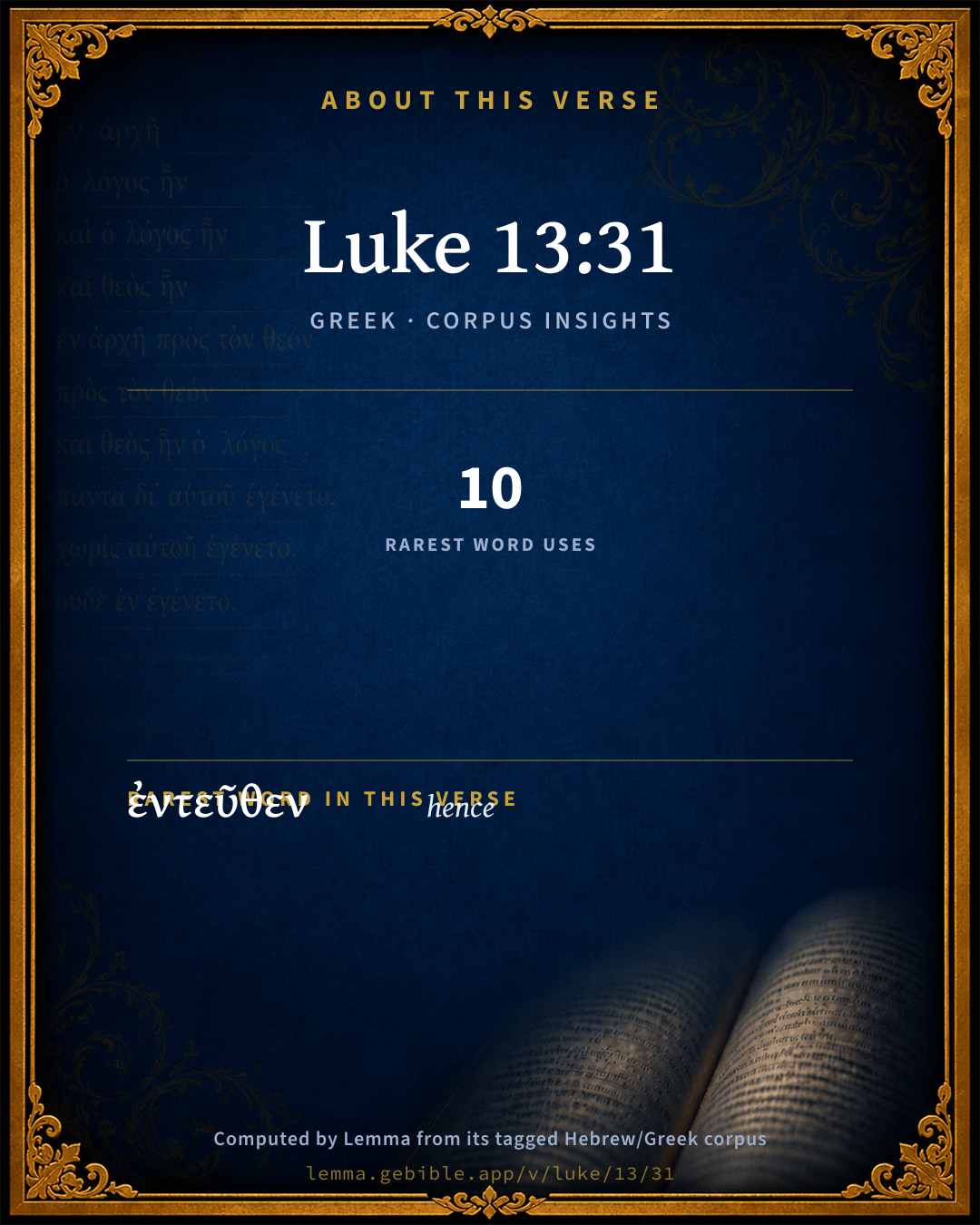
Luke 13:31

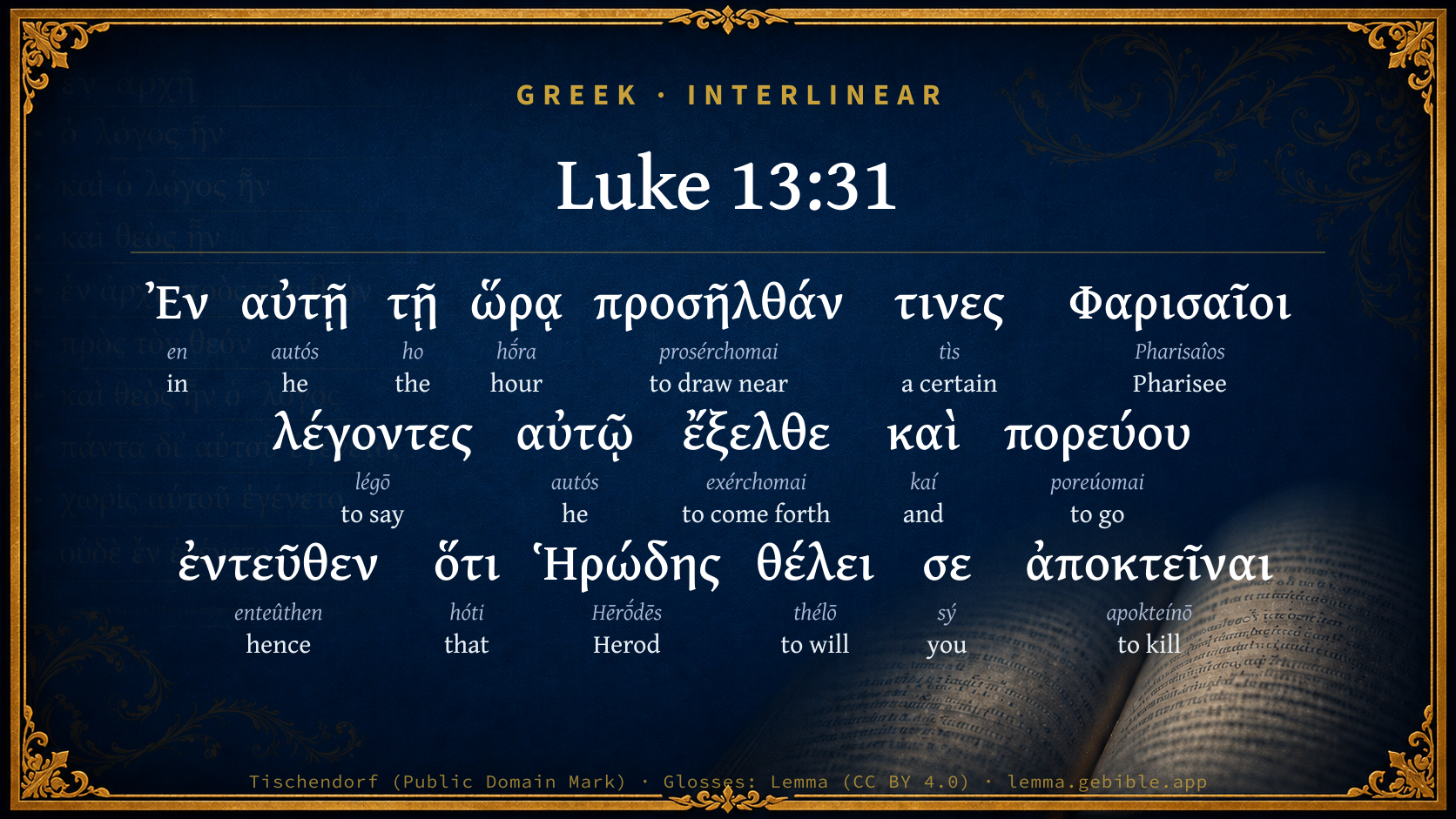
Greek (Tischendorf 8th ed.) Luke 13:31 appears in the Greek New Testament. The text above is from the Tischendorf 8th edition. Each word links to its Strong’s number and a concise gloss. Click any word for its full Thayer’s Greek Lexicon entry.
Download image
Cite this verse

Luke 13:31 (World English Bible). Public Domain. Lemma interlinear Bible study tool, https://lemma.gebible.app/v/luke/13/31.

Show BibTeX & RIS
BibTeX
RIS
English Translation
On that same day, some Pharisees came, saying to him, "Get out of here, and go away, for Herod wants to kill you."
World English Bible · Public Domain
Download a study sheet

One document with this verse’s original text, its word-by-word gloss line, the meaning frame, cross-references with their text, attributed commentary, and full source and license credits — printable, and it pastes into notes with its structure intact.

This verse Autodidact and up

Study sheet (.html) Plain text (.txt)

A passage Seminary Student

Up to 50 verses in one chapter. A passage sheet keeps up to 6 commentary sources and 12 cross-references per verse, in the order this page ranks them, and says so on the sheet whenever that leaves anything out. Ask for a single verse and you get the Autodidact verse sheet above.

Everything on this page stays free to read, with no account — the sheet is a download of what is already on screen, not access to it.

Want to remove ads? Support Godless Engineer
Compare translations 3

The same verse in 3 English versions, stacked beneath the original-language interlinear above. Click any original word for its lexicon entry.

Each is an independent rendering of the whole verse — the interlinear is not word-aligned to these translations.

Highlighted words mark where these versions differ — a whole-verse word diff, not a word-by-word alignment.

  • World English Bible Public Domain
    On that same day, some Pharisees came, saying to him, "Get out of here, and go away, for Herod wants to kill you."
  • King James Version Public Domain
    The same day there came certain of the Pharisees, saying unto him, Get thee out, and depart hence: for Herod will kill thee.
  • unfoldingWord Literal Text CC BY-SA 4.0
    At that hour, certain Pharisees approached, saying to him, “Leave and go away from here, because Herod wants to kill you.”

unfoldingWord Literal Text — © unfoldingWord, licensed CC BY-SA 4.0. Word-aligned USFM3 via Door43 (git.door43.org/unfoldingWord/en_ult).

Versions to compare (up to 4)

3 of 4 selected

Show all 19 translations

Every available English version of this verse, each an independent rendering of the whole verse.

  • World English Bible Public Domain
    On that same day, some Pharisees came, saying to him, "Get out of here, and go away, for Herod wants to kill you."
  • Berean Standard Bible Public Domain
    At that very hour, some Pharisees came to Jesus and told Him, “Leave this place and get away, because Herod wants to kill You.”
  • Majority Standard Bible Public Domain
    On that very day, some Pharisees came to Jesus and told Him, “Leave this place and get away, because Herod wants to kill You.”
  • King James Version Public Domain
    The same day there came certain of the Pharisees, saying unto him, Get thee out, and depart hence: for Herod will kill thee.
  • American Standard Version (1901) Public Domain
    In that very hour there came certain Pharisees, saying to him, Get thee out, and go hence: for Herod would fain kill thee.
  • Revised Version (1885) Public Domain
    In that very hour there came certain Pharisees, saying to him, Get thee out, and go hence: for Herod would fain kill thee.
  • Geneva Bible (1599) Public Domain
    The same day there came certaine Pharises, and said vnto him, Depart, and goe hence: for Herod will kill thee.
  • Douay-Rheims (1899) Public Domain
    The same day, there came some of the Pharisees, saying to him: Depart, and get thee hence, for Herod hath a mind to kill thee.
  • Young's Literal Translation Public Domain
    On that day there came near certain Pharisees, saying to him, `Go forth, and be going on hence, for Herod doth wish to kill thee;'
  • Literal Standard Version CC BY-SA 4.0
    On that day there came near certain Pharisees, saying to Him, “Go forth, and be going on from here, for Herod wishes to kill You”;
  • Unlocked Literal Bible CC BY-SA 4.0
    Shortly after, some Pharisees came and said to him, “Go and leave here because Herod wants to kill you.”
  • unfoldingWord Literal Text CC BY-SA 4.0
    At that hour, certain Pharisees approached, saying to him, “Leave and go away from here, because Herod wants to kill you.”
  • Darby Bible Public Domain
    The same hour certain Pharisees came up, saying to him, Get out, and go hence, for Herod is desirous to kill thee.
  • World Messianic Bible Public Domain
    On that same day, some Pharisees came, saying to him, “Get out of here and go away, for Herod wants to kill you.”
  • Webster's Bible Public Domain
    The same day there came certain of the Pharisees, saying to him, Go out, and depart hence; for Herod will kill thee.
  • Free Bible Version CC BY-SA 4.0
    At that moment some Pharisees came to Jesus and told him, “You should leave here. Herod wants to kill you!”
  • Bible in Basic English Public Domain
    At that time, certain Pharisees came to him and said, Go away from this place, because Herod's purpose is to put you to death.
  • Text-Critical English NT CC BY 4.0
    On that same day some Pharisees came up and said to Jesus, “Leave this place and go somewhere else, for Herod wants to kill yoʋ.”
  • Tyndale New Testament (1534) Public Domain
    The same daye there came certayne of the pharises and sayd vnto him: Get the out of the waye and departe hence: for Herode will kyll the.

Literal Standard Version (2020), Covenant Press — licensed CC BY-SA 4.0. Text via the HelloAO Bible API (eBible.org). Unlocked Literal Bible (unfoldingWord) — licensed CC BY-SA 4.0. Text via the HelloAO Bible API (eBible.org). unfoldingWord Literal Text — © unfoldingWord, licensed CC BY-SA 4.0. Word-aligned USFM3 via Door43 (git.door43.org/unfoldingWord/en_ult). Free Bible Version, Dr. Jonathan Gallagher — licensed CC BY-SA 4.0. Text via the HelloAO Bible API (eBible.org).

Word by word

More ways to search: Search by grammar → Find every occurrence → Compare this word →

Practice this passage: Drill this verse → Learn its vocabulary →

ἐντεῦθεν
enteûthen
G1782
“hence”
Adverb
Part of Speech
Adverb
Full Thayer's Definition

Origin: from the same as G1759

TDNT: None

1. from this place, hence 2. on the one side and on the other, on each side
  1. Ἐν en G1722 “in” Preposition
  2. αὐτῇ autós G846 “he” Personal pronoun, Dative, Singular, Feminine
  3. τῇ ho G3588 “the” Article, Dative, Singular, Feminine
  4. ὥρᾳ hṓra G5610 “hour” Noun, Dative, Singular, Feminine
  5. προσῆλθάν prosérchomai G4334 “to draw near” Verb, Aorist, Active, Indicative, 3rd person, Plural
  6. τινες tìs G5100 “a certain” Indefinite pronoun, Nominative, Plural, Masculine
  7. Φαρισαῖοι Pharisaîos G5330 “Pharisee” Noun, Nominative, Plural, Masculine
  8. λέγοντες légō G3004 “to say” Verb, Present, Active, Participle, Nominative, Plural, Masculine
  9. αὐτῷ autós G846 “he” Personal pronoun, Dative, Singular, Masculine
  10. ἔξελθε exérchomai G1831 “to come forth” Verb, Aorist, Active, Imperative, 2nd person, Singular
  11. καὶ kaí G2532 “and” Conjunction
  12. πορεύου poreúomai G4198 “to go” Verb, Present, Middle or Passive deponent, Imperative, 2nd person, Singular
  13. ὅτι hóti G3754 “that” Conjunction
  14. Ἡρώδης Hērṓdēs G2264 “Herod” Noun, Nominative, Singular, Masculine
  15. θέλει thélō G2309 “to will” Verb, Present, Active, Indicative, 3rd person, Singular
  16. σε sý G4771 “you” Personal pronoun, 2nd person, Accusative, Singular
  17. ἀποκτεῖναι apokteínō G615 “to kill” Verb, Aorist, Active, Infinitive

About this verse

These counts appear in no published source. They are computed here, from the morphology-tagged text and Lemma’s own curated glosses. What Lemma adds →

18
words
17
distinct lemmas
Gospels
section

Notable vocabulary

The rarest word here is ἐντεῦθεν hence G1782 — appearing just 10 times in the whole Greek New Testament.

Shared distinctive vocabulary

ἐντεῦθεν hence G1782 occurs in 9 verses of the Greek New Testament. Also found in:

Repetition

A word recurs within this verse:

  • αὐτῇ he G846 ×2

Cross-references

4

Topical passages linked to Luke 13:31 in the Treasury of Scripture Knowledge — connected by theme and wording, ordered by reader-vote popularity; previews shown in the World English Bible.

  • Nehemiah 6:9–11 For they all would have made us afraid, saying, Their hands shall be weakened from the work, that it not be done. But now, [God], strengthen you my hands.
  • Psalms 11:1–2 In Yahweh, I take refuge. How can you say to my soul, "Flee as a bird to your mountain!"
  • Amos 7:12–13 Amaziah also said to Amos, "You seer, go, flee away into the land of Judah, and there eat bread, and prophesy there:
  • Matthew 14:1 At that time, Herod the tetrarch heard the report concerning Jesus,

Cross-references courtesy of OpenBible.info (CC BY 4.0).

Where the printed editions differ

1 variant

Places in this verse where the major printed Greek editions disagree on the wording in a way that affects the translation — a comparison of editions, not a manuscript-by-manuscript collation. The editions are the modern critical texts (Nestlé-Aland 28/27, SBL, Westcott-Hort, Tregelles, Tyndale House) and the traditional texts behind the KJV (the Textus Receptus and the Byzantine/Majority text). It is not a claim about which reading is original.

  1. Different wording
    ὥρᾳ

    “hour”

    In NA28NA27TynSBLWH Not in TregTRByz

    ἡμέρᾳ (hēmera) 'day' occurs in traditional manuscripts (Treg+TR+Byz) instead of ὥρᾳ (hōra) 'hour' in older manuscripts (NA28+NA27+Tyn+SBL+WH)

Textual data: Translators Amalgamated Greek New Testament (STEPBible TAGNT) · CC BY 4.0.

Commentary

Notes on Luke 13:31 from classic Christian and Jewish commentators (each source and its license shown beneath its notes). The classic Christian expositions comment on the surrounding passage and are grouped to its opening verse, so a note may address several verses; the Jewish commentaries on the Tanakh (Rashi and others) are per-verse, so they appear only where the commentator wrote on this verse.

Lemma curates 59 commentaries, every one of them public domain or Creative Commons licensed, each selected and text-cleaned for this edition rather than reprinted as found. About our sources →

Matthew Henry's Commentary

Here is, I. A suggestion to Christ of his danger from Herod, now that he was in Galilee, within Herod's jurisdiction (Luk 13:31): Certain of the Pharisees (for there were those of that sect dispersed all the nation over) came to Christ, pretending friendship and a concern for his safety, and said, Get thee out of this country, and depart hence, for otherwise Herod will kill thee, as he did John. Some think that these Pharisees had no ground at all for this, that Herod had not given out any words to this purport, but that they framed this lie, to drive him out of Galilee, where he had a great and growing interest, and to drive him into Judea, where they knew there were those that really sought his life. But, Christ's answer being directed to Herod himself, it should seem that the Pharisees had ground for what they said, and that Herod was enraged against Christ, and designed him a mischief, for the honourable testimony he had borne to John Baptist, and to the doctrine of repentance which John preached. Herod was willing to get rid of Christ out of his dominions; and, when he durst not put him to death, he hoped to frighten him away by sending him this threatening message.

II. His defiance of Herod's rage and the Pharisees' too; he fears neither the one nor the other: Go you, and tell that fox so, Luk 13:32. In calling him a fox, he gives him his true character; for he was subtle as a fox, noted for his craft, and treachery, and baseness, and preying (as they say of a fox) furthest from his own den. And, though it is a black and ugly character, yet it did not ill become Christ to give it to him, nor was it in him a violation of that law, Thou shalt not speak evil of the ruler of thy people. For Christ was a prophet, and prophets always had a liberty of speech in reproving princes and great men. Nay, Christ was more than a prophet, he was a king, he was King of kings, and the greatest of men were accountable to him, and therefore it became him to call this proud king by his own name; but it is not to be drawn into an example by us. "Go, and tell that fox, yea, and this fox too" (for so it is in the original, tē alōpeki tautē); "that Pharisee, whoever he is, that whispers this in my ear, let him know that I do not fear him, nor regard his menaces. For," 1. "I know that I must die, and must die shortly; I expect it, and count upon it, the third day," that is, "very shortly; my hour is at hand." Note, It will help us very much above the fear of death, and of them that have the power of death, to make death familiar to us, to expect it, think of it, and converse with it, and see it at the door. "If Herod should kill me, he will not surprise me." 2. "I know that death will be not only no prejudice to me, but that it will be my preferment; and therefore tell him I do not fear him; when I die, I shall be perfected. I shall then have finished the hardest part of my undertaking; I shall have completed my business;" teleioumai - I shall be consecrated. When Christ dies, he is said to have sanctified himself; he consecrated himself to his priestly office with his own blood. 3. "I know that neither he nor any one else can kill me till I have done my work. Go, and tell him that I value not his impotent rage. I will cast out devils, and do cures, today and tomorrow," that is, "now and for some little space of time yet to come, in spite of him and all his threats. I must walk, I must go on in my intended journey, and it is not in his power to hinder me. I must go about, as I do, preaching and healing, today, and tomorrow, and the day following." Note, It is good for us to look upon the time we have before us as but a little, two or three days perhaps may be the utmost, that we may thereby be quickened to do the work of the day in its day. And it is a comfort to us, in reference to the power and malice of our enemies, that they can have no power to take us off as long as God has any work for us to do. The witnesses were not slain till they had finished their testimony. 4. "I know that Herod can do me no harm, not only because my time is not yet come, but because the place appointed for my death is Jerusalem, which is not within his jurisdiction: It cannot be that a prophet perish out of Jerusalem," that is, "any where but at Jerusalem." If a true prophet was put to death, he was prosecuted as a false prophet. Now none undertook to try prophets, and to judge concerning them, but the great sanhedrim, which always sat at Jerusalem; it was a cause which the inferior courts did not take cognizance of, and therefore, if a prophet be put to death, it must be at Jerusalem.

III. His lamentation for Jerusalem, and his denunciation of wrath against that city, Luk 13:34, Luk 13:35. This we had Mat 23:37-39. Perhaps this was not said now in Galilee, but the evangelist, not designing to bring it in in its proper place, inserts it here, upon occasion of Christ's mentioning his being put to death at Jerusalem.

Note, 1. The wickedness of persons and places that more eminently than others profess religion and relation to God is in a particular manner provoking and grieving to the Lord Jesus. How pathetically does he speak of the sin and ruin of that holy city! O Jerusalem! Jerusalem! 2. Those that enjoy great plenty of the means of grace, if they are not profited by them, are often prejudiced against them. They that would not hearken to the prophets, nor welcome those whom God had sent to them, killed them, and stoned them. If men's corruptions are not conquered, they are provoked. 3. Jesus Christ has shown himself willing, freely willing, to receive and entertain poor souls that come to him, and put themselves under his protection: How often would I have gathered thy children together, as a hen gathereth her brood under her wings, with such care and tenderness! 4. The reason why sinners are not protected and provided for by the Lord Jesus, as the chickens are by the hen, is because they will not: I would, I often would, and ye would not. Christ's willingness aggravates sinners' unwillingness, and leaves their blood upon their own heads. 5. The house that Christ leaves is left desolate. The temple, though richly adorned, though greatly frequented, is yet desolate if Christ has deserted it. He leaves it to them; they had made an idol of it, and let them take it to themselves, and make their best of it, Christ will trouble it no more. 6. Christ justly withdraws from those that drive him from them. They would not be gathered by him, and therefore, saith he, "You shall not see me, you shall not hear me, any more," as Moses said to Pharaoh, when he forbade him his presence, Exo 10:28, Exo 10:29. 7. The judgment of the great day will effectually convince unbelievers that would not now be convinced: "Then you will say, Blessed is he that cometh," that is, "you will be glad to be among those that say so, and will not see me to be the Messiah till then when it is too late."

Matthew Henry's Commentary on the Whole Bible (1708–1710) — public domain (CC PDM 1.0). Text via the HelloAO Bible API.

Jamieson, Fausset & Brown

Robert Jamieson, A. R. Fausset & David Brown

MESSAGE TO HEROD. (Luk 13:31-35)

and depart hence--and "go forward," push on. He was on His way out of Perea, east of Jordan, and in Herod's dominions, "journeying towards Jerusalem" (Luk 13:22). Haunted by guilty fears, probably, Herod wanted to get rid of Him (see on Mar 6:14), and seems, from our Lord's answer, to have sent these Pharisees, under pretense of a friendly hint, to persuade Him that the sooner He got beyond Herod's jurisdiction the better it would be for His own safety. Our Lord saw through both of them, and sends the cunning ruler a message couched in dignified and befitting irony.

Jamieson, Fausset & Brown — Commentary Critical and Explanatory on the Whole Bible (1871) — public domain (CC PDM 1.0). Text via the HelloAO Bible API.

The Biblical Illustrator

Joseph S. Exell

Luk_13:31-32

Go ye and tell that fox

That fox

The attempt of the Pharisees to frighten Jesus Christ out of Perea drew from Him a prompt and sharp rejoinder.

The answer was to the effect that no such threats could influence the purpose or in the least degree accelerate the movements of the Nazarene. His work was near an end, but He would have no hurry or panic. He would cast out demons and perform cures to the last day that His predestined stay in Perea would permit. If Herod wished to put a hasty stop to such works, so much to the discredit of Herod. As for the menace to His life, Jesus despised it. He was going up to Jerusalem, knowing that He would be killed. But Herod could not kill Him. At the outset of His ministry an angry crowd in Galilee had tried to make an end of Him, but they could not. The Prophet could not die but at Jerusalem. The metaphor here was in the opprobrious epithet applied to Herod Antipas--that fox. Evidently it expressed, and was meant to express, that the Lord Jesus saw through and despised the cunning wiles of the Tetrarch. Many writers on the Gospels, both in Germany and among ourselves, have been anxious to protect our Saviour from the charge of speaking disrespectfully of a ruler, and have therefore tried to show that this epithet was in reality hurled against the Pharisees, who had affected so much Solicitude for His life. In the present case, it is as plain as words can make it that Jesus stigmatized Herod as that fox. The man was a selfish intriguer, neither good nor strong, but cunning, subservient to those above him, a sort of jackal to the imperial lion at Rome, but ruthless to any who were beneath him and within his grasp. Probably it was this metaphor that suggested to Jesus that of the hen protecting her brood, which immediately follows. He looked on Herod and men of his stamp as devourers of the people. As for Himself, He might seem to be weak and unable to save Himself, but He was the best friend of the people; and if they would only gather to Him, He would cover them with the wings of His protection, so that no fox could do them hurt. But the Pharisees, and ultimately the misguided people too, took part with the fox against Him. And why should it be thought strange that Jesus could entertain and express a feeling of scorn for what is mean and wicked? Some of our moralists assert too roundly that mortal man has no right to feel contempt. There is a contempt that is ignoble, and there is a contempt that is noble. The ignoble is that which rests on mere conventionalism and prejudice, as when one despises another for being less highly born or less richly provided than himself. It flourishes among conventional professors of religion who yet sing the praises of humility. Such hauteur could not find place in the breast of our Saviour, and ought not to be harboured by any Christian. Wherever it enters it hardens the heart, dries up the sympathies, inflates the sense of self-importance, and induces a cold indifference to the wants and woes of others. But there is a noble scorn that may dwell in the heart along with tender compassion and fervent love. If there be a genuine appreciation of what is good and true, the obverse side of it must be a healthy contempt for what is wicked and false. (D. Fraser, D. D.)

Righteous reproach

He does not hesitate to call Herod a fox--a mere cunning, designing man, only courageous when there is no danger at hand; scheming and plotting in his den, but having no true bravery of heart; an evil-minded person, whose whole character is summed up in the word fox. What I did Jesus Christ, then, call men names? Not in the usual sense of that expression. Did He call Herod a fox out of mere defiance or spite? He was incapable of doing anything of the kind. When Jesus Christ spoke a severe word, the severity came out of the truth of its application. Is it not a harsh thing to call a man a liar? Not if he be false. Is it not very unsocial to describe any man as a hypocrite? Not if he be untrue. Wherein, then, is this wickedness of calling men names? In the misapplication of the epithets. It is wicked to call a man true, if we know him to be untrue. There is an immoral courtesy; there is a righteous reproach. We do not use harsh words when we tell men what they really are. On the other hand, it is a matter of infinite delicacy to tell a man what he really is, because, at best, we seldom see more than one aspect of a mans character. If we could see more of the man, probably we should change our opinion of his spirit. In the case of Jesus Christ, however, He saw the inner heart, the real and true quality of the Tetrarch; and, therefore, when He described Herod as a fox, He spoke the word of righteousness and of truth. It was not an epithet; it was a character in a word; it was a man summed up in a syllable. Let us, therefore, be very careful how we follow this example, because we ought to have equal knowledge before we take an equal position in this respect. On the other hand, let us beware of that simulation of courtesy, which is profoundly untrue, which is despicably immoral--the kind of thing which sets itself to catch the favour and the flattery of the passing moment. (J. Parker, D. D.)

Christs work cannot be stopped

We thought that Jesus Christs labour would be cut short by this message from Herod. Jesus Christ must finish what He has begun. But is it not in the power of the great and the mighty to say to Christ, You must stop at this point? It is in their power, truly, to say it, and when they have said it they may have relieved their own feelings: but the great, the beneficent, the redeeming work of the Son of God proceeds as if not a word to the contrary had been said. The kings of the earth set themselves, and the rulers took counsel together against the Lord, and against His anointed; and behold their rage came to nothing, and their fury recoiled upon themselves! He that sitteth in the heavens shall laugh; the Holy one shall have them in derision. Are we opposing Jesus Christ? Are we in any way setting ourselves against the advancement of His kingdom? It will be an impotent rage. Go and strike the rocks with your fist- perhaps you may batter down the granite with your poor bones. Try! Go and tell the sea that it shall not come beyond a certain line, and perhaps the hoary billows will hear you, and run away and say they be afraid of such mighty men. Try! You have nothing else to do, you may as well try. But as for keeping back this kingdom of God, this holy and beneficent kingdom of truth--no man can keep it back, and even the gates of hell shall not prevail against it. Men may rage; men do rage. Other men adopt another policy; instead of rage and fury and great excitement, they set themselves against the kingdom of God in an indirect and remote way. But both policies come to the same thing. The raging man who pulls down the wooden cross and tramples it underfoot, and the man who offers a passive resistance to the progress of the kingdom of heaven, come to the same fate. The light shines on, noontide comes, and God gets His own way in His own universe. (J. Parker, D. D.)

Perseverance in the path of duty

An example of the marvellous power to be found in the motive of duty is afforded in the seven years march of David Livingstone from the coast of Zanzibar toward the courses of the Nile. What else, indeed, could have so well sustained him in his trials with savages, and noxious insects, and nearly impassable jungles, and starvation, and prostrating disease, and prospective death? In this journey, he writes, in the calmest style of self-examination, I have endeavoured to follow with unswerving fidelity the path of duty The prospect of death in pursuing what I knew to be right did not make me veer to one side or the other. And so this sublime hero struggled on until, while apparently engaged in the act of prayer, he passed from a kneeling posture on earth to an enthroned position in heaven.

The Biblical Illustrator, edited by Joseph S. Exell (c. 1880s–1900s) — public domain. Text from a community e-Sword module.

Joseph Benson's Commentary

Luk 13:31-32. The same day there came certain of the Pharisees — Who pretended friendship, and a great concern for his safety; saying, Get thee out and depart hence — Withdraw from this country into the territories of some other prince; for Herod — In whose dominions thou now art; will kill thee — Greek, θελει σε αποκτειναι, intends, or rather, is determined to kill thee. The term will, in our translation of this clause, is a mere sign of the future time, and declares no more than that the event spoken of would take place. But this is not what is declared by the evangelist. His expression denotes that, at that very time, it was Herod’s purpose to kill him. It is much to be doubted whether these Pharisees had any ground at all for making this declaration respecting Herod’s resolution. From the known disposition of the Pharisees, who were always Christ’s enemies, it seems not improbable that their concern for his safety was reigned, and that their real design was to intimidate him, and make him flee into Judea, not doubting that the haughty priests at Jerusalem would fall upon some method of putting him to death. Herod, too, might possibly be in the plot, for it seems he now began to take umbrage at Christ’s fame and authority, fearing that they might occasion him some embarrassment, either with his people or with the Romans. But he dreaded to make an attempt on his life, remembering the agonies of mind he had suffered on account of the Baptist’s murder. He therefore, probably, sent the Pharisees to him with the message above mentioned. In this view there was a peculiar propriety in our Lord’s calling him a fox, rather than a lion, wolf, or bear; to which savage beasts the prophets had sometimes, with a plainness becoming their character, compared wicked princes. And he said, Go ye, and tell that fox, &c. — That crafty, wicked, and murderous prince; behold, I cast out devils and do cures — In thy dominions. With what majesty does he speak to his enemies! With what tenderness to his friends! to-day and to-morrow — And carry on my work a little while longer; and the third day I shall be perfected — For the appointed time will quickly come when I shall have finished my course, and have done all that I intend to do here. It is probable our Lord is not to be understood here as speaking exactly of three days, but of a short period of time: for in many places of the Old Testament similar expressions, such as yesterday, and the third day, signify lately, or a little while ago; and, on this interpretation, the word τελειουμαι, I shall be perfected, may refer to his finishing the work of redemption, and being by death consecrated to his office, as the great High-Priest and Captain of our salvation, as the same word is used Heb 2:10; Heb 5:9; Heb 7:28. It is proper to observe here, with regard to our Lord’s terming Herod a fox, that we must carefully distinguish between those things wherein Christ is our pattern, and those which were peculiar to his office. His extraordinary office justified him in using that severity of language, when speaking of wicked princes and corrupt teachers, to which we have no call: and by which we should only bring scandal on religion, and ruin on ourselves, while we irritated, rather than convinced or reformed, those whom we so indecently rebuked.

Joseph Benson's Commentary on the Old and New Testaments (1811–1818) — public domain. Text from a community e-Sword module.

Whedon's Commentary on the Bible

Daniel D. Whedon

Herod’s malignant warning, and the Lord’s reply, Luk_13:31-34.

31. The same day—The day on which the question of Luk_13:23 was answered; namely, the first of the two closing days of the Peraean ministry.

Certain of the Pharisees—Herodian partizans among the Jews, flatterers and tools at the court of Herod Antipas. (See note on Mat_22:16.) They were Pharisees in profession, but Sadducees in life and practice. It is this same sort of men, if not this very set, who appear in Luk_20:19-20. They appear here as emissaries sent from Herod to Jesus.

For Herod— Jesus in Peraea was within the dominions of Herod, and not far from that very fortress of Machaerus where John had been beheaded by this same Herod Antipas. For the life and character of Herod Antipas, and for the superstitious dread he entertained of Jesus, consult our notes on Mat_14:1-2.

Will kill thee—It is evident that Antipas, equally infidel and superstitious, was actually at the present time afraid of Jesus; equally dreading to have him in his dominions, or to touch him with violence, so as to incur the odium of murdering a second holy man. He therefore sends these spies to frighten Jesus out of his dominions.

Daniel D. Whedon (gen. ed.), Commentary on the Old and New Testaments (1874–1909) — public domain. Text from a community e-Sword module.

The Preacher's Complete Homiletical Commentary

Joseph S. Exell (gen. ed.)

CRITICAL NOTES

Luk_13:31. The same day.—A better reading is, “In that very hour” (R.V.). Pharisees, saying, etc.—We are certainly led to understand that these Pharisees had been sent by Herod to induce Jesus to leave his territory. If the intimation of Herod’s desire were a mere invention of the Pharisees it would be difficult to understand the epithet Christ applied to him. Probably Herod had no real desire of the kind; he had become sufficiently unpopular by the murder of the Baptist, and had no inducement to add to his guilt by further violence against Jesus. Besides, when Jesus was afterwards in his power be abstained from injuring him. But the excitement connected with Christ, and Herod’s own superstitious fears, would doubtless make him anxious for the Saviour to leave the country. His cunning is shown by his endeavouring to secure this end in an underhand way, and by his using his enemies, the Pharisees, as his tools in the matter. Will kill thee.—Rather, “would fain kill thee” (R.V.); i.e., “will” is not a mark of the future tense, but the verb “to desire.”

Luk_13:32. That fox.—An emblem of cunning and mischief. This is the only recorded example of Christ’s speaking of any one in terms of sheer contempt. The rest of the verse has been the subject of great discussion. What are the three days specified? and what is meant by “being perfected”? Some have taken the time specified as referring to present labours (“to-day”), to future labours (“to-morrow”), and to His final sufferings at Jerusalem (“the third day I shall be perfected”). It is difficult, however, to understand the days in any other than a literal sense. The meaning would, therefore, be that Jesus would still remain for three days in Herod’s terrritories, and would still engage in those mighty works that had excited his apprehensions, and carry through His plan to the very end. The only serious objection to this interpretation is that the words “I shall be perfected” would seem to suggest more than merely bringing to an end the miracles of healing in the district of Peræa; but no other meaning is possible if the days specified are to be taken as literal days.

Luk_13:33. I must walk.—Rather, “I must go on My way” (R.V.), the word used by the Pharisees in Luk_13:31 (“depart”). Christ is on His way out of the territory of Herod, but He is not urged by the fear of that king’s malignity; He is not afraid of death, for He is going to meet death in Jerusalem. It cannot be, etc.—There is terrible irony in these words. Christ speaks of His life as being safe until He arrives in Jerusalem. It is almost a moral impossibility, His words imply, for a prophet to perish except in that city, which had monopolised the slaughter of the prophets. The death of John the Baptist was an exception to the rule.

Luk_13:34. O Jerusalem! etc.—Rather, “which killeth … stoneth … sent unto her” (R.V.). How often.—Reference is here made to visits of Jesus to Jerusalem and of labours there which St. Luke and the other Synoptists do not record. As a hen.—It has been said that the figure of the eagle in Deu_32:11-12 is emblematical of the spirit of the Old Testament, and this in the present passage of the spirit of the New Testament. The contrast between “I would” and “ye would not” is very startling: the power of man to resist and defeat the merciful purposes of God.

Luk_13:35. Desolate.—The best MSS. omit the word, but it or some such term is needed to complete the sense. In the R.V. it is inserted in italics. The Divine Glory had departed from the house (cf. Eze_10:18; Eze_11:23). Ye shall not see Me.—Judicial blindness, the veil remaining still upon the heart of the Jewish people. Until the time, etc.—The words quoted were actually used on Christ’s triumphal entrance into Jerusalem a short time after this, but we cannot think that the prophecy was in any sense then fulfilled. It is more probable that a mistaken understanding of these words led to their being employed on that occasion. Christ here speaks of a second coming in the far-distant future and associates it with the penitence and faith of the Jewish nation, which will then receive Him as the Blessed One.

MAIN HOMILETICS OF THE PARAGRAPH.—Luk_13:31-35

Courage and Compassion.—There could be no doubt of the hypocritical character of the concern which these Pharisees manifested for the safety of Jesus, or of the enmity of the prince whose designs were now disclosed to our Lord. Yet he was not intimidated by the news conveyed to Him, nor did He break off His beneficent labours to save Himself by flight. His reply was animated by a calm dignity and an heroic courage. “So far from being interrupted in My ministry by any tidings you bring, be they false or true, by your wish or by Herod’s wish, to be rid of My presence at once, I shall proceed on My way. I shall do as before I have done. I shall put forth My powers, casting out devils, healing sick for the present, for the future; and only at a remoter period will My life and course reach their appointed end.” Nor was it that He refused to believe that a violent end was in store for Him. He knew that He should die in that city to which He was now journeying, and His heart was filled with grief—not at the thought of His own sufferings and death, but at the thought of all the miseries which rejection of Him would draw down upon her—miseries against which He would fain have protected her. This union of unshaken courage with infinite tenderness is very wonderful and affecting, and make the lamentation which He uttered over Jerusalem one of the most pathetic passages which history contains. These words of Christ are full of instruction and warning.

I. We, too, need to be on our guard against the craft and malice of enemies.—We are exposed to the wiles of one who but seeks to allure and to drive us from following the path of duty, and whose subtilty and malice we cannot by our own strength overcome. Our own hearts are only too apt to betray us, by becoming allies of our enemies, and by trying to persuade us to avoid the risks which fidelity to God seems to involve. Our true safety lies in our having that wisdom which will enable us to discern the snare of the enemy, under whatever guise it may be concealed, and in our committing our souls to God in well-doing as unto a faithful Creator.

II. The serenity and courage of Christ should be an example to us.—He was not to be deterred from the path of duty by the menaces of enemies or by the solicitations of weak friends. He continued to prosecute His work faithfully and boldly, notwithstanding every threat and danger. Let us, then, persevere in the path of duty, and believe that God will restrain the wrath of men, and bring us safely through every danger, until our appointed time arrives. The place, time, and manner of our death are in God’s hand, and, like those of Christ, are determined. It is good, too, that, like Him, we should regard the period of our life here as short, that we may be diligent in doing the work that lies before us; and that we should regard death, not as interrupting, but as completing, our course.

III. The expostulation with those who had resisted His invitations is full of significance for us.—It implies very real and great dangers to which we are exposed. He would not have spoken in such solemn tones of the protection He would have afforded to those who now rejected Him, if dangers of the most terrible kind did not threaten them. The judgments of God upon the doomed city, the penalties of a broken law, the punishment due to those who have wilfully rejected the salvation brought near to them—are all in His mind’s eye as He speaks these words. And the same dangers of being cut off in sin and being overwhelmed in sudden and hopeless ruin still hang over those who are impenitent. His words distinctly imply, also, that all who betake themselves to His protection are safe, and that He is ready to receive even the worst of those who have despised and rejected Him, if only they will betake themselves to Him in humility and penitence. In many ways He warns us of our danger—in the expostulations of conscience, in the invitations of the gospel, and in the events of life, which are all governed by His providence, and which daily illustrate the wrath of God against sin, and the blessedness of obedience to Him. He points out, too, in this utterance, the true reason of rejection of salvation: “Ye would not.” However we may deceive ourselves, aversion of heart is the secret of refusal to accept Christ as a Saviour. “Ye will not come unto Me, that ye might have life.” And, finally, He warns His hearers of a time when He will return, clothed with Divine power and authority, to judge the world, and when all must meet Him face to face. Only those who receive Him will then welcome Him, and say, “Blessed be He that cometh in the name of the Lord.”

SUGGESTIVE COMMENTS ON Luk_13:31-35

Luk_13:31-35. The Saviour and His Adversaries.

I. We may learn from this passage the craft and malice of the enemies of the gospel and of our salvation.

II. The example of Christ should teach and encourage us not to be deterred from the path of duty by any threatenings of enemies or misgivings of weak friends.

III. It teaches that Christ was, indeed, perfected by His sufferings—perfected as a Saviour for us.

IV. He here appears as expostulating with those who have hitherto resisted His invitations.

Luk_13:31-32. “Herod will kill thee.”—Our Lord not merely gave an answer to the Pharisees, which would have been enough if their word of alarm had been a mere audacious lie, devised by themselves, but charged them to take back His reply to Herod—“that fox,” that creature of cunning and deceit. As for the menace to His life, Jesus despised it. He was going up to Jerusalem, knowing that He would be killed. But Herod could not kill Him. The Prophet could not die but at Jerusalem. The metaphor here was meant to express that the Lord Jesus saw through and despised the cunning wiles of the Tetrarch. The man was a selfish intriguer, neither good nor strong, but cunning, subservient—a jackal to the imperial lion at Rome. The epithet is certainly a startling one. It must have sounded to the Pharisees like the crack of a whip. But there is no need to apologise for it, as though it were unworthy of Him who was meek and lowly in heart, and as if it had fallen from His lips incautiously. It was calmly spoken. It expressed a just feeling of scorn for a tricky and crafty character. There is a contempt that is noble, as well as a contempt that is ignoble. Noble scorn may dwell in the heart along with tender compassion and fervent love. That man cannot be the disciple of Christ who breathes intrigue and practises deceit. Those who please Him are men of simple faith and honest purpose. Without these a man is liable to be described by the Lord’s withering epithet, “that fox.”—Fraser.

“Depart hence.”—It was in the interest of the Pharisees to see Jesus depart into Judæa, where he would fall under the power of the Sanhedrim. And it also suited Herod best for Jesus to quit his territories; for, on the one hand, the excitement which His presence caused among the people was bound to disturb him; and, on the other hand, he was certainly unwilling to burden his conscience by adding another murder to that of the Baptist. Jesus, however, knew the Pharisees too well to believe that they were interested in His welfare, and recognised in the message they brought a plot in which Herod was chief conspirator. His reply contains a severe but merited rebuke: “Not daring to show the teeth of the lion, thou hast recourse to the tricks of the fox.”—Godet.

Luk_13:32-35. “I do cures to-day and to-morrow.”—The words may be paraphrased as follows: “I have to exercise My blessed office for a certain time. For this time, however, I must walk and work, and no power can touch Me (Mine hour is not yet come); but in Jerusalem it will come, and then will ye gain power over Me. Your victory, however, will be your ruin, and Him whom ye shall have rejected, ye shall never more behold till the day of His final return.”

A Revelation of the Saviour’s Heart.

I. Jesus displays His perfect knowledge of what is in man as He unveils the cunning and hypocrisy of His enemies.

II. He manifests a holy serenity in carrying on His beneficent labours, though he is conscious that a cruel death awaits Him in the near future.

III. He laments over the miseries which His enemies are preparing for themselves by their rejection of Him.

IV. He anticipates with joy the last and most glorious scene of all, when Israel will repent of her unbelief, and receive Him as her Saviour and Lord.

Luk_13:32-33. “Go ye, and tell.”—Christ’s reply is addressed—

1. To Herod. Be reassured: My activity, which consists in ministering to the suffering, is drawing to an end: three days only remain—but those three days, no one, not even thou, mayest cut short.

2. To the Pharisees. They, too, may reassure themselves: their victim will not escape them; He is on the way to the city which has ever been the murderess of the prophets.

Luk_13:32. “That fox.”—Distinguished by craftiness, and malice, and cowardice. Herod probably did not wish to kill Jesus, but to get Him out of His territory. To threaten thus without really purposing to carry out the threat, and to use Pharisees, his opponents, to report the threat, is the cunning of “that fox.”

The Message to Herod.—“Tell him from Me that My times are set in the eternal counsel of God, and when My prefixed time is accomplished for My labours and sufferings I shall, in spite of all the opposition of earth and hell, be perfected and enjoy My full glory.”—Hall.

Respect for Rulers.—There is no need to seek to clear our Saviour from the appearance of having violated the law which forbade speaking evil of the ruler of the people (Exo_22:11-28). The prophets all along had no hesitation in severely reproving kings and princes. Thus Elijah tells Ahab that it was he that troubled Israel, and Isaiah calls the rulers of the Jews “rulers of Sodom and princes of Gomorrah.” Much more might He who had sent the prophets use like freedom in rebuking sin.

Lamb-like Patience, Lion-like Courage.—Over against the fox, the Saviour appears in lamb-like patience, but also in lion-like courage.—Van Oosterzee.

Luk_13:33. “The third day I shall be perfected.”

I. Christ’s clear vision of the successive steps of His work yet remaining.

II. His calm and deliberate purpose to go through with His work, unmoved by the menaces of His enemies.

III. His consciousness of the rapid march of events—of His death now not far off.

“I must walk,” i.e., “depart” (as in Luk_13:31), or “go on my journey.” Christ was, indeed, journeying out of Herod’s territory, but not because of Herod’s threat. So far from being scared away by fear of death, He knew that in the city to which He journeyed He would meet certain death.

“It cannot be.”—There would be a certain moral unfitness, a violation of custom, in the murder of a prophet anywhere but in Jerusalem. The words are instinct with a terrible irony.

John the Baptist had indeed been an exception to the rule; he had not been slain in Jerusalem. But that city could scarcely allow its monopoly to be again infringed upon, and that within so short a space of time.

Luk_13:34-35. The Lamentation of Love.—We have here a typical exhibition of grace:

1. Indiscriminate grace.

2. Inviting grace.

3. Ineffectual grace.

Luk_13:34. “Them that are sent.”—Not treating the ambassadors of God as clothed with that inviolable sanctity which protects from injury the ambassadors of an earthly sovereign.

“As a hen.”—The similitude condescendingly employed by our Saviour is one of the homeliest possible, but inexpressibly felicitous and significant. It graphically represents the Saviour’s intense and tender solicitude and desire. How lofty, too, the self-consciousness which it bespeaks! The whole of the Jews belonged to Him as His brood. He could cover and protect them all. He could do, too, without them, although He longed after them; but they could not do without Him.—Morison.

Protection Withdrawn.—Like a bird of prey which hovers in the air above its victim, the enemy threatens the inhabitants of Jerusalem. Jesus, who had, up to this, been sheltering them under His wings, as a hen her chickens, withdraws; they remain exposed and are reduced to defend themselves. Such is the representation of matters given here.—Godet.

The Hen and Chickens.—Christ’s word carries such intrinsic dignity that we do not need to fear the familiarity of the metaphor. The words express Christ’s feeling for the people of Jerusalem in view of their city’s hastening doom. Coming after words of stern warning, this saying reveals a most pathetic sorrow. Remember how complete was His knowledge of the sin of Jerusalem. He recalled its past blood-guiltiness. He foresaw its coming treatment of Himself and His apostles. Yet He lamented over it, and His compassion yearned to rescue its people from destruction. His repeated visits, at personal risk, had been fruitless. They would not come to Him that they might have life. To this day the relations subsisting between Jesus Christ and the Jewish nation at large throughout the world may be expressed in His own words, “I would, but ye would not.”

I. The illustration employed implies that the danger was at hand.—Perdition is imminent. Christ is a present Helper to those who come to Him.

II. How simple the way of salvation!—How sure and perfect the defence! Those who trust in the Saviour are completely covered by His righteousness and strength.

III. It is a grief to Christ to have His offer of salvation slighted.—No one knows as He does the awfulness of the doom from which He rescues His people, or their weakness and helplessness before the impending judgment.

IV. What joy of faith and restfulness of love are under the covert of Christ’s wings!—There His people dwell together in unity. Loved of the Saviour, they learn to love one another.—Fraser.

“And ye would not.”—The teaching of Scripture regarding the will includes the following points:—

I. Whether men are to be saved or lost hinges entirely upon their own will: “ye would not.”

II. The will of man is utterly indisposed and disabled from yielding to Christ (Joh_6:44).

III. When the will is effectually gained, and salvation thus obtained, it is in consequence of a Divine operation upon it (Php_2:13). How the fact of the Divine action is to be reconciled with our freedom is left unsolved, and perhaps will always remain so.

Eternal Blessings Lost only with Our Consent.—A man may lose the things of this life against his will; but, if he loses eternal blessings, he does so with his own consent.—Augustine.

Luk_13:35. “Your house”—i.e., the Temple: but their house now, not the Lord’s.

“Desolate.”—Deserted of its Divine Inhabitant—a spiritual ruin to be followed by material ruin.

“Your house is left.”—By these words Jesus frees Himself from the charge laid upon Him by His Father—viz., the salvation of His people. He is in exactly the same circumstances as the Divine Shepherd represented in the picture which Zechariah draws of the last attempt which Jehovah makes to save the flock appointed to the slaughter (Zec_11:10-14).

“Until the time.”—Until that day, the subject of all prophecy, when the repentant people shall turn with true and loyal hosannas and blessings to greet “Him whom they have pierced” (Deu_4:30-31; Hos_3:4-5; Zec_12:10; Zec_14:8-11).

The Preacher's Complete Homiletical Commentary (gen. ed. Joseph S. Exell; Funk & Wagnalls, c. 1892) — public domain (pre-1929). A full-Bible homiletical/sermon-outline anthology covering 65 of 66 books (2 John is absent from the source module). Text from a community e-Sword module.

Lange's Commentary on the Holy Scriptures

3. The Menace of Herod. The Woe uttered over Jerusalem (Luk_13:31-35)

(Luk_13:34-35 parallel to Mat_23:37-39.)

31The same day5 there came certain of the Pharisees, saying unto him, Get thee out,and depart hence; for Herod will [means to, θέλει] kill thee. 32And he said unto them, Go ye, and tell that fox, Behold, I cast out devils [demons], and I do cures to-day and to-morrow, and the third day I shall be perfected [or, I shall end my work here]. 33Nevertheless I must walk to-day, and to-morrow, and the day following: for it cannot be that a prophet perish out of Jerusalem. 34O Jerusalem, Jerusalem, which killest the prophets, and stonest them that are sent unto thee; how often would I have gathered thy children together, as a hen doth gather her brood under her wings, and ye would not! 35Behold, your house is left unto you desolate:6 and verily I say unto you, Ye shall not see me, until the time come when ye shall say, Blessed is he that cometh in the name of the Lord.

EXEGETICAL AND CRITICAL

Luk_13:31. The same day.—This whole narrative is peculiar to Luke, but bears an internal character of probability and consistency, and constitutes unquestionably an essential link in the series of his accounts respecting Herod, with reference to his relation to John and Jesus. Remember that not only Galilee, but also Peræa and the boundary district in which Jesus now was (Luk_13:22), belonged to the jurisdiction of Herod. If the Saviour, according to Luk_9:51, was not in that province, this is a proof that here another journey than the just-named district is designated (against De Wette).

Get thee out.—The question arises, whether these Pharisees actually spoke in the name of Herod, or whether they only made use of that name in order to expel the Saviour, by the scattering abroad of a false report. The latter view (Olshansen, Stier, Ebrard) appears at first sight not improbable, since such a piece of craft agrees very well with their character, as this is manifested everywhere, and it could hardly be assumed that Herod, who already previously and afterwards again (Luk_9:9; Luk_23:8) manifested so much curiosity in relation to Jesus, should this time have sent such a message to Him. And yet this difficulty, if it is closely considered, is not much more than a mere appearance. Self-contradiction belongs to the character of those whose conscience is ill at ease, and it is therefore psychologically very easily conceiváble that Herod, sometimes filled with desire and sometimes with fear, wished at the one time to remove our Lord from him, and at another time to attract Him to him. So had he also trembled before the shade of John the Baptist, although he did not in his heart believe in immortality or eternal life; and so might he just as well sometimes wish the Nazarene at his court, sometimes, again, beyond the boundaries of his province. But that he desired the latter just now, had its ground perhaps in the whisperings of the Pharisees and Sadducees, as well as in anger at the fact that the company of Jesus’ followers extended even to families of the court-party, Luk_8:3. And as now wickedness is most disposed to creep in crooked ways, and is ever of cowardly nature, it is quite agreeable to his disposition that he should use the Pharisees, who in turns flattered and feared him, as messengers to the Nazarene, against whom he did not venture to fight with open visor. These were underhandedly to threaten Him with possible dangers; perhaps, he may have thought, He will then voluntarily withdraw.—On this interpretation the answer of the Saviour is justified, and we do not see ourselves necessitated to discover by a forced interpretation in the ἀλώπηξ the Pharisees themselves, and in this image the fact that the Saviour saw through the craft and the lie. On all these grounds, we believe that the message really proceeded from Herod, and that the answer was directed to this Tetrarch.

Luk_13:32. Tell that fox.—Intimating craft and slyness. Proofs of this significance (proofs superfluous, as the matter is self-evident), are found in Wetstein, a. o. Against the objection, that such an answer to Herod on the part of Jesus would have been hardly seemly, it must be remarked, that antiquity, in this respect, was not so excessively courtly as modern times; that the man who wasted the vineyard of the Lord (Son_2:15), fully deserved this name, and that surely no one in this respect deserved less to be spared than this tyrant, who had shortly before stained his hands with a prophet’s blood. Moreover, the Saviour has here yet more the man than the prince in mind (Lange), and the fear of drawing upon Himself the displeasure of such a man, did not in the least measure arise in Him, as appears from the message which He immediately adds. There is not therefore any need of assuming that this whole message of the Pharisees was only the consequence of an uncertain report, or of a cabal which these had formed with the courtiers of Herod (Riggenbach). In this very thing Herod already showed himself worthy of the name of “Fox,” that he availed himself for once of such go-betweens, who at all events wished the removal of the Lord as ardently as he.

Behold I cast out demons.—Intentionally the Saviour speaks not of His words but of His miraculous deeds; because these had most strongly excited the uneasiness of Herod (Luk_9:9). We have already seen before, that To-Day, To-Morrow, and the Third Day, are no proverbial intimation of a brief but ascertained period of time, but are the exact statement of the time which the Saviour needed for travel from Peræa to Bethany, in the immediate neighborhood of Jerusalem.—Τελειοῦμαι, Present Middle, not in the sense of “I die,” which is in conflict as well with the connection as with the usus loquendi; but in the sense of “I accomplish.” Not My work in general, but this part of My work, the casting out of demons, &c. Not an instant earlier will He leave the domain of the Tetrarch, than the mission to be accomplished by Him is discharged. Herod might therefore have spared himself the trouble of such an embassy. “This is one of the deepest words in the mouth of Jesus, which opens a view into the innermost essence of His history.” Baumgarten.

Luk_13:33. Nevertheless I must.—“No obscure and apparently inaccurately reported utterance” (De Wette), but a very intelligible intimation that He has nothing to fear from Herod, as long as His day of life endures, and that He united the fullest repose in the present with the clearest consciousness of His impending departure. Very well does Meyer give the nexus of the thoughts: “Nevertheless (although I do not allow Myself to be disturbed in that three days’ activity by your devices), yet the necessity lies before Me that I to-day, to-morrow, and the next day, should follow your πορεύου ἐντεῦθεν, since it is not admissible that a prophet perish out of Jerusalem.”—That definite time therefore He still continues to work in Galilee, but at the same time, while He so works, proceeds towards Judæa; not because Herod chases Him away, but because He must follow a higher decree, since it would conflict with all rule that a prophet should be slain out of the capital, which, so to express it, possessed in this respect a sad monopoly. It appears at once that the three days in Luk_13:33 can denote no other space of time than in Luk_13:32.

It cannot be.—Holy irony united with deep melancholy. On the third day will the Saviour be at Jerusalem, which is destined afterwards to become the theatre of His bloody death. The view of Sepp (l. c. ii. p. 424), that the three days here were meant to be a symbolical intimation of the three years of the public life of the Lord, is arbitrariness itself, and in direct conflict with the connection. The common objection against this saying of the Saviour, that all the prophets nevertheless were not killed at Jerusalem,—among others John was not,—is best refuted by the remark that the latter had not fallen as a victim of the unbelief of the Jews, and that the Saviour here does not mean to give statistics, but a general rule. Besides this, it is less the local situation that is here in view, than the symbolical significance of Jerusalem as the capital of the Theocratic State. Every murder of a prophet committed by the Jews, proceeded mediately or immediately from the elders of the people, who had there their seat; as for example, the horrors of the reign of terror at the end of the last century, in the south of France, proceeded from Paris as the centre. As to the rest, the Pharisees themselves might now judge how insignificant in the eyes of the Lord, after such a δεῖ ordered by a higher hand, a casual and passing threat like that of Herod must be.

Luk_13:34. O Jerusalem, Jerusalem.—Comp. Luk_23:37-39, Lange, ad loc. If we will not assume that this expression also was used twice by the Saviour (Stier), we have then to choose between its arrangement in Luke or in Matthew. The former is assumed by Olshausen, the other by De Wette, Ebrard, Lange, Meyer, and many others. The lamentation over Jerusalem is unquestionably much more plainly explicable at the end of the public life of Jesus, at His last leaving of the temple, than here, when He was yet far from Jerusalem. This lamentation appears to have been taken up by Luke in this place, only on account of its logical connection with Luk_13:32, and so far not incongruously.

Luk_13:35. Blessed is He that cometh.—The view (Wieseler, Paulus) that the Saviour here means the customary Easter greeting of the inhabitants of the city to the arriving pilgrims, and therefore, in other words, means to give notice that He would not be seen before this feast any more in the capital, appears to us unnaturalness itself, and to be only grounded on harmonistic predilections. Why should the Saviour have expressed Himself so indirectly, if He thereby would state nothing else than the term of His impending arrival in the capital? The true explication see in Lange, on the parallel passage.

DOCTRINAL AND ETHICAL

1. Already here, as also farther on in the history of the Passion, we see that secular and spiritual might conspire against the Saviour. In a certain measure, the fulfilment of the prophetic word, Psalms 2, Herod appears here allied with the Pharisees, as afterwards (Luk_23:12) with Pilate, both times in opposition to Jesus.

2. In a striking manner, over against the craft and cowardice of the tyrant, does the undisturbed clearness of vision and the steady courage of the Son of man come into view; to this moment also in His history is the declaration Joh_11:9, applicable. Over against the fox, the Saviour appears in lamb-like patience, but also in lion-like courage.

3. These words of the Saviour belong to the prophecies of His suffering and dying, in the wider sense of the word. They show that He is plainly conscious to what an end His earthly course will come, where this end awaits Him, and by whom it was to be prepared for Him. Such a departure out of Herod’s province is certainly to be regarded as a victory. No one takes His life from Him; He alone has power to lay it down (Joh_10:18).

4. The heart-thrilling lamentation of the Saviour over Jerusalem, affords a powerful testimony against the fatalistic view, as if Jerusalem must have fallen at all events and absolutely. Either the tears of our Lord over His land and people are an illusive semblance, or we must on the strength of such expressions assume not only an abstract, but a very essential possibility that the chosen people, if it really had known the time of its visitation, would yet have been spared and preserved. “The might of the Almighty appears as powerlessness before the stiffneckedness of the creature, and has only tears to overcome it with. Whose heart will venture to answer here with a system of the head: Thy willing and drawing was now no truly earnest one, Thy lamentation was only a scoffing and sport, for Thy irresistible grace was not present to give them the will?” Stier.

5. Now as ever is the threat fulfilled upon Israel: “Ye shall no longer see Me.” Their senses are blinded, and the veil of the Talmud, which hangs over their eyes, is twice as heavy as the veil of Moses. But the last promise also: “until the time come,” &c., points to a happier future, which, e. g. Zechariah 12, Romans 11, and in other places of the Scripture, is yet more precisely designated.

HOMILETICAL AND PRACTICAL

Jesus over against false friends and irreconcilable enemies.—The dangerous counsel which seeming friendship gives to leave the appointed post.—What the one Herod had begun, the other after thirty years continues. Now that the Saviour will not let Himself be lured to the court of the Tetrarch, He is expelled from His jurisdiction.—How restlessly and yet how restfully does the Saviour strive towards the goal set before Him.—The Fox over against the Hen, Mat_23:37.—The Christian also is in a certain sense inviolable, so long as he is necessary upon the earth.—The triumphant return from Galilee.—The mournful prerogative of Jerusalem.—Jesus over against Herod. There stand over against one another: 1. Steady courage and wretched cowardice; 2. heavenly simplicity and creeping craft; 3. unshaken fixedness and anxious indecision; 4. certain expectation of departure and powerless threats.—Oh, Jerusalem, Jerusalem!—How Jerusalem stands related to the Lord and the Lord to Jerusalem.—The rejection of Christ the culminating point of the wickedness of Jerusalem.—Whoever will not seek refuge under the wings of the Hen, falls as a booty into the talons of the Eagle.—House left desolate.—Night and morning in Israel’s state.—The arousing voice of the Saviour to Jerusalem is addressed to every sinner: 1. The loving care which waits for Jerusalem; 2. the iniquity which reigns in Jerusalem; 3. the compassion which laments for Jerusalem; 4. the retribution which comes upon Jerusalem; 5. the gleam of light which breaks through for Jerusalem.

Starke:—Zeisius:—Satan’s way in his children is to draw the saints from good partly through craft, partly through terror, but a Christian must take no account of this.—Osiander:—When therefore counsels are brought before us, we should measure them according to the word and our own vocation. If they are contrary thereto, despise them.—The business of true teachers requires that they should call things by their names: who shall take offence with them for that?—God’s work can no man, how mighty soever he be, hinder or set back.—In great cities great sins are committed.—Shame on thee, thou enemy, who often dost not venture to call by name thy real or supposed injurer, while Jesus did it!—Zeisius:—Not the loving God, but men’s own wickedness, has the fault of their temporal and eternal destruction.—Osiander:—The persecution of the Gospel is the principal one of the causes why cities, lands, &c., are laid desolate.—Quesnel:—What a fearful wilderness is in the heart when God departs from it; what a darkness when the eternal light no longer shines therein!—Bibl. Wirt.:—The greater the grace God shows to a people, the greater punishment follows if this grace is unthankfully repelled.

Nitzsch:—Pred. v. p. Luke 95: Christ at Jerusalem:—1. Calling love and obstinate repugnance; 2. deadly hatred and self-sacrificing faithfulness.—Tholuck:—Pred. i. p. Luke 173:—So many of them as are lost, are lost not through God, but through their own will (O Jerusalem, Jerusalem!):—1. What appears opposed to this declaration; 2. what confirms it; 3. to what it summons us.

Footnotes:

[5]Luk_13:31.—After the Rec. ἡμἑρα, which appears to deserve the preference over the reading ὥρᾳ, accepted by Scholz and Griesbach, [Tischendorf, Cod. Sin.]

[6]Luk_13:35.—Ἔρημος is omitted by a preponderating number of authorities, and is probably borrowed from Mat_23:38.

Lange's Commentary on the Holy Scriptures (Critical, Doctrinal, and Homiletical), ed. John Peter Lange, English translation edited by Philip Schaff (1864–1880) — public domain. Text from a community e-Sword module.

Godbey's Commentary on the New Testament

William B. Godbey

HE IS THREATENED WITH HEROD

Luk 13:31-33. “In the same hour certain Pharisees came to Him, saying, Go out, and depart hence, because Herod wishes to kill Thee. And He Said to them, Going, tell that fox, Behold, I cast out demons, and perfect healings today, and tomorrow, and the third day I am made perfect, Moreover, it behooveth Me to travel today, and tomorrow, and next day, because it is not pertinent that a prophet perish out of Jerusalem.” We have no evidence that King Herod, in whose country Jesus was then preaching, had threatened Him. If he had wanted Him killed, he had a chance at Jerusalem a few days afterward, when Pilate, learning that He was from Galilee, Herod’s jurisdiction, sent Him to him for trial. The solution of the matter was, those Pharisees wanted to get rid of Him, and thought to drive Him out of the country by threatening Him with Herod, as He had already fled from the Sanhedrin at Jerusalem. Jesus knew all about it, and how he was to die at Jerusalem in about a dozen days from that time. How boldly He preaches, and how little does He care for the royal dignity of King Herod, in whose territory He was then preaching, and who had quite recently killed John the Baptist! See how, in the presence of that vast multitude, He calls their king a fox! In this we learn an important lesson, illustrating the manner of our Lord’s preaching, and warning us against pressing a metaphor too far. In calling him a fox, He simply refers to the animal to symbolize the cunning and dishonesty of Herod. If you extend the application, you run into gross error. Herod was a well-educated, highly- cultured, intelligent ruler of the earth, and only like a fox in the isolated point of his cunning and rascality. We are very liable to make egregious mistakes by thus pressing metaphors too far, and violating a prominent rule laid down in rhetoric; e.g., in our Lord’s parables of the kingdom, each one emblematizes some peculiar phase of His kingdom — the tares and the wheat, the saints and the hypocrites; the blade, ear, and full corn, regeneration, sanctification, and glorification, progressively: and contrastively;: the mustard-seed, the development of grace in the heart and life; the leaven, the progress of the Christian religion in the whole earth; the drag-net, the promiscuous character of the gospel Church; the treasure in the field, regeneration in the Church; and the pearl of great price, entire sanctification, when we have consecrated everything unreservedly and eternally to God, “I must travel today, and tomorrow, and next day,” does not mean that He was to die in three days, but in a short time, as He did. Then He says He must hasten, because it is not pertinent that a prophet die out of Jerusalem. John the Baptist, the greatest of prophets, had died out of Jerusalem, and at Machaerus, which was near the place where our Lord was speaking at that time; yet, as a rule, the prophets had died at Jerusalem.

William B. Godbey, Commentary on the New Testament (1896–1900) — public domain. Text from a community e-Sword module.

Bengel's Gnomon

Johann Albrecht Bengel

Luk 13:31. Ἡρώδης, Herod) The Pharisees, in saying this, did not say what was decidedly untrue: for Herod did earn the appellation, fox; and Simonius suspects that he was so called by many. But Herod was wishing that this worker of miracles, whom he suspected to be John, should be removed as far as possible from him [For which reason he the more frequently drove Him from place to place: Mat 4:12; Mat 14:1, comparing Luk 13:13.—Harm., p. 407]: and the same object was the aim of the Pharisees: hence both conspired together against Jesus. Again, on the other hand, Herod does not seem in serious earnest to have wished to kill Jesus; for if he was struck with fear after having killed John, ch. Luk 9:7-8, he could not but have been struck with more violent fear had he killed Jesus; but he tried to agitate Jesus (by alarming Him, and to thrust Him out of his country, under the pretext of his territorial right (comp. Amo 7:12, [where Amaziah uses the same policy towards the prophet]), and by means of threats derived from that plea, which the Pharisees reported to Him, as if in the way of friendly admonition, not in Herod’s words, but in their own words, and perhaps with exaggerations of their own invention. Therefore Jesus replies to both in accordance with the real state of the case, not being terrified by anything (in any respect). He calls Herod a fox, employing an epithet accurately characterizing him, on account of his cunning and hypocritical cowardice (comp. ch. Luk 9:7), inasmuch as he was throwing out threats which were but a feint, and declaring that He is not to be deterred by those threats from the performing of miracles: but, at the same time, He upbraids the persons who announced the tidings of Herod’s threats, as also the whole of Jerusalem, with their ungrateful and blood-thirty spirit: Luk 13:33-34. Herod was a fox, a persecutor on a comparatively small scale, compared with Jerusalem, the great persecutor (‘persecutrix’).—θέλει σε ἀποκτεῖναι, wishes to kill Thee) being irritated perhaps with the act of Pilate, mentioned Luk 13:1.

Bengel's Gnomon of the New Testament — English translation (T&T Clark, Edinburgh, 1860) — public domain. Text from a community e-Sword module.

Meyer's Critical & Exegetical Commentary

Heinrich August Wilhelm Meyer

ff

Luk_13:31 ff. as far as Luk_13:33 peculiar to Luke from the source of his narrative of the journey.

According to Luk_17:11, the incident occurred in Galilee, with which Luk_9:51 ff. (see on the passage) is not inconsistent.

That the Pharisees did not merely give out on pretence their statement in reference to Antipas (Theophylact, Euthymius Zigabenus, Maldonatus, and others, including Olshausen and Ebrard), but actually had instructions from him, because he himself wished to be rid of the dreaded miracle-worker (Luk_9:7; Luk_9:9) out of his dominions, is plain from τῇ ἀλώπεκι ταύτῃ, Luk_13:32, whereby is declared His penetration of the subtle cunning[167] of Herod (not of the Pharisees); in the contrary case, Jesus would have had no ground for characterizing him just as He did, and that too in the consciousness of His higher prophetic and regal dignity. But that Herod used even the enemies of Jesus for this purpose was not unwisely calculated, because he could rely upon them, since they also, on their part, must be glad to see Him removed out of their district, and because the cunning of the Pharisees for the execution of such like purposes was at all events better known to him than were the frequent exposures which they had experienced at the hands of Jesus. On the proverbial ἀλώπηξ, comp. Pind. Pyth. ii. 141; Plat. Pol. ii. p. 365 C; and thereupon, Stallbaum; Plut. Sol. 30. Comp. ἀλωπεκίζειν in Aristoph. Vesp. 1241; also κίναδος, Dem. 281. 22, 307. 23; Soph. Aj. 103.

[167] As a type of cunning and knavery, the epithet fox is so generally frequent, and this figure is here so appropriate, that it appears quite groundless for Hofmann, Schriftbew. II. 1, p. 315, to suppose that by the fox is meant the destroyer of the vineyard (comp. Son_2:15). References to the Song of Songs are not in general to be discerned anywhere in the New Testament, comp. on Joh_3:29.

Meyer — Critical and Exegetical Commentary on the New Testament — English translation by Peter Christie, edited by Frederick Crombie (T&T Clark, 1880) — public domain. Text from a community e-Sword module.

Expositor's Greek Testament

ed. W. Robertson Nicoll

Luk 13:31-33 . Warning against Herod by Pharisees , peculiar to Lk., but Mk. (Mar 3:6 , Mar 8:15 ) has prepared us for combined action of court and religious coteries against Jesus similar to that against Amos (Luk 7:10-13 ), both alike eager to be rid of Him as endangering their power.

Luk 13:31 . ἔξελθε : Luk 17:11 shows that Lk. did not attach critical importance to this incident as a cause of Christ’s final departure from Galilee. θέλει σε ἀποκτεῖναι : was this a lie, an inference, a message sent by Herod in order to intimidate, or a fact which had somehow come to the knowledge of the reporters? It is impossible to ascertain. The answer of Jesus seems to imply that He regarded the Pharisees as messengers, and also innocent tools of the crafty king. But He answers according to the ex facie character of the message, that of friends warning against a foe, while probably having His own thoughts as to where the craft and the enmity lay. The one thing certain is that there was low cunning somewhere. The king was using the Pharisees, or the Pharisees the king, or perhaps they were both playing the same game. Possibly the evangelist viewed the Pharisees as friends.

The Expositor's Greek Testament, edited by W. Robertson Nicoll (1897–1910) — public domain. Text from a community e-Sword module.

Geneva Bible (1599)

Geneva Bible translators

We must go forward in the case of our calling, through the midst of terrors, whether they be true or fained.

Geneva Bible (1599) marginal notes — public domain. Text via Bolls.life.

Adam Clarke's Commentary

Verse 31. Depart hence, c.] It is probable that the place from which Christ was desired to depart was Galilee or Perea for beyond this Herod had no jurisdiction. It can scarcely mean Jerusalem, though it appears from Lu 23:7, that Herod Antipas was there at the time of our Lord's crucifixion.

Herod will kill thee.] Lactantius says that this Herod was the person who chiefly instigated the Jewish rulers to put our Lord to death: Tum Pontius, et illorum clamoribus, et Herodis tetrarchae instigatione, metuentis ne regno pelleretur, victus est:-fearing lest himself should be expelled from the kingdom, if Christ should be permitted to set up his. See LACT. Inst. Div. lib. iv. c. xviii., and Bishop Pearce on Lu 23:7.

Adam Clarke's Commentary on the Bible (1810–1826) — public domain. Text from a community e-Sword/MySword module.

Ellicott's Commentary for English Readers

(31) Herod will kill thee.—This is the only intimation of such a purpose, and it is, of course, a question whether the Pharisees reported what they actually knew, out of feelings more or less friendly to our Lord, or invented a false tale in order that they might get rid of His presence among them, or were sent by Herod to announce his purpose as a threat that he might be rid of it. Our Lord’s answer, “Go tell that fox . . .,” points to the last of these views as the most probable. It is true that in Luk_23:8, we are told that Herod “had desired to see Him of a long season;” but oscillations of vague curiosity and vague fears were quite in keeping with the Tetrarch’s character. Accepting the conclusion suggested in the Note on Luk_13:22, that we have here a record of our Lord’s Peræan ministry, we may probably connect the message with the fact that His journeys had brought Him near Machærus, where John had been imprisoned, and in which was one of Herod’s most stately palaces (Jos. Wars, vii. 6). Thence the Pharisees may have come with a threat, in which we may possibly trace the hand of Herodias, and which, at least, reminds us of the message sent by Jezebel to Elijah (1Ki_19:2). St. Luke’s knowledge of the incident may have been derived from Manaen; or, as Machærus was famous for hot medicinal springs, and for herbs that had a widespread fame for special virtues (Josephus, as above), it may have been one of the places to which he was attracted by his pursuits as a physician. (See Introduction.)

A Bible Commentary for English Readers, edited by Charles John Ellicott (1878–1897) — public domain. Text from a community e-Sword module.

The Cambridge Bible for Schools and Colleges

gen. ed. J. J. S. Perowne

31-35. A Message to Herod Antipas.

31. The same day] Or, In that very hour (א, A, D, L, &c.).

Get thee out, and depart hence] These Pharisees were as eager as the Gadarenes to get rid of Jesus; but whether this was their sole motive or whether they further wished to separate Him from the multitudes who as yet protected His life, and to put Him in the power of the Sadducean hierarchy, is not clear. That any solicitude for His safety was purely hypocritical appears in the tone of our Lord’s answer, which is yet far more merciful than that in which the prophet Amos had answered a similar message from an analogous quarter. Amo_7:12-17.

for Herod will kill thee] Rather, wills to kill thee. The assertion was probably quite untrue. Herod had not even wished to kill John, but had done so with great reluctance, and had been deeply troubled in conscience ever since. He did indeed wish to see Christ, but it was with the very different desire of “seeing some miracle done by Him” (Luk_23:8).

The Cambridge Bible for Schools and Colleges (gen. ed. J. J. S. Perowne; Cambridge University Press, 1878–1918) — public domain. Text from a community e-Sword module.

John Gill's Exposition

And he said unto them, go ye and tell that fox,.... Herod, who it may be sent them, of which Christ was not ignorant, nor of his design in it; and who, as Nero, for his cruelty, is compared to a lion, so he for his subtlety in this instance, as well as in the whole of his conduct, to a fox; though some think Christ has a regard to the Pharisees, and their craftiness, in forming this story, pretending good will to him, by acquainting him of Herod's malicious designs, when their view was only to scare him out of their country; so the false prophets and teachers, are for their cunning, subtlety, and flattery, compared to foxes, Sol 2:15 as well as for their greediness and voraciousness: the word is used with the Jews, for a vain and empty man, in opposition to a good man; as in that saying (d) of R. Jannai,

"be thou the tail of lions, and not the head of "foxes;"''

or "vain men", as the gloss explains it:

behold, I cast out devils; or "I will cast out devils", as the Ethiopic version reads, in spite of him, let him do his worst:

and I do cures today and tomorrow; and so for some time to come; and which was doing good, and was what Herod and the Pharisees, had they any humanity in them, would have rejoiced at, and have chose that he should have continued with them, and not have threatened him with his life, or have took any methods to send him from them:

and the third day I shall be perfected; that is, in a little time after, I shall be made perfect by sufferings, my course will be finished, and I shall have done all the work completely, I came about; and till that time come, it is not in his power, nor yours, nor all the men on earth, or devils in hell, to take away my life, or hinder me doing what I am about.

(d) Pirke Abot, c. 4. sect. 15. & Jarchi in ib.

John Gill's Exposition of the Whole Bible (1746–1763) — public domain (CC PDM 1.0). Text via the HelloAO Bible API.

Trapp's Complete Commentary

John Trapp

31 The same day there came certain of the Pharisees, saying unto him, Get thee out, and depart hence: for Herod will kill thee.

Ver. 31. For Herod will kill thee]

" Tu vero Herodes sanguinolente timo." (Beza, Ep.)

If Herod or these Pharisees had been as wise as Pilate’s wife, they would never have meddled with that just man.

John Trapp, A Commentary or Exposition upon All the Books of the Old and New Testament (1647–1656) — public domain. Text from a community e-Sword module.

Albert Barnes' Notes on the Bible

Came certain of thee Pharisees - Their coming to him in this manner would have the appearance of friendship, as if they had conjectured or secretly learned that it was Herod’s intention to kill him. Their suggestion had much appearance of probability. Herod had killed John. He knew that Jesus made many disciples, and was drawing away many of the people. He was a wicked man, and he might be supposed to fear the presence of one who had so strong a resemblance to John, whom he had slain. It might seem probable, therefore, that he intended to take the life of Jesus, and this might appear as a friendly hint to escape him. Yet it is more than possible that Herod might have sent these Pharisees to Jesus. Jesus was eminently popular, and Herod might not dare openly to put him to death; yet he desired his removal, and for this purpose he sent these people, as if in a friendly way, to advise him to retire. This was probably the reason why Jesus called him a fox.

Herod - Herod Antipas, a son of Herod the Great. He ruled over Galilee and Perea, and wished Jesus to retire beyond these regions. See the notes at Luk 3:1.

Albert Barnes' Notes on the Bible (1834–1885) — public domain. Text from a community e-Sword/MySword module.

Matthew Poole's English Annotations

It is plain from this text, that our Saviour was at this time in Galilee, for that was the tetrarchy or province of Herod Antipas, who is the Herod here mentioned. Whether these Pharisees came of their own heads, or as sent by Herod, is not so plain, nor so well agreed by interpreters. If they came of their own heads, it is certain they came not out of kindness, for the whole history of the gospel lets us know, that the Pharisees had no kindness for Christ, but were his most implacable enemies, and continually consulting how to destroy him; but they either came to scare him out of Galilee, whose repute was so great, and who did them so much mischief there, or to drive him into the trap which they had laid for him in Judea. But it is most probable that they came as secretly sent by Herod, who though of himself he be reported to be of no bloody disposition, yet upon the Pharisees’ continual solicitations might be persuaded to send them on this errand, choosing rather cunningly to scare him out of his province, than by violence to fall upon him. This opinion looks more probable, because, Luk 13:32, our Saviour sends them back with a message to Herod, Go ye, and tell that fox. Herod had gained himself no reputation amongst the Jews, by his murdering John the Baptist, whom the Jews generally valued as a prophet; and probably seeing our Saviour exceeding him in popular applause, he was not willing to augment the odium which already lay upon him for that fact; yet, to gratify the Pharisees, (many of which were in his province), he was willing, if he could effect it cleverly, and without noise, to he quit of Christ, especially considering (as we before heard) he had an opinion that he was John the Baptist risen from the dead, or the soul of John the Baptist in another body; and possibly: he could not tell what might be the effect of his ghost so haunting his province. It is certain, that either he, or the Pharisees, or both, had a mind to have him gone some where else, to which purpose this message is brought to him. Our Saviour, either discerning Herod’s craft in this thing, or having observed the craft he used in the whole management of his government, that he might keep favour both with the Roman emperor and with the Jews, bids them, Go and tell that fox. I do not much value their critical observation, who observe that it is not αλωπεκι εχεινη, but, ταυτη, that is, this fox; from whence they would observe that our Saviour might mean the Pharisees, not Herod; nor is there any need of it to excuse our Saviour from the violation of that law of God, Exo 22:28, Thou shalt not revile the gods, nor curse the ruler of thy people; which law Paul reflected on, Act 23:5, and pleads ignorance for his calling Ananias a whited wall. For we shall observe that the prophets all along (being immediately sent from God) took a further liberty than any others, in severely reproving kings and princes. Elijah tells Ahab it was he that troubled Israel; the prophets call the rulers of the Jews, rulers of Sodom, and princes of Gomorrah, &c. But Christ may be allowed a liberty neither lawful nor decent for other persons, not though they were prophets. But what is the message which Christ sends by these Pharisees?

Behold, I cast out devils, and I do cures today and tomorrow, and the third day I shall be perfected. Tell him, saith he, what I am doing; I am freeing his subjects from molestations by evil spirits, and the encumbrances of many diseases. What do I do worthy of death? I have but a little time to trouble him, for in a little time I must die, which is that which he means by being perfected: it is plain that those words today, and tomorrow, and the third day, must not be taken strictly, for Christ lived more than three days after this. If this will not satisfy him, tell him, saith our Saviour, that

I must walk today, and tomorrow, and the day following. I know that, as to this thing, I am not under his command or power, I must walk, & c.; my days are not in his hands, and I know that he cannot kill me,

for it cannot be that a prophet perish out of Jerusalem. Jerusalem is the place where I must die, not Galilee; the sanhedrim sits at Jerusalem, who alone can take cognizance of the case of false prophets, and Jerusalem is the place where the people must fill up the measure of their iniquities by spilling my blood. Upon this our Saviour breaketh out into a sad lamentation of the case of that once holy city, the praise of the whole earth.

Matthew Poole's English Annotations on the Holy Bible (1683–1685) — public domain. Text from a community e-Sword/MySword module.

John Wesley's Explanatory Notes

Herod is minded to kill thee - Possibly they gave him the caution out of good will.

John Wesley, Explanatory Notes Upon the Whole Bible (1754–1765) — public domain. Text via the GEBible commentary corpus.

Scofield Reference Notes

C. I. Scofield

Herod

See margin ref., (See Scofield "Mat 14:1").

The Scofield Reference Bible (1917 edition), notes by C. I. Scofield — public domain. Text from a community e-Sword module.

Kretzmann's Popular Commentary

Paul E. Kretzmann

The warning against Herod:

v. 31. The same day there came certain of the Pharisees, saying unto Him, Get Thee out and depart hence; for Herod will kill Thee.

v. 32. And He said unto them, Go ye and tell that fox, Behold, I cast out devils, and I do cures today and tomorrow, and the third day I shall be perfected.

v. 33. Nevertheless I must walk today and tomorrow and the day following; for it cannot be that a prophet perish out of Jerusalem.

Jesus was still in the territory of Herod Antipas, and this man was being driven by the furies of an evil conscience. Whether Jesus was John the Baptist resurrected or not, He was in the way. As one commentator states it: "In every work of Jesus he saw the hand of John the Baptist extended from the grave toward him; in every word concerning the Judgment that Jesus uttered he heard again the voice of John: Thou murderer of prophets!" It is hardly likely that the Pharisees had been commissioned by Herod to bring this message to Jesus. It was rather thus with these enemies of the Lord: They had exhausted every possible means that they could think of to make Him desist from the work of His ministry with the exception of touching His body, and they hoped to intimidate Jesus and cause Him to remove from the country. Upon Jesus the request: Go away from here, because Herod wants to kill Thee, made no impression. A threat of this kind could not make Him desist from the usual work of His ministry. Therefore He answers according to the character of the warning, bidding the warners go and take His return message to Herod. Jesus calls Herod a fox, both on account of his crafty, cruel disposition, and because of the fact that he had become a fox, a destroyer, in the vineyard of the Lord, Lam 5:18; Son 2:15. The threat had no effect whatever upon Jesus. The scorn of the Idumean tyrant could not force the Prophet of Galilee to yield. He had work to do in the near future, and that work would be done. He must continue to cast out demons and to cure sicknesses as He has done hitherto, for the time set in the counsel of God is near. Then, according to His own will, at the time appointed by Him, the end will come. That was the obligation resting upon Him, and that He would carry out. And He adds, with bitter sorrow, that He must die in Jerusalem, the murderess of prophets, Luk 11:51. It is in accordance with God’s will that His career shall end in that city. In the same way the disciples of Christ of all times, the believers, fulfill their day’s work, the portion decreed to them by God. And in this no power of earth and hell can hinder them or shorten the time which God has fixed for their work. But when the hour has come which God has intended as the last, then they will have completed their course, then they will have finished their labors and may enter into the rest of the saints.

Paul E. Kretzmann, Popular Commentary of the Bible (1921–1924) — public domain. Text from a community e-Sword module.

Burkitt's Expository Notes on the New Testament

William Burkitt

It may seem strange that the Pharisees, who had no kindness for our Saviour, should come here and acquaint him with a danger that he was in from Herod: Get thee hence, for Herod will kill thee. It is probable they had a design to drive him out of the country, because his reputation was so great amongst the people, who were admirers of his person, hearers of his doctrine, and witnesses of his miracles. But what intention soever they had in acquainting Christ with his danger, it is very evident that our Saviour slighted it, by the messsage which he sent to Herod; Go and tell that fox. Where we must not suppose, that our Lord did fix this name of fox upon Herod as an opprobrious title, thereby reflecting the least dishonor upon him as a king; but it was as a prophet, to let him know, that being about his Father’s work, he feared neither his power nor his policy; neither his cruelty nor his craft; and that nothing should take him off from finishing the work of man’s redemption.

Learn hence, that when God calls forth any of his servants to any special service for him, all the combined power and policy of the prince of darkeness and his instruments, shall never be able to hinder them, until they have finished their course, and done the service which God designed: I must work today, and tomorrow, and the day following; as if Christ had said, "Let Herod know that my time is not in his hand, and, as to this matter, I am not under his command or power; however long my work will be finished, and then I shall be perfected."

Observe here, that to impose this ignominious but agreeable name on Herod, is not contrary to the command, not to speak evil of the ruler of the people; it being the office of a prophet, not to spare kings when they reprove their offences. Accordingly Christ here uses his prophetic call and power, in giving this tyrant a name so suitable to his actions: Go and tell that fox, from me, a prophet sent of God, and therefore authorized so to style him, that I am hastening to Jerusalem to lay down my life there, not fearing to be killed by him in the way; for it cannot be that a prophet perish out of Jerusalem, where the Sanhedrin sit, who are to pass judgment upon me. Dr. Whitby.

William Burkitt's Expository Notes on the New Testament (1700–1703) — public domain. Text from a community e-Sword module.

The People's New Testament

B. W. Johnson

31. There came certain of the Pharisees. Their object was to frighten Jesus away, and hence they asserted that Herod, Herod Antipas, would kill him. He was the tetrarch of Galilee and ruler of the country beyond the Jordan, who slew John the Baptist. See notes on Matt. 2:1.

B. W. Johnson's The People's New Testament with Notes (1889–1891) — public domain. Electronic text from the Christian Classics Ethereal Library (CCEL) ThML edition.

unfoldingWord translationNotes

Door43 World Missions Community

Connecting Statement:

This is the next event in this part of the story. Jesus is still on his way towards Jerusalem when some Pharisees speak to him about Herod.

Shortly after

"Soon after Jesus finished speaking"

Go and leave here because Herod wants to kill you

Translate this as a warning to Jesus. They were advising him to go somewhere else and be safe.

Herod wants to kill you

Herod would order people to kill Jesus. AT: "Herod wants to send his men to kill you"

that fox

Jesus was calling Herod a fox. A fox is a small wild dog. Possible meanings are 1) Herod was not much of a threat at all 2) Herod was deceptive. (See: Metaphor)

In any case

"Nevertheless" or "However" or "Whatever happens"

it is not acceptable to kill a prophet away from Jerusalem

The Jewish leaders claimed to serve God. And yet their ancestors killed many of God's prophets in Jerusalem, and Jesus knew that they would kill him there too. AT: "it is in Jerusalem that the Jewish leaders kill God's messengers" (See: Irony)

translationWords

Pharisee

Herod Antipas

cast out

demon

cure

prophet

Jerusalem

unfoldingWord translationNotes — © Distant Shores Media and the Door43 World Missions Community, licensed CC BY-SA 4.0. Source: git.door43.org/Door43/en_tn.

Cambridge Greek Testament for Schools and Colleges

31–35. A MESSAGE TO HEROD ANTIPAS

31. ἐν αὐτῇ τῇ ὥρᾳ. In that very hour (אADL, &c.).

ἔξελθε καὶ πορεύου ἐντεῦθεν. These Pharisees were as eager as the Gadarenes to get rid of Jesus; but whether this was their sole motive or whether they further wished to separate Him from the multitudes who as yet protected His life, and to put Him in the power of the Sadducean hierarchy, is not clear. That their solicitude for His safety was purely hypocritical appears in the tone of our Lord’s answer, which is yet far more merciful than that in which the prophet Amos had answered a similar message from an analogous quarter. Amo 7:12-17.

θέλει σε ἀποκτεῖναι. ‘Wills to kill thee.’ The assertion was probably quite untrue. Herod had not even wished to kill John, but had done so with great reluctance, and had been deeply troubled in conscience ever since. He did indeed wish to see Christ, but it was with the very different desire of “seeing some miracle done by Him” (Luk 23:8).

Cambridge Greek Testament for Schools and Colleges (Cambridge University Press, 1896; 21 vols, various authors incl. Carr, Maclear, Plummer, Farrar, Lumby, Moule, M. R. James, Simcox) — public domain. Text from a community e-Sword module.

Alford’s Greek Testament

Henry Alford

31-35.] Warning of Herod’s enmity; our Lord’s reply. Peculiar to Luke:—the apostrophe in vv. 34, 35 was spoken by our Lord also on another occasion, Mat 23:37-39.

31.] ἐν αὐτῇ τῇ ὥρᾳ is not necessarily definite.

These Pharisees appear to have been sent by Herod for the purpose of getting rid of Jesus out of his jurisdiction. Considering his character, it is hardly possible that he should really have wished to kill one who was so popular;—he refused to do so when Jesus was in his power afterwards in Jerusalem;—but, as great multitudes were now following Him about, and superstitious fears, as we know, agitated Herod, he wished to be quit of Him, and took this means of doing so. I think this view is necessary to justify the epithet applied to Herod, which certainly implies cunning on his part. Stier thinks the Pharisees invented the tale about Herod: but then how can the epithet applied to him be explained? I cannot for a moment believe, as he does, that our Lord saw through the lie of the Pharisees, and yet adopted it, meaning the ἀλώπηξ to signify themselves. “That Jesus in a public discourse uses such an expression of the ruler of his country, is not to be judged of by the manners, and ways of speech, of our times. The free-spokenness of the ancient world, which we meet with especially in the Hebrew prophets, allowed such strong expressions, without any thing peculiarly offensive being found in them.” Bleek.

32,

Henry Alford, The Greek Testament (1849–1861) — public domain. Text from a community e-Sword module.

International Critical Commentary

31-35. § The Message to Herod Antipas and the Lament over Jerusalem. From ἐν αὐτῇ τῇ ὦρᾳ it is clear that the scene does not shift. It probably lies in Peræa, but we cannot be certain. Both Peræa and Galilee were under the jurisdiction of Antipas. The Pharisees wanted to frighten Jesus into Judæa, where He would be more in the power of the Sanhedrin; but that they did not invent this alarm about Antipas is clear from Christ’s reply. He would have denounced the Pharisees for cunning and deceit, if they had brought Him a lying report; and it is very unnatural to make τῇ ἀλώπεκι ταύτῃ refer to the inventor of the report or to be Pharisees as a body, or indeed to anyone but Herod. For the same reason we need not suppose that the Pharisees werein a plot with Herod. They reported his words withow consulting him. Although the tetrarch wished to see Christ work a miracle, yet he probably regarded Him as a dangerous leader like tha Baptist; and that he should openly threaten to put Him to death, in order to induce Him to leave his province, is probable enough. The wish to disturb Jesus in His work, and to create a panic among His followers, would make the Pharisees report this threat, even it they had no hope of driving Him into the power of the hierarchy. The incident is remarkably parallel to the attempt of Amaziah, priest of the golden calf at Bethel, who first denounced the Prophet Amos to Jeroboam 2., and then tried to frighten Amos out of Israel into Judah, equally in vain (Amo 7:10-17). See Trench, Studies in the Gospels, p. 238.

31. θέλει σε ἀποκτεῖναι . “Would fain kill Thee” (RV.). The “will” of all other English Versions is too like the simple future: comp. 9:23. They do not say, “has determined to kill.” Possibly Jesus was in the very district in which John had been captured by Antipas; and this may have suggested the threat or the report of it, or both.

International Critical Commentary — older volumes (1896–1929), various authors — public domain. Text from a community e-Sword module.

Vincent's Word Studies in the New Testament

Marvin R. Vincent

Day. The best texts read hour.

Will kill [θελει αποκτειναι] . As in so many cases the A. V. renders as the future of the verb to kill; whereas there are two distinct verbs; to will or determine, and to kill. The meaning is, Herod willeth or is determined to kill thee. Rev., would fain, seems rather feeble.

Marvin R. Vincent, Word Studies in the New Testament (1887–1900) — public domain. Text from a community e-Sword/MySword module.

Godet's Commentaries

Frédéric Louis Godet

Vers. 31-33. “The same day there came certain of the Pharisees, saying unto Him, Get thee out, and depart hence; for Herod will kill thee. 32. And He said unto them, Go ye and tell that fox, Behold, I cast out devils, and I do cures to-day and to-morrow, and the third day I shall be perfected. 33. Nevertheless, I must walk to-day, and to-morrow, and the day following; for it cannot be that a prophet perish out of Jerusalem.”

We cannot help being surprised at seeing the Pharisees interesting themselves in the safety of Jesus, and we are naturally led to suspect a feint, if not a secret understanding with Herod. Already at a much earlier date Mark (Mar 3:6) had showed us the Herodians and Pharisees plotting together. Is not something of the same kind now repeated? Herod, on whose conscience there already weighed the murder of a prophet, was not anxious to commit another crime of the same sort; but no more did he wish to see this public activity of Jesus, of which his dominions had been for some time the theatre, and the popular excitement which accompanied it, indefinitely prolonged. As to the Pharisees, it was natural that they should seek to draw Jesus to Judea, where He would fall more directly under the power of the Sanhedrim. It had been agreed, therefore, to bring this lengthened journey to an end by terrifying Jesus. He penetrates their intrigue; and hence He addresses His reply to Herod himself, making the Pharisees at the same time His message-bearers, as they had been the king’s message-bearers to Him. “I see well on whose part you come. Go and answer Herod...” Thus also the epithet fox, which He applies to this prince, finds its explanation. Instead of issuing a command, as becomes a king, he degrades himself to play the part of an intriguer. Not daring to show the teeth of the lion, he uses the tricks of the fox. Fault has been found with Jesus for speaking with so little respect of the prince of His people. But it must be remembered that Herod was the creature of Caesar, and not the lawful heir of David’s throne.

The meaning of the first part of the answer (Luk 13:32 b) is this: “Reassure thyself, thou who seekest to terrify me; my present activity in no way threatens thy power; I am not a Messiah such as he whose appearance thou dreadest; some devils cast out, some cures accomplished, such is all my work in thy dominions. And to complete the assuring of thee, I promise thee that it shall not be long: to-day, to-morrow, and a day more; then it will be at an end.” These last words symbolically express the idea of a very short time; comp. Hos 6:2. We may regard τελειοῦμαι either, with Bleek, as Attic fut. mid., or, what seems simpler, as a pres. mid. used for the fut. to designate what is immediately imminent. The term so near can be none other than that of His life; comp. 33b. Bleek and others give τελειοῦμαι the active meaning: “I close [my ministry in Galilee].” But the word τελειοῦμαι in this context is too solemn to suit this almost superfluous sense.

The Alex. reading ἀποτελῶ, I finish, does not so well correspond to the parallel term ἐκβάλλω, I cast out, as the received reading ἐπιτελῶ, I work. It is probably owing to a retrospective influence of the word τελειοῦμαι.

Ver. 33. Short as the time is which is allowed to Jesus, it remains none the less true (πλήν) that He will quietly pursue His present journey, and that no one will force Him to bring His progress and work hastily to an end. The δεῖ, I must, which refers to the decree of Heaven, justifies this mode of acting. Πορεύεσθαι, to travel, the emblem of life and action; this word is opposed to τελειοῦμαι, which designates the time at which the journeying ends. Τῇ ἐχομένῃ (the day following), Luk 13:33, corresponds to τῇ τρίτῃ (the third day), Luk 13:32; Jesus means: “I have only three days; but I have them, and no one will cut them short.” Wieseler takes the three days literally, and thinks that at the time when Jesus thus spoke He was but three days’ journey from Bethany, whither He was repairing. It would be difficult to reduce so weighty a saying to greater poverty of meaning. Bleek, who does not succeed in overcoming the difficulty of this enigmatical utterance, proposes to suppress in Luk 13:33 the words σήμερον καὶ αὔριον καί as a very old interpolation. No document supports this supposition, which would have the effect of mutilating one of the most striking declarations of our Lord.

The last words of Luk 13:33 are the answer of Jesus to the Pharisees. They, too, may reassure themselves; their prey will not escape them. Jerusalem has the monopoly of killing the prophets, and on this highest occasion the city will not be deprived of its right. The word ἐνδέχεται, it is possible, contains, like the entire saying, a scathing irony: “It is not suitable; it would be contrary to use and wont, and, in a manner, to theocratic decorum, if such a prophet as I should perish elsewhere than in Jerusalem!” No doubt John the Baptist had perished away from that city. But such ironies must not be taken in the strict letter. Jerusalem could not let her privilege be twice taken from her in so short a time! The relation indicated by ὅτι, for, is this: “I know that the time which is at my disposal in favour of Galilee will not be cut short by my death; for I am not to die elsewhere than at Jerusalem...”

According to Holtzmann, this passage, peculiar to Luke and taken from Λ, was omitted by Matthew because of its obscurity. Must he not have omitted many others for the same reason?

Already, Luk 13:4-5, on occasion of an event which more particularly concerned the Galileans, the mind of Jesus had been directed toward Jerusalem. Now the thought of this capital become, as it were, the executioner of the prophets, takes possession of His heart. His grief breaks forth; the prelude to the tears of Palm-day.

Frédéric Louis Godet — Commentaries on Luke, John, Romans, and 1 Corinthians — English translation (T&T Clark, Edinburgh, 1870s–1890s) — public domain. Text from a community e-Sword module.

Lesson kit

Teaching starters — assembled from the data on this page, not authored interpretation. Every prompt links to the verse data it draws on. Edit before teaching.

Luke, in the Gospels, opens this verse with 18 words (17 distinct Greek lemmas). Its most distinctive word is enteûthen (“hence”). A historical commentator’s framing appears above. Read the whole chapter for the surrounding context.

Discussion questions

  1. What does “hence” (enteûthen) contribute to the verse as a whole?
  2. How does Luke 4:9, which shares the word «hence», read alongside this verse?
  3. What does the repetition of “he” (2× in this one verse) do in this verse?
  4. These translations render this verse differently. What is at stake in choosing one wording over another?
  5. Compare how Matthew Henry's Commentary and Jamieson, Fausset & Brown read this verse. Where do they agree or differ?

Things to notice

Reading settings

Reading text

Shown beneath each verse's original-language words.

Old Testament
Old Testament edition

Read the OT as the Masoretic Hebrew (MT) or the Greek Septuagint (LXX).

English shown for the Greek Septuagint (in the Hebrew ↔ Greek comparison).

Comparing translations? Open the Compare panel on any verse page to stack up to four side by side.