
Luke 11:41

Greek (Tischendorf 8th ed.) Luke 11:41 appears in the Greek New Testament. The text above is from the Tischendorf 8th edition. Each word links to its Strong’s number and a concise gloss. Click any word for its full Thayer’s Greek Lexicon entry.
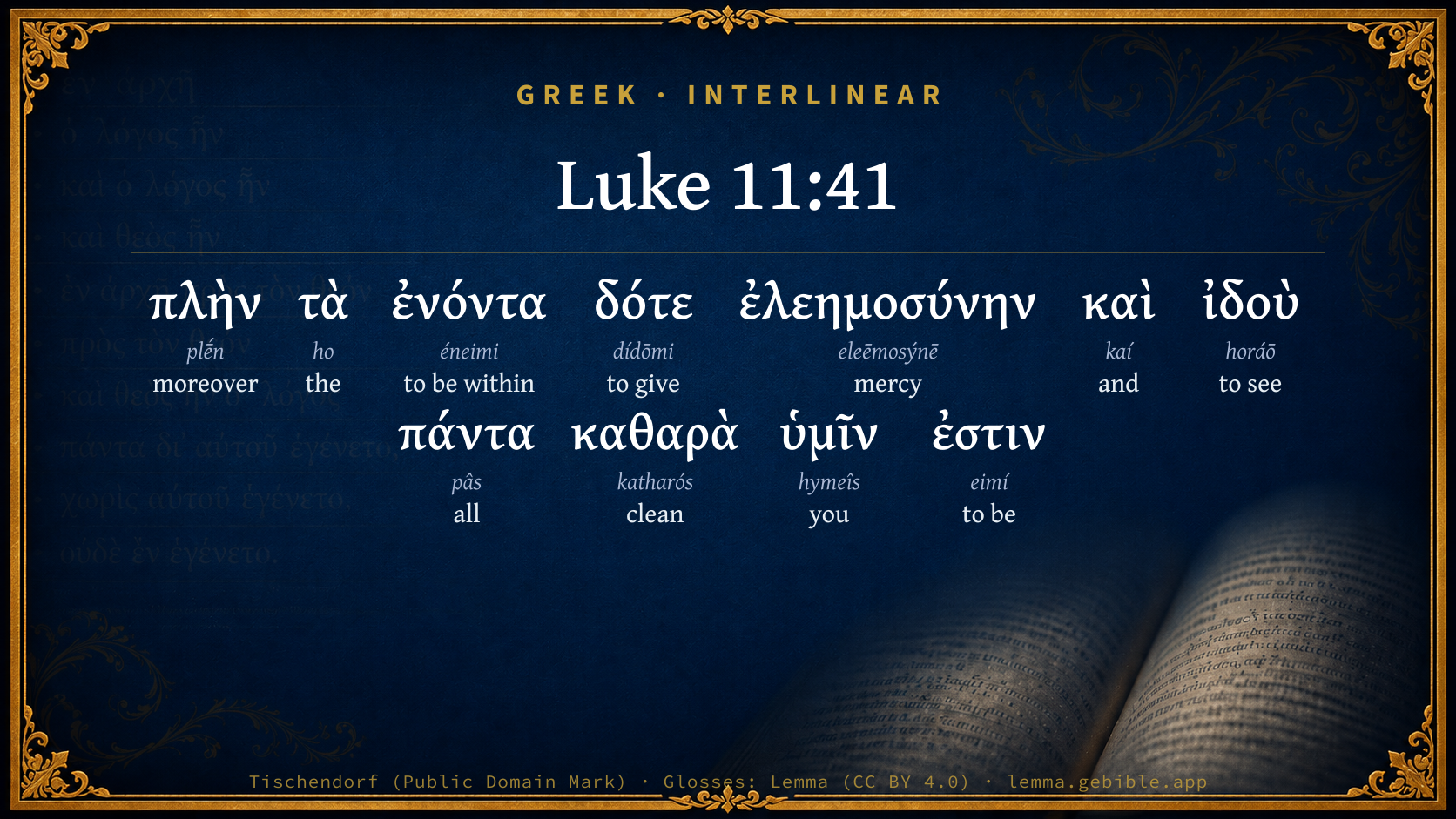
Download image
Cite this verse

Luke 11:41 (World English Bible). Public Domain. Lemma interlinear Bible study tool, https://lemma.gebible.app/v/luke/11/41.

Show BibTeX & RIS
BibTeX
RIS
English Translation
But give for gifts to the needy those things which are within, and behold, all things will be clean to you.
World English Bible · Public Domain
Highlights
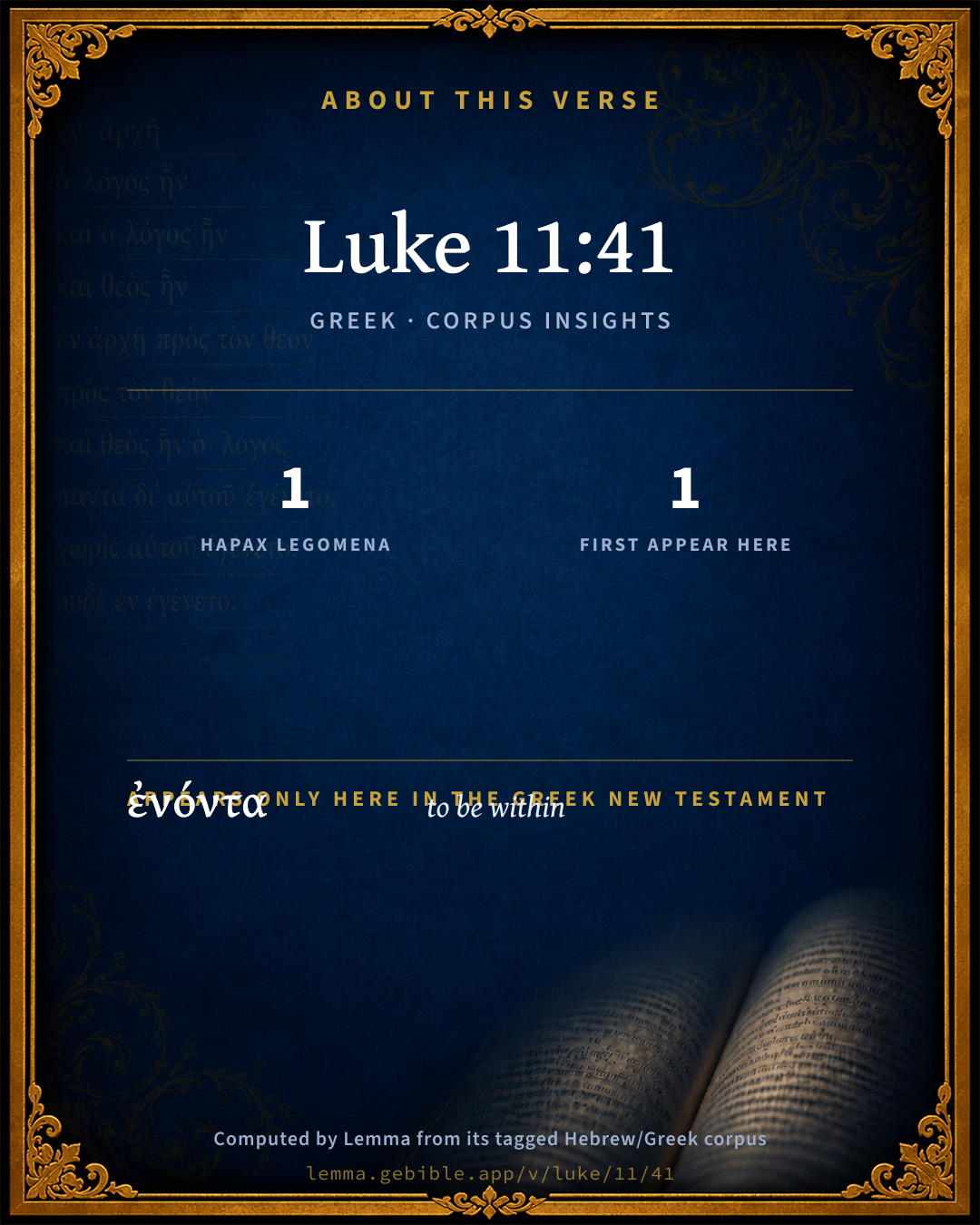
  • 1 hapax legomenon — only here in the Greek New Testament
  • 1 first appearance in the Greek New Testament
Full analysis ↓
Download a study sheet

One document with this verse’s original text, its word-by-word gloss line, the meaning frame, cross-references with their text, attributed commentary, and full source and license credits — printable, and it pastes into notes with its structure intact.

This verse Autodidact and up

Study sheet (.html) Plain text (.txt)

A passage Seminary Student

Up to 50 verses in one chapter. A passage sheet keeps up to 6 commentary sources and 12 cross-references per verse, in the order this page ranks them, and says so on the sheet whenever that leaves anything out. Ask for a single verse and you get the Autodidact verse sheet above.

Everything on this page stays free to read, with no account — the sheet is a download of what is already on screen, not access to it.

Want to remove ads? Support Godless Engineer
Compare translations 3

The same verse in 3 English versions, stacked beneath the original-language interlinear above. Click any original word for its lexicon entry.

Each is an independent rendering of the whole verse — the interlinear is not word-aligned to these translations.

Highlighted words mark where these versions differ — a whole-verse word diff, not a word-by-word alignment.

  • World English Bible Public Domain
    But give for gifts to the needy those things which are within, and behold, all things will be clean to you.
  • King James Version Public Domain
    But rather give alms of such things as ye have; and, behold, all things are clean unto you.
  • unfoldingWord Literal Text CC BY-SA 4.0
    But give as charity is inside, and behold, all things are clean to you.

unfoldingWord Literal Text — © unfoldingWord, licensed CC BY-SA 4.0. Word-aligned USFM3 via Door43 (git.door43.org/unfoldingWord/en_ult).

Versions to compare (up to 4)

3 of 4 selected

Show all 19 translations

Every available English version of this verse, each an independent rendering of the whole verse.

  • World English Bible Public Domain
    But give for gifts to the needy those things which are within, and behold, all things will be clean to you.
  • Berean Standard Bible Public Domain
    But give as alms the things that are within you, and you will see that everything is clean for you.
  • Majority Standard Bible Public Domain
    But give as alms the things that are within you, and behold, everything will be clean for you.
  • King James Version Public Domain
    But rather give alms of such things as ye have; and, behold, all things are clean unto you.
  • American Standard Version (1901) Public Domain
    But give for alms those things which are within; and behold, all things are clean unto you.
  • Revised Version (1885) Public Domain
    Howbeit give for alms those things which are within; and behold, all things are clean unto you.
  • Geneva Bible (1599) Public Domain
    Therefore, giue almes of those thinges which you haue, and beholde, all thinges shall be cleane to you.
  • Douay-Rheims (1899) Public Domain
    But yet that which remaineth, give alms; and behold, all things are clean unto you.
  • Young's Literal Translation Public Domain
    But what ye have give ye `as' alms, and, lo, all things are clean to you.
  • Literal Standard Version CC BY-SA 4.0
    But what you have given [as] alms, and behold, all things are clean to you.
  • Unlocked Literal Bible CC BY-SA 4.0
    Give to the poor what is inside, and then all things will be clean for you.
  • unfoldingWord Literal Text CC BY-SA 4.0
    But give as charity is inside, and behold, all things are clean to you.
  • Darby Bible Public Domain
    But rather give alms of what ye have, and behold, all things are clean to you.
  • World Messianic Bible Public Domain
    But give for gifts to the needy those things which are within, and behold, all things will be clean to you.
  • Webster's Bible Public Domain
    But rather give alms of such things as ye have; and behold, all things are clean to you.
  • Free Bible Version CC BY-SA 4.0
    If, acting from within, you do acts of kindness to others, then everything will be clean to you.
  • Bible in Basic English Public Domain
    But if you give to the poor such things as you are able, then all things are clean to you.
  • Text-Critical English NT CC BY 4.0
    But give as alms the things that are on the inside, and behold, everything will be clean for you.
  • Tyndale New Testament (1534) Public Domain
    Neverthelesse geve almose of that ye have and beholde all is clene to you.

Literal Standard Version (2020), Covenant Press — licensed CC BY-SA 4.0. Text via the HelloAO Bible API (eBible.org). Unlocked Literal Bible (unfoldingWord) — licensed CC BY-SA 4.0. Text via the HelloAO Bible API (eBible.org). unfoldingWord Literal Text — © unfoldingWord, licensed CC BY-SA 4.0. Word-aligned USFM3 via Door43 (git.door43.org/unfoldingWord/en_ult). Free Bible Version, Dr. Jonathan Gallagher — licensed CC BY-SA 4.0. Text via the HelloAO Bible API (eBible.org).

Word by word

More ways to search: Search by grammar → Find every occurrence → Compare this word →

Practice this passage: Drill this verse → Learn its vocabulary →

About this verse

These counts appear in no published source. They are computed here, from the morphology-tagged text and Lemma’s own curated glosses. What Lemma adds →

11
words
11
distinct lemmas
Gospels
section

Notable vocabulary

1 hapax legomenon — a word that appears only here in the entire Greek New Testament:

  • ἐνόντα to be within G1751

First appearance in Scripture

This word makes its first canonical appearance in the Greek New Testament here:

  • ἐνόντα to be within G1751

Shared distinctive vocabulary

ἐλεημοσύνην mercy G1654 occurs in 13 verses of the Greek New Testament. Also found in:
Cross-references

35

Topical passages linked to Luke 11:41 in the Treasury of Scripture Knowledge — connected by theme and wording, ordered by reader-vote popularity; previews shown in the World English Bible.

  • Luke 12:33 Sell that which you have, and give gifts to the needy. Make for yourselves purses which don't grow old, a treasure in the heavens that doesn't fail, where no thief approaches, neither moth destroys.
  • Titus 1:15 To the pure, all things are pure; but to those who are defiled and unbelieving, nothing is pure; but both their mind and their conscience are defiled.
  • James 1:27 Pure religion and undefiled before our God and Father is this: to visit the fatherless and widows in their affliction, and to keep oneself unstained by the world.
  • Luke 16:9 I tell you, make for yourselves friends by means of unrighteous mammon, so that when you fail, they may receive you into the eternal tents.
  • Acts 10:15 A voice came to him again the second time, "What God has cleansed, you must not call unclean."
  • Hebrews 13:16 But don't forget to be doing good and sharing, for with such sacrifices God is well pleased.
  • Proverbs 14:31 He who oppresses the poor shows contempt for his Maker, But he who is kind to the needy honors him.
  • Proverbs 19:17 He who has pity on the poor lends to Yahweh; He will reward him.
  • Isaiah 58:7–11 Isn't it to deal your bread to the hungry, and that you bring the poor who are cast out to your house? when you see the naked, that you cover him; and that you not hide yourself from your own flesh?
  • Daniel 4:27 Therefore, O king, let my counsel be acceptable to you, and break off your sins by righteousness, and your iniquities by showing mercy to the poor; if there may be a lengthening of your tranquillity.
  • Matthew 6:1–4 "Be careful that you don't do your charitable giving before men, to be seen by them, or else you have no reward from your Father who is in heaven.
  • 2 Corinthians 8:7–9 But as you abound in everything, in faith, utterance, knowledge, all earnestness, and in your love to us, see that you also abound in this grace.
  • Deuteronomy 15:8–10 but you shall surely open your hand to him, and shall surely lend him sufficient for his need [in that] which he wants.
  • Psalms 41:1 Blessed is he who considers the poor: Yahweh will deliver him in the day of evil.
  • Psalms 112:9 He has dispersed, he has given to the poor. His righteousness endures forever. His horn will be exalted with honor.
  • Ecclesiastes 11:1–2 Cast your bread on the waters; For you shall find it after many days.
  • Matthew 5:42 Give to him who asks you, and don't turn away him who desires to borrow from you.
  • Matthew 25:34–40 Then the King will tell those on his right hand, 'Come, blessed of my Father, inherit the Kingdom prepared for you from the foundation of the world;
  • Luke 14:12–14 He also said to the one who had invited him, "When you make a dinner or a supper, don't call your friends, nor your brothers, nor your kinsmen, nor rich neighbors, or perhaps they might also return the favor, and pay you back.
  • Luke 18:22 When Jesus heard these things, he said to him, "You still lack one thing. Sell all that you have, and distribute it to the poor. You will have treasure in heaven. Come, follow me."
  • Luke 19:8 Zacchaeus stood and said to the Lord, "Behold, Lord, half of my goods I give to the poor. If I have wrongfully exacted anything of anyone, I restore four times as much."
  • Acts 9:36–39 Now there was at Joppa a certain disciple named Tabitha, which when translated, means Dorcas. This woman was full of good works and acts of mercy which she did.
  • 2 Corinthians 8:12 For if the readiness is there, it is acceptable according to what you have, not according to what you don't have.
  • 2 Corinthians 9:6–15 Remember this: he who sows sparingly will also reap sparingly. He who sows bountifully will also reap bountifully.
  • Hebrews 6:10 For God is not unrighteous, so as to forget your work and the labor of love which you showed toward his name, in that you served the saints, and still do serve them.
  • James 2:14–16 What good is it, my brothers, if a man says he has faith, but has no works? Can faith save him?
  • 1 John 3:16–17 By this we know love, because he laid down his life for us. And we ought to lay down our lives for the brothers.
  • Job 13:16–20 This also shall be my salvation, That a godless man shall not come before him.
  • Matthew 26:11 For you always have the poor with you; but you don't always have me.
  • Acts 10:31–32 and said, 'Cornelius, your prayer is heard, and your gifts to the needy are remembered in the sight of God.
  • Acts 11:29 As any of the disciples had plenty, each determined to send relief to the brothers who lived in Judea;
  • Ephesians 4:28 Let him who stole steal no more; but rather let him labor, working with his hands the thing that is good, that he may have something to give to him who has need.
  • 1 Timothy 4:4–5 For every creature of God is good, and nothing is to be rejected, if it is received with thanksgiving.
  • Acts 24:17 Now after some years, I came to bring gifts for the needy to my nation, and offerings;
  • Romans 14:14–18 I know, and am persuaded in the Lord Jesus, that nothing is unclean of itself; except that to him who considers anything to be unclean, to him it is unclean.

Cross-references courtesy of OpenBible.info (CC BY 4.0).

Commentary

Notes on Luke 11:41 from classic Christian and Jewish commentators (each source and its license shown beneath its notes). The classic Christian expositions comment on the surrounding passage and are grouped to its opening verse, so a note may address several verses; the Jewish commentaries on the Tanakh (Rashi and others) are per-verse, so they appear only where the commentator wrote on this verse.

Lemma curates 59 commentaries, every one of them public domain or Creative Commons licensed, each selected and text-cleaned for this edition rather than reprinted as found. About our sources →

The Biblical Illustrator

Joseph S. Exell

Luk_11:41

Give alms of such things as ye have

Christian charity

In the Revised Version the translation is--Give for alms those things that are within, and this preserves the point of the saying, which is obscured in the rendering of the Authorized Version.

Our Lord had been invited to dinner by a certain Pharisee, and had sat down to meat without the customary ritual ablutions. In the eyes of His host He sat there defiled by His refusal of the outward cleansing; and it was to teach the lesson that purity must be born within the soul and cannot come to it from without, that He spoke these words.

I. In ONE SENSE THIS PRECEPT MAKES CHARITY EASIER RATHER THAN MORE DIFFICULT. We do not all possess the things which are without--money, influence, rank, and the patronage they bring with them; and if Christ had made charity to consist in the bestowal of such things He would have made charity an impossible virtue to a large number of His disciples. But when Christ enlarges His definition of charity, when He says almsgiving does not only consist in giving money or giving anything that is external, but in giving the things that are within, He certainly seems to open this royal road to all who choose to enter it, for lives there the man so poor as to be unable to give a tear, a look, a kindly word, a touch of brotherly sympathy to his fellow-man?

II. Yet it needs hut a moments thought to discover that INSTEAD OF THIS COMMAND MAKING ALMSGIVING EASIER, IT REALLY MAKES IT MORE

DIFFICULT. For which is the easier, to give what you may have in your purse to the poor, or to give yourself; to bestow the coin that is hardly missed, or to bestow your thought, sympathy, personal interest on some sad case of misfortune and suffering?

1. Among the things that are within, we may certainly count the manner in which charity is bestowed. As John Morley remarks, It is not enough to do good; one must do it in a good way. There is more real value, both to God and man, in a little gift given in a good way, given with willingness, with cheerfulness, with gratitude for the privilege of giving, than in a great gift flung out from a stony heart, like honey out of the rock.

2. But manner is not everything. Sympathy is more than manner; and of all the inner sources of wealth which confer value on our alms, sympathy is the chief. It is one thing to give a sovereign to a a poor widow overwhelmed with trouble; it is another thing to give ourselves, our time, our sympathy, to help to lift her to a happier life, and to make her feel there is one heart that cares for her. A little while ago a poor lost girl lay dying on some filthy straw in a London slum. I know not whether any relief had been sent from the great houses near by, but if it had been given it had not touched her heart or brought hope to that darkened life. One day a Christian lady heard of the dying girl, heard the sad story of her life, and mounting the rickety stairs that led to her miserable room, found her out. She went to her side. Her first act was to stoop down and kiss her. That womanly act--that Christlike act, rather let me say, the pure touching and loving the impure--brought a flood of cleansing tears to that girls face; that act saved a lost soul. It was giving for alms of the things that were within.

3. Once again, in illustration of the inner wealth which we are to bestow on others, there is our personal service in the relief of suffering, or the increase of human joy, or the saving of the lost. Neither the manner of almsgiving nor the sympathy of the heart is enough. We must do good as well as be good. From the service of God, as expressed in the service of man, there is no exemption. You may pay a substitute to take your place in the conscriptions of earth; in the war of God against sin and suffering and ignorance, there is no vicarious service. Christ gave Himself for us; and He asks us to give ourselves to Him and to His service on earth. The Church of Christ will never save the world until, following its Divine Lord, it goes out into the dark places of the earth to seek and to save that which is lost. There is no Christian charity worth the name without sacrifice. Its lowest form is the sacrifice of money; its highest is the sacrifice of ourselves--the giving without murmuring or grudging our best for the service of God in the service of man.

4. I cannot omit from the things that are within, the inner life of Christ which He has imparted to the soul, the gospel of His redeeming love, which has made us what we are. Christ expects you to speak for Him, to be a gospel to those who know Him not. There is a preaching more eloquent than any sermon from the pulpit, and that is the message spoken, not by the minister, but by each individual Christian in his own life in the fitting season. (G. S. Barrett, B. A.)

The value of alms-giving

Instead of such things as ye have, the words ought rather to be rendered, give alms of that which is within the cup and platter, i.e., of their contents: give food and refreshment to those who need it, and behold all things are clean unto you. This is one of those very many places which assign to alms-giving (of course if practised for the approval of God, and not for vainglory) an almost expiatory value (see Luk_16:9; Act_10:4; Mat_25:34-35; 1Ti_6:17-18). Godet paraphrases it well: Do you wish, then, that these meats and these wines should not be defiled, and should not defile you? Do not think that it is enough for you carefully to wash your hands before eating; there is a surer means: let some poor man partake of them. (M. F. Sadler.)

Offertorial gifts

When we read this verse in connection with those that immediately precede it, the meaning of it appears to become clear and unquestionable. The Pharisees, in whose company our blessed Lord was sitting at meat, had remarked upon His not first washing before the dinner; for they themselves, and all the Jews, by their example, except they washed their hands often (or to the elbow) ate not, holding the tradition of the elders (Mar_7:3). Ye fools, do ye then hope to deceive God by cleansing the outside, while your reward hearts are thus full of all extortion and greediness? Nay, rather purify the inside; change ravening into mercy, and stinginess and grudging into almsgiving; and, behold, every part, both the inside and the outside, will become clean unto you. The praise of almsgiving, then, which is contained in this passage, seems to be that when it is duly done, it is better in the sight of God than all whole burnt-offerings and sacrifices; that it has a more cleansing efficacy than any ceremonial worship; that it is an inward cleanness, and as such is acceptable to God beyond any outward punctiliousness or exactness of service. I am led to select this topic of Christian instruction, my brethren, in addressing you today, in order to make a few observations on the benefits of the sacred offertory of the Holy Communion.

1. Let it be observed then, first, that the holy offertorial gift is a gift of peace. If thou bring thy gift to the altar, and there rememberest that thy brother hath aught against thee, leave there thy gift before the altar, and go thy way; first be reconciled to thy brother, and then come and offer thy Mat_5:23-24). How shall any one, then, who is unkind, or quarrelsome, or unforgiving, be able to offer the sacramental gift? Be it ever so small, it is the token and symbol of peace. Think, then, my brethren, whether, even in this respect only, the offertorial gift have not a very strong and important reference to your own lives and habits. Think whether there be not many ways in which you are tempted to infringe the law of Christian charity and courtesy towards one another; whether mutual kindness and considerateness, in great and small things, in matters of all sorts, in deeds, in words, in nicknames, in insults, in injury of feelings or property; whether such minute considerateness and kindly courtesy, be not a duty of which you greatly need to be sometimes reminded. And think again whether you are not apt sometimes, in treating those whom God has placed in a lower rank than yourselves in life, to offend against the same law.

2. Secondly, the offertorial gift is to be regarded as the first-fruit of alms. Whatever a man may give in alms between communion and communion is to be considered as all offered to God in the offering of this the first-fruits. Thus the little gift of the communion is, in fact, greater, even in amount, than it seems; for it represents all that a man Christianly gives for similar pious and charitable uses till his next communion. It is as the libation, sanctifying all the feast. As Christian alms then, the offertorial gift may be of most various and unconceived effects. Who knows what sorrows it may alleviate, what pains it may soothe, what wants it may supply? Who knows again how many thanksgivings it may awaken, how many prayers for blessings on the giver, what hearts it may touch to repentance? Who knows what consequences, never to be known on earth, but surely to be declared in the Judgment, a little gift with Gods good blessing on it may produce beyond our power to trace or think? how it may bring glory to God from men on earth and from rejoicing angels in the highest heavens? Thus then, in the second place, I would urge you to prize the offertorial gift as opening to you the privilege of sacred alms-giving. But I have hitherto spoken only of the outward aspects of the offertorial gift. It is to the inward ones, if I may so express myself, that the text of St. Luke particularly refers, and to which I rather desire to direct your attention. Consider, then, how many ways there are in which men need that money, in its various uses, should be sanctified to them. You know in what remarkable terms the Holy Scriptures constantly speak of money: how they seem to identify it in a very particular way with evil and the powers of evil; how our Lord calls it by the name of the unrighteous mammon, and telling His disciples that they cannot serve God and mammon, seems to put the false god of money for the evil spirit; and to say that he and his dominion are so separate and distinct from God and His kingdom, that whosoever is subject to the one cannot possibly be subject to the other also. What, then, I desire to set before you is this: that you, too, in your present state of life are beginning to be tried in respect of money; that the false god of money, the unholy mammon, solicits you in various ways, as well as those whose pecuniary trials are larger and more notorious; that you have many such dangers even now, which you must learn to escape in these early days of springing Christian strength, and that the secret of your strength and safety is to be found in your communion offerings. There, while you dedicate the little first-fruits, you must intend to sanctify the whole. There, while you directly consecrate a little, you must resolve that there shall be none unconsecrated; that Christian devotion and duty shall accompany you even in the most distant and secular uses to which the rest may be applied; that the manner of spending the rest shall be appropriate to this beginning.

3. Consider, then, how entirely inconsistent with the offering of communion gifts is all incurring of debt. How can any person venture to approach the altar of God with what he pretends to be a gift, while, in fact, the very piece of money which he offers belongs of right to another, and is not his own? Let no one, then, think that he shall honour God by making an offering at the altar of that which he owes. It is, according to the expressive idiom of the Latin, another mans money; and little indeed can we think that God will be glorified, or that blessing will follow on the gift, which is rather an additional sin than a manner of sanctifying our other actions. And let all remember that to offer at the Holy Communion is, in fact, to forswear and abandon the practice of incurring debts.

2. Think, again, of wastefulness and luxury, and consider whether you are not commonly tempted to spend money, often very hardly spared by those who supply it to you, in self-indulgence of the most wanton and needless kinds.

3. Again, how impossible it should be for one who offers a gift at Gods holy altar to be dishonest, whether that dishonesty be shown in the coarser and more unquestionable ways of theft or cheating, or in the less obvious, but not less guilty devices, whereby advantage is often unfairly taken, and some enriched to their neighbours loss!

4. And again, as connected with the last topic, consider whether it be possible for those who desire to make their offertorial gift in true earnestness and devotion, to endeavour to gain money in gambling or betting of any kind. And who that ever saw the gambling passion strongly exhibited in any person can doubt of what manner of spirit such a man is while the passion is on him--the Spirit of God, or the spirit of mammon?

5. And, lastly, let me ask you whether it be possible for one who brings his offering to the altar, and desires thereby to make all his other pecuniary dealings clean unto him, to purchase any things that are themselves unlawful, whether they be unlawful by the universal law of God, or unlawful by the laws to which they are now subject, and which they must obey, as they hope to please God in the state of life to which He has called them? Plainly, it is not possible. It would be an attempt to give God a little and Satan much. These, then, are some of the ways in which the Holy Communion offering ought to be of benefit to you in these years: so true is it that if we would act up to all the precepts and directions of the Church we should find that they bear in many unexpected ways upon our lives, and cannot be neglected without much and heavy loss. The offertory gives the sacred Church rule of spending money; and there is no part of the subject, however remote or secular, to which the rule thence derived will not apply. (Bishop Moberly.)

The Biblical Illustrator, edited by Joseph S. Exell (c. 1880s–1900s) — public domain. Text from a community e-Sword module.

Tyndale Open Study Notes

Tyndale Open Resources

11:41 by giving gifts to the poor: Acts of love reveal internal righteousness.

Tyndale Open Study Notes — © Tyndale Open Resources, licensed CC BY-SA 4.0. Text via the HelloAO Bible API.

Bengel's Gnomon

Johann Albrecht Bengel

Luk 11:41. Πλὴν) Although the exterior thing has been made by Him by whom the interior has been made: nevertheless in the case of man, who has contracted uncleanness, the footing on which the exterior stands, which does not in itself defile, is different from that on which the interior stands, which is in the greatest degree in need of purification.—τὰ ἐνόντα) An anonymous writer in Suidas (V. ἐνόν) says: θυσίαν ἐκ τῶν ἐνόντων καὶ παρόντων προσαχθεῖσαν, a sacrifice brought of the animals which were there, and which he had; as is observed by Pricæus, whom see on this passage. Therefore τὰ ἐνόντα are not τὸ ἔσωθεν, but articles of food and drink which are in the vessels. Supply κατά.—δότε, give) The more usual expression is ποιεῖν, to do alms: but in this place give, used (as in ch. Luk 12:33) in antithesis to rapaciousness [ravening: Give is antithetic to rapaciously snatch, implied in ἁρπαγῆς], Luk 11:39.—καὶ ἰδοῦ, and behold) He does not say, and then, but and behold; and presently after, not shall be [in consequence], but are. Therefore He does not say, that it is by giving alms in particular that cleanness or purity is to be gained for one’s food and drink; but that purity exists in the creature of God in itself (that is, in the food and drink regarded per se in itself): that all that is effected by the alms when given, not by the washing of hands, is that the stain is wiped away, which the Pharisees had contracted by their rapacity.[112]—πάντα καθαρὰ) all things, which are in the cup and the dish, are clean unto you. For God hath made all these things: Luk 11:40. None of these things defileth a man: Mat 15:11.

[112] i.e. Having been guilty of rapacity, and having found pardon through repentance and faith, the only outward amends which one can make to his neighbour, as a fruit of faith and a pledge of sanctification, is, besides restoration of what has been wrongfully taken, almsgiving.—ED. and TRANSL.

Bengel's Gnomon of the New Testament — English translation (T&T Clark, Edinburgh, 1860) — public domain. Text from a community e-Sword module.

Meyer's Critical & Exegetical Commentary

Heinrich August Wilhelm Meyer

Luk_11:41. A prescription how they are to effect the true purification. Πλήν is verumtamen (see on Luk_6:24): Still, in order to set aside this foolish incongruity, give that which is therein (the contents of your cups and platters) as alms, and behold everything is pure unto you … this loving activity will then make your entire ceremonial purifications superfluous for you. All that you now believe you are compelled to subordinate to your customs of washings (the context gives this as the reference of the πάντα) will stand to you (to your consciousness) in the relation of purity. On the idea, comp. Hos_6:6 (Mat_9:13; Mat_12:7). τὰ ἐνόντα has the emphasis: yet what is in them, etc. Moreover, it is of itself obvious, according to the meaning of Jesus, that He sets this value not on the external work of love in itself, but on the disposition evinced thereby. Comp. Luk_16:9. The more unnecessary was the view which regarded the passage as ironical (Erasmus, Lightfoot, and others, including Kuinoel, Schleiermacher, Neander, Bornemann), and according to which Jesus repeats the peculiar maxim of the Pharisees for attaining righteousness by works: Attamen date modo stipem pauperibus, tunc ex vestra opinione parum solliciti esse potestis de victu injuste comparato, tunc vobis omnia pura sunt, Kuinoel. Irony would come in only if in the text were expressed, not date, but datis. Moreover, the Pharisees would not have said τὰ ἐνόντα, but ἐκ τῶν ἐνόντων. Besides, notwithstanding the Old Testament praise of this virtue (Pro_16:6; Dan_4:24; Eccles. 3:30, 29:12; Tob_4:10; Tob_12:9, and elsewhere), and notwithstanding the Rabbinical Eleemosyna aequipollet omnibus virtutibus (Bava bathra, f. 9. 1), charitableness (apart from ostentatious almsgiving, Mat_6:2) was so far from being the strong side of the Pharisees (Mat_23:13-14; Mar_7:11) that Jesus had sufficient reason to inculcate on them that virtue instead of their worthless washings.

τὰ ἐνόντα] that which is therein. It might also mean, not: quod superest, i.e. τὸ λοιπόν (Vulgate), but perhaps: that which is at hand, that which ye have (Theophylact: τὰ ὑπάρχοντα ὑμῖν; Euthymius Zigabenus: τὰ ἐναποκείμενα; Luther: Of that which is there), or which is possible (Grotius, Morus), to justify which δοῦναι would have to be understood; but the connection requires the reference to the cups and platters.

Meyer — Critical and Exegetical Commentary on the New Testament — English translation by Peter Christie, edited by Frederick Crombie (T&T Clark, 1880) — public domain. Text from a community e-Sword module.

Expositor's Greek Testament

ed. W. Robertson Nicoll

Luk 11:41 . πλὴν , rather (instead of devoting such attention to the outside). τὰ ἐνόντα , etc., give, as alms, the things within the dishes . Others render as if the phrase were κατὰ τ . ἐν .: according to your ability (Pricaeus, Grotius, etc.).

The Expositor's Greek Testament, edited by W. Robertson Nicoll (1897–1910) — public domain. Text from a community e-Sword module.

Geneva Bible (1599)

Geneva Bible translators

That is, according to your abilities as who would say, instead of your extortions, which hindered you, that you could not eat cleanly, use charity, and accordingly as your ability shall serve you, be good to the poor, and so shall that, that is within the platter, be sanctified though the platter be unwashed.

Geneva Bible (1599) marginal notes — public domain. Text via Bolls.life.

Jamieson, Fausset & Brown

Robert Jamieson, A. R. Fausset & David Brown

give alms . . . and . . . all . . . clean--a principle of immense value. As the greed of these hypocrites was one of the most prominent features of their character (Luk 16:14; Mat 23:14), our Lord bids them exemplify the opposite character, and then their outside, ruled by this, would be beautiful in the eye of God, and their meals would be eaten with clean hands, though never so fouled with the business of this worky world. (See Ecc 9:7).

Jamieson, Fausset & Brown — Commentary Critical and Explanatory on the Whole Bible (1871) — public domain (CC PDM 1.0). Text via the HelloAO Bible API.

Adam Clarke's Commentary

Verse 41. Give alms of such things as ye have] Meaning either what was within the dishes spoken of before; or what was within their houses or power: or what they had at hand, for so τα ενοντα is used by the purest Greek writers. Cease from rapine: far from spoiling the poor by wicked exactions, rather give them alms of every thing you possess; and when a part of every thing you have is sincerely consecrated to God for the use of the poor, then all that remains will be clean unto you; you will have the blessing of God in your basket and store, and every thing will be sanctified to you. These verses are very difficult, and are variously translated and interpreted by critics and divines. I have given what I believe to be our Lord's meaning, in the preceding paraphrase. For a description of the rapine, &c., of the Pharisees, See Clarke on Mt 23:25.

Adam Clarke's Commentary on the Bible (1810–1826) — public domain. Text from a community e-Sword/MySword module.

Ellicott's Commentary for English Readers

(41) But rather give alms of such things as ye have.—This, too, is peculiar to St. Luke. In the underlying principle of its teaching it sweeps away the whole fabric of the law of ceremonial purity, as the words of St. Mat_15:10-20 had, on different grounds, done before. The distinction between the two phases of the truth is that here greater stress is laid on the active purifying power of the love of which alms, if not given for the sake of man’s praise, is the natural expression. That which defiles is selfishness; that which purifies is the unselfishness of love.

A Bible Commentary for English Readers, edited by Charles John Ellicott (1878–1897) — public domain. Text from a community e-Sword module.

The Cambridge Bible for Schools and Colleges

gen. ed. J. J. S. Perowne

41. give alms] See Luk_12:33, Luk_16:14; Mat_6:3. Almsgiving is only mentioned as one typical form of Charity, which was in that state of society preeminently necessary. Indeed ‘alms’ is the same word as eleemosune, which involves the idea of Mercy. The general lesson— that God does not care for ceremonies, in themselves, and only cares for them at all when they are accompanied by sincere goodness—is again and again taught in Scripture. 1Sa_15:22 j Isa_58:6-8; Mic_6:8; Dan_4:27; Jas_4:8.

of such things as you have] Perhaps, “as for that which is within you, give alms.” But the entire meaning of the clause is much disputed. Some explain it, Give as alms ‘the contents’ of cup and platter, and then they will be all clean without washing. ‘It is Love which purifies, not lustrations.’

The Cambridge Bible for Schools and Colleges (gen. ed. J. J. S. Perowne; Cambridge University Press, 1878–1918) — public domain. Text from a community e-Sword module.

John Gill's Exposition

Woe unto you Pharisees, for ye love the uppermost seats in the synagogues,.... And also the uppermost rooms at feasts, Mat 23:6

and greetings in the market; See Gill on Mat 23:6 and See Gill on Mat 23:7.

John Gill's Exposition of the Whole Bible (1746–1763) — public domain (CC PDM 1.0). Text via the HelloAO Bible API.

Trapp's Complete Commentary

John Trapp

41 But rather give alms of such things as ye have; and, behold, all things are clean unto you.

Ver. 41. But rather give alms] So Daniel counsels Nebuchadnezzar, Dan 4:27. Ralph, Bishop of Chichester, A. D. 1070, drawing towards his end, delivered unto the poor with his own hands whatsoever he had in the world (I inquire not with what intention), leaving himself scarcely clothes to cover him. Alexander V, Bishop of Rome, was liberal to the poor (saith the historian), that he left nothing for himself, so that he would merrily say that he was a rich bishop, a poor cardinal, and a beggarly pope.

Of such things as ye have] Gr. As are within, τα ενοντα, either within the platter (send morsels to the hungry) or within your hearts; for riches get within their owners many times, and do more possess them than are possessed by them;

" difficile est opibus non tradere mentem."

John Trapp, A Commentary or Exposition upon All the Books of the Old and New Testament (1647–1656) — public domain. Text from a community e-Sword module.

Albert Barnes' Notes on the Bible

Alms - Charity. Benefactions to the poor.

Such things as ye have - Your property; though it has been gained unjustly: though you have lived by rapine, and have amassed wealth in an improper manner, yet, since “you have it,” it is your duty to make the best of it and do good. By giving to the poor, you may show your repentance for your crimes in amassing money in this manner. You may show that you disapprove of your former course of life, and are disposed henceforward to live honestly. If this be the meaning of this passage, then it shows what is the duty of those who have by unjust gains become wealthy, and who are “then” converted to God. It may not be possible for them in every case to make exact restitution to those whom they have injured; thousands of instances of wrong they may have forgotten; many persons whom they have injured may have died; but still they may show, by giving to others, that they do not think their gains acquired honestly, and that they truly repent. They may devote their property to God; distribute it to the poor; or give it to send the gospel to the heathen world. Thus may they show that they disapprove of their former conduct; and thus may be seen one great principle of God’s government - “that good finally comes out of evil.”

And behold ... - Doing this will show that you are a true penitent, and the remainder of your property you will enjoy with a feeling that you have done your duty, and no longer be smitten with the consciousness of hoarding unjust gains. The object of the Saviour here seems to have been to bring the Pharisee to repentance. Repentance consists in sorrow for sin, and in forsaking it. This he endeavored to produce by showing him:

The “evil” and hypocrisy of his conduct; and, By “exhorting” him to ““forsake” his sins, and to “show” this by doing good.

Thus doing, he would evince that the “mind” was clean as well the “body;” the “inside” as well as the “outside.”

Albert Barnes' Notes on the Bible (1834–1885) — public domain. Text from a community e-Sword/MySword module.

Haydock's Catholic Bible Commentary

But yet that which remaineth, give alms.[1] The sense seems not to be of what remaineth, give alms, as some expound it; but by the Greek, the sense is, give alms of what you have, i.e. of your goods, according to your abilities; and as Tobias said to his son, If thou hast much, give much; if little, give a little willingly. (Tobias iv. 9.) --- All things are clean unto you. Not that alms without other pious dispositions, will suffice to your salvation; but that other necessary virtues will be given you, by the mercies of God. (Witham) --- These are the means I propose to you to gain that interior purity I am speaking of. But will alms suffice to expiate all sorts of crimes? Is it enough for the murderer, the homicide, &c. to give alms? Undoubtedly not. Our Saviour only compares alms-deeds with the exterior washing which the Pharisees affected. As if he had said, "It is not by the washing in common water that you will take out the stains of your souls, by the works of charity. Charity will be more efficacious to cleanse you than all the waters of the rivers and of the sea." Or, according to Euthymius, if you wish to cleanse yourselves truly, bring forth worthy fruits of penance, give up ill acquired possessions; and as for the rest, redeem you sins by alms. Thus shall all things be made clean to you, as well within as without the vase. (Calmet)

===============================

[BIBLIOGRAPHY]

Verumtamen quod superest, date eleemosynam Greek: plen ta enonta dote eleemosunen; quæ adsunt, quæ penes vos sunt. It is not Greek: to loipon, &c.

George Leo Haydock (1774–1849), Haydock's Catholic Family Bible and Commentary, 1859 edition — public domain. Excludes Psalms (Douay-Rheims chapter numbering differs from Protestant) and Deuterocanonical books (Catholic canon only).

Matthew Poole's English Annotations

πλὴν τὰ ἐνόντα δότε ἐλεημοσύνην. The word ενοντα being a word not ordinarily used in a sense which will fit this place, hath made a great abounding in their own senses amongst interpreters; some translating it, Give such things as are within for alms; others, such things as you have; others, such things as are necessary; others, such things as ye are able, as if κατα were to be understood before τα ενοντα, according to what you have. Others, what things remain, after the serving your own necessities, and a just restitution to those whom you have wronged. Others think it is but a connexion of our Saviour’s speech, and the sense is, Moreover there is but one thing to be done, Give alms, &c., as if it were το ενον I do not see but our own translation is as good as any, and κατα seems to be understood in the Greek. According to what you have, which is truly and justly your own, not theirs whom you have wronged, nor your creditors’, nor your families’, for their necessities; give alms of all that.

And, behold, all things are clean unto you. Not, your souls are clean; though that must first be, yet our Saviour is not here directing that, or the means and methods for it; but all things are clean to you, you may lawfully and without guilt use them: Unto the pure all things are pure; but unto them that are defiled and unbelieving is nothing pure, Tit 1:15. Our Saviour’s words are a plain exhortation to repentance, that lieth in the change of our minds; and that inward change of our minds must be evidenced by the change of our actions, and particularly by a restitution in case of wrong done to any. The Pharisees were a covetous, rapacious generation, full of extortion, devouring widows’ houses, &c. Their repentance was to be evidenced by contrary works; those were works of justice and mercy. God calleth to the Israelites for the first, Isa 1:16,17. Christ calls to the Pharisees for the latter. Such works of mercy as might evidence their hearts to be truly changed: and then, saith our Saviour, all things will be clean to you, which otherwise will not be with all your traditional superstitious washings. And needs it must be so, for no soul can repent truly without the influence and assistance of Divine grace, which God giveth not, but to those souls which are washed with the blood of Christ. So that before a soul can produce the fruits of true repentance, it must be justified by faith, and sanctified by the Spirit of holiness. Or if we understand it only of that repentance which an unjustified soul may have, yet even that may so far profit, as to have our outward things so blessed to us, that we may use them without any pollution or guilt, and have them outwardly blest to us.

Matthew Poole's English Annotations on the Holy Bible (1683–1685) — public domain. Text from a community e-Sword/MySword module.

Whedon's Commentary on the Bible

Daniel D. Whedon

41. Give alms—This we hold with Stier, and against Alford, to be ironical. Give alms, forsooth, and that is to make compensation for your extortions a purification of all your guilt! Our Lord casts no slur upon alms-giving, but upon using our alms-giving as a cover for sin.

Daniel D. Whedon (gen. ed.), Commentary on the Old and New Testaments (1874–1909) — public domain. Text from a community e-Sword module.

The Pulpit Commentary

But rather give alms of such things as ye have; and, behold, all things are clean unto you. The translation here should run, but rather give the things that are in them as alms, etc. The thought of the contents of these cups and dishes a thought which came out, as we have seen, so prominently in St. Matthew here is evidently in the Lord"s mind. "Ah!" he seems to say, "what you Pharisees and your schools of formalism indeed want is the knowledge of that great law of love" (the law Jesus was ever teaching in such parables, for instance, as that of the good Samaritan). "I will tell you how really to purify, in the eyes of God, these cups and dishes of yours. Share their contents with your poorer neighbors. " "Let them do one single loving, unselfish act, not for the sake of the action itself, not for any merit inherent in it; but out of pure good will towards others, and their whole inward condition would be different" (Bishop Basil Jones, in the "Speaker"s Commentary").

The Pulpit Commentary (1880–1919), ed. H.D.M. Spence-Jones & Joseph S. Exell — public domain. Text from a community e-Sword module.

John Wesley's Explanatory Notes

Give what is in them - The vessels which ye clean, in alms, and all things are clean to you. As if he had said, By acts directly contrary to rapine and wickedness, show that your hearts are cleansed, and these outward washings are needless.

John Wesley, Explanatory Notes Upon the Whole Bible (1754–1765) — public domain. Text via the GEBible commentary corpus.

Burkitt's Expository Notes on the New Testament

William Burkitt

As if Christ had said, the way to purify your meats, and drinks, and estates, from all pollution cleaving to them, and to have them sanctified blessings to you, is (in conjunction with other graces) by doing works of mercy, and by liberal alms-giving according to your ability.

Learn, that charity and alms-giving according to our ability and opportunity, is a special means to sanctify our estates to us, and to cause us wholly and comfortably to enjoy whatever we do possess: Give alms of such things as ye have; and behold, all things are clean unto you.

As if Christ had said, your temporal enjoyments are unclean, that is, unlawful to be used by you, until you have sanctified them by some act of charity, which will procure a blessing upon your substance.

William Burkitt's Expository Notes on the New Testament (1700–1703) — public domain. Text from a community e-Sword module.

Cambridge Greek Testament for Schools and Colleges

41. τὰ ἐνόντα. St Matthew’s τὸ ἐντὸς καθάρισον is clearer. Theophylact explains this to mean τὰ ὑπάρχοντα ὑμῖν. Euthym. τὰ ἐναποκείμενα. Luther, ‘of that which is true.’ A. V[245] ‘of that which ye have.’ Grotius, ‘of what is possible.’ This is followed by the marg. of the R. V[246] ‘that which ye can.’ The R.V[247] renders literally, ‘those things which are within.’ Perhaps we may render ‘as for that which is within you, give alms.’ But the entire meaning of the clause is much disputed. Some explain it, Give as alms ‘the contents’ of cup and platter, and then they will be all clean without washing. ‘It is Love which purifies, not lustrations.’ ‘A loving deed makes the hands clean.’

[245] A. V. Authorised Version.

[246] R. V. Revised Version.

[247] R.V. Revised Version.

δότε ἐλεημοσύνην. See Luk 12:33, Luk 16:14; Mat 6:3. Almsgiving is only mentioned as one typical form of Charity, which was in that state of society preeminently necessary. Indeed ‘alms’ is the same word as ἐλεημοσύνη, which involves the idea of Mercy. The general lesson—that God does not care for ceremonies, in themselves, and only cares for them at all when they are accompanied by sincere goodness—is again and again taught in Scripture. 1Sa 15:22; Isa 58:6-8; Mic 6:8; Dan 4:27; Jas 4:8.

Cambridge Greek Testament for Schools and Colleges (Cambridge University Press, 1896; 21 vols, various authors incl. Carr, Maclear, Plummer, Farrar, Lumby, Moule, M. R. James, Simcox) — public domain. Text from a community e-Sword module.

Alford’s Greek Testament

Henry Alford

41.] Here again I am compelled entirely to differ from Stier, who, with Erasmus, Lightfoot, Kuinoel, Schleiermacher, &c., understands this as ironical—‘but ye give alms of their contents, and behold, all things are clean (in your estimation) to you.’ But (1) this is inconsistent with the imperative δότε. (2) It would require ἐκ τῶν ἐνότων, for the Pharisees did not give τὰ ἐνόντα in this sense. (3) It would be altogether irrelevant to the matter in hand, which was reproof to the Pharisees for their care about outward cleanliness, when the inside was left unclean. (4) It would be inconsistent with the emphatic position of τὰ ἐνόντα, which are thus pointed out as the true material, out of which to give alms. It would be altogether contrary to our Lord’s usual habit of speaking about giving alms, to make Him cast a slur on it, as this would do: see Mar 10:21: ch. 12:33, where the expression is very similar to this.

The command is a rebuke for their covetousness (see ch. 16:14), which follows in close connexion with ἁρπαγή and πονηρία, ver. 39. The τὰ ἐνόντα are the contents of the vessel, which vessel (ver. 39: see note above) is ὑμεῖς: = therefore, in its meaning, the τὰ ὑπάρχοντα of ch. 12:33,—and the πάντα καθαρά ἐστιν answers to the θησαυρὸς ἐν οὐρανῷ of that verse, the result of which is the καρδία ἐν οὐρανῷ: and such persons being καθαροὶ τῇ καρδίᾳ,—to them, as τοῖς καθαροῖς, πάντα καθαρά (Tit 1:15).

Henry Alford, The Greek Testament (1849–1861) — public domain. Text from a community e-Sword module.

International Critical Commentary

41. πλὴν τὰ ἐνόντα δότε ἐλεημοσύνην. The πλήν is here expansive and progressive, “only.” See on 6:24. The meaning of τὰ ἐνόντα is much disputed, and the renderings vary greatly: quæ sunt (b d g); ex his quæ habetis (f); quod superest (Vulg.) ; ea quæ, panes Vos sunt (Beza); quantum potestis (Grot.); von dem, das da ist (Luth.). Quod superest is impossible; and the others are not very probable. Nor is it satisfactory to follow Erasmus, Schleiermacher, and others, and make the saying ironical: “Give something to the or out of your luxuries, and then (as you fancy) all your ἁρππαγή and πονηρία will be condoned.” According to this τὰ ἔνόντα means either what is in the cups and platters, or what is in your purses. And this is perhaps right, but without irony. “The contents of your cup and platter give ye in alms, and, lo, all things are clean to you,” i.e. benevolence is a better way of keeping meals free from defilement than scrupulous cleansing of vessels. We are told that this is “a peculiarly Ebionitic touch.” But it is very good Christianity. Others make τὰ ἐνόντα = τὸ ἔσωθεν: “As for that which is within you, as for the care of your souls, give alms.” See Expositor, 2nd series, v. P. 318. Or, “Give your souls as alms,” i.e. give not merely food or money, but your heart. Comp. δῷς πεινῶντι τὸν ἄρτον ἐκ ψυχῆς σου (Isa 58:10). In any case, πάντα refers specially to the vessels used at meals. They will not defile where benevolence prevails. With the passage as a whole com Mar 7:18, Mar 7:19 and the Baptist’s commands (Luk 3:11).

International Critical Commentary — older volumes (1896–1929), various authors — public domain. Text from a community e-Sword module.

Vincent's Word Studies in the New Testament

Marvin R. Vincent

Such things as ye have [τα ενοντα] . Only here in New Testament. Commentators differ as to the meaning, but generally reject that of the A. V. Rev., those things which are within. The meaning is, give alms of the contents of the cups and platters. Jesus is insisting upon inward righteousness as against pharisaic externalism, and says : "Your virtue consists in washing the outside, and making a respectable appearance. Cultivate rather the loving, brotherly spirit of inward righteousness, which will prompt you to give of the food which the vessels contain (that which is within) to your suffering brother." " Do you think it is enough to wash your hands before eating? There is a surer means. Let some poor man partake of your meats and wines " (Godet). So Bengel, Meyer, Alford. Compare Mt 9:13; Hos 6:6. Wyc., That thing that is over (i. e., remaining in the dishes) give ye alms. 9

Marvin R. Vincent, Word Studies in the New Testament (1887–1900) — public domain. Text from a community e-Sword/MySword module.

Lesson kit

Teaching starters — assembled from the data on this page, not authored interpretation. Every prompt links to the verse data it draws on. Edit before teaching.

Luke, in the Gospels, opens this verse with 11 words (11 distinct Greek lemmas). Its most distinctive word is éneimi (“to be within”). A historical commentator’s framing appears above. Read the whole chapter for the surrounding context.

Discussion questions

  1. How does “to be within” (éneimi) shape what this verse is saying?
  2. This verse holds 1 word here found nowhere else in the Greek New Testament. What might the rare word draw attention to?
  3. The word “to be within” first appears here in Scripture. What is being introduced at this debut?
  4. Matthew 6:2 shares the word «mercy» with this verse. How do the two illuminate each other?
  5. These translations render this verse differently; the difference is in the English rendering, not the original. What questions does that raise?
  6. Reading how The Biblical Illustrator and Tyndale Open Study Notes read this verse, where do the two commentators agree and where do they part?

Things to notice

  • 1 word in this verse appears nowhere else in the Greek New Testament.
  • 1 word makes its first canonical appearance in Scripture here.
  • These translations choose different wording for 11 words in this verse.
  • 11 distinct Greek lemmas span 11 words in this verse.

Reading settings

Reading text

Shown beneath each verse's original-language words.

Old Testament
Old Testament edition

Read the OT as the Masoretic Hebrew (MT) or the Greek Septuagint (LXX).

English shown for the Greek Septuagint (in the Hebrew ↔ Greek comparison).

Comparing translations? Open the Compare panel on any verse page to stack up to four side by side.