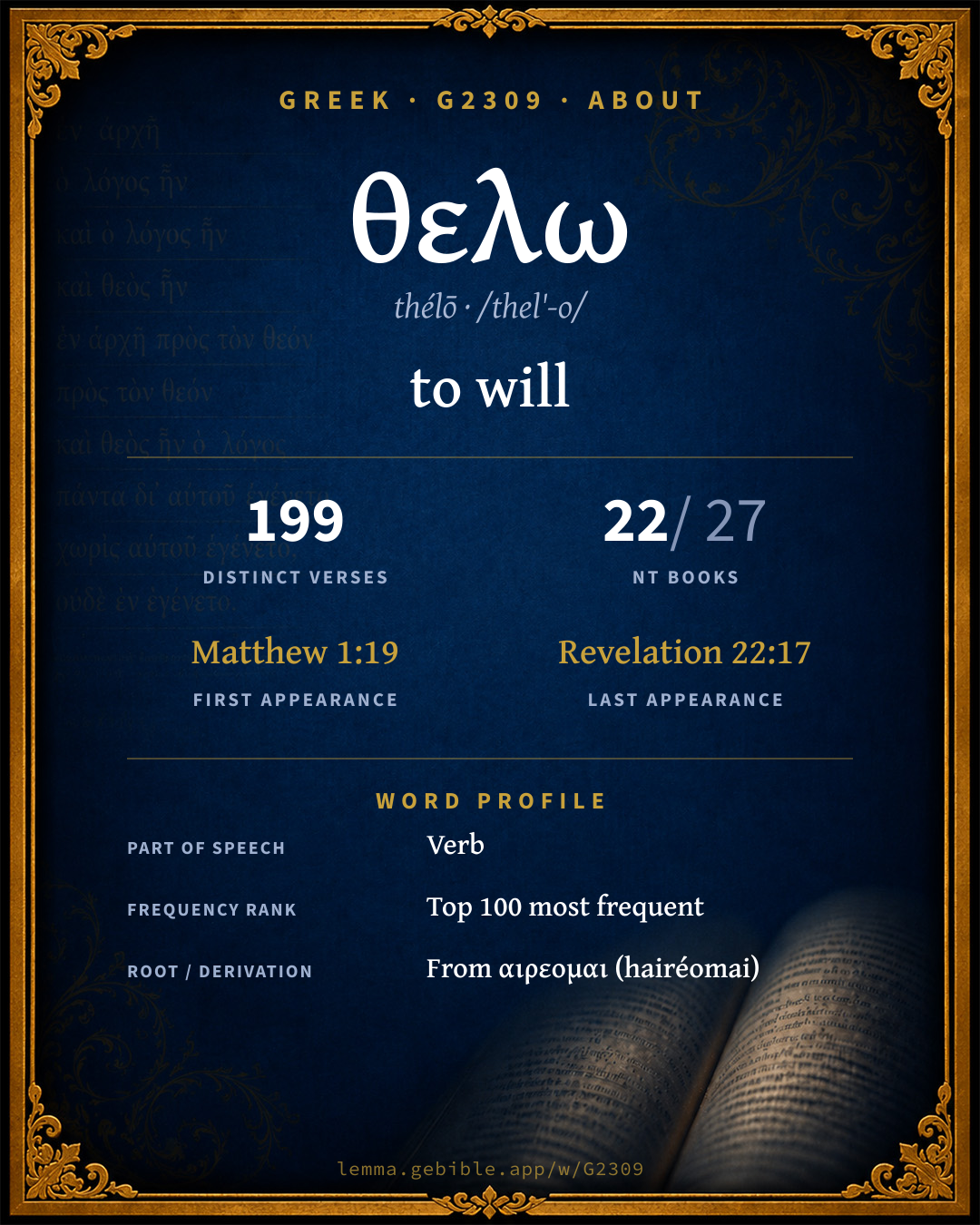
θελω
to will
Full lexicon entry — Thayer's Greek Lexicon
From Thayer's Greek Lexicon
Where this word appears
See every Present-tense verb in the Greek New Testament →
Grammar key — what these labels mean
Part of speech
- Verb
- An action or state-of-being word.
Tense
- Present
- Ongoing or general action in present time (imperfective aspect).
- Imperfect
- Continuous or repeated action in past time (“was writing”).
- Aorist
- Action viewed as a simple whole, without regard to duration — often past (perfective aspect).
Voice
- Active
- The subject performs the action.
Mood
- Indicative
- States a fact or asks a factual question (the mood of reality).
- Participle
- A verbal adjective (“writing,” “having written”).
- Subjunctive
- Expresses probability, purpose, or possibility (the mood of contingency).
- Infinitive
- A verbal noun (“to write”), unmarked for person or number.
- Optative
- Expresses a wish or a remote possibility.
Case
- Nominative
- The case of the subject (and the predicate nominative).
- Genitive
- The case of source, possession, or “of” — answers “whose / from what.”
- Dative
- The case of the indirect object, means, or location — “to / for / with / in.”
- Accusative
- The case of the direct object and of extent.
Person
- 1st person
- The speaker (“I / we”).
- 3rd person
- The one spoken about (“he / she / it / they”).
- 2nd person
- The one addressed (“you”).
Gender
- Masculine
- Grammatically masculine.
Number
- Singular
- One.
- Plural
- More than one.
Grammatical forms 34 distinct
- Verb, Present, Active, Indicative, 1st person, Singular 35 times (17%)
- Verb, Present, Active, Indicative, 3rd person, Singular 19 times (9%)
- Verb, Present, Active, Indicative, 2nd person, Plural 18 times (9%)
- Verb, Present, Active, Indicative, 2nd person, Singular 18 times (9%)
- Verb, Imperfect, Active, Indicative, 3rd person, Singular 13 times (6%)
- Verb, Present, Active, Participle, Nominative, Singular, Masculine 13 times (6%)
- Verb, Aorist, Active, Indicative, 3rd person, Singular 9 times (4%)
- Verb, Present, Active, Subjunctive, 3rd person, Singular 8 times (4%)
+26 more forms (75 occurrences)
Parsed forms decoded from the imported morphology (Robinson–Tischendorf, public domain), counted across 208 parsed occurrences — not distinct verses.
Every verse where G2309 appears — 199 distinct verses across 22 books. Click any verse to open its interlinear word-by-word view. Verse text shown in the World English Bible for context — . Each verse’s Greek form is shown with its reference; the English is not keyword-highlighted, since the data carries no word-level English alignment. Use “Compare translations” on any verse to read it across multiple English versions. This concordance covers the Greek New Testament; Septuagint (Greek Old Testament) occurrences of this word are not indexed here.
Matthew 41 verses
- Matthew 1:19 θέλων pres act ptcp nom sg masc Joseph, her husband, being a righteous man, and not willing to make her a public example, intended to put her away secretly.
- Matthew 2:18 ἤθελεν impf act ind 3sg "A voice was heard in Ramah, Lamentation, weeping and great mourning, Rachel weeping for her children; She wouldn't be comforted, Because they are no more."
- Matthew 5:40 θέλοντί pres act ptcp dat sg masc If anyone sues you to take away your coat, let him have your cloak also.
- Matthew 5:42 θέλοντα pres act ptcp acc sg masc Give to him who asks you, and don't turn away him who desires to borrow from you.
- Matthew 7:12 θέλητε pres act subj 2pl Therefore whatever you desire for men to do to you, you shall also do to them; for this is the law and the prophets.
- Matthew 8:2 θέλῃς pres act subj 2sg Behold, a leper came to him and worshiped him, saying, "Lord, if you want to, you can make me clean."
- Matthew 8:3 θέλω pres act ind 1sg Jesus stretched out his hand, and touched him, saying, "I want to. Be made clean." Immediately his leprosy was cleansed.
- Matthew 9:13 θέλω pres act ind 1sg But you go and learn what this means: 'I desire mercy, and not sacrifice,' for I came not to call the righteous, but sinners to repentance."
- Matthew 11:14 θέλετε pres act ind 2pl If you are willing to receive it, this is Elijah, who is to come.
- Matthew 12:7 θέλω pres act ind 1sg But if you had known what this means, 'I desire mercy, and not sacrifice,' you would not have condemned the guiltless.
- Matthew 12:38 θέλομεν pres act ind 1pl Then certain of the scribes and Pharisees answered, "Teacher, we want to see a sign from you."
- Matthew 13:28 θέλεις pres act ind 2sg "He said to them, 'An enemy has done this.' "The servants asked him, 'Do you want us to go and gather them up?'
- Matthew 14:5 θέλων pres act ptcp nom sg masc When he would have put him to death, he feared the multitude, because they counted him as a prophet.
- Matthew 15:28 θέλεις pres act ind 2sg Then Jesus answered her, "Woman, great is your faith! Be it done to you even as you desire." And her daughter was healed from that hour.
- Matthew 15:32 θέλω pres act ind 1sg Jesus summoned his disciples and said, "I have compassion on the multitude, because they continue with me now three days and have nothing to eat. I don't want to send them away fasting, or they might faint on the way."
- Matthew 16:24 θέλει pres act ind 3sg Then Jesus said to his disciples, "If anyone desires to come after me, let him deny himself, and take up his cross, and follow me.
- Matthew 16:25 θέλῃ pres act subj 3sg For whoever desires to save his life will lose it, and whoever will lose his life for my sake will find it.
- Matthew 17:4 θέλεις pres act ind 2sg Peter answered, and said to Jesus, "Lord, it is good for us to be here. If you want, let's make three tents here: one for you, one for Moses, and one for Elijah."
- Matthew 17:12 ἠθέλησαν aor act ind 3pl but I tell you that Elijah has come already, and they didn't recognize him, but did to him whatever they wanted to. Even so the Son of Man will also suffer by them."
- Matthew 18:23 ἠθέλησεν aor act ind 3sg Therefore the Kingdom of Heaven is like a certain king, who wanted to reconcile accounts with his servants.
- Matthew 18:30 ἤθελεν impf act ind 3sg He would not, but went and cast him into prison, until he should pay back that which was due.
- Matthew 19:17 θέλεις pres act ind 2sg He said to him, "Why do you call me good? No one is good but one, that is, God. But if you want to enter into life, keep the commandments."
- Matthew 19:21 θέλεις pres act ind 2sg Jesus said to him, "If you want to be perfect, go, sell what you have, and give to the poor, and you will have treasure in heaven; and come, follow me."
- Matthew 20:14 θέλω pres act ind 1sg Take that which is yours, and go your way. It is my desire to give to this last just as much as to you.
- Matthew 20:15 θέλω pres act ind 1sg Isn't it lawful for me to do what I want to with what I own? Or is your eye evil, because I am good?'
- Matthew 20:21 θέλεις pres act ind 2sg He said to her, "What do you want?" She said to him, "Command that these, my two sons, may sit, one on your right hand, and one on your left hand, in your Kingdom."
- Matthew 20:26 θέλῃ pres act subj 3sg It shall not be so among you, but whoever desires to become great among you shall be your servant.
- Matthew 20:27 θέλῃ pres act subj 3sg Whoever desires to be first among you shall be your bondservant,
- Matthew 20:32 θέλετε pres act ind 2pl Jesus stood still, and called them, and asked, "What do you want me to do for you?"
- Matthew 21:29 θέλω pres act ind 1sg He answered, 'I will not,' but afterward he changed his mind, and went.
- Matthew 22:3 ἤθελον impf act ind 3pl and sent out his servants to call those who were invited to the marriage feast, but they would not come.
- Matthew 23:4 θέλουσιν pres act ind 3pl For they bind heavy burdens that are grievous to be borne, and lay them on men's shoulders; but they themselves will not lift a finger to help them.
- Matthew 23:37 ἠθέλησα ἠθελήσατε aor act ind 1sg aor act ind 2pl "Jerusalem, Jerusalem, who kills the prophets, and stones those who are sent to her! How often would I have gathered your children together, even as a hen gathers her chickens under her wings, and you would not!
- Matthew 26:15 θέλετέ pres act ind 2pl and said, "What are you willing to give me, that I should deliver him to you?" They weighed out for him thirty pieces of silver.
- Matthew 26:17 θέλεις pres act ind 2sg Now on the first day of unleavened bread, the disciples came to Jesus, saying to him, "Where do you want us to prepare for you to eat the Passover?"
- Matthew 26:39 θέλω pres act ind 1sg He went forward a little, fell on his face, and prayed, saying, "My Father, if it is possible, let this cup pass away from me; nevertheless, not what I desire, but what you desire."
- Matthew 27:15 ἤθελον impf act ind 3pl Now at the feast the governor was accustomed to release to the multitude one prisoner, whom they desired.
- Matthew 27:17 θέλετε pres act ind 2pl When therefore they were gathered together, Pilate said to them, "Whom do you want me to release to you? Barabbas, or Jesus, who is called Christ?"
- Matthew 27:21 θέλετε pres act ind 2pl But the governor answered them, "Which of the two do you want me to release to you?" They said, "Barabbas!"
- Matthew 27:34 ἠθέλησεν aor act ind 3sg They gave him sour wine to drink mixed with gall. When he had tasted it, he would not drink.
- Matthew 27:43 θέλει pres act ind 3sg He trusts in God. Let God deliver him now, if he wants him; for he said, 'I am the Son of God.'"
Mark 25 verses
- Mark 1:40 θέλῃς pres act subj 2sg There came to him a leper, begging him, kneeling down to him, and saying to him, "If you want to, you can make me clean."
- Mark 1:41 θέλω pres act ind 1sg Being moved with compassion, he stretched out his hand, and touched him, and said to him, "I want to. Be made clean."
- Mark 3:13 ἤθελεν impf act ind 3sg He went up into the mountain, and called to himself those whom he wanted, and they went to him.
- Mark 6:19 ἤθελεν impf act ind 3sg Herodias set herself against him, and desired to kill him, but she couldn't,
- Mark 6:22 θέλῃς pres act subj 2sg When the daughter of Herodias herself came in and danced, she pleased Herod and those sitting with him. The king said to the young lady, "Ask me whatever you want, and I will give it to you."
- Mark 6:25 θέλω pres act ind 1sg She came in immediately with haste to the king, and asked, "I want you to give me right now the head of John the Baptizer on a platter."
- Mark 6:26 ἠθέλησεν aor act ind 3sg The king was exceedingly sorry, but for the sake of his oaths, and of his dinner guests, he didn't wish to refuse her.
- Mark 6:48 ἤθελεν impf act ind 3sg Seeing them distressed in rowing, for the wind was contrary to them, about the fourth watch of the night he came to them, walking on the sea, and he would have passed by them,
- Mark 7:24 ἠθέλησεν aor act ind 3sg From there he arose, and went away into the borders of Tyre and Sidon. He entered into a house, and didn't want anyone to know it, but he couldn't escape notice.
- Mark 8:34 θέλει pres act ind 3sg He called the multitude to himself with his disciples, and said to them, "Whoever wants to come after me, let him deny himself, and take up his cross, and follow me.
- Mark 8:35 θέλῃ pres act subj 3sg For whoever wants to save his life will lose it; and whoever will lose his life for my sake and the Gospel's will save it.
- Mark 9:13 ἤθελον impf act ind 3pl But I tell you that Elijah has come, and they have also done to him whatever they wanted to, even as it is written about him."
- Mark 9:30 ἤθελεν impf act ind 3sg They went out from there, and passed through Galilee. He didn't want anyone to know it.
- Mark 9:35 θέλει pres act ind 3sg He sat down, and called the twelve; and he said to them, "If any man wants to be first, he shall be last of all, and servant of all."
- Mark 10:35 θέλομεν pres act ind 1pl James and John, the sons of Zebedee, came near to him, saying, "Teacher, we want you to do for us whatever we will ask."
- Mark 10:36 θέλετέ pres act ind 2pl He said to them, "What do you want me to do for you?"
- Mark 10:43 θέλῃ pres act subj 3sg But it shall not be so among you, but whoever wants to become great among you shall be your servant.
- Mark 10:44 θέλῃ pres act subj 3sg Whoever of you wants to become first among you, shall be bondservant of all.
- Mark 10:51 θέλεις pres act ind 2sg Jesus asked him, "What do you want me to do for you?" The blind man said to him, "Rhabboni, that I may see again."
- Mark 12:38 θελόντων pres act ptcp gen pl masc In his teaching he said to them, "Beware of the scribes, who like to walk in long robes, and to get greetings in the marketplaces,
- Mark 14:7 θέλητε pres act subj 2pl For you always have the poor with you, and whenever you want to, you can do them good; but you will not always have me.
- Mark 14:12 θέλεις pres act ind 2sg On the first day of unleavened bread, when they sacrificed the Passover, his disciples asked him, "Where do you want us to go and make ready that you may eat the Passover?"
- Mark 14:36 θέλω pres act ind 1sg He said, "Abba, Father, all things are possible to you. Please remove this cup from me. However, not what I desire, but what you desire."
- Mark 15:9 θέλετε pres act ind 2pl Pilate answered them, saying, "Do you want me to release to you the King of the Jews?"
- Mark 15:12 θέλετε pres act ind 2pl Pilate again asked them, "What then should I do to him whom you call the King of the Jews?"
Luke 27 verses
- Luke 1:62 θέλοι pres act opt 3sg They made signs to his father, what he would have him called.
- Luke 4:6 θέλω pres act subj 1sg The devil said to him, "I will give you all this authority, and their glory, for it has been delivered to me; and I give it to whomever I want.
- Luke 5:12 θέλῃς pres act subj 2sg It happened, while he was in one of the cities, behold, there was a man full of leprosy. When he saw Jesus, he fell on his face, and begged him, saying, "Lord, if you want to, you can make me clean."
- Luke 5:13 θέλω pres act ind 1sg He stretched out his hand, and touched him, saying, "I want to. Be made clean." Immediately the leprosy left him.
- Luke 5:39 θέλει pres act ind 3sg No man having drunk old wine immediately desires new, for he says, 'The old is better.'"
- Luke 6:31 θέλετε pres act ind 2pl "As you would like people to do to you, do exactly so to them.
- Luke 8:20 θέλοντες pres act ptcp nom pl masc It was told him by some saying, "Your mother and your brothers stand outside, desiring to see you."
- Luke 9:23 θέλει pres act ind 3sg He said to all, "If anyone desires to come after me, let him deny himself, take up his cross, and follow me.
- Luke 9:24 θέλῃ pres act subj 3sg For whoever desires to save his life will lose it, but whoever will lose his life for my sake, the same will save it.
- Luke 9:54 θέλεις pres act ind 2sg When his disciples, James and John, saw this, they said, "Lord, do you want us to command fire to come down from the sky, and destroy them, just as Elijah did?"
- Luke 10:24 ἠθέλησαν aor act ind 3pl for I tell you that many prophets and kings desired to see the things which you see, and didn't see them, and to hear the things which you hear, and didn't hear them."
- Luke 10:29 θέλων pres act ptcp nom sg masc But he, desiring to justify himself, asked Jesus, "Who is my neighbor?"
- Luke 12:49 θέλω pres act ind 1sg "I came to throw fire on the earth. I wish it were already kindled.
- Luke 13:31 θέλει pres act ind 3sg On that same day, some Pharisees came, saying to him, "Get out of here, and go away, for Herod wants to kill you."
- Luke 13:34 ἠθέλησα ἠθελήσατε aor act ind 1sg aor act ind 2pl "Jerusalem, Jerusalem, that kills the prophets, and stones those who are sent to her! How often I wanted to gather your children together, like a hen gathers her own brood under her wings, and you refused!
- Luke 14:28 θέλων pres act ptcp nom sg masc For which of you, desiring to build a tower, doesn't first sit down and count the cost, to see if he has enough to complete it?
- Luke 15:28 ἤθελεν impf act ind 3sg But he was angry, and would not go in. Therefore his father came out, and begged him.
- Luke 16:26 θέλοντες pres act ptcp nom pl masc Besides all this, between us and you there is a great gulf fixed, that those who want to pass from here to you are not able, and that none may cross over from there to us.'
- Luke 18:4 ἤθελεν impf act ind 3sg He wouldn't for a while, but afterward he said to himself, 'Though I neither fear God, nor respect man,
- Luke 18:13 ἤθελεν impf act ind 3sg But the tax collector, standing far away, wouldn't even lift up his eyes to heaven, but beat his breast, saying, 'God, be merciful to me, a sinner!'
- Luke 18:41 θέλεις pres act ind 2sg "What do you want me to do?" He said, "Lord, that I may see again."
- Luke 19:14 θέλομεν pres act ind 1pl But his citizens hated him, and sent an envoy after him, saying, 'We don't want this man to reign over us.'
- Luke 19:27 θελήσαντάς aor act ptcp acc pl masc But bring those enemies of mine who didn't want me to reign over them here, and kill them before me.'"
- Luke 20:46 θελόντων pres act ptcp gen pl masc "Beware of the scribes, who like to walk in long robes, and love greetings in the marketplaces, the best seats in the synagogues, and the best places at feasts;
- Luke 22:9 θέλεις pres act ind 2sg They said to him, "Where do you want us to prepare?"
- Luke 23:8 θέλων pres act ptcp nom sg masc Now when Herod saw Jesus, he was exceedingly glad, for he had wanted to see him for a long time, because he had heard many things about him. He hoped to see some miracle done by him.
- Luke 23:20 θέλων pres act ptcp nom sg masc Then Pilate spoke to them again, wanting to release Jesus,
John 21 verses
- John 1:44 ἠθέλησεν aor act ind 3sg Now Philip was from Bethsaida, of the city of Andrew and Peter.
- John 3:8 θέλει pres act ind 3sg The wind blows where it wants to, and you hear its sound, but don't know where it comes from and where it is going. So is everyone who is born of the Spirit."
- John 5:6 θέλεις pres act ind 2sg When Jesus saw him lying there, and knew that he had been sick for a long time, he asked him, "Do you want to be made well?"
- John 5:21 θέλει pres act ind 3sg For as the Father raises the dead and gives them life, even so the Son also gives life to whom he desires.
- John 5:35 ἠθελήσατε aor act ind 2pl He was the burning and shining lamp, and you were willing to rejoice for a while in his light.
- John 5:40 θέλετε pres act ind 2pl Yet you will not come to me, that you may have life.
- John 6:11 ἤθελον impf act ind 3pl Jesus took the loaves; and having given thanks, he distributed to the disciples, and the disciples to those who were sitting down; likewise also of the fish as much as they desired.
- John 6:21 ἤθελον impf act ind 3pl They were willing therefore to receive him into the boat. Immediately the boat was at the land where they were going.
- John 6:67 θέλετε pres act ind 2pl Jesus said therefore to the twelve, "You don't also want to go away, do you?"
- John 7:1 ἤθελεν impf act ind 3sg After these things, Jesus was walking in Galilee, for he wouldn't walk in Judea, because the Jews sought to kill him.
- John 7:17 θέλῃ pres act subj 3sg If anyone desires to do his will, he will know about the teaching, whether it is from God, or if I am speaking from myself.
- John 7:44 ἤθελον impf act ind 3pl Some of them would have arrested him, but no one laid hands on him.
- John 8:44 θέλετε pres act ind 2pl You are of your Father, the devil, and you want to do the desires of your father. He was a murderer from the beginning, and doesn't stand in the truth, because there is no truth in him. When he speaks a lie, he speaks on his own; for he is a liar, and the father of it.
- John 9:27 θέλετε θέλετε pres act ind 2pl pres act ind 2pl He answered them, "I told you already, and you didn't listen. Why do you want to hear it again? You don't also want to become his disciples, do you?"
- John 12:21 θέλομεν pres act ind 1pl These, therefore, came to Philip, who was from Bethsaida of Galilee, and asked him, saying, "Sir, we want to see Jesus."
- John 15:7 θέλητε pres act subj 2pl If you remain in me, and my words remain in you, you will ask whatever you desire, and it will be done for you.
- John 16:19 ἤθελον impf act ind 3pl Therefore Jesus perceived that they wanted to ask him, and he said to them, "Do you inquire among yourselves concerning this, that I said, 'A little while, and you won't see me, and again a little while, and you will see me?'
- John 17:24 θέλω pres act ind 1sg Father, I desire that they also whom you have given me be with me where I am, that they may see my glory, which you have given me, for you loved me before the foundation of the world.
- John 21:18 ἤθελες θέλεις impf act ind 2sg pres act ind 2sg Most assuredly I tell you, when you were young, you dressed yourself, and walked where you wanted to. But when you are old, you will stretch out your hands, and another will dress you, and carry you where you don't want to go."
- John 21:22 θέλω pres act subj 1sg Jesus said to him, "If I desire that he stay until I come, what is that to you? You follow me."
- John 21:23 θέλω pres act subj 1sg This saying therefore went out among the brothers, that this disciple wouldn't die. Yet Jesus didn't say to him that he wouldn't die, but, "If I desire that he stay until I come, what is that to you?"
Acts 13 verses
- Acts 2:12 θέλει pres act ind 3sg They were all amazed, and were perplexed, saying one to another, "What does this mean?"
- Acts 7:28 θέλεις pres act ind 2sg Do you want to kill me, as you killed the Egyptian yesterday?'
- Acts 7:39 ἠθέλησαν aor act ind 3pl to whom our fathers wouldn't be obedient, but rejected him, and turned back in their hearts to Egypt,
- Acts 10:10 ἤθελεν impf act ind 3sg He became hungry and desired to eat, but while they were preparing, he fell into a trance.
- Acts 14:13 ἤθελεν impf act ind 3sg The priest of Jupiter, whose temple was in front of their city, brought oxen and garlands to the gates, and would have made a sacrifice along with the multitudes.
- Acts 16:3 ἠθέλησεν aor act ind 3sg Paul wanted to have him go out with him, and he took and circumcised him because of the Jews who were in those parts; for they all knew that his father was a Greek.
- Acts 17:18 θέλοι pres act opt 3sg Some of the Epicurean and Stoic philosophers also were conversing with him. Some said, "What does this babbler want to say?" Others said, "He seems to be advocating foreign deities," because he preached Jesus and the resurrection.
- Acts 17:20 θέλει pres act ind 3sg For you bring certain strange things to our ears. We want to know therefore what these things mean."
- Acts 18:21 θέλοντος pres act ptcp gen sg masc but taking his leave of them, and saying, "I must by all means keep this coming feast in Jerusalem, but I will return again to you if God wills," he set sail from Ephesus.
- Acts 19:33 ἤθελεν impf act ind 3sg They brought Alexander out of the multitude, the Jews putting him forward. Alexander beckoned with his hand, and would have made a defense to the people.
- Acts 24:27 θέλων pres act ptcp nom sg masc But when two years were fulfilled, Felix was succeeded by Porcius Festus, and desiring to gain favor with the Jews, Felix left Paul in bonds.
- Acts 25:9 θέλων θέλεις pres act ptcp nom sg masc pres act ind 2sg But Festus, desiring to gain favor with the Jews, answered Paul and said, "Are you willing to go up to Jerusalem, and be judged by me there concerning these things?"
- Acts 26:5 θέλωσι pres act subj 3pl having known me from the first, if they are willing to testify, that after the strictest sect of our religion I lived a Pharisee.
Romans 13 verses
- Romans 1:13 θέλω pres act ind 1sg Now I don't desire to have you unaware, brothers, that I often planned to come to you, and was hindered so far, that I might have some fruit among you also, even as among the rest of the Gentiles.
- Romans 7:15 θέλω pres act ind 1sg For I don't know what I am doing. For I don't practice what I desire to do; but what I hate, that I do.
- Romans 7:16 θέλω pres act ind 1sg But if what I don't desire, that I do, I consent to the law that it is good.
- Romans 7:18 θέλειν pres act inf For I know that in me, that is, in my flesh, dwells no good thing. For desire is present with me, but I don't find it doing that which is good.
- Romans 7:19 θέλω θέλω pres act ind 1sg pres act ind 1sg For the good which I desire, I don't do; but the evil which I don't desire, that I practice.
- Romans 7:20 θέλω pres act ind 1sg But if what I don't desire, that I do, it is no more I that do it, but sin which dwells in me.
- Romans 7:21 θέλοντι pres act ptcp dat sg masc I find then the law, that, to me, while I desire to do good, evil is present.
- Romans 9:16 θέλοντος pres act ptcp gen sg masc So then it is not of him who wills, nor of him who runs, but of God who has mercy.
- Romans 9:18 θέλει θέλει pres act ind 3sg pres act ind 3sg So then, he has mercy on whom he desires, and he hardens whom he desires.
- Romans 9:22 θέλων pres act ptcp nom sg masc What if God, willing to show his wrath, and to make his power known, endured with much patience vessels of wrath made for destruction,
- Romans 11:25 θέλω pres act ind 1sg For I don't desire, brothers, to have you ignorant of this mystery, so that you won't be wise in your own conceits, that a partial hardening has happened to Israel, until the fullness of the Gentiles has come in,
- Romans 13:3 θέλεις pres act ind 2sg For rulers are not a terror to the good work, but to the evil. Do you desire to have no fear of the authority? Do that which is good, and you will have praise from the same,
- Romans 16:19 θέλω pres act ind 1sg For your obedience has become known to all. I rejoice therefore over you. But I desire to have you wise in that which is good, but innocent in that which is evil.
1 Corinthians 17 verses
- 1 Corinthians 4:19 θελήσῃ aor act subj 3sg But I will come to you shortly, if the Lord is willing. And I will know, not the word of those who are puffed up, but the power.
- 1 Corinthians 4:21 θέλετε pres act ind 2pl What do you want? Shall I come to you with a rod, or in love and a spirit of gentleness?
- 1 Corinthians 7:7 θέλω pres act ind 1sg Yet I wish that all men were like me. However each man has his own gift from God, one of this kind, and another of that kind.
- 1 Corinthians 7:32 θέλω pres act ind 1sg But I desire to have you to be free from cares. He who is unmarried is concerned for the things of the Lord, how he may please the Lord;
- 1 Corinthians 7:36 θέλει pres act ind 3sg But if any man thinks that he is behaving inappropriately toward his virgin, if she is past the flower of her age, and if need so requires, let him do what he desires. He doesn't sin. Let them marry.
- 1 Corinthians 7:39 θέλει pres act ind 3sg A wife is bound by law for as long as her husband lives; but if the husband is dead, she is free to be married to whoever she desires, only in the Lord.
- 1 Corinthians 10:1 θέλω pres act ind 1sg Now I would not have you ignorant, brothers, that our fathers were all under the cloud, and all passed through the sea;
- 1 Corinthians 10:20 θέλω pres act ind 1sg But I say that the things which the Gentiles sacrifice, they sacrifice to demons, and not to God, and I don't desire that you would have communion with demons.
- 1 Corinthians 10:27 θέλετε pres act ind 2pl But if one of those who don't believe invites you to a meal, and you are inclined to go, eat whatever is set before you, asking no questions for the sake of conscience.
- 1 Corinthians 11:3 θέλω pres act ind 1sg But I would have you know that the head of every man is Christ, and the head of the woman is the man, and the head of Christ is God.
- 1 Corinthians 12:1 θέλω pres act ind 1sg Now concerning spiritual things, brothers, I don't want you to be ignorant.
- 1 Corinthians 12:18 ἠθέλησεν aor act ind 3sg But now God has set the members, each one of them, in the body, just as he desired.
- 1 Corinthians 14:5 θέλω pres act ind 1sg Now I desire to have you all speak with other languages, but rather that you would prophesy. For he is greater who prophesies than he who speaks with other languages, unless he interprets, that the assembly may be built up.
- 1 Corinthians 14:19 θέλω pres act ind 1sg However in the assembly I would rather speak five words with my understanding, that I might instruct others also, than ten thousand words in another language.
- 1 Corinthians 14:35 θέλουσιν pres act ind 3pl If they desire to learn anything, let them ask their own husbands at home, for it is shameful for a woman to chatter in the assembly.
- 1 Corinthians 15:38 ἠθέλησεν aor act ind 3sg But God gives it a body even as it pleased him, and to each seed a body of its own.
- 1 Corinthians 16:7 θέλω pres act ind 1sg For I do not wish to see you now in passing, but I hope to stay a while with you, if the Lord permits.
2 Corinthians 7 verses
- 2 Corinthians 1:8 θέλομεν pres act ind 1pl For we don't desire to have you uninformed, brothers, concerning our affliction which happened to us in Asia, that we were weighed down exceedingly, beyond our power, so much that we despaired even of life.
- 2 Corinthians 5:4 θέλομεν pres act ind 1pl For indeed we who are in this tent do groan, being burdened; not that we desire to be unclothed, but that we desire to be clothed, that what is mortal may be swallowed up by life.
- 2 Corinthians 8:10 θέλειν pres act inf I give a judgment in this: for this is expedient for you, who were the first to start a year ago, not only to do, but also to be willing.
- 2 Corinthians 8:11 θέλειν pres act inf But now complete the doing also, that as there was the readiness to be willing, so there may be the completion also out of your ability.
- 2 Corinthians 11:12 θελόντων pres act ptcp gen pl masc But what I do, that I will do, that I may cut off occasion from them that desire an occasion, that in which they boast, they may be found even as we.
- 2 Corinthians 12:6 θελήσω aor act subj 1sg For if I would desire to boast, I will not be foolish; for I will speak the truth. But I forbear, so that no man may account of me above that which he sees in me, or hears from me.
- 2 Corinthians 12:20 θέλω θέλετε pres act ind 1sg pres act ind 2pl For I am afraid that by any means, when I come, I might find you not the way I want to, and that I might be found by you as you don't desire; that by any means there would be strife, jealousy, outbursts of anger, factions, slander, whisperings, proud thoughts, riots;
Galatians 9 verses
- Galatians 1:7 θέλοντες pres act ptcp nom pl masc and there isn't another gospel. Only there are some who trouble you, and want to pervert the Gospel of Christ.
- Galatians 3:2 θέλω pres act ind 1sg I just want to learn this from you. Did you receive the Spirit by the works of the law, or by hearing of faith?
- Galatians 4:9 θέλετε pres act ind 2pl But now that you have come to know God, or rather to be known by God, why do you turn back again to the weak and miserable elements, to which you desire to be in bondage all over again?
- Galatians 4:17 θέλουσιν pres act ind 3pl They zealously seek you in no good way. No, they desire to alienate you, that you may seek them.
- Galatians 4:20 ἤθελον impf act ind 1sg but I could wish to be present with you now, and to change my tone, for I am perplexed about you.
- Galatians 4:21 θέλοντες pres act ptcp nom pl masc Tell me, you that desire to be under the law, don't you listen to the law?
- Galatians 5:17 θέλητε pres act subj 2pl For the flesh lusts against the Spirit, and the Spirit against the flesh; and these are contrary to one other, that you may not do the things that you desire.
- Galatians 6:12 θέλουσιν pres act ind 3pl As many as desire to look good in the flesh, they compel you to be circumcised; only that they may not be persecuted for the cross of Christ.
- Galatians 6:13 θέλουσιν pres act ind 3pl For even they who receive circumcision don't keep the law themselves, but they desire to have you circumcised, that they may boast in your flesh.
Philippians 1 verse
Colossians 3 verses
- Colossians 1:27 ἠθέλησεν aor act ind 3sg to whom God was pleased to make known what are the riches of the glory of this mystery among the Gentiles, which is Christ in you, the hope of glory;
- Colossians 2:1 Θέλω pres act ind 1sg For I desire to have you know how greatly I struggle for you, and for those at Laodicea, and for as many as have not seen my face in the flesh;
- Colossians 2:18 θέλων pres act ptcp nom sg masc Let no one rob you of your prize by a voluntary humility and worshipping of the angels, dwelling in the things which he has not seen, vainly puffed up by his fleshly mind,
1 Thessalonians 2 verses
- 1 Thessalonians 2:18 ἠθελήσαμεν aor act ind 1pl because we wanted to come to you--indeed, I, Paul, once and again-- but Satan hindered us.
- 1 Thessalonians 4:13 θέλομεν pres act ind 1pl But we don't want you to be ignorant, brothers, concerning those who have fallen asleep, so that you don't grieve like the rest, who have no hope.
2 Thessalonians 1 verse
1 Timothy 3 verses
- 1 Timothy 1:7 θέλοντες pres act ptcp nom pl masc desiring to be teachers of the law, though they understand neither what they say, nor about what they strongly affirm.
- 1 Timothy 2:4 θέλει pres act ind 3sg who desires all people to be saved and come to full knowledge of the truth.
- 1 Timothy 5:11 θέλουσιν pres act ind 3pl But refuse younger widows, for when they have grown wanton against Christ, they desire to marry;
2 Timothy 1 verse
Philemon 1 verse
Hebrews 4 verses
- Hebrews 10:5 ἠθέλησας aor act ind 2sg Therefore when he comes into the world, he says, "Sacrifice and offering you didn't desire, But a body did you prepare for me;
- Hebrews 10:8 ἠθέλησας aor act ind 2sg Previously saying, "Sacrifices and offerings and whole burnt offerings and sacrifices for sin you didn't desire, neither had pleasure in them" (those which are offered according to the law),
- Hebrews 12:17 θέλων pres act ptcp nom sg masc For you know that even when he afterward desired to inherit the blessing, he was rejected, for he found no place for a change of mind though he sought it diligently with tears.
- Hebrews 13:18 θέλοντες pres act ptcp nom pl masc Pray for us, for we are persuaded that we have a good conscience, desiring to live honorably in all things.
James 2 verses
1 Peter 2 verses
- 1 Peter 3:10 θέλων pres act ptcp nom sg masc For, "He who would love life, And see good days, Let him keep his tongue from evil, And his lips from speaking deceit.
- 1 Peter 3:17 θέλοι pres act opt 3sg For it is better, if the will of God should so will, that you suffer for doing well than for doing evil.
2 Peter 1 verse
3 John 1 verse
Revelation 4 verses
- Revelation 2:21 θέλει pres act ind 3sg I gave her time to repent, but she refuses to repent of her sexual immorality.
- Revelation 11:5 θέλει θελήσῃ pres act ind 3sg aor act subj 3sg If anyone desires to harm them, fire proceeds out of their mouth and devours their enemies. If anyone desires to harm them, he must be killed in this way.
- Revelation 11:6 θελήσωσιν aor act subj 3pl These have the power to shut up the sky, that it may not rain during the days of their prophecy. They have power over the waters, to turn them into blood, and to strike the earth with every plague, as often as they desire.
- Revelation 22:17 θέλων pres act ptcp nom sg masc The Spirit and the bride say, "Come!" He who hears, let him say, "Come!" He who is thirsty, let him come. He who desires, let him take the water of life freely.
About this entry
At a glance — auto-summarized from this page’s data, not written by a person. Every figure links to its source below. This summary describes the numbers; it doesn’t interpret them.
At its core, θελω (thélō) means “to will.” Translators differ — “would” in the King James Version, then “do you want” (Berean Standard Bible) and “want” (unfoldingWord Literal Text), as the renderings breakdown shows. With 199 verses in 22 books, it is a common word in the Greek New Testament. First canonically at Matthew 1:19, it enters the text early. From the same root come αιρεομαι, αιρεσις and αιρετιζω. For the data behind this summary, explore the sense tree and the renderings breakdown below.
Gloss history
Strong's 1890 vs modern scholarship

About this word
Strong's G2309 catalogs a Greek word from the Greek New Testament.
These counts are not copied from any lexicon or concordance. They are computed here, from the morphology-tagged Greek New Testament. What Lemma adds →
- 199
- distinct verses
- The word appears in 199 distinct verses.
- 22 / 27
- NT books
- The word appears in 22 of 27 New Testament books.
- #79
- by frequency
- Top 100 most frequent Greek words (rank 79 of 5,347 Greek words by occurrence).
View all 199 occurrences in the concordance →
By section of the New Testament
By traditional corpus
Conventional, traditional groupings — biblical authorship is debated, so this is a traditional corpus grouping, not an authorship claim. Some books belong to more than one corpus (Luke is in both the Gospels and the Lukan corpus, and so on), so these shares overlap and need not total 100%. Each figure is a share of the word’s 199 distinct verses.
- Gospels 114 verses · 57%
- Pauline corpus 58 verses · 29%
- Lukan (Luke–Acts) 40 verses · 20%
- Johannine 26 verses · 13%
- General (Catholic) Epistles 6 verses · 3%
- Hebrews 4 verses · 2%
- Revelation 4 verses · 2%
How translations render this word
Counts come from each version’s own published word-to-Strong’s tagging or interlinear alignment — an approximate guide to how each version renders this word, not a word-level alignment the data otherwise carries. Because each total is that version’s own tagged count, the per-version totals vary from one another and need not match the appearance or distinct-verse counts above. These counts may also differ from a printed concordance because Lemma counts each distinctly tagged rendering and does not collapse phrase taggings into a single head-word total. This is a fixed set of word-tagged versions (KJV, ASV, BSB, ULT) and does not change with the reading translation you choose elsewhere. Each version’s license is shown beside its name below (and on Sources).
- King James Version: Would 27×, Will 23×, I will 15×
- American Standard Version: Would 20×, I would 13×, Will 11×
- Berean Standard Bible: Do you want 18×, Wants 18×, I want 11×
- unfoldingWord Literal Text: Want 25×, Wanting 15×, Willing 15×
King James Version Public Domain
Renders G2309 across 208 tagged occurrences — most commonly:
Plus other, less common renderings. Plus 38 renderings that appear only once — usually multi-word phrases or single function words the recovered tagging swept in, not distinct renderings. Not rendered by a distinct English word in 5 further occurrences.
American Standard Version Public Domain
Renders G2309 across 215 tagged occurrences — most commonly:
Plus other, less common renderings. Plus 60 renderings that appear only once — usually multi-word phrases or single function words the recovered tagging swept in, not distinct renderings.
Berean Standard Bible Public Domain
Renders G2309 across 207 tagged occurrences — most commonly:
Plus other, less common renderings. Plus 50 renderings that appear only once — usually multi-word phrases or single function words the recovered tagging swept in, not distinct renderings. Not rendered by a distinct English word in 1 further occurrence.
unfoldingWord Literal Text CC BY-SA 4.0
Renders G2309 across 252 tagged occurrences — most commonly:
Plus other, less common renderings. Plus 44 renderings that appear only once — usually multi-word phrases or single function words the recovered tagging swept in, not distinct renderings.
Senses in Thayer's
The 1 sense Thayer's distinguishes for this word, in lexicon order (not ranked by frequency or importance). The full entry — with sub-senses — is in the Lexicon Entry tab.
- to will, have in mind, intend
Word origin
Derived from αιρεομαι (hairéomai) (G138) — to choose.
Either the first or the second form may be used. In certain tenses θελέω theleō thel-eh'-o (and ἐθέλέω etheleō eth-el-eh'-o ) are used which are otherwise obsolete; apparently strengthened from the alternate form of G138 ; to determine (as an active voice option from subjective impulse; whereas G1014 properly denotes rather a passive voice acquiescence in objective considerations) that is choose or prefer (literally or figuratively); by implication to wish that is be inclined to (sometimes adverbially gladly ); impersonally for the future tense to be about to ; by hebraism to delight in : - desire be disposed (forward) intend list love mean please have rather (be) will (have -ling -ling [ly]).
— Strong’s Exhaustive Concordance (1890), public domain.
Forms in the corpus
The 35 distinct written forms G2309 takes in the Greek New Testament, most frequent first — each parse links to that tense’s occurrences in the concordance.
Same root — word family
Other Thayer's entries built from the same root as G2309, grouped by Strong’s listed origin. These share a root / origin per the lexicon — not necessarily a shared meaning. Each links to that word’s own entry.
Derives from
Shares the same root
- αιρεσις haíresis G139 choice
- αιρετιζω hairetízō G140 to choose
- αλωσις hálōsis G259 capture
- αρπαζω harpázō G726 to seize
- ελκυω helkýō G1670 to draw
- ηλιος hḗlios G2246 sun
- ιλεως híleōs G2436 merciful
- σεληνη selḗnē G4582 moon
- σπειρα speîra G4686 cohort
- συλαω syláō G4813 to rob
- συρω sýrō G4951 to drag
- τιλλω tíllō G5089 to pluck
Derived from this word
- εθελοθρησκεια ethelothrēskeía G1479 will-worship
- θελημα thélēma G2307 will
- θελησις thélēsis G2308 willing
Compare all same-root words → Showing 4 of 17 — not the complete family. They share a root, not necessarily a meaning.
Septuagint usage
The same Greek word θελω appears 113 times in the Greek Old Testament (Septuagint), across 108 verses in 24 books.
- 113
- LXX occurrences
- Tagged occurrences of this Greek word in the Septuagint.
- 108
- verses
- Distinct Septuagint verses containing this word.
- 24 / 39
- OT books
- The word appears in 24 of the 39 Old Testament books.
Sample Septuagint occurrences
- Genesis 24:8 θέλω
- Exodus 2:7 θέλω
- Numbers 20:21 θέλω
- Deuteronomy 1:26 θέλω
- Joshua 24:10 θέλω
- Judges 13:23 θέλω
- 1 Samuel 14:15 θέλω
- 2 Samuel 2:21 θέλω
- 1 Kings 9:1 θέλω
- 2 Kings 8:19 θέλω
- 1 Chronicles 11:18 θέλω
- 2 Chronicles 7:11 θέλω
Septuagint occurrences (same lexeme)
Every verse where the same Strong’s number (G2309) appears in the Greek Septuagint — showing the first 50 of 108. Verse text shown in the World English Bible for context; the Greek form is the matched word — the English is not keyword-highlighted.
- Genesis 24:8 θέλω If the woman isn't willing to follow you, then you shall be clear from this my oath. Only you shall not bring my son there again."
- Genesis 37:35 θέλω All his sons and all his daughters rose up to comfort him; but he refused to be comforted. He said, "For I will go down to Sheol to my son mourning." His father wept for him.
- Genesis 39:8 θέλω But he refused, and said to his master's wife, "Behold, my master doesn't know what is with me in the house, and he has put all that he has into my hand.
- Genesis 48:19 θέλω His father refused, and said, "I know, my son, I know. He also will become a people, and he also will be great. However, his younger brother will be greater than he, and his seed will become a multitude of nations."
- Exodus 2:7 θέλω Then his sister said to Pharaoh's daughter, "Should I go and call a nurse for you from the Hebrew women, that she may nurse the child for you?"
- Exodus 2:14 θέλω He said, "Who made you a prince and a judge over us? Do you plan to kill me, as you killed the Egyptian?" Moses was afraid, and said, "Surely this thing is known."
- Exodus 8:28 θέλω Pharaoh said, "I will let you go, that you may sacrifice to Yahweh your God in the wilderness, only you shall not go very far away. Pray for me."
- Exodus 10:4 θέλω Or else, if you refuse to let my people go, behold, tomorrow I will bring locusts into your country,
- Exodus 11:10 θέλω Moses and Aaron did all these wonders before Pharaoh, and Yahweh hardened Pharaoh's heart, and he didn't let the children of Israel go out of his land.
- Numbers 20:21 θέλω Thus Edom refused to give Israel passage through his border: why Israel turned away from him.
- Numbers 22:14 θέλω The princes of Moab rose up, and they went to Balak, and said, Balaam refuses to come with us.
- Deuteronomy 1:26 θέλω Yet you wouldn't go up, but rebelled against the commandment of Yahweh your God:
- Deuteronomy 2:30 θέλω But Sihon king of Heshbon would not let us pass by him; for Yahweh your God hardened his spirit, and made his heart obstinate, that he might deliver him into your hand, as at this day.
- Deuteronomy 10:10 θέλω I stayed on the mountain, as at the first time, forty days and forty nights: and Yahweh listened to me that time also; Yahweh would not destroy you.
- Deuteronomy 21:14 θέλω It shall be, if you have no delight in her, then you shall let her go where she will; but you shall not sell her at all for money, you shall not deal with her as a slave, because you have humbled her.
- Deuteronomy 23:6 θέλω You shall not seek their peace nor their prosperity all your days forever.
- Deuteronomy 23:23 θέλω That which is gone out of your lips you shall observe and do; according as you have vowed to Yahweh your God, a freewill-offering, which you have promised with your mouth.
- Deuteronomy 25:7 θέλω If the man doesn't want to take his brother's wife, then his brother's wife shall go up to the gate to the elders, and say, My husband's brother refuses to raise up to his brother a name in Israel; he will not perform the duty of a husband's brother to me.
- Deuteronomy 29:19 θέλω and it happen, when he hears the words of this curse, that he bless himself in his heart, saying, I shall have peace, though I walk in the stubbornness of my heart, to destroy the moist with the dry.
- Joshua 24:10 θέλω but I would not listen to Balaam; therefore he blessed you still: so I delivered you out of his hand.
- Judges 13:23 θέλω But his wife said to him, If Yahweh were pleased to kill us, he wouldn't have received a burnt offering and a meal-offering at our hand, neither would he have shown us all these things, nor would at this time have told such things as these.
- Judges 20:5 θέλω The men of Gibeah rose against me, and beset the house round about me by night; me they thought to have slain, and my concubine they forced, and she is dead.
- 1 Samuel 14:15 θέλω There was a trembling in the camp, in the field, and among all the people; the garrison, and the spoilers, they also trembled; and the earth quaked: so there was an exceeding great trembling.
- 1 Samuel 18:12 θέλω Saul was afraid of David, because Yahweh was with him, and was departed from Saul.
- 1 Samuel 26:23 θέλω Yahweh will render to every man his righteousness and his faithfulness; because Yahweh delivered you into my hand today, and I wouldn't put forth my hand against Yahweh's anointed.
- 2 Samuel 2:21 θέλω Abner said to him, Turn you aside to your right hand or to your left, and lay you hold on one of the young men, and take you his armor. But Asahel would not turn aside from following him.
- 2 Samuel 12:17 θέλω The elders of his house arose, [and stood] beside him, to raise him up from the earth: but he would not, neither did he eat bread with them.
- 2 Samuel 13:9 θέλω She took the pan, and poured them out before him; but he refused to eat. Amnon said, Have out all men from me. They went out every man from him.
- 2 Samuel 13:14 θέλω However he would not listen to her voice; but being stronger than she, he forced her, and lay with her.
- 2 Samuel 13:16 θέλω She said to him, Not so, because this great wrong in putting me forth is [worse] than the other that you did to me. But he would not listen to her.
- 2 Samuel 13:25 θέλω The king said to Absalom, No, my son, let us not all go, lest we be burdensome to you. He pressed him: however he would not go, but blessed him.
- 2 Samuel 14:29 θέλω Then Absalom sent for Joab, to send him to the king; but he would not come to him: and he sent again a second time, but he would not come.
- 2 Samuel 23:16 θέλω The three mighty men broke through the host of the Philistines, and drew water out of the well of Bethlehem, that was by the gate, and took it, and brought it to David: but he would not drink of it, but poured it out to Yahweh.
- 2 Samuel 23:17 θέλω He said, Be it far from me, Yahweh, that I should do this: [shall I drink] the blood of the men who went in jeopardy of their lives? therefore he would not drink it. These things did the three mighty men.
- 1 Kings 9:1 θέλω It happened, when Solomon had finished the building of the house of Yahweh, and the king's house, and all Solomon's desire which he was pleased to do,
- 1 Kings 10:9 θέλω Blessed be Yahweh your God, who delighted in you, to set you on the throne of Israel: because Yahweh loved Israel forever, therefore made he you king, to do justice and righteousness.
- 1 Kings 10:13 θέλω King Solomon gave to the queen of Sheba all her desire, whatever she asked, besides that which Solomon gave her of his royal bounty. So she turned, and went to her own land, she and her servants.
- 1 Kings 21:8 θέλω So she wrote letters in Ahab's name, and sealed them with his seal, and sent the letters to the elders and to the nobles who were in his city, [and] who lived with Naboth.
- 1 Kings 21:35 θέλω
- 2 Kings 8:19 θέλω However Yahweh would not destroy Judah, for David his servant's sake, as he promised him to give to him a lamp for his children always.
- 2 Kings 13:23 θέλω But Yahweh was gracious to them, and had compassion on them, and had respect to them, because of his covenant with Abraham, Isaac, and Jacob, and would not destroy them, neither cast he them from his presence as yet.
- 2 Kings 24:4 θέλω and also for the innocent blood that he shed; for he filled Jerusalem with innocent blood: and Yahweh would not pardon.
- 1 Chronicles 11:18 θέλω The three broke through the host of the Philistines, and drew water out of the well of Bethlehem, that was by the gate, and took it, and brought it to David: but David would not drink of it, but poured it out to Yahweh,
- 1 Chronicles 19:19 θέλω When the servants of Hadarezer saw that they were put to the worse before Israel, they made peace with David, and served him: neither would the Syrians help the children of Ammon any more.
- 1 Chronicles 28:4 θέλω However Yahweh, the God of Israel, chose me out of all the house of my father to be king over Israel forever: for he has chosen Judah to be prince; and in the house of Judah, the house of my father; and among the sons of my father he took pleasure in me to make me king over all Israel;
- 1 Chronicles 28:9 θέλω You, Solomon my son, know the God of your father, and serve him with a perfect heart and with a willing mind; for Yahweh searches all hearts, and understands all the imaginations of the thoughts: if you seek him, he will be found of you; but if you forsake him, he will cast you off forever.
- 2 Chronicles 7:11 θέλω Thus Solomon finished the house of Yahweh, and the king's house: and all that came into Solomon's heart to make in the house of Yahweh, and in his own house, he prosperously effected.
- 2 Chronicles 9:8 θέλω Blessed be Yahweh your God, who delighted in you, to set you on his throne, to be king for Yahweh your God: because your God loved Israel, to establish them forever, therefore made he you king over them, to do justice and righteousness.
- 2 Chronicles 36:5 θέλω Jehoiakim was Twenty-five years old when he began to reign; and he reigned eleven years in Jerusalem: and he did that which was evil in the sight of Yahweh his God.
- Ezra 11:11 θέλω
These are occurrences of the same Greek lexeme (G2309) in the Septuagint — not a translation of any one Hebrew word. The store carries no word-level Hebrew↔Greek alignment, so no Hebrew original is asserted here. Counts come from the recovered LXX Strong's tagging — high-frequency vocabulary is well covered, while rare or late forms may be untagged — so they reflect tagged occurrences and may slightly undercount.