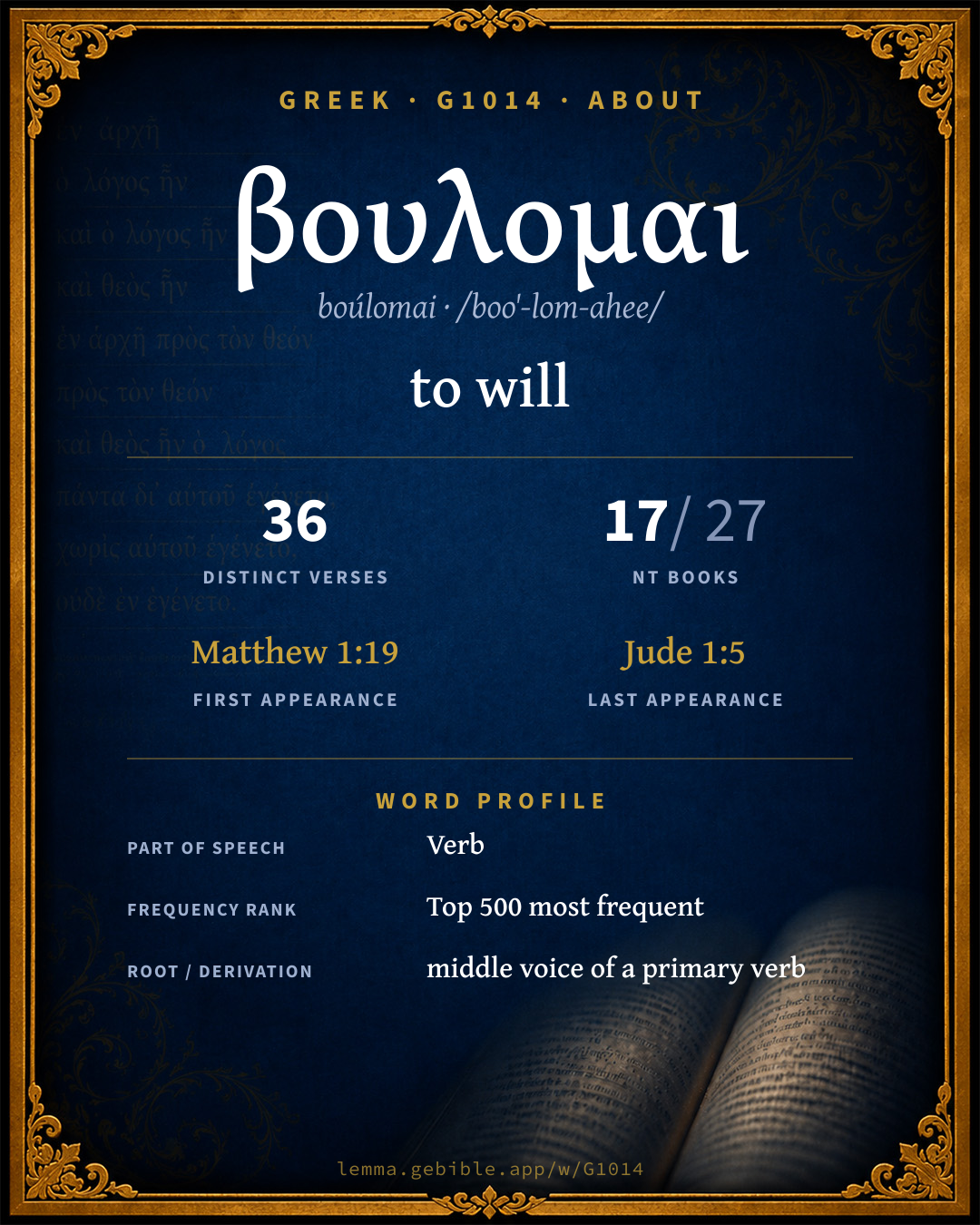
βούλομαι
to will
‘to will’ is one of 2 main senses fuller range ↓
Full lexicon entry — Thayer's Greek Lexicon
From Thayer's Greek Lexicon
Where this word appears
See every Present-tense verb in the Greek New Testament →
Grammar key — what these labels mean
Part of speech
- Verb
- An action or state-of-being word.
Tense
- Present
- Ongoing or general action in present time (imperfective aspect).
- Imperfect
- Continuous or repeated action in past time (“was writing”).
- Aorist
- Action viewed as a simple whole, without regard to duration — often past (perfective aspect).
Voice
- Middle or Passive deponent
- Middle/passive in form but active in meaning.
- Passive deponent
- Passive in form but active in meaning.
Mood
- Participle
- A verbal adjective (“writing,” “having written”).
- Indicative
- States a fact or asks a factual question (the mood of reality).
- Subjunctive
- Expresses probability, purpose, or possibility (the mood of contingency).
- Optative
- Expresses a wish or a remote possibility.
Case
- Nominative
- The case of the subject (and the predicate nominative).
- Genitive
- The case of source, possession, or “of” — answers “whose / from what.”
- Accusative
- The case of the direct object and of extent.
Person
- 1st person
- The speaker (“I / we”).
- 2nd person
- The one addressed (“you”).
- 3rd person
- The one spoken about (“he / she / it / they”).
Gender
- Masculine
- Grammatically masculine.
Number
- Singular
- One.
- Plural
- More than one.
Grammatical forms 18 distinct
- Verb, Present, Middle or Passive deponent, Participle, Nominative, Singular, Masculine 8 times (22%)
- Verb, Present, Middle or Passive deponent, Indicative, 1st person, Singular 6 times (17%)
- Verb, Imperfect, Middle or Passive deponent, Indicative, 1st person, Singular 3 times (8%)
- Verb, Present, Middle or Passive deponent, Indicative, 2nd person, Plural 2 times (6%)
- Verb, Present, Middle or Passive deponent, Indicative, 3rd person, Singular 2 times (6%)
- Verb, Present, Middle or Passive deponent, Participle, Genitive, Singular, Masculine 2 times (6%)
- Verb, Present, Middle or Passive deponent, Subjunctive, 3rd person, Singular 2 times (6%)
- Verb, Aorist, Passive deponent, Indicative, 1st person, Singular 1 time (3%)
+10 more forms (10 occurrences)
Parsed forms decoded from the imported morphology (Robinson–Tischendorf, public domain), counted across 36 parsed occurrences — not distinct verses.
Every verse where G1014 appears — 36 distinct verses across 17 books. Click any verse to open its interlinear word-by-word view. Verse text shown in the World English Bible for context — . Each verse’s Greek form is shown with its reference; the English is not keyword-highlighted, since the data carries no word-level English alignment. Use “Compare translations” on any verse to read it across multiple English versions. This concordance covers the Greek New Testament; Septuagint (Greek Old Testament) occurrences of this word are not indexed here.
Matthew 2 verses
- Matthew 1:19 ἐβουλήθη aor pass.dep ind 3sg Joseph, her husband, being a righteous man, and not willing to make her a public example, intended to put her away secretly.
- Matthew 11:27 βούληται pres mid/pass.dep subj 3sg All things have been delivered to me by my Father. No one knows the Son, except the Father; neither does anyone know the Father, except the Son, and he to whom the Son desires to reveal him.
Mark 1 verse
Luke 2 verses
- Luke 10:22 βούληται pres mid/pass.dep subj 3sg Turning to the disciples, he said, "All things have been delivered to me by my Father. No one knows who the Son is, except the Father, and who the Father is, except the Son, and he to whomever the Son desires to reveal him."
- Luke 22:42 βούλει pres mid/pass.dep ind 2sg saying, "Father, if you are willing, remove this cup from me. Nevertheless, not my will, but yours, be done."
John 1 verse
Acts 13 verses
- Acts 5:28 βούλεσθε pres mid/pass.dep ind 2pl saying, "Didn't we strictly charge you not to teach in this name? Behold, you have filled Jerusalem with your teaching, and intend to bring this man's blood on us."
- Acts 12:4 βουλόμενος pres mid/pass.dep ptcp nom sg masc When he had arrested him, he put him in prison, and delivered him to four squads of four soldiers each to guard him, intending to bring him out to the people after the Passover.
- Acts 15:37 ἐβούλετο impf mid/pass.dep ind 3sg Barnabas planned to take John, who was called Mark, with them also.
- Acts 17:20 βουλόμεθα pres mid/pass.dep ind 1pl For you bring certain strange things to our ears. We want to know therefore what these things mean."
- Acts 18:15 βούλομαι pres mid/pass.dep ind 1sg but if they are questions about words and names and your own law, look to it yourselves. For I don't want to be a judge of these matters."
- Acts 18:27 βουλομένου pres mid/pass.dep ptcp gen sg masc When he had determined to pass over into Achaia, the brothers encouraged him, and wrote to the disciples to receive him. When he had come, he greatly helped those who had believed through grace;
- Acts 19:30 βουλομένου pres mid/pass.dep ptcp gen sg masc When Paul wanted to enter in to the people, the disciples didn't allow him.
- Acts 22:30 βουλόμενος pres mid/pass.dep ptcp nom sg masc But on the next day, desiring to know the truth about why he was accused by the Jews, he freed him from the bonds, and commanded the chief priests and all the council to come together, and brought Paul down and set him before them.
- Acts 23:28 βουλόμενός pres mid/pass.dep ptcp nom sg masc Desiring to know the cause why they accused him, I brought him down to their council.
- Acts 25:20 βούλοιτο pres mid/pass.dep opt 3sg Being perplexed how to inquire concerning these things, I asked whether he was willing to go to Jerusalem and there be judged concerning these matters.
- Acts 25:22 ἐβουλόμην impf mid/pass.dep ind 1sg Agrippa said to Festus, "I also would like to hear the man myself." "Tomorrow," he said, "you shall hear him."
- Acts 27:43 βουλόμενος pres mid/pass.dep ptcp nom sg masc But the centurion, desiring to save Paul, stopped them from their purpose, and commanded that those who could swim should throw themselves overboard first to go toward the land;
- Acts 28:18 ἐβούλοντο impf mid/pass.dep ind 3pl who, when they had examined me, desired to set me free, because there was no cause of death in me.
1 Corinthians 1 verse
2 Corinthians 2 verses
- 2 Corinthians 1:15 ἐβουλόμην impf mid/pass.dep ind 1sg In this confidence, I was determined to come first to you, that you might have a second benefit;
- 2 Corinthians 1:17 βουλόμενος pres mid/pass.dep ptcp nom sg masc When I therefore was thus determined, did I show fickleness? Or the things that I purpose, do I purpose according to the flesh, that with me there should be the "Yes, yes" and the "No, no?"
Philippians 1 verse
1 Timothy 3 verses
- 1 Timothy 2:8 Βούλομαι pres mid/pass.dep ind 1sg I desire therefore that the men in every place pray, lifting up holy hands without wrath and doubting.
- 1 Timothy 5:14 βούλομαι pres mid/pass.dep ind 1sg I desire therefore that the younger widows marry, bear children, rule the household, and give no occasion to the adversary for reviling.
- 1 Timothy 6:9 βουλόμενοι pres mid/pass.dep ptcp nom pl masc But those who are determined to be rich fall into a temptation and a snare and many foolish and harmful lusts, such as drown men in ruin and destruction.
Titus 1 verse
Philemon 1 verse
Hebrews 1 verse
James 3 verses
- James 1:18 βουληθεὶς aor pass.dep ptcp nom sg masc Of his own will he brought us forth by the word of truth, that we should be a kind of first fruits of his creatures.
- James 3:4 βούλεται pres mid/pass.dep ind 3sg Behold, the ships also, though they are so big and are driven by fierce winds, are yet guided by a very small rudder, wherever the pilot desires.
- James 4:4 βουληθῇ aor pass.dep subj 3sg You adulterers and adulteresses, don't you know that friendship with the world is enmity with God? Whoever therefore wants to be a friend of the world makes himself an enemy of God.
2 Peter 1 verse
2 John 1 verse
3 John 1 verse
Jude 1 verse
About this entry
At a glance — auto-summarized from this page’s data, not written by a person. Every figure links to its source below. This summary describes the numbers; it doesn’t interpret them.
At its core, βουλομαι (boúlomai) means “to will.” First canonically at Matthew 1:19, it enters the text early. With 36 verses in 17 books, it is a moderately common word in the Greek New Testament. Its uses concentrate in Acts (36% of all occurrences). Catalogued under 2 senses, its meaning is not single-sense. Dig into 36-verse concordance and the renderings breakdown below.
Gloss history
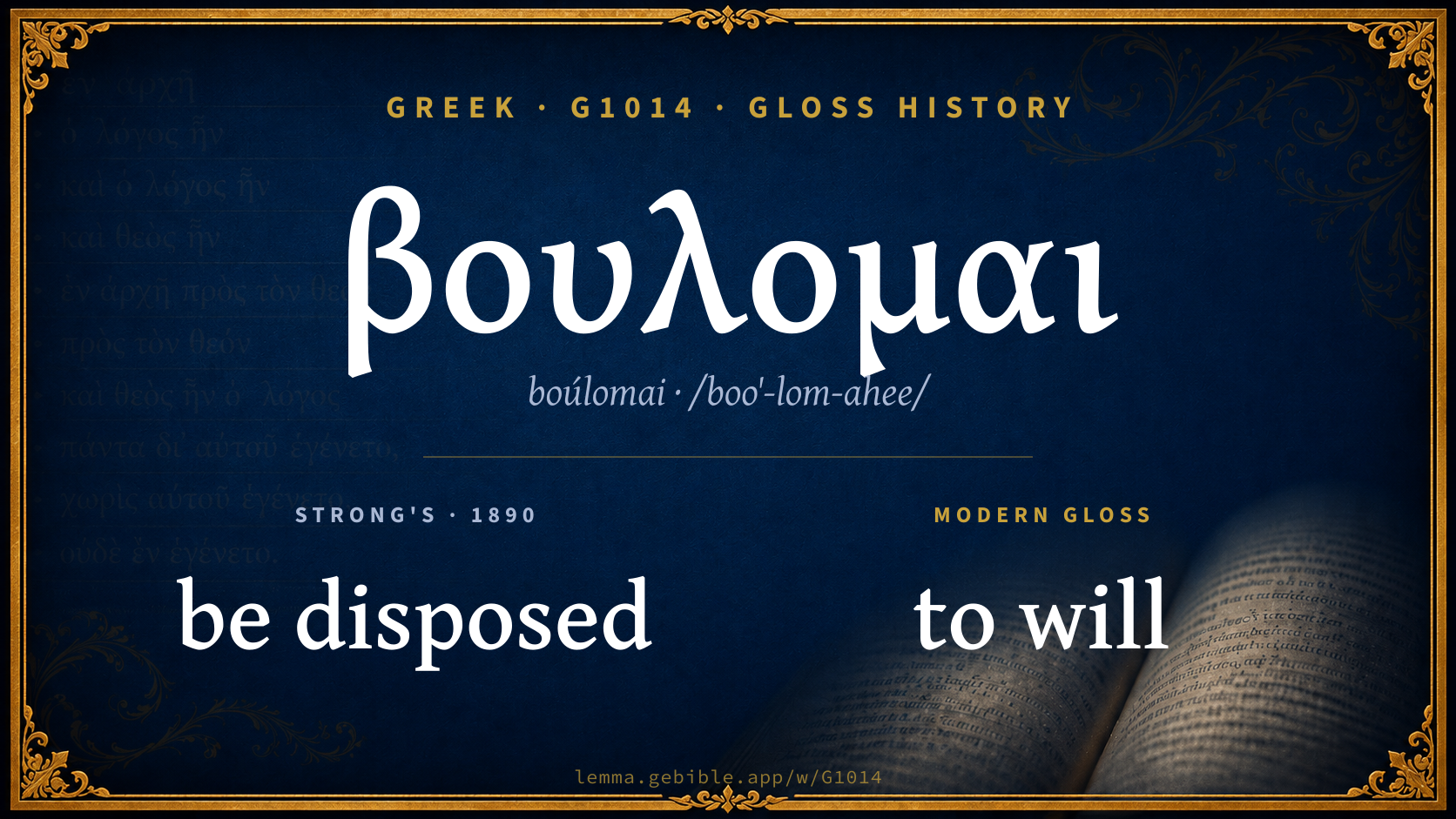
Strong's 1890 vs modern scholarship
About this word
Strong's G1014 catalogs a Greek word from the Greek New Testament.
These counts are not copied from any lexicon or concordance. They are computed here, from the morphology-tagged Greek New Testament. What Lemma adds →
- 36
- distinct verses
- The word appears in 36 distinct verses.
- 17 / 27
- NT books
- The word appears in 17 of 27 New Testament books.
- #406
- by frequency
- Top 500 most frequent Greek words (rank 406 of 5,347 Greek words by occurrence).
View all 36 occurrences in the concordance →
By section of the New Testament
By traditional corpus
Conventional, traditional groupings — biblical authorship is debated, so this is a traditional corpus grouping, not an authorship claim. Some books belong to more than one corpus (Luke is in both the Gospels and the Lukan corpus, and so on), so these shares overlap and need not total 100%. Each figure is a share of the word’s 36 distinct verses.
- Lukan (Luke–Acts) 15 verses · 42%
- Pauline corpus 9 verses · 25%
- General (Catholic) Epistles 7 verses · 19%
- Gospels 6 verses · 17%
- Johannine 3 verses · 8%
- Hebrews 1 verse · 3%
How translations render this word
Counts come from each version’s own published word-to-Strong’s tagging or interlinear alignment — an approximate guide to how each version renders this word, not a word-level alignment the data otherwise carries. Because each total is that version’s own tagged count, the per-version totals vary from one another and need not match the appearance or distinct-verse counts above. These counts may also differ from a printed concordance because Lemma counts each distinctly tagged rendering and does not collapse phrase taggings into a single head-word total. This is a fixed set of word-tagged versions (KJV, ASV, BSB, ULT) and does not change with the reading translation you choose elsewhere. Each version’s license is shown beside its name below (and on Sources).
- King James Version: I will 4×, I would 4×, Willing 4×
- American Standard Version: Desiring 3×, I desire 3×, Was minded 3×
- Berean Standard Bible: I want 4×, Wanted 4×, Chooses 3×
- unfoldingWord Literal Text: Wanting 7×, I want 5×, Desires 3×
King James Version Public Domain
Renders G1014 across 34 tagged occurrences — most commonly:
Plus 12 renderings that appear only once — usually multi-word phrases or single function words the recovered tagging swept in, not distinct renderings. Not rendered by a distinct English word in 2 further occurrences.
American Standard Version Public Domain
Renders G1014 across 34 tagged occurrences — most commonly:
Plus 17 renderings that appear only once — usually multi-word phrases or single function words the recovered tagging swept in, not distinct renderings.
Berean Standard Bible Public Domain
Renders G1014 across 35 tagged occurrences — most commonly:
Plus 19 renderings that appear only once — usually multi-word phrases or single function words the recovered tagging swept in, not distinct renderings. Not rendered by a distinct English word in 1 further occurrence.
unfoldingWord Literal Text CC BY-SA 4.0
Renders G1014 across 43 tagged occurrences — most commonly:
Plus 19 renderings that appear only once — usually multi-word phrases or single function words the recovered tagging swept in, not distinct renderings.
Senses in Thayer's
The 2 senses Thayer's distinguishes for this word, in lexicon order (not ranked by frequency or importance). The full entry — with sub-senses — is in the Lexicon Entry tab.
- to will deliberately, have a purpose, be minded
- of willing as an affection, to desire
Word origin
Origin: middle voice of a primary verb
Middle voice of a primary verb; to will that is (reflexively) be willing : - be disposed minded intend list (be of own) will (-ing). Compare G2309 .
— Strong’s Exhaustive Concordance (1890), public domain.
Forms in the corpus
The 21 distinct written forms G1014 takes in the Greek New Testament, most frequent first — each parse links to that tense’s occurrences in the concordance.
Same root — word family
Other Thayer's entries built from the same root as G1014, grouped by Strong’s listed origin. These share a root / origin per the lexicon — not necessarily a shared meaning. Each links to that word’s own entry.
Derived from this word
Compare all same-root words → They share a root, not necessarily a meaning.
Septuagint usage
The same Greek word βουλομαι appears 75 times in the Greek Old Testament (Septuagint), across 72 verses in 20 books.
- 75
- LXX occurrences
- Tagged occurrences of this Greek word in the Septuagint.
- 72
- verses
- Distinct Septuagint verses containing this word.
- 20 / 39
- OT books
- The word appears in 20 of the 39 Old Testament books.
Sample Septuagint occurrences
- Genesis 24:5 βούλομαι
- Exodus 4:23 βούλομαι
- Leviticus 26:21 βούλομαι
- Deuteronomy 25:7 βούλομαι
- Ruth 3:13 βούλομαι
- 1 Samuel 2:25 βούλομαι
- 2 Samuel 2:23 βούλομαι
- 1 Kings 13:33 βούλομαι
- 1 Chronicles 10:4 βούλομαι
- 2 Chronicles 21:7 βούλομαι
- Ezra 10:3 βούλομαι
- Esther 3:11 βούλομαι
Septuagint occurrences (same lexeme)
Every verse where the same Strong’s number (G1014) appears in the Greek Septuagint — showing the first 50 of 72. Verse text shown in the World English Bible for context; the Greek form is the matched word — the English is not keyword-highlighted.
- Genesis 24:5 βούλομαι The servant said to him, "What if the woman isn't willing to follow me to this land? Must I bring your son again to the land you came from?"
- Exodus 4:23 βούλομαι and I have said to you, "Let my son go, that he may serve me;" and you have refused to let him go. Behold, I will kill your son, your firstborn.'"
- Exodus 7:27 βούλομαι
- Exodus 8:17 βούλομαι They did so; and Aaron stretched out his hand with his rod, and struck the dust of the earth, and there were lice on man, and on animal; all the dust of the earth became lice throughout all the land of Egypt.
- Exodus 9:2 βούλομαι For if you refuse to let them go, and hold them still,
- Exodus 10:3 βούλομαι Moses and Aaron went in to Pharaoh, and said to him, "This is what Yahweh, the God of the Hebrews, says: 'How long will you refuse to humble yourself before me? Let my people go, that they may serve me.
- Exodus 10:7 βούλομαι Pharaoh's servants said to him, "How long will this man be a snare to us? Let the men go, that they may serve Yahweh, their God. Don't you yet know that Egypt is destroyed?"
- Exodus 10:27 βούλομαι But Yahweh hardened Pharaoh's heart, and he wouldn't let them go.
- Exodus 16:28 βούλομαι Yahweh said to Moses, "How long do you refuse to keep my commandments and my laws?
- Exodus 22:16 βούλομαι "If a man entices a virgin who isn't pledged to be married, and lies with her, he shall surely pay a dowry for her to be his wife.
- Exodus 36:2 βούλομαι Moses called Bezalel and Oholiab, and every wise-hearted man, in whose heart Yahweh had put wisdom, even everyone whose heart stirred him up to come to the work to do it:
- Leviticus 26:21 βούλομαι "'If you walk contrary to me, and won't listen to me, then I will bring seven times more plagues on you according to your sins.
- Deuteronomy 25:7 βούλομαι If the man doesn't want to take his brother's wife, then his brother's wife shall go up to the gate to the elders, and say, My husband's brother refuses to raise up to his brother a name in Israel; he will not perform the duty of a husband's brother to me.
- Deuteronomy 25:8 βούλομαι Then the elders of his city shall call him, and speak to him: and if he stand, and say, I don't want to take her;
- Ruth 3:13 βούλομαι Stay this night, and it shall be in the morning, that if he will perform to you the part of a kinsman, well; let him do the kinsman's part: but if he will not do the part of a kinsman to you, then will I do the part of a kinsman to you, as Yahweh lives: lie down until the morning.
- 1 Samuel 2:25 βούλομαι If one man sin against another, God shall judge him; but if a man sin against Yahweh, who shall entreat for him? Notwithstanding, they didn't listen to the voice of their father, because Yahweh was minded to kill them.
- 1 Samuel 15:9 βούλομαι But Saul and the people spared Agag, and the best of the sheep, and of the oxen, and of the fatlings, and the lambs, and all that was good, and wouldn't utterly destroy them: but everything that was vile and refuse, that they destroyed utterly.
- 1 Samuel 18:15 βούλομαι When Saul saw that he behaved himself very wisely, he stood in awe of him.
- 1 Samuel 20:3 βούλομαι David swore moreover, and said, Your father knows well that I have found favor in your eyes; and he says, Don't let Jonathan know this, lest he be grieved: but truly as Yahweh lives, and as your soul lives, there is but a step between me and death.
- 1 Samuel 22:17 βούλομαι The king said to the guard who stood about him, Turn, and kill the priests of Yahweh; because their hand also is with David, and because they knew that he fled, and didn't disclose it to me. But the servants of the king wouldn't put forth their hand to fall on the priests of Yahweh.
- 1 Samuel 28:23 βούλομαι But he refused, and said, I will not eat. But his servants, together with the woman, constrained him; and he listened to their voice. So he arose from the earth, and sat on the bed.
- 1 Samuel 31:4 βούλομαι Then said Saul to his armor bearer, Draw your sword, and thrust me through therewith, lest these uncircumcised come and thrust me through, and abuse me. But his armor bearer would not; for he was sore afraid. Therefore Saul took his sword, and fell on it.
- 2 Samuel 2:23 βούλομαι However he refused to turn aside: therefore Abner with the hinder end of the spear struck him in the body, so that the spear came out behind him; and he fell down there, and died in the same place: and it happened, that as many as came to the place where Asahel fell down and died stood still.
- 2 Samuel 6:10 βούλομαι So David would not remove the ark of Yahweh to him into the city of David; but David carried it aside into the house of Obed-edom the Gittite.
- 2 Samuel 20:11 βούλομαι There stood by him one of Joab's young men, and said, He who favors Joab, and he who is for David, let him follow Joab.
- 2 Samuel 24:3 βούλομαι Joab said to the king, Now Yahweh your God add to the people, however many they may be, one hundred times; and may the eyes of my lord the king see it: but why does my lord the king delight in this thing?
- 1 Kings 13:33 βούλομαι After this thing Jeroboam didn't return from his evil way, but made again from among all the people priests of the high places: whoever would, he consecrated him, that there might be priests of the high places.
- 1 Kings 16:28 βούλομαι So Omri slept with his fathers, and was buried in Samaria; and Ahab his son reigned in his place.
- 1 Kings 20:6 βούλομαι but I will send my servants to you tomorrow about this time, and they shall search your house, and the houses of your servants; and it shall be, that whatever is pleasant in your eyes, they shall put it in their hand, and take it away.
- 1 Chronicles 10:4 βούλομαι Then said Saul to his armor-bearer, Draw your sword, and thrust me through therewith, lest these uncircumcised come and abuse me. But his armor-bearer would not; for he was sore afraid. Therefore Saul took his sword, and fell on it.
- 1 Chronicles 11:19 βούλομαι and said, My God forbid it me, that I should do this: shall I drink the blood of these men who have put their lives in jeopardy? for with [the jeopardy of] their lives they brought it. Therefore he would not drink it. These things did the three mighty men.
- 2 Chronicles 21:7 βούλομαι However Yahweh would not destroy the house of David, because of the covenant that he had made with David, and as he promised to give a lamp to him and to his children always.
- 2 Chronicles 25:16 βούλομαι It happened, as he talked with him, that [the king] said to him, Have we made you of the king's counsel? Stop! Why should you be struck down? Then the prophet stopped, and said, I know that God has determined to destroy you, because you have done this, and have not listened to my counsel.
- Ezra 10:3 βούλομαι Now therefore let us make a covenant with our God to put away all the wives, and such as are born of them, according to the counsel of my lord, and of those who tremble at the commandment of our God; and let it be done according to the law.
- Esther 3:11 βούλομαι The king said to Haman, The silver is given to you, the people also, to do with them as it seems good to you.
- Esther 8:11 βούλομαι in which the king granted the Jews who were in every city to gather themselves together, and to stand for their life, to destroy, to kill, and to cause to perish, all the power of the people and province that would assault them, [their] little ones and women, and to take the spoil of them for a prey,
- Job 9:3 βούλομαι If he is pleased to contend with him, He can't answer him one time in a thousand.
- Job 13:3 βούλομαι "Surely I would speak to the Almighty. I desire to reason with God.
- Job 21:14 βούλομαι They tell God, 'Depart from us, For we don't want to know about your ways.
- Job 30:14 βούλομαι As through a wide breach they come, In the midst of the ruin they roll themselves in.
- Job 34:14 βούλομαι If he set his heart on himself, If he gathered to himself his spirit and his breath;
- Job 35:13 βούλομαι Surely God will not hear an empty cry, Neither will the Almighty regard it.
- Job 36:12 βούλομαι But if they don't listen, they shall perish by the sword; They shall die without knowledge.
- Job 37:10 βούλομαι By the breath of God, ice is given, And the breadth of the waters is frozen.
- Job 39:9 βούλομαι "Will the wild ox be content to serve you? Or will he stay by your feeding trough?
- Psalms 35:4 βούλομαι Let those who seek after my soul be disappointed and brought to dishonor. Let those who plot my ruin be turned back and confounded.
- Psalms 39:9 βούλομαι I was mute. I didn't open my mouth, Because you did it.
- Psalms 69:3 βούλομαι I am weary with my crying. My throat is dry. My eyes fail, looking for my God.
- Proverbs 1:10 βούλομαι My son, if sinners entice you, don't consent.
- Proverbs 12:20 βούλομαι Deceit is in the heart of those who plot evil, But joy comes to the promoters of peace.
These are occurrences of the same Greek lexeme (G1014) in the Septuagint — not a translation of any one Hebrew word. The store carries no word-level Hebrew↔Greek alignment, so no Hebrew original is asserted here. Counts come from the recovered LXX Strong's tagging — high-frequency vocabulary is well covered, while rare or late forms may be untagged — so they reflect tagged occurrences and may slightly undercount.