

1 Thessalonians 4:13
Greek (Tischendorf 8th ed.) 1 Thessalonians 4:13 appears in the Greek New Testament. The text above is from the Tischendorf 8th edition. Each word links to its Strong’s number and a concise gloss. Click any word for its full Thayer’s Greek Lexicon entry.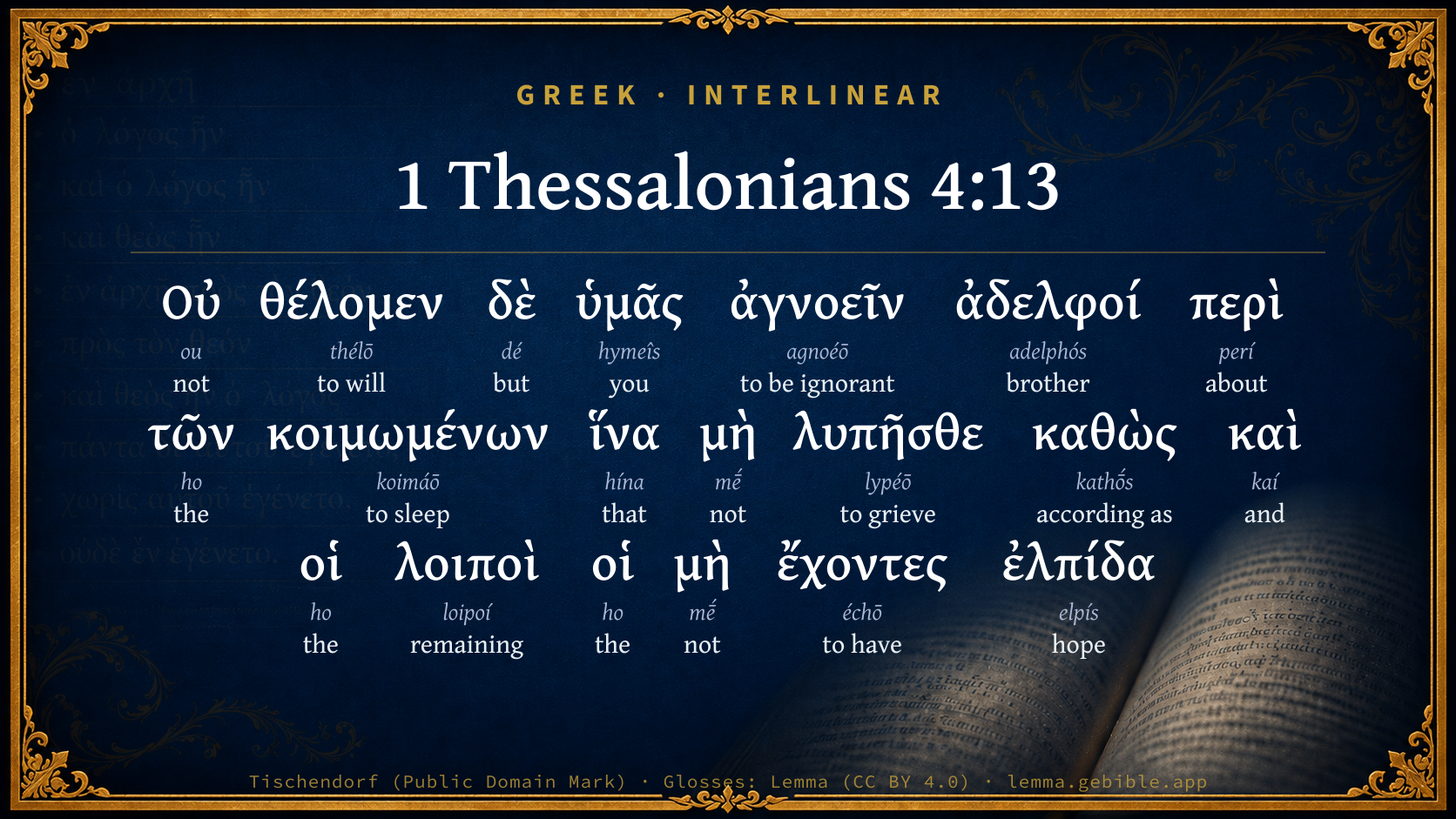
But we don't want you to be ignorant, brothers, concerning those who have fallen asleep, so that you don't grieve like the rest, who have no hope.
Download a study sheet
One document with this verse’s original text, its word-by-word gloss line, the meaning frame, cross-references with their text, attributed commentary, and full source and license credits — printable, and it pastes into notes with its structure intact.
This verse Autodidact and up
A passage Seminary Student
Up to 50 verses in one chapter. A passage sheet keeps up to 6 commentary sources and 12 cross-references per verse, in the order this page ranks them, and says so on the sheet whenever that leaves anything out. Ask for a single verse and you get the Autodidact verse sheet above.
Everything on this page stays free to read, with no account — the sheet is a download of what is already on screen, not access to it.
Compare translations 3
The same verse in 3 English versions, stacked beneath the original-language interlinear above. Click any original word for its lexicon entry.
Each is an independent rendering of the whole verse — the interlinear is not word-aligned to these translations.
Highlighted words mark where these versions differ — a whole-verse word diff, not a word-by-word alignment.
-
World English Bible Public Domain
But we don't want you to be ignorant, brothers, concerning those who have fallen asleep, so that you don't grieve like the rest, who have no hope.
-
King James Version Public Domain
But I would not have you to be ignorant, brethren, concerning them which are asleep, that ye sorrow not, even as others which have no hope.
-
unfoldingWord Literal Text CC BY-SA 4.0
Now we do not want you to be ignorant, brothers, concerning the ones sleeping, so that you may not grieve just as also the rest, the ones not having hope.
unfoldingWord Literal Text — © unfoldingWord, licensed CC BY-SA 4.0. Word-aligned USFM3 via Door43 (git.door43.org/unfoldingWord/en_ult).
Show all 19 translations
Every available English version of this verse, each an independent rendering of the whole verse.
-
World English Bible Public Domain
But we don't want you to be ignorant, brothers, concerning those who have fallen asleep, so that you don't grieve like the rest, who have no hope.
-
Berean Standard Bible Public Domain
Brothers, we do not want you to be uninformed about those who sleep in death, so that you will not grieve like the rest, who are without hope.
-
Majority Standard Bible Public Domain
Brothers, we do not want you to be uninformed about those who sleep in death, so that you will not grieve like the rest, who are without hope.
-
King James Version Public Domain
But I would not have you to be ignorant, brethren, concerning them which are asleep, that ye sorrow not, even as others which have no hope.
-
American Standard Version (1901) Public Domain
But we would not have you ignorant, brethren, concerning them that fall asleep; that ye sorrow not, even as the rest, who have no hope.
-
Revised Version (1885) Public Domain
But we would not have you ignorant, brethren, concerning them that fall asleep; that ye sorrow not, even as the rest, which have no hope.
-
Geneva Bible (1599) Public Domain
I would not, brethren, haue you ignorant concerning them which are a sleepe, that ye sorow not euen as other which haue no hope.
-
Douay-Rheims (1899) Public Domain
For if we believe that Jesus died, and rose again; even so them who have slept through Jesus, will God bring with him.
-
Young's Literal Translation Public Domain
And I do not wish you to be ignorant, brethren, concerning those who have fallen asleep, that ye may not sorrow, as also the rest who have not hope,
-
Literal Standard Version CC BY-SA 4.0
And I do not wish you to be ignorant, brothers, concerning those who have fallen asleep, that you may not sorrow, as also the rest who have no hope,
-
Unlocked Literal Bible CC BY-SA 4.0
We do not want you to be uninformed, brothers, about those who sleep, so that you do not grieve like the rest who do not have hope.
-
unfoldingWord Literal Text CC BY-SA 4.0
Now we do not want you to be ignorant, brothers, concerning the ones sleeping, so that you may not grieve just as also the rest, the ones not having hope.
-
Darby Bible Public Domain
But we do not wish you to be ignorant, brethren, concerning them that are fallen asleep, to the end that ye be not grieved even as also the rest who have no hope.
-
World Messianic Bible Public Domain
But we don’t want you to be ignorant, brothers, concerning those who have fallen asleep, so that you don’t grieve like the rest, who have no hope.
-
Webster's Bible Public Domain
But I would not have you to be ignorant, brethren, concerning them who are asleep, that ye sorrow not, even as others who have no hope.
-
Free Bible Version CC BY-SA 4.0
We don't want you to be confused about what happens when people die, brothers and sisters, so that you won't grieve like others who don't have any hope.
-
Bible in Basic English Public Domain
But it is our desire, brothers, that you may be certain about those who are sleeping; so that you may have no need for sorrow, as others have who are without hope.
-
Text-Critical English NT CC BY 4.0
But we do not want you to be uninformed, brothers, about those who have fallen asleep, so that you may not be grieved like others who do not have hope.
-
Tyndale New Testament (1534) Public Domain
I wolde not brethren have you ignoraunt concerninge them which are fallen aslepe that ye sorowe not as other do which have no hope.
Literal Standard Version (2020), Covenant Press — licensed CC BY-SA 4.0. Text via the HelloAO Bible API (eBible.org). Unlocked Literal Bible (unfoldingWord) — licensed CC BY-SA 4.0. Text via the HelloAO Bible API (eBible.org). unfoldingWord Literal Text — © unfoldingWord, licensed CC BY-SA 4.0. Word-aligned USFM3 via Door43 (git.door43.org/unfoldingWord/en_ult). Free Bible Version, Dr. Jonathan Gallagher — licensed CC BY-SA 4.0. Text via the HelloAO Bible API (eBible.org).
Word by word
More ways to search: Search by grammar → Find every occurrence → Compare this word →
Practice this passage: Drill this verse → Learn its vocabulary →
- Appears 18× in the Greek New Testament
- First appears at Matthew 27:52
- Part of Speech
- Verb
- Tense
- Present
- Voice
- Passive
- Mood
- Participle
- Case
- Genitive
- Number
- Plural
- Gender
- Masculine
Full Thayer's Definition
- Οὐ ou G3756 “not” Particle, Negative
- θέλομεν thélō G2309 “to will” Verb, Present, Active, Indicative, 1st person, Plural
- δὲ dé G1161 “but” Conjunction
- ὑμᾶς hymeîs G5210 “you” Personal pronoun, 2nd person, Accusative, Plural
- ἀγνοεῖν agnoéō G50 “to be ignorant” Verb, Present, Active, Infinitive
- ἀδελφοί adelphós G80 “brother” Noun, Vocative, Plural, Masculine
- περὶ perí G4012 “about” Preposition
- τῶν ho G3588 “the” Article, Genitive, Plural, Masculine
- κοιμωμένων koimáō G2837 “to sleep” Verb, Present, Passive, Participle, Genitive, Plural, Masculine
- ἵνα hína G2443 “that” Conjunction
- μὴ mḗ G3361 “not” Particle, Negative
- λυπῆσθε lypéō G3076 “to grieve” Verb, Present, Passive, Subjunctive, 2nd person, Plural
- καθὼς kathṓs G2531 “according as” Adverb
- καὶ kaí G2532 “and” Conjunction
- οἱ ho G3588 “the” Article, Nominative, Plural, Masculine
- λοιποὶ loipoí G3062 “remaining” Adjective, Nominative, Plural, Masculine
- οἱ ho G3588 “the” Article, Nominative, Plural, Masculine
- μὴ mḗ G3361 “not” Particle, Negative
- ἔχοντες échō G2192 “to have” Verb, Present, Active, Participle, Nominative, Plural, Masculine
- ἐλπίδα elpís G1680 “hope” Noun, Accusative, Singular, Feminine
About this verse
These counts appear in no published source. They are computed here, from the morphology-tagged text and Lemma’s own curated glosses. What Lemma adds →
- 20
- words
- 17
- distinct lemmas
- Pauline Epistles
- section
Cross-references
31Topical passages linked to 1 Thessalonians 4:13 in the Treasury of Scripture Knowledge — connected by theme and wording, ordered by reader-vote popularity; previews shown in the World English Bible.
- Daniel 12:2 Many of those who sleep in the dust of the earth shall awake, some to everlasting life, and some to shame and everlasting contempt.
- 1 Thessalonians 4:15 For this we tell you by the word of the Lord, that we who are alive, who are left to the coming of the Lord, will in no way precede those who have fallen asleep.
- 1 Thessalonians 5:10 who died for us, that, whether we wake or sleep, we should live together with him.
- 1 Corinthians 15:18–19 Then they also who are fallen asleep in Christ have perished.
- 2 Peter 3:4 and saying, "Where is the promise of his coming? For, from the day that the fathers fell asleep, all things continue as they were from the beginning of the creation."
- Acts 7:60 He kneeled down, and cried with a loud voice, "Lord, don't hold this sin against them!" When he had said this, he fell asleep.
- 1 Corinthians 15:6 Then he appeared to over five hundred brothers at once, most of whom remain until now, but some have also fallen asleep.
- Ephesians 2:12 that you were at that time separate from Christ, alienated from the commonwealth of Israel, and strangers from the covenants of the promise, having no hope and without God in the world.
- Ezekiel 37:11 Then he said to me, Son of man, these bones are the whole house of Israel: behold, they say, Our bones are dried up, and our hope is lost; we are clean cut off.
- John 11:11–13 He said these things, and after that, he said to them, "Our friend, Lazarus, has fallen asleep, but I am going so that I may awake him out of sleep."
- Job 19:25–27 But as for me, I know that my Redeemer lives. In the end, he will stand upon the earth.
- Matthew 27:52 The tombs were opened, and many bodies of the saints who had fallen asleep were raised;
- John 11:24 Martha said to him, "I know that he will rise again in the resurrection at the last day."
- Acts 13:36 For David, after he had in his own generation served the counsel of God, fell asleep, and was laid with his fathers, and saw decay.
- 1 Corinthians 10:1 Now I would not have you ignorant, brothers, that our fathers were all under the cloud, and all passed through the sea;
- 1 Kings 1:21 Otherwise it will happen, when my lord the king shall sleep with his fathers, that I and my son Solomon shall be counted offenders.
- 1 Kings 2:10 David slept with his fathers, and was buried in the city of David.
- Proverbs 14:32 The wicked is brought down in his calamity, But in death, the righteous has a refuge.
- Romans 1:13 Now I don't desire to have you unaware, brothers, that I often planned to come to you, and was hindered so far, that I might have some fruit among you also, even as among the rest of the Gentiles.
- 2 Corinthians 1:8 For we don't desire to have you uninformed, brothers, concerning our affliction which happened to us in Asia, that we were weighed down exceedingly, beyond our power, so much that we despaired even of life.
- Leviticus 19:28 "'You shall not make any cuttings in your flesh for the dead, nor tattoo any marks on you. I am Yahweh.
- Ezekiel 24:16–18 Son of man, behold, I take away from you the desire of your eyes with a stroke: yet you shall neither mourn nor weep, neither shall your tears run down.
- Acts 8:2 Devout men buried Stephen, and lamented greatly over him.
- 2 Peter 3:8 But don't forget this one thing, beloved, that one day is with the Lord as a thousand years, and a thousand years as one day.
- 2 Samuel 12:19–20 But when David saw that his servants were whispering together, David perceived that the child was dead; and David said to his servants, Is the child dead? They said, He is dead.
- Luke 8:52–53 All were weeping and mourning her, but he said, "Don't weep. She isn't dead, but sleeping."
- 1 Corinthians 12:1 Now concerning spiritual things, brothers, I don't want you to be ignorant.
- Genesis 37:35 All his sons and all his daughters rose up to comfort him; but he refused to be comforted. He said, "For I will go down to Sheol to my son mourning." His father wept for him.
- Deuteronomy 14:1–2 You are the children of Yahweh your God: you shall not cut yourselves, nor make any baldness between your eyes for the dead.
- 2 Samuel 18:33 The king was much moved, and went up to the chamber over the gate, and wept: and as he went, thus he said, my son Absalom, my son, my son Absalom! would I had died for you, Absalom, my son, my son!
- Job 1:21 He said, "Naked I came out of my mother's womb, and naked shall I return there. Yahweh gave, and Yahweh has taken away. Blessed be the name of Yahweh."
Cross-references courtesy of OpenBible.info (CC BY 4.0).
Where the printed editions differ
1 variantPlaces in this verse where the major printed Greek editions disagree on the wording in a way that affects the translation — a comparison of editions, not a manuscript-by-manuscript collation. The editions are the modern critical texts (Nestlé-Aland 28/27, SBL, Westcott-Hort, Tregelles, Tyndale House) and the traditional texts behind the KJV (the Textus Receptus and the Byzantine/Majority text). It is not a claim about which reading is original.
-
Different wording
θέλομεν
“we do want”
In NA28NA27TynSBLWHTregByz Not in TRθέλω (thelō) 'I want' occurs in traditional manuscripts (TR) instead of θέλομεν (thelomen) 'we do want' in older manuscripts (NA28+NA27+Tyn+SBL+WH+Treg+Byz)
Textual data: Translators Amalgamated Greek New Testament (STEPBible TAGNT) · CC BY 4.0.
Lesson kit
Teaching starters — assembled from the data on this page, not authored interpretation. Every prompt links to the verse data it draws on. Edit before teaching.
1 Thessalonians, in the Pauline Epistles, opens this verse with 20 words (17 distinct Greek lemmas). Its most distinctive word is koimáō (“to sleep”). A historical commentator’s framing appears above. Read the whole chapter for the surrounding context.
Discussion questions
- The word koimáō carries the sense “to sleep.” How does it shape the verse?
- How does Matthew 27:52, which shares the word «to sleep», read alongside this verse?
- What does the repetition of “the” (3× in this one verse) do in this verse?
- These translations render this verse differently; the difference is in the English rendering, not the original. What questions does that raise?
- Compare how Matthew Henry's Commentary and The Cambridge Bible for Schools and Colleges read this verse. Where do they agree or differ?
Things to notice
- These translations choose different wording for 26 words in this verse.
- “the” occurs 3× in this single verse.
- 17 distinct Greek lemmas span 20 words in this verse.
Commentary
Notes on 1 Thessalonians 4:13 from classic Christian and Jewish commentators (each source and its license shown beneath its notes). The classic Christian expositions comment on the surrounding passage and are grouped to its opening verse, so a note may address several verses; the Jewish commentaries on the Tanakh (Rashi and others) are per-verse, so they appear only where the commentator wrote on this verse.
Lemma curates 59 commentaries, every one of them public domain or Creative Commons licensed, each selected and text-cleaned for this edition rather than reprinted as found. About our sources →
Matthew Henry's Commentary
Matthew Henry's Commentary on the Whole Bible (1708–1710) — public domain (CC PDM 1.0). Text via the HelloAO Bible API.
The Cambridge Bible for Schools and Colleges
gen. ed. J. J. S. Perowne
The Cambridge Bible for Schools and Colleges (gen. ed. J. J. S. Perowne; Cambridge University Press, 1878–1918) — public domain. Text from a community e-Sword module.
The Biblical Illustrator
Joseph S. Exell
The Biblical Illustrator, edited by Joseph S. Exell (c. 1880s–1900s) — public domain. Text from a community e-Sword module.
Joseph Benson's Commentary
Joseph Benson's Commentary on the Old and New Testaments (1811–1818) — public domain. Text from a community e-Sword module.
Whedon's Commentary on the Bible
Daniel D. Whedon
Daniel D. Whedon (gen. ed.), Commentary on the Old and New Testaments (1874–1909) — public domain. Text from a community e-Sword module.
The Preacher's Complete Homiletical Commentary
Joseph S. Exell (gen. ed.)
The Preacher's Complete Homiletical Commentary (gen. ed. Joseph S. Exell; Funk & Wagnalls, c. 1892) — public domain (pre-1929). A full-Bible homiletical/sermon-outline anthology covering 65 of 66 books (2 John is absent from the source module). Text from a community e-Sword module.
Lange's Commentary on the Holy Scriptures
Lange's Commentary on the Holy Scriptures (Critical, Doctrinal, and Homiletical), ed. John Peter Lange, English translation edited by Philip Schaff (1864–1880) — public domain. Text from a community e-Sword module.
F. W. Grant's Numerical Bible
F. W. Grant, The Numerical Bible (4th ed., 1903) — public domain. Text from a community e-Sword module.
The Expositor's Bible
William Robertson Nicoll, ed., The Expositor's Bible (London: Hodder & Stoughton, 1887–1910) — public domain. 65 of 66 books (1 Corinthians is not separately keyed, as that volume carries no machine-parseable verse references); section-level commentary keyed to the opening verse. Introductory and overview sections not keyed to a specific passage are excluded.
Tyndale Open Study Notes
Tyndale Open Resources
Tyndale Open Study Notes — © Tyndale Open Resources, licensed CC BY-SA 4.0. Text via the HelloAO Bible API.
Bengel's Gnomon
Johann Albrecht Bengel
Bengel's Gnomon of the New Testament — English translation (T&T Clark, Edinburgh, 1860) — public domain. Text from a community e-Sword module.
Meyer's Critical & Exegetical Commentary
Heinrich August Wilhelm Meyer
Meyer — Critical and Exegetical Commentary on the New Testament — English translation by Peter Christie, edited by Frederick Crombie (T&T Clark, 1880) — public domain. Text from a community e-Sword module.
Expositor's Greek Testament
ed. W. Robertson Nicoll
The Expositor's Greek Testament, edited by W. Robertson Nicoll (1897–1910) — public domain. Text from a community e-Sword module.
Cambridge Greek Testament for Schools and Colleges
Cambridge Greek Testament for Schools and Colleges (Cambridge University Press, 1896; 21 vols, various authors incl. Carr, Maclear, Plummer, Farrar, Lumby, Moule, M. R. James, Simcox) — public domain. Text from a community e-Sword module.
Geneva Bible (1599)
Geneva Bible translators
Geneva Bible (1599) marginal notes — public domain. Text via Bolls.life.
Jamieson, Fausset & Brown
Robert Jamieson, A. R. Fausset & David Brown
Jamieson, Fausset & Brown — Commentary Critical and Explanatory on the Whole Bible (1871) — public domain (CC PDM 1.0). Text via the HelloAO Bible API.
Adam Clarke's Commentary
Adam Clarke's Commentary on the Bible (1810–1826) — public domain. Text from a community e-Sword/MySword module.
John Calvin's Commentaries
John Calvin's Commentaries (1540-1563) — public domain. Text from the Calvin Translation Society English edition (1840s-50s) via the Christian Classics Ethereal Library (ccel.org). Calvin's coverage is partial (roughly two-thirds of the Bible); uncommented books and verses are honest gaps, never fabricated. The 19th-century editor's footnotes and remarks are omitted so the notes are faithfully Calvin's own voice.
Ellicott's Commentary for English Readers
A Bible Commentary for English Readers, edited by Charles John Ellicott (1878–1897) — public domain. Text from a community e-Sword module.
John Gill's Exposition
John Gill's Exposition of the Whole Bible (1746–1763) — public domain (CC PDM 1.0). Text via the HelloAO Bible API.
Trapp's Complete Commentary
John Trapp
John Trapp, A Commentary or Exposition upon All the Books of the Old and New Testament (1647–1656) — public domain. Text from a community e-Sword module.
Albert Barnes' Notes on the Bible
Albert Barnes' Notes on the Bible (1834–1885) — public domain. Text from a community e-Sword/MySword module.
Matthew Poole's English Annotations
Matthew Poole's English Annotations on the Holy Bible (1683–1685) — public domain. Text from a community e-Sword/MySword module.
The Pulpit Commentary
The Pulpit Commentary (1880–1919), ed. H.D.M. Spence-Jones & Joseph S. Exell — public domain. Text from a community e-Sword module.
John Wesley's Explanatory Notes
John Wesley, Explanatory Notes Upon the Whole Bible (1754–1765) — public domain. Text via the GEBible commentary corpus.
Kretzmann's Popular Commentary
Paul E. Kretzmann
Paul E. Kretzmann, Popular Commentary of the Bible (1921–1924) — public domain. Text from a community e-Sword module.
Burkitt's Expository Notes on the New Testament
William Burkitt
William Burkitt's Expository Notes on the New Testament (1700–1703) — public domain. Text from a community e-Sword module.
Godbey's Commentary on the New Testament
William B. Godbey
William B. Godbey, Commentary on the New Testament (1896–1900) — public domain. Text from a community e-Sword module.
McGarvey & Pendleton's Commentaries
J. W. McGarvey
J. W. McGarvey (with Philip Y. Pendleton), Commentaries on the New Testament (The Fourfold Gospel, 1914; Acts; and the epistles) — public domain. Text from a community e-Sword/MySword module.
The People's New Testament
B. W. Johnson
B. W. Johnson's The People's New Testament with Notes (1889–1891) — public domain. Electronic text from the Christian Classics Ethereal Library (CCEL) ThML edition.
unfoldingWord translationNotes
Door43 World Missions Community
unfoldingWord translationNotes — © Distant Shores Media and the Door43 World Missions Community, licensed CC BY-SA 4.0. Source: git.door43.org/Door43/en_tn.
Alford’s Greek Testament
Henry Alford
Henry Alford, The Greek Testament (1849–1861) — public domain. Text from a community e-Sword module.
International Critical Commentary
International Critical Commentary — older volumes (1896–1929), various authors — public domain. Text from a community e-Sword module.
Vincent's Word Studies in the New Testament
Marvin R. Vincent
Marvin R. Vincent, Word Studies in the New Testament (1887–1900) — public domain. Text from a community e-Sword/MySword module.