2 Thessalonians 3:10

Greek (Tischendorf 8th ed.) 2 Thessalonians 3:10 appears in the Greek New Testament. The text above is from the Tischendorf 8th edition. Each word links to its Strong’s number and a concise gloss. Click any word for its full Thayer’s Greek Lexicon entry.
Download image
Cite this verse

2 Thessalonians 3:10 (World English Bible). Public Domain. Lemma interlinear Bible study tool, https://lemma.gebible.app/v/2-thessalonians/3/10.

Show BibTeX & RIS
BibTeX
RIS
English Translation
For even when we were with you, we commanded you this: "If anyone will not work, neither let him eat."
World English Bible · Public Domain
Download a study sheet

One document with this verse’s original text, its word-by-word gloss line, the meaning frame, cross-references with their text, attributed commentary, and full source and license credits — printable, and it pastes into notes with its structure intact.

This verse Autodidact and up

Study sheet (.html) Plain text (.txt)

A passage Seminary Student

Up to 50 verses in one chapter. A passage sheet keeps up to 6 commentary sources and 12 cross-references per verse, in the order this page ranks them, and says so on the sheet whenever that leaves anything out. Ask for a single verse and you get the Autodidact verse sheet above.

Everything on this page stays free to read, with no account — the sheet is a download of what is already on screen, not access to it.

Want to remove ads? Support Godless Engineer
Compare translations 3

The same verse in 3 English versions, stacked beneath the original-language interlinear above. Click any original word for its lexicon entry.

Each is an independent rendering of the whole verse — the interlinear is not word-aligned to these translations.

Highlighted words mark where these versions differ — a whole-verse word diff, not a word-by-word alignment.

  • World English Bible Public Domain
    For even when we were with you, we commanded you this: "If anyone will not work, neither let him eat."
  • King James Version Public Domain
    For even when we were with you, this we commanded you, that if any would not work, neither should he eat.
  • unfoldingWord Literal Text CC BY-SA 4.0
    For even when we were with you, we were commanding you this, “If anyone is not willing to work, do not even let him eat.”

unfoldingWord Literal Text — © unfoldingWord, licensed CC BY-SA 4.0. Word-aligned USFM3 via Door43 (git.door43.org/unfoldingWord/en_ult).

Versions to compare (up to 4)

3 of 4 selected

Show all 19 translations

Every available English version of this verse, each an independent rendering of the whole verse.

  • World English Bible Public Domain
    For even when we were with you, we commanded you this: "If anyone will not work, neither let him eat."
  • Berean Standard Bible Public Domain
    For even while we were with you, we gave you this command: “If anyone is unwilling to work, he shall not eat.”
  • Majority Standard Bible Public Domain
    For even while we were with you, we gave you this command: “If anyone is unwilling to work, he shall not eat.”
  • King James Version Public Domain
    For even when we were with you, this we commanded you, that if any would not work, neither should he eat.
  • American Standard Version (1901) Public Domain
    For even when we were with you, this we commanded you, If any will not work, neither let him eat.
  • Revised Version (1885) Public Domain
    For even when we were with you, this we commanded you, If any will not work, neither let him eat.
  • Geneva Bible (1599) Public Domain
    For euen when we were with you, this we warned you of, that if there were any, which would not worke, that he should not eate.
  • Douay-Rheims (1899) Public Domain
    For also when we were with you, this we declared to you: that, if any man will not work, neither let him eat.
  • Young's Literal Translation Public Domain
    for even when we were with you, this we did command you, that if any one is not willing to work, neither let him eat,
  • Literal Standard Version CC BY-SA 4.0
    for even when we were with you, this we commanded you, that if anyone is not willing to work, neither let him eat,
  • Unlocked Literal Bible CC BY-SA 4.0
    When we were with you, we commanded you, “The one who is unwilling to work must not eat.”
  • unfoldingWord Literal Text CC BY-SA 4.0
    For even when we were with you, we were commanding you this, “If anyone is not willing to work, do not even let him eat.”
  • Darby Bible Public Domain
    For also when we were with you we enjoined you this, that if any man does not like to work, neither let him eat.
  • World Messianic Bible Public Domain
    For even when we were with you, we commanded you this: “If anyone is not willing to work, don’t let him eat.”
  • Webster's Bible Public Domain
    For even when we were with you, this we commanded you, that if any would not work, neither should he eat.
  • Free Bible Version CC BY-SA 4.0
    Even while we were with you we gave strict instructions that anybody who didn't want to work shouldn't eat.
  • Bible in Basic English Public Domain
    For even when we were with you we gave you orders, saying, If any man does no work, let him not have food.
  • Text-Critical English NT CC BY 4.0
    For even when we were with you, we gave you this command: “If anyone is not willing to work, neither should he eat.”
  • Tyndale New Testament (1534) Public Domain
    For when we were with you this we warned you of that yf ther were eny which wolde not worke that the same shuld not eate.

Literal Standard Version (2020), Covenant Press — licensed CC BY-SA 4.0. Text via the HelloAO Bible API (eBible.org). Unlocked Literal Bible (unfoldingWord) — licensed CC BY-SA 4.0. Text via the HelloAO Bible API (eBible.org). unfoldingWord Literal Text — © unfoldingWord, licensed CC BY-SA 4.0. Word-aligned USFM3 via Door43 (git.door43.org/unfoldingWord/en_ult). Free Bible Version, Dr. Jonathan Gallagher — licensed CC BY-SA 4.0. Text via the HelloAO Bible API (eBible.org).

Word by word

More ways to search: Search by grammar → Find every occurrence → Compare this word →

Practice this passage: Drill this verse → Learn its vocabulary →

παρηγγέλλομεν
parangéllō
G3853
“to announce”
Verb, Imperfect, Active, Indicative, 1st person, Plural
Part of Speech
Verb
Tense
Imperfect
Voice
Active
Mood
Indicative
Person
1st person
Number
Plural
Full Thayer's Definition

Origin: from G3844 and the base of G32

TDNT: 17:41,8

1. to transmit a message along from one to another, to declare, announce 2. to command, order, charge
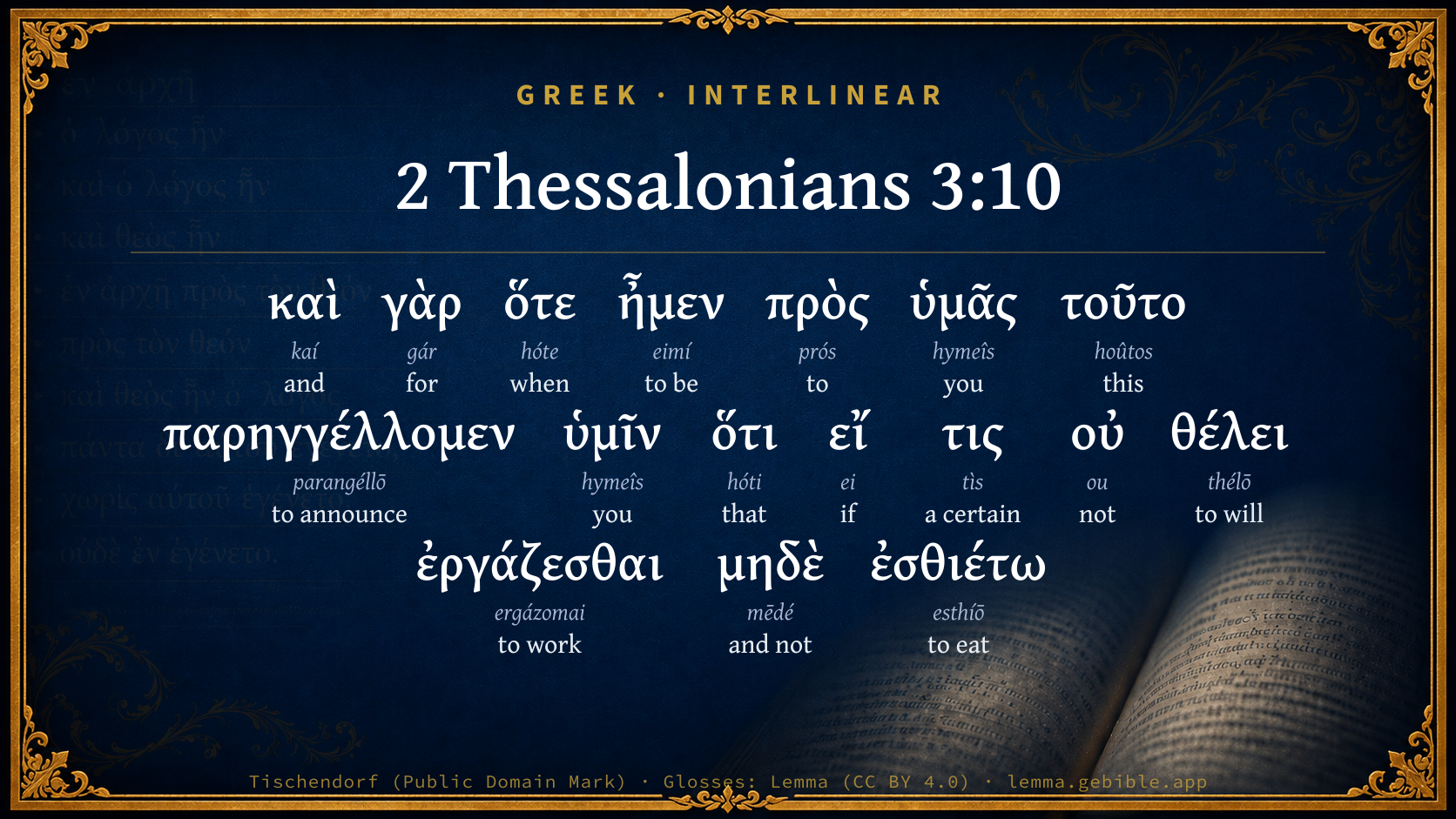
  1. καὶ kaí G2532 “and” Conjunction
  2. γὰρ gár G1063 “for” Conjunction
  3. ὅτε hóte G3753 “when” Adverb
  4. ἦμεν eimí G1510 “to be” Verb, Imperfect, Active, Indicative, 1st person, Plural
  5. πρὸς prós G4314 “to” Preposition
  6. ὑμᾶς hymeîs G5210 “you” Personal pronoun, 2nd person, Accusative, Plural
  7. τοῦτο hoûtos G3778 “this” Demonstrative pronoun, Accusative, Singular, Neuter
  8. ὑμῖν hymeîs G5210 “you” Personal pronoun, 2nd person, Dative, Plural
  9. ὅτι hóti G3754 “that” Conjunction
  10. εἴ ei G1487 “if” Conditional
  11. τις tìs G5100 “a certain” Indefinite pronoun, Nominative, Singular, Masculine
  12. οὐ ou G3756 “not” Particle, Negative
  13. θέλει thélō G2309 “to will” Verb, Present, Active, Indicative, 3rd person, Singular
  14. ἐργάζεσθαι ergázomai G2038 “to work” Verb, Present, Middle or Passive deponent, Infinitive
  15. μηδὲ mēdé G3366 “and not” Conjunction, Negative
  16. ἐσθιέτω esthíō G2068 “to eat” Verb, Present, Active, Imperative, 3rd person, Singular

About this verse

These counts appear in no published source. They are computed here, from the morphology-tagged text and Lemma’s own curated glosses. What Lemma adds →

17
words
16
distinct lemmas
Pauline Epistles
section

Shared distinctive vocabulary

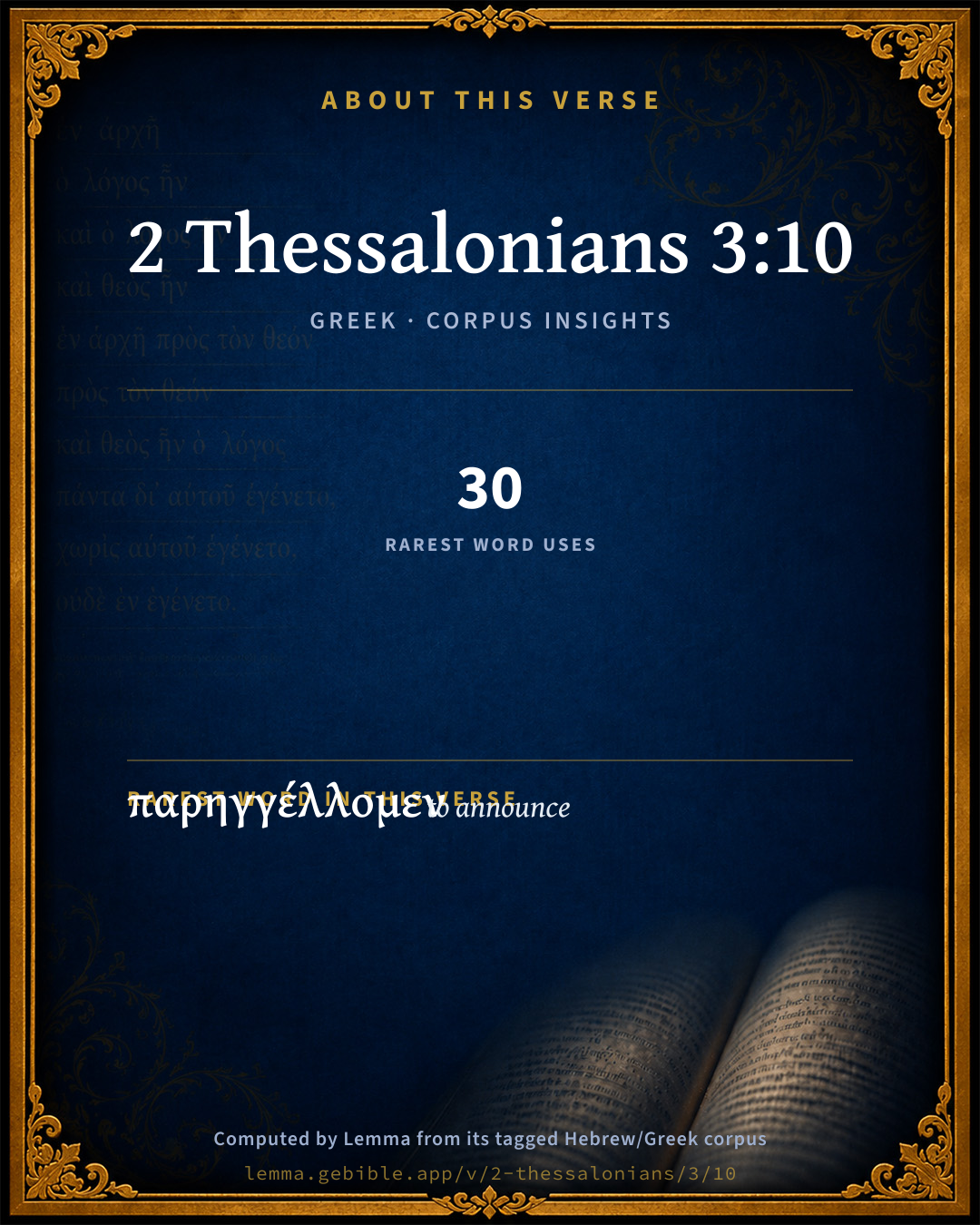
παρηγγέλλομεν to announce G3853 occurs in 30 verses of the Greek New Testament. Also found in:

Repetition

A word recurs within this verse:

  • ὑμᾶς you G5210 ×2

Cross-references

7

Topical passages linked to 2 Thessalonians 3:10 in the Treasury of Scripture Knowledge — connected by theme and wording, ordered by reader-vote popularity; previews shown in the World English Bible.

  • Genesis 3:19 By the sweat of your face will you eat bread until you return to the ground, for out of it you were taken. For you are dust, and to dust you shall return."
  • Proverbs 13:4 The soul of the sluggard desires, and has nothing, But the desire of the diligent shall be fully satisfied.
  • 1 Thessalonians 4:11 and that you make it your ambition to lead a quiet life, and to do your own business, and to work with your own hands, even as we charged you;
  • Proverbs 20:4 The sluggard will not plow by reason of the winter; Therefore he shall beg in harvest, and have nothing.
  • Proverbs 21:25 The desire of the sluggard kills him, For his hands refuse to labor.
  • Proverbs 24:30–34 I went by the field of the sluggard, By the vineyard of the man void of understanding;
  • 1 Thessalonians 3:4 For most assuredly, when we were with you, we told you beforehand that we are to suffer affliction, even as it happened, and you know.

Cross-references courtesy of OpenBible.info (CC BY 4.0).

Commentary

Notes on 2 Thessalonians 3:10 from classic Christian and Jewish commentators (each source and its license shown beneath its notes). The classic Christian expositions comment on the surrounding passage and are grouped to its opening verse, so a note may address several verses; the Jewish commentaries on the Tanakh (Rashi and others) are per-verse, so they appear only where the commentator wrote on this verse.

Lemma curates 59 commentaries, every one of them public domain or Creative Commons licensed, each selected and text-cleaned for this edition rather than reprinted as found. About our sources →

The Biblical Illustrator

Joseph S. Exell

2Th_3:10

We commanded you that if any man would not work, neither should he eat

The law of labour

It is a curious circumstance that the first subject that disturbed the apostolic church was not of a profound character.

It was the question of temporal relief--the early budding of a poor law. From that time forth the mode and measure of the administration of charity has been a vexed question in church and state. Here St. Paul lays down the grand principle which is applicable to all relief. We have here a common law to guide all our alms, national and individual. It is a law against wilful idleness. This is plain from the context. But we are not to withhold the hand from the necessitous (2Th_3:13). Let us apply this law that labour is life and life is labour to--

I. The irrational creation.

1. The inanimate creation is Gods great chemical laboratory.

2. His animated creation is one enormous factory where the law of labour is rigidly enforced, from the royal eagle to the meanest reptile. The swallows skimming round us seem to be only sporting in the air. In reality they are working for their food, opening their beaks as they fly, and carrying home insects to their young. How many miles daily does a sheep walk to get its living? Look into the insect world (Pro_6:6; Pro_30:24) at the ant hills, spiders webs, coral reefs, marvels of scientific, artistic, and laborious industry. The law everywhere is--no work, no life.

II. The spiritual life of man.

1. Here we might imagine that another great law meets us in opposition--the law of grace. Scripture teaches us that we are saved not by our own endeavours but by Gods free and unmerited mercy. May we then lie down in antinomian security? That moment we cease to live. Antinomianism is spiritual suicide. Hear the word of God: Agonize to enter into the strait gate. Labour for the meat which endureth, etc. How is a Christian described? As a soldier, husbandman, pilgrim, and by other figures, every one of which implies exertion of the most strenuous character. Every promise is held out to the energetic; and not only so, but the result is proportionate. The diligent soul shall be made fat. The more we pray and toil, the richer will be our present harvest in peace of conscience, the sense of pardoning love, and in the world to come eternal glory.

2. And if this be true individually in what we have to do in working out our own salvation, how much more in our labours of love. Here nothing is done without toil. You need but look at all the benevolent institutions of the country to see that no real good is done without trouble.

III. Man in his natural state. Work was the law of Paradise; it only became a painful one after the fail. From the moment of its utterance, By the sweat of thy brow, this law has ruled all human life. There is not a man who has attained to eminence save in obedience to it. In our country, whose distinction is that the paths of fame and wealth are open to the meanest, it is a fact that the vast majority of our greatest men in Parliament, the army, science, the law, the Church, have sprung from the lower or middle classes. It is not the poor mechanic only, but all must work or die. But what about the born wealthy? Well, that is the result of their ancestors labour. It did not originally come by chance or fortune. And even those who are under no obligation to toil for their daily bread are obliged to have recourse either to it or to artificial labour in travel or sport to maintain their health and save their life. (Dean Close.)

Idlers

In writing to his step-brother Johnston, who had requested a loan of money, Abraham Lincoln says: The great defect in your conduct is, not that you are lazy, but that you are an idler. This habit of uselessly wasting time is the whole difficulty, and it is vastly important to you and to your children that you should break the habit. Go to work for the best money wages you can get, and for every dollar that you will get for your own labour I will give you another one. If you will do this you will soon be out of debt, and what is better you will have gained a habit that will keep you from getting in debt again. (H. O. Mackay.)

No work, no pay

Here is a large vineyard. Many men and maidens are busy on the hillside. They are coming and going, and singing the vintage songs. Here is the master. He sees that the rules are kept. There must be no disorder, no profanity. Each must keep his place. The baskets must be clean. The master is counting the baskets that are brought to the vats. After each name he writes the number of baskets brought. At last the week is ended, and the men and maidens come to receive their pay. Here among them is a man whom the master has been watching day by day. He kept his basket clean; he kept his place; he used no profane language; he enjoyed the companionship of the others; he joined merrily in the vintage songs. But in all this time he gathered no grapes. What is your name? says the master. Menalque, says the man. I find your name upon the book, replies the master, but I do not find that you gathered a single cluster; there is therefore no pay for you. No pay? says the man. What have I done wrong? I have kept my place, used no improper language, kept my basket clean, and joined heartily in the songs. You did no wrong, says the master, but you did no work. There is nothing for you. No pay for me! exclaimed the man. Why, that is the one thing I came in the vineyard for. The pay constituted my chief interest in it. Is not this the history of thousands in the Lords vineyard? They come, their names are upon the book. They do no special wrong; they do not swear, or steal, or commit adultery. They break no rule. They sing the vintage songs. They hear sermons, if they are entertaining. They attend church, if it is quite convenient. But are they in any true sense labourers in Gods vineyard? Have they done any honest work for Christ and His Church? Have they performed one hard task, done one unpleasant duty, spoken one brave word, lifted one fallen sinner, lightened one heavy burden, crucified one loved comfort, or done any one thing or series of things that would justly entitle them to the name of labourer, or the hope of reward when the great day of reckoning comes? (R. S. Barrett.)

Work necessary for man

John the Dwarf wanted to be without care like the angels, doing nothing but praise God. So he threw away his cloak, left his brothers and the Abbot, and went into the desert. But after seven days he came back and knocked at the door. Who is there? asked the Abbot. John. John is turned into an angel, and is no more among men. So he left him outside all night, and in the morning gave him to understand that if he was a man he must work, but that if he was an angel he had no need to live in a cell.

The danger of idleness

Notice the invention used by country people to catch wasps. They will put a little sweet liquor into a long and narrow-necked phial. The do nothing wasp comes by, smells the sweet liquor, plunges in and is drowned. But the bee comes by, and if she does stop for a moment to smell, yet she enters not, because she has honey of her own to make; she is too busy in the work of the commonwealth to indulge herself with the tempting sweets. Master Greenham, a Puritan divine, was once waited upon by a woman who was greatly tempted. Upon making inquiries into her way of life, he found she had little to do, and Greenham said, That is the secret of your being so much tempted. Sister, if you are very busy, Satan may tempt you, but he will not easily prevail, and he will soon give up the attempt. Idle Christians are not tempted of the devil so much as they tempt the devil to tempt them. (C. H. Spurgeon.)

The cure for idleness

The wife of a certain chieftain who had fallen on idle habits, one day lifted the dish cover at dinner, and revealed a pair of spurs; a sign that he must ride and hunt for his next meal. (H. O. Mackay.)

How to deal with beggars

Oberlin was distinguished by his benevolence and charity; hence he was beset with beggars. Why do you not work? said he to a man one day. Because no one will employ me. Well, then, I will employ you; there, carry those planks; break these stones; fill that bucket with water, and I will repay you for your trouble. Such was his usual mode, and idle beggars were taught to come there no more. (J. L. Nye.)

The Biblical Illustrator, edited by Joseph S. Exell (c. 1880s–1900s) — public domain. Text from a community e-Sword module.

The Preacher's Complete Homiletical Commentary

Joseph S. Exell (gen. ed.)

CRITICAL AND EXPLANATORY NOTES

2Th_3:10. If any would not work, neither should he eat.—“A stern, but necessary and merciful rule, the neglect of which makes charity demoralising” (Ibid.). It is parasitism which is condemned.

2Th_3:11. Working not at all, but are busybodies.—“Not working, but working round people,” as we might represent St. Paul’s play on the words. “Their only business is to be busybodies.”

MAIN HOMILETICS OF THE PARAGRAPH.—2Th_3:10-12

Christianity and Work.

Christianity is the gospel of work. Its clarion-call thrills along the nerves of human life and summons the world to labour. It gives to work meaning, purpose, dignity, and exalts drudgery into a blessedness. While full of sympathy for the feeble and maimed, it has no pity for the indolent. Its Founder and first apostles were giants in labour, and their example animates the world to-day with a spirit of noblest activity. It is not the drone, but the worker, who blesses the world. “Be no longer a chaos,” writes Carlyle, “but a world, or even a worldkin. Produce! produce! were it but the pitifullest, infinitesimal fraction of a product, produce it, in God’s name! ’Tis the utmost thou hast in thee; out with it, then. Up, up! whatever thy hand findeth to do, do it with thy might.”

I. Christianity recognises the duty of every man to work for his own support.—“For even when we were with you, this we commanded, that if any would not work, neither should he eat” (2Th_3:10). The necessity of food involves the necessity of work. As every one must eat, so every one must work. The wife of a certain chieftain, who had fallen upon idle habits, one day lifted the dish-cover at dinner and revealed a pair of spurs, a sign that he must ride and hunt for his next meal. It is said that in the Californian bee-pastures, on the sun-days of summer, one may readily infer the time of day from the comparative energy of bee-movements alone; drowsy and moderate in the cool of the morning, increasing in energy with the ascending sun, and at high noon thrilling and quivering in wild ecstasy, then gradually declining again to the stillness of night. Is not this a picture of our life? Work is necessary for sustenance, for health, for moral development; and rest is all the sweeter after genuine toil.

II. Christianity is intolerant of an ignoble indolence.—“For we hear that there are some which walk among you disorderly, working not at all, but are busybodies” (2Th_3:11). The disorderly are the idle tatlers, who make a pretence of work by busying themselves with all kinds of things but their own duty. They are triflers, wasting their own time and other people’s; and they do serious mischief. In certain foreign parts, where insects abound in such swarms as to be a pest to the people and destructive enemies to young growing plants, an electric apparatus has been constructed to destroy the brood wholesale. The appliance consists of a strong electric light attracting the moths and insects, a suction-fan drawing them into a shaft as they approach the light, and a small mill in the shaft where the victims are ground up and mixed with flour, thus converting them into poultry-food. Cannot some genius contrive a means of putting an end—short of grinding them into chicken-food: let us be merciful, even to our enemies!—to those social pests who go buzzing about our homes and Churches, worrying with their idle gossip and stinging with their spiteful venom the innocent and inoffensive? If these busybodies would devote, in doing their duty, the energy they waste, they would be able to produce quite a respectable amount of honest work. But they find it easier to sponge on the generosity and simplicity of others. They are parasites; and all parasites are the paupers of nature. Parasitism is a crime—a breach of the law of evolution.

III. Christianity enforces the necessity of a steady and independent industry.—“We command and exhort by our Lord Jesus Christ that with quietness they work, and eat their own bread” (2Th_3:12). The apostle, having the authority of Christ for what he counsels, commands; and as a man addressing his fellow-men, he exhorts and persuades. The law of Christianity is both stern and gentle: unbending in principle, and flexible only in manifold persuasions to translate the principle into actual living practice. It rouses man from yielding to a sinful listlessness and helps him to develop a robust Christian manhood. When an Indian candidate for the ministry was asked the question, “What is original sin?” he frankly replied, “He did not know what other people’s might be, but he rather thought that his was laziness.” Idleness is the prolific source of many evils: work is at once a remedy and a safeguard. A clergyman once said, “A Christian should never plead spirituality for being a sloven; if he be but a shoe-cleaner, he should be the best in the parish.” We are honouring Christianity most when we are doing our best to observe its precepts, “Working with quietness and eating our own bread.” An American preacher once said, “You sit here and sing yourselves away to everlasting bliss; but I tell you that you are wanted a great deal more out in Illinois than you are in heaven.”

Lessons.—

1. Christianity encourages and honours honest toil.

2. Fearlessly denounces unprincipled idlers.

3. Is an inspiration to the highest kind of work.

GERM NOTES ON THE VERSES

2Th_3:10. Industry the True Charity.—When the palace and church buildings of Caprarolo were completed, Borromeo, the great patron of idle almsgiving, came to see it, and complained that so much money had not been given to the poor instead. “I have let them have it all little by little,” said Alexandro Farnese; “but I have made them earn it by the sweat of their brow.”

2Th_3:11. Idleness and Death.—Ælian mentions a witticism of Alcibiades when some one was vaunting to him about the contempt the Lacedæmonians had for death. “It is no wonder,” said he, “since it relieves them from the heavy burden of an idle and stupid life.”

2Th_3:12. The Way to Value Quietness.—“How dull and quiet everything is. There isn’t a leaf stirring,” said a young sparrow perched on the bough of a willow tree. “How delicious a puff of wind would be!” “We shall have one before long,” croaked an old raven; “more than you want, I fancy.” Before many hours a tempest swept over the country, and in the morning the fields were strewn with its ravages. “What a comfort the storm is over,” said the sparrow, as he trimmed his wet feathers. “Ah!” croaked the raven, “you’ve altered your mind since last night. Take my word for it, there’s nothing like a storm to teach you to value a calm.”—G. Eliot.

The Preacher's Complete Homiletical Commentary (gen. ed. Joseph S. Exell; Funk & Wagnalls, c. 1892) — public domain (pre-1929). A full-Bible homiletical/sermon-outline anthology covering 65 of 66 books (2 John is absent from the source module). Text from a community e-Sword module.

Tyndale Open Study Notes

Tyndale Open Resources

3:10 Work is the appropriate way to gain a living (see Gen 3:17-19; Ps 128:2; Prov 10:4). Paul absolves the church of the responsibility of feeding other believers who refuse to work.

Tyndale Open Study Notes — © Tyndale Open Resources, licensed CC BY-SA 4.0. Text via the HelloAO Bible API.

Bengel's Gnomon

Johann Albrecht Bengel

2Th 3:10. Ὅτε, when) They had already seen the necessity of this commandment among the Thessalonians.—ἔι τις οὐ θέλει, if any will not) To be unwilling is a fault.—μηδὲ ἐσθιέτω, let him not eat) An Enthymeme.[25] Supply, But every man eats: therefore let every man labour. Paul does not mean, that such a man should have his food immediately withdrawn from him by others; but he proves from the necessity of eating the necessity of labouring, by throwing out this pleasantry, let such a one show himself as an angel.[26] There is a similar Enthymeme at 1Co 11:6.[27]

[25] This is the oratorical Enthymeme, wherein the argument is confirmed from its contrary. The logical Enthymeme is a covert syllogism.—ED.

[26] i.e. Let him do without food, as the angels do.—ED.

[27] “If the woman be not covered, let her also be shorn” (But she is not shorn; therefore let her be covered).—ED.

Bengel's Gnomon of the New Testament — English translation (T&T Clark, Edinburgh, 1860) — public domain. Text from a community e-Sword module.

Meyer's Critical & Exegetical Commentary

Heinrich August Wilhelm Meyer

2Th_3:10. A further reason, along with the example of the apostle, which should preserve them from ἀτάκτως περιπατεῖν.

γάρ] co-ordinate with the γάρ in 2Th_3:7. καί cannot serve to bring out ὅτε ἦμεν πρὸς ὑμᾶς (so Hofmann), so that it would be explained, with Theodoret: Οὐδὲν καινὸν ὑμῖν γράφομεν, ἀλλʼ ἅπερ ἐξ ἀρχῆς ὑμᾶς ἐδιδάξαμεν. For ὅτε ἦμεν πρὸς ὑμᾶς is no new additional idea, but only again resumes what was at least already implied in 2Th_3:7-8. Καί must accordingly be taken with τοῦτο παρηγγέλλομεν ὑμῖν, and the emphasis lies on τοῦτο, which is placed first. The meaning is: for even when we were with you, this we commanded you.

τοῦτο] namely, what follows: ὅτι εἴ τις κ.τ.λ.

εἴ τις οὐ θέλει ἐργάζεσθαι, μηδὲ ἐσθιέτω] was a Jewish proverb; see Schoettgen and Wetstein in loco. It has its root in the expression in Gen_3:19, that man in the sweat of his brow shall eat his bread.

οὐ θέλει] Bengel: Nolle vitium est.

Meyer — Critical and Exegetical Commentary on the New Testament — English translation by Peter Christie, edited by Frederick Crombie (T&T Clark, 1880) — public domain. Text from a community e-Sword module.

Expositor's Greek Testament

ed. W. Robertson Nicoll

2Th 3:10 . Precept as well as example ( DC [36] , ii. 2). As is perhaps implied in ὅτι , εἰ … ἐσθιέτω is a maxim quoted by the apostle, not from some unwritten saying of Jesus (Resch) but from the Jewish counterparts, based on Gen 3:19 , which are cited by Wetstein, especially Beresch. rabba , xiv. 12: “ut, si non laborat, non manducet”. Cf. Carlyle’s Chartism , chap. iii (“In all ways it needs, especially in these times, to be proclaimed aloud that for the idle man there is no place in this England … he that will not work according to his faculty, let him perish according to his necessity”). The use of ἐν Κυρίῳ here and in 1Co 11:11 ( cf. Mat 19:4 f.) proves, as Titius argues ( der Paulinismus unter dem Gesichtspunkt der Seligkeit , 1900, p. 105), that the original divine ideas of the Creation are fulfilled and realised in the light of Christ’s gospel; the entire process of human life culminates in the faith of Christ, and therefore no unqualified antithesis can be drawn between ordinary life and Christian conduct.

[36] CG Hastings’ Dictionary of Christ and the Gospels (1907 1908)

The Expositor's Greek Testament, edited by W. Robertson Nicoll (1897–1910) — public domain. Text from a community e-Sword module.

Geneva Bible (1599)

Geneva Bible translators

What shall we do then with those idle bellied Monks, and sacrificing Priests? A Monk (saith Socrates, book 8, of his Tripartite history) which worketh not with hands, is like a thief.

Geneva Bible (1599) marginal notes — public domain. Text via Bolls.life.

Jamieson, Fausset & Brown

Robert Jamieson, A. R. Fausset & David Brown

For even--Translate, "For also." We not only set you the example, but gave a positive "command."

commanded--Greek imperfect, "We were commanding"; we kept charge of you.

would not work--Greek, "is unwilling to work." BENGEL makes this to be the argument: not that such a one is to have his food withdrawn from him by others; but he proves from the necessity of eating the necessity of working; using this pleasantry, Let him who will not work show himself an angel, that is, do without food as the angels do (but since he cannot do without food, then he ought to be not unwilling to work). It seems to me simpler to take it as a punishment of the idle. Paul often quotes good adages current among the people, stamping them with inspired approval. In the Hebrew, "Bereshith Rabba," the same saying is found; and in the book Zeror, "He who will not work before the sabbath, must not eat on the sabbath."

Jamieson, Fausset & Brown — Commentary Critical and Explanatory on the Whole Bible (1871) — public domain (CC PDM 1.0). Text via the HelloAO Bible API.

Adam Clarke's Commentary

Verse 10. If any would not work, neither should he eat.] This is a just maxim, and universal nature inculcates it to man. If man will work, he may eat; if he do not work, he neither can eat, nor should he eat. The maxim is founded on these words of the Lord: In the sweat of thy brow thou shall eat bread. Industry is crowned with God's blessing; idleness is loaded with his curse. This maxim was a proverb among the Jews. Men who can work, and will rather support themselves by begging, should not get one morsel of bread. It is a sin to minister to necessities that are merely artificial.

Adam Clarke's Commentary on the Bible (1810–1826) — public domain. Text from a community e-Sword/MySword module.

John Calvin's Commentaries

10 He that will not labor. From its being written in Psalm 128:2 —

Thou art blessed, eating of the labor of thy hands,

also in Proverbs 10:4,

The blessing of the Lord is upon the hands of him that laboreth,

it is certain that indolence and idleness are accursed of God. Besides, we know that man was created with this view, that he might do something. Not only does Scripture testify this to us, but nature itself taught it to the heathen. Hence it is reasonable, that those, who wish to exempt themselves from the common law, should also be deprived of food, the reward of labor. When, however, the Apostle commanded that such persons should not eat, he does not mean that he gave commandment to those persons, but forbade that the Thessalonians should encourage their indolence by supplying them with food.

It is also to be observed, that there are different ways of laboring. For whoever aids the society of men by his industry, either by ruling his family, or by administering public or private affairs, or by counseling, or by teaching, or in any other way, is not to be reckoned among the idle. For Paul censures those lazy drones who lived by the sweat of others, while they contribute no service in common for aiding the human race. Of this sort are our monks and priests who are largely pampered by doing nothing, excepting that they chant in the temples, for the sake of preventing weariness. This truly is, (as Plautus speaks,) to “live musically.”

John Calvin's Commentaries (1540-1563) — public domain. Text from the Calvin Translation Society English edition (1840s-50s) via the Christian Classics Ethereal Library (ccel.org). Calvin's coverage is partial (roughly two-thirds of the Bible); uncommented books and verses are honest gaps, never fabricated. The 19th-century editor's footnotes and remarks are omitted so the notes are faithfully Calvin's own voice.

Ellicott's Commentary for English Readers

(10) For even.—The sequence of thought is a little difficult, but it seems best to regard this “for” as connecting its sentence, not with 2Th_3:9, but rather with 2Th_3:6. It does not give the reason why St. Paul and his companions worked: “because we strictly enjoined you to work, and therefore could not be idle ourselves.” Rather, it justifies the reiteration of the command: “We do not hesitate to command you now to repress this disorderly conduct, so contrary to the example set you; for, in fact, when we were with you we used to lay down this law.” So Theodoret takes it: “It is no new thing that we write to you.”

We commanded.—The tense in the original is that of constant re-assertion, which brings out once more the thorough grounding which the Apostles gave at once to their converts. (See Note on 2Th_3:6 : “the tradition;” also the Note on 2Th_2:5.) The same definite precept is referred to in 1Th_4:11.

If any would not work.—The word “would” stands for “is not willing,” “refuses.” To any weakness or incapacity for work, except in himself, St. Paul would be very tender; the vice consists in the defective will. The canon (in the original) is laid down in the pointed form of some old Roman law like those of the Twelve Tables: “If any man choose not to work, neither let him eat.” It does not mean, “let him leave off eating,” putting it to the man’s own conscience to see the necessary connection between the two things (Gen_3:19); but, “let him not be fed.” The Thessalonians are not to be misled into a false charity: giving food in Christ’s name to persons who are capable of working and able to get work, and are too indolent to do so. The support which is here forbidden to be given to these disorderly persons might come either direct from the private liberality of individuals, or from some collected church fund administered by the deacons. It does not seem at all impossible that this Thessalonian Church, which St. Paul himself declares to have taken the churches of Judaea for a model (1Th_2:14), may have copied its model in adopting some form of communism, or, at any rate, some extensive use of the agapè which we see to have been in use at Corinth, established by the Apostle at the very time of writing this Letter (1Co_11:21). Such a supposition would give much more point to St. Paul’s canon, as well as to other phrases in both these Epistles, and would enable us to understand better how this discipline could be actively enforced. That the ordinary agape was a matter of considerable importance to the poorer classes is evident from 1Co_11:22.

A Bible Commentary for English Readers, edited by Charles John Ellicott (1878–1897) — public domain. Text from a community e-Sword module.

The Cambridge Bible for Schools and Colleges

gen. ed. J. J. S. Perowne

10. For even when we were with you, this we commanded you] Better, For also: St Paul’s present charge on the subject repeats and reinforces what he said in his oral teaching; this we used to charge you—same verb as in 2Th_3:4; 2Th_3:6 (see note), and same tense as in ch. 2Th_2:5 (“I was wont to tell you”), and 1Th_3:4 (see note). To this original “charge” the Apostle referred in 1Th_4:11, touching the same point; it formed part of “the tradition” which he and his fellow-missionaries “delivered” to the Thessalonians (2Th_3:6, ch. 2Th_2:15).

that if any would not work, neither should he eat] In the Greek this is put vividly in direct narration: If any will not work, neither let him eat. A stem, but necessary and merciful rule, the neglect of which makes charity demoralising. But this law of St Paul’s touches the idle rich, as well as the poor; it makes that a discredit which one hears spoken of as if it were a privilege and the mark of a gentleman,—to “live upon one’s means,” to live without settled occupation and service to the community—“natus consumere fruges.”

The form of the Greek implies in this case a positive refusal to labour: the man wont work (Latin nonvult operari). Then it is God’s law that he shall starve.

The Cambridge Bible for Schools and Colleges (gen. ed. J. J. S. Perowne; Cambridge University Press, 1878–1918) — public domain. Text from a community e-Sword module.

John Gill's Exposition

For even when we were with you,.... At Thessalonica in person, and first preached the Gospel to them,

we commanded you, that if any would not work, neither should he eat; the Ethiopic version reads in the singular number, "when I was with you, I commanded you"; using the above words, which were a sort of a proverb with the Jews, and is frequently used by them, , or , "that if a man would not work, he should not eat" (q). And again (r),

"he that labours on the evening of the sabbath (or on weekdays), he shall eat on the sabbath day; and he who does not labour on the evening of the sabbath, from whence shall he eat (or what right and authority has he to eat) on the sabbath day?''

Not he that could not work through weakness, bodily diseases, or old age, the necessities of such are to be distributed to, and they are to be taken care of, and provided with the necessaries of life by the officers of the church; but those that can work, and will not, ought to starve, for any assistance that should be given them by the members of the church, or the officers of it.

(q) Bereshit Rabba, sect. 14. fol. 13. 1. Echa Rabbati, fol. 48. 4. & Midrash Koholet, fol. 65. 4. (r) T. Bab. Avoda Zara, fol. 3. 1.

John Gill's Exposition of the Whole Bible (1746–1763) — public domain (CC PDM 1.0). Text via the HelloAO Bible API.

Trapp's Complete Commentary

John Trapp

10 For even when we were with you, this we commanded you, that if any would not work, neither should he eat.

Ver. 10. That if any would not work] In the sweat of thy nose shalt thou eat thy bread, was the old sanction, Gen 3:19; yea, Paradise, that was man’s storehouse, was also his workhouse. They bury themselves alive, that, as body lice, live on other men’s labours; and it is a sin to help them. Seneca professed, that he had rather be sick in his bed than out of employment.

John Trapp, A Commentary or Exposition upon All the Books of the Old and New Testament (1647–1656) — public domain. Text from a community e-Sword module.

Albert Barnes' Notes on the Bible

For even when we were with you, this we commanded you - It would seem from this that the evil of which the apostle here complains had begun to operate even when he was with them. There were those who were disposed to be idle, and who needed the solemn command of an apostle to induce them to labor.

That if any would not work, neither should he eat - That is, at the public expense. They should not be supported by the church. This was a maxim among the Jews (see Wetstein, in loc.), and the same sentiment may be found in Homer, Demosthenes, and Pythagoras; see Grotius, in loc. The maxim is founded in obvious justice, and is in accordance with the great law under which our Creator has placed us; Gen 3:19. That law, in the circumstances, was benevolent, and it should be our aim to carry it out in reference to ourselves and to others. The law here laid down by the apostle extends to all who are able to work for a living, and who will not do it, and binds us not to contribute to their support if they will not labor for it. It should be regarded as extending:

(1)To the members of a church - who, though poor, should not be supported by their brethren, unless they are willing to work in any way they can for their own maintenance.

(2)To those who beg from door to door, who should never be assisted unless they are willing to do all they can do for their own support. No one can be justified in assisting a lazy man. In no possible circumstances are we to contribute to foster indolence. A man might as properly help to maintain open vice.

Albert Barnes' Notes on the Bible (1834–1885) — public domain. Text from a community e-Sword/MySword module.

Haydock's Catholic Bible Commentary

Not work. By prying with curiosity into other men’s actions. He that is idle, saith St. John Chrysostom, will be given to curiosity. (Witham) --- The apostles, like our Lord, were fond of introducing popular saying or axioms. Another, and not unlike the former, is found in one of the Jewish rabbies, Zeror: Qui non laboraverit in Prosabbato, ne edat in Sabbato.

George Leo Haydock (1774–1849), Haydock's Catholic Family Bible and Commentary, 1859 edition — public domain. Excludes Psalms (Douay-Rheims chapter numbering differs from Protestant) and Deuterocanonical books (Catholic canon only).

Matthew Poole's English Annotations

The words contain a reason, as the illative for imports; but what it refers to is uncertain; most probably a further reason of the apostle’s working with his hands, because when with them he left this command,

that if any would not work, neither should he eat; he would therefore practise himself what he commanded them, and not be thought to be as the Pharisees, binding heavy burdens upon others, and he not touch them himself. And this is another of the commandments which the apostle gave them, which he declared his confidence that they would do, 2Th 3:4. And this command seems grounded upon the law given to Adam: In the sweat of thy face shalt thou eat bread, Gen 3:19. For when he recommends a practice not directly grounded upon some word of God, or of Christ, or from infallible inspiration, he calls it a permission, as 1Co 7:6; but when otherwise, he saith: I command, yet not I, but the Lord, 1Co 7:10; and calls it the commandment of the Lord, 1Co 14:37. And this in the text is not his alone, but the Lord’s, and is elsewhere mentioned, as Eph 4:28; Let him that stole steal no more, but work with his hands, & c.: see 1Co 7:20. God requires it of us as men, that we may be profitable in the commonwealth, supply our own wants and of those that depend upon us, and have wherewith also to supply the wants of the poor, Eph 4:28, to be kept from the temptations of idleness. Christianity doth not extinguish the profitable laws of nature or nations. Yet this general command admits limitations; if men have ability and opportunity to work, or if the ends of working are not otherwise supplied. For he that lives out of the reason of the law seems not bound by the law; or if the work be mental, and not manual, the law is fulfilled; and the equity of the law reacheth all men so far, as that none ought to be idle and useless in the world. And the apostle’s argument for it in the text is cogent from nature itself; agreeably to that of Solomon, Pro 16:26; He that laboureth laboureth for himself, for his mouth craveth it of him. Whereupon some judge these believing Thessalonians to be generally a people that lived by some handicraft trade, or some other manual labour. And the eating here intended is meant of relief from the stock and charge of the church: such should not be relieved who would not work, as it is in the text; who could, but would not, the fault being in the will.

Matthew Poole's English Annotations on the Holy Bible (1683–1685) — public domain. Text from a community e-Sword/MySword module.

Whedon's Commentary on the Bible

Daniel D. Whedon

10. Not work… eat—He is scarce a Christian, whatever his rank, who, possessed of the ability, does not earn his own living. It is a sad account he has to give at the judgment-seat who has not made the world better by his having lived in it. And he who does so earns his living, and the final reward, whether he has worked with his brain or his hands. St. Paul’s converts were doubtless mostly artisans, and he set the example of working with his hands, not because his preaching was not a most arduous and powerful work, but in order to make the idlers among them work at all. Paul’s maxim is based on the primeval law of Gen_3:19, that “eat bread” should depend on “the sweat of thy face.” And hence saith an old Rabbi: “Whoso laboureth not on the sixth day—what shall he eat on the Sabbath?”

Daniel D. Whedon (gen. ed.), Commentary on the Old and New Testaments (1874–1909) — public domain. Text from a community e-Sword module.

The Pulpit Commentary

For even when we were with you; during our residence in Thessalonica. This we commanded, that if any man would not work, neither should he eat. This or similar expressions have been shown to be a proverb in frequent use among the Jews. Thus: "Whoever doth not work doth not eat" ("Bereshith Rabba"); "Let not him who would not labour before the sabbath eat on the sabbath" ("In Lib. Zenon."). It is a law of nature, and the apostle here sanctions it as a law of Christianity. There is here a reference to the sentence pronounced on man in Paradise in consequence of disobedience: "In the sweat of thy face shalt thou eat bread". (Gen_3:19) Labour, indeed, may in one point of view be considered as part of the curse, but it is also a blessing adapted to man"s fallen nature. Labour is the law of God; idleness is the parent of many crimes and is productive of misery. He who has no business allotted to him ought to choose some useful occupation for himself.

The sanctity of labour.

True religion hallows earthly labour. Christianity is not designed to draw a man out, of the world, to cause him to neglect his earthly duties, or to make him idle; but to consecrate and sanctify his worldly employments; to cause him to perform them in a religious spirit, and to look up to God as his chief Master. Paul himself wrought at the occupation of a tent maker; and a far greater than Paul, the Lord Jesus Christ himself, was for the greater part of his life engaged in the occupation of a carpenter. "Earthly things," observes Dr. Arnold, "are precious when we use them as the materials with which we may build for ourselves a heavenly habitation; and the humblest and most ordinary trade or employment may be carried on with such a temper and such a spirit that it may advance us daily on our way to heaven; and the angels themselves may behold us engaged in it with respect and love.

Pauperizing charity.

There appear to have been idle, talkative persons in the Thessalonian Church who neglected their trades while they made themselves very prominent in the Christian assemblies, expecting to be supported out of the common funds. St. Paul justly rebukes their disgraceful conduct. He points to his own example. Even he, an apostle, devoted to the work of the Churches, did not draw from the funds of the Churches, but supported himself by his own labour. The wholesome direction which he gives has a certain grim humour about it. Here is his remedy for the tiresome, loquacious idlers: starve them into industry. That process will bring them to their senses. It would have been well if the same wise, manly counsel had always prevailed in the Church. A weak and foolish administration of Christian charity has too often fostered the poverty it aimed at curing. Some of the reasons which make it positively wrong for the charitable to support the idle should be well weighed by those persons who are more kind hearted than reflective.

I IT INJURES THE RECIPIENT. Thus paupers are bred and multiplied.

1. The sin of idleness is encouraged; for idleness is a sin. Those who encourage it will have to bear part of the guilt of it.

2. The indolent are tempted to many vices. The idle members of the Church gave to the Thessalonians the greatest trouble. Work is a moral antiseptic.

3. Independence is destroyed. The able-bodied pauper is quite unmanned by the loss of his independence. There was some sense in those stern old Elizabethan laws against sturdy beggars and vagrants.

II IT INJURES THE GIVER.

1. Where public funds are thus misappropriated, an injustice is done to those who contribute to them. We do not pay poor rates in order to encourage idleness, nor do we give communion offerings for that unworthy object. District visitors who have the administration of moneys subscribed by other people should remember this, and not permit soft-heartedness to oust justice.

2. Where only private benevolence is concerned, the heart is hardened in the end by the sight of the abuse of charity.

III IT INJURES THE TRULY NEEDY. We take the children"s bread and give it to dogs, and the children starve. The idlers are the most clamorous for assistance, while the deserving are the most backward to make their wants known. Suffering in silence, they are often neglected, because greedy, worthless persons step in first and ravage the small heritage of the poor.

IV IT INJURES THE COMMUNITY.

1. It discourages industry generally. Not only are the idle encouraged in their discreditable way of living, but a tax is put upon industry, and men do not feel so strongly inclined to work honestly for their daily bread.

2. It propagates the worst class of society. The idle part of the population of great cities are the canker of civilization. There vice and crime breed most freely. It is the law of England that no man need starve. But it is right and necessary that when the state gives bread it should compel labouri.e. , of course, if there is health for work. Idleness is the curse of the East; Syrian felahin will sit to reap their corn. Wise Christians will ever protest against this fatal vice, and all who administer Church funds should feel a heavy responsibility resting upon them to guard against increasing it by well meant but foolish doles of charity. W.F.A.

The Pulpit Commentary (1880–1919), ed. H.D.M. Spence-Jones & Joseph S. Exell — public domain. Text from a community e-Sword module.

John Wesley's Explanatory Notes

Neither let him eat - Do not maintain him in idleness.

John Wesley, Explanatory Notes Upon the Whole Bible (1754–1765) — public domain. Text via the GEBible commentary corpus.

Burkitt's Expository Notes on the New Testament

William Burkitt

Observe here, 1. The solemn charge given by the apostle for every man to follow some lawful calling, and be found in the way of an industrious diligence; if any (being able) will not work, let him not eat (any part of the church’s charity). So that the sin of idleness was directly contrary to the apostle’s command, and to the apostle’s example.

Mark, It is not those that cannot work, but those that will not, whom the apostle excludes from the church’s charity: poor men that will not work when they can, do forfeit the bread of charity from men; the rich men that live idly, do by that sin forfeit their food to God, yea, even their lives and their souls too; if any man would not work, neither should he eat.

Observe, 2. The apostle exhorts every man to eat his own bread: implying, that the bread of idleness is stolen bread; idle persons shall be judged as thieves, though they eat that which was freely given them; drones deserve no honey, what they eat is stolen from the industrious bee; that is truly our bread which we labour for ourselves, or recompense those who get it for us by their labour. God has sent no man into the world to be idle; but as the providence of God disposes of every man, though he has never so much worldly wealth, yet he must be some way useful and serviceable in his generation.

Observe, 3. One of the bad effects of idleness pointed at by our apostle; namely, an intermeddling (as busy-bodies) in other men’s matters: an idle person that doeth nothing to any good purpose, yet has a deal of business to answer for, done to very bad purpose; not for labouring, but busy trifling, the busy-body’s business is very unprofitable business; the mind of man cannot be wholly idle, but must be employed in something, if not in doing good, of necessity in contriving evil; usually none are so busy in other men’s matters as they that neglect their own; those disorderly persons, who did not work at all, yet were busy-bodies, and as such censured by our apostle: I hear there are some among you disorderly, working not at all, but are busy-bodies.

William Burkitt's Expository Notes on the New Testament (1700–1703) — public domain. Text from a community e-Sword module.

Godbey's Commentary on the New Testament

William B. Godbey

10. “For when we were with you, we commanded this to you, that if any one does not wish to work, let him not eat.” The Bible is the plainest of all books, solving every problem of duty so clearly as to leave al without excuse. Well are we assured that “he who runs may read,” and the “wayfaring men, though fools, may not err therein.” (Isaiah.) On this great problem of material sustenance, O how plain and simple, “If any one is not willing to work, let him not eat!” When the first American settlement, founded at Jamestown, Virginia, in 1607, having consumed the supply brought over from England, and finding the Indian resources exceedingly meager, starvation began to look them in the face, their only hope is to fell the forest, and cultivate the rich virgin soils. But how can they do this, when nearly all of their colony are goldsmiths, having come over in search of the precious metals, and their tender hands never hardened by the ax, maul, and hoe. In their emergency, fortunately they elect Captain John Smith president, whose first law proclaimed in the Colony is a transcript of this laconic mandate of the apostle Paul, “Those who do not work shall not eat.” Soon cloth coats are stacked, sleeves rolled up, and all hands blistered while the Colony is vocal with the roar of the ax, the thunder of the maul, and the crash and smash of falling trees, whose burning brush lights the firmament by night; and they are all feasting on peas, potatoes, and roasting-ears. With the enforcement of this simple law of heaven, earth teems with plenty, and beggary takes her everlasting flight; hireling preachers all transformed into shouting evangelists.

William B. Godbey, Commentary on the New Testament (1896–1900) — public domain. Text from a community e-Sword module.

McGarvey & Pendleton's Commentaries

J. W. McGarvey

For even when we were with you [and so even before we wrote you our first epistle], this we commanded you, If any will not work, neither let him eat . [This precept is founded on Gen_3:19 . It forbids the Christian to exercise that false charity which genders beggary and becomes the parent of manifold crime.]

J. W. McGarvey (with Philip Y. Pendleton), Commentaries on the New Testament (The Fourfold Gospel, 1914; Acts; and the epistles) — public domain. Text from a community e-Sword/MySword module.

The People's New Testament

B. W. Johnson

10. We commanded. Even then he gave a command that if any refused to work for their food, they should be refused support by others. He who is able to work, and unwilling, should not be fed.

B. W. Johnson's The People's New Testament with Notes (1889–1891) — public domain. Electronic text from the Christian Classics Ethereal Library (CCEL) ThML edition.

unfoldingWord translationNotes

Door43 World Missions Community

The one who is unwilling to work must not eat

This can be stated in positive form. AT: "If a person wants to eat, he must work" (See: Double Negatives)

some walk idly

Here "walk" stands for behavior in life. AT: "some live idle lives" or "some are lazy" (See: Metaphor)

but are instead meddlers

Meddlers are people who interfere in the affairs of others without being asked to help.

with quietness

"in a quiet, peaceful, and mild manner." Paul exhorts the meddlers to stop getting involved in other people's affairs.

translationWords

exhort

lord

Jesus

unfoldingWord translationNotes — © Distant Shores Media and the Door43 World Missions Community, licensed CC BY-SA 4.0. Source: git.door43.org/Door43/en_tn.

Cambridge Greek Testament for Schools and Colleges

10. καὶ γὰρ ὅτε ἦμεν πρὸς ὑμᾶς, τοῦτο παρηγγέλλομεν ὑμῖν. For indeed when we were with you, we used to give you this charge: cf. 1Th 4:11. Καὶ γάρ is parallel to the γάρ of 2Th 3:7; it sets the Apostolic παραγγελία side by side with the Apostolic τύπος in the matter of ἐργάζεσθαι καὶ ἐσθίειν (cf. γάρ … καὶ γάρ in 1Th 4:9 f.): together these constitute ἡ παράδοσις of 2Th 3:6. This sentence almost repeats 1Th 3:4, only substituting τοῦτο παρηγγέλλομεν (after 2Th 3:6) for προελέγομεν. On the use of πρός, see note to 1Th 3:4; 1Th 2:5 above.

ὅτι εἴ τις οὐ θέλει ἐργάζεσθαι μηδὲ ἐσθιέτω. ‘If any one refuses (nonvult, Vulg.) to work, neither shall he eat!’ a Jewish proverb, based upon Gen 3:19. For the apodosis, thrown into the lively imperative mood, cf. 1Co 11:6. For the ὅτι recitative of direct narration, cf. Gal 1:23, Act 14:22; and see Winer-Moulton, p. 683, note. For τοῦτο … ὄτι, cf. 1Th 2:13; 1Th 4:15. Οὐ θέλω is not the mere contradictory, but the contrary of θέλω—“if any one won’t work”—not a negative supposition (εἰ μή), but the supposition of a negative: see Winer-Moulton, pp. 597, 599; cf. Rom 7:19 f., 1Co 7:9, 1Ti 3:5, &c., and 2Th 3:14 below. “Nolle, vitium est” (Bengel). Note the present of continuous action (habit or rule) in the verbs: cf. for the last verb, 1Co 10:18; 1Co 10:25, &c., 1Co 11:22-34. The neglect of this stern but necessary rule makes charity demoralizing. This law of Christ touches the idle rich as well as the poor; it makes that a disgrace which one hears spoken of as though it were a privilege and the mark of a gentleman,—“to live upon one’s means,” fruges consumere natus: see 2Th 3:11. This rule is forcibly applied in the following direction of the Didaché, xii. 2–5: εἰ θέλει [παρόδιος ὁ ἐρχόμενος] πρὸς ὑμᾶς καθίσαι, τεχνίτης ὤν, ἐργαζέσθω καὶ φαγέτω· εἰ δὲ οὐκ ἔχει τέχνην, κατὰ τὴν σύνεσιν ὑμῶν προνοήσατε πῶς μὴ ἀργὸς μεθʼ ὑμῶν ζήσεται Χριστιανός· εἰ δὲ οὐ θέλει οὔτω ποιεῖν, χριστέμπορός ἐστιν· προσέχετε ἀπὸ τῶν τοιούτων. Cf. the quotation cited below, on 2Th 3:12.

Cambridge Greek Testament for Schools and Colleges (Cambridge University Press, 1896; 21 vols, various authors incl. Carr, Maclear, Plummer, Farrar, Lumby, Moule, M. R. James, Simcox) — public domain. Text from a community e-Sword module.

Alford’s Greek Testament

Henry Alford

10.] καὶ γάρ,—and we carried this further: we not only set you an example, but inculcated the duty of diligence by special precept. The γάρ is co-ordinate with that in ver. 7. The καί does not bring out ὅτε ἦμεν πρ. ὑμᾶς as a new feature, as Thdrt., for of this period the last three verses have treated—but it brings out τοῦτο, on which the stress lies, as an additional element in the reminiscence. This seems to me clearly to be the force here, and not the merely conjunctive, as Ellic. maintains, τοῦτο, viz. what follows.

εἴ τις κ.τ.λ.] Schöttgen and Wetst. quote this saying from several places in the rabbinical books.

Henry Alford, The Greek Testament (1849–1861) — public domain. Text from a community e-Sword module.

International Critical Commentary

10. καὶ γὰρ ὅτε κτλ “For also when we were with you (cf. I 3:4, II 2:5) this (that follows, τοῦτ being resumed by the ὅτ recitative as in I 4:15) we were wont to command you (παρηγγέλλομε; contrast παρηγγείλαμε in I 4:11), namely,” etc. The γά is parallel to γά in v. 7, and the και co-ordinates the first reason for the command of v. 6, that is, the example of industry (vv. 7-9), with the second reason, namely, the oral precept repeatedly given when he was with them (v. 10). The παράδοσι of v. 6, which is now stated (εἴ τις οὐ θέλει κτλ), is not a truism: “if any one does not work, he has nothing to eat,” but an ethical imperative: “if any one refuses to work, he shall not eat”; “nolle vitium est” (Bengel). In characterising as Christian this “golden rule of labour” (Dob.), Paul is true to the traditions of his Jewish teachers and to the example of the Master himself (Mar 6:3). The very phrase itself may well be the coinage of Paul, for the Thessalonians were mainly working people.

Many parallels to this word of Paul, both Jewish and Greek, have been suggested (see Wetstein); but the closest is that found in Bereshith Rabba on Gen 1:2 (a midrash “redacted according to Zunz in Palestine in the sixth century”; see Schürer, I, 140): “if they do not work, they have nothing to eat.” But, as Dob. rightly urges, both in the passage cited and in other parallels that have been adduced, “the full valuation of labour as a moral duty” (Dob.), which is the point of Paul’s words, is absent. Deissmann would have it (Light, 318) that Paul was “probably borrowing a bit of good old workshop morality, a maxim coined perhaps by some industrious workman as he forbade his lazy apprentice to sit down to dinner.” Be that as it may, it is the industrious workman Paul who introduces this phrase, with its significant emphasis on θέλει into the realm of Christian ethics. On the imperative in the apodosis, cf. 1Co 3:18, 1Co 7:12, etc. For ου which negates θέλει instead of μη (which D reads) in conditional sentences, see BMT 370 f. The presence of μηδε instead of μη (1Co 7:12) is due to ου (cf. 1Co 10:7 ff., Eph 5:3, and Bl 77:12). B* and א* read ἐργάζεσθ; L reads θέλῃ

International Critical Commentary — older volumes (1896–1929), various authors — public domain. Text from a community e-Sword module.

Vincent's Word Studies in the New Testament

Marvin R. Vincent

If any would not work, etc. A Jewish proverb.

Marvin R. Vincent, Word Studies in the New Testament (1887–1900) — public domain. Text from a community e-Sword/MySword module.

Lesson kit

Teaching starters — assembled from the data on this page, not authored interpretation. Every prompt links to the verse data it draws on. Edit before teaching.

2 Thessalonians, in the Pauline Epistles, opens this verse with 17 words (16 distinct Greek lemmas). Its most distinctive word is parangéllō (“to announce”). A historical commentator’s framing appears above. Read the whole chapter for the surrounding context.

Discussion questions

  1. The word parangéllō carries the sense “to announce.” How does it shape the verse?
  2. Matthew 10:5 shares the word «to announce» with this verse. How do the two illuminate each other?
  3. “you” occurs 2× in this one verse. What is the effect of the repetition?
  4. These translations render this verse differently; the difference is in the English rendering, not the original. What questions does that raise?
  5. Reading how The Biblical Illustrator and The Preacher's Complete Homiletical Commentary read this verse, where do the two commentators agree and where do they part?

Things to notice

Reading settings

Reading text

Shown beneath each verse's original-language words.

Old Testament
Old Testament edition

Read the OT as the Masoretic Hebrew (MT) or the Greek Septuagint (LXX).

English shown for the Greek Septuagint (in the Hebrew ↔ Greek comparison).

Comparing translations? Open the Compare panel on any verse page to stack up to four side by side.