
2 Samuel 13:9

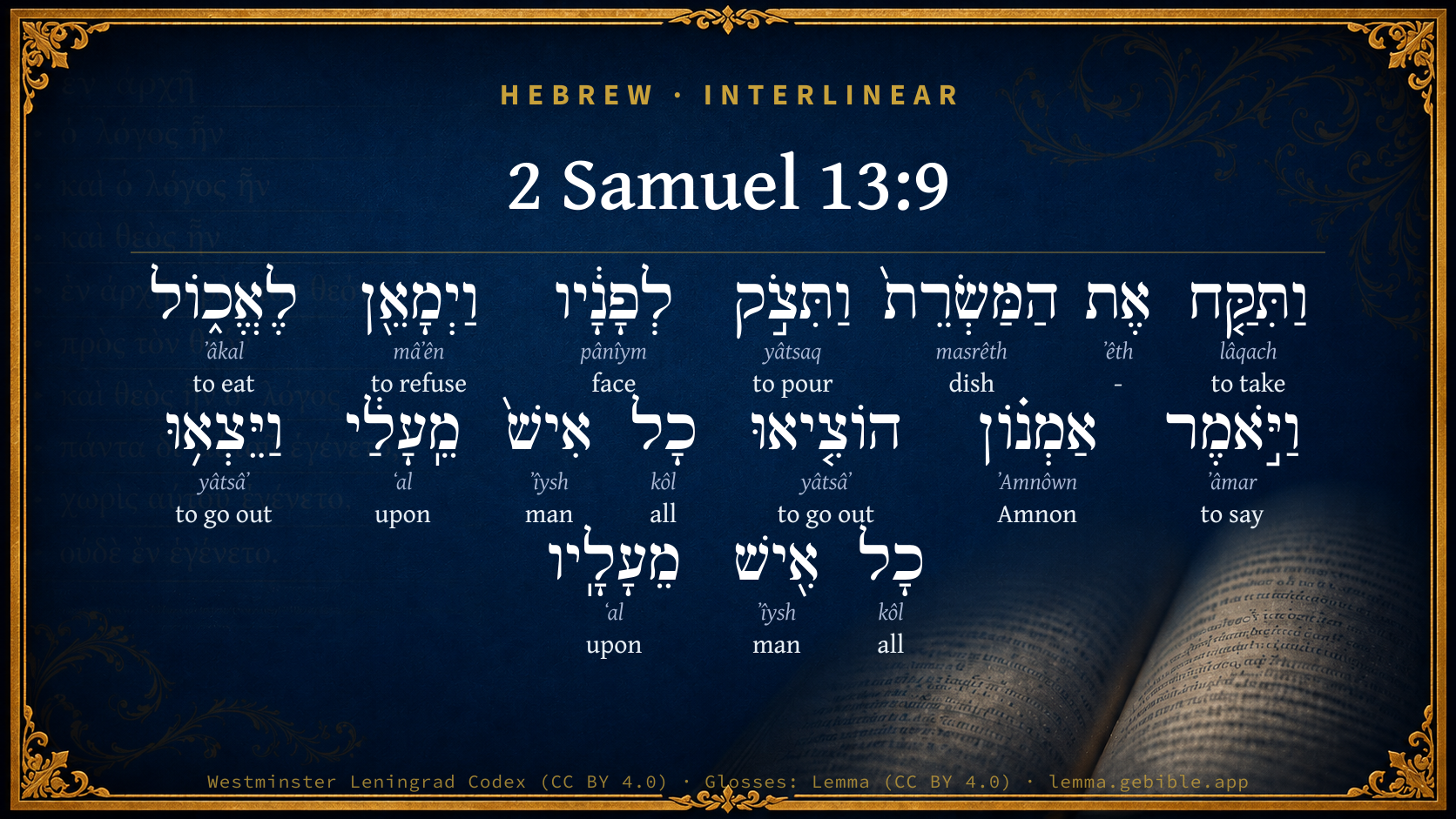
Hebrew (Westminster Leningrad Codex) 2 Samuel 13:9 appears in the Hebrew Old Testament. The text above is from the Westminster Leningrad Codex. Each word links to its Strong’s number, a concise gloss, and parsing drawn from the Open Scriptures Hebrew Bible morphology. Click any word for its full Brown-Driver-Briggs (BDB) entry.
Download image
Cite this verse

2 Samuel 13:9 (World English Bible). Public Domain. Lemma interlinear Bible study tool, https://lemma.gebible.app/v/2-samuel/13/9.

Show BibTeX & RIS
BibTeX
RIS
English Translation
She took the pan, and poured them out before him; but he refused to eat. Amnon said, Have out all men from me. They went out every man from him.
World English Bible · Public Domain
Highlights
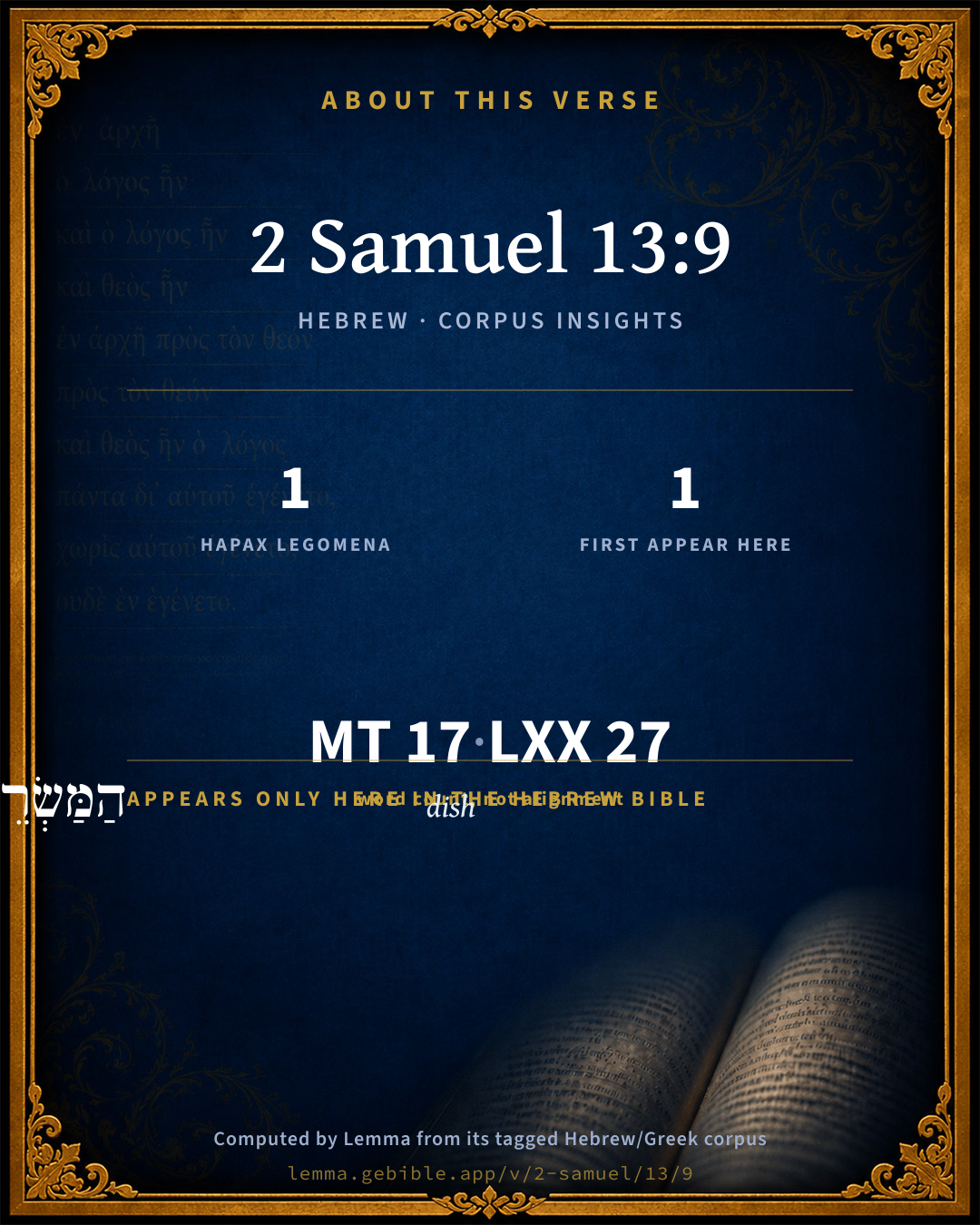
  • 1 hapax legomenon — only here in the Hebrew Bible
  • 1 first appearance in the Hebrew Bible
Full analysis ↓
Download a study sheet

One document with this verse’s original text, its word-by-word gloss line, the meaning frame, cross-references with their text, attributed commentary, and full source and license credits — printable, and it pastes into notes with its structure intact.

This verse Autodidact and up

Study sheet (.html) Plain text (.txt)

A passage Seminary Student

Up to 50 verses in one chapter. A passage sheet keeps up to 6 commentary sources and 12 cross-references per verse, in the order this page ranks them, and says so on the sheet whenever that leaves anything out. Ask for a single verse and you get the Autodidact verse sheet above.

Everything on this page stays free to read, with no account — the sheet is a download of what is already on screen, not access to it.

Want to remove ads? Support Godless Engineer
Compare translations 3

The same verse in 3 English versions, stacked beneath the original-language interlinear above. Click any original word for its lexicon entry.

Each is an independent rendering of the whole verse — the interlinear is not word-aligned to these translations.

Highlighted words mark where these versions differ — a whole-verse word diff, not a word-by-word alignment.

  • World English Bible Public Domain
    She took the pan, and poured them out before him; but he refused to eat. Amnon said, Have out all men from me. They went out every man from him.
  • King James Version Public Domain
    And she took a pan, and poured them out before him; but he refused to eat. And Amnon said, Have out all men from me. And they went out every man from him.
  • unfoldingWord Literal Text CC BY-SA 4.0
    And she took the pan, and she poured out to his face, but he refused to eat. And Amnon said, “Make every man go out from me.” So every man went out from him.

unfoldingWord Literal Text — © unfoldingWord, licensed CC BY-SA 4.0. Word-aligned USFM3 via Door43 (git.door43.org/unfoldingWord/en_ult).

Versions to compare (up to 4)

3 of 4 selected

Show all 18 translations

Every available English version of this verse, each an independent rendering of the whole verse.

  • World English Bible Public Domain
    She took the pan, and poured them out before him; but he refused to eat. Amnon said, Have out all men from me. They went out every man from him.
  • Berean Standard Bible Public Domain
    Then she brought the pan and set it down before him, but he refused to eat. “Send everyone away!” said Amnon. And everyone went out.
  • Majority Standard Bible Public Domain
    Then she brought the pan and set it down before him, but he refused to eat. “Send everyone away!” said Amnon. And everyone went out.
  • King James Version Public Domain
    And she took a pan, and poured them out before him; but he refused to eat. And Amnon said, Have out all men from me. And they went out every man from him.
  • American Standard Version (1901) Public Domain
    And she took the pan, and poured them out before him; but he refused to eat. And Amnon said, Have out all men from me. And they went out every man from him.
  • Revised Version (1885) Public Domain
    And she took the pan, and poured them out before him; but he refused to eat. And Amnon said, Have out all men from me. And they went out every man from him.
  • Geneva Bible (1599) Public Domain
    And she tooke a pan, and powred them out before him, but he would not eat. Then Amnon saide, Cause ye euery man to goe out from me: so euery man went out from him.
  • Douay-Rheims (1899) Public Domain
    And taking what she had boiled, she poured it out, and set it before him, but he would not eat: and Amnon said: Put out all persons from me. And when they had put all persons out,
  • Young's Literal Translation Public Domain
    and taketh the frying-pan, and poureth out before him, and he refuseth to eat, and Amnon saith, `Take ye out every one from me;' and they go out every one from him.
  • Literal Standard Version CC BY-SA 4.0
    and takes the frying-pan, and pours out before him, and he refuses to eat, and Amnon says, “Have everyone go out from me”; and everyone goes out from him.
  • Unlocked Literal Bible CC BY-SA 4.0
    She took the pan and gave the bread to him, but he refused to eat. Then Amnon said to the others present, “Send everyone out, away from me.” So everyone went out from him.
  • unfoldingWord Literal Text CC BY-SA 4.0
    And she took the pan, and she poured out to his face, but he refused to eat. And Amnon said, “Make every man go out from me.” So every man went out from him.
  • Darby Bible Public Domain
    And she took the pan, and poured them out before him; but he refused to eat. And Amnon said, Put every man out from me. And they went out every man from him.
  • World Messianic Bible Public Domain
    She took the pan and poured them out before him, but he refused to eat. Amnon said, “Have all men leave me.” Then every man went out from him.
  • Webster's Bible Public Domain
    And she took a pan, and poured them out before him; but he refused to eat. And Amnon said, Have out all men from me. And they went out every man from him.
  • Free Bible Version CC BY-SA 4.0
    Then she took the pan and emptied it out before him, but he refused to eat. “Everybody leave me!” Amnon shouted. Everyone left.
  • Bible in Basic English Public Domain
    And she took the cooking-pot, and put the cakes before him, but he would not take them. And Amnon said, Let everyone go away from me. So they all went out.
  • JPS Tanakh (1917) Public Domain
    And she took the pan, and poured them out before him; but he refused to eat. And Amnon said: 'Have out all men from me.' And they went out every man from him.

Literal Standard Version (2020), Covenant Press — licensed CC BY-SA 4.0. Text via the HelloAO Bible API (eBible.org). Unlocked Literal Bible (unfoldingWord) — licensed CC BY-SA 4.0. Text via the HelloAO Bible API (eBible.org). unfoldingWord Literal Text — © unfoldingWord, licensed CC BY-SA 4.0. Word-aligned USFM3 via Door43 (git.door43.org/unfoldingWord/en_ult). Free Bible Version, Dr. Jonathan Gallagher — licensed CC BY-SA 4.0. Text via the HelloAO Bible API (eBible.org).

Word by word

More ways to search: Search by grammar → Find every occurrence → Compare this word →

Practice this passage: Drill this verse → Learn its vocabulary →

הַמַּשְׂרֵת֙
masrêth
H4958
“the · dish”
Particle, Definite Article + Noun, Common, Feminine, Singular, Absolute
Part of Speech
Particle + Noun
Type
Common
Gender
Feminine
Number
Singular
State
Absolute
Full BDB Definition

Origin: apparently from an unused root meaning to perforate, i.e. hollow out

TWOT: 1251

pan, dish
  1. וַתִּקַּ֤ח lâqach H3947 “and · to take” Conjunction + Verb, Qal, Sequential Imperfect, 3rd Person, Feminine, Singular
  2. אֶת ʼêth H853 “-” Particle, Direct Object
  3. וַתִּצֹ֣ק yâtsaq H3332 “and · to pour” Conjunction + Verb, Qal, Sequential Imperfect, 3rd Person, Feminine, Singular
  4. לְפָנָ֔יו pânîym H6440 “to/for · face(s) · his” Preposition + Noun, Common, Both, Plural, Construct + Suffix, Personal, 3rd Person, Masculine, Singular
  5. וַיְמָאֵ֖ן mâʼên H3985 “and · to refuse” Conjunction + Verb, Piel, Sequential Imperfect, 3rd Person, Masculine, Singular
  6. לֶאֱכ֑וֹל ʼâkal H398 “to eat” Preposition + Verb, Qal, Infinitive Construct
  7. וַיֹּ֣אמֶר ʼâmar H559 “and · to say” Conjunction + Verb, Qal, Sequential Imperfect, 3rd Person, Masculine, Singular
  8. אַמְנ֗וֹן ʼAmnôwn H550 “Amnon” Noun, Proper
  9. הוֹצִ֤יאוּ yâtsâʼ H3318 “go out” Verb, Hiphil, Imperative, 2nd Person, Masculine, Plural
  10. כָל kôl H3605 “all of” Noun, Common, Masculine, Singular, Construct
  11. אִישׁ֙ ʼîysh H376 “man” Noun, Common, Masculine, Singular, Absolute
  12. מֵֽעָלַ֔י ʻal H5921 “from · upon · me” Preposition + Preposition + Suffix, Personal, 1st Person, Common, Singular
  13. וַיֵּצְא֥וּ yâtsâʼ H3318 “and · to go out” Conjunction + Verb, Qal, Sequential Imperfect, 3rd Person, Masculine, Plural
  14. כָל kôl H3605 “all of” Noun, Common, Masculine, Singular, Construct
  15. אִ֖ישׁ ʼîysh H376 “man” Noun, Common, Masculine, Singular, Absolute
  16. מֵעָלָֽיו ʻal H5921 “from · upon · him” Preposition + Preposition + Suffix, Personal, 3rd Person, Masculine, Singular

About this verse

These counts appear in no published source. They are computed here, from the morphology-tagged text and Lemma’s own curated glosses. What Lemma adds →

17
words
13
distinct lemmas
Historical
section

Notable vocabulary

1 hapax legomenon — a word that appears only here in the entire Hebrew Bible:

  • הַמַּשְׂרֵת֙ dish H4958

First appearance in Scripture

This word makes its first canonical appearance in the Hebrew Bible here:

  • הַמַּשְׂרֵת֙ dish H4958

Shared distinctive vocabulary

אַמְנ֗וֹן Amnon H550 occurs in 22 verses of the Hebrew Bible. Also found in:

Grammatical profile

  • 7 verbs
  • 7 nouns
  • 2 prepositions
  • 1 particle

Verb forms

  • וַתִּקַּ֤ח Qal · Sequential Imperfect
  • וַתִּצֹ֣ק Qal · Sequential Imperfect
  • וַיְמָאֵ֖ן Piel · Sequential Imperfect
  • לֶאֱכ֑וֹל Qal · Infinitive Construct
  • וַיֹּ֣אמֶר Qal · Sequential Imperfect
  • הוֹצִ֤יאוּ Hiphil · Imperative
  • וַיֵּצְא֥וּ Qal · Sequential Imperfect

Repetition

Words recur within this verse — often emphatic in Hebrew:

  • הוֹצִ֤יאוּ to go out H3318 ×2
  • כָל all H3605 ×2
  • אִישׁ֙ man H376 ×2
  • מֵֽעָלַ֔י upon H5921 ×2

Hebrew & Septuagint length

In English translation the verse runs 30 words from the Hebrew and 35 from the Septuagint (LXX English) — closely comparable.

A rough comparison of the two English renderings, which tokenize alike — not a word-level alignment.

Word counts can differ between the Hebrew and the Greek without any difference in meaning — e.g. the Hebrew direct-object marker אֵת has no separate Greek word, and Greek often adds the article ὁ.

In the original languages it is 17 Hebrew tokens and 27 Greek tokens — but the two are counted differently (Hebrew bundles its prefixes and suffixes into one token; the Greek is in lemma form), so that isn’t a like-for-like length.

Cross-references

3

Topical passages linked to 2 Samuel 13:9 in the Treasury of Scripture Knowledge — connected by theme and wording, ordered by reader-vote popularity; previews shown in the World English Bible.

  • Genesis 45:1 Then Joseph couldn't control himself before all those who stood before him, and he cried, "Cause every man to go out from me!" There stood no man with him, while Joseph made himself known to his brothers.
  • Judges 3:19 But he himself turned back from the quarries that were by Gilgal, and said, I have a secret errand to you, king. He said, Keep silence. All who stood by him went out from him.
  • John 3:20 For everyone who does evil hates the light, and doesn't come to the light, lest his works would be exposed.

Cross-references courtesy of OpenBible.info (CC BY 4.0).

Hebrew and Greek witnesses Masoretic Hebrew ↔ Greek Septuagint

The same verse in the two great witnesses to the Old Testament, shown verse-for-verse.

These are two independent witnesses, not word-aligned to each other, and the Septuagint is shown in lemma (dictionary) form.

Hebrew 2 Samuel 13:9 Masoretic · Westminster Leningrad Codex

וַתִּקַּ֤ח אֶת הַמַּשְׂרֵת֙ וַתִּצֹ֣ק לְפָנָ֔יו וַיְמָאֵ֖ן לֶאֱכ֑וֹל וַיֹּ֣אמֶר אַמְנ֗וֹן הוֹצִ֤יאוּ כָל אִישׁ֙ מֵֽעָלַ֔י וַיֵּצְא֥וּ כָל אִ֖ישׁ מֵעָלָֽיו

She took the pan, and poured them out before him; but he refused to eat. Amnon said, Have out all men from me. They went out every man from him.

World English Bible · Public Domain

Greek LXX 2 Samuel 13:9 Septuagint · lemma form

καί λαμβάνω ὁ τήγανον καί κατακενόω ἐνώπιον αὐτός καί οὐ θέλω ἐσθίω καί εἶπον αμνων ἐκἄγω πᾶς ἀνήρ ἐπάνωθε ἐγώ καί ἐκἄγω πᾶς ἀνήρ ἀπό ἐπάνωθε αὐτός

And she took the frying pan and poured them out before him, but he would not eat. And Amnon said, Send out every man from about me. And they removed every man from about him.

LXX2012 (modern English Septuagint) · Public Domain

Hebrew: Westminster Leningrad Codex (CC BY 4.0). Greek: Septuagint (public domain); English from LXX2012 (modern English Septuagint) (Public Domain). How the Septuagint differs from the Hebrew →

Targum (Aramaic paraphrase)

1

The Targum is the ancient Jewish Aramaic paraphrase of the Hebrew Scriptures — an interpretive translation, not the Hebrew text itself. Onkelos (literal) and Pseudo-Jonathan (expansive) render the Torah, and Jonathan the Prophets. Coverage is partial: where no permissively-licensed English translation exists for a verse, only the Aramaic is shown. This is verse-level text, not a word-by-word alignment to the Hebrew.

  1. Targum Jonathan Prophets (Joshua–Malachi)
    וּנְסֵיבַת יַת מַסְרֵיתָא וַאֲרִיקַת קֳדָמוֹהִי וְלָא אֲבָא לְמֵיכַל וַאֲמַר אַמְנוֹן אַפִּיקוּ כָל אֱנַשׁ מֵעִילַוָי וְאַפִּיקוּ כָל אֱנַשׁ מֵעִילַוֹהִי:

    (no public-domain English translation for this verse)

    Targum Jonathan — Aramaic: “Mikraot Gedolot” (public domain). English: “Sefaria Community Translation” (CC0 1.0 (public-domain dedication)); “London "Chaldee Paraphrase," 1871” (public domain). Text via Sefaria.

Commentary

Notes on 2 Samuel 13:9 from classic Christian and Jewish commentators (each source and its license shown beneath its notes). The classic Christian expositions comment on the surrounding passage and are grouped to its opening verse, so a note may address several verses; the Jewish commentaries on the Tanakh (Rashi and others) are per-verse, so they appear only where the commentator wrote on this verse.

Lemma curates 59 commentaries, every one of them public domain or Creative Commons licensed, each selected and text-cleaned for this edition rather than reprinted as found. About our sources →

Trapp's Complete Commentary

John Trapp

2Sa 13:9 And she took a pan, and poured [them] out before him; but he refused to eat. And Amnon said, Have out all men from me. And they went out every man from him.

Ver. 9. But he refused to eat.] As if he had been very sick: and so bade all to go out: then he called for her again, and so forced her. This was the fruit of those base, vain, wanton, capering thoughts, which he should at first have resisted, before they had thus broken out into foul incest; as ill humours in the body do into sores and botches. The poets tell us, that whoso washeth in the river Silenus, is forthwith cured of his love passions. The Stoics say, Aut mentem, aut restim. Let a man either moderate his lusts, or go hang himself. But Amnon might have learned better than all this of his father and other holy prophets, had he more minded their counsel, than that of his cousin Jonadab.

John Trapp, A Commentary or Exposition upon All the Books of the Old and New Testament (1647–1656) — public domain. Text from a community e-Sword module.

Geneva Bible (1599)

Geneva Bible translators

For the wicked are ashamed to do that before men, which they are not afraid to commit in the sight of God.

That is, she served them on a dish.

Geneva Bible (1599) marginal notes — public domain. Text via Bolls.life.

Ellicott's Commentary for English Readers

(9) He refused to eat.—This also seemed natural enough in a whimsical invalid, and for the same reason his next requirement, “Have out all men from me,” awakened no suspicion in the mind of Tamar.

A Bible Commentary for English Readers, edited by Charles John Ellicott (1878–1897) — public domain. Text from a community e-Sword module.

The Cambridge Bible for Schools and Colleges

gen. ed. J. J. S. Perowne

9. a pan] The pan in which the cakes or puddings had been cooked.

The Cambridge Bible for Schools and Colleges (gen. ed. J. J. S. Perowne; Cambridge University Press, 1878–1918) — public domain. Text from a community e-Sword module.

John Gill's Exposition

And she took a pan, and poured them out before him,.... Out of the frying pan, in which they were, into another dish; and all this was done in his presence, that he might see and know of what, and in what manner it was made, that his stomach might not recoil at it:

but he refused to eat: for that was not what he wanted:

and Amnon said, have out all men from me; as if company was troublesome to him, and he wanted rest, &c.

and they went out every man from him; at his orders, that he might get some sleep, as he seemed desirous of it.

John Gill's Exposition of the Whole Bible (1746–1763) — public domain (CC PDM 1.0). Text via the HelloAO Bible API.

Haydock's Catholic Bible Commentary

Out. This conveys the idea of something liquid. (Calmet) --- It was a thin wafer, (Haydock) or cake, of which there were different sorts.

George Leo Haydock (1774–1849), Haydock's Catholic Family Bible and Commentary, 1859 edition — public domain. Excludes Psalms (Douay-Rheims chapter numbering differs from Protestant) and Deuterocanonical books (Catholic canon only).

Matthew Poole's English Annotations

Poured them out; out of the frying-pan into the dish.

Matthew Poole's English Annotations on the Holy Bible (1683–1685) — public domain. Text from a community e-Sword/MySword module.

The Pulpit Commentary

She took a pan. Many of the words are difficult because, being the names of ordinary domestic articles, they do not occur in literature. A man may be a good French scholar, and yet find it difficult in France to ask for things in common use. Here the Syriac is probably right in understanding, not a pan, but the delicacy Tamar had been cooking. In ver. 8 the word rendered "flour" is certainly "dough," and is so rendered in the Revised Version. The cakes were a kind of pancake, fitted to tempt the appetite of a sickly person. The picture is a very interesting one: the palace parcelled out into separate dwellings; the king kindly visiting all; the girls on friendly terms with their brothers, yet not allowed to go to their rooms without special permission; and finally Tamar"s skill in cookery an accomplishment by no means despised in an Oriental menage, or thought unworthy of a king"s daughter.

The Pulpit Commentary (1880–1919), ed. H.D.M. Spence-Jones & Joseph S. Exell — public domain. Text from a community e-Sword module.

John Wesley's Explanatory Notes

Out - Out of the frying-pan into the dish.

John Wesley, Explanatory Notes Upon the Whole Bible (1754–1765) — public domain. Text via the GEBible commentary corpus.

Rashi

Rabbi Shlomo Yitzchaki (Rashi)

The pan. The [Onkelus'] translation of Machues is "pan".

Rashi on the Tanakh — English translations: “The Judaica Press complete Tanach with Rashi, translated by A. J. Rosenberg” (CC BY 4.0); “Pentateuch with Rashi's commentary by M. Rosenbaum and A.M. Silbermann, 1929-1934” (public domain); “The Metsudah Tanach series, Lakewood, N.J” (CC BY 4.0); and “The Book of Joshua, Metsudah Publications, 1997” (CC BY 4.0). Text via Sefaria.

Lesson kit

Teaching starters — assembled from the data on this page, not authored interpretation. Every prompt links to the verse data it draws on. Edit before teaching.

2 Samuel, in the Historical, opens this verse with 17 words (13 distinct Hebrew lemmas). Its most distinctive word is masrêth (“dish”). A historical commentator’s framing appears above. Read the whole chapter for the surrounding context.

Discussion questions

  1. How does “dish” (masrêth) shape what this verse is saying?
  2. This verse holds 1 word here found nowhere else in the Hebrew Bible. What might the rare word draw attention to?
  3. The word “dish” first appears here in Scripture. What is being introduced at this debut?
  4. 2 Samuel 3:2 shares the word «Amnon» with this verse. How do the two illuminate each other?
  5. “to go out” occurs 2× in this one verse. What is the effect of the repetition?
  6. The translations on this page render this verse differently — a whole-verse word diff, not a word-by-word alignment. What might account for the different wordings?
  7. The verb «וַתִּקַּ֤ח» is Qal Sequential Imperfect. How does its form color the action?
  8. Reading how Trapp's Complete Commentary and Geneva Bible (1599) read this verse, where do the two commentators agree and where do they part?

Things to notice

  • 1 word in this verse appears nowhere else in the Hebrew Bible.
  • 1 word makes its first canonical appearance in Scripture here.
  • This verse counts 17 Hebrew ↔ 27 Greek words.
  • These translations choose different wording for 7 words in this verse.
  • “to go out” occurs 2× in this single verse.

Reading settings

Reading text

Shown beneath each verse's original-language words.

Old Testament
Old Testament edition

Read the OT as the Masoretic Hebrew (MT) or the Greek Septuagint (LXX).

English shown for the Greek Septuagint (in the Hebrew ↔ Greek comparison).

Comparing translations? Open the Compare panel on any verse page to stack up to four side by side.