Galatians 4:20

Greek (Tischendorf 8th ed.) Galatians 4:20 appears in the Greek New Testament. The text above is from the Tischendorf 8th edition. Each word links to its Strong’s number and a concise gloss. Click any word for its full Thayer’s Greek Lexicon entry.
Download image
Cite this verse

Galatians 4:20 (World English Bible). Public Domain. Lemma interlinear Bible study tool, https://lemma.gebible.app/v/galatians/4/20.

Show BibTeX & RIS
BibTeX
RIS
English Translation
but I could wish to be present with you now, and to change my tone, for I am perplexed about you.
World English Bible · Public Domain
Download a study sheet

One document with this verse’s original text, its word-by-word gloss line, the meaning frame, cross-references with their text, attributed commentary, and full source and license credits — printable, and it pastes into notes with its structure intact.

This verse Autodidact and up

Study sheet (.html) Plain text (.txt)

A passage Seminary Student

Up to 50 verses in one chapter. A passage sheet keeps up to 6 commentary sources and 12 cross-references per verse, in the order this page ranks them, and says so on the sheet whenever that leaves anything out. Ask for a single verse and you get the Autodidact verse sheet above.

Everything on this page stays free to read, with no account — the sheet is a download of what is already on screen, not access to it.

Want to remove ads? Support Godless Engineer
Compare translations 3

The same verse in 3 English versions, stacked beneath the original-language interlinear above. Click any original word for its lexicon entry.

Each is an independent rendering of the whole verse — the interlinear is not word-aligned to these translations.

Highlighted words mark where these versions differ — a whole-verse word diff, not a word-by-word alignment.

  • World English Bible Public Domain
    but I could wish to be present with you now, and to change my tone, for I am perplexed about you.
  • King James Version Public Domain
    I desire to be present with you now, and to change my voice; for I stand in doubt of you.
  • unfoldingWord Literal Text CC BY-SA 4.0
    but I am desiring to be present with you now and to change my tone, because I am perplexed about you.

unfoldingWord Literal Text — © unfoldingWord, licensed CC BY-SA 4.0. Word-aligned USFM3 via Door43 (git.door43.org/unfoldingWord/en_ult).

Versions to compare (up to 4)

3 of 4 selected

Show all 19 translations

Every available English version of this verse, each an independent rendering of the whole verse.

  • World English Bible Public Domain
    but I could wish to be present with you now, and to change my tone, for I am perplexed about you.
  • Berean Standard Bible Public Domain
    how I wish I could be with you now and change my tone, because I am perplexed about you.
  • Majority Standard Bible Public Domain
    how I wish I could be with you now and change my tone, because I am perplexed about you.
  • King James Version Public Domain
    I desire to be present with you now, and to change my voice; for I stand in doubt of you.
  • American Standard Version (1901) Public Domain
    but I could wish to be present with you now, and to change my tone; for I am perplexed about you.
  • Revised Version (1885) Public Domain
    yea, I could wish to be present with you now, and to change my voice; for I am perplexed about you.
  • Geneva Bible (1599) Public Domain
    And I would I were with you nowe, that I might change my voyce: for I am in doubt of you.
  • Douay-Rheims (1899) Public Domain
    And I would willingly be present with you now, and change my voice: because I am ashamed for you.
  • Young's Literal Translation Public Domain
    and I was wishing to be present with you now, and to change my voice, because I am in doubt about you.
  • Literal Standard Version CC BY-SA 4.0
    indeed I was wishing to be present with you now, and to change my voice, because I am in doubt about you.
  • Unlocked Literal Bible CC BY-SA 4.0
    I wish I could be present with you now and change my tone, because I am perplexed about you.
  • unfoldingWord Literal Text CC BY-SA 4.0
    but I am desiring to be present with you now and to change my tone, because I am perplexed about you.
  • Darby Bible Public Domain
    and I should wish to be present with you now, and change my voice, for I am perplexed as to you.
  • World Messianic Bible Public Domain
    but I could wish to be present with you now, and to change my tone, for I am perplexed about you.
  • Webster's Bible Public Domain
    I desire to be present with you now, and to change my voice; for I stand in doubt of you.
  • Free Bible Version CC BY-SA 4.0
    I really wish I could be with you right now so I could change my tone of voice… I'm so worried about you.
  • Bible in Basic English Public Domain
    Truly my desire is to be present with you now, using a changed voice; for I am troubled about you.
  • Text-Critical English NT CC BY 4.0
    how I wish that I could be with you now and change my tone, for I am perplexed about you!
  • Tyndale New Testament (1534) Public Domain
    I wolde I were with you now and coulde chaunge my voyce: for I stonde in a doute of you

Literal Standard Version (2020), Covenant Press — licensed CC BY-SA 4.0. Text via the HelloAO Bible API (eBible.org). Unlocked Literal Bible (unfoldingWord) — licensed CC BY-SA 4.0. Text via the HelloAO Bible API (eBible.org). unfoldingWord Literal Text — © unfoldingWord, licensed CC BY-SA 4.0. Word-aligned USFM3 via Door43 (git.door43.org/unfoldingWord/en_ult). Free Bible Version, Dr. Jonathan Gallagher — licensed CC BY-SA 4.0. Text via the HelloAO Bible API (eBible.org).

Word by word

More ways to search: Search by grammar → Find every occurrence → Compare this word →

Practice this passage: Drill this verse → Learn its vocabulary →

ἀποροῦμαι
aporéō
G639
“to be perplexed”
Verb, Present, Middle, Indicative, 1st person, Singular
Part of Speech
Verb
Tense
Present
Voice
Middle
Mood
Indicative
Person
1st person
Number
Singular
Full Thayer's Definition

Origin: from a compound of G1 (as a negative particle) and the base of G4198

TDNT: None

1. to be without resources, to be in straits, to be left wanting, to be embarrassed, to be in doubt, not to know which way to turn 2. to be at a loss with one's self, be in doubt 3. not to know how to decide or what to do, to be perplexed
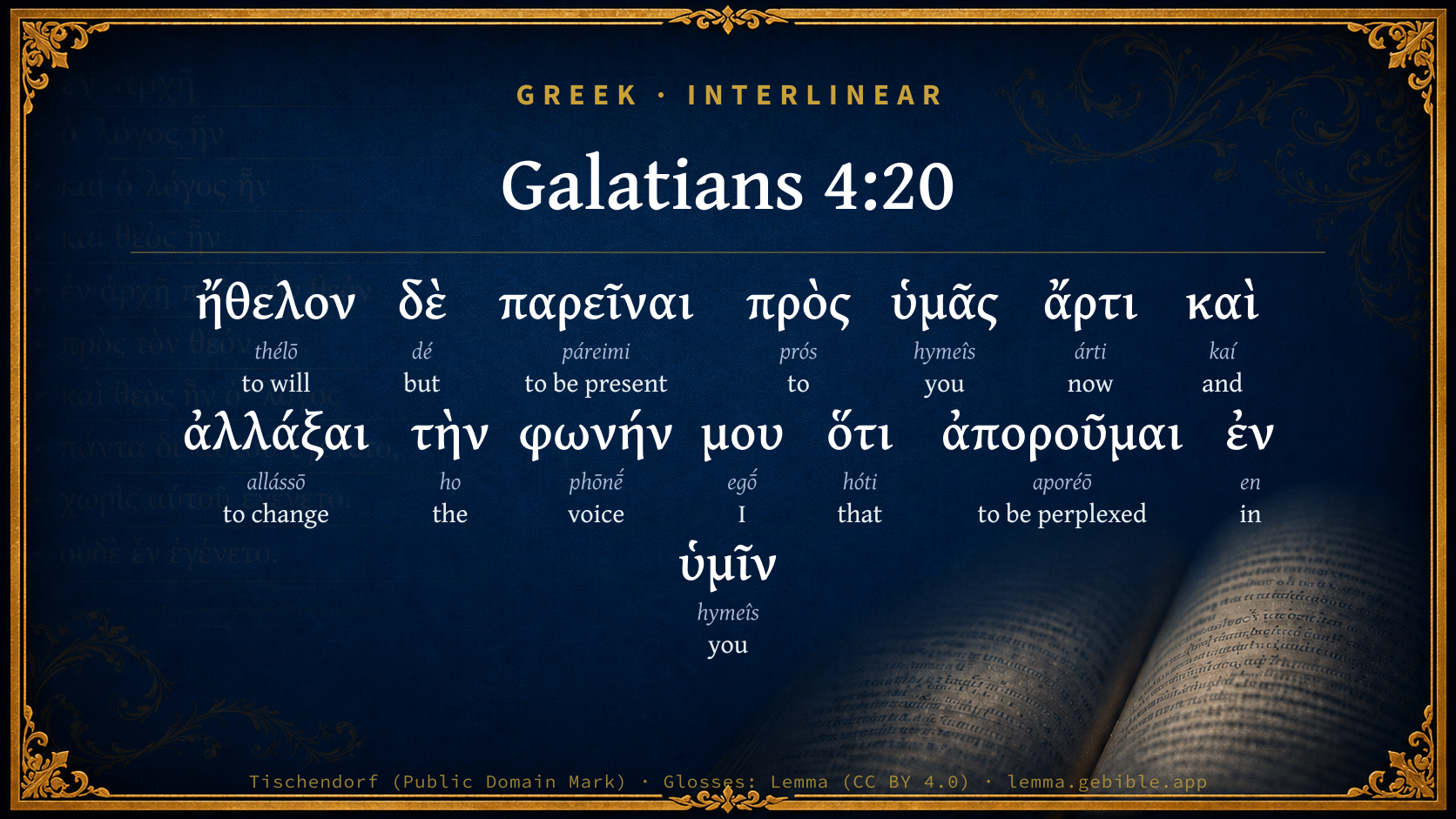
  1. ἤθελον thélō G2309 “to will” Verb, Imperfect, Active, Indicative, 1st person, Singular
  2. δὲ dé G1161 “but” Conjunction
  3. παρεῖναι páreimi G3918 “to be present” Verb, Present, Active, Infinitive
  4. πρὸς prós G4314 “to” Preposition
  5. ὑμᾶς hymeîs G5210 “you” Personal pronoun, 2nd person, Accusative, Plural
  6. ἄρτι árti G737 “now” Adverb
  7. καὶ kaí G2532 “and” Conjunction
  8. ἀλλάξαι allássō G236 “to change” Verb, Aorist, Active, Infinitive
  9. τὴν ho G3588 “the” Article, Accusative, Singular, Feminine
  10. φωνήν phōnḗ G5456 “voice” Noun, Accusative, Singular, Feminine
  11. μου egṓ G1473 “I” Personal pronoun, 1st person, Genitive, Singular
  12. ὅτι hóti G3754 “that” Conjunction
  13. ἐν en G1722 “in” Preposition
  14. ὑμῖν hymeîs G5210 “you” Personal pronoun, 2nd person, Dative, Plural

About this verse

These counts appear in no published source. They are computed here, from the morphology-tagged text and Lemma’s own curated glosses. What Lemma adds →

15
words
14
distinct lemmas
Pauline Epistles
section

Notable vocabulary

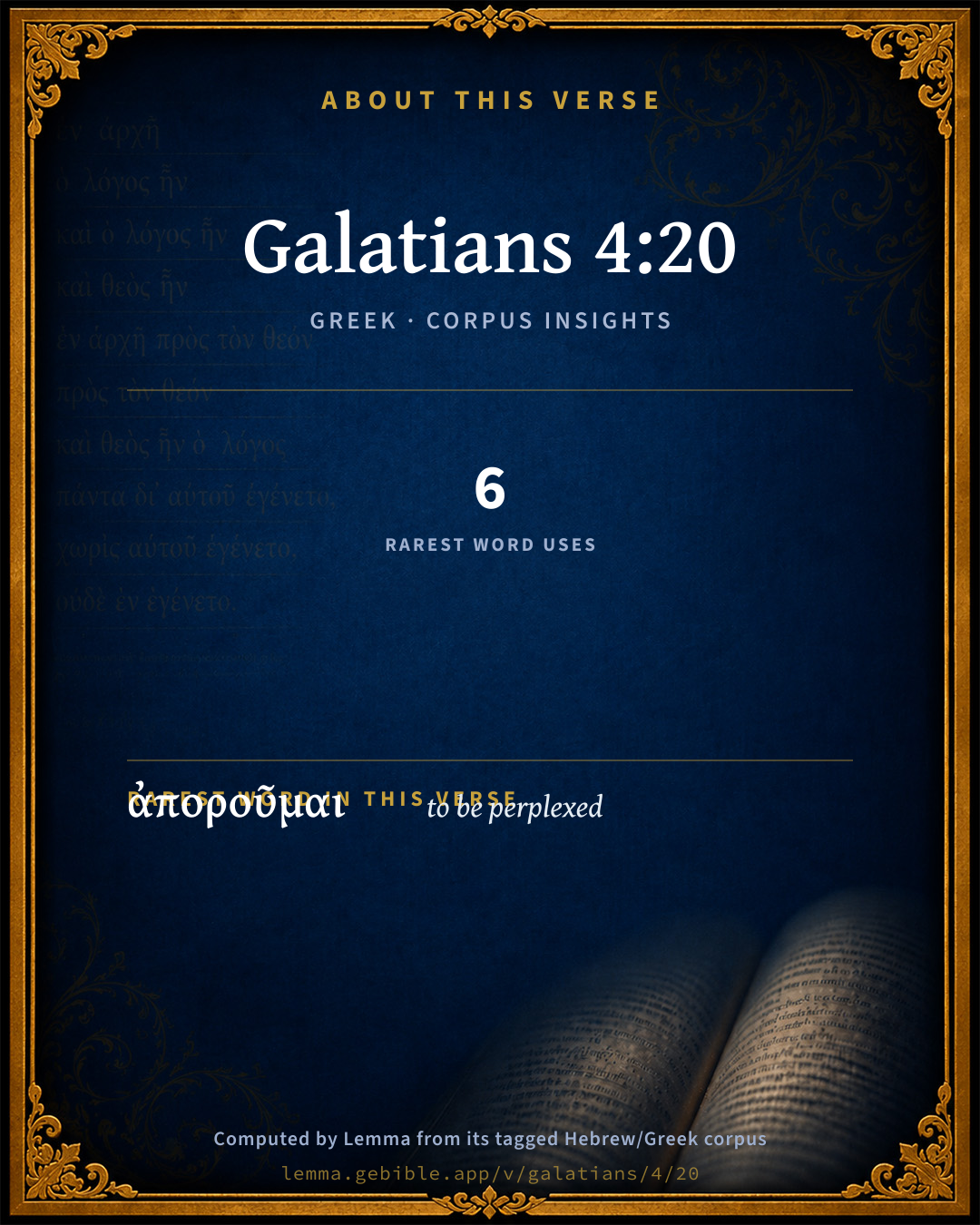
The rarest word here is ἀποροῦμαι to be perplexed G639 — appearing just 6 times in the whole Greek New Testament.

Shared distinctive vocabulary

ἀποροῦμαι to be perplexed G639 occurs in 6 verses of the Greek New Testament. Also found in:

Repetition

A word recurs within this verse:

  • ὑμᾶς you G5210 ×2

Cross-references

3

Topical passages linked to Galatians 4:20 in the Treasury of Scripture Knowledge — connected by theme and wording, ordered by reader-vote popularity; previews shown in the World English Bible.

  • 1 Thessalonians 2:17–18 But we, brothers, being bereaved of you for a short season, in presence, not in heart, tried even harder to see your face with great desire,
  • 1 Corinthians 4:19–21 But I will come to you shortly, if the Lord is willing. And I will know, not the word of those who are puffed up, but the power.
  • 1 Thessalonians 3:9 For what thanksgiving can we render again to God for you, for all the joy with which we rejoice for your sakes before our God;

Cross-references courtesy of OpenBible.info (CC BY 4.0).

Commentary

Notes on Galatians 4:20 from classic Christian and Jewish commentators (each source and its license shown beneath its notes). The classic Christian expositions comment on the surrounding passage and are grouped to its opening verse, so a note may address several verses; the Jewish commentaries on the Tanakh (Rashi and others) are per-verse, so they appear only where the commentator wrote on this verse.

Lemma curates 59 commentaries, every one of them public domain or Creative Commons licensed, each selected and text-cleaned for this edition rather than reprinted as found. About our sources →

Tyndale Open Study Notes

Tyndale Open Resources

4:20 Had Paul been personally present, he would have been able to “read” his hearers and thus shape his appeal to their exact spiritual and emotional condition. From afar, he wasn’t sure if the tone he was using would be effective.

Tyndale Open Study Notes — © Tyndale Open Resources, licensed CC BY-SA 4.0. Text via the HelloAO Bible API.

Bengel's Gnomon

Johann Albrecht Bengel

Gal 4:20. Δὲ, but [indeed]) although my presence is not the one and only cause which ought to kindle your zeal.—παρεῖναι, to be present) Gal 4:18.—ἄρτι) Now it would be more necessary than formerly; comp. again, Gal 4:19.—ἀλλάξαι) [to change] to accommodate the varying tones of the voice to the various feelings. They usually do so, who have zeal [are zealously affectionate in entreaties] whilst striving to recover the affections, that have been alienated from them. He writes mildly, Gal 4:12; Gal 4:19, but he would wish to speak still more mildly.—τὴν φωνήν μου, my voice) The voice may be rendered more flexible than writing, according as the case demands. The art of speaking occupies the first place, that of writing is only vicarious and subsidiary; 2 John Gal 4:12; 3 John Gal 4:13-14.—ἀποροῦμαι, I stand in doubt) I do not find the way of coming in and going out among you. Paul aimed at the greatest ease in speaking to the Galatians. He accommodated his discourse as much as possible to the dulness of the Galatians, with a view to convince them. The doctrine of inspiration is not endangered by this fact; see 1Co 7:25, note.

Bengel's Gnomon of the New Testament — English translation (T&T Clark, Edinburgh, 1860) — public domain. Text from a community e-Sword module.

Meyer's Critical & Exegetical Commentary

Heinrich August Wilhelm Meyer

Gal_4:20. As to the connection of thought of the δέ with Gal_4:18, see on Gal_4:18.

ἤθελον] namely, if the thing were possible. Comp. Rom_9:3; Act_25:22. See Stallbaum, ad Plat. Gorg. p. 235; Kühner, II. p. 68; Fritzsche, ad Rom. II. p. 245.

ἄρτι] just now, presently (see on Gal_1:9), has the emphasis.

ἀλλάξαι τὴν φωνήν μου] The emphasis is on ἀλλάξαι. But in harmony with the context (see Gal_4:16; Gal_4:18, and the foregoing ἄρτι), this changing can only refer to the second visit of the apostle to the Galatians, not to the language now employed in his letter, as many expositors think.[208] Erroneously, thereforeand how sharply in opposition to the previous affectionate address!

Ambrosius, Pelagius, Wetstein, Michaelis, Rosenmüller, Rückert, Baumgarten-Crusius, take the sense to be: to assume a stern language of reproof. Hofmann also erroneously holds that Paul means the (in oral expression) more chastened tone of a didactic statementaiming at the bringing the readers back from their errorafter the strongly excited style in which, since the word θαυμάζω in Gal_1:6, he had urged his readers, as one who had already been almost deprived of the fruit of his labours. As if Paul had not previously, and especially from Gal_3:6 to Gal_4:7, written didactically enough; and as if he had not also in the sequel (see immediately, Gal_4:21, and chap. 5 and 4 down to the abrupt dismissal at the end) urged his readers with excitement enough! The supposition, however, which Hofmann entertains, that Paul has hitherto been answering a letter of the Galatians, and has just at this point come to the end of it, is nothing but a groundless hypothesis, for there is no trace of such a letter to be found in the epistle. No; when Paul was for the second time in Galatia, he had spoken sharply and sternly, and this had made his readers suspect him, as if he had become their enemy (Gal_4:16): hence he wishes to be now with them, and to speak to them with a voice different from what he had then used, that is, to speak to them in a soft and gentle tone.[209] By this, of course, he means not any deviation in the substance of his teaching from the ἀληθεύειν (Gal_4:16), but a manner of language betokening tender, mother-like love. A wish of self-denying affection, which is ready and willing, in the service of the cause and for the salvation of the persons concerned, to change form and tone, although retaining φωνὰν ψευδέων ἀγνωστόν (Pind. Ol. vi. 112). The latter was a matter of course in the case of a Paul, willingly though he became all things to all men; comp. on 1Co_9:22. Many other expositors, as Theodoret, Theodore of Mopsuestia, Erasmus, Luther, Calvin, Grotius, Estius, Koppe, Borger, Winer, Matthies, Schott, de Wette, understand it as: to speak according to the circumstances of each case, with tenderness and affection to one, with severity and censure to another. Comp. Corn. a Lapide: ut scilicet quasi mater nunc blandirer, nunc gemerem, nunc obsecrarem, nunc objurgarem vos. But this cannot be expressed by the mere ἀλλάξαι τ. φ., which without addition means nothing more than to change the voice (comp. ἀλλάττειν χώραν, Plat. Parm. p. 139 A; εἶδος, Eur. Bacch. 53; χρῶμα, Eur. Phoen. 1252; στολάς, Gen_35:2), that is, to assume another voice, to let oneself be heard otherwise, not differently. See Artem. ii. 20, iv. 56; Dio Chrysostom, lix. p. 575, in Wetstein. Comp. Rom_1:23; Wis_4:11; Wis_12:10; frequently in the LXX. Paul must have added either a more precise definition, such as εἰς πολλοὺς τρόπους, εἰς μορφὰς πλείονας (Lucian, Vit. Auct. 5), or at least some such expression as πρὸς τὴν χρείαν (Act_28:10), πρὸς τὸ συμφέρον (1Co_12:7), πρὸς διάκρισιν καλοῦ τε καὶ κακοῦ (Heb_5:14). Fritzsche incorrectly interprets it: to adopt some other voice, so that ye may believe that ye are listening to some other teacher, and not to the hated Paul. What a strange, unseemly idea, not at all in keeping with the thoughtful manner of the apostle! According to Wieseler, the sense intended is: to exchange my speaking with you; that is, to enter into mutual discourse with you, in order most surely to learn and to obviate your counter-arguments. But in this view with you is a pure interpolation, although it would be essentially requisite to the definition of the sense; and ἀλλάσσειν λόγους, to say nothing of ἀλλ. φωνήν, is never so used. What Wieseler means is expressed by ἀμείβεσθαί τινα λόγοις (Hom. Od. iii. 148, et al.), προσδιαλέγεσθαί τινι (Plat. Theaet. p. 161 B), συζητεῖν τινι, or πρός τινα (Act_6:9; Luk_22:23), λόγους ἀντιβάλλειν πρός (Luk_24:17), δοῦναί τε καὶ ἀποδέξασθαι λόγον (Plat. Rep. p. 531 E).

ὅτι ἀποροῦμαι ἐν ὑμῖν] justifies the wish of ἀλλάξαι τὴν φων. μου. The usual interpretation is the correct one: I am perplexed about you; ἐν ὑμῖν is to be taken as in the phrase θαῤῥῶ ἐν ὑμῖν, 2Co_7:16, so that the perplexity is conceived as inherent in the readers, dependent on their condition as its cause (comp. also Gal_1:24). The perplexity consists in this, that he at the time knows no certain ways and means by which he shall effect their re-conversion (Gal_4:19); and this instils the wish (ὅτι) that he could now be present with them, and, in place of the severe tone which at the preceding visit had had no good effect (Gal_4:16), could try the experiment of an altered and milder tone. The form ἀποροῦμαι is, moreover (comp. ἀπορηθείς, Dem. 830. 2, and ἀπορηθήσεται, Sir_18:7), to be taken passively (as a middle form with a passive signification), so that the state of the ἀπορεῖν is conceived of as produced on the subject, passively (Schoemann, ad Isaeum, p. 192). Fritzsche, l.c. p. 257, holds the sense to be: Nam haeretis, quo me loco habeatis, nam sum vobis suspectus. Thus ἐν ὑμῖν would be among you, and ἀποροῦμαι: I am an object of perplexity, according to the well-known Greek use of the personal passive of intransitive verbs (Bernhardy, p. 341; Kühner, II. p. 34 f.). Comp. Xen. de rep. Lac. xiii. 7: ὥστε τῶν δεομένων γίγνεσθαι οὐδὲν ἀπορεῖται, Plat. Soph. p. 243 B, Legg. vii. p. 799 C. But the sense: sum vobis suspectus is interpolated, and there is no ground for deviating from the use of ἀποροῦμαι throughout the N.T. (2Co_4:8; Luk_24:4; Act_25:20; Joh_13:22); as, indeed, the idea sum vobis suspectus cannot give any suitable motive for the wish of the ἀλλάξαι τὴν φωνήν, unless we adopt Fritzsches erroneous interpretation of ἀλλάξαι. To disconnect (with Hofmann) ἐν ὑμῖν from ἀποροῦμαι, and attach it to ἀλλάξ. τ. φωνήν μου, would yield an addition entirely superfluous after παρεῖναι πρὸς ὑμᾶς, and leave ἀποροῦμαι without any more precise definition of its bearing. And the proposal to attach ὅτι ἀπορ. ἐν ὑμῖν as protasis to the following λέγετέ μοι (Matthias) would have the effect of giving to the λέγ. μοι, which stands forth sternly and peremptorily, an enfeebling background.

[208] So also Zachariae (who is followed by Flatt): to lay aside my present mournful language, and to adopt that of tenderness and contentment. In this case Paul must have used δύνασθαι; for unless his readers had improved in their conduct, it would have been impossible for him to speak contentedly. Bengel, in opposition to the idea of ἀλλάξαι: molliter scribit, sed mollius loqui vellet. Jerome explained the passage as referring to the exchange of the vox epistolica for the vivus sermo of actual presence, which might have more effect in bringing them back ad veritatem.

[209] Not exactly weeping, as Chrysostom thinks: ποιῆσαι καὶ δακρύα καὶ πάντα εἰς θρῆνον ἐπισπάσασθαι.

Meyer — Critical and Exegetical Commentary on the New Testament — English translation by Peter Christie, edited by Frederick Crombie (T&T Clark, 1880) — public domain. Text from a community e-Sword module.

Expositor's Greek Testament

ed. W. Robertson Nicoll

Gal 4:20 . ἤθελον . This imperfect expresses a modified wish, qualified by implied conditions, like ηὐχόμην in Rom 9:3 and ἐβουλόμην in Act 25:22 . He would fain be with them now ( ἄρτι ) instead of waiting for some future opportunity, were it not that he was unavoidably detained by other claims. ἀλλάξαι . This is interpreted by some as a threat of increased severity, by others as a craving for the use of gentler words; but neither interpretation agrees with the regular Greek usage of the word. The natural meaning of the Greek expression is to exchange the voice for some other means of persuasion, in this case for the pen, and this sense is clearly indicated by the context. Paul longs to come and speak to them instead of writing, and is confident of his power to clear away doubts and errors by personal intercourse. ἀποροῦμαι . This middle voice denotes the inward distress of a mind tossed to and fro by conflicting doubts and fears.

The Expositor's Greek Testament, edited by W. Robertson Nicoll (1897–1910) — public domain. Text from a community e-Sword module.

Geneva Bible (1599)

Geneva Bible translators

Use other words among you.

Geneva Bible (1599) marginal notes — public domain. Text via Bolls.life.

Jamieson, Fausset & Brown

Robert Jamieson, A. R. Fausset & David Brown

Translate as Greek, "I could wish." If circumstances permitted (which they do not), I would gladly be with you [M. STUART].

now--as I was twice already. Speaking face to face is so much more effective towards loving persuasion than writing (Jo2 1:12; Jo3 1:13-14).

change my voice--as a mother (Gal 4:19): adapting my tone of voice to what I saw in person your case might need. This is possible to one present, but not to one in writing [GROTIUS and ESTIUS].

I stand in doubt of you--rather, "I am perplexed about you," namely, how to deal with you, what kind of words to use, gentle or severe, to bring you back to the right path.

Jamieson, Fausset & Brown — Commentary Critical and Explanatory on the Whole Bible (1871) — public domain (CC PDM 1.0). Text via the HelloAO Bible API.

Adam Clarke's Commentary

Verse 20. I desire to be present with you] I wish to accommodate my doctrine to your state; I know not whether you need stronger reprehension, or to be dealt with more leniently.

I stand in doubt of you.] I have doubts concerning your state; the progress of error and conviction among you, which I cannot fully know without being among you, This appears to be the apostle's meaning, and tends much to soften and render palatable the severity of his reproofs.

Adam Clarke's Commentary on the Bible (1810–1826) — public domain. Text from a community e-Sword/MySword module.

John Calvin's Commentaries

20. I would wish to be present with you now. This is a most serious expostulation, the complaint of a father so perplexed by the misconduct of his sons, that he looks around him for advice, and knows not to what hand to turn. He wishes to have an opportunity of personally addressing them, because we thus obtain a better idea of what is adapted to present circumstances; because, according as the hearer is affected, according as he is submissive or obstinate, we are enabled to regulate our discourse. But something more than this was meant by the desire to change the voice He was prepared most cheerfully to assume a variety of forms, and even, if the case required it, to frame a new language. This is a course which pastors ought most carefully to follow. They must not be entirely guided by their own inclinations, or by the bent of their own genius, but must accommodate themselves, as far as the case will allow, to the capacity of the people, — with this reservation, however, that they are to proceed no farther than conscience shall dictate, and that no departure from integrity shall be made, in order to gain the favor of the people.

John Calvin's Commentaries (1540-1563) — public domain. Text from the Calvin Translation Society English edition (1840s-50s) via the Christian Classics Ethereal Library (ccel.org). Calvin's coverage is partial (roughly two-thirds of the Bible); uncommented books and verses are honest gaps, never fabricated. The 19th-century editor's footnotes and remarks are omitted so the notes are faithfully Calvin's own voice.

Ellicott's Commentary for English Readers

(20) I desire.—The Greek is not quite so definite: “I could indeed wish.”

Change my voice.—Rather, change my tone; speak in terms less severe.

I stand in doubt of you.—Rather, as in the margin, I am perplexed about you—i.e., I do not know what to say to you—how I ought to deal with you so as to win you back from this defection. If the Apostle had been present, so as to see what effect his words were having, he would know what line to take. As it is, in writing to them he is at a loss, and fears to make matters worse instead of better.

A Bible Commentary for English Readers, edited by Charles John Ellicott (1878–1897) — public domain. Text from a community e-Sword module.

The Cambridge Bible for Schools and Colleges

gen. ed. J. J. S. Perowne

20. I desire] Rather, “But, speaking of being present, I could wish to be present with you now”. The ‘but’ which is not expressed in the A.V. connects this verse with Gal_4:18 in which he had referred to his presence in Galatia.

to change my voice] Most commentators understand this to mean either (1) to accommodate my speech to your requirements which I could do, were I on the spot; or (2) to change my tone from severity to gentleness. Mr Wood contends for a different explanation. He considers that St Paul’s intention in writing this Epistle, was that ‘by another’s voice he might speak to them without delay’. He understands the presence to be ‘a presence in spirit’ as in 1Co_5:3. The choice lies between the 1st and 2nd interpretation, of which perhaps the first is preferable.

I stand in doubt of you] Rather, I am perplexed about you, as R.V.

The Cambridge Bible for Schools and Colleges (gen. ed. J. J. S. Perowne; Cambridge University Press, 1878–1918) — public domain. Text from a community e-Sword module.

John Gill's Exposition

Tell me, ye that desire to be under the law,.... Not merely to obey it, as holy, just, and good, from a principle of love, and to testify subjection and gratitude to God; so all believers desire to bc under the law: but these men sought for justification and salvation by their obedience to it: they desired to be under it as a covenant of works, which was downright madness and folly to the last degree, since this was the way to come under the curse of it; they wanted to be under the yoke of the law, which is a yoke of bondage, an insupportable one, which the Jewish fathers could not bear; and therefore it was egregious weakness in them to desire to come under it: wherefore the apostle desires them to answer this question,

do ye not hear the law? meaning either the language and voice of the law of Moses, what it says to transgressors, and so to them; what it accused them of, and charged them with; how it declared them guilty before God, pronounced them accursed, and, ministered sententially condemnation and death unto them; and could they desire to be under such a law? or rather the books of the Old Testament, particularly the five books of Moses, and what is said therein; referring them, as Christ did the Jews, to the Scriptures, to the writings of Moses, and to read, hear, and observe what is in them, since they professed so great a regard to the law; from whence they might learn, that they ought not to be under the bondage and servitude of it. The Vulgate Latin version renders it, "have ye not read the law?" and so one of Stephens's copies; that is, the books of the law; if you have, as you should, you might observe what follows.

John Gill's Exposition of the Whole Bible (1746–1763) — public domain (CC PDM 1.0). Text via the HelloAO Bible API.

Trapp's Complete Commentary

John Trapp

20 I desire to be present with you now, and to change my voice; for I stand in doubt of you.

Ver. 20. And to change my vaice] To speak to your necessity; for now being absent I shoot at rovers, and am at some uncertainty (απορουμαι) how to frame my discourse to you.

John Trapp, A Commentary or Exposition upon All the Books of the Old and New Testament (1647–1656) — public domain. Text from a community e-Sword module.

Albert Barnes' Notes on the Bible

I desire to be present with you now - They had lost much by his absence; they had changed their views; they had in some measure become alienated from him; and he wishes that he might be again with them, as he was before. He would hope to accomplish much more by his personal presence than he could by letter.

And to change my voice - That is, from complaint and censure, to tones of entire confidence.

For I stand in doubt of you - Margin, “I am perplexed for you.” On the meaning of the word used here, see the note at 2Co 4:8. The sense is plain. Paul had much reason to doubt the sincerity and the solidity of their Christian principles, and he was deeply anxious on that account.

Albert Barnes' Notes on the Bible (1834–1885) — public domain. Text from a community e-Sword/MySword module.

Haydock's Catholic Bible Commentary

===============================

[BIBLIOGRAPHY]

Confundor in vobis, Greek: aporoumai. See 2 Corinthians iv. 8. &c.

George Leo Haydock (1774–1849), Haydock's Catholic Family Bible and Commentary, 1859 edition — public domain. Excludes Psalms (Douay-Rheims chapter numbering differs from Protestant) and Deuterocanonical books (Catholic canon only).

Matthew Poole's English Annotations

I desire to be present with you now; I wish circumstances so concurred that I could be present with you.

And to change my voice; that I might use my tongue towards you as I saw occasion; either commending, or reproving, or exhorting, as I saw cause.

For I stand in doubt of you; for I do not know what to think of you; I am afraid of your falling away from the profession of the gospel to Judaism.

Matthew Poole's English Annotations on the Holy Bible (1683–1685) — public domain. Text from a community e-Sword/MySword module.

Whedon's Commentary on the Bible

Daniel D. Whedon

20. Desire… be present—The mention of being present in Gal_4:18 now recurs to him in the form of a most affectionate wish.

Change my voice— From doubt and rebuke to confidence and commendation.

For—With my present view of you at this distance.

I stand… doubt—My sad position is, that your Christian perseverance is a dubious matter.

Daniel D. Whedon (gen. ed.), Commentary on the Old and New Testaments (1874–1909) — public domain. Text from a community e-Sword module.

The Pulpit Commentary

I desire to be present with you now (hqelon de pareinai prov uJmav arti); I could wish to be present with you this very hour. The de marks here simply a transition to another thought, and, as is not unfrequently the case, and as our Authorized Version assumes, needs not to be represented in translation at all. Bishop Lightfoot writes, But, speaking of my presence, I would I had been present," etc. But this explanation is not necessary. The imperfect verb hqelon, like the ejboulomhn of mhn Act_25:22 and the hujco of Rom_9:3, denotes a movement as it were which had just been stirring in the mind, but which for good reasons is now withdrawn: "I could almost wish but long distance and pressure of other duties make it impossible." Thus much in explanation of the withdrawal of the wish. The wish itself was occasioned by the feeling that the yearning desire of his soul might perhaps be more likely to be achieved if, by being on the spot, he were enabled to adapt his treatment to a more distinct consciousness of the circumstances than he can possibly now have. "To be present with you;" the very words are repeated from ver. 18. It was well both with you and with me when I was with you: would that I could be with van now I (On arti," this very hour," see note on ch. 1:9.) And to change my voice (kaixai thn mou). The tense of the infinitive ajllaxai hardly allows us to take the word as meaning "from moment to moment according to the rapidly varying emergencies." This would have been expressed rather by ajllassein. The question then arises Change: from what to what? to which a great variety of answers have been proposed. The clue is probably supplied in the words, "be present with you this very hour." This arti, contrasting as it does the very present with the former occasions on which the apostle had been with them, suggests that he meant that the tone of his utterance would need to be different if amongst them just now from what it had then been. Then, it was the simple, un-anxious, joyous, exposition of the blessed gospel, untrammelled by fear of being misunderstood; such a way of speaking as one would be naturally drawn on to pursue who found himself addressing those whom he could confide in, and who were disposed frankly and lovingly, with an honest and good heart, to drink in from his lips the simple faith. Perhaps he might now find it necessary to replace that mode of utterance by guarded words, by stern reasoning, by the refuting of wilful misconceptions, by exposing and abashing cavil and objection. For I stand in doubt of you; or, I am perplexed for you (ajporoumai gar ejn uJmin); I am perplexed about you. Compare QarjrJw ejn uJmin, "I am in good courage concerning you". (2Co_7:16) As in" the Corinthians the apostle found ground for good courage, so "in" the Galatians he found ground for perplexity. This explains his wishing that he were with them. He would in that case be less unable to clearly understand their state of mind.

The Pulpit Commentary (1880–1919), ed. H.D.M. Spence-Jones & Joseph S. Exell — public domain. Text from a community e-Sword module.

John Wesley's Explanatory Notes

I could wish to be present with you now - Particularly in this exigence. And to change - Variously to attemper. My voice - He writes with much softness; but he would speak with more. The voice may more easily be varied according to the occasion than a letter can. For I stand in doubt of you - So that I am at a loss how to speak at this distance.

John Wesley, Explanatory Notes Upon the Whole Bible (1754–1765) — public domain. Text via the GEBible commentary corpus.

Luther on Galatians

Martin Luther

VERSE 20. I desire to be present with you now, and to change my voice.

A common saying has it that a letter is a dead messenger. Something is lacking in all writing. You can never be sure how the written page will affect the reader, because his mood, his circumstances, his affections are so changeable. It is different with the spoken word. If it is harsh and ill-timed it can always be remodeled. No wonder the Apostle expresses the wish that he could speak to the Galatians in person. He could change his voice according to their attitude. If he saw that they were repentant he could soften the tone of his voice. If he saw that they were stubborn he could speak to them more earnestly. This way he did not know how to deal with them by letter. If his Epistle is too severe it will do more damage than good. If it is too gentle, it will not correct conditions. But if he could be with them in person he could change his voice as the occasion demanded.

VERSE 20. For I stand in doubt of you.

"I do not know how to take you. I do not know how to approach you by letter." In order to make sure that he leaves no stone unturned in his effort to recall them to the Gospel of Christ, he chides, entreats, praises, and blames the Galatians, trying every way to hit the right note and tone of voice.

Martin Luther — Commentary on the Epistle to the Galatians (1535), English translation by Theodore Graebner (Zondervan, 1939) — public domain (U.S. copyright not renewed). Text from a community e-Sword module.

Burkitt's Expository Notes on the New Testament

William Burkitt

Our apostle, as a farther testimony of his endeared affections towards the Galatians, declares here his earnest desire to have been with them, and see them face to face, that so being more fully acquainted with their case, he might know how to suit his discourse to them, and might have more cause of rejoicing with, than complaining of them.

Learn hence, 1. That though a minister may sometimes necessarily withdraw himself from his flock, yet he ought always to have a fervent desire to be present with them, without neglecting any opportunity, when occasion offereth, of returning to them: I desire to be present with you.

Learn, 2. That it is a minister’s duty to get, as much as may be, the exact knowledge of his people’s inclinations and dispositions, of their state and condition, that he may know how to make a fit application to all of them, admonishing and reproving some, threatening and correcting others.

Thus the apostle here wished to be present with them, that he might change his voice; that is, know the better how to speak most suitably and seasonably to their condition. I desire to be present with you now, and to change my voice.

William Burkitt's Expository Notes on the New Testament (1700–1703) — public domain. Text from a community e-Sword module.

McGarvey & Pendleton's Commentaries

J. W. McGarvey

but I could wish to be present with you now, and to change my tone; for I am perplexed about you. [My little children, for whom I endured spiritual travail to give you birth at the time of your conversion, and for whom I a second time endure travail, that the Christ life may be formed in you, so that you may live, and think, and glory in nothing but Christ.--Here the apostle breaks suddenly off and at once explains why he did so. If the Galatians had come to look upon him as an enemy, how ridiculous such affectionate language would sound to them! He did not, as he viewed them at a distance, and as they were pictured to him by report, feel free to use such tender speech; but still, trusting that matters were better than reported, he wished that he might be present, and, finding them indeed loyal, lay aside the perplexity which was now hampering him, and change his tone from rebuke and reserve to the accents of loving persuasion. No language could be devised that would more fully reveal the apostle's heart in all its contending emotions.]

J. W. McGarvey (with Philip Y. Pendleton), Commentaries on the New Testament (The Fourfold Gospel, 1914; Acts; and the epistles) — public domain. Text from a community e-Sword/MySword module.

The People's New Testament

B. W. Johnson

20. I desire to be present. When present (verse 18) they had shown warm feeling for him. He would now that they were face to face. To change my voice. To speak, not severely, as a letter would sound, but tenderly. I stand in doubt. Is perplexed by what he hears, and filled with fears.

B. W. Johnson's The People's New Testament with Notes (1889–1891) — public domain. Electronic text from the Christian Classics Ethereal Library (CCEL) ThML edition.

Cambridge Greek Testament for Schools and Colleges

20. ἤθελον δὲ. “The δέ catches up the passing thought of παρεῖναι (Gal 4:18) before it escapes” (Lightfoot); “but I would (if it were possible).” ἤθελον in itself may express a practicable or an impracticable wish (see Blass, Gram. § 63. 5). The context alone decides. Here it seems to be impracticable. He cannot come, and he has no immediate prospect of being able to do so. It seems to come under the heading of conative imperfects (cf. Moulton, Proleg., 1906, p. 128).

παρεῖναι πρὸς ὑμᾶς (Gal 4:18 note) ἄρτι (Gal 1:9 note). I know how helpful I should be, and what a change it would make in our relation to each other.

καὶ ἀλλάξαι τὴν φωνήν μον. Apparently the usual meaning given to the words is right; change my voice of blame, heard in this Epistle, to one of praise and congratulation, as I am sure would be the case if I could but see you.

ὅτι. Because, as things are, and judging them at a distance.

ἀποροῦμαι ἐν ὑμῖν, “I am at a loss about you.” Cf. Gen 32:7 (8) ἐφοβεῖτο δὲ Ἰακὼβ σφόδρα, καὶ ἠπορεῖτο. Moulton and Milligan quote from a papyrus of the 2nd cent. A.D. ὑπὸ δανειστῶν ὤλλντο καὶ ἠπόρει, “he was [being] ruined by creditors and at his wits’ end” (Expositor, VII. 6, 1908, p. 189).

Cambridge Greek Testament for Schools and Colleges (Cambridge University Press, 1896; 21 vols, various authors incl. Carr, Maclear, Plummer, Farrar, Lumby, Moule, M. R. James, Simcox) — public domain. Text from a community e-Sword module.

Alford’s Greek Testament

Henry Alford

20.] yea, I could wish (see note on Rom 9:3. There is a contrast in the δέ between his present anxiety in absence from them and his former παρεῖναι ver. 18: similar constructions with δέ are frequent, especially after vocatives, when some particular is adduced more or less inconsistent with the address which has preceded: thus Hom. Il. ο. 244, Ἕκτορ, υἱὲ Πριάμοιο, τίη δὲ σὺ νόσφιν ἀπʼ ἄλλων | ἧσʼ ὀλιγηπελέων; Eur. Hec. 372, μῆτερ, σὺ δʼ ἡμῖν μηδὲν ἐμποδὼν γένῃ … al. freq.) to be present with you now, and to change my voice (from what, to what? Some say, from mildness to severity. But surely such a change would be altogether beside the tone of this deeply affectionate address. I should rather hold, with Meyer,—from my former severity, when I became your enemy by ἀληθεύων ὑμῖν, to the softness and mildness of a mother, still ἀληθεύων, but in another tone. The great majority of Commentators understand ἀλλάξαι as Corn.-a-lap. (Mey.): ‘ut scilicet quasi mater nunc blandirer, nunc gemerem, nunc obsecrarem, nunc objurgarem vos.’ But so much can hardly be contained in the mere word ἀλλάξαι without some addition, such as πρὸς τὸν καιρόν, πρὸς τὸ συμφέρον (1Co 12:7), or the like): for I am perplexed about you (not ‘I am suspected among you,’ but ἐν ὑμῖν as in 2Co 7:16, θαῤῥῶ ἐν ὑμῖν,—the element in which: the other is irrelevant, and inconsistent with the N. T. usage of ἀποροῦμαι: see reff. The verb is passive: Meyer quotes Demosth. p. 830. 2, πολλὰ τοίνυν ἀπορηθεὶς περὶ τούτων κ. καθʼ ἕκαστον ἐξελεγχόμενος, and Sir. 18:7, ὅταν παύσηται, τότε ἀπορηθήσεται).

Henry Alford, The Greek Testament (1849–1861) — public domain. Text from a community e-Sword module.

International Critical Commentary

20. ἤθελον δὲ παρεῖναι πρὸς ὑμᾶς ἄρτι, καὶ ἀλλάξαι τὴν φωνήν μου, ὅτι ἀποροῦμαι ἐν ὑμῖν. “But I could wish to be present with you now, and to change my tone; because I am in perplexity in reference to you.” Moved by his deep sense of the unhappy situation in Galatia (v. 11), stirred by his strong affection for the Galatians (v. 19) and in doubt as to what the outcome might be (ὅτι ἀποροῦμαι ἐν ὑμῖν), the apostle regrets for the moment the strong language which he had used when he told them the truth, and so gave occasion for its being subsequently said that he had become their enemy (v. 16), and expresses the fervent wish, evidently regarded as impossible to be carried out, that he were even now (ἄρτι) with them and could speak in a different tone from that which he had used on that other occasion. For an entirely similar instance of strong language subsequently for a time regretted, see 2Co 7:8, and for the letter to which he there refers, 2 Cor., chaps. 11-13.

On ἤθελον, cf. BMT 33; Rob. 885 f. The wish is evidently regarded as impracticable, though not distinctly characterised as such by the language. ἄρτι with more sharply defined reference to the present moment than νῦν means “at this very moment.” The clause ὅτι … ἐν ὑμῖν suggests for ἀλλάξκι τὴν φωνήν μου the meaning “to change my tone according to the situation.” But the absence of a limiting phrase such as κατʼ ἀναγκαῖον is against this and necessitates understanding it to mean, “to modify my tone,” i. e., to adopt a different one; yet certainly not different from the immediately preceding language of strong affection: to express this wish would be unaccountably harsh. The reference can only be to a tone different from that, doubtless less considerate, manner of speech which he had used when he told them the truth (v. 16; cf. note on that v. and reference to 1:9). ὅτι ἀποροῦμαι, giving the reason for ἤθελον, etc., probably has chief reference to παρεῖναι πρὸς ὑμᾶς; because of his perplexity about them, he wishes he were even now present with them. δέ is slightly adversative. Though justifying his attitude towards the Galatians when he was present with them as having been ἐν κκαλῷ (v. 18), he yet wishes that he could now speak in a different tone. ἀποροῦμαι is middle (the middle and passive forms are thus used with nearly the same meaning as the active in Dem. 830:3, etc.; Sir. 18:7, Luk 24:4, Joh 13:22, Act 25:20, 2Co 4:8). ἐν ὑμῖν means “in respect to you,” as in 2Co 7:16.

International Critical Commentary — older volumes (1896–1929), various authors — public domain. Text from a community e-Sword module.

Vincent's Word Studies in the New Testament

Marvin R. Vincent

I desire [ηθελον] . Better, I could wish, the imperfect tense referring to a suppressed conditional clause, as if it were possible. Comp. Act 25:22; Rom 9:3.

To change my voice [αλλαξαι την φωνην μου] . To address you, not with my former severity, so as to make you think me your enemy, but affectionately, as a mother speaks to her children, yet still telling them the truth [αληθευων] .

I stand in doubt of you [απορουμαι εν υμιν] . Lit. I am perplexed in you. For this use of ejn, comp. 2Co 7:16; Gal 1:24. Paul 's perplexity is conceived as taking place in the readers. For the verb, see on Mr 6:20; 2Co 4:8. Paul means : " I am puzzled how to deal with you; how to find entrance to your hearts.

21 - 31. Paul now defends the principle of Christian freedom from the law by means of an allegorical interpretation of the history of Abraham 's two sons. He meets the Jusaisers on their own Old Testament ground, going back to the statement of chapter Gal 3:7.

Marvin R. Vincent, Word Studies in the New Testament (1887–1900) — public domain. Text from a community e-Sword/MySword module.

Lesson kit

Teaching starters — assembled from the data on this page, not authored interpretation. Every prompt links to the verse data it draws on. Edit before teaching.

Galatians, in the Pauline Epistles, opens this verse with 15 words (14 distinct Greek lemmas). Its most distinctive word is aporéō (“to be perplexed”). A historical commentator’s framing appears above. Read the whole chapter for the surrounding context.

Discussion questions

  1. The word aporéō carries the sense “to be perplexed.” How does it shape the verse?
  2. Mark 6:20 shares the word «to be perplexed» with this verse. How do the two illuminate each other?
  3. “you” occurs 2× in this one verse. What is the effect of the repetition?
  4. These translations render this verse differently; the difference is in the English rendering, not the original. What questions does that raise?
  5. Reading how Tyndale Open Study Notes and Bengel's Gnomon read this verse, where do the two commentators agree and where do they part?

Things to notice

Reading settings

Reading text

Shown beneath each verse's original-language words.

Old Testament
Old Testament edition

Read the OT as the Masoretic Hebrew (MT) or the Greek Septuagint (LXX).

English shown for the Greek Septuagint (in the Hebrew ↔ Greek comparison).

Comparing translations? Open the Compare panel on any verse page to stack up to four side by side.