Luke 23:20

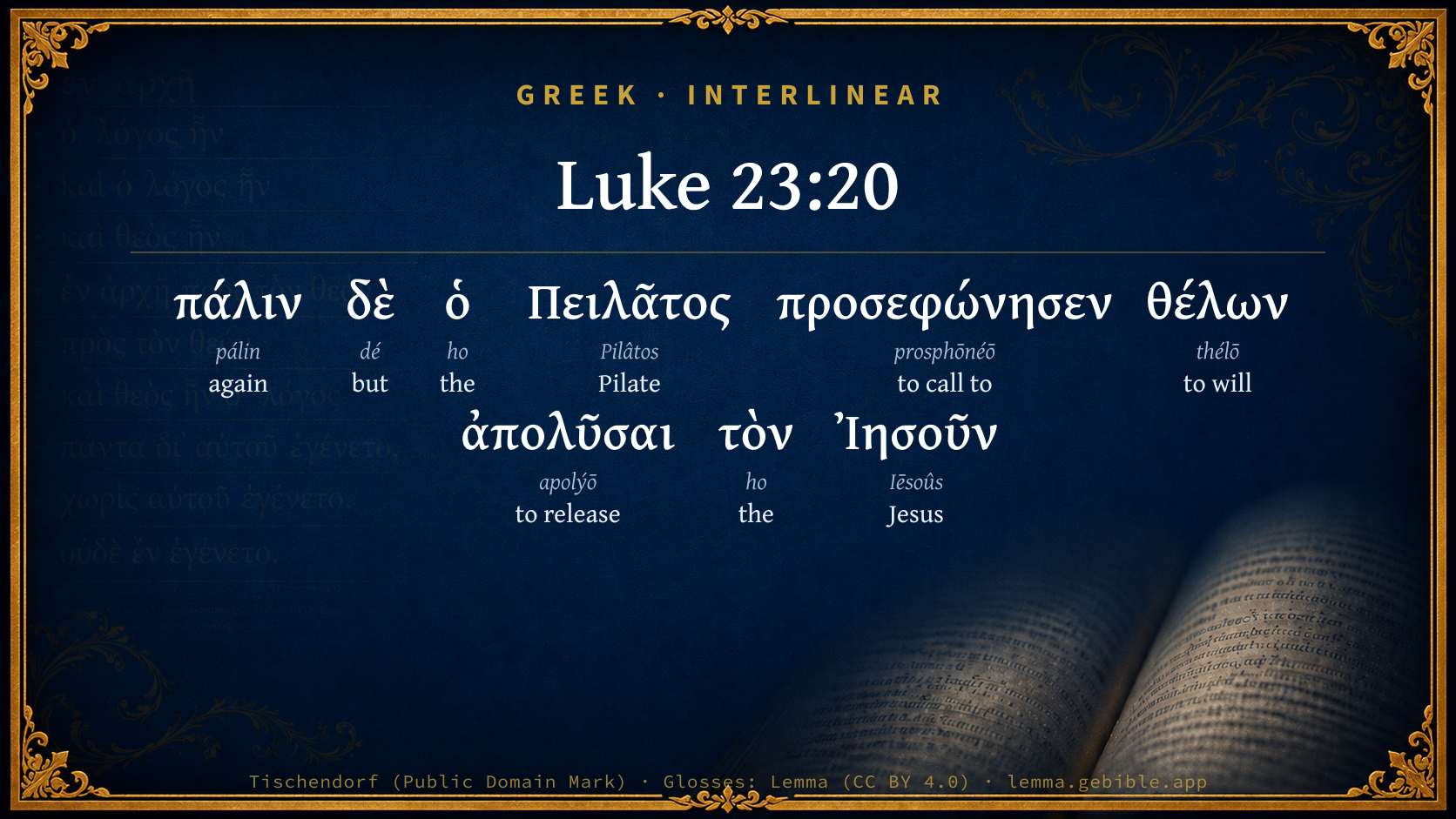
Greek (Tischendorf 8th ed.) Luke 23:20 appears in the Greek New Testament. The text above is from the Tischendorf 8th edition. Each word links to its Strong’s number and a concise gloss. Click any word for its full Thayer’s Greek Lexicon entry.
Download image
Cite this verse

Luke 23:20 (World English Bible). Public Domain. Lemma interlinear Bible study tool, https://lemma.gebible.app/v/luke/23/20.

Show BibTeX & RIS
BibTeX
RIS
English Translation
Then Pilate spoke to them again, wanting to release Jesus,
World English Bible · Public Domain
Download a study sheet

One document with this verse’s original text, its word-by-word gloss line, the meaning frame, cross-references with their text, attributed commentary, and full source and license credits — printable, and it pastes into notes with its structure intact.

This verse Autodidact and up

Study sheet (.html) Plain text (.txt)

A passage Seminary Student

Up to 50 verses in one chapter. A passage sheet keeps up to 6 commentary sources and 12 cross-references per verse, in the order this page ranks them, and says so on the sheet whenever that leaves anything out. Ask for a single verse and you get the Autodidact verse sheet above.

Everything on this page stays free to read, with no account — the sheet is a download of what is already on screen, not access to it.

Want to remove ads? Support Godless Engineer
Compare translations 3

The same verse in 3 English versions, stacked beneath the original-language interlinear above. Click any original word for its lexicon entry.

Each is an independent rendering of the whole verse — the interlinear is not word-aligned to these translations.

Highlighted words mark where these versions differ — a whole-verse word diff, not a word-by-word alignment.

  • World English Bible Public Domain
    Then Pilate spoke to them again, wanting to release Jesus,
  • King James Version Public Domain
    Pilate therefore, willing to release Jesus, spake again to them.
  • unfoldingWord Literal Text CC BY-SA 4.0
    Then Pilate again addressed them, desiring to release Jesus.

unfoldingWord Literal Text — © unfoldingWord, licensed CC BY-SA 4.0. Word-aligned USFM3 via Door43 (git.door43.org/unfoldingWord/en_ult).

Versions to compare (up to 4)

3 of 4 selected

Show all 19 translations

Every available English version of this verse, each an independent rendering of the whole verse.

  • World English Bible Public Domain
    Then Pilate spoke to them again, wanting to release Jesus,
  • Berean Standard Bible Public Domain
    Wanting to release Jesus, Pilate addressed them again,
  • Majority Standard Bible Public Domain
    Wanting to release Jesus, Pilate addressed them again,
  • King James Version Public Domain
    Pilate therefore, willing to release Jesus, spake again to them.
  • American Standard Version (1901) Public Domain
    And Pilate spake unto them again, desiring to release Jesus;
  • Revised Version (1885) Public Domain
    And Pilate spake unto them again, desiring to release Jesus;
  • Geneva Bible (1599) Public Domain
    Then Pilate spake againe to them, willing to let Iesus loose.
  • Douay-Rheims (1899) Public Domain
    And Pilate again spoke to them, desiring to release Jesus.
  • Young's Literal Translation Public Domain
    Pilate again then -- wishing to release Jesus -- called to them,
  • Literal Standard Version CC BY-SA 4.0
    Pilate again then—wishing to release Jesus—called to them,
  • Unlocked Literal Bible CC BY-SA 4.0
    Pilate addressed them again, desiring to release Jesus.
  • unfoldingWord Literal Text CC BY-SA 4.0
    Then Pilate again addressed them, desiring to release Jesus.
  • Darby Bible Public Domain
    Pilate therefore, desirous to release Jesus, again addressed [them].
  • World Messianic Bible Public Domain
    Then Pilate spoke to them again, wanting to release Yeshua,
  • Webster's Bible Public Domain
    Pilate therefore, willing to release Jesus, spoke again to them.
  • Free Bible Version CC BY-SA 4.0
    Pilate wanted to release Jesus, so spoke to them again.
  • Bible in Basic English Public Domain
    And Pilate again said to them that it was his desire to let Jesus go free.
  • Text-Critical English NT CC BY 4.0
    Wishing to release Jesus, Pilate addressed them again,
  • Tyndale New Testament (1534) Public Domain
    Pylate spake agayne to them willynge to let Iesus lowse.

Literal Standard Version (2020), Covenant Press — licensed CC BY-SA 4.0. Text via the HelloAO Bible API (eBible.org). Unlocked Literal Bible (unfoldingWord) — licensed CC BY-SA 4.0. Text via the HelloAO Bible API (eBible.org). unfoldingWord Literal Text — © unfoldingWord, licensed CC BY-SA 4.0. Word-aligned USFM3 via Door43 (git.door43.org/unfoldingWord/en_ult). Free Bible Version, Dr. Jonathan Gallagher — licensed CC BY-SA 4.0. Text via the HelloAO Bible API (eBible.org).

Word by word

More ways to search: Search by grammar → Find every occurrence → Compare this word →

Practice this passage: Drill this verse → Learn its vocabulary →

About this verse

These counts appear in no published source. They are computed here, from the morphology-tagged text and Lemma’s own curated glosses. What Lemma adds →

9
words
8
distinct lemmas
Gospels
section

Notable vocabulary

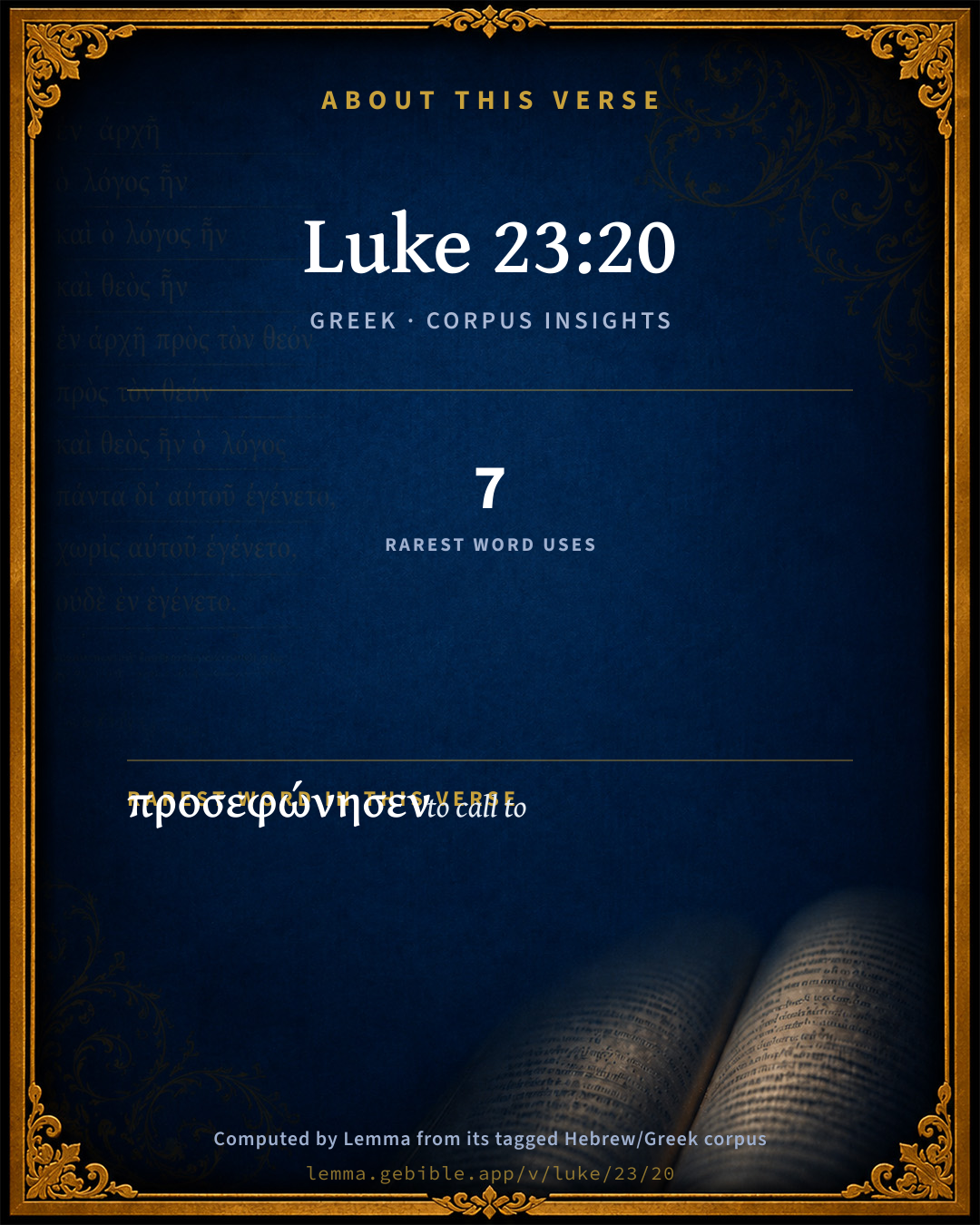
The rarest word here is προσεφώνησεν to call to G4377 — appearing just 7 times in the whole Greek New Testament.

Shared distinctive vocabulary

προσεφώνησεν to call to G4377 occurs in 7 verses of the Greek New Testament. Also found in:

Repetition

A word recurs within this verse:

Cross-references

4

Topical passages linked to Luke 23:20 in the Treasury of Scripture Knowledge — connected by theme and wording, ordered by reader-vote popularity; previews shown in the World English Bible.

  • Mark 15:15 Pilate, wishing to please the multitude, released Barabbas to them, and handed over Jesus, when he had flogged him, to be crucified.
  • Matthew 14:8–9 She, being prompted by her mother, said, "Give me here on a platter the head of John the Baptizer."
  • Matthew 27:19 While he was sitting on the judgment seat, his wife sent to him, saying, "Have nothing to do with that righteous man, for I have suffered many things this day in a dream because of him."
  • John 19:12 At this, Pilate was seeking to release him, but the Jews cried out, saying, "If you release this man, you aren't Caesar's friend! Everyone who makes himself a king speaks against Caesar!"

Cross-references courtesy of OpenBible.info (CC BY 4.0).

Commentary

Notes on Luke 23:20 from classic Christian and Jewish commentators (each source and its license shown beneath its notes). The classic Christian expositions comment on the surrounding passage and are grouped to its opening verse, so a note may address several verses; the Jewish commentaries on the Tanakh (Rashi and others) are per-verse, so they appear only where the commentator wrote on this verse.

Lemma curates 59 commentaries, every one of them public domain or Creative Commons licensed, each selected and text-cleaned for this edition rather than reprinted as found. About our sources →

Expositor's Greek Testament

ed. W. Robertson Nicoll

Luk 23:20 . πάλιν , again, a second time. Lk. carefully enumerates the friendly attempts of Pilate, hence τρίτον in Luk 23:22 . The first is in Luk 23:16 .

The Expositor's Greek Testament, edited by W. Robertson Nicoll (1897–1910) — public domain. Text from a community e-Sword module.

Godet's Commentaries

Frédéric Louis Godet

Vers. 20-25. This manoeuvre having failed, Pilate returns to the expedient on which he reckons most; he will try to satisfy the anger of the most infuriated, and to excite the pity of those who are yet capable of this feeling, by a beginning of punishment. The real contents of the declaration announced by the προσεφώνησε, he spake again to them, Luk 23:20, are not expressed till the end of Luk 23:22: “I will therefore chastise him, and let him go.” But Pilate is interrupted before having uttered his whole thought by the cries of the Jews, Luk 23:21; his answer, Luk 23:22, breathes indignation. By the τρίτον, for the third time, allusion is made to his two previous declarations, Luk 23:4 and Luk 23:14-15. Γάρ bears on the idea of crucifixion, Luk 23:21: “Crucify him? For he has done...what evil?” But this indignation of Pilate is only an example of cowardice. Why scourge Him whom he acknowledges to be innocent? This first weakness is appreciated and immediately turned to account by the Jews. It is here, in Luke’s account, that the scourging should be placed. John, who has left the most vivid recital of this scene, places it exactly at this moment. According to Matthew and Mark, the scourging did not take place till after the sentence was pronounced, agreeably to custom, and as the first stage of crucifixion.

Ver. 23 summarizes a whole series of negotiations, the various phases of which John alone has preserved to us (Luk 19:1-12). Jesus, covered with blood, appears before the people. But the rulers and their partisans succeed in extinguishing the voice of pity in the multitude. Pilate, who reckoned on the effect of the spectacle, is shocked at this excess of cruelty. He authorizes them to carry out the crucifixion themselves at their own risk; they decline. They understand that it is he who serves as their executioner. To gain him there remain yet two ways. All at once changing their tactics, they demand the death of Jesus as a blasphemer: “He made himself the Son of God.” But on hearing this accusation, Pilate shows himself still less disposed to condemn Jesus, whose person had already inspired him with a mysterious fear. The Jews then determine to employ the weapon which they had kept to the last, probably as the most ignoble in their own eyes, that of personal intimidation. They threaten him with an accusation before the emperor, as having taken a rebel under his protection. Pilate knows how ready Tiberius will be to welcome such a charge. On hearing this threat, he understands at once, that if he wishes to save his place and life, he has no alternative but to yield. It is at this point that the four narratives again unite. Pilate for the second time ascends the judgment-seat, which was set up in a raised place in the open square situated before the praetorium. He washes his hands (Matthew), and again declining all participation in the judicial murder which is about to be committed, he delivers Jesus over to His enemies.

Ver. 25 of Luke is the only passage of this narrative where the feelings of the historian break through the objectivity of the narrative. The details repeated here (Luk 23:19) regarding the character of Barabbas bring into prominence all that is odious in the choice of Israel; and the words, he delivered Him to their will, all the cowardice of the judge who thus declines to act as the protector of innocence. Matthew and Mark here narrate the abuse which Jesus had to suffer from the Roman soldiers; it is the scene related Joh 19:1-3, and which should be placed before the scourging. The scene of it, according to Mark, was the inner court of the praetorium, which agrees with John. It was less the mockery of Jesus Himself than of the Jewish Messiah in His person.

3. The Crucifixion of Jesus: Luk 23:26-46.

John indicates, as the time when Pilate pronounced sentence, the sixth hour; Mark, as the hour at which Jesus was crucified, the third. According to the ordinary mode of reckoning time among the ancients (starting from six o’clock in the morning), it would be mid-day with the first, nine o’clock in the morning with the second. The contradiction seems flagrant: Jesus condemned at noon, according to John, and crucified at nine. according to Mark! Langen brings new arguments to support an attempt at harmony which has often been made—that John reckoned the hours as we do, that is to say, starting from midnight. The sixth hour would then be with him six o’clock in the morning, which would harmonize a little better with Mark’s date, the interval between six and nine o’clock being employed in preparations for the crucifixion.

But is it probable that John adopted a mode of reckoning different from that which was generally in use, and that without in the least apprizing his readers? We incline rather to hold with Lange, in his Life of Jesus, that Mark dated the beginning of the punishment from the time of the scourging, which legally formed its first act. In this Mark followed an opinion which naturally arose from the connection in which scourging was ordinarily practised. It is John who, by his more exact knowledge of the whole course of the trial, has placed this part of the punishment of Jesus at its true time and in its true light. The scourging, in Pilate’s view, was not the beginning of the crucifixion, but rather a means of preventing it. Thus it is that Mark has ante-dated the crucifixion by the whole interval which divided the scene of the Ecce homo from the pronouncing of the sentence and its execution.

It is absolutely impossible to suppose that the whole long and complicated negotiation between the Jews and Pilate took place between the last sitting of the Sanhedrim (which was held as soon as it was day, Luk 22:66) and six o’clock in the morning. See my Comment. sur Jean, ii. pp. 606 and 607.

The punishment of crucifixion was in use among several ancient peoples (Persians, Assyrians, Egyptians, Indians, Seythians, Greeks). Among the Romans, it was used only for slaves (servile supplicium, Horace), and for the greatest criminals (assassins, brigands, rebels). It was abolished by Constantine. The scourging took place either before setting out, or on the way to the cross (Liv. 33:36). According to Plutarch, every criminal carried his own cross. There was borne before him or hung round his neck a white plate, on which his crime was indicated (titulus, σανίς, αἰτία). The punishment took place, as a rule, beyond inhabited houses, near a road, that the largest possible number of people might witness it. The Talmud of Jerusalem relates that before crucifixion there was offered to the prisoner a stupifying draught, which compassionate people, generally ladies of Jerusalem, prepared at their own cost. The cross consisted of two pieces, the one perpendicular (staticulum), the other horizontal (antenna). Nearly at the middle of the first was fixed a pin of wood or horn (πῆμα, sedile), on which the prisoner rested as on horseback. Otherwise the weight would have torn the hands, and left the body to fall. They began ordinarily by setting up and fixing the cross (Cic. Verr. 5:66; Jos. Bell. Jud. 7.6. 4); then by means of cords the body was raised to the height of the antenna, and the nails driven into the hands. The condemned person was rarely nailed to the cross while it was yet lying on the ground, to be afterwards raised.

The cross does not seem to have been very high. Langen thinks that it was twice the height of a man; that is the maximum; and it is probable that generally it was not so high. The rod of hyssop on which the sponge was held out to Jesus could not be more than two or three feet in length. As to the feet, Paulus, Lücke, Winer, and others have more or less positively denied that they were nailed. They appeal to Joh 20:25. But would it not have been singular pedantry on the part of Thomas to speak here of the holes in the feet? He enumerates the wounds, which were immediately within reach of his hand. It is the same when Jesus speaks to Thomas, Luk 23:27. Then they allege the fact that the Empress Helena, after having discovered the true cross, sent to her son the nails which had been fastened in the hands of Christ. But it is not said that she sent to him all that she had found. The contrary rather appears from the tenor of the narrative (see Meyer, ad Mat 27:35). Hug, Meyer, Langen have proved beyond doubt, by a series of quotations from Xenophon, Plautus, Lucian, Justin, Tertullian, etc., that the custom was to nail the feet also; and Luk 24:39 (written without the least reference to the prophecy of Psalms 22) admits of no doubt that this practice was followed in the case of Jesus. For how could His feet have served as a proof of His identity (ὅτι αὐτὸς ἐγώ) otherwise than by the wounds the mark of which they bore?

The small board (suppedaneum), on which the representations of the crucifixion usually make the feet of our lord rest, is a later invention, rendered in a way necessary by the suppression of the sedile in those pictures. The feet were nailed either the one above the other by means of a single nail, which would explain the epithet τρίσηλος, three-nailed, given to the cross by Nonnus, in his versified paraphrase of John’s Gospel (4th century), or the one beside the other, which generally demanded four nails in all, as Plautus seems to say, but might also be executed with three, if we suppose the use of a nail in the form of a horse-shoe having two points. Was the sole of the foot supported on the wood by means of a very full bend of the knee, or was the leg in its whole length laid to the cross, so that the feet preserved their natural position? Such details probably varied at the caprice of the executioner.

The crucified usually lived twelve hours, sometimes even till the second or third day. The fever which soon set in produced a burning thirst. The increasing inflammation of the wounds in the back, hands, and feet; the congestion of the blood in the head, lungs, and heart; the swelling of every vein, an indescribable oppression, racking pains in the head; the stiffness of the limbs, caused by the unnatural position of the body;—these all united to make the punishment, in the language of Cicero (in Verr. 5:64), crudelissimum teterrimumque supplicium.

From the beginning, Jesus had foreseen that such would be the end of His life. He had announced it to Nicodemus (Joh 3:14), to the Jews (Luk 12:32), and once and again to His disciples. It was the foresight of this which had caused His agony in Gethsemane. No kind of death was so fitted to strike the imagination. For this very reason, no other was so well fitted to realize the end which God proposed in the death of Christ. The object was, as St. Paul says (Romans 3), to give to the sinful world a complete demonstration (ἔνδειξις) of the righteousness of God (Luk 23:25-26). By its cruelty, a death of this sort corresponds to the odiousness of sin; by its duration, it leaves the crucified one time to recognise fully the right of God; lastly, its dramatic character produces an impression, never to be effaced, on the conscience of the spectator.

Of all known punishments, it was the cross which must be that of the Lamb of God.

Frédéric Louis Godet — Commentaries on Luke, John, Romans, and 1 Corinthians — English translation (T&T Clark, Edinburgh, 1870s–1890s) — public domain. Text from a community e-Sword module.

The Cambridge Bible for Schools and Colleges

gen. ed. J. J. S. Perowne

20. spake again to them] Rather, called unto them again. He did not make them a second speech, but simply called out again his question as to their choice..

The Cambridge Bible for Schools and Colleges (gen. ed. J. J. S. Perowne; Cambridge University Press, 1878–1918) — public domain. Text from a community e-Sword module.

John Gill's Exposition

Pilate therefore willing to release Jesus,.... Being more and more convinced of his innocence; and still seeing more clearly into the wickedness, malice, and envy of his accusers; and having received a message from his wife:

spake again to them; putting it again to them, which he should release; asking them what he should do with Jesus; plainly signifying his mind, that he thought him innocent, and that it would be right to let him go. The Ethiopic version represents him, saying, "will ye that I save for you, or release to you the Lord Jesus?"

John Gill's Exposition of the Whole Bible (1746–1763) — public domain (CC PDM 1.0). Text via the HelloAO Bible API.

Trapp's Complete Commentary

John Trapp

20 Pilate therefore, willing to release Jesus, spake again to them.

Ver. 20. Pilate therefore willing, &c.] I read of one that did verily think that Pilate was an honest man, because he was so unwilling to crucify Christ. But this arose only from the restraint of natural conscience against so foul a fact.

John Trapp, A Commentary or Exposition upon All the Books of the Old and New Testament (1647–1656) — public domain. Text from a community e-Sword module.

Kretzmann's Popular Commentary

Paul E. Kretzmann

The sentence of Pilate:

v. 20. Pilate, therefore, willing to release Jesus, spake again to them.

v. 21. But they cried, saying, Crucify Him, crucify Him!

v. 22. And he said unto them the third time, Why? What evil hath He done? I have found no cause of death in Him; I will therefore chastise Him and let Him go.

v. 23. And they were instant with loud voices, requiring that He might be crucified. And the voices of them and of the chief priests prevailed.

v. 24. And Pilate gave sentence that it should be as they required.

v. 25. And he released unto them him that for sedition and murder was cast into prison, whom they had desired; but he delivered Jesus to their will.

When the first wrong step has been taken, a person is liable to be carried forward by his own impetus. Pilate was no longer in control of the situation. And he was not dealing with rational human beings, but with an infuriated mob, which now might have been quelled by only one method: ruthless violence. As well try to stop a tornado by raising your hand as to reason with a bloodthirsty mob. Pilate called to them, trying to make himself heard above the turmoil, for he wanted to release Jesus. But they shouted back, with ever-increasing strength, demanding that Jesus be crucified. For the third time Pilate tried to urge the fact of Christ’s innocence, that he had found no reason to put Him to death, and that he would therefore chastise Him and release Him. But there was no staying the current. They were instant, urgent, with the full volume of their combined voices. Their shouts rolled and reverberated along the narrow streets until they broke into frightened echoes against the Temple walls, demanding that Christ be crucified. And the longer the governor hesitated, the more confidently their cries rang out, and the threatening tone grew from one minute to the next. At last weak Pilate, outgeneraled by the high priests, succumbed; he decided, he gave judgment according to the will of the people; for of right and justice not a vestige remained. Note the contrast brought out by Luke: Him who on account of rebellion and murder had been thrown into prison, the obstinate, wicked criminal, he released because they wanted it; but Jesus, the Savior of the world, who was even then suffering for the sins of the howling mob, he delivered to their will; he decided that He must die by crucifixion. Pilate is a type of the unjust judges of this world that do not follow righteousness and justice in the fulfillment of their duties, but far too often are tools of the enemies of the Church. And, like Pilate, many children of the world hesitate between truth and falsehood, between friendship and enmity for Christ, until in the crisis they are overcome by the evil, and openly persecute the cause of Christ.

Paul E. Kretzmann, Popular Commentary of the Bible (1921–1924) — public domain. Text from a community e-Sword module.

unfoldingWord translationNotes

Door43 World Missions Community

addressed them again

"spoke to them again" or "spoke again to the people in the crowd and to the religious rulers"

desiring to release Jesus

"because he wanted to set Jesus free"

He said to them a third time

"Pilate said to the crowd again, for the third time" (See: Ordinal Numbers)

what evil has this man done?

Pilate uses this question to cause the crowd to understand that Jesus is innocent. AT: "this man has not done anything wrong!" (See: Rhetorical Question)

I have found nothing deserving the death penalty in him

"He has done nothing for which he deserves to die"

after punishing him, I will release him

As in Luke 23:16, Pilate should have released Jesus without punishment because he was innocent. However, he offered to punish Jesus to appease the crowd.

I will release him

"I will set him free"

translationWords

Pilate

Jesus

crucify

evil

die

punish

unfoldingWord translationNotes — © Distant Shores Media and the Door43 World Missions Community, licensed CC BY-SA 4.0. Source: git.door43.org/Door43/en_tn.

Cambridge Greek Testament for Schools and Colleges

20. πάλιν … προσεφώνησεν. ‘Called unto them again.’ He did not make them a second speech, but repeated his question.

Cambridge Greek Testament for Schools and Colleges (Cambridge University Press, 1896; 21 vols, various authors incl. Carr, Maclear, Plummer, Farrar, Lumby, Moule, M. R. James, Simcox) — public domain. Text from a community e-Sword module.

International Critical Commentary

20. That we should read δέ (א A B D T, Latt. Bob. Sah.) and not οὖν (C Γ Δ L etc.) after πάλιν is certain. That αὐτοῖς is to be added after προσεφώνησεν (א B L T, Latt. Boh. Sah. Syx-Cur. Æth.) is also certain. But Lk. uses the verb absolutely, 13:12; Act 21:40. Contrast 7:32; Act 22:2.

International Critical Commentary — older volumes (1896–1929), various authors — public domain. Text from a community e-Sword module.

Vincent's Word Studies in the New Testament

Marvin R. Vincent

Spake [προσεφωνησεν] . Addressed. Compare Act 21:40; Act 22:2. Always in the New Testament in the sense of to accost, whether an individual or a crowd.

Marvin R. Vincent, Word Studies in the New Testament (1887–1900) — public domain. Text from a community e-Sword/MySword module.

Lesson kit

Teaching starters — assembled from the data on this page, not authored interpretation. Every prompt links to the verse data it draws on. Edit before teaching.

Luke, in the Gospels, opens this verse with 9 words (8 distinct Greek lemmas). Its most distinctive word is prosphōnéō (“to call to”). A historical commentator’s framing appears above. Read the whole chapter for the surrounding context.

Discussion questions

  1. What does “to call to” (prosphōnéō) contribute to the verse as a whole?
  2. Matthew 11:16 shares the word «to call to» with this verse. How do the two illuminate each other?
  3. “the” occurs 2× in this one verse. What is the effect of the repetition?
  4. These translations render this verse differently; the difference is in the English rendering, not the original. What questions does that raise?
  5. Reading how Expositor's Greek Testament and Godet's Commentaries read this verse, where do the two commentators agree and where do they part?

Things to notice

  • These translations choose different wording for 7 words in this verse.
  • “the” occurs 2× in this single verse.
  • 8 distinct Greek lemmas span 9 words in this verse.

Reading settings

Reading text

Shown beneath each verse's original-language words.

Old Testament
Old Testament edition

Read the OT as the Masoretic Hebrew (MT) or the Greek Septuagint (LXX).

English shown for the Greek Septuagint (in the Hebrew ↔ Greek comparison).

Comparing translations? Open the Compare panel on any verse page to stack up to four side by side.